In This Article
Step-by-step guidance to design, staff, fund, and measure voluntary travel training programs that enable safe, independent transit access.
Travel Training Programs: Planning Guide
I plan travel training around one result: helping riders reach the places they need to go safely. I start with rider goals, match staffing and costs to the support each trip requires, and check access at 30 and 90 days - not just when lessons end.
In this guide, I outline how to:
Define who the program serves and choose the right level of instruction.
Assign staff, prepare transit partners, and budget for training and follow-up.
Set up accessible referrals, consent, and private records.
Check routes, safety plans, and staff readiness before launch.
Measure completed trips, rider experience, costs, and barriers that need fixes beyond training.
My starting rule is simple: <u>participation stays voluntary</u>. Travel training cannot be required for ADA complementary paratransit eligibility. I treat rider choice and continued access as the measures that guide program decisions.
Did you know Community Transit offers free 1:1 travel training for everyone?
sbb-itb-8baf5f1
Plan Program Delivery, Staffing, and Costs
Once the scope is set, choose a delivery model that fits the riders, trips, and partners the program will serve. Account for the destinations, hours, and support riders need to reach work, school, health care, and core services.
Choose a Delivery Model and Training Process
Choose the lead operator based on accountability, capacity, rider access, and coordination needs. If partners share delivery, put the agreement in writing. Specify supervision, data ownership, referral handoffs, incident reporting, and who remains responsible after training ends.
| Delivery model | Accountability | Capacity | Coordination needed |
|---|---|---|---|
| Transit-agency-operated | Transit agency leads delivery | Strong route, fare, and operations knowledge | Build disability-service expertise and referral relationships |
| Human-service-agency-operated | Human-service agency leads delivery | Strong individualized support and rider relationships | Keep transit knowledge and operating contacts current |
| Joint program | Name one accountable lead | Combines transit and support expertise | Document shared duties, records access, and escalation procedures |
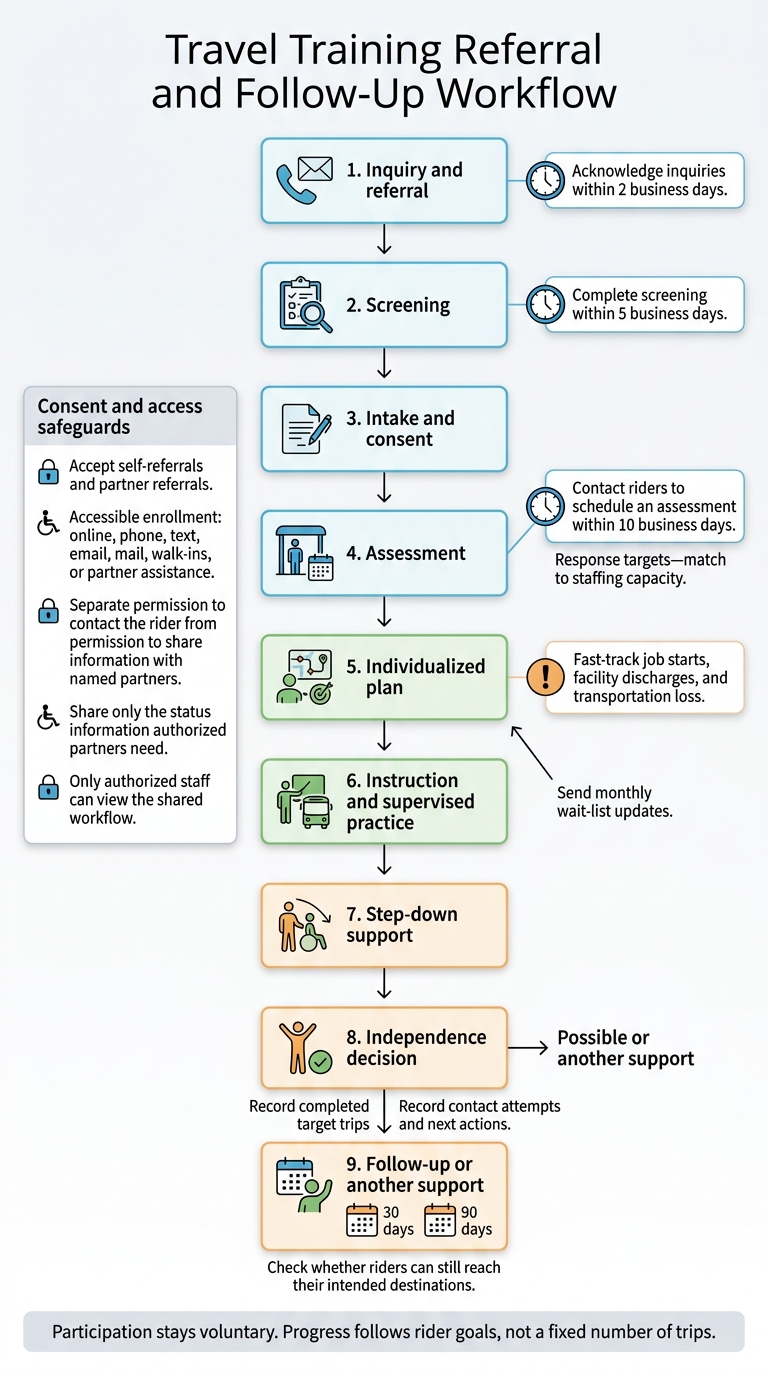
Map each step from referral through follow-up: screening, intake and consent, assessment, an individualized plan, instruction, supervised practice, step-down support, an independence decision, and follow-up. Use group sessions for shared basics and individual fieldwork for practice.
Instruction should cover trip planning, fares, boarding, transfers, accessible routes, stop recognition, mobility devices, communication, safety and emergencies, missed stops, severe weather, and service disruptions.
Measure progress against each rider’s goals - not a set number of trips. Document safe route choices, fare payment, responses to disruptions, and help-seeking. When a rider’s skills or travel conditions call for it, offer more instruction, a modified route, or continued assistance.
Assign Staff Roles and Prepare Transit Partners
Give each task one accountable owner, even when staff fill several roles.
| Task | Accountable owner | Responsible staff | Consulted / informed |
|---|---|---|---|
| Referrals and consent | Intake coordinator | Intake staff | Rider and referring partners, with consent |
| Assessment | Program manager | Instructor | Rider and support people they identify |
| Instruction | Program manager | Instructor | Transit liaison |
| Incident response | Program manager | Designated responder | Transit operations / authorized contacts |
| Records and scheduling | Program manager | Administrator | Intake and evaluation staff |
| Outcome review | Program manager | Evaluator | Instructors and transit liaison |
Name an after-hours contact and an escalation path for safety incidents, vehicle failures, harassment, medical emergencies, and service disruptions.
Estimate capacity as available instructor hours ÷ average hours needed per trainee. Include travel, preparation, documentation, cancellations, coordination, reassessment, and follow-up in the workload. Model group instruction separately, then update the assumptions after the first quarter.
Train instructors in disability awareness, trauma-informed communication, transit procedures, mobility-device access, emergency response, supervision in public settings, and documentation. Provide continuing education as conditions change. Orient operators, dispatchers, customer-service staff, and referral partners on privacy, respectful assistance, communication access, referral criteria, and emergency procedures.
Build a Budget and Check Funding Rules
Build the budget from the staffing model, then confirm which costs each funding source allows. Use local payroll rates, fare schedules, procurement quotes, and insurance allocations. Include benefits in personnel costs, and count staff travel time only once.
FTA mobility-management funds may cover travel training and trip planning. Sections 5307, 5310, and 5311 may also offer support, subject to agency rules.[1][3][4][6] Link cost tracking to access outcomes: trained riders, completed plans, and independent trips.
| Budget line | Timing; cost behavior | Owner | Estimate from |
|---|---|---|---|
| Personnel and program design | Startup and recurring; fixed and variable | Program manager | Loaded hourly rate × full workload |
| Staff development | Startup and recurring; fixed and variable | Training lead | Fees, paid hours, travel |
| Accessible materials | Startup and recurring; fixed and variable | Accessibility lead | Production quotes and expected use |
| Fares | Recurring; variable | Finance lead | Fare schedule × practice trips |
| Mileage and parking | Recurring; variable | Operations lead | Field miles × approved rate, plus parking |
| Scheduling and records systems | Startup and recurring; mainly fixed | Administrator | Setup, licenses, support |
| Insurance and risk management | Recurring; mainly fixed | Administration | Premium quotes or agency allocation |
| Outreach | Startup and recurring; fixed and variable | Intake coordinator | Staff hours, events, materials |
| Interpretation | Recurring; variable | Intake coordinator | Contract rate × expected hours |
| Evaluation | Startup and recurring; fixed and variable | Evaluator | Setup, analysis, reporting hours |
| Contingency | Budget reserve | Finance lead | Documented risks; verify grant allowability |
Review operations monthly, costs and outcomes quarterly, and funding results annually. Use the same total program cost to report cost per enrolled trainee, per completed plan, and per independent-travel outcome.
Define plan completion before reporting results. Attendance alone does not show completion or independence. Report group and individual instruction separately, allocate shared costs consistently, and present costs alongside access, safety, and continued-use results.
Use the checklist to confirm readiness before the first rider begins training.
Readiness checklist - complete before launch:
[ ] Name owners, decision rights, backup staff, and after-hours contacts.
[ ] Verify workload capacity, instructor preparation, partner agreements, and transit orientation.
[ ] Confirm funding, match documentation, insurance, fares, mileage, and accessible materials.
[ ] Test referral channels, consent forms, privacy controls, scheduling, and records.
[ ] Approve each rider’s safety plan, communication method, emergency procedure, and independence criteria.
[ ] Rehearse missed stops, severe weather, blocked elevators, medical events, and service disruptions.
[ ] Record a deadline and funding source for each requirement; delay launch if safety or rider-safeguard issues remain unresolved.
Recruit Riders and Organize Referrals
Travel Training Referral and Follow-Up Workflow
With scope and staffing set, connect community partners to the places riders need to reach: work, school, health care, and core services. Focus recruitment on riders whose trips support employment, education, health care, housing, and other basic access needs.
Build on trusted community relationships. Give partners a one-page guide that explains eligibility, destinations, program format, time commitment, fares, accommodations, and next steps for riders who aren't ready for independent travel. NADTC identifies community partnerships, staff referrals, and word-of-mouth as useful recruitment channels.[9][10]
Set Up Referral Partners and Ways to Enroll
Accept both self-referrals and partner referrals. Offer accessible enrollment online, by phone, text, email, or mail, and through walk-ins or partner assistance. Provide translated materials, interpreters, large print, screen-reader-compatible documents, and relay-compatible communication.
Give each partner one program contact and one referral method, along with response-time expectations and clear instructions for getting permission before sharing personal data. Use the destination map from program planning to guide outreach and referrals.
| Partner | Populations or destinations served | Referral duties | Information supplied, with consent | Follow-up role |
|---|---|---|---|---|
| Schools and transition programs | Students transitioning to work, college, or community travel | Identify students and obtain student or guardian permission | Travel goals, schedules, communication needs | Reinforce route practice and share calendar constraints |
| Vocational rehabilitation, workforce agencies, and employers | Job seekers and workers with disabilities | Refer riders who need transportation for employment | Work location, shifts, mobility and accommodation needs | Check job access and retention |
| Aging and disability organizations, Centers for Independent Living, and caregivers | Older adults and people with disabilities | Explain eligibility and help with enrollment | Travel goals, functional, communication, and support needs | Connect riders with independent-living services |
| Health and social-service agencies | Riders accessing care, food, benefits, or housing | Offer a direct referral | Trip urgency, language needs, contact preference | Check whether access barriers were addressed |
| Housing providers and faith organizations | Residents and community members | Share accessible materials and help with offline enrollment | Destinations, location, contact preferences | Help maintain contact, with permission |
| Transit agencies and mobility managers | Current or potential riders | Identify route, fare, or accessibility support needs | Trip goals and relevant route, stop, service, or paratransit information | Resolve transit barriers and update training materials |
Set Intake, Consent, and Follow-Up Procedures
Keep the first form short. Ask for the rider's name, ZIP Code, preferred contact details, travel goals, destinations, travel days, current barriers, mobility devices, language needs, and support contacts.
Separate permission to contact the rider from permission to share information with named partners. Explain what information will be shared, why, for how long, and how the rider can withdraw permission. Don't request unrelated medical records.
Set response targets that match staffing capacity: acknowledge inquiries within 2 business days, complete screening within 5 business days, and contact riders to schedule an assessment within 10 business days. Send monthly wait-list updates. Fast-track job starts, facility discharges, and transportation loss.
Record contact attempts and next actions. Explain when unsuccessful contact leads to closure, how riders can return, and how they can request a review.
Track each rider's status in a shared workflow that only authorized staff can view:
Inquiry and referral → screening → intake and consent → assessment → individualized plan → instruction and supervised practice → step-down support → independence decision → follow-up or another support
Record completed target trips. Follow up at 30 and 90 days to check whether riders can still reach their intended destinations.
Share only the status information authorized partners need; a referral does not permit broad sharing. Use secure transfer, role-based access, and record-retention rules. Before sharing records, health agencies must confirm requirements under HIPAA, state privacy laws, substance-use-disorder confidentiality rules, and other disclosure limits.[7][8]
Referral-specific checks:
[ ] Confirm that each partner uses the same referral form, contact path, and escalation contact.
[ ] Give riders a clear way to submit feedback or appeals, along with alternative referrals when needed.
Before the first rider begins training, test launch readiness against these intake and tracking rules.
Launch the Program and Measure Access
With intake and staffing in place, check that the program is ready to launch and set up outcome tracking.
Check Launch Readiness
Audit training routes for accessible stops, continuous sidewalks, crossings, lighting, signage, transfers, fare payment, shelter, weather exposure, and backup options.
Before instruction begins, record each rider’s travel modes, destinations, trip frequency, confidence, barriers, and independence goals. Start with a caseload staff can safely support. Expand only when instructor capacity, incident trends, follow-up, funding, and training quality support growth.
Track Results and Independent Travel
Define completion by the rider’s agreed trip and skills - not attendance alone. A trip can still count as successful when the rider uses a mobility aid, support person, or accommodation.
Track whether riders can reach the destinations the program was built to serve.
| Access goal | Indicators | Data source | Review frequency | Owner |
|---|---|---|---|---|
| Reach and referrals | Referral sources, enrollment rate, time to intake | Referral log | Monthly | Referral coordinator |
| Assessment | Completed assessments, rider goals, support needs, route risks | Assessment forms | Per participant | Travel trainer |
| Service delivery | Training hours, practice trips, accommodations used | Session records | Monthly | Program supervisor |
| Completion and retention | Completions, withdrawals and reasons, time to completion | Case records | Monthly | Case manager |
| Safety and quality | Incidents, near misses, disruptions, corrective actions | Incident reports and trainer notes | Immediate and monthly | Safety lead |
| Access outcomes | Independent trips to jobs, education, health care, and core services; trip frequency; continued transit use | 30- and 90-day follow-up | Quarterly summary | Evaluation lead |
| Rider experience | Confidence, perceived safety, usefulness, remaining barriers | Accessible survey or interview | After training and follow-up | Participant liaison |
| Program costs | Cost per enrolled trainee, completed plan, and independent-travel outcome | Financial and time records | Quarterly | Finance manager |
| Access barriers | Inaccessible stops, sidewalk gaps, unsafe crossings, service gaps, first- and last-mile barriers | Route audits, rider reports, partner data | Quarterly | Mobility manager |
Compare rider and partner feedback with staff observations during monthly program reviews and quarterly outcome reviews. Use the findings to adjust staffing, instruction, route coverage, referrals, and budgets.
Report missing follow-up data separately. Break down results by geography, language, or other relevant factors only when privacy and group sizes allow it. Suppress small groups that could identify riders.
Address Barriers Beyond Training
Use route audits and rider reports to flag recurring access problems for action beyond instruction. Persistent problems with stops, sidewalks, crossings, service, and first- and last-mile connections belong in mobility management - not extra lessons alone.[5]
Coordinated transportation planning should assess available services and unmet needs, identify strategies, prioritize feasible actions within available resources, and measure progress.[11][12]
Bring riders, transit operations and accessibility staff, community organizations, and local government together around a barrier log. Give each issue one owner, an action, a deadline, and a progress measure. That measure should include whether riders can use the improved connection. Keep responsibility for instruction, safeguarding, and accessibility with the operating agency.
Conclusion: Review Scope, Resources, and Access Results
After launch, review the written scope each year: riders served, service area, travel modes, and staff responsibilities. Participation must remain voluntary. Travel training cannot be a condition of ADA paratransit eligibility, and riders must be free to pause or stop without penalty.[2]
Check that staffing, safety procedures, referral agreements, and funding can keep the program running safely. The annual cost review should cover supervision, accommodations, coordination, and follow-up. Compare these supports with access results and rider feedback to decide what to continue, revise, or end.
Review the program again whenever services, funding, or community needs change. Close each review with three questions: Which riders are served? Which barrier is reduced? How is access measured?
FAQs
How should we prioritize riders when demand exceeds capacity?
Use a transparent, evidence-based framework to balance equity, access, and operating limits. Equity assessment tools and demographic mapping can help identify riders who depend most on transit, including residents in underserved areas, seniors, and people with disabilities.
Track commute times and access to essential services to set priorities that reflect community goals and direct limited resources to those who need them most.
How can we estimate costs before a pilot?
Start with feasibility studies and scenario modeling to test tradeoffs among coverage, frequency, and ridership. Define the use case and pilot scope, then agree on a shared budget. Include protected implementation time and clarify who will cover pilot losses or testing costs.
Compare costs and benefits to assess whether the project can sustain itself over time. Show stakeholders it’s shovel-ready by spelling out the work required, expected benefits, and funding options.
How can we measure access gains beyond ridership?
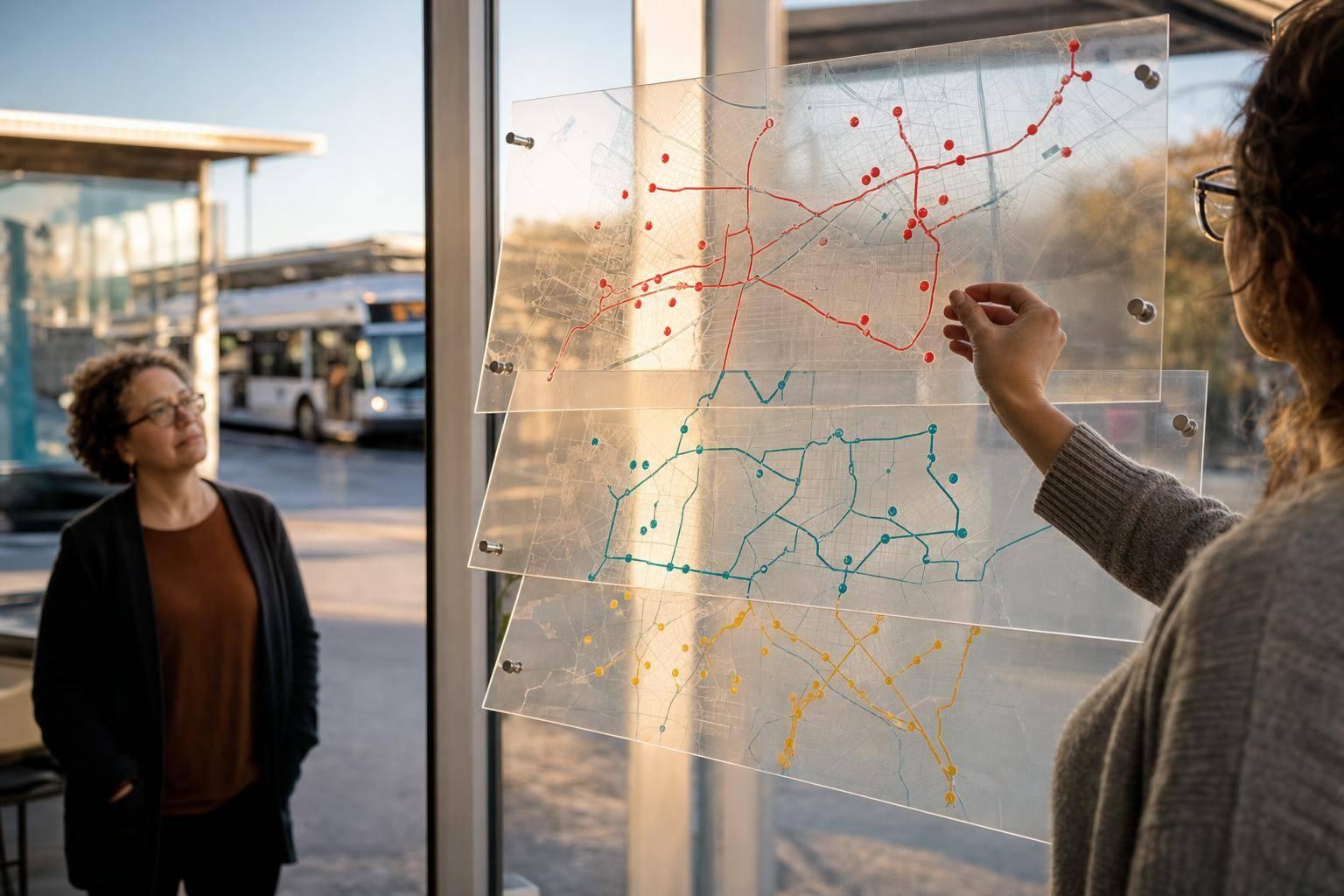
Measure how well transit connects people to jobs, healthcare, and schools. Map transit networks alongside demographic data to spot gaps in service and unsafe infrastructure. Track commute times by income, the number of households within a set distance of frequent transit, and accessible pedestrian crossings across neighborhoods.
Pair these measures with community feedback to assess whether investments improve daily life and give people more equal access.


FAQ