Feb 27, 2026
Top Revenue Streams in Circular PaaS Systems
Sustainability Strategy
In This Article
Explore renting, leasing, subscription, and pay-per-use in Circular PaaS, and how each balances revenue predictability, asset utilization, scalability, and circular benefits.
Top Revenue Streams in Circular PaaS Systems
Product-as-a-Service (PaaS) redefines how businesses rethink profit by shifting from selling products to offering them as services. This approach retains provider ownership, enabling better lifecycle management and resource efficiency. Key revenue models include:
Renting: Short-term, demand-driven access to products. High asset utilization but variable revenue.
Leasing: Long-term agreements with steady payments. Simplifies financial planning but limits asset sharing.
Subscription: Ongoing access with regular payments. Predictable income but moderate asset usage.
Pay-Per-Use: Charges based on actual usage. Promotes high efficiency but requires significant infrastructure.
Each model aligns differently with financial goals, customer needs, and lifecycle management, offering varied advantages for businesses pursuing circular strategies.
Product-as-a-Service (PaaS) Business Model Explained 🔄💰
1. Renting Revenue Model
Renting serves as a key pillar of circular PaaS, combining revenue generation with efficient asset management. Under this model, customers pay to use a product for a defined, short-term period - ranging from hours to weeks - while the provider retains ownership and handles maintenance, repairs, and logistics. This setup is particularly effective for items that are only needed occasionally, such as power tools, event gear, or specialized machinery [3].
Revenue Predictability
Renting delivers immediate income with each transaction, but the revenue stream can be less stable compared to subscription models. Subscriptions offer steady, recurring payments without a fixed end date, while rental income fluctuates based on customer usage and rental frequency. To manage these variations, providers rely on data analytics to fine-tune inventory levels and anticipate seasonal demand [3]. This dynamic approach helps providers balance the unpredictability of rental revenue while ensuring asset availability.
Asset Utilization
One of the standout advantages of renting is its ability to maximize asset usage. By allowing multiple customers to use the same product over its lifespan, renting spreads the cost and utility of an asset across a broader user base. As KPMG highlights, "A PaaS model can increase asset utilization by renting, leasing, or providing access to a fixed asset to numerous customers over its lifetime, rather than selling it to one customer who may underuse it" [3]. This sequential use not only enhances efficiency but also reduces unit costs and extends the life of the product [3].
Circular Economy Benefits
Renting aligns seamlessly with the principles of a circular economy. Products are returned to the provider after each use, enabling consistent maintenance and lifecycle management. Since providers are responsible for the full lifecycle costs, they are motivated to design products that are durable, easy to repair, and simple to disassemble. This approach minimizes waste and reduces the demand for raw materials, reinforcing a more sustainable consumption model [1][5].
2. Leasing Revenue Model
Leasing provides customers with extended access to products - often spanning months or years - while allowing providers to retain ownership and oversee the entire product lifecycle. Under this model, customers pay a fixed periodic fee, typically on a monthly or quarterly basis, for uninterrupted use of the product. Meanwhile, the provider manages maintenance, upgrades, and eventual decommissioning. This setup is especially effective for high-value assets like MRI machines in healthcare, tractors in agriculture, and heavy construction machinery. Building on the flexibility of renting, leasing adds a layer of commitment and long-term asset value.
Revenue Predictability
Leasing ensures a steady flow of recurring revenue through consistent periodic payments. These fees cover all aspects of the product lifecycle, including procurement, maintenance, and eventual decommissioning, making financial planning simpler for both providers and customers. Olivier Bussenot, Vice President for Sales Operations and Enablement at DigitalRoute, highlights the shift in business mindset required for this model:
"Manufacturers need to shift from a unit price mindset to measuring the lifetime value of equipment. Unlike one-off sales, transitioning to a model with outcome-based pricing offers the potential for predictable revenue streams and in parallel, a more attractive business model" [2].
These long-term agreements foster stronger relationships, often leading to lease renewals or expanded service arrangements.
Asset Utilization
The success of leasing lies in maximizing the value of an asset over its entire lifecycle rather than relying on a single sale. Providers increasingly use IoT sensors and data analytics to monitor equipment performance, anticipate maintenance needs, and optimize utilization. This approach not only reduces operational costs but also improves profit margins. A notable example is Desso, a supplier of commercial carpets, which leases its products while ensuring that 100% of the materials are recycled into new carpet tiles at the end of their lifecycle [5]. Retaining ownership also motivates providers to design products that are durable, easy to refurbish, and capable of maintaining high residual value across multiple leasing cycles.
Circular Economy Benefits
Leasing fosters a continuous connection between the provider and the asset, enabling controlled maintenance, precise usage tracking, and efficient recycling or refurbishing. Neil Pein, CEO of BNP Paribas Leasing Solutions, emphasizes the broader impact of this approach:
"The Circular Economy offers a transformative alternative to the traditional linear model by maximising asset value and minimising waste" [7].
3. Subscription Revenue Model
Subscription models provide customers with easy, ongoing access to products through regular flat-rate payments. Unlike renting or leasing, these models focus on long-term service relationships, where the provider handles everything - from maintenance to eventual recycling. This setup works especially well for items like consumer electronics, household appliances, and modular products, where convenience often outweighs the desire for ownership. For example, Fairphone offers subscription plans for its modular, repairable smartphones, enabling customers to upgrade specific components instead of replacing entire devices [8].
Revenue Predictability
Subscriptions transform unpredictable, one-time sales into consistent, recurring income streams that span the entire product lifecycle. This stability allows companies to forecast revenue more accurately, while customers enjoy the simplicity of fixed monthly costs. Since providers retain ownership of the products and collect ongoing payments, they have a strong financial incentive to prioritize durability and repairability, avoiding the cost of producing replacements. Stéphane Dierick, Director of Cloud Projects at Zuora, highlights the strategic importance of this model:
"Product-as-a-Service is a pillar of the circular economy, but its potential remains largely untapped in many industries. As regulatory pressures increase, more businesses will turn to circular and PaaS models to stay competitive and compliant" [2].
This reliable income stream also supports better asset management, which paves the way for operational growth and efficiency.
Asset Utilization
The subscription model optimizes how products generate revenue by ensuring they serve multiple customers throughout their full technical lifespan. Research indicates that subscription systems improve asset recovery and component reuse compared to traditional sales models [1]. Providers maintain control over their products, allowing them to refurbish and remanufacture items between customer contracts. This efficient asset recovery process enables businesses to expand their market reach while reducing waste.
Scalability
By eliminating the need for high upfront costs, subscriptions make it easier for customers to access premium products. This affordability helps providers grow their customer base more quickly. Additionally, the model fosters stronger relationships and continuous feedback, which drive product improvements. By lowering barriers to entry and building loyalty, subscriptions create the scale necessary to support reverse logistics and remanufacturing operations, crucial for circular systems.
Circular Economy Benefits
Subscription-based models align business goals with environmental responsibility. Since providers handle all maintenance, repair, and end-of-life processes, they are incentivized to design products that last longer and support multiple use cycles. This ensures products are returned for recycling or component harvesting, keeping valuable materials in use. By shifting the focus from "take-make-dispose" to access-based consumption, businesses prioritize keeping products functional for as long as possible, rather than pushing replacements. This approach supports predictable revenue and efficient asset use, essential for sustaining circular Product-as-a-Service systems.
4. Pay-Per-Use Revenue Model
The pay-per-use model charges customers based on actual usage - whether it's hours of operation, miles driven, or pages printed - tying revenue directly to measurable performance metrics. This model is particularly suited for assets that are idle much of the time, such as industrial equipment, specialized vehicles, or power tools. A 2025 Joint Research Centre assessment of a PaaS model for handheld vacuum cleaners in the EU revealed impressive results: a 100% collection rate and a 90% reuse rate of components, compared to just 41% and 0%, respectively, under traditional sales models [1].
Revenue Predictability
For providers, this model creates a steady, lifecycle-based revenue stream instead of relying on one-time sales. However, income can vary with customer usage, which is not always predictable. Additionally, service costs can be uncertain due to equipment breakdowns or the logistical challenges of serving dispersed users [6]. On the customer side, pay-per-use offers clear cost management, as expenses are tied to actual usage, allowing for better budgeting and control [4]. This performance-driven revenue model also encourages more efficient asset use.
Asset Utilization
Pay-per-use models excel at maximizing asset value by enabling resource sharing among multiple users. Since providers retain ownership and bear lifecycle costs, they are motivated to create products that are durable, reliable, and easy to maintain. Johan Vogt Duberg from Linköping University highlights this dynamic:
"PaaS economically incentivises the manufacturer to use the product with its fuller technical lifespan, typically via multiple contracts with end users" [6].
With tools like Digital Product Passports and IoT sensors, providers can monitor usage in real-time, optimize maintenance schedules, and extend the functional life of their products. This focus on durability and efficiency directly enhances profitability by reducing maintenance costs and increasing reliability.
Scalability
Scaling a pay-per-use model requires substantial initial investment in infrastructure, including systems for repair and remanufacturing. Technologies like IoT sensors and Digital Product Passports make it possible to track usage data across a broad customer base, enabling performance-based billing on a larger scale [4]. For customers, this approach eliminates the need to list high-value equipment as liabilities on their balance sheets, offering financial flexibility.
Circular Economy Benefits
This model aligns financial incentives with environmental accountability by making providers responsible for lifecycle costs. This encourages eco-friendly design focused on durability and ease of disassembly, reducing the use of raw materials, energy, and waste [5]. The JRC study found that PaaS reduced the need for new materials by 50% for motors and printed wiring boards, and by 75% for aluminum and copper components [1]. In contrast, traditional sales models often see nearly all motor materials ending up in landfills. By emphasizing long-term functionality over volume sales, pay-per-use ensures materials are recycled and reused rather than discarded. This approach not only supports environmental goals but also reinforces the economic viability of keeping products in circulation longer.
Comparing Revenue Streams: Advantages and Disadvantages
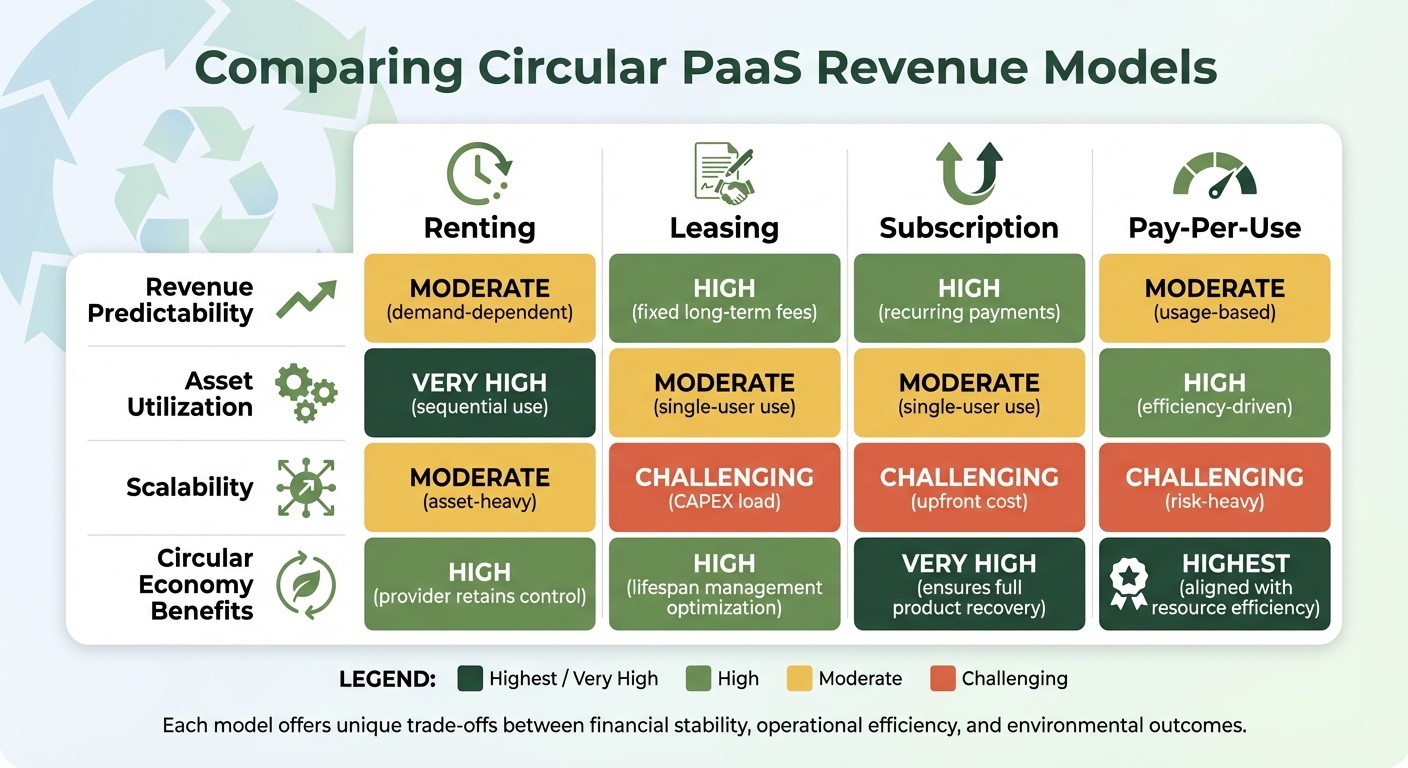
Circular PaaS Revenue Models Comparison: Renting vs Leasing vs Subscription vs Pay-Per-Use
Each circular PaaS revenue model brings its own mix of benefits and challenges when it comes to income generation, asset management, and environmental considerations. Let’s break down the key aspects of these models.
Renting achieves exceptional asset utilization by allowing multiple customers to use the same asset sequentially. However, its revenue predictability is only moderate, as it relies heavily on fluctuating demand cycles. On the other hand, leasing offers stable, predictable income through fixed long-term contracts but sees only moderate asset utilization since each asset is tied to a single customer for the duration of the lease.
Subscription models are similar to leasing in that they guarantee recurring revenue through periodic payments. However, like leasing, they also see moderate asset utilization, as assets are typically dedicated to individual customers. Stéphane Dierick, Director of Cloud Projects at Zuora, highlights the potential of these models:
"Product-as-a-Service is a pillar of the circular economy, but its potential remains largely untapped in many industries" [2].
Pay-per-use strikes a balance, offering moderate revenue predictability based on usage volume while promoting high asset utilization. This model incentivizes providers to maximize uptime and operational efficiency.
From an environmental perspective, pay-per-use stands out. Since providers are responsible for lifecycle costs, they have a strong financial incentive to design products that are durable, easy to maintain, and recyclable. This alignment of profitability with sustainability goals makes pay-per-use particularly appealing in the context of resource efficiency.
Scalability, however, presents challenges across all four models. Providers must keep assets on their balance sheets, requiring significant upfront investment compared to traditional sales. Renting has a slight edge in scalability, as assets can be shared among many short-term users. Leasing and subscription models face tighter constraints due to their capital-intensive nature, while pay-per-use models must manage heightened operational and technical risks, which can be a barrier for smaller companies.
Here’s a snapshot of these models and how they perform across key metrics:
Revenue Model | Revenue Predictability | Asset Utilization | Scalability | Circular Benefits |
|---|---|---|---|---|
Renting | Moderate (demand-dependent) | Very High (sequential use) | Moderate (asset-heavy) | High (provider retains control) |
Leasing | High (fixed long-term fees) | Moderate (single-user use) | Challenging (CAPEX load) | High (lifespan management optimization) |
Subscription | High (recurring payments) | Moderate (single-user use) | Challenging (upfront cost) | Very High (ensures full product recovery) |
Pay-Per-Use | Moderate (usage-based) | High (efficiency-driven) | Challenging (risk-heavy) | Highest (aligned with resource efficiency) |
These comparisons highlight the trade-offs between financial stability, operational efficiency, and environmental outcomes, providing a clearer picture of how each model serves different business and sustainability goals.
Conclusion
Examining the different revenue streams reveals that each option comes with its own set of trade-offs. Selecting the most suitable revenue stream for a circular PaaS system depends on how well it aligns with your business model, the product's characteristics, customer demands, and environmental objectives. For instance, pay-per-use models stand out for their strong environmental advantages. By managing lifecycle costs, providers have a financial incentive to design products that prioritize durability, maintenance, and reuse. Rolls Royce exemplifies this approach with its "Power by the Hour" program. Under this model, customers pay based on engine usage time, while Rolls Royce retains ownership and leverages sensors for predictive maintenance, maximizing the engine's lifecycle value [5].
For companies seeking predictable revenue, leasing and subscription models provide steady income through fixed, recurring payments. A notable example is Desso (now part of Tarkett), which leases carpets to commercial clients. By retaining ownership, the company ensures 100% of the material is recycled into new leased carpets, creating a circular lifecycle [5]. On the other hand, renting models shine when the goal is to optimize asset utilization. These models allow multiple customers to sequentially use the same product, significantly reducing the need for raw materials.
To develop effective circular PaaS strategies, businesses should begin by employing lifecycle costing tools to simulate various scenarios. This approach helps identify revenue streams that balance profitability for providers with cost savings for users [6]. Organizations can also seek expert support from Council Fire, which specializes in turning sustainability goals into actionable revenue models. By integrating systems thinking with data-driven insights, Council Fire assists businesses in crafting circular PaaS strategies that achieve tangible outcomes in areas like climate resilience, circular supply chains, and long-term value generation.
FAQs
How do I choose the best PaaS revenue model for my product?
To determine the most suitable PaaS (Platform as a Service) revenue model, start by focusing on your customers' preferences and usage patterns. Options like subscription plans, pay-per-use, or even leasing can cater to different needs. At the same time, factor in your broader objectives, such as encouraging reuse or optimizing product utilization, which align with circular economy principles.
Evaluate the financial feasibility of your chosen model by examining lifecycle costs and the potential for steady, recurring revenue. Leveraging digital tools, such as traceability solutions, can help implement models like pay-per-use by providing accurate usage data. Finally, ensure your approach resonates with current market trends and draws inspiration from successful industry examples to position your business for long-term growth.
What data and tech do I need for pay-per-use billing?
To set up pay-per-use billing, it's essential to gather and evaluate usage data, such as energy consumption or API call volume. Utilize digital tools like IoT sensors, data management systems, and billing platforms to precisely track usage and ensure accurate customer billing based on their consumption.
How do circular PaaS models affect cash flow and upfront costs?
Circular Product-as-a-Service (PaaS) models transform the traditional approach to financial transactions by replacing one-time sales with recurring revenue streams. Instead of paying a large upfront cost, customers pay based on usage or through subscriptions, which eases their financial burden. For providers, this shift creates a more predictable and steady cash flow.
However, adopting this model isn't without challenges. It demands upfront investments in crafting durable product designs, building advanced digital infrastructure, and establishing new types of contracts. These initial expenses, though significant, are balanced out over time. The extended lifespan of products, better resource efficiency, and minimized waste contribute to long-term financial benefits, ensuring the model's viability in the long run.
Related Blog Posts
Latest Articles
©2025



FAQ
01
What does it really mean to “redefine profit”?
02
What makes Council Fire different?
03
Who does Council Fire you work with?
04
What does working with Council Fire actually look like?
05
How does Council Fire help organizations turn big goals into action?
06
How does Council Fire define and measure success?
Feb 27, 2026
Top Revenue Streams in Circular PaaS Systems
Sustainability Strategy
In This Article
Explore renting, leasing, subscription, and pay-per-use in Circular PaaS, and how each balances revenue predictability, asset utilization, scalability, and circular benefits.
Top Revenue Streams in Circular PaaS Systems
Product-as-a-Service (PaaS) redefines how businesses rethink profit by shifting from selling products to offering them as services. This approach retains provider ownership, enabling better lifecycle management and resource efficiency. Key revenue models include:
Renting: Short-term, demand-driven access to products. High asset utilization but variable revenue.
Leasing: Long-term agreements with steady payments. Simplifies financial planning but limits asset sharing.
Subscription: Ongoing access with regular payments. Predictable income but moderate asset usage.
Pay-Per-Use: Charges based on actual usage. Promotes high efficiency but requires significant infrastructure.
Each model aligns differently with financial goals, customer needs, and lifecycle management, offering varied advantages for businesses pursuing circular strategies.
Product-as-a-Service (PaaS) Business Model Explained 🔄💰
1. Renting Revenue Model
Renting serves as a key pillar of circular PaaS, combining revenue generation with efficient asset management. Under this model, customers pay to use a product for a defined, short-term period - ranging from hours to weeks - while the provider retains ownership and handles maintenance, repairs, and logistics. This setup is particularly effective for items that are only needed occasionally, such as power tools, event gear, or specialized machinery [3].
Revenue Predictability
Renting delivers immediate income with each transaction, but the revenue stream can be less stable compared to subscription models. Subscriptions offer steady, recurring payments without a fixed end date, while rental income fluctuates based on customer usage and rental frequency. To manage these variations, providers rely on data analytics to fine-tune inventory levels and anticipate seasonal demand [3]. This dynamic approach helps providers balance the unpredictability of rental revenue while ensuring asset availability.
Asset Utilization
One of the standout advantages of renting is its ability to maximize asset usage. By allowing multiple customers to use the same product over its lifespan, renting spreads the cost and utility of an asset across a broader user base. As KPMG highlights, "A PaaS model can increase asset utilization by renting, leasing, or providing access to a fixed asset to numerous customers over its lifetime, rather than selling it to one customer who may underuse it" [3]. This sequential use not only enhances efficiency but also reduces unit costs and extends the life of the product [3].
Circular Economy Benefits
Renting aligns seamlessly with the principles of a circular economy. Products are returned to the provider after each use, enabling consistent maintenance and lifecycle management. Since providers are responsible for the full lifecycle costs, they are motivated to design products that are durable, easy to repair, and simple to disassemble. This approach minimizes waste and reduces the demand for raw materials, reinforcing a more sustainable consumption model [1][5].
2. Leasing Revenue Model
Leasing provides customers with extended access to products - often spanning months or years - while allowing providers to retain ownership and oversee the entire product lifecycle. Under this model, customers pay a fixed periodic fee, typically on a monthly or quarterly basis, for uninterrupted use of the product. Meanwhile, the provider manages maintenance, upgrades, and eventual decommissioning. This setup is especially effective for high-value assets like MRI machines in healthcare, tractors in agriculture, and heavy construction machinery. Building on the flexibility of renting, leasing adds a layer of commitment and long-term asset value.
Revenue Predictability
Leasing ensures a steady flow of recurring revenue through consistent periodic payments. These fees cover all aspects of the product lifecycle, including procurement, maintenance, and eventual decommissioning, making financial planning simpler for both providers and customers. Olivier Bussenot, Vice President for Sales Operations and Enablement at DigitalRoute, highlights the shift in business mindset required for this model:
"Manufacturers need to shift from a unit price mindset to measuring the lifetime value of equipment. Unlike one-off sales, transitioning to a model with outcome-based pricing offers the potential for predictable revenue streams and in parallel, a more attractive business model" [2].
These long-term agreements foster stronger relationships, often leading to lease renewals or expanded service arrangements.
Asset Utilization
The success of leasing lies in maximizing the value of an asset over its entire lifecycle rather than relying on a single sale. Providers increasingly use IoT sensors and data analytics to monitor equipment performance, anticipate maintenance needs, and optimize utilization. This approach not only reduces operational costs but also improves profit margins. A notable example is Desso, a supplier of commercial carpets, which leases its products while ensuring that 100% of the materials are recycled into new carpet tiles at the end of their lifecycle [5]. Retaining ownership also motivates providers to design products that are durable, easy to refurbish, and capable of maintaining high residual value across multiple leasing cycles.
Circular Economy Benefits
Leasing fosters a continuous connection between the provider and the asset, enabling controlled maintenance, precise usage tracking, and efficient recycling or refurbishing. Neil Pein, CEO of BNP Paribas Leasing Solutions, emphasizes the broader impact of this approach:
"The Circular Economy offers a transformative alternative to the traditional linear model by maximising asset value and minimising waste" [7].
3. Subscription Revenue Model
Subscription models provide customers with easy, ongoing access to products through regular flat-rate payments. Unlike renting or leasing, these models focus on long-term service relationships, where the provider handles everything - from maintenance to eventual recycling. This setup works especially well for items like consumer electronics, household appliances, and modular products, where convenience often outweighs the desire for ownership. For example, Fairphone offers subscription plans for its modular, repairable smartphones, enabling customers to upgrade specific components instead of replacing entire devices [8].
Revenue Predictability
Subscriptions transform unpredictable, one-time sales into consistent, recurring income streams that span the entire product lifecycle. This stability allows companies to forecast revenue more accurately, while customers enjoy the simplicity of fixed monthly costs. Since providers retain ownership of the products and collect ongoing payments, they have a strong financial incentive to prioritize durability and repairability, avoiding the cost of producing replacements. Stéphane Dierick, Director of Cloud Projects at Zuora, highlights the strategic importance of this model:
"Product-as-a-Service is a pillar of the circular economy, but its potential remains largely untapped in many industries. As regulatory pressures increase, more businesses will turn to circular and PaaS models to stay competitive and compliant" [2].
This reliable income stream also supports better asset management, which paves the way for operational growth and efficiency.
Asset Utilization
The subscription model optimizes how products generate revenue by ensuring they serve multiple customers throughout their full technical lifespan. Research indicates that subscription systems improve asset recovery and component reuse compared to traditional sales models [1]. Providers maintain control over their products, allowing them to refurbish and remanufacture items between customer contracts. This efficient asset recovery process enables businesses to expand their market reach while reducing waste.
Scalability
By eliminating the need for high upfront costs, subscriptions make it easier for customers to access premium products. This affordability helps providers grow their customer base more quickly. Additionally, the model fosters stronger relationships and continuous feedback, which drive product improvements. By lowering barriers to entry and building loyalty, subscriptions create the scale necessary to support reverse logistics and remanufacturing operations, crucial for circular systems.
Circular Economy Benefits
Subscription-based models align business goals with environmental responsibility. Since providers handle all maintenance, repair, and end-of-life processes, they are incentivized to design products that last longer and support multiple use cycles. This ensures products are returned for recycling or component harvesting, keeping valuable materials in use. By shifting the focus from "take-make-dispose" to access-based consumption, businesses prioritize keeping products functional for as long as possible, rather than pushing replacements. This approach supports predictable revenue and efficient asset use, essential for sustaining circular Product-as-a-Service systems.
4. Pay-Per-Use Revenue Model
The pay-per-use model charges customers based on actual usage - whether it's hours of operation, miles driven, or pages printed - tying revenue directly to measurable performance metrics. This model is particularly suited for assets that are idle much of the time, such as industrial equipment, specialized vehicles, or power tools. A 2025 Joint Research Centre assessment of a PaaS model for handheld vacuum cleaners in the EU revealed impressive results: a 100% collection rate and a 90% reuse rate of components, compared to just 41% and 0%, respectively, under traditional sales models [1].
Revenue Predictability
For providers, this model creates a steady, lifecycle-based revenue stream instead of relying on one-time sales. However, income can vary with customer usage, which is not always predictable. Additionally, service costs can be uncertain due to equipment breakdowns or the logistical challenges of serving dispersed users [6]. On the customer side, pay-per-use offers clear cost management, as expenses are tied to actual usage, allowing for better budgeting and control [4]. This performance-driven revenue model also encourages more efficient asset use.
Asset Utilization
Pay-per-use models excel at maximizing asset value by enabling resource sharing among multiple users. Since providers retain ownership and bear lifecycle costs, they are motivated to create products that are durable, reliable, and easy to maintain. Johan Vogt Duberg from Linköping University highlights this dynamic:
"PaaS economically incentivises the manufacturer to use the product with its fuller technical lifespan, typically via multiple contracts with end users" [6].
With tools like Digital Product Passports and IoT sensors, providers can monitor usage in real-time, optimize maintenance schedules, and extend the functional life of their products. This focus on durability and efficiency directly enhances profitability by reducing maintenance costs and increasing reliability.
Scalability
Scaling a pay-per-use model requires substantial initial investment in infrastructure, including systems for repair and remanufacturing. Technologies like IoT sensors and Digital Product Passports make it possible to track usage data across a broad customer base, enabling performance-based billing on a larger scale [4]. For customers, this approach eliminates the need to list high-value equipment as liabilities on their balance sheets, offering financial flexibility.
Circular Economy Benefits
This model aligns financial incentives with environmental accountability by making providers responsible for lifecycle costs. This encourages eco-friendly design focused on durability and ease of disassembly, reducing the use of raw materials, energy, and waste [5]. The JRC study found that PaaS reduced the need for new materials by 50% for motors and printed wiring boards, and by 75% for aluminum and copper components [1]. In contrast, traditional sales models often see nearly all motor materials ending up in landfills. By emphasizing long-term functionality over volume sales, pay-per-use ensures materials are recycled and reused rather than discarded. This approach not only supports environmental goals but also reinforces the economic viability of keeping products in circulation longer.
Comparing Revenue Streams: Advantages and Disadvantages
Circular PaaS Revenue Models Comparison: Renting vs Leasing vs Subscription vs Pay-Per-Use
Each circular PaaS revenue model brings its own mix of benefits and challenges when it comes to income generation, asset management, and environmental considerations. Let’s break down the key aspects of these models.
Renting achieves exceptional asset utilization by allowing multiple customers to use the same asset sequentially. However, its revenue predictability is only moderate, as it relies heavily on fluctuating demand cycles. On the other hand, leasing offers stable, predictable income through fixed long-term contracts but sees only moderate asset utilization since each asset is tied to a single customer for the duration of the lease.
Subscription models are similar to leasing in that they guarantee recurring revenue through periodic payments. However, like leasing, they also see moderate asset utilization, as assets are typically dedicated to individual customers. Stéphane Dierick, Director of Cloud Projects at Zuora, highlights the potential of these models:
"Product-as-a-Service is a pillar of the circular economy, but its potential remains largely untapped in many industries" [2].
Pay-per-use strikes a balance, offering moderate revenue predictability based on usage volume while promoting high asset utilization. This model incentivizes providers to maximize uptime and operational efficiency.
From an environmental perspective, pay-per-use stands out. Since providers are responsible for lifecycle costs, they have a strong financial incentive to design products that are durable, easy to maintain, and recyclable. This alignment of profitability with sustainability goals makes pay-per-use particularly appealing in the context of resource efficiency.
Scalability, however, presents challenges across all four models. Providers must keep assets on their balance sheets, requiring significant upfront investment compared to traditional sales. Renting has a slight edge in scalability, as assets can be shared among many short-term users. Leasing and subscription models face tighter constraints due to their capital-intensive nature, while pay-per-use models must manage heightened operational and technical risks, which can be a barrier for smaller companies.
Here’s a snapshot of these models and how they perform across key metrics:
Revenue Model | Revenue Predictability | Asset Utilization | Scalability | Circular Benefits |
|---|---|---|---|---|
Renting | Moderate (demand-dependent) | Very High (sequential use) | Moderate (asset-heavy) | High (provider retains control) |
Leasing | High (fixed long-term fees) | Moderate (single-user use) | Challenging (CAPEX load) | High (lifespan management optimization) |
Subscription | High (recurring payments) | Moderate (single-user use) | Challenging (upfront cost) | Very High (ensures full product recovery) |
Pay-Per-Use | Moderate (usage-based) | High (efficiency-driven) | Challenging (risk-heavy) | Highest (aligned with resource efficiency) |
These comparisons highlight the trade-offs between financial stability, operational efficiency, and environmental outcomes, providing a clearer picture of how each model serves different business and sustainability goals.
Conclusion
Examining the different revenue streams reveals that each option comes with its own set of trade-offs. Selecting the most suitable revenue stream for a circular PaaS system depends on how well it aligns with your business model, the product's characteristics, customer demands, and environmental objectives. For instance, pay-per-use models stand out for their strong environmental advantages. By managing lifecycle costs, providers have a financial incentive to design products that prioritize durability, maintenance, and reuse. Rolls Royce exemplifies this approach with its "Power by the Hour" program. Under this model, customers pay based on engine usage time, while Rolls Royce retains ownership and leverages sensors for predictive maintenance, maximizing the engine's lifecycle value [5].
For companies seeking predictable revenue, leasing and subscription models provide steady income through fixed, recurring payments. A notable example is Desso (now part of Tarkett), which leases carpets to commercial clients. By retaining ownership, the company ensures 100% of the material is recycled into new leased carpets, creating a circular lifecycle [5]. On the other hand, renting models shine when the goal is to optimize asset utilization. These models allow multiple customers to sequentially use the same product, significantly reducing the need for raw materials.
To develop effective circular PaaS strategies, businesses should begin by employing lifecycle costing tools to simulate various scenarios. This approach helps identify revenue streams that balance profitability for providers with cost savings for users [6]. Organizations can also seek expert support from Council Fire, which specializes in turning sustainability goals into actionable revenue models. By integrating systems thinking with data-driven insights, Council Fire assists businesses in crafting circular PaaS strategies that achieve tangible outcomes in areas like climate resilience, circular supply chains, and long-term value generation.
FAQs
How do I choose the best PaaS revenue model for my product?
To determine the most suitable PaaS (Platform as a Service) revenue model, start by focusing on your customers' preferences and usage patterns. Options like subscription plans, pay-per-use, or even leasing can cater to different needs. At the same time, factor in your broader objectives, such as encouraging reuse or optimizing product utilization, which align with circular economy principles.
Evaluate the financial feasibility of your chosen model by examining lifecycle costs and the potential for steady, recurring revenue. Leveraging digital tools, such as traceability solutions, can help implement models like pay-per-use by providing accurate usage data. Finally, ensure your approach resonates with current market trends and draws inspiration from successful industry examples to position your business for long-term growth.
What data and tech do I need for pay-per-use billing?
To set up pay-per-use billing, it's essential to gather and evaluate usage data, such as energy consumption or API call volume. Utilize digital tools like IoT sensors, data management systems, and billing platforms to precisely track usage and ensure accurate customer billing based on their consumption.
How do circular PaaS models affect cash flow and upfront costs?
Circular Product-as-a-Service (PaaS) models transform the traditional approach to financial transactions by replacing one-time sales with recurring revenue streams. Instead of paying a large upfront cost, customers pay based on usage or through subscriptions, which eases their financial burden. For providers, this shift creates a more predictable and steady cash flow.
However, adopting this model isn't without challenges. It demands upfront investments in crafting durable product designs, building advanced digital infrastructure, and establishing new types of contracts. These initial expenses, though significant, are balanced out over time. The extended lifespan of products, better resource efficiency, and minimized waste contribute to long-term financial benefits, ensuring the model's viability in the long run.
Related Blog Posts
FAQ
01
What does it really mean to “redefine profit”?
02
What makes Council Fire different?
03
Who does Council Fire you work with?
04
What does working with Council Fire actually look like?
05
How does Council Fire help organizations turn big goals into action?
06
How does Council Fire define and measure success?
Feb 27, 2026
Top Revenue Streams in Circular PaaS Systems
Sustainability Strategy
In This Article
Explore renting, leasing, subscription, and pay-per-use in Circular PaaS, and how each balances revenue predictability, asset utilization, scalability, and circular benefits.
Top Revenue Streams in Circular PaaS Systems
Product-as-a-Service (PaaS) redefines how businesses rethink profit by shifting from selling products to offering them as services. This approach retains provider ownership, enabling better lifecycle management and resource efficiency. Key revenue models include:
Renting: Short-term, demand-driven access to products. High asset utilization but variable revenue.
Leasing: Long-term agreements with steady payments. Simplifies financial planning but limits asset sharing.
Subscription: Ongoing access with regular payments. Predictable income but moderate asset usage.
Pay-Per-Use: Charges based on actual usage. Promotes high efficiency but requires significant infrastructure.
Each model aligns differently with financial goals, customer needs, and lifecycle management, offering varied advantages for businesses pursuing circular strategies.
Product-as-a-Service (PaaS) Business Model Explained 🔄💰
1. Renting Revenue Model
Renting serves as a key pillar of circular PaaS, combining revenue generation with efficient asset management. Under this model, customers pay to use a product for a defined, short-term period - ranging from hours to weeks - while the provider retains ownership and handles maintenance, repairs, and logistics. This setup is particularly effective for items that are only needed occasionally, such as power tools, event gear, or specialized machinery [3].
Revenue Predictability
Renting delivers immediate income with each transaction, but the revenue stream can be less stable compared to subscription models. Subscriptions offer steady, recurring payments without a fixed end date, while rental income fluctuates based on customer usage and rental frequency. To manage these variations, providers rely on data analytics to fine-tune inventory levels and anticipate seasonal demand [3]. This dynamic approach helps providers balance the unpredictability of rental revenue while ensuring asset availability.
Asset Utilization
One of the standout advantages of renting is its ability to maximize asset usage. By allowing multiple customers to use the same product over its lifespan, renting spreads the cost and utility of an asset across a broader user base. As KPMG highlights, "A PaaS model can increase asset utilization by renting, leasing, or providing access to a fixed asset to numerous customers over its lifetime, rather than selling it to one customer who may underuse it" [3]. This sequential use not only enhances efficiency but also reduces unit costs and extends the life of the product [3].
Circular Economy Benefits
Renting aligns seamlessly with the principles of a circular economy. Products are returned to the provider after each use, enabling consistent maintenance and lifecycle management. Since providers are responsible for the full lifecycle costs, they are motivated to design products that are durable, easy to repair, and simple to disassemble. This approach minimizes waste and reduces the demand for raw materials, reinforcing a more sustainable consumption model [1][5].
2. Leasing Revenue Model
Leasing provides customers with extended access to products - often spanning months or years - while allowing providers to retain ownership and oversee the entire product lifecycle. Under this model, customers pay a fixed periodic fee, typically on a monthly or quarterly basis, for uninterrupted use of the product. Meanwhile, the provider manages maintenance, upgrades, and eventual decommissioning. This setup is especially effective for high-value assets like MRI machines in healthcare, tractors in agriculture, and heavy construction machinery. Building on the flexibility of renting, leasing adds a layer of commitment and long-term asset value.
Revenue Predictability
Leasing ensures a steady flow of recurring revenue through consistent periodic payments. These fees cover all aspects of the product lifecycle, including procurement, maintenance, and eventual decommissioning, making financial planning simpler for both providers and customers. Olivier Bussenot, Vice President for Sales Operations and Enablement at DigitalRoute, highlights the shift in business mindset required for this model:
"Manufacturers need to shift from a unit price mindset to measuring the lifetime value of equipment. Unlike one-off sales, transitioning to a model with outcome-based pricing offers the potential for predictable revenue streams and in parallel, a more attractive business model" [2].
These long-term agreements foster stronger relationships, often leading to lease renewals or expanded service arrangements.
Asset Utilization
The success of leasing lies in maximizing the value of an asset over its entire lifecycle rather than relying on a single sale. Providers increasingly use IoT sensors and data analytics to monitor equipment performance, anticipate maintenance needs, and optimize utilization. This approach not only reduces operational costs but also improves profit margins. A notable example is Desso, a supplier of commercial carpets, which leases its products while ensuring that 100% of the materials are recycled into new carpet tiles at the end of their lifecycle [5]. Retaining ownership also motivates providers to design products that are durable, easy to refurbish, and capable of maintaining high residual value across multiple leasing cycles.
Circular Economy Benefits
Leasing fosters a continuous connection between the provider and the asset, enabling controlled maintenance, precise usage tracking, and efficient recycling or refurbishing. Neil Pein, CEO of BNP Paribas Leasing Solutions, emphasizes the broader impact of this approach:
"The Circular Economy offers a transformative alternative to the traditional linear model by maximising asset value and minimising waste" [7].
3. Subscription Revenue Model
Subscription models provide customers with easy, ongoing access to products through regular flat-rate payments. Unlike renting or leasing, these models focus on long-term service relationships, where the provider handles everything - from maintenance to eventual recycling. This setup works especially well for items like consumer electronics, household appliances, and modular products, where convenience often outweighs the desire for ownership. For example, Fairphone offers subscription plans for its modular, repairable smartphones, enabling customers to upgrade specific components instead of replacing entire devices [8].
Revenue Predictability
Subscriptions transform unpredictable, one-time sales into consistent, recurring income streams that span the entire product lifecycle. This stability allows companies to forecast revenue more accurately, while customers enjoy the simplicity of fixed monthly costs. Since providers retain ownership of the products and collect ongoing payments, they have a strong financial incentive to prioritize durability and repairability, avoiding the cost of producing replacements. Stéphane Dierick, Director of Cloud Projects at Zuora, highlights the strategic importance of this model:
"Product-as-a-Service is a pillar of the circular economy, but its potential remains largely untapped in many industries. As regulatory pressures increase, more businesses will turn to circular and PaaS models to stay competitive and compliant" [2].
This reliable income stream also supports better asset management, which paves the way for operational growth and efficiency.
Asset Utilization
The subscription model optimizes how products generate revenue by ensuring they serve multiple customers throughout their full technical lifespan. Research indicates that subscription systems improve asset recovery and component reuse compared to traditional sales models [1]. Providers maintain control over their products, allowing them to refurbish and remanufacture items between customer contracts. This efficient asset recovery process enables businesses to expand their market reach while reducing waste.
Scalability
By eliminating the need for high upfront costs, subscriptions make it easier for customers to access premium products. This affordability helps providers grow their customer base more quickly. Additionally, the model fosters stronger relationships and continuous feedback, which drive product improvements. By lowering barriers to entry and building loyalty, subscriptions create the scale necessary to support reverse logistics and remanufacturing operations, crucial for circular systems.
Circular Economy Benefits
Subscription-based models align business goals with environmental responsibility. Since providers handle all maintenance, repair, and end-of-life processes, they are incentivized to design products that last longer and support multiple use cycles. This ensures products are returned for recycling or component harvesting, keeping valuable materials in use. By shifting the focus from "take-make-dispose" to access-based consumption, businesses prioritize keeping products functional for as long as possible, rather than pushing replacements. This approach supports predictable revenue and efficient asset use, essential for sustaining circular Product-as-a-Service systems.
4. Pay-Per-Use Revenue Model
The pay-per-use model charges customers based on actual usage - whether it's hours of operation, miles driven, or pages printed - tying revenue directly to measurable performance metrics. This model is particularly suited for assets that are idle much of the time, such as industrial equipment, specialized vehicles, or power tools. A 2025 Joint Research Centre assessment of a PaaS model for handheld vacuum cleaners in the EU revealed impressive results: a 100% collection rate and a 90% reuse rate of components, compared to just 41% and 0%, respectively, under traditional sales models [1].
Revenue Predictability
For providers, this model creates a steady, lifecycle-based revenue stream instead of relying on one-time sales. However, income can vary with customer usage, which is not always predictable. Additionally, service costs can be uncertain due to equipment breakdowns or the logistical challenges of serving dispersed users [6]. On the customer side, pay-per-use offers clear cost management, as expenses are tied to actual usage, allowing for better budgeting and control [4]. This performance-driven revenue model also encourages more efficient asset use.
Asset Utilization
Pay-per-use models excel at maximizing asset value by enabling resource sharing among multiple users. Since providers retain ownership and bear lifecycle costs, they are motivated to create products that are durable, reliable, and easy to maintain. Johan Vogt Duberg from Linköping University highlights this dynamic:
"PaaS economically incentivises the manufacturer to use the product with its fuller technical lifespan, typically via multiple contracts with end users" [6].
With tools like Digital Product Passports and IoT sensors, providers can monitor usage in real-time, optimize maintenance schedules, and extend the functional life of their products. This focus on durability and efficiency directly enhances profitability by reducing maintenance costs and increasing reliability.
Scalability
Scaling a pay-per-use model requires substantial initial investment in infrastructure, including systems for repair and remanufacturing. Technologies like IoT sensors and Digital Product Passports make it possible to track usage data across a broad customer base, enabling performance-based billing on a larger scale [4]. For customers, this approach eliminates the need to list high-value equipment as liabilities on their balance sheets, offering financial flexibility.
Circular Economy Benefits
This model aligns financial incentives with environmental accountability by making providers responsible for lifecycle costs. This encourages eco-friendly design focused on durability and ease of disassembly, reducing the use of raw materials, energy, and waste [5]. The JRC study found that PaaS reduced the need for new materials by 50% for motors and printed wiring boards, and by 75% for aluminum and copper components [1]. In contrast, traditional sales models often see nearly all motor materials ending up in landfills. By emphasizing long-term functionality over volume sales, pay-per-use ensures materials are recycled and reused rather than discarded. This approach not only supports environmental goals but also reinforces the economic viability of keeping products in circulation longer.
Comparing Revenue Streams: Advantages and Disadvantages
Circular PaaS Revenue Models Comparison: Renting vs Leasing vs Subscription vs Pay-Per-Use
Each circular PaaS revenue model brings its own mix of benefits and challenges when it comes to income generation, asset management, and environmental considerations. Let’s break down the key aspects of these models.
Renting achieves exceptional asset utilization by allowing multiple customers to use the same asset sequentially. However, its revenue predictability is only moderate, as it relies heavily on fluctuating demand cycles. On the other hand, leasing offers stable, predictable income through fixed long-term contracts but sees only moderate asset utilization since each asset is tied to a single customer for the duration of the lease.
Subscription models are similar to leasing in that they guarantee recurring revenue through periodic payments. However, like leasing, they also see moderate asset utilization, as assets are typically dedicated to individual customers. Stéphane Dierick, Director of Cloud Projects at Zuora, highlights the potential of these models:
"Product-as-a-Service is a pillar of the circular economy, but its potential remains largely untapped in many industries" [2].
Pay-per-use strikes a balance, offering moderate revenue predictability based on usage volume while promoting high asset utilization. This model incentivizes providers to maximize uptime and operational efficiency.
From an environmental perspective, pay-per-use stands out. Since providers are responsible for lifecycle costs, they have a strong financial incentive to design products that are durable, easy to maintain, and recyclable. This alignment of profitability with sustainability goals makes pay-per-use particularly appealing in the context of resource efficiency.
Scalability, however, presents challenges across all four models. Providers must keep assets on their balance sheets, requiring significant upfront investment compared to traditional sales. Renting has a slight edge in scalability, as assets can be shared among many short-term users. Leasing and subscription models face tighter constraints due to their capital-intensive nature, while pay-per-use models must manage heightened operational and technical risks, which can be a barrier for smaller companies.
Here’s a snapshot of these models and how they perform across key metrics:
Revenue Model | Revenue Predictability | Asset Utilization | Scalability | Circular Benefits |
|---|---|---|---|---|
Renting | Moderate (demand-dependent) | Very High (sequential use) | Moderate (asset-heavy) | High (provider retains control) |
Leasing | High (fixed long-term fees) | Moderate (single-user use) | Challenging (CAPEX load) | High (lifespan management optimization) |
Subscription | High (recurring payments) | Moderate (single-user use) | Challenging (upfront cost) | Very High (ensures full product recovery) |
Pay-Per-Use | Moderate (usage-based) | High (efficiency-driven) | Challenging (risk-heavy) | Highest (aligned with resource efficiency) |
These comparisons highlight the trade-offs between financial stability, operational efficiency, and environmental outcomes, providing a clearer picture of how each model serves different business and sustainability goals.
Conclusion
Examining the different revenue streams reveals that each option comes with its own set of trade-offs. Selecting the most suitable revenue stream for a circular PaaS system depends on how well it aligns with your business model, the product's characteristics, customer demands, and environmental objectives. For instance, pay-per-use models stand out for their strong environmental advantages. By managing lifecycle costs, providers have a financial incentive to design products that prioritize durability, maintenance, and reuse. Rolls Royce exemplifies this approach with its "Power by the Hour" program. Under this model, customers pay based on engine usage time, while Rolls Royce retains ownership and leverages sensors for predictive maintenance, maximizing the engine's lifecycle value [5].
For companies seeking predictable revenue, leasing and subscription models provide steady income through fixed, recurring payments. A notable example is Desso (now part of Tarkett), which leases carpets to commercial clients. By retaining ownership, the company ensures 100% of the material is recycled into new leased carpets, creating a circular lifecycle [5]. On the other hand, renting models shine when the goal is to optimize asset utilization. These models allow multiple customers to sequentially use the same product, significantly reducing the need for raw materials.
To develop effective circular PaaS strategies, businesses should begin by employing lifecycle costing tools to simulate various scenarios. This approach helps identify revenue streams that balance profitability for providers with cost savings for users [6]. Organizations can also seek expert support from Council Fire, which specializes in turning sustainability goals into actionable revenue models. By integrating systems thinking with data-driven insights, Council Fire assists businesses in crafting circular PaaS strategies that achieve tangible outcomes in areas like climate resilience, circular supply chains, and long-term value generation.
FAQs
How do I choose the best PaaS revenue model for my product?
To determine the most suitable PaaS (Platform as a Service) revenue model, start by focusing on your customers' preferences and usage patterns. Options like subscription plans, pay-per-use, or even leasing can cater to different needs. At the same time, factor in your broader objectives, such as encouraging reuse or optimizing product utilization, which align with circular economy principles.
Evaluate the financial feasibility of your chosen model by examining lifecycle costs and the potential for steady, recurring revenue. Leveraging digital tools, such as traceability solutions, can help implement models like pay-per-use by providing accurate usage data. Finally, ensure your approach resonates with current market trends and draws inspiration from successful industry examples to position your business for long-term growth.
What data and tech do I need for pay-per-use billing?
To set up pay-per-use billing, it's essential to gather and evaluate usage data, such as energy consumption or API call volume. Utilize digital tools like IoT sensors, data management systems, and billing platforms to precisely track usage and ensure accurate customer billing based on their consumption.
How do circular PaaS models affect cash flow and upfront costs?
Circular Product-as-a-Service (PaaS) models transform the traditional approach to financial transactions by replacing one-time sales with recurring revenue streams. Instead of paying a large upfront cost, customers pay based on usage or through subscriptions, which eases their financial burden. For providers, this shift creates a more predictable and steady cash flow.
However, adopting this model isn't without challenges. It demands upfront investments in crafting durable product designs, building advanced digital infrastructure, and establishing new types of contracts. These initial expenses, though significant, are balanced out over time. The extended lifespan of products, better resource efficiency, and minimized waste contribute to long-term financial benefits, ensuring the model's viability in the long run.
Related Blog Posts
FAQ
What does it really mean to “redefine profit”?
What makes Council Fire different?
Who does Council Fire you work with?
What does working with Council Fire actually look like?
How does Council Fire help organizations turn big goals into action?
How does Council Fire define and measure success?