
Jan 5, 2026
Top 7 Tools for Stakeholder Consensus Building
Capacity Building
In This Article
Seven practical methods—Single-Text, Fist-to-Five, Joint Fact-Finding, Dot Voting, NGT, and Visioning—for building fair, durable stakeholder agreements.
Top 7 Tools for Stakeholder Consensus Building
When making decisions with diverse stakeholders, reaching agreement can be challenging. Consensus building prioritizes collaboration, ensuring solutions are supported by all parties, not just the majority. This article explores seven tools designed to simplify the process, address conflicts early, and create lasting agreements:
Council Fire: Combines relationship-building and structured frameworks like the "Satisfaction Triangle" to guide multi-sector collaborations.
Single-Text Document Method: Uses a shared draft and a 3-2-1 scale to refine proposals and address disagreements collaboratively.
Fist-to-Five Consensus: A visual method where participants indicate their support level (0-5 fingers), enabling quick identification of concerns.
Joint Fact-Finding: Promotes shared understanding by uniting stakeholders to agree on technical data and facts.
Nominal Group Technique (NGT): A four-step process ensuring equal input from all participants to prioritize ideas effectively.
Dot Voting: Visualizes group preferences by allowing participants to vote on ideas using dots or rating sheets.
Visioning Approach: Aligns stakeholders by creating a shared plan and addressing objectives collectively.
These tools help navigate complex discussions, ensuring all voices are heard and agreements are more durable. Below, we dive into how each method works and why they’re effective for building consensus.
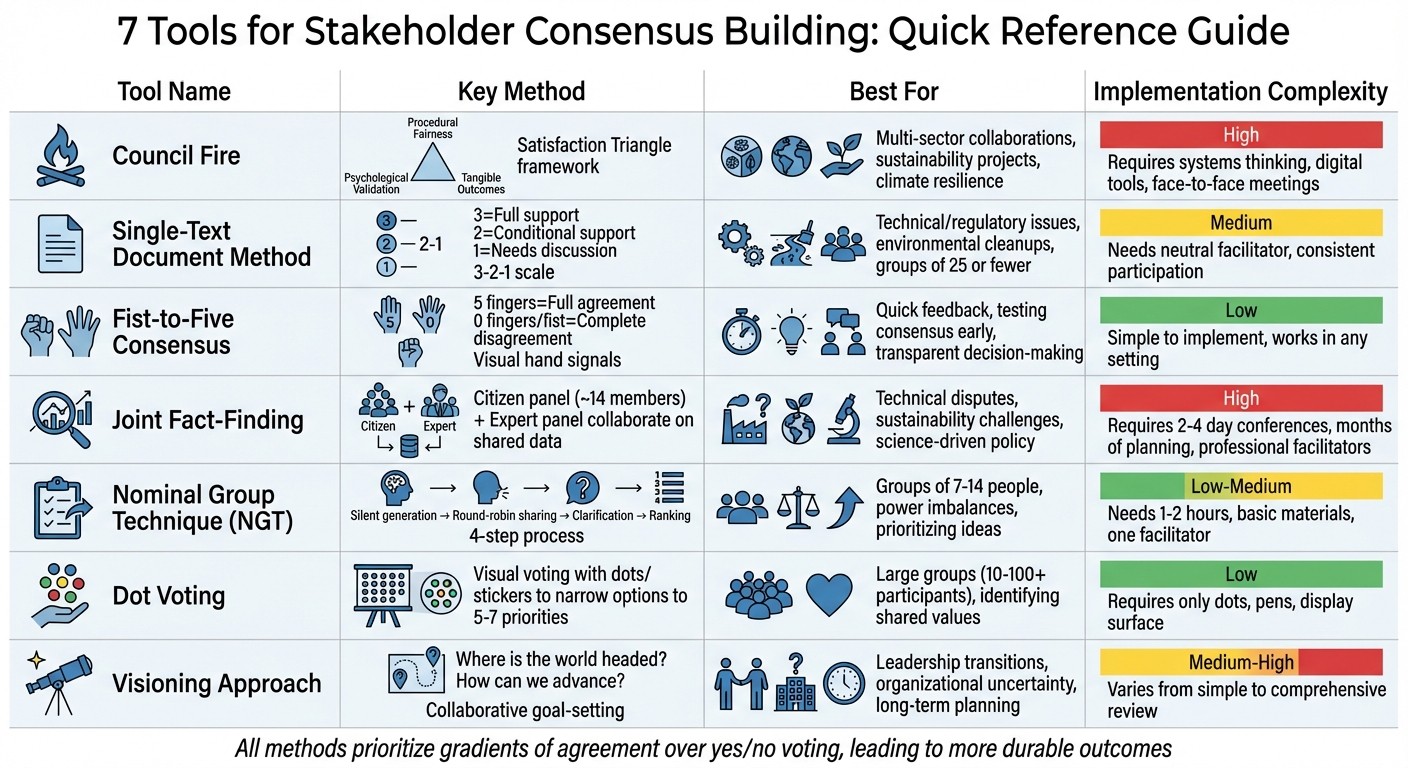
7 Consensus Building Tools Comparison: Methods, Implementation, and Best Use Cases
What Methods Ensure Stakeholder Consensus on Features?
How Tools Support Consensus Building
Structured tools play a key role in transforming unproductive debates into meaningful discussions. Instead of forcing participants into rigid yes/no decisions, these tools highlight a spectrum of agreement, which fosters collaboration rather than division. As one toolkit aptly puts it:
Consensus intentionally surfaces gradients of agreement [3].
This method allows participants to express varying degrees of support, ranging from full endorsement to concerns that require attention. By doing so, proposals can be refined step by step until all parties can accept the outcome. The structured nature of these tools seamlessly guides participants through measurable phases, promoting clarity and progress.
The benefits of this approach are threefold: it ensures procedural fairness, validates participants' perspectives, and aligns goals effectively. This combination results in agreements that are not only more legitimate but also more enduring [3]. Negotiators and mediators often advocate for these strategies, as they can lead to agreements that save both time and resources during implementation [3].
Though consensus building requires an initial investment - such as assembling small, focused groups [1][5] - the long-term advantages are undeniable. Stakeholders who actively participate in shaping solutions are far more likely to support them in the future, reducing the risk of delays and resistance that can be costly.
In addition to streamlining discussions, these tools address power dynamics thoughtfully. Conducting a stakeholder analysis based on real data, rather than assumptions, helps facilitators identify key influencers and potential sources of resistance early on [6]. This insight allows them to craft targeted engagement strategies, whether through skill-building sessions, pilot programs to shift mindsets, or structured processes to address power imbalances [6]. For sustainability projects, where Council Fire often collaborates with diverse groups spanning government, business, and community sectors, this systematic relationship-building is a critical foundation for meaningful agreements.
Practical mechanisms like the "3-2-1" consensus scale bring clarity to abstract discussions: a 3 indicates full support, a 2 signals support with reservations, and a 1 highlights the need for further discussion [3]. By frequently testing for consensus throughout the process, facilitators can uncover potential weak points early and refine proposals before they escalate into conflicts. This iterative method transforms disagreements into opportunities for creative solutions that no single perspective could achieve on its own.
1. Council Fire
Effectiveness in Facilitating Multi-Stakeholder Agreement
Council Fire brings together diverse groups from the public, private, and nonprofit sectors to create agreements that everyone can stand behind. Their process goes beyond simply organizing meetings - it’s about reshaping how stakeholders approach tough decisions through systems thinking and meaningful collaboration.
A key tool in their approach is the "Satisfaction Triangle", which focuses on three essential elements: procedural fairness, psychological validation, and tangible outcomes [3]. This framework is especially useful in situations where trust is low. By prioritizing trust-building early on, Council Fire lays the groundwork for stakeholders to move toward formal agreements [1].
Adapting to Complex and Sustainability-Focused Challenges
Council Fire’s methods are designed to turn ambitious sustainability goals into actionable plans. They tackle issues across a variety of sectors, including natural resource management, energy and water infrastructure, transportation, and community development. In these areas, reaching consensus among stakeholders often determines whether a project moves forward or stalls. By blending face-to-face relationship-building with digital tools like document sharing and video conferencing, Council Fire keeps the momentum going between meetings [1]. They also tailor their tools and methods based on the number of stakeholders involved, the complexity of the issue, and the desired outcomes [5].
For initiatives like climate resilience planning or circular economy projects, this adaptability allows them to shift focus as needed. Whether it’s conducting a technical carbon footprint analysis or facilitating stakeholder-driven planning sessions, their emphasis remains on achieving measurable results rather than just meeting compliance standards.
2. Single-Text Document Method
Effectiveness in Facilitating Multi-Stakeholder Agreement
The Single-Text Document Method moves beyond simple yes-or-no voting by introducing "levels of agreement." Stakeholders can express positions like "fully support" or "conditional support", allowing for a more nuanced understanding of their perspectives [3]. This approach helps reveal disagreements early in the process, avoiding the pitfalls of power imbalances that can obscure critical issues. From the outset, a working draft is presented, providing a concrete proposal for all parties to evaluate and refine collaboratively [4]. Using a central document and a 3-2-1 scale - where 3 signifies full support, 2 indicates conditional support, and 1 suggests further discussion is needed - the method ensures fairness and produces well-rounded, validated outcomes [3].
This structured approach also simplifies how agreements are rolled out across different settings, making it a practical choice for diverse groups.
Ease of Implementation in Diverse Organizational Contexts
The method's structured framework makes it adaptable to a variety of organizational environments. Typically, a neutral facilitator - such as a mediator, technical expert, or a small representative group - prepares the initial draft after gathering input from all stakeholders about their priorities and concerns [4]. This draft serves as a guide for focused discussions. As Lawrence Susskind, Sarah McKearnan, and Jennifer Thomas-Larmer explain:
The single-text method provides a clear structure for discussions and a focal point for identifying areas of agreement and disagreement [4].
This method is particularly effective in scenarios involving technical or regulatory language, or when managing a large and diverse group of participants [4]. Consistency in participation is essential, as it helps build the relationships necessary for reaching agreements [7]. In situations where trust is lacking, the process may take longer, as participants need time to establish a foundation for productive collaboration [7].
Flexibility to Address Complex or Sustainability-Focused Challenges
The Single-Text Document Method proves especially useful in tackling science-driven public policy issues, such as environmental cleanups or sustainability projects. These types of challenges often require stakeholders to engage in continuous dialogue and collaborative learning [8][1]. For long-term projects focused on sustainability, limiting the core group to 25 or fewer participants can enhance productivity while enabling meaningful discussions [1]. This adaptability highlights the method's effectiveness in addressing intricate, sustainability-related initiatives.
3. Fist-to-Five Consensus
Effectiveness in Facilitating Multi-Stakeholder Agreement
The Fist-to-Five method transforms decision-making into a straightforward visual exercise. Participants express their level of support by raising zero to five fingers: five fingers indicate full agreement, while a fist (zero fingers) signals complete disagreement, requiring immediate discussion [9]. This approach provides more than a simple yes-or-no answer - it reveals the strength of support or opposition [3].
Unlike majority-rule systems, this method ensures serious concerns are addressed rather than overlooked. If someone raises a fist, the facilitator pauses the process to invite that individual to share their concerns and suggest changes. As highlighted in the Transforming Community Spaces Through Equitable Collaboration Toolkit:
A consensus-based decision will be one that all parties have openly discussed, including sharing any serious questions and concerns [3].
By addressing disagreements early, the method creates stronger, more durable agreements where no one feels forced into accepting something they oppose. It works well alongside other consensus tools, providing immediate and transparent feedback that helps refine proposals.
Ease of Implementation in Diverse Organizational Contexts
Fist-to-Five is simple to use and adaptable to a variety of settings. The facilitator presents the proposal clearly, and participants respond using the scale: 5 for full support, 3 for support with minor reservations, and 0 to block the proposal [9]. This uniform approach ensures everyone understands the process [3].
The method is particularly effective for testing consensus early and refining ideas. For instance, if most participants raise just two fingers - indicating weak support - the facilitator knows the proposal needs further adjustments [3]. This iterative process helps avoid rushed decisions that might fail during implementation.
Ability to Build Trust and Collaboration Among Stakeholders
Beyond gauging support, Fist-to-Five builds trust by ensuring everyone feels heard. It gives every participant a visible way to express their perspective, preventing hidden disagreements from derailing progress later [3]. This openness fosters a sense of inclusion and collaboration.
When low scores appear, they spark immediate dialogue, turning potential conflicts into opportunities for improvement. Experts emphasize that consensus methods like this go beyond majority rule to create broad agreement, where everyone benefits in some way from the final decision [4]. By addressing concerns transparently, the process strengthens both the outcome and the relationships among participants [3].
4. Joint Fact-Finding
Effectiveness in Facilitating Multi-Stakeholder Agreement
Joint Fact-Finding is a collaborative process that unites stakeholders to agree on the technical data and facts essential for informed decision-making. Instead of gathering information independently, participants rely on a shared pool of data, ensuring decisions are built on a common foundation [10]. This approach not only streamlines discussions but also minimizes disputes over conflicting information.
A key strength of this process is its inclusivity. It empowers all participants, including those from marginalized communities, to better understand complex technical issues [2]. A citizen panel, typically composed of about 14 members, plays a central role by defining critical questions and contributing to the expert selection process [2]. This level of involvement fosters a sense of ownership, making the resulting agreements more durable and widely accepted [2].
By establishing a solid, mutually agreed-upon information base, Joint Fact-Finding lays the groundwork for smoother decision-making and efficient implementation.
Ease of Implementation in Diverse Organizational Contexts
While effective, Joint Fact-Finding requires thoughtful preparation and adequate resources. Formal consensus conferences, a common format for this method, typically span two to four days and are preceded by months of planning [2]. Professional facilitators are essential to guide the process, ensuring it remains democratic and transparent [2].
The success of this approach also hinges on assembling an expert panel that reflects a wide range of perspectives and expertise [2]. The first step is to identify the technical questions that need addressing. From there, stakeholders can establish a shared framework for evaluating information, reducing the risk of bias [10]. Breaking discussions into distinct areas - such as logistics, feasibility, or legal considerations - keeps the process focused and manageable [10].
When executed with care, Joint Fact-Finding not only simplifies complex discussions but also builds trust and cooperation among participants.
Ability to Build Trust and Collaboration Among Stakeholders
By fostering direct dialogue between technical experts and laypeople, Joint Fact-Finding creates an environment of transparency and shared learning [2]. This openness helps build trust among stakeholders. As highlighted by the U.S. Environmental Protection Agency:
"The expert panel is selected in a way that ensures that essential opposing views and professional conflicts can emerge and be discussed at the conference."
– U.S. Environmental Protection Agency [2]
A practical example of this approach in action comes from 2020, when Clark Twiddy, President of Twiddy & Co., used fact-finding to engage the North Carolina Real Estate Commission. This collaboration clarified legal obligations, resulting in a strong framework that supported both high employee retention and business success [11].
Flexibility to Address Complex or Sustainability-Focused Challenges
Joint Fact-Finding is particularly effective in tackling complex issues where technical expertise must align with public values. In uncertain situations, it helps stakeholders distinguish between what is known and what remains uncertain, offering clarity and confidence [11]. This makes it especially valuable for addressing challenges involving sustainability, where technical data often intersects with community priorities.
Transparency is a cornerstone of this method. Organizations must openly acknowledge what they know, what they don’t, and how they plan to fill gaps in their knowledge [11]. By promoting shared learning and a common understanding of facts, Joint Fact-Finding strengthens relationships and encourages collaboration, even among groups with differing interests [10].
5. Nominal Group Technique
Effectiveness in Facilitating Multi-Stakeholder Agreement
The Nominal Group Technique (NGT) follows a structured four-step process: silent idea generation, round-robin sharing, nonjudgmental clarification, and independent ranking. This method ensures that every participant has a voice, reducing the influence of dominant individuals. During the clarification phase, participants work toward a shared understanding before moving on to the final step, where preferences are ranked - often focusing on the top five choices. This process consolidates individual opinions into a collective priority, making it possible to achieve consensus within a single session lasting anywhere from one to several hours [12][13][14].
"Nominal Group Technique is a group consensus decision-making process that ensures everyone is heard, the key issues discussed, the best solutions identified, and a fair, group-based decision is made."
– Synergy Commons [12]
This approach is highly adaptable, making it suitable for a wide range of organizational settings.
Ease of Implementation in Diverse Organizational Contexts
NGT requires only basic resources: a facilitator, some flipcharts or index cards, pens, and about one to two hours of time [12][15]. While the ideal group size is around seven participants, the method can accommodate up to 14. For larger groups, dividing participants into subgroups of six to eight and using dot voting to consolidate options can maintain efficiency. The process is flexible enough to accommodate various needs; for example, facilitators can merge certain phases or rely on verbal discussions for participants with lower literacy levels. Setting clear objectives by distinguishing between "MUST" (mandatory and measurable) and "WANT" (relative importance) criteria can help avoid conflicts during the evaluation phase [12][14].
Ability to Build Trust and Collaboration Among Stakeholders
The silent idea-generation phase of NGT encourages diverse contributions while reducing the pressure to conform, fostering an environment of trust where every perspective is equally valued. The structured voting process ensures transparency and fairness, helping participants feel that their input genuinely matters. This technique is particularly effective in situations where groups feel stuck or are dealing with significant disagreements. It is especially useful in scenarios with notable power imbalances, such as between executives and junior staff. In such cases, holding separate sessions can encourage honest feedback without fear of repercussions [12][15][16].
"A key strength of consensus methods is the balanced participation from group members, unlike a focus group, whereby the facilitator must control for, and minimise the risk of, a dominant participant influencing the discussion."
– Sara S. McMillan, Michelle King, and Mary P. Tully [14]
6. Dot Voting
Effectiveness in Facilitating Multi-Stakeholder Agreement
Dot voting provides a straightforward way to distill a wide range of opinions into a clear visual summary, narrowing down a long list of ideas to five to seven top priorities [12]. A more nuanced version, known as Dotmocracy, uses rating sheets to gauge opinions ranging from strong agreement to strong disagreement [17]. This method captures the subtleties of stakeholder perspectives, highlighting which parts of a proposal enjoy widespread support and which may require further refinement.
The process ensures equal participation across all stakeholder levels, giving everyone a voice [12]. Participants can attach brief comments to their dots for greater accountability, fostering transparency and enabling follow-up discussions on specific viewpoints [17]. This visual approach simplifies decision-making and sets the stage for smoother implementation.
Ease of Implementation in Diverse Organizational Contexts
Dot voting is remarkably simple to set up, requiring only basic materials like sticker dots, pens, markers, and a surface for display, such as a wall or table [12][17]. Its scalability is one of its strengths - it works just as effectively in small groups of fewer than ten people as it does in large workshops with hundreds of participants, making it suitable for identifying shared values in any setting [12].
By giving each participant the same number of dots or rating opportunities, the method helps level the playing field, minimizing power dynamics between different groups [12]. For the process to succeed, three key roles are essential: neutral facilitators to guide the session, participants to share their input, and hosts to act on the results [17].
Flexibility to Address Complex or Sustainability-Focused Challenges
While its simplicity is a major benefit, dot voting is also adaptable to tackle more complex issues, including sustainability challenges. Preparing participants with background information is crucial when addressing intricate topics [17].
"Before starting an idea rating process on a complex topic, education should be provided to the participants to ensure they are knowledgeable on the issue that will be addressed, e.g., distribute a primer booklet a few days ahead of time."
– Dotmocracy.org [17]
For complex challenges, the process should be iterative. After the initial round of voting, participants review the patterns and comments, discuss areas of confusion or disagreement, and refine their ideas for a second round of voting [17]. This iterative cycle strengthens proposals, helping build consensus around shared goals. To maintain trust among diverse stakeholders, the hosting organization should clearly explain how the results will be used and commit to accountability. Celebrating broadly supported ideas while documenting key disagreements ensures transparency and fosters collaboration [17].
7. Visioning Approach
Effectiveness in Facilitating Multi-Stakeholder Agreement
The visioning approach brings clarity to objectives and aligns both internal and external stakeholders under a unified plan. It tackles essential questions such as "Where is the world headed?" and "How can we advance our mission?" Unlike traditional consulting, which often presents solutions from an external perspective, this method engages directly with those most connected to the organization. Together, they uncover insights and define the steps needed to move forward. This collaborative effort has proven effective in contexts ranging from local environmental initiatives to setting global priorities. The resulting shared vision becomes a cornerstone for fostering mutual trust among stakeholders.
Building Trust and Collaboration Among Stakeholders
Once a shared vision is established, it naturally strengthens relationships and deepens collaborative commitment among participants. The process builds confidence by helping stakeholders achieve meaningful breakthroughs in understanding and perspective. It also creates a safe space to address complex or previously unspoken organizational challenges, which can lead to transformative outcomes for groups that may have avoided difficult conversations in the past.
"A great strategic plan does more than set direction - it inspires the organization's stakeholders, leaders and junior staff, external partners and clients to work together to achieve a set of goals that they find truly meaningful." – Consensus Building Institute [18]
By incorporating external viewpoints - encouraging organizations to "see themselves as others see them" - this approach enriches internal discussions and nurtures a sustained sense of shared purpose.
Flexibility to Address Complex or Sustainability-Focused Challenges
The visioning process is designed to adapt to varying circumstances. It can range from a straightforward exercise for stable organizations to a more comprehensive review in times of operational uncertainty. This makes it particularly effective during leadership transitions or when external conditions shift. Clear decision-making boundaries and well-defined timeframes ensure the process remains focused and credible. This adaptability not only strengthens stakeholder commitment but also supports smooth and effective decision-making.
Conclusion
The tools outlined above allow organizations to navigate complex challenges while bringing together diverse groups of stakeholders. These approaches ensure that everyone, regardless of their background or income level, has an opportunity to contribute meaningfully to the conversation [1].
When compared to traditional majority voting, the advantages of consensus methods become more evident. Unlike voting, which often results in winners and losers, consensus building aims for broad agreement that all participants can accept, leading to more stable and enduring decisions [4][19]. Harvard Law School Professor Lawrence Susskind captures this well:
"The result is a negotiated decision that is as close to unanimous as possible. From an organizational standpoint, consensus‐building techniques help groups as a whole win." [4]
While structured consensus methods may require more time upfront during the planning stages, they often pay off in the long run. By fostering collective commitment, organizations can streamline implementation, saving time and resources while enhancing stakeholder satisfaction. This is achieved through procedural fairness, psychological acknowledgment, and addressing the key interests of all involved [3][19].
Moreover, this process transforms disagreements into opportunities for creative problem-solving. By exploring varying levels of agreement rather than forcing binary yes-or-no decisions, organizations can achieve more durable and thoughtful outcomes [3]. This method also helps bridge the gap between technical experts and community members, ensuring that groups traditionally left out of policy discussions are empowered to participate [2].
FAQs
How can I select the best consensus-building tool for my organization?
To select the most suitable consensus-building tool, begin by clearly identifying your objectives and understanding your audience. Are you aiming to gather feedback, refine a list of options, or reach a final agreement? Consider the characteristics of your stakeholders, such as their size, expertise, geographical locations, and the level of trust within the group. For instance, approaches like the World Café are well-suited for large and diverse groups, whereas the Delphi method is better for gathering iterative input from geographically dispersed experts.
Practical considerations like budget, time constraints, and available resources are also critical. Methods such as workshops often demand significant preparation and skilled facilitation, while online surveys or digital platforms may offer a more budget-friendly and efficient alternative. Once you’ve outlined your goals and limitations, refine your choices and evaluate them through a structured framework to ensure they meet your requirements. Partnering with an experienced facilitator - such as Council Fire - can further enhance the process, ensuring the chosen tool is implemented effectively while addressing financial, environmental, and social considerations.
Why is consensus-building better than traditional voting for stakeholder decisions?
Consensus-building brings a unique approach to decision-making by prioritizing collaboration and mutual understanding over the more divisive nature of traditional voting. While voting can sometimes leave certain participants feeling sidelined, consensus ensures that everyone's perspective is taken into account. This method fosters trust, encourages collective ownership of decisions, and often results in solutions that gain broader support.
Through open dialogue and the refinement of ideas, consensus-based methods lead to outcomes that are more inclusive and well-rounded. They help bridge divides, support fair collaboration, and make it easier to put decisions into action. Council Fire employs these techniques to assist clients in aligning financial success with sustainability objectives, ensuring that every voice has a chance to be heard.
How do these tools help ensure fair participation among stakeholders?
Consensus-building tools are crafted to ensure that every voice in the room has a chance to be heard, not just the loudest or most influential. These tools create an environment where participants feel encouraged to raise concerns, ask thoughtful questions, and address objections before any decisions are set in stone. This approach ensures quieter or less prominent stakeholders can actively contribute to the process.
Methods such as stakeholder mapping, structured workshops, and small-group discussions - like the World Café model or citizen advisory boards - are particularly effective at identifying and addressing power imbalances. These techniques prevent any single group from dominating the conversation while fostering trust and transparency. By prioritizing collaboration, they help shape decisions that genuinely reflect the diverse interests of all parties involved. Council Fire employs these time-tested strategies to guide clients in building consensus and crafting fair, inclusive solutions.
Related Blog Posts
Latest Articles
©2025



FAQ
01
What does it really mean to “redefine profit”?
02
What makes Council Fire different?
03
Who does Council Fire you work with?
04
What does working with Council Fire actually look like?
05
How does Council Fire help organizations turn big goals into action?
06
How does Council Fire define and measure success?
Jan 5, 2026
Top 7 Tools for Stakeholder Consensus Building
Capacity Building
In This Article
Seven practical methods—Single-Text, Fist-to-Five, Joint Fact-Finding, Dot Voting, NGT, and Visioning—for building fair, durable stakeholder agreements.
Top 7 Tools for Stakeholder Consensus Building
When making decisions with diverse stakeholders, reaching agreement can be challenging. Consensus building prioritizes collaboration, ensuring solutions are supported by all parties, not just the majority. This article explores seven tools designed to simplify the process, address conflicts early, and create lasting agreements:
Council Fire: Combines relationship-building and structured frameworks like the "Satisfaction Triangle" to guide multi-sector collaborations.
Single-Text Document Method: Uses a shared draft and a 3-2-1 scale to refine proposals and address disagreements collaboratively.
Fist-to-Five Consensus: A visual method where participants indicate their support level (0-5 fingers), enabling quick identification of concerns.
Joint Fact-Finding: Promotes shared understanding by uniting stakeholders to agree on technical data and facts.
Nominal Group Technique (NGT): A four-step process ensuring equal input from all participants to prioritize ideas effectively.
Dot Voting: Visualizes group preferences by allowing participants to vote on ideas using dots or rating sheets.
Visioning Approach: Aligns stakeholders by creating a shared plan and addressing objectives collectively.
These tools help navigate complex discussions, ensuring all voices are heard and agreements are more durable. Below, we dive into how each method works and why they’re effective for building consensus.
7 Consensus Building Tools Comparison: Methods, Implementation, and Best Use Cases
What Methods Ensure Stakeholder Consensus on Features?
How Tools Support Consensus Building
Structured tools play a key role in transforming unproductive debates into meaningful discussions. Instead of forcing participants into rigid yes/no decisions, these tools highlight a spectrum of agreement, which fosters collaboration rather than division. As one toolkit aptly puts it:
Consensus intentionally surfaces gradients of agreement [3].
This method allows participants to express varying degrees of support, ranging from full endorsement to concerns that require attention. By doing so, proposals can be refined step by step until all parties can accept the outcome. The structured nature of these tools seamlessly guides participants through measurable phases, promoting clarity and progress.
The benefits of this approach are threefold: it ensures procedural fairness, validates participants' perspectives, and aligns goals effectively. This combination results in agreements that are not only more legitimate but also more enduring [3]. Negotiators and mediators often advocate for these strategies, as they can lead to agreements that save both time and resources during implementation [3].
Though consensus building requires an initial investment - such as assembling small, focused groups [1][5] - the long-term advantages are undeniable. Stakeholders who actively participate in shaping solutions are far more likely to support them in the future, reducing the risk of delays and resistance that can be costly.
In addition to streamlining discussions, these tools address power dynamics thoughtfully. Conducting a stakeholder analysis based on real data, rather than assumptions, helps facilitators identify key influencers and potential sources of resistance early on [6]. This insight allows them to craft targeted engagement strategies, whether through skill-building sessions, pilot programs to shift mindsets, or structured processes to address power imbalances [6]. For sustainability projects, where Council Fire often collaborates with diverse groups spanning government, business, and community sectors, this systematic relationship-building is a critical foundation for meaningful agreements.
Practical mechanisms like the "3-2-1" consensus scale bring clarity to abstract discussions: a 3 indicates full support, a 2 signals support with reservations, and a 1 highlights the need for further discussion [3]. By frequently testing for consensus throughout the process, facilitators can uncover potential weak points early and refine proposals before they escalate into conflicts. This iterative method transforms disagreements into opportunities for creative solutions that no single perspective could achieve on its own.
1. Council Fire
Effectiveness in Facilitating Multi-Stakeholder Agreement
Council Fire brings together diverse groups from the public, private, and nonprofit sectors to create agreements that everyone can stand behind. Their process goes beyond simply organizing meetings - it’s about reshaping how stakeholders approach tough decisions through systems thinking and meaningful collaboration.
A key tool in their approach is the "Satisfaction Triangle", which focuses on three essential elements: procedural fairness, psychological validation, and tangible outcomes [3]. This framework is especially useful in situations where trust is low. By prioritizing trust-building early on, Council Fire lays the groundwork for stakeholders to move toward formal agreements [1].
Adapting to Complex and Sustainability-Focused Challenges
Council Fire’s methods are designed to turn ambitious sustainability goals into actionable plans. They tackle issues across a variety of sectors, including natural resource management, energy and water infrastructure, transportation, and community development. In these areas, reaching consensus among stakeholders often determines whether a project moves forward or stalls. By blending face-to-face relationship-building with digital tools like document sharing and video conferencing, Council Fire keeps the momentum going between meetings [1]. They also tailor their tools and methods based on the number of stakeholders involved, the complexity of the issue, and the desired outcomes [5].
For initiatives like climate resilience planning or circular economy projects, this adaptability allows them to shift focus as needed. Whether it’s conducting a technical carbon footprint analysis or facilitating stakeholder-driven planning sessions, their emphasis remains on achieving measurable results rather than just meeting compliance standards.
2. Single-Text Document Method
Effectiveness in Facilitating Multi-Stakeholder Agreement
The Single-Text Document Method moves beyond simple yes-or-no voting by introducing "levels of agreement." Stakeholders can express positions like "fully support" or "conditional support", allowing for a more nuanced understanding of their perspectives [3]. This approach helps reveal disagreements early in the process, avoiding the pitfalls of power imbalances that can obscure critical issues. From the outset, a working draft is presented, providing a concrete proposal for all parties to evaluate and refine collaboratively [4]. Using a central document and a 3-2-1 scale - where 3 signifies full support, 2 indicates conditional support, and 1 suggests further discussion is needed - the method ensures fairness and produces well-rounded, validated outcomes [3].
This structured approach also simplifies how agreements are rolled out across different settings, making it a practical choice for diverse groups.
Ease of Implementation in Diverse Organizational Contexts
The method's structured framework makes it adaptable to a variety of organizational environments. Typically, a neutral facilitator - such as a mediator, technical expert, or a small representative group - prepares the initial draft after gathering input from all stakeholders about their priorities and concerns [4]. This draft serves as a guide for focused discussions. As Lawrence Susskind, Sarah McKearnan, and Jennifer Thomas-Larmer explain:
The single-text method provides a clear structure for discussions and a focal point for identifying areas of agreement and disagreement [4].
This method is particularly effective in scenarios involving technical or regulatory language, or when managing a large and diverse group of participants [4]. Consistency in participation is essential, as it helps build the relationships necessary for reaching agreements [7]. In situations where trust is lacking, the process may take longer, as participants need time to establish a foundation for productive collaboration [7].
Flexibility to Address Complex or Sustainability-Focused Challenges
The Single-Text Document Method proves especially useful in tackling science-driven public policy issues, such as environmental cleanups or sustainability projects. These types of challenges often require stakeholders to engage in continuous dialogue and collaborative learning [8][1]. For long-term projects focused on sustainability, limiting the core group to 25 or fewer participants can enhance productivity while enabling meaningful discussions [1]. This adaptability highlights the method's effectiveness in addressing intricate, sustainability-related initiatives.
3. Fist-to-Five Consensus
Effectiveness in Facilitating Multi-Stakeholder Agreement
The Fist-to-Five method transforms decision-making into a straightforward visual exercise. Participants express their level of support by raising zero to five fingers: five fingers indicate full agreement, while a fist (zero fingers) signals complete disagreement, requiring immediate discussion [9]. This approach provides more than a simple yes-or-no answer - it reveals the strength of support or opposition [3].
Unlike majority-rule systems, this method ensures serious concerns are addressed rather than overlooked. If someone raises a fist, the facilitator pauses the process to invite that individual to share their concerns and suggest changes. As highlighted in the Transforming Community Spaces Through Equitable Collaboration Toolkit:
A consensus-based decision will be one that all parties have openly discussed, including sharing any serious questions and concerns [3].
By addressing disagreements early, the method creates stronger, more durable agreements where no one feels forced into accepting something they oppose. It works well alongside other consensus tools, providing immediate and transparent feedback that helps refine proposals.
Ease of Implementation in Diverse Organizational Contexts
Fist-to-Five is simple to use and adaptable to a variety of settings. The facilitator presents the proposal clearly, and participants respond using the scale: 5 for full support, 3 for support with minor reservations, and 0 to block the proposal [9]. This uniform approach ensures everyone understands the process [3].
The method is particularly effective for testing consensus early and refining ideas. For instance, if most participants raise just two fingers - indicating weak support - the facilitator knows the proposal needs further adjustments [3]. This iterative process helps avoid rushed decisions that might fail during implementation.
Ability to Build Trust and Collaboration Among Stakeholders
Beyond gauging support, Fist-to-Five builds trust by ensuring everyone feels heard. It gives every participant a visible way to express their perspective, preventing hidden disagreements from derailing progress later [3]. This openness fosters a sense of inclusion and collaboration.
When low scores appear, they spark immediate dialogue, turning potential conflicts into opportunities for improvement. Experts emphasize that consensus methods like this go beyond majority rule to create broad agreement, where everyone benefits in some way from the final decision [4]. By addressing concerns transparently, the process strengthens both the outcome and the relationships among participants [3].
4. Joint Fact-Finding
Effectiveness in Facilitating Multi-Stakeholder Agreement
Joint Fact-Finding is a collaborative process that unites stakeholders to agree on the technical data and facts essential for informed decision-making. Instead of gathering information independently, participants rely on a shared pool of data, ensuring decisions are built on a common foundation [10]. This approach not only streamlines discussions but also minimizes disputes over conflicting information.
A key strength of this process is its inclusivity. It empowers all participants, including those from marginalized communities, to better understand complex technical issues [2]. A citizen panel, typically composed of about 14 members, plays a central role by defining critical questions and contributing to the expert selection process [2]. This level of involvement fosters a sense of ownership, making the resulting agreements more durable and widely accepted [2].
By establishing a solid, mutually agreed-upon information base, Joint Fact-Finding lays the groundwork for smoother decision-making and efficient implementation.
Ease of Implementation in Diverse Organizational Contexts
While effective, Joint Fact-Finding requires thoughtful preparation and adequate resources. Formal consensus conferences, a common format for this method, typically span two to four days and are preceded by months of planning [2]. Professional facilitators are essential to guide the process, ensuring it remains democratic and transparent [2].
The success of this approach also hinges on assembling an expert panel that reflects a wide range of perspectives and expertise [2]. The first step is to identify the technical questions that need addressing. From there, stakeholders can establish a shared framework for evaluating information, reducing the risk of bias [10]. Breaking discussions into distinct areas - such as logistics, feasibility, or legal considerations - keeps the process focused and manageable [10].
When executed with care, Joint Fact-Finding not only simplifies complex discussions but also builds trust and cooperation among participants.
Ability to Build Trust and Collaboration Among Stakeholders
By fostering direct dialogue between technical experts and laypeople, Joint Fact-Finding creates an environment of transparency and shared learning [2]. This openness helps build trust among stakeholders. As highlighted by the U.S. Environmental Protection Agency:
"The expert panel is selected in a way that ensures that essential opposing views and professional conflicts can emerge and be discussed at the conference."
– U.S. Environmental Protection Agency [2]
A practical example of this approach in action comes from 2020, when Clark Twiddy, President of Twiddy & Co., used fact-finding to engage the North Carolina Real Estate Commission. This collaboration clarified legal obligations, resulting in a strong framework that supported both high employee retention and business success [11].
Flexibility to Address Complex or Sustainability-Focused Challenges
Joint Fact-Finding is particularly effective in tackling complex issues where technical expertise must align with public values. In uncertain situations, it helps stakeholders distinguish between what is known and what remains uncertain, offering clarity and confidence [11]. This makes it especially valuable for addressing challenges involving sustainability, where technical data often intersects with community priorities.
Transparency is a cornerstone of this method. Organizations must openly acknowledge what they know, what they don’t, and how they plan to fill gaps in their knowledge [11]. By promoting shared learning and a common understanding of facts, Joint Fact-Finding strengthens relationships and encourages collaboration, even among groups with differing interests [10].
5. Nominal Group Technique
Effectiveness in Facilitating Multi-Stakeholder Agreement
The Nominal Group Technique (NGT) follows a structured four-step process: silent idea generation, round-robin sharing, nonjudgmental clarification, and independent ranking. This method ensures that every participant has a voice, reducing the influence of dominant individuals. During the clarification phase, participants work toward a shared understanding before moving on to the final step, where preferences are ranked - often focusing on the top five choices. This process consolidates individual opinions into a collective priority, making it possible to achieve consensus within a single session lasting anywhere from one to several hours [12][13][14].
"Nominal Group Technique is a group consensus decision-making process that ensures everyone is heard, the key issues discussed, the best solutions identified, and a fair, group-based decision is made."
– Synergy Commons [12]
This approach is highly adaptable, making it suitable for a wide range of organizational settings.
Ease of Implementation in Diverse Organizational Contexts
NGT requires only basic resources: a facilitator, some flipcharts or index cards, pens, and about one to two hours of time [12][15]. While the ideal group size is around seven participants, the method can accommodate up to 14. For larger groups, dividing participants into subgroups of six to eight and using dot voting to consolidate options can maintain efficiency. The process is flexible enough to accommodate various needs; for example, facilitators can merge certain phases or rely on verbal discussions for participants with lower literacy levels. Setting clear objectives by distinguishing between "MUST" (mandatory and measurable) and "WANT" (relative importance) criteria can help avoid conflicts during the evaluation phase [12][14].
Ability to Build Trust and Collaboration Among Stakeholders
The silent idea-generation phase of NGT encourages diverse contributions while reducing the pressure to conform, fostering an environment of trust where every perspective is equally valued. The structured voting process ensures transparency and fairness, helping participants feel that their input genuinely matters. This technique is particularly effective in situations where groups feel stuck or are dealing with significant disagreements. It is especially useful in scenarios with notable power imbalances, such as between executives and junior staff. In such cases, holding separate sessions can encourage honest feedback without fear of repercussions [12][15][16].
"A key strength of consensus methods is the balanced participation from group members, unlike a focus group, whereby the facilitator must control for, and minimise the risk of, a dominant participant influencing the discussion."
– Sara S. McMillan, Michelle King, and Mary P. Tully [14]
6. Dot Voting
Effectiveness in Facilitating Multi-Stakeholder Agreement
Dot voting provides a straightforward way to distill a wide range of opinions into a clear visual summary, narrowing down a long list of ideas to five to seven top priorities [12]. A more nuanced version, known as Dotmocracy, uses rating sheets to gauge opinions ranging from strong agreement to strong disagreement [17]. This method captures the subtleties of stakeholder perspectives, highlighting which parts of a proposal enjoy widespread support and which may require further refinement.
The process ensures equal participation across all stakeholder levels, giving everyone a voice [12]. Participants can attach brief comments to their dots for greater accountability, fostering transparency and enabling follow-up discussions on specific viewpoints [17]. This visual approach simplifies decision-making and sets the stage for smoother implementation.
Ease of Implementation in Diverse Organizational Contexts
Dot voting is remarkably simple to set up, requiring only basic materials like sticker dots, pens, markers, and a surface for display, such as a wall or table [12][17]. Its scalability is one of its strengths - it works just as effectively in small groups of fewer than ten people as it does in large workshops with hundreds of participants, making it suitable for identifying shared values in any setting [12].
By giving each participant the same number of dots or rating opportunities, the method helps level the playing field, minimizing power dynamics between different groups [12]. For the process to succeed, three key roles are essential: neutral facilitators to guide the session, participants to share their input, and hosts to act on the results [17].
Flexibility to Address Complex or Sustainability-Focused Challenges
While its simplicity is a major benefit, dot voting is also adaptable to tackle more complex issues, including sustainability challenges. Preparing participants with background information is crucial when addressing intricate topics [17].
"Before starting an idea rating process on a complex topic, education should be provided to the participants to ensure they are knowledgeable on the issue that will be addressed, e.g., distribute a primer booklet a few days ahead of time."
– Dotmocracy.org [17]
For complex challenges, the process should be iterative. After the initial round of voting, participants review the patterns and comments, discuss areas of confusion or disagreement, and refine their ideas for a second round of voting [17]. This iterative cycle strengthens proposals, helping build consensus around shared goals. To maintain trust among diverse stakeholders, the hosting organization should clearly explain how the results will be used and commit to accountability. Celebrating broadly supported ideas while documenting key disagreements ensures transparency and fosters collaboration [17].
7. Visioning Approach
Effectiveness in Facilitating Multi-Stakeholder Agreement
The visioning approach brings clarity to objectives and aligns both internal and external stakeholders under a unified plan. It tackles essential questions such as "Where is the world headed?" and "How can we advance our mission?" Unlike traditional consulting, which often presents solutions from an external perspective, this method engages directly with those most connected to the organization. Together, they uncover insights and define the steps needed to move forward. This collaborative effort has proven effective in contexts ranging from local environmental initiatives to setting global priorities. The resulting shared vision becomes a cornerstone for fostering mutual trust among stakeholders.
Building Trust and Collaboration Among Stakeholders
Once a shared vision is established, it naturally strengthens relationships and deepens collaborative commitment among participants. The process builds confidence by helping stakeholders achieve meaningful breakthroughs in understanding and perspective. It also creates a safe space to address complex or previously unspoken organizational challenges, which can lead to transformative outcomes for groups that may have avoided difficult conversations in the past.
"A great strategic plan does more than set direction - it inspires the organization's stakeholders, leaders and junior staff, external partners and clients to work together to achieve a set of goals that they find truly meaningful." – Consensus Building Institute [18]
By incorporating external viewpoints - encouraging organizations to "see themselves as others see them" - this approach enriches internal discussions and nurtures a sustained sense of shared purpose.
Flexibility to Address Complex or Sustainability-Focused Challenges
The visioning process is designed to adapt to varying circumstances. It can range from a straightforward exercise for stable organizations to a more comprehensive review in times of operational uncertainty. This makes it particularly effective during leadership transitions or when external conditions shift. Clear decision-making boundaries and well-defined timeframes ensure the process remains focused and credible. This adaptability not only strengthens stakeholder commitment but also supports smooth and effective decision-making.
Conclusion
The tools outlined above allow organizations to navigate complex challenges while bringing together diverse groups of stakeholders. These approaches ensure that everyone, regardless of their background or income level, has an opportunity to contribute meaningfully to the conversation [1].
When compared to traditional majority voting, the advantages of consensus methods become more evident. Unlike voting, which often results in winners and losers, consensus building aims for broad agreement that all participants can accept, leading to more stable and enduring decisions [4][19]. Harvard Law School Professor Lawrence Susskind captures this well:
"The result is a negotiated decision that is as close to unanimous as possible. From an organizational standpoint, consensus‐building techniques help groups as a whole win." [4]
While structured consensus methods may require more time upfront during the planning stages, they often pay off in the long run. By fostering collective commitment, organizations can streamline implementation, saving time and resources while enhancing stakeholder satisfaction. This is achieved through procedural fairness, psychological acknowledgment, and addressing the key interests of all involved [3][19].
Moreover, this process transforms disagreements into opportunities for creative problem-solving. By exploring varying levels of agreement rather than forcing binary yes-or-no decisions, organizations can achieve more durable and thoughtful outcomes [3]. This method also helps bridge the gap between technical experts and community members, ensuring that groups traditionally left out of policy discussions are empowered to participate [2].
FAQs
How can I select the best consensus-building tool for my organization?
To select the most suitable consensus-building tool, begin by clearly identifying your objectives and understanding your audience. Are you aiming to gather feedback, refine a list of options, or reach a final agreement? Consider the characteristics of your stakeholders, such as their size, expertise, geographical locations, and the level of trust within the group. For instance, approaches like the World Café are well-suited for large and diverse groups, whereas the Delphi method is better for gathering iterative input from geographically dispersed experts.
Practical considerations like budget, time constraints, and available resources are also critical. Methods such as workshops often demand significant preparation and skilled facilitation, while online surveys or digital platforms may offer a more budget-friendly and efficient alternative. Once you’ve outlined your goals and limitations, refine your choices and evaluate them through a structured framework to ensure they meet your requirements. Partnering with an experienced facilitator - such as Council Fire - can further enhance the process, ensuring the chosen tool is implemented effectively while addressing financial, environmental, and social considerations.
Why is consensus-building better than traditional voting for stakeholder decisions?
Consensus-building brings a unique approach to decision-making by prioritizing collaboration and mutual understanding over the more divisive nature of traditional voting. While voting can sometimes leave certain participants feeling sidelined, consensus ensures that everyone's perspective is taken into account. This method fosters trust, encourages collective ownership of decisions, and often results in solutions that gain broader support.
Through open dialogue and the refinement of ideas, consensus-based methods lead to outcomes that are more inclusive and well-rounded. They help bridge divides, support fair collaboration, and make it easier to put decisions into action. Council Fire employs these techniques to assist clients in aligning financial success with sustainability objectives, ensuring that every voice has a chance to be heard.
How do these tools help ensure fair participation among stakeholders?
Consensus-building tools are crafted to ensure that every voice in the room has a chance to be heard, not just the loudest or most influential. These tools create an environment where participants feel encouraged to raise concerns, ask thoughtful questions, and address objections before any decisions are set in stone. This approach ensures quieter or less prominent stakeholders can actively contribute to the process.
Methods such as stakeholder mapping, structured workshops, and small-group discussions - like the World Café model or citizen advisory boards - are particularly effective at identifying and addressing power imbalances. These techniques prevent any single group from dominating the conversation while fostering trust and transparency. By prioritizing collaboration, they help shape decisions that genuinely reflect the diverse interests of all parties involved. Council Fire employs these time-tested strategies to guide clients in building consensus and crafting fair, inclusive solutions.
Related Blog Posts
FAQ
01
What does it really mean to “redefine profit”?
02
What makes Council Fire different?
03
Who does Council Fire you work with?
04
What does working with Council Fire actually look like?
05
How does Council Fire help organizations turn big goals into action?
06
How does Council Fire define and measure success?
Jan 5, 2026
Top 7 Tools for Stakeholder Consensus Building
Capacity Building
In This Article
Seven practical methods—Single-Text, Fist-to-Five, Joint Fact-Finding, Dot Voting, NGT, and Visioning—for building fair, durable stakeholder agreements.
Top 7 Tools for Stakeholder Consensus Building
When making decisions with diverse stakeholders, reaching agreement can be challenging. Consensus building prioritizes collaboration, ensuring solutions are supported by all parties, not just the majority. This article explores seven tools designed to simplify the process, address conflicts early, and create lasting agreements:
Council Fire: Combines relationship-building and structured frameworks like the "Satisfaction Triangle" to guide multi-sector collaborations.
Single-Text Document Method: Uses a shared draft and a 3-2-1 scale to refine proposals and address disagreements collaboratively.
Fist-to-Five Consensus: A visual method where participants indicate their support level (0-5 fingers), enabling quick identification of concerns.
Joint Fact-Finding: Promotes shared understanding by uniting stakeholders to agree on technical data and facts.
Nominal Group Technique (NGT): A four-step process ensuring equal input from all participants to prioritize ideas effectively.
Dot Voting: Visualizes group preferences by allowing participants to vote on ideas using dots or rating sheets.
Visioning Approach: Aligns stakeholders by creating a shared plan and addressing objectives collectively.
These tools help navigate complex discussions, ensuring all voices are heard and agreements are more durable. Below, we dive into how each method works and why they’re effective for building consensus.
7 Consensus Building Tools Comparison: Methods, Implementation, and Best Use Cases
What Methods Ensure Stakeholder Consensus on Features?
How Tools Support Consensus Building
Structured tools play a key role in transforming unproductive debates into meaningful discussions. Instead of forcing participants into rigid yes/no decisions, these tools highlight a spectrum of agreement, which fosters collaboration rather than division. As one toolkit aptly puts it:
Consensus intentionally surfaces gradients of agreement [3].
This method allows participants to express varying degrees of support, ranging from full endorsement to concerns that require attention. By doing so, proposals can be refined step by step until all parties can accept the outcome. The structured nature of these tools seamlessly guides participants through measurable phases, promoting clarity and progress.
The benefits of this approach are threefold: it ensures procedural fairness, validates participants' perspectives, and aligns goals effectively. This combination results in agreements that are not only more legitimate but also more enduring [3]. Negotiators and mediators often advocate for these strategies, as they can lead to agreements that save both time and resources during implementation [3].
Though consensus building requires an initial investment - such as assembling small, focused groups [1][5] - the long-term advantages are undeniable. Stakeholders who actively participate in shaping solutions are far more likely to support them in the future, reducing the risk of delays and resistance that can be costly.
In addition to streamlining discussions, these tools address power dynamics thoughtfully. Conducting a stakeholder analysis based on real data, rather than assumptions, helps facilitators identify key influencers and potential sources of resistance early on [6]. This insight allows them to craft targeted engagement strategies, whether through skill-building sessions, pilot programs to shift mindsets, or structured processes to address power imbalances [6]. For sustainability projects, where Council Fire often collaborates with diverse groups spanning government, business, and community sectors, this systematic relationship-building is a critical foundation for meaningful agreements.
Practical mechanisms like the "3-2-1" consensus scale bring clarity to abstract discussions: a 3 indicates full support, a 2 signals support with reservations, and a 1 highlights the need for further discussion [3]. By frequently testing for consensus throughout the process, facilitators can uncover potential weak points early and refine proposals before they escalate into conflicts. This iterative method transforms disagreements into opportunities for creative solutions that no single perspective could achieve on its own.
1. Council Fire
Effectiveness in Facilitating Multi-Stakeholder Agreement
Council Fire brings together diverse groups from the public, private, and nonprofit sectors to create agreements that everyone can stand behind. Their process goes beyond simply organizing meetings - it’s about reshaping how stakeholders approach tough decisions through systems thinking and meaningful collaboration.
A key tool in their approach is the "Satisfaction Triangle", which focuses on three essential elements: procedural fairness, psychological validation, and tangible outcomes [3]. This framework is especially useful in situations where trust is low. By prioritizing trust-building early on, Council Fire lays the groundwork for stakeholders to move toward formal agreements [1].
Adapting to Complex and Sustainability-Focused Challenges
Council Fire’s methods are designed to turn ambitious sustainability goals into actionable plans. They tackle issues across a variety of sectors, including natural resource management, energy and water infrastructure, transportation, and community development. In these areas, reaching consensus among stakeholders often determines whether a project moves forward or stalls. By blending face-to-face relationship-building with digital tools like document sharing and video conferencing, Council Fire keeps the momentum going between meetings [1]. They also tailor their tools and methods based on the number of stakeholders involved, the complexity of the issue, and the desired outcomes [5].
For initiatives like climate resilience planning or circular economy projects, this adaptability allows them to shift focus as needed. Whether it’s conducting a technical carbon footprint analysis or facilitating stakeholder-driven planning sessions, their emphasis remains on achieving measurable results rather than just meeting compliance standards.
2. Single-Text Document Method
Effectiveness in Facilitating Multi-Stakeholder Agreement
The Single-Text Document Method moves beyond simple yes-or-no voting by introducing "levels of agreement." Stakeholders can express positions like "fully support" or "conditional support", allowing for a more nuanced understanding of their perspectives [3]. This approach helps reveal disagreements early in the process, avoiding the pitfalls of power imbalances that can obscure critical issues. From the outset, a working draft is presented, providing a concrete proposal for all parties to evaluate and refine collaboratively [4]. Using a central document and a 3-2-1 scale - where 3 signifies full support, 2 indicates conditional support, and 1 suggests further discussion is needed - the method ensures fairness and produces well-rounded, validated outcomes [3].
This structured approach also simplifies how agreements are rolled out across different settings, making it a practical choice for diverse groups.
Ease of Implementation in Diverse Organizational Contexts
The method's structured framework makes it adaptable to a variety of organizational environments. Typically, a neutral facilitator - such as a mediator, technical expert, or a small representative group - prepares the initial draft after gathering input from all stakeholders about their priorities and concerns [4]. This draft serves as a guide for focused discussions. As Lawrence Susskind, Sarah McKearnan, and Jennifer Thomas-Larmer explain:
The single-text method provides a clear structure for discussions and a focal point for identifying areas of agreement and disagreement [4].
This method is particularly effective in scenarios involving technical or regulatory language, or when managing a large and diverse group of participants [4]. Consistency in participation is essential, as it helps build the relationships necessary for reaching agreements [7]. In situations where trust is lacking, the process may take longer, as participants need time to establish a foundation for productive collaboration [7].
Flexibility to Address Complex or Sustainability-Focused Challenges
The Single-Text Document Method proves especially useful in tackling science-driven public policy issues, such as environmental cleanups or sustainability projects. These types of challenges often require stakeholders to engage in continuous dialogue and collaborative learning [8][1]. For long-term projects focused on sustainability, limiting the core group to 25 or fewer participants can enhance productivity while enabling meaningful discussions [1]. This adaptability highlights the method's effectiveness in addressing intricate, sustainability-related initiatives.
3. Fist-to-Five Consensus
Effectiveness in Facilitating Multi-Stakeholder Agreement
The Fist-to-Five method transforms decision-making into a straightforward visual exercise. Participants express their level of support by raising zero to five fingers: five fingers indicate full agreement, while a fist (zero fingers) signals complete disagreement, requiring immediate discussion [9]. This approach provides more than a simple yes-or-no answer - it reveals the strength of support or opposition [3].
Unlike majority-rule systems, this method ensures serious concerns are addressed rather than overlooked. If someone raises a fist, the facilitator pauses the process to invite that individual to share their concerns and suggest changes. As highlighted in the Transforming Community Spaces Through Equitable Collaboration Toolkit:
A consensus-based decision will be one that all parties have openly discussed, including sharing any serious questions and concerns [3].
By addressing disagreements early, the method creates stronger, more durable agreements where no one feels forced into accepting something they oppose. It works well alongside other consensus tools, providing immediate and transparent feedback that helps refine proposals.
Ease of Implementation in Diverse Organizational Contexts
Fist-to-Five is simple to use and adaptable to a variety of settings. The facilitator presents the proposal clearly, and participants respond using the scale: 5 for full support, 3 for support with minor reservations, and 0 to block the proposal [9]. This uniform approach ensures everyone understands the process [3].
The method is particularly effective for testing consensus early and refining ideas. For instance, if most participants raise just two fingers - indicating weak support - the facilitator knows the proposal needs further adjustments [3]. This iterative process helps avoid rushed decisions that might fail during implementation.
Ability to Build Trust and Collaboration Among Stakeholders
Beyond gauging support, Fist-to-Five builds trust by ensuring everyone feels heard. It gives every participant a visible way to express their perspective, preventing hidden disagreements from derailing progress later [3]. This openness fosters a sense of inclusion and collaboration.
When low scores appear, they spark immediate dialogue, turning potential conflicts into opportunities for improvement. Experts emphasize that consensus methods like this go beyond majority rule to create broad agreement, where everyone benefits in some way from the final decision [4]. By addressing concerns transparently, the process strengthens both the outcome and the relationships among participants [3].
4. Joint Fact-Finding
Effectiveness in Facilitating Multi-Stakeholder Agreement
Joint Fact-Finding is a collaborative process that unites stakeholders to agree on the technical data and facts essential for informed decision-making. Instead of gathering information independently, participants rely on a shared pool of data, ensuring decisions are built on a common foundation [10]. This approach not only streamlines discussions but also minimizes disputes over conflicting information.
A key strength of this process is its inclusivity. It empowers all participants, including those from marginalized communities, to better understand complex technical issues [2]. A citizen panel, typically composed of about 14 members, plays a central role by defining critical questions and contributing to the expert selection process [2]. This level of involvement fosters a sense of ownership, making the resulting agreements more durable and widely accepted [2].
By establishing a solid, mutually agreed-upon information base, Joint Fact-Finding lays the groundwork for smoother decision-making and efficient implementation.
Ease of Implementation in Diverse Organizational Contexts
While effective, Joint Fact-Finding requires thoughtful preparation and adequate resources. Formal consensus conferences, a common format for this method, typically span two to four days and are preceded by months of planning [2]. Professional facilitators are essential to guide the process, ensuring it remains democratic and transparent [2].
The success of this approach also hinges on assembling an expert panel that reflects a wide range of perspectives and expertise [2]. The first step is to identify the technical questions that need addressing. From there, stakeholders can establish a shared framework for evaluating information, reducing the risk of bias [10]. Breaking discussions into distinct areas - such as logistics, feasibility, or legal considerations - keeps the process focused and manageable [10].
When executed with care, Joint Fact-Finding not only simplifies complex discussions but also builds trust and cooperation among participants.
Ability to Build Trust and Collaboration Among Stakeholders
By fostering direct dialogue between technical experts and laypeople, Joint Fact-Finding creates an environment of transparency and shared learning [2]. This openness helps build trust among stakeholders. As highlighted by the U.S. Environmental Protection Agency:
"The expert panel is selected in a way that ensures that essential opposing views and professional conflicts can emerge and be discussed at the conference."
– U.S. Environmental Protection Agency [2]
A practical example of this approach in action comes from 2020, when Clark Twiddy, President of Twiddy & Co., used fact-finding to engage the North Carolina Real Estate Commission. This collaboration clarified legal obligations, resulting in a strong framework that supported both high employee retention and business success [11].
Flexibility to Address Complex or Sustainability-Focused Challenges
Joint Fact-Finding is particularly effective in tackling complex issues where technical expertise must align with public values. In uncertain situations, it helps stakeholders distinguish between what is known and what remains uncertain, offering clarity and confidence [11]. This makes it especially valuable for addressing challenges involving sustainability, where technical data often intersects with community priorities.
Transparency is a cornerstone of this method. Organizations must openly acknowledge what they know, what they don’t, and how they plan to fill gaps in their knowledge [11]. By promoting shared learning and a common understanding of facts, Joint Fact-Finding strengthens relationships and encourages collaboration, even among groups with differing interests [10].
5. Nominal Group Technique
Effectiveness in Facilitating Multi-Stakeholder Agreement
The Nominal Group Technique (NGT) follows a structured four-step process: silent idea generation, round-robin sharing, nonjudgmental clarification, and independent ranking. This method ensures that every participant has a voice, reducing the influence of dominant individuals. During the clarification phase, participants work toward a shared understanding before moving on to the final step, where preferences are ranked - often focusing on the top five choices. This process consolidates individual opinions into a collective priority, making it possible to achieve consensus within a single session lasting anywhere from one to several hours [12][13][14].
"Nominal Group Technique is a group consensus decision-making process that ensures everyone is heard, the key issues discussed, the best solutions identified, and a fair, group-based decision is made."
– Synergy Commons [12]
This approach is highly adaptable, making it suitable for a wide range of organizational settings.
Ease of Implementation in Diverse Organizational Contexts
NGT requires only basic resources: a facilitator, some flipcharts or index cards, pens, and about one to two hours of time [12][15]. While the ideal group size is around seven participants, the method can accommodate up to 14. For larger groups, dividing participants into subgroups of six to eight and using dot voting to consolidate options can maintain efficiency. The process is flexible enough to accommodate various needs; for example, facilitators can merge certain phases or rely on verbal discussions for participants with lower literacy levels. Setting clear objectives by distinguishing between "MUST" (mandatory and measurable) and "WANT" (relative importance) criteria can help avoid conflicts during the evaluation phase [12][14].
Ability to Build Trust and Collaboration Among Stakeholders
The silent idea-generation phase of NGT encourages diverse contributions while reducing the pressure to conform, fostering an environment of trust where every perspective is equally valued. The structured voting process ensures transparency and fairness, helping participants feel that their input genuinely matters. This technique is particularly effective in situations where groups feel stuck or are dealing with significant disagreements. It is especially useful in scenarios with notable power imbalances, such as between executives and junior staff. In such cases, holding separate sessions can encourage honest feedback without fear of repercussions [12][15][16].
"A key strength of consensus methods is the balanced participation from group members, unlike a focus group, whereby the facilitator must control for, and minimise the risk of, a dominant participant influencing the discussion."
– Sara S. McMillan, Michelle King, and Mary P. Tully [14]
6. Dot Voting
Effectiveness in Facilitating Multi-Stakeholder Agreement
Dot voting provides a straightforward way to distill a wide range of opinions into a clear visual summary, narrowing down a long list of ideas to five to seven top priorities [12]. A more nuanced version, known as Dotmocracy, uses rating sheets to gauge opinions ranging from strong agreement to strong disagreement [17]. This method captures the subtleties of stakeholder perspectives, highlighting which parts of a proposal enjoy widespread support and which may require further refinement.
The process ensures equal participation across all stakeholder levels, giving everyone a voice [12]. Participants can attach brief comments to their dots for greater accountability, fostering transparency and enabling follow-up discussions on specific viewpoints [17]. This visual approach simplifies decision-making and sets the stage for smoother implementation.
Ease of Implementation in Diverse Organizational Contexts
Dot voting is remarkably simple to set up, requiring only basic materials like sticker dots, pens, markers, and a surface for display, such as a wall or table [12][17]. Its scalability is one of its strengths - it works just as effectively in small groups of fewer than ten people as it does in large workshops with hundreds of participants, making it suitable for identifying shared values in any setting [12].
By giving each participant the same number of dots or rating opportunities, the method helps level the playing field, minimizing power dynamics between different groups [12]. For the process to succeed, three key roles are essential: neutral facilitators to guide the session, participants to share their input, and hosts to act on the results [17].
Flexibility to Address Complex or Sustainability-Focused Challenges
While its simplicity is a major benefit, dot voting is also adaptable to tackle more complex issues, including sustainability challenges. Preparing participants with background information is crucial when addressing intricate topics [17].
"Before starting an idea rating process on a complex topic, education should be provided to the participants to ensure they are knowledgeable on the issue that will be addressed, e.g., distribute a primer booklet a few days ahead of time."
– Dotmocracy.org [17]
For complex challenges, the process should be iterative. After the initial round of voting, participants review the patterns and comments, discuss areas of confusion or disagreement, and refine their ideas for a second round of voting [17]. This iterative cycle strengthens proposals, helping build consensus around shared goals. To maintain trust among diverse stakeholders, the hosting organization should clearly explain how the results will be used and commit to accountability. Celebrating broadly supported ideas while documenting key disagreements ensures transparency and fosters collaboration [17].
7. Visioning Approach
Effectiveness in Facilitating Multi-Stakeholder Agreement
The visioning approach brings clarity to objectives and aligns both internal and external stakeholders under a unified plan. It tackles essential questions such as "Where is the world headed?" and "How can we advance our mission?" Unlike traditional consulting, which often presents solutions from an external perspective, this method engages directly with those most connected to the organization. Together, they uncover insights and define the steps needed to move forward. This collaborative effort has proven effective in contexts ranging from local environmental initiatives to setting global priorities. The resulting shared vision becomes a cornerstone for fostering mutual trust among stakeholders.
Building Trust and Collaboration Among Stakeholders
Once a shared vision is established, it naturally strengthens relationships and deepens collaborative commitment among participants. The process builds confidence by helping stakeholders achieve meaningful breakthroughs in understanding and perspective. It also creates a safe space to address complex or previously unspoken organizational challenges, which can lead to transformative outcomes for groups that may have avoided difficult conversations in the past.
"A great strategic plan does more than set direction - it inspires the organization's stakeholders, leaders and junior staff, external partners and clients to work together to achieve a set of goals that they find truly meaningful." – Consensus Building Institute [18]
By incorporating external viewpoints - encouraging organizations to "see themselves as others see them" - this approach enriches internal discussions and nurtures a sustained sense of shared purpose.
Flexibility to Address Complex or Sustainability-Focused Challenges
The visioning process is designed to adapt to varying circumstances. It can range from a straightforward exercise for stable organizations to a more comprehensive review in times of operational uncertainty. This makes it particularly effective during leadership transitions or when external conditions shift. Clear decision-making boundaries and well-defined timeframes ensure the process remains focused and credible. This adaptability not only strengthens stakeholder commitment but also supports smooth and effective decision-making.
Conclusion
The tools outlined above allow organizations to navigate complex challenges while bringing together diverse groups of stakeholders. These approaches ensure that everyone, regardless of their background or income level, has an opportunity to contribute meaningfully to the conversation [1].
When compared to traditional majority voting, the advantages of consensus methods become more evident. Unlike voting, which often results in winners and losers, consensus building aims for broad agreement that all participants can accept, leading to more stable and enduring decisions [4][19]. Harvard Law School Professor Lawrence Susskind captures this well:
"The result is a negotiated decision that is as close to unanimous as possible. From an organizational standpoint, consensus‐building techniques help groups as a whole win." [4]
While structured consensus methods may require more time upfront during the planning stages, they often pay off in the long run. By fostering collective commitment, organizations can streamline implementation, saving time and resources while enhancing stakeholder satisfaction. This is achieved through procedural fairness, psychological acknowledgment, and addressing the key interests of all involved [3][19].
Moreover, this process transforms disagreements into opportunities for creative problem-solving. By exploring varying levels of agreement rather than forcing binary yes-or-no decisions, organizations can achieve more durable and thoughtful outcomes [3]. This method also helps bridge the gap between technical experts and community members, ensuring that groups traditionally left out of policy discussions are empowered to participate [2].
FAQs
How can I select the best consensus-building tool for my organization?
To select the most suitable consensus-building tool, begin by clearly identifying your objectives and understanding your audience. Are you aiming to gather feedback, refine a list of options, or reach a final agreement? Consider the characteristics of your stakeholders, such as their size, expertise, geographical locations, and the level of trust within the group. For instance, approaches like the World Café are well-suited for large and diverse groups, whereas the Delphi method is better for gathering iterative input from geographically dispersed experts.
Practical considerations like budget, time constraints, and available resources are also critical. Methods such as workshops often demand significant preparation and skilled facilitation, while online surveys or digital platforms may offer a more budget-friendly and efficient alternative. Once you’ve outlined your goals and limitations, refine your choices and evaluate them through a structured framework to ensure they meet your requirements. Partnering with an experienced facilitator - such as Council Fire - can further enhance the process, ensuring the chosen tool is implemented effectively while addressing financial, environmental, and social considerations.
Why is consensus-building better than traditional voting for stakeholder decisions?
Consensus-building brings a unique approach to decision-making by prioritizing collaboration and mutual understanding over the more divisive nature of traditional voting. While voting can sometimes leave certain participants feeling sidelined, consensus ensures that everyone's perspective is taken into account. This method fosters trust, encourages collective ownership of decisions, and often results in solutions that gain broader support.
Through open dialogue and the refinement of ideas, consensus-based methods lead to outcomes that are more inclusive and well-rounded. They help bridge divides, support fair collaboration, and make it easier to put decisions into action. Council Fire employs these techniques to assist clients in aligning financial success with sustainability objectives, ensuring that every voice has a chance to be heard.
How do these tools help ensure fair participation among stakeholders?
Consensus-building tools are crafted to ensure that every voice in the room has a chance to be heard, not just the loudest or most influential. These tools create an environment where participants feel encouraged to raise concerns, ask thoughtful questions, and address objections before any decisions are set in stone. This approach ensures quieter or less prominent stakeholders can actively contribute to the process.
Methods such as stakeholder mapping, structured workshops, and small-group discussions - like the World Café model or citizen advisory boards - are particularly effective at identifying and addressing power imbalances. These techniques prevent any single group from dominating the conversation while fostering trust and transparency. By prioritizing collaboration, they help shape decisions that genuinely reflect the diverse interests of all parties involved. Council Fire employs these time-tested strategies to guide clients in building consensus and crafting fair, inclusive solutions.
Related Blog Posts
FAQ
What does it really mean to “redefine profit”?
What makes Council Fire different?
Who does Council Fire you work with?
What does working with Council Fire actually look like?
How does Council Fire help organizations turn big goals into action?
How does Council Fire define and measure success?