
May 21, 2026
How to Tell Impact Stories That Inspire Action for Maritime & Logistics Companies
ESG Strategy
In This Article
Turn verified emissions and efficiency data into clear, honest narratives that persuade investors, cargo owners, and regulators to act.
How to Tell Impact Stories That Inspire Action for Maritime & Logistics Companies
The maritime and logistics sector handles 90% of global trade but often struggles to effectively communicate its efforts in reducing emissions and improving operations. While raw data and compliance reports are abundant, they fail to inspire action or build trust with stakeholders. Impact stories bridge this gap by transforming technical achievements into relatable narratives that resonate with investors, cargo owners, regulators, and employees.
Key Insights:
Why Stories Matter: Stakeholders value specific, verifiable examples over broad claims like "net-zero by 2050." Stories backed by measurable outcomes are 22x more memorable than standalone data.
Stakeholder Focus: Tailor narratives to specific groups - investors prioritize ROI, while cargo owners seek Scope 3 emissions data for their reports.
Data as the Foundation: Centralized, verified data ensures consistency and credibility, turning metrics into meaningful claims.
Transparent Challenges: Acknowledge trade-offs, like balancing alternative fuel costs with emissions reductions, to build trust.
Embedding Stories: Align stories with business goals and integrate them into decision-making processes for lasting impact.
Practical Steps:
Define your audience and the specific action you want them to take.
Build narratives around measurable outcomes, linking them to business and sustainability objectives.
Use clear structures to simplify complex data and make stories relatable.
Be transparent about constraints and trade-offs to maintain trust.
Test, refine, and integrate stories across internal and external channels.
Impact stories are not just about showcasing progress - they drive accountability and inspire meaningful action across the maritime value chain.
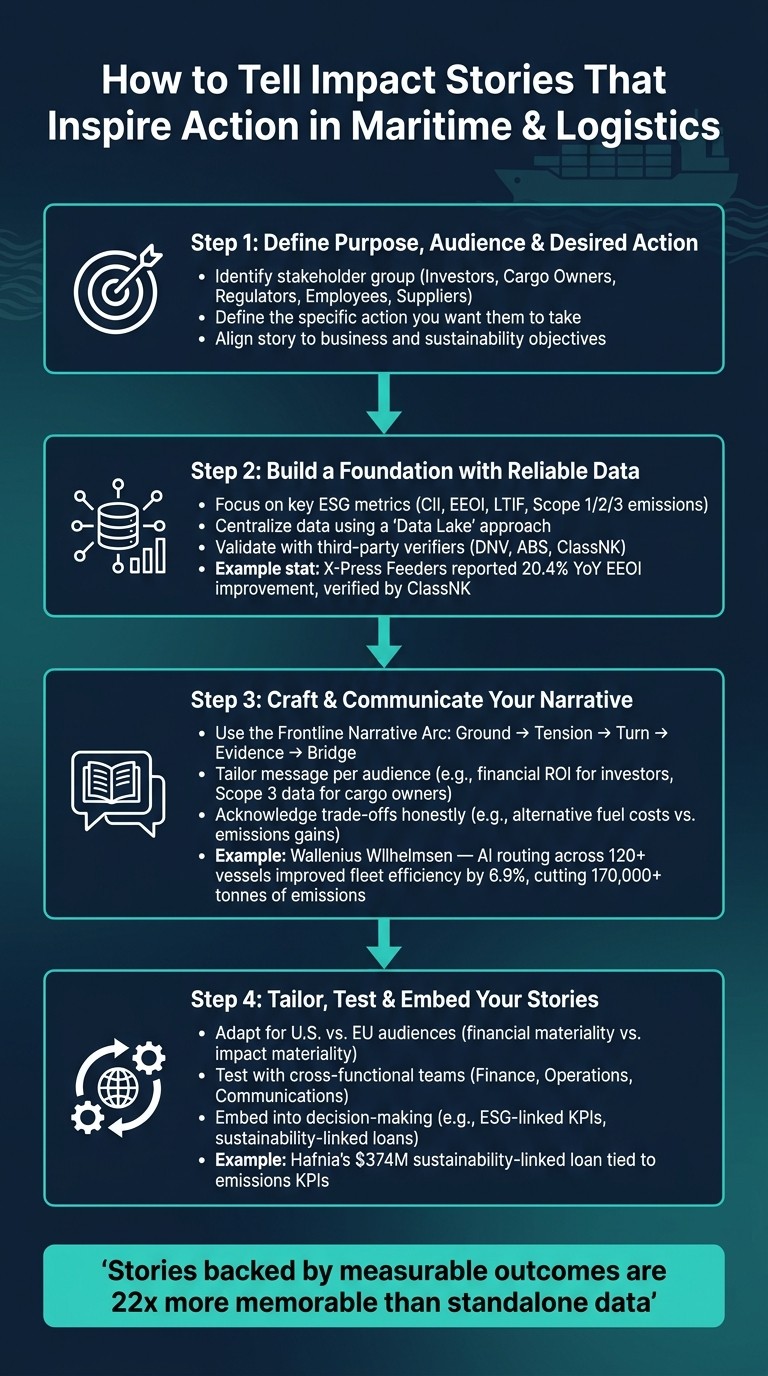
How to Tell Impact Stories That Drive Action in Maritime & Logistics
Step 1: Define Your Purpose, Audience, and Desired Action
Before you begin crafting your narrative, it’s essential to address three fundamental questions: Who is your audience? What action do you want them to take? And how does this align with your organization’s larger objectives? Skipping this step can leave your impact stories disconnected and ineffective. By targeting a specific audience, you ensure your message resonates and drives meaningful engagement.
Mapping Stakeholders and Target Outcomes
Different stakeholders have distinct priorities, so tailoring your story to each group is crucial. Regulators might focus on compliance, while investors look for financial risk management. Cargo owners, on the other hand, need accurate Scope 3 emissions data to support their own reporting. The table below highlights key stakeholder groups in maritime and logistics, their primary engagement channels, and what they typically expect:
Stakeholder Group | Primary Engagement Channels | Key ESG Expectations |
|---|---|---|
Customers/Cargo Owners | Strategic customer councils, tender processes | Net-zero supply chain solutions, Scope 3 data |
Investors | ESG roadshows, earnings calls, AGMs | Risk mitigation, financial materiality, ROI |
Regulators | Compliance with IMO/EU laws, industry leadership | |
Employees/Crews | Engagement surveys, union dialogues | Safety (LTIF), fair wages, inclusion, development |
Suppliers | Audits, relationship frameworks, workshops | Fair business opportunities, strategic partnerships |
Once you’ve identified your audience, define a clear and specific action you want them to take. Whether it’s approving a budget, revising a policy, or adopting a new initiative, the call to action should align with their priorities and your goals.
Connecting Stories to Business and Sustainability Goals
Impact stories gain strength when tied directly to business or sustainability objectives. Whether the focus is meeting an IMO carbon intensity target, advancing a circular economy initiative, or showcasing supply chain resilience, the narrative must reflect a clear connection to measurable outcomes. This approach ensures your story feels grounded and relevant to your audience.
"The best sustainability stories are the ones that share an authentic journey, struggles and all. By reframing challenges as opportunities, B2B organizations can create narratives that resonate deeply with decision-makers." - Martha Marchesi, CEO, JK Communications [2]
For example, when discussing technical improvements like fuel efficiency, link them to specific goals such as achieving carbon intensity reductions or delivering cost savings. This dual focus appeals to both sustainability advocates and financially driven stakeholders, keeping your narrative balanced and impactful.
Building a Narrative Planning Framework
A structured framework helps keep your storytelling consistent and goal-oriented. Before drafting your narrative, consider these five core elements:
Audience: Who are you addressing? Be as specific as possible.
Objective: What action or change in perception are you aiming for?
Key Metric: What measurable data point anchors your story?
Core Message: What is the central takeaway you want your audience to remember?
Channel: Where and how will you deliver your story?
To ensure your message resonates, create 2–3 detailed personas for each audience segment. For instance, a fleet operations manager and a sustainability-focused pension fund manager may both care about emissions, but they’ll need the information framed differently to match their unique perspectives.
This planning framework not only keeps your narrative focused but also lays the groundwork for integrating measurable data in the next step.
Step 2: Build a Foundation with Reliable Data
A compelling impact narrative starts with solid, measurable data. Before you dive into storytelling, establish clear parameters: what are you measuring, how will you collect it, and can it withstand scrutiny?
Identifying Key Impact Areas to Measure
For maritime and logistics companies, the sheer number of potential impact areas can be overwhelming. Trying to measure everything often results in confusion rather than clarity. Instead, focus on the areas that matter most to your stakeholders and align with your business objectives.
Here’s a breakdown of core ESG categories, the metrics to prioritize, and the tools that add credibility to your data:
ESG Category | Key Metrics to Track | Recommended Frameworks/Tools |
|---|---|---|
Emissions & Climate | CII rating, AER, EEOI, Scope 1/2/3 emissions | IMO DCS, EU MRV, Poseidon Principles |
Fuel Efficiency | Fuel consumption per voyage, gCO2/DWT-Nm | ISO 19847/48, DNV Veracity |
Worker Safety | Lost Time Injury Frequency (LTIF), near-miss rates | ILO MLC, ISM Code |
Community & Social | Local hiring rates, port community investments | |
Cost & Risk Reduction | Operational cost savings, downtime reduction | Internal benchmarks, audited financials |
Collecting Accurate and Consistent Data
The maritime sector doesn’t lack data - it suffers from fragmentation. Voyage logs, port metrics, and supply chain stats often exist in separate systems, making it difficult to create a cohesive narrative.
The key is centralization. A "Data Lake" - a centralized repository connecting vessel performance, port operations, and supply chain data - ensures consistency. Pair this with the "Collect Once, Use Many" principle: gather and validate data like vessel emissions once, then apply it across multiple reporting frameworks such as IMO DCS, EU MRV, and Poseidon Principles. This approach not only reduces workload for crews but also eliminates discrepancies between reports.
Third-party validation is becoming essential as stakeholders demand greater transparency. Organizations such as DNV, ABS, and ClassNK provide independent verification of ESG metrics. The trend is shifting from "limited assurance" to "reasonable assurance" as regulatory oversight intensifies. For example, X-Press Feeders showcased this by reporting a 20.4% year-over-year improvement in their EEOI (20.430 gCO2e/MT-Nm), with ClassNK independently verifying the data. This added credibility resonated with both investors and regulators.
With a centralized and verified data pool, you’re ready to craft impactful claims that resonate with your audience.
Turning Data into Clear Impact Claims
Numbers alone don’t tell a story - they need context. The most effective claims use baseline comparisons, percentage improvements, and before-and-after framing to make the data relatable.
One strategy is the "Frontline Narrative Arc": set the stage (Ground), highlight the issue (Tension), explain the action taken (Turn), present data-backed results (Evidence), and tie it to audience priorities (Bridge) [1]. For instance, instead of vaguely stating "we reduced emissions", Wallenius Wilhelmsen offered this: "By deploying AI-powered performance routing across 120+ vessels, we improved fleet efficiency by 6.9% and are on track to cut over 170,000 tonnes of emissions." This impactful claim was made possible through DeepSea’s routing system, as noted by Adam Larsson, Senior Manager of Energy Efficiency and Performance.
When presenting data, specificity is key. Avoid vague or aspirational statements - make every figure feel concrete and earned. This structured, data-driven approach sets the stage for the narrative techniques explored in the next step.
Step 3: Craft and Communicate Your Narrative
Once you've collected solid data, the next step is shaping a narrative that resonates. While data builds trust, it's the story that motivates action.
Structuring Impact Stories for Complex Systems
Using your verified data, structure your narrative to reflect the intricate connections within maritime systems. In maritime and logistics operations, changes in one area often ripple through the entire supply chain. Your story must capture this complexity while remaining clear and accessible.
A modular framework can help organize your narrative effectively. Move through these stages: establish the business context, define materiality, set specific objectives, show progress with clear comparisons, explain decisions made, and finish with an outlook [3].
Here's an example of how each narrative element functions in the maritime world:
Narrative Element | Purpose | Maritime/Logistics Example |
|---|---|---|
Status Quo | Provides the baseline and operational context | Current fleet age, fuel mix, and regulatory landscape (e.g., IMO/EU ETS) |
Catalyst | Highlights the driver for change | New carbon taxes, customer Scope 3 data demands, or advancements in technology |
Interventions | Details specific actions taken | Retrofitting 200 vessels with bulbous bows; switching to methanol dual-fuel |
Outcomes | Showcases measurable results and lessons learned | 8% reduction in total fuel consumption; 20% improvement in AER |
Positioning your company as a "catalyst of transformation" instead of just an operator can also elevate your narrative. For instance, A.P. Moller–Maersk’s collaboration with Swedish retailer ICA on the "ECO Delivery" program went beyond optimizing fleet performance. It demonstrated how Maersk’s infrastructure enabled ICA to move 80% of its ocean inventory sustainably, cutting over 3,500 tonnes of CO2e in 2024 [2]. This type of value chain narrative appeals to a broad range of stakeholders.
A well-structured story like this makes even the most technical data relatable and impactful.
Making Technical Concepts Easy to Understand
Your audience isn't limited to technical experts. Procurement managers, investors, and policymakers will also engage with your message. A layered information approach can bridge this gap: start with a universal narrative that’s easy to follow, then provide additional details tailored to specific audiences [2].
For U.S.-based stakeholders, converting metrics into familiar formats - like miles, pounds, and U.S. dollars - makes the scale of your story instantly clear.
The following table shows how to adapt your narrative for various audiences, building on the stakeholder mapping from Step 1:
Stakeholder Group | What They Care About | How to Communicate |
|---|---|---|
Investors | Risk reduction and financial relevance | ESG-focused roadshows, earnings calls, Annual General Meetings |
Cargo Owners | Net-zero supply chain solutions and verified Scope 3 data | Strategic Customer Councils, tender processes |
Regulators | Compliance with environmental laws and standards | Industry associations (e.g., BIMCO, WSC), bilateral meetings |
Crews/Unions | Fair wages, safety, and inclusion | Engagement surveys, union dialogues |
When departments like Finance and Procurement align behind a shared sustainability story, the commitments become more credible and actionable [3].
Addressing Trade-Offs and Constraints Honestly
Credibility comes from acknowledging challenges as well as successes. Transparency not only reflects ethical behavior but also strengthens your strategic standing. Stakeholders today expect openness, and avoiding difficult topics can make your story feel like marketing rather than leadership.
Be upfront about the trade-offs in your sustainability efforts. For example, transitioning to alternative fuels like ammonia or methanol may reduce emissions but comes with higher upfront costs and the need for additional safety training. Similarly, slow steaming can cut fuel use but may extend delivery times - something cargo owners must weigh carefully. Discussing these trade-offs builds trust and encourages meaningful dialogue.
Constraint/Trade-off | Impact on Storytelling | Recommended Transparency Action |
|---|---|---|
Alternative fuel costs vs. emissions gains | May seem financially unfeasible | Share total cost of ownership (TCO) projections alongside emissions data |
Slow steaming vs. delivery timelines | Could conflict with customer service expectations | Quantify emissions benefits and offer opt-in choices for customers |
Data gaps in Scope 3 reporting | Can weaken supply chain claims | Disclose methodology, assumptions, and third-party verification status |
Regulatory uncertainty | Makes long-term goals harder to justify | Present targets as directional with planned review milestones |
An honest narrative that openly discusses uncertainties while outlining efforts to address them fosters deeper trust with stakeholders.
Step 4: Tailor, Test, and Embed Your Stories
An impact story only resonates if it’s aimed at the right audience. Once you’ve built a narrative rooted in accurate data and a clear framework, the next step is ensuring it connects effectively - whether with stakeholders, global partners, or internal teams.
Adapting Stories for U.S. and International Audiences
How a story is received often depends on the audience. For example, U.S. investors tend to focus on climate risks, long-term value, and compliance with SEC climate disclosure rules. On the other hand, EU-based partners and regulators emphasize adherence to frameworks like CSRD and EU ETS, alongside transparency in Scope 3 emissions across the supply chain. This means you’ll need tailored versions of the same narrative: a financial materiality-focused story appeals to U.S. investors, while a version centered on impact materiality and verified emissions data aligns better with EU priorities.
To maintain consistency and reduce errors, repurpose validated data across multiple reporting frameworks. For instance, data used in IMO DCS submissions, EU MRV reports, and customer-specific Scope 3 reports can be adapted to fit different contexts without duplication.
Testing and Refining Your Narratives
Before launching a narrative broadly, test it with a small, cross-functional group. Include representatives from Finance, Operations, and Communications to identify any gaps in logic, data accuracy, or tone. Once it passes internal review, take it to external audiences.
For example, in November 2022, A.P. Moller–Maersk held a virtual "Investor ESG Day", where executives presented their decarbonization strategies and addressed investor concerns about green fuels and biodiversity. Events like these are invaluable for testing your narrative. The questions and feedback you receive highlight areas needing clarification. Additionally, track metrics like downloads, shares, and follow-up inquiries to gauge engagement. Sentiment analysis of social media responses can further reveal how your story is being interpreted, offering actionable insights for revisions. Once refined externally, bring the narrative back into the organization to ensure alignment and accountability.
Embedding Stories into Decision-Making Processes
The most impactful stories don’t just live in reports - they become part of the organization’s operational DNA. A.P. Moller–Maersk, for instance, replaced its ESG Committee with a dedicated Energy Transition Committee to oversee net-zero goals. This committee operates under a "Commit" framework, which includes 35 governance rules, each assigned to a specific owner responsible for quarterly compliance reporting [2]. By integrating the narrative into internal processes, the story drives accountability at every level.
Tying leadership compensation to ESG targets is another way to embed impact stories into operations. For example, in March 2021, Hafnia secured a $374 million Sustainability-Linked Senior Secure Term Loan with terms directly tied to emissions-related KPIs and IMO targets. Sustainalytics oversees these metrics [2]. Here, the impact story isn’t just a communication tool - it’s woven into the company’s financial agreements.
"The ambition is to capture high-frequency data without human involvement, making reliable real-time data easily accessible and visualizing it in a user-friendly way, which is key to making better decisions." - Lars Pedersen, Chief Technical Officer, Frontline [4]
Conclusion: Building a Long-Term Impact Storytelling Practice
The steps discussed earlier form the backbone of a storytelling strategy that not only fosters accountability but also motivates meaningful action.
Key Takeaways
Effective impact storytelling in maritime and logistics hinges on four essential practices: setting clear objectives, anchoring stories in reliable data, being transparent about trade-offs, and integrating narratives into operational and financial strategies. Together, these elements elevate your storytelling from simple communication to a tool for driving accountability.
By mapping your value chain, you can identify where sustainability efforts generate the greatest value for downstream partners. This positions your organization as a leader driving industry-wide progress, rather than acting in isolation - making your story resonate on a broader scale and ensuring it remains relevant over time [2].
These methods lay the groundwork for a dynamic, organization-wide approach to sustainability storytelling.
Treating Sustainability as a Story That Keeps Evolving
With a structured narrative as your base, sustainability storytelling becomes a continuous process. Sustainability isn’t a one-time achievement; it’s an ongoing narrative that must adapt to changing regulations, shifting emissions goals, and advancements like alternative fuels.
The strongest companies approach their impact stories much like they handle their data: constantly revisiting, validating, and aligning them with the industry’s direction. This requires regularly updating your narrative framework - not just during reporting cycles - and involving the teams responsible for ESG commitments at every stage of the process. By doing so, your story remains both credible and forward-looking.
FAQs
What impact metrics should we track first?
To begin, carry out a materiality assessment to pinpoint the issues that are most critical to your operations and stakeholders. Establish baseline metrics for essential ESG factors to guide your focus:
Environmental: Track emissions per ton-kilometer, fuel efficiency, energy consumption, and your total carbon footprint, including Scope 3 emissions.
Social: Measure indicators like Lost Time Injury Frequency (LTIF), workforce diversity, and levels of community engagement.
Governance: Evaluate the effectiveness of anti-corruption policies and the transparency within your supply chain.
Ensure these metrics are tied to financial outcomes, such as savings from improved fuel efficiency or reduced risks, to illustrate their broader impact.
How can we prove our ESG claims are credible?
To make your ESG claims trustworthy, support them with solid, verifiable data. This can include documentation such as third-party audits, certifications, or energy usage records. Avoid making statements that lack evidence. Transparency is key - share not only your achievements but also the hurdles you face, demonstrating responsibility and openness. Independent validation can help meet stakeholder expectations effectively, while digital tools can centralize your data, minimizing errors and ensuring consistency across various reporting frameworks.
How do we turn a sustainability win into action?
To make a sustainability achievement resonate, focus on crafting a clear and data-backed narrative. Ground your success in measurable objectives to establish trust and reliability. Share the reasoning and steps behind your accomplishment, being transparent about any obstacles encountered to build a sense of authenticity. Conclude with actionable steps that invite feedback and collaboration, turning your achievement into a catalyst for engaging stakeholders effectively.
Related Blog Posts
How to Build a Corporate Sustainability Strategy Aligned to ROI for Maritime & Logistics Companies
How to Align Stakeholders Around a Shared ESG Vision for Maritime & Logistics Companies
How to Communicate ESG Progress Credibly for Maritime & Logistics Companies
How to Communicate Sustainability to Non-Technical Audiences for Maritime & Logistics Companies
Latest Articles
©2025

Narrative Change and Power Building: The Missing Half of Advocacy
Narrative change is the process of disrupting dominant narratives that normalize inequity and advancing new narratives from historically marginalized communities.

Funding Resilience Without Federal Grants
BRIC is unreliable and FEMA is shrinking. Here's how cities fund climate resilience with dedicated revenue, blended finance, and a coordinating authority.

The ESG Blind Spot: How AI Is Finding Risks in Companies Nobody Else Is Watching
Norway's sovereign wealth fund uses AI to screen 7,200 portfolio companies for forced labor and corruption within 24 hours. The real story is the emerging-market coverage gap that traditional ESG data vendors miss — and what it means for any company with a global supply chain.
Narrative Change and Power Building: The Missing Half of Advocacy
Narrative change is the process of disrupting dominant narratives that normalize inequity and advancing new narratives from historically marginalized communities.
Funding Resilience Without Federal Grants
BRIC is unreliable and FEMA is shrinking. Here's how cities fund climate resilience with dedicated revenue, blended finance, and a coordinating authority.
The ESG Blind Spot: How AI Is Finding Risks in Companies Nobody Else Is Watching
Norway's sovereign wealth fund uses AI to screen 7,200 portfolio companies for forced labor and corruption within 24 hours. The real story is the emerging-market coverage gap that traditional ESG data vendors miss — and what it means for any company with a global supply chain.
FAQ
01
What does it really mean to “redefine profit”?
02
What makes Council Fire different?
03
Who does Council Fire work with?
04
What does working with Council Fire actually look like?
05
How does Council Fire help organizations turn big goals into action?
06
How does Council Fire define and measure success?
May 21, 2026
How to Tell Impact Stories That Inspire Action for Maritime & Logistics Companies
ESG Strategy
In This Article
Turn verified emissions and efficiency data into clear, honest narratives that persuade investors, cargo owners, and regulators to act.
How to Tell Impact Stories That Inspire Action for Maritime & Logistics Companies
The maritime and logistics sector handles 90% of global trade but often struggles to effectively communicate its efforts in reducing emissions and improving operations. While raw data and compliance reports are abundant, they fail to inspire action or build trust with stakeholders. Impact stories bridge this gap by transforming technical achievements into relatable narratives that resonate with investors, cargo owners, regulators, and employees.
Key Insights:
Why Stories Matter: Stakeholders value specific, verifiable examples over broad claims like "net-zero by 2050." Stories backed by measurable outcomes are 22x more memorable than standalone data.
Stakeholder Focus: Tailor narratives to specific groups - investors prioritize ROI, while cargo owners seek Scope 3 emissions data for their reports.
Data as the Foundation: Centralized, verified data ensures consistency and credibility, turning metrics into meaningful claims.
Transparent Challenges: Acknowledge trade-offs, like balancing alternative fuel costs with emissions reductions, to build trust.
Embedding Stories: Align stories with business goals and integrate them into decision-making processes for lasting impact.
Practical Steps:
Define your audience and the specific action you want them to take.
Build narratives around measurable outcomes, linking them to business and sustainability objectives.
Use clear structures to simplify complex data and make stories relatable.
Be transparent about constraints and trade-offs to maintain trust.
Test, refine, and integrate stories across internal and external channels.
Impact stories are not just about showcasing progress - they drive accountability and inspire meaningful action across the maritime value chain.
How to Tell Impact Stories That Drive Action in Maritime & Logistics
Step 1: Define Your Purpose, Audience, and Desired Action
Before you begin crafting your narrative, it’s essential to address three fundamental questions: Who is your audience? What action do you want them to take? And how does this align with your organization’s larger objectives? Skipping this step can leave your impact stories disconnected and ineffective. By targeting a specific audience, you ensure your message resonates and drives meaningful engagement.
Mapping Stakeholders and Target Outcomes
Different stakeholders have distinct priorities, so tailoring your story to each group is crucial. Regulators might focus on compliance, while investors look for financial risk management. Cargo owners, on the other hand, need accurate Scope 3 emissions data to support their own reporting. The table below highlights key stakeholder groups in maritime and logistics, their primary engagement channels, and what they typically expect:
Stakeholder Group | Primary Engagement Channels | Key ESG Expectations |
|---|---|---|
Customers/Cargo Owners | Strategic customer councils, tender processes | Net-zero supply chain solutions, Scope 3 data |
Investors | ESG roadshows, earnings calls, AGMs | Risk mitigation, financial materiality, ROI |
Regulators | Compliance with IMO/EU laws, industry leadership | |
Employees/Crews | Engagement surveys, union dialogues | Safety (LTIF), fair wages, inclusion, development |
Suppliers | Audits, relationship frameworks, workshops | Fair business opportunities, strategic partnerships |
Once you’ve identified your audience, define a clear and specific action you want them to take. Whether it’s approving a budget, revising a policy, or adopting a new initiative, the call to action should align with their priorities and your goals.
Connecting Stories to Business and Sustainability Goals
Impact stories gain strength when tied directly to business or sustainability objectives. Whether the focus is meeting an IMO carbon intensity target, advancing a circular economy initiative, or showcasing supply chain resilience, the narrative must reflect a clear connection to measurable outcomes. This approach ensures your story feels grounded and relevant to your audience.
"The best sustainability stories are the ones that share an authentic journey, struggles and all. By reframing challenges as opportunities, B2B organizations can create narratives that resonate deeply with decision-makers." - Martha Marchesi, CEO, JK Communications [2]
For example, when discussing technical improvements like fuel efficiency, link them to specific goals such as achieving carbon intensity reductions or delivering cost savings. This dual focus appeals to both sustainability advocates and financially driven stakeholders, keeping your narrative balanced and impactful.
Building a Narrative Planning Framework
A structured framework helps keep your storytelling consistent and goal-oriented. Before drafting your narrative, consider these five core elements:
Audience: Who are you addressing? Be as specific as possible.
Objective: What action or change in perception are you aiming for?
Key Metric: What measurable data point anchors your story?
Core Message: What is the central takeaway you want your audience to remember?
Channel: Where and how will you deliver your story?
To ensure your message resonates, create 2–3 detailed personas for each audience segment. For instance, a fleet operations manager and a sustainability-focused pension fund manager may both care about emissions, but they’ll need the information framed differently to match their unique perspectives.
This planning framework not only keeps your narrative focused but also lays the groundwork for integrating measurable data in the next step.
Step 2: Build a Foundation with Reliable Data
A compelling impact narrative starts with solid, measurable data. Before you dive into storytelling, establish clear parameters: what are you measuring, how will you collect it, and can it withstand scrutiny?
Identifying Key Impact Areas to Measure
For maritime and logistics companies, the sheer number of potential impact areas can be overwhelming. Trying to measure everything often results in confusion rather than clarity. Instead, focus on the areas that matter most to your stakeholders and align with your business objectives.
Here’s a breakdown of core ESG categories, the metrics to prioritize, and the tools that add credibility to your data:
ESG Category | Key Metrics to Track | Recommended Frameworks/Tools |
|---|---|---|
Emissions & Climate | CII rating, AER, EEOI, Scope 1/2/3 emissions | IMO DCS, EU MRV, Poseidon Principles |
Fuel Efficiency | Fuel consumption per voyage, gCO2/DWT-Nm | ISO 19847/48, DNV Veracity |
Worker Safety | Lost Time Injury Frequency (LTIF), near-miss rates | ILO MLC, ISM Code |
Community & Social | Local hiring rates, port community investments | |
Cost & Risk Reduction | Operational cost savings, downtime reduction | Internal benchmarks, audited financials |
Collecting Accurate and Consistent Data
The maritime sector doesn’t lack data - it suffers from fragmentation. Voyage logs, port metrics, and supply chain stats often exist in separate systems, making it difficult to create a cohesive narrative.
The key is centralization. A "Data Lake" - a centralized repository connecting vessel performance, port operations, and supply chain data - ensures consistency. Pair this with the "Collect Once, Use Many" principle: gather and validate data like vessel emissions once, then apply it across multiple reporting frameworks such as IMO DCS, EU MRV, and Poseidon Principles. This approach not only reduces workload for crews but also eliminates discrepancies between reports.
Third-party validation is becoming essential as stakeholders demand greater transparency. Organizations such as DNV, ABS, and ClassNK provide independent verification of ESG metrics. The trend is shifting from "limited assurance" to "reasonable assurance" as regulatory oversight intensifies. For example, X-Press Feeders showcased this by reporting a 20.4% year-over-year improvement in their EEOI (20.430 gCO2e/MT-Nm), with ClassNK independently verifying the data. This added credibility resonated with both investors and regulators.
With a centralized and verified data pool, you’re ready to craft impactful claims that resonate with your audience.
Turning Data into Clear Impact Claims
Numbers alone don’t tell a story - they need context. The most effective claims use baseline comparisons, percentage improvements, and before-and-after framing to make the data relatable.
One strategy is the "Frontline Narrative Arc": set the stage (Ground), highlight the issue (Tension), explain the action taken (Turn), present data-backed results (Evidence), and tie it to audience priorities (Bridge) [1]. For instance, instead of vaguely stating "we reduced emissions", Wallenius Wilhelmsen offered this: "By deploying AI-powered performance routing across 120+ vessels, we improved fleet efficiency by 6.9% and are on track to cut over 170,000 tonnes of emissions." This impactful claim was made possible through DeepSea’s routing system, as noted by Adam Larsson, Senior Manager of Energy Efficiency and Performance.
When presenting data, specificity is key. Avoid vague or aspirational statements - make every figure feel concrete and earned. This structured, data-driven approach sets the stage for the narrative techniques explored in the next step.
Step 3: Craft and Communicate Your Narrative
Once you've collected solid data, the next step is shaping a narrative that resonates. While data builds trust, it's the story that motivates action.
Structuring Impact Stories for Complex Systems
Using your verified data, structure your narrative to reflect the intricate connections within maritime systems. In maritime and logistics operations, changes in one area often ripple through the entire supply chain. Your story must capture this complexity while remaining clear and accessible.
A modular framework can help organize your narrative effectively. Move through these stages: establish the business context, define materiality, set specific objectives, show progress with clear comparisons, explain decisions made, and finish with an outlook [3].
Here's an example of how each narrative element functions in the maritime world:
Narrative Element | Purpose | Maritime/Logistics Example |
|---|---|---|
Status Quo | Provides the baseline and operational context | Current fleet age, fuel mix, and regulatory landscape (e.g., IMO/EU ETS) |
Catalyst | Highlights the driver for change | New carbon taxes, customer Scope 3 data demands, or advancements in technology |
Interventions | Details specific actions taken | Retrofitting 200 vessels with bulbous bows; switching to methanol dual-fuel |
Outcomes | Showcases measurable results and lessons learned | 8% reduction in total fuel consumption; 20% improvement in AER |
Positioning your company as a "catalyst of transformation" instead of just an operator can also elevate your narrative. For instance, A.P. Moller–Maersk’s collaboration with Swedish retailer ICA on the "ECO Delivery" program went beyond optimizing fleet performance. It demonstrated how Maersk’s infrastructure enabled ICA to move 80% of its ocean inventory sustainably, cutting over 3,500 tonnes of CO2e in 2024 [2]. This type of value chain narrative appeals to a broad range of stakeholders.
A well-structured story like this makes even the most technical data relatable and impactful.
Making Technical Concepts Easy to Understand
Your audience isn't limited to technical experts. Procurement managers, investors, and policymakers will also engage with your message. A layered information approach can bridge this gap: start with a universal narrative that’s easy to follow, then provide additional details tailored to specific audiences [2].
For U.S.-based stakeholders, converting metrics into familiar formats - like miles, pounds, and U.S. dollars - makes the scale of your story instantly clear.
The following table shows how to adapt your narrative for various audiences, building on the stakeholder mapping from Step 1:
Stakeholder Group | What They Care About | How to Communicate |
|---|---|---|
Investors | Risk reduction and financial relevance | ESG-focused roadshows, earnings calls, Annual General Meetings |
Cargo Owners | Net-zero supply chain solutions and verified Scope 3 data | Strategic Customer Councils, tender processes |
Regulators | Compliance with environmental laws and standards | Industry associations (e.g., BIMCO, WSC), bilateral meetings |
Crews/Unions | Fair wages, safety, and inclusion | Engagement surveys, union dialogues |
When departments like Finance and Procurement align behind a shared sustainability story, the commitments become more credible and actionable [3].
Addressing Trade-Offs and Constraints Honestly
Credibility comes from acknowledging challenges as well as successes. Transparency not only reflects ethical behavior but also strengthens your strategic standing. Stakeholders today expect openness, and avoiding difficult topics can make your story feel like marketing rather than leadership.
Be upfront about the trade-offs in your sustainability efforts. For example, transitioning to alternative fuels like ammonia or methanol may reduce emissions but comes with higher upfront costs and the need for additional safety training. Similarly, slow steaming can cut fuel use but may extend delivery times - something cargo owners must weigh carefully. Discussing these trade-offs builds trust and encourages meaningful dialogue.
Constraint/Trade-off | Impact on Storytelling | Recommended Transparency Action |
|---|---|---|
Alternative fuel costs vs. emissions gains | May seem financially unfeasible | Share total cost of ownership (TCO) projections alongside emissions data |
Slow steaming vs. delivery timelines | Could conflict with customer service expectations | Quantify emissions benefits and offer opt-in choices for customers |
Data gaps in Scope 3 reporting | Can weaken supply chain claims | Disclose methodology, assumptions, and third-party verification status |
Regulatory uncertainty | Makes long-term goals harder to justify | Present targets as directional with planned review milestones |
An honest narrative that openly discusses uncertainties while outlining efforts to address them fosters deeper trust with stakeholders.
Step 4: Tailor, Test, and Embed Your Stories
An impact story only resonates if it’s aimed at the right audience. Once you’ve built a narrative rooted in accurate data and a clear framework, the next step is ensuring it connects effectively - whether with stakeholders, global partners, or internal teams.
Adapting Stories for U.S. and International Audiences
How a story is received often depends on the audience. For example, U.S. investors tend to focus on climate risks, long-term value, and compliance with SEC climate disclosure rules. On the other hand, EU-based partners and regulators emphasize adherence to frameworks like CSRD and EU ETS, alongside transparency in Scope 3 emissions across the supply chain. This means you’ll need tailored versions of the same narrative: a financial materiality-focused story appeals to U.S. investors, while a version centered on impact materiality and verified emissions data aligns better with EU priorities.
To maintain consistency and reduce errors, repurpose validated data across multiple reporting frameworks. For instance, data used in IMO DCS submissions, EU MRV reports, and customer-specific Scope 3 reports can be adapted to fit different contexts without duplication.
Testing and Refining Your Narratives
Before launching a narrative broadly, test it with a small, cross-functional group. Include representatives from Finance, Operations, and Communications to identify any gaps in logic, data accuracy, or tone. Once it passes internal review, take it to external audiences.
For example, in November 2022, A.P. Moller–Maersk held a virtual "Investor ESG Day", where executives presented their decarbonization strategies and addressed investor concerns about green fuels and biodiversity. Events like these are invaluable for testing your narrative. The questions and feedback you receive highlight areas needing clarification. Additionally, track metrics like downloads, shares, and follow-up inquiries to gauge engagement. Sentiment analysis of social media responses can further reveal how your story is being interpreted, offering actionable insights for revisions. Once refined externally, bring the narrative back into the organization to ensure alignment and accountability.
Embedding Stories into Decision-Making Processes
The most impactful stories don’t just live in reports - they become part of the organization’s operational DNA. A.P. Moller–Maersk, for instance, replaced its ESG Committee with a dedicated Energy Transition Committee to oversee net-zero goals. This committee operates under a "Commit" framework, which includes 35 governance rules, each assigned to a specific owner responsible for quarterly compliance reporting [2]. By integrating the narrative into internal processes, the story drives accountability at every level.
Tying leadership compensation to ESG targets is another way to embed impact stories into operations. For example, in March 2021, Hafnia secured a $374 million Sustainability-Linked Senior Secure Term Loan with terms directly tied to emissions-related KPIs and IMO targets. Sustainalytics oversees these metrics [2]. Here, the impact story isn’t just a communication tool - it’s woven into the company’s financial agreements.
"The ambition is to capture high-frequency data without human involvement, making reliable real-time data easily accessible and visualizing it in a user-friendly way, which is key to making better decisions." - Lars Pedersen, Chief Technical Officer, Frontline [4]
Conclusion: Building a Long-Term Impact Storytelling Practice
The steps discussed earlier form the backbone of a storytelling strategy that not only fosters accountability but also motivates meaningful action.
Key Takeaways
Effective impact storytelling in maritime and logistics hinges on four essential practices: setting clear objectives, anchoring stories in reliable data, being transparent about trade-offs, and integrating narratives into operational and financial strategies. Together, these elements elevate your storytelling from simple communication to a tool for driving accountability.
By mapping your value chain, you can identify where sustainability efforts generate the greatest value for downstream partners. This positions your organization as a leader driving industry-wide progress, rather than acting in isolation - making your story resonate on a broader scale and ensuring it remains relevant over time [2].
These methods lay the groundwork for a dynamic, organization-wide approach to sustainability storytelling.
Treating Sustainability as a Story That Keeps Evolving
With a structured narrative as your base, sustainability storytelling becomes a continuous process. Sustainability isn’t a one-time achievement; it’s an ongoing narrative that must adapt to changing regulations, shifting emissions goals, and advancements like alternative fuels.
The strongest companies approach their impact stories much like they handle their data: constantly revisiting, validating, and aligning them with the industry’s direction. This requires regularly updating your narrative framework - not just during reporting cycles - and involving the teams responsible for ESG commitments at every stage of the process. By doing so, your story remains both credible and forward-looking.
FAQs
What impact metrics should we track first?
To begin, carry out a materiality assessment to pinpoint the issues that are most critical to your operations and stakeholders. Establish baseline metrics for essential ESG factors to guide your focus:
Environmental: Track emissions per ton-kilometer, fuel efficiency, energy consumption, and your total carbon footprint, including Scope 3 emissions.
Social: Measure indicators like Lost Time Injury Frequency (LTIF), workforce diversity, and levels of community engagement.
Governance: Evaluate the effectiveness of anti-corruption policies and the transparency within your supply chain.
Ensure these metrics are tied to financial outcomes, such as savings from improved fuel efficiency or reduced risks, to illustrate their broader impact.
How can we prove our ESG claims are credible?
To make your ESG claims trustworthy, support them with solid, verifiable data. This can include documentation such as third-party audits, certifications, or energy usage records. Avoid making statements that lack evidence. Transparency is key - share not only your achievements but also the hurdles you face, demonstrating responsibility and openness. Independent validation can help meet stakeholder expectations effectively, while digital tools can centralize your data, minimizing errors and ensuring consistency across various reporting frameworks.
How do we turn a sustainability win into action?
To make a sustainability achievement resonate, focus on crafting a clear and data-backed narrative. Ground your success in measurable objectives to establish trust and reliability. Share the reasoning and steps behind your accomplishment, being transparent about any obstacles encountered to build a sense of authenticity. Conclude with actionable steps that invite feedback and collaboration, turning your achievement into a catalyst for engaging stakeholders effectively.
Related Blog Posts
How to Build a Corporate Sustainability Strategy Aligned to ROI for Maritime & Logistics Companies
How to Align Stakeholders Around a Shared ESG Vision for Maritime & Logistics Companies
How to Communicate ESG Progress Credibly for Maritime & Logistics Companies
How to Communicate Sustainability to Non-Technical Audiences for Maritime & Logistics Companies
Latest Articles
©2025
Narrative Change and Power Building: The Missing Half of Advocacy
Narrative change is the process of disrupting dominant narratives that normalize inequity and advancing new narratives from historically marginalized communities.
Funding Resilience Without Federal Grants
BRIC is unreliable and FEMA is shrinking. Here's how cities fund climate resilience with dedicated revenue, blended finance, and a coordinating authority.
The ESG Blind Spot: How AI Is Finding Risks in Companies Nobody Else Is Watching
Norway's sovereign wealth fund uses AI to screen 7,200 portfolio companies for forced labor and corruption within 24 hours. The real story is the emerging-market coverage gap that traditional ESG data vendors miss — and what it means for any company with a global supply chain.
FAQ
01
What does it really mean to “redefine profit”?
02
What makes Council Fire different?
03
Who does Council Fire work with?
04
What does working with Council Fire actually look like?
05
How does Council Fire help organizations turn big goals into action?
06
How does Council Fire define and measure success?
May 21, 2026
How to Tell Impact Stories That Inspire Action for Maritime & Logistics Companies
ESG Strategy
In This Article
Turn verified emissions and efficiency data into clear, honest narratives that persuade investors, cargo owners, and regulators to act.
How to Tell Impact Stories That Inspire Action for Maritime & Logistics Companies
The maritime and logistics sector handles 90% of global trade but often struggles to effectively communicate its efforts in reducing emissions and improving operations. While raw data and compliance reports are abundant, they fail to inspire action or build trust with stakeholders. Impact stories bridge this gap by transforming technical achievements into relatable narratives that resonate with investors, cargo owners, regulators, and employees.
Key Insights:
Why Stories Matter: Stakeholders value specific, verifiable examples over broad claims like "net-zero by 2050." Stories backed by measurable outcomes are 22x more memorable than standalone data.
Stakeholder Focus: Tailor narratives to specific groups - investors prioritize ROI, while cargo owners seek Scope 3 emissions data for their reports.
Data as the Foundation: Centralized, verified data ensures consistency and credibility, turning metrics into meaningful claims.
Transparent Challenges: Acknowledge trade-offs, like balancing alternative fuel costs with emissions reductions, to build trust.
Embedding Stories: Align stories with business goals and integrate them into decision-making processes for lasting impact.
Practical Steps:
Define your audience and the specific action you want them to take.
Build narratives around measurable outcomes, linking them to business and sustainability objectives.
Use clear structures to simplify complex data and make stories relatable.
Be transparent about constraints and trade-offs to maintain trust.
Test, refine, and integrate stories across internal and external channels.
Impact stories are not just about showcasing progress - they drive accountability and inspire meaningful action across the maritime value chain.
How to Tell Impact Stories That Drive Action in Maritime & Logistics
Step 1: Define Your Purpose, Audience, and Desired Action
Before you begin crafting your narrative, it’s essential to address three fundamental questions: Who is your audience? What action do you want them to take? And how does this align with your organization’s larger objectives? Skipping this step can leave your impact stories disconnected and ineffective. By targeting a specific audience, you ensure your message resonates and drives meaningful engagement.
Mapping Stakeholders and Target Outcomes
Different stakeholders have distinct priorities, so tailoring your story to each group is crucial. Regulators might focus on compliance, while investors look for financial risk management. Cargo owners, on the other hand, need accurate Scope 3 emissions data to support their own reporting. The table below highlights key stakeholder groups in maritime and logistics, their primary engagement channels, and what they typically expect:
Stakeholder Group | Primary Engagement Channels | Key ESG Expectations |
|---|---|---|
Customers/Cargo Owners | Strategic customer councils, tender processes | Net-zero supply chain solutions, Scope 3 data |
Investors | ESG roadshows, earnings calls, AGMs | Risk mitigation, financial materiality, ROI |
Regulators | Compliance with IMO/EU laws, industry leadership | |
Employees/Crews | Engagement surveys, union dialogues | Safety (LTIF), fair wages, inclusion, development |
Suppliers | Audits, relationship frameworks, workshops | Fair business opportunities, strategic partnerships |
Once you’ve identified your audience, define a clear and specific action you want them to take. Whether it’s approving a budget, revising a policy, or adopting a new initiative, the call to action should align with their priorities and your goals.
Connecting Stories to Business and Sustainability Goals
Impact stories gain strength when tied directly to business or sustainability objectives. Whether the focus is meeting an IMO carbon intensity target, advancing a circular economy initiative, or showcasing supply chain resilience, the narrative must reflect a clear connection to measurable outcomes. This approach ensures your story feels grounded and relevant to your audience.
"The best sustainability stories are the ones that share an authentic journey, struggles and all. By reframing challenges as opportunities, B2B organizations can create narratives that resonate deeply with decision-makers." - Martha Marchesi, CEO, JK Communications [2]
For example, when discussing technical improvements like fuel efficiency, link them to specific goals such as achieving carbon intensity reductions or delivering cost savings. This dual focus appeals to both sustainability advocates and financially driven stakeholders, keeping your narrative balanced and impactful.
Building a Narrative Planning Framework
A structured framework helps keep your storytelling consistent and goal-oriented. Before drafting your narrative, consider these five core elements:
Audience: Who are you addressing? Be as specific as possible.
Objective: What action or change in perception are you aiming for?
Key Metric: What measurable data point anchors your story?
Core Message: What is the central takeaway you want your audience to remember?
Channel: Where and how will you deliver your story?
To ensure your message resonates, create 2–3 detailed personas for each audience segment. For instance, a fleet operations manager and a sustainability-focused pension fund manager may both care about emissions, but they’ll need the information framed differently to match their unique perspectives.
This planning framework not only keeps your narrative focused but also lays the groundwork for integrating measurable data in the next step.
Step 2: Build a Foundation with Reliable Data
A compelling impact narrative starts with solid, measurable data. Before you dive into storytelling, establish clear parameters: what are you measuring, how will you collect it, and can it withstand scrutiny?
Identifying Key Impact Areas to Measure
For maritime and logistics companies, the sheer number of potential impact areas can be overwhelming. Trying to measure everything often results in confusion rather than clarity. Instead, focus on the areas that matter most to your stakeholders and align with your business objectives.
Here’s a breakdown of core ESG categories, the metrics to prioritize, and the tools that add credibility to your data:
ESG Category | Key Metrics to Track | Recommended Frameworks/Tools |
|---|---|---|
Emissions & Climate | CII rating, AER, EEOI, Scope 1/2/3 emissions | IMO DCS, EU MRV, Poseidon Principles |
Fuel Efficiency | Fuel consumption per voyage, gCO2/DWT-Nm | ISO 19847/48, DNV Veracity |
Worker Safety | Lost Time Injury Frequency (LTIF), near-miss rates | ILO MLC, ISM Code |
Community & Social | Local hiring rates, port community investments | |
Cost & Risk Reduction | Operational cost savings, downtime reduction | Internal benchmarks, audited financials |
Collecting Accurate and Consistent Data
The maritime sector doesn’t lack data - it suffers from fragmentation. Voyage logs, port metrics, and supply chain stats often exist in separate systems, making it difficult to create a cohesive narrative.
The key is centralization. A "Data Lake" - a centralized repository connecting vessel performance, port operations, and supply chain data - ensures consistency. Pair this with the "Collect Once, Use Many" principle: gather and validate data like vessel emissions once, then apply it across multiple reporting frameworks such as IMO DCS, EU MRV, and Poseidon Principles. This approach not only reduces workload for crews but also eliminates discrepancies between reports.
Third-party validation is becoming essential as stakeholders demand greater transparency. Organizations such as DNV, ABS, and ClassNK provide independent verification of ESG metrics. The trend is shifting from "limited assurance" to "reasonable assurance" as regulatory oversight intensifies. For example, X-Press Feeders showcased this by reporting a 20.4% year-over-year improvement in their EEOI (20.430 gCO2e/MT-Nm), with ClassNK independently verifying the data. This added credibility resonated with both investors and regulators.
With a centralized and verified data pool, you’re ready to craft impactful claims that resonate with your audience.
Turning Data into Clear Impact Claims
Numbers alone don’t tell a story - they need context. The most effective claims use baseline comparisons, percentage improvements, and before-and-after framing to make the data relatable.
One strategy is the "Frontline Narrative Arc": set the stage (Ground), highlight the issue (Tension), explain the action taken (Turn), present data-backed results (Evidence), and tie it to audience priorities (Bridge) [1]. For instance, instead of vaguely stating "we reduced emissions", Wallenius Wilhelmsen offered this: "By deploying AI-powered performance routing across 120+ vessels, we improved fleet efficiency by 6.9% and are on track to cut over 170,000 tonnes of emissions." This impactful claim was made possible through DeepSea’s routing system, as noted by Adam Larsson, Senior Manager of Energy Efficiency and Performance.
When presenting data, specificity is key. Avoid vague or aspirational statements - make every figure feel concrete and earned. This structured, data-driven approach sets the stage for the narrative techniques explored in the next step.
Step 3: Craft and Communicate Your Narrative
Once you've collected solid data, the next step is shaping a narrative that resonates. While data builds trust, it's the story that motivates action.
Structuring Impact Stories for Complex Systems
Using your verified data, structure your narrative to reflect the intricate connections within maritime systems. In maritime and logistics operations, changes in one area often ripple through the entire supply chain. Your story must capture this complexity while remaining clear and accessible.
A modular framework can help organize your narrative effectively. Move through these stages: establish the business context, define materiality, set specific objectives, show progress with clear comparisons, explain decisions made, and finish with an outlook [3].
Here's an example of how each narrative element functions in the maritime world:
Narrative Element | Purpose | Maritime/Logistics Example |
|---|---|---|
Status Quo | Provides the baseline and operational context | Current fleet age, fuel mix, and regulatory landscape (e.g., IMO/EU ETS) |
Catalyst | Highlights the driver for change | New carbon taxes, customer Scope 3 data demands, or advancements in technology |
Interventions | Details specific actions taken | Retrofitting 200 vessels with bulbous bows; switching to methanol dual-fuel |
Outcomes | Showcases measurable results and lessons learned | 8% reduction in total fuel consumption; 20% improvement in AER |
Positioning your company as a "catalyst of transformation" instead of just an operator can also elevate your narrative. For instance, A.P. Moller–Maersk’s collaboration with Swedish retailer ICA on the "ECO Delivery" program went beyond optimizing fleet performance. It demonstrated how Maersk’s infrastructure enabled ICA to move 80% of its ocean inventory sustainably, cutting over 3,500 tonnes of CO2e in 2024 [2]. This type of value chain narrative appeals to a broad range of stakeholders.
A well-structured story like this makes even the most technical data relatable and impactful.
Making Technical Concepts Easy to Understand
Your audience isn't limited to technical experts. Procurement managers, investors, and policymakers will also engage with your message. A layered information approach can bridge this gap: start with a universal narrative that’s easy to follow, then provide additional details tailored to specific audiences [2].
For U.S.-based stakeholders, converting metrics into familiar formats - like miles, pounds, and U.S. dollars - makes the scale of your story instantly clear.
The following table shows how to adapt your narrative for various audiences, building on the stakeholder mapping from Step 1:
Stakeholder Group | What They Care About | How to Communicate |
|---|---|---|
Investors | Risk reduction and financial relevance | ESG-focused roadshows, earnings calls, Annual General Meetings |
Cargo Owners | Net-zero supply chain solutions and verified Scope 3 data | Strategic Customer Councils, tender processes |
Regulators | Compliance with environmental laws and standards | Industry associations (e.g., BIMCO, WSC), bilateral meetings |
Crews/Unions | Fair wages, safety, and inclusion | Engagement surveys, union dialogues |
When departments like Finance and Procurement align behind a shared sustainability story, the commitments become more credible and actionable [3].
Addressing Trade-Offs and Constraints Honestly
Credibility comes from acknowledging challenges as well as successes. Transparency not only reflects ethical behavior but also strengthens your strategic standing. Stakeholders today expect openness, and avoiding difficult topics can make your story feel like marketing rather than leadership.
Be upfront about the trade-offs in your sustainability efforts. For example, transitioning to alternative fuels like ammonia or methanol may reduce emissions but comes with higher upfront costs and the need for additional safety training. Similarly, slow steaming can cut fuel use but may extend delivery times - something cargo owners must weigh carefully. Discussing these trade-offs builds trust and encourages meaningful dialogue.
Constraint/Trade-off | Impact on Storytelling | Recommended Transparency Action |
|---|---|---|
Alternative fuel costs vs. emissions gains | May seem financially unfeasible | Share total cost of ownership (TCO) projections alongside emissions data |
Slow steaming vs. delivery timelines | Could conflict with customer service expectations | Quantify emissions benefits and offer opt-in choices for customers |
Data gaps in Scope 3 reporting | Can weaken supply chain claims | Disclose methodology, assumptions, and third-party verification status |
Regulatory uncertainty | Makes long-term goals harder to justify | Present targets as directional with planned review milestones |
An honest narrative that openly discusses uncertainties while outlining efforts to address them fosters deeper trust with stakeholders.
Step 4: Tailor, Test, and Embed Your Stories
An impact story only resonates if it’s aimed at the right audience. Once you’ve built a narrative rooted in accurate data and a clear framework, the next step is ensuring it connects effectively - whether with stakeholders, global partners, or internal teams.
Adapting Stories for U.S. and International Audiences
How a story is received often depends on the audience. For example, U.S. investors tend to focus on climate risks, long-term value, and compliance with SEC climate disclosure rules. On the other hand, EU-based partners and regulators emphasize adherence to frameworks like CSRD and EU ETS, alongside transparency in Scope 3 emissions across the supply chain. This means you’ll need tailored versions of the same narrative: a financial materiality-focused story appeals to U.S. investors, while a version centered on impact materiality and verified emissions data aligns better with EU priorities.
To maintain consistency and reduce errors, repurpose validated data across multiple reporting frameworks. For instance, data used in IMO DCS submissions, EU MRV reports, and customer-specific Scope 3 reports can be adapted to fit different contexts without duplication.
Testing and Refining Your Narratives
Before launching a narrative broadly, test it with a small, cross-functional group. Include representatives from Finance, Operations, and Communications to identify any gaps in logic, data accuracy, or tone. Once it passes internal review, take it to external audiences.
For example, in November 2022, A.P. Moller–Maersk held a virtual "Investor ESG Day", where executives presented their decarbonization strategies and addressed investor concerns about green fuels and biodiversity. Events like these are invaluable for testing your narrative. The questions and feedback you receive highlight areas needing clarification. Additionally, track metrics like downloads, shares, and follow-up inquiries to gauge engagement. Sentiment analysis of social media responses can further reveal how your story is being interpreted, offering actionable insights for revisions. Once refined externally, bring the narrative back into the organization to ensure alignment and accountability.
Embedding Stories into Decision-Making Processes
The most impactful stories don’t just live in reports - they become part of the organization’s operational DNA. A.P. Moller–Maersk, for instance, replaced its ESG Committee with a dedicated Energy Transition Committee to oversee net-zero goals. This committee operates under a "Commit" framework, which includes 35 governance rules, each assigned to a specific owner responsible for quarterly compliance reporting [2]. By integrating the narrative into internal processes, the story drives accountability at every level.
Tying leadership compensation to ESG targets is another way to embed impact stories into operations. For example, in March 2021, Hafnia secured a $374 million Sustainability-Linked Senior Secure Term Loan with terms directly tied to emissions-related KPIs and IMO targets. Sustainalytics oversees these metrics [2]. Here, the impact story isn’t just a communication tool - it’s woven into the company’s financial agreements.
"The ambition is to capture high-frequency data without human involvement, making reliable real-time data easily accessible and visualizing it in a user-friendly way, which is key to making better decisions." - Lars Pedersen, Chief Technical Officer, Frontline [4]
Conclusion: Building a Long-Term Impact Storytelling Practice
The steps discussed earlier form the backbone of a storytelling strategy that not only fosters accountability but also motivates meaningful action.
Key Takeaways
Effective impact storytelling in maritime and logistics hinges on four essential practices: setting clear objectives, anchoring stories in reliable data, being transparent about trade-offs, and integrating narratives into operational and financial strategies. Together, these elements elevate your storytelling from simple communication to a tool for driving accountability.
By mapping your value chain, you can identify where sustainability efforts generate the greatest value for downstream partners. This positions your organization as a leader driving industry-wide progress, rather than acting in isolation - making your story resonate on a broader scale and ensuring it remains relevant over time [2].
These methods lay the groundwork for a dynamic, organization-wide approach to sustainability storytelling.
Treating Sustainability as a Story That Keeps Evolving
With a structured narrative as your base, sustainability storytelling becomes a continuous process. Sustainability isn’t a one-time achievement; it’s an ongoing narrative that must adapt to changing regulations, shifting emissions goals, and advancements like alternative fuels.
The strongest companies approach their impact stories much like they handle their data: constantly revisiting, validating, and aligning them with the industry’s direction. This requires regularly updating your narrative framework - not just during reporting cycles - and involving the teams responsible for ESG commitments at every stage of the process. By doing so, your story remains both credible and forward-looking.
FAQs
What impact metrics should we track first?
To begin, carry out a materiality assessment to pinpoint the issues that are most critical to your operations and stakeholders. Establish baseline metrics for essential ESG factors to guide your focus:
Environmental: Track emissions per ton-kilometer, fuel efficiency, energy consumption, and your total carbon footprint, including Scope 3 emissions.
Social: Measure indicators like Lost Time Injury Frequency (LTIF), workforce diversity, and levels of community engagement.
Governance: Evaluate the effectiveness of anti-corruption policies and the transparency within your supply chain.
Ensure these metrics are tied to financial outcomes, such as savings from improved fuel efficiency or reduced risks, to illustrate their broader impact.
How can we prove our ESG claims are credible?
To make your ESG claims trustworthy, support them with solid, verifiable data. This can include documentation such as third-party audits, certifications, or energy usage records. Avoid making statements that lack evidence. Transparency is key - share not only your achievements but also the hurdles you face, demonstrating responsibility and openness. Independent validation can help meet stakeholder expectations effectively, while digital tools can centralize your data, minimizing errors and ensuring consistency across various reporting frameworks.
How do we turn a sustainability win into action?
To make a sustainability achievement resonate, focus on crafting a clear and data-backed narrative. Ground your success in measurable objectives to establish trust and reliability. Share the reasoning and steps behind your accomplishment, being transparent about any obstacles encountered to build a sense of authenticity. Conclude with actionable steps that invite feedback and collaboration, turning your achievement into a catalyst for engaging stakeholders effectively.
Related Blog Posts
How to Build a Corporate Sustainability Strategy Aligned to ROI for Maritime & Logistics Companies
How to Align Stakeholders Around a Shared ESG Vision for Maritime & Logistics Companies
How to Communicate ESG Progress Credibly for Maritime & Logistics Companies
How to Communicate Sustainability to Non-Technical Audiences for Maritime & Logistics Companies
Latest Articles
©2025
Narrative Change and Power Building: The Missing Half of Advocacy
Narrative change is the process of disrupting dominant narratives that normalize inequity and advancing new narratives from historically marginalized communities.
Funding Resilience Without Federal Grants
BRIC is unreliable and FEMA is shrinking. Here's how cities fund climate resilience with dedicated revenue, blended finance, and a coordinating authority.
The ESG Blind Spot: How AI Is Finding Risks in Companies Nobody Else Is Watching
Norway's sovereign wealth fund uses AI to screen 7,200 portfolio companies for forced labor and corruption within 24 hours. The real story is the emerging-market coverage gap that traditional ESG data vendors miss — and what it means for any company with a global supply chain.
FAQ
What does it really mean to “redefine profit”?
What makes Council Fire different?
Who does Council Fire work with?
What does working with Council Fire actually look like?
How does Council Fire help organizations turn big goals into action?
How does Council Fire define and measure success?