
Jan 28, 2026
Soil Organic Matter in Regenerative Agriculture
Sustainability Strategy
In This Article
How regenerative practices increase soil organic matter and carbon to boost water retention, resilience and farm profitability over a multi-year transition.
Soil Organic Matter in Regenerative Agriculture
Regenerative agriculture focuses on restoring soil health by increasing soil organic matter (SOM) and soil organic carbon (SOC), which improve water retention, nutrient availability, and carbon sequestration. Unlike conventional farming, which depletes soil through practices like tillage and monocropping, regenerative methods use no-till farming, cover crops, and integrated livestock systems to rebuild soil structure and fertility over time.
Key Insights:
SOC Benefits: A 0.1% increase in SOC boosts crop yields by 4.0–6.6 bushels per acre annually and improves water retention by 0.06–0.10 inches per foot of soil depth.
Carbon Sequestration: Regenerative systems achieve a 57.3% humification rate (stable carbon storage) compared to 45.6% in conventional farming.
Economic Impact: Farmers using regenerative practices report lower input costs and higher profitability over time, despite initial yield reductions during the 6+ year transition period.
Soil Health Metrics: Regenerative systems average 8.33% SOM, outperforming conventional farming's 7.37%.
Conventional farming prioritizes short-term yields but contributes to long-term soil degradation, while regenerative agriculture builds resilience, reduces reliance on synthetic inputs, and helps mitigate climate change through carbon storage.
1. Regenerative Agriculture
Soil Organic Matter (SOM) Metrics
Regenerative farming goes beyond simply measuring total organic matter - it delves into the type of carbon being built in the soil. About 58% of total SOM consists of soil organic carbon. To better understand its dynamics, regenerative systems divide SOM into two categories: Particulate Organic Carbon (POC), which quickly nourishes microbes and supports nutrient supply for crops, and Mineral-Associated Organic Carbon (MAOC), which binds to clay particles and locks away carbon for decades[1].
Soil sampling typically focuses on the top 0–6 inches, where management practices like cover cropping and reduced tillage have the most noticeable effects[4]. This layer is a hub of activity - root exudates feed soil microbes, earthworms break down organic material, and soil aggregates form around organic particles. Tracking these metrics over time provides a clear picture of SOC improvements.
Soil Organic Carbon (SOC) Tracking
Regenerative practices are known to significantly enhance SOC, leading to better productivity and water retention. For every 0.1% increase in SOC, farmers can expect an additional 4.0 to 6.6 bushels per acre annually[4]. Water retention also sees a boost, with a 1% increase in SOC adding roughly 0.06 to 0.10 inches of water-holding capacity per foot of soil depth[4]. In drought conditions, this improved water storage can make the difference between a thriving crop and a failed one.
Impact on Soil Health
When comparing systems, organic and regenerative soils average 8.33% SOM, outperforming the 7.37% seen in conventional systems. Additionally, regenerative systems are more effective at sequestering carbon, with a humification rate of 57.3% compared to 45.6%[3]. This means a larger share of carbon inputs is transformed into stable humic substances rather than being released as CO₂.
However, building SOC pools takes time. It often requires at least six years of consistent regenerative practices to see meaningful changes[1]. Over this period, microbial networks and stable soil aggregates gradually develop, creating healthier soils that stabilize carbon and deliver both economic and environmental benefits.
Economic and Environmental Outcomes
Regenerative agriculture shifts the focus from high-input, yield-driven farming to a more stable and cost-effective approach. By reducing the need for fertilizers, pesticides, and fuel, farmers can maintain yields while cutting costs[6][7]. Studies show that regenerative farms can increase SOC by 22% and boost soil microbial biomass carbon by 133% compared to conventional systems[5].
Dr. Wayne Honeycutt, President and CEO of the Soil Health Institute, highlights the financial benefits of these practices:
"Soil organic carbon increases profitability. Soil Health Institute (SHI) scientists recently interviewed 125 farmers... almost all of the farmers interviewed reported higher profitability after adopting soil health systems."[6]
The environmental benefits are equally compelling. Traditional farming methods have released an estimated 133 petagrams of soil organic carbon since agriculture began[1]. Regenerative practices aim to reverse this trend by capturing atmospheric CO₂ and storing it in stable soil fractions. These methods also improve water infiltration and reduce runoff[6][8], turning fields into carbon sinks rather than sources.
2. Conventional Farming
Soil Organic Matter (SOM) Metrics
In conventional farming, total SOM or Soil Organic Carbon (SOC) is measured primarily to optimize crop yields [1][3]. However, these methods often overlook the difference between fast-cycling and stable carbon, which are crucial for understanding long-term carbon storage.
On average, conventional soils show 7.37% SOM (ranging from 0.63% to 46.1%) with a humification rate of 45.6%, compared to 8.33% SOM and a 57.3% humification rate in regenerative systems [3]. This lower rate of carbon sequestration highlights the limited ability of conventional soils to store carbon over extended periods. These limitations become especially apparent during soil disturbances caused by common farming practices.
Impact on Soil Health
Conventional tillage methods, like moldboard plowing, disrupt soil by inverting surface layers and breaking down aggregates [3][9]. This process exposes stored carbon and nitrogen to rapid decomposition. While this may temporarily release nutrients, it ultimately depletes the soil’s reserves. Currently, about 50% of the U.S. land planted with crops like corn, wheat, soybeans, and cotton is still conventionally tilled each year [9].
Tillage also damages soil health by breaking apart fungal networks, particularly mycorrhizal fungi, which play a key role in nutrient absorption and maintaining soil structure. Without these networks, soils become more prone to erosion from wind and water. Over time, these practices have significantly contributed to the depletion of soil carbon stocks in agricultural lands [1].
Economic and Environmental Outcomes
The consequences of conventional farming extend beyond soil health, impacting both economic and environmental aspects. While tillage can help manage weeds, it degrades land and reduces the soil’s ability to retain water [3][9]. Lower SOC levels result in less water retention, a critical drawback during periods of drought.
Economically, the focus on short-term yield gains often sacrifices long-term soil health. Conventional systems tend to lose Particulate Organic Carbon (POC) more readily due to its vulnerability to physical disturbances [1]. This loss not only reduces productivity over time but also weakens the soil’s overall resilience. Environmentally, conventional practices contribute to greenhouse gas emissions and diminish the potential for long-term carbon storage [3].
What is Soil Organic Carbon? | Regenerative Agriculture | Soil Carbon Course
Pros and Cons
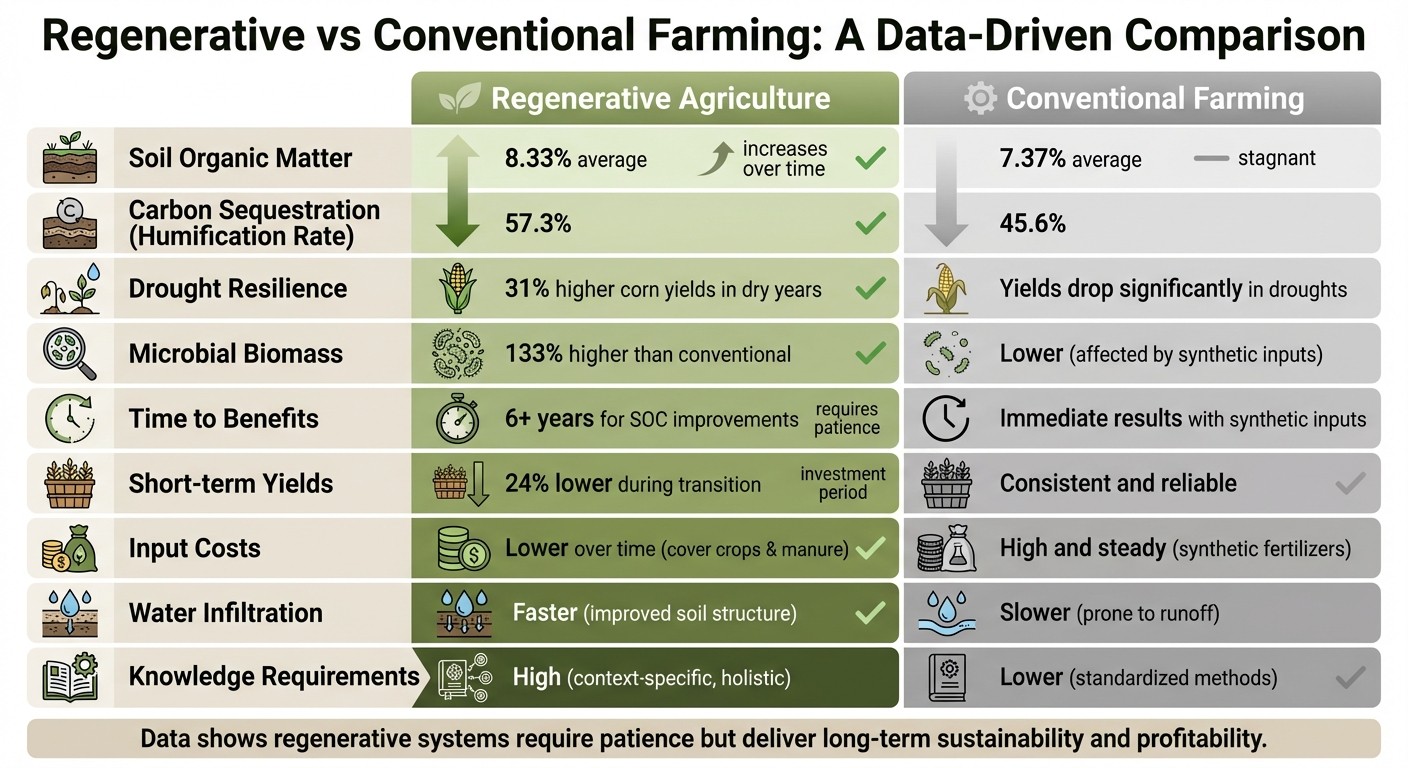
Regenerative vs Conventional Farming: Soil Health and Economic Comparison
Both regenerative and conventional farming systems involve trade-offs, particularly when it comes to soil health, economic outcomes, and environmental effects. These differences highlight why the decision between these approaches goes beyond immediate crop yields - it’s about building resilience for the future.
Regenerative agriculture, with its emphasis on increasing soil organic matter (SOM) and humification rates, consistently outperforms conventional farming in terms of drought resilience. For instance, during dry years, regenerative systems have shown 31% higher corn yields compared to conventional methods, thanks to improved water retention capabilities [3][10]. The Rodale Institute’s 40-year Farming Systems Trial in Kutztown, PA, further supports this, showing that organic manure-based systems were the most profitable over time and had microbial biomass levels 133% higher than conventional systems [5][10].
However, transitioning to regenerative practices isn’t without challenges. It requires specialized knowledge and a long-term commitment, as significant gains in soil organic carbon (SOC) often take at least six years to materialize [1]. During this transition period, short-term yields can drop by 24% as the soil structure rebuilds [5]. For example, the Montgomery Paired Farm Study revealed that regenerative farms using practices like no-till and cover crops for 5 to 10 years achieved Haney soil health scores averaging 20, compared to just 8 for neighboring conventional farms [11]. This progress, however, demands patience and a shift in management strategies.
On the other hand, conventional farming prioritizes immediate and predictable yields, relying heavily on synthetic inputs. While it demands less specialized expertise and provides consistent short-term results, these benefits come with long-term costs. Practices like tillage disrupt carbon stabilization, damage fungal networks, and reduce water infiltration rates [1][10]. Additionally, input costs remain consistently high, while SOM levels either stagnate or decline over time [10]. This approach focuses on maximizing current crop production rather than enhancing soil health for the future [1].
Here’s a quick comparison of the two systems:
| <strong>Factor</strong> | <strong>Regenerative Agriculture</strong> | <strong>Conventional Farming</strong> |
| --- | --- | --- |
| <strong>Soil Organic Matter</strong> | Average 8.33%; increases over time <a href="https://www.sciencedirect.com/science/article/abs/pii/S0065211317300676" target="_blank" style="text-decoration: none;" rel="nofollow noopener noreferrer" data-framer-link="Link:{"url":"https://www.sciencedirect.com/science/article/abs/pii/S0065211317300676","type":"url"}" data-framer-open-in-new-tab=""><sup>[3]</sup></a> | Average 7.37%; stagnant <a href="https://www.sciencedirect.com/science/article/abs/pii/S0065211317300676" target="_blank" style="text-decoration: none;" rel="nofollow noopener noreferrer" data-framer-link="Link:{"url":"https://www.sciencedirect.com/science/article/abs/pii/S0065211317300676","type":"url"}" data-framer-open-in-new-tab=""><sup>[3]</sup></a> |
| <strong>Carbon Sequestration</strong> | 57.3% humification rate <a href="https://www.sciencedirect.com/science/article/abs/pii/S0065211317300676" target="_blank" style="text-decoration: none;" rel="nofollow noopener noreferrer" data-framer-link="Link:{"url":"https://www.sciencedirect.com/science/article/abs/pii/S0065211317300676","type":"url"}" data-framer-open-in-new-tab=""><sup>[3]</sup></a> | 45.6% humification rate <a href="https://www.sciencedirect.com/science/article/abs/pii/S0065211317300676" target="_blank" style="text-decoration: none;" rel="nofollow noopener noreferrer" data-framer-link="Link:{"url":"https://www.sciencedirect.com/science/article/abs/pii/S0065211317300676","type":"url"}" data-framer-open-in-new-tab=""><sup>[3]</sup></a> |
| <strong>Drought Resilience</strong> | 31% higher corn yields in dry years <a href="https://rodaleinstitute.org/science/farming-systems-trial" target="_blank" style="text-decoration: none;" rel="nofollow noopener noreferrer" data-framer-link="Link:{"url":"https://rodaleinstitute.org/science/farming-systems-trial","type":"url"}" data-framer-open-in-new-tab=""><sup>[10]</sup></a> | Yields drop significantly in droughts <a href="https://rodaleinstitute.org/science/farming-systems-trial" target="_blank" style="text-decoration: none;" rel="nofollow noopener noreferrer" data-framer-link="Link:{"url":"https://rodaleinstitute.org/science/farming-systems-trial","type":"url"}" data-framer-open-in-new-tab=""><sup>[10]</sup></a> |
| <strong>Microbial Biomass</strong> | 133% higher than conventional <a href="https://www.sciencedirect.com/science/article/pii/S2212041625000257" target="_blank" style="text-decoration: none;" rel="nofollow noopener noreferrer" data-framer-link="Link:{"url":"https://www.sciencedirect.com/science/article/pii/S2212041625000257","type":"url"}" data-framer-open-in-new-tab=""><sup>[5]</sup></a> | Lower; affected by synthetic inputs <a href="https://www.sciencedirect.com/science/article/pii/S2212041625000257" target="_blank" style="text-decoration: none;" rel="nofollow noopener noreferrer" data-framer-link="Link:{"url":"https://www.sciencedirect.com/science/article/pii/S2212041625000257","type":"url"}" data-framer-open-in-new-tab=""><sup>[5]</sup></a> |
| <strong>Time to Benefits</strong> | 6+ years for SOC improvements <a href="https://www.pnas.org/doi/10.1073/pnas.2217481120" target="_blank" style="text-decoration: none;" rel="nofollow noopener noreferrer" data-framer-link="Link:{"url":"https://www.pnas.org/doi/10.1073/pnas.2217481120","type":"url"}" data-framer-open-in-new-tab=""><sup>[1]</sup></a> | Immediate results with synthetic inputs |
| <strong>Short-term Yields</strong> | 24% lower during transition <a href="https://www.sciencedirect.com/science/article/pii/S2212041625000257" target="_blank" style="text-decoration: none;" rel="nofollow noopener noreferrer" data-framer-link="Link:{"url":"https://www.sciencedirect.com/science/article/pii/S2212041625000257","type":"url"}" data-framer-open-in-new-tab=""><sup>[5]</sup></a> | Consistent and reliable |
| <strong>Input Costs</strong> | Lower over time; uses cover crops and manure <a href="https://rodaleinstitute.org/science/farming-systems-trial" target="_blank" style="text-decoration: none;" rel="nofollow noopener noreferrer" data-framer-link="Link:{"url":"https://rodaleinstitute.org/science/farming-systems-trial","type":"url"}" data-framer-open-in-new-tab=""><sup>[10]</sup></a> | High and steady; synthetic fertilizers required <a href="https://rodaleinstitute.org/science/farming-systems-trial" target="_blank" style="text-decoration: none;" rel="nofollow noopener noreferrer" data-framer-link="Link:{"url":"https://rodaleinstitute.org/science/farming-systems-trial","type":"url"}" data-framer-open-in-new-tab=""><sup>[10]</sup></a> |
| <strong>Water Infiltration</strong> | Faster due to improved soil structure <a href="https://rodaleinstitute.org/science/farming-systems-trial" target="_blank" style="text-decoration: none;" rel="nofollow noopener noreferrer" data-framer-link="Link:{"url":"https://rodaleinstitute.org/science/farming-systems-trial","type":"url"}" data-framer-open-in-new-tab=""><sup>[10]</sup></a> | Slower; prone to runoff <a href="https://rodaleinstitute.org/science/farming-systems-trial" target="_blank" style="text-decoration: none;" rel="nofollow noopener noreferrer" data-framer-link="Link:{"url":"https://rodaleinstitute.org/science/farming-systems-trial","type":"url"}" data-framer-open-in-new-tab=""><sup>[10]</sup></a> |
| <strong>Knowledge Requirements</strong> | High; context-specific and holistic <a href="https://www.frontiersin.org/articles/10.3389/fsufs.2023.1234108/full" target="_blank" style="text-decoration: none;" rel="nofollow noopener noreferrer" data-framer-link="Link:{"url":"https://www.frontiersin.org/articles/10.3389/fsufs.2023.1234108/full","type":"url"}" data-framer-open-in-new-tab=""><sup>[2]</sup></a> | Lower; standardized methods |
| <strong>Factor</strong> | <strong>Regenerative Agriculture</strong> | <strong>Conventional Farming</strong> |
| --- | --- | --- |
| <strong>Soil Organic Matter</strong> | Average 8.33%; increases over time <a href="https://www.sciencedirect.com/science/article/abs/pii/S0065211317300676" target="_blank" style="text-decoration: none;" rel="nofollow noopener noreferrer" data-framer-link="Link:{"url":"https://www.sciencedirect.com/science/article/abs/pii/S0065211317300676","type":"url"}" data-framer-open-in-new-tab=""><sup>[3]</sup></a> | Average 7.37%; stagnant <a href="https://www.sciencedirect.com/science/article/abs/pii/S0065211317300676" target="_blank" style="text-decoration: none;" rel="nofollow noopener noreferrer" data-framer-link="Link:{"url":"https://www.sciencedirect.com/science/article/abs/pii/S0065211317300676","type":"url"}" data-framer-open-in-new-tab=""><sup>[3]</sup></a> |
| <strong>Carbon Sequestration</strong> | 57.3% humification rate <a href="https://www.sciencedirect.com/science/article/abs/pii/S0065211317300676" target="_blank" style="text-decoration: none;" rel="nofollow noopener noreferrer" data-framer-link="Link:{"url":"https://www.sciencedirect.com/science/article/abs/pii/S0065211317300676","type":"url"}" data-framer-open-in-new-tab=""><sup>[3]</sup></a> | 45.6% humification rate <a href="https://www.sciencedirect.com/science/article/abs/pii/S0065211317300676" target="_blank" style="text-decoration: none;" rel="nofollow noopener noreferrer" data-framer-link="Link:{"url":"https://www.sciencedirect.com/science/article/abs/pii/S0065211317300676","type":"url"}" data-framer-open-in-new-tab=""><sup>[3]</sup></a> |
| <strong>Drought Resilience</strong> | 31% higher corn yields in dry years <a href="https://rodaleinstitute.org/science/farming-systems-trial" target="_blank" style="text-decoration: none;" rel="nofollow noopener noreferrer" data-framer-link="Link:{"url":"https://rodaleinstitute.org/science/farming-systems-trial","type":"url"}" data-framer-open-in-new-tab=""><sup>[10]</sup></a> | Yields drop significantly in droughts <a href="https://rodaleinstitute.org/science/farming-systems-trial" target="_blank" style="text-decoration: none;" rel="nofollow noopener noreferrer" data-framer-link="Link:{"url":"https://rodaleinstitute.org/science/farming-systems-trial","type":"url"}" data-framer-open-in-new-tab=""><sup>[10]</sup></a> |
| <strong>Microbial Biomass</strong> | 133% higher than conventional <a href="https://www.sciencedirect.com/science/article/pii/S2212041625000257" target="_blank" style="text-decoration: none;" rel="nofollow noopener noreferrer" data-framer-link="Link:{"url":"https://www.sciencedirect.com/science/article/pii/S2212041625000257","type":"url"}" data-framer-open-in-new-tab=""><sup>[5]</sup></a> | Lower; affected by synthetic inputs <a href="https://www.sciencedirect.com/science/article/pii/S2212041625000257" target="_blank" style="text-decoration: none;" rel="nofollow noopener noreferrer" data-framer-link="Link:{"url":"https://www.sciencedirect.com/science/article/pii/S2212041625000257","type":"url"}" data-framer-open-in-new-tab=""><sup>[5]</sup></a> |
| <strong>Time to Benefits</strong> | 6+ years for SOC improvements <a href="https://www.pnas.org/doi/10.1073/pnas.2217481120" target="_blank" style="text-decoration: none;" rel="nofollow noopener noreferrer" data-framer-link="Link:{"url":"https://www.pnas.org/doi/10.1073/pnas.2217481120","type":"url"}" data-framer-open-in-new-tab=""><sup>[1]</sup></a> | Immediate results with synthetic inputs |
| <strong>Short-term Yields</strong> | 24% lower during transition <a href="https://www.sciencedirect.com/science/article/pii/S2212041625000257" target="_blank" style="text-decoration: none;" rel="nofollow noopener noreferrer" data-framer-link="Link:{"url":"https://www.sciencedirect.com/science/article/pii/S2212041625000257","type":"url"}" data-framer-open-in-new-tab=""><sup>[5]</sup></a> | Consistent and reliable |
| <strong>Input Costs</strong> | Lower over time; uses cover crops and manure <a href="https://rodaleinstitute.org/science/farming-systems-trial" target="_blank" style="text-decoration: none;" rel="nofollow noopener noreferrer" data-framer-link="Link:{"url":"https://rodaleinstitute.org/science/farming-systems-trial","type":"url"}" data-framer-open-in-new-tab=""><sup>[10]</sup></a> | High and steady; synthetic fertilizers required <a href="https://rodaleinstitute.org/science/farming-systems-trial" target="_blank" style="text-decoration: none;" rel="nofollow noopener noreferrer" data-framer-link="Link:{"url":"https://rodaleinstitute.org/science/farming-systems-trial","type":"url"}" data-framer-open-in-new-tab=""><sup>[10]</sup></a> |
| <strong>Water Infiltration</strong> | Faster due to improved soil structure <a href="https://rodaleinstitute.org/science/farming-systems-trial" target="_blank" style="text-decoration: none;" rel="nofollow noopener noreferrer" data-framer-link="Link:{"url":"https://rodaleinstitute.org/science/farming-systems-trial","type":"url"}" data-framer-open-in-new-tab=""><sup>[10]</sup></a> | Slower; prone to runoff <a href="https://rodaleinstitute.org/science/farming-systems-trial" target="_blank" style="text-decoration: none;" rel="nofollow noopener noreferrer" data-framer-link="Link:{"url":"https://rodaleinstitute.org/science/farming-systems-trial","type":"url"}" data-framer-open-in-new-tab=""><sup>[10]</sup></a> |
| <strong>Knowledge Requirements</strong> | High; context-specific and holistic <a href="https://www.frontiersin.org/articles/10.3389/fsufs.2023.1234108/full" target="_blank" style="text-decoration: none;" rel="nofollow noopener noreferrer" data-framer-link="Link:{"url":"https://www.frontiersin.org/articles/10.3389/fsufs.2023.1234108/full","type":"url"}" data-framer-open-in-new-tab=""><sup>[2]</sup></a> | Lower; standardized methods |These figures reveal the economic and environmental considerations at play. Conventional farming offers stability in the short term but often sacrifices long-term sustainability. Meanwhile, regenerative systems reduce operating costs over time as soil health improves, though they require patience and adaptability during the transition period. As the Rodale Institute explains:
"Organic systems usually have much more diverse carbon inputs going into the soil so microbial biomass is significantly higher than in the conventional system, leading to higher soil organic matter over time" [10].
Ultimately, farmers face the challenge of balancing short-term productivity with the long-term rewards of healthier soils and reduced costs. The choice between these systems reflects a broader decision about priorities: immediate results or enduring resilience.
Conclusion
Regenerative agriculture offers a powerful approach to improving soil health, with benefits that extend beyond immediate yields to include long-term environmental and economic advantages. Unlike conventional farming, which often relies on synthetic inputs and intensive tillage, regenerative methods focus on rebuilding soil organic matter. This includes restoring Particulate Organic Carbon (POC) for short-term fertility and Mineral-Associated Organic Carbon (MAOC) for long-term carbon stabilization [1]. By addressing agriculture's "carbon debt" - the significant loss of soil carbon caused by converting natural ecosystems into farmland [13] - regenerative practices provide a sustainable alternative.
This approach requires patience and dedication, but the results can be transformative. For instance, regenerative methods can increase topsoil thickness by approximately 0.86 cm annually, a rate far exceeding natural soil formation [12]. A striking example comes from the University of Washington Student Farm, where two decades of regenerative management not only significantly boosted soil organic matter but also tripled topsoil thickness [12].
Farmers transitioning to regenerative systems are encouraged to adopt multiple complementary practices. Research shows that combining methods, rather than implementing them individually, leads to greater improvements in soil organic carbon [1]. In perennial systems like vineyards, integrating livestock can sequester around 2.05 tons of carbon per hectare per year (roughly 0.83 tons per acre annually) [2]. These combined efforts yield far greater benefits than isolated practices.
To support this shift, decision-makers should focus on outcome-based metrics. Financial incentives tied to measurable improvements in soil health, such as increased organic matter, enhanced water infiltration, and greater biodiversity, can help farmers navigate the transition. By aligning support with verified results, widespread adoption of regenerative agriculture becomes more achievable [14].
FAQs
How does regenerative agriculture boost soil organic matter compared to conventional farming?
Regenerative agriculture strengthens soil organic matter (SOM) by focusing on practices that nurture soil health and stimulate biological activity. Techniques such as planting diverse crop rotations, using cover crops, reducing tillage, and integrating livestock grazing play key roles. These approaches increase organic inputs, limit soil disruption, and encourage the growth of beneficial microbes. The result? Improved SOM levels, better soil structure, enhanced water retention, and greater nutrient availability.
Studies reveal that regenerative farming methods can boost soil organic carbon (SOC) by 23–41% compared to conventional practices. Strategies like cover cropping and combining crops with livestock are particularly effective in promoting long-term carbon storage and stabilizing organic matter. By embracing these methods, regenerative agriculture not only fosters healthier soils but also supports sustainable food systems and contributes to addressing climate change.
What are the financial benefits of adopting regenerative agriculture practices?
Adopting regenerative agriculture offers farmers a pathway to improve their financial outcomes while enhancing soil health. By increasing organic matter in the soil, these practices improve water retention and nutrient availability, which can significantly reduce reliance on costly inputs like fertilizers and irrigation. The result? Lower expenses and better crop productivity, which often translate into higher net profits.
Techniques like no-till farming, crop rotation, and cover cropping bring even more advantages. These methods not only build soil organic carbon, boosting long-term fertility and resilience, but also contribute to carbon sequestration. This opens doors to additional income opportunities through programs like carbon credits and other financial incentives. Over time, regenerative agriculture doesn’t just benefit the environment - it also helps establish a more stable and profitable farming system.
How long does it take for regenerative agriculture to improve soil health?
Improvements in soil health through regenerative agriculture often require time, with significant changes becoming evident after about 3 to 5 years of steady practices like cover cropping, no-till farming, and integrating crops with livestock. While some benefits, such as improved water infiltration, may emerge within the first year, more substantial transformations in soil organic matter and structure usually demand a longer-term commitment.
For instance, research indicates that soil organic carbon levels can rise by 20–40% over a three-year period in systems that integrate crops and livestock. Extended efforts spanning decades can yield even greater outcomes, including thicker layers of topsoil and increased biological activity. Achieving these lasting benefits calls for patience and consistent application of regenerative methods.
Related Blog Posts
Latest Articles
©2025



FAQ
01
What does it really mean to “redefine profit”?
02
What makes Council Fire different?
03
Who does Council Fire you work with?
04
What does working with Council Fire actually look like?
05
How does Council Fire help organizations turn big goals into action?
06
How does Council Fire define and measure success?
Jan 28, 2026
Soil Organic Matter in Regenerative Agriculture
Sustainability Strategy
In This Article
How regenerative practices increase soil organic matter and carbon to boost water retention, resilience and farm profitability over a multi-year transition.
Soil Organic Matter in Regenerative Agriculture
Regenerative agriculture focuses on restoring soil health by increasing soil organic matter (SOM) and soil organic carbon (SOC), which improve water retention, nutrient availability, and carbon sequestration. Unlike conventional farming, which depletes soil through practices like tillage and monocropping, regenerative methods use no-till farming, cover crops, and integrated livestock systems to rebuild soil structure and fertility over time.
Key Insights:
SOC Benefits: A 0.1% increase in SOC boosts crop yields by 4.0–6.6 bushels per acre annually and improves water retention by 0.06–0.10 inches per foot of soil depth.
Carbon Sequestration: Regenerative systems achieve a 57.3% humification rate (stable carbon storage) compared to 45.6% in conventional farming.
Economic Impact: Farmers using regenerative practices report lower input costs and higher profitability over time, despite initial yield reductions during the 6+ year transition period.
Soil Health Metrics: Regenerative systems average 8.33% SOM, outperforming conventional farming's 7.37%.
Conventional farming prioritizes short-term yields but contributes to long-term soil degradation, while regenerative agriculture builds resilience, reduces reliance on synthetic inputs, and helps mitigate climate change through carbon storage.
1. Regenerative Agriculture
Soil Organic Matter (SOM) Metrics
Regenerative farming goes beyond simply measuring total organic matter - it delves into the type of carbon being built in the soil. About 58% of total SOM consists of soil organic carbon. To better understand its dynamics, regenerative systems divide SOM into two categories: Particulate Organic Carbon (POC), which quickly nourishes microbes and supports nutrient supply for crops, and Mineral-Associated Organic Carbon (MAOC), which binds to clay particles and locks away carbon for decades[1].
Soil sampling typically focuses on the top 0–6 inches, where management practices like cover cropping and reduced tillage have the most noticeable effects[4]. This layer is a hub of activity - root exudates feed soil microbes, earthworms break down organic material, and soil aggregates form around organic particles. Tracking these metrics over time provides a clear picture of SOC improvements.
Soil Organic Carbon (SOC) Tracking
Regenerative practices are known to significantly enhance SOC, leading to better productivity and water retention. For every 0.1% increase in SOC, farmers can expect an additional 4.0 to 6.6 bushels per acre annually[4]. Water retention also sees a boost, with a 1% increase in SOC adding roughly 0.06 to 0.10 inches of water-holding capacity per foot of soil depth[4]. In drought conditions, this improved water storage can make the difference between a thriving crop and a failed one.
Impact on Soil Health
When comparing systems, organic and regenerative soils average 8.33% SOM, outperforming the 7.37% seen in conventional systems. Additionally, regenerative systems are more effective at sequestering carbon, with a humification rate of 57.3% compared to 45.6%[3]. This means a larger share of carbon inputs is transformed into stable humic substances rather than being released as CO₂.
However, building SOC pools takes time. It often requires at least six years of consistent regenerative practices to see meaningful changes[1]. Over this period, microbial networks and stable soil aggregates gradually develop, creating healthier soils that stabilize carbon and deliver both economic and environmental benefits.
Economic and Environmental Outcomes
Regenerative agriculture shifts the focus from high-input, yield-driven farming to a more stable and cost-effective approach. By reducing the need for fertilizers, pesticides, and fuel, farmers can maintain yields while cutting costs[6][7]. Studies show that regenerative farms can increase SOC by 22% and boost soil microbial biomass carbon by 133% compared to conventional systems[5].
Dr. Wayne Honeycutt, President and CEO of the Soil Health Institute, highlights the financial benefits of these practices:
"Soil organic carbon increases profitability. Soil Health Institute (SHI) scientists recently interviewed 125 farmers... almost all of the farmers interviewed reported higher profitability after adopting soil health systems."[6]
The environmental benefits are equally compelling. Traditional farming methods have released an estimated 133 petagrams of soil organic carbon since agriculture began[1]. Regenerative practices aim to reverse this trend by capturing atmospheric CO₂ and storing it in stable soil fractions. These methods also improve water infiltration and reduce runoff[6][8], turning fields into carbon sinks rather than sources.
2. Conventional Farming
Soil Organic Matter (SOM) Metrics
In conventional farming, total SOM or Soil Organic Carbon (SOC) is measured primarily to optimize crop yields [1][3]. However, these methods often overlook the difference between fast-cycling and stable carbon, which are crucial for understanding long-term carbon storage.
On average, conventional soils show 7.37% SOM (ranging from 0.63% to 46.1%) with a humification rate of 45.6%, compared to 8.33% SOM and a 57.3% humification rate in regenerative systems [3]. This lower rate of carbon sequestration highlights the limited ability of conventional soils to store carbon over extended periods. These limitations become especially apparent during soil disturbances caused by common farming practices.
Impact on Soil Health
Conventional tillage methods, like moldboard plowing, disrupt soil by inverting surface layers and breaking down aggregates [3][9]. This process exposes stored carbon and nitrogen to rapid decomposition. While this may temporarily release nutrients, it ultimately depletes the soil’s reserves. Currently, about 50% of the U.S. land planted with crops like corn, wheat, soybeans, and cotton is still conventionally tilled each year [9].
Tillage also damages soil health by breaking apart fungal networks, particularly mycorrhizal fungi, which play a key role in nutrient absorption and maintaining soil structure. Without these networks, soils become more prone to erosion from wind and water. Over time, these practices have significantly contributed to the depletion of soil carbon stocks in agricultural lands [1].
Economic and Environmental Outcomes
The consequences of conventional farming extend beyond soil health, impacting both economic and environmental aspects. While tillage can help manage weeds, it degrades land and reduces the soil’s ability to retain water [3][9]. Lower SOC levels result in less water retention, a critical drawback during periods of drought.
Economically, the focus on short-term yield gains often sacrifices long-term soil health. Conventional systems tend to lose Particulate Organic Carbon (POC) more readily due to its vulnerability to physical disturbances [1]. This loss not only reduces productivity over time but also weakens the soil’s overall resilience. Environmentally, conventional practices contribute to greenhouse gas emissions and diminish the potential for long-term carbon storage [3].
What is Soil Organic Carbon? | Regenerative Agriculture | Soil Carbon Course
Pros and Cons
Regenerative vs Conventional Farming: Soil Health and Economic Comparison
Both regenerative and conventional farming systems involve trade-offs, particularly when it comes to soil health, economic outcomes, and environmental effects. These differences highlight why the decision between these approaches goes beyond immediate crop yields - it’s about building resilience for the future.
Regenerative agriculture, with its emphasis on increasing soil organic matter (SOM) and humification rates, consistently outperforms conventional farming in terms of drought resilience. For instance, during dry years, regenerative systems have shown 31% higher corn yields compared to conventional methods, thanks to improved water retention capabilities [3][10]. The Rodale Institute’s 40-year Farming Systems Trial in Kutztown, PA, further supports this, showing that organic manure-based systems were the most profitable over time and had microbial biomass levels 133% higher than conventional systems [5][10].
However, transitioning to regenerative practices isn’t without challenges. It requires specialized knowledge and a long-term commitment, as significant gains in soil organic carbon (SOC) often take at least six years to materialize [1]. During this transition period, short-term yields can drop by 24% as the soil structure rebuilds [5]. For example, the Montgomery Paired Farm Study revealed that regenerative farms using practices like no-till and cover crops for 5 to 10 years achieved Haney soil health scores averaging 20, compared to just 8 for neighboring conventional farms [11]. This progress, however, demands patience and a shift in management strategies.
On the other hand, conventional farming prioritizes immediate and predictable yields, relying heavily on synthetic inputs. While it demands less specialized expertise and provides consistent short-term results, these benefits come with long-term costs. Practices like tillage disrupt carbon stabilization, damage fungal networks, and reduce water infiltration rates [1][10]. Additionally, input costs remain consistently high, while SOM levels either stagnate or decline over time [10]. This approach focuses on maximizing current crop production rather than enhancing soil health for the future [1].
Here’s a quick comparison of the two systems:
| <strong>Factor</strong> | <strong>Regenerative Agriculture</strong> | <strong>Conventional Farming</strong> |
| --- | --- | --- |
| <strong>Soil Organic Matter</strong> | Average 8.33%; increases over time <a href="https://www.sciencedirect.com/science/article/abs/pii/S0065211317300676" target="_blank" style="text-decoration: none;" rel="nofollow noopener noreferrer" data-framer-link="Link:{"url":"https://www.sciencedirect.com/science/article/abs/pii/S0065211317300676","type":"url"}" data-framer-open-in-new-tab=""><sup>[3]</sup></a> | Average 7.37%; stagnant <a href="https://www.sciencedirect.com/science/article/abs/pii/S0065211317300676" target="_blank" style="text-decoration: none;" rel="nofollow noopener noreferrer" data-framer-link="Link:{"url":"https://www.sciencedirect.com/science/article/abs/pii/S0065211317300676","type":"url"}" data-framer-open-in-new-tab=""><sup>[3]</sup></a> |
| <strong>Carbon Sequestration</strong> | 57.3% humification rate <a href="https://www.sciencedirect.com/science/article/abs/pii/S0065211317300676" target="_blank" style="text-decoration: none;" rel="nofollow noopener noreferrer" data-framer-link="Link:{"url":"https://www.sciencedirect.com/science/article/abs/pii/S0065211317300676","type":"url"}" data-framer-open-in-new-tab=""><sup>[3]</sup></a> | 45.6% humification rate <a href="https://www.sciencedirect.com/science/article/abs/pii/S0065211317300676" target="_blank" style="text-decoration: none;" rel="nofollow noopener noreferrer" data-framer-link="Link:{"url":"https://www.sciencedirect.com/science/article/abs/pii/S0065211317300676","type":"url"}" data-framer-open-in-new-tab=""><sup>[3]</sup></a> |
| <strong>Drought Resilience</strong> | 31% higher corn yields in dry years <a href="https://rodaleinstitute.org/science/farming-systems-trial" target="_blank" style="text-decoration: none;" rel="nofollow noopener noreferrer" data-framer-link="Link:{"url":"https://rodaleinstitute.org/science/farming-systems-trial","type":"url"}" data-framer-open-in-new-tab=""><sup>[10]</sup></a> | Yields drop significantly in droughts <a href="https://rodaleinstitute.org/science/farming-systems-trial" target="_blank" style="text-decoration: none;" rel="nofollow noopener noreferrer" data-framer-link="Link:{"url":"https://rodaleinstitute.org/science/farming-systems-trial","type":"url"}" data-framer-open-in-new-tab=""><sup>[10]</sup></a> |
| <strong>Microbial Biomass</strong> | 133% higher than conventional <a href="https://www.sciencedirect.com/science/article/pii/S2212041625000257" target="_blank" style="text-decoration: none;" rel="nofollow noopener noreferrer" data-framer-link="Link:{"url":"https://www.sciencedirect.com/science/article/pii/S2212041625000257","type":"url"}" data-framer-open-in-new-tab=""><sup>[5]</sup></a> | Lower; affected by synthetic inputs <a href="https://www.sciencedirect.com/science/article/pii/S2212041625000257" target="_blank" style="text-decoration: none;" rel="nofollow noopener noreferrer" data-framer-link="Link:{"url":"https://www.sciencedirect.com/science/article/pii/S2212041625000257","type":"url"}" data-framer-open-in-new-tab=""><sup>[5]</sup></a> |
| <strong>Time to Benefits</strong> | 6+ years for SOC improvements <a href="https://www.pnas.org/doi/10.1073/pnas.2217481120" target="_blank" style="text-decoration: none;" rel="nofollow noopener noreferrer" data-framer-link="Link:{"url":"https://www.pnas.org/doi/10.1073/pnas.2217481120","type":"url"}" data-framer-open-in-new-tab=""><sup>[1]</sup></a> | Immediate results with synthetic inputs |
| <strong>Short-term Yields</strong> | 24% lower during transition <a href="https://www.sciencedirect.com/science/article/pii/S2212041625000257" target="_blank" style="text-decoration: none;" rel="nofollow noopener noreferrer" data-framer-link="Link:{"url":"https://www.sciencedirect.com/science/article/pii/S2212041625000257","type":"url"}" data-framer-open-in-new-tab=""><sup>[5]</sup></a> | Consistent and reliable |
| <strong>Input Costs</strong> | Lower over time; uses cover crops and manure <a href="https://rodaleinstitute.org/science/farming-systems-trial" target="_blank" style="text-decoration: none;" rel="nofollow noopener noreferrer" data-framer-link="Link:{"url":"https://rodaleinstitute.org/science/farming-systems-trial","type":"url"}" data-framer-open-in-new-tab=""><sup>[10]</sup></a> | High and steady; synthetic fertilizers required <a href="https://rodaleinstitute.org/science/farming-systems-trial" target="_blank" style="text-decoration: none;" rel="nofollow noopener noreferrer" data-framer-link="Link:{"url":"https://rodaleinstitute.org/science/farming-systems-trial","type":"url"}" data-framer-open-in-new-tab=""><sup>[10]</sup></a> |
| <strong>Water Infiltration</strong> | Faster due to improved soil structure <a href="https://rodaleinstitute.org/science/farming-systems-trial" target="_blank" style="text-decoration: none;" rel="nofollow noopener noreferrer" data-framer-link="Link:{"url":"https://rodaleinstitute.org/science/farming-systems-trial","type":"url"}" data-framer-open-in-new-tab=""><sup>[10]</sup></a> | Slower; prone to runoff <a href="https://rodaleinstitute.org/science/farming-systems-trial" target="_blank" style="text-decoration: none;" rel="nofollow noopener noreferrer" data-framer-link="Link:{"url":"https://rodaleinstitute.org/science/farming-systems-trial","type":"url"}" data-framer-open-in-new-tab=""><sup>[10]</sup></a> |
| <strong>Knowledge Requirements</strong> | High; context-specific and holistic <a href="https://www.frontiersin.org/articles/10.3389/fsufs.2023.1234108/full" target="_blank" style="text-decoration: none;" rel="nofollow noopener noreferrer" data-framer-link="Link:{"url":"https://www.frontiersin.org/articles/10.3389/fsufs.2023.1234108/full","type":"url"}" data-framer-open-in-new-tab=""><sup>[2]</sup></a> | Lower; standardized methods |
These figures reveal the economic and environmental considerations at play. Conventional farming offers stability in the short term but often sacrifices long-term sustainability. Meanwhile, regenerative systems reduce operating costs over time as soil health improves, though they require patience and adaptability during the transition period. As the Rodale Institute explains:
"Organic systems usually have much more diverse carbon inputs going into the soil so microbial biomass is significantly higher than in the conventional system, leading to higher soil organic matter over time" [10].
Ultimately, farmers face the challenge of balancing short-term productivity with the long-term rewards of healthier soils and reduced costs. The choice between these systems reflects a broader decision about priorities: immediate results or enduring resilience.
Conclusion
Regenerative agriculture offers a powerful approach to improving soil health, with benefits that extend beyond immediate yields to include long-term environmental and economic advantages. Unlike conventional farming, which often relies on synthetic inputs and intensive tillage, regenerative methods focus on rebuilding soil organic matter. This includes restoring Particulate Organic Carbon (POC) for short-term fertility and Mineral-Associated Organic Carbon (MAOC) for long-term carbon stabilization [1]. By addressing agriculture's "carbon debt" - the significant loss of soil carbon caused by converting natural ecosystems into farmland [13] - regenerative practices provide a sustainable alternative.
This approach requires patience and dedication, but the results can be transformative. For instance, regenerative methods can increase topsoil thickness by approximately 0.86 cm annually, a rate far exceeding natural soil formation [12]. A striking example comes from the University of Washington Student Farm, where two decades of regenerative management not only significantly boosted soil organic matter but also tripled topsoil thickness [12].
Farmers transitioning to regenerative systems are encouraged to adopt multiple complementary practices. Research shows that combining methods, rather than implementing them individually, leads to greater improvements in soil organic carbon [1]. In perennial systems like vineyards, integrating livestock can sequester around 2.05 tons of carbon per hectare per year (roughly 0.83 tons per acre annually) [2]. These combined efforts yield far greater benefits than isolated practices.
To support this shift, decision-makers should focus on outcome-based metrics. Financial incentives tied to measurable improvements in soil health, such as increased organic matter, enhanced water infiltration, and greater biodiversity, can help farmers navigate the transition. By aligning support with verified results, widespread adoption of regenerative agriculture becomes more achievable [14].
FAQs
How does regenerative agriculture boost soil organic matter compared to conventional farming?
Regenerative agriculture strengthens soil organic matter (SOM) by focusing on practices that nurture soil health and stimulate biological activity. Techniques such as planting diverse crop rotations, using cover crops, reducing tillage, and integrating livestock grazing play key roles. These approaches increase organic inputs, limit soil disruption, and encourage the growth of beneficial microbes. The result? Improved SOM levels, better soil structure, enhanced water retention, and greater nutrient availability.
Studies reveal that regenerative farming methods can boost soil organic carbon (SOC) by 23–41% compared to conventional practices. Strategies like cover cropping and combining crops with livestock are particularly effective in promoting long-term carbon storage and stabilizing organic matter. By embracing these methods, regenerative agriculture not only fosters healthier soils but also supports sustainable food systems and contributes to addressing climate change.
What are the financial benefits of adopting regenerative agriculture practices?
Adopting regenerative agriculture offers farmers a pathway to improve their financial outcomes while enhancing soil health. By increasing organic matter in the soil, these practices improve water retention and nutrient availability, which can significantly reduce reliance on costly inputs like fertilizers and irrigation. The result? Lower expenses and better crop productivity, which often translate into higher net profits.
Techniques like no-till farming, crop rotation, and cover cropping bring even more advantages. These methods not only build soil organic carbon, boosting long-term fertility and resilience, but also contribute to carbon sequestration. This opens doors to additional income opportunities through programs like carbon credits and other financial incentives. Over time, regenerative agriculture doesn’t just benefit the environment - it also helps establish a more stable and profitable farming system.
How long does it take for regenerative agriculture to improve soil health?
Improvements in soil health through regenerative agriculture often require time, with significant changes becoming evident after about 3 to 5 years of steady practices like cover cropping, no-till farming, and integrating crops with livestock. While some benefits, such as improved water infiltration, may emerge within the first year, more substantial transformations in soil organic matter and structure usually demand a longer-term commitment.
For instance, research indicates that soil organic carbon levels can rise by 20–40% over a three-year period in systems that integrate crops and livestock. Extended efforts spanning decades can yield even greater outcomes, including thicker layers of topsoil and increased biological activity. Achieving these lasting benefits calls for patience and consistent application of regenerative methods.
Related Blog Posts
FAQ
01
What does it really mean to “redefine profit”?
02
What makes Council Fire different?
03
Who does Council Fire you work with?
04
What does working with Council Fire actually look like?
05
How does Council Fire help organizations turn big goals into action?
06
How does Council Fire define and measure success?
Jan 28, 2026
Soil Organic Matter in Regenerative Agriculture
Sustainability Strategy
In This Article
How regenerative practices increase soil organic matter and carbon to boost water retention, resilience and farm profitability over a multi-year transition.
Soil Organic Matter in Regenerative Agriculture
Regenerative agriculture focuses on restoring soil health by increasing soil organic matter (SOM) and soil organic carbon (SOC), which improve water retention, nutrient availability, and carbon sequestration. Unlike conventional farming, which depletes soil through practices like tillage and monocropping, regenerative methods use no-till farming, cover crops, and integrated livestock systems to rebuild soil structure and fertility over time.
Key Insights:
SOC Benefits: A 0.1% increase in SOC boosts crop yields by 4.0–6.6 bushels per acre annually and improves water retention by 0.06–0.10 inches per foot of soil depth.
Carbon Sequestration: Regenerative systems achieve a 57.3% humification rate (stable carbon storage) compared to 45.6% in conventional farming.
Economic Impact: Farmers using regenerative practices report lower input costs and higher profitability over time, despite initial yield reductions during the 6+ year transition period.
Soil Health Metrics: Regenerative systems average 8.33% SOM, outperforming conventional farming's 7.37%.
Conventional farming prioritizes short-term yields but contributes to long-term soil degradation, while regenerative agriculture builds resilience, reduces reliance on synthetic inputs, and helps mitigate climate change through carbon storage.
1. Regenerative Agriculture
Soil Organic Matter (SOM) Metrics
Regenerative farming goes beyond simply measuring total organic matter - it delves into the type of carbon being built in the soil. About 58% of total SOM consists of soil organic carbon. To better understand its dynamics, regenerative systems divide SOM into two categories: Particulate Organic Carbon (POC), which quickly nourishes microbes and supports nutrient supply for crops, and Mineral-Associated Organic Carbon (MAOC), which binds to clay particles and locks away carbon for decades[1].
Soil sampling typically focuses on the top 0–6 inches, where management practices like cover cropping and reduced tillage have the most noticeable effects[4]. This layer is a hub of activity - root exudates feed soil microbes, earthworms break down organic material, and soil aggregates form around organic particles. Tracking these metrics over time provides a clear picture of SOC improvements.
Soil Organic Carbon (SOC) Tracking
Regenerative practices are known to significantly enhance SOC, leading to better productivity and water retention. For every 0.1% increase in SOC, farmers can expect an additional 4.0 to 6.6 bushels per acre annually[4]. Water retention also sees a boost, with a 1% increase in SOC adding roughly 0.06 to 0.10 inches of water-holding capacity per foot of soil depth[4]. In drought conditions, this improved water storage can make the difference between a thriving crop and a failed one.
Impact on Soil Health
When comparing systems, organic and regenerative soils average 8.33% SOM, outperforming the 7.37% seen in conventional systems. Additionally, regenerative systems are more effective at sequestering carbon, with a humification rate of 57.3% compared to 45.6%[3]. This means a larger share of carbon inputs is transformed into stable humic substances rather than being released as CO₂.
However, building SOC pools takes time. It often requires at least six years of consistent regenerative practices to see meaningful changes[1]. Over this period, microbial networks and stable soil aggregates gradually develop, creating healthier soils that stabilize carbon and deliver both economic and environmental benefits.
Economic and Environmental Outcomes
Regenerative agriculture shifts the focus from high-input, yield-driven farming to a more stable and cost-effective approach. By reducing the need for fertilizers, pesticides, and fuel, farmers can maintain yields while cutting costs[6][7]. Studies show that regenerative farms can increase SOC by 22% and boost soil microbial biomass carbon by 133% compared to conventional systems[5].
Dr. Wayne Honeycutt, President and CEO of the Soil Health Institute, highlights the financial benefits of these practices:
"Soil organic carbon increases profitability. Soil Health Institute (SHI) scientists recently interviewed 125 farmers... almost all of the farmers interviewed reported higher profitability after adopting soil health systems."[6]
The environmental benefits are equally compelling. Traditional farming methods have released an estimated 133 petagrams of soil organic carbon since agriculture began[1]. Regenerative practices aim to reverse this trend by capturing atmospheric CO₂ and storing it in stable soil fractions. These methods also improve water infiltration and reduce runoff[6][8], turning fields into carbon sinks rather than sources.
2. Conventional Farming
Soil Organic Matter (SOM) Metrics
In conventional farming, total SOM or Soil Organic Carbon (SOC) is measured primarily to optimize crop yields [1][3]. However, these methods often overlook the difference between fast-cycling and stable carbon, which are crucial for understanding long-term carbon storage.
On average, conventional soils show 7.37% SOM (ranging from 0.63% to 46.1%) with a humification rate of 45.6%, compared to 8.33% SOM and a 57.3% humification rate in regenerative systems [3]. This lower rate of carbon sequestration highlights the limited ability of conventional soils to store carbon over extended periods. These limitations become especially apparent during soil disturbances caused by common farming practices.
Impact on Soil Health
Conventional tillage methods, like moldboard plowing, disrupt soil by inverting surface layers and breaking down aggregates [3][9]. This process exposes stored carbon and nitrogen to rapid decomposition. While this may temporarily release nutrients, it ultimately depletes the soil’s reserves. Currently, about 50% of the U.S. land planted with crops like corn, wheat, soybeans, and cotton is still conventionally tilled each year [9].
Tillage also damages soil health by breaking apart fungal networks, particularly mycorrhizal fungi, which play a key role in nutrient absorption and maintaining soil structure. Without these networks, soils become more prone to erosion from wind and water. Over time, these practices have significantly contributed to the depletion of soil carbon stocks in agricultural lands [1].
Economic and Environmental Outcomes
The consequences of conventional farming extend beyond soil health, impacting both economic and environmental aspects. While tillage can help manage weeds, it degrades land and reduces the soil’s ability to retain water [3][9]. Lower SOC levels result in less water retention, a critical drawback during periods of drought.
Economically, the focus on short-term yield gains often sacrifices long-term soil health. Conventional systems tend to lose Particulate Organic Carbon (POC) more readily due to its vulnerability to physical disturbances [1]. This loss not only reduces productivity over time but also weakens the soil’s overall resilience. Environmentally, conventional practices contribute to greenhouse gas emissions and diminish the potential for long-term carbon storage [3].
What is Soil Organic Carbon? | Regenerative Agriculture | Soil Carbon Course
Pros and Cons
Regenerative vs Conventional Farming: Soil Health and Economic Comparison
Both regenerative and conventional farming systems involve trade-offs, particularly when it comes to soil health, economic outcomes, and environmental effects. These differences highlight why the decision between these approaches goes beyond immediate crop yields - it’s about building resilience for the future.
Regenerative agriculture, with its emphasis on increasing soil organic matter (SOM) and humification rates, consistently outperforms conventional farming in terms of drought resilience. For instance, during dry years, regenerative systems have shown 31% higher corn yields compared to conventional methods, thanks to improved water retention capabilities [3][10]. The Rodale Institute’s 40-year Farming Systems Trial in Kutztown, PA, further supports this, showing that organic manure-based systems were the most profitable over time and had microbial biomass levels 133% higher than conventional systems [5][10].
However, transitioning to regenerative practices isn’t without challenges. It requires specialized knowledge and a long-term commitment, as significant gains in soil organic carbon (SOC) often take at least six years to materialize [1]. During this transition period, short-term yields can drop by 24% as the soil structure rebuilds [5]. For example, the Montgomery Paired Farm Study revealed that regenerative farms using practices like no-till and cover crops for 5 to 10 years achieved Haney soil health scores averaging 20, compared to just 8 for neighboring conventional farms [11]. This progress, however, demands patience and a shift in management strategies.
On the other hand, conventional farming prioritizes immediate and predictable yields, relying heavily on synthetic inputs. While it demands less specialized expertise and provides consistent short-term results, these benefits come with long-term costs. Practices like tillage disrupt carbon stabilization, damage fungal networks, and reduce water infiltration rates [1][10]. Additionally, input costs remain consistently high, while SOM levels either stagnate or decline over time [10]. This approach focuses on maximizing current crop production rather than enhancing soil health for the future [1].
Here’s a quick comparison of the two systems:
| <strong>Factor</strong> | <strong>Regenerative Agriculture</strong> | <strong>Conventional Farming</strong> |
| --- | --- | --- |
| <strong>Soil Organic Matter</strong> | Average 8.33%; increases over time <a href="https://www.sciencedirect.com/science/article/abs/pii/S0065211317300676" target="_blank" style="text-decoration: none;" rel="nofollow noopener noreferrer" data-framer-link="Link:{"url":"https://www.sciencedirect.com/science/article/abs/pii/S0065211317300676","type":"url"}" data-framer-open-in-new-tab=""><sup>[3]</sup></a> | Average 7.37%; stagnant <a href="https://www.sciencedirect.com/science/article/abs/pii/S0065211317300676" target="_blank" style="text-decoration: none;" rel="nofollow noopener noreferrer" data-framer-link="Link:{"url":"https://www.sciencedirect.com/science/article/abs/pii/S0065211317300676","type":"url"}" data-framer-open-in-new-tab=""><sup>[3]</sup></a> |
| <strong>Carbon Sequestration</strong> | 57.3% humification rate <a href="https://www.sciencedirect.com/science/article/abs/pii/S0065211317300676" target="_blank" style="text-decoration: none;" rel="nofollow noopener noreferrer" data-framer-link="Link:{"url":"https://www.sciencedirect.com/science/article/abs/pii/S0065211317300676","type":"url"}" data-framer-open-in-new-tab=""><sup>[3]</sup></a> | 45.6% humification rate <a href="https://www.sciencedirect.com/science/article/abs/pii/S0065211317300676" target="_blank" style="text-decoration: none;" rel="nofollow noopener noreferrer" data-framer-link="Link:{"url":"https://www.sciencedirect.com/science/article/abs/pii/S0065211317300676","type":"url"}" data-framer-open-in-new-tab=""><sup>[3]</sup></a> |
| <strong>Drought Resilience</strong> | 31% higher corn yields in dry years <a href="https://rodaleinstitute.org/science/farming-systems-trial" target="_blank" style="text-decoration: none;" rel="nofollow noopener noreferrer" data-framer-link="Link:{"url":"https://rodaleinstitute.org/science/farming-systems-trial","type":"url"}" data-framer-open-in-new-tab=""><sup>[10]</sup></a> | Yields drop significantly in droughts <a href="https://rodaleinstitute.org/science/farming-systems-trial" target="_blank" style="text-decoration: none;" rel="nofollow noopener noreferrer" data-framer-link="Link:{"url":"https://rodaleinstitute.org/science/farming-systems-trial","type":"url"}" data-framer-open-in-new-tab=""><sup>[10]</sup></a> |
| <strong>Microbial Biomass</strong> | 133% higher than conventional <a href="https://www.sciencedirect.com/science/article/pii/S2212041625000257" target="_blank" style="text-decoration: none;" rel="nofollow noopener noreferrer" data-framer-link="Link:{"url":"https://www.sciencedirect.com/science/article/pii/S2212041625000257","type":"url"}" data-framer-open-in-new-tab=""><sup>[5]</sup></a> | Lower; affected by synthetic inputs <a href="https://www.sciencedirect.com/science/article/pii/S2212041625000257" target="_blank" style="text-decoration: none;" rel="nofollow noopener noreferrer" data-framer-link="Link:{"url":"https://www.sciencedirect.com/science/article/pii/S2212041625000257","type":"url"}" data-framer-open-in-new-tab=""><sup>[5]</sup></a> |
| <strong>Time to Benefits</strong> | 6+ years for SOC improvements <a href="https://www.pnas.org/doi/10.1073/pnas.2217481120" target="_blank" style="text-decoration: none;" rel="nofollow noopener noreferrer" data-framer-link="Link:{"url":"https://www.pnas.org/doi/10.1073/pnas.2217481120","type":"url"}" data-framer-open-in-new-tab=""><sup>[1]</sup></a> | Immediate results with synthetic inputs |
| <strong>Short-term Yields</strong> | 24% lower during transition <a href="https://www.sciencedirect.com/science/article/pii/S2212041625000257" target="_blank" style="text-decoration: none;" rel="nofollow noopener noreferrer" data-framer-link="Link:{"url":"https://www.sciencedirect.com/science/article/pii/S2212041625000257","type":"url"}" data-framer-open-in-new-tab=""><sup>[5]</sup></a> | Consistent and reliable |
| <strong>Input Costs</strong> | Lower over time; uses cover crops and manure <a href="https://rodaleinstitute.org/science/farming-systems-trial" target="_blank" style="text-decoration: none;" rel="nofollow noopener noreferrer" data-framer-link="Link:{"url":"https://rodaleinstitute.org/science/farming-systems-trial","type":"url"}" data-framer-open-in-new-tab=""><sup>[10]</sup></a> | High and steady; synthetic fertilizers required <a href="https://rodaleinstitute.org/science/farming-systems-trial" target="_blank" style="text-decoration: none;" rel="nofollow noopener noreferrer" data-framer-link="Link:{"url":"https://rodaleinstitute.org/science/farming-systems-trial","type":"url"}" data-framer-open-in-new-tab=""><sup>[10]</sup></a> |
| <strong>Water Infiltration</strong> | Faster due to improved soil structure <a href="https://rodaleinstitute.org/science/farming-systems-trial" target="_blank" style="text-decoration: none;" rel="nofollow noopener noreferrer" data-framer-link="Link:{"url":"https://rodaleinstitute.org/science/farming-systems-trial","type":"url"}" data-framer-open-in-new-tab=""><sup>[10]</sup></a> | Slower; prone to runoff <a href="https://rodaleinstitute.org/science/farming-systems-trial" target="_blank" style="text-decoration: none;" rel="nofollow noopener noreferrer" data-framer-link="Link:{"url":"https://rodaleinstitute.org/science/farming-systems-trial","type":"url"}" data-framer-open-in-new-tab=""><sup>[10]</sup></a> |
| <strong>Knowledge Requirements</strong> | High; context-specific and holistic <a href="https://www.frontiersin.org/articles/10.3389/fsufs.2023.1234108/full" target="_blank" style="text-decoration: none;" rel="nofollow noopener noreferrer" data-framer-link="Link:{"url":"https://www.frontiersin.org/articles/10.3389/fsufs.2023.1234108/full","type":"url"}" data-framer-open-in-new-tab=""><sup>[2]</sup></a> | Lower; standardized methods |
These figures reveal the economic and environmental considerations at play. Conventional farming offers stability in the short term but often sacrifices long-term sustainability. Meanwhile, regenerative systems reduce operating costs over time as soil health improves, though they require patience and adaptability during the transition period. As the Rodale Institute explains:
"Organic systems usually have much more diverse carbon inputs going into the soil so microbial biomass is significantly higher than in the conventional system, leading to higher soil organic matter over time" [10].
Ultimately, farmers face the challenge of balancing short-term productivity with the long-term rewards of healthier soils and reduced costs. The choice between these systems reflects a broader decision about priorities: immediate results or enduring resilience.
Conclusion
Regenerative agriculture offers a powerful approach to improving soil health, with benefits that extend beyond immediate yields to include long-term environmental and economic advantages. Unlike conventional farming, which often relies on synthetic inputs and intensive tillage, regenerative methods focus on rebuilding soil organic matter. This includes restoring Particulate Organic Carbon (POC) for short-term fertility and Mineral-Associated Organic Carbon (MAOC) for long-term carbon stabilization [1]. By addressing agriculture's "carbon debt" - the significant loss of soil carbon caused by converting natural ecosystems into farmland [13] - regenerative practices provide a sustainable alternative.
This approach requires patience and dedication, but the results can be transformative. For instance, regenerative methods can increase topsoil thickness by approximately 0.86 cm annually, a rate far exceeding natural soil formation [12]. A striking example comes from the University of Washington Student Farm, where two decades of regenerative management not only significantly boosted soil organic matter but also tripled topsoil thickness [12].
Farmers transitioning to regenerative systems are encouraged to adopt multiple complementary practices. Research shows that combining methods, rather than implementing them individually, leads to greater improvements in soil organic carbon [1]. In perennial systems like vineyards, integrating livestock can sequester around 2.05 tons of carbon per hectare per year (roughly 0.83 tons per acre annually) [2]. These combined efforts yield far greater benefits than isolated practices.
To support this shift, decision-makers should focus on outcome-based metrics. Financial incentives tied to measurable improvements in soil health, such as increased organic matter, enhanced water infiltration, and greater biodiversity, can help farmers navigate the transition. By aligning support with verified results, widespread adoption of regenerative agriculture becomes more achievable [14].
FAQs
How does regenerative agriculture boost soil organic matter compared to conventional farming?
Regenerative agriculture strengthens soil organic matter (SOM) by focusing on practices that nurture soil health and stimulate biological activity. Techniques such as planting diverse crop rotations, using cover crops, reducing tillage, and integrating livestock grazing play key roles. These approaches increase organic inputs, limit soil disruption, and encourage the growth of beneficial microbes. The result? Improved SOM levels, better soil structure, enhanced water retention, and greater nutrient availability.
Studies reveal that regenerative farming methods can boost soil organic carbon (SOC) by 23–41% compared to conventional practices. Strategies like cover cropping and combining crops with livestock are particularly effective in promoting long-term carbon storage and stabilizing organic matter. By embracing these methods, regenerative agriculture not only fosters healthier soils but also supports sustainable food systems and contributes to addressing climate change.
What are the financial benefits of adopting regenerative agriculture practices?
Adopting regenerative agriculture offers farmers a pathway to improve their financial outcomes while enhancing soil health. By increasing organic matter in the soil, these practices improve water retention and nutrient availability, which can significantly reduce reliance on costly inputs like fertilizers and irrigation. The result? Lower expenses and better crop productivity, which often translate into higher net profits.
Techniques like no-till farming, crop rotation, and cover cropping bring even more advantages. These methods not only build soil organic carbon, boosting long-term fertility and resilience, but also contribute to carbon sequestration. This opens doors to additional income opportunities through programs like carbon credits and other financial incentives. Over time, regenerative agriculture doesn’t just benefit the environment - it also helps establish a more stable and profitable farming system.
How long does it take for regenerative agriculture to improve soil health?
Improvements in soil health through regenerative agriculture often require time, with significant changes becoming evident after about 3 to 5 years of steady practices like cover cropping, no-till farming, and integrating crops with livestock. While some benefits, such as improved water infiltration, may emerge within the first year, more substantial transformations in soil organic matter and structure usually demand a longer-term commitment.
For instance, research indicates that soil organic carbon levels can rise by 20–40% over a three-year period in systems that integrate crops and livestock. Extended efforts spanning decades can yield even greater outcomes, including thicker layers of topsoil and increased biological activity. Achieving these lasting benefits calls for patience and consistent application of regenerative methods.
Related Blog Posts
FAQ
What does it really mean to “redefine profit”?
What makes Council Fire different?
Who does Council Fire you work with?
What does working with Council Fire actually look like?
How does Council Fire help organizations turn big goals into action?
How does Council Fire define and measure success?