
Sep 28, 2026 · 11 min read
Sustainability Strategy
In This Article
Social norms, visibility, and trust drive reuse, refill, repair, resale, sharing and returns—practical fixes to boost participation.
On this page
- [Rewind] What marketers need to know about driving circular demand
- Quick comparison
- How descriptive and injunctive norms shape behavior
- What the evidence shows across reuse, repair, resale, sharing, and return behaviors
- How trust and visibility affect whether norm messages work
- What organizations should do with this evidence
- FAQs
Social Norms Drive Circular Consumption
Most people say they will reuse, refill, repair, or buy secondhand. Far fewer do it. The main reason is simple: people follow what they see, what others approve of, and what feels safe.
If I had to sum up the article in a few lines, I’d say this:
Social norms shape action
Visible habits help more than vague claims
Trust decides whether people follow through
Convenience often beats good intent
Proof matters most for resale, repair, sharing, and returns
The data makes that clear. 56% worry about quality when buying secondhand, refurbished, or repaired goods. 51% worry about safety. 49% worry about reliability. At the same time, refill tests showed a 33% lift in refill purchases, and Patagonia reported 130,000 repairs in 2024 along with 30% sales growth.
What I take from this is direct: if you want people to join circular programs, you need to make the action easy to see, easy to trust, and easy to repeat. Social pressure can help, but it does not fix weak program design.
A few points stand out:
Descriptive norms work when people can see others doing the behavior
Injunctive norms work when people feel social approval, but only if trust problems are handled
Refill, reuse, and repair do better when the behavior is visible
Resale and sharing need ratings, reviews, warranties, and clear product details
Corporate messaging alone is weak when only 20.9% hear about circular options from brands, while 60.9% hear through media
Vague green claims hurt adoption, especially when people already doubt the offer
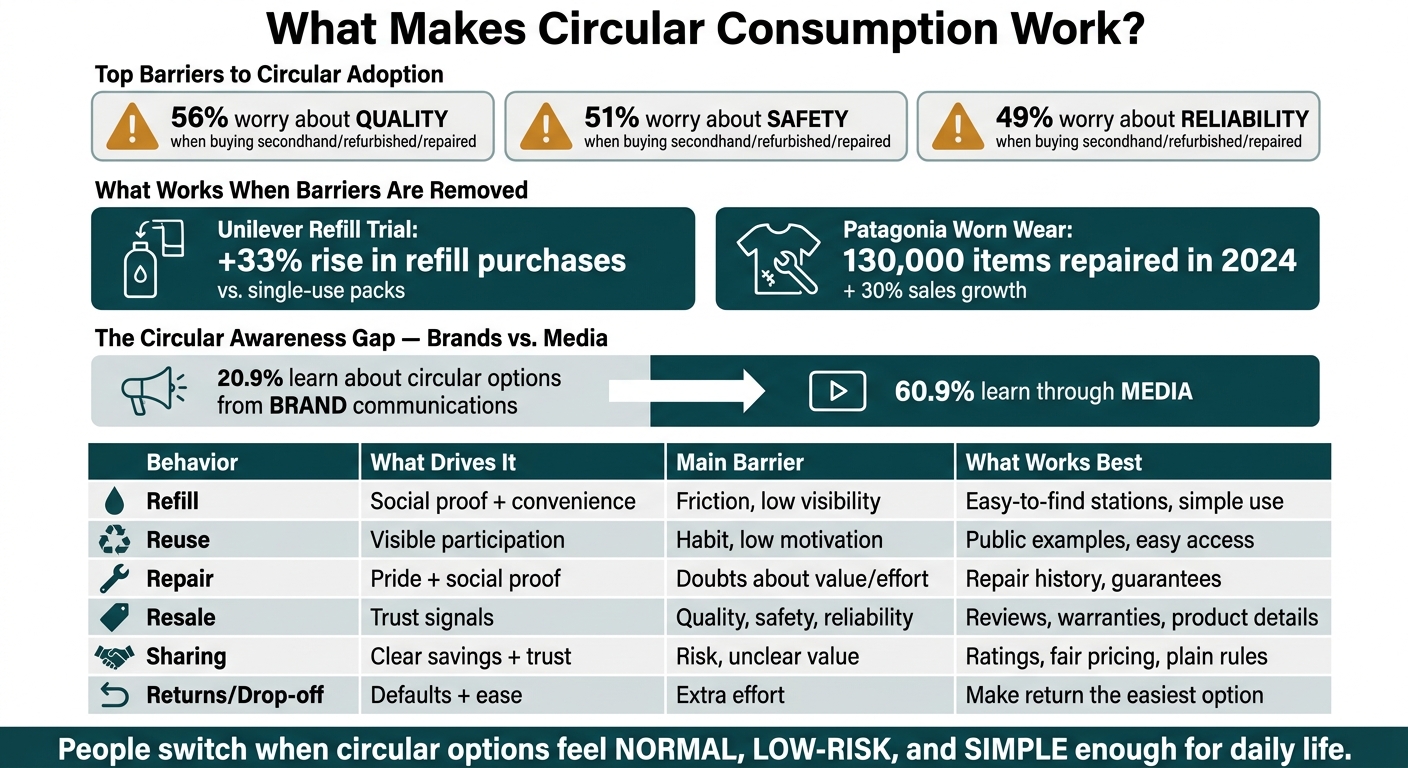
Circular Consumption Behaviors: What Drives Them & What Blocks Them
[Rewind] What marketers need to know about driving circular demand
sbb-itb-8baf5f1
Quick comparison
| Area | What drives behavior | Main barrier | What works best |
|---|---|---|---|
| Refill | Social proof, convenience | Friction, low visibility | Easy-to-find stations, simple use |
| Reuse | Visible participation | Habit, low motivation | Public examples, easy access |
| Repair | Pride, proof, social proof | Doubts about value or effort | Repair history, story, guarantees |
| Resale | Trust signals | Quality, safety, reliability | Reviews, warranties, product details |
| Sharing | Clear savings, trust | Risk, unclear value | Ratings, fair pricing, plain rules |
| Returns/drop-off | Defaults, ease | Extra effort | Make return the easiest option |
My bottom line: people do not switch behavior just because they like the idea. They switch when the option feels normal, low-risk, and simple enough to fit into daily life.
How descriptive and injunctive norms shape behavior
Social norms show up in two main ways. Descriptive norms are beliefs about what people actually do. Injunctive norms are beliefs about what people approve of. Both can shape circular behavior, but they send different signals. That matters because norms can help move people from good intentions to behavior they can see, repeat, and stick with.
Descriptive norms: how common behavior creates social proof
Descriptive norms work through social proof. When people see a behavior happening around them, it starts to feel normal. A refill station that gets steady traffic sends a simple message: this is what people here do. On the flip side, a message can hurt adoption if it draws attention to low participation. Norm-based messaging tends to work better when it shows the behavior is already common.
The key issue isn’t whether norms matter. It’s which circular behaviors they shift most.
Injunctive norms: how approval and status shape choices
Injunctive norms speak to approval, reputation, and the pull to do what other people respect. They work best when practical barriers are low - or when those barriers have already been handled. People still hesitate when trust is weak: 56% cite quality, 51% safety, and 49% reliability [1]. That’s why injunctive messages tend to land better when they come with guarantees and evidence-based messaging.
The difference between these norm types matters because each one fits a different kind of behavior and a different messaging approach.
Comparison table: descriptive norms, injunctive norms, personal norms, and social identity
In circular consumption, the right norm often depends on whether the behavior is private, visible, or tied to trust.
| Norm/Influence Type | Definition | Mechanism | Relevant Circular Behaviors | Common Communication Risk |
|---|---|---|---|---|
| Descriptive norms | Beliefs about what others actually do | Builds confidence through social proof | Reuse, refill, repair | Can backfire if participation appears rare |
| Injunctive norms | Beliefs about what others approve of | Builds moral accountability and reputation | Resale, sharing, repair | Symbolic claims without proof undermine trust |
| Personal norms | Internalized values and self-expectation | Supports consistent behavior without social pressure | Repair, refill, reuse | Hard to activate through messaging alone |
| Social identity | Connection to a specific group, such as a zero-waste community | Amplifies both descriptive and injunctive norms within that group | All circular behaviors, especially sharing and resale | Limited reach outside the target group |
The next section shows where these norms change reuse, repair, refill, resale, sharing, and return behavior.
What the evidence shows across reuse, repair, resale, sharing, and return behaviors
The pattern shifts by behavior. Visible, low-friction actions tend to respond to social proof. Actions that ask for more trust lean far more on credibility.
Reuse, refill, and repair
Reuse and refill tend to grow when participation is easy to see and simple to do. If refill stations are easy to spot and easy to use, people are more likely to take part. In one Unilever refill trial, refill purchases rose 33% compared with single-use packs [1].
Patagonia's Worn Wear repaired 130,000 items in 2024, and the brand reported 30% sales growth [1]. That matters because repair lands better when it is presented as a sign of product life and pride of ownership, not just routine upkeep.
But once a behavior becomes less visible or asks people to trust the product, the seller, or the system, approval by itself stops doing the heavy lifting.
Resale, second-hand, sharing, and access-based use
Resale and sharing run on trust infrastructure: ratings, reviews, warranties, and plain product details. Without that, people hesitate. 56% of consumers are reluctant to buy secondhand, refurbished, or repaired products because of quality concerns. 51% point to safety, and 49% cite reliability [1].
Acceptance tends to climb when the savings are clear, especially for high-cost items that people do not use often [1]. That's part of why access-based models can work so well in a few categories. People are more open to sharing when the math is obvious and the trade feels fair.
There is also a communication gap. Only 20.9% learn about circular options from corporate communications, while 60.9% hear about them from media [1]. So if the goal is to shape norms, branded campaigns can't do the whole job on their own.
Evidence matrix for circular behaviors
| Practice | Norm Mechanism | Research Design | Observed Outcome | Implementation Implication |
|---|---|---|---|---|
| Return/drop-off | Default options | University waste station redesign | Significant increase in recycling rates when bins were the easiest option [1] | Make the circular choice the path of least resistance |
| Repair/Reuse | Social proof & storytelling | Patagonia Worn Wear case study | 130,000 items repaired in 2024; 30% sales increase [1] | Celebrate product longevity to make secondhand aspirational |
| Sharing/Access | Trust & reciprocity | Turo/Airbnb platform analysis | Higher acceptance for high-cost, infrequently used items [1] | Focus sharing models on items where cost savings are most visible |
| Refill systems | Convenience & nudging | Unilever refill trials | 33% rise in refill purchases vs. single-use packs [1] | Physical infrastructure must be highly visible and easy to use |
The next question is whether trust and visibility are strong enough to make those norms stick.
How trust and visibility affect whether norm messages work
Even strong norms can fall flat when the program itself feels shaky. Norm messages only work when the program behind them seems credible.
Why trust matters in sharing, resale, and community programs
Trust gaps are a major barrier to secondhand, refurbished, and repaired products [1]. That problem gets worse in a noisy claims market. An EU Commission review found that 53% of green claims examined were vague, misleading, or unfounded [1].
That points to a plain lesson: the answer is verification, not louder marketing. Third-party verification, lifecycle data, and Digital Product Passports can shift circular claims from promises to evidence-based information. Digital Product Passports can record a product's origin, repair history, and material composition [1].
In many cases, being open about limits does more for credibility than making sweeping impact claims. If a company overstates its circular work, it chips away at the trust that norm messages depend on.
Why visibility matters for reuse and repair
Visibility helps when people can actually see the behavior in front of them: repaired items still in use, refill stations with steady traffic, or return points that are clearly marked. That kind of public signal can strengthen norms, but only if people can verify what they are seeing.
Comparison table: high-trust and low-trust program conditions
| Program Feature | High-Trust Condition | Low-Trust Condition |
|---|---|---|
| Communication | Specific, evidence-based, and transparent about limitations | Generic, jargon-heavy, or over-promising |
| Verification | Third-party audits, lifecycle assessments, or Digital Product Passports | Self-declared claims without supporting data |
| Provider credibility | Uses recognized verification and transparent data | Relies on vague claims like "eco-friendly" or "green" |
| Visibility | Public, easy-to-see participation | Hidden or hard-to-observe participation |
These credibility conditions shape how organizations design circular programs.
What organizations should do with this evidence
Design principles for norm-based circular programs
The practical takeaway is simple: social norms help only when the program behind them is visible and easy to check. If people can't see how it works, or if they doubt the claim, the message falls flat. That’s why it helps to acknowledge limits. Saying where current circular models fall short can build more consumer trust than claiming perfection [1].
An evidence-first approach matters here. Generic corporate statements don’t carry the same weight as proof people can see for themselves. Replace vague sustainability language with specific, verifiable claims and Digital Product Passports that show composition, origin, and repair guidance [1]. In plain terms, don’t just say a product is part of a circular system - show what it’s made of, where it came from, and how someone can fix it.
Norm messages also need backup. Pair them with guarantees and proof points that deal with the doubts people already have about quality, safety, and reliability [1]. If a brand wants people to buy used, refill, repair, or return, it has to remove the “Can I trust this?” hurdle first.
Measurement standards and research limits
Once the program is in place, the next step is to measure what people do, not just what they notice. That means checking whether norm messages change actual reuse, repair, refill, resale, or sharing behavior [1]. Attention is nice, but participation is the thing that counts.
Before taking a message to a larger audience, test the norm frame first and compare it against program data [1]. Results should be treated as context-specific, not universal. What works in one category, channel, or audience may not land the same way somewhere else. That’s why verification matters before expansion.
Conclusion: social norms help, but trust decides outcomes
The rule for organizations is straightforward: make circular behavior easy to see, easy to trust, and easy to repeat. Social norms can push reuse, repair, refill, resale, sharing, and return, but only when the program feels credible, stays visible, and gives people a reason to believe it will work [1].
FAQs
Why don’t good intentions lead to circular behavior?
Good intentions don’t always turn into circular behavior. That gap usually comes down to one simple thing: people’s values and their daily habits don’t always line up. Someone may care about sustainability and still choose the easier, more familiar option when it’s time to buy, return, or replace something. In day-to-day life, convenience often wins.
A few roadblocks show up again and again. People may not know how circular systems work in the first place. Some worry that secondhand goods won’t be clean, safe, or worth the money. Others are attached to buying new because it feels more reliable, more enjoyable, or just more normal. There’s also distrust - many shoppers aren’t sure which sustainability claims are honest and which are just marketing. And when return, repair, resale, or recycling processes feel like a hassle, even people with strong values tend to stop short of action.
Which circular actions depend most on trust?
Sharing platforms that connect strangers - or put high-value items into shared use - run on trust. If people don’t feel safe, informed, and respected, they won’t take part. Users need to coordinate with each other, follow the rules, and take care of shared assets. That only works when trust is in place.
Reuse and repair programs depend on that same confidence, just in a different form. People need to believe the product still performs well, and they need a reason to believe a company’s sustainability claims. That confidence grows through clear communication, steady performance over time, and plain proof that the program helps the customer in practical ways.
How can organizations make circular options feel normal?
Organizations can make circular options feel normal when they’re easy to use, easy to see, and easy to trust. In the U.S., convenience often matters more than concern about waste or climate, so reuse, repair, refill, and recycling need to feel as simple as the standard choice.
That means reducing friction wherever possible. Put circular options in places people already use. Make them the default when it makes sense. Show that other people are already doing it. Small signals like these can shift behavior because they make the choice feel familiar instead of like extra work.
Clear communication matters just as much. People need to know what to do, why it matters, and what they can expect. Plain language helps. So do relatable stories, local voices, and visible examples from people they already trust. When organizations use transparent messaging and lean on community champions, circular behavior starts to move from a special effort to an everyday habit.



FAQ