

Jul 28, 2026
Setting SMART Goals for Sustainability Change
Sustainability Strategy
In This Article
Turn sustainability ambition into action: pick a material issue, set a 12-month baseline, write SMART targets, assign owners, and budget.
Setting SMART Goals for Sustainability Change
If a goal has no baseline, no owner, no budget, and no deadline, I treat it as a wish - not a plan.
I can turn a broad aim into action with a simple six-step process: pick the issue that matters most, set a baseline from one full year of data, write a SMART target, assign one person to own it, set review dates, and link the work to CapEx or OpEx. That is what makes a goal usable in budgets, planning, and performance reviews.
Here’s the short version:
Start with one material issue instead of a vague promise.
Use 12 months of data to set a baseline.
Define the target clearly: what changes, by how much, and by MM/DD/YYYY.
Name one accountable owner and separate sponsor, data, and support roles.
Track 1 to 3 KPIs with a set reporting rhythm, such as monthly or quarterly.
Tie each goal to dollars, like $750,000 CapEx with $200,000 in yearly savings.
Set escalation rules if results drift 5% to 10% off plan for two review periods.
A strong goal tells me what the team should do next week, what finance should fund this quarter, and what leaders should review by year-end. The point is simple: make the goal specific enough to run.
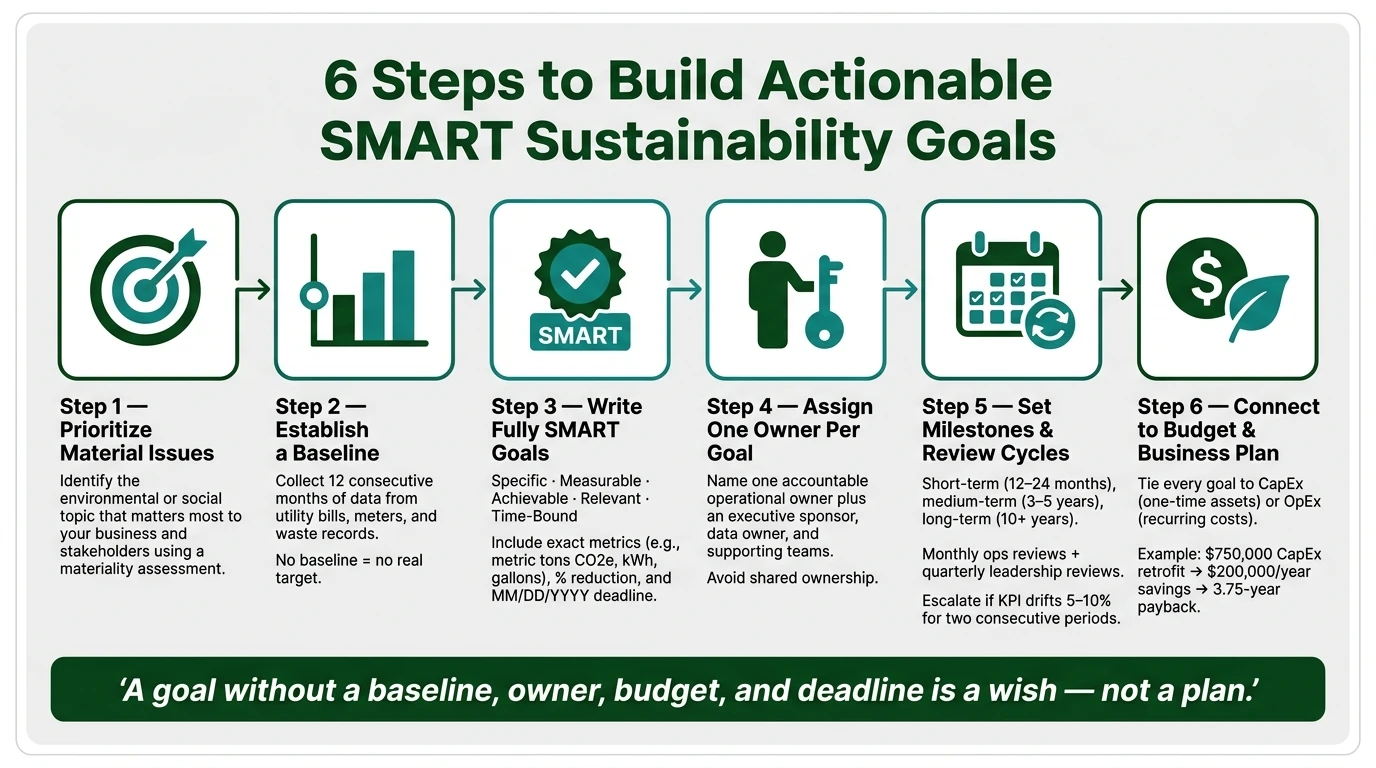
6 Steps to Build Actionable SMART Sustainability Goals
How to set sustainability goals for your business
1. Define the goal clearly before making it SMART
Before you apply the SMART framework, get clear on the issue itself. A broad aim like "be more sustainable" sounds fine on paper, but it’s too loose to manage. You need to turn that ambition into a defined sustainability issue that matters to the business and the people connected to it.
Start with material issues and a baseline
Begin with a material issue - the environmental or social topic that matters most to the business and stakeholders. A materiality assessment helps rank issues based on business impact and stakeholder concern.
Once you’ve picked the priority issue, trace where it shows up in the value chain: owned facilities, logistics, supply chain, or product use. Then state the intended outcome in plain English. After that, run a current-state review. Use solid internal data such as utility bills and meters, water bills and flow meters, and waste records to set a baseline. Work from one recent full year of complete data, and note the method you’ll use for year-over-year comparison. As ENERGY STAR puts it:
"Without good energy data, it is impossible to tell if you are really improving or not!" [1]
Without a baseline, a target is just a direction.
Once the issue, boundary, and baseline are in place, write the target using all five SMART criteria.
Write the goal across all five SMART criteria
Spell out each SMART element. The table below is a simple check: does the target say exactly what will change, by how much, by when, and from what starting point?
Broad Aim | SMART Goal | What Was Missing |
|---|---|---|
Reduce our carbon footprint. | Reduce absolute Scope 1 and 2 GHG emissions by 50% by 12/31/2030 from a 2020 baseline of 10,000 metric tons CO2e. | Specificity (Scope), measurability (metric tons), time-bound deadline, and a defined baseline. |
Use more renewable energy. | Achieve 100% renewable electricity across all U.S. facilities (measured in MWh) by 06/30/2027. | Precise target (100%), specific metric (MWh), and a clear deadline. |
Cut waste going to landfill. | Decrease landfill waste from U.S. corporate offices by 50% (from 2,000 tons in 2023 to 1,000 tons) by 12/31/2027 by expanding recycling and composting programs. | Baseline tonnage and year, percentage reduction, operational boundary, and time frame. |
Improve water efficiency. | Reduce water consumption intensity by 15% per square foot of office space by 12/31/2028, using 2023 consumption of 5,000,000 gallons as a baseline. | Metric (gallons), intensity factor (sq. ft.), and a baseline year. |
Use U.S.-relevant metrics and formats
Consistency in units matters, especially when goals cover more than one site or feed into outside reporting. For U.S. sustainability targets, use metric tons CO2e for emissions, kWh and MWh for electricity, gallons for water, and pounds or tons for waste. When site size or output changes, intensity metrics help keep comparisons clean. For buildings across a portfolio, kWh per square foot is a useful way to measure performance.
For budgets, use standard U.S. dollar formatting such as $2,500,000 so numbers are easy to read in finance documents. Put deadlines in MM/DD/YYYY format - for example, 12/31/2030 - to avoid mix-ups in planning and reporting. These conventions make the goal easier to use from day one across finance, reporting, and day-to-day tracking.
Example: By 12/31/2029, reduce water use at our Phoenix plant 30% from a 2024 baseline, backed by a $2,500,000 capital budget for efficiency and reuse systems.
That level of detail makes the next step much easier. You can assign ownership, set milestones, and track progress without guessing. Next, assign deadlines, owners, and review cycles.
2. Set time frames, owners, and review cycles
A sustainability goal without a deadline or clear owner usually goes nowhere. Once you set the target, turn it into a managed plan with milestones, named owners, and fixed review points. The setup around the goal - owner, deadline, review process, and escalation path - is what decides whether the work moves or stalls.
Build short-, medium-, and long-term milestones
Start with the end state, then work backward. A simple way to do that is to use three time horizons:
Short term (12–24 months): baselining and day-to-day operational changes.
Medium term (3–5 years): capital-heavy projects such as fleet electrification, retrofits, and renewable procurement, lined up with capital planning cycles.
Long term (10+ years): system-level shifts tied to 2030, 2040, or 2050 commitments.
The Science-Based Targets initiative (SBTi), referenced by the U.S. EPA, recommends interim milestones at five-year intervals between the base year and the long-term target year. [3][6] For organizational GHG reduction targets, the EPA recommends target years that are 5 to 10 years from the base year, with a clearly defined base year and boundary. [4] Writing milestones in fiscal year format - FY2027, FY2028 - makes it easier to connect them to budget cycles and helps finance teams track progress.
These horizons should line up with annual budgets, forecast cycles, and capital approvals. That link matters. If the timeline lives in one place and the money decisions live somewhere else, the plan starts to drift.
Assign one accountable owner per goal
Every goal needs one named person who has the authority to make calls and the responsibility to deliver results. Without that, the goal ends up owned by everyone on paper and no one in practice.
There are four separate roles to assign:
Executive sponsor: A senior leader, often a C-suite member, who ties the goal to business strategy, approves major budget decisions, and escalates issues to the board when needed.
Operational owner: The person handling the day-to-day work - a Director of Facilities for an energy goal, or a Supply Chain Manager for a waste or supplier engagement target. This is the main accountability role.
Data owner: The person responsible for metric accuracy and timing - maintaining metering systems, checking kWh or CO₂e figures, and issuing regular performance reports.
Supporting teams such as finance, procurement, HR, and IT: These teams bring needed input, but they are not accountable for the final outcome.
Mixing up these roles is a common failure point. If an executive sponsor is named but no operational owner is in place, the goal often stalls. The reason is simple: no one has both the authority and the daily job of pushing it forward.
Map goals to owners, deadlines, and escalation paths
Once owners are assigned, put the details into one reference table. This becomes the working record for monthly check-ins and quarterly leadership reviews.
Goal | Owner | KPI | Deadline | Reporting Cadence | Escalation Path |
|---|---|---|---|---|---|
Reduce facility energy intensity by 15% vs. 2022 baseline | Director of Facilities | kWh per square foot (monthly) | 12/31/2028 | Monthly ops; quarterly leadership | Escalate to COO if off track for two consecutive quarters |
Achieve 60% waste diversion from landfill | Sustainability Manager | % of total waste diverted | 12/31/2027 | Monthly; quarterly sustainability committee | Escalate to executive sponsor if performance lags for two consecutive reporting periods |
Reduce combined Scope 1, 2, and selected Scope 3 emissions by 45% vs. 2022 baseline | VP of Operations | Metric tons of CO₂e (quarterly) | 12/31/2035 | Quarterly ops; annual board review | Escalate to CEO if annual progress lags the target path for two consecutive years |
With ownership in place, set a review rhythm that keeps the goal alive. Monthly reviews should track KPI variance, data gaps, and corrective action. Quarterly reviews should look at trends, resource needs, and strategy, ideally inside existing management meetings and financial reporting cycles.
The escalation path should also have a clear trigger. For example, if a KPI drifts more than 5% to 10% from its target path for two straight reporting periods, the issue should move from the operational owner to the executive sponsor. If it still is not fixed, it goes to the board. [2][5]
3. Choose the right data and connect goals to budgets
Once owners are in place, the next job is simple in concept but easy to muddle in practice: decide how progress will be tracked and how funding will be defended. That means a small set of outcome KPIs, a clear data map, and a budget line tied to each goal.
Select KPIs, data sources, and reporting frequency
Use one to three outcome KPIs for each material issue, whether that’s energy, waste, water, or supplier impact. The key is to pick measures that are quantifiable and comparable over time. If you track energy intensity in kWh per square foot, for instance, you can see whether a building is becoming more efficient or just using less power because occupancy changed. That makes the goal measurable and lets you review it against the SMART target.
Each KPI should be linked to its data source, unit, and collection cadence. In practice, that usually means pulling from utility bills, hauler reports, fuel records, telematics, supplier questionnaires, or procurement records.
Reporting cadence should match the speed of decision-making. Monthly works well for operating KPIs, where teams can step in and fix issues fast. Quarterly fits more strategic indicators that move at a slower pace.
KPI | Unit | Data Source | Reporting Frequency |
|---|---|---|---|
Total electricity use | kWh and $ | Monthly utility bills | Monthly |
Scope 1 GHG emissions | metric tons CO₂e | Fuel records, equipment logs | Quarterly |
Scope 2 GHG emissions | metric tons CO₂e | Electricity and steam utility bills | Quarterly |
Water withdrawal | gallons and $ | Water utility bills | Monthly |
Landfill diversion rate | % of total waste | Waste hauler reports and weight tickets | Quarterly |
Renewable energy share | % of total electricity | Power purchase agreements, REC records | Quarterly |
Supplier ESG compliance rate | % of key suppliers compliant | Supplier questionnaires, audits | Quarterly |
Start gathering 12 consecutive months of utility data as early as possible so the baseline is ready before target setting. [8]
With the measurement setup in place, the next step is funding.
Tie each goal to a budget line and cost category
Every goal should connect to CapEx for one-time assets or OpEx for recurring program costs. Each owner also needs a budget tied to the deadline they’re on the hook for.
Take a common example: a goal to cut facility electricity use by 20% by 12/31/2028. That goal might sit behind a $750,000 CapEx allocation for efficiency retrofits, with projected annual utility savings of $200,000. Put plainly, that’s a payback period of about 3.75 years. [7]
This is where many plans either get traction or stall out. If the goal lives in a slide deck but not in the budget, it usually doesn’t move far.
Budgets carry the most weight when they flow straight into annual planning and capital decisions.
Connect sustainability goals to business plans and investment decisions
A goal framed only as an environmental commitment often slips down the priority list. The same goal tends to land much better when it is put in business terms: a hedge against energy price swings, a response to climate disclosure rules, or a path to growth.
That shift matters in capital planning conversations. Leaders rarely fund a target because it sounds good on paper. They fund it because it links to cost control, risk reduction, compliance, or revenue.
The table below ties sustainability goals to budget lines, financial effects, and business aims in the format most useful for annual planning and capital allocation reviews.
Sustainability Goal | Budget Line & Category | Expected Financial Effect | Related Business Objective |
|---|---|---|---|
Reduce electricity use by 20% by 12/31/2028 | Energy-efficiency retrofits (CapEx, $750,000) | ~$200,000/year utility savings; 3.75-year payback | Cost management; GHG reduction; regulatory readiness |
Achieve 75% landfill diversion by 12/31/2027 | Waste management program (OpEx, $60,000/year) | Lower disposal fees; possible recycling rebates | Cost management; stakeholder trust |
Source 50% of electricity from renewables by 12/31/2030 | Renewable power contracts (OpEx, incremental $ per MWh) | Energy price stability; possible premium pricing | Resilience; regulatory readiness; brand differentiation |
Complete climate risk assessments for all key sites by 12/31/2027 | Risk assessment project (OpEx, $150,000) | Avoided downtime; improved insurance terms | Resilience; risk management |
Implement supplier ESG standards for top 100 suppliers by 12/31/2029 | Supplier program (OpEx, $100,000/year) | Reduced supply chain disruptions; improved compliance | Regulatory readiness; stakeholder trust |
Conclusion: A simple method for building actionable sustainability goals
This guide comes down to six steps you can repeat again and again: prioritize material issues, establish a baseline, write fully SMART goals, assign one owner per goal, set milestones and review cycles, and connect every goal to a budget and business plan. Put together, those steps turn sustainability ambition into a plan people can run day to day. The hard part isn't naming the steps. It's using them as one working system.
The pattern is hard to miss: targets fall apart when they don't have baselines, owners, budgets, or review cycles.
On the ground, that means a goal needs to be specific, funded, assigned, and checked on a fixed schedule. A mid-sized U.S. manufacturer that commits to a 30% reduction in Scope 1 and 2 emissions by 12/31/2030, funds that target, assigns a VP of Operations, and reviews progress quarterly is using SMART discipline.
When a team is stretched thin, outside help can speed things up. Council Fire helps organizations turn sustainability strategy into SMART goals, data systems, accountability, and investment plans.
The aim is simple: know where you are, decide what matters most, define success precisely, fund it, own it, and review it. That sequence, applied with discipline, is what separates organizations that make measurable progress from those that simply make promises.
FAQs
How do I choose the right sustainability issue to prioritize first?
Start with a materiality assessment. It helps you pinpoint the environmental, social, and governance issues that matter most to both your organization and the people who have a stake in it.
When you look at financial materiality alongside impact materiality, you get a clearer view of where to act first. That means putting time and resources toward the issues most likely to cut risk and create value.
What should I do if I don’t have 12 full months of baseline data?
If you don’t have a full 12 months of baseline data, fill the gaps with regional averages or industry benchmarks. The key is consistency. If direct records like utility bills or meter readings are missing, use the same regional average method across the board instead of mixing approaches.
Write down your process in an Inventory Management Plan so your estimates, assumptions, and sources are easy to track. That paper trail matters. It shows how you got your numbers and makes later reviews much less painful.
As better internal data comes in, go back and tighten your figures. Using a standard framework like the Greenhouse Gas Protocol also helps keep your baseline solid and ready for audit.
How can I get leadership to fund a sustainability goal?
Show how the goal connects to core business aims, lowers organizational risk, and leads to measurable financial returns.
Use regular briefings to connect sustainability performance with business results. That keeps the conversation grounded in what leaders care about most: growth, cost control, risk, and long-term value. Build the business case with clear metrics such as NPV and payback periods, so the upside is easy to see and compare with other investments.
Tying executive compensation to ESG metrics can also strengthen accountability and board-level oversight. When pay is linked to results, sustainability stops sitting on the sidelines and becomes part of how leadership is judged and managed.
Related Blog Posts
Latest Articles
©2026

Narrative Change and Power Building: The Missing Half of Advocacy
Narrative change is the process of disrupting dominant narratives that normalize inequity and advancing new narratives from historically marginalized communities.

Funding Resilience Without Federal Grants
BRIC is unreliable and FEMA is shrinking. Here's how cities fund climate resilience with dedicated revenue, blended finance, and a coordinating authority.

The ESG Blind Spot: How AI Is Finding Risks in Companies Nobody Else Is Watching
Norway's sovereign wealth fund uses AI to screen 7,200 portfolio companies for forced labor and corruption within 24 hours. The real story is the emerging-market coverage gap that traditional ESG data vendors miss — and what it means for any company with a global supply chain.
Narrative Change and Power Building: The Missing Half of Advocacy
Narrative change is the process of disrupting dominant narratives that normalize inequity and advancing new narratives from historically marginalized communities.
Funding Resilience Without Federal Grants
BRIC is unreliable and FEMA is shrinking. Here's how cities fund climate resilience with dedicated revenue, blended finance, and a coordinating authority.
The ESG Blind Spot: How AI Is Finding Risks in Companies Nobody Else Is Watching
Norway's sovereign wealth fund uses AI to screen 7,200 portfolio companies for forced labor and corruption within 24 hours. The real story is the emerging-market coverage gap that traditional ESG data vendors miss — and what it means for any company with a global supply chain.
FAQ
01
What does it really mean to “redefine profit”?
02
What makes Council Fire different?
03
Who does Council Fire work with?
04
What does working with Council Fire actually look like?
05
How does Council Fire help organizations turn big goals into action?
06
How does Council Fire define and measure success?
07
How does technology fit into Council Fire’s work?
Jul 28, 2026
Setting SMART Goals for Sustainability Change
Sustainability Strategy
In This Article
Turn sustainability ambition into action: pick a material issue, set a 12-month baseline, write SMART targets, assign owners, and budget.
Setting SMART Goals for Sustainability Change
If a goal has no baseline, no owner, no budget, and no deadline, I treat it as a wish - not a plan.
I can turn a broad aim into action with a simple six-step process: pick the issue that matters most, set a baseline from one full year of data, write a SMART target, assign one person to own it, set review dates, and link the work to CapEx or OpEx. That is what makes a goal usable in budgets, planning, and performance reviews.
Here’s the short version:
Start with one material issue instead of a vague promise.
Use 12 months of data to set a baseline.
Define the target clearly: what changes, by how much, and by MM/DD/YYYY.
Name one accountable owner and separate sponsor, data, and support roles.
Track 1 to 3 KPIs with a set reporting rhythm, such as monthly or quarterly.
Tie each goal to dollars, like $750,000 CapEx with $200,000 in yearly savings.
Set escalation rules if results drift 5% to 10% off plan for two review periods.
A strong goal tells me what the team should do next week, what finance should fund this quarter, and what leaders should review by year-end. The point is simple: make the goal specific enough to run.
6 Steps to Build Actionable SMART Sustainability Goals
How to set sustainability goals for your business
1. Define the goal clearly before making it SMART
Before you apply the SMART framework, get clear on the issue itself. A broad aim like "be more sustainable" sounds fine on paper, but it’s too loose to manage. You need to turn that ambition into a defined sustainability issue that matters to the business and the people connected to it.
Start with material issues and a baseline
Begin with a material issue - the environmental or social topic that matters most to the business and stakeholders. A materiality assessment helps rank issues based on business impact and stakeholder concern.
Once you’ve picked the priority issue, trace where it shows up in the value chain: owned facilities, logistics, supply chain, or product use. Then state the intended outcome in plain English. After that, run a current-state review. Use solid internal data such as utility bills and meters, water bills and flow meters, and waste records to set a baseline. Work from one recent full year of complete data, and note the method you’ll use for year-over-year comparison. As ENERGY STAR puts it:
"Without good energy data, it is impossible to tell if you are really improving or not!" [1]
Without a baseline, a target is just a direction.
Once the issue, boundary, and baseline are in place, write the target using all five SMART criteria.
Write the goal across all five SMART criteria
Spell out each SMART element. The table below is a simple check: does the target say exactly what will change, by how much, by when, and from what starting point?
Broad Aim | SMART Goal | What Was Missing |
|---|---|---|
Reduce our carbon footprint. | Reduce absolute Scope 1 and 2 GHG emissions by 50% by 12/31/2030 from a 2020 baseline of 10,000 metric tons CO2e. | Specificity (Scope), measurability (metric tons), time-bound deadline, and a defined baseline. |
Use more renewable energy. | Achieve 100% renewable electricity across all U.S. facilities (measured in MWh) by 06/30/2027. | Precise target (100%), specific metric (MWh), and a clear deadline. |
Cut waste going to landfill. | Decrease landfill waste from U.S. corporate offices by 50% (from 2,000 tons in 2023 to 1,000 tons) by 12/31/2027 by expanding recycling and composting programs. | Baseline tonnage and year, percentage reduction, operational boundary, and time frame. |
Improve water efficiency. | Reduce water consumption intensity by 15% per square foot of office space by 12/31/2028, using 2023 consumption of 5,000,000 gallons as a baseline. | Metric (gallons), intensity factor (sq. ft.), and a baseline year. |
Use U.S.-relevant metrics and formats
Consistency in units matters, especially when goals cover more than one site or feed into outside reporting. For U.S. sustainability targets, use metric tons CO2e for emissions, kWh and MWh for electricity, gallons for water, and pounds or tons for waste. When site size or output changes, intensity metrics help keep comparisons clean. For buildings across a portfolio, kWh per square foot is a useful way to measure performance.
For budgets, use standard U.S. dollar formatting such as $2,500,000 so numbers are easy to read in finance documents. Put deadlines in MM/DD/YYYY format - for example, 12/31/2030 - to avoid mix-ups in planning and reporting. These conventions make the goal easier to use from day one across finance, reporting, and day-to-day tracking.
Example: By 12/31/2029, reduce water use at our Phoenix plant 30% from a 2024 baseline, backed by a $2,500,000 capital budget for efficiency and reuse systems.
That level of detail makes the next step much easier. You can assign ownership, set milestones, and track progress without guessing. Next, assign deadlines, owners, and review cycles.
2. Set time frames, owners, and review cycles
A sustainability goal without a deadline or clear owner usually goes nowhere. Once you set the target, turn it into a managed plan with milestones, named owners, and fixed review points. The setup around the goal - owner, deadline, review process, and escalation path - is what decides whether the work moves or stalls.
Build short-, medium-, and long-term milestones
Start with the end state, then work backward. A simple way to do that is to use three time horizons:
Short term (12–24 months): baselining and day-to-day operational changes.
Medium term (3–5 years): capital-heavy projects such as fleet electrification, retrofits, and renewable procurement, lined up with capital planning cycles.
Long term (10+ years): system-level shifts tied to 2030, 2040, or 2050 commitments.
The Science-Based Targets initiative (SBTi), referenced by the U.S. EPA, recommends interim milestones at five-year intervals between the base year and the long-term target year. [3][6] For organizational GHG reduction targets, the EPA recommends target years that are 5 to 10 years from the base year, with a clearly defined base year and boundary. [4] Writing milestones in fiscal year format - FY2027, FY2028 - makes it easier to connect them to budget cycles and helps finance teams track progress.
These horizons should line up with annual budgets, forecast cycles, and capital approvals. That link matters. If the timeline lives in one place and the money decisions live somewhere else, the plan starts to drift.
Assign one accountable owner per goal
Every goal needs one named person who has the authority to make calls and the responsibility to deliver results. Without that, the goal ends up owned by everyone on paper and no one in practice.
There are four separate roles to assign:
Executive sponsor: A senior leader, often a C-suite member, who ties the goal to business strategy, approves major budget decisions, and escalates issues to the board when needed.
Operational owner: The person handling the day-to-day work - a Director of Facilities for an energy goal, or a Supply Chain Manager for a waste or supplier engagement target. This is the main accountability role.
Data owner: The person responsible for metric accuracy and timing - maintaining metering systems, checking kWh or CO₂e figures, and issuing regular performance reports.
Supporting teams such as finance, procurement, HR, and IT: These teams bring needed input, but they are not accountable for the final outcome.
Mixing up these roles is a common failure point. If an executive sponsor is named but no operational owner is in place, the goal often stalls. The reason is simple: no one has both the authority and the daily job of pushing it forward.
Map goals to owners, deadlines, and escalation paths
Once owners are assigned, put the details into one reference table. This becomes the working record for monthly check-ins and quarterly leadership reviews.
Goal | Owner | KPI | Deadline | Reporting Cadence | Escalation Path |
|---|---|---|---|---|---|
Reduce facility energy intensity by 15% vs. 2022 baseline | Director of Facilities | kWh per square foot (monthly) | 12/31/2028 | Monthly ops; quarterly leadership | Escalate to COO if off track for two consecutive quarters |
Achieve 60% waste diversion from landfill | Sustainability Manager | % of total waste diverted | 12/31/2027 | Monthly; quarterly sustainability committee | Escalate to executive sponsor if performance lags for two consecutive reporting periods |
Reduce combined Scope 1, 2, and selected Scope 3 emissions by 45% vs. 2022 baseline | VP of Operations | Metric tons of CO₂e (quarterly) | 12/31/2035 | Quarterly ops; annual board review | Escalate to CEO if annual progress lags the target path for two consecutive years |
With ownership in place, set a review rhythm that keeps the goal alive. Monthly reviews should track KPI variance, data gaps, and corrective action. Quarterly reviews should look at trends, resource needs, and strategy, ideally inside existing management meetings and financial reporting cycles.
The escalation path should also have a clear trigger. For example, if a KPI drifts more than 5% to 10% from its target path for two straight reporting periods, the issue should move from the operational owner to the executive sponsor. If it still is not fixed, it goes to the board. [2][5]
3. Choose the right data and connect goals to budgets
Once owners are in place, the next job is simple in concept but easy to muddle in practice: decide how progress will be tracked and how funding will be defended. That means a small set of outcome KPIs, a clear data map, and a budget line tied to each goal.
Select KPIs, data sources, and reporting frequency
Use one to three outcome KPIs for each material issue, whether that’s energy, waste, water, or supplier impact. The key is to pick measures that are quantifiable and comparable over time. If you track energy intensity in kWh per square foot, for instance, you can see whether a building is becoming more efficient or just using less power because occupancy changed. That makes the goal measurable and lets you review it against the SMART target.
Each KPI should be linked to its data source, unit, and collection cadence. In practice, that usually means pulling from utility bills, hauler reports, fuel records, telematics, supplier questionnaires, or procurement records.
Reporting cadence should match the speed of decision-making. Monthly works well for operating KPIs, where teams can step in and fix issues fast. Quarterly fits more strategic indicators that move at a slower pace.
KPI | Unit | Data Source | Reporting Frequency |
|---|---|---|---|
Total electricity use | kWh and $ | Monthly utility bills | Monthly |
Scope 1 GHG emissions | metric tons CO₂e | Fuel records, equipment logs | Quarterly |
Scope 2 GHG emissions | metric tons CO₂e | Electricity and steam utility bills | Quarterly |
Water withdrawal | gallons and $ | Water utility bills | Monthly |
Landfill diversion rate | % of total waste | Waste hauler reports and weight tickets | Quarterly |
Renewable energy share | % of total electricity | Power purchase agreements, REC records | Quarterly |
Supplier ESG compliance rate | % of key suppliers compliant | Supplier questionnaires, audits | Quarterly |
Start gathering 12 consecutive months of utility data as early as possible so the baseline is ready before target setting. [8]
With the measurement setup in place, the next step is funding.
Tie each goal to a budget line and cost category
Every goal should connect to CapEx for one-time assets or OpEx for recurring program costs. Each owner also needs a budget tied to the deadline they’re on the hook for.
Take a common example: a goal to cut facility electricity use by 20% by 12/31/2028. That goal might sit behind a $750,000 CapEx allocation for efficiency retrofits, with projected annual utility savings of $200,000. Put plainly, that’s a payback period of about 3.75 years. [7]
This is where many plans either get traction or stall out. If the goal lives in a slide deck but not in the budget, it usually doesn’t move far.
Budgets carry the most weight when they flow straight into annual planning and capital decisions.
Connect sustainability goals to business plans and investment decisions
A goal framed only as an environmental commitment often slips down the priority list. The same goal tends to land much better when it is put in business terms: a hedge against energy price swings, a response to climate disclosure rules, or a path to growth.
That shift matters in capital planning conversations. Leaders rarely fund a target because it sounds good on paper. They fund it because it links to cost control, risk reduction, compliance, or revenue.
The table below ties sustainability goals to budget lines, financial effects, and business aims in the format most useful for annual planning and capital allocation reviews.
Sustainability Goal | Budget Line & Category | Expected Financial Effect | Related Business Objective |
|---|---|---|---|
Reduce electricity use by 20% by 12/31/2028 | Energy-efficiency retrofits (CapEx, $750,000) | ~$200,000/year utility savings; 3.75-year payback | Cost management; GHG reduction; regulatory readiness |
Achieve 75% landfill diversion by 12/31/2027 | Waste management program (OpEx, $60,000/year) | Lower disposal fees; possible recycling rebates | Cost management; stakeholder trust |
Source 50% of electricity from renewables by 12/31/2030 | Renewable power contracts (OpEx, incremental $ per MWh) | Energy price stability; possible premium pricing | Resilience; regulatory readiness; brand differentiation |
Complete climate risk assessments for all key sites by 12/31/2027 | Risk assessment project (OpEx, $150,000) | Avoided downtime; improved insurance terms | Resilience; risk management |
Implement supplier ESG standards for top 100 suppliers by 12/31/2029 | Supplier program (OpEx, $100,000/year) | Reduced supply chain disruptions; improved compliance | Regulatory readiness; stakeholder trust |
Conclusion: A simple method for building actionable sustainability goals
This guide comes down to six steps you can repeat again and again: prioritize material issues, establish a baseline, write fully SMART goals, assign one owner per goal, set milestones and review cycles, and connect every goal to a budget and business plan. Put together, those steps turn sustainability ambition into a plan people can run day to day. The hard part isn't naming the steps. It's using them as one working system.
The pattern is hard to miss: targets fall apart when they don't have baselines, owners, budgets, or review cycles.
On the ground, that means a goal needs to be specific, funded, assigned, and checked on a fixed schedule. A mid-sized U.S. manufacturer that commits to a 30% reduction in Scope 1 and 2 emissions by 12/31/2030, funds that target, assigns a VP of Operations, and reviews progress quarterly is using SMART discipline.
When a team is stretched thin, outside help can speed things up. Council Fire helps organizations turn sustainability strategy into SMART goals, data systems, accountability, and investment plans.
The aim is simple: know where you are, decide what matters most, define success precisely, fund it, own it, and review it. That sequence, applied with discipline, is what separates organizations that make measurable progress from those that simply make promises.
FAQs
How do I choose the right sustainability issue to prioritize first?
Start with a materiality assessment. It helps you pinpoint the environmental, social, and governance issues that matter most to both your organization and the people who have a stake in it.
When you look at financial materiality alongside impact materiality, you get a clearer view of where to act first. That means putting time and resources toward the issues most likely to cut risk and create value.
What should I do if I don’t have 12 full months of baseline data?
If you don’t have a full 12 months of baseline data, fill the gaps with regional averages or industry benchmarks. The key is consistency. If direct records like utility bills or meter readings are missing, use the same regional average method across the board instead of mixing approaches.
Write down your process in an Inventory Management Plan so your estimates, assumptions, and sources are easy to track. That paper trail matters. It shows how you got your numbers and makes later reviews much less painful.
As better internal data comes in, go back and tighten your figures. Using a standard framework like the Greenhouse Gas Protocol also helps keep your baseline solid and ready for audit.
How can I get leadership to fund a sustainability goal?
Show how the goal connects to core business aims, lowers organizational risk, and leads to measurable financial returns.
Use regular briefings to connect sustainability performance with business results. That keeps the conversation grounded in what leaders care about most: growth, cost control, risk, and long-term value. Build the business case with clear metrics such as NPV and payback periods, so the upside is easy to see and compare with other investments.
Tying executive compensation to ESG metrics can also strengthen accountability and board-level oversight. When pay is linked to results, sustainability stops sitting on the sidelines and becomes part of how leadership is judged and managed.
Related Blog Posts
Latest Articles
©2026
Narrative Change and Power Building: The Missing Half of Advocacy
Narrative change is the process of disrupting dominant narratives that normalize inequity and advancing new narratives from historically marginalized communities.
Funding Resilience Without Federal Grants
BRIC is unreliable and FEMA is shrinking. Here's how cities fund climate resilience with dedicated revenue, blended finance, and a coordinating authority.
The ESG Blind Spot: How AI Is Finding Risks in Companies Nobody Else Is Watching
Norway's sovereign wealth fund uses AI to screen 7,200 portfolio companies for forced labor and corruption within 24 hours. The real story is the emerging-market coverage gap that traditional ESG data vendors miss — and what it means for any company with a global supply chain.
FAQ
01
What does it really mean to “redefine profit”?
02
What makes Council Fire different?
03
Who does Council Fire work with?
04
What does working with Council Fire actually look like?
05
How does Council Fire help organizations turn big goals into action?
06
How does Council Fire define and measure success?
07
How does technology fit into Council Fire’s work?
Jul 28, 2026
Setting SMART Goals for Sustainability Change
Sustainability Strategy
In This Article
Turn sustainability ambition into action: pick a material issue, set a 12-month baseline, write SMART targets, assign owners, and budget.
Setting SMART Goals for Sustainability Change
If a goal has no baseline, no owner, no budget, and no deadline, I treat it as a wish - not a plan.
I can turn a broad aim into action with a simple six-step process: pick the issue that matters most, set a baseline from one full year of data, write a SMART target, assign one person to own it, set review dates, and link the work to CapEx or OpEx. That is what makes a goal usable in budgets, planning, and performance reviews.
Here’s the short version:
Start with one material issue instead of a vague promise.
Use 12 months of data to set a baseline.
Define the target clearly: what changes, by how much, and by MM/DD/YYYY.
Name one accountable owner and separate sponsor, data, and support roles.
Track 1 to 3 KPIs with a set reporting rhythm, such as monthly or quarterly.
Tie each goal to dollars, like $750,000 CapEx with $200,000 in yearly savings.
Set escalation rules if results drift 5% to 10% off plan for two review periods.
A strong goal tells me what the team should do next week, what finance should fund this quarter, and what leaders should review by year-end. The point is simple: make the goal specific enough to run.
6 Steps to Build Actionable SMART Sustainability Goals
How to set sustainability goals for your business
1. Define the goal clearly before making it SMART
Before you apply the SMART framework, get clear on the issue itself. A broad aim like "be more sustainable" sounds fine on paper, but it’s too loose to manage. You need to turn that ambition into a defined sustainability issue that matters to the business and the people connected to it.
Start with material issues and a baseline
Begin with a material issue - the environmental or social topic that matters most to the business and stakeholders. A materiality assessment helps rank issues based on business impact and stakeholder concern.
Once you’ve picked the priority issue, trace where it shows up in the value chain: owned facilities, logistics, supply chain, or product use. Then state the intended outcome in plain English. After that, run a current-state review. Use solid internal data such as utility bills and meters, water bills and flow meters, and waste records to set a baseline. Work from one recent full year of complete data, and note the method you’ll use for year-over-year comparison. As ENERGY STAR puts it:
"Without good energy data, it is impossible to tell if you are really improving or not!" [1]
Without a baseline, a target is just a direction.
Once the issue, boundary, and baseline are in place, write the target using all five SMART criteria.
Write the goal across all five SMART criteria
Spell out each SMART element. The table below is a simple check: does the target say exactly what will change, by how much, by when, and from what starting point?
Broad Aim | SMART Goal | What Was Missing |
|---|---|---|
Reduce our carbon footprint. | Reduce absolute Scope 1 and 2 GHG emissions by 50% by 12/31/2030 from a 2020 baseline of 10,000 metric tons CO2e. | Specificity (Scope), measurability (metric tons), time-bound deadline, and a defined baseline. |
Use more renewable energy. | Achieve 100% renewable electricity across all U.S. facilities (measured in MWh) by 06/30/2027. | Precise target (100%), specific metric (MWh), and a clear deadline. |
Cut waste going to landfill. | Decrease landfill waste from U.S. corporate offices by 50% (from 2,000 tons in 2023 to 1,000 tons) by 12/31/2027 by expanding recycling and composting programs. | Baseline tonnage and year, percentage reduction, operational boundary, and time frame. |
Improve water efficiency. | Reduce water consumption intensity by 15% per square foot of office space by 12/31/2028, using 2023 consumption of 5,000,000 gallons as a baseline. | Metric (gallons), intensity factor (sq. ft.), and a baseline year. |
Use U.S.-relevant metrics and formats
Consistency in units matters, especially when goals cover more than one site or feed into outside reporting. For U.S. sustainability targets, use metric tons CO2e for emissions, kWh and MWh for electricity, gallons for water, and pounds or tons for waste. When site size or output changes, intensity metrics help keep comparisons clean. For buildings across a portfolio, kWh per square foot is a useful way to measure performance.
For budgets, use standard U.S. dollar formatting such as $2,500,000 so numbers are easy to read in finance documents. Put deadlines in MM/DD/YYYY format - for example, 12/31/2030 - to avoid mix-ups in planning and reporting. These conventions make the goal easier to use from day one across finance, reporting, and day-to-day tracking.
Example: By 12/31/2029, reduce water use at our Phoenix plant 30% from a 2024 baseline, backed by a $2,500,000 capital budget for efficiency and reuse systems.
That level of detail makes the next step much easier. You can assign ownership, set milestones, and track progress without guessing. Next, assign deadlines, owners, and review cycles.
2. Set time frames, owners, and review cycles
A sustainability goal without a deadline or clear owner usually goes nowhere. Once you set the target, turn it into a managed plan with milestones, named owners, and fixed review points. The setup around the goal - owner, deadline, review process, and escalation path - is what decides whether the work moves or stalls.
Build short-, medium-, and long-term milestones
Start with the end state, then work backward. A simple way to do that is to use three time horizons:
Short term (12–24 months): baselining and day-to-day operational changes.
Medium term (3–5 years): capital-heavy projects such as fleet electrification, retrofits, and renewable procurement, lined up with capital planning cycles.
Long term (10+ years): system-level shifts tied to 2030, 2040, or 2050 commitments.
The Science-Based Targets initiative (SBTi), referenced by the U.S. EPA, recommends interim milestones at five-year intervals between the base year and the long-term target year. [3][6] For organizational GHG reduction targets, the EPA recommends target years that are 5 to 10 years from the base year, with a clearly defined base year and boundary. [4] Writing milestones in fiscal year format - FY2027, FY2028 - makes it easier to connect them to budget cycles and helps finance teams track progress.
These horizons should line up with annual budgets, forecast cycles, and capital approvals. That link matters. If the timeline lives in one place and the money decisions live somewhere else, the plan starts to drift.
Assign one accountable owner per goal
Every goal needs one named person who has the authority to make calls and the responsibility to deliver results. Without that, the goal ends up owned by everyone on paper and no one in practice.
There are four separate roles to assign:
Executive sponsor: A senior leader, often a C-suite member, who ties the goal to business strategy, approves major budget decisions, and escalates issues to the board when needed.
Operational owner: The person handling the day-to-day work - a Director of Facilities for an energy goal, or a Supply Chain Manager for a waste or supplier engagement target. This is the main accountability role.
Data owner: The person responsible for metric accuracy and timing - maintaining metering systems, checking kWh or CO₂e figures, and issuing regular performance reports.
Supporting teams such as finance, procurement, HR, and IT: These teams bring needed input, but they are not accountable for the final outcome.
Mixing up these roles is a common failure point. If an executive sponsor is named but no operational owner is in place, the goal often stalls. The reason is simple: no one has both the authority and the daily job of pushing it forward.
Map goals to owners, deadlines, and escalation paths
Once owners are assigned, put the details into one reference table. This becomes the working record for monthly check-ins and quarterly leadership reviews.
Goal | Owner | KPI | Deadline | Reporting Cadence | Escalation Path |
|---|---|---|---|---|---|
Reduce facility energy intensity by 15% vs. 2022 baseline | Director of Facilities | kWh per square foot (monthly) | 12/31/2028 | Monthly ops; quarterly leadership | Escalate to COO if off track for two consecutive quarters |
Achieve 60% waste diversion from landfill | Sustainability Manager | % of total waste diverted | 12/31/2027 | Monthly; quarterly sustainability committee | Escalate to executive sponsor if performance lags for two consecutive reporting periods |
Reduce combined Scope 1, 2, and selected Scope 3 emissions by 45% vs. 2022 baseline | VP of Operations | Metric tons of CO₂e (quarterly) | 12/31/2035 | Quarterly ops; annual board review | Escalate to CEO if annual progress lags the target path for two consecutive years |
With ownership in place, set a review rhythm that keeps the goal alive. Monthly reviews should track KPI variance, data gaps, and corrective action. Quarterly reviews should look at trends, resource needs, and strategy, ideally inside existing management meetings and financial reporting cycles.
The escalation path should also have a clear trigger. For example, if a KPI drifts more than 5% to 10% from its target path for two straight reporting periods, the issue should move from the operational owner to the executive sponsor. If it still is not fixed, it goes to the board. [2][5]
3. Choose the right data and connect goals to budgets
Once owners are in place, the next job is simple in concept but easy to muddle in practice: decide how progress will be tracked and how funding will be defended. That means a small set of outcome KPIs, a clear data map, and a budget line tied to each goal.
Select KPIs, data sources, and reporting frequency
Use one to three outcome KPIs for each material issue, whether that’s energy, waste, water, or supplier impact. The key is to pick measures that are quantifiable and comparable over time. If you track energy intensity in kWh per square foot, for instance, you can see whether a building is becoming more efficient or just using less power because occupancy changed. That makes the goal measurable and lets you review it against the SMART target.
Each KPI should be linked to its data source, unit, and collection cadence. In practice, that usually means pulling from utility bills, hauler reports, fuel records, telematics, supplier questionnaires, or procurement records.
Reporting cadence should match the speed of decision-making. Monthly works well for operating KPIs, where teams can step in and fix issues fast. Quarterly fits more strategic indicators that move at a slower pace.
KPI | Unit | Data Source | Reporting Frequency |
|---|---|---|---|
Total electricity use | kWh and $ | Monthly utility bills | Monthly |
Scope 1 GHG emissions | metric tons CO₂e | Fuel records, equipment logs | Quarterly |
Scope 2 GHG emissions | metric tons CO₂e | Electricity and steam utility bills | Quarterly |
Water withdrawal | gallons and $ | Water utility bills | Monthly |
Landfill diversion rate | % of total waste | Waste hauler reports and weight tickets | Quarterly |
Renewable energy share | % of total electricity | Power purchase agreements, REC records | Quarterly |
Supplier ESG compliance rate | % of key suppliers compliant | Supplier questionnaires, audits | Quarterly |
Start gathering 12 consecutive months of utility data as early as possible so the baseline is ready before target setting. [8]
With the measurement setup in place, the next step is funding.
Tie each goal to a budget line and cost category
Every goal should connect to CapEx for one-time assets or OpEx for recurring program costs. Each owner also needs a budget tied to the deadline they’re on the hook for.
Take a common example: a goal to cut facility electricity use by 20% by 12/31/2028. That goal might sit behind a $750,000 CapEx allocation for efficiency retrofits, with projected annual utility savings of $200,000. Put plainly, that’s a payback period of about 3.75 years. [7]
This is where many plans either get traction or stall out. If the goal lives in a slide deck but not in the budget, it usually doesn’t move far.
Budgets carry the most weight when they flow straight into annual planning and capital decisions.
Connect sustainability goals to business plans and investment decisions
A goal framed only as an environmental commitment often slips down the priority list. The same goal tends to land much better when it is put in business terms: a hedge against energy price swings, a response to climate disclosure rules, or a path to growth.
That shift matters in capital planning conversations. Leaders rarely fund a target because it sounds good on paper. They fund it because it links to cost control, risk reduction, compliance, or revenue.
The table below ties sustainability goals to budget lines, financial effects, and business aims in the format most useful for annual planning and capital allocation reviews.
Sustainability Goal | Budget Line & Category | Expected Financial Effect | Related Business Objective |
|---|---|---|---|
Reduce electricity use by 20% by 12/31/2028 | Energy-efficiency retrofits (CapEx, $750,000) | ~$200,000/year utility savings; 3.75-year payback | Cost management; GHG reduction; regulatory readiness |
Achieve 75% landfill diversion by 12/31/2027 | Waste management program (OpEx, $60,000/year) | Lower disposal fees; possible recycling rebates | Cost management; stakeholder trust |
Source 50% of electricity from renewables by 12/31/2030 | Renewable power contracts (OpEx, incremental $ per MWh) | Energy price stability; possible premium pricing | Resilience; regulatory readiness; brand differentiation |
Complete climate risk assessments for all key sites by 12/31/2027 | Risk assessment project (OpEx, $150,000) | Avoided downtime; improved insurance terms | Resilience; risk management |
Implement supplier ESG standards for top 100 suppliers by 12/31/2029 | Supplier program (OpEx, $100,000/year) | Reduced supply chain disruptions; improved compliance | Regulatory readiness; stakeholder trust |
Conclusion: A simple method for building actionable sustainability goals
This guide comes down to six steps you can repeat again and again: prioritize material issues, establish a baseline, write fully SMART goals, assign one owner per goal, set milestones and review cycles, and connect every goal to a budget and business plan. Put together, those steps turn sustainability ambition into a plan people can run day to day. The hard part isn't naming the steps. It's using them as one working system.
The pattern is hard to miss: targets fall apart when they don't have baselines, owners, budgets, or review cycles.
On the ground, that means a goal needs to be specific, funded, assigned, and checked on a fixed schedule. A mid-sized U.S. manufacturer that commits to a 30% reduction in Scope 1 and 2 emissions by 12/31/2030, funds that target, assigns a VP of Operations, and reviews progress quarterly is using SMART discipline.
When a team is stretched thin, outside help can speed things up. Council Fire helps organizations turn sustainability strategy into SMART goals, data systems, accountability, and investment plans.
The aim is simple: know where you are, decide what matters most, define success precisely, fund it, own it, and review it. That sequence, applied with discipline, is what separates organizations that make measurable progress from those that simply make promises.
FAQs
How do I choose the right sustainability issue to prioritize first?
Start with a materiality assessment. It helps you pinpoint the environmental, social, and governance issues that matter most to both your organization and the people who have a stake in it.
When you look at financial materiality alongside impact materiality, you get a clearer view of where to act first. That means putting time and resources toward the issues most likely to cut risk and create value.
What should I do if I don’t have 12 full months of baseline data?
If you don’t have a full 12 months of baseline data, fill the gaps with regional averages or industry benchmarks. The key is consistency. If direct records like utility bills or meter readings are missing, use the same regional average method across the board instead of mixing approaches.
Write down your process in an Inventory Management Plan so your estimates, assumptions, and sources are easy to track. That paper trail matters. It shows how you got your numbers and makes later reviews much less painful.
As better internal data comes in, go back and tighten your figures. Using a standard framework like the Greenhouse Gas Protocol also helps keep your baseline solid and ready for audit.
How can I get leadership to fund a sustainability goal?
Show how the goal connects to core business aims, lowers organizational risk, and leads to measurable financial returns.
Use regular briefings to connect sustainability performance with business results. That keeps the conversation grounded in what leaders care about most: growth, cost control, risk, and long-term value. Build the business case with clear metrics such as NPV and payback periods, so the upside is easy to see and compare with other investments.
Tying executive compensation to ESG metrics can also strengthen accountability and board-level oversight. When pay is linked to results, sustainability stops sitting on the sidelines and becomes part of how leadership is judged and managed.
Related Blog Posts
Latest Articles
©2026
Narrative Change and Power Building: The Missing Half of Advocacy
Narrative change is the process of disrupting dominant narratives that normalize inequity and advancing new narratives from historically marginalized communities.
Funding Resilience Without Federal Grants
BRIC is unreliable and FEMA is shrinking. Here's how cities fund climate resilience with dedicated revenue, blended finance, and a coordinating authority.
The ESG Blind Spot: How AI Is Finding Risks in Companies Nobody Else Is Watching
Norway's sovereign wealth fund uses AI to screen 7,200 portfolio companies for forced labor and corruption within 24 hours. The real story is the emerging-market coverage gap that traditional ESG data vendors miss — and what it means for any company with a global supply chain.
FAQ
What does it really mean to “redefine profit”?
What makes Council Fire different?
Who does Council Fire work with?
What does working with Council Fire actually look like?
How does Council Fire help organizations turn big goals into action?
How does Council Fire define and measure success?
How does technology fit into Council Fire’s work?