
Aug 27, 2026
Public-Private Health Partnerships: Study Summary
Governance
In This Article
Health PPPs can expand services and cut costs — but only when governance, oversight, and state capacity are strong.
Public-Private Health Partnerships: Study Summary
PPPs in health can expand care and lower some costs, but the results are uneven. From HIV treatment scale-up to hospital networks in Lesotho, the research shows the same pattern: these deals work best when goals are clear, oversight is strong, and governments can enforce the contract.
If I had to reduce the full article to a few points, I’d put it this way:
PPPs are not one thing. A vaccine alliance, a hospital contract, and a drug R&D fund work in very different ways.
Cost cuts are possible, but hidden costs matter. Oversight, legal disputes, audits, and earmarked funds can reduce or erase budget gains.
Access can improve without fixing equity. More services may reach cities while rural areas still lag.
Quality can improve in tightly managed networks. In Lesotho, one PPP reported 41% lower first-year mortality, 24,796 admissions in 2018, and 99% bed occupancy.
Governance is the dividing line. Clear roles, open conflict rules, small boards, and contract review points are linked with better results.
The weak point is often government capacity. If public agencies cannot manage contracts or monitor delivery, the private side can end up steering the deal.
I read the evidence as a simple warning for decision-makers: don’t judge a health PPP by the label or launch story. Judge it by public value, access, quality, cost after oversight, and whether it still works when conditions change.
A quick view of the article:
Area | Main takeaway |
|---|---|
Cost | Savings can happen, but oversight and dispute costs are easy to miss |
Access | Coverage may grow, but rural and low-income groups may still be left behind |
Quality | Some service-delivery PPPs show better clinical results inside the funded network |
Governance | Clear rules and public-sector control matter more than deal structure |
Risk | Rigid contracts, weak state capacity, and partner dominance are common failure points |
That is the core of the full piece in plain English: health PPPs can help, but only under the right setup - and that setup is hard work, not a shortcut.
Lessons from public-private partnerships in healthcare
What Studies Show on Cost and Financing
The evidence points to a pretty clear pattern: PPPs can cut costs, but that only happens when the deal matches the health system it serves.
When Partnerships Lower Costs or Add Resources
Studies show two main paths through which public-private partnerships can cut costs or add value: market transformation and operational efficiency.
On the market side, coordinated investments by PEPFAR, the Global Fund, and national governments reshaped the market for antiretroviral medicines in the early 2000s. By creating a more stable market, these partnerships gave manufacturers a reason to scale production. That pushed down unit costs and expanded access to HIV treatment in low- and middle-income countries [1].
On the operational side, private partners in integrated PPPs often move through procurement faster than public systems can on their own. QMMH-IN used frequent procurement to cut stockouts and speed repairs [2]. In Lesotho, QMMH-IN reported a 41% lower first-year mortality than the prior public hospital, along with 24,796 admissions in 2018 and 99% bed occupancy [2].
Where Transaction Costs and Funding Constraints Appear
The savings story gets more complicated once the hidden costs show up. Contract management, independent monitoring, legal arbitration, and accreditation upkeep all add expense [2]. In Lesotho, financial disputes led to arbitration and early termination of the 18-year contract in mid-2021 [2].
Earmarked funding creates another tradeoff. When external partners pay for specific facilities or programs, governments can lose room to move money where it is most needed. That can leave non-PPP public facilities short on funds, especially during a crisis [3].
So while PPPs may save money on paper, those gains are often eaten up by:
That helps explain a point that comes up again and again in the research: PPP savings depend heavily on government capacity to manage contracts, monitor performance, and enforce terms [1]. As Tachi Yamada of Frasier Partners observed, "PPPs often fail to consider how to make it possible for government to engage and governments support externally funded programs without building ownership" [1].
Those costs rarely show up in headline budget comparisons.
Cost savings matter only if they improve access and service delivery; the next section looks at that claim.
Access, Equity, and Service Delivery Outcomes
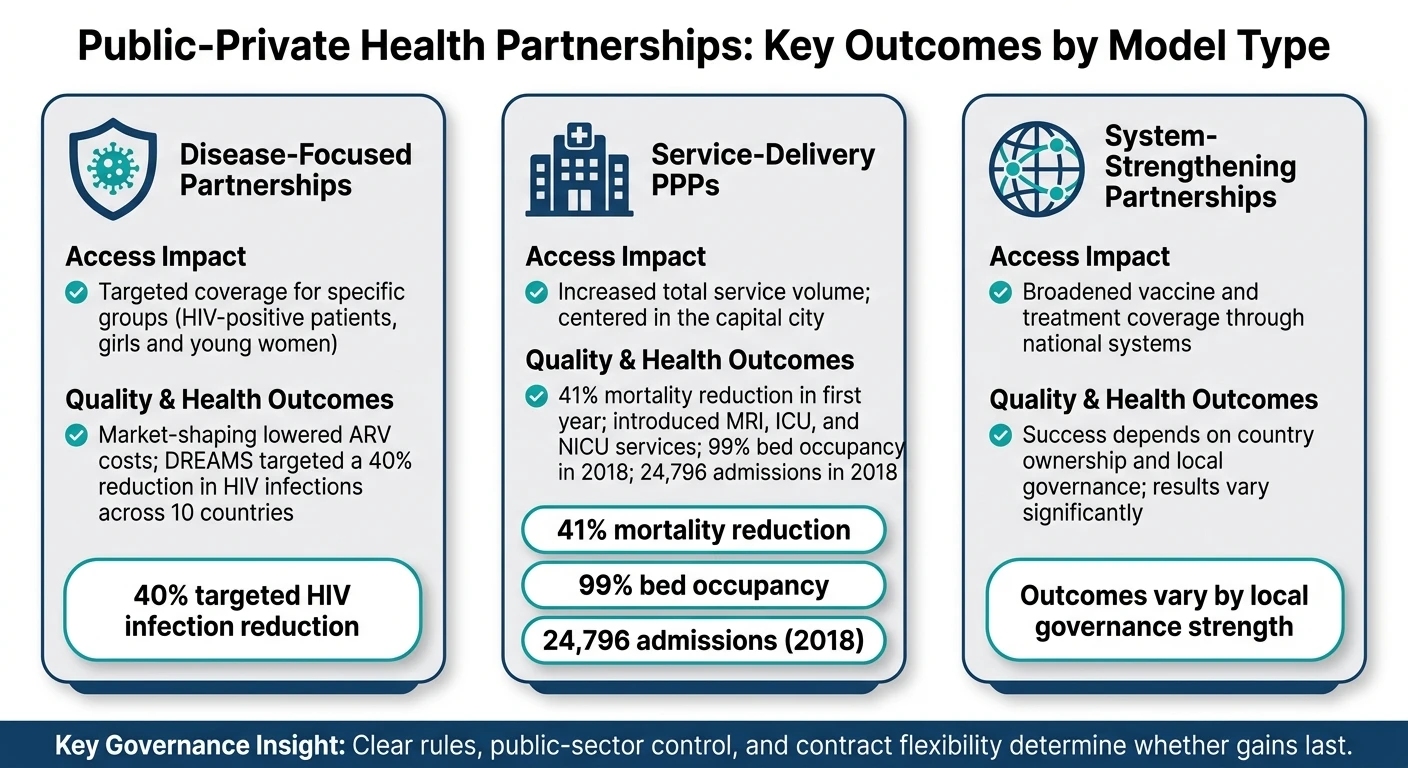
Public-Private Health Partnerships: Key Outcomes by Model Type
Cost savings mean little on their own. What matters is whether they lead to better care for more people. The research paints a mixed picture: PPPs can expand access and lift care quality, but those gains do not always reach the people who need them most.
Effects on Coverage, Affordability, and Underserved Groups
The clearest access gains show up in disease-focused partnerships. PEPFAR and the Global Fund expanded HIV treatment access across low- and middle-income countries [1]. When market-shaping partnerships line up business incentives with public health goals, they can also bring prices down.
Service-delivery PPPs are more uneven. In Lesotho, the QMMH-IN partnership brought MRI, ICU, and NICU services to Maseru and increased the total volume of care [2]. That improved access in the capital, but remote communities still had too little service because the new infrastructure stayed centered in the city.
That pattern comes up again and again in hospital-based PPPs. Total capacity may go up, but geographic equity does not improve on its own. The strongest access gains tend to happen when partnerships move past capital cities and connect with day-to-day public delivery systems.
Effects on Quality, Continuity, and Health Outcomes
The clearest evidence on quality sits within integrated PPP facilities. The QMMH-IN network used standardized clinical protocols, independent quarterly audits, and COHSASA accreditation to support performance [2]. Shared lab systems and medication-tracking systems also improved continuity of care [2].
The story shifts depending on the model, so the table below separates targeted coverage, service delivery, and system-strengthening effects.
Partnership Model | Access Impact | Quality & Health Outcomes |
|---|---|---|
Disease-Focused (e.g., DREAMS, ARV access) | Targeted coverage for specific groups (e.g., HIV-positive patients, girls and young women) | Market-shaping lowered ARV costs; DREAMS targeted a 40% reduction in HIV infections across 10 countries [1] |
Service-Delivery PPP (e.g., Lesotho QMMH-IN) | Increased total service volume; centered in the capital | 41% mortality reduction in the first year; introduced MRI, ICU, and NICU; 99% bed occupancy in 2018 [2] |
System-Strengthening (e.g., Gavi, Global Fund) | Broadened vaccine and treatment coverage through national systems | Success depends on country ownership and local governance; results vary significantly [1] |
Those mixed results lead straight to the next issue: which governance setups help access and quality gains last?
Governance, Accountability, and Major Risks
Governance decides whether partnership gains stick. The research ties transparency and accountability to lasting performance [1]. But that only holds when the rules are plain, shared, and enforceable.
What Strong Governance Looks Like in the Literature
In day-to-day practice, governance shapes whether cost and access gains continue over time. Clear mandates written into formal agreements - most often Memorandums of Understanding (MOUs) - set roles early and help partners stay focused on shared goals [1]. Independent oversight matters just as much. In Lesotho's QMMH-IN, the contract included performance-linked payment deductions when the private partner missed quality benchmarks [2].
On the accountability side, stronger PPPs rely on simple tools that make performance visible and enforceable. Attendance tracking, outcome scorecards, and accreditation give partners a way to check progress instead of guessing [2][3]. The literature also points to a governance pattern that shows up again and again: small strategic boards with clear delegation tend to work better than large representational boards [1].
Common Governance Failures and Risk Patterns
The same choices that support accountability can also become pressure points when the setup is weak. The Lesotho contract ended early after legal disputes, a reminder that rigid agreements can break down even when early results look good [2][3]. The Global Fund offers a similar lesson: rigid voting structures can make adjustment harder as conditions shift over time [1].
Governance Risk | Likely Consequence | Mitigation Step |
|---|---|---|
Dominance by stronger partners | Well-resourced partners dominate; local ownership erodes [1] | Define roles based on unique resources - financial, political, and technical - not just funding size [1] |
Fragmented Accountability | Board members prioritize home organizations over the partnership [1] | Clarify board expectations and use balanced scorecards for individual performance assessment [1][2] |
Limited government capacity | Government becomes a passive partner with little influence [1] | Train civil servants in contract management and private-sector engagement [1][2] |
Inflexible contracts | The partnership cannot adapt when health system conditions change [2][3] | Build in periodic governance reviews and formal mechanisms for change from the start [1][2] |
Undisclosed conflicts | Decisions may favor commercial interests over public health goals [1] | Require transparent disclosure and have conflicted partners abstain from relevant votes [1] |
Conflicts of interest do not have to derail a partnership. They are manageable when they are declared openly and conflicted parties abstain from relevant votes [1].
These governance patterns lead straight into the design choices that companies, governments, and funders have to make in practice.
Lessons for Companies, Governments, and Funders
Those governance findings lead straight to day-to-day decisions for companies, governments, and funders. The research shows that choices made before launch often shape whether a partnership delivers lasting public value or stalls after an early pilot.
Research-Based Design Lessons for Each Stakeholder Group
For companies, the main job is to support public health goals, not treat the partnership as a path into a market. Standardized measurement makes it easier to see what works across programs, rather than guessing from one-off results. Companies should also disclose conflicts and remove conflicted actors from voting [1].
For governments, the issue is power in practice, not just power on paper. Governments need real negotiating leverage and oversight authority. They also need contract-management capacity so they can hold partners to account instead of defaulting to the private side’s agenda [1]. Monitoring should be built into the contract from the start, and agreements should leave room to respond when conditions change [2].
For funders, the research points toward strong, standardized evaluation and independent monitoring rather than output-only reporting [1]. That matters because activity counts alone can look good while masking weak long-term results. Local ownership and sustainability planning also need to start at launch, so the partnership can continue after outside funding ends [1].
Taken together, these choices shape whether a partnership grows beyond a pilot. The bigger lesson for integrated partnerships is plain: connect the work to the health system around it. High transaction costs, staffing limits, and weak system integration can cap results even when clinical performance looks strong [1][2].
Conclusion: Key Findings for Decision-Makers
The evidence lines up around a few core points. Partnerships can improve scale and service delivery, but outcomes stay mixed when governance is weak. Again and again, the literature points to transparency, accountability, alignment, and the ability to adjust as central design requirements [1].
For decision-makers, the most useful test is simple: judge partnerships by public value, not by deal structure. The strongest partnerships are flexible, accountable, and built around public value.
FAQs
What makes a health PPP successful?
A health PPP works best when both sides begin with the same destination in mind: a shared vision, steady leadership, and clear accountability. That sounds simple, but it’s often where projects either gain traction or start to drift. When partners communicate clearly, agree on shared goals, and spell out roles from the start, expectations stay aligned and day-to-day decisions get a lot less messy.
Good results also depend on governance that can adjust when conditions change, along with steady investment in staff and monitoring tools. Just as important, the PPP can’t operate like an island. It needs to connect with the broader health system so it can deliver lasting, measurable value over time.
Do health PPPs really save money?
Sometimes they do, but the record is mixed.
Some health public-private partnerships have cut costs for key services. A good example is antiretroviral medicines, where better market efficiency helped bring prices down.
Other PPPs run into financial pressure. The usual trouble spots are rigid contracts, weak payment histories, and shifts in the economy that throw earlier assumptions off track.
So the bottom line is pretty simple: whether a PPP saves money depends on two things - how flexible the arrangement is and how well it fits the broader health system.
Who benefits most from health PPPs?
Health PPPs are built to serve more than one side at once. The idea is simple: line up public health goals with business incentives so each group has a reason to stay invested.
Patients, especially in low- and middle-income countries, can gain better access to affordable care and stronger health infrastructure.
Governments can add capacity, share risk, and tap private sector expertise.
Private partners can enter new markets and take part in solving public health challenges.
Related Blog Posts
Latest Articles
©2026

Narrative Change and Power Building: The Missing Half of Advocacy
Narrative change is the process of disrupting dominant narratives that normalize inequity and advancing new narratives from historically marginalized communities.

Funding Resilience Without Federal Grants
BRIC is unreliable and FEMA is shrinking. Here's how cities fund climate resilience with dedicated revenue, blended finance, and a coordinating authority.

The ESG Blind Spot: How AI Is Finding Risks in Companies Nobody Else Is Watching
Norway's sovereign wealth fund uses AI to screen 7,200 portfolio companies for forced labor and corruption within 24 hours. The real story is the emerging-market coverage gap that traditional ESG data vendors miss — and what it means for any company with a global supply chain.
Narrative Change and Power Building: The Missing Half of Advocacy
Narrative change is the process of disrupting dominant narratives that normalize inequity and advancing new narratives from historically marginalized communities.
Funding Resilience Without Federal Grants
BRIC is unreliable and FEMA is shrinking. Here's how cities fund climate resilience with dedicated revenue, blended finance, and a coordinating authority.
The ESG Blind Spot: How AI Is Finding Risks in Companies Nobody Else Is Watching
Norway's sovereign wealth fund uses AI to screen 7,200 portfolio companies for forced labor and corruption within 24 hours. The real story is the emerging-market coverage gap that traditional ESG data vendors miss — and what it means for any company with a global supply chain.
FAQ
01
What does it really mean to “redefine profit”?
02
What makes Council Fire different?
03
Who does Council Fire work with?
04
What does working with Council Fire actually look like?
05
How does Council Fire help organizations turn big goals into action?
06
How does Council Fire define and measure success?
07
How does technology fit into Council Fire’s work?
Aug 27, 2026
Public-Private Health Partnerships: Study Summary
Governance
In This Article
Health PPPs can expand services and cut costs — but only when governance, oversight, and state capacity are strong.
Public-Private Health Partnerships: Study Summary
PPPs in health can expand care and lower some costs, but the results are uneven. From HIV treatment scale-up to hospital networks in Lesotho, the research shows the same pattern: these deals work best when goals are clear, oversight is strong, and governments can enforce the contract.
If I had to reduce the full article to a few points, I’d put it this way:
PPPs are not one thing. A vaccine alliance, a hospital contract, and a drug R&D fund work in very different ways.
Cost cuts are possible, but hidden costs matter. Oversight, legal disputes, audits, and earmarked funds can reduce or erase budget gains.
Access can improve without fixing equity. More services may reach cities while rural areas still lag.
Quality can improve in tightly managed networks. In Lesotho, one PPP reported 41% lower first-year mortality, 24,796 admissions in 2018, and 99% bed occupancy.
Governance is the dividing line. Clear roles, open conflict rules, small boards, and contract review points are linked with better results.
The weak point is often government capacity. If public agencies cannot manage contracts or monitor delivery, the private side can end up steering the deal.
I read the evidence as a simple warning for decision-makers: don’t judge a health PPP by the label or launch story. Judge it by public value, access, quality, cost after oversight, and whether it still works when conditions change.
A quick view of the article:
Area | Main takeaway |
|---|---|
Cost | Savings can happen, but oversight and dispute costs are easy to miss |
Access | Coverage may grow, but rural and low-income groups may still be left behind |
Quality | Some service-delivery PPPs show better clinical results inside the funded network |
Governance | Clear rules and public-sector control matter more than deal structure |
Risk | Rigid contracts, weak state capacity, and partner dominance are common failure points |
That is the core of the full piece in plain English: health PPPs can help, but only under the right setup - and that setup is hard work, not a shortcut.
Lessons from public-private partnerships in healthcare
What Studies Show on Cost and Financing
The evidence points to a pretty clear pattern: PPPs can cut costs, but that only happens when the deal matches the health system it serves.
When Partnerships Lower Costs or Add Resources
Studies show two main paths through which public-private partnerships can cut costs or add value: market transformation and operational efficiency.
On the market side, coordinated investments by PEPFAR, the Global Fund, and national governments reshaped the market for antiretroviral medicines in the early 2000s. By creating a more stable market, these partnerships gave manufacturers a reason to scale production. That pushed down unit costs and expanded access to HIV treatment in low- and middle-income countries [1].
On the operational side, private partners in integrated PPPs often move through procurement faster than public systems can on their own. QMMH-IN used frequent procurement to cut stockouts and speed repairs [2]. In Lesotho, QMMH-IN reported a 41% lower first-year mortality than the prior public hospital, along with 24,796 admissions in 2018 and 99% bed occupancy [2].
Where Transaction Costs and Funding Constraints Appear
The savings story gets more complicated once the hidden costs show up. Contract management, independent monitoring, legal arbitration, and accreditation upkeep all add expense [2]. In Lesotho, financial disputes led to arbitration and early termination of the 18-year contract in mid-2021 [2].
Earmarked funding creates another tradeoff. When external partners pay for specific facilities or programs, governments can lose room to move money where it is most needed. That can leave non-PPP public facilities short on funds, especially during a crisis [3].
So while PPPs may save money on paper, those gains are often eaten up by:
That helps explain a point that comes up again and again in the research: PPP savings depend heavily on government capacity to manage contracts, monitor performance, and enforce terms [1]. As Tachi Yamada of Frasier Partners observed, "PPPs often fail to consider how to make it possible for government to engage and governments support externally funded programs without building ownership" [1].
Those costs rarely show up in headline budget comparisons.
Cost savings matter only if they improve access and service delivery; the next section looks at that claim.
Access, Equity, and Service Delivery Outcomes
Public-Private Health Partnerships: Key Outcomes by Model Type
Cost savings mean little on their own. What matters is whether they lead to better care for more people. The research paints a mixed picture: PPPs can expand access and lift care quality, but those gains do not always reach the people who need them most.
Effects on Coverage, Affordability, and Underserved Groups
The clearest access gains show up in disease-focused partnerships. PEPFAR and the Global Fund expanded HIV treatment access across low- and middle-income countries [1]. When market-shaping partnerships line up business incentives with public health goals, they can also bring prices down.
Service-delivery PPPs are more uneven. In Lesotho, the QMMH-IN partnership brought MRI, ICU, and NICU services to Maseru and increased the total volume of care [2]. That improved access in the capital, but remote communities still had too little service because the new infrastructure stayed centered in the city.
That pattern comes up again and again in hospital-based PPPs. Total capacity may go up, but geographic equity does not improve on its own. The strongest access gains tend to happen when partnerships move past capital cities and connect with day-to-day public delivery systems.
Effects on Quality, Continuity, and Health Outcomes
The clearest evidence on quality sits within integrated PPP facilities. The QMMH-IN network used standardized clinical protocols, independent quarterly audits, and COHSASA accreditation to support performance [2]. Shared lab systems and medication-tracking systems also improved continuity of care [2].
The story shifts depending on the model, so the table below separates targeted coverage, service delivery, and system-strengthening effects.
Partnership Model | Access Impact | Quality & Health Outcomes |
|---|---|---|
Disease-Focused (e.g., DREAMS, ARV access) | Targeted coverage for specific groups (e.g., HIV-positive patients, girls and young women) | Market-shaping lowered ARV costs; DREAMS targeted a 40% reduction in HIV infections across 10 countries [1] |
Service-Delivery PPP (e.g., Lesotho QMMH-IN) | Increased total service volume; centered in the capital | 41% mortality reduction in the first year; introduced MRI, ICU, and NICU; 99% bed occupancy in 2018 [2] |
System-Strengthening (e.g., Gavi, Global Fund) | Broadened vaccine and treatment coverage through national systems | Success depends on country ownership and local governance; results vary significantly [1] |
Those mixed results lead straight to the next issue: which governance setups help access and quality gains last?
Governance, Accountability, and Major Risks
Governance decides whether partnership gains stick. The research ties transparency and accountability to lasting performance [1]. But that only holds when the rules are plain, shared, and enforceable.
What Strong Governance Looks Like in the Literature
In day-to-day practice, governance shapes whether cost and access gains continue over time. Clear mandates written into formal agreements - most often Memorandums of Understanding (MOUs) - set roles early and help partners stay focused on shared goals [1]. Independent oversight matters just as much. In Lesotho's QMMH-IN, the contract included performance-linked payment deductions when the private partner missed quality benchmarks [2].
On the accountability side, stronger PPPs rely on simple tools that make performance visible and enforceable. Attendance tracking, outcome scorecards, and accreditation give partners a way to check progress instead of guessing [2][3]. The literature also points to a governance pattern that shows up again and again: small strategic boards with clear delegation tend to work better than large representational boards [1].
Common Governance Failures and Risk Patterns
The same choices that support accountability can also become pressure points when the setup is weak. The Lesotho contract ended early after legal disputes, a reminder that rigid agreements can break down even when early results look good [2][3]. The Global Fund offers a similar lesson: rigid voting structures can make adjustment harder as conditions shift over time [1].
Governance Risk | Likely Consequence | Mitigation Step |
|---|---|---|
Dominance by stronger partners | Well-resourced partners dominate; local ownership erodes [1] | Define roles based on unique resources - financial, political, and technical - not just funding size [1] |
Fragmented Accountability | Board members prioritize home organizations over the partnership [1] | Clarify board expectations and use balanced scorecards for individual performance assessment [1][2] |
Limited government capacity | Government becomes a passive partner with little influence [1] | Train civil servants in contract management and private-sector engagement [1][2] |
Inflexible contracts | The partnership cannot adapt when health system conditions change [2][3] | Build in periodic governance reviews and formal mechanisms for change from the start [1][2] |
Undisclosed conflicts | Decisions may favor commercial interests over public health goals [1] | Require transparent disclosure and have conflicted partners abstain from relevant votes [1] |
Conflicts of interest do not have to derail a partnership. They are manageable when they are declared openly and conflicted parties abstain from relevant votes [1].
These governance patterns lead straight into the design choices that companies, governments, and funders have to make in practice.
Lessons for Companies, Governments, and Funders
Those governance findings lead straight to day-to-day decisions for companies, governments, and funders. The research shows that choices made before launch often shape whether a partnership delivers lasting public value or stalls after an early pilot.
Research-Based Design Lessons for Each Stakeholder Group
For companies, the main job is to support public health goals, not treat the partnership as a path into a market. Standardized measurement makes it easier to see what works across programs, rather than guessing from one-off results. Companies should also disclose conflicts and remove conflicted actors from voting [1].
For governments, the issue is power in practice, not just power on paper. Governments need real negotiating leverage and oversight authority. They also need contract-management capacity so they can hold partners to account instead of defaulting to the private side’s agenda [1]. Monitoring should be built into the contract from the start, and agreements should leave room to respond when conditions change [2].
For funders, the research points toward strong, standardized evaluation and independent monitoring rather than output-only reporting [1]. That matters because activity counts alone can look good while masking weak long-term results. Local ownership and sustainability planning also need to start at launch, so the partnership can continue after outside funding ends [1].
Taken together, these choices shape whether a partnership grows beyond a pilot. The bigger lesson for integrated partnerships is plain: connect the work to the health system around it. High transaction costs, staffing limits, and weak system integration can cap results even when clinical performance looks strong [1][2].
Conclusion: Key Findings for Decision-Makers
The evidence lines up around a few core points. Partnerships can improve scale and service delivery, but outcomes stay mixed when governance is weak. Again and again, the literature points to transparency, accountability, alignment, and the ability to adjust as central design requirements [1].
For decision-makers, the most useful test is simple: judge partnerships by public value, not by deal structure. The strongest partnerships are flexible, accountable, and built around public value.
FAQs
What makes a health PPP successful?
A health PPP works best when both sides begin with the same destination in mind: a shared vision, steady leadership, and clear accountability. That sounds simple, but it’s often where projects either gain traction or start to drift. When partners communicate clearly, agree on shared goals, and spell out roles from the start, expectations stay aligned and day-to-day decisions get a lot less messy.
Good results also depend on governance that can adjust when conditions change, along with steady investment in staff and monitoring tools. Just as important, the PPP can’t operate like an island. It needs to connect with the broader health system so it can deliver lasting, measurable value over time.
Do health PPPs really save money?
Sometimes they do, but the record is mixed.
Some health public-private partnerships have cut costs for key services. A good example is antiretroviral medicines, where better market efficiency helped bring prices down.
Other PPPs run into financial pressure. The usual trouble spots are rigid contracts, weak payment histories, and shifts in the economy that throw earlier assumptions off track.
So the bottom line is pretty simple: whether a PPP saves money depends on two things - how flexible the arrangement is and how well it fits the broader health system.
Who benefits most from health PPPs?
Health PPPs are built to serve more than one side at once. The idea is simple: line up public health goals with business incentives so each group has a reason to stay invested.
Patients, especially in low- and middle-income countries, can gain better access to affordable care and stronger health infrastructure.
Governments can add capacity, share risk, and tap private sector expertise.
Private partners can enter new markets and take part in solving public health challenges.
Related Blog Posts
Latest Articles
©2026
Narrative Change and Power Building: The Missing Half of Advocacy
Narrative change is the process of disrupting dominant narratives that normalize inequity and advancing new narratives from historically marginalized communities.
Funding Resilience Without Federal Grants
BRIC is unreliable and FEMA is shrinking. Here's how cities fund climate resilience with dedicated revenue, blended finance, and a coordinating authority.
The ESG Blind Spot: How AI Is Finding Risks in Companies Nobody Else Is Watching
Norway's sovereign wealth fund uses AI to screen 7,200 portfolio companies for forced labor and corruption within 24 hours. The real story is the emerging-market coverage gap that traditional ESG data vendors miss — and what it means for any company with a global supply chain.
FAQ
01
What does it really mean to “redefine profit”?
02
What makes Council Fire different?
03
Who does Council Fire work with?
04
What does working with Council Fire actually look like?
05
How does Council Fire help organizations turn big goals into action?
06
How does Council Fire define and measure success?
07
How does technology fit into Council Fire’s work?
Aug 27, 2026
Public-Private Health Partnerships: Study Summary
Governance
In This Article
Health PPPs can expand services and cut costs — but only when governance, oversight, and state capacity are strong.
Public-Private Health Partnerships: Study Summary
PPPs in health can expand care and lower some costs, but the results are uneven. From HIV treatment scale-up to hospital networks in Lesotho, the research shows the same pattern: these deals work best when goals are clear, oversight is strong, and governments can enforce the contract.
If I had to reduce the full article to a few points, I’d put it this way:
PPPs are not one thing. A vaccine alliance, a hospital contract, and a drug R&D fund work in very different ways.
Cost cuts are possible, but hidden costs matter. Oversight, legal disputes, audits, and earmarked funds can reduce or erase budget gains.
Access can improve without fixing equity. More services may reach cities while rural areas still lag.
Quality can improve in tightly managed networks. In Lesotho, one PPP reported 41% lower first-year mortality, 24,796 admissions in 2018, and 99% bed occupancy.
Governance is the dividing line. Clear roles, open conflict rules, small boards, and contract review points are linked with better results.
The weak point is often government capacity. If public agencies cannot manage contracts or monitor delivery, the private side can end up steering the deal.
I read the evidence as a simple warning for decision-makers: don’t judge a health PPP by the label or launch story. Judge it by public value, access, quality, cost after oversight, and whether it still works when conditions change.
A quick view of the article:
Area | Main takeaway |
|---|---|
Cost | Savings can happen, but oversight and dispute costs are easy to miss |
Access | Coverage may grow, but rural and low-income groups may still be left behind |
Quality | Some service-delivery PPPs show better clinical results inside the funded network |
Governance | Clear rules and public-sector control matter more than deal structure |
Risk | Rigid contracts, weak state capacity, and partner dominance are common failure points |
That is the core of the full piece in plain English: health PPPs can help, but only under the right setup - and that setup is hard work, not a shortcut.
Lessons from public-private partnerships in healthcare
What Studies Show on Cost and Financing
The evidence points to a pretty clear pattern: PPPs can cut costs, but that only happens when the deal matches the health system it serves.
When Partnerships Lower Costs or Add Resources
Studies show two main paths through which public-private partnerships can cut costs or add value: market transformation and operational efficiency.
On the market side, coordinated investments by PEPFAR, the Global Fund, and national governments reshaped the market for antiretroviral medicines in the early 2000s. By creating a more stable market, these partnerships gave manufacturers a reason to scale production. That pushed down unit costs and expanded access to HIV treatment in low- and middle-income countries [1].
On the operational side, private partners in integrated PPPs often move through procurement faster than public systems can on their own. QMMH-IN used frequent procurement to cut stockouts and speed repairs [2]. In Lesotho, QMMH-IN reported a 41% lower first-year mortality than the prior public hospital, along with 24,796 admissions in 2018 and 99% bed occupancy [2].
Where Transaction Costs and Funding Constraints Appear
The savings story gets more complicated once the hidden costs show up. Contract management, independent monitoring, legal arbitration, and accreditation upkeep all add expense [2]. In Lesotho, financial disputes led to arbitration and early termination of the 18-year contract in mid-2021 [2].
Earmarked funding creates another tradeoff. When external partners pay for specific facilities or programs, governments can lose room to move money where it is most needed. That can leave non-PPP public facilities short on funds, especially during a crisis [3].
So while PPPs may save money on paper, those gains are often eaten up by:
That helps explain a point that comes up again and again in the research: PPP savings depend heavily on government capacity to manage contracts, monitor performance, and enforce terms [1]. As Tachi Yamada of Frasier Partners observed, "PPPs often fail to consider how to make it possible for government to engage and governments support externally funded programs without building ownership" [1].
Those costs rarely show up in headline budget comparisons.
Cost savings matter only if they improve access and service delivery; the next section looks at that claim.
Access, Equity, and Service Delivery Outcomes
Public-Private Health Partnerships: Key Outcomes by Model Type
Cost savings mean little on their own. What matters is whether they lead to better care for more people. The research paints a mixed picture: PPPs can expand access and lift care quality, but those gains do not always reach the people who need them most.
Effects on Coverage, Affordability, and Underserved Groups
The clearest access gains show up in disease-focused partnerships. PEPFAR and the Global Fund expanded HIV treatment access across low- and middle-income countries [1]. When market-shaping partnerships line up business incentives with public health goals, they can also bring prices down.
Service-delivery PPPs are more uneven. In Lesotho, the QMMH-IN partnership brought MRI, ICU, and NICU services to Maseru and increased the total volume of care [2]. That improved access in the capital, but remote communities still had too little service because the new infrastructure stayed centered in the city.
That pattern comes up again and again in hospital-based PPPs. Total capacity may go up, but geographic equity does not improve on its own. The strongest access gains tend to happen when partnerships move past capital cities and connect with day-to-day public delivery systems.
Effects on Quality, Continuity, and Health Outcomes
The clearest evidence on quality sits within integrated PPP facilities. The QMMH-IN network used standardized clinical protocols, independent quarterly audits, and COHSASA accreditation to support performance [2]. Shared lab systems and medication-tracking systems also improved continuity of care [2].
The story shifts depending on the model, so the table below separates targeted coverage, service delivery, and system-strengthening effects.
Partnership Model | Access Impact | Quality & Health Outcomes |
|---|---|---|
Disease-Focused (e.g., DREAMS, ARV access) | Targeted coverage for specific groups (e.g., HIV-positive patients, girls and young women) | Market-shaping lowered ARV costs; DREAMS targeted a 40% reduction in HIV infections across 10 countries [1] |
Service-Delivery PPP (e.g., Lesotho QMMH-IN) | Increased total service volume; centered in the capital | 41% mortality reduction in the first year; introduced MRI, ICU, and NICU; 99% bed occupancy in 2018 [2] |
System-Strengthening (e.g., Gavi, Global Fund) | Broadened vaccine and treatment coverage through national systems | Success depends on country ownership and local governance; results vary significantly [1] |
Those mixed results lead straight to the next issue: which governance setups help access and quality gains last?
Governance, Accountability, and Major Risks
Governance decides whether partnership gains stick. The research ties transparency and accountability to lasting performance [1]. But that only holds when the rules are plain, shared, and enforceable.
What Strong Governance Looks Like in the Literature
In day-to-day practice, governance shapes whether cost and access gains continue over time. Clear mandates written into formal agreements - most often Memorandums of Understanding (MOUs) - set roles early and help partners stay focused on shared goals [1]. Independent oversight matters just as much. In Lesotho's QMMH-IN, the contract included performance-linked payment deductions when the private partner missed quality benchmarks [2].
On the accountability side, stronger PPPs rely on simple tools that make performance visible and enforceable. Attendance tracking, outcome scorecards, and accreditation give partners a way to check progress instead of guessing [2][3]. The literature also points to a governance pattern that shows up again and again: small strategic boards with clear delegation tend to work better than large representational boards [1].
Common Governance Failures and Risk Patterns
The same choices that support accountability can also become pressure points when the setup is weak. The Lesotho contract ended early after legal disputes, a reminder that rigid agreements can break down even when early results look good [2][3]. The Global Fund offers a similar lesson: rigid voting structures can make adjustment harder as conditions shift over time [1].
Governance Risk | Likely Consequence | Mitigation Step |
|---|---|---|
Dominance by stronger partners | Well-resourced partners dominate; local ownership erodes [1] | Define roles based on unique resources - financial, political, and technical - not just funding size [1] |
Fragmented Accountability | Board members prioritize home organizations over the partnership [1] | Clarify board expectations and use balanced scorecards for individual performance assessment [1][2] |
Limited government capacity | Government becomes a passive partner with little influence [1] | Train civil servants in contract management and private-sector engagement [1][2] |
Inflexible contracts | The partnership cannot adapt when health system conditions change [2][3] | Build in periodic governance reviews and formal mechanisms for change from the start [1][2] |
Undisclosed conflicts | Decisions may favor commercial interests over public health goals [1] | Require transparent disclosure and have conflicted partners abstain from relevant votes [1] |
Conflicts of interest do not have to derail a partnership. They are manageable when they are declared openly and conflicted parties abstain from relevant votes [1].
These governance patterns lead straight into the design choices that companies, governments, and funders have to make in practice.
Lessons for Companies, Governments, and Funders
Those governance findings lead straight to day-to-day decisions for companies, governments, and funders. The research shows that choices made before launch often shape whether a partnership delivers lasting public value or stalls after an early pilot.
Research-Based Design Lessons for Each Stakeholder Group
For companies, the main job is to support public health goals, not treat the partnership as a path into a market. Standardized measurement makes it easier to see what works across programs, rather than guessing from one-off results. Companies should also disclose conflicts and remove conflicted actors from voting [1].
For governments, the issue is power in practice, not just power on paper. Governments need real negotiating leverage and oversight authority. They also need contract-management capacity so they can hold partners to account instead of defaulting to the private side’s agenda [1]. Monitoring should be built into the contract from the start, and agreements should leave room to respond when conditions change [2].
For funders, the research points toward strong, standardized evaluation and independent monitoring rather than output-only reporting [1]. That matters because activity counts alone can look good while masking weak long-term results. Local ownership and sustainability planning also need to start at launch, so the partnership can continue after outside funding ends [1].
Taken together, these choices shape whether a partnership grows beyond a pilot. The bigger lesson for integrated partnerships is plain: connect the work to the health system around it. High transaction costs, staffing limits, and weak system integration can cap results even when clinical performance looks strong [1][2].
Conclusion: Key Findings for Decision-Makers
The evidence lines up around a few core points. Partnerships can improve scale and service delivery, but outcomes stay mixed when governance is weak. Again and again, the literature points to transparency, accountability, alignment, and the ability to adjust as central design requirements [1].
For decision-makers, the most useful test is simple: judge partnerships by public value, not by deal structure. The strongest partnerships are flexible, accountable, and built around public value.
FAQs
What makes a health PPP successful?
A health PPP works best when both sides begin with the same destination in mind: a shared vision, steady leadership, and clear accountability. That sounds simple, but it’s often where projects either gain traction or start to drift. When partners communicate clearly, agree on shared goals, and spell out roles from the start, expectations stay aligned and day-to-day decisions get a lot less messy.
Good results also depend on governance that can adjust when conditions change, along with steady investment in staff and monitoring tools. Just as important, the PPP can’t operate like an island. It needs to connect with the broader health system so it can deliver lasting, measurable value over time.
Do health PPPs really save money?
Sometimes they do, but the record is mixed.
Some health public-private partnerships have cut costs for key services. A good example is antiretroviral medicines, where better market efficiency helped bring prices down.
Other PPPs run into financial pressure. The usual trouble spots are rigid contracts, weak payment histories, and shifts in the economy that throw earlier assumptions off track.
So the bottom line is pretty simple: whether a PPP saves money depends on two things - how flexible the arrangement is and how well it fits the broader health system.
Who benefits most from health PPPs?
Health PPPs are built to serve more than one side at once. The idea is simple: line up public health goals with business incentives so each group has a reason to stay invested.
Patients, especially in low- and middle-income countries, can gain better access to affordable care and stronger health infrastructure.
Governments can add capacity, share risk, and tap private sector expertise.
Private partners can enter new markets and take part in solving public health challenges.
Related Blog Posts
Latest Articles
©2026
Narrative Change and Power Building: The Missing Half of Advocacy
Narrative change is the process of disrupting dominant narratives that normalize inequity and advancing new narratives from historically marginalized communities.
Funding Resilience Without Federal Grants
BRIC is unreliable and FEMA is shrinking. Here's how cities fund climate resilience with dedicated revenue, blended finance, and a coordinating authority.
The ESG Blind Spot: How AI Is Finding Risks in Companies Nobody Else Is Watching
Norway's sovereign wealth fund uses AI to screen 7,200 portfolio companies for forced labor and corruption within 24 hours. The real story is the emerging-market coverage gap that traditional ESG data vendors miss — and what it means for any company with a global supply chain.
FAQ
What does it really mean to “redefine profit”?
What makes Council Fire different?
Who does Council Fire work with?
What does working with Council Fire actually look like?
How does Council Fire help organizations turn big goals into action?
How does Council Fire define and measure success?
How does technology fit into Council Fire’s work?