Jul 19, 2026
Study: Policy Impact on Industrial Symbiosis
Sustainability Strategy
In This Article
Clear by-product rules, regional coordinators, and funding reduce legal friction and scale industrial symbiosis to cut materials, emissions.
Study: Policy Impact on Industrial Symbiosis
I see three plain takeaways from this research: clear by-product rules help firms exchange materials, regional coordinators help firms find matches, and funding plus planning support helps more companies join in. The article also points to big long-run stakes: better resource use could cut material extraction by up to 28% and greenhouse gas emissions by about 60% by 2050.
If you want the short version, here it is:
Classification matters: when outputs are treated as by-products instead of waste, exchanges face fewer legal delays.
Coordination matters: firms need shared data, match-making, and a neutral group to connect supply with demand.
Small firms need help: many SMEs lack money, staff, equipment, and logistics support.
Planning matters: zoning, land use, and infrastructure choices can make exchanges easier or block them from the start.
U.S. action is local and regional: because authority is split, states and regions have the clearest path to cut friction.
I’d sum up the research this way: policy does not create industrial symbiosis by itself, but poor policy can stop it fast. For U.S. leaders, the best path is to line up rules, incentives, data-sharing, and land-use planning from day one.
Inside the world of industrial symbiosis | The origins of the circular economy
Policy Tools That Support Industrial Symbiosis Adoption
Broad policy goals matter, but they don’t decide on their own whether one company’s output becomes another company’s input. Recent studies point to a simpler truth: policy tends to work when it lowers legal risk, cuts transaction costs, and makes firm-to-firm coordination easier.
By-Product and Waste Classification Rules
How a material gets classified often decides whether an exchange can happen at all. If regulators label an output as waste, firms can run into disposal rules, permit delays, and extra compliance steps. If that same material is recognized as a by-product, the path to exchange gets much easier and far less risky.
The Brownsville/Matamoros border region offers a clear example. There, strict waste definitions and complex permitting can slow by-product exchanges [1].
Clear classification rules do one big job: they let materials move legally. But legality alone isn’t enough. Firms also need a practical way to find partners that can use those materials.
Regional Coordination and Data-Sharing Systems
Industrial symbiosis depends on match-making as much as it depends on regulation. Even when a material can be exchanged, nothing happens if firms don’t know who needs it, who has it, or how to coordinate timing, volume, and quality.
That’s where government-backed consortia such as Innovation Poles come in. These groups help firms identify usable inputs, coordinate exchanges, and share information across a region [1].
The pattern across these tools is pretty clear: policy helps most when it reduces friction in two places - legality and matching.
Where Policy Still Blocks Industrial Symbiosis
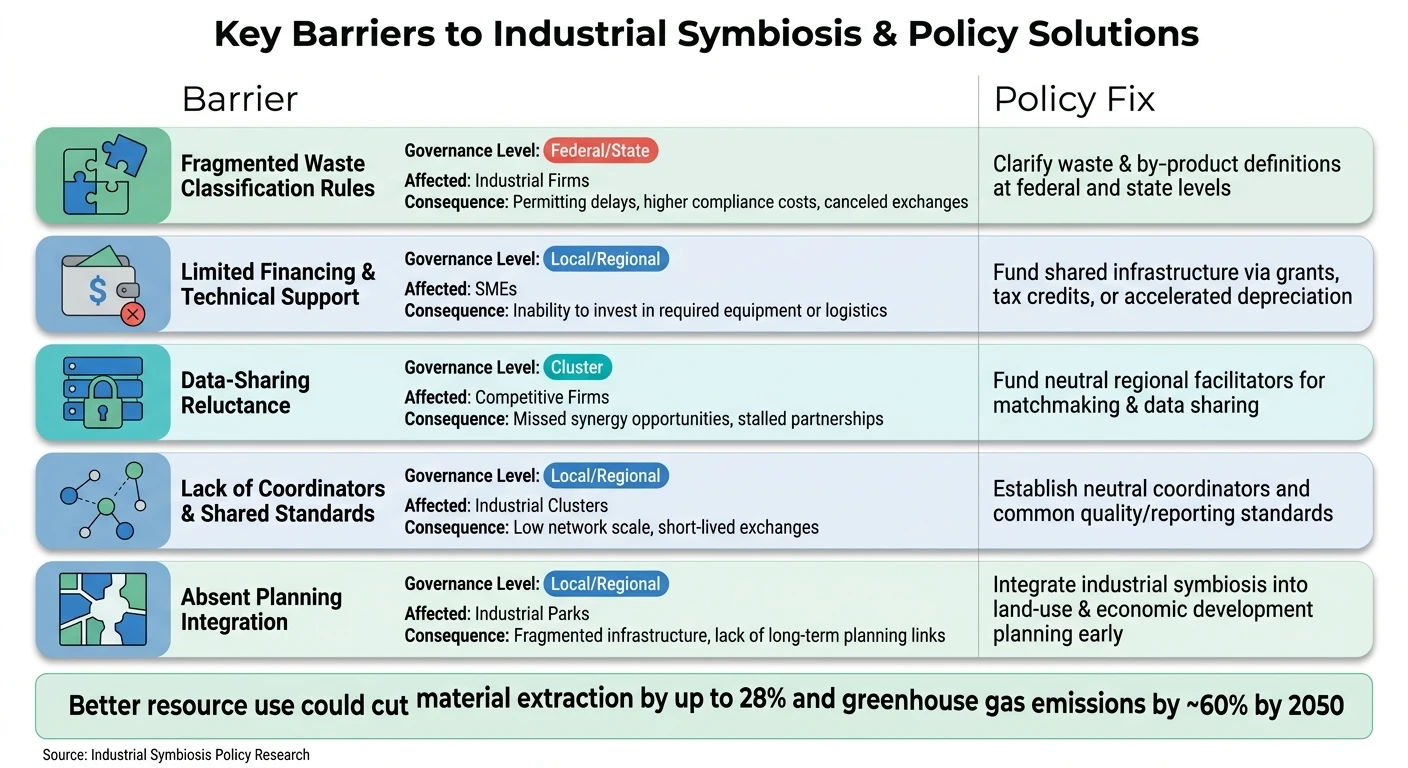
Key Barriers to Industrial Symbiosis & Policy Solutions
Even when classification systems and coordination tools are in place, exchange can still stall. The problem often isn't a lack of policy. It's that governance gets split up. Rules sit in different agencies, smaller firms don't have the staff or money to work through them, and no one is steering the network as a whole.
Fragmented Rules and Permitting Delays
When federal, state, and local agencies apply different rules to the same material or exchange, companies get stuck dealing with overlapping requirements that don't line up. A secondary material that is cleared in one place may trigger a different classification somewhere else. That gets even harder when firms move material across state lines and waste rules change from one state to the next.
The result is familiar: longer timelines, higher compliance costs, and canceled exchanges. For many firms, that kind of uncertainty is enough to stop progress. A pilot may go forward once, but turning it into a repeat transaction becomes far more difficult.
Gaps in Support for Smaller Firms
Large companies usually have more room to absorb the cost of complex permitting, outside consultants, and the equipment needed to process and move materials for exchange. Smaller firms usually don't. SMEs face steeper pressure around permitting, logistics, and equipment costs.
Those problems tend to stack on top of each other. Many smaller manufacturers don't have the specialized processing tools or logistics systems needed to join exchanges. Financing for infrastructure upgrades is also harder to get. On top of that, some firms are reluctant to share proprietary data or put money into joint projects without clear agreements on cost and risk.
The pattern is hard to miss: symbiosis often stays concentrated among larger firms with more compliance capacity.
Missing Standards, Facilitators, and Planning Links
Even when firms want to participate and the rules allow it, industrial symbiosis can still struggle to grow. Two missing pieces show up again and again: shared standards and neutral coordinators.
Without common standards for quality, tracking, and reporting, firms have a harder time building trust and comparing results. And without coordinators who can help standardize and scale exchanges, many potential matches simply slip by. Networks remain fragile, and exchanges stay small.
There's also a planning problem. Industrial symbiosis is still rarely built into zoning, land use, or infrastructure planning. So new industrial developments are often placed without asking a basic question: could nearby facilities share energy, water, or materials? When that question never gets asked, inefficiency gets built in from day one, and symbiosis stays local and one-off.
These barriers show up at different levels of governance, but they lead to the same outcome: slower exchanges and weaker networks.
Key Barrier | Governance Level | Affected Stakeholders | Documented Consequences |
|---|---|---|---|
Fragmented waste classification rules | Federal/State | Industrial firms | Permitting delays, higher compliance costs, canceled exchanges |
Limited financing and technical support | Local/Regional | SMEs | Inability to invest in required equipment or logistics |
Data-sharing reluctance | Cluster | Competitive firms | Missed opportunities for synergy, stalled partnerships |
Lack of coordinators and shared standards | Local/Regional | Industrial clusters | Low network scale, short-lived exchanges |
Absent planning integration | Local/Regional | Industrial parks | Fragmented infrastructure, lack of long-term planning links |
That gap between policy intent and governance design helps explain what happens in the case studies that follow.
What Regional Case Studies Show About Policy Design
These barriers don’t play out the same way everywhere. The clearest case studies show that policy helps industrial symbiosis grow when it cuts risk, lowers coordination costs, and makes exchanges easier to keep in place over time. Across the research, three regional models show up again and again. Each reflects the same basic policy role: stable rules, built-in coordination, and easier participation. In other words, policy helps turn hard-to-manage barriers into systems firms can actually use.
European Policy Frameworks and Long-Term Governance
Kalundborg shows that industrial symbiosis holds up when governance stays steady and rules for secondary materials remain clear. Over time, firms became more willing to commit to the relationships symbiosis depends on because the rules were predictable and the risk tied to exchange stayed low. That matters. When firms can count on the policy setting, they’re more likely to make the longer-term investments that keep these networks in motion.
At the center of this case is a simple idea: stability builds trust, and trust makes it easier for firms to stay in the game long enough for symbiosis to mature.
The same pattern shows up in a different way in park-based systems.
China's Eco-Industrial Park Model
China's eco-industrial park model builds symbiosis into the industrial area from the beginning. Rather than waiting for firms to find matches on their own, the park weaves exchanges into site design and governance. Shared infrastructure and park-level coordination take pressure off individual firms and help line up resource flows across the site. That changes the role of symbiosis. It becomes part of how the park works day to day, not something added later if companies happen to see an opportunity.
Lessons for U.S. States, Regions, and Industrial Clusters
Neither model maps neatly onto the U.S. National alignment is hard when authority is split across federal, state, and local levels. On top of that, most U.S. industrial areas are dispersed and privately owned, which makes fully planned co-location much less likely.
For U.S. states and regions, the practical focus is narrower and more grounded in what they can control:
clearer rules for secondary materials
coordination support
shared data
planning tools that help firms spot exchanges earlier
Because authority is fragmented, regions stand to gain the most from low-friction approaches that cut compliance burden without requiring top-down restructuring.
These cases point to the design principles that follow.
Policy Design Lessons and Conclusion
Key Design Principles From the Research
Across the case studies, the pattern is hard to miss: one policy tool won’t do the job. Recent studies point to the same problem from different angles. Fragmented rules slow progress. SME constraints limit participation. Missing coordinators make it harder for firms to find matches and share data. Each barrier works in its own way, so no single fix solves all three.
The strongest lessons across the literature come back to four priorities. Policymakers should clarify waste and by-product definitions. They should fund shared infrastructure through grants, tax credits, or accelerated depreciation. They should fund neutral regional facilitators for matchmaking and data sharing. They should also integrate industrial symbiosis into land-use and economic development planning early.
Just as important, agencies need to track outcomes. Progress data helps show what’s working, where efforts are stalling, and why public support should continue.
None of these priorities mean much if agencies and regional partners can’t carry them out. Good policy on paper still needs people, budgets, and coordination to make it work.
From Policy Goals to Implementation
Setting goals is the easy part. Implementation is where things get messy. Turning policy aims into working systems across jurisdictions and industries often slows down once the day-to-day work begins.
That gap between policy goals and on-the-ground action is where coordination matters most. Industrial symbiosis tends to work best when policy, infrastructure, and cross-sector coordination are planned as one system, not as separate efforts moving on parallel tracks.
Conclusion: Core Takeaways for U.S. Leaders
Taken together, the message is plain: clear rules enable exchange, coordination expands scale, and incentives speed investment. When rules are weak or fragmented, adoption still stalls - even when the business case looks strong.
For U.S. states, regions, and industrial clusters, the practical takeaway is simple: plan policy, infrastructure, and coordination together from the start.
FAQs
What is industrial symbiosis?
Industrial symbiosis is a way for companies to work together so that one firm’s waste, byproducts, energy, water, or spare logistics capacity becomes a useful input for another. In plain terms, what used to be thrown away can become part of someone else’s process.
The idea borrows from natural ecosystems, where outputs from one organism feed another. Applied to business, it shifts supply chains away from a straight take-make-dispose model and toward more circular networks.
This often works best among companies located near each other. When done well, it can cut the use of virgin materials, reduce operating costs, and lessen environmental impacts.
Why do by-product rules matter so much?
By-product rules matter because they set the legal boundary between waste and a secondary raw material. In the U.S., that line isn’t always simple. Waste rules and permit requirements can turn a workable industrial symbiosis project into a slow, frustrating process.
When a material is labeled as waste instead of a product, everything gets harder. Transport can face tighter controls. Processing may trigger extra permits. Reuse can become more expensive and more limited. Clear rules give companies more certainty, help cut disposal costs, and make it easier to keep materials moving in circular resource loops.
How can U.S. regions make adoption easier?
U.S. regions can make industrial symbiosis easier to adopt when public agencies and private firms work side by side. The biggest gains often come from the basics: shared infrastructure such as water treatment, practical systems for joint energy purchasing and resource distribution, and clear rules that spell out when waste becomes a product or a secondary raw material.
That last point matters more than it may seem. If the rules are fuzzy, good projects can stall. If the rules are clear, companies can move with more confidence, line up partners, and put materials back into use instead of sending them out as waste.
Council Fire helps stakeholders put these governance structures in place and coordinate engagement across sectors, so the people, systems, and rules all work together.
Related Blog Posts
Latest Articles
©2026

Narrative Change and Power Building: The Missing Half of Advocacy
Narrative change is the process of disrupting dominant narratives that normalize inequity and advancing new narratives from historically marginalized communities.

Funding Resilience Without Federal Grants
BRIC is unreliable and FEMA is shrinking. Here's how cities fund climate resilience with dedicated revenue, blended finance, and a coordinating authority.

The ESG Blind Spot: How AI Is Finding Risks in Companies Nobody Else Is Watching
Norway's sovereign wealth fund uses AI to screen 7,200 portfolio companies for forced labor and corruption within 24 hours. The real story is the emerging-market coverage gap that traditional ESG data vendors miss — and what it means for any company with a global supply chain.
Narrative Change and Power Building: The Missing Half of Advocacy
Narrative change is the process of disrupting dominant narratives that normalize inequity and advancing new narratives from historically marginalized communities.
Funding Resilience Without Federal Grants
BRIC is unreliable and FEMA is shrinking. Here's how cities fund climate resilience with dedicated revenue, blended finance, and a coordinating authority.
The ESG Blind Spot: How AI Is Finding Risks in Companies Nobody Else Is Watching
Norway's sovereign wealth fund uses AI to screen 7,200 portfolio companies for forced labor and corruption within 24 hours. The real story is the emerging-market coverage gap that traditional ESG data vendors miss — and what it means for any company with a global supply chain.
FAQ
01
What does it really mean to “redefine profit”?
02
What makes Council Fire different?
03
Who does Council Fire work with?
04
What does working with Council Fire actually look like?
05
How does Council Fire help organizations turn big goals into action?
06
How does Council Fire define and measure success?
07
How does technology fit into Council Fire’s work?
Jul 19, 2026
Study: Policy Impact on Industrial Symbiosis
Sustainability Strategy
In This Article
Clear by-product rules, regional coordinators, and funding reduce legal friction and scale industrial symbiosis to cut materials, emissions.
Study: Policy Impact on Industrial Symbiosis
I see three plain takeaways from this research: clear by-product rules help firms exchange materials, regional coordinators help firms find matches, and funding plus planning support helps more companies join in. The article also points to big long-run stakes: better resource use could cut material extraction by up to 28% and greenhouse gas emissions by about 60% by 2050.
If you want the short version, here it is:
Classification matters: when outputs are treated as by-products instead of waste, exchanges face fewer legal delays.
Coordination matters: firms need shared data, match-making, and a neutral group to connect supply with demand.
Small firms need help: many SMEs lack money, staff, equipment, and logistics support.
Planning matters: zoning, land use, and infrastructure choices can make exchanges easier or block them from the start.
U.S. action is local and regional: because authority is split, states and regions have the clearest path to cut friction.
I’d sum up the research this way: policy does not create industrial symbiosis by itself, but poor policy can stop it fast. For U.S. leaders, the best path is to line up rules, incentives, data-sharing, and land-use planning from day one.
Inside the world of industrial symbiosis | The origins of the circular economy
Policy Tools That Support Industrial Symbiosis Adoption
Broad policy goals matter, but they don’t decide on their own whether one company’s output becomes another company’s input. Recent studies point to a simpler truth: policy tends to work when it lowers legal risk, cuts transaction costs, and makes firm-to-firm coordination easier.
By-Product and Waste Classification Rules
How a material gets classified often decides whether an exchange can happen at all. If regulators label an output as waste, firms can run into disposal rules, permit delays, and extra compliance steps. If that same material is recognized as a by-product, the path to exchange gets much easier and far less risky.
The Brownsville/Matamoros border region offers a clear example. There, strict waste definitions and complex permitting can slow by-product exchanges [1].
Clear classification rules do one big job: they let materials move legally. But legality alone isn’t enough. Firms also need a practical way to find partners that can use those materials.
Regional Coordination and Data-Sharing Systems
Industrial symbiosis depends on match-making as much as it depends on regulation. Even when a material can be exchanged, nothing happens if firms don’t know who needs it, who has it, or how to coordinate timing, volume, and quality.
That’s where government-backed consortia such as Innovation Poles come in. These groups help firms identify usable inputs, coordinate exchanges, and share information across a region [1].
The pattern across these tools is pretty clear: policy helps most when it reduces friction in two places - legality and matching.
Where Policy Still Blocks Industrial Symbiosis
Key Barriers to Industrial Symbiosis & Policy Solutions
Even when classification systems and coordination tools are in place, exchange can still stall. The problem often isn't a lack of policy. It's that governance gets split up. Rules sit in different agencies, smaller firms don't have the staff or money to work through them, and no one is steering the network as a whole.
Fragmented Rules and Permitting Delays
When federal, state, and local agencies apply different rules to the same material or exchange, companies get stuck dealing with overlapping requirements that don't line up. A secondary material that is cleared in one place may trigger a different classification somewhere else. That gets even harder when firms move material across state lines and waste rules change from one state to the next.
The result is familiar: longer timelines, higher compliance costs, and canceled exchanges. For many firms, that kind of uncertainty is enough to stop progress. A pilot may go forward once, but turning it into a repeat transaction becomes far more difficult.
Gaps in Support for Smaller Firms
Large companies usually have more room to absorb the cost of complex permitting, outside consultants, and the equipment needed to process and move materials for exchange. Smaller firms usually don't. SMEs face steeper pressure around permitting, logistics, and equipment costs.
Those problems tend to stack on top of each other. Many smaller manufacturers don't have the specialized processing tools or logistics systems needed to join exchanges. Financing for infrastructure upgrades is also harder to get. On top of that, some firms are reluctant to share proprietary data or put money into joint projects without clear agreements on cost and risk.
The pattern is hard to miss: symbiosis often stays concentrated among larger firms with more compliance capacity.
Missing Standards, Facilitators, and Planning Links
Even when firms want to participate and the rules allow it, industrial symbiosis can still struggle to grow. Two missing pieces show up again and again: shared standards and neutral coordinators.
Without common standards for quality, tracking, and reporting, firms have a harder time building trust and comparing results. And without coordinators who can help standardize and scale exchanges, many potential matches simply slip by. Networks remain fragile, and exchanges stay small.
There's also a planning problem. Industrial symbiosis is still rarely built into zoning, land use, or infrastructure planning. So new industrial developments are often placed without asking a basic question: could nearby facilities share energy, water, or materials? When that question never gets asked, inefficiency gets built in from day one, and symbiosis stays local and one-off.
These barriers show up at different levels of governance, but they lead to the same outcome: slower exchanges and weaker networks.
Key Barrier | Governance Level | Affected Stakeholders | Documented Consequences |
|---|---|---|---|
Fragmented waste classification rules | Federal/State | Industrial firms | Permitting delays, higher compliance costs, canceled exchanges |
Limited financing and technical support | Local/Regional | SMEs | Inability to invest in required equipment or logistics |
Data-sharing reluctance | Cluster | Competitive firms | Missed opportunities for synergy, stalled partnerships |
Lack of coordinators and shared standards | Local/Regional | Industrial clusters | Low network scale, short-lived exchanges |
Absent planning integration | Local/Regional | Industrial parks | Fragmented infrastructure, lack of long-term planning links |
That gap between policy intent and governance design helps explain what happens in the case studies that follow.
What Regional Case Studies Show About Policy Design
These barriers don’t play out the same way everywhere. The clearest case studies show that policy helps industrial symbiosis grow when it cuts risk, lowers coordination costs, and makes exchanges easier to keep in place over time. Across the research, three regional models show up again and again. Each reflects the same basic policy role: stable rules, built-in coordination, and easier participation. In other words, policy helps turn hard-to-manage barriers into systems firms can actually use.
European Policy Frameworks and Long-Term Governance
Kalundborg shows that industrial symbiosis holds up when governance stays steady and rules for secondary materials remain clear. Over time, firms became more willing to commit to the relationships symbiosis depends on because the rules were predictable and the risk tied to exchange stayed low. That matters. When firms can count on the policy setting, they’re more likely to make the longer-term investments that keep these networks in motion.
At the center of this case is a simple idea: stability builds trust, and trust makes it easier for firms to stay in the game long enough for symbiosis to mature.
The same pattern shows up in a different way in park-based systems.
China's Eco-Industrial Park Model
China's eco-industrial park model builds symbiosis into the industrial area from the beginning. Rather than waiting for firms to find matches on their own, the park weaves exchanges into site design and governance. Shared infrastructure and park-level coordination take pressure off individual firms and help line up resource flows across the site. That changes the role of symbiosis. It becomes part of how the park works day to day, not something added later if companies happen to see an opportunity.
Lessons for U.S. States, Regions, and Industrial Clusters
Neither model maps neatly onto the U.S. National alignment is hard when authority is split across federal, state, and local levels. On top of that, most U.S. industrial areas are dispersed and privately owned, which makes fully planned co-location much less likely.
For U.S. states and regions, the practical focus is narrower and more grounded in what they can control:
clearer rules for secondary materials
coordination support
shared data
planning tools that help firms spot exchanges earlier
Because authority is fragmented, regions stand to gain the most from low-friction approaches that cut compliance burden without requiring top-down restructuring.
These cases point to the design principles that follow.
Policy Design Lessons and Conclusion
Key Design Principles From the Research
Across the case studies, the pattern is hard to miss: one policy tool won’t do the job. Recent studies point to the same problem from different angles. Fragmented rules slow progress. SME constraints limit participation. Missing coordinators make it harder for firms to find matches and share data. Each barrier works in its own way, so no single fix solves all three.
The strongest lessons across the literature come back to four priorities. Policymakers should clarify waste and by-product definitions. They should fund shared infrastructure through grants, tax credits, or accelerated depreciation. They should fund neutral regional facilitators for matchmaking and data sharing. They should also integrate industrial symbiosis into land-use and economic development planning early.
Just as important, agencies need to track outcomes. Progress data helps show what’s working, where efforts are stalling, and why public support should continue.
None of these priorities mean much if agencies and regional partners can’t carry them out. Good policy on paper still needs people, budgets, and coordination to make it work.
From Policy Goals to Implementation
Setting goals is the easy part. Implementation is where things get messy. Turning policy aims into working systems across jurisdictions and industries often slows down once the day-to-day work begins.
That gap between policy goals and on-the-ground action is where coordination matters most. Industrial symbiosis tends to work best when policy, infrastructure, and cross-sector coordination are planned as one system, not as separate efforts moving on parallel tracks.
Conclusion: Core Takeaways for U.S. Leaders
Taken together, the message is plain: clear rules enable exchange, coordination expands scale, and incentives speed investment. When rules are weak or fragmented, adoption still stalls - even when the business case looks strong.
For U.S. states, regions, and industrial clusters, the practical takeaway is simple: plan policy, infrastructure, and coordination together from the start.
FAQs
What is industrial symbiosis?
Industrial symbiosis is a way for companies to work together so that one firm’s waste, byproducts, energy, water, or spare logistics capacity becomes a useful input for another. In plain terms, what used to be thrown away can become part of someone else’s process.
The idea borrows from natural ecosystems, where outputs from one organism feed another. Applied to business, it shifts supply chains away from a straight take-make-dispose model and toward more circular networks.
This often works best among companies located near each other. When done well, it can cut the use of virgin materials, reduce operating costs, and lessen environmental impacts.
Why do by-product rules matter so much?
By-product rules matter because they set the legal boundary between waste and a secondary raw material. In the U.S., that line isn’t always simple. Waste rules and permit requirements can turn a workable industrial symbiosis project into a slow, frustrating process.
When a material is labeled as waste instead of a product, everything gets harder. Transport can face tighter controls. Processing may trigger extra permits. Reuse can become more expensive and more limited. Clear rules give companies more certainty, help cut disposal costs, and make it easier to keep materials moving in circular resource loops.
How can U.S. regions make adoption easier?
U.S. regions can make industrial symbiosis easier to adopt when public agencies and private firms work side by side. The biggest gains often come from the basics: shared infrastructure such as water treatment, practical systems for joint energy purchasing and resource distribution, and clear rules that spell out when waste becomes a product or a secondary raw material.
That last point matters more than it may seem. If the rules are fuzzy, good projects can stall. If the rules are clear, companies can move with more confidence, line up partners, and put materials back into use instead of sending them out as waste.
Council Fire helps stakeholders put these governance structures in place and coordinate engagement across sectors, so the people, systems, and rules all work together.
Related Blog Posts
Latest Articles
©2026
Narrative Change and Power Building: The Missing Half of Advocacy
Narrative change is the process of disrupting dominant narratives that normalize inequity and advancing new narratives from historically marginalized communities.
Funding Resilience Without Federal Grants
BRIC is unreliable and FEMA is shrinking. Here's how cities fund climate resilience with dedicated revenue, blended finance, and a coordinating authority.
The ESG Blind Spot: How AI Is Finding Risks in Companies Nobody Else Is Watching
Norway's sovereign wealth fund uses AI to screen 7,200 portfolio companies for forced labor and corruption within 24 hours. The real story is the emerging-market coverage gap that traditional ESG data vendors miss — and what it means for any company with a global supply chain.
FAQ
01
What does it really mean to “redefine profit”?
02
What makes Council Fire different?
03
Who does Council Fire work with?
04
What does working with Council Fire actually look like?
05
How does Council Fire help organizations turn big goals into action?
06
How does Council Fire define and measure success?
07
How does technology fit into Council Fire’s work?
Jul 19, 2026
Study: Policy Impact on Industrial Symbiosis
Sustainability Strategy
In This Article
Clear by-product rules, regional coordinators, and funding reduce legal friction and scale industrial symbiosis to cut materials, emissions.
Study: Policy Impact on Industrial Symbiosis
I see three plain takeaways from this research: clear by-product rules help firms exchange materials, regional coordinators help firms find matches, and funding plus planning support helps more companies join in. The article also points to big long-run stakes: better resource use could cut material extraction by up to 28% and greenhouse gas emissions by about 60% by 2050.
If you want the short version, here it is:
Classification matters: when outputs are treated as by-products instead of waste, exchanges face fewer legal delays.
Coordination matters: firms need shared data, match-making, and a neutral group to connect supply with demand.
Small firms need help: many SMEs lack money, staff, equipment, and logistics support.
Planning matters: zoning, land use, and infrastructure choices can make exchanges easier or block them from the start.
U.S. action is local and regional: because authority is split, states and regions have the clearest path to cut friction.
I’d sum up the research this way: policy does not create industrial symbiosis by itself, but poor policy can stop it fast. For U.S. leaders, the best path is to line up rules, incentives, data-sharing, and land-use planning from day one.
Inside the world of industrial symbiosis | The origins of the circular economy
Policy Tools That Support Industrial Symbiosis Adoption
Broad policy goals matter, but they don’t decide on their own whether one company’s output becomes another company’s input. Recent studies point to a simpler truth: policy tends to work when it lowers legal risk, cuts transaction costs, and makes firm-to-firm coordination easier.
By-Product and Waste Classification Rules
How a material gets classified often decides whether an exchange can happen at all. If regulators label an output as waste, firms can run into disposal rules, permit delays, and extra compliance steps. If that same material is recognized as a by-product, the path to exchange gets much easier and far less risky.
The Brownsville/Matamoros border region offers a clear example. There, strict waste definitions and complex permitting can slow by-product exchanges [1].
Clear classification rules do one big job: they let materials move legally. But legality alone isn’t enough. Firms also need a practical way to find partners that can use those materials.
Regional Coordination and Data-Sharing Systems
Industrial symbiosis depends on match-making as much as it depends on regulation. Even when a material can be exchanged, nothing happens if firms don’t know who needs it, who has it, or how to coordinate timing, volume, and quality.
That’s where government-backed consortia such as Innovation Poles come in. These groups help firms identify usable inputs, coordinate exchanges, and share information across a region [1].
The pattern across these tools is pretty clear: policy helps most when it reduces friction in two places - legality and matching.
Where Policy Still Blocks Industrial Symbiosis
Key Barriers to Industrial Symbiosis & Policy Solutions
Even when classification systems and coordination tools are in place, exchange can still stall. The problem often isn't a lack of policy. It's that governance gets split up. Rules sit in different agencies, smaller firms don't have the staff or money to work through them, and no one is steering the network as a whole.
Fragmented Rules and Permitting Delays
When federal, state, and local agencies apply different rules to the same material or exchange, companies get stuck dealing with overlapping requirements that don't line up. A secondary material that is cleared in one place may trigger a different classification somewhere else. That gets even harder when firms move material across state lines and waste rules change from one state to the next.
The result is familiar: longer timelines, higher compliance costs, and canceled exchanges. For many firms, that kind of uncertainty is enough to stop progress. A pilot may go forward once, but turning it into a repeat transaction becomes far more difficult.
Gaps in Support for Smaller Firms
Large companies usually have more room to absorb the cost of complex permitting, outside consultants, and the equipment needed to process and move materials for exchange. Smaller firms usually don't. SMEs face steeper pressure around permitting, logistics, and equipment costs.
Those problems tend to stack on top of each other. Many smaller manufacturers don't have the specialized processing tools or logistics systems needed to join exchanges. Financing for infrastructure upgrades is also harder to get. On top of that, some firms are reluctant to share proprietary data or put money into joint projects without clear agreements on cost and risk.
The pattern is hard to miss: symbiosis often stays concentrated among larger firms with more compliance capacity.
Missing Standards, Facilitators, and Planning Links
Even when firms want to participate and the rules allow it, industrial symbiosis can still struggle to grow. Two missing pieces show up again and again: shared standards and neutral coordinators.
Without common standards for quality, tracking, and reporting, firms have a harder time building trust and comparing results. And without coordinators who can help standardize and scale exchanges, many potential matches simply slip by. Networks remain fragile, and exchanges stay small.
There's also a planning problem. Industrial symbiosis is still rarely built into zoning, land use, or infrastructure planning. So new industrial developments are often placed without asking a basic question: could nearby facilities share energy, water, or materials? When that question never gets asked, inefficiency gets built in from day one, and symbiosis stays local and one-off.
These barriers show up at different levels of governance, but they lead to the same outcome: slower exchanges and weaker networks.
Key Barrier | Governance Level | Affected Stakeholders | Documented Consequences |
|---|---|---|---|
Fragmented waste classification rules | Federal/State | Industrial firms | Permitting delays, higher compliance costs, canceled exchanges |
Limited financing and technical support | Local/Regional | SMEs | Inability to invest in required equipment or logistics |
Data-sharing reluctance | Cluster | Competitive firms | Missed opportunities for synergy, stalled partnerships |
Lack of coordinators and shared standards | Local/Regional | Industrial clusters | Low network scale, short-lived exchanges |
Absent planning integration | Local/Regional | Industrial parks | Fragmented infrastructure, lack of long-term planning links |
That gap between policy intent and governance design helps explain what happens in the case studies that follow.
What Regional Case Studies Show About Policy Design
These barriers don’t play out the same way everywhere. The clearest case studies show that policy helps industrial symbiosis grow when it cuts risk, lowers coordination costs, and makes exchanges easier to keep in place over time. Across the research, three regional models show up again and again. Each reflects the same basic policy role: stable rules, built-in coordination, and easier participation. In other words, policy helps turn hard-to-manage barriers into systems firms can actually use.
European Policy Frameworks and Long-Term Governance
Kalundborg shows that industrial symbiosis holds up when governance stays steady and rules for secondary materials remain clear. Over time, firms became more willing to commit to the relationships symbiosis depends on because the rules were predictable and the risk tied to exchange stayed low. That matters. When firms can count on the policy setting, they’re more likely to make the longer-term investments that keep these networks in motion.
At the center of this case is a simple idea: stability builds trust, and trust makes it easier for firms to stay in the game long enough for symbiosis to mature.
The same pattern shows up in a different way in park-based systems.
China's Eco-Industrial Park Model
China's eco-industrial park model builds symbiosis into the industrial area from the beginning. Rather than waiting for firms to find matches on their own, the park weaves exchanges into site design and governance. Shared infrastructure and park-level coordination take pressure off individual firms and help line up resource flows across the site. That changes the role of symbiosis. It becomes part of how the park works day to day, not something added later if companies happen to see an opportunity.
Lessons for U.S. States, Regions, and Industrial Clusters
Neither model maps neatly onto the U.S. National alignment is hard when authority is split across federal, state, and local levels. On top of that, most U.S. industrial areas are dispersed and privately owned, which makes fully planned co-location much less likely.
For U.S. states and regions, the practical focus is narrower and more grounded in what they can control:
clearer rules for secondary materials
coordination support
shared data
planning tools that help firms spot exchanges earlier
Because authority is fragmented, regions stand to gain the most from low-friction approaches that cut compliance burden without requiring top-down restructuring.
These cases point to the design principles that follow.
Policy Design Lessons and Conclusion
Key Design Principles From the Research
Across the case studies, the pattern is hard to miss: one policy tool won’t do the job. Recent studies point to the same problem from different angles. Fragmented rules slow progress. SME constraints limit participation. Missing coordinators make it harder for firms to find matches and share data. Each barrier works in its own way, so no single fix solves all three.
The strongest lessons across the literature come back to four priorities. Policymakers should clarify waste and by-product definitions. They should fund shared infrastructure through grants, tax credits, or accelerated depreciation. They should fund neutral regional facilitators for matchmaking and data sharing. They should also integrate industrial symbiosis into land-use and economic development planning early.
Just as important, agencies need to track outcomes. Progress data helps show what’s working, where efforts are stalling, and why public support should continue.
None of these priorities mean much if agencies and regional partners can’t carry them out. Good policy on paper still needs people, budgets, and coordination to make it work.
From Policy Goals to Implementation
Setting goals is the easy part. Implementation is where things get messy. Turning policy aims into working systems across jurisdictions and industries often slows down once the day-to-day work begins.
That gap between policy goals and on-the-ground action is where coordination matters most. Industrial symbiosis tends to work best when policy, infrastructure, and cross-sector coordination are planned as one system, not as separate efforts moving on parallel tracks.
Conclusion: Core Takeaways for U.S. Leaders
Taken together, the message is plain: clear rules enable exchange, coordination expands scale, and incentives speed investment. When rules are weak or fragmented, adoption still stalls - even when the business case looks strong.
For U.S. states, regions, and industrial clusters, the practical takeaway is simple: plan policy, infrastructure, and coordination together from the start.
FAQs
What is industrial symbiosis?
Industrial symbiosis is a way for companies to work together so that one firm’s waste, byproducts, energy, water, or spare logistics capacity becomes a useful input for another. In plain terms, what used to be thrown away can become part of someone else’s process.
The idea borrows from natural ecosystems, where outputs from one organism feed another. Applied to business, it shifts supply chains away from a straight take-make-dispose model and toward more circular networks.
This often works best among companies located near each other. When done well, it can cut the use of virgin materials, reduce operating costs, and lessen environmental impacts.
Why do by-product rules matter so much?
By-product rules matter because they set the legal boundary between waste and a secondary raw material. In the U.S., that line isn’t always simple. Waste rules and permit requirements can turn a workable industrial symbiosis project into a slow, frustrating process.
When a material is labeled as waste instead of a product, everything gets harder. Transport can face tighter controls. Processing may trigger extra permits. Reuse can become more expensive and more limited. Clear rules give companies more certainty, help cut disposal costs, and make it easier to keep materials moving in circular resource loops.
How can U.S. regions make adoption easier?
U.S. regions can make industrial symbiosis easier to adopt when public agencies and private firms work side by side. The biggest gains often come from the basics: shared infrastructure such as water treatment, practical systems for joint energy purchasing and resource distribution, and clear rules that spell out when waste becomes a product or a secondary raw material.
That last point matters more than it may seem. If the rules are fuzzy, good projects can stall. If the rules are clear, companies can move with more confidence, line up partners, and put materials back into use instead of sending them out as waste.
Council Fire helps stakeholders put these governance structures in place and coordinate engagement across sectors, so the people, systems, and rules all work together.
Related Blog Posts
Latest Articles
©2026
Narrative Change and Power Building: The Missing Half of Advocacy
Narrative change is the process of disrupting dominant narratives that normalize inequity and advancing new narratives from historically marginalized communities.
Funding Resilience Without Federal Grants
BRIC is unreliable and FEMA is shrinking. Here's how cities fund climate resilience with dedicated revenue, blended finance, and a coordinating authority.
The ESG Blind Spot: How AI Is Finding Risks in Companies Nobody Else Is Watching
Norway's sovereign wealth fund uses AI to screen 7,200 portfolio companies for forced labor and corruption within 24 hours. The real story is the emerging-market coverage gap that traditional ESG data vendors miss — and what it means for any company with a global supply chain.
FAQ
What does it really mean to “redefine profit”?
What makes Council Fire different?
Who does Council Fire work with?
What does working with Council Fire actually look like?
How does Council Fire help organizations turn big goals into action?
How does Council Fire define and measure success?
How does technology fit into Council Fire’s work?