In This Article
Parametric rainfall insurance can speed drought payouts but won’t guarantee shipments—pilot coverage, test indices, and match payments to bill due dates.
Parametric Insurance for Drought-Hit Farm Suppliers
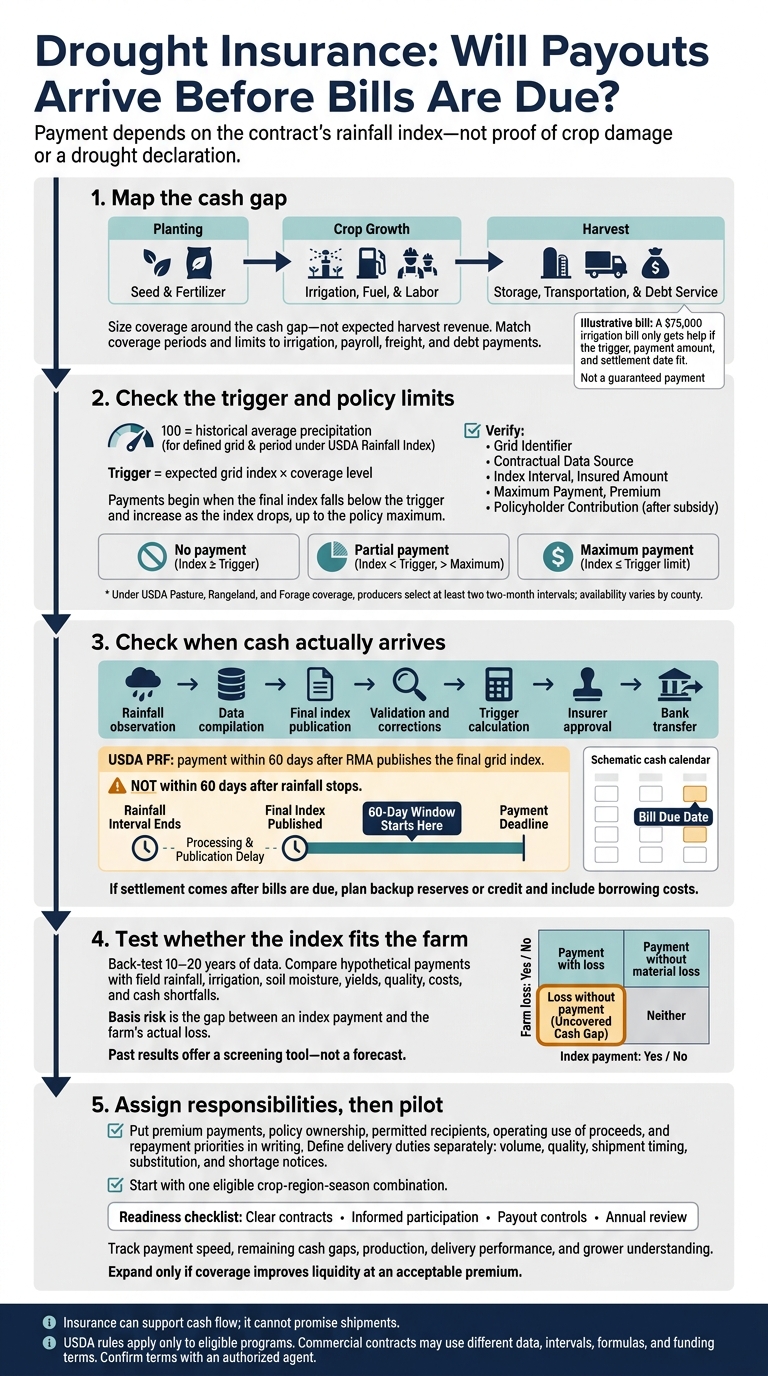
I’d judge drought insurance by one question: Will the cash arrive before the bills are due? A policy may help with a $75,000 irrigation bill, but only if its rainfall trigger, payment amount, and settlement date fit your needs. Payment depends on the contract’s rainfall index - not proof of crop damage or a drought declaration.
Before buying coverage, I’d check four things:
Cash needs: Match coverage periods and limits to irrigation, payroll, freight, and debt payments - not total harvest revenue.
Payment timing: Allow for data publication and settlement. USDA PRF guidance calls for payment within 60 days after the final grid index is published, not after rainfall stops.
Index fit: Test 10–20 years of records against farm losses. Your farm can lose money without receiving a payment - a mismatch called <u>basis risk</u>.
Written responsibilities: Agree on who pays premiums, receives funds, and meets repayment and delivery duties.
I’d start with a small pilot, keep backup funding for gaps, and expand only if the coverage helps pay bills at an acceptable cost. Insurance can support cash flow; it cannot promise shipments.
Drought Insurance: Will Payouts Arrive Before Bills Are Due?
How Rainfall-Based Parametric Insurance Works
Rainfall Triggers and Policy Terms
In USDA Rainfall Index coverage, 100 represents historical average precipitation for a defined grid and time period.[10] The contract’s data source - not a farm rain gauge - determines the final index and payment.[3][8] Payment timing matters: suppliers may need that cash to pay bills before harvest revenue arrives.
Before enrolling, request the grid identifier, data source, calculation method, and schedule for publishing the final index.
| Term | Practical meaning |
|---|---|
| Trigger / attachment point | The index level where payment begins. |
| Exit point | The index level where payment reaches its maximum. |
| Index interval | The period during which rainfall is measured. |
| Indemnity | The payment calculated under the policy formula. |
| Basis risk | The chance that the index does not match losses at the supplier’s operation. |
Get the payment formula, insured amount, maximum payment, and premium in writing. Confirm the policyholder contribution, too - the amount you pay after any subsidy. Exit points, payment caps, available intervals, and subsidies vary by policy. Some USDA programs require insured acreage to be assigned across more than one interval.[4][9]
Under USDA’s Rainfall Index plan, the trigger equals the expected grid index multiplied by the coverage level. When the final index falls below that trigger, payments increase as the index drops, up to the policy maximum.[4][5]
For suppliers, the key question is whether the contract pays based on rainfall data or proven crop loss.
Rainfall Index Payments Versus Crop-Loss Payments
Only one of these structures may deliver cash soon enough to protect supply commitments.
| Feature | Rainfall-index coverage | Crop-loss coverage |
|---|---|---|
| Payment basis | A rainfall index for a defined area and interval. | A covered crop or revenue loss from an insured cause. |
| Field-loss assessment | Usually does not require proof of actual field loss. | Generally requires documentation or adjustment of covered losses. |
| Settlement requirements | Final index data and the contract’s payment formula. | Loss reporting and policy-specific proof, inspection, and claim requirements. |
| Coverage limits | Insured amount, intervals, coverage level, payment cap, and index risk. | Insured unit, guarantee, covered causes, exclusions, and policy limits. |
Neither structure automatically covers every drought-related financial loss. Rainfall coverage may not pay if the trigger is not met, even when a supplier’s fields or inventory suffer damage. It may also pay when measured rainfall is low but the supplier’s actual loss is limited. Check whether heat, pests, disease, hail, wildfire, flooding, irrigation failure, and market-price losses require separate coverage.[3][5][6]
USDA rules apply only to eligible programs, including specified Pasture, Rangeland, and Forage coverage. Confirm eligibility and enrollment deadlines with an authorized agent. An eligible commercial contract may use different data, intervals, formulas, and funding terms.[3][7][9]
Check the payment schedule against irrigation, payroll, and freight due dates to see whether funds would arrive when those bills are due.
sbb-itb-8baf5f1
Parametric Insurance: Understanding Basis Risk
Plan Coverage Around Seasonal Cash Needs
Once the trigger and formula are clear, line up coverage with the farm’s cash calendar.
Match Coverage Periods to Crop Stages and Bills
Tie each coverage interval to bills that could disrupt deliveries. Match seed and fertilizer costs to planting; irrigation, fuel, and labor to crop growth; and harvest, storage, transportation, and debt service to their due dates.
For each interval, record rainfall shortfall, crop stage, cash on hand, and buyer delivery needs. Include buyer costs for replacement supply, expedited transportation, and idle processing capacity. This timing map shows whether the policy covers the bills that put supply at risk.
Size coverage around the cash gap - not expected harvest revenue. Apply policy valuation rules and caps before choosing insured amounts. Under USDA Pasture, Rangeland, and Forage coverage, producers select at least two two-month intervals; availability varies by county.[12][13] Document who pays the premium and how proceeds will be used. Those terms cannot change eligibility or insured-value limits.
Then check whether the trigger and payment cap can cover that gap.
Weigh Triggers, Payment Caps, and Premiums
Before enrolling, compare three outcomes: no payment, a partial payment, and the maximum payment. Calculate premiums per acre and across all covered acres. Add borrowing costs if settlement would come after bills are due. The applicable policy documents set premium billing dates and payment obligations.[11]
| Decision | Fixed rules to check | Available choices and trade-offs |
|---|---|---|
| Insured periods | Available intervals and allocation requirements | Focus permitted allocations on critical cash needs; spreading coverage can dilute protection. |
| Trigger level | Formula and eligible coverage levels | A higher permitted trigger can respond to smaller deficits but changes premiums and payment potential. |
| Payment cap | Maximum liability and valuation limits | Allocating more insured value to one interval leaves less for another. |
| Grid match | Grid, rainfall dataset, and calculation method | Check whether the eligible grid tracks the farm; local rainfall in inches cannot replace the contractual index. |
| Premium | Rates, subsidies, fees, and billing rules | Adjust coverage choices; handle buyer payment terms separately. |
Check Payment Timing Against Bill Due Dates
Even a strong trigger may leave an invoice unpaid if the payout arrives too late. Trace each settlement step: rainfall observation, data compilation, index publication, validation and corrections, trigger calculation, insurer approval, and bank transfer.
Get written calculation dates, correction deadlines, payment deadlines, and confirmation of the permitted recipient. USDA’s general PRF materials specify payment within 60 days after RMA publishes the final grid index - not within 60 days after rainfall stops.[14]
Match the expected payment date to each bill’s due date, accounting for payouts that arrive after the coverage interval ends.
Manage Basis Risk and Set Shared Responsibilities
Test Gaps Between Rainfall Payments and Farm Losses
After confirming the trigger and payment timing, check whether the index tracks the supplier’s losses. Basis risk is the gap between an index payment and the farm’s actual loss. Weather-station distance, grid size, uneven rainfall, topography, soil moisture, heat, and crop water needs can leave bills or delivery risks uncovered.[3][10]
Back-test 10–20 years of data. Compare hypothetical payments with field rainfall, irrigation, soil moisture, yields, quality, costs, and cash shortfalls. Sort each season into four outcomes: payment with loss, payment without material loss, loss without payment, or neither. NOAA and the U.S. Drought Portal can support this work.[15][16] Past results offer a screening tool - not a forecast.
Use this history to find where rainfall payouts missed or overstated actual disruption.
| Mismatch to test | Cash-flow or delivery risk | Practical response |
|---|---|---|
| Trigger met, but heat drives most losses | Rainfall alone understates costs | Compare payments with heat-related irrigation bills and lost revenue. |
| Rainfall total misses a critical dry spell | Timing matters more than total inches | Test crop-stage dry spells against bills and delivery shortfalls. |
| The grid crosses the trigger, but field damage differs | Payment overstates or understates cash needs | Compare the contractual index with field records and cash gaps. |
| Crops show water stress without a trigger | Bills remain unpaid | Test reserves and agreed backup credit against the shortfall. |
Document Funding, Payment Rights, and Delivery Duties
Once you’ve tested the index fit, put policy control and the payout’s effect on supply commitments in writing.
Assign named owners. Growers document production costs and the cash needed to maintain shipments. Buyers identify delivery risks and backup sources. Lenders confirm credit availability, collateral, and repayment priorities. Insurers or authorized administrators handle policy terms and settlement, while data providers manage weather records, publication dates, and corrections. Obtain data consent and confirm group eligibility before enrollment.
Document premium support, policy ownership, beneficiaries or permitted assignees, receiving accounts, and repayment priorities. State who receives the proceeds, who uses them for operating costs, and whether debt repayment comes first. Have assignment, clawback, privacy, and insurance-law requirements reviewed.
Separately, define how payments - or losses that receive no payment - affect volume, quality, shipment timing, pricing, substitution, and shortage notices. Insurance cannot guarantee supply continuity, and a missed payment does not prove grower negligence.
Pilot Coverage and Track Results
If the test shows the coverage can work, begin with a limited rollout: one eligible crop-region-season combination. Map acreage, crop stages, bills, and buyer commitments. Validate weather records and release schedules, then model permitted triggers, premiums, and limits. Test basis risk and confirm agreement among the buyer, grower, and lender.
Check readiness against four requirements: clear contracts, informed participation, payout controls, and annual review. Track payment speed, remaining cash gaps, production, delivery performance, and grower understanding. Separate insurance’s contribution from the effects of weather, prices, and management.
Conclusion: Start Small and Review Before Expanding
Coverage intervals should match the bills they’re meant to protect. Check when cash will reach growers, factoring in data publication and settlement delays. A payment that arrives after payroll is due won’t close that immediate funding gap.
Use pilot results to judge whether to expand - not simply to count payouts. Track on-time payments, remaining cash gaps, and uncovered losses that could threaten shipments. Review these results alongside written grower and buyer responsibilities for premiums, payment rights, and deliveries.
Expand only if coverage improves liquidity at an acceptable premium. Use the findings to adjust next year’s intervals, triggers, or limits. Drop coverage if the index repeatedly misses local rainfall patterns. Rainfall-triggered payments cannot guarantee enough supply to meet buyer demand.[6]
FAQs
How much backup cash should I keep while awaiting a drought payout?
The provided resources don’t specify a dollar amount or formula for backup cash. Parametric drought insurance can help maintain cash flow by paying out quickly - often within days of a verified trigger - without lengthy claims investigations [1][2].
To estimate how much cash you may need, assess how drought could affect your operations, then factor those findings into your capital planning [3][4].
How can I tell if rainfall coverage is worth the premium?
Begin with a climate vulnerability assessment to identify your drought risks and estimate potential financial losses. Compare those estimates with the insurance premium, then check whether the policy’s objective payout triggers fit your region and business activities.
Parametric insurance offers fast, automated payouts. But factor in basis risk: rainfall triggers may not match your actual losses.
How should buyers and growers share premium costs?
Buyers and growers can split parametric insurance premiums to help protect against drought-related yield losses and keep supplies flowing [1][2]. For smaller suppliers with limited resources to prepare for climate risks, buyers should consider financial support or training [3].
Cost sharing keeps growers from bearing the full financial burden [1][4]. Public-private partnerships can also help keep these measures financially viable for everyone involved [2].


FAQ