Sep 20, 2025
Norway Launches First Ever Cross-Border CO2 Storage Service
In This Article
Norway launches Northern Lights, the world's first merchant cross-border CO2 transport and storage service, pioneering industrial decarbonization in Europe.
Norway Launches First Ever Cross-Border CO2 Storage Service
In a landmark step toward industrial decarbonization, Norway has officially launched Northern Lights, the world’s first merchant CO₂ transport and storage service. This innovative initiative represents a significant advancement in carbon capture and storage (CCS) technology, offering a scalable and commercial pathway for reducing emissions across Europe.
A Milestone in Carbon Storage
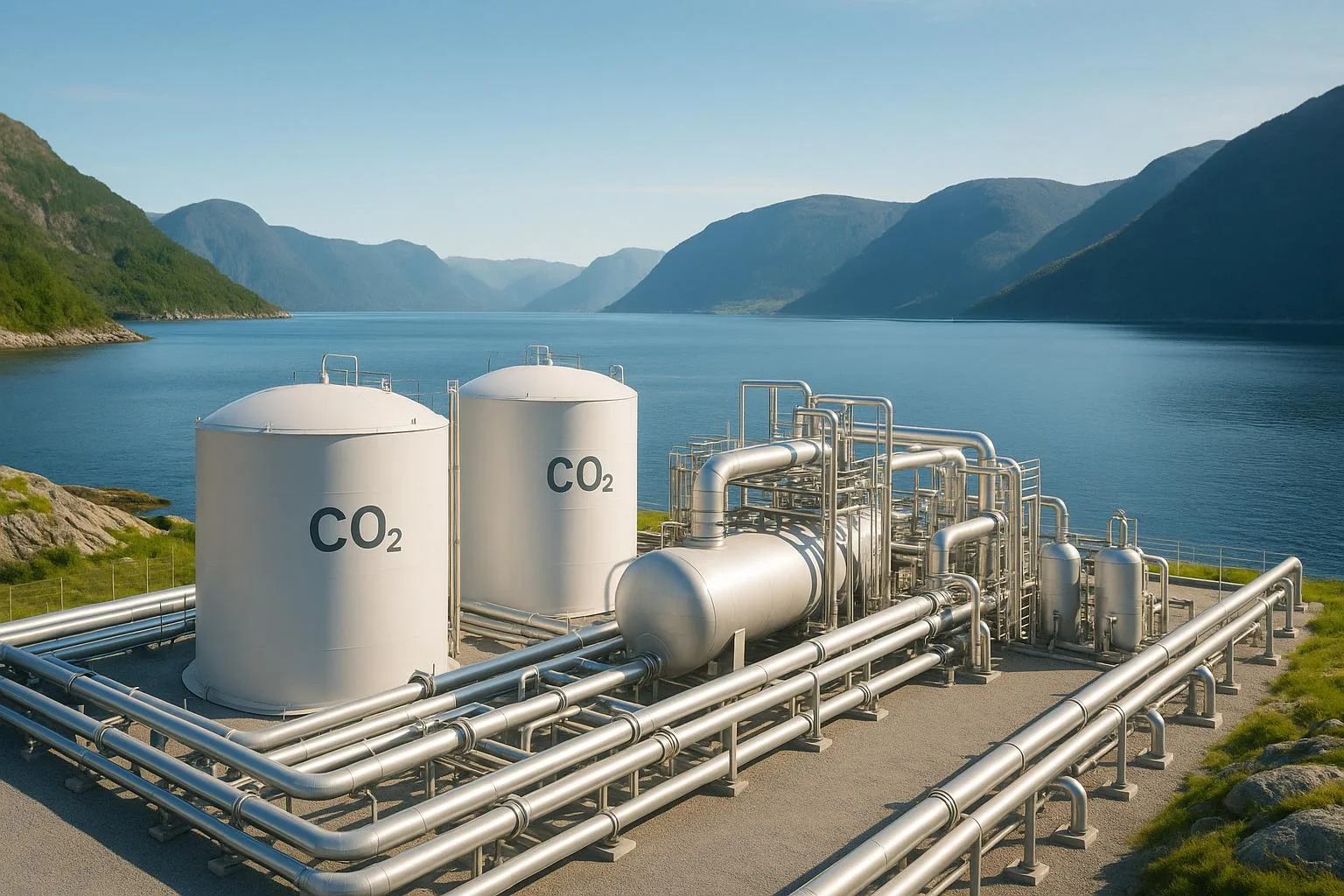
The project’s first CO₂ injection marked a pivotal moment in the effort to combat industrial emissions. Carbon dioxide captured from Heidelberg Materials’ cement plant in Brevik was successfully transported by ship, stored in onshore tanks, and then pumped through a 100-kilometer pipeline to be permanently stored 2,600 meters beneath the North Sea seabed.
What sets Northern Lights apart is its unique merchant model. The service allows companies to transport and store carbon emissions, creating a critical solution for industries struggling to manage hard-to-abate emissions. The first phase of the project, with a capacity of 1.5 million tonnes per year, is already fully booked by customers across Norway and continental Europe.
Expansion Plans Underway
Partners Equinor, Shell, and TotalEnergies have approved an expansion of the project, known as Phase 2. With an investment of NOK 7.5 billion, this next phase will increase Northern Lights’ capacity to over 5 million tonnes annually by 2028. This expansion is being supported in part by an EU grant and Norway’s Longship initiative, demonstrating the collaborative efforts necessary to tackle global carbon emissions.
Pioneering a New Era for CCS
Northern Lights is a key component of Norway’s Longship CCS program, which aims to transform carbon capture and storage from small-scale pilot projects into a viable, commercially structured infrastructure. The project opens new possibilities for decarbonizing heavy industries such as cement, waste-to-energy, and fertilizer production.
By providing a cross-border solution for CO₂ storage, Northern Lights has positioned Norway as a leader in the European CCS market. The initiative demonstrates how CCS can not only be feasible but also scalable, offering a promising economic and environmental model for other nations.
As Northern Lights moves forward, Norway sets a precedent for how countries can implement innovative solutions to address climate challenges, proving that commercial CCS services can play a critical role in the global fight against climate change.
Latest Articles
©2026

Narrative Change and Power Building: The Missing Half of Advocacy
Narrative change is the process of disrupting dominant narratives that normalize inequity and advancing new narratives from historically marginalized communities.

Funding Resilience Without Federal Grants
BRIC is unreliable and FEMA is shrinking. Here's how cities fund climate resilience with dedicated revenue, blended finance, and a coordinating authority.

The ESG Blind Spot: How AI Is Finding Risks in Companies Nobody Else Is Watching
Norway's sovereign wealth fund uses AI to screen 7,200 portfolio companies for forced labor and corruption within 24 hours. The real story is the emerging-market coverage gap that traditional ESG data vendors miss — and what it means for any company with a global supply chain.
Narrative Change and Power Building: The Missing Half of Advocacy
Narrative change is the process of disrupting dominant narratives that normalize inequity and advancing new narratives from historically marginalized communities.
Funding Resilience Without Federal Grants
BRIC is unreliable and FEMA is shrinking. Here's how cities fund climate resilience with dedicated revenue, blended finance, and a coordinating authority.
The ESG Blind Spot: How AI Is Finding Risks in Companies Nobody Else Is Watching
Norway's sovereign wealth fund uses AI to screen 7,200 portfolio companies for forced labor and corruption within 24 hours. The real story is the emerging-market coverage gap that traditional ESG data vendors miss — and what it means for any company with a global supply chain.
FAQ
01
What does it really mean to “redefine profit”?
02
What makes Council Fire different?
03
Who does Council Fire work with?
04
What does working with Council Fire actually look like?
05
How does Council Fire help organizations turn big goals into action?
06
How does Council Fire define and measure success?
07
How does technology fit into Council Fire’s work?
Sep 20, 2025
Norway Launches First Ever Cross-Border CO2 Storage Service
In This Article
Norway launches Northern Lights, the world's first merchant cross-border CO2 transport and storage service, pioneering industrial decarbonization in Europe.
Norway Launches First Ever Cross-Border CO2 Storage Service
In a landmark step toward industrial decarbonization, Norway has officially launched Northern Lights, the world’s first merchant CO₂ transport and storage service. This innovative initiative represents a significant advancement in carbon capture and storage (CCS) technology, offering a scalable and commercial pathway for reducing emissions across Europe.
A Milestone in Carbon Storage
The project’s first CO₂ injection marked a pivotal moment in the effort to combat industrial emissions. Carbon dioxide captured from Heidelberg Materials’ cement plant in Brevik was successfully transported by ship, stored in onshore tanks, and then pumped through a 100-kilometer pipeline to be permanently stored 2,600 meters beneath the North Sea seabed.
What sets Northern Lights apart is its unique merchant model. The service allows companies to transport and store carbon emissions, creating a critical solution for industries struggling to manage hard-to-abate emissions. The first phase of the project, with a capacity of 1.5 million tonnes per year, is already fully booked by customers across Norway and continental Europe.
Expansion Plans Underway
Partners Equinor, Shell, and TotalEnergies have approved an expansion of the project, known as Phase 2. With an investment of NOK 7.5 billion, this next phase will increase Northern Lights’ capacity to over 5 million tonnes annually by 2028. This expansion is being supported in part by an EU grant and Norway’s Longship initiative, demonstrating the collaborative efforts necessary to tackle global carbon emissions.
Pioneering a New Era for CCS
Northern Lights is a key component of Norway’s Longship CCS program, which aims to transform carbon capture and storage from small-scale pilot projects into a viable, commercially structured infrastructure. The project opens new possibilities for decarbonizing heavy industries such as cement, waste-to-energy, and fertilizer production.
By providing a cross-border solution for CO₂ storage, Northern Lights has positioned Norway as a leader in the European CCS market. The initiative demonstrates how CCS can not only be feasible but also scalable, offering a promising economic and environmental model for other nations.
As Northern Lights moves forward, Norway sets a precedent for how countries can implement innovative solutions to address climate challenges, proving that commercial CCS services can play a critical role in the global fight against climate change.
Latest Articles
©2026
Narrative Change and Power Building: The Missing Half of Advocacy
Narrative change is the process of disrupting dominant narratives that normalize inequity and advancing new narratives from historically marginalized communities.
Funding Resilience Without Federal Grants
BRIC is unreliable and FEMA is shrinking. Here's how cities fund climate resilience with dedicated revenue, blended finance, and a coordinating authority.
The ESG Blind Spot: How AI Is Finding Risks in Companies Nobody Else Is Watching
Norway's sovereign wealth fund uses AI to screen 7,200 portfolio companies for forced labor and corruption within 24 hours. The real story is the emerging-market coverage gap that traditional ESG data vendors miss — and what it means for any company with a global supply chain.
FAQ
01
What does it really mean to “redefine profit”?
02
What makes Council Fire different?
03
Who does Council Fire work with?
04
What does working with Council Fire actually look like?
05
How does Council Fire help organizations turn big goals into action?
06
How does Council Fire define and measure success?
07
How does technology fit into Council Fire’s work?
Sep 20, 2025
Norway Launches First Ever Cross-Border CO2 Storage Service
In This Article
Norway launches Northern Lights, the world's first merchant cross-border CO2 transport and storage service, pioneering industrial decarbonization in Europe.
Norway Launches First Ever Cross-Border CO2 Storage Service
In a landmark step toward industrial decarbonization, Norway has officially launched Northern Lights, the world’s first merchant CO₂ transport and storage service. This innovative initiative represents a significant advancement in carbon capture and storage (CCS) technology, offering a scalable and commercial pathway for reducing emissions across Europe.
A Milestone in Carbon Storage
The project’s first CO₂ injection marked a pivotal moment in the effort to combat industrial emissions. Carbon dioxide captured from Heidelberg Materials’ cement plant in Brevik was successfully transported by ship, stored in onshore tanks, and then pumped through a 100-kilometer pipeline to be permanently stored 2,600 meters beneath the North Sea seabed.
What sets Northern Lights apart is its unique merchant model. The service allows companies to transport and store carbon emissions, creating a critical solution for industries struggling to manage hard-to-abate emissions. The first phase of the project, with a capacity of 1.5 million tonnes per year, is already fully booked by customers across Norway and continental Europe.
Expansion Plans Underway
Partners Equinor, Shell, and TotalEnergies have approved an expansion of the project, known as Phase 2. With an investment of NOK 7.5 billion, this next phase will increase Northern Lights’ capacity to over 5 million tonnes annually by 2028. This expansion is being supported in part by an EU grant and Norway’s Longship initiative, demonstrating the collaborative efforts necessary to tackle global carbon emissions.
Pioneering a New Era for CCS
Northern Lights is a key component of Norway’s Longship CCS program, which aims to transform carbon capture and storage from small-scale pilot projects into a viable, commercially structured infrastructure. The project opens new possibilities for decarbonizing heavy industries such as cement, waste-to-energy, and fertilizer production.
By providing a cross-border solution for CO₂ storage, Northern Lights has positioned Norway as a leader in the European CCS market. The initiative demonstrates how CCS can not only be feasible but also scalable, offering a promising economic and environmental model for other nations.
As Northern Lights moves forward, Norway sets a precedent for how countries can implement innovative solutions to address climate challenges, proving that commercial CCS services can play a critical role in the global fight against climate change.
Latest Articles
©2026
Narrative Change and Power Building: The Missing Half of Advocacy
Narrative change is the process of disrupting dominant narratives that normalize inequity and advancing new narratives from historically marginalized communities.
Funding Resilience Without Federal Grants
BRIC is unreliable and FEMA is shrinking. Here's how cities fund climate resilience with dedicated revenue, blended finance, and a coordinating authority.
The ESG Blind Spot: How AI Is Finding Risks in Companies Nobody Else Is Watching
Norway's sovereign wealth fund uses AI to screen 7,200 portfolio companies for forced labor and corruption within 24 hours. The real story is the emerging-market coverage gap that traditional ESG data vendors miss — and what it means for any company with a global supply chain.
FAQ
What does it really mean to “redefine profit”?
What makes Council Fire different?
Who does Council Fire work with?
What does working with Council Fire actually look like?
How does Council Fire help organizations turn big goals into action?
How does Council Fire define and measure success?
How does technology fit into Council Fire’s work?