
May 28, 2026
How to Develop Metrics, Monitoring, and Verification (MRV) for Impact for NGOs & Nonprofits
Capacity Building
In This Article
Design MRV for NGOs: align metrics with your Theory of Change, set monitoring plans, verify data, and turn insights into action.
How to Develop Metrics, Monitoring, and Verification (MRV) for Impact for NGOs & Nonprofits
Measurement, Reporting, and Verification (MRV) systems help NGOs and nonprofits track their impact, improve transparency, and meet funder expectations. This guide outlines how to design an MRV framework that aligns with your mission, ensures data accuracy, and supports decision-making. Key steps include:
Define Metrics: Use your Theory of Change (ToC) to identify measurable outcomes linked to your goals.
Develop Monitoring Plans: Establish clear data collection methods, assign responsibilities, and set collection schedules.
Verify Data: Use internal reviews, external audits, or advanced tools like AI and satellite imaging to confirm accuracy.
Use Insights: Turn verified data into actionable findings to improve programs and build trust with stakeholders.
MRV systems are essential for organizations adopting outcome-based funding models, where verified results drive financial support. By implementing structured MRV processes, nonprofits can demonstrate accountability, measure their impact effectively, and strengthen relationships with funders and communities.
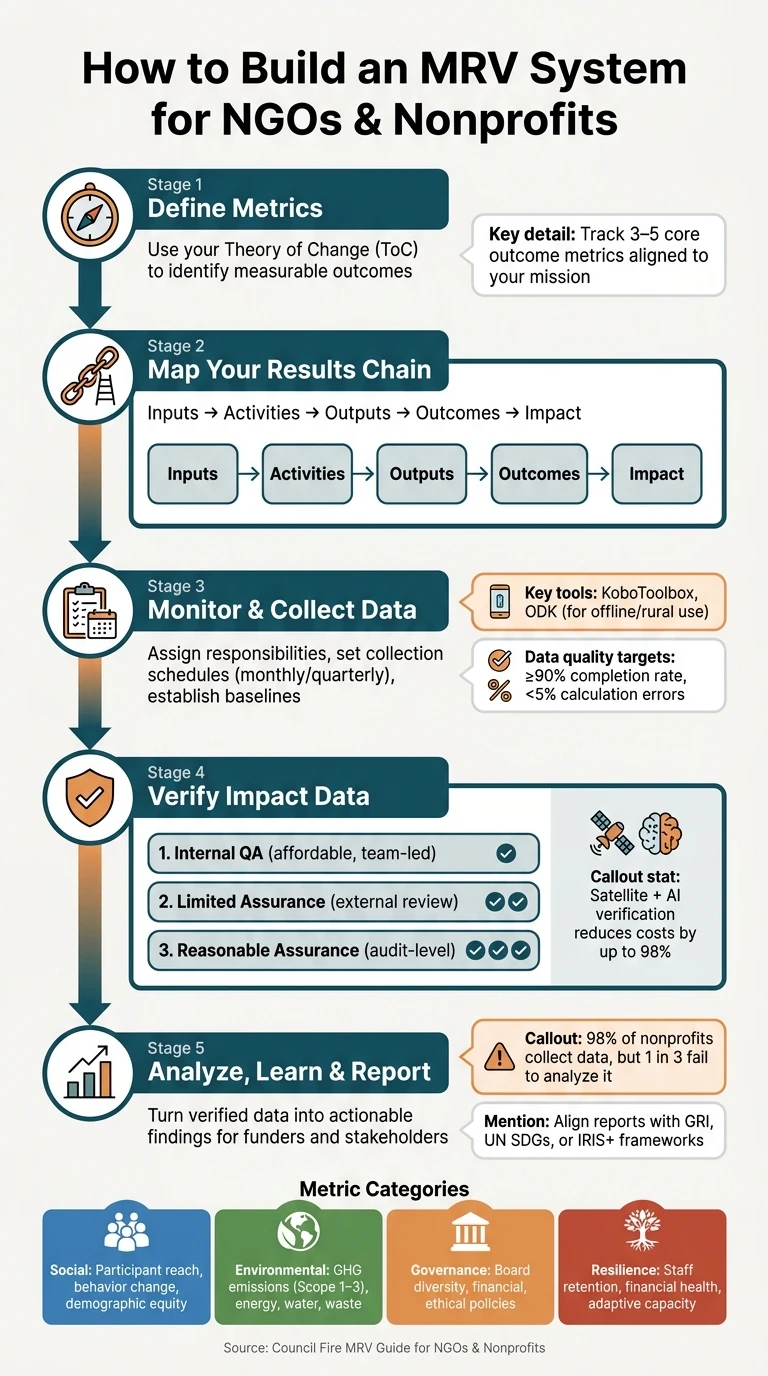
MRV Framework for NGOs: From Metrics to Impact
Building an MRV Framework Aligned with Your Mission and Theory of Change
Aligning MRV Metrics with Your Mission and Goals
When developing your MRV framework, it’s crucial to align it with your mission to ensure every metric contributes to meaningful outcomes.
A common mistake nonprofits make is diving into data collection without first clarifying the change they aim to create. This is where the Theory of Change (ToC) becomes invaluable. Think of your ToC as a roadmap that connects your daily activities to your long-term mission, outlining how and why those activities lead to the desired change [3].
Every metric you track should directly link to an outcome defined in your ToC. If a data point doesn’t support a specific outcome, it’s likely unnecessary. This focus keeps your MRV system streamlined and intentional.
"A Theory of Change is a hypothesis about how change happens. Once monitoring data starts flowing, some links in the chain will hold and others will not. Revisions are healthy when they reflect evidence." - Sopact [3]
By aligning your ToC with your data collection efforts, you create a system that is both efficient and impactful.
Core Components of an MRV Framework
An effective MRV framework is built around a results chain: inputs → activities → outputs → outcomes → impact. Each stage builds on the previous one, and understanding these distinctions is key to measuring what truly matters [2][5].
Component | Definition | Measurement Effort |
|---|---|---|
Inputs | Resources invested (e.g., staff, funding) | Low - tracked via budgets and HR systems [3] |
Activities | Programs or services delivered | Medium - logged in program records [3] |
Outputs | Tangible results (e.g., people trained) | High frequency, but simple to track [3] |
Outcomes | Changes in behavior, knowledge, or conditions | High - requires surveys and follow-ups [3] |
Impact | Broad, population-level changes | Very high - needs contribution analysis [3] |
These components work together to create a structured approach to measurement. To ensure each piece serves its purpose, consider reverse-engineering your results chain. Start with your ultimate goal, then identify the intermediate outcomes and activities required to reach it [5]. This approach ensures every action has a clear role in driving results.
Choosing the Right Key Performance Indicators (KPIs)
Once your results chain is in place, the next step is selecting KPIs that not only measure progress but also inform decisions.
After mapping your ToC, assign at least one indicator to each outcome. Pair these indicators with a specific data source, a collection method, and a measurement frequency [3]. Without these clearly defined KPIs, your ToC risks remaining a theoretical exercise.
Effective KPIs share five characteristics: they are valid (measuring what they claim to measure), reliable (consistent across time and evaluators), sensitive (able to detect meaningful changes), feasible (collectible within your resources), and actionable (useful for decision-making) [5]. Neglecting any of these traits can result in indicators that look impressive but fail to deliver practical insights.
Finally, when addressing broad goals like reducing poverty or closing achievement gaps, use contribution language rather than claiming sole credit [3]. Acknowledging that your program is one of many influences on large-scale change helps maintain trust with funders and communities while presenting an honest picture of your impact.
Defining Impact Metrics and KPIs for Social and Environmental Outcomes
Categories of Impact Metrics
Organizing metrics into categories helps uncover gaps and focus data collection efforts. Non-governmental organizations (NGOs) typically operate within four main areas: social, environmental, governance, and resilience.
Metric Category | Tracks | Common Indicators |
|---|---|---|
Social | Human and community impact | Participant reach, behavior change, demographic equity |
Environmental | Resource use and ecological effects | GHG emissions (Scope 1–3), energy use, water consumption, waste diversion |
Governance | Accountability and decision-making | Board diversity, financial transparency, ethical policies |
Resilience | Stability and adaptability | Staff retention, financial health, adaptive capacity |
Understanding the scopes of greenhouse gas (GHG) emissions is essential for accurate reporting. Scope 1 includes direct emissions from sources you control, such as company vehicles. Scope 2 covers emissions from purchased electricity. Scope 3 encompasses indirect emissions from activities like supply chain operations or business travel. Identifying the relevant scopes ensures no gaps in environmental reporting.
These categories provide a foundation for distinguishing between outputs, outcomes, and impact, which are often mistakenly treated as interchangeable.
Output, Outcome, and Impact Indicators: Key Differences
Each type of indicator serves a unique purpose, answering different questions about your efforts.
Outputs focus on "what did we do?" They measure the quantity of activities delivered, such as workshops held or trees planted.
Outcomes address "what changed?" They track shifts in behavior, knowledge, or conditions, like the percentage of participants adopting a new practice.
Impact asks "what difference did we make?" It isolates the specific change directly attributable to your work, accounting for what would have happened without your intervention.
Indicator Type | Focus | Example |
|---|---|---|
Output | Activities & deliverables | Number of people trained in sustainable farming |
Outcome | Behavioral or condition changes | Percentage of farmers adopting sustainable techniques |
Impact | Long-term attributable change | Regional improvements in food security |
While outputs are easier to measure, prioritizing outcomes is more meaningful because they reveal whether real change occurred. For long-term goals like reducing poverty or improving ecosystems, use interim metrics - such as shifts in knowledge or practices - as stepping stones while working toward broader impact.
How to Prioritize Metrics for Practical Use
With numerous potential indicators available, narrowing them down is critical. Use these five questions to evaluate each metric:
Is it relevant to your mission and Theory of Change?
Is it feasible to collect without overburdening your team?
Will it be actionable, meaning it informs decision-making?
Is it reliable, holding up over time and scrutiny?
Does it meet stakeholder expectations, including those of donors, beneficiaries, or regulators?
Aim to track 3–5 core outcome metrics that align directly with your mission. While it might seem thorough to monitor dozens of indicators, excessive data often goes unused. Ensure that each chosen metric ties back to your Theory of Change, and wherever possible, disaggregate data by race, gender, and geography. Aggregated data can hide inequities, masking the experiences of underserved groups.
Finally, always establish a baseline before starting your intervention. Without a clear starting point, measuring progress becomes speculative. While it’s tempting to skip this step under tight deadlines, failing to do so can lead to challenges from funders questioning the credibility of your results later on.
Designing Monitoring Systems and Data Collection Processes
How to Build a Monitoring Plan
A monitoring plan serves as the operational structure for your MRV system, turning metrics into actionable schedules with clearly defined roles. Start by revisiting your Theory of Change to ensure that each data point aligns with a specific activity, output, or outcome. This alignment ensures that every indicator has a purpose within your broader objectives.
Once indicators are finalized, outline four critical components for each: the data source, the method of collection, the frequency of collection, and the staff member responsible. Assigning clear responsibilities prevents last-minute data collection chaos and boosts accuracy. Monthly or quarterly data collection cycles are often more effective and manageable than annual reviews.
Establish a baseline before implementing any interventions to measure progress effectively. Pair this baseline with a specific, measurable target that can be realistically achieved within a set timeframe.
Data Collection Methods for NGOs
Selecting the right data collection methods depends on your program’s context, the needs of your beneficiaries, and the resources available. Surveys and structured questionnaires work well for assessing large-scale changes in knowledge, attitudes, and behaviors. On the other hand, interviews and focus groups provide deeper insights that go beyond numerical data, while field observations confirm that activities are being carried out as reported.
In rural or low-connectivity areas, mobile tools like KoboToolbox and ODK are particularly useful. These platforms allow offline data entry, which can be synced later when connectivity is available [6]. Incorporating participatory monitoring, where beneficiaries are directly involved in the process, ensures that the data reflects real-world conditions more accurately.
Maintaining Data Quality and Consistency
Gathering data is only part of the job - ensuring its accuracy and consistency is equally important. Implement a tiered verification system that includes daily checks for completeness, weekly cross-referencing, monthly reviews, and quarterly feedback from stakeholders [7].
Staff training is crucial for maintaining data quality. Regular workshops, such as focused 4-hour sessions on data collection protocols, can minimize errors and ensure everyone follows the same procedures. A well-maintained system should aim for a data completion rate of at least 90% and keep calculation errors below 5% [7].
"Fix the architecture at stage two - one persistent participant ID across every form and survey - and stage three becomes a query, not a project." - Unmesh Sheth, Founder, Sopact [8]
Before fully deploying new tools, consider running a one-month pilot phase. This trial period helps identify technical issues early and gives your team the chance to become comfortable with the system [7]. A strong monitoring system like this not only enhances data accuracy but also sets the stage for ongoing verification and continuous improvement in your MRV process.
Verification, Learning, and Continuous Improvement
Verification Methods for Impact Data
Verification ensures that reported data aligns with actual outcomes, offering varying levels of rigor based on available resources and stakeholder needs.
A straightforward starting point is internal quality assurance, which involves staff-led checks like year-over-year variance analysis and maintaining audit trails to track data sources. While cost-effective and useful for building internal data skills, this method may not satisfy major donors who prefer independent validation.
For organizations aiming to enhance credibility, external assurance is a strong option. A limited assurance review involves an outside expert sampling data and evaluating processes, offering a balance between cost and credibility. On the other hand, reasonable assurance provides audit-level scrutiny of data, controls, and evidence, delivering maximum confidence for donors but requiring significant resources and time [4].
Verification Method | Pros | Cons |
|---|---|---|
Internal Quality Assurance | Affordable; improves team data skills [4] | Risk of perceived bias; may not meet donor expectations |
Limited Assurance (external review) | Boosts credibility; less intensive than a full audit [4] | Offers less certainty than full audits |
Reasonable Assurance (audit-level) | Provides top-tier transparency and donor trust [4] | Expensive; demands advanced systems and staff time [4] |
Technological Verification (AI/satellite) | Scalable; cuts costs by up to 98%; objective [1] | Limited to physical/environmental outcomes; needs specialized infrastructure [1] |
For environmental initiatives, technology is reshaping verification possibilities. In January 2026, the World Resources Institute (WRI) adopted a satellite-based verification system for TerraFund, covering 198 land restoration projects across Africa. Using high-resolution imagery and the DINOv3 AI model, this method reduced verification costs by an impressive 98% compared to traditional fieldwork while enabling oversight across thousands of project sites [1].
Once data is verified, the next step is to turn it into actionable insights for growth and improvement.
Using MRV Findings for Organizational Learning
Monitoring, Reporting, and Verification (MRV) systems are only as valuable as the insights they generate. Yet many organizations struggle to use the data they collect effectively. While 98% of nonprofits gather significant amounts of information, a third fail to analyze it or apply findings to their work, and 60% neglect to track learning metrics at the organizational level [9].
Bridging this gap requires deliberate strategies. One proven method is creating Communities of Practice (CoPs) - collaborative groups where staff and experts regularly discuss findings, exchange ideas, and address challenges. For instance, World Vision launched 23 CoPs, engaging over 10,000 members across 93 countries through a SharePoint platform. Their health care CoP alone attracted 900 members in a short time, driving advancements in global primary health care practices [9].
"The intentional practice of collecting information, reflecting on it, and sharing the findings, to improve the performance of an organization." - Katie Smith Milway & Amy Saxton, Authors [9]
Another effective approach is adopting an "Honesty Floor" in reporting. This involves openly sharing underperforming areas and planned improvements, which fosters greater trust with funders than reports that highlight only successes [8].
By integrating these practices, organizations not only improve their programs but also strengthen their transparency and appeal to donors.
Improving Donor and Stakeholder Reporting with MRV
A well-structured MRV system simplifies donor reporting, transforming it from a last-minute scramble into a seamless process. Collecting data on a monthly or quarterly basis eliminates the need to piece together information at year-end, allowing reports to reflect verified, well-analyzed insights [4].
Donors increasingly expect evidence-backed narratives rather than anecdotal accounts. Aligning MRV data with established frameworks like GRI ensures reports are comparable and meet professional standards [4]. Assigning clear responsibility for each metric further enhances accountability and reduces ambiguity around data sources.
After completing each reporting cycle, take time to review the process: note successes, identify shortcomings, and outline adjustments for the next cycle. This habit turns reporting into an ongoing opportunity for learning and improvement, gradually elevating your data systems and stakeholder communications [4].
Digital Tools and Infrastructure for MRV
How to Choose the Right MRV Tools
Choosing the right MRV (Measurement, Reporting, and Verification) tool isn’t about picking the one with the most features - it’s about finding one your team will use consistently. A key factor to consider is the total cost of ownership (TCO) over three years, rather than just focusing on the upfront price. Hidden costs, like implementation fees, can often double the first-year expense [10].
"Total cost of ownership over three years should be the evaluation metric, not just license fees." - Council Fire [10]
Look for tools offering features like role-based access controls, audit logging (a growing requirement during security reviews), mobile-first data capture (including offline functionality, GPS, and timestamps), and automatic framework mapping for standards like GRI, UN SDGs, or IRIS+. A strong emphasis on point-of-entry data validation ensures that data is "clean at source", avoiding the costly and time-intensive cleanup often associated with spreadsheet-based systems [10][11].
For smaller nonprofits not ready to invest in enterprise-level software, free tools like the EPA's Simplified GHG Emissions Calculator can provide a practical way to establish environmental baselines before committing to more advanced platforms.
Types of MRV Tools for Nonprofits
MRV tools serve different roles within the workflow. Once your selection criteria are clear, it’s helpful to understand how specific tool categories align with various MRV functions.
Tool Category | Example Platforms | Key Strength |
|---|---|---|
Impact Tracking | Tracking client outcomes and longitudinal case management | |
Portfolio Management | Managing multiple projects and donor reporting cycles | |
AI-Powered Analytics | Sopact | Qualitative data coding and "clean at source" validation |
Environmental MRV | Global Forest Watch (GFW) | Satellite-based monitoring of forest cover |
For instance, Sopact claims to reduce data cleanup time by 80%, streamlining impact assessments from six months to just six days [12]. Amp Impact, built on Salesforce, is used by over 17,000 users in 150+ countries, managing data tied to over $12.5 billion in development programs [13]. For organizations just starting out, Clear Impact Suite offers a free "Scorecard Free" version, allowing nonprofits to begin tracking performance without upfront costs [14].
However, it’s important to weigh trade-offs. General-purpose tools like survey platforms or BI dashboards may excel at specific tasks but often lack persistent participant IDs. Without a unique identifier to track individuals across programs and years, long-term data consistency becomes difficult. Purpose-built platforms, on the other hand, assign unique IDs from the first interaction, enabling seamless tracking over time [8].
How Council Fire Can Support MRV Implementation
Implementing an MRV system requires more than just selecting the right tools - it also involves aligning technology with workflows and ensuring teams are well-trained. As a platform-agnostic consultant, Council Fire focuses on finding the best solutions tailored to your organization’s needs, rather than pushing specific vendors. Their services include vendor evaluation, data migration planning, and workflow design, ensuring the selected tools deliver meaningful results [10].
Their approach has garnered positive feedback:
"Their analysis and storytelling turned case outcomes into compelling metrics - making the value of our work crystal clear to funders, partners, and the communities we serve." - Atty. David Reed, Executive Director, Chesapeake Legal Alliance [15]
For nonprofits starting from scratch, Council Fire typically begins by identifying 3–5 core outcome metrics that align with the organization’s mission. They then design scalable data infrastructure, ensuring that as funder requirements evolve, the system can adapt without requiring a complete overhaul [10].
Conclusion: Key Takeaways for Building MRV Systems
Summary of Key Points
Creating an MRV system is not a one-and-done task - it’s an ongoing process rooted in transparency and data-driven accountability. Success hinges on aligning metrics with your mission, consistently gathering data, rigorously verifying it, and using insights to inform and improve strategies.
Certain principles are essential at every stage. Assign responsibility for each metric clearly, and establish regular data collection cycles - monthly or quarterly, depending on your needs. Treat your impact data with the same level of scrutiny as financial data by implementing validation checks, audit trails, and documented methodologies. When the time comes, aim for external verification. As Council Fire emphasizes, "The real value of assurance lies in the discipline it imposes on data management, controls, and governance." [16]
One often-overlooked but powerful practice is holding a review after each reporting cycle. Use this opportunity to celebrate successes, address gaps, and refine processes for the future. Consistently following this practice builds a stronger, more reliable MRV system over time [4].
By adhering to these principles, you’ll be well-positioned to take meaningful steps toward continuous improvement.
Next Steps for NGOs and Nonprofits
Start by focusing on a small set of core metrics that align closely with your mission. As your organization’s capacity grows, expand your framework and refine it through periodic materiality assessments to ensure you’re tracking what truly matters [17].
With a well-honed MRV system and verified data, you can strengthen stakeholder confidence and amplify your impact. If you’re facing challenges in governance, data verification, or reporting, consider reaching out to Council Fire. They specialize in helping NGOs and nonprofits design practical and scalable MRV systems that foster trust. Contact Council Fire to begin building a framework tailored to your organization’s unique goals.
What are Monitoring, Reporting and Verification (MRV)?
FAQs
How do I pick just a few impact metrics that funders will accept?
To determine impact metrics that resonate with funders, concentrate on a handful of key indicators tied to your objectives and measurable results. Begin by outlining your theory of change to pinpoint essential outcomes, then focus on metrics that are both relevant and straightforward to track. Opt for data-backed indicators that clearly showcase progress and are simple for funders to interpret, ensuring they align directly with your intended impact.
What’s the simplest way to verify our data without a full audit?
To maintain consistent and reliable data, start with regular internal quality checks. Schedule daily or weekly reviews to identify any irregularities early on. Incorporate spot-checks where senior team members can verify activities as they occur. Utilize detective controls such as automated range checks, variance analysis, and cross-metric reviews to catch discrepancies efficiently. Additionally, establish a clear and well-documented data collection protocol. This should outline who collects the data, how it is gathered, and when the process occurs. Such a protocol not only ensures consistency but also keeps your data prepared for audits.
How do we track outcomes over time if we don’t have a database yet?
If you’re starting without a database, the first step is to create a straightforward data collection process. Begin by clearly identifying the outcomes you want to track and the indicators that will measure them. Assign specific roles to team members for gathering data, and set a consistent schedule - whether daily, weekly, or monthly - for these tasks.
To keep things organized, use simple tools like shared spreadsheets to centralize your data. Make sure to validate the information regularly to maintain consistency and accuracy. This method not only helps you monitor progress effectively but also lays the groundwork for transitioning to a more advanced database system down the line.
Related Blog Posts
Latest Articles
©2026

Narrative Change and Power Building: The Missing Half of Advocacy
Narrative change is the process of disrupting dominant narratives that normalize inequity and advancing new narratives from historically marginalized communities.

Funding Resilience Without Federal Grants
BRIC is unreliable and FEMA is shrinking. Here's how cities fund climate resilience with dedicated revenue, blended finance, and a coordinating authority.

The ESG Blind Spot: How AI Is Finding Risks in Companies Nobody Else Is Watching
Norway's sovereign wealth fund uses AI to screen 7,200 portfolio companies for forced labor and corruption within 24 hours. The real story is the emerging-market coverage gap that traditional ESG data vendors miss — and what it means for any company with a global supply chain.
Narrative Change and Power Building: The Missing Half of Advocacy
Narrative change is the process of disrupting dominant narratives that normalize inequity and advancing new narratives from historically marginalized communities.
Funding Resilience Without Federal Grants
BRIC is unreliable and FEMA is shrinking. Here's how cities fund climate resilience with dedicated revenue, blended finance, and a coordinating authority.
The ESG Blind Spot: How AI Is Finding Risks in Companies Nobody Else Is Watching
Norway's sovereign wealth fund uses AI to screen 7,200 portfolio companies for forced labor and corruption within 24 hours. The real story is the emerging-market coverage gap that traditional ESG data vendors miss — and what it means for any company with a global supply chain.
FAQ
01
What does it really mean to “redefine profit”?
02
What makes Council Fire different?
03
Who does Council Fire work with?
04
What does working with Council Fire actually look like?
05
How does Council Fire help organizations turn big goals into action?
06
How does Council Fire define and measure success?
07
How does technology fit into Council Fire’s work?
May 28, 2026
How to Develop Metrics, Monitoring, and Verification (MRV) for Impact for NGOs & Nonprofits
Capacity Building
In This Article
Design MRV for NGOs: align metrics with your Theory of Change, set monitoring plans, verify data, and turn insights into action.
How to Develop Metrics, Monitoring, and Verification (MRV) for Impact for NGOs & Nonprofits
Measurement, Reporting, and Verification (MRV) systems help NGOs and nonprofits track their impact, improve transparency, and meet funder expectations. This guide outlines how to design an MRV framework that aligns with your mission, ensures data accuracy, and supports decision-making. Key steps include:
Define Metrics: Use your Theory of Change (ToC) to identify measurable outcomes linked to your goals.
Develop Monitoring Plans: Establish clear data collection methods, assign responsibilities, and set collection schedules.
Verify Data: Use internal reviews, external audits, or advanced tools like AI and satellite imaging to confirm accuracy.
Use Insights: Turn verified data into actionable findings to improve programs and build trust with stakeholders.
MRV systems are essential for organizations adopting outcome-based funding models, where verified results drive financial support. By implementing structured MRV processes, nonprofits can demonstrate accountability, measure their impact effectively, and strengthen relationships with funders and communities.
MRV Framework for NGOs: From Metrics to Impact
Building an MRV Framework Aligned with Your Mission and Theory of Change
Aligning MRV Metrics with Your Mission and Goals
When developing your MRV framework, it’s crucial to align it with your mission to ensure every metric contributes to meaningful outcomes.
A common mistake nonprofits make is diving into data collection without first clarifying the change they aim to create. This is where the Theory of Change (ToC) becomes invaluable. Think of your ToC as a roadmap that connects your daily activities to your long-term mission, outlining how and why those activities lead to the desired change [3].
Every metric you track should directly link to an outcome defined in your ToC. If a data point doesn’t support a specific outcome, it’s likely unnecessary. This focus keeps your MRV system streamlined and intentional.
"A Theory of Change is a hypothesis about how change happens. Once monitoring data starts flowing, some links in the chain will hold and others will not. Revisions are healthy when they reflect evidence." - Sopact [3]
By aligning your ToC with your data collection efforts, you create a system that is both efficient and impactful.
Core Components of an MRV Framework
An effective MRV framework is built around a results chain: inputs → activities → outputs → outcomes → impact. Each stage builds on the previous one, and understanding these distinctions is key to measuring what truly matters [2][5].
Component | Definition | Measurement Effort |
|---|---|---|
Inputs | Resources invested (e.g., staff, funding) | Low - tracked via budgets and HR systems [3] |
Activities | Programs or services delivered | Medium - logged in program records [3] |
Outputs | Tangible results (e.g., people trained) | High frequency, but simple to track [3] |
Outcomes | Changes in behavior, knowledge, or conditions | High - requires surveys and follow-ups [3] |
Impact | Broad, population-level changes | Very high - needs contribution analysis [3] |
These components work together to create a structured approach to measurement. To ensure each piece serves its purpose, consider reverse-engineering your results chain. Start with your ultimate goal, then identify the intermediate outcomes and activities required to reach it [5]. This approach ensures every action has a clear role in driving results.
Choosing the Right Key Performance Indicators (KPIs)
Once your results chain is in place, the next step is selecting KPIs that not only measure progress but also inform decisions.
After mapping your ToC, assign at least one indicator to each outcome. Pair these indicators with a specific data source, a collection method, and a measurement frequency [3]. Without these clearly defined KPIs, your ToC risks remaining a theoretical exercise.
Effective KPIs share five characteristics: they are valid (measuring what they claim to measure), reliable (consistent across time and evaluators), sensitive (able to detect meaningful changes), feasible (collectible within your resources), and actionable (useful for decision-making) [5]. Neglecting any of these traits can result in indicators that look impressive but fail to deliver practical insights.
Finally, when addressing broad goals like reducing poverty or closing achievement gaps, use contribution language rather than claiming sole credit [3]. Acknowledging that your program is one of many influences on large-scale change helps maintain trust with funders and communities while presenting an honest picture of your impact.
Defining Impact Metrics and KPIs for Social and Environmental Outcomes
Categories of Impact Metrics
Organizing metrics into categories helps uncover gaps and focus data collection efforts. Non-governmental organizations (NGOs) typically operate within four main areas: social, environmental, governance, and resilience.
Metric Category | Tracks | Common Indicators |
|---|---|---|
Social | Human and community impact | Participant reach, behavior change, demographic equity |
Environmental | Resource use and ecological effects | GHG emissions (Scope 1–3), energy use, water consumption, waste diversion |
Governance | Accountability and decision-making | Board diversity, financial transparency, ethical policies |
Resilience | Stability and adaptability | Staff retention, financial health, adaptive capacity |
Understanding the scopes of greenhouse gas (GHG) emissions is essential for accurate reporting. Scope 1 includes direct emissions from sources you control, such as company vehicles. Scope 2 covers emissions from purchased electricity. Scope 3 encompasses indirect emissions from activities like supply chain operations or business travel. Identifying the relevant scopes ensures no gaps in environmental reporting.
These categories provide a foundation for distinguishing between outputs, outcomes, and impact, which are often mistakenly treated as interchangeable.
Output, Outcome, and Impact Indicators: Key Differences
Each type of indicator serves a unique purpose, answering different questions about your efforts.
Outputs focus on "what did we do?" They measure the quantity of activities delivered, such as workshops held or trees planted.
Outcomes address "what changed?" They track shifts in behavior, knowledge, or conditions, like the percentage of participants adopting a new practice.
Impact asks "what difference did we make?" It isolates the specific change directly attributable to your work, accounting for what would have happened without your intervention.
Indicator Type | Focus | Example |
|---|---|---|
Output | Activities & deliverables | Number of people trained in sustainable farming |
Outcome | Behavioral or condition changes | Percentage of farmers adopting sustainable techniques |
Impact | Long-term attributable change | Regional improvements in food security |
While outputs are easier to measure, prioritizing outcomes is more meaningful because they reveal whether real change occurred. For long-term goals like reducing poverty or improving ecosystems, use interim metrics - such as shifts in knowledge or practices - as stepping stones while working toward broader impact.
How to Prioritize Metrics for Practical Use
With numerous potential indicators available, narrowing them down is critical. Use these five questions to evaluate each metric:
Is it relevant to your mission and Theory of Change?
Is it feasible to collect without overburdening your team?
Will it be actionable, meaning it informs decision-making?
Is it reliable, holding up over time and scrutiny?
Does it meet stakeholder expectations, including those of donors, beneficiaries, or regulators?
Aim to track 3–5 core outcome metrics that align directly with your mission. While it might seem thorough to monitor dozens of indicators, excessive data often goes unused. Ensure that each chosen metric ties back to your Theory of Change, and wherever possible, disaggregate data by race, gender, and geography. Aggregated data can hide inequities, masking the experiences of underserved groups.
Finally, always establish a baseline before starting your intervention. Without a clear starting point, measuring progress becomes speculative. While it’s tempting to skip this step under tight deadlines, failing to do so can lead to challenges from funders questioning the credibility of your results later on.
Designing Monitoring Systems and Data Collection Processes
How to Build a Monitoring Plan
A monitoring plan serves as the operational structure for your MRV system, turning metrics into actionable schedules with clearly defined roles. Start by revisiting your Theory of Change to ensure that each data point aligns with a specific activity, output, or outcome. This alignment ensures that every indicator has a purpose within your broader objectives.
Once indicators are finalized, outline four critical components for each: the data source, the method of collection, the frequency of collection, and the staff member responsible. Assigning clear responsibilities prevents last-minute data collection chaos and boosts accuracy. Monthly or quarterly data collection cycles are often more effective and manageable than annual reviews.
Establish a baseline before implementing any interventions to measure progress effectively. Pair this baseline with a specific, measurable target that can be realistically achieved within a set timeframe.
Data Collection Methods for NGOs
Selecting the right data collection methods depends on your program’s context, the needs of your beneficiaries, and the resources available. Surveys and structured questionnaires work well for assessing large-scale changes in knowledge, attitudes, and behaviors. On the other hand, interviews and focus groups provide deeper insights that go beyond numerical data, while field observations confirm that activities are being carried out as reported.
In rural or low-connectivity areas, mobile tools like KoboToolbox and ODK are particularly useful. These platforms allow offline data entry, which can be synced later when connectivity is available [6]. Incorporating participatory monitoring, where beneficiaries are directly involved in the process, ensures that the data reflects real-world conditions more accurately.
Maintaining Data Quality and Consistency
Gathering data is only part of the job - ensuring its accuracy and consistency is equally important. Implement a tiered verification system that includes daily checks for completeness, weekly cross-referencing, monthly reviews, and quarterly feedback from stakeholders [7].
Staff training is crucial for maintaining data quality. Regular workshops, such as focused 4-hour sessions on data collection protocols, can minimize errors and ensure everyone follows the same procedures. A well-maintained system should aim for a data completion rate of at least 90% and keep calculation errors below 5% [7].
"Fix the architecture at stage two - one persistent participant ID across every form and survey - and stage three becomes a query, not a project." - Unmesh Sheth, Founder, Sopact [8]
Before fully deploying new tools, consider running a one-month pilot phase. This trial period helps identify technical issues early and gives your team the chance to become comfortable with the system [7]. A strong monitoring system like this not only enhances data accuracy but also sets the stage for ongoing verification and continuous improvement in your MRV process.
Verification, Learning, and Continuous Improvement
Verification Methods for Impact Data
Verification ensures that reported data aligns with actual outcomes, offering varying levels of rigor based on available resources and stakeholder needs.
A straightforward starting point is internal quality assurance, which involves staff-led checks like year-over-year variance analysis and maintaining audit trails to track data sources. While cost-effective and useful for building internal data skills, this method may not satisfy major donors who prefer independent validation.
For organizations aiming to enhance credibility, external assurance is a strong option. A limited assurance review involves an outside expert sampling data and evaluating processes, offering a balance between cost and credibility. On the other hand, reasonable assurance provides audit-level scrutiny of data, controls, and evidence, delivering maximum confidence for donors but requiring significant resources and time [4].
Verification Method | Pros | Cons |
|---|---|---|
Internal Quality Assurance | Affordable; improves team data skills [4] | Risk of perceived bias; may not meet donor expectations |
Limited Assurance (external review) | Boosts credibility; less intensive than a full audit [4] | Offers less certainty than full audits |
Reasonable Assurance (audit-level) | Provides top-tier transparency and donor trust [4] | Expensive; demands advanced systems and staff time [4] |
Technological Verification (AI/satellite) | Scalable; cuts costs by up to 98%; objective [1] | Limited to physical/environmental outcomes; needs specialized infrastructure [1] |
For environmental initiatives, technology is reshaping verification possibilities. In January 2026, the World Resources Institute (WRI) adopted a satellite-based verification system for TerraFund, covering 198 land restoration projects across Africa. Using high-resolution imagery and the DINOv3 AI model, this method reduced verification costs by an impressive 98% compared to traditional fieldwork while enabling oversight across thousands of project sites [1].
Once data is verified, the next step is to turn it into actionable insights for growth and improvement.
Using MRV Findings for Organizational Learning
Monitoring, Reporting, and Verification (MRV) systems are only as valuable as the insights they generate. Yet many organizations struggle to use the data they collect effectively. While 98% of nonprofits gather significant amounts of information, a third fail to analyze it or apply findings to their work, and 60% neglect to track learning metrics at the organizational level [9].
Bridging this gap requires deliberate strategies. One proven method is creating Communities of Practice (CoPs) - collaborative groups where staff and experts regularly discuss findings, exchange ideas, and address challenges. For instance, World Vision launched 23 CoPs, engaging over 10,000 members across 93 countries through a SharePoint platform. Their health care CoP alone attracted 900 members in a short time, driving advancements in global primary health care practices [9].
"The intentional practice of collecting information, reflecting on it, and sharing the findings, to improve the performance of an organization." - Katie Smith Milway & Amy Saxton, Authors [9]
Another effective approach is adopting an "Honesty Floor" in reporting. This involves openly sharing underperforming areas and planned improvements, which fosters greater trust with funders than reports that highlight only successes [8].
By integrating these practices, organizations not only improve their programs but also strengthen their transparency and appeal to donors.
Improving Donor and Stakeholder Reporting with MRV
A well-structured MRV system simplifies donor reporting, transforming it from a last-minute scramble into a seamless process. Collecting data on a monthly or quarterly basis eliminates the need to piece together information at year-end, allowing reports to reflect verified, well-analyzed insights [4].
Donors increasingly expect evidence-backed narratives rather than anecdotal accounts. Aligning MRV data with established frameworks like GRI ensures reports are comparable and meet professional standards [4]. Assigning clear responsibility for each metric further enhances accountability and reduces ambiguity around data sources.
After completing each reporting cycle, take time to review the process: note successes, identify shortcomings, and outline adjustments for the next cycle. This habit turns reporting into an ongoing opportunity for learning and improvement, gradually elevating your data systems and stakeholder communications [4].
Digital Tools and Infrastructure for MRV
How to Choose the Right MRV Tools
Choosing the right MRV (Measurement, Reporting, and Verification) tool isn’t about picking the one with the most features - it’s about finding one your team will use consistently. A key factor to consider is the total cost of ownership (TCO) over three years, rather than just focusing on the upfront price. Hidden costs, like implementation fees, can often double the first-year expense [10].
"Total cost of ownership over three years should be the evaluation metric, not just license fees." - Council Fire [10]
Look for tools offering features like role-based access controls, audit logging (a growing requirement during security reviews), mobile-first data capture (including offline functionality, GPS, and timestamps), and automatic framework mapping for standards like GRI, UN SDGs, or IRIS+. A strong emphasis on point-of-entry data validation ensures that data is "clean at source", avoiding the costly and time-intensive cleanup often associated with spreadsheet-based systems [10][11].
For smaller nonprofits not ready to invest in enterprise-level software, free tools like the EPA's Simplified GHG Emissions Calculator can provide a practical way to establish environmental baselines before committing to more advanced platforms.
Types of MRV Tools for Nonprofits
MRV tools serve different roles within the workflow. Once your selection criteria are clear, it’s helpful to understand how specific tool categories align with various MRV functions.
Tool Category | Example Platforms | Key Strength |
|---|---|---|
Impact Tracking | Tracking client outcomes and longitudinal case management | |
Portfolio Management | Managing multiple projects and donor reporting cycles | |
AI-Powered Analytics | Sopact | Qualitative data coding and "clean at source" validation |
Environmental MRV | Global Forest Watch (GFW) | Satellite-based monitoring of forest cover |
For instance, Sopact claims to reduce data cleanup time by 80%, streamlining impact assessments from six months to just six days [12]. Amp Impact, built on Salesforce, is used by over 17,000 users in 150+ countries, managing data tied to over $12.5 billion in development programs [13]. For organizations just starting out, Clear Impact Suite offers a free "Scorecard Free" version, allowing nonprofits to begin tracking performance without upfront costs [14].
However, it’s important to weigh trade-offs. General-purpose tools like survey platforms or BI dashboards may excel at specific tasks but often lack persistent participant IDs. Without a unique identifier to track individuals across programs and years, long-term data consistency becomes difficult. Purpose-built platforms, on the other hand, assign unique IDs from the first interaction, enabling seamless tracking over time [8].
How Council Fire Can Support MRV Implementation
Implementing an MRV system requires more than just selecting the right tools - it also involves aligning technology with workflows and ensuring teams are well-trained. As a platform-agnostic consultant, Council Fire focuses on finding the best solutions tailored to your organization’s needs, rather than pushing specific vendors. Their services include vendor evaluation, data migration planning, and workflow design, ensuring the selected tools deliver meaningful results [10].
Their approach has garnered positive feedback:
"Their analysis and storytelling turned case outcomes into compelling metrics - making the value of our work crystal clear to funders, partners, and the communities we serve." - Atty. David Reed, Executive Director, Chesapeake Legal Alliance [15]
For nonprofits starting from scratch, Council Fire typically begins by identifying 3–5 core outcome metrics that align with the organization’s mission. They then design scalable data infrastructure, ensuring that as funder requirements evolve, the system can adapt without requiring a complete overhaul [10].
Conclusion: Key Takeaways for Building MRV Systems
Summary of Key Points
Creating an MRV system is not a one-and-done task - it’s an ongoing process rooted in transparency and data-driven accountability. Success hinges on aligning metrics with your mission, consistently gathering data, rigorously verifying it, and using insights to inform and improve strategies.
Certain principles are essential at every stage. Assign responsibility for each metric clearly, and establish regular data collection cycles - monthly or quarterly, depending on your needs. Treat your impact data with the same level of scrutiny as financial data by implementing validation checks, audit trails, and documented methodologies. When the time comes, aim for external verification. As Council Fire emphasizes, "The real value of assurance lies in the discipline it imposes on data management, controls, and governance." [16]
One often-overlooked but powerful practice is holding a review after each reporting cycle. Use this opportunity to celebrate successes, address gaps, and refine processes for the future. Consistently following this practice builds a stronger, more reliable MRV system over time [4].
By adhering to these principles, you’ll be well-positioned to take meaningful steps toward continuous improvement.
Next Steps for NGOs and Nonprofits
Start by focusing on a small set of core metrics that align closely with your mission. As your organization’s capacity grows, expand your framework and refine it through periodic materiality assessments to ensure you’re tracking what truly matters [17].
With a well-honed MRV system and verified data, you can strengthen stakeholder confidence and amplify your impact. If you’re facing challenges in governance, data verification, or reporting, consider reaching out to Council Fire. They specialize in helping NGOs and nonprofits design practical and scalable MRV systems that foster trust. Contact Council Fire to begin building a framework tailored to your organization’s unique goals.
What are Monitoring, Reporting and Verification (MRV)?
FAQs
How do I pick just a few impact metrics that funders will accept?
To determine impact metrics that resonate with funders, concentrate on a handful of key indicators tied to your objectives and measurable results. Begin by outlining your theory of change to pinpoint essential outcomes, then focus on metrics that are both relevant and straightforward to track. Opt for data-backed indicators that clearly showcase progress and are simple for funders to interpret, ensuring they align directly with your intended impact.
What’s the simplest way to verify our data without a full audit?
To maintain consistent and reliable data, start with regular internal quality checks. Schedule daily or weekly reviews to identify any irregularities early on. Incorporate spot-checks where senior team members can verify activities as they occur. Utilize detective controls such as automated range checks, variance analysis, and cross-metric reviews to catch discrepancies efficiently. Additionally, establish a clear and well-documented data collection protocol. This should outline who collects the data, how it is gathered, and when the process occurs. Such a protocol not only ensures consistency but also keeps your data prepared for audits.
How do we track outcomes over time if we don’t have a database yet?
If you’re starting without a database, the first step is to create a straightforward data collection process. Begin by clearly identifying the outcomes you want to track and the indicators that will measure them. Assign specific roles to team members for gathering data, and set a consistent schedule - whether daily, weekly, or monthly - for these tasks.
To keep things organized, use simple tools like shared spreadsheets to centralize your data. Make sure to validate the information regularly to maintain consistency and accuracy. This method not only helps you monitor progress effectively but also lays the groundwork for transitioning to a more advanced database system down the line.
Related Blog Posts
Latest Articles
©2026
Narrative Change and Power Building: The Missing Half of Advocacy
Narrative change is the process of disrupting dominant narratives that normalize inequity and advancing new narratives from historically marginalized communities.
Funding Resilience Without Federal Grants
BRIC is unreliable and FEMA is shrinking. Here's how cities fund climate resilience with dedicated revenue, blended finance, and a coordinating authority.
The ESG Blind Spot: How AI Is Finding Risks in Companies Nobody Else Is Watching
Norway's sovereign wealth fund uses AI to screen 7,200 portfolio companies for forced labor and corruption within 24 hours. The real story is the emerging-market coverage gap that traditional ESG data vendors miss — and what it means for any company with a global supply chain.
FAQ
01
What does it really mean to “redefine profit”?
02
What makes Council Fire different?
03
Who does Council Fire work with?
04
What does working with Council Fire actually look like?
05
How does Council Fire help organizations turn big goals into action?
06
How does Council Fire define and measure success?
07
How does technology fit into Council Fire’s work?
May 28, 2026
How to Develop Metrics, Monitoring, and Verification (MRV) for Impact for NGOs & Nonprofits
Capacity Building
In This Article
Design MRV for NGOs: align metrics with your Theory of Change, set monitoring plans, verify data, and turn insights into action.
How to Develop Metrics, Monitoring, and Verification (MRV) for Impact for NGOs & Nonprofits
Measurement, Reporting, and Verification (MRV) systems help NGOs and nonprofits track their impact, improve transparency, and meet funder expectations. This guide outlines how to design an MRV framework that aligns with your mission, ensures data accuracy, and supports decision-making. Key steps include:
Define Metrics: Use your Theory of Change (ToC) to identify measurable outcomes linked to your goals.
Develop Monitoring Plans: Establish clear data collection methods, assign responsibilities, and set collection schedules.
Verify Data: Use internal reviews, external audits, or advanced tools like AI and satellite imaging to confirm accuracy.
Use Insights: Turn verified data into actionable findings to improve programs and build trust with stakeholders.
MRV systems are essential for organizations adopting outcome-based funding models, where verified results drive financial support. By implementing structured MRV processes, nonprofits can demonstrate accountability, measure their impact effectively, and strengthen relationships with funders and communities.
MRV Framework for NGOs: From Metrics to Impact
Building an MRV Framework Aligned with Your Mission and Theory of Change
Aligning MRV Metrics with Your Mission and Goals
When developing your MRV framework, it’s crucial to align it with your mission to ensure every metric contributes to meaningful outcomes.
A common mistake nonprofits make is diving into data collection without first clarifying the change they aim to create. This is where the Theory of Change (ToC) becomes invaluable. Think of your ToC as a roadmap that connects your daily activities to your long-term mission, outlining how and why those activities lead to the desired change [3].
Every metric you track should directly link to an outcome defined in your ToC. If a data point doesn’t support a specific outcome, it’s likely unnecessary. This focus keeps your MRV system streamlined and intentional.
"A Theory of Change is a hypothesis about how change happens. Once monitoring data starts flowing, some links in the chain will hold and others will not. Revisions are healthy when they reflect evidence." - Sopact [3]
By aligning your ToC with your data collection efforts, you create a system that is both efficient and impactful.
Core Components of an MRV Framework
An effective MRV framework is built around a results chain: inputs → activities → outputs → outcomes → impact. Each stage builds on the previous one, and understanding these distinctions is key to measuring what truly matters [2][5].
Component | Definition | Measurement Effort |
|---|---|---|
Inputs | Resources invested (e.g., staff, funding) | Low - tracked via budgets and HR systems [3] |
Activities | Programs or services delivered | Medium - logged in program records [3] |
Outputs | Tangible results (e.g., people trained) | High frequency, but simple to track [3] |
Outcomes | Changes in behavior, knowledge, or conditions | High - requires surveys and follow-ups [3] |
Impact | Broad, population-level changes | Very high - needs contribution analysis [3] |
These components work together to create a structured approach to measurement. To ensure each piece serves its purpose, consider reverse-engineering your results chain. Start with your ultimate goal, then identify the intermediate outcomes and activities required to reach it [5]. This approach ensures every action has a clear role in driving results.
Choosing the Right Key Performance Indicators (KPIs)
Once your results chain is in place, the next step is selecting KPIs that not only measure progress but also inform decisions.
After mapping your ToC, assign at least one indicator to each outcome. Pair these indicators with a specific data source, a collection method, and a measurement frequency [3]. Without these clearly defined KPIs, your ToC risks remaining a theoretical exercise.
Effective KPIs share five characteristics: they are valid (measuring what they claim to measure), reliable (consistent across time and evaluators), sensitive (able to detect meaningful changes), feasible (collectible within your resources), and actionable (useful for decision-making) [5]. Neglecting any of these traits can result in indicators that look impressive but fail to deliver practical insights.
Finally, when addressing broad goals like reducing poverty or closing achievement gaps, use contribution language rather than claiming sole credit [3]. Acknowledging that your program is one of many influences on large-scale change helps maintain trust with funders and communities while presenting an honest picture of your impact.
Defining Impact Metrics and KPIs for Social and Environmental Outcomes
Categories of Impact Metrics
Organizing metrics into categories helps uncover gaps and focus data collection efforts. Non-governmental organizations (NGOs) typically operate within four main areas: social, environmental, governance, and resilience.
Metric Category | Tracks | Common Indicators |
|---|---|---|
Social | Human and community impact | Participant reach, behavior change, demographic equity |
Environmental | Resource use and ecological effects | GHG emissions (Scope 1–3), energy use, water consumption, waste diversion |
Governance | Accountability and decision-making | Board diversity, financial transparency, ethical policies |
Resilience | Stability and adaptability | Staff retention, financial health, adaptive capacity |
Understanding the scopes of greenhouse gas (GHG) emissions is essential for accurate reporting. Scope 1 includes direct emissions from sources you control, such as company vehicles. Scope 2 covers emissions from purchased electricity. Scope 3 encompasses indirect emissions from activities like supply chain operations or business travel. Identifying the relevant scopes ensures no gaps in environmental reporting.
These categories provide a foundation for distinguishing between outputs, outcomes, and impact, which are often mistakenly treated as interchangeable.
Output, Outcome, and Impact Indicators: Key Differences
Each type of indicator serves a unique purpose, answering different questions about your efforts.
Outputs focus on "what did we do?" They measure the quantity of activities delivered, such as workshops held or trees planted.
Outcomes address "what changed?" They track shifts in behavior, knowledge, or conditions, like the percentage of participants adopting a new practice.
Impact asks "what difference did we make?" It isolates the specific change directly attributable to your work, accounting for what would have happened without your intervention.
Indicator Type | Focus | Example |
|---|---|---|
Output | Activities & deliverables | Number of people trained in sustainable farming |
Outcome | Behavioral or condition changes | Percentage of farmers adopting sustainable techniques |
Impact | Long-term attributable change | Regional improvements in food security |
While outputs are easier to measure, prioritizing outcomes is more meaningful because they reveal whether real change occurred. For long-term goals like reducing poverty or improving ecosystems, use interim metrics - such as shifts in knowledge or practices - as stepping stones while working toward broader impact.
How to Prioritize Metrics for Practical Use
With numerous potential indicators available, narrowing them down is critical. Use these five questions to evaluate each metric:
Is it relevant to your mission and Theory of Change?
Is it feasible to collect without overburdening your team?
Will it be actionable, meaning it informs decision-making?
Is it reliable, holding up over time and scrutiny?
Does it meet stakeholder expectations, including those of donors, beneficiaries, or regulators?
Aim to track 3–5 core outcome metrics that align directly with your mission. While it might seem thorough to monitor dozens of indicators, excessive data often goes unused. Ensure that each chosen metric ties back to your Theory of Change, and wherever possible, disaggregate data by race, gender, and geography. Aggregated data can hide inequities, masking the experiences of underserved groups.
Finally, always establish a baseline before starting your intervention. Without a clear starting point, measuring progress becomes speculative. While it’s tempting to skip this step under tight deadlines, failing to do so can lead to challenges from funders questioning the credibility of your results later on.
Designing Monitoring Systems and Data Collection Processes
How to Build a Monitoring Plan
A monitoring plan serves as the operational structure for your MRV system, turning metrics into actionable schedules with clearly defined roles. Start by revisiting your Theory of Change to ensure that each data point aligns with a specific activity, output, or outcome. This alignment ensures that every indicator has a purpose within your broader objectives.
Once indicators are finalized, outline four critical components for each: the data source, the method of collection, the frequency of collection, and the staff member responsible. Assigning clear responsibilities prevents last-minute data collection chaos and boosts accuracy. Monthly or quarterly data collection cycles are often more effective and manageable than annual reviews.
Establish a baseline before implementing any interventions to measure progress effectively. Pair this baseline with a specific, measurable target that can be realistically achieved within a set timeframe.
Data Collection Methods for NGOs
Selecting the right data collection methods depends on your program’s context, the needs of your beneficiaries, and the resources available. Surveys and structured questionnaires work well for assessing large-scale changes in knowledge, attitudes, and behaviors. On the other hand, interviews and focus groups provide deeper insights that go beyond numerical data, while field observations confirm that activities are being carried out as reported.
In rural or low-connectivity areas, mobile tools like KoboToolbox and ODK are particularly useful. These platforms allow offline data entry, which can be synced later when connectivity is available [6]. Incorporating participatory monitoring, where beneficiaries are directly involved in the process, ensures that the data reflects real-world conditions more accurately.
Maintaining Data Quality and Consistency
Gathering data is only part of the job - ensuring its accuracy and consistency is equally important. Implement a tiered verification system that includes daily checks for completeness, weekly cross-referencing, monthly reviews, and quarterly feedback from stakeholders [7].
Staff training is crucial for maintaining data quality. Regular workshops, such as focused 4-hour sessions on data collection protocols, can minimize errors and ensure everyone follows the same procedures. A well-maintained system should aim for a data completion rate of at least 90% and keep calculation errors below 5% [7].
"Fix the architecture at stage two - one persistent participant ID across every form and survey - and stage three becomes a query, not a project." - Unmesh Sheth, Founder, Sopact [8]
Before fully deploying new tools, consider running a one-month pilot phase. This trial period helps identify technical issues early and gives your team the chance to become comfortable with the system [7]. A strong monitoring system like this not only enhances data accuracy but also sets the stage for ongoing verification and continuous improvement in your MRV process.
Verification, Learning, and Continuous Improvement
Verification Methods for Impact Data
Verification ensures that reported data aligns with actual outcomes, offering varying levels of rigor based on available resources and stakeholder needs.
A straightforward starting point is internal quality assurance, which involves staff-led checks like year-over-year variance analysis and maintaining audit trails to track data sources. While cost-effective and useful for building internal data skills, this method may not satisfy major donors who prefer independent validation.
For organizations aiming to enhance credibility, external assurance is a strong option. A limited assurance review involves an outside expert sampling data and evaluating processes, offering a balance between cost and credibility. On the other hand, reasonable assurance provides audit-level scrutiny of data, controls, and evidence, delivering maximum confidence for donors but requiring significant resources and time [4].
Verification Method | Pros | Cons |
|---|---|---|
Internal Quality Assurance | Affordable; improves team data skills [4] | Risk of perceived bias; may not meet donor expectations |
Limited Assurance (external review) | Boosts credibility; less intensive than a full audit [4] | Offers less certainty than full audits |
Reasonable Assurance (audit-level) | Provides top-tier transparency and donor trust [4] | Expensive; demands advanced systems and staff time [4] |
Technological Verification (AI/satellite) | Scalable; cuts costs by up to 98%; objective [1] | Limited to physical/environmental outcomes; needs specialized infrastructure [1] |
For environmental initiatives, technology is reshaping verification possibilities. In January 2026, the World Resources Institute (WRI) adopted a satellite-based verification system for TerraFund, covering 198 land restoration projects across Africa. Using high-resolution imagery and the DINOv3 AI model, this method reduced verification costs by an impressive 98% compared to traditional fieldwork while enabling oversight across thousands of project sites [1].
Once data is verified, the next step is to turn it into actionable insights for growth and improvement.
Using MRV Findings for Organizational Learning
Monitoring, Reporting, and Verification (MRV) systems are only as valuable as the insights they generate. Yet many organizations struggle to use the data they collect effectively. While 98% of nonprofits gather significant amounts of information, a third fail to analyze it or apply findings to their work, and 60% neglect to track learning metrics at the organizational level [9].
Bridging this gap requires deliberate strategies. One proven method is creating Communities of Practice (CoPs) - collaborative groups where staff and experts regularly discuss findings, exchange ideas, and address challenges. For instance, World Vision launched 23 CoPs, engaging over 10,000 members across 93 countries through a SharePoint platform. Their health care CoP alone attracted 900 members in a short time, driving advancements in global primary health care practices [9].
"The intentional practice of collecting information, reflecting on it, and sharing the findings, to improve the performance of an organization." - Katie Smith Milway & Amy Saxton, Authors [9]
Another effective approach is adopting an "Honesty Floor" in reporting. This involves openly sharing underperforming areas and planned improvements, which fosters greater trust with funders than reports that highlight only successes [8].
By integrating these practices, organizations not only improve their programs but also strengthen their transparency and appeal to donors.
Improving Donor and Stakeholder Reporting with MRV
A well-structured MRV system simplifies donor reporting, transforming it from a last-minute scramble into a seamless process. Collecting data on a monthly or quarterly basis eliminates the need to piece together information at year-end, allowing reports to reflect verified, well-analyzed insights [4].
Donors increasingly expect evidence-backed narratives rather than anecdotal accounts. Aligning MRV data with established frameworks like GRI ensures reports are comparable and meet professional standards [4]. Assigning clear responsibility for each metric further enhances accountability and reduces ambiguity around data sources.
After completing each reporting cycle, take time to review the process: note successes, identify shortcomings, and outline adjustments for the next cycle. This habit turns reporting into an ongoing opportunity for learning and improvement, gradually elevating your data systems and stakeholder communications [4].
Digital Tools and Infrastructure for MRV
How to Choose the Right MRV Tools
Choosing the right MRV (Measurement, Reporting, and Verification) tool isn’t about picking the one with the most features - it’s about finding one your team will use consistently. A key factor to consider is the total cost of ownership (TCO) over three years, rather than just focusing on the upfront price. Hidden costs, like implementation fees, can often double the first-year expense [10].
"Total cost of ownership over three years should be the evaluation metric, not just license fees." - Council Fire [10]
Look for tools offering features like role-based access controls, audit logging (a growing requirement during security reviews), mobile-first data capture (including offline functionality, GPS, and timestamps), and automatic framework mapping for standards like GRI, UN SDGs, or IRIS+. A strong emphasis on point-of-entry data validation ensures that data is "clean at source", avoiding the costly and time-intensive cleanup often associated with spreadsheet-based systems [10][11].
For smaller nonprofits not ready to invest in enterprise-level software, free tools like the EPA's Simplified GHG Emissions Calculator can provide a practical way to establish environmental baselines before committing to more advanced platforms.
Types of MRV Tools for Nonprofits
MRV tools serve different roles within the workflow. Once your selection criteria are clear, it’s helpful to understand how specific tool categories align with various MRV functions.
Tool Category | Example Platforms | Key Strength |
|---|---|---|
Impact Tracking | Tracking client outcomes and longitudinal case management | |
Portfolio Management | Managing multiple projects and donor reporting cycles | |
AI-Powered Analytics | Sopact | Qualitative data coding and "clean at source" validation |
Environmental MRV | Global Forest Watch (GFW) | Satellite-based monitoring of forest cover |
For instance, Sopact claims to reduce data cleanup time by 80%, streamlining impact assessments from six months to just six days [12]. Amp Impact, built on Salesforce, is used by over 17,000 users in 150+ countries, managing data tied to over $12.5 billion in development programs [13]. For organizations just starting out, Clear Impact Suite offers a free "Scorecard Free" version, allowing nonprofits to begin tracking performance without upfront costs [14].
However, it’s important to weigh trade-offs. General-purpose tools like survey platforms or BI dashboards may excel at specific tasks but often lack persistent participant IDs. Without a unique identifier to track individuals across programs and years, long-term data consistency becomes difficult. Purpose-built platforms, on the other hand, assign unique IDs from the first interaction, enabling seamless tracking over time [8].
How Council Fire Can Support MRV Implementation
Implementing an MRV system requires more than just selecting the right tools - it also involves aligning technology with workflows and ensuring teams are well-trained. As a platform-agnostic consultant, Council Fire focuses on finding the best solutions tailored to your organization’s needs, rather than pushing specific vendors. Their services include vendor evaluation, data migration planning, and workflow design, ensuring the selected tools deliver meaningful results [10].
Their approach has garnered positive feedback:
"Their analysis and storytelling turned case outcomes into compelling metrics - making the value of our work crystal clear to funders, partners, and the communities we serve." - Atty. David Reed, Executive Director, Chesapeake Legal Alliance [15]
For nonprofits starting from scratch, Council Fire typically begins by identifying 3–5 core outcome metrics that align with the organization’s mission. They then design scalable data infrastructure, ensuring that as funder requirements evolve, the system can adapt without requiring a complete overhaul [10].
Conclusion: Key Takeaways for Building MRV Systems
Summary of Key Points
Creating an MRV system is not a one-and-done task - it’s an ongoing process rooted in transparency and data-driven accountability. Success hinges on aligning metrics with your mission, consistently gathering data, rigorously verifying it, and using insights to inform and improve strategies.
Certain principles are essential at every stage. Assign responsibility for each metric clearly, and establish regular data collection cycles - monthly or quarterly, depending on your needs. Treat your impact data with the same level of scrutiny as financial data by implementing validation checks, audit trails, and documented methodologies. When the time comes, aim for external verification. As Council Fire emphasizes, "The real value of assurance lies in the discipline it imposes on data management, controls, and governance." [16]
One often-overlooked but powerful practice is holding a review after each reporting cycle. Use this opportunity to celebrate successes, address gaps, and refine processes for the future. Consistently following this practice builds a stronger, more reliable MRV system over time [4].
By adhering to these principles, you’ll be well-positioned to take meaningful steps toward continuous improvement.
Next Steps for NGOs and Nonprofits
Start by focusing on a small set of core metrics that align closely with your mission. As your organization’s capacity grows, expand your framework and refine it through periodic materiality assessments to ensure you’re tracking what truly matters [17].
With a well-honed MRV system and verified data, you can strengthen stakeholder confidence and amplify your impact. If you’re facing challenges in governance, data verification, or reporting, consider reaching out to Council Fire. They specialize in helping NGOs and nonprofits design practical and scalable MRV systems that foster trust. Contact Council Fire to begin building a framework tailored to your organization’s unique goals.
What are Monitoring, Reporting and Verification (MRV)?
FAQs
How do I pick just a few impact metrics that funders will accept?
To determine impact metrics that resonate with funders, concentrate on a handful of key indicators tied to your objectives and measurable results. Begin by outlining your theory of change to pinpoint essential outcomes, then focus on metrics that are both relevant and straightforward to track. Opt for data-backed indicators that clearly showcase progress and are simple for funders to interpret, ensuring they align directly with your intended impact.
What’s the simplest way to verify our data without a full audit?
To maintain consistent and reliable data, start with regular internal quality checks. Schedule daily or weekly reviews to identify any irregularities early on. Incorporate spot-checks where senior team members can verify activities as they occur. Utilize detective controls such as automated range checks, variance analysis, and cross-metric reviews to catch discrepancies efficiently. Additionally, establish a clear and well-documented data collection protocol. This should outline who collects the data, how it is gathered, and when the process occurs. Such a protocol not only ensures consistency but also keeps your data prepared for audits.
How do we track outcomes over time if we don’t have a database yet?
If you’re starting without a database, the first step is to create a straightforward data collection process. Begin by clearly identifying the outcomes you want to track and the indicators that will measure them. Assign specific roles to team members for gathering data, and set a consistent schedule - whether daily, weekly, or monthly - for these tasks.
To keep things organized, use simple tools like shared spreadsheets to centralize your data. Make sure to validate the information regularly to maintain consistency and accuracy. This method not only helps you monitor progress effectively but also lays the groundwork for transitioning to a more advanced database system down the line.
Related Blog Posts
Latest Articles
©2026
Narrative Change and Power Building: The Missing Half of Advocacy
Narrative change is the process of disrupting dominant narratives that normalize inequity and advancing new narratives from historically marginalized communities.
Funding Resilience Without Federal Grants
BRIC is unreliable and FEMA is shrinking. Here's how cities fund climate resilience with dedicated revenue, blended finance, and a coordinating authority.
The ESG Blind Spot: How AI Is Finding Risks in Companies Nobody Else Is Watching
Norway's sovereign wealth fund uses AI to screen 7,200 portfolio companies for forced labor and corruption within 24 hours. The real story is the emerging-market coverage gap that traditional ESG data vendors miss — and what it means for any company with a global supply chain.
FAQ
What does it really mean to “redefine profit”?
What makes Council Fire different?
Who does Council Fire work with?
What does working with Council Fire actually look like?
How does Council Fire help organizations turn big goals into action?
How does Council Fire define and measure success?
How does technology fit into Council Fire’s work?