
Aug 5, 2026
Low-Temperature Waste Heat: Key Barriers and Fixes
Sustainability Strategy
In This Article
Fixes for low-temperature industrial waste heat: match temperature, distance, timing, fouling, and finance with heat pumps and storage.
Low-Temperature Waste Heat: Key Barriers and Fixes
U.S. industry leaves a lot of low-temperature waste heat unused - about 908 TBtu per year by one DOE estimate - mostly because the heat is too cool, too far away, out of sync with demand, dirty, or hard to justify on payback. If I want a plain answer, it is this: most projects work only when I match each barrier with the right fix.
Here’s the short version:
If the heat is too cool, I use direct low-temp loads, a heat pump, or a cascade setup.
If the heat is too far from demand, I check in-plant reuse first, then a nearby user, then a shared loop only if demand is dense.
If supply and demand do not line up, I add thermal storage and controls.
If the stream is dirty or corrosive, I plan for pretreatment, better materials, and easier cleaning.
If payback is weak, I improve utilization, phase the rollout, and count more than fuel savings alone.
A few numbers frame the issue fast: low-temperature waste heat often sits in the 80–300°F range, industrial heat pumps often run at a COP of 3 to 6, and pairing heat pumps with storage can move utilization from roughly 30%–40% to 60%–80%. In many cases, that is the difference between a project that stalls and one that clears an internal hurdle.
Barrier | What usually goes wrong | Common fix |
|---|---|---|
Low heat quality | Source temperature is below what the end use needs | Direct use, heat pump, staged reuse |
Distance | Piping cost and heat loss hurt the case | Nearest sink first, short runs, shared loop only where it fits |
Load mismatch | Heat shows up at the wrong hour or season | Buffer tanks, TES, control logic |
Fouling | Scale, residue, or acidic condensation cut performance | Pretreatment, material choice, intermediate loop |
Weak payback | Savings are too low for the capital cost | Higher utilization, phased buildout, shared use |
The core point: low-temperature waste heat is not one problem. It is a matching problem across temperature, location, timing, stream quality, and project finance. When I screen those five items early, I get a much clearer read on what is worth taking to pre-feasibility.
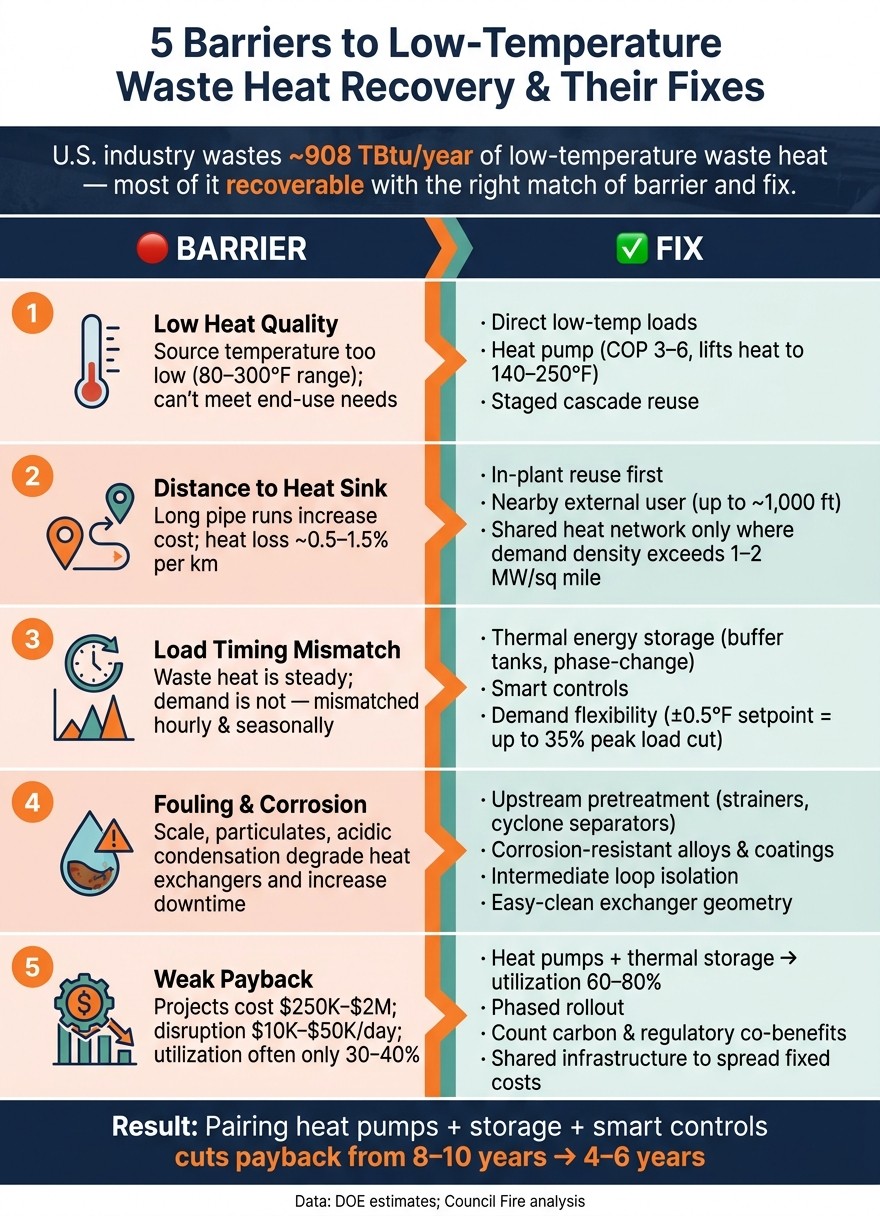
5 Barriers to Low-Temperature Waste Heat Recovery & Their Fixes
From Waste to Worth: Innovative Waste Heat Recovery Solution in DHC
Barrier 1: Low heat quality and Barrier 2: Distance to a usable heat sink
Two problems tend to show up first: the heat is too cool to use as-is, or it’s too far from a place that can use it.
When the waste heat is too cool for the end use
The first job is to match the source temperature with a sink that can take it. A stream at 110°F (43°C) can’t run a pasteurizer that needs 180°F (82°C), and it won’t feed a boiler that needs steam far above 250°F (121°C). In plain terms, the stream sits too close to ambient conditions to deliver much useful heat.[2][5][7]
The most common fix is a heat pump. It uses a vapor compression cycle to lift waste heat from 80–110°F (27–43°C) up to 140–200°F (60–93°C), and some advanced units can reach 212–250°F (100–121°C). Performance is tracked with Coefficient of Performance (COP), which compares heat delivered with electricity used. Industrial heat pumps often fall in the 3 to 6 range, so one unit of electricity can produce three to six units of useful heat output.[4]
If one temperature lift still doesn’t do the job, staged reuse often makes more sense. The idea is simple: use the hottest part first, then cascade the rest into cooler loads. A food plant with a 190°F (88°C) effluent stream might send the hottest share to boiler feedwater preheat, the middle range to cleaning and domestic hot water, and the coolest share through a heat pump for space heating. That kind of cascade can drive better site-wide efficiency than a one-and-done setup.[5][6]
Strategy | Temperature Fit | Efficiency Impact | Typical U.S. Application |
|---|---|---|---|
Direct use | Source within ~10–20°F of demand | Highest - no conversion losses | Space heating, DHW preheat, low-temp process rinses |
Heat pump upgrade | Source 30–80°F or more below demand | High COP (3–6); replaces combustion heat | Industrial hot water, district energy from data centers |
Staged reuse | Multiple loads at different temperatures | Highest system-level efficiency | Food plants, pulp and paper mills, campus energy systems |
Once temperature is dealt with, the next issue is cost: can the heat be moved to the load without spending too much to get it there?
When the heat source and heat user are not in the same place
The best sink is usually the nearest one that can take the heat without major retrofit work. Long pipe runs aren’t cheap to install or insulate, and heat loss adds up along the route. Well-insulated hot-water lines at 158–176°F (70–80°C) can lose about 0.5% to 1.5% of heat per kilometer. Stretch that distance, and the lost heat starts to eat into project value fast.[9]
In most cases, the economics come down to three delivery models:
Delivery Mode | Distance Tolerance | Infrastructure Need | Likely Economics |
|---|---|---|---|
In-house reuse | Same site; ideally within tens of feet | Low - existing piping, simple heat exchangers | Best payback when an internal sink exists |
Nearby external user | Up to a few thousand feet | Moderate - insulated connection piping, metering, contracts | Works when a close neighbor offsets transport cost and signs a long-term agreement |
Shared heat network | Highest, but only in dense demand areas | High - buried piping, pumps, substations, controls | Strongest where heat demand density exceeds roughly 1–2 MW of thermal demand per square mile[3][8] |
In-plant reuse is almost always the first place to check. The logic is pretty straightforward: short pipe runs, simple tie-ins, and no outside party to negotiate with. That usually makes these projects the fastest to move.
If internal sinks are limited, a nearby outside user can change the picture. An office building next to a data center, for example, might use a 95–105°F (35–40°C) rejection loop as a heat source. That can turn stranded heat into revenue, but it also means contract work up front and firm reliability commitments on both sides.
Shared heat networks are a different animal. They can move heat farther, but only where demand is dense enough to support the cost of buried piping, pumps, substations, and controls.
Even if temperature and distance line up, timing and fouling can still derail the project.
Barrier 3: Load mismatch and Barrier 4: Fouling and maintenance burden
Once heat can be moved, two hard questions come next. Does it show up when the load needs it? And can the system stay clean enough to keep doing its job?
When heat supply and demand do not line up in time
Timing can sink a project even when temperature and distance make sense. Waste heat is often steady, but demand is not. A plant running 24/7 may send out more heat than the network can use at 2:00 a.m., then come up short during a cold Monday morning peak. Across the year, the pattern gets even tougher: surplus heat tends to peak in summer, while space-heating demand peaks in winter.[13][17]
Thermal energy storage (TES) helps bridge that gap. Short-duration storage, such as insulated hot-water buffer tanks or phase-change storage, can soak up extra heat and release it later when demand climbs.[14][15][16] In larger systems, seasonal TES can help shift heat from summer to winter, though it comes with a big infrastructure bill.
Controls make that storage far more useful. A good control system sends heat to the highest-value load first, charges storage when demand is low, and adjusts pumps and valves to keep use high. Research on district heating networks shows that letting indoor building temperatures move by only ±0.5°F around a setpoint can cut peak heating load by as much as 35%.[18] That may sound small, but it matters. Paired with building automation, this kind of demand-side flexibility can make an uneven waste heat stream behave much more like a dispatchable one.
When dirty or corrosive streams reduce system performance
Storage and controls help with timing, but they do not fix dirty streams.
Fouling, whether from scale, particulates, biofilm, or process residue, reduces heat transfer, increases pressure drop, and leads to more cleaning, more downtime, and more replacement work.[11][19][20][21]
Low-temperature recovery can make fouling and corrosion worse. As exhaust gases or process streams cool toward ambient conditions, water vapor can condense and carry acidic or corrosive compounds, such as sulfur compounds and chlorides, onto metal surfaces. That condensation-driven corrosion is a common failure mode in flue gas heat recovery. It also helps explain why projects that look good on paper can turn into maintenance problems within a few years.[1][10][12]
The answer starts in the design phase. Materials selection matters. Exchanger geometry matters. Upstream pretreatment matters too. Corrosion-resistant alloys, protective coatings, and designs that allow easy cleaning can cut downtime and lower lifecycle cost. If the stream carries heavy particulates, upstream strainers or cyclone separators can pull out contaminants before they hit the exchanger surface.
In harsh service, paying more up front for materials can save money later through longer equipment life and less maintenance. The right material choice depends on stream chemistry, the cost of downtime, and how much cleaning the system can tolerate. The cheapest exchanger on day one may end up costing more if it forces repeated shutdowns.
Barrier 5: Weak payback and the fixes that improve project viability
Why energy savings alone often do not close the business case
Even when temperature, distance, load timing, and fouling are under control, the numbers can still sink the project. The problem is simple: low-temperature waste heat often replaces low-value uses like domestic hot water preheat and other low-grade process loads. That puts a ceiling on the dollar value of every unit of heat recovered. If natural gas prices are low, the avoided fuel savings drop even more, and payback becomes much harder to defend.[25][23]
Capital cost is the next hurdle. A typical U.S. low-temperature waste heat project can fall between $250,000 and $2,000,000, and the biggest line items are often not the heat recovery equipment itself, but piping, trenching, and building penetrations.[33][34] In retrofit projects, downtime can hit just as hard. Some U.S. plants put disruption costs at $10,000 to $50,000 per day, which can weigh heavily on the go-or-no-go decision.[31]
Then there’s operating risk. A project modeled around $250,000 in annual savings may end up delivering only $125,000 to $175,000 if the system runs at just 50% to 70% of expected capacity because waste heat is not there when demand peaks, or because the actual load comes in lower than planned.[31] That kind of shortfall can stretch a 6-year payback to more than 10 years. For many industrial firms, that misses the 3- to 5-year hurdle rate used for non-core capital by a mile.[33][31]
Ownership issues can make matters worse. If one party pays for the system while another party gets most of the savings - as happens in multi-tenant buildings or industrial parks - even a technically sound project can stall out.[22][24][30]
How to strengthen payback with better design and phased rollout
The surest way to improve the economics is to lift utilization. In plain terms, that means finding ways to capture and use more of the available heat for more hours each year. Heat pumps are the main tool here because they increase usable heat output and help the system run more often.[26][28] Add thermal storage, and the picture gets much better: utilization can rise from about 30%–40% to 60%–80%, which helps bring payback back into range.[26][27]
Some U.S. case studies show how much that matters. In food processing, data centers, and commercial campuses, pairing heat pumps with thermal storage and smart controls has cut payback from 8 to 10 years down to 4 to 6 years.[32][9]
Shared infrastructure can push the case further. When several buildings or processes connect to a common thermal loop, waste heat from one site can serve multiple heat users. That helps smooth demand swings and spreads fixed costs across more participants.[29][30] These bundled projects often beat single-measure efforts because they:
increase operating hours
lower unit costs through economies of scale
make shared-service models easier to justify
It also helps to look past fuel savings alone. Carbon cuts, lower exposure to natural gas price swings, and avoided future regulatory costs all matter, yet many internal models leave them out. A phased rollout can help here too - start with the loads that use the most heat most often, then add capacity once actual performance is proven. That kind of step-by-step plan gives decision-makers a firmer case for the next round of investment and sets up the implementation roadmap that follows.
Implementation roadmap and conclusion
A simple screening sequence for evaluating opportunities
Use the five barriers above as a go/no-go screen before you spend money on engineering. This turns the earlier barriers into a fast first-pass test. If a project fails even one gate, it usually makes more sense to redesign the idea before moving ahead.
Screening Step | Key Question | Go/No-Go Threshold |
|---|---|---|
Source temperature | Is the waste heat hot enough and available in sufficient volume, or will a heat pump be needed? | Below 140–160°F, plan on a heat pump or a low-temperature end use. |
Distance to heat demand | Is the main heat load within a few hundred feet, or does a shared network already exist? | Beyond 300–500 ft, piping often undermines the case. |
Load timing match | Do supply and demand line up hourly and seasonally? | Hourly or seasonal mismatch requires storage and controls. |
Fouling and contamination | Does the stream carry particulates, scale-forming minerals, corrosive compounds, or other contaminants? | High fouling risk calls for intermediate loops or robust materials. |
Basic economics | Does estimated simple payback fit the organization's hurdle? | Without emission cuts and other gains, deprioritize projects above 5–7 years' payback. |
Run the checks in order. A stream that fails the first gate rarely turns into a strong project later. On the other hand, a clean source that is nearby and lines up well with demand can move to pre-feasibility with far less friction.
Key takeaways for leaders planning decarbonization projects
Once a project clears the screen, the next step is to place it inside the broader decarbonization plan. Low-temperature waste heat only pays off when each barrier has a matching fix. Heat pumps close the temperature gap. Thermal storage and smart controls deal with timing mismatches. Shared heat networks handle distance. Strong equipment choices and intermediate loops help manage fouling. Stack several loads onto one recovered heat source, pair that with phased rollouts and non-energy co-benefits, and the business case gets much stronger. The best projects tend to solve several barriers at the same time.
U.S. manufacturing generates an estimated 1,182 trillion BTU of low-temperature waste heat each year, with feasible recovery equal to about 9% of total U.S. industrial energy use.[2][35] That is a major decarbonization lever sitting in plain sight.
The projects that get built usually have two things in common: disciplined screening up front and systems-level design after that. Teams that treat waste heat recovery as a stand-alone efficiency play often leave money and impact on the table. Teams that fold it into a broader decarbonization roadmap - alongside electrification, building retrofits, and renewable procurement - are better positioned to avoid stranded assets and build a set of projects that support one another.
For teams that need help turning screened opportunities into execution, Council Fire supports roadmap development.
FAQs
How do I know if my waste heat source is worth screening?
Start by mapping energy flows so you can see where heat is generated, where it goes, and where it slips through the cracks. Smart meters and sensors help turn that picture into live data, making it easier to spot waste as it happens instead of finding it months later in a utility bill.
From there, weigh the costs against the gains. That means looking at payback under different energy price scenarios, not just today’s rates. You’ll also want to test whether the heat’s quality, scale, and load profile match the recovery path you’re considering, such as heat pumps or shared heat networks.
When does a heat pump make financial sense?
A heat pump makes financial sense when its lifecycle cost - equipment, maintenance, and energy - comes in below the cost of fossil fuel options.
That math gets better when federal incentives cut the upfront price, recovered waste heat turns into revenue, and the project lines up with a normal equipment replacement cycle. There’s also a practical way to phase the shift: start with projects that deliver immediate operating savings. Those early savings can help pay for larger moves later.
What should I check first before investing in engineering?
Start with a rigorous baseline assessment of your current energy use and greenhouse gas emissions. Pull utility bills from the past 12–24 months, then complete a professional energy audit - ideally through your utility provider - to spot the measures with the best payback.
From there, assess technical, economic, regulatory, and social feasibility. Your financial model should cover capital costs, operating costs, and revenue opportunities.
Related Blog Posts
Latest Articles
©2025

Narrative Change and Power Building: The Missing Half of Advocacy
Narrative change is the process of disrupting dominant narratives that normalize inequity and advancing new narratives from historically marginalized communities.

Funding Resilience Without Federal Grants
BRIC is unreliable and FEMA is shrinking. Here's how cities fund climate resilience with dedicated revenue, blended finance, and a coordinating authority.

The ESG Blind Spot: How AI Is Finding Risks in Companies Nobody Else Is Watching
Norway's sovereign wealth fund uses AI to screen 7,200 portfolio companies for forced labor and corruption within 24 hours. The real story is the emerging-market coverage gap that traditional ESG data vendors miss — and what it means for any company with a global supply chain.
Narrative Change and Power Building: The Missing Half of Advocacy
Narrative change is the process of disrupting dominant narratives that normalize inequity and advancing new narratives from historically marginalized communities.
Funding Resilience Without Federal Grants
BRIC is unreliable and FEMA is shrinking. Here's how cities fund climate resilience with dedicated revenue, blended finance, and a coordinating authority.
The ESG Blind Spot: How AI Is Finding Risks in Companies Nobody Else Is Watching
Norway's sovereign wealth fund uses AI to screen 7,200 portfolio companies for forced labor and corruption within 24 hours. The real story is the emerging-market coverage gap that traditional ESG data vendors miss — and what it means for any company with a global supply chain.
FAQ
01
What does it really mean to “redefine profit”?
02
What makes Council Fire different?
03
Who does Council Fire work with?
04
What does working with Council Fire actually look like?
05
How does Council Fire help organizations turn big goals into action?
06
How does Council Fire define and measure success?
Aug 5, 2026
Low-Temperature Waste Heat: Key Barriers and Fixes
Sustainability Strategy
In This Article
Fixes for low-temperature industrial waste heat: match temperature, distance, timing, fouling, and finance with heat pumps and storage.
Low-Temperature Waste Heat: Key Barriers and Fixes
U.S. industry leaves a lot of low-temperature waste heat unused - about 908 TBtu per year by one DOE estimate - mostly because the heat is too cool, too far away, out of sync with demand, dirty, or hard to justify on payback. If I want a plain answer, it is this: most projects work only when I match each barrier with the right fix.
Here’s the short version:
If the heat is too cool, I use direct low-temp loads, a heat pump, or a cascade setup.
If the heat is too far from demand, I check in-plant reuse first, then a nearby user, then a shared loop only if demand is dense.
If supply and demand do not line up, I add thermal storage and controls.
If the stream is dirty or corrosive, I plan for pretreatment, better materials, and easier cleaning.
If payback is weak, I improve utilization, phase the rollout, and count more than fuel savings alone.
A few numbers frame the issue fast: low-temperature waste heat often sits in the 80–300°F range, industrial heat pumps often run at a COP of 3 to 6, and pairing heat pumps with storage can move utilization from roughly 30%–40% to 60%–80%. In many cases, that is the difference between a project that stalls and one that clears an internal hurdle.
Barrier | What usually goes wrong | Common fix |
|---|---|---|
Low heat quality | Source temperature is below what the end use needs | Direct use, heat pump, staged reuse |
Distance | Piping cost and heat loss hurt the case | Nearest sink first, short runs, shared loop only where it fits |
Load mismatch | Heat shows up at the wrong hour or season | Buffer tanks, TES, control logic |
Fouling | Scale, residue, or acidic condensation cut performance | Pretreatment, material choice, intermediate loop |
Weak payback | Savings are too low for the capital cost | Higher utilization, phased buildout, shared use |
The core point: low-temperature waste heat is not one problem. It is a matching problem across temperature, location, timing, stream quality, and project finance. When I screen those five items early, I get a much clearer read on what is worth taking to pre-feasibility.
5 Barriers to Low-Temperature Waste Heat Recovery & Their Fixes
From Waste to Worth: Innovative Waste Heat Recovery Solution in DHC
Barrier 1: Low heat quality and Barrier 2: Distance to a usable heat sink
Two problems tend to show up first: the heat is too cool to use as-is, or it’s too far from a place that can use it.
When the waste heat is too cool for the end use
The first job is to match the source temperature with a sink that can take it. A stream at 110°F (43°C) can’t run a pasteurizer that needs 180°F (82°C), and it won’t feed a boiler that needs steam far above 250°F (121°C). In plain terms, the stream sits too close to ambient conditions to deliver much useful heat.[2][5][7]
The most common fix is a heat pump. It uses a vapor compression cycle to lift waste heat from 80–110°F (27–43°C) up to 140–200°F (60–93°C), and some advanced units can reach 212–250°F (100–121°C). Performance is tracked with Coefficient of Performance (COP), which compares heat delivered with electricity used. Industrial heat pumps often fall in the 3 to 6 range, so one unit of electricity can produce three to six units of useful heat output.[4]
If one temperature lift still doesn’t do the job, staged reuse often makes more sense. The idea is simple: use the hottest part first, then cascade the rest into cooler loads. A food plant with a 190°F (88°C) effluent stream might send the hottest share to boiler feedwater preheat, the middle range to cleaning and domestic hot water, and the coolest share through a heat pump for space heating. That kind of cascade can drive better site-wide efficiency than a one-and-done setup.[5][6]
Strategy | Temperature Fit | Efficiency Impact | Typical U.S. Application |
|---|---|---|---|
Direct use | Source within ~10–20°F of demand | Highest - no conversion losses | Space heating, DHW preheat, low-temp process rinses |
Heat pump upgrade | Source 30–80°F or more below demand | High COP (3–6); replaces combustion heat | Industrial hot water, district energy from data centers |
Staged reuse | Multiple loads at different temperatures | Highest system-level efficiency | Food plants, pulp and paper mills, campus energy systems |
Once temperature is dealt with, the next issue is cost: can the heat be moved to the load without spending too much to get it there?
When the heat source and heat user are not in the same place
The best sink is usually the nearest one that can take the heat without major retrofit work. Long pipe runs aren’t cheap to install or insulate, and heat loss adds up along the route. Well-insulated hot-water lines at 158–176°F (70–80°C) can lose about 0.5% to 1.5% of heat per kilometer. Stretch that distance, and the lost heat starts to eat into project value fast.[9]
In most cases, the economics come down to three delivery models:
Delivery Mode | Distance Tolerance | Infrastructure Need | Likely Economics |
|---|---|---|---|
In-house reuse | Same site; ideally within tens of feet | Low - existing piping, simple heat exchangers | Best payback when an internal sink exists |
Nearby external user | Up to a few thousand feet | Moderate - insulated connection piping, metering, contracts | Works when a close neighbor offsets transport cost and signs a long-term agreement |
Shared heat network | Highest, but only in dense demand areas | High - buried piping, pumps, substations, controls | Strongest where heat demand density exceeds roughly 1–2 MW of thermal demand per square mile[3][8] |
In-plant reuse is almost always the first place to check. The logic is pretty straightforward: short pipe runs, simple tie-ins, and no outside party to negotiate with. That usually makes these projects the fastest to move.
If internal sinks are limited, a nearby outside user can change the picture. An office building next to a data center, for example, might use a 95–105°F (35–40°C) rejection loop as a heat source. That can turn stranded heat into revenue, but it also means contract work up front and firm reliability commitments on both sides.
Shared heat networks are a different animal. They can move heat farther, but only where demand is dense enough to support the cost of buried piping, pumps, substations, and controls.
Even if temperature and distance line up, timing and fouling can still derail the project.
Barrier 3: Load mismatch and Barrier 4: Fouling and maintenance burden
Once heat can be moved, two hard questions come next. Does it show up when the load needs it? And can the system stay clean enough to keep doing its job?
When heat supply and demand do not line up in time
Timing can sink a project even when temperature and distance make sense. Waste heat is often steady, but demand is not. A plant running 24/7 may send out more heat than the network can use at 2:00 a.m., then come up short during a cold Monday morning peak. Across the year, the pattern gets even tougher: surplus heat tends to peak in summer, while space-heating demand peaks in winter.[13][17]
Thermal energy storage (TES) helps bridge that gap. Short-duration storage, such as insulated hot-water buffer tanks or phase-change storage, can soak up extra heat and release it later when demand climbs.[14][15][16] In larger systems, seasonal TES can help shift heat from summer to winter, though it comes with a big infrastructure bill.
Controls make that storage far more useful. A good control system sends heat to the highest-value load first, charges storage when demand is low, and adjusts pumps and valves to keep use high. Research on district heating networks shows that letting indoor building temperatures move by only ±0.5°F around a setpoint can cut peak heating load by as much as 35%.[18] That may sound small, but it matters. Paired with building automation, this kind of demand-side flexibility can make an uneven waste heat stream behave much more like a dispatchable one.
When dirty or corrosive streams reduce system performance
Storage and controls help with timing, but they do not fix dirty streams.
Fouling, whether from scale, particulates, biofilm, or process residue, reduces heat transfer, increases pressure drop, and leads to more cleaning, more downtime, and more replacement work.[11][19][20][21]
Low-temperature recovery can make fouling and corrosion worse. As exhaust gases or process streams cool toward ambient conditions, water vapor can condense and carry acidic or corrosive compounds, such as sulfur compounds and chlorides, onto metal surfaces. That condensation-driven corrosion is a common failure mode in flue gas heat recovery. It also helps explain why projects that look good on paper can turn into maintenance problems within a few years.[1][10][12]
The answer starts in the design phase. Materials selection matters. Exchanger geometry matters. Upstream pretreatment matters too. Corrosion-resistant alloys, protective coatings, and designs that allow easy cleaning can cut downtime and lower lifecycle cost. If the stream carries heavy particulates, upstream strainers or cyclone separators can pull out contaminants before they hit the exchanger surface.
In harsh service, paying more up front for materials can save money later through longer equipment life and less maintenance. The right material choice depends on stream chemistry, the cost of downtime, and how much cleaning the system can tolerate. The cheapest exchanger on day one may end up costing more if it forces repeated shutdowns.
Barrier 5: Weak payback and the fixes that improve project viability
Why energy savings alone often do not close the business case
Even when temperature, distance, load timing, and fouling are under control, the numbers can still sink the project. The problem is simple: low-temperature waste heat often replaces low-value uses like domestic hot water preheat and other low-grade process loads. That puts a ceiling on the dollar value of every unit of heat recovered. If natural gas prices are low, the avoided fuel savings drop even more, and payback becomes much harder to defend.[25][23]
Capital cost is the next hurdle. A typical U.S. low-temperature waste heat project can fall between $250,000 and $2,000,000, and the biggest line items are often not the heat recovery equipment itself, but piping, trenching, and building penetrations.[33][34] In retrofit projects, downtime can hit just as hard. Some U.S. plants put disruption costs at $10,000 to $50,000 per day, which can weigh heavily on the go-or-no-go decision.[31]
Then there’s operating risk. A project modeled around $250,000 in annual savings may end up delivering only $125,000 to $175,000 if the system runs at just 50% to 70% of expected capacity because waste heat is not there when demand peaks, or because the actual load comes in lower than planned.[31] That kind of shortfall can stretch a 6-year payback to more than 10 years. For many industrial firms, that misses the 3- to 5-year hurdle rate used for non-core capital by a mile.[33][31]
Ownership issues can make matters worse. If one party pays for the system while another party gets most of the savings - as happens in multi-tenant buildings or industrial parks - even a technically sound project can stall out.[22][24][30]
How to strengthen payback with better design and phased rollout
The surest way to improve the economics is to lift utilization. In plain terms, that means finding ways to capture and use more of the available heat for more hours each year. Heat pumps are the main tool here because they increase usable heat output and help the system run more often.[26][28] Add thermal storage, and the picture gets much better: utilization can rise from about 30%–40% to 60%–80%, which helps bring payback back into range.[26][27]
Some U.S. case studies show how much that matters. In food processing, data centers, and commercial campuses, pairing heat pumps with thermal storage and smart controls has cut payback from 8 to 10 years down to 4 to 6 years.[32][9]
Shared infrastructure can push the case further. When several buildings or processes connect to a common thermal loop, waste heat from one site can serve multiple heat users. That helps smooth demand swings and spreads fixed costs across more participants.[29][30] These bundled projects often beat single-measure efforts because they:
increase operating hours
lower unit costs through economies of scale
make shared-service models easier to justify
It also helps to look past fuel savings alone. Carbon cuts, lower exposure to natural gas price swings, and avoided future regulatory costs all matter, yet many internal models leave them out. A phased rollout can help here too - start with the loads that use the most heat most often, then add capacity once actual performance is proven. That kind of step-by-step plan gives decision-makers a firmer case for the next round of investment and sets up the implementation roadmap that follows.
Implementation roadmap and conclusion
A simple screening sequence for evaluating opportunities
Use the five barriers above as a go/no-go screen before you spend money on engineering. This turns the earlier barriers into a fast first-pass test. If a project fails even one gate, it usually makes more sense to redesign the idea before moving ahead.
Screening Step | Key Question | Go/No-Go Threshold |
|---|---|---|
Source temperature | Is the waste heat hot enough and available in sufficient volume, or will a heat pump be needed? | Below 140–160°F, plan on a heat pump or a low-temperature end use. |
Distance to heat demand | Is the main heat load within a few hundred feet, or does a shared network already exist? | Beyond 300–500 ft, piping often undermines the case. |
Load timing match | Do supply and demand line up hourly and seasonally? | Hourly or seasonal mismatch requires storage and controls. |
Fouling and contamination | Does the stream carry particulates, scale-forming minerals, corrosive compounds, or other contaminants? | High fouling risk calls for intermediate loops or robust materials. |
Basic economics | Does estimated simple payback fit the organization's hurdle? | Without emission cuts and other gains, deprioritize projects above 5–7 years' payback. |
Run the checks in order. A stream that fails the first gate rarely turns into a strong project later. On the other hand, a clean source that is nearby and lines up well with demand can move to pre-feasibility with far less friction.
Key takeaways for leaders planning decarbonization projects
Once a project clears the screen, the next step is to place it inside the broader decarbonization plan. Low-temperature waste heat only pays off when each barrier has a matching fix. Heat pumps close the temperature gap. Thermal storage and smart controls deal with timing mismatches. Shared heat networks handle distance. Strong equipment choices and intermediate loops help manage fouling. Stack several loads onto one recovered heat source, pair that with phased rollouts and non-energy co-benefits, and the business case gets much stronger. The best projects tend to solve several barriers at the same time.
U.S. manufacturing generates an estimated 1,182 trillion BTU of low-temperature waste heat each year, with feasible recovery equal to about 9% of total U.S. industrial energy use.[2][35] That is a major decarbonization lever sitting in plain sight.
The projects that get built usually have two things in common: disciplined screening up front and systems-level design after that. Teams that treat waste heat recovery as a stand-alone efficiency play often leave money and impact on the table. Teams that fold it into a broader decarbonization roadmap - alongside electrification, building retrofits, and renewable procurement - are better positioned to avoid stranded assets and build a set of projects that support one another.
For teams that need help turning screened opportunities into execution, Council Fire supports roadmap development.
FAQs
How do I know if my waste heat source is worth screening?
Start by mapping energy flows so you can see where heat is generated, where it goes, and where it slips through the cracks. Smart meters and sensors help turn that picture into live data, making it easier to spot waste as it happens instead of finding it months later in a utility bill.
From there, weigh the costs against the gains. That means looking at payback under different energy price scenarios, not just today’s rates. You’ll also want to test whether the heat’s quality, scale, and load profile match the recovery path you’re considering, such as heat pumps or shared heat networks.
When does a heat pump make financial sense?
A heat pump makes financial sense when its lifecycle cost - equipment, maintenance, and energy - comes in below the cost of fossil fuel options.
That math gets better when federal incentives cut the upfront price, recovered waste heat turns into revenue, and the project lines up with a normal equipment replacement cycle. There’s also a practical way to phase the shift: start with projects that deliver immediate operating savings. Those early savings can help pay for larger moves later.
What should I check first before investing in engineering?
Start with a rigorous baseline assessment of your current energy use and greenhouse gas emissions. Pull utility bills from the past 12–24 months, then complete a professional energy audit - ideally through your utility provider - to spot the measures with the best payback.
From there, assess technical, economic, regulatory, and social feasibility. Your financial model should cover capital costs, operating costs, and revenue opportunities.
Related Blog Posts
Latest Articles
©2025
Narrative Change and Power Building: The Missing Half of Advocacy
Narrative change is the process of disrupting dominant narratives that normalize inequity and advancing new narratives from historically marginalized communities.
Funding Resilience Without Federal Grants
BRIC is unreliable and FEMA is shrinking. Here's how cities fund climate resilience with dedicated revenue, blended finance, and a coordinating authority.
The ESG Blind Spot: How AI Is Finding Risks in Companies Nobody Else Is Watching
Norway's sovereign wealth fund uses AI to screen 7,200 portfolio companies for forced labor and corruption within 24 hours. The real story is the emerging-market coverage gap that traditional ESG data vendors miss — and what it means for any company with a global supply chain.
FAQ
01
What does it really mean to “redefine profit”?
02
What makes Council Fire different?
03
Who does Council Fire work with?
04
What does working with Council Fire actually look like?
05
How does Council Fire help organizations turn big goals into action?
06
How does Council Fire define and measure success?
Aug 5, 2026
Low-Temperature Waste Heat: Key Barriers and Fixes
Sustainability Strategy
In This Article
Fixes for low-temperature industrial waste heat: match temperature, distance, timing, fouling, and finance with heat pumps and storage.
Low-Temperature Waste Heat: Key Barriers and Fixes
U.S. industry leaves a lot of low-temperature waste heat unused - about 908 TBtu per year by one DOE estimate - mostly because the heat is too cool, too far away, out of sync with demand, dirty, or hard to justify on payback. If I want a plain answer, it is this: most projects work only when I match each barrier with the right fix.
Here’s the short version:
If the heat is too cool, I use direct low-temp loads, a heat pump, or a cascade setup.
If the heat is too far from demand, I check in-plant reuse first, then a nearby user, then a shared loop only if demand is dense.
If supply and demand do not line up, I add thermal storage and controls.
If the stream is dirty or corrosive, I plan for pretreatment, better materials, and easier cleaning.
If payback is weak, I improve utilization, phase the rollout, and count more than fuel savings alone.
A few numbers frame the issue fast: low-temperature waste heat often sits in the 80–300°F range, industrial heat pumps often run at a COP of 3 to 6, and pairing heat pumps with storage can move utilization from roughly 30%–40% to 60%–80%. In many cases, that is the difference between a project that stalls and one that clears an internal hurdle.
Barrier | What usually goes wrong | Common fix |
|---|---|---|
Low heat quality | Source temperature is below what the end use needs | Direct use, heat pump, staged reuse |
Distance | Piping cost and heat loss hurt the case | Nearest sink first, short runs, shared loop only where it fits |
Load mismatch | Heat shows up at the wrong hour or season | Buffer tanks, TES, control logic |
Fouling | Scale, residue, or acidic condensation cut performance | Pretreatment, material choice, intermediate loop |
Weak payback | Savings are too low for the capital cost | Higher utilization, phased buildout, shared use |
The core point: low-temperature waste heat is not one problem. It is a matching problem across temperature, location, timing, stream quality, and project finance. When I screen those five items early, I get a much clearer read on what is worth taking to pre-feasibility.
5 Barriers to Low-Temperature Waste Heat Recovery & Their Fixes
From Waste to Worth: Innovative Waste Heat Recovery Solution in DHC
Barrier 1: Low heat quality and Barrier 2: Distance to a usable heat sink
Two problems tend to show up first: the heat is too cool to use as-is, or it’s too far from a place that can use it.
When the waste heat is too cool for the end use
The first job is to match the source temperature with a sink that can take it. A stream at 110°F (43°C) can’t run a pasteurizer that needs 180°F (82°C), and it won’t feed a boiler that needs steam far above 250°F (121°C). In plain terms, the stream sits too close to ambient conditions to deliver much useful heat.[2][5][7]
The most common fix is a heat pump. It uses a vapor compression cycle to lift waste heat from 80–110°F (27–43°C) up to 140–200°F (60–93°C), and some advanced units can reach 212–250°F (100–121°C). Performance is tracked with Coefficient of Performance (COP), which compares heat delivered with electricity used. Industrial heat pumps often fall in the 3 to 6 range, so one unit of electricity can produce three to six units of useful heat output.[4]
If one temperature lift still doesn’t do the job, staged reuse often makes more sense. The idea is simple: use the hottest part first, then cascade the rest into cooler loads. A food plant with a 190°F (88°C) effluent stream might send the hottest share to boiler feedwater preheat, the middle range to cleaning and domestic hot water, and the coolest share through a heat pump for space heating. That kind of cascade can drive better site-wide efficiency than a one-and-done setup.[5][6]
Strategy | Temperature Fit | Efficiency Impact | Typical U.S. Application |
|---|---|---|---|
Direct use | Source within ~10–20°F of demand | Highest - no conversion losses | Space heating, DHW preheat, low-temp process rinses |
Heat pump upgrade | Source 30–80°F or more below demand | High COP (3–6); replaces combustion heat | Industrial hot water, district energy from data centers |
Staged reuse | Multiple loads at different temperatures | Highest system-level efficiency | Food plants, pulp and paper mills, campus energy systems |
Once temperature is dealt with, the next issue is cost: can the heat be moved to the load without spending too much to get it there?
When the heat source and heat user are not in the same place
The best sink is usually the nearest one that can take the heat without major retrofit work. Long pipe runs aren’t cheap to install or insulate, and heat loss adds up along the route. Well-insulated hot-water lines at 158–176°F (70–80°C) can lose about 0.5% to 1.5% of heat per kilometer. Stretch that distance, and the lost heat starts to eat into project value fast.[9]
In most cases, the economics come down to three delivery models:
Delivery Mode | Distance Tolerance | Infrastructure Need | Likely Economics |
|---|---|---|---|
In-house reuse | Same site; ideally within tens of feet | Low - existing piping, simple heat exchangers | Best payback when an internal sink exists |
Nearby external user | Up to a few thousand feet | Moderate - insulated connection piping, metering, contracts | Works when a close neighbor offsets transport cost and signs a long-term agreement |
Shared heat network | Highest, but only in dense demand areas | High - buried piping, pumps, substations, controls | Strongest where heat demand density exceeds roughly 1–2 MW of thermal demand per square mile[3][8] |
In-plant reuse is almost always the first place to check. The logic is pretty straightforward: short pipe runs, simple tie-ins, and no outside party to negotiate with. That usually makes these projects the fastest to move.
If internal sinks are limited, a nearby outside user can change the picture. An office building next to a data center, for example, might use a 95–105°F (35–40°C) rejection loop as a heat source. That can turn stranded heat into revenue, but it also means contract work up front and firm reliability commitments on both sides.
Shared heat networks are a different animal. They can move heat farther, but only where demand is dense enough to support the cost of buried piping, pumps, substations, and controls.
Even if temperature and distance line up, timing and fouling can still derail the project.
Barrier 3: Load mismatch and Barrier 4: Fouling and maintenance burden
Once heat can be moved, two hard questions come next. Does it show up when the load needs it? And can the system stay clean enough to keep doing its job?
When heat supply and demand do not line up in time
Timing can sink a project even when temperature and distance make sense. Waste heat is often steady, but demand is not. A plant running 24/7 may send out more heat than the network can use at 2:00 a.m., then come up short during a cold Monday morning peak. Across the year, the pattern gets even tougher: surplus heat tends to peak in summer, while space-heating demand peaks in winter.[13][17]
Thermal energy storage (TES) helps bridge that gap. Short-duration storage, such as insulated hot-water buffer tanks or phase-change storage, can soak up extra heat and release it later when demand climbs.[14][15][16] In larger systems, seasonal TES can help shift heat from summer to winter, though it comes with a big infrastructure bill.
Controls make that storage far more useful. A good control system sends heat to the highest-value load first, charges storage when demand is low, and adjusts pumps and valves to keep use high. Research on district heating networks shows that letting indoor building temperatures move by only ±0.5°F around a setpoint can cut peak heating load by as much as 35%.[18] That may sound small, but it matters. Paired with building automation, this kind of demand-side flexibility can make an uneven waste heat stream behave much more like a dispatchable one.
When dirty or corrosive streams reduce system performance
Storage and controls help with timing, but they do not fix dirty streams.
Fouling, whether from scale, particulates, biofilm, or process residue, reduces heat transfer, increases pressure drop, and leads to more cleaning, more downtime, and more replacement work.[11][19][20][21]
Low-temperature recovery can make fouling and corrosion worse. As exhaust gases or process streams cool toward ambient conditions, water vapor can condense and carry acidic or corrosive compounds, such as sulfur compounds and chlorides, onto metal surfaces. That condensation-driven corrosion is a common failure mode in flue gas heat recovery. It also helps explain why projects that look good on paper can turn into maintenance problems within a few years.[1][10][12]
The answer starts in the design phase. Materials selection matters. Exchanger geometry matters. Upstream pretreatment matters too. Corrosion-resistant alloys, protective coatings, and designs that allow easy cleaning can cut downtime and lower lifecycle cost. If the stream carries heavy particulates, upstream strainers or cyclone separators can pull out contaminants before they hit the exchanger surface.
In harsh service, paying more up front for materials can save money later through longer equipment life and less maintenance. The right material choice depends on stream chemistry, the cost of downtime, and how much cleaning the system can tolerate. The cheapest exchanger on day one may end up costing more if it forces repeated shutdowns.
Barrier 5: Weak payback and the fixes that improve project viability
Why energy savings alone often do not close the business case
Even when temperature, distance, load timing, and fouling are under control, the numbers can still sink the project. The problem is simple: low-temperature waste heat often replaces low-value uses like domestic hot water preheat and other low-grade process loads. That puts a ceiling on the dollar value of every unit of heat recovered. If natural gas prices are low, the avoided fuel savings drop even more, and payback becomes much harder to defend.[25][23]
Capital cost is the next hurdle. A typical U.S. low-temperature waste heat project can fall between $250,000 and $2,000,000, and the biggest line items are often not the heat recovery equipment itself, but piping, trenching, and building penetrations.[33][34] In retrofit projects, downtime can hit just as hard. Some U.S. plants put disruption costs at $10,000 to $50,000 per day, which can weigh heavily on the go-or-no-go decision.[31]
Then there’s operating risk. A project modeled around $250,000 in annual savings may end up delivering only $125,000 to $175,000 if the system runs at just 50% to 70% of expected capacity because waste heat is not there when demand peaks, or because the actual load comes in lower than planned.[31] That kind of shortfall can stretch a 6-year payback to more than 10 years. For many industrial firms, that misses the 3- to 5-year hurdle rate used for non-core capital by a mile.[33][31]
Ownership issues can make matters worse. If one party pays for the system while another party gets most of the savings - as happens in multi-tenant buildings or industrial parks - even a technically sound project can stall out.[22][24][30]
How to strengthen payback with better design and phased rollout
The surest way to improve the economics is to lift utilization. In plain terms, that means finding ways to capture and use more of the available heat for more hours each year. Heat pumps are the main tool here because they increase usable heat output and help the system run more often.[26][28] Add thermal storage, and the picture gets much better: utilization can rise from about 30%–40% to 60%–80%, which helps bring payback back into range.[26][27]
Some U.S. case studies show how much that matters. In food processing, data centers, and commercial campuses, pairing heat pumps with thermal storage and smart controls has cut payback from 8 to 10 years down to 4 to 6 years.[32][9]
Shared infrastructure can push the case further. When several buildings or processes connect to a common thermal loop, waste heat from one site can serve multiple heat users. That helps smooth demand swings and spreads fixed costs across more participants.[29][30] These bundled projects often beat single-measure efforts because they:
increase operating hours
lower unit costs through economies of scale
make shared-service models easier to justify
It also helps to look past fuel savings alone. Carbon cuts, lower exposure to natural gas price swings, and avoided future regulatory costs all matter, yet many internal models leave them out. A phased rollout can help here too - start with the loads that use the most heat most often, then add capacity once actual performance is proven. That kind of step-by-step plan gives decision-makers a firmer case for the next round of investment and sets up the implementation roadmap that follows.
Implementation roadmap and conclusion
A simple screening sequence for evaluating opportunities
Use the five barriers above as a go/no-go screen before you spend money on engineering. This turns the earlier barriers into a fast first-pass test. If a project fails even one gate, it usually makes more sense to redesign the idea before moving ahead.
Screening Step | Key Question | Go/No-Go Threshold |
|---|---|---|
Source temperature | Is the waste heat hot enough and available in sufficient volume, or will a heat pump be needed? | Below 140–160°F, plan on a heat pump or a low-temperature end use. |
Distance to heat demand | Is the main heat load within a few hundred feet, or does a shared network already exist? | Beyond 300–500 ft, piping often undermines the case. |
Load timing match | Do supply and demand line up hourly and seasonally? | Hourly or seasonal mismatch requires storage and controls. |
Fouling and contamination | Does the stream carry particulates, scale-forming minerals, corrosive compounds, or other contaminants? | High fouling risk calls for intermediate loops or robust materials. |
Basic economics | Does estimated simple payback fit the organization's hurdle? | Without emission cuts and other gains, deprioritize projects above 5–7 years' payback. |
Run the checks in order. A stream that fails the first gate rarely turns into a strong project later. On the other hand, a clean source that is nearby and lines up well with demand can move to pre-feasibility with far less friction.
Key takeaways for leaders planning decarbonization projects
Once a project clears the screen, the next step is to place it inside the broader decarbonization plan. Low-temperature waste heat only pays off when each barrier has a matching fix. Heat pumps close the temperature gap. Thermal storage and smart controls deal with timing mismatches. Shared heat networks handle distance. Strong equipment choices and intermediate loops help manage fouling. Stack several loads onto one recovered heat source, pair that with phased rollouts and non-energy co-benefits, and the business case gets much stronger. The best projects tend to solve several barriers at the same time.
U.S. manufacturing generates an estimated 1,182 trillion BTU of low-temperature waste heat each year, with feasible recovery equal to about 9% of total U.S. industrial energy use.[2][35] That is a major decarbonization lever sitting in plain sight.
The projects that get built usually have two things in common: disciplined screening up front and systems-level design after that. Teams that treat waste heat recovery as a stand-alone efficiency play often leave money and impact on the table. Teams that fold it into a broader decarbonization roadmap - alongside electrification, building retrofits, and renewable procurement - are better positioned to avoid stranded assets and build a set of projects that support one another.
For teams that need help turning screened opportunities into execution, Council Fire supports roadmap development.
FAQs
How do I know if my waste heat source is worth screening?
Start by mapping energy flows so you can see where heat is generated, where it goes, and where it slips through the cracks. Smart meters and sensors help turn that picture into live data, making it easier to spot waste as it happens instead of finding it months later in a utility bill.
From there, weigh the costs against the gains. That means looking at payback under different energy price scenarios, not just today’s rates. You’ll also want to test whether the heat’s quality, scale, and load profile match the recovery path you’re considering, such as heat pumps or shared heat networks.
When does a heat pump make financial sense?
A heat pump makes financial sense when its lifecycle cost - equipment, maintenance, and energy - comes in below the cost of fossil fuel options.
That math gets better when federal incentives cut the upfront price, recovered waste heat turns into revenue, and the project lines up with a normal equipment replacement cycle. There’s also a practical way to phase the shift: start with projects that deliver immediate operating savings. Those early savings can help pay for larger moves later.
What should I check first before investing in engineering?
Start with a rigorous baseline assessment of your current energy use and greenhouse gas emissions. Pull utility bills from the past 12–24 months, then complete a professional energy audit - ideally through your utility provider - to spot the measures with the best payback.
From there, assess technical, economic, regulatory, and social feasibility. Your financial model should cover capital costs, operating costs, and revenue opportunities.
Related Blog Posts
Latest Articles
©2025
Narrative Change and Power Building: The Missing Half of Advocacy
Narrative change is the process of disrupting dominant narratives that normalize inequity and advancing new narratives from historically marginalized communities.
Funding Resilience Without Federal Grants
BRIC is unreliable and FEMA is shrinking. Here's how cities fund climate resilience with dedicated revenue, blended finance, and a coordinating authority.
The ESG Blind Spot: How AI Is Finding Risks in Companies Nobody Else Is Watching
Norway's sovereign wealth fund uses AI to screen 7,200 portfolio companies for forced labor and corruption within 24 hours. The real story is the emerging-market coverage gap that traditional ESG data vendors miss — and what it means for any company with a global supply chain.
FAQ
What does it really mean to “redefine profit”?
What makes Council Fire different?
Who does Council Fire work with?
What does working with Council Fire actually look like?
How does Council Fire help organizations turn big goals into action?
How does Council Fire define and measure success?