Jul 21, 2026
Justice in Sustainability: Lessons from Stakeholders
Sustainability Strategy
In This Article
How distributional, procedural, and recognitional justice—early engagement, data, and enforceable reviews—make sustainability fair.
Justice in Sustainability: Lessons from Stakeholders
Most people don’t judge climate or community projects by targets alone - they judge them by who gets helped, who gets hurt, and who gets a real say.
I see one clear lesson in this piece: if you want support for a project, you have to deal with results, process, and respect at the same time. The article points to three core tests people use:
Distribution:Who gains, who pays, and who is protected?
Process:Were people brought in early enough to shape the choice?
Recognition:Were local histories, identities, and lived experience taken seriously?
A few facts stand out. 81% of U.S. registered voters support parks and green space in low-income communities and communities of color, and 77% support tougher pollution enforcement in places hit hardest. At the same time, many plans still fall short because input comes too late, local knowledge gets sidelined, and public promises are not checked during rollout.
If I boil the article down to action, it says this: define justice clearly, map affected groups early, give people real influence, track who gets costs and gains with disaggregated data, and build review systems that can fix harm. That is what turns a plan from paper into something people will accept.
The bottom line: lower emissions or cleaner infrastructure alone will not carry a project; people want proof that power, costs, and voice are shared in a just way.
Climate Justice: Working Together for An Equitable Future
What stakeholders consistently say about fair sustainability practice
Research on environmental justice, climate resilience, and urban sustainability transitions points to a plain truth: people judge sustainability work by what it delivers and how it gets done. Those judgments line up with distributional, procedural, and recognitional justice. A plan can be technically sound on paper, but if it shuts out the people most affected, many will still see it as unjust. On the other hand, a process can look orderly and well managed, yet if the results fall unevenly, it will still be tough to defend as fair. Stakeholder research shows how these ideas show up in day-to-day expectations.
Shared priorities across communities, institutions, and organizations
Across frontline communities, public agencies, nonprofits, and companies, the same concerns keep surfacing. People want clear answers to basic questions: Who benefits? Who pays? Why this choice and not another? They want a seat at the table before decisions are set, not a comment form after the plan is finished. They also want lived experience and local knowledge treated as valid input, not brushed aside as secondary.
Transparency comes up again and again. Stakeholders want clear rules for how benefits and burdens are assigned, plain-language explanations of trade-offs, and visible reasoning behind decisions. Just as important is the follow-through. Communities want to see how their input shaped the outcome - or, if it did not, why not. Without that feedback loop, participation can start to feel performative. Research on U.S. flood protection and Justice40 implementation shows that late-stage consultation is widely seen as unfair and disempowering.[3][4]
This support is broad. It is not sitting at the margins. A 2023 survey of U.S. registered voters found that 81% support creating parks and green spaces in low-income communities and communities of color, and 77% support stronger enforcement of industrial pollution limits in disproportionately impacted low-income communities and communities of color.[6] That level of agreement suggests that protecting vulnerable communities is not a niche issue; it is a mainstream expectation.
Where stakeholder priorities differ
That shared frame does not mean every group weighs each justice dimension the same way. Environmental justice groups and frontline communities often see procedural safeguards as the starting point. That makes sense. Many have lived through exclusion and harm before, so co-governance and shared leadership are not nice extras; they are the baseline for trust.
Some institutional stakeholders see it differently. They may accept a flawed process if they believe the outcome is technically sound or efficient. That can create real friction, especially when communities read that trade-off as one more version of an old story.
Historically excluded groups, including Indigenous peoples, often place recognitional justice near the center. They push for cultural rights, historic harms, and local knowledge to be built into project design from the start, not dropped into a footnote at the end. That difference matters. It shows that justice cannot be copied from one place and pasted into another. Decision-makers have to read local history, power, and priorities closely, then shape the process around how stakeholders define fairness.
How to design decision-making that stakeholders view as just
Those priorities matter only if the decision process turns them into real influence. People tend to see sustainability decisions as fair when they are brought in early, can shape the outcome, and can trace how their input changed the final call. In practice, decisions feel more just when stakeholders help frame the problem, weigh trade-offs, shape options, and review what happened after the choice is made.
Stakeholder trust grows as engagement shifts from simple information-sharing to shared decision-making.
Engagement Level | Goal | Promise to Stakeholders |
|---|---|---|
Inform | Share information | We will share information. |
Consult | Collect feedback | We will gather and respond to feedback. |
Involve | Work directly through the process | We will reflect concerns throughout the process. |
Collaborate | Co-decide | We will incorporate your advice and innovation. |
Empower | Give them final decision power | We will implement what you decide. |
A one-time consultation can satisfy a formal requirement without giving people much say. The shift toward involve and collaborate is where procedural and recognitional justice start to take shape.
Procedural justice: participation with real influence
A common mistake is waiting too long to start engagement, after a preferred option is already in play. At that point, communities are reacting to a decision rather than helping shape it. People are more likely to view a process as fair when they help define the problem and the trade-offs, not just comment on the final plan.[8][11][12]
Four parts of the process make the biggest difference.
Engage early. Bring people in before the list of options gets narrowed.
Make participation accessible. Schedule meetings at times that work for working families, offer virtual options, use plain language, and translate materials when needed. Barriers to participation often shut out the people most affected.[8][14]
Publish a response summary. Show what was heard, what changed, and why. The OECD defines consultation as a two-way relationship in which governments respond to input with clear information on outcomes.[9][13] Only about one-third of OECD countries currently require policymakers to publish a formal response to consultation comments.[11] That gap weakens accountability.
Explain your reasoning. If a community suggestion was not adopted, say why. Without that step, even a long engagement process can feel performative.
Still, access on its own does not produce fairness. The process also has to reflect who people are and what they have lived through.
Recognitional justice: representation beyond token inclusion
Attendance by itself is not recognitional justice. The deeper issue is whose knowledge shapes the agenda, whose history informs the trade-offs, and whose definition of harm is taken seriously. A study of urban greening in Amsterdam found that more participation did not fix procedural barriers or lack of recognition.[10]
Recognitional justice asks decision-makers to understand community history, cultural priorities, Indigenous knowledge, and past harms before they design the engagement process. UNEP policy guidance specifically highlights the importance of engaging Indigenous Peoples as partners in environmental policy development and implementation - not as one-time consultees.[7] That distinction matters. It means moving beyond one-off advisory meetings and building lasting structures such as standing councils, paid roles, and recurring check-ins across planning, implementation, and evaluation.
Trust grows over time. Communities can hold organizations to their commitments only if they stay involved long enough to see whether those commitments are kept.
Even when participation is strong, fairness still has to hold once decisions move from process to outcomes. Process matters, but justice also depends on how benefits, burdens, and accountability are shared in implementation.
From commitments to implementation: distribution, power, and accountability
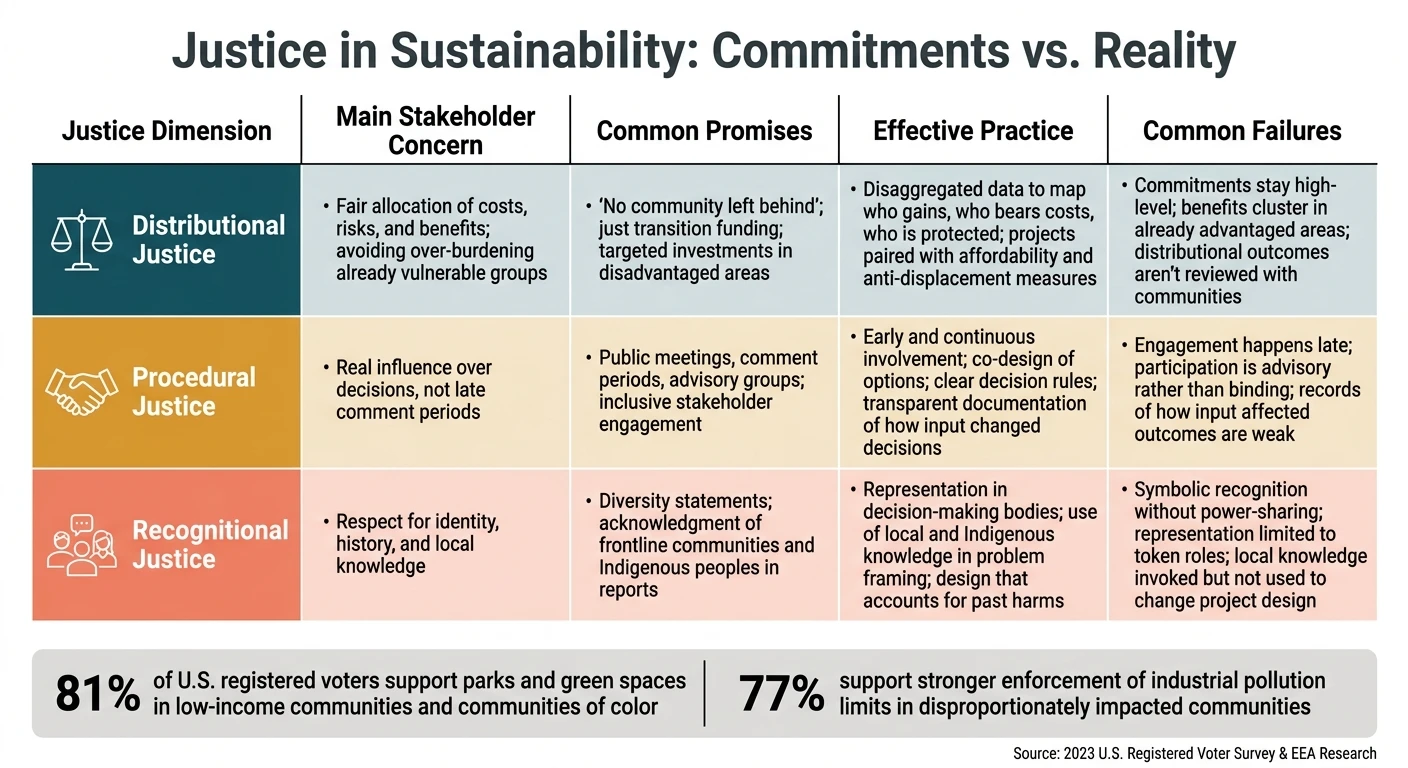
Justice in Sustainability: 3 Dimensions, Key Gaps & What Works
Strong participation doesn't mean much if the final rollout still leaves vulnerable communities worse off. Justice has to be checked where it counts: who gets the gains, who carries the costs, and who has a path to seek remedy.
Distributional justice: who gains, who pays, and who is protected
Stakeholders keep coming back to three plain questions: who gains, who pays, and who is protected. You can see those questions play out in monthly utility bills, rent hikes tied to green redevelopment, pollution concentrated near low-income neighborhoods, and whether resilience spending - flood defenses, wildfire buffers, stormwater upgrades - reaches areas that have been pushed aside for years.
Research on just transitions shows that low-income households and communities of color often carry an unfair share of the burden even when overall environmental results improve.[16][2] National averages can blur what is happening on the ground. Benefits may go to homeowners while renters face displacement. Infrastructure jobs may be announced with fanfare, yet the work ends up going to outside contractors instead of local workers. For many stakeholders, the test is simple: are the same communities still taking the same hits?
That is why implementation needs sharper questions before projects begin and while they are underway. Are rebates, tax credits, and grants set up so renters can use them, not just homeowners? Which neighborhoods are being asked to host new facilities, and are those places already overburdened? Are resilience projects tied to affordable housing protections so upgrades do not set off displacement? The U.S. Climate Vulnerability Index offers one useful tool here. It evaluates 73,057 census tracts using 184 indicators across seven categories, helping identify where high climate exposure overlaps with poverty and poor housing quality.[15]
The same standard applies after the meeting ends. Participation and respect have to survive implementation, not disappear once the decision is on paper.
Justice priorities and implementation gaps: a comparison
The table below compares what stakeholders worry about, what institutions often promise, what good implementation looks like, and where those promises break down.
Justice dimension | Main stakeholder concern | Common promises | Effective practice | Common failures |
|---|---|---|---|---|
Distributional | Fair allocation of costs, risks, and benefits; avoiding over-burdening already vulnerable groups | No community left behind; just transition funding; targeted investments in disadvantaged areas | Disaggregated data to map who gains, who bears costs, who is protected; projects paired with affordability and anti-displacement measures | Commitments stay high-level; compensation replaces prevention; benefits cluster in already advantaged areas; distributional outcomes aren't reviewed with communities |
Procedural | Real influence over decisions, not late comment periods | Public meetings, comment periods, advisory groups; inclusive stakeholder engagement | Early and continuous involvement; co-design of options; clear decision rules and veto points; funding for independent expertise; transparent documentation of how input changed decisions | Engagement happens late; participation is advisory rather than binding; technical complexity limits who can attend; records of how input affected outcomes are weak |
Recognitional | Respect for identity, history, and local knowledge | Diversity statements; acknowledgment of frontline communities and Indigenous peoples in reports | Representation in decision-making bodies; use of local and Indigenous knowledge in problem framing; design that accounts for past harms and structural inequities | Symbolic recognition without power-sharing; representation limited to token roles; local knowledge invoked but not used to change project design |
Without enforcement, commitments drift into symbolism. The European Environment Agency says delivering justice in sustainability transitions requires a continuous commitment and processes to assess progress so policymakers can detect injustices and adjust accordingly.[1]
Several governance checks can help close that gap:
Public dashboards that track distributional outcomes at the neighborhood level
Community benefit agreements with enforceable conditions
Mid-term reviews with the authority to trigger corrective action
Grievance pathways that let affected residents report harms and trigger corrective action[17][18]
A climate justice policy paper pushes this a step further. If annual or mid-term reviews find unresolved justice issues, funds should consider mitigation measures or suspended payments until the problems are addressed.[18] Public reporting, corrective action, and funding pauses give justice commitments teeth.
Conclusion: Lessons for leaders building justice into sustainability strategy
Justice in sustainability is not a box to tick once and move on. It asks leaders to work on three fronts at the same time: distributional, procedural, and recognitional justice. When one is missing, the whole effort starts to wobble. Research on 101 climate adaptation plans from 2010 to 2021 found that most plans put more weight on recognitional and distributional justice than on procedural justice, and many offered weak detail on how any of it would be carried out.[19][5] That shortfall is often where trust starts to crack. The hard test is simple: do leaders turn stated commitments into rules people can see, use, and challenge?
Meaningful engagement matters more than process on paper. Studies of wind and solar projects found that trust, perceived fairness, and meaningful engagement were strongly linked to public support, while awareness of formal Environmental Impact Assessment processes had no measurable effect.[20] That finding says a lot. People do not want to be invited into a room just to fill a seat. They want proof that their input shaped the result.
Accountability is what keeps justice from turning into a slogan. Without it, the language of justice can help win approval while the actual scorecard still favors speed and cost. Transparent reporting, independent evaluation, and enforceable agreements give those commitments weight over time.
Key takeaways for public, private, and nonprofit decision-makers
These lessons point to five actions leaders can use right away:
Define justice explicitly. Put context-specific definitions of distributional, procedural, and recognitional justice into mandates, ESG policies, and value frameworks.
Map stakeholders early and specifically. Name who is affected from the start, including renters, tribal governments, undocumented residents, youth, disabled people, and workers in high-risk sectors.
Design participation for influence. Bring communities in before major options are locked down. Share agenda-setting, spell out decision rules, and provide the support people need to take part, such as stipends, translation, and childcare. Then show how their input changed the outcome.
Use disaggregated data on race, income, and geography to track who gains, who pays, and who is protected - and to prevent displacement.
Build review mechanisms with real authority. Revisit strategy every two to three years. Set up grievance pathways, and use independent evaluation, public reporting, and adaptive management to correct course when equity outcomes fall short.
FAQs
What does justice in sustainability mean?
Justice in sustainability means looking past technical fixes or green targets and putting equity, human rights, and accountability at the center.
It has three parts:
Fair distribution of benefits and burdens, so some people don’t carry the costs while others get the gains
Meaningful community participation in decisions, especially for people most affected
Recognition of historical harms and diverse knowledge systems, including the ways different communities understand and live with the land, water, and economy
How can communities get real decision-making power?
Communities start to shape policy in a real way when they move past the usual public comment period and step into the role of formal co-creators.
In practice, that means giving residents seats on decision-making bodies, not just asking for input after key choices have already been made. It also means sharing power over project goals and data, paying people for their time and expertise, and building steady feedback into the process from day one.
How do leaders measure who benefits or is harmed?
Leaders track who gains and who bears the cost by pairing data-based screening with direct community input. They use tools like the EPA’s EJScreen and the Climate and Economic Justice Screening Tool to compare environmental indicators - such as air quality and distance from hazardous sites - with demographic data like income and health outcomes.
They also rely on disaggregated data and social vulnerability indices to follow outcomes for frontline communities. Through Council Fire, partners can turn those findings into measurable, community-centered action.
Related Blog Posts
Latest Articles
©2026

Narrative Change and Power Building: The Missing Half of Advocacy
Narrative change is the process of disrupting dominant narratives that normalize inequity and advancing new narratives from historically marginalized communities.

Funding Resilience Without Federal Grants
BRIC is unreliable and FEMA is shrinking. Here's how cities fund climate resilience with dedicated revenue, blended finance, and a coordinating authority.

The ESG Blind Spot: How AI Is Finding Risks in Companies Nobody Else Is Watching
Norway's sovereign wealth fund uses AI to screen 7,200 portfolio companies for forced labor and corruption within 24 hours. The real story is the emerging-market coverage gap that traditional ESG data vendors miss — and what it means for any company with a global supply chain.
Narrative Change and Power Building: The Missing Half of Advocacy
Narrative change is the process of disrupting dominant narratives that normalize inequity and advancing new narratives from historically marginalized communities.
Funding Resilience Without Federal Grants
BRIC is unreliable and FEMA is shrinking. Here's how cities fund climate resilience with dedicated revenue, blended finance, and a coordinating authority.
The ESG Blind Spot: How AI Is Finding Risks in Companies Nobody Else Is Watching
Norway's sovereign wealth fund uses AI to screen 7,200 portfolio companies for forced labor and corruption within 24 hours. The real story is the emerging-market coverage gap that traditional ESG data vendors miss — and what it means for any company with a global supply chain.
FAQ
01
What does it really mean to “redefine profit”?
02
What makes Council Fire different?
03
Who does Council Fire work with?
04
What does working with Council Fire actually look like?
05
How does Council Fire help organizations turn big goals into action?
06
How does Council Fire define and measure success?
07
How does technology fit into Council Fire’s work?
Jul 21, 2026
Justice in Sustainability: Lessons from Stakeholders
Sustainability Strategy
In This Article
How distributional, procedural, and recognitional justice—early engagement, data, and enforceable reviews—make sustainability fair.
Justice in Sustainability: Lessons from Stakeholders
Most people don’t judge climate or community projects by targets alone - they judge them by who gets helped, who gets hurt, and who gets a real say.
I see one clear lesson in this piece: if you want support for a project, you have to deal with results, process, and respect at the same time. The article points to three core tests people use:
Distribution:Who gains, who pays, and who is protected?
Process:Were people brought in early enough to shape the choice?
Recognition:Were local histories, identities, and lived experience taken seriously?
A few facts stand out. 81% of U.S. registered voters support parks and green space in low-income communities and communities of color, and 77% support tougher pollution enforcement in places hit hardest. At the same time, many plans still fall short because input comes too late, local knowledge gets sidelined, and public promises are not checked during rollout.
If I boil the article down to action, it says this: define justice clearly, map affected groups early, give people real influence, track who gets costs and gains with disaggregated data, and build review systems that can fix harm. That is what turns a plan from paper into something people will accept.
The bottom line: lower emissions or cleaner infrastructure alone will not carry a project; people want proof that power, costs, and voice are shared in a just way.
Climate Justice: Working Together for An Equitable Future
What stakeholders consistently say about fair sustainability practice
Research on environmental justice, climate resilience, and urban sustainability transitions points to a plain truth: people judge sustainability work by what it delivers and how it gets done. Those judgments line up with distributional, procedural, and recognitional justice. A plan can be technically sound on paper, but if it shuts out the people most affected, many will still see it as unjust. On the other hand, a process can look orderly and well managed, yet if the results fall unevenly, it will still be tough to defend as fair. Stakeholder research shows how these ideas show up in day-to-day expectations.
Shared priorities across communities, institutions, and organizations
Across frontline communities, public agencies, nonprofits, and companies, the same concerns keep surfacing. People want clear answers to basic questions: Who benefits? Who pays? Why this choice and not another? They want a seat at the table before decisions are set, not a comment form after the plan is finished. They also want lived experience and local knowledge treated as valid input, not brushed aside as secondary.
Transparency comes up again and again. Stakeholders want clear rules for how benefits and burdens are assigned, plain-language explanations of trade-offs, and visible reasoning behind decisions. Just as important is the follow-through. Communities want to see how their input shaped the outcome - or, if it did not, why not. Without that feedback loop, participation can start to feel performative. Research on U.S. flood protection and Justice40 implementation shows that late-stage consultation is widely seen as unfair and disempowering.[3][4]
This support is broad. It is not sitting at the margins. A 2023 survey of U.S. registered voters found that 81% support creating parks and green spaces in low-income communities and communities of color, and 77% support stronger enforcement of industrial pollution limits in disproportionately impacted low-income communities and communities of color.[6] That level of agreement suggests that protecting vulnerable communities is not a niche issue; it is a mainstream expectation.
Where stakeholder priorities differ
That shared frame does not mean every group weighs each justice dimension the same way. Environmental justice groups and frontline communities often see procedural safeguards as the starting point. That makes sense. Many have lived through exclusion and harm before, so co-governance and shared leadership are not nice extras; they are the baseline for trust.
Some institutional stakeholders see it differently. They may accept a flawed process if they believe the outcome is technically sound or efficient. That can create real friction, especially when communities read that trade-off as one more version of an old story.
Historically excluded groups, including Indigenous peoples, often place recognitional justice near the center. They push for cultural rights, historic harms, and local knowledge to be built into project design from the start, not dropped into a footnote at the end. That difference matters. It shows that justice cannot be copied from one place and pasted into another. Decision-makers have to read local history, power, and priorities closely, then shape the process around how stakeholders define fairness.
How to design decision-making that stakeholders view as just
Those priorities matter only if the decision process turns them into real influence. People tend to see sustainability decisions as fair when they are brought in early, can shape the outcome, and can trace how their input changed the final call. In practice, decisions feel more just when stakeholders help frame the problem, weigh trade-offs, shape options, and review what happened after the choice is made.
Stakeholder trust grows as engagement shifts from simple information-sharing to shared decision-making.
Engagement Level | Goal | Promise to Stakeholders |
|---|---|---|
Inform | Share information | We will share information. |
Consult | Collect feedback | We will gather and respond to feedback. |
Involve | Work directly through the process | We will reflect concerns throughout the process. |
Collaborate | Co-decide | We will incorporate your advice and innovation. |
Empower | Give them final decision power | We will implement what you decide. |
A one-time consultation can satisfy a formal requirement without giving people much say. The shift toward involve and collaborate is where procedural and recognitional justice start to take shape.
Procedural justice: participation with real influence
A common mistake is waiting too long to start engagement, after a preferred option is already in play. At that point, communities are reacting to a decision rather than helping shape it. People are more likely to view a process as fair when they help define the problem and the trade-offs, not just comment on the final plan.[8][11][12]
Four parts of the process make the biggest difference.
Engage early. Bring people in before the list of options gets narrowed.
Make participation accessible. Schedule meetings at times that work for working families, offer virtual options, use plain language, and translate materials when needed. Barriers to participation often shut out the people most affected.[8][14]
Publish a response summary. Show what was heard, what changed, and why. The OECD defines consultation as a two-way relationship in which governments respond to input with clear information on outcomes.[9][13] Only about one-third of OECD countries currently require policymakers to publish a formal response to consultation comments.[11] That gap weakens accountability.
Explain your reasoning. If a community suggestion was not adopted, say why. Without that step, even a long engagement process can feel performative.
Still, access on its own does not produce fairness. The process also has to reflect who people are and what they have lived through.
Recognitional justice: representation beyond token inclusion
Attendance by itself is not recognitional justice. The deeper issue is whose knowledge shapes the agenda, whose history informs the trade-offs, and whose definition of harm is taken seriously. A study of urban greening in Amsterdam found that more participation did not fix procedural barriers or lack of recognition.[10]
Recognitional justice asks decision-makers to understand community history, cultural priorities, Indigenous knowledge, and past harms before they design the engagement process. UNEP policy guidance specifically highlights the importance of engaging Indigenous Peoples as partners in environmental policy development and implementation - not as one-time consultees.[7] That distinction matters. It means moving beyond one-off advisory meetings and building lasting structures such as standing councils, paid roles, and recurring check-ins across planning, implementation, and evaluation.
Trust grows over time. Communities can hold organizations to their commitments only if they stay involved long enough to see whether those commitments are kept.
Even when participation is strong, fairness still has to hold once decisions move from process to outcomes. Process matters, but justice also depends on how benefits, burdens, and accountability are shared in implementation.
From commitments to implementation: distribution, power, and accountability
Justice in Sustainability: 3 Dimensions, Key Gaps & What Works
Strong participation doesn't mean much if the final rollout still leaves vulnerable communities worse off. Justice has to be checked where it counts: who gets the gains, who carries the costs, and who has a path to seek remedy.
Distributional justice: who gains, who pays, and who is protected
Stakeholders keep coming back to three plain questions: who gains, who pays, and who is protected. You can see those questions play out in monthly utility bills, rent hikes tied to green redevelopment, pollution concentrated near low-income neighborhoods, and whether resilience spending - flood defenses, wildfire buffers, stormwater upgrades - reaches areas that have been pushed aside for years.
Research on just transitions shows that low-income households and communities of color often carry an unfair share of the burden even when overall environmental results improve.[16][2] National averages can blur what is happening on the ground. Benefits may go to homeowners while renters face displacement. Infrastructure jobs may be announced with fanfare, yet the work ends up going to outside contractors instead of local workers. For many stakeholders, the test is simple: are the same communities still taking the same hits?
That is why implementation needs sharper questions before projects begin and while they are underway. Are rebates, tax credits, and grants set up so renters can use them, not just homeowners? Which neighborhoods are being asked to host new facilities, and are those places already overburdened? Are resilience projects tied to affordable housing protections so upgrades do not set off displacement? The U.S. Climate Vulnerability Index offers one useful tool here. It evaluates 73,057 census tracts using 184 indicators across seven categories, helping identify where high climate exposure overlaps with poverty and poor housing quality.[15]
The same standard applies after the meeting ends. Participation and respect have to survive implementation, not disappear once the decision is on paper.
Justice priorities and implementation gaps: a comparison
The table below compares what stakeholders worry about, what institutions often promise, what good implementation looks like, and where those promises break down.
Justice dimension | Main stakeholder concern | Common promises | Effective practice | Common failures |
|---|---|---|---|---|
Distributional | Fair allocation of costs, risks, and benefits; avoiding over-burdening already vulnerable groups | No community left behind; just transition funding; targeted investments in disadvantaged areas | Disaggregated data to map who gains, who bears costs, who is protected; projects paired with affordability and anti-displacement measures | Commitments stay high-level; compensation replaces prevention; benefits cluster in already advantaged areas; distributional outcomes aren't reviewed with communities |
Procedural | Real influence over decisions, not late comment periods | Public meetings, comment periods, advisory groups; inclusive stakeholder engagement | Early and continuous involvement; co-design of options; clear decision rules and veto points; funding for independent expertise; transparent documentation of how input changed decisions | Engagement happens late; participation is advisory rather than binding; technical complexity limits who can attend; records of how input affected outcomes are weak |
Recognitional | Respect for identity, history, and local knowledge | Diversity statements; acknowledgment of frontline communities and Indigenous peoples in reports | Representation in decision-making bodies; use of local and Indigenous knowledge in problem framing; design that accounts for past harms and structural inequities | Symbolic recognition without power-sharing; representation limited to token roles; local knowledge invoked but not used to change project design |
Without enforcement, commitments drift into symbolism. The European Environment Agency says delivering justice in sustainability transitions requires a continuous commitment and processes to assess progress so policymakers can detect injustices and adjust accordingly.[1]
Several governance checks can help close that gap:
Public dashboards that track distributional outcomes at the neighborhood level
Community benefit agreements with enforceable conditions
Mid-term reviews with the authority to trigger corrective action
Grievance pathways that let affected residents report harms and trigger corrective action[17][18]
A climate justice policy paper pushes this a step further. If annual or mid-term reviews find unresolved justice issues, funds should consider mitigation measures or suspended payments until the problems are addressed.[18] Public reporting, corrective action, and funding pauses give justice commitments teeth.
Conclusion: Lessons for leaders building justice into sustainability strategy
Justice in sustainability is not a box to tick once and move on. It asks leaders to work on three fronts at the same time: distributional, procedural, and recognitional justice. When one is missing, the whole effort starts to wobble. Research on 101 climate adaptation plans from 2010 to 2021 found that most plans put more weight on recognitional and distributional justice than on procedural justice, and many offered weak detail on how any of it would be carried out.[19][5] That shortfall is often where trust starts to crack. The hard test is simple: do leaders turn stated commitments into rules people can see, use, and challenge?
Meaningful engagement matters more than process on paper. Studies of wind and solar projects found that trust, perceived fairness, and meaningful engagement were strongly linked to public support, while awareness of formal Environmental Impact Assessment processes had no measurable effect.[20] That finding says a lot. People do not want to be invited into a room just to fill a seat. They want proof that their input shaped the result.
Accountability is what keeps justice from turning into a slogan. Without it, the language of justice can help win approval while the actual scorecard still favors speed and cost. Transparent reporting, independent evaluation, and enforceable agreements give those commitments weight over time.
Key takeaways for public, private, and nonprofit decision-makers
These lessons point to five actions leaders can use right away:
Define justice explicitly. Put context-specific definitions of distributional, procedural, and recognitional justice into mandates, ESG policies, and value frameworks.
Map stakeholders early and specifically. Name who is affected from the start, including renters, tribal governments, undocumented residents, youth, disabled people, and workers in high-risk sectors.
Design participation for influence. Bring communities in before major options are locked down. Share agenda-setting, spell out decision rules, and provide the support people need to take part, such as stipends, translation, and childcare. Then show how their input changed the outcome.
Use disaggregated data on race, income, and geography to track who gains, who pays, and who is protected - and to prevent displacement.
Build review mechanisms with real authority. Revisit strategy every two to three years. Set up grievance pathways, and use independent evaluation, public reporting, and adaptive management to correct course when equity outcomes fall short.
FAQs
What does justice in sustainability mean?
Justice in sustainability means looking past technical fixes or green targets and putting equity, human rights, and accountability at the center.
It has three parts:
Fair distribution of benefits and burdens, so some people don’t carry the costs while others get the gains
Meaningful community participation in decisions, especially for people most affected
Recognition of historical harms and diverse knowledge systems, including the ways different communities understand and live with the land, water, and economy
How can communities get real decision-making power?
Communities start to shape policy in a real way when they move past the usual public comment period and step into the role of formal co-creators.
In practice, that means giving residents seats on decision-making bodies, not just asking for input after key choices have already been made. It also means sharing power over project goals and data, paying people for their time and expertise, and building steady feedback into the process from day one.
How do leaders measure who benefits or is harmed?
Leaders track who gains and who bears the cost by pairing data-based screening with direct community input. They use tools like the EPA’s EJScreen and the Climate and Economic Justice Screening Tool to compare environmental indicators - such as air quality and distance from hazardous sites - with demographic data like income and health outcomes.
They also rely on disaggregated data and social vulnerability indices to follow outcomes for frontline communities. Through Council Fire, partners can turn those findings into measurable, community-centered action.
Related Blog Posts
Latest Articles
©2026
Narrative Change and Power Building: The Missing Half of Advocacy
Narrative change is the process of disrupting dominant narratives that normalize inequity and advancing new narratives from historically marginalized communities.
Funding Resilience Without Federal Grants
BRIC is unreliable and FEMA is shrinking. Here's how cities fund climate resilience with dedicated revenue, blended finance, and a coordinating authority.
The ESG Blind Spot: How AI Is Finding Risks in Companies Nobody Else Is Watching
Norway's sovereign wealth fund uses AI to screen 7,200 portfolio companies for forced labor and corruption within 24 hours. The real story is the emerging-market coverage gap that traditional ESG data vendors miss — and what it means for any company with a global supply chain.
FAQ
01
What does it really mean to “redefine profit”?
02
What makes Council Fire different?
03
Who does Council Fire work with?
04
What does working with Council Fire actually look like?
05
How does Council Fire help organizations turn big goals into action?
06
How does Council Fire define and measure success?
07
How does technology fit into Council Fire’s work?
Jul 21, 2026
Justice in Sustainability: Lessons from Stakeholders
Sustainability Strategy
In This Article
How distributional, procedural, and recognitional justice—early engagement, data, and enforceable reviews—make sustainability fair.
Justice in Sustainability: Lessons from Stakeholders
Most people don’t judge climate or community projects by targets alone - they judge them by who gets helped, who gets hurt, and who gets a real say.
I see one clear lesson in this piece: if you want support for a project, you have to deal with results, process, and respect at the same time. The article points to three core tests people use:
Distribution:Who gains, who pays, and who is protected?
Process:Were people brought in early enough to shape the choice?
Recognition:Were local histories, identities, and lived experience taken seriously?
A few facts stand out. 81% of U.S. registered voters support parks and green space in low-income communities and communities of color, and 77% support tougher pollution enforcement in places hit hardest. At the same time, many plans still fall short because input comes too late, local knowledge gets sidelined, and public promises are not checked during rollout.
If I boil the article down to action, it says this: define justice clearly, map affected groups early, give people real influence, track who gets costs and gains with disaggregated data, and build review systems that can fix harm. That is what turns a plan from paper into something people will accept.
The bottom line: lower emissions or cleaner infrastructure alone will not carry a project; people want proof that power, costs, and voice are shared in a just way.
Climate Justice: Working Together for An Equitable Future
What stakeholders consistently say about fair sustainability practice
Research on environmental justice, climate resilience, and urban sustainability transitions points to a plain truth: people judge sustainability work by what it delivers and how it gets done. Those judgments line up with distributional, procedural, and recognitional justice. A plan can be technically sound on paper, but if it shuts out the people most affected, many will still see it as unjust. On the other hand, a process can look orderly and well managed, yet if the results fall unevenly, it will still be tough to defend as fair. Stakeholder research shows how these ideas show up in day-to-day expectations.
Shared priorities across communities, institutions, and organizations
Across frontline communities, public agencies, nonprofits, and companies, the same concerns keep surfacing. People want clear answers to basic questions: Who benefits? Who pays? Why this choice and not another? They want a seat at the table before decisions are set, not a comment form after the plan is finished. They also want lived experience and local knowledge treated as valid input, not brushed aside as secondary.
Transparency comes up again and again. Stakeholders want clear rules for how benefits and burdens are assigned, plain-language explanations of trade-offs, and visible reasoning behind decisions. Just as important is the follow-through. Communities want to see how their input shaped the outcome - or, if it did not, why not. Without that feedback loop, participation can start to feel performative. Research on U.S. flood protection and Justice40 implementation shows that late-stage consultation is widely seen as unfair and disempowering.[3][4]
This support is broad. It is not sitting at the margins. A 2023 survey of U.S. registered voters found that 81% support creating parks and green spaces in low-income communities and communities of color, and 77% support stronger enforcement of industrial pollution limits in disproportionately impacted low-income communities and communities of color.[6] That level of agreement suggests that protecting vulnerable communities is not a niche issue; it is a mainstream expectation.
Where stakeholder priorities differ
That shared frame does not mean every group weighs each justice dimension the same way. Environmental justice groups and frontline communities often see procedural safeguards as the starting point. That makes sense. Many have lived through exclusion and harm before, so co-governance and shared leadership are not nice extras; they are the baseline for trust.
Some institutional stakeholders see it differently. They may accept a flawed process if they believe the outcome is technically sound or efficient. That can create real friction, especially when communities read that trade-off as one more version of an old story.
Historically excluded groups, including Indigenous peoples, often place recognitional justice near the center. They push for cultural rights, historic harms, and local knowledge to be built into project design from the start, not dropped into a footnote at the end. That difference matters. It shows that justice cannot be copied from one place and pasted into another. Decision-makers have to read local history, power, and priorities closely, then shape the process around how stakeholders define fairness.
How to design decision-making that stakeholders view as just
Those priorities matter only if the decision process turns them into real influence. People tend to see sustainability decisions as fair when they are brought in early, can shape the outcome, and can trace how their input changed the final call. In practice, decisions feel more just when stakeholders help frame the problem, weigh trade-offs, shape options, and review what happened after the choice is made.
Stakeholder trust grows as engagement shifts from simple information-sharing to shared decision-making.
Engagement Level | Goal | Promise to Stakeholders |
|---|---|---|
Inform | Share information | We will share information. |
Consult | Collect feedback | We will gather and respond to feedback. |
Involve | Work directly through the process | We will reflect concerns throughout the process. |
Collaborate | Co-decide | We will incorporate your advice and innovation. |
Empower | Give them final decision power | We will implement what you decide. |
A one-time consultation can satisfy a formal requirement without giving people much say. The shift toward involve and collaborate is where procedural and recognitional justice start to take shape.
Procedural justice: participation with real influence
A common mistake is waiting too long to start engagement, after a preferred option is already in play. At that point, communities are reacting to a decision rather than helping shape it. People are more likely to view a process as fair when they help define the problem and the trade-offs, not just comment on the final plan.[8][11][12]
Four parts of the process make the biggest difference.
Engage early. Bring people in before the list of options gets narrowed.
Make participation accessible. Schedule meetings at times that work for working families, offer virtual options, use plain language, and translate materials when needed. Barriers to participation often shut out the people most affected.[8][14]
Publish a response summary. Show what was heard, what changed, and why. The OECD defines consultation as a two-way relationship in which governments respond to input with clear information on outcomes.[9][13] Only about one-third of OECD countries currently require policymakers to publish a formal response to consultation comments.[11] That gap weakens accountability.
Explain your reasoning. If a community suggestion was not adopted, say why. Without that step, even a long engagement process can feel performative.
Still, access on its own does not produce fairness. The process also has to reflect who people are and what they have lived through.
Recognitional justice: representation beyond token inclusion
Attendance by itself is not recognitional justice. The deeper issue is whose knowledge shapes the agenda, whose history informs the trade-offs, and whose definition of harm is taken seriously. A study of urban greening in Amsterdam found that more participation did not fix procedural barriers or lack of recognition.[10]
Recognitional justice asks decision-makers to understand community history, cultural priorities, Indigenous knowledge, and past harms before they design the engagement process. UNEP policy guidance specifically highlights the importance of engaging Indigenous Peoples as partners in environmental policy development and implementation - not as one-time consultees.[7] That distinction matters. It means moving beyond one-off advisory meetings and building lasting structures such as standing councils, paid roles, and recurring check-ins across planning, implementation, and evaluation.
Trust grows over time. Communities can hold organizations to their commitments only if they stay involved long enough to see whether those commitments are kept.
Even when participation is strong, fairness still has to hold once decisions move from process to outcomes. Process matters, but justice also depends on how benefits, burdens, and accountability are shared in implementation.
From commitments to implementation: distribution, power, and accountability
Justice in Sustainability: 3 Dimensions, Key Gaps & What Works
Strong participation doesn't mean much if the final rollout still leaves vulnerable communities worse off. Justice has to be checked where it counts: who gets the gains, who carries the costs, and who has a path to seek remedy.
Distributional justice: who gains, who pays, and who is protected
Stakeholders keep coming back to three plain questions: who gains, who pays, and who is protected. You can see those questions play out in monthly utility bills, rent hikes tied to green redevelopment, pollution concentrated near low-income neighborhoods, and whether resilience spending - flood defenses, wildfire buffers, stormwater upgrades - reaches areas that have been pushed aside for years.
Research on just transitions shows that low-income households and communities of color often carry an unfair share of the burden even when overall environmental results improve.[16][2] National averages can blur what is happening on the ground. Benefits may go to homeowners while renters face displacement. Infrastructure jobs may be announced with fanfare, yet the work ends up going to outside contractors instead of local workers. For many stakeholders, the test is simple: are the same communities still taking the same hits?
That is why implementation needs sharper questions before projects begin and while they are underway. Are rebates, tax credits, and grants set up so renters can use them, not just homeowners? Which neighborhoods are being asked to host new facilities, and are those places already overburdened? Are resilience projects tied to affordable housing protections so upgrades do not set off displacement? The U.S. Climate Vulnerability Index offers one useful tool here. It evaluates 73,057 census tracts using 184 indicators across seven categories, helping identify where high climate exposure overlaps with poverty and poor housing quality.[15]
The same standard applies after the meeting ends. Participation and respect have to survive implementation, not disappear once the decision is on paper.
Justice priorities and implementation gaps: a comparison
The table below compares what stakeholders worry about, what institutions often promise, what good implementation looks like, and where those promises break down.
Justice dimension | Main stakeholder concern | Common promises | Effective practice | Common failures |
|---|---|---|---|---|
Distributional | Fair allocation of costs, risks, and benefits; avoiding over-burdening already vulnerable groups | No community left behind; just transition funding; targeted investments in disadvantaged areas | Disaggregated data to map who gains, who bears costs, who is protected; projects paired with affordability and anti-displacement measures | Commitments stay high-level; compensation replaces prevention; benefits cluster in already advantaged areas; distributional outcomes aren't reviewed with communities |
Procedural | Real influence over decisions, not late comment periods | Public meetings, comment periods, advisory groups; inclusive stakeholder engagement | Early and continuous involvement; co-design of options; clear decision rules and veto points; funding for independent expertise; transparent documentation of how input changed decisions | Engagement happens late; participation is advisory rather than binding; technical complexity limits who can attend; records of how input affected outcomes are weak |
Recognitional | Respect for identity, history, and local knowledge | Diversity statements; acknowledgment of frontline communities and Indigenous peoples in reports | Representation in decision-making bodies; use of local and Indigenous knowledge in problem framing; design that accounts for past harms and structural inequities | Symbolic recognition without power-sharing; representation limited to token roles; local knowledge invoked but not used to change project design |
Without enforcement, commitments drift into symbolism. The European Environment Agency says delivering justice in sustainability transitions requires a continuous commitment and processes to assess progress so policymakers can detect injustices and adjust accordingly.[1]
Several governance checks can help close that gap:
Public dashboards that track distributional outcomes at the neighborhood level
Community benefit agreements with enforceable conditions
Mid-term reviews with the authority to trigger corrective action
Grievance pathways that let affected residents report harms and trigger corrective action[17][18]
A climate justice policy paper pushes this a step further. If annual or mid-term reviews find unresolved justice issues, funds should consider mitigation measures or suspended payments until the problems are addressed.[18] Public reporting, corrective action, and funding pauses give justice commitments teeth.
Conclusion: Lessons for leaders building justice into sustainability strategy
Justice in sustainability is not a box to tick once and move on. It asks leaders to work on three fronts at the same time: distributional, procedural, and recognitional justice. When one is missing, the whole effort starts to wobble. Research on 101 climate adaptation plans from 2010 to 2021 found that most plans put more weight on recognitional and distributional justice than on procedural justice, and many offered weak detail on how any of it would be carried out.[19][5] That shortfall is often where trust starts to crack. The hard test is simple: do leaders turn stated commitments into rules people can see, use, and challenge?
Meaningful engagement matters more than process on paper. Studies of wind and solar projects found that trust, perceived fairness, and meaningful engagement were strongly linked to public support, while awareness of formal Environmental Impact Assessment processes had no measurable effect.[20] That finding says a lot. People do not want to be invited into a room just to fill a seat. They want proof that their input shaped the result.
Accountability is what keeps justice from turning into a slogan. Without it, the language of justice can help win approval while the actual scorecard still favors speed and cost. Transparent reporting, independent evaluation, and enforceable agreements give those commitments weight over time.
Key takeaways for public, private, and nonprofit decision-makers
These lessons point to five actions leaders can use right away:
Define justice explicitly. Put context-specific definitions of distributional, procedural, and recognitional justice into mandates, ESG policies, and value frameworks.
Map stakeholders early and specifically. Name who is affected from the start, including renters, tribal governments, undocumented residents, youth, disabled people, and workers in high-risk sectors.
Design participation for influence. Bring communities in before major options are locked down. Share agenda-setting, spell out decision rules, and provide the support people need to take part, such as stipends, translation, and childcare. Then show how their input changed the outcome.
Use disaggregated data on race, income, and geography to track who gains, who pays, and who is protected - and to prevent displacement.
Build review mechanisms with real authority. Revisit strategy every two to three years. Set up grievance pathways, and use independent evaluation, public reporting, and adaptive management to correct course when equity outcomes fall short.
FAQs
What does justice in sustainability mean?
Justice in sustainability means looking past technical fixes or green targets and putting equity, human rights, and accountability at the center.
It has three parts:
Fair distribution of benefits and burdens, so some people don’t carry the costs while others get the gains
Meaningful community participation in decisions, especially for people most affected
Recognition of historical harms and diverse knowledge systems, including the ways different communities understand and live with the land, water, and economy
How can communities get real decision-making power?
Communities start to shape policy in a real way when they move past the usual public comment period and step into the role of formal co-creators.
In practice, that means giving residents seats on decision-making bodies, not just asking for input after key choices have already been made. It also means sharing power over project goals and data, paying people for their time and expertise, and building steady feedback into the process from day one.
How do leaders measure who benefits or is harmed?
Leaders track who gains and who bears the cost by pairing data-based screening with direct community input. They use tools like the EPA’s EJScreen and the Climate and Economic Justice Screening Tool to compare environmental indicators - such as air quality and distance from hazardous sites - with demographic data like income and health outcomes.
They also rely on disaggregated data and social vulnerability indices to follow outcomes for frontline communities. Through Council Fire, partners can turn those findings into measurable, community-centered action.
Related Blog Posts
Latest Articles
©2026
Narrative Change and Power Building: The Missing Half of Advocacy
Narrative change is the process of disrupting dominant narratives that normalize inequity and advancing new narratives from historically marginalized communities.
Funding Resilience Without Federal Grants
BRIC is unreliable and FEMA is shrinking. Here's how cities fund climate resilience with dedicated revenue, blended finance, and a coordinating authority.
The ESG Blind Spot: How AI Is Finding Risks in Companies Nobody Else Is Watching
Norway's sovereign wealth fund uses AI to screen 7,200 portfolio companies for forced labor and corruption within 24 hours. The real story is the emerging-market coverage gap that traditional ESG data vendors miss — and what it means for any company with a global supply chain.
FAQ
What does it really mean to “redefine profit”?
What makes Council Fire different?
Who does Council Fire work with?
What does working with Council Fire actually look like?
How does Council Fire help organizations turn big goals into action?
How does Council Fire define and measure success?
How does technology fit into Council Fire’s work?