
Feb 20, 2026
How to Integrate ESG into Core Business Operations for Corporations
ESG Strategy
In This Article
Practical guide to embed ESG into core operations: run a materiality assessment, align leadership, improve supply-chain data, set KPIs, and secure independent verification.
How to Integrate ESG into Core Business Operations for Corporations
Integrating ESG (Environmental, Social, and Governance) into business operations is no longer optional - it’s a requirement for long-term success. Companies that embed ESG into their strategies reduce risks, gain stakeholder trust, and improve financial performance. By 2026, 95% of business leaders will prioritize ESG reporting, and ESG-related assets are projected to reach $40 trillion by 2030. Here's how companies can align ESG principles with their core operations:
Materiality Assessment: Identify the ESG issues most relevant to your business and stakeholders using frameworks like SASB, GRI, and ISSB.
Leadership Alignment: Make ESG a C-suite priority by tying executive compensation to measurable ESG goals.
Supply Chain Integration: Use technology like AI and blockchain to improve supplier data accuracy and reduce emissions.
Regulatory Compliance: Stay ahead of evolving laws like California’s climate disclosure requirements and the EU’s reporting mandates.
Measurement and Verification: Set clear KPIs, use third-party assurance, and ensure ESG data is as reliable as financial data.
Key Takeaway: ESG integration isn’t just about compliance - it drives growth, operational efficiency, and investor confidence. Companies that act now will lead in a competitive landscape.
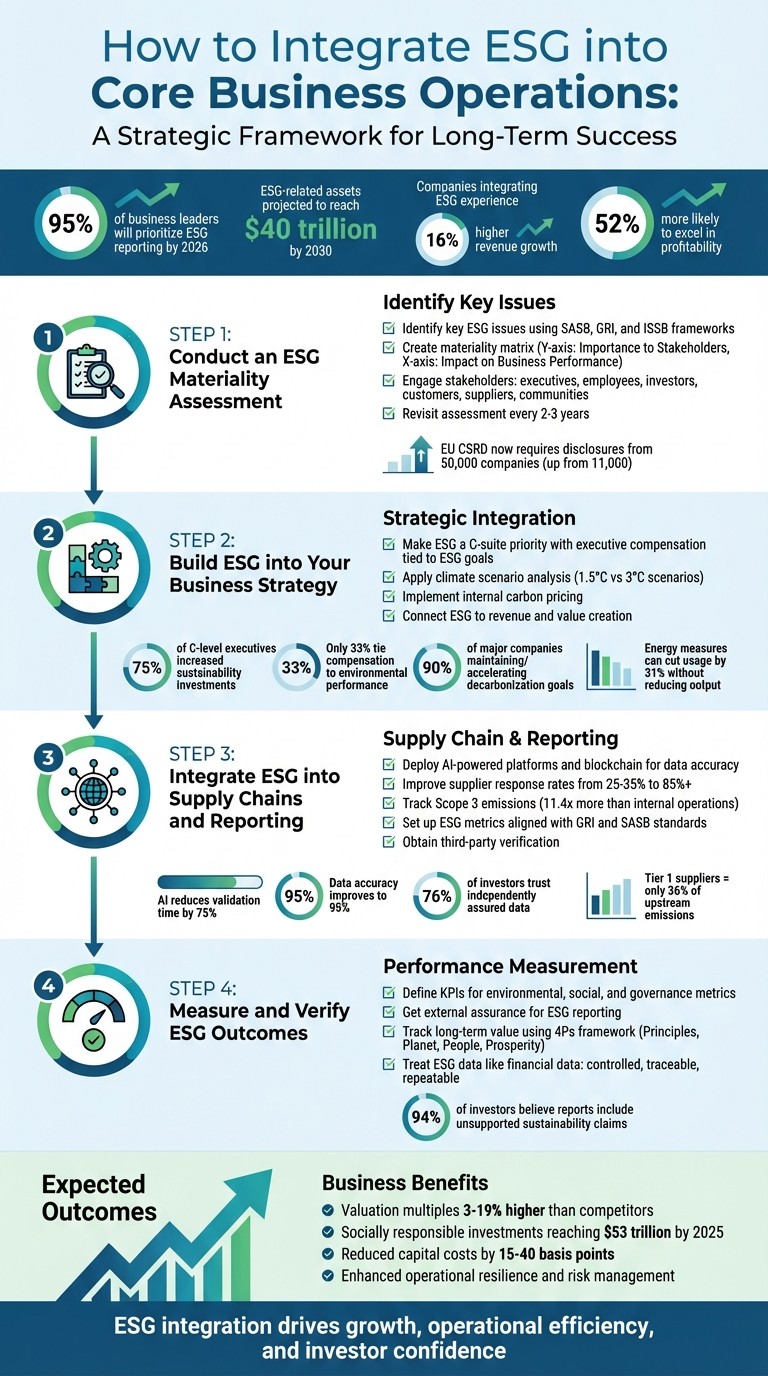
4-Step Framework for Integrating ESG into Core Business Operations
ESG-SDG Integration in Action: Your Integration Roadmap
Step 1: Conduct an ESG Materiality Assessment
Start with a materiality assessment to identify the ESG (Environmental, Social, and Governance) issues that have the greatest impact on financial performance and stakeholder expectations. Define your scope, set clear objectives, establish a timeline, and assemble a cross-functional team. Including representatives from HR, Legal, Finance, and Supply Chain ensures diverse perspectives and internal alignment. Companies that integrate sustainability into their core operations experience 16% higher revenue growth and are 52% more likely to excel in profitability [4]. Laying this groundwork is essential.
Identify Your Key ESG Issues
Use established ESG frameworks like SASB, GRI, and ISSB to research relevant topics. Then, map these issues on a materiality matrix to prioritize them based on their importance to stakeholders and their impact on business performance. Tailor your analysis to your industry. For example, a manufacturing company might focus on waste management and worker safety, while a tech company could prioritize data security and energy efficiency.
Plotting issues on a matrix - where the Y-axis represents "Importance to Stakeholders" and the X-axis represents "Impact on Business Performance" - helps highlight the most critical areas. These high-priority issues, often located in the top-right quadrant, are easier to present to your board and leadership team.
Involve Stakeholders in the Assessment
Engage a broad range of stakeholders, including executives, employees, investors, customers, suppliers, regulators, and local communities. This ensures a well-rounded understanding of the issues. With regulations like the EU's Corporate Sustainability Reporting Directive now requiring disclosures from approximately 50,000 companies (up from 11,000), stakeholder input has become increasingly important.
Gather feedback through multiple channels to capture diverse perspectives. Use a mix of surveys, interviews, focus groups, roundtables, and town halls. To avoid survey fatigue, integrate ESG-related questions into existing tools like employee pulse checks or regular meetings. As BDO explains:
"Double materiality calls on companies to report information that would be meaningful not only to investor decision-making but also to other stakeholders, such as local communities, non-governmental organizations (NGOs), environmental agencies, customers, consumers, and employees."
This "double materiality" approach ensures that both internal business impacts and external effects are accounted for.
Use Data and Tools for Materiality Analysis
Leverage sustainability software and ESG analytics to streamline data collection and analysis. AI-powered tools and natural language processing can help analyze stakeholder sentiment from large datasets, uncovering trends and concerns you might otherwise miss.
Combining different standards provides a comprehensive view for various audiences - SASB emphasizes financially material issues for investors, while GRI focuses on broader impacts relevant to all stakeholders.
Keep in mind, materiality assessments shouldn’t be a one-and-done effort. Experts suggest revisiting your analysis every two to three years, or even annually if your business or operating environment undergoes significant changes. As Deloitte Insights notes:
"Materiality is not a snapshot but a continuous exercise."
Use the insights from this process to create a focused action plan, complete with KPIs and resource allocation, ensuring ESG becomes a core part of your strategy. With this solid foundation, you’ll be ready to integrate ESG into your overall business approach in the next step.
Step 2: Build ESG into Your Business Strategy
After identifying key ESG priorities through your materiality assessment, the next step is weaving these priorities into your business strategy to achieve revenue growth, cost efficiencies, and operational durability. This requires leadership buy-in, forward-thinking analysis, and a clear link between sustainability efforts and financial outcomes.
Make ESG a C-Suite Priority
CFOs are increasingly tasked with embedding sustainability into financial planning and resource allocation [5]. A recent survey revealed that 75% of C-level executives increased their organizations' sustainability investments in the past year, with nearly 20% reporting significant increases [6]. However, only 33% of companies currently tie senior leader compensation to environmental sustainability performance [6], which limits accountability and progress.
To address this, assign ESG oversight to senior leadership, whether that’s the Board of Directors, the CFO, or a dedicated cross-functional team. Tie executive compensation to measurable sustainability metrics to ensure alignment with organizational goals. Simon Cleveland, Partner at Deloitte UK, emphasizes the importance of governance in this process:
"If you don't have governance, you can't talk about having environmental or social disclosures. To be transparent, you need governance. It's the foundation and the base" [6].
Some organizations are also adopting internal carbon pricing to evaluate decarbonization projects alongside other investments on equal footing [5]. This approach allows CFOs to make informed comparisons and allocate funds specifically for sustainability initiatives, ensuring these projects remain a priority. With leadership on board, the next focus is understanding how future climate scenarios can shape strategic decisions.
Apply Climate Scenario Analysis
Climate scenario analysis is a critical tool for assessing how various climate outcomes, such as a 1.5°C or 3°C temperature rise, could impact your business in the long run [7]. Unlike traditional forecasting, this method frames potential outcomes based on specific conditions. Established frameworks like the Intergovernmental Panel on Climate Change (IPCC) Shared Socioeconomic Pathways (SSPs), International Energy Agency (IEA), or Science Based Target Initiative (SBTi) can guide this process [7].
Focus on a few distinct scenarios to highlight key strategic differences [7]. This analysis should yield two results: high-level decisions influenced by climate developments (tracked through markers like carbon price thresholds or infrastructure changes) and "no-regret" actions that benefit the business regardless of the scenario [7].
Embed these insights into financial models and strategic plans. As BCG experts Rebecca Russell, Gates Moss, and Zoe Whitewolfe explain:
"Climate scenario analysis is a vital tool to help companies understand the impact of climate change on their strategy, operating model, performance and risk profile" [7].
This proactive approach equips businesses to navigate uncertainty and make smarter investment decisions, ensuring ESG contributes to long-term value.
Connect ESG to Revenue and Value Creation
Incorporating ESG into your strategy isn’t just about managing risks - it’s about identifying new opportunities and driving shareholder value. Investing in sustainable technologies can open up fresh revenue streams as customers increasingly prefer low-carbon products and services. For instance, 90% of major publicly traded companies are maintaining or accelerating their decarbonization goals, recognizing sustainability as a key driver of growth [5].
On the cost side, demand-side energy measures can cut energy use by up to 31% without reducing output across sectors [5]. CFOs and COOs can collaborate on energy demand assessments to uncover immediate savings and reduce emissions. Additionally, involving tax teams early in capital planning can help maximize returns through incentives like those offered in the Inflation Reduction Act (IRA) [5].
Operational resilience also benefits from ESG integration. Climate scenario analysis can identify risks such as extreme weather or resource shortages that might disrupt supply chains. Companies that link sustainability efforts to revenue growth, cost reductions, risk management, and brand enhancement ensure ESG becomes a core strategic focus rather than a compliance task.
The following table outlines how these strategy elements translate into actionable steps and measurable outcomes:
| Strategy Component | Practical Executive Action | Expected Business Outcome |
| --- | --- | --- |
| <strong>Governance</strong> | Assign ESG oversight to the CFO or Board | Increased accountability and data accuracy |
| <strong>Capital Allocation</strong> | Implement internal carbon pricing | Better prioritization of decarbonization projects |
| <strong>Operations</strong> | Conduct energy demand assessments | Up to 31% reduction in energy costs |
| <strong>Incentives</strong> | Embed sustainability metrics in compensation | Leadership alignment with ESG goals |
| <strong>Risk</strong> | Apply climate scenario analysis | Enhanced supply chain and operational resilience
| Strategy Component | Practical Executive Action | Expected Business Outcome |
| --- | --- | --- |
| <strong>Governance</strong> | Assign ESG oversight to the CFO or Board | Increased accountability and data accuracy |
| <strong>Capital Allocation</strong> | Implement internal carbon pricing | Better prioritization of decarbonization projects |
| <strong>Operations</strong> | Conduct energy demand assessments | Up to 31% reduction in energy costs |
| <strong>Incentives</strong> | Embed sustainability metrics in compensation | Leadership alignment with ESG goals |
| <strong>Risk</strong> | Apply climate scenario analysis | Enhanced supply chain and operational resilience
Step 3: Integrate ESG into Supply Chains and Reporting
Once ESG principles are woven into your core business strategy, the next step is to extend these practices into your supply chain and reporting. This is where your ESG efforts can have a measurable impact. Supply chains, on average, account for 11.4 times more emissions than internal operations [8][13], making them a critical area for driving change.
Improve Supply Chain Visibility with Technology
Traditional approaches like spreadsheets and annual surveys often fall short, with response rates between 25–35% and significant gaps in data [10]. Modern technology offers a better solution, automating data collection and providing real-time visibility across multiple supplier tiers.
AI-powered platforms can aggregate supplier data, flag inconsistencies for manual review, and reduce validation time by up to 75%. This improves data accuracy to 95% and boosts response rates to over 85% [10][11]. Blockchain technology adds another layer of reliability, creating immutable records suitable for regulatory compliance [10][12]. Additionally, IoT-enabled dashboards allow teams to monitor emissions continuously and make on-the-spot adjustments [10].
Technology also supports circular economy practices by tracking products from raw materials to end-of-life recovery. Companies have used data-driven tracing to cut Scope 3 emissions and address human rights risks in their supply chains [9][11][12].
With these tools in place, the next step is to establish strong reporting standards.
Set Up ESG Metrics and Reporting Standards
Once you've improved data collection, focus on creating clear ESG metrics and governance. Align your reporting with frameworks like the Global Reporting Initiative (GRI) for broad stakeholder engagement and the Sustainability Accounting Standards Board (SASB) for financial materiality to investors [15][16].
Conduct a materiality assessment to determine which of the 15 Scope 3 categories are most relevant to your business. Use the GHG Protocol as your measurement standard for tracking emissions across your value chain [14]. Concentrate on top-tier suppliers, as they often contribute the bulk of Scope 3 emissions.
Strong governance is essential. Involve leaders from finance (CFO), sustainability (CSO), and technology (CIO) to oversee data collection and strategy [14][15]. External verification is also vital - 76% of investors trust sustainability information more when it is independently assured [15]. As one investor noted in PwC's Global Investor Survey 2024:
"If a company is building a strong organisation and is reporting and monitoring in a good manner, then from an investor's point of view, I can positively evaluate such activities as a part of a company's main corporate strategy" [15].
For U.S. companies, compliance with California's SB-253 (emissions reporting) and SB-261 (climate risk) should be a priority, especially as federal SEC rules remain in flux [15][17]. California's laws require companies with over $1 billion in revenue to disclose Scope 3 emissions starting in 2027 [15].
Incorporate ESG requirements directly into supplier contracts. Include clauses for carbon reporting and allow contract termination if ESG targets are missed [14][12]. Request Environmental Product Declarations (EPDs) from suppliers to get certified lifecycle assessment data on materials [14].
Compare Scope 3 Disclosure Methods
Accurately disclosing Scope 3 emissions is a key step toward improving upstream emissions and making targeted changes. Companies typically choose one of three methods, each with its own pros and cons:
| Method | Data Input | Accuracy | Benefits | Challenges |
| --- | --- | --- | --- | --- |
| <strong>Supplier-specific</strong> | Product-level data or LCAs from suppliers | High | Reflects actual supplier improvements | Requires significant supplier engagement and data verification |
| <strong>Average-data</strong> | Mass or units of goods with industry averages | Moderate | Fills data gaps when supplier data is missing | Does not account for specific supplier efficiency |
| <strong>Spend-based</strong> | Economic value of goods/services with emission factors | Low | Fast to implement using financial data | Sensitive to price changes, not actual emissions
| Method | Data Input | Accuracy | Benefits | Challenges |
| --- | --- | --- | --- | --- |
| <strong>Supplier-specific</strong> | Product-level data or LCAs from suppliers | High | Reflects actual supplier improvements | Requires significant supplier engagement and data verification |
| <strong>Average-data</strong> | Mass or units of goods with industry averages | Moderate | Fills data gaps when supplier data is missing | Does not account for specific supplier efficiency |
| <strong>Spend-based</strong> | Economic value of goods/services with emission factors | Low | Fast to implement using financial data | Sensitive to price changes, not actual emissions
Many companies start with a spend-based approach to quickly establish a baseline, then transition to supplier-specific data for the most critical categories. The GHG Protocol's free Scope 3 Evaluator tool can help with initial estimates [18].
It's important to go beyond Tier 1 suppliers, as they represent only 36% of total upstream emissions. In industries like high-tech, emissions from suppliers beyond Tier 1 can reach 80% [8]. Advanced technology that provides visibility into these deeper layers is essential for capturing the full picture. Companies with audit-ready Scope 3 data may also enjoy financial advantages, such as reduced capital costs by 15–40 basis points compared to peers [10].
Step 4: Measure and Verify ESG Outcomes
To complete the ESG integration process, it's essential to move beyond internal implementation and focus on thorough measurement and verification. Demonstrating measurable ESG results involves setting precise KPIs, obtaining third-party verification, and monitoring long-term value creation.
Define Key Performance Indicators (KPIs)
Choosing the right KPIs is crucial - they should align with your business objectives and address stakeholder priorities. For instance, environmental KPIs might include metrics such as energy consumption, greenhouse gas (GHG) emissions (covering Scopes 1, 2, and 3), and water or waste management practices. Social KPIs could focus on workforce diversity (broken down by sex and age), gender pay equity, employee turnover, and safety records. Governance KPIs might measure board diversity, the proportion of executive compensation linked to ESG performance, and supplier compliance with your code of conduct [19].
To ensure meaningful comparisons and industry benchmarking, consider using intensity metrics, such as energy consumption per million dollars of revenue. Additionally, employing the GHG Protocol methodology allows for consistency across regions and enhances accountability, especially if ESG metrics are tied to executive compensation [19].
Once KPIs are in place, the next step is to validate your data through independent review.
Get External Assurance for ESG Reporting
Independent verification plays a vital role in building stakeholder confidence. A significant 94% of investors believe corporate reports often include unsupported sustainability claims, and 85% agree that "reasonable assurance" would greatly enhance their trust in these reports [21][22]. Third-party assurance provides an impartial evaluation of your ESG data and disclosures, identifying gaps and areas for improvement.
Before seeking external assurance, establish strong internal controls and maintain key documentation, such as waste manifests, utility bills, and weight logs. Appointing a dedicated ESG Controller can help bridge the gap between sustainability efforts and financial reporting. Involving your assurance provider early in the process allows for the identification of data or control weaknesses before public disclosure [21][22][3].
"Reporting should be investor-grade - credible and well-supported so that investors and other stakeholders can rely on it." - PwC [21]
When selecting an assurance provider, prioritize firms with independence, global expertise, and a strong background in both ESG and financial auditing.
After verification, focus on tracking how these metrics contribute to long-term strategic value.
Track Long-Term Value Creation
Measuring ESG outcomes helps illustrate how sustainability efforts drive resilience and growth. The World Economic Forum's "4Ps" framework provides a useful structure for understanding value creation:
Principles of Governance: Effective oversight and monitoring.
Planet: Managing environmental impacts and dependencies.
People: Promoting workforce diversity, equity, and well-being.
Prosperity: Generating economic and social benefits through innovation and employment [1][20].
"Long-term resilience and the company's ability to create enduring value is directly linked to how it aligns its purpose and values with the expectations of society." - Deloitte Analysis [1]
Integrating ESG considerations into governance, strategy, risk management, and performance metrics strengthens decision-making and breaks down organizational silos. Aligning your ESG framework with the Task Force on Climate-related Financial Disclosures (TCFD) pillars - governance, strategy, risk management, and metrics/targets - offers a clear and structured approach for stakeholders. Keep in mind that developing the capacity for integrated ESG reporting is a gradual process, requiring simultaneous changes in internal practices and external reporting [1].
Common Challenges in ESG Integration and How to Address Them
Implementing an ESG strategy often comes with hurdles, but understanding these challenges and preparing effective responses can help maintain momentum and build credibility as your efforts evolve.
Navigate Regulatory Fragmentation
In the U.S., companies face a complex regulatory landscape that makes compliance tricky. At the federal level, the SEC's 2024 climate disclosure rules remain uncertain, with enforcement delayed until at least 2026. Meanwhile, states like Texas have introduced "Anti-ESG" laws that restrict ESG-related investments or bar contracts with companies seen as opposing fossil fuels. These state-level rules directly conflict with California's mandatory disclosure requirements, forcing businesses to juggle conflicting obligations.
To address this, companies can adopt a "highest common denominator" approach, aligning their ESG frameworks with the most stringent regulations - such as California's or the EU's CSRD standards. This reduces redundancy and ensures compliance across jurisdictions. Using ESG platforms that map data to multiple regulatory frameworks (e.g., SEC, California, CSRD, ISSB) can streamline reporting processes. Additionally, keeping an eye on legislative developments in states like New York and Illinois, which are considering new climate disclosure bills, is crucial for staying ahead [23].
Manage Political and Social Resistance
Political and social pressures can further complicate ESG initiatives. Corporate communication on sustainability and diversity has faced backlash, often fueled by political rhetoric [6]. Resistance also arises when stakeholders perceive ESG efforts as conflicting with short-term financial priorities or question the sincerity of corporate commitments.
Reframing ESG initiatives in business terms can help overcome this resistance. Instead of emphasizing "ESG", focus on "business resilience", "long-term value creation", or "risk management." These terms highlight tangible benefits like safeguarding supply chains, reducing costs, and attracting top talent. Boards can play a pivotal role by assigning ESG oversight to their audit or risk committees and staying updated on fiduciary duties tied to climate risks. Transparency about trade-offs and timelines, coupled with sharing data on the financial impact of sustainability efforts, helps align organizational goals. Engaging employees in solution development fosters broader support and ensures operational alignment with corporate values [6][20].
Avoid Greenwashing and Maintain Credibility
Greenwashing poses a significant threat to ESG efforts, with 94% of investors skeptical of corporate sustainability claims [22]. Beyond damaging reputations, it can invite regulatory scrutiny, making it vital to handle ESG data with the same care as financial reporting.
The Gasilov Group offers sound advice:
"Treat sustainability data like financial data: controlled, traceable, and repeatable" [24].
To ensure credibility, establish clear data lineage by identifying the system of record for every metric and reconciling it with financial statements. Appointing an ESG Controller to oversee data quality, implementing thorough process documentation, and standardizing calculation methods can improve reliability. Additionally, maintaining an audit-grade evidence trail - including meter readings, utility invoices, and supplier attestations - builds trust. For Scope 3 emissions, a supplier-data acceptance policy with defined variance thresholds can clarify when modeled data may be used instead of actual figures [24].
Companies like CVS Health have set an example by obtaining reasonable assurance for Scope 1 and Scope 2 emissions and limited assurance for Scope 3. Similarly, Apple has anchored its sustainability claims with verifiable data, reporting that over 320 suppliers participated in its clean-energy program, supported by procurement documents and invoices [24]. These practices not only enhance credibility but also strengthen the foundation for long-term success.
Conclusion: Building a Successful ESG-Driven Business
A well-designed ESG framework is more than a response to external pressures - it’s a strategic necessity that strengthens resilience, sparks new ideas, and builds enduring value. As Barbara Spiegel, Partner and Sustainability Lead at EY Switzerland, aptly states:
"Sustainability is a strategic imperative, not just a compliance task, that requires true integration into the daily operations and business objectives" [25].
To truly embed ESG into the fabric of a business, it must be treated with the same seriousness as financial performance. Finance teams, in particular, play a pivotal role in this integration. Yasmine Chahed from Deloitte Global explains:
"The finance teams have the capabilities to put strong controls in place, build systems that capture data once and reuse it for multiple purposes... they are uniquely positioned to ensure that sustainability information is integrated into management and board decision making" [2].
This alignment creates a unified approach where risk management, operational efficiency, and revenue growth work hand in hand. Companies that adopt this perspective can better mitigate risks tied to climate and market transitions, optimize operations to cut costs, and identify opportunities for growth in emerging markets. Moreover, viewing business challenges through an ESG lens often reveals new opportunities and solutions that might otherwise go unnoticed [2].
The advantages of prioritizing ESG are clear. Leading ESG performers enjoy valuation multiples 3% to 19% higher than their competitors. Additionally, with socially responsible investments expected to hit $53 trillion by 2025, there’s no denying the financial implications of addressing climate risks [26][2]. ESG isn’t just about meeting regulatory requirements - it’s about future-proofing businesses and gaining an edge in an increasingly competitive landscape. By ensuring data accuracy and leveraging third-party verification, companies can solidify their ESG efforts, demonstrating both compliance and leadership in a fast-changing market.
FAQs
Where should we start with ESG if we have limited resources?
To kick things off, start by conducting a materiality assessment to pinpoint the ESG (Environmental, Social, and Governance) issues that are most relevant to your business and stakeholders. This step ensures your focus is on areas that truly matter. Next, tie these ESG priorities directly to your core business objectives by revisiting your strategy and setting specific, measurable targets for the key areas you've identified.
It's wise to start small - introduce sustainable practices gradually and scale up as your resources allow. This approach helps you build momentum and showcase consistent progress, making it easier to gain support and drive long-term impact.
How do we get reliable Scope 3 data from suppliers?
To gather dependable Scope 3 emissions data, it's crucial to work closely with suppliers. Start by educating them about emissions reporting and the importance of transparency. Establish clear reporting guidelines and focus on the categories that have the most significant impact. Provide resources to help suppliers set climate goals and encourage regular, consistent data sharing.
Leverage tools such as emissions databases to streamline the process and aim to improve data quality over time. Regular tracking and offering ongoing support to suppliers not only enhances accuracy but also builds trust, ensuring a more reliable and collaborative approach to emissions reporting.
What ESG KPIs should we track first to satisfy investors and regulators?
To align with the expectations of investors and regulators, it’s essential to focus on tracking ESG KPIs, particularly those that highlight management and board oversight of climate-related risks and opportunities. Emphasize universal metrics designed to evaluate long-term outcomes for society and stakeholders. Global frameworks, such as the WEF IBC guidance, offer a solid foundation for these metrics, delivering measurable insights that help integrate ESG goals with broader business objectives.
Related Blog Posts
Latest Articles
©2025



FAQ
01
What does it really mean to “redefine profit”?
02
What makes Council Fire different?
03
Who does Council Fire you work with?
04
What does working with Council Fire actually look like?
05
How does Council Fire help organizations turn big goals into action?
06
How does Council Fire define and measure success?
Feb 20, 2026
How to Integrate ESG into Core Business Operations for Corporations
ESG Strategy
In This Article
Practical guide to embed ESG into core operations: run a materiality assessment, align leadership, improve supply-chain data, set KPIs, and secure independent verification.
How to Integrate ESG into Core Business Operations for Corporations
Integrating ESG (Environmental, Social, and Governance) into business operations is no longer optional - it’s a requirement for long-term success. Companies that embed ESG into their strategies reduce risks, gain stakeholder trust, and improve financial performance. By 2026, 95% of business leaders will prioritize ESG reporting, and ESG-related assets are projected to reach $40 trillion by 2030. Here's how companies can align ESG principles with their core operations:
Materiality Assessment: Identify the ESG issues most relevant to your business and stakeholders using frameworks like SASB, GRI, and ISSB.
Leadership Alignment: Make ESG a C-suite priority by tying executive compensation to measurable ESG goals.
Supply Chain Integration: Use technology like AI and blockchain to improve supplier data accuracy and reduce emissions.
Regulatory Compliance: Stay ahead of evolving laws like California’s climate disclosure requirements and the EU’s reporting mandates.
Measurement and Verification: Set clear KPIs, use third-party assurance, and ensure ESG data is as reliable as financial data.
Key Takeaway: ESG integration isn’t just about compliance - it drives growth, operational efficiency, and investor confidence. Companies that act now will lead in a competitive landscape.
4-Step Framework for Integrating ESG into Core Business Operations
ESG-SDG Integration in Action: Your Integration Roadmap
Step 1: Conduct an ESG Materiality Assessment
Start with a materiality assessment to identify the ESG (Environmental, Social, and Governance) issues that have the greatest impact on financial performance and stakeholder expectations. Define your scope, set clear objectives, establish a timeline, and assemble a cross-functional team. Including representatives from HR, Legal, Finance, and Supply Chain ensures diverse perspectives and internal alignment. Companies that integrate sustainability into their core operations experience 16% higher revenue growth and are 52% more likely to excel in profitability [4]. Laying this groundwork is essential.
Identify Your Key ESG Issues
Use established ESG frameworks like SASB, GRI, and ISSB to research relevant topics. Then, map these issues on a materiality matrix to prioritize them based on their importance to stakeholders and their impact on business performance. Tailor your analysis to your industry. For example, a manufacturing company might focus on waste management and worker safety, while a tech company could prioritize data security and energy efficiency.
Plotting issues on a matrix - where the Y-axis represents "Importance to Stakeholders" and the X-axis represents "Impact on Business Performance" - helps highlight the most critical areas. These high-priority issues, often located in the top-right quadrant, are easier to present to your board and leadership team.
Involve Stakeholders in the Assessment
Engage a broad range of stakeholders, including executives, employees, investors, customers, suppliers, regulators, and local communities. This ensures a well-rounded understanding of the issues. With regulations like the EU's Corporate Sustainability Reporting Directive now requiring disclosures from approximately 50,000 companies (up from 11,000), stakeholder input has become increasingly important.
Gather feedback through multiple channels to capture diverse perspectives. Use a mix of surveys, interviews, focus groups, roundtables, and town halls. To avoid survey fatigue, integrate ESG-related questions into existing tools like employee pulse checks or regular meetings. As BDO explains:
"Double materiality calls on companies to report information that would be meaningful not only to investor decision-making but also to other stakeholders, such as local communities, non-governmental organizations (NGOs), environmental agencies, customers, consumers, and employees."
This "double materiality" approach ensures that both internal business impacts and external effects are accounted for.
Use Data and Tools for Materiality Analysis
Leverage sustainability software and ESG analytics to streamline data collection and analysis. AI-powered tools and natural language processing can help analyze stakeholder sentiment from large datasets, uncovering trends and concerns you might otherwise miss.
Combining different standards provides a comprehensive view for various audiences - SASB emphasizes financially material issues for investors, while GRI focuses on broader impacts relevant to all stakeholders.
Keep in mind, materiality assessments shouldn’t be a one-and-done effort. Experts suggest revisiting your analysis every two to three years, or even annually if your business or operating environment undergoes significant changes. As Deloitte Insights notes:
"Materiality is not a snapshot but a continuous exercise."
Use the insights from this process to create a focused action plan, complete with KPIs and resource allocation, ensuring ESG becomes a core part of your strategy. With this solid foundation, you’ll be ready to integrate ESG into your overall business approach in the next step.
Step 2: Build ESG into Your Business Strategy
After identifying key ESG priorities through your materiality assessment, the next step is weaving these priorities into your business strategy to achieve revenue growth, cost efficiencies, and operational durability. This requires leadership buy-in, forward-thinking analysis, and a clear link between sustainability efforts and financial outcomes.
Make ESG a C-Suite Priority
CFOs are increasingly tasked with embedding sustainability into financial planning and resource allocation [5]. A recent survey revealed that 75% of C-level executives increased their organizations' sustainability investments in the past year, with nearly 20% reporting significant increases [6]. However, only 33% of companies currently tie senior leader compensation to environmental sustainability performance [6], which limits accountability and progress.
To address this, assign ESG oversight to senior leadership, whether that’s the Board of Directors, the CFO, or a dedicated cross-functional team. Tie executive compensation to measurable sustainability metrics to ensure alignment with organizational goals. Simon Cleveland, Partner at Deloitte UK, emphasizes the importance of governance in this process:
"If you don't have governance, you can't talk about having environmental or social disclosures. To be transparent, you need governance. It's the foundation and the base" [6].
Some organizations are also adopting internal carbon pricing to evaluate decarbonization projects alongside other investments on equal footing [5]. This approach allows CFOs to make informed comparisons and allocate funds specifically for sustainability initiatives, ensuring these projects remain a priority. With leadership on board, the next focus is understanding how future climate scenarios can shape strategic decisions.
Apply Climate Scenario Analysis
Climate scenario analysis is a critical tool for assessing how various climate outcomes, such as a 1.5°C or 3°C temperature rise, could impact your business in the long run [7]. Unlike traditional forecasting, this method frames potential outcomes based on specific conditions. Established frameworks like the Intergovernmental Panel on Climate Change (IPCC) Shared Socioeconomic Pathways (SSPs), International Energy Agency (IEA), or Science Based Target Initiative (SBTi) can guide this process [7].
Focus on a few distinct scenarios to highlight key strategic differences [7]. This analysis should yield two results: high-level decisions influenced by climate developments (tracked through markers like carbon price thresholds or infrastructure changes) and "no-regret" actions that benefit the business regardless of the scenario [7].
Embed these insights into financial models and strategic plans. As BCG experts Rebecca Russell, Gates Moss, and Zoe Whitewolfe explain:
"Climate scenario analysis is a vital tool to help companies understand the impact of climate change on their strategy, operating model, performance and risk profile" [7].
This proactive approach equips businesses to navigate uncertainty and make smarter investment decisions, ensuring ESG contributes to long-term value.
Connect ESG to Revenue and Value Creation
Incorporating ESG into your strategy isn’t just about managing risks - it’s about identifying new opportunities and driving shareholder value. Investing in sustainable technologies can open up fresh revenue streams as customers increasingly prefer low-carbon products and services. For instance, 90% of major publicly traded companies are maintaining or accelerating their decarbonization goals, recognizing sustainability as a key driver of growth [5].
On the cost side, demand-side energy measures can cut energy use by up to 31% without reducing output across sectors [5]. CFOs and COOs can collaborate on energy demand assessments to uncover immediate savings and reduce emissions. Additionally, involving tax teams early in capital planning can help maximize returns through incentives like those offered in the Inflation Reduction Act (IRA) [5].
Operational resilience also benefits from ESG integration. Climate scenario analysis can identify risks such as extreme weather or resource shortages that might disrupt supply chains. Companies that link sustainability efforts to revenue growth, cost reductions, risk management, and brand enhancement ensure ESG becomes a core strategic focus rather than a compliance task.
The following table outlines how these strategy elements translate into actionable steps and measurable outcomes:
| Strategy Component | Practical Executive Action | Expected Business Outcome |
| --- | --- | --- |
| <strong>Governance</strong> | Assign ESG oversight to the CFO or Board | Increased accountability and data accuracy |
| <strong>Capital Allocation</strong> | Implement internal carbon pricing | Better prioritization of decarbonization projects |
| <strong>Operations</strong> | Conduct energy demand assessments | Up to 31% reduction in energy costs |
| <strong>Incentives</strong> | Embed sustainability metrics in compensation | Leadership alignment with ESG goals |
| <strong>Risk</strong> | Apply climate scenario analysis | Enhanced supply chain and operational resilience
Step 3: Integrate ESG into Supply Chains and Reporting
Once ESG principles are woven into your core business strategy, the next step is to extend these practices into your supply chain and reporting. This is where your ESG efforts can have a measurable impact. Supply chains, on average, account for 11.4 times more emissions than internal operations [8][13], making them a critical area for driving change.
Improve Supply Chain Visibility with Technology
Traditional approaches like spreadsheets and annual surveys often fall short, with response rates between 25–35% and significant gaps in data [10]. Modern technology offers a better solution, automating data collection and providing real-time visibility across multiple supplier tiers.
AI-powered platforms can aggregate supplier data, flag inconsistencies for manual review, and reduce validation time by up to 75%. This improves data accuracy to 95% and boosts response rates to over 85% [10][11]. Blockchain technology adds another layer of reliability, creating immutable records suitable for regulatory compliance [10][12]. Additionally, IoT-enabled dashboards allow teams to monitor emissions continuously and make on-the-spot adjustments [10].
Technology also supports circular economy practices by tracking products from raw materials to end-of-life recovery. Companies have used data-driven tracing to cut Scope 3 emissions and address human rights risks in their supply chains [9][11][12].
With these tools in place, the next step is to establish strong reporting standards.
Set Up ESG Metrics and Reporting Standards
Once you've improved data collection, focus on creating clear ESG metrics and governance. Align your reporting with frameworks like the Global Reporting Initiative (GRI) for broad stakeholder engagement and the Sustainability Accounting Standards Board (SASB) for financial materiality to investors [15][16].
Conduct a materiality assessment to determine which of the 15 Scope 3 categories are most relevant to your business. Use the GHG Protocol as your measurement standard for tracking emissions across your value chain [14]. Concentrate on top-tier suppliers, as they often contribute the bulk of Scope 3 emissions.
Strong governance is essential. Involve leaders from finance (CFO), sustainability (CSO), and technology (CIO) to oversee data collection and strategy [14][15]. External verification is also vital - 76% of investors trust sustainability information more when it is independently assured [15]. As one investor noted in PwC's Global Investor Survey 2024:
"If a company is building a strong organisation and is reporting and monitoring in a good manner, then from an investor's point of view, I can positively evaluate such activities as a part of a company's main corporate strategy" [15].
For U.S. companies, compliance with California's SB-253 (emissions reporting) and SB-261 (climate risk) should be a priority, especially as federal SEC rules remain in flux [15][17]. California's laws require companies with over $1 billion in revenue to disclose Scope 3 emissions starting in 2027 [15].
Incorporate ESG requirements directly into supplier contracts. Include clauses for carbon reporting and allow contract termination if ESG targets are missed [14][12]. Request Environmental Product Declarations (EPDs) from suppliers to get certified lifecycle assessment data on materials [14].
Compare Scope 3 Disclosure Methods
Accurately disclosing Scope 3 emissions is a key step toward improving upstream emissions and making targeted changes. Companies typically choose one of three methods, each with its own pros and cons:
| Method | Data Input | Accuracy | Benefits | Challenges |
| --- | --- | --- | --- | --- |
| <strong>Supplier-specific</strong> | Product-level data or LCAs from suppliers | High | Reflects actual supplier improvements | Requires significant supplier engagement and data verification |
| <strong>Average-data</strong> | Mass or units of goods with industry averages | Moderate | Fills data gaps when supplier data is missing | Does not account for specific supplier efficiency |
| <strong>Spend-based</strong> | Economic value of goods/services with emission factors | Low | Fast to implement using financial data | Sensitive to price changes, not actual emissions
Many companies start with a spend-based approach to quickly establish a baseline, then transition to supplier-specific data for the most critical categories. The GHG Protocol's free Scope 3 Evaluator tool can help with initial estimates [18].
It's important to go beyond Tier 1 suppliers, as they represent only 36% of total upstream emissions. In industries like high-tech, emissions from suppliers beyond Tier 1 can reach 80% [8]. Advanced technology that provides visibility into these deeper layers is essential for capturing the full picture. Companies with audit-ready Scope 3 data may also enjoy financial advantages, such as reduced capital costs by 15–40 basis points compared to peers [10].
Step 4: Measure and Verify ESG Outcomes
To complete the ESG integration process, it's essential to move beyond internal implementation and focus on thorough measurement and verification. Demonstrating measurable ESG results involves setting precise KPIs, obtaining third-party verification, and monitoring long-term value creation.
Define Key Performance Indicators (KPIs)
Choosing the right KPIs is crucial - they should align with your business objectives and address stakeholder priorities. For instance, environmental KPIs might include metrics such as energy consumption, greenhouse gas (GHG) emissions (covering Scopes 1, 2, and 3), and water or waste management practices. Social KPIs could focus on workforce diversity (broken down by sex and age), gender pay equity, employee turnover, and safety records. Governance KPIs might measure board diversity, the proportion of executive compensation linked to ESG performance, and supplier compliance with your code of conduct [19].
To ensure meaningful comparisons and industry benchmarking, consider using intensity metrics, such as energy consumption per million dollars of revenue. Additionally, employing the GHG Protocol methodology allows for consistency across regions and enhances accountability, especially if ESG metrics are tied to executive compensation [19].
Once KPIs are in place, the next step is to validate your data through independent review.
Get External Assurance for ESG Reporting
Independent verification plays a vital role in building stakeholder confidence. A significant 94% of investors believe corporate reports often include unsupported sustainability claims, and 85% agree that "reasonable assurance" would greatly enhance their trust in these reports [21][22]. Third-party assurance provides an impartial evaluation of your ESG data and disclosures, identifying gaps and areas for improvement.
Before seeking external assurance, establish strong internal controls and maintain key documentation, such as waste manifests, utility bills, and weight logs. Appointing a dedicated ESG Controller can help bridge the gap between sustainability efforts and financial reporting. Involving your assurance provider early in the process allows for the identification of data or control weaknesses before public disclosure [21][22][3].
"Reporting should be investor-grade - credible and well-supported so that investors and other stakeholders can rely on it." - PwC [21]
When selecting an assurance provider, prioritize firms with independence, global expertise, and a strong background in both ESG and financial auditing.
After verification, focus on tracking how these metrics contribute to long-term strategic value.
Track Long-Term Value Creation
Measuring ESG outcomes helps illustrate how sustainability efforts drive resilience and growth. The World Economic Forum's "4Ps" framework provides a useful structure for understanding value creation:
Principles of Governance: Effective oversight and monitoring.
Planet: Managing environmental impacts and dependencies.
People: Promoting workforce diversity, equity, and well-being.
Prosperity: Generating economic and social benefits through innovation and employment [1][20].
"Long-term resilience and the company's ability to create enduring value is directly linked to how it aligns its purpose and values with the expectations of society." - Deloitte Analysis [1]
Integrating ESG considerations into governance, strategy, risk management, and performance metrics strengthens decision-making and breaks down organizational silos. Aligning your ESG framework with the Task Force on Climate-related Financial Disclosures (TCFD) pillars - governance, strategy, risk management, and metrics/targets - offers a clear and structured approach for stakeholders. Keep in mind that developing the capacity for integrated ESG reporting is a gradual process, requiring simultaneous changes in internal practices and external reporting [1].
Common Challenges in ESG Integration and How to Address Them
Implementing an ESG strategy often comes with hurdles, but understanding these challenges and preparing effective responses can help maintain momentum and build credibility as your efforts evolve.
Navigate Regulatory Fragmentation
In the U.S., companies face a complex regulatory landscape that makes compliance tricky. At the federal level, the SEC's 2024 climate disclosure rules remain uncertain, with enforcement delayed until at least 2026. Meanwhile, states like Texas have introduced "Anti-ESG" laws that restrict ESG-related investments or bar contracts with companies seen as opposing fossil fuels. These state-level rules directly conflict with California's mandatory disclosure requirements, forcing businesses to juggle conflicting obligations.
To address this, companies can adopt a "highest common denominator" approach, aligning their ESG frameworks with the most stringent regulations - such as California's or the EU's CSRD standards. This reduces redundancy and ensures compliance across jurisdictions. Using ESG platforms that map data to multiple regulatory frameworks (e.g., SEC, California, CSRD, ISSB) can streamline reporting processes. Additionally, keeping an eye on legislative developments in states like New York and Illinois, which are considering new climate disclosure bills, is crucial for staying ahead [23].
Manage Political and Social Resistance
Political and social pressures can further complicate ESG initiatives. Corporate communication on sustainability and diversity has faced backlash, often fueled by political rhetoric [6]. Resistance also arises when stakeholders perceive ESG efforts as conflicting with short-term financial priorities or question the sincerity of corporate commitments.
Reframing ESG initiatives in business terms can help overcome this resistance. Instead of emphasizing "ESG", focus on "business resilience", "long-term value creation", or "risk management." These terms highlight tangible benefits like safeguarding supply chains, reducing costs, and attracting top talent. Boards can play a pivotal role by assigning ESG oversight to their audit or risk committees and staying updated on fiduciary duties tied to climate risks. Transparency about trade-offs and timelines, coupled with sharing data on the financial impact of sustainability efforts, helps align organizational goals. Engaging employees in solution development fosters broader support and ensures operational alignment with corporate values [6][20].
Avoid Greenwashing and Maintain Credibility
Greenwashing poses a significant threat to ESG efforts, with 94% of investors skeptical of corporate sustainability claims [22]. Beyond damaging reputations, it can invite regulatory scrutiny, making it vital to handle ESG data with the same care as financial reporting.
The Gasilov Group offers sound advice:
"Treat sustainability data like financial data: controlled, traceable, and repeatable" [24].
To ensure credibility, establish clear data lineage by identifying the system of record for every metric and reconciling it with financial statements. Appointing an ESG Controller to oversee data quality, implementing thorough process documentation, and standardizing calculation methods can improve reliability. Additionally, maintaining an audit-grade evidence trail - including meter readings, utility invoices, and supplier attestations - builds trust. For Scope 3 emissions, a supplier-data acceptance policy with defined variance thresholds can clarify when modeled data may be used instead of actual figures [24].
Companies like CVS Health have set an example by obtaining reasonable assurance for Scope 1 and Scope 2 emissions and limited assurance for Scope 3. Similarly, Apple has anchored its sustainability claims with verifiable data, reporting that over 320 suppliers participated in its clean-energy program, supported by procurement documents and invoices [24]. These practices not only enhance credibility but also strengthen the foundation for long-term success.
Conclusion: Building a Successful ESG-Driven Business
A well-designed ESG framework is more than a response to external pressures - it’s a strategic necessity that strengthens resilience, sparks new ideas, and builds enduring value. As Barbara Spiegel, Partner and Sustainability Lead at EY Switzerland, aptly states:
"Sustainability is a strategic imperative, not just a compliance task, that requires true integration into the daily operations and business objectives" [25].
To truly embed ESG into the fabric of a business, it must be treated with the same seriousness as financial performance. Finance teams, in particular, play a pivotal role in this integration. Yasmine Chahed from Deloitte Global explains:
"The finance teams have the capabilities to put strong controls in place, build systems that capture data once and reuse it for multiple purposes... they are uniquely positioned to ensure that sustainability information is integrated into management and board decision making" [2].
This alignment creates a unified approach where risk management, operational efficiency, and revenue growth work hand in hand. Companies that adopt this perspective can better mitigate risks tied to climate and market transitions, optimize operations to cut costs, and identify opportunities for growth in emerging markets. Moreover, viewing business challenges through an ESG lens often reveals new opportunities and solutions that might otherwise go unnoticed [2].
The advantages of prioritizing ESG are clear. Leading ESG performers enjoy valuation multiples 3% to 19% higher than their competitors. Additionally, with socially responsible investments expected to hit $53 trillion by 2025, there’s no denying the financial implications of addressing climate risks [26][2]. ESG isn’t just about meeting regulatory requirements - it’s about future-proofing businesses and gaining an edge in an increasingly competitive landscape. By ensuring data accuracy and leveraging third-party verification, companies can solidify their ESG efforts, demonstrating both compliance and leadership in a fast-changing market.
FAQs
Where should we start with ESG if we have limited resources?
To kick things off, start by conducting a materiality assessment to pinpoint the ESG (Environmental, Social, and Governance) issues that are most relevant to your business and stakeholders. This step ensures your focus is on areas that truly matter. Next, tie these ESG priorities directly to your core business objectives by revisiting your strategy and setting specific, measurable targets for the key areas you've identified.
It's wise to start small - introduce sustainable practices gradually and scale up as your resources allow. This approach helps you build momentum and showcase consistent progress, making it easier to gain support and drive long-term impact.
How do we get reliable Scope 3 data from suppliers?
To gather dependable Scope 3 emissions data, it's crucial to work closely with suppliers. Start by educating them about emissions reporting and the importance of transparency. Establish clear reporting guidelines and focus on the categories that have the most significant impact. Provide resources to help suppliers set climate goals and encourage regular, consistent data sharing.
Leverage tools such as emissions databases to streamline the process and aim to improve data quality over time. Regular tracking and offering ongoing support to suppliers not only enhances accuracy but also builds trust, ensuring a more reliable and collaborative approach to emissions reporting.
What ESG KPIs should we track first to satisfy investors and regulators?
To align with the expectations of investors and regulators, it’s essential to focus on tracking ESG KPIs, particularly those that highlight management and board oversight of climate-related risks and opportunities. Emphasize universal metrics designed to evaluate long-term outcomes for society and stakeholders. Global frameworks, such as the WEF IBC guidance, offer a solid foundation for these metrics, delivering measurable insights that help integrate ESG goals with broader business objectives.
Related Blog Posts
FAQ
01
What does it really mean to “redefine profit”?
02
What makes Council Fire different?
03
Who does Council Fire you work with?
04
What does working with Council Fire actually look like?
05
How does Council Fire help organizations turn big goals into action?
06
How does Council Fire define and measure success?
Feb 20, 2026
How to Integrate ESG into Core Business Operations for Corporations
ESG Strategy
In This Article
Practical guide to embed ESG into core operations: run a materiality assessment, align leadership, improve supply-chain data, set KPIs, and secure independent verification.
How to Integrate ESG into Core Business Operations for Corporations
Integrating ESG (Environmental, Social, and Governance) into business operations is no longer optional - it’s a requirement for long-term success. Companies that embed ESG into their strategies reduce risks, gain stakeholder trust, and improve financial performance. By 2026, 95% of business leaders will prioritize ESG reporting, and ESG-related assets are projected to reach $40 trillion by 2030. Here's how companies can align ESG principles with their core operations:
Materiality Assessment: Identify the ESG issues most relevant to your business and stakeholders using frameworks like SASB, GRI, and ISSB.
Leadership Alignment: Make ESG a C-suite priority by tying executive compensation to measurable ESG goals.
Supply Chain Integration: Use technology like AI and blockchain to improve supplier data accuracy and reduce emissions.
Regulatory Compliance: Stay ahead of evolving laws like California’s climate disclosure requirements and the EU’s reporting mandates.
Measurement and Verification: Set clear KPIs, use third-party assurance, and ensure ESG data is as reliable as financial data.
Key Takeaway: ESG integration isn’t just about compliance - it drives growth, operational efficiency, and investor confidence. Companies that act now will lead in a competitive landscape.
4-Step Framework for Integrating ESG into Core Business Operations
ESG-SDG Integration in Action: Your Integration Roadmap
Step 1: Conduct an ESG Materiality Assessment
Start with a materiality assessment to identify the ESG (Environmental, Social, and Governance) issues that have the greatest impact on financial performance and stakeholder expectations. Define your scope, set clear objectives, establish a timeline, and assemble a cross-functional team. Including representatives from HR, Legal, Finance, and Supply Chain ensures diverse perspectives and internal alignment. Companies that integrate sustainability into their core operations experience 16% higher revenue growth and are 52% more likely to excel in profitability [4]. Laying this groundwork is essential.
Identify Your Key ESG Issues
Use established ESG frameworks like SASB, GRI, and ISSB to research relevant topics. Then, map these issues on a materiality matrix to prioritize them based on their importance to stakeholders and their impact on business performance. Tailor your analysis to your industry. For example, a manufacturing company might focus on waste management and worker safety, while a tech company could prioritize data security and energy efficiency.
Plotting issues on a matrix - where the Y-axis represents "Importance to Stakeholders" and the X-axis represents "Impact on Business Performance" - helps highlight the most critical areas. These high-priority issues, often located in the top-right quadrant, are easier to present to your board and leadership team.
Involve Stakeholders in the Assessment
Engage a broad range of stakeholders, including executives, employees, investors, customers, suppliers, regulators, and local communities. This ensures a well-rounded understanding of the issues. With regulations like the EU's Corporate Sustainability Reporting Directive now requiring disclosures from approximately 50,000 companies (up from 11,000), stakeholder input has become increasingly important.
Gather feedback through multiple channels to capture diverse perspectives. Use a mix of surveys, interviews, focus groups, roundtables, and town halls. To avoid survey fatigue, integrate ESG-related questions into existing tools like employee pulse checks or regular meetings. As BDO explains:
"Double materiality calls on companies to report information that would be meaningful not only to investor decision-making but also to other stakeholders, such as local communities, non-governmental organizations (NGOs), environmental agencies, customers, consumers, and employees."
This "double materiality" approach ensures that both internal business impacts and external effects are accounted for.
Use Data and Tools for Materiality Analysis
Leverage sustainability software and ESG analytics to streamline data collection and analysis. AI-powered tools and natural language processing can help analyze stakeholder sentiment from large datasets, uncovering trends and concerns you might otherwise miss.
Combining different standards provides a comprehensive view for various audiences - SASB emphasizes financially material issues for investors, while GRI focuses on broader impacts relevant to all stakeholders.
Keep in mind, materiality assessments shouldn’t be a one-and-done effort. Experts suggest revisiting your analysis every two to three years, or even annually if your business or operating environment undergoes significant changes. As Deloitte Insights notes:
"Materiality is not a snapshot but a continuous exercise."
Use the insights from this process to create a focused action plan, complete with KPIs and resource allocation, ensuring ESG becomes a core part of your strategy. With this solid foundation, you’ll be ready to integrate ESG into your overall business approach in the next step.
Step 2: Build ESG into Your Business Strategy
After identifying key ESG priorities through your materiality assessment, the next step is weaving these priorities into your business strategy to achieve revenue growth, cost efficiencies, and operational durability. This requires leadership buy-in, forward-thinking analysis, and a clear link between sustainability efforts and financial outcomes.
Make ESG a C-Suite Priority
CFOs are increasingly tasked with embedding sustainability into financial planning and resource allocation [5]. A recent survey revealed that 75% of C-level executives increased their organizations' sustainability investments in the past year, with nearly 20% reporting significant increases [6]. However, only 33% of companies currently tie senior leader compensation to environmental sustainability performance [6], which limits accountability and progress.
To address this, assign ESG oversight to senior leadership, whether that’s the Board of Directors, the CFO, or a dedicated cross-functional team. Tie executive compensation to measurable sustainability metrics to ensure alignment with organizational goals. Simon Cleveland, Partner at Deloitte UK, emphasizes the importance of governance in this process:
"If you don't have governance, you can't talk about having environmental or social disclosures. To be transparent, you need governance. It's the foundation and the base" [6].
Some organizations are also adopting internal carbon pricing to evaluate decarbonization projects alongside other investments on equal footing [5]. This approach allows CFOs to make informed comparisons and allocate funds specifically for sustainability initiatives, ensuring these projects remain a priority. With leadership on board, the next focus is understanding how future climate scenarios can shape strategic decisions.
Apply Climate Scenario Analysis
Climate scenario analysis is a critical tool for assessing how various climate outcomes, such as a 1.5°C or 3°C temperature rise, could impact your business in the long run [7]. Unlike traditional forecasting, this method frames potential outcomes based on specific conditions. Established frameworks like the Intergovernmental Panel on Climate Change (IPCC) Shared Socioeconomic Pathways (SSPs), International Energy Agency (IEA), or Science Based Target Initiative (SBTi) can guide this process [7].
Focus on a few distinct scenarios to highlight key strategic differences [7]. This analysis should yield two results: high-level decisions influenced by climate developments (tracked through markers like carbon price thresholds or infrastructure changes) and "no-regret" actions that benefit the business regardless of the scenario [7].
Embed these insights into financial models and strategic plans. As BCG experts Rebecca Russell, Gates Moss, and Zoe Whitewolfe explain:
"Climate scenario analysis is a vital tool to help companies understand the impact of climate change on their strategy, operating model, performance and risk profile" [7].
This proactive approach equips businesses to navigate uncertainty and make smarter investment decisions, ensuring ESG contributes to long-term value.
Connect ESG to Revenue and Value Creation
Incorporating ESG into your strategy isn’t just about managing risks - it’s about identifying new opportunities and driving shareholder value. Investing in sustainable technologies can open up fresh revenue streams as customers increasingly prefer low-carbon products and services. For instance, 90% of major publicly traded companies are maintaining or accelerating their decarbonization goals, recognizing sustainability as a key driver of growth [5].
On the cost side, demand-side energy measures can cut energy use by up to 31% without reducing output across sectors [5]. CFOs and COOs can collaborate on energy demand assessments to uncover immediate savings and reduce emissions. Additionally, involving tax teams early in capital planning can help maximize returns through incentives like those offered in the Inflation Reduction Act (IRA) [5].
Operational resilience also benefits from ESG integration. Climate scenario analysis can identify risks such as extreme weather or resource shortages that might disrupt supply chains. Companies that link sustainability efforts to revenue growth, cost reductions, risk management, and brand enhancement ensure ESG becomes a core strategic focus rather than a compliance task.
The following table outlines how these strategy elements translate into actionable steps and measurable outcomes:
| Strategy Component | Practical Executive Action | Expected Business Outcome |
| --- | --- | --- |
| <strong>Governance</strong> | Assign ESG oversight to the CFO or Board | Increased accountability and data accuracy |
| <strong>Capital Allocation</strong> | Implement internal carbon pricing | Better prioritization of decarbonization projects |
| <strong>Operations</strong> | Conduct energy demand assessments | Up to 31% reduction in energy costs |
| <strong>Incentives</strong> | Embed sustainability metrics in compensation | Leadership alignment with ESG goals |
| <strong>Risk</strong> | Apply climate scenario analysis | Enhanced supply chain and operational resilience
Step 3: Integrate ESG into Supply Chains and Reporting
Once ESG principles are woven into your core business strategy, the next step is to extend these practices into your supply chain and reporting. This is where your ESG efforts can have a measurable impact. Supply chains, on average, account for 11.4 times more emissions than internal operations [8][13], making them a critical area for driving change.
Improve Supply Chain Visibility with Technology
Traditional approaches like spreadsheets and annual surveys often fall short, with response rates between 25–35% and significant gaps in data [10]. Modern technology offers a better solution, automating data collection and providing real-time visibility across multiple supplier tiers.
AI-powered platforms can aggregate supplier data, flag inconsistencies for manual review, and reduce validation time by up to 75%. This improves data accuracy to 95% and boosts response rates to over 85% [10][11]. Blockchain technology adds another layer of reliability, creating immutable records suitable for regulatory compliance [10][12]. Additionally, IoT-enabled dashboards allow teams to monitor emissions continuously and make on-the-spot adjustments [10].
Technology also supports circular economy practices by tracking products from raw materials to end-of-life recovery. Companies have used data-driven tracing to cut Scope 3 emissions and address human rights risks in their supply chains [9][11][12].
With these tools in place, the next step is to establish strong reporting standards.
Set Up ESG Metrics and Reporting Standards
Once you've improved data collection, focus on creating clear ESG metrics and governance. Align your reporting with frameworks like the Global Reporting Initiative (GRI) for broad stakeholder engagement and the Sustainability Accounting Standards Board (SASB) for financial materiality to investors [15][16].
Conduct a materiality assessment to determine which of the 15 Scope 3 categories are most relevant to your business. Use the GHG Protocol as your measurement standard for tracking emissions across your value chain [14]. Concentrate on top-tier suppliers, as they often contribute the bulk of Scope 3 emissions.
Strong governance is essential. Involve leaders from finance (CFO), sustainability (CSO), and technology (CIO) to oversee data collection and strategy [14][15]. External verification is also vital - 76% of investors trust sustainability information more when it is independently assured [15]. As one investor noted in PwC's Global Investor Survey 2024:
"If a company is building a strong organisation and is reporting and monitoring in a good manner, then from an investor's point of view, I can positively evaluate such activities as a part of a company's main corporate strategy" [15].
For U.S. companies, compliance with California's SB-253 (emissions reporting) and SB-261 (climate risk) should be a priority, especially as federal SEC rules remain in flux [15][17]. California's laws require companies with over $1 billion in revenue to disclose Scope 3 emissions starting in 2027 [15].
Incorporate ESG requirements directly into supplier contracts. Include clauses for carbon reporting and allow contract termination if ESG targets are missed [14][12]. Request Environmental Product Declarations (EPDs) from suppliers to get certified lifecycle assessment data on materials [14].
Compare Scope 3 Disclosure Methods
Accurately disclosing Scope 3 emissions is a key step toward improving upstream emissions and making targeted changes. Companies typically choose one of three methods, each with its own pros and cons:
| Method | Data Input | Accuracy | Benefits | Challenges |
| --- | --- | --- | --- | --- |
| <strong>Supplier-specific</strong> | Product-level data or LCAs from suppliers | High | Reflects actual supplier improvements | Requires significant supplier engagement and data verification |
| <strong>Average-data</strong> | Mass or units of goods with industry averages | Moderate | Fills data gaps when supplier data is missing | Does not account for specific supplier efficiency |
| <strong>Spend-based</strong> | Economic value of goods/services with emission factors | Low | Fast to implement using financial data | Sensitive to price changes, not actual emissions
Many companies start with a spend-based approach to quickly establish a baseline, then transition to supplier-specific data for the most critical categories. The GHG Protocol's free Scope 3 Evaluator tool can help with initial estimates [18].
It's important to go beyond Tier 1 suppliers, as they represent only 36% of total upstream emissions. In industries like high-tech, emissions from suppliers beyond Tier 1 can reach 80% [8]. Advanced technology that provides visibility into these deeper layers is essential for capturing the full picture. Companies with audit-ready Scope 3 data may also enjoy financial advantages, such as reduced capital costs by 15–40 basis points compared to peers [10].
Step 4: Measure and Verify ESG Outcomes
To complete the ESG integration process, it's essential to move beyond internal implementation and focus on thorough measurement and verification. Demonstrating measurable ESG results involves setting precise KPIs, obtaining third-party verification, and monitoring long-term value creation.
Define Key Performance Indicators (KPIs)
Choosing the right KPIs is crucial - they should align with your business objectives and address stakeholder priorities. For instance, environmental KPIs might include metrics such as energy consumption, greenhouse gas (GHG) emissions (covering Scopes 1, 2, and 3), and water or waste management practices. Social KPIs could focus on workforce diversity (broken down by sex and age), gender pay equity, employee turnover, and safety records. Governance KPIs might measure board diversity, the proportion of executive compensation linked to ESG performance, and supplier compliance with your code of conduct [19].
To ensure meaningful comparisons and industry benchmarking, consider using intensity metrics, such as energy consumption per million dollars of revenue. Additionally, employing the GHG Protocol methodology allows for consistency across regions and enhances accountability, especially if ESG metrics are tied to executive compensation [19].
Once KPIs are in place, the next step is to validate your data through independent review.
Get External Assurance for ESG Reporting
Independent verification plays a vital role in building stakeholder confidence. A significant 94% of investors believe corporate reports often include unsupported sustainability claims, and 85% agree that "reasonable assurance" would greatly enhance their trust in these reports [21][22]. Third-party assurance provides an impartial evaluation of your ESG data and disclosures, identifying gaps and areas for improvement.
Before seeking external assurance, establish strong internal controls and maintain key documentation, such as waste manifests, utility bills, and weight logs. Appointing a dedicated ESG Controller can help bridge the gap between sustainability efforts and financial reporting. Involving your assurance provider early in the process allows for the identification of data or control weaknesses before public disclosure [21][22][3].
"Reporting should be investor-grade - credible and well-supported so that investors and other stakeholders can rely on it." - PwC [21]
When selecting an assurance provider, prioritize firms with independence, global expertise, and a strong background in both ESG and financial auditing.
After verification, focus on tracking how these metrics contribute to long-term strategic value.
Track Long-Term Value Creation
Measuring ESG outcomes helps illustrate how sustainability efforts drive resilience and growth. The World Economic Forum's "4Ps" framework provides a useful structure for understanding value creation:
Principles of Governance: Effective oversight and monitoring.
Planet: Managing environmental impacts and dependencies.
People: Promoting workforce diversity, equity, and well-being.
Prosperity: Generating economic and social benefits through innovation and employment [1][20].
"Long-term resilience and the company's ability to create enduring value is directly linked to how it aligns its purpose and values with the expectations of society." - Deloitte Analysis [1]
Integrating ESG considerations into governance, strategy, risk management, and performance metrics strengthens decision-making and breaks down organizational silos. Aligning your ESG framework with the Task Force on Climate-related Financial Disclosures (TCFD) pillars - governance, strategy, risk management, and metrics/targets - offers a clear and structured approach for stakeholders. Keep in mind that developing the capacity for integrated ESG reporting is a gradual process, requiring simultaneous changes in internal practices and external reporting [1].
Common Challenges in ESG Integration and How to Address Them
Implementing an ESG strategy often comes with hurdles, but understanding these challenges and preparing effective responses can help maintain momentum and build credibility as your efforts evolve.
Navigate Regulatory Fragmentation
In the U.S., companies face a complex regulatory landscape that makes compliance tricky. At the federal level, the SEC's 2024 climate disclosure rules remain uncertain, with enforcement delayed until at least 2026. Meanwhile, states like Texas have introduced "Anti-ESG" laws that restrict ESG-related investments or bar contracts with companies seen as opposing fossil fuels. These state-level rules directly conflict with California's mandatory disclosure requirements, forcing businesses to juggle conflicting obligations.
To address this, companies can adopt a "highest common denominator" approach, aligning their ESG frameworks with the most stringent regulations - such as California's or the EU's CSRD standards. This reduces redundancy and ensures compliance across jurisdictions. Using ESG platforms that map data to multiple regulatory frameworks (e.g., SEC, California, CSRD, ISSB) can streamline reporting processes. Additionally, keeping an eye on legislative developments in states like New York and Illinois, which are considering new climate disclosure bills, is crucial for staying ahead [23].
Manage Political and Social Resistance
Political and social pressures can further complicate ESG initiatives. Corporate communication on sustainability and diversity has faced backlash, often fueled by political rhetoric [6]. Resistance also arises when stakeholders perceive ESG efforts as conflicting with short-term financial priorities or question the sincerity of corporate commitments.
Reframing ESG initiatives in business terms can help overcome this resistance. Instead of emphasizing "ESG", focus on "business resilience", "long-term value creation", or "risk management." These terms highlight tangible benefits like safeguarding supply chains, reducing costs, and attracting top talent. Boards can play a pivotal role by assigning ESG oversight to their audit or risk committees and staying updated on fiduciary duties tied to climate risks. Transparency about trade-offs and timelines, coupled with sharing data on the financial impact of sustainability efforts, helps align organizational goals. Engaging employees in solution development fosters broader support and ensures operational alignment with corporate values [6][20].
Avoid Greenwashing and Maintain Credibility
Greenwashing poses a significant threat to ESG efforts, with 94% of investors skeptical of corporate sustainability claims [22]. Beyond damaging reputations, it can invite regulatory scrutiny, making it vital to handle ESG data with the same care as financial reporting.
The Gasilov Group offers sound advice:
"Treat sustainability data like financial data: controlled, traceable, and repeatable" [24].
To ensure credibility, establish clear data lineage by identifying the system of record for every metric and reconciling it with financial statements. Appointing an ESG Controller to oversee data quality, implementing thorough process documentation, and standardizing calculation methods can improve reliability. Additionally, maintaining an audit-grade evidence trail - including meter readings, utility invoices, and supplier attestations - builds trust. For Scope 3 emissions, a supplier-data acceptance policy with defined variance thresholds can clarify when modeled data may be used instead of actual figures [24].
Companies like CVS Health have set an example by obtaining reasonable assurance for Scope 1 and Scope 2 emissions and limited assurance for Scope 3. Similarly, Apple has anchored its sustainability claims with verifiable data, reporting that over 320 suppliers participated in its clean-energy program, supported by procurement documents and invoices [24]. These practices not only enhance credibility but also strengthen the foundation for long-term success.
Conclusion: Building a Successful ESG-Driven Business
A well-designed ESG framework is more than a response to external pressures - it’s a strategic necessity that strengthens resilience, sparks new ideas, and builds enduring value. As Barbara Spiegel, Partner and Sustainability Lead at EY Switzerland, aptly states:
"Sustainability is a strategic imperative, not just a compliance task, that requires true integration into the daily operations and business objectives" [25].
To truly embed ESG into the fabric of a business, it must be treated with the same seriousness as financial performance. Finance teams, in particular, play a pivotal role in this integration. Yasmine Chahed from Deloitte Global explains:
"The finance teams have the capabilities to put strong controls in place, build systems that capture data once and reuse it for multiple purposes... they are uniquely positioned to ensure that sustainability information is integrated into management and board decision making" [2].
This alignment creates a unified approach where risk management, operational efficiency, and revenue growth work hand in hand. Companies that adopt this perspective can better mitigate risks tied to climate and market transitions, optimize operations to cut costs, and identify opportunities for growth in emerging markets. Moreover, viewing business challenges through an ESG lens often reveals new opportunities and solutions that might otherwise go unnoticed [2].
The advantages of prioritizing ESG are clear. Leading ESG performers enjoy valuation multiples 3% to 19% higher than their competitors. Additionally, with socially responsible investments expected to hit $53 trillion by 2025, there’s no denying the financial implications of addressing climate risks [26][2]. ESG isn’t just about meeting regulatory requirements - it’s about future-proofing businesses and gaining an edge in an increasingly competitive landscape. By ensuring data accuracy and leveraging third-party verification, companies can solidify their ESG efforts, demonstrating both compliance and leadership in a fast-changing market.
FAQs
Where should we start with ESG if we have limited resources?
To kick things off, start by conducting a materiality assessment to pinpoint the ESG (Environmental, Social, and Governance) issues that are most relevant to your business and stakeholders. This step ensures your focus is on areas that truly matter. Next, tie these ESG priorities directly to your core business objectives by revisiting your strategy and setting specific, measurable targets for the key areas you've identified.
It's wise to start small - introduce sustainable practices gradually and scale up as your resources allow. This approach helps you build momentum and showcase consistent progress, making it easier to gain support and drive long-term impact.
How do we get reliable Scope 3 data from suppliers?
To gather dependable Scope 3 emissions data, it's crucial to work closely with suppliers. Start by educating them about emissions reporting and the importance of transparency. Establish clear reporting guidelines and focus on the categories that have the most significant impact. Provide resources to help suppliers set climate goals and encourage regular, consistent data sharing.
Leverage tools such as emissions databases to streamline the process and aim to improve data quality over time. Regular tracking and offering ongoing support to suppliers not only enhances accuracy but also builds trust, ensuring a more reliable and collaborative approach to emissions reporting.
What ESG KPIs should we track first to satisfy investors and regulators?
To align with the expectations of investors and regulators, it’s essential to focus on tracking ESG KPIs, particularly those that highlight management and board oversight of climate-related risks and opportunities. Emphasize universal metrics designed to evaluate long-term outcomes for society and stakeholders. Global frameworks, such as the WEF IBC guidance, offer a solid foundation for these metrics, delivering measurable insights that help integrate ESG goals with broader business objectives.
Related Blog Posts
FAQ
What does it really mean to “redefine profit”?
What makes Council Fire different?
Who does Council Fire you work with?
What does working with Council Fire actually look like?
How does Council Fire help organizations turn big goals into action?
How does Council Fire define and measure success?