In This Article
Embed climate risk into ERM with six practical steps—scope, exposure testing, owners, limits, funded responses, and ongoing monitoring.
On this page
- ESG Risks - Module 6: Climate Risk Integration -6.5- Integrating Climate into ERM & TCFD Frameworks
- Step 1: Define the Scope and Financial Decisions
- Step 2: Assess Exposure and Financial Impact
- Step 3: Assign Owners and Approval Authority
- Step 4: Set Limits, Metrics, and Action Triggers
- Step 5: Choose Responses and Fund Action Plans
- Step 6: Monitor Results and Update Financial Plans
- Conclusion: Make Climate Risk Part of Routine ERM
- FAQs
How to Integrate Climate Risk into ERM: 6 Steps
I treat climate risk as a financial risk—not a separate reporting task—to build climate resilience. To bring it into enterprise risk management (ERM), I connect flood, heat, energy, and policy exposures to the decisions you already make about budgets, insurance, cash, and investments.
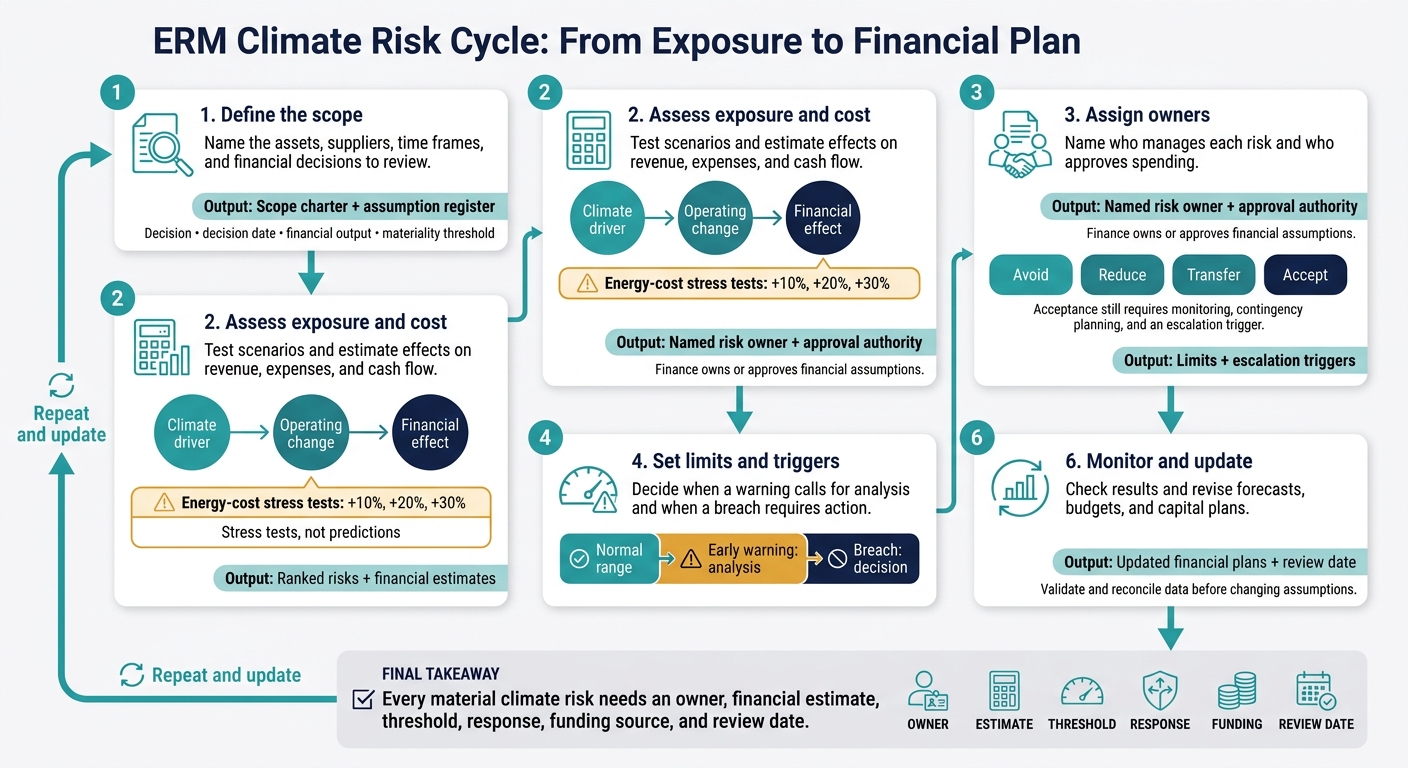
I use six steps to turn that work into funded action:
Define the scope: Name the assets, suppliers, time frames, and financial decisions to review.
Assess exposure and cost: Test scenarios and estimate effects on revenue, expenses, and cash flow.
Assign owners: Name who manages each risk and who approves spending.
Set limits and triggers: Decide when a warning calls for analysis and when a breach requires action.
Choose and fund responses: Compare avoiding, reducing, transferring, or accepting each risk.
Monitor and update: Check results and revise forecasts, budgets, and capital plans.
For example, I can test energy-cost increases of 10%, 20%, and 30% to see where margins or cash become strained. These are stress tests, not predictions. My goal is simple: <u>each material risk has an owner, a financial estimate, an action trigger, and a funding decision.</u>
How to Integrate Climate Risk into ERM: 6 Steps
ESG Risks - Module 6: Climate Risk Integration -6.5- Integrating Climate into ERM & TCFD Frameworks
sbb-itb-8baf5f1
Step 1: Define the Scope and Financial Decisions
Create a one-page scope charter that names the decision, decision date, intended financial output, and materiality threshold.
Specify the legal entities, regions, sites, value-chain nodes, and financing arrangements covered. Document every exclusion and explain why it was left out. Then map physical and transition risks to those boundaries and the financial decisions they inform. A review limited to sites can miss supplier, logistics, and demand risks.
Apply the same short-, medium-, and long-term horizons across financial models, board materials, and the risk register. Extend the analysis when an asset’s life exceeds the forecast window. IFRS S2 requires organizations to explain these horizons and how they connect to business strategy decisions.[6][7]
With those boundaries set, identify the assumptions finance needs to test.
Identify Financial Assumptions at Risk
Have finance build an assumption register for each decision. For every assumption, record its baseline, source, owner, update date, affected model, and climate-tested range.
Cover maintenance expense, energy and fuel prices, labor productivity, disruption days, inventory buffers, insurance premiums and deductibles, repair costs, useful lives, residual values, demand, pricing, borrowing costs, capital needs, and working capital.
The table below links exposure boundaries to planning variables and decision owners.
| Risk category | Exposure boundary | Time horizon | Financial planning variable | Decision owner |
|---|---|---|---|---|
| Extreme heat | U.S. plants, outdoor operations, labor-intensive sites | 0–3 years; 3–10 years | Cooling energy, labor productivity, maintenance, downtime | Operations and CFO |
| Flood and storm surge | Coastal facilities, inventory, access routes, leased warehouses | 0–3 years; 10-plus years | Insurance premiums, repair costs, asset life, capital protection | Facilities and risk |
| Water stress and drought | Water-intensive plants and regional suppliers | 3–10 years; 10-plus years | Water cost, production capacity, capital needs, revenue | Operations and procurement |
| Transition regulation | High-emission products, U.S. facilities, relevant suppliers | 0–3 years; 3–10 years | Compliance expense, product demand, R&D, pricing | Product and legal |
| Energy transition | Purchased electricity, fuel-intensive assets, logistics network | 0–3 years; 3–10 years | Energy prices, capital expenditure, operating margin | Procurement and finance |
| Customer and market change | Carbon-sensitive products and exposed customer segments | 3–10 years; 10-plus years | Revenue, demand forecast, product-development funding | Sales and strategy |
| Financing and insurance | Insured assets, collateral, debt facilities, renewal dates | 0–3 years; 3–10 years | Premiums, deductibles, borrowing costs, covenants | Treasury and risk |
Use the register to guide exposure testing and financial impact estimates.
Set risk-register entry criteria using existing ERM materiality standards - not hazard severity alone. Include exposures that could materially affect revenue, cash flow, asset value, liquidity, compliance, safety, or strategy.
Add a risk when its exposure crosses the approved threshold, affects multiple business units, threatens a critical service, or depends on an uncertain external factor that needs monitoring. Describe it in business terms:
“a 10-day flood interruption at Facility A could reduce annual revenue and require unplanned capital spending”
Keep lower-priority exposures in a monitored inventory, with clear conditions for escalation. These criteria determine which risks move into scenario testing.
Step 2: Assess Exposure and Financial Impact
Use your existing ERM scoring method to rank climate exposures by operating dependency, financial effect, and data confidence. Map exposures across owned and leased assets, operations, suppliers, logistics routes, and customer markets. Connect each exposure to the activity it could disrupt and the financial effect that could follow.
Rate likelihood, severity, speed, duration, and interdependencies. When probabilities are unreliable, use ranges or document a plausible risk without assigning a number, explaining why. Keep risks with missing data in the register; lower the confidence rating rather than remove them. Work with operating teams to verify coordinates, values, dependencies, insurance terms, and disruption history. Record sources, dates, and proxies. Then test the exposure map’s financial impact under climate scenarios.
Test Scenarios and Estimate Financial Effects
Test orderly, disorderly, and higher-warming scenarios. Use NGFS scenarios for climate and macroeconomic inputs.[8][9] Combine those inputs with location, business activity, emissions, supplier, and financial data. Match analysis periods to the budget cycle and asset life. Label outputs as scenario estimates - not forecasts, and document assumptions, management actions, and uncertainty.
Trace each result from climate driver to operating change to financial effect. Estimate effects on revenue, operating expenses, capital spending, asset values, working capital, liquidity, insurance, financing costs, and downtime. Test energy-cost increases of 10%, 20%, and 30%.
Use one baseline and separate gross loss from residual impact. Scenario losses do not automatically become impairments or provisions. Reconcile lost sales, lost contribution margin, repairs, insurance recoveries, and borrowing needs so the same effect is not counted twice.
Use the ranked results to update budgets, forecasts, and capital priorities.
Prioritize Risks for Budgets and Forecasts
Add climate drivers to the risk register. Rank findings by financial materiality, concentration, urgency, control strength, and data confidence - not dollar size alone. Record the affected planning cycle and the trigger for reassessment. Translate findings into revised cost assumptions, inventory funding, liquidity needs, or capital requirements.
Use the table to prioritize budget and forecast updates. Estimates are illustrative, in U.S. dollars, and are not company results.
| Risk | Rating before controls | Existing controls | Residual risk | Estimated impact and timing | Data confidence | Recommended priority |
|---|---|---|---|---|---|---|
| Gulf Coast hurricane disrupts a distribution center | High | Flood barriers, backup power, business-interruption insurance, alternate warehouse | Medium-high | $2.0 million–$6.0 million per event | Medium | High - fund redundancy and validate recovery assumptions |
| Extreme heat reduces output at a Southwest manufacturing site | Medium-high | Cooling upgrades, shift changes, heat-safety procedures | Medium | $500,000–$1.5 million annually by the 2030s | Medium | Medium-high - include energy and productivity assumptions in the forecast |
| Carbon or clean-energy requirements increase production costs | High | Energy-efficiency projects and procurement review | Medium-high | $1.0 million–$4.0 million annually under a faster transition | Low-medium | High - stress-test prices and approve a data-improvement plan |
| Flooding interrupts a single-source supplier | High | Limited safety stock and informal alternate sourcing | High | $3.0 million–$8.0 million, including expedited freight and lost contribution margin | Low-medium | High - qualify a second supplier and increase working-capital planning |
The highest-priority items move into ownership and approval in Step 3, including budget responsibility.
Step 3: Assign Owners and Approval Authority
Use the Step 2 ranking to assign ownership and approval authority. Give each material climate risk one named business owner. Follow the Three Lines Model: management owns risks and controls; risk and compliance challenge them; internal audit tests governance and control effectiveness. Internal audit should not approve or operate controls it will later test.[11][12]
The board or designated committee oversees risk appetite, material exposures, and major resilience spending. Name an executive sponsor to resolve cross-functional issues and route funding decisions to the right authority. Board reports should focus on decisions needed, overdue actions, and exposures approaching tolerance limits.[13]
Finance should own or approve climate-sensitive assumptions used in budgets, forecasts, valuations, and capital requests. Business leaders own the underlying data and controls, while sustainability teams supply climate data and methods.
Document Responsibilities and Spending Authority
For each material risk, document the risk owner, control owner, planning owner, mitigation deadline, escalation trigger, reporting cadence, and required evidence. Also name the budget owner, executive sponsor, and person responsible for resolving disagreements, and record any dependencies. Require dated evidence, such as maintenance records, purchase orders, control-test results, and approved model updates.
Set delegation-of-authority limits that state who can approve resilience spending, capital requests, contingency funds, insurance changes, forecast revisions, and residual-risk acceptance. Review these limits annually. If a breach occurs between reviews, the risk owner must notify finance and the executive sponsor, quantify the effect, propose interim controls, and escalate material breaches to the board committee. These authorities define the limits and triggers used in Step 4.
Step 4: Set Limits, Metrics, and Action Triggers
Use the highest-priority risks from Step 2 and the named owners from Step 3 to set each limit.
Match limits to loss capacity, not just risk appetite. Test each limit against cash, earnings volatility, covenants, insurance, and contingency funding. For each material exposure, define a normal range, an early-warning threshold, and a breach limit. Link all three to budgets, forecasts, and capital allocation.
Cover high-hazard sites, outages, revenue loss, recovery time, uninsured losses, supplier concentration, and transition-sensitive costs. Connect emissions-heavy assets to financial metrics: emissions alone do not quantify financial risk.[14][17] Early warnings trigger analysis; breaches trigger a decision. Test limits across physical-risk and transition scenarios, using ranges when estimates are uncertain.[17]
Link Thresholds to Financial Actions
Pair leading indicators - backup-power readiness, adaptation-project completion, and projected carbon costs - with lagging results, such as outage hours, repair costs, energy-cost variance, water use, and actual emissions. Record each metric’s baseline, unit, formula, data source, owner, and reporting frequency. State whether targets are absolute or intensity-based, and separate measured data from estimates.
Use the table as a template, adjusting each threshold to loss capacity and approval authority. Every trigger should lead to a specific financial action - not just a report to management. Assign the Step 3 risk and budget owners to each row, and route breaches to the named approver.
Metric or limit Threshold Financial effect Responsible owner Review cadence Escalation action Critical-site outage More than 72 hours per event Revenue interruption and emergency operating costs added to forecast Named business risk owner; budget owner Monthly and after each event Release contingency funding; approve backup-power capital High-hazard facility exposure More than 15% of replacement value in severe flood or wildfire zones Higher expected loss and insurance premium pressure Named business risk owner; control owner Quarterly Require mitigation plan, relocation analysis, or revised insurance Supplier concentration More than 30% of critical input volume from one high-hazard region Production shortfall and expedited-shipping costs Named business risk owner; budget owner Monthly Qualify alternate suppliers and revise supplier terms Transition-sensitive operating cost More than 8% increase in energy or carbon-related costs Lower margin and revised earnings forecast Named planning owner; finance Quarterly Reprice products, fund efficiency projects, or revise capital priorities Emissions-intensive asset Project fails minimum return under a defined transition scenario Impairment, stranded-asset, or investment-loss risk Named business risk owner; budget owner At approval and annually Redesign, defer, or stop investment Insurance protection gap Modeled loss exceeds available coverage by more than $2 million Unfunded loss and liquidity pressure Named business risk owner; budget owner Before renewal and after material exposure change Increase coverage, retain risk explicitly, or fund mitigation
Set a deadline for escalation. Each trigger should name the decision deadline, required financial analysis, and possible funding source. Include financing sensitivity, such as debt-service coverage under higher energy costs. Apply approved triggers to rolling forecasts, liquidity plans, and capital priorities.
These triggers feed the response choices in Step 5.
Step 5: Choose Responses and Fund Action Plans
When a trigger is hit, choose a treatment and fund it. Decide whether to avoid, reduce, transfer, or accept the risk based on severity, timing, controllability, regulation, and cost.
Before relying on insurance, contracts, or hedging, check policy wording, limits, waiting periods, exclusions, counterparty credit strength, and renewal assumptions.
Compare Responses and Approve Funding
Compare options using the same budget and capital-request assumptions. Cover risk reduction, upfront capital cost, recurring operating cost, implementation time, useful life, residual exposure, liquidity needs, and tax or accounting treatment. Also assess effects on revenue, margins, debt capacity, and cash flow.
| Response | Best suited to | Main financial effects | Residual exposure |
|---|---|---|---|
| Avoid | Exposure is severe, hard to control, or uneconomic to protect against | May require relocation, a supplier change, product withdrawal, or forgone revenue | Physical exposure is often lower, but transition and execution costs remain |
| Reduce | Exposure is material and practical controls exist | Upfront capital or operating costs may reduce downtime, losses, premiums, or energy use | Hazard and disruption risk remain |
| Transfer | Loss is insurable or can be allocated through a contract | Premiums, deductibles, collateral, counterparty costs, or hedge costs | Exclusions, limits, delays, business interruption, and physical disruption remain |
| Accept | Exposure is within tolerance or treatment is uneconomic | No immediate treatment cost; reserves or contingency funding may still be needed | Full residual exposure remains and must be monitored |
Use the table to narrow the options, then document the chosen treatment before approving funding.
Require a one-page treatment record that covers:
Risk statement, cause, affected asset or process, time horizon, baseline likelihood, financial impact, and transmission channels.
Treatment type, expected reduction in likelihood and impact, and confidence level.
Capital expenditure versus operating expense classification; upfront amount in U.S. dollars; recurring annual cost; payment schedule; and funding source - operating budget, capital plan, insurance premium, contingency reserve, or external financing.
Accountable owner, implementation milestones, and approval authority.
Expected return, avoided loss, resilience value, or business benefit.
Residual exposure, trigger metrics, and review date.
Dependencies, including permits, suppliers, contracts, and maintenance needs.
Finance tests cash flow, NPV, payback, and accounting. Risk tests residual exposure and scenario coverage. Operations confirms feasibility and maintenance needs, while legal and insurance check transfer terms. The business owner remains responsible for delivery. This cross-functional review helps reduce model bias and speed approval.
If no further treatment receives funding, document why acceptance is justified and who approved it. Include the estimated residual likelihood and impact, maximum credible loss, insurance limitations, contractual constraints, affected financial assumptions, and conditions that would reopen the decision. Set a review date, such as the next annual ERM cycle or an earlier trigger-based date. Acceptance still requires monitoring, contingency planning, and an escalation trigger.
After choosing risk-reduction treatments, assess value-creation projects on their own merits. Evaluate resilient infrastructure, lower-carbon products, and efficiency separately so commercial upside is neither mixed with risk reduction nor counted twice.
Test Investments Across Climate Scenarios
Test each investment under at least three scenarios: a baseline or current-policy case, a faster-transition case, and a more severe physical-risk case.[10][4] For each, estimate when and how much revenue, operating expenses, maintenance, capital spending, insurance premiums, working capital, asset life, and downtime could change. Calculate cash flow, net present value, and payback using consistent discount rates and clearly disclosed assumptions.
Run sensitivity tests for uncertain variables, including hazard frequency, carbon prices, energy prices, repair costs, demand, and discount rates. Fund projects that perform well across scenarios now, phase uncertain investments, or retain flexibility when results depend heavily on assumptions.
Model avoided loss as a range, then compare it with annual maintenance cost, financing cost, and useful life.
Add approved spending and payment dates to budgets, long-range plans, and capital allocation. Update insurance decisions and investment appraisals to account for the remaining risk.[16]
Once funding is approved, put the action into budgets and track results against the trigger metrics in Step 6.
Step 6: Monitor Results and Update Financial Plans
Use the approved limits, owners, and treatment plans from Steps 3–5 as your review baseline. Check each relevant risk entry, control, threshold breach, incident, near miss, treatment, and budget variance. Compare results with approved limits, assumptions, scenarios, and mitigation targets to guide updates to budgets, forecasts, and capital plans. Track downtime, uninsured losses, supplier interruptions, and cost variance to see whether controls reduce disruption and losses.[5][15]
Validate the data before changing assumptions. Reconcile facility, asset, supplier, and insurance records with finance and operations data so ERM and financial planning work from consistent inputs. Flag missing data, outdated estimates, and mismatched units. Record scenario versions so teams can distinguish changes in exposure from changes in the model. Finance should revise the forecast only after the data is reconciled.
Schedule Reviews and Funding Updates
Use these reviews to adjust budgets, capital timing, and insurance decisions. Review high-impact or fast-changing risks monthly or quarterly, and stable risks semiannually or annually. Reassess affected risks after major weather events, regulatory changes, acquisitions, supplier changes, or new scientific findings. Update both physical-risk and transition-risk assumptions when these changes could materially affect financial results.[5]
When a threshold is breached, the risk owner should validate the breach, apply temporary controls, and escalate within the agreed deadline. Finance should then revise affected revenue forecasts, operating budgets, capital-project timing, working-capital needs, contingency funding, and insurance assumptions. Keep planning allowances separate from accounting reserves. Reserves must meet recognition and measurement rules; scenario losses alone are not enough.[5][6]
Share operating findings with risk owners, and forecast and funding changes with finance leaders. Inform executives about material breaches and spending decisions. On the board’s agreed reporting cycle, report material residual exposure, risk-appetite exceptions, and effects on capital allocation. Retain decisions, approvals, forecast revisions, and the reasons for acting - or not acting.[5]
Conclusion: Make Climate Risk Part of Routine ERM
Turn the six steps into a repeatable cycle that links climate risk decisions to financial plans. Climate risk belongs alongside budgeting, forecasting, and capital allocation - not in a separate sustainability exercise.
Every material climate risk needs an owner, financial estimate, threshold, response, funding source, and review date.
Before the next budget cycle, check that:
Each material climate risk has one owner.
Thresholds, funding, and decision authority are approved.
Scenario results are reflected in budgets and capital plans.
Monitoring metrics and review dates are current.
FAQs
How can we start with limited climate data?
Don’t wait for perfect data. Start with a qualitative risk screen: map climate drivers to business units or assets, then identify possible financial effects, such as higher costs or lost revenue. Rank those exposures to decide which need deeper analysis.
Next, run directional stress tests to see which assumptions make a meaningful difference to financial outcomes. Feed the findings into existing capital budgeting and business planning cycles.
How do we prioritize climate risks on a tight budget?
Start with a staged risk screen: identify physical, transition, and opportunity risks, then rank them by expected financial exposure - lost revenue, higher costs, asset impairment, and capital spending needs. Focus existing planning on the most material exposures across facilities, suppliers, and revenue streams rather than trying to address every risk.
Quantify only the top risks, using order-of-magnitude ranges across a few scenarios. Feed those results into enterprise risk management (ERM), capital budgeting, and budget and forecast stress tests. [1][2][3]
How can we measure the ROI of climate resilience?
Measure return on investment (ROI) by linking climate resilience efforts to financial planning. Track operating cost savings, lower risk exposure, and better access to capital.
Key metrics include revenue at risk, adaptation capital expenditures (CapEx), potential asset impairment, investment payback periods, avoided emissions, and production downtime saved. Add these metrics to annual budgets and performance reviews so teams can see and measure how resilience efforts cut costs and reduce risk.




FAQ