
Jan 30, 2026
How Incentive Financing Drives Supply Chain Sustainability
ESG Strategy
In This Article
How sustainability-linked financing, KPIs, contracts and real-time verification unlock supplier funding and cut Scope 3 emissions.
How Incentive Financing Drives Supply Chain Sustainability
Supply chains contribute up to 90% of a company’s emissions, making supplier collaboration essential for reducing environmental impacts. Incentive financing offers a practical solution by tying financial rewards to sustainability goals, helping suppliers access funding while encouraging greener practices. Here’s how it works:
What It Is: Programs like Sustainable Supply Chain Finance (SSCF) reward suppliers for meeting Environmental, Social, and Governance (ESG) targets with benefits like lower interest rates or faster payments.
Why It Matters: Supply chains dominate emissions, but many suppliers lack resources to act. Incentive financing bridges this gap, addressing a $1.5 trillion global trade finance shortfall.
How It Works: Buyers assess supplier performance through ESG audits, set measurable KPIs, and offer tiered financial rewards for progress. Tools like blockchain and IoT ensure transparency and real-time monitoring.
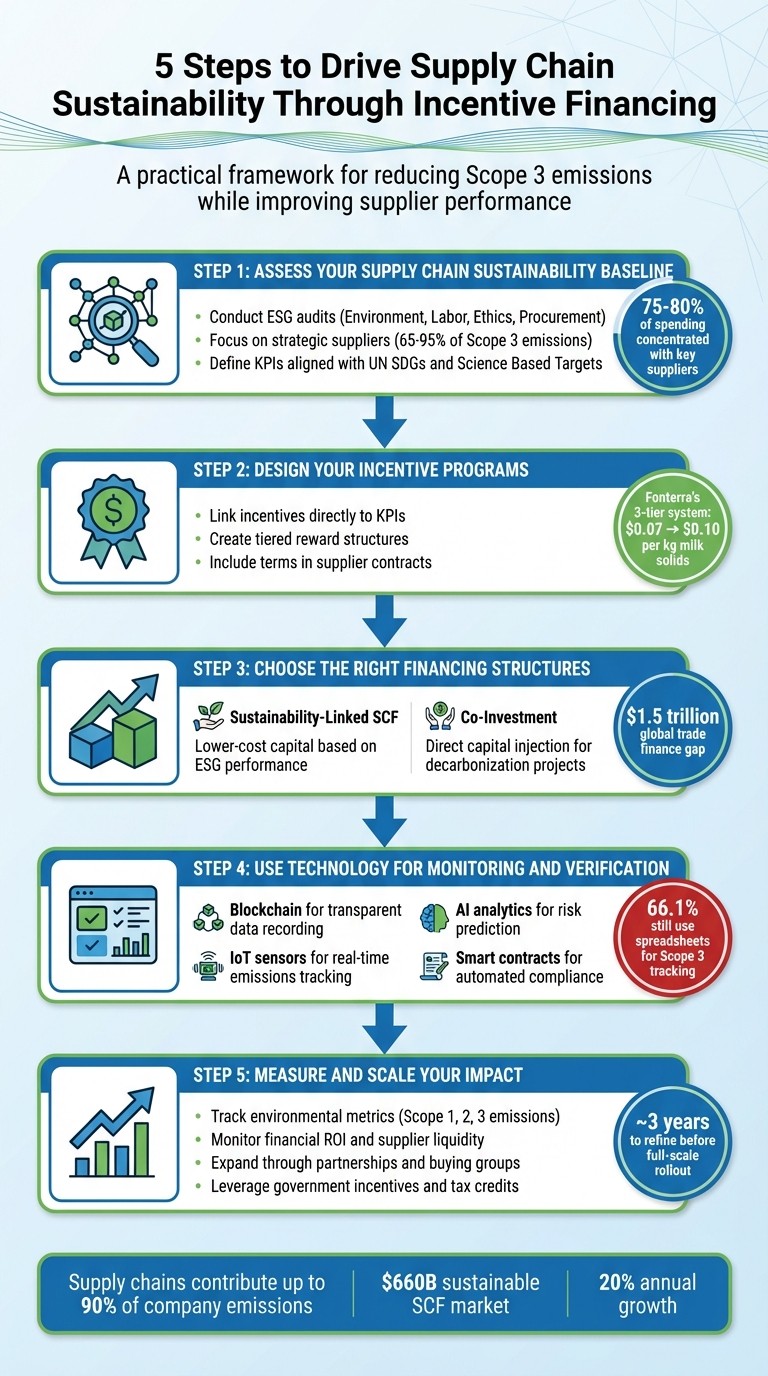
5-Step Framework for Implementing Incentive Financing in Supply Chains
Supporting the sustainability agenda through supply chain finance
Step 1: Assess Your Supply Chain Sustainability Baseline
Before creating an incentive program, it’s essential to understand the current state of your supply chain. Without a clear baseline, managing progress becomes guesswork, and you can’t effectively identify which suppliers need the most guidance or how to design impactful financial rewards [8]. Establishing this baseline transforms broad sustainability goals into actionable, measurable targets - like committing to "100% deforestation-free soy by 2025" [8].
Council Fire emphasizes that a solid baseline assessment is the foundation for crafting strategies that deliver both financial and environmental benefits. This groundwork leads to comprehensive ESG audits, which provide the detailed insights necessary for structuring effective incentives.
Conduct ESG Audits
Start by reviewing existing data. Annual sustainability reports often include third-party audits that highlight current performance and reveal any data gaps [2].
A thorough ESG audit typically examines four critical areas: Environment (e.g., carbon emissions, water use, waste), Labor & Human Rights, Ethics, and Sustainable Procurement [6]. Prioritize strategic suppliers - those that often account for 65% to 95% of Scope 3 emissions - since the majority of spending (around 75% to 80%) is usually concentrated with a small group of key suppliers [7][9].
Using third-party rating agencies like EcoVadis can enhance consistency across your supplier base. These agencies provide independent verification, which is highly valued by investors and lenders while helping avoid greenwashing concerns [2]. A notable example is Bridgestone EMIA’s 2022 Sustainable Supply Chain Financing initiative. Through the SAP Taulia platform, suppliers were required to undergo EcoVadis reporting. Suppliers demonstrating strong environmental performance earned preferential early payment interest rates [2][5].
Start with basic qualitative questions such as, "Are you measuring emissions?" and gradually move toward more detailed quantitative data. Many smaller suppliers may lack the expertise to start on their own, so offering tools like the EPA's Simplified GHG Emissions Calculator can help them establish their baselines [9].
Define Key Performance Indicators (KPIs)
The insights from ESG audits guide the creation of performance metrics that drive incentive programs. Choose KPIs that align with your company’s sustainability goals and broader frameworks like the UN Sustainable Development Goals or the Science Based Targets initiative [2][3].
Environmental KPIs focus on metrics such as carbon emissions (Scope 1, 2, and 3), energy efficiency, waste reduction, water use, and sustainable sourcing.
Social KPIs evaluate labor practices, workplace safety, and diversity efforts, such as the inclusion of minority-owned or women-owned suppliers.
Governance KPIs assess transparency, accountability, and compliance with reporting standards [1][2][7].
In June 2022, PVH Corp. (parent company of Tommy Hilfiger and Calvin Klein) collaborated with HSBC to launch a sustainability-linked supply chain finance program. This initiative utilized the Social & Labor Convergence Program (SLCP) to assess supplier performance on human rights and labor practices. Additionally, suppliers were required to set specific energy reduction targets supported by verified action plans for environmental improvements [7].
Mallory McConnell, Vice President of Corporate Responsibility at PVH Corp., highlighted the program’s impact:
"As we start to think about different kinds of incentives for our suppliers, money matters. So, this was a really great opportunity to do something that was meaningful to them" [7].
Ensure your KPIs are fair and comparable across suppliers, directly linking them to financial outcomes. The baseline data you collect will help determine which suppliers qualify for benefits like preferential interest rates and which might require further assistance to enhance their performance [4].
Step 2: Design Your Incentive Programs
After setting your baseline and defining KPIs, the next step is crafting incentive programs that inspire suppliers to meet their targets. The rewards should be meaningful enough to offset the costs of adopting more sustainable practices. As BCG and WBCSD note:
"Well-designed incentives encourage suppliers to decarbonize more than they might otherwise, while offering freedom to innovate and pursue a path forward that makes sense for their business circumstances." [4]
Council Fire collaborates with organizations to create incentive structures that balance financial feasibility with environmental goals, yielding measurable benefits for both sides.
A critical part of this process is tying financial rewards directly to measurable KPIs.
Link Incentives to KPIs
Directly connecting financial rewards to specific sustainability milestones can drive significant progress. A tiered approach allows suppliers to earn better terms as they achieve higher levels of performance. For instance, Rabobank and Coca-Cola Europacific Partners (CCEP) introduced a sustainability-linked supply chain finance program in October 2023. In this program, suppliers qualify for early payments by maintaining a target EcoVadis score. They can also unlock additional financing discounts by setting emissions reduction targets aligned with the Science Based Targets initiative (SBTi) or committing to 100% renewable energy use.
Similarly, Fonterra employs a three-tier green premium system for its approximately 9,000 farmers:
Level 1: Farmers receive an extra $0.07 per kilogram of milk solids for implementing a Farm Environment Plan.
Level 2: A total of $0.10 per kilogram is awarded for maintaining "excellent" quality levels for 30 days.
Level 3: Public recognition is granted to those sustaining these standards for 90% of the season.
These types of programs not only provide suppliers with liquidity to fund decarbonization efforts but also help buyers advance their sustainability objectives.
Once tiered incentives are in place, formalize the arrangement by embedding these terms into supplier contracts.
Include Incentives in Contracts
Incorporating incentive terms into supplier contracts ensures transparency and accountability. Contracts should clearly define the metrics that trigger rewards, outline how performance will be measured, and specify the consequences for failing to meet targets. Using sliding scales for rewards, such as premiums or discounts, can encourage incremental progress and keep suppliers motivated. Additionally, including renegotiation clauses allows for flexibility to adapt terms as circumstances evolve or as progress is made toward climate goals.
For example, Danone's "Farming for Generations" alliance uses long-term contracts to provide farmers with technical expertise and financial support as they transition to regenerative practices. This approach ensures a steady path toward decarbonization while also protecting the economic stability of suppliers.
Contracts should also spell out consequences for non-performance, such as reduced volumes or non-renewal of agreements. However, these should be balanced with benefits like early payments or green premiums to maintain a productive feedback loop. Lastly, before finalizing any incentive program, ensure your monitoring, reporting, and verification (MRV) systems are capable of accurately tracking the chosen KPIs. [4]
Step 3: Choose the Right Financing Structures
Once you've established structured incentive programs and integrated them into contracts, the next step is identifying the most effective financial mechanisms to fund these initiatives. The choice of structure depends on your suppliers' specific needs and your broader sustainability objectives. Suppliers typically require either short-term liquidity to manage operational expenses or long-term funding to support decarbonization efforts.
Globally, there is an estimated $2 trillion in secure, financeable payables, alongside a $1.5 trillion trade finance gap [1]. This creates a significant opportunity to channel capital into sustainability improvements across supply chains. The challenge lies in aligning the right financial tools with the needs of different supplier segments. Below, we explore two primary financing structures designed to meet these demands.
Sustainability-Linked Supply Chain Finance (SCF)
Sustainability-linked SCF enables suppliers to access lower-cost capital by leveraging your company's strong credit rating. In this model, a financial institution provides early payments to suppliers at discounted rates, which are adjusted based on their ESG (Environmental, Social, and Governance) performance. Suppliers demonstrating strong EcoVadis ratings or meeting Science-Based Targets benefit from reduced discount or interest rates [11][4].
This approach is particularly effective for small-to-medium enterprises (SMEs) that often face challenges with working capital. For example, the IFC's GTSF program disbursed $3.5 billion in fiscal year 2025, largely through sustainability-linked facilities [12]. A notable case is the IFC's collaboration with Levi Strauss & Co., which offers discounted financing to textile and apparel suppliers who achieve measurable reductions in greenhouse gas emissions and improve water and energy efficiency.
To ensure participation, financial incentives must be compelling. Suppliers already using conventional SCF programs need a significant rate differential to justify the additional effort required to meet sustainability targets [1]. It's worth noting that 78% of reviewed sustainable SCF programs now incorporate environmental criteria, reflecting the growing adoption of this model [11].
Co-Invest with Suppliers
For suppliers requiring substantial decarbonization investments, co-investment provides a more direct and impactful solution. This approach involves injecting capital directly into high-impact suppliers, especially those critical to achieving Scope 3 emissions reductions but lacking the resources for major infrastructure upgrades.
Co-investment ensures suppliers receive the financial support needed while maintaining their stability to meet stringent sustainability standards. For instance, the IFC teamed up with Barry Callebaut, the largest chocolate producer globally, to offer sustainability-linked pricing to sugarcane suppliers. These suppliers gain access to discounted financing rates when they meet specific decarbonization and social compliance goals [12]. Similarly, Danone's "Farming for Generations" initiative co-invests with dairy farmers, combining technical guidance with direct financial assistance to promote regenerative farming practices [4].
When implementing co-investment strategies, it's essential to prioritize suppliers where the potential impact is highest. Agreements should include clear guidelines on capital usage and robust monitoring systems to track progress. While this approach requires a larger upfront commitment compared to SCF, it offers the potential for deeper, long-lasting transformations within the supply chain.
Step 4: Use Technology for Monitoring and Verification
Once financing structures are in place, the next critical step is ensuring that sustainability improvements tied to incentive programs are actually happening. Manual audits, which can take weeks or even months, often leave room for accountability gaps and delays [13]. Digital technology offers a game-changing approach, transforming how progress is tracked, verified, and rewarded by enabling real-time updates.
Switching from manual to digital Measuring, Reporting, and Verification (dMRV) systems minimizes human error and lowers administrative costs. Instead of relying on spreadsheets and annual audits, automated systems provide continuous oversight. A 2023 study revealed that over 90% of rainforest carbon offset credits approved by a major certifier failed to represent actual emissions reductions due to inadequate manual verification processes [13]. Let’s explore the technologies making real-time monitoring reliable and effective.
Use Blockchain and Data Analytics
Blockchain technology offers a secure and transparent way to record sustainability data, accessible to all stakeholders. This distributed ledger ensures data integrity by eliminating information gaps and reducing the risk of manipulation.
Smart contracts, an integral feature of blockchain, automatically enforce agreements by triggering actions like incentive payments or rate adjustments upon verification. As BSR points out:
"Smart contracts make transactions traceable, transparent, and irreversible, the tenets of a sustainable supply chain" [1].
Artificial intelligence (AI) further enhances monitoring by analyzing complex datasets, such as satellite imagery, to track reforestation efforts or predict potential sustainability risks before they escalate. Platforms like EcoVadis are widely used for standardized sustainability scoring, helping determine supplier eligibility for preferential financing [4].
Beyond blockchain and AI, automated data capture technologies continue to refine verification processes.
Enable Real-Time Reporting
Real-time reporting replaces outdated, annual assessments with continuous monitoring, enabling immediate responses to any shortfalls. Internet of Things (IoT) sensors and smart meters automatically collect primary data - such as energy consumption, water usage, and emissions - directly from equipment and facilities. This eliminates manual data entry errors and ensures frequent updates, allowing for quicker corrective actions when targets are missed.
Despite these advancements, 66.1% of businesses still rely on spreadsheets for Scope 3 emissions tracking [14]. To move beyond this outdated method, companies should consider implementing unified data platforms with API integration. Such platforms consolidate information from suppliers, manufacturers, and logistics partners into a single, centralized system. For example, the Partnership for Carbon Transparency (PACT) framework facilitates the exchange of supplier-specific Product Carbon Footprints, enabling one company’s reporting to serve as verifiable input for another’s Scope 3 assessments [15].
In October 2023, Rabobank and Coca-Cola Europacific Partners launched a sustainability-linked supply chain financing program. Suppliers maintaining an EcoVadis score above a certain threshold received early payments, while those committing to Science Based Targets or transitioning to 100% renewable energy earned additional financial discounts [4]. This program relies entirely on real-time verification - without automated monitoring, the administrative workload would make scaling such initiatives nearly impossible.
| Technology | Role in Monitoring & Verification | Key Benefit |
| --- | --- | --- |
| <strong>Blockchain</strong> | Creates an immutable, shared ledger of sustainability claims | Reduces fraud and ensures data transparency |
| <strong>IoT / Sensors</strong> | Automates the capture of emissions and resource data | Eliminates manual errors and enables real-time tracking |
| <strong>AI / Analytics</strong> | Processes complex datasets for impact assessment | Provides granular insights and detects anomalies |
| <strong>Smart Contracts</strong> | Enforces incentive terms based on verified data | Ensures objective, automated compliance
| Technology | Role in Monitoring & Verification | Key Benefit |
| --- | --- | --- |
| <strong>Blockchain</strong> | Creates an immutable, shared ledger of sustainability claims | Reduces fraud and ensures data transparency |
| <strong>IoT / Sensors</strong> | Automates the capture of emissions and resource data | Eliminates manual errors and enables real-time tracking |
| <strong>AI / Analytics</strong> | Processes complex datasets for impact assessment | Provides granular insights and detects anomalies |
| <strong>Smart Contracts</strong> | Enforces incentive terms based on verified data | Ensures objective, automated compliance
Before rolling out your incentive program, evaluate whether your current systems can support the necessary monitoring or if new dMRV tools are required [4]. Focus on deploying IoT in high-impact areas like Scope 2 energy use, where real-time data can drive carbon-conscious decisions [13]. Opt for scalable technologies that cover a broad range of suppliers to maximize the program’s reach and efficiency.
Step 5: Measure and Scale Your Impact
Track Metrics and ROI
Demonstrating the effectiveness of your incentive program starts with tracking the right metrics. Environmental metrics should emphasize reductions in Scope 1, 2, and 3 emissions, with a particular focus on Scope 3 categories such as Category 1 (Purchased Goods and Services), Category 2 (Capital Goods), and Category 4 (Upstream Transportation and Distribution) [4]. These areas are often where the bulk of Scope 3 emissions occur.
On the financial side, metrics should capture improvements in supplier liquidity, interest rate reductions tied to sustainability-linked loans, and the recovery of "green premiums" - the ability to offset higher costs of sustainable procurement through consumer pricing [4]. Scorecards are an effective way to break down these objectives into measurable tasks across your organization. As Kai Anderson, Transformation Lead at Mercer, explains:
"What gets measured gets done. An ESG scorecard can embed sustainability metrics throughout your organization, translating strategic objectives into individual responsibilities" [17].
To ensure success, performance measures should align with your business goals, adhere to industry standards, and remain both practical and focused [16]. Before launching, establish which team or organization will handle data collection and validation to maintain the credibility of your program [16].
These metrics create the foundation for scaling your efforts.
Expand Through Partnerships and Public Incentives
Once your metrics prove the program's success, scaling up involves collaboration and resource-sharing. Broader strategies, such as forming buying groups, can pool resources and distribute incentives to thousands of suppliers more efficiently [4]. Typically, organizations concentrate on key suppliers that account for 75% to 80% of total spending. It often takes around three years of pilot testing to refine these programs before rolling them out on a larger scale [19].
Government incentives can also play a crucial role in scaling. Tax credits from the US Inflation Reduction Act, along with resources like DSIRE (Database of State Incentives for Renewables & Efficiency), can help identify grants and credits to offset costs [18][4]. A multi-faceted approach - combining grants, technical assistance, loans, credit enhancements, and tax incentives - tends to be more effective than relying on a single funding mechanism [18]. Additionally, U.S. community foundations issue approximately $5 billion in grants annually, offering significant opportunities for local sustainability initiatives [18]. Partnering with sector-specific alliances and using standardized platforms can further amplify your program's reach while simplifying reporting processes [19].
Benefits and Challenges of Incentive Financing
Incentive financing offers meaningful advantages across the board, but it also introduces some complexities that need careful management. For buyers, these programs provide a direct pathway to cutting Scope 3 emissions, which are often the most challenging to address. They also strengthen supply chain resilience, reduce market volatility, and help protect brand reputation in an era where transparency is increasingly non-negotiable [7,32].
Suppliers, especially small and medium-sized enterprises (SMEs), benefit from improved cash flow and better payment terms, which can help offset the high upfront costs of decarbonization [7,4]. Long-term contracts offer a sense of stability, while access to expert advice and technical resources supports their sustainability efforts. On the financial side, institutions gain access to a growing market, with sustainable supply chain finance expanding at a rate of roughly 20% annually [1].
However, these benefits come with challenges. Suppliers often face significant hurdles in collecting and reporting data, and smaller businesses may lack the tools or expertise to handle complex metrics [19]. Long-term contracts, while stabilizing, can also lead to overdependence on a single buyer [4]. Buyers, on the other hand, must grapple with the costs of implementing these programs, the difficulty of verifying ESG data across vast supplier networks, and the risk of profit margin reductions if higher costs ("green premiums") can't be passed on to consumers [4]. Financial institutions are not immune to challenges either, as they rely heavily on high-quality ESG data from third parties and face risks tied to "greenwashing" if verification systems fall short [4].
As BSR aptly puts it:
"Sustainable supply chain finance is an unrealized opportunity to improve supply chains while also achieving sustainability goals" [1].
The key to success lies in designing programs that balance these trade-offs. This can be achieved through thoughtful segmentation of suppliers, clear timelines, and shared responsibilities for verification. A well-structured approach ensures that benefits are maximized while challenges are effectively managed.
Comparison Table: Stakeholder Benefits and Challenges
| Stakeholder | Key Benefits | Primary Challenges |
| --- | --- | --- |
| <strong>Suppliers</strong> | Improved liquidity and favorable payment terms; stable demand through long-term contracts; access to technical expertise and green capital [7,4] | High data collection and reporting burdens; risk of losing business if targets are missed; potential overdependence on a single buyer <a href="https://www.theclimatedrive.org/action-library/creating-financial-incentives-for-suppliers" target="_blank" style="text-decoration: none;" rel="nofollow noopener noreferrer" data-framer-link="Link:{"url":"https://www.theclimatedrive.org/action-library/creating-financial-incentives-for-suppliers","type":"url"}" data-framer-open-in-new-tab=""><sup>[4]</sup></a> |
| <strong>Buyers</strong> | Direct Scope 3 emission reductions; increased supply chain resilience and reduced volatility; enhanced brand reputation and competitive edge [7,32] | Implementation costs; resource-intensive verification; margin erosion if premiums aren’t recovered; complexity in integrating ESG data [7,32] |
| <strong>Financial Institutions</strong> | New revenue streams from sustainable finance products (US$6 billion opportunity); ESG portfolio alignment; reduced credit risk through better supplier data <a href="https://www.bsr.org/en/reports/win-win-win-the-sustainable-supply-chain-finance-opportunity" target="_blank" style="text-decoration: none;" rel="nofollow noopener noreferrer" data-framer-link="Link:{"url":"https://www.bsr.org/en/reports/win-win-win-the-sustainable-supply-chain-finance-opportunity","type":"url"}" data-framer-open-in-new-tab=""><sup>[1]</sup></a> | Reliance on third-party ESG data quality; challenges in finding robust verification technology; exposure to "greenwashing" risks [1,7] |
| Stakeholder | Key Benefits | Primary Challenges |
| --- | --- | --- |
| <strong>Suppliers</strong> | Improved liquidity and favorable payment terms; stable demand through long-term contracts; access to technical expertise and green capital [7,4] | High data collection and reporting burdens; risk of losing business if targets are missed; potential overdependence on a single buyer <a href="https://www.theclimatedrive.org/action-library/creating-financial-incentives-for-suppliers" target="_blank" style="text-decoration: none;" rel="nofollow noopener noreferrer" data-framer-link="Link:{"url":"https://www.theclimatedrive.org/action-library/creating-financial-incentives-for-suppliers","type":"url"}" data-framer-open-in-new-tab=""><sup>[4]</sup></a> |
| <strong>Buyers</strong> | Direct Scope 3 emission reductions; increased supply chain resilience and reduced volatility; enhanced brand reputation and competitive edge [7,32] | Implementation costs; resource-intensive verification; margin erosion if premiums aren’t recovered; complexity in integrating ESG data [7,32] |
| <strong>Financial Institutions</strong> | New revenue streams from sustainable finance products (US$6 billion opportunity); ESG portfolio alignment; reduced credit risk through better supplier data <a href="https://www.bsr.org/en/reports/win-win-win-the-sustainable-supply-chain-finance-opportunity" target="_blank" style="text-decoration: none;" rel="nofollow noopener noreferrer" data-framer-link="Link:{"url":"https://www.bsr.org/en/reports/win-win-win-the-sustainable-supply-chain-finance-opportunity","type":"url"}" data-framer-open-in-new-tab=""><sup>[1]</sup></a> | Reliance on third-party ESG data quality; challenges in finding robust verification technology; exposure to "greenwashing" risks [1,7] |Conclusion: Using Incentives to Drive Supply Chain Sustainability
Incentive financing brings clarity and measurable results to supply chain sustainability efforts. By following the five-step framework - baseline assessment, program design, financing structure selection, technology deployment, and scaling - organizations gain a structured approach to addressing their Scope 3 emissions. Considering that supply chains account for over 80% of emissions for many companies, this framework offers a practical path forward [10].
This method not only supports environmental objectives but also reveals substantial financial benefits. With the sustainable supply chain finance market valued at $660 billion and offering a $6 billion revenue opportunity, the financial advantages are hard to ignore [1]. Examples provided in the guide highlight how these models work effectively in practice.
However, successful implementation goes beyond simply designing programs. It requires alignment among sustainability, procurement, and finance teams to ensure that incentive programs are both financially sound and operationally efficient. Incentives need to be compelling enough to engage suppliers, including those already using traditional financing, while addressing the unique challenges faced by small and medium-sized enterprises (SMEs), such as limited data and access to capital.
As highlighted by Accounting for Sustainability (A4S):
"Finance professionals have access to unique levers that can incentivize change and therefore have a vital role to play in driving action across the whole value chain" [10].
Organizations adopting incentive financing now can position themselves to capture green premiums, enhance supply chain resilience, and meet tightening regulatory standards. At the same time, they can build partnerships that deliver long-term environmental and financial benefits.
For tailored support, Council Fire (https://councilfire.org) offers expertise in leveraging incentive financing to revolutionize supply chain practices.
FAQs
How can small suppliers meet ESG goals through incentive-based financing?
Small suppliers have a clear opportunity to meet ESG goals through incentive-based financing programs that reward sustainable practices. By linking financing terms to specific, measurable sustainability metrics - such as cutting carbon emissions or enhancing social impact - businesses can benefit from advantages like reduced interest rates or more favorable repayment terms. This strategy not only aligns financial incentives with positive environmental and social outcomes but also lowers the barrier for smaller businesses to participate without requiring substantial upfront investments.
Suppliers can also consider options like sustainability-linked loans or trade finance programs designed with performance-based rewards. These programs motivate suppliers to achieve their ESG targets by offering financial perks tied directly to their progress. With a combination of well-defined sustainability objectives and supportive financial tools, small suppliers can tackle ESG compliance challenges while securing the capital they need to grow.
How does technology improve transparency and efficiency in sustainability-focused supply chain financing?
Technology is revolutionizing how organizations approach transparency and efficiency in sustainability-linked supply chain finance. With the help of digital tools, companies can now track, gather, and analyze environmental, social, and governance (ESG) metrics in real time. This allows for precise verification of supplier compliance with sustainability standards, minimizing the reliance on manual processes.
Sophisticated platforms also streamline monitoring, enabling businesses to connect financial incentives - such as discounts or favorable payment terms - to verified ESG performance. These systems deliver clear reporting and quantifiable outcomes, building trust and accountability among stakeholders. By integrating these technologies, organizations can effectively advance their sustainability objectives throughout the supply chain.
How can businesses manage the costs of incentive financing while achieving environmental sustainability?
Businesses have the opportunity to manage the costs of incentive financing by aligning financial incentives with their sustainability objectives. This strategy not only motivates suppliers to embrace eco-friendly practices but also generates lasting value throughout the supply chain.
When companies design incentives to meet the unique needs of their suppliers and embed these incentives into a broader sustainability plan, they can minimize risks, boost operational efficiency, and improve their environmental footprint. Over time, such efforts can translate into tangible cost savings and more resilient supplier partnerships, proving that sustainability can be both economically and environmentally advantageous.
Related Blog Posts
Latest Articles
©2025



FAQ
01
What does it really mean to “redefine profit”?
02
What makes Council Fire different?
03
Who does Council Fire you work with?
04
What does working with Council Fire actually look like?
05
How does Council Fire help organizations turn big goals into action?
06
How does Council Fire define and measure success?
Jan 30, 2026
How Incentive Financing Drives Supply Chain Sustainability
ESG Strategy
In This Article
How sustainability-linked financing, KPIs, contracts and real-time verification unlock supplier funding and cut Scope 3 emissions.
How Incentive Financing Drives Supply Chain Sustainability
Supply chains contribute up to 90% of a company’s emissions, making supplier collaboration essential for reducing environmental impacts. Incentive financing offers a practical solution by tying financial rewards to sustainability goals, helping suppliers access funding while encouraging greener practices. Here’s how it works:
What It Is: Programs like Sustainable Supply Chain Finance (SSCF) reward suppliers for meeting Environmental, Social, and Governance (ESG) targets with benefits like lower interest rates or faster payments.
Why It Matters: Supply chains dominate emissions, but many suppliers lack resources to act. Incentive financing bridges this gap, addressing a $1.5 trillion global trade finance shortfall.
How It Works: Buyers assess supplier performance through ESG audits, set measurable KPIs, and offer tiered financial rewards for progress. Tools like blockchain and IoT ensure transparency and real-time monitoring.
5-Step Framework for Implementing Incentive Financing in Supply Chains
Supporting the sustainability agenda through supply chain finance
Step 1: Assess Your Supply Chain Sustainability Baseline
Before creating an incentive program, it’s essential to understand the current state of your supply chain. Without a clear baseline, managing progress becomes guesswork, and you can’t effectively identify which suppliers need the most guidance or how to design impactful financial rewards [8]. Establishing this baseline transforms broad sustainability goals into actionable, measurable targets - like committing to "100% deforestation-free soy by 2025" [8].
Council Fire emphasizes that a solid baseline assessment is the foundation for crafting strategies that deliver both financial and environmental benefits. This groundwork leads to comprehensive ESG audits, which provide the detailed insights necessary for structuring effective incentives.
Conduct ESG Audits
Start by reviewing existing data. Annual sustainability reports often include third-party audits that highlight current performance and reveal any data gaps [2].
A thorough ESG audit typically examines four critical areas: Environment (e.g., carbon emissions, water use, waste), Labor & Human Rights, Ethics, and Sustainable Procurement [6]. Prioritize strategic suppliers - those that often account for 65% to 95% of Scope 3 emissions - since the majority of spending (around 75% to 80%) is usually concentrated with a small group of key suppliers [7][9].
Using third-party rating agencies like EcoVadis can enhance consistency across your supplier base. These agencies provide independent verification, which is highly valued by investors and lenders while helping avoid greenwashing concerns [2]. A notable example is Bridgestone EMIA’s 2022 Sustainable Supply Chain Financing initiative. Through the SAP Taulia platform, suppliers were required to undergo EcoVadis reporting. Suppliers demonstrating strong environmental performance earned preferential early payment interest rates [2][5].
Start with basic qualitative questions such as, "Are you measuring emissions?" and gradually move toward more detailed quantitative data. Many smaller suppliers may lack the expertise to start on their own, so offering tools like the EPA's Simplified GHG Emissions Calculator can help them establish their baselines [9].
Define Key Performance Indicators (KPIs)
The insights from ESG audits guide the creation of performance metrics that drive incentive programs. Choose KPIs that align with your company’s sustainability goals and broader frameworks like the UN Sustainable Development Goals or the Science Based Targets initiative [2][3].
Environmental KPIs focus on metrics such as carbon emissions (Scope 1, 2, and 3), energy efficiency, waste reduction, water use, and sustainable sourcing.
Social KPIs evaluate labor practices, workplace safety, and diversity efforts, such as the inclusion of minority-owned or women-owned suppliers.
Governance KPIs assess transparency, accountability, and compliance with reporting standards [1][2][7].
In June 2022, PVH Corp. (parent company of Tommy Hilfiger and Calvin Klein) collaborated with HSBC to launch a sustainability-linked supply chain finance program. This initiative utilized the Social & Labor Convergence Program (SLCP) to assess supplier performance on human rights and labor practices. Additionally, suppliers were required to set specific energy reduction targets supported by verified action plans for environmental improvements [7].
Mallory McConnell, Vice President of Corporate Responsibility at PVH Corp., highlighted the program’s impact:
"As we start to think about different kinds of incentives for our suppliers, money matters. So, this was a really great opportunity to do something that was meaningful to them" [7].
Ensure your KPIs are fair and comparable across suppliers, directly linking them to financial outcomes. The baseline data you collect will help determine which suppliers qualify for benefits like preferential interest rates and which might require further assistance to enhance their performance [4].
Step 2: Design Your Incentive Programs
After setting your baseline and defining KPIs, the next step is crafting incentive programs that inspire suppliers to meet their targets. The rewards should be meaningful enough to offset the costs of adopting more sustainable practices. As BCG and WBCSD note:
"Well-designed incentives encourage suppliers to decarbonize more than they might otherwise, while offering freedom to innovate and pursue a path forward that makes sense for their business circumstances." [4]
Council Fire collaborates with organizations to create incentive structures that balance financial feasibility with environmental goals, yielding measurable benefits for both sides.
A critical part of this process is tying financial rewards directly to measurable KPIs.
Link Incentives to KPIs
Directly connecting financial rewards to specific sustainability milestones can drive significant progress. A tiered approach allows suppliers to earn better terms as they achieve higher levels of performance. For instance, Rabobank and Coca-Cola Europacific Partners (CCEP) introduced a sustainability-linked supply chain finance program in October 2023. In this program, suppliers qualify for early payments by maintaining a target EcoVadis score. They can also unlock additional financing discounts by setting emissions reduction targets aligned with the Science Based Targets initiative (SBTi) or committing to 100% renewable energy use.
Similarly, Fonterra employs a three-tier green premium system for its approximately 9,000 farmers:
Level 1: Farmers receive an extra $0.07 per kilogram of milk solids for implementing a Farm Environment Plan.
Level 2: A total of $0.10 per kilogram is awarded for maintaining "excellent" quality levels for 30 days.
Level 3: Public recognition is granted to those sustaining these standards for 90% of the season.
These types of programs not only provide suppliers with liquidity to fund decarbonization efforts but also help buyers advance their sustainability objectives.
Once tiered incentives are in place, formalize the arrangement by embedding these terms into supplier contracts.
Include Incentives in Contracts
Incorporating incentive terms into supplier contracts ensures transparency and accountability. Contracts should clearly define the metrics that trigger rewards, outline how performance will be measured, and specify the consequences for failing to meet targets. Using sliding scales for rewards, such as premiums or discounts, can encourage incremental progress and keep suppliers motivated. Additionally, including renegotiation clauses allows for flexibility to adapt terms as circumstances evolve or as progress is made toward climate goals.
For example, Danone's "Farming for Generations" alliance uses long-term contracts to provide farmers with technical expertise and financial support as they transition to regenerative practices. This approach ensures a steady path toward decarbonization while also protecting the economic stability of suppliers.
Contracts should also spell out consequences for non-performance, such as reduced volumes or non-renewal of agreements. However, these should be balanced with benefits like early payments or green premiums to maintain a productive feedback loop. Lastly, before finalizing any incentive program, ensure your monitoring, reporting, and verification (MRV) systems are capable of accurately tracking the chosen KPIs. [4]
Step 3: Choose the Right Financing Structures
Once you've established structured incentive programs and integrated them into contracts, the next step is identifying the most effective financial mechanisms to fund these initiatives. The choice of structure depends on your suppliers' specific needs and your broader sustainability objectives. Suppliers typically require either short-term liquidity to manage operational expenses or long-term funding to support decarbonization efforts.
Globally, there is an estimated $2 trillion in secure, financeable payables, alongside a $1.5 trillion trade finance gap [1]. This creates a significant opportunity to channel capital into sustainability improvements across supply chains. The challenge lies in aligning the right financial tools with the needs of different supplier segments. Below, we explore two primary financing structures designed to meet these demands.
Sustainability-Linked Supply Chain Finance (SCF)
Sustainability-linked SCF enables suppliers to access lower-cost capital by leveraging your company's strong credit rating. In this model, a financial institution provides early payments to suppliers at discounted rates, which are adjusted based on their ESG (Environmental, Social, and Governance) performance. Suppliers demonstrating strong EcoVadis ratings or meeting Science-Based Targets benefit from reduced discount or interest rates [11][4].
This approach is particularly effective for small-to-medium enterprises (SMEs) that often face challenges with working capital. For example, the IFC's GTSF program disbursed $3.5 billion in fiscal year 2025, largely through sustainability-linked facilities [12]. A notable case is the IFC's collaboration with Levi Strauss & Co., which offers discounted financing to textile and apparel suppliers who achieve measurable reductions in greenhouse gas emissions and improve water and energy efficiency.
To ensure participation, financial incentives must be compelling. Suppliers already using conventional SCF programs need a significant rate differential to justify the additional effort required to meet sustainability targets [1]. It's worth noting that 78% of reviewed sustainable SCF programs now incorporate environmental criteria, reflecting the growing adoption of this model [11].
Co-Invest with Suppliers
For suppliers requiring substantial decarbonization investments, co-investment provides a more direct and impactful solution. This approach involves injecting capital directly into high-impact suppliers, especially those critical to achieving Scope 3 emissions reductions but lacking the resources for major infrastructure upgrades.
Co-investment ensures suppliers receive the financial support needed while maintaining their stability to meet stringent sustainability standards. For instance, the IFC teamed up with Barry Callebaut, the largest chocolate producer globally, to offer sustainability-linked pricing to sugarcane suppliers. These suppliers gain access to discounted financing rates when they meet specific decarbonization and social compliance goals [12]. Similarly, Danone's "Farming for Generations" initiative co-invests with dairy farmers, combining technical guidance with direct financial assistance to promote regenerative farming practices [4].
When implementing co-investment strategies, it's essential to prioritize suppliers where the potential impact is highest. Agreements should include clear guidelines on capital usage and robust monitoring systems to track progress. While this approach requires a larger upfront commitment compared to SCF, it offers the potential for deeper, long-lasting transformations within the supply chain.
Step 4: Use Technology for Monitoring and Verification
Once financing structures are in place, the next critical step is ensuring that sustainability improvements tied to incentive programs are actually happening. Manual audits, which can take weeks or even months, often leave room for accountability gaps and delays [13]. Digital technology offers a game-changing approach, transforming how progress is tracked, verified, and rewarded by enabling real-time updates.
Switching from manual to digital Measuring, Reporting, and Verification (dMRV) systems minimizes human error and lowers administrative costs. Instead of relying on spreadsheets and annual audits, automated systems provide continuous oversight. A 2023 study revealed that over 90% of rainforest carbon offset credits approved by a major certifier failed to represent actual emissions reductions due to inadequate manual verification processes [13]. Let’s explore the technologies making real-time monitoring reliable and effective.
Use Blockchain and Data Analytics
Blockchain technology offers a secure and transparent way to record sustainability data, accessible to all stakeholders. This distributed ledger ensures data integrity by eliminating information gaps and reducing the risk of manipulation.
Smart contracts, an integral feature of blockchain, automatically enforce agreements by triggering actions like incentive payments or rate adjustments upon verification. As BSR points out:
"Smart contracts make transactions traceable, transparent, and irreversible, the tenets of a sustainable supply chain" [1].
Artificial intelligence (AI) further enhances monitoring by analyzing complex datasets, such as satellite imagery, to track reforestation efforts or predict potential sustainability risks before they escalate. Platforms like EcoVadis are widely used for standardized sustainability scoring, helping determine supplier eligibility for preferential financing [4].
Beyond blockchain and AI, automated data capture technologies continue to refine verification processes.
Enable Real-Time Reporting
Real-time reporting replaces outdated, annual assessments with continuous monitoring, enabling immediate responses to any shortfalls. Internet of Things (IoT) sensors and smart meters automatically collect primary data - such as energy consumption, water usage, and emissions - directly from equipment and facilities. This eliminates manual data entry errors and ensures frequent updates, allowing for quicker corrective actions when targets are missed.
Despite these advancements, 66.1% of businesses still rely on spreadsheets for Scope 3 emissions tracking [14]. To move beyond this outdated method, companies should consider implementing unified data platforms with API integration. Such platforms consolidate information from suppliers, manufacturers, and logistics partners into a single, centralized system. For example, the Partnership for Carbon Transparency (PACT) framework facilitates the exchange of supplier-specific Product Carbon Footprints, enabling one company’s reporting to serve as verifiable input for another’s Scope 3 assessments [15].
In October 2023, Rabobank and Coca-Cola Europacific Partners launched a sustainability-linked supply chain financing program. Suppliers maintaining an EcoVadis score above a certain threshold received early payments, while those committing to Science Based Targets or transitioning to 100% renewable energy earned additional financial discounts [4]. This program relies entirely on real-time verification - without automated monitoring, the administrative workload would make scaling such initiatives nearly impossible.
| Technology | Role in Monitoring & Verification | Key Benefit |
| --- | --- | --- |
| <strong>Blockchain</strong> | Creates an immutable, shared ledger of sustainability claims | Reduces fraud and ensures data transparency |
| <strong>IoT / Sensors</strong> | Automates the capture of emissions and resource data | Eliminates manual errors and enables real-time tracking |
| <strong>AI / Analytics</strong> | Processes complex datasets for impact assessment | Provides granular insights and detects anomalies |
| <strong>Smart Contracts</strong> | Enforces incentive terms based on verified data | Ensures objective, automated compliance
Before rolling out your incentive program, evaluate whether your current systems can support the necessary monitoring or if new dMRV tools are required [4]. Focus on deploying IoT in high-impact areas like Scope 2 energy use, where real-time data can drive carbon-conscious decisions [13]. Opt for scalable technologies that cover a broad range of suppliers to maximize the program’s reach and efficiency.
Step 5: Measure and Scale Your Impact
Track Metrics and ROI
Demonstrating the effectiveness of your incentive program starts with tracking the right metrics. Environmental metrics should emphasize reductions in Scope 1, 2, and 3 emissions, with a particular focus on Scope 3 categories such as Category 1 (Purchased Goods and Services), Category 2 (Capital Goods), and Category 4 (Upstream Transportation and Distribution) [4]. These areas are often where the bulk of Scope 3 emissions occur.
On the financial side, metrics should capture improvements in supplier liquidity, interest rate reductions tied to sustainability-linked loans, and the recovery of "green premiums" - the ability to offset higher costs of sustainable procurement through consumer pricing [4]. Scorecards are an effective way to break down these objectives into measurable tasks across your organization. As Kai Anderson, Transformation Lead at Mercer, explains:
"What gets measured gets done. An ESG scorecard can embed sustainability metrics throughout your organization, translating strategic objectives into individual responsibilities" [17].
To ensure success, performance measures should align with your business goals, adhere to industry standards, and remain both practical and focused [16]. Before launching, establish which team or organization will handle data collection and validation to maintain the credibility of your program [16].
These metrics create the foundation for scaling your efforts.
Expand Through Partnerships and Public Incentives
Once your metrics prove the program's success, scaling up involves collaboration and resource-sharing. Broader strategies, such as forming buying groups, can pool resources and distribute incentives to thousands of suppliers more efficiently [4]. Typically, organizations concentrate on key suppliers that account for 75% to 80% of total spending. It often takes around three years of pilot testing to refine these programs before rolling them out on a larger scale [19].
Government incentives can also play a crucial role in scaling. Tax credits from the US Inflation Reduction Act, along with resources like DSIRE (Database of State Incentives for Renewables & Efficiency), can help identify grants and credits to offset costs [18][4]. A multi-faceted approach - combining grants, technical assistance, loans, credit enhancements, and tax incentives - tends to be more effective than relying on a single funding mechanism [18]. Additionally, U.S. community foundations issue approximately $5 billion in grants annually, offering significant opportunities for local sustainability initiatives [18]. Partnering with sector-specific alliances and using standardized platforms can further amplify your program's reach while simplifying reporting processes [19].
Benefits and Challenges of Incentive Financing
Incentive financing offers meaningful advantages across the board, but it also introduces some complexities that need careful management. For buyers, these programs provide a direct pathway to cutting Scope 3 emissions, which are often the most challenging to address. They also strengthen supply chain resilience, reduce market volatility, and help protect brand reputation in an era where transparency is increasingly non-negotiable [7,32].
Suppliers, especially small and medium-sized enterprises (SMEs), benefit from improved cash flow and better payment terms, which can help offset the high upfront costs of decarbonization [7,4]. Long-term contracts offer a sense of stability, while access to expert advice and technical resources supports their sustainability efforts. On the financial side, institutions gain access to a growing market, with sustainable supply chain finance expanding at a rate of roughly 20% annually [1].
However, these benefits come with challenges. Suppliers often face significant hurdles in collecting and reporting data, and smaller businesses may lack the tools or expertise to handle complex metrics [19]. Long-term contracts, while stabilizing, can also lead to overdependence on a single buyer [4]. Buyers, on the other hand, must grapple with the costs of implementing these programs, the difficulty of verifying ESG data across vast supplier networks, and the risk of profit margin reductions if higher costs ("green premiums") can't be passed on to consumers [4]. Financial institutions are not immune to challenges either, as they rely heavily on high-quality ESG data from third parties and face risks tied to "greenwashing" if verification systems fall short [4].
As BSR aptly puts it:
"Sustainable supply chain finance is an unrealized opportunity to improve supply chains while also achieving sustainability goals" [1].
The key to success lies in designing programs that balance these trade-offs. This can be achieved through thoughtful segmentation of suppliers, clear timelines, and shared responsibilities for verification. A well-structured approach ensures that benefits are maximized while challenges are effectively managed.
Comparison Table: Stakeholder Benefits and Challenges
| Stakeholder | Key Benefits | Primary Challenges |
| --- | --- | --- |
| <strong>Suppliers</strong> | Improved liquidity and favorable payment terms; stable demand through long-term contracts; access to technical expertise and green capital [7,4] | High data collection and reporting burdens; risk of losing business if targets are missed; potential overdependence on a single buyer <a href="https://www.theclimatedrive.org/action-library/creating-financial-incentives-for-suppliers" target="_blank" style="text-decoration: none;" rel="nofollow noopener noreferrer" data-framer-link="Link:{"url":"https://www.theclimatedrive.org/action-library/creating-financial-incentives-for-suppliers","type":"url"}" data-framer-open-in-new-tab=""><sup>[4]</sup></a> |
| <strong>Buyers</strong> | Direct Scope 3 emission reductions; increased supply chain resilience and reduced volatility; enhanced brand reputation and competitive edge [7,32] | Implementation costs; resource-intensive verification; margin erosion if premiums aren’t recovered; complexity in integrating ESG data [7,32] |
| <strong>Financial Institutions</strong> | New revenue streams from sustainable finance products (US$6 billion opportunity); ESG portfolio alignment; reduced credit risk through better supplier data <a href="https://www.bsr.org/en/reports/win-win-win-the-sustainable-supply-chain-finance-opportunity" target="_blank" style="text-decoration: none;" rel="nofollow noopener noreferrer" data-framer-link="Link:{"url":"https://www.bsr.org/en/reports/win-win-win-the-sustainable-supply-chain-finance-opportunity","type":"url"}" data-framer-open-in-new-tab=""><sup>[1]</sup></a> | Reliance on third-party ESG data quality; challenges in finding robust verification technology; exposure to "greenwashing" risks [1,7] |
Conclusion: Using Incentives to Drive Supply Chain Sustainability
Incentive financing brings clarity and measurable results to supply chain sustainability efforts. By following the five-step framework - baseline assessment, program design, financing structure selection, technology deployment, and scaling - organizations gain a structured approach to addressing their Scope 3 emissions. Considering that supply chains account for over 80% of emissions for many companies, this framework offers a practical path forward [10].
This method not only supports environmental objectives but also reveals substantial financial benefits. With the sustainable supply chain finance market valued at $660 billion and offering a $6 billion revenue opportunity, the financial advantages are hard to ignore [1]. Examples provided in the guide highlight how these models work effectively in practice.
However, successful implementation goes beyond simply designing programs. It requires alignment among sustainability, procurement, and finance teams to ensure that incentive programs are both financially sound and operationally efficient. Incentives need to be compelling enough to engage suppliers, including those already using traditional financing, while addressing the unique challenges faced by small and medium-sized enterprises (SMEs), such as limited data and access to capital.
As highlighted by Accounting for Sustainability (A4S):
"Finance professionals have access to unique levers that can incentivize change and therefore have a vital role to play in driving action across the whole value chain" [10].
Organizations adopting incentive financing now can position themselves to capture green premiums, enhance supply chain resilience, and meet tightening regulatory standards. At the same time, they can build partnerships that deliver long-term environmental and financial benefits.
For tailored support, Council Fire (https://councilfire.org) offers expertise in leveraging incentive financing to revolutionize supply chain practices.
FAQs
How can small suppliers meet ESG goals through incentive-based financing?
Small suppliers have a clear opportunity to meet ESG goals through incentive-based financing programs that reward sustainable practices. By linking financing terms to specific, measurable sustainability metrics - such as cutting carbon emissions or enhancing social impact - businesses can benefit from advantages like reduced interest rates or more favorable repayment terms. This strategy not only aligns financial incentives with positive environmental and social outcomes but also lowers the barrier for smaller businesses to participate without requiring substantial upfront investments.
Suppliers can also consider options like sustainability-linked loans or trade finance programs designed with performance-based rewards. These programs motivate suppliers to achieve their ESG targets by offering financial perks tied directly to their progress. With a combination of well-defined sustainability objectives and supportive financial tools, small suppliers can tackle ESG compliance challenges while securing the capital they need to grow.
How does technology improve transparency and efficiency in sustainability-focused supply chain financing?
Technology is revolutionizing how organizations approach transparency and efficiency in sustainability-linked supply chain finance. With the help of digital tools, companies can now track, gather, and analyze environmental, social, and governance (ESG) metrics in real time. This allows for precise verification of supplier compliance with sustainability standards, minimizing the reliance on manual processes.
Sophisticated platforms also streamline monitoring, enabling businesses to connect financial incentives - such as discounts or favorable payment terms - to verified ESG performance. These systems deliver clear reporting and quantifiable outcomes, building trust and accountability among stakeholders. By integrating these technologies, organizations can effectively advance their sustainability objectives throughout the supply chain.
How can businesses manage the costs of incentive financing while achieving environmental sustainability?
Businesses have the opportunity to manage the costs of incentive financing by aligning financial incentives with their sustainability objectives. This strategy not only motivates suppliers to embrace eco-friendly practices but also generates lasting value throughout the supply chain.
When companies design incentives to meet the unique needs of their suppliers and embed these incentives into a broader sustainability plan, they can minimize risks, boost operational efficiency, and improve their environmental footprint. Over time, such efforts can translate into tangible cost savings and more resilient supplier partnerships, proving that sustainability can be both economically and environmentally advantageous.
Related Blog Posts
FAQ
01
What does it really mean to “redefine profit”?
02
What makes Council Fire different?
03
Who does Council Fire you work with?
04
What does working with Council Fire actually look like?
05
How does Council Fire help organizations turn big goals into action?
06
How does Council Fire define and measure success?
Jan 30, 2026
How Incentive Financing Drives Supply Chain Sustainability
ESG Strategy
In This Article
How sustainability-linked financing, KPIs, contracts and real-time verification unlock supplier funding and cut Scope 3 emissions.
How Incentive Financing Drives Supply Chain Sustainability
Supply chains contribute up to 90% of a company’s emissions, making supplier collaboration essential for reducing environmental impacts. Incentive financing offers a practical solution by tying financial rewards to sustainability goals, helping suppliers access funding while encouraging greener practices. Here’s how it works:
What It Is: Programs like Sustainable Supply Chain Finance (SSCF) reward suppliers for meeting Environmental, Social, and Governance (ESG) targets with benefits like lower interest rates or faster payments.
Why It Matters: Supply chains dominate emissions, but many suppliers lack resources to act. Incentive financing bridges this gap, addressing a $1.5 trillion global trade finance shortfall.
How It Works: Buyers assess supplier performance through ESG audits, set measurable KPIs, and offer tiered financial rewards for progress. Tools like blockchain and IoT ensure transparency and real-time monitoring.
5-Step Framework for Implementing Incentive Financing in Supply Chains
Supporting the sustainability agenda through supply chain finance
Step 1: Assess Your Supply Chain Sustainability Baseline
Before creating an incentive program, it’s essential to understand the current state of your supply chain. Without a clear baseline, managing progress becomes guesswork, and you can’t effectively identify which suppliers need the most guidance or how to design impactful financial rewards [8]. Establishing this baseline transforms broad sustainability goals into actionable, measurable targets - like committing to "100% deforestation-free soy by 2025" [8].
Council Fire emphasizes that a solid baseline assessment is the foundation for crafting strategies that deliver both financial and environmental benefits. This groundwork leads to comprehensive ESG audits, which provide the detailed insights necessary for structuring effective incentives.
Conduct ESG Audits
Start by reviewing existing data. Annual sustainability reports often include third-party audits that highlight current performance and reveal any data gaps [2].
A thorough ESG audit typically examines four critical areas: Environment (e.g., carbon emissions, water use, waste), Labor & Human Rights, Ethics, and Sustainable Procurement [6]. Prioritize strategic suppliers - those that often account for 65% to 95% of Scope 3 emissions - since the majority of spending (around 75% to 80%) is usually concentrated with a small group of key suppliers [7][9].
Using third-party rating agencies like EcoVadis can enhance consistency across your supplier base. These agencies provide independent verification, which is highly valued by investors and lenders while helping avoid greenwashing concerns [2]. A notable example is Bridgestone EMIA’s 2022 Sustainable Supply Chain Financing initiative. Through the SAP Taulia platform, suppliers were required to undergo EcoVadis reporting. Suppliers demonstrating strong environmental performance earned preferential early payment interest rates [2][5].
Start with basic qualitative questions such as, "Are you measuring emissions?" and gradually move toward more detailed quantitative data. Many smaller suppliers may lack the expertise to start on their own, so offering tools like the EPA's Simplified GHG Emissions Calculator can help them establish their baselines [9].
Define Key Performance Indicators (KPIs)
The insights from ESG audits guide the creation of performance metrics that drive incentive programs. Choose KPIs that align with your company’s sustainability goals and broader frameworks like the UN Sustainable Development Goals or the Science Based Targets initiative [2][3].
Environmental KPIs focus on metrics such as carbon emissions (Scope 1, 2, and 3), energy efficiency, waste reduction, water use, and sustainable sourcing.
Social KPIs evaluate labor practices, workplace safety, and diversity efforts, such as the inclusion of minority-owned or women-owned suppliers.
Governance KPIs assess transparency, accountability, and compliance with reporting standards [1][2][7].
In June 2022, PVH Corp. (parent company of Tommy Hilfiger and Calvin Klein) collaborated with HSBC to launch a sustainability-linked supply chain finance program. This initiative utilized the Social & Labor Convergence Program (SLCP) to assess supplier performance on human rights and labor practices. Additionally, suppliers were required to set specific energy reduction targets supported by verified action plans for environmental improvements [7].
Mallory McConnell, Vice President of Corporate Responsibility at PVH Corp., highlighted the program’s impact:
"As we start to think about different kinds of incentives for our suppliers, money matters. So, this was a really great opportunity to do something that was meaningful to them" [7].
Ensure your KPIs are fair and comparable across suppliers, directly linking them to financial outcomes. The baseline data you collect will help determine which suppliers qualify for benefits like preferential interest rates and which might require further assistance to enhance their performance [4].
Step 2: Design Your Incentive Programs
After setting your baseline and defining KPIs, the next step is crafting incentive programs that inspire suppliers to meet their targets. The rewards should be meaningful enough to offset the costs of adopting more sustainable practices. As BCG and WBCSD note:
"Well-designed incentives encourage suppliers to decarbonize more than they might otherwise, while offering freedom to innovate and pursue a path forward that makes sense for their business circumstances." [4]
Council Fire collaborates with organizations to create incentive structures that balance financial feasibility with environmental goals, yielding measurable benefits for both sides.
A critical part of this process is tying financial rewards directly to measurable KPIs.
Link Incentives to KPIs
Directly connecting financial rewards to specific sustainability milestones can drive significant progress. A tiered approach allows suppliers to earn better terms as they achieve higher levels of performance. For instance, Rabobank and Coca-Cola Europacific Partners (CCEP) introduced a sustainability-linked supply chain finance program in October 2023. In this program, suppliers qualify for early payments by maintaining a target EcoVadis score. They can also unlock additional financing discounts by setting emissions reduction targets aligned with the Science Based Targets initiative (SBTi) or committing to 100% renewable energy use.
Similarly, Fonterra employs a three-tier green premium system for its approximately 9,000 farmers:
Level 1: Farmers receive an extra $0.07 per kilogram of milk solids for implementing a Farm Environment Plan.
Level 2: A total of $0.10 per kilogram is awarded for maintaining "excellent" quality levels for 30 days.
Level 3: Public recognition is granted to those sustaining these standards for 90% of the season.
These types of programs not only provide suppliers with liquidity to fund decarbonization efforts but also help buyers advance their sustainability objectives.
Once tiered incentives are in place, formalize the arrangement by embedding these terms into supplier contracts.
Include Incentives in Contracts
Incorporating incentive terms into supplier contracts ensures transparency and accountability. Contracts should clearly define the metrics that trigger rewards, outline how performance will be measured, and specify the consequences for failing to meet targets. Using sliding scales for rewards, such as premiums or discounts, can encourage incremental progress and keep suppliers motivated. Additionally, including renegotiation clauses allows for flexibility to adapt terms as circumstances evolve or as progress is made toward climate goals.
For example, Danone's "Farming for Generations" alliance uses long-term contracts to provide farmers with technical expertise and financial support as they transition to regenerative practices. This approach ensures a steady path toward decarbonization while also protecting the economic stability of suppliers.
Contracts should also spell out consequences for non-performance, such as reduced volumes or non-renewal of agreements. However, these should be balanced with benefits like early payments or green premiums to maintain a productive feedback loop. Lastly, before finalizing any incentive program, ensure your monitoring, reporting, and verification (MRV) systems are capable of accurately tracking the chosen KPIs. [4]
Step 3: Choose the Right Financing Structures
Once you've established structured incentive programs and integrated them into contracts, the next step is identifying the most effective financial mechanisms to fund these initiatives. The choice of structure depends on your suppliers' specific needs and your broader sustainability objectives. Suppliers typically require either short-term liquidity to manage operational expenses or long-term funding to support decarbonization efforts.
Globally, there is an estimated $2 trillion in secure, financeable payables, alongside a $1.5 trillion trade finance gap [1]. This creates a significant opportunity to channel capital into sustainability improvements across supply chains. The challenge lies in aligning the right financial tools with the needs of different supplier segments. Below, we explore two primary financing structures designed to meet these demands.
Sustainability-Linked Supply Chain Finance (SCF)
Sustainability-linked SCF enables suppliers to access lower-cost capital by leveraging your company's strong credit rating. In this model, a financial institution provides early payments to suppliers at discounted rates, which are adjusted based on their ESG (Environmental, Social, and Governance) performance. Suppliers demonstrating strong EcoVadis ratings or meeting Science-Based Targets benefit from reduced discount or interest rates [11][4].
This approach is particularly effective for small-to-medium enterprises (SMEs) that often face challenges with working capital. For example, the IFC's GTSF program disbursed $3.5 billion in fiscal year 2025, largely through sustainability-linked facilities [12]. A notable case is the IFC's collaboration with Levi Strauss & Co., which offers discounted financing to textile and apparel suppliers who achieve measurable reductions in greenhouse gas emissions and improve water and energy efficiency.
To ensure participation, financial incentives must be compelling. Suppliers already using conventional SCF programs need a significant rate differential to justify the additional effort required to meet sustainability targets [1]. It's worth noting that 78% of reviewed sustainable SCF programs now incorporate environmental criteria, reflecting the growing adoption of this model [11].
Co-Invest with Suppliers
For suppliers requiring substantial decarbonization investments, co-investment provides a more direct and impactful solution. This approach involves injecting capital directly into high-impact suppliers, especially those critical to achieving Scope 3 emissions reductions but lacking the resources for major infrastructure upgrades.
Co-investment ensures suppliers receive the financial support needed while maintaining their stability to meet stringent sustainability standards. For instance, the IFC teamed up with Barry Callebaut, the largest chocolate producer globally, to offer sustainability-linked pricing to sugarcane suppliers. These suppliers gain access to discounted financing rates when they meet specific decarbonization and social compliance goals [12]. Similarly, Danone's "Farming for Generations" initiative co-invests with dairy farmers, combining technical guidance with direct financial assistance to promote regenerative farming practices [4].
When implementing co-investment strategies, it's essential to prioritize suppliers where the potential impact is highest. Agreements should include clear guidelines on capital usage and robust monitoring systems to track progress. While this approach requires a larger upfront commitment compared to SCF, it offers the potential for deeper, long-lasting transformations within the supply chain.
Step 4: Use Technology for Monitoring and Verification
Once financing structures are in place, the next critical step is ensuring that sustainability improvements tied to incentive programs are actually happening. Manual audits, which can take weeks or even months, often leave room for accountability gaps and delays [13]. Digital technology offers a game-changing approach, transforming how progress is tracked, verified, and rewarded by enabling real-time updates.
Switching from manual to digital Measuring, Reporting, and Verification (dMRV) systems minimizes human error and lowers administrative costs. Instead of relying on spreadsheets and annual audits, automated systems provide continuous oversight. A 2023 study revealed that over 90% of rainforest carbon offset credits approved by a major certifier failed to represent actual emissions reductions due to inadequate manual verification processes [13]. Let’s explore the technologies making real-time monitoring reliable and effective.
Use Blockchain and Data Analytics
Blockchain technology offers a secure and transparent way to record sustainability data, accessible to all stakeholders. This distributed ledger ensures data integrity by eliminating information gaps and reducing the risk of manipulation.
Smart contracts, an integral feature of blockchain, automatically enforce agreements by triggering actions like incentive payments or rate adjustments upon verification. As BSR points out:
"Smart contracts make transactions traceable, transparent, and irreversible, the tenets of a sustainable supply chain" [1].
Artificial intelligence (AI) further enhances monitoring by analyzing complex datasets, such as satellite imagery, to track reforestation efforts or predict potential sustainability risks before they escalate. Platforms like EcoVadis are widely used for standardized sustainability scoring, helping determine supplier eligibility for preferential financing [4].
Beyond blockchain and AI, automated data capture technologies continue to refine verification processes.
Enable Real-Time Reporting
Real-time reporting replaces outdated, annual assessments with continuous monitoring, enabling immediate responses to any shortfalls. Internet of Things (IoT) sensors and smart meters automatically collect primary data - such as energy consumption, water usage, and emissions - directly from equipment and facilities. This eliminates manual data entry errors and ensures frequent updates, allowing for quicker corrective actions when targets are missed.
Despite these advancements, 66.1% of businesses still rely on spreadsheets for Scope 3 emissions tracking [14]. To move beyond this outdated method, companies should consider implementing unified data platforms with API integration. Such platforms consolidate information from suppliers, manufacturers, and logistics partners into a single, centralized system. For example, the Partnership for Carbon Transparency (PACT) framework facilitates the exchange of supplier-specific Product Carbon Footprints, enabling one company’s reporting to serve as verifiable input for another’s Scope 3 assessments [15].
In October 2023, Rabobank and Coca-Cola Europacific Partners launched a sustainability-linked supply chain financing program. Suppliers maintaining an EcoVadis score above a certain threshold received early payments, while those committing to Science Based Targets or transitioning to 100% renewable energy earned additional financial discounts [4]. This program relies entirely on real-time verification - without automated monitoring, the administrative workload would make scaling such initiatives nearly impossible.
| Technology | Role in Monitoring & Verification | Key Benefit |
| --- | --- | --- |
| <strong>Blockchain</strong> | Creates an immutable, shared ledger of sustainability claims | Reduces fraud and ensures data transparency |
| <strong>IoT / Sensors</strong> | Automates the capture of emissions and resource data | Eliminates manual errors and enables real-time tracking |
| <strong>AI / Analytics</strong> | Processes complex datasets for impact assessment | Provides granular insights and detects anomalies |
| <strong>Smart Contracts</strong> | Enforces incentive terms based on verified data | Ensures objective, automated compliance
Before rolling out your incentive program, evaluate whether your current systems can support the necessary monitoring or if new dMRV tools are required [4]. Focus on deploying IoT in high-impact areas like Scope 2 energy use, where real-time data can drive carbon-conscious decisions [13]. Opt for scalable technologies that cover a broad range of suppliers to maximize the program’s reach and efficiency.
Step 5: Measure and Scale Your Impact
Track Metrics and ROI
Demonstrating the effectiveness of your incentive program starts with tracking the right metrics. Environmental metrics should emphasize reductions in Scope 1, 2, and 3 emissions, with a particular focus on Scope 3 categories such as Category 1 (Purchased Goods and Services), Category 2 (Capital Goods), and Category 4 (Upstream Transportation and Distribution) [4]. These areas are often where the bulk of Scope 3 emissions occur.
On the financial side, metrics should capture improvements in supplier liquidity, interest rate reductions tied to sustainability-linked loans, and the recovery of "green premiums" - the ability to offset higher costs of sustainable procurement through consumer pricing [4]. Scorecards are an effective way to break down these objectives into measurable tasks across your organization. As Kai Anderson, Transformation Lead at Mercer, explains:
"What gets measured gets done. An ESG scorecard can embed sustainability metrics throughout your organization, translating strategic objectives into individual responsibilities" [17].
To ensure success, performance measures should align with your business goals, adhere to industry standards, and remain both practical and focused [16]. Before launching, establish which team or organization will handle data collection and validation to maintain the credibility of your program [16].
These metrics create the foundation for scaling your efforts.
Expand Through Partnerships and Public Incentives
Once your metrics prove the program's success, scaling up involves collaboration and resource-sharing. Broader strategies, such as forming buying groups, can pool resources and distribute incentives to thousands of suppliers more efficiently [4]. Typically, organizations concentrate on key suppliers that account for 75% to 80% of total spending. It often takes around three years of pilot testing to refine these programs before rolling them out on a larger scale [19].
Government incentives can also play a crucial role in scaling. Tax credits from the US Inflation Reduction Act, along with resources like DSIRE (Database of State Incentives for Renewables & Efficiency), can help identify grants and credits to offset costs [18][4]. A multi-faceted approach - combining grants, technical assistance, loans, credit enhancements, and tax incentives - tends to be more effective than relying on a single funding mechanism [18]. Additionally, U.S. community foundations issue approximately $5 billion in grants annually, offering significant opportunities for local sustainability initiatives [18]. Partnering with sector-specific alliances and using standardized platforms can further amplify your program's reach while simplifying reporting processes [19].
Benefits and Challenges of Incentive Financing
Incentive financing offers meaningful advantages across the board, but it also introduces some complexities that need careful management. For buyers, these programs provide a direct pathway to cutting Scope 3 emissions, which are often the most challenging to address. They also strengthen supply chain resilience, reduce market volatility, and help protect brand reputation in an era where transparency is increasingly non-negotiable [7,32].
Suppliers, especially small and medium-sized enterprises (SMEs), benefit from improved cash flow and better payment terms, which can help offset the high upfront costs of decarbonization [7,4]. Long-term contracts offer a sense of stability, while access to expert advice and technical resources supports their sustainability efforts. On the financial side, institutions gain access to a growing market, with sustainable supply chain finance expanding at a rate of roughly 20% annually [1].
However, these benefits come with challenges. Suppliers often face significant hurdles in collecting and reporting data, and smaller businesses may lack the tools or expertise to handle complex metrics [19]. Long-term contracts, while stabilizing, can also lead to overdependence on a single buyer [4]. Buyers, on the other hand, must grapple with the costs of implementing these programs, the difficulty of verifying ESG data across vast supplier networks, and the risk of profit margin reductions if higher costs ("green premiums") can't be passed on to consumers [4]. Financial institutions are not immune to challenges either, as they rely heavily on high-quality ESG data from third parties and face risks tied to "greenwashing" if verification systems fall short [4].
As BSR aptly puts it:
"Sustainable supply chain finance is an unrealized opportunity to improve supply chains while also achieving sustainability goals" [1].
The key to success lies in designing programs that balance these trade-offs. This can be achieved through thoughtful segmentation of suppliers, clear timelines, and shared responsibilities for verification. A well-structured approach ensures that benefits are maximized while challenges are effectively managed.
Comparison Table: Stakeholder Benefits and Challenges
| Stakeholder | Key Benefits | Primary Challenges |
| --- | --- | --- |
| <strong>Suppliers</strong> | Improved liquidity and favorable payment terms; stable demand through long-term contracts; access to technical expertise and green capital [7,4] | High data collection and reporting burdens; risk of losing business if targets are missed; potential overdependence on a single buyer <a href="https://www.theclimatedrive.org/action-library/creating-financial-incentives-for-suppliers" target="_blank" style="text-decoration: none;" rel="nofollow noopener noreferrer" data-framer-link="Link:{"url":"https://www.theclimatedrive.org/action-library/creating-financial-incentives-for-suppliers","type":"url"}" data-framer-open-in-new-tab=""><sup>[4]</sup></a> |
| <strong>Buyers</strong> | Direct Scope 3 emission reductions; increased supply chain resilience and reduced volatility; enhanced brand reputation and competitive edge [7,32] | Implementation costs; resource-intensive verification; margin erosion if premiums aren’t recovered; complexity in integrating ESG data [7,32] |
| <strong>Financial Institutions</strong> | New revenue streams from sustainable finance products (US$6 billion opportunity); ESG portfolio alignment; reduced credit risk through better supplier data <a href="https://www.bsr.org/en/reports/win-win-win-the-sustainable-supply-chain-finance-opportunity" target="_blank" style="text-decoration: none;" rel="nofollow noopener noreferrer" data-framer-link="Link:{"url":"https://www.bsr.org/en/reports/win-win-win-the-sustainable-supply-chain-finance-opportunity","type":"url"}" data-framer-open-in-new-tab=""><sup>[1]</sup></a> | Reliance on third-party ESG data quality; challenges in finding robust verification technology; exposure to "greenwashing" risks [1,7] |
Conclusion: Using Incentives to Drive Supply Chain Sustainability
Incentive financing brings clarity and measurable results to supply chain sustainability efforts. By following the five-step framework - baseline assessment, program design, financing structure selection, technology deployment, and scaling - organizations gain a structured approach to addressing their Scope 3 emissions. Considering that supply chains account for over 80% of emissions for many companies, this framework offers a practical path forward [10].
This method not only supports environmental objectives but also reveals substantial financial benefits. With the sustainable supply chain finance market valued at $660 billion and offering a $6 billion revenue opportunity, the financial advantages are hard to ignore [1]. Examples provided in the guide highlight how these models work effectively in practice.
However, successful implementation goes beyond simply designing programs. It requires alignment among sustainability, procurement, and finance teams to ensure that incentive programs are both financially sound and operationally efficient. Incentives need to be compelling enough to engage suppliers, including those already using traditional financing, while addressing the unique challenges faced by small and medium-sized enterprises (SMEs), such as limited data and access to capital.
As highlighted by Accounting for Sustainability (A4S):
"Finance professionals have access to unique levers that can incentivize change and therefore have a vital role to play in driving action across the whole value chain" [10].
Organizations adopting incentive financing now can position themselves to capture green premiums, enhance supply chain resilience, and meet tightening regulatory standards. At the same time, they can build partnerships that deliver long-term environmental and financial benefits.
For tailored support, Council Fire (https://councilfire.org) offers expertise in leveraging incentive financing to revolutionize supply chain practices.
FAQs
How can small suppliers meet ESG goals through incentive-based financing?
Small suppliers have a clear opportunity to meet ESG goals through incentive-based financing programs that reward sustainable practices. By linking financing terms to specific, measurable sustainability metrics - such as cutting carbon emissions or enhancing social impact - businesses can benefit from advantages like reduced interest rates or more favorable repayment terms. This strategy not only aligns financial incentives with positive environmental and social outcomes but also lowers the barrier for smaller businesses to participate without requiring substantial upfront investments.
Suppliers can also consider options like sustainability-linked loans or trade finance programs designed with performance-based rewards. These programs motivate suppliers to achieve their ESG targets by offering financial perks tied directly to their progress. With a combination of well-defined sustainability objectives and supportive financial tools, small suppliers can tackle ESG compliance challenges while securing the capital they need to grow.
How does technology improve transparency and efficiency in sustainability-focused supply chain financing?
Technology is revolutionizing how organizations approach transparency and efficiency in sustainability-linked supply chain finance. With the help of digital tools, companies can now track, gather, and analyze environmental, social, and governance (ESG) metrics in real time. This allows for precise verification of supplier compliance with sustainability standards, minimizing the reliance on manual processes.
Sophisticated platforms also streamline monitoring, enabling businesses to connect financial incentives - such as discounts or favorable payment terms - to verified ESG performance. These systems deliver clear reporting and quantifiable outcomes, building trust and accountability among stakeholders. By integrating these technologies, organizations can effectively advance their sustainability objectives throughout the supply chain.
How can businesses manage the costs of incentive financing while achieving environmental sustainability?
Businesses have the opportunity to manage the costs of incentive financing by aligning financial incentives with their sustainability objectives. This strategy not only motivates suppliers to embrace eco-friendly practices but also generates lasting value throughout the supply chain.
When companies design incentives to meet the unique needs of their suppliers and embed these incentives into a broader sustainability plan, they can minimize risks, boost operational efficiency, and improve their environmental footprint. Over time, such efforts can translate into tangible cost savings and more resilient supplier partnerships, proving that sustainability can be both economically and environmentally advantageous.
Related Blog Posts
FAQ
What does it really mean to “redefine profit”?
What makes Council Fire different?
Who does Council Fire you work with?
What does working with Council Fire actually look like?
How does Council Fire help organizations turn big goals into action?
How does Council Fire define and measure success?