In This Article
Use impact metrics to verify outcomes and ESG scores to assess financial risk—check methods, timing, boundaries, and data quality before investing.
On this page
Impact Metrics vs. ESG Scores: What Investors Compare
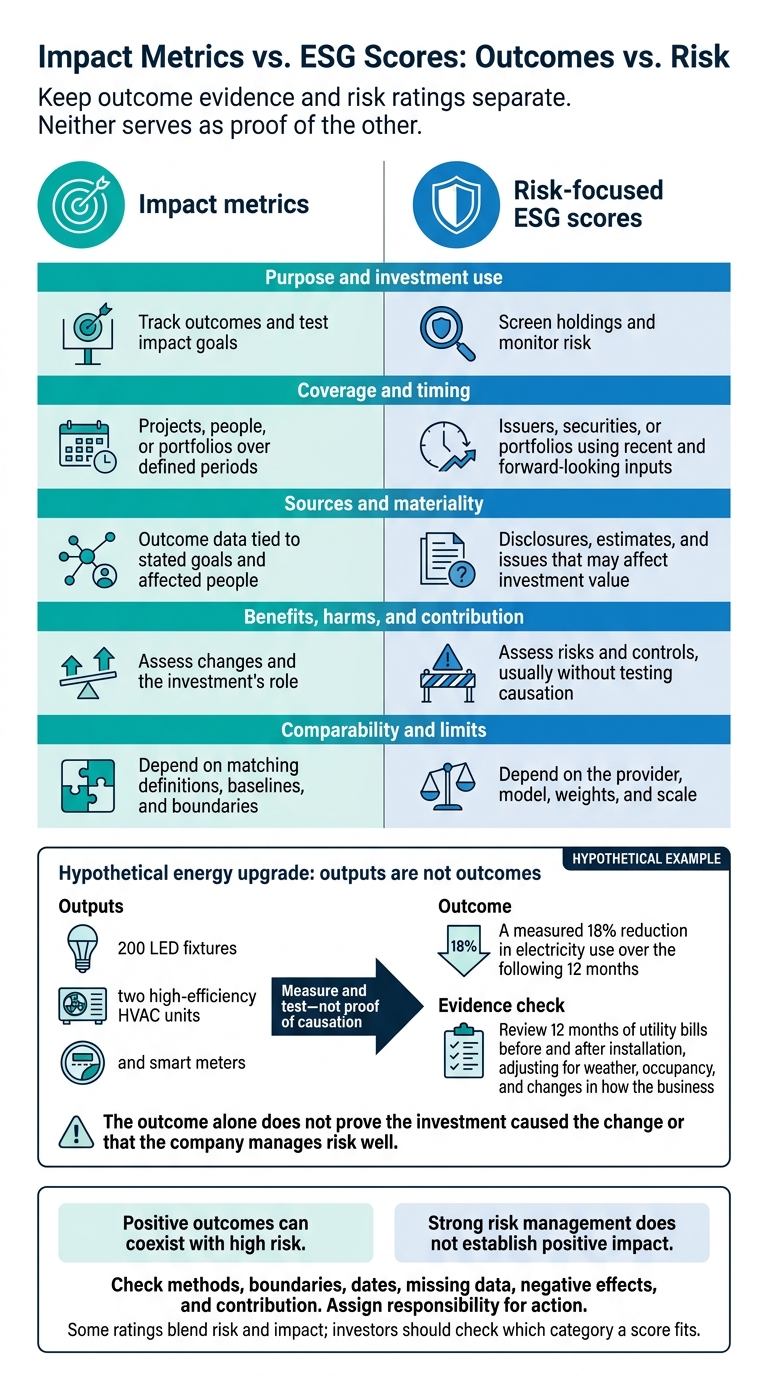
I use impact metrics to check what changed and risk-focused ESG scores to check risk exposure and management - not as proof of each other. Before you compare investments, check what each measure covers, how it was calculated, and when its data were collected.
An illustrative 18% drop in electricity use over 12 months describes an outcome. It does not, by itself, prove the investment caused that change or that the company manages risk well.
I compare the two across their purpose, coverage, timing, sources, materiality, benefits and harms, contribution, comparability, investment use, and limits.
Quick Comparison
| What I check | Impact metrics | Risk-focused ESG scores |
|---|---|---|
| Purpose and investment use | Track outcomes and test impact goals | Screen holdings and monitor risk |
| Coverage and timing | Projects, people, or portfolios over defined periods | Issuers, securities, or portfolios using recent and forward-looking inputs |
| Sources and materiality | Outcome data tied to stated goals and affected people | Disclosures, estimates, and issues that may affect investment value |
| Benefits, harms, and contribution | Assess changes and the investment’s role | Assess risks and controls, usually without testing causation |
| Comparability and limits | Depend on matching definitions, baselines, and boundaries | Depend on the provider, model, weights, and scale |
My rule: <u>keep outcome claims and risk ratings separate</u>. I check methods, missing data, negative effects, and outside sources, then assign responsibility for acting on the findings. Some ESG scores also include impact measures, so I read the methodology before relying on the label.
Impact Metrics vs. ESG Scores: Outcomes vs. Risk
From Goldman Sachs to Excel Hell: Measuring Sustainability that ESG Ratings Miss
sbb-itb-8baf5f1
What Impact Metrics and ESG Scores Measure
What you measure depends on whether you want to track outcomes or manage risk. Impact measurement starts with an intended outcome and the stakeholders expected to experience it. Financial materiality focuses on sustainability issues that can affect investment value. A community benefit can matter even when its financial effect is small. A material financial risk, meanwhile, need not involve an intended positive outcome.
| Measurement approach | Primary question | Typical inputs | What it cannot establish alone |
|---|---|---|---|
| Impact metrics | What changed, for whom, and at what scale? | Outcome indicators, stakeholder data, baselines, targets, geography, reporting periods, and evidence of activities | That the investment caused the result, that the result went beyond what would have happened without it, or that all material risks are controlled |
| ESG scores focused on financial risk | How exposed is the issuer to selected ESG risks, and how well does it manage them? | Company disclosures and filings, third-party data, estimates, controversies, governance indicators, and sector-specific weights | That the issuer created positive stakeholder outcomes or measurable impact beyond its policies and disclosures |
Some ratings blend risk and impact; investors should check which category a score fits.[5]
Similar labels can mask very different approaches to measurement.
Impact Metrics: Track Progress Toward Intended Outcomes
Choose quantitative indicators and qualitative evidence that match the intended outcome, affected population, geography, baseline, and reporting period. The Global Impact Investing Network’s IRIS+ offers sector- and goal-specific Core Metrics Sets. These cover what outcome occurs; who experiences it; how much change occurs, including scale and duration; contribution beyond what likely would have happened anyway; and risk that results differ from expectations.[1][2][4]
Outputs, Outcomes, and Proof of Impact
A simple example separates what was installed from what changed.
Hypothetical small-business energy upgrade: Installing 200 LED fixtures, two high-efficiency HVAC units, and smart meters represents outputs. A measured 18% reduction in electricity use over the following 12 months represents an outcome.
Review 12 months of utility bills before and after installation, adjusting for weather, occupancy, and changes in how the business runs. Results remain provisional when data arrive late.
The baseline records initial conditions. A counterfactual estimates what would have happened without the upgrade, helping test additionality. Attribution asks how much of the change belongs to the investment. When several actors helped, claiming a contribution to the measured reduction is safer than claiming sole causation.[2][3][4]
ESG Scores: Assess Risk Exposure and Management
Unlike impact metrics, ESG scores usually start with risk exposure rather than intended social or environmental change. They combine company disclosures and filings, third-party data, estimates, controversies, governance indicators, and sector-specific weights.
Check the methodology’s scope, weighting, missing-data rules, and treatment of policies versus actual performance. Some approaches emphasize financially material risks; others also assess effects on stakeholders and the environment.
A favorable score reflects the methodology used. It does not verify that policies worked or that stakeholders experienced better outcomes. Investors therefore use risk-focused ESG scores as risk signals, not proof of impact.
Impact Metrics vs. ESG Scores: A Side-by-Side Comparison
Use this comparison to distinguish outcome evidence from risk signals during due diligence. Neither replaces a review of methods, boundaries, data quality, uncertainty, and investment context.
| Comparison dimension | Impact metrics | ESG scores | Investor check |
|---|---|---|---|
| What it supports in a decision | Outcome tracking | Risk screening | Is the measure focused on outcomes, risks, or explicitly designed as an impact rating? |
| Units of analysis | Project, product, facility, beneficiary group, defined population, or portfolio | Usually issuer, security, or portfolio | Does coverage match the investment? Are portfolio results weighted by market value? |
| Time horizons | Reporting-period changes, cumulative results, and longer-term targets | Current or recent risk exposure, plus historical and forward-looking inputs | Check start and end dates, update frequency, and whether results are cumulative or point-in-time |
| Sources | Primary evidence from activities and operations | Disclosed, third-party, and estimated data | Check source reliability, independence, coverage, and whether data are reported or estimated |
| Materiality | Relevance to the intended theory of change or stated impact objective | Relevance to financially material ESG risks, often sector-specific | Identify whose lens applies: beneficiaries, stakeholders, investors, or the provider’s sector model |
| Positive and negative effects | Benefits and harms | Risks, controls, and controversies | Are adverse effects measured alongside benefits? |
| Attribution or contribution | Can examine the activity’s or investor’s role in change | Generally does not establish outcome causation | Check additionality, the contribution method, and confidence |
| Comparability | Depends on consistent definitions and boundaries | Depends on provider, sector model, and scale | Do comparisons use equivalent measures? |
| Investment use | Test impact objectives, set targets, and inform allocation | Screen holdings, monitor risk, and prioritize engagement | How does the metric or score change an investment decision? |
| Limits | Results may be delayed, incomplete, or difficult to attribute | Aggregation and estimates can hide weaknesses | Review methods, boundaries, data quality, uncertainty, conflicts of interest, and investment context |
With these categories in place, check the methodology behind each label.
Check Definitions, Boundaries, and Scales
For each ESG score, record the provider, methodology version, rating date, sector model, scale direction, weights, controversy rules, and missing-data treatment. Check whether it measures absolute risk or standing within a peer group. A strong sector-relative rating does not mean strong absolute performance. Do not average provider scores unless their methods and indicators match.[7][8]
For impact metrics, record the definition, unit, organizational and geographic boundaries, baseline, denominator, and reporting period. Separate absolute emissions reductions from emissions intensity, and people reached from outcomes achieved. Do not rank unrelated investments. Compare only compatible outcomes, populations, methods, and boundaries.
Even well-measured results can point to different investment decisions.
Why Positive Outcomes Can Coexist With High Risk
Outcome evidence and risk assessments can both be valid without pointing in the same direction. These hypothetical situations show why investors should read each signal separately rather than let one cancel out the other.
Hypothetical situation Outcome evidence Risk assessment Investor interpretation A clean-technology company expands a verified battery-recycling facility Measured reduction in virgin-material use and documented recovery rates High transition, supply-chain, and governance risk; weak controls or dependence on changing regulation Positive outcomes may be real, but investors should price risks, demand stronger controls, and monitor improvement A diversified company has mature compliance systems and low modeled ESG risk Limited evidence of measurable community benefit or additional environmental outcomes Relatively well-managed financially material risks Strong risk management does not establish positive impact
How Investment Teams Review Outcomes and Risks
Investors need to assess outcome evidence and risk signals separately, checking the sources and who is accountable for decisions. Choose measures that fit the strategy, intended outcomes, stakeholders, time horizon, and material ESG risks. Keep reported outcomes and ESG risk ratings in separate workflows, then examine where they interact.[6][12]
Trace Claims to Sources and Methods
Use an evidence log to check whether outcome claims have support and risk scores rest on sound methods. Record the reporting entity, portfolio or operating boundary, geography, baseline, reporting period, source, calculation method, units, assumptions, and exclusions. Label evidence as reported, estimated, modeled, or independently assured.
For impact claims, record the stakeholder group, the counterfactual or comparison basis where available, and the investor’s financial or other contribution. Keep company results separate from the investor’s contribution. Assurance adds confidence only within its stated scope; it does not establish causation.[10][11]
Internal records document the claim. Outside checks test whether it holds up.
Check Claims Against Outside Sources
Cross-check disclosures against regulatory records, controversy reports, and stakeholder feedback to find contradictions. Investigate negative effects, and document missing data, uncertainty, and changes to boundaries or methods.
Treat avoided emissions as a separate claim, not as proof of low transition risk. Do not net these counterfactual estimates against an emissions inventory without an appropriate methodology.[9]
Assign Responsibility for Measurement and Action
Once evidence checks are complete, assign responsibility so weak data or poor results lead to action - not just another report. Name an accountable executive, data owner, methodology owner, and action owner for each material metric or risk. Set deadlines, a review schedule, evidence standards, and escalation thresholds.
Use stakeholder feedback to shape targets and corrective action. The Impact Principles call for monitoring progress against expected impact and taking action when performance diverges.[13]
Conclusion: Keep Risk Ratings Separate From Outcome Evidence
Use ESG scores to screen for risk and impact metrics to assess outcomes. Neither serves as proof of the other.
Before making an investment decision, identify the method, classify each measure, and check its scope, dates, and data quality. Record uncertainty, negative effects, and the investment’s contribution to the reported outcome.
Keep outcome evidence and risk ratings separate in the investment memo. Compare measures only when their definitions, scope, and context match, and avoid claims of cause and effect that the evidence does not support.
FAQs
How should I weigh strong impact against high ESG risk?
ESG ratings and impact metrics answer different questions. ESG ratings assess financial risk and management quality. Impact metrics measure intentional outcomes for people and the planet. Strong impact does not offset high ESG risk, and aggregate results should never hide negative impacts.
Use ESG data to identify material business risks and impact tools to verify additionality and measurable outcomes. Require rigorous internal controls to monitor and mitigate high ESG risks - positive outcomes do not cancel out potential harm.
What evidence should I request before trusting an impact claim?
Ask for a documented evidence trail linking the claim to source records, such as meter readings, invoices, or survey responses. Request a scope statement that defines the subject, reporting period, methodology, and assumptions.
Check for internal controls, including multi-level approvals and automated data checks, along with evidence of independent verification. Make sure the claim clearly separates verified facts from management estimates and future forecasts.
How can I assess impact when outcome data are incomplete?
Reduce measurement risk by regularly improving methods and validating them with stakeholders. Before fieldwork, build a scope-to-evidence matrix that records missing or estimated data for each material claim.
Maintain a controlled methodology register covering definitions, formulas, data sources, and rules for handling estimates. Keep assumptions documented, up to date, and approved. Pair quantitative models with qualitative assessments of company-specific actions, and use human judgment to interpret results when data are limited.




FAQ