
May 24, 2026
How to Identify and Secure Funding for Climate Resilience Projects for Foundations & Philanthropic Organizations
Capacity Building
In This Article
Guidance for foundations on aligning mission, building pipelines, and co‑financing equitable climate resilience projects.
How to Identify and Secure Funding for Climate Resilience Projects for Foundations & Philanthropic Organizations
Finding and securing funding for climate resilience projects requires a clear mission, measurable goals, and strategic partnerships. With less than 10% of global climate finance allocated to adaptation, foundations can play a critical role in addressing this gap by supporting underserved communities, de-risking early-stage projects, and unlocking larger investments.
Key Takeaways:
Align with Mission: Link climate resilience to your organization’s core goals, focusing on areas like public health, food security, or infrastructure.
Set Clear Goals: Measure outcomes like reduced flood risks or improved heat response systems, not just dollars spent.
Understand Funding Options: Federal grants (e.g., FEMA BRIC), private financing tools, and co-funding models offer diverse opportunities.
Build Community-Centered Projects: Engage local stakeholders early to design equitable, impactful initiatives.
Leverage Partnerships: Collaborate with public agencies, peer funders, and private investors to amplify impact.
By following these steps, foundations can bridge critical funding gaps and drive long-term resilience in vulnerable communities.
Strategies for Building Rural Climate Resilience Capacity: Funding & Finance Needs for Climate Work
Defining Your Mission and Climate Resilience Goals
Before pursuing funding, it’s vital to align your organization’s core mission with climate resilience. A mismatch here can lead to short-sighted, reactive approaches that fail to deliver meaningful results.
Connecting Your Mission to a Resilience Funding Thesis
Climate resilience touches on critical areas like health, food security, and infrastructure. The most impactful organizations integrate this lens into their existing priorities rather than treating it as a separate initiative.
Ask yourself: How do climate risks threaten the progress we’re working to protect? For example, a foundation focused on poverty reduction in the Gulf Coast must consider the region’s vulnerability to hurricanes and flooding. Ignoring these risks could undo years of progress after a single storm season.
"Investing in locally led solutions can strengthen the food, health, and economic systems people rely on to adapt and thrive." - Neil Watkins, Deputy Director, Gates Foundation [1]
From this reflection, develop a resilience funding thesis - a concise statement linking climate resilience to your mission. This thesis acts as a strategic guide for funding decisions and lays the groundwork for setting measurable goals.
Setting Measurable Resilience Outcomes and Focus Areas
To maximize impact, focus on outcome-based metrics instead of process-based ones. Instead of tracking dollars spent or projects funded, measure tangible changes, such as lower heat-related mortality rates, reduced insurance losses in vulnerable areas, or expanded access to early warning systems.
Organize your efforts around clear thematic pillars. For example:
Building the local evidence base: Funding research and creating strong data systems.
Strengthening institutional capacity: Supporting local governments in crafting effective heat action plans.
Unlocking innovative finance: Testing solutions like community-based insurance models.
Each pillar should have specific focus areas and time-bound targets. Geographic prioritization is also key - channeling resources into high-risk, underserved regions can yield more impactful results than spreading funds too thinly [2].
Once your goals are in place, you’ll need to formalize your approach to risk.
Assessing Risk Tolerance and Building an Investment Policy
With mission alignment and measurable outcomes defined, it’s time to evaluate the level of risk your foundation is willing to take. Philanthropic capital has the unique ability to absorb risks that other sectors often avoid, making it a powerful tool when used strategically.
A resilience investment policy statement should outline your risk tolerance across various funding types, from low-risk grants to high-risk experimental projects. It should also describe how you’ll layer funding sources - combining philanthropic dollars with mechanisms like state revolving funds or local matching contributions to spread risk.
"Philanthropy can invest early, de-risk innovation, and strengthen systems that can unlock broader flows of public and private capital. When done right, adaptation not only prevents the worst outcomes; it sets the table for a stable future." - ClimateWorks Foundation [5]
The potential payoff is enormous. For every $1 invested in climate adaptation, the return can exceed $10 in long-term economic and social benefits, equating to a 20–27% rate of return [5]. A well-thought-out investment policy ensures your foundation captures these benefits intentionally, not by chance.
Navigating the Climate Resilience Funding Landscape
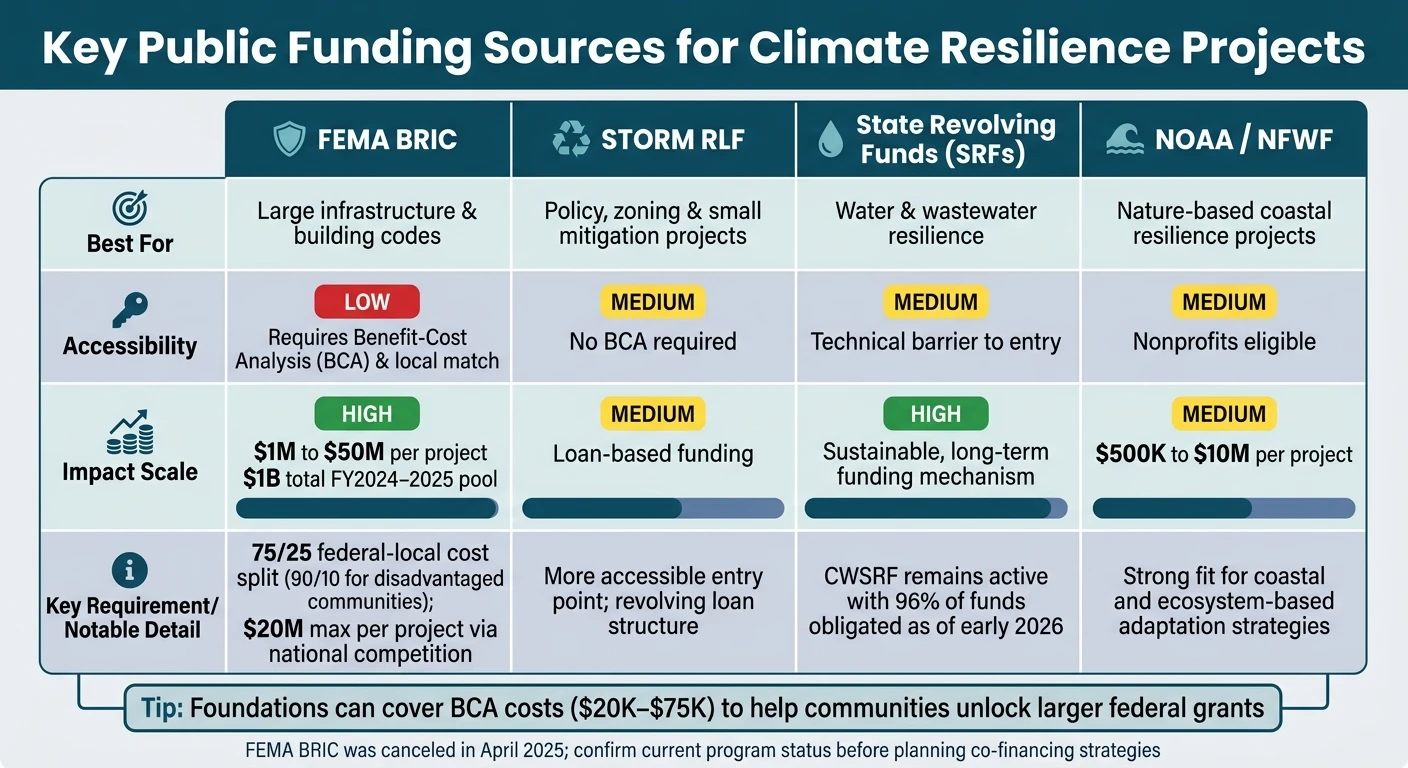
Climate Resilience Funding Sources Compared: FEMA BRIC, STORM RLF, SRFs & NOAA/NFWF
Once you've established your mission and investment policy, the next step is to explore the funding options available and determine which ones align with your goals. The funding landscape includes federal grants, private financial tools, and blended financing models, each with its own rules, timelines, and suitability for specific projects.
Key Funding Types and Instruments
With your goals clearly defined, it's time to identify the financial tools that best support your climate resilience initiatives. Grants are often the first choice since they don’t require repayment. However, other tools may also be worth considering, depending on your project's risk profile and objectives. Given that climate resilience projects typically take 3 to 7 years from concept to completion [3], securing long-term funding is crucial.
Using Public Grants and Co-Financing
Federal programs, like FEMA's Building Resilient Infrastructure and Communities (BRIC) initiative, provide some of the largest pools of funding for climate resilience. However, these programs often come with complex requirements. For example, the FY2024–2025 BRIC cycle includes $1 billion in total funding, with up to $20 million available per project through a national competition. The submission deadline for this cycle is July 23, 2026 [7][8].
"The program now maximizes state and local responsibility for resilience and risk reduction rather than federal investing in a wide range of activities." - Karen S. Evans, Senior Official Performing the Duties of the FEMA Administrator [7]
The current BRIC cycle focuses on construction-ready infrastructure projects, eliminating standalone planning grants [9]. Foundations can play a critical role here by funding technical work that makes local projects competitive. For example, covering the costs of professional Benefit-Cost Analyses (BCAs), which range from $20,000 to $75,000, can make a significant impact [3]. By handling these upfront costs, foundations help reduce project risks and unlock larger federal investments. Additionally, projects located in designated Community Disaster Resilience Zones gain scoring advantages, emphasizing the importance of geographic focus [3].
Federal cost-sharing typically follows a 75% federal to 25% local split, but smaller or economically disadvantaged communities may qualify for a 90/10 split [3]. Philanthropic contributions can help bridge local funding gaps, enabling access to larger federal grants.
"The federal climate resilience funding picture is genuinely uncertain in ways it wasn't two years ago." - George Chmael II, Founder & CEO, Council Fire [3]
Here’s a comparison of key public funding sources for co-financing opportunities:
Funding Source | Best For | Accessibility | Impact Scale |
|---|---|---|---|
FEMA BRIC | Large infrastructure, building codes | Low (requires BCA & match) | High ($1M–$50M) |
STORM RLF | Policy, zoning, small mitigation | Medium (no BCA required) | Medium (loans) |
State Revolving Funds (SRFs) | Water/wastewater resilience | Medium (technical barrier) | High (sustainable) |
NOAA/NFWF | Nature-based coastal projects | Medium (nonprofits eligible) | Medium ($500K–$10M) |
Collaborative and Private Financing Options
In addition to public grants, consider options that combine private capital with philanthropic support. For instance, philanthropic or public funds can absorb first-loss risk, making projects more appealing to institutional investors.
Resilience bonds are an example of this approach. These bonds are tied to measurable outcomes, such as reduced flood insurance premiums for municipalities, and are well-suited for large-scale infrastructure projects. However, they often require voter approval or a creditworthy issuer [3]. Another tool, PACE (Property Assessed Clean Energy) financing, operates at the individual property level. It allows property owners to finance flood-proofing or storm-hardening measures through a property tax assessment. While useful, PACE is typically limited to individual buildings [3].
For organizations lacking the capacity to structure these complex deals, partnering with CDFIs (Community Development Financial Institutions), green banks, or specialized climate finance funds can be a practical solution. These entities have the legal frameworks and networks needed to deploy capital efficiently. A philanthropic investment in these partnerships can often catalyze additional layers of private co-investment, amplifying the overall impact of your funding efforts.
Building a Pipeline of Fundable Resilience Projects
A solid funding strategy only works if you have well-prepared projects that align with it. To build your pipeline, focus on addressing community needs, embedding equity into your plans, and structuring projects to attract a variety of funding sources.
Identifying Community Needs and Project Ideas
Creating fundable projects begins with a comprehensive vulnerability assessment. This involves evaluating hazard exposure with tools like FEMA flood maps and NOAA Climate Explorer, examining community sensitivity through indicators such as poverty levels, housing conditions, and age demographics, and assessing available adaptive resources like social networks and institutional capacity [4].
To complement this data, engage directly with the community. Use participatory methods such as community mapping, photovoice projects, and small-group storytelling sessions. Hold these activities in accessible locations like schools, churches, or community centers, and provide necessary supports like childcare, food, and translation services. It’s also important to compensate residents, block captains, and local leaders for their contributions [4].
The "Partnership Trio" model is a helpful approach here. By bringing together a technical adaptation expert, a community-based organization (CBO), and a local or regional government representative, this model ensures project ideas are technically sound, rooted in community priorities, and politically feasible from the outset [10].
These steps create a strong foundation for designing projects that prioritize equity.
Designing Projects With Equity at the Center
Once you’ve gathered community insights, equity should move from being a guiding principle to an essential design element. Resilience projects often increase property values, which can inadvertently displace the very residents they aim to protect - an issue known as climate gentrification. To address this, projects should include measures like affordable housing protections from the start [4].
"Building resilience requires more than infrastructure upgrades. It demands social cohesion, equitable resource distribution, and governance structures that center the people most vulnerable to climate impacts." - Council Fire Resources [4]
Using detailed demographic data to track who benefits from these investments is crucial. Establish specific, measurable goals to ensure accountability. For example, a milestone like "Install 50 bioswales in flood-prone neighborhoods by 2027" provides clear targets and demonstrates impact to potential funders [4].
With equity woven into the design, the next step is to package your projects for diverse funding opportunities.
Packaging Projects for Multiple Funding Sources
To align with a multi-layered funding strategy, design projects that deliver several co-benefits. For example, an urban tree canopy initiative could address urban heat islands, enhance stormwater management, and improve public health. This approach makes the project eligible for various funding programs, such as EPA Climate Pollution Reduction Grants or NOAA coastal resilience funding [3].
Having a "lead and backup" funding strategy is also essential. Identify one primary funding source and at least two alternatives, such as state funds or FEMA's Hazard Mitigation Grant Program (HMGP). This approach proved effective in Galveston County, Texas, where a $4.2 million stormwater detention project initially targeted for BRIC funding was successfully redirected to HMGP after the BRIC cycle was canceled in April 2025. Although the project’s scope had to be adjusted to meet lower award limits, the county still secured critical funding [3].
Finally, ensure your projects are technically ready. Completing a Benefit-Cost Analysis (BCA) and other preparatory work significantly increases the likelihood of securing large grants [3].
Building Internal Processes to Secure and Manage Funding
Once you’ve defined your mission and established a funding pipeline, the next step is creating robust internal processes to manage and scale resilience investments. With a clear project pipeline in place, strong governance, well-defined workflows, and effective evaluation practices are essential to ensure consistent success in securing and utilizing funding.
Setting Up Governance and Decision-Making Structures
Creating a dedicated climate resilience funding committee can be a game changer. Instead of merging resilience funding decisions into general grantmaking, a specialized committee can focus on evaluating technical projects, assessing risks, and navigating the fast-changing funding landscape with precision.
Embedding resilience criteria into your investment policy is another key step. One effective approach is developing a "Resiliency Playbook" - an internal, dynamic document that consolidates investment criteria, equity standards, and decision-making processes into one cohesive guide.
Additionally, consider joining technical capacity hubs designed to assist under-resourced communities in preparing grant applications. For example, the Local Infrastructure Hub provides peer learning networks and application support, enabling organizations to expand their reach without needing to build every capability internally.
Once governance is in place, focus on streamlining workflows to ensure grantmaking processes are both efficient and effective.
Optimizing Workflows for Faster Grantmaking
Speed and efficiency in grantmaking can be achieved by pre-vetting technical experts through a dedicated registry. The Climate Smart Communities Initiative (CSCI) offers a practical example of this approach. During its 2026 grant cycle, CSCI managed a $1.5–$2 million budget distributed across 16–20 grants. Each project team was required to include an adaptation practitioner from a pre-vetted registry, a community-based organization, and a local government representative.
Applicants followed a structured 12-month process that included mandatory orientations, a baseline survey at the project kickoff, a 6-month progress check-in, and a final case study. This system kept projects on schedule and provided a framework for comparing outcomes across a diverse portfolio of initiatives [10].
Well-structured workflows like these also make it easier to collect and evaluate data, which is critical for improving long-term resilience efforts.
Building Capacity for Data, Evaluation, and Learning
Organizations that prioritize evaluation systems not only improve their learning but also see those insights accumulate over time. A structured evaluation schedule simplifies the tracking process and ensures consistent monitoring. The table below, inspired by CSCI's 2026 program design, provides a practical evaluation framework [10]:
Evaluation Stage | Purpose | Timing |
|---|---|---|
Baseline Survey | Establishes starting conditions and community metrics | Grant kickoff |
Progress Check-in | Identifies early challenges and allows for adjustments | Month 6 |
End-of-Grant Survey | Captures immediate outcomes and deliverables | Month 12 |
Case Study | Documents qualitative insights and actionable strategies | End of grant |
Post-Grant Survey | Measures long-term sustainability and resilience impact | 1 year post-grant |
Scaling Impact Through Partnerships and Collaboration
To achieve meaningful climate resilience outcomes, strong internal processes and a well-structured project pipeline must be paired with strategic partnerships. Collaborating with public agencies, peer funders, and private investors is essential, as no single entity can address the full spectrum of risks and resources required for resilience projects.
Working With Public Sector Partners
The Infrastructure Investment and Jobs Act (IIJA) has allocated roughly $50 billion for climate resilience initiatives, spanning water systems, grid improvements, wildfire prevention, and flood mitigation programs [3]. Additionally, the Justice40 Initiative mandates that at least 40% of the benefits from certain federal climate investments go to disadvantaged communities [4], presenting a unique opportunity for foundations focused on equity to support both fair outcomes and long-term resilience goals.
Philanthropic funding plays a critical role in bridging gaps left by public funding restrictions. Federal and state programs often face limitations due to strict eligibility criteria, rigid procurement schedules, and inflexible budget cycles. Foundations can step in to cover predevelopment costs - such as feasibility studies, engineering predesign, and community engagement - that are vital for strengthening applications to programs like FEMA's Building Resilient Infrastructure and Communities (BRIC) or the Clean Water State Revolving Fund (CWSRF). They can also provide bridge funding to sustain momentum while awaiting public disbursements.
Program Status Update: Some federal resilience programs have undergone significant changes. FEMA's BRIC program was canceled in April 2025, and the Hazard Mitigation Grant Program (HMGP) was suspended the same month. However, the CWSRF remains active, with 96% of its funds obligated as of early 2026. Foundations should confirm the current status of federal programs before integrating them into co-financing strategies.
Building effective public partnerships requires a relationship-first approach rather than starting with funding requests. Attending city council meetings, participating in regional climate collaboratives, and meeting with local resilience officers or state energy offices can help identify funding gaps where philanthropic support can be most effective.
While public partnerships are vital, collaborating with other philanthropic organizations can further amplify impact.
Co-Funding With Other Philanthropic Organizations
Pooling resources with peer funders can expand the reach and efficiency of resilience efforts. Three common models for resource pooling include:
Pooled funds: Multiple foundations contribute to a shared funding vehicle, often managed by a community foundation or public charity. These funds work best when they have a clear investment strategy, standardized due diligence, and defined governance structures.
Regranting arrangements: Larger foundations provide funding to intermediaries with strong local connections, enabling smaller grants to reach community-based organizations that may lack the capacity for complex applications.
Joint funding calls: Several foundations issue a unified request for proposals (RFP), aligning timelines and reporting requirements while allowing each foundation to make independent funding decisions.
Examples like the Climate and Clean Energy Equity Fund demonstrate how pooling capital from multiple donors can support grassroots organizations, often in alignment with public funding streams [5][6][7]. Establishing shared metrics - such as the number of updated community resilience plans or reductions in flood risks for low-income households - helps streamline reporting and ensures accountability.
While partnerships with peer funders enhance reach, philanthropic capital can also play a pivotal role in attracting private investment.
Using Philanthropy to Attract Private Investment
Philanthropic funding can de-risk resilience projects, making them more appealing to private investors. One effective tool is first-loss capital, where a foundation provides equity or subordinated debt to absorb initial losses, thereby protecting senior investors. For instance, in a $20 million resilience fund, a $5 million first-loss tranche can secure a $15 million senior tranche.
Guarantees are another mechanism that shields senior investors from potential losses, enabling local banks or community development financial institutions to finance resilience projects that might otherwise be deemed too risky. According to Convergence, a blended finance network, every $1 of concessional capital in blended finance transactions has mobilized about $4 of commercial capital on average across sectors [9]. This demonstrates the potential for philanthropic tools to significantly increase the impact of each dollar invested.
Technical assistance (TA) grants further enhance these efforts by helping project developers, municipalities, and community organizations craft viable proposals. These grants support the development of credible business models, robust revenue streams, and comprehensive risk assessments - turning promising ideas into projects that private investors are willing to back.
Conclusion: A Step-by-Step Roadmap for Climate Resilience Funding
Turning a mission statement into a fully funded and operational resilience project is rarely straightforward, but it’s a journey that can be managed with a clear plan. Each step builds on the last: align your funding strategy with your mission, identify funding tools, develop a pipeline of equity-focused projects, establish strong governance practices, and expand through well-chosen partnerships.
The current gaps in climate adaptation financing highlight the pressing need for thoughtful investment [5]. By laying deliberate and strategic groundwork, organizations can bridge these gaps and amplify their impact.
The roadmap includes several critical steps: crafting a resilience thesis, evaluating risk tolerance, identifying funding options, designing projects ready for grants, creating robust governance frameworks, securing both public and private co-financing, and finally, measuring outcomes to refine approaches. Skipping essential steps, such as engaging communities early or conducting thorough benefit-cost analyses, can derail progress.
To assist at every stage of this process, Council Fire offers tailored services. Its impact analysis tools use data-driven models to pinpoint funding shortfalls and assess the effectiveness of resilience investments. Strategic consulting helps organizations revamp internal workflows, ensuring projects align with policy requirements, equity goals, and strategic partnerships [11]. For those grappling with complex climate risk communications, Council Fire translates technical strategies into clear, actionable narratives that foster trust and drive decisions [12]. This roadmap provides the tools needed to take meaningful steps toward securing climate resilience funding.
FAQs
What’s the fastest way to find climate resilience funding that fits our mission?
To efficiently locate climate resilience funding that aligns with your mission, consider leveraging specialized tools and databases. Platforms like the Climate Funds Explorer and FindGrants are excellent starting points, offering tailored funding options. Beyond these, look into initiatives such as the Adaptation and Resilience Fund or federal programs like FEMA’s BRIC (Building Resilient Infrastructure and Communities) and EPA grants. These resources simplify the process of finding funding opportunities that match your goals.
How can we help communities meet federal match and BCA requirements?
Communities have several ways to address federal match and Benefit-Cost Analysis (BCA) requirements by tapping into state programs, regional collaborations, and creative financing strategies. For instance, certain states provide funding specifically designed to lessen the financial burden of local matches. Programs like State Revolving Funds often come with adaptable match terms, offering additional flexibility.
When it comes to BCAs, FEMA's toolkit can serve as a valuable resource, though seeking professional expertise may be necessary for more complex analyses. Partnering with nonprofit organizations or exploring loan options can also help alleviate financial challenges, making these requirements more manageable.
Which metrics best prove real resilience impact (not just spend)?
Metrics that showcase the true impact of resilience efforts include outcome-based indicators such as reduced flood damage, trends in heat-related illnesses and mortality, and evacuation and shelter capacity. Other key measures include power outage durations, insurance loss ratios, and community survey data reflecting preparedness and perceived safety. By emphasizing tangible outcomes instead of merely financial inputs, these metrics provide a clearer picture of how effective climate resilience initiatives truly are.
Related Blog Posts
Latest Articles
©2026

Narrative Change and Power Building: The Missing Half of Advocacy
Narrative change is the process of disrupting dominant narratives that normalize inequity and advancing new narratives from historically marginalized communities.

Funding Resilience Without Federal Grants
BRIC is unreliable and FEMA is shrinking. Here's how cities fund climate resilience with dedicated revenue, blended finance, and a coordinating authority.

The ESG Blind Spot: How AI Is Finding Risks in Companies Nobody Else Is Watching
Norway's sovereign wealth fund uses AI to screen 7,200 portfolio companies for forced labor and corruption within 24 hours. The real story is the emerging-market coverage gap that traditional ESG data vendors miss — and what it means for any company with a global supply chain.
Narrative Change and Power Building: The Missing Half of Advocacy
Narrative change is the process of disrupting dominant narratives that normalize inequity and advancing new narratives from historically marginalized communities.
Funding Resilience Without Federal Grants
BRIC is unreliable and FEMA is shrinking. Here's how cities fund climate resilience with dedicated revenue, blended finance, and a coordinating authority.
The ESG Blind Spot: How AI Is Finding Risks in Companies Nobody Else Is Watching
Norway's sovereign wealth fund uses AI to screen 7,200 portfolio companies for forced labor and corruption within 24 hours. The real story is the emerging-market coverage gap that traditional ESG data vendors miss — and what it means for any company with a global supply chain.
FAQ
01
What does it really mean to “redefine profit”?
02
What makes Council Fire different?
03
Who does Council Fire work with?
04
What does working with Council Fire actually look like?
05
How does Council Fire help organizations turn big goals into action?
06
How does Council Fire define and measure success?
07
How does technology fit into Council Fire’s work?
May 24, 2026
How to Identify and Secure Funding for Climate Resilience Projects for Foundations & Philanthropic Organizations
Capacity Building
In This Article
Guidance for foundations on aligning mission, building pipelines, and co‑financing equitable climate resilience projects.
How to Identify and Secure Funding for Climate Resilience Projects for Foundations & Philanthropic Organizations
Finding and securing funding for climate resilience projects requires a clear mission, measurable goals, and strategic partnerships. With less than 10% of global climate finance allocated to adaptation, foundations can play a critical role in addressing this gap by supporting underserved communities, de-risking early-stage projects, and unlocking larger investments.
Key Takeaways:
Align with Mission: Link climate resilience to your organization’s core goals, focusing on areas like public health, food security, or infrastructure.
Set Clear Goals: Measure outcomes like reduced flood risks or improved heat response systems, not just dollars spent.
Understand Funding Options: Federal grants (e.g., FEMA BRIC), private financing tools, and co-funding models offer diverse opportunities.
Build Community-Centered Projects: Engage local stakeholders early to design equitable, impactful initiatives.
Leverage Partnerships: Collaborate with public agencies, peer funders, and private investors to amplify impact.
By following these steps, foundations can bridge critical funding gaps and drive long-term resilience in vulnerable communities.
Strategies for Building Rural Climate Resilience Capacity: Funding & Finance Needs for Climate Work
Defining Your Mission and Climate Resilience Goals
Before pursuing funding, it’s vital to align your organization’s core mission with climate resilience. A mismatch here can lead to short-sighted, reactive approaches that fail to deliver meaningful results.
Connecting Your Mission to a Resilience Funding Thesis
Climate resilience touches on critical areas like health, food security, and infrastructure. The most impactful organizations integrate this lens into their existing priorities rather than treating it as a separate initiative.
Ask yourself: How do climate risks threaten the progress we’re working to protect? For example, a foundation focused on poverty reduction in the Gulf Coast must consider the region’s vulnerability to hurricanes and flooding. Ignoring these risks could undo years of progress after a single storm season.
"Investing in locally led solutions can strengthen the food, health, and economic systems people rely on to adapt and thrive." - Neil Watkins, Deputy Director, Gates Foundation [1]
From this reflection, develop a resilience funding thesis - a concise statement linking climate resilience to your mission. This thesis acts as a strategic guide for funding decisions and lays the groundwork for setting measurable goals.
Setting Measurable Resilience Outcomes and Focus Areas
To maximize impact, focus on outcome-based metrics instead of process-based ones. Instead of tracking dollars spent or projects funded, measure tangible changes, such as lower heat-related mortality rates, reduced insurance losses in vulnerable areas, or expanded access to early warning systems.
Organize your efforts around clear thematic pillars. For example:
Building the local evidence base: Funding research and creating strong data systems.
Strengthening institutional capacity: Supporting local governments in crafting effective heat action plans.
Unlocking innovative finance: Testing solutions like community-based insurance models.
Each pillar should have specific focus areas and time-bound targets. Geographic prioritization is also key - channeling resources into high-risk, underserved regions can yield more impactful results than spreading funds too thinly [2].
Once your goals are in place, you’ll need to formalize your approach to risk.
Assessing Risk Tolerance and Building an Investment Policy
With mission alignment and measurable outcomes defined, it’s time to evaluate the level of risk your foundation is willing to take. Philanthropic capital has the unique ability to absorb risks that other sectors often avoid, making it a powerful tool when used strategically.
A resilience investment policy statement should outline your risk tolerance across various funding types, from low-risk grants to high-risk experimental projects. It should also describe how you’ll layer funding sources - combining philanthropic dollars with mechanisms like state revolving funds or local matching contributions to spread risk.
"Philanthropy can invest early, de-risk innovation, and strengthen systems that can unlock broader flows of public and private capital. When done right, adaptation not only prevents the worst outcomes; it sets the table for a stable future." - ClimateWorks Foundation [5]
The potential payoff is enormous. For every $1 invested in climate adaptation, the return can exceed $10 in long-term economic and social benefits, equating to a 20–27% rate of return [5]. A well-thought-out investment policy ensures your foundation captures these benefits intentionally, not by chance.
Navigating the Climate Resilience Funding Landscape
Climate Resilience Funding Sources Compared: FEMA BRIC, STORM RLF, SRFs & NOAA/NFWF
Once you've established your mission and investment policy, the next step is to explore the funding options available and determine which ones align with your goals. The funding landscape includes federal grants, private financial tools, and blended financing models, each with its own rules, timelines, and suitability for specific projects.
Key Funding Types and Instruments
With your goals clearly defined, it's time to identify the financial tools that best support your climate resilience initiatives. Grants are often the first choice since they don’t require repayment. However, other tools may also be worth considering, depending on your project's risk profile and objectives. Given that climate resilience projects typically take 3 to 7 years from concept to completion [3], securing long-term funding is crucial.
Using Public Grants and Co-Financing
Federal programs, like FEMA's Building Resilient Infrastructure and Communities (BRIC) initiative, provide some of the largest pools of funding for climate resilience. However, these programs often come with complex requirements. For example, the FY2024–2025 BRIC cycle includes $1 billion in total funding, with up to $20 million available per project through a national competition. The submission deadline for this cycle is July 23, 2026 [7][8].
"The program now maximizes state and local responsibility for resilience and risk reduction rather than federal investing in a wide range of activities." - Karen S. Evans, Senior Official Performing the Duties of the FEMA Administrator [7]
The current BRIC cycle focuses on construction-ready infrastructure projects, eliminating standalone planning grants [9]. Foundations can play a critical role here by funding technical work that makes local projects competitive. For example, covering the costs of professional Benefit-Cost Analyses (BCAs), which range from $20,000 to $75,000, can make a significant impact [3]. By handling these upfront costs, foundations help reduce project risks and unlock larger federal investments. Additionally, projects located in designated Community Disaster Resilience Zones gain scoring advantages, emphasizing the importance of geographic focus [3].
Federal cost-sharing typically follows a 75% federal to 25% local split, but smaller or economically disadvantaged communities may qualify for a 90/10 split [3]. Philanthropic contributions can help bridge local funding gaps, enabling access to larger federal grants.
"The federal climate resilience funding picture is genuinely uncertain in ways it wasn't two years ago." - George Chmael II, Founder & CEO, Council Fire [3]
Here’s a comparison of key public funding sources for co-financing opportunities:
Funding Source | Best For | Accessibility | Impact Scale |
|---|---|---|---|
FEMA BRIC | Large infrastructure, building codes | Low (requires BCA & match) | High ($1M–$50M) |
STORM RLF | Policy, zoning, small mitigation | Medium (no BCA required) | Medium (loans) |
State Revolving Funds (SRFs) | Water/wastewater resilience | Medium (technical barrier) | High (sustainable) |
NOAA/NFWF | Nature-based coastal projects | Medium (nonprofits eligible) | Medium ($500K–$10M) |
Collaborative and Private Financing Options
In addition to public grants, consider options that combine private capital with philanthropic support. For instance, philanthropic or public funds can absorb first-loss risk, making projects more appealing to institutional investors.
Resilience bonds are an example of this approach. These bonds are tied to measurable outcomes, such as reduced flood insurance premiums for municipalities, and are well-suited for large-scale infrastructure projects. However, they often require voter approval or a creditworthy issuer [3]. Another tool, PACE (Property Assessed Clean Energy) financing, operates at the individual property level. It allows property owners to finance flood-proofing or storm-hardening measures through a property tax assessment. While useful, PACE is typically limited to individual buildings [3].
For organizations lacking the capacity to structure these complex deals, partnering with CDFIs (Community Development Financial Institutions), green banks, or specialized climate finance funds can be a practical solution. These entities have the legal frameworks and networks needed to deploy capital efficiently. A philanthropic investment in these partnerships can often catalyze additional layers of private co-investment, amplifying the overall impact of your funding efforts.
Building a Pipeline of Fundable Resilience Projects
A solid funding strategy only works if you have well-prepared projects that align with it. To build your pipeline, focus on addressing community needs, embedding equity into your plans, and structuring projects to attract a variety of funding sources.
Identifying Community Needs and Project Ideas
Creating fundable projects begins with a comprehensive vulnerability assessment. This involves evaluating hazard exposure with tools like FEMA flood maps and NOAA Climate Explorer, examining community sensitivity through indicators such as poverty levels, housing conditions, and age demographics, and assessing available adaptive resources like social networks and institutional capacity [4].
To complement this data, engage directly with the community. Use participatory methods such as community mapping, photovoice projects, and small-group storytelling sessions. Hold these activities in accessible locations like schools, churches, or community centers, and provide necessary supports like childcare, food, and translation services. It’s also important to compensate residents, block captains, and local leaders for their contributions [4].
The "Partnership Trio" model is a helpful approach here. By bringing together a technical adaptation expert, a community-based organization (CBO), and a local or regional government representative, this model ensures project ideas are technically sound, rooted in community priorities, and politically feasible from the outset [10].
These steps create a strong foundation for designing projects that prioritize equity.
Designing Projects With Equity at the Center
Once you’ve gathered community insights, equity should move from being a guiding principle to an essential design element. Resilience projects often increase property values, which can inadvertently displace the very residents they aim to protect - an issue known as climate gentrification. To address this, projects should include measures like affordable housing protections from the start [4].
"Building resilience requires more than infrastructure upgrades. It demands social cohesion, equitable resource distribution, and governance structures that center the people most vulnerable to climate impacts." - Council Fire Resources [4]
Using detailed demographic data to track who benefits from these investments is crucial. Establish specific, measurable goals to ensure accountability. For example, a milestone like "Install 50 bioswales in flood-prone neighborhoods by 2027" provides clear targets and demonstrates impact to potential funders [4].
With equity woven into the design, the next step is to package your projects for diverse funding opportunities.
Packaging Projects for Multiple Funding Sources
To align with a multi-layered funding strategy, design projects that deliver several co-benefits. For example, an urban tree canopy initiative could address urban heat islands, enhance stormwater management, and improve public health. This approach makes the project eligible for various funding programs, such as EPA Climate Pollution Reduction Grants or NOAA coastal resilience funding [3].
Having a "lead and backup" funding strategy is also essential. Identify one primary funding source and at least two alternatives, such as state funds or FEMA's Hazard Mitigation Grant Program (HMGP). This approach proved effective in Galveston County, Texas, where a $4.2 million stormwater detention project initially targeted for BRIC funding was successfully redirected to HMGP after the BRIC cycle was canceled in April 2025. Although the project’s scope had to be adjusted to meet lower award limits, the county still secured critical funding [3].
Finally, ensure your projects are technically ready. Completing a Benefit-Cost Analysis (BCA) and other preparatory work significantly increases the likelihood of securing large grants [3].
Building Internal Processes to Secure and Manage Funding
Once you’ve defined your mission and established a funding pipeline, the next step is creating robust internal processes to manage and scale resilience investments. With a clear project pipeline in place, strong governance, well-defined workflows, and effective evaluation practices are essential to ensure consistent success in securing and utilizing funding.
Setting Up Governance and Decision-Making Structures
Creating a dedicated climate resilience funding committee can be a game changer. Instead of merging resilience funding decisions into general grantmaking, a specialized committee can focus on evaluating technical projects, assessing risks, and navigating the fast-changing funding landscape with precision.
Embedding resilience criteria into your investment policy is another key step. One effective approach is developing a "Resiliency Playbook" - an internal, dynamic document that consolidates investment criteria, equity standards, and decision-making processes into one cohesive guide.
Additionally, consider joining technical capacity hubs designed to assist under-resourced communities in preparing grant applications. For example, the Local Infrastructure Hub provides peer learning networks and application support, enabling organizations to expand their reach without needing to build every capability internally.
Once governance is in place, focus on streamlining workflows to ensure grantmaking processes are both efficient and effective.
Optimizing Workflows for Faster Grantmaking
Speed and efficiency in grantmaking can be achieved by pre-vetting technical experts through a dedicated registry. The Climate Smart Communities Initiative (CSCI) offers a practical example of this approach. During its 2026 grant cycle, CSCI managed a $1.5–$2 million budget distributed across 16–20 grants. Each project team was required to include an adaptation practitioner from a pre-vetted registry, a community-based organization, and a local government representative.
Applicants followed a structured 12-month process that included mandatory orientations, a baseline survey at the project kickoff, a 6-month progress check-in, and a final case study. This system kept projects on schedule and provided a framework for comparing outcomes across a diverse portfolio of initiatives [10].
Well-structured workflows like these also make it easier to collect and evaluate data, which is critical for improving long-term resilience efforts.
Building Capacity for Data, Evaluation, and Learning
Organizations that prioritize evaluation systems not only improve their learning but also see those insights accumulate over time. A structured evaluation schedule simplifies the tracking process and ensures consistent monitoring. The table below, inspired by CSCI's 2026 program design, provides a practical evaluation framework [10]:
Evaluation Stage | Purpose | Timing |
|---|---|---|
Baseline Survey | Establishes starting conditions and community metrics | Grant kickoff |
Progress Check-in | Identifies early challenges and allows for adjustments | Month 6 |
End-of-Grant Survey | Captures immediate outcomes and deliverables | Month 12 |
Case Study | Documents qualitative insights and actionable strategies | End of grant |
Post-Grant Survey | Measures long-term sustainability and resilience impact | 1 year post-grant |
Scaling Impact Through Partnerships and Collaboration
To achieve meaningful climate resilience outcomes, strong internal processes and a well-structured project pipeline must be paired with strategic partnerships. Collaborating with public agencies, peer funders, and private investors is essential, as no single entity can address the full spectrum of risks and resources required for resilience projects.
Working With Public Sector Partners
The Infrastructure Investment and Jobs Act (IIJA) has allocated roughly $50 billion for climate resilience initiatives, spanning water systems, grid improvements, wildfire prevention, and flood mitigation programs [3]. Additionally, the Justice40 Initiative mandates that at least 40% of the benefits from certain federal climate investments go to disadvantaged communities [4], presenting a unique opportunity for foundations focused on equity to support both fair outcomes and long-term resilience goals.
Philanthropic funding plays a critical role in bridging gaps left by public funding restrictions. Federal and state programs often face limitations due to strict eligibility criteria, rigid procurement schedules, and inflexible budget cycles. Foundations can step in to cover predevelopment costs - such as feasibility studies, engineering predesign, and community engagement - that are vital for strengthening applications to programs like FEMA's Building Resilient Infrastructure and Communities (BRIC) or the Clean Water State Revolving Fund (CWSRF). They can also provide bridge funding to sustain momentum while awaiting public disbursements.
Program Status Update: Some federal resilience programs have undergone significant changes. FEMA's BRIC program was canceled in April 2025, and the Hazard Mitigation Grant Program (HMGP) was suspended the same month. However, the CWSRF remains active, with 96% of its funds obligated as of early 2026. Foundations should confirm the current status of federal programs before integrating them into co-financing strategies.
Building effective public partnerships requires a relationship-first approach rather than starting with funding requests. Attending city council meetings, participating in regional climate collaboratives, and meeting with local resilience officers or state energy offices can help identify funding gaps where philanthropic support can be most effective.
While public partnerships are vital, collaborating with other philanthropic organizations can further amplify impact.
Co-Funding With Other Philanthropic Organizations
Pooling resources with peer funders can expand the reach and efficiency of resilience efforts. Three common models for resource pooling include:
Pooled funds: Multiple foundations contribute to a shared funding vehicle, often managed by a community foundation or public charity. These funds work best when they have a clear investment strategy, standardized due diligence, and defined governance structures.
Regranting arrangements: Larger foundations provide funding to intermediaries with strong local connections, enabling smaller grants to reach community-based organizations that may lack the capacity for complex applications.
Joint funding calls: Several foundations issue a unified request for proposals (RFP), aligning timelines and reporting requirements while allowing each foundation to make independent funding decisions.
Examples like the Climate and Clean Energy Equity Fund demonstrate how pooling capital from multiple donors can support grassroots organizations, often in alignment with public funding streams [5][6][7]. Establishing shared metrics - such as the number of updated community resilience plans or reductions in flood risks for low-income households - helps streamline reporting and ensures accountability.
While partnerships with peer funders enhance reach, philanthropic capital can also play a pivotal role in attracting private investment.
Using Philanthropy to Attract Private Investment
Philanthropic funding can de-risk resilience projects, making them more appealing to private investors. One effective tool is first-loss capital, where a foundation provides equity or subordinated debt to absorb initial losses, thereby protecting senior investors. For instance, in a $20 million resilience fund, a $5 million first-loss tranche can secure a $15 million senior tranche.
Guarantees are another mechanism that shields senior investors from potential losses, enabling local banks or community development financial institutions to finance resilience projects that might otherwise be deemed too risky. According to Convergence, a blended finance network, every $1 of concessional capital in blended finance transactions has mobilized about $4 of commercial capital on average across sectors [9]. This demonstrates the potential for philanthropic tools to significantly increase the impact of each dollar invested.
Technical assistance (TA) grants further enhance these efforts by helping project developers, municipalities, and community organizations craft viable proposals. These grants support the development of credible business models, robust revenue streams, and comprehensive risk assessments - turning promising ideas into projects that private investors are willing to back.
Conclusion: A Step-by-Step Roadmap for Climate Resilience Funding
Turning a mission statement into a fully funded and operational resilience project is rarely straightforward, but it’s a journey that can be managed with a clear plan. Each step builds on the last: align your funding strategy with your mission, identify funding tools, develop a pipeline of equity-focused projects, establish strong governance practices, and expand through well-chosen partnerships.
The current gaps in climate adaptation financing highlight the pressing need for thoughtful investment [5]. By laying deliberate and strategic groundwork, organizations can bridge these gaps and amplify their impact.
The roadmap includes several critical steps: crafting a resilience thesis, evaluating risk tolerance, identifying funding options, designing projects ready for grants, creating robust governance frameworks, securing both public and private co-financing, and finally, measuring outcomes to refine approaches. Skipping essential steps, such as engaging communities early or conducting thorough benefit-cost analyses, can derail progress.
To assist at every stage of this process, Council Fire offers tailored services. Its impact analysis tools use data-driven models to pinpoint funding shortfalls and assess the effectiveness of resilience investments. Strategic consulting helps organizations revamp internal workflows, ensuring projects align with policy requirements, equity goals, and strategic partnerships [11]. For those grappling with complex climate risk communications, Council Fire translates technical strategies into clear, actionable narratives that foster trust and drive decisions [12]. This roadmap provides the tools needed to take meaningful steps toward securing climate resilience funding.
FAQs
What’s the fastest way to find climate resilience funding that fits our mission?
To efficiently locate climate resilience funding that aligns with your mission, consider leveraging specialized tools and databases. Platforms like the Climate Funds Explorer and FindGrants are excellent starting points, offering tailored funding options. Beyond these, look into initiatives such as the Adaptation and Resilience Fund or federal programs like FEMA’s BRIC (Building Resilient Infrastructure and Communities) and EPA grants. These resources simplify the process of finding funding opportunities that match your goals.
How can we help communities meet federal match and BCA requirements?
Communities have several ways to address federal match and Benefit-Cost Analysis (BCA) requirements by tapping into state programs, regional collaborations, and creative financing strategies. For instance, certain states provide funding specifically designed to lessen the financial burden of local matches. Programs like State Revolving Funds often come with adaptable match terms, offering additional flexibility.
When it comes to BCAs, FEMA's toolkit can serve as a valuable resource, though seeking professional expertise may be necessary for more complex analyses. Partnering with nonprofit organizations or exploring loan options can also help alleviate financial challenges, making these requirements more manageable.
Which metrics best prove real resilience impact (not just spend)?
Metrics that showcase the true impact of resilience efforts include outcome-based indicators such as reduced flood damage, trends in heat-related illnesses and mortality, and evacuation and shelter capacity. Other key measures include power outage durations, insurance loss ratios, and community survey data reflecting preparedness and perceived safety. By emphasizing tangible outcomes instead of merely financial inputs, these metrics provide a clearer picture of how effective climate resilience initiatives truly are.
Related Blog Posts
Latest Articles
©2026
Narrative Change and Power Building: The Missing Half of Advocacy
Narrative change is the process of disrupting dominant narratives that normalize inequity and advancing new narratives from historically marginalized communities.
Funding Resilience Without Federal Grants
BRIC is unreliable and FEMA is shrinking. Here's how cities fund climate resilience with dedicated revenue, blended finance, and a coordinating authority.
The ESG Blind Spot: How AI Is Finding Risks in Companies Nobody Else Is Watching
Norway's sovereign wealth fund uses AI to screen 7,200 portfolio companies for forced labor and corruption within 24 hours. The real story is the emerging-market coverage gap that traditional ESG data vendors miss — and what it means for any company with a global supply chain.
FAQ
01
What does it really mean to “redefine profit”?
02
What makes Council Fire different?
03
Who does Council Fire work with?
04
What does working with Council Fire actually look like?
05
How does Council Fire help organizations turn big goals into action?
06
How does Council Fire define and measure success?
07
How does technology fit into Council Fire’s work?
May 24, 2026
How to Identify and Secure Funding for Climate Resilience Projects for Foundations & Philanthropic Organizations
Capacity Building
In This Article
Guidance for foundations on aligning mission, building pipelines, and co‑financing equitable climate resilience projects.
How to Identify and Secure Funding for Climate Resilience Projects for Foundations & Philanthropic Organizations
Finding and securing funding for climate resilience projects requires a clear mission, measurable goals, and strategic partnerships. With less than 10% of global climate finance allocated to adaptation, foundations can play a critical role in addressing this gap by supporting underserved communities, de-risking early-stage projects, and unlocking larger investments.
Key Takeaways:
Align with Mission: Link climate resilience to your organization’s core goals, focusing on areas like public health, food security, or infrastructure.
Set Clear Goals: Measure outcomes like reduced flood risks or improved heat response systems, not just dollars spent.
Understand Funding Options: Federal grants (e.g., FEMA BRIC), private financing tools, and co-funding models offer diverse opportunities.
Build Community-Centered Projects: Engage local stakeholders early to design equitable, impactful initiatives.
Leverage Partnerships: Collaborate with public agencies, peer funders, and private investors to amplify impact.
By following these steps, foundations can bridge critical funding gaps and drive long-term resilience in vulnerable communities.
Strategies for Building Rural Climate Resilience Capacity: Funding & Finance Needs for Climate Work
Defining Your Mission and Climate Resilience Goals
Before pursuing funding, it’s vital to align your organization’s core mission with climate resilience. A mismatch here can lead to short-sighted, reactive approaches that fail to deliver meaningful results.
Connecting Your Mission to a Resilience Funding Thesis
Climate resilience touches on critical areas like health, food security, and infrastructure. The most impactful organizations integrate this lens into their existing priorities rather than treating it as a separate initiative.
Ask yourself: How do climate risks threaten the progress we’re working to protect? For example, a foundation focused on poverty reduction in the Gulf Coast must consider the region’s vulnerability to hurricanes and flooding. Ignoring these risks could undo years of progress after a single storm season.
"Investing in locally led solutions can strengthen the food, health, and economic systems people rely on to adapt and thrive." - Neil Watkins, Deputy Director, Gates Foundation [1]
From this reflection, develop a resilience funding thesis - a concise statement linking climate resilience to your mission. This thesis acts as a strategic guide for funding decisions and lays the groundwork for setting measurable goals.
Setting Measurable Resilience Outcomes and Focus Areas
To maximize impact, focus on outcome-based metrics instead of process-based ones. Instead of tracking dollars spent or projects funded, measure tangible changes, such as lower heat-related mortality rates, reduced insurance losses in vulnerable areas, or expanded access to early warning systems.
Organize your efforts around clear thematic pillars. For example:
Building the local evidence base: Funding research and creating strong data systems.
Strengthening institutional capacity: Supporting local governments in crafting effective heat action plans.
Unlocking innovative finance: Testing solutions like community-based insurance models.
Each pillar should have specific focus areas and time-bound targets. Geographic prioritization is also key - channeling resources into high-risk, underserved regions can yield more impactful results than spreading funds too thinly [2].
Once your goals are in place, you’ll need to formalize your approach to risk.
Assessing Risk Tolerance and Building an Investment Policy
With mission alignment and measurable outcomes defined, it’s time to evaluate the level of risk your foundation is willing to take. Philanthropic capital has the unique ability to absorb risks that other sectors often avoid, making it a powerful tool when used strategically.
A resilience investment policy statement should outline your risk tolerance across various funding types, from low-risk grants to high-risk experimental projects. It should also describe how you’ll layer funding sources - combining philanthropic dollars with mechanisms like state revolving funds or local matching contributions to spread risk.
"Philanthropy can invest early, de-risk innovation, and strengthen systems that can unlock broader flows of public and private capital. When done right, adaptation not only prevents the worst outcomes; it sets the table for a stable future." - ClimateWorks Foundation [5]
The potential payoff is enormous. For every $1 invested in climate adaptation, the return can exceed $10 in long-term economic and social benefits, equating to a 20–27% rate of return [5]. A well-thought-out investment policy ensures your foundation captures these benefits intentionally, not by chance.
Navigating the Climate Resilience Funding Landscape
Climate Resilience Funding Sources Compared: FEMA BRIC, STORM RLF, SRFs & NOAA/NFWF
Once you've established your mission and investment policy, the next step is to explore the funding options available and determine which ones align with your goals. The funding landscape includes federal grants, private financial tools, and blended financing models, each with its own rules, timelines, and suitability for specific projects.
Key Funding Types and Instruments
With your goals clearly defined, it's time to identify the financial tools that best support your climate resilience initiatives. Grants are often the first choice since they don’t require repayment. However, other tools may also be worth considering, depending on your project's risk profile and objectives. Given that climate resilience projects typically take 3 to 7 years from concept to completion [3], securing long-term funding is crucial.
Using Public Grants and Co-Financing
Federal programs, like FEMA's Building Resilient Infrastructure and Communities (BRIC) initiative, provide some of the largest pools of funding for climate resilience. However, these programs often come with complex requirements. For example, the FY2024–2025 BRIC cycle includes $1 billion in total funding, with up to $20 million available per project through a national competition. The submission deadline for this cycle is July 23, 2026 [7][8].
"The program now maximizes state and local responsibility for resilience and risk reduction rather than federal investing in a wide range of activities." - Karen S. Evans, Senior Official Performing the Duties of the FEMA Administrator [7]
The current BRIC cycle focuses on construction-ready infrastructure projects, eliminating standalone planning grants [9]. Foundations can play a critical role here by funding technical work that makes local projects competitive. For example, covering the costs of professional Benefit-Cost Analyses (BCAs), which range from $20,000 to $75,000, can make a significant impact [3]. By handling these upfront costs, foundations help reduce project risks and unlock larger federal investments. Additionally, projects located in designated Community Disaster Resilience Zones gain scoring advantages, emphasizing the importance of geographic focus [3].
Federal cost-sharing typically follows a 75% federal to 25% local split, but smaller or economically disadvantaged communities may qualify for a 90/10 split [3]. Philanthropic contributions can help bridge local funding gaps, enabling access to larger federal grants.
"The federal climate resilience funding picture is genuinely uncertain in ways it wasn't two years ago." - George Chmael II, Founder & CEO, Council Fire [3]
Here’s a comparison of key public funding sources for co-financing opportunities:
Funding Source | Best For | Accessibility | Impact Scale |
|---|---|---|---|
FEMA BRIC | Large infrastructure, building codes | Low (requires BCA & match) | High ($1M–$50M) |
STORM RLF | Policy, zoning, small mitigation | Medium (no BCA required) | Medium (loans) |
State Revolving Funds (SRFs) | Water/wastewater resilience | Medium (technical barrier) | High (sustainable) |
NOAA/NFWF | Nature-based coastal projects | Medium (nonprofits eligible) | Medium ($500K–$10M) |
Collaborative and Private Financing Options
In addition to public grants, consider options that combine private capital with philanthropic support. For instance, philanthropic or public funds can absorb first-loss risk, making projects more appealing to institutional investors.
Resilience bonds are an example of this approach. These bonds are tied to measurable outcomes, such as reduced flood insurance premiums for municipalities, and are well-suited for large-scale infrastructure projects. However, they often require voter approval or a creditworthy issuer [3]. Another tool, PACE (Property Assessed Clean Energy) financing, operates at the individual property level. It allows property owners to finance flood-proofing or storm-hardening measures through a property tax assessment. While useful, PACE is typically limited to individual buildings [3].
For organizations lacking the capacity to structure these complex deals, partnering with CDFIs (Community Development Financial Institutions), green banks, or specialized climate finance funds can be a practical solution. These entities have the legal frameworks and networks needed to deploy capital efficiently. A philanthropic investment in these partnerships can often catalyze additional layers of private co-investment, amplifying the overall impact of your funding efforts.
Building a Pipeline of Fundable Resilience Projects
A solid funding strategy only works if you have well-prepared projects that align with it. To build your pipeline, focus on addressing community needs, embedding equity into your plans, and structuring projects to attract a variety of funding sources.
Identifying Community Needs and Project Ideas
Creating fundable projects begins with a comprehensive vulnerability assessment. This involves evaluating hazard exposure with tools like FEMA flood maps and NOAA Climate Explorer, examining community sensitivity through indicators such as poverty levels, housing conditions, and age demographics, and assessing available adaptive resources like social networks and institutional capacity [4].
To complement this data, engage directly with the community. Use participatory methods such as community mapping, photovoice projects, and small-group storytelling sessions. Hold these activities in accessible locations like schools, churches, or community centers, and provide necessary supports like childcare, food, and translation services. It’s also important to compensate residents, block captains, and local leaders for their contributions [4].
The "Partnership Trio" model is a helpful approach here. By bringing together a technical adaptation expert, a community-based organization (CBO), and a local or regional government representative, this model ensures project ideas are technically sound, rooted in community priorities, and politically feasible from the outset [10].
These steps create a strong foundation for designing projects that prioritize equity.
Designing Projects With Equity at the Center
Once you’ve gathered community insights, equity should move from being a guiding principle to an essential design element. Resilience projects often increase property values, which can inadvertently displace the very residents they aim to protect - an issue known as climate gentrification. To address this, projects should include measures like affordable housing protections from the start [4].
"Building resilience requires more than infrastructure upgrades. It demands social cohesion, equitable resource distribution, and governance structures that center the people most vulnerable to climate impacts." - Council Fire Resources [4]
Using detailed demographic data to track who benefits from these investments is crucial. Establish specific, measurable goals to ensure accountability. For example, a milestone like "Install 50 bioswales in flood-prone neighborhoods by 2027" provides clear targets and demonstrates impact to potential funders [4].
With equity woven into the design, the next step is to package your projects for diverse funding opportunities.
Packaging Projects for Multiple Funding Sources
To align with a multi-layered funding strategy, design projects that deliver several co-benefits. For example, an urban tree canopy initiative could address urban heat islands, enhance stormwater management, and improve public health. This approach makes the project eligible for various funding programs, such as EPA Climate Pollution Reduction Grants or NOAA coastal resilience funding [3].
Having a "lead and backup" funding strategy is also essential. Identify one primary funding source and at least two alternatives, such as state funds or FEMA's Hazard Mitigation Grant Program (HMGP). This approach proved effective in Galveston County, Texas, where a $4.2 million stormwater detention project initially targeted for BRIC funding was successfully redirected to HMGP after the BRIC cycle was canceled in April 2025. Although the project’s scope had to be adjusted to meet lower award limits, the county still secured critical funding [3].
Finally, ensure your projects are technically ready. Completing a Benefit-Cost Analysis (BCA) and other preparatory work significantly increases the likelihood of securing large grants [3].
Building Internal Processes to Secure and Manage Funding
Once you’ve defined your mission and established a funding pipeline, the next step is creating robust internal processes to manage and scale resilience investments. With a clear project pipeline in place, strong governance, well-defined workflows, and effective evaluation practices are essential to ensure consistent success in securing and utilizing funding.
Setting Up Governance and Decision-Making Structures
Creating a dedicated climate resilience funding committee can be a game changer. Instead of merging resilience funding decisions into general grantmaking, a specialized committee can focus on evaluating technical projects, assessing risks, and navigating the fast-changing funding landscape with precision.
Embedding resilience criteria into your investment policy is another key step. One effective approach is developing a "Resiliency Playbook" - an internal, dynamic document that consolidates investment criteria, equity standards, and decision-making processes into one cohesive guide.
Additionally, consider joining technical capacity hubs designed to assist under-resourced communities in preparing grant applications. For example, the Local Infrastructure Hub provides peer learning networks and application support, enabling organizations to expand their reach without needing to build every capability internally.
Once governance is in place, focus on streamlining workflows to ensure grantmaking processes are both efficient and effective.
Optimizing Workflows for Faster Grantmaking
Speed and efficiency in grantmaking can be achieved by pre-vetting technical experts through a dedicated registry. The Climate Smart Communities Initiative (CSCI) offers a practical example of this approach. During its 2026 grant cycle, CSCI managed a $1.5–$2 million budget distributed across 16–20 grants. Each project team was required to include an adaptation practitioner from a pre-vetted registry, a community-based organization, and a local government representative.
Applicants followed a structured 12-month process that included mandatory orientations, a baseline survey at the project kickoff, a 6-month progress check-in, and a final case study. This system kept projects on schedule and provided a framework for comparing outcomes across a diverse portfolio of initiatives [10].
Well-structured workflows like these also make it easier to collect and evaluate data, which is critical for improving long-term resilience efforts.
Building Capacity for Data, Evaluation, and Learning
Organizations that prioritize evaluation systems not only improve their learning but also see those insights accumulate over time. A structured evaluation schedule simplifies the tracking process and ensures consistent monitoring. The table below, inspired by CSCI's 2026 program design, provides a practical evaluation framework [10]:
Evaluation Stage | Purpose | Timing |
|---|---|---|
Baseline Survey | Establishes starting conditions and community metrics | Grant kickoff |
Progress Check-in | Identifies early challenges and allows for adjustments | Month 6 |
End-of-Grant Survey | Captures immediate outcomes and deliverables | Month 12 |
Case Study | Documents qualitative insights and actionable strategies | End of grant |
Post-Grant Survey | Measures long-term sustainability and resilience impact | 1 year post-grant |
Scaling Impact Through Partnerships and Collaboration
To achieve meaningful climate resilience outcomes, strong internal processes and a well-structured project pipeline must be paired with strategic partnerships. Collaborating with public agencies, peer funders, and private investors is essential, as no single entity can address the full spectrum of risks and resources required for resilience projects.
Working With Public Sector Partners
The Infrastructure Investment and Jobs Act (IIJA) has allocated roughly $50 billion for climate resilience initiatives, spanning water systems, grid improvements, wildfire prevention, and flood mitigation programs [3]. Additionally, the Justice40 Initiative mandates that at least 40% of the benefits from certain federal climate investments go to disadvantaged communities [4], presenting a unique opportunity for foundations focused on equity to support both fair outcomes and long-term resilience goals.
Philanthropic funding plays a critical role in bridging gaps left by public funding restrictions. Federal and state programs often face limitations due to strict eligibility criteria, rigid procurement schedules, and inflexible budget cycles. Foundations can step in to cover predevelopment costs - such as feasibility studies, engineering predesign, and community engagement - that are vital for strengthening applications to programs like FEMA's Building Resilient Infrastructure and Communities (BRIC) or the Clean Water State Revolving Fund (CWSRF). They can also provide bridge funding to sustain momentum while awaiting public disbursements.
Program Status Update: Some federal resilience programs have undergone significant changes. FEMA's BRIC program was canceled in April 2025, and the Hazard Mitigation Grant Program (HMGP) was suspended the same month. However, the CWSRF remains active, with 96% of its funds obligated as of early 2026. Foundations should confirm the current status of federal programs before integrating them into co-financing strategies.
Building effective public partnerships requires a relationship-first approach rather than starting with funding requests. Attending city council meetings, participating in regional climate collaboratives, and meeting with local resilience officers or state energy offices can help identify funding gaps where philanthropic support can be most effective.
While public partnerships are vital, collaborating with other philanthropic organizations can further amplify impact.
Co-Funding With Other Philanthropic Organizations
Pooling resources with peer funders can expand the reach and efficiency of resilience efforts. Three common models for resource pooling include:
Pooled funds: Multiple foundations contribute to a shared funding vehicle, often managed by a community foundation or public charity. These funds work best when they have a clear investment strategy, standardized due diligence, and defined governance structures.
Regranting arrangements: Larger foundations provide funding to intermediaries with strong local connections, enabling smaller grants to reach community-based organizations that may lack the capacity for complex applications.
Joint funding calls: Several foundations issue a unified request for proposals (RFP), aligning timelines and reporting requirements while allowing each foundation to make independent funding decisions.
Examples like the Climate and Clean Energy Equity Fund demonstrate how pooling capital from multiple donors can support grassroots organizations, often in alignment with public funding streams [5][6][7]. Establishing shared metrics - such as the number of updated community resilience plans or reductions in flood risks for low-income households - helps streamline reporting and ensures accountability.
While partnerships with peer funders enhance reach, philanthropic capital can also play a pivotal role in attracting private investment.
Using Philanthropy to Attract Private Investment
Philanthropic funding can de-risk resilience projects, making them more appealing to private investors. One effective tool is first-loss capital, where a foundation provides equity or subordinated debt to absorb initial losses, thereby protecting senior investors. For instance, in a $20 million resilience fund, a $5 million first-loss tranche can secure a $15 million senior tranche.
Guarantees are another mechanism that shields senior investors from potential losses, enabling local banks or community development financial institutions to finance resilience projects that might otherwise be deemed too risky. According to Convergence, a blended finance network, every $1 of concessional capital in blended finance transactions has mobilized about $4 of commercial capital on average across sectors [9]. This demonstrates the potential for philanthropic tools to significantly increase the impact of each dollar invested.
Technical assistance (TA) grants further enhance these efforts by helping project developers, municipalities, and community organizations craft viable proposals. These grants support the development of credible business models, robust revenue streams, and comprehensive risk assessments - turning promising ideas into projects that private investors are willing to back.
Conclusion: A Step-by-Step Roadmap for Climate Resilience Funding
Turning a mission statement into a fully funded and operational resilience project is rarely straightforward, but it’s a journey that can be managed with a clear plan. Each step builds on the last: align your funding strategy with your mission, identify funding tools, develop a pipeline of equity-focused projects, establish strong governance practices, and expand through well-chosen partnerships.
The current gaps in climate adaptation financing highlight the pressing need for thoughtful investment [5]. By laying deliberate and strategic groundwork, organizations can bridge these gaps and amplify their impact.
The roadmap includes several critical steps: crafting a resilience thesis, evaluating risk tolerance, identifying funding options, designing projects ready for grants, creating robust governance frameworks, securing both public and private co-financing, and finally, measuring outcomes to refine approaches. Skipping essential steps, such as engaging communities early or conducting thorough benefit-cost analyses, can derail progress.
To assist at every stage of this process, Council Fire offers tailored services. Its impact analysis tools use data-driven models to pinpoint funding shortfalls and assess the effectiveness of resilience investments. Strategic consulting helps organizations revamp internal workflows, ensuring projects align with policy requirements, equity goals, and strategic partnerships [11]. For those grappling with complex climate risk communications, Council Fire translates technical strategies into clear, actionable narratives that foster trust and drive decisions [12]. This roadmap provides the tools needed to take meaningful steps toward securing climate resilience funding.
FAQs
What’s the fastest way to find climate resilience funding that fits our mission?
To efficiently locate climate resilience funding that aligns with your mission, consider leveraging specialized tools and databases. Platforms like the Climate Funds Explorer and FindGrants are excellent starting points, offering tailored funding options. Beyond these, look into initiatives such as the Adaptation and Resilience Fund or federal programs like FEMA’s BRIC (Building Resilient Infrastructure and Communities) and EPA grants. These resources simplify the process of finding funding opportunities that match your goals.
How can we help communities meet federal match and BCA requirements?
Communities have several ways to address federal match and Benefit-Cost Analysis (BCA) requirements by tapping into state programs, regional collaborations, and creative financing strategies. For instance, certain states provide funding specifically designed to lessen the financial burden of local matches. Programs like State Revolving Funds often come with adaptable match terms, offering additional flexibility.
When it comes to BCAs, FEMA's toolkit can serve as a valuable resource, though seeking professional expertise may be necessary for more complex analyses. Partnering with nonprofit organizations or exploring loan options can also help alleviate financial challenges, making these requirements more manageable.
Which metrics best prove real resilience impact (not just spend)?
Metrics that showcase the true impact of resilience efforts include outcome-based indicators such as reduced flood damage, trends in heat-related illnesses and mortality, and evacuation and shelter capacity. Other key measures include power outage durations, insurance loss ratios, and community survey data reflecting preparedness and perceived safety. By emphasizing tangible outcomes instead of merely financial inputs, these metrics provide a clearer picture of how effective climate resilience initiatives truly are.
Related Blog Posts
Latest Articles
©2026
Narrative Change and Power Building: The Missing Half of Advocacy
Narrative change is the process of disrupting dominant narratives that normalize inequity and advancing new narratives from historically marginalized communities.
Funding Resilience Without Federal Grants
BRIC is unreliable and FEMA is shrinking. Here's how cities fund climate resilience with dedicated revenue, blended finance, and a coordinating authority.
The ESG Blind Spot: How AI Is Finding Risks in Companies Nobody Else Is Watching
Norway's sovereign wealth fund uses AI to screen 7,200 portfolio companies for forced labor and corruption within 24 hours. The real story is the emerging-market coverage gap that traditional ESG data vendors miss — and what it means for any company with a global supply chain.
FAQ
What does it really mean to “redefine profit”?
What makes Council Fire different?
Who does Council Fire work with?
What does working with Council Fire actually look like?
How does Council Fire help organizations turn big goals into action?
How does Council Fire define and measure success?
How does technology fit into Council Fire’s work?