
May 22, 2026
How to Identify and Secure Funding for Climate Resilience Projects for Corporations
ESG Strategy
In This Article
Guide for corporations to identify climate risks, find grants and green financing, build fundable projects, and blend funding sources.
How to Identify and Secure Funding for Climate Resilience Projects for Corporations
Climate resilience funding is essential for businesses to protect operations and mitigate risks from climate change. Extreme weather events, regulatory pressures, and financial risks demand immediate attention, but securing funding requires careful planning, data, and alignment with available resources. Here's a quick guide:
Understand Risks: Identify physical and regulatory risks impacting your operations.
Explore Funding Sources: Federal and state grants, green bonds, and public-private partnerships are key options.
Prepare Strong Applications: Use data-backed risk assessments, measurable goals, and stakeholder engagement.
Combine Funding Tools: Blend grants, loans, and private capital to cover all project stages.
Maintain Compliance: Ensure proper governance, reporting, and performance tracking to meet funder requirements.
Investing in resilience not only safeguards assets but also creates long-term financial benefits. The following sections provide actionable steps to secure funding and execute successful projects.
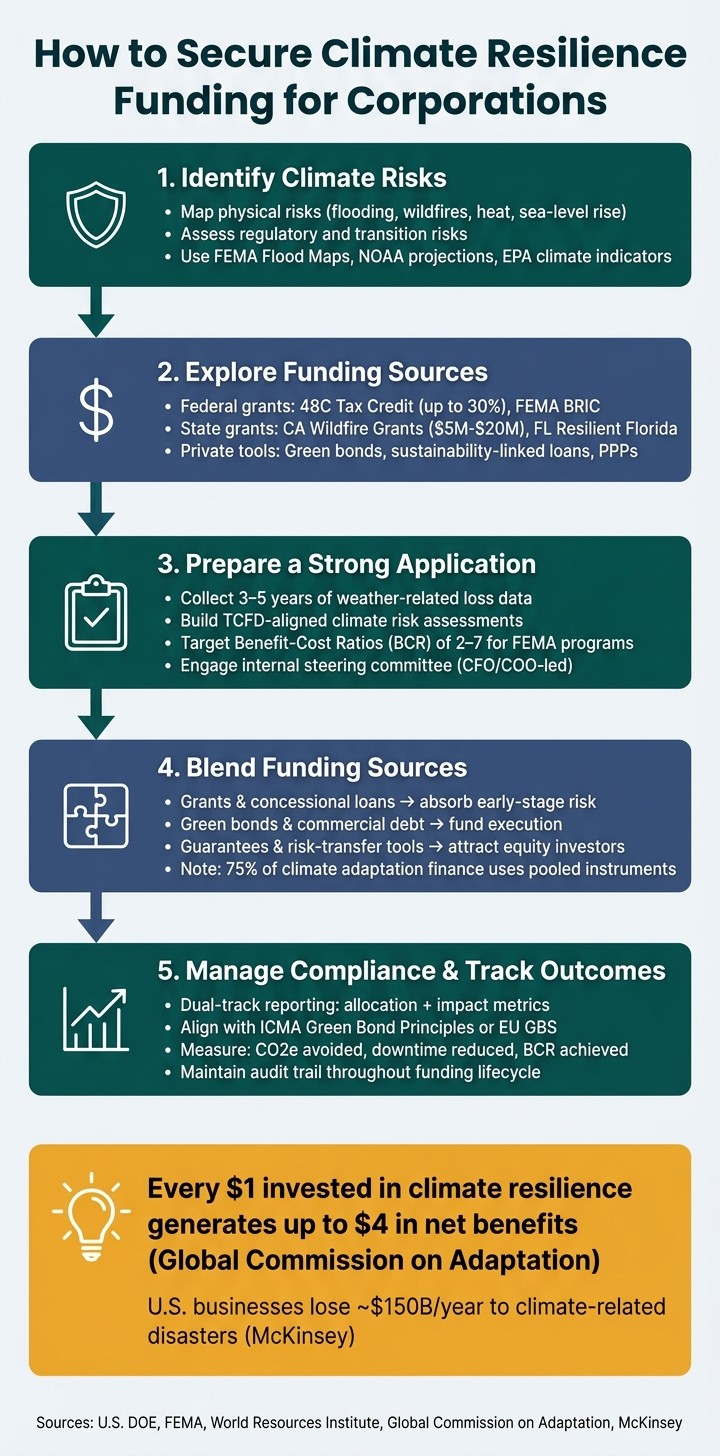
How to Secure Climate Resilience Funding: Step-by-Step Framework
Corporate Climate Resilience in Practice: Insights from the 2025 Foresight Series
Corporate Funding Channels for Climate Resilience
Corporations aiming to secure funding for climate resilience projects have access to a range of financial resources designed to address both immediate risks and long-term sustainability. The challenge lies in selecting the right funding mechanism to suit specific project requirements. Broadly, these funding options fall into three main categories: government grants, market-driven financing, and collaborative partnership models.
Federal and State Grants
Government grants provide a direct avenue for funding climate-related initiatives, though eligibility requirements can vary significantly. At the federal level, two notable programs stand out:
Qualifying Advanced Energy Project Credit (48C): Expanded under the Inflation Reduction Act, this program offers an investment tax credit of up to 30% for projects focused on industrial decarbonization and clean energy manufacturing. In January 2025, approximately $6 billion in 48C credits were allocated to over 140 projects across 30 states. Eligible industries, such as cement, steel, and chemicals, must demonstrate at least a 20% reduction in greenhouse gas emissions to qualify [4].
"The 48C credit is a tax credit for investments in advanced energy projects... intended to build clean energy supply chains, drive investments, and lower costs in energy communities." - U.S. Department of Energy [4]
FEMA's BRIC Program (Building Resilient Infrastructure and Communities): This initiative supports large-scale hazard mitigation and infrastructure hardening projects. While corporations cannot apply directly, they can participate as subapplicants or partners through state or local Hazard Mitigation Offices. The application deadline for the Fiscal Year 2024–25 cycle is July 23, 2026 [2].
At the state level, additional opportunities include:
California's Regional Wildfire & Landscape Resilience Grants: Awards range from $5 million to $20 million, funded by a $10 billion Climate Bond, and target wildfire risk mitigation and landscape resilience [3].
Florida's Resilient Florida Grants: Focused on addressing flooding and sea level rise, this program encourages corporate partnerships with public agencies [5].
The following table highlights key grant programs and their corporate eligibility:
Program | Level | Focus Area | Corporate Eligibility |
|---|---|---|---|
48C Tax Credit | Federal | Industrial decarbonization & clean energy | Direct (tax credit) |
FEMA BRIC | Federal | Infrastructure hardening & hazard mitigation | Indirect (subapplicant/partner) |
CA Regional Wildfire Grants | State (CA) | Wildfire risk & landscape resilience | Direct (utilities/legal entities) |
Resilient Florida | State (FL) | Flooding & sea level rise | Indirect (partner to public agency) |
While public grants are a valuable resource, corporations are increasingly exploring private market tools to secure additional funding.
Green Bonds and Sustainability-Linked Financing
Green bonds and sustainability-linked loans have emerged as effective tools for raising private capital while demonstrating a commitment to environmental, social, and governance (ESG) principles. These financial instruments align corporate funding needs with broader environmental goals, creating opportunities for collaboration with state-level initiatives.
For instance, California's Safe Drinking Water, Wildfire Prevention, Drought Preparedness, and Clean Air Bond Act of 2024 - a $10 billion General Obligation Bond - has funded resilience projects like landscape-scale wildfire prevention. In May 2026, CAL FIRE allocated $30 million in grants from this bond, targeting public utilities and nonprofits. By aligning projects with state priorities, corporations can enhance their chances of securing funding [5].
Public-Private Partnerships and Impact Investments
Collaborative funding models, such as public-private partnerships (PPPs), offer a way to tackle large-scale resilience projects. These partnerships are particularly critical in sectors like transportation, construction, and utilities, where climate adaptation efforts often lag despite the high risks posed by extreme weather events [1]. By sharing financial responsibilities, corporations and public entities can jointly invest in projects - such as flood defenses - that benefit both businesses and local communities.
Impact investors also play a growing role in addressing funding gaps. They focus on underfunded areas like wetland restoration and urban green infrastructure, which deliver both environmental benefits and measurable returns for businesses and communities. These innovative collaborations between public and private stakeholders are reshaping how resilience investments are designed and executed [1].
How to Prepare a Climate Resilience Project for Funding
To secure funding, climate resilience projects must be backed by solid data, clearly outlined goals, and a practical execution plan. Preparation typically involves three key steps: defining the project’s scope and objectives, validating the risks involved, and ensuring the right stakeholders are engaged.
Defining Project Scope and Objectives
A well-defined project scope should answer three essential questions: What specific climate hazard is being addressed? Which facilities or locations are included? What measurable outcomes define success?
Start by identifying hazards using resources like FEMA Flood Insurance Rate Maps, NOAA’s sea-level rise projections, or EPA climate indicators. Narrow the scope to specific locations, such as states, zip codes, or facilities (e.g., "all distribution centers along the Gulf Coast in Texas and Louisiana"). Then, establish measurable objectives, such as reducing climate-related downtime at a facility by a set percentage by a specific year or cutting annual storm repair costs by a defined dollar amount.
Different funders prioritize different outcomes. For instance:
Federal grants like FEMA’s BRIC program focus on community benefits and risk reduction.
Green bond investors emphasize measurable ESG outcomes.
Impact investors value social benefits, such as protecting local jobs or reducing community vulnerability.
Aligning your project’s objectives with the priorities of your target funder early on can save time later. Once objectives are clear, gather baseline data to quantify current risks and ensure the project’s parameters are well-supported.
Baseline Data and Risk Assessments
Funders expect a detailed baseline of current risks and performance metrics before committing resources. Start by collecting 3–5 years of data on weather-related downtime, supply chain disruptions, and repair costs. Translate these into annual financial impacts, such as "$3.2 million per year in storm damage and lost production at our New Orleans facility."
Conduct a formal climate risk assessment that addresses both acute hazards (like hurricanes or wildfires) and chronic hazards (such as rising sea levels or prolonged heat). Use at least two climate scenarios - one for moderate emissions and another for high emissions - and project impacts for specific timeframes, such as 2030 and 2050. Align this analysis with TCFD (Task Force on Climate-Related Financial Disclosures) recommendations, as this is increasingly expected by both public and private funders.
"Climate risk assessment is not an environmental exercise - it is an enterprise risk management exercise with financial consequences." - Council Fire [6]
Quantifying potential benefits is just as critical as assessing risks. For example, FEMA typically favors projects with benefit–cost ratios (BCRs) above 1.0. Competitive applications often demonstrate BCRs between 2 and 7 by calculating avoided property damage, reduced business interruptions, and improved worker safety.
Stakeholder Engagement and Regulatory Compliance
Engaging stakeholders and meeting regulatory requirements are crucial for reducing project risks and demonstrating feasibility. Internally, create a steering committee that includes representatives from finance, operations, risk management, legal, and sustainability teams, led by a senior executive sponsor like the CFO or COO. Externally, involve local governments, emergency management agencies, neighboring communities, and key suppliers early in the planning process.
Document all engagement efforts, including meeting notes, letters of support, and MOUs with municipal or agency partners. For federally funded projects, aligning with local Hazard Mitigation Plans or regional resilience strategies can provide a competitive edge.
On the regulatory front, identify necessary permits early in the process. These may include NEPA reviews for federally funded projects, Clean Water Act permits, state coastal zone approvals, and compliance with building codes like ASCE 7. Developing a simple regulatory roadmap with a clear timeline and assigned responsibilities signals to funders that your project is both realistic and executable within budget and schedule constraints.
How to Find and Evaluate Funding Opportunities
Once you've laid the groundwork for your project, the next step is identifying funding sources that align with your goals. With your scope, data, and stakeholder plans ready, it's time to focus on funding opportunities worth pursuing.
Researching Federal, State, and Local Resources
Start with Grants.gov, the go-to database for federal grants. You can refine your search by agency, eligibility requirements, and funding categories. Keep in mind, though, that the federal funding landscape has undergone major changes in recent years. For instance, FEMA's BRIC and HMGP programs were either canceled or suspended in 2025, while notices for some PROTECT Discretionary grants were removed. Always verify the current status of programs through updated federal and state announcements.
Program | Status (as of Jan. 2026) | Risk Level |
|---|---|---|
Clean Water SRF | 96% obligated; 49% expended | Low |
EPA IRA Climate Grants | 98% obligated | Low (some projects canceled) |
STORM RLF | $500M appropriated through FY2026 | Moderate |
BRIC | Canceled April 2025 | High |
HMGP | Suspended April 2025 | High |
PROTECT Discretionary | NOFO removed Feb. 2025 | High |
Given these shifts, state and local resources have become increasingly valuable. Many states now offer their own resilience-focused grants, often tied to infrastructure, water, or public safety budgets. Don't limit your search to programs explicitly labeled as "climate-related." Broader funding categories, like general infrastructure or public safety, may also support resilience goals. Specialized platforms can further help in identifying industry-specific opportunities.
Using Sector-Specific Funding Platforms
State-level and industry-specific platforms can provide tailored funding options. Here are three active examples from 2026:
MassCEC 2030 Fund: This Massachusetts-based initiative offers $50 million to climate technology companies. It provides investments ranging from $100,000 to $600,000 per check, with a cumulative cap of $1.5 million. Focus areas include carbon management and resilience, with a typical timeline of three to five months from pitch to funding. [9]
Minnesota Climate Innovation Finance Authority (MnCIFA): By March 2026, MnCIFA had approved $37 million across 14 loans, with an average loan size of $2.6 million. Around 90% of these loans benefit Environmental Justice Communities, and interest rates are set at the U.S. Treasury rate plus 100–300 basis points, depending on risk. [10]
CAL FIRE Regional Grants: Under California's Climate Bond Act, this program launched a $30 million funding cycle in May 2026. It supports large-scale wildfire resilience projects with awards ranging from $5 million to $20 million, covering performance periods through February 2031. [5]
Additionally, tools like the Flood Funding Finder and the Ready-to-Fund Resilience Toolkit can help narrow down options based on project type and hazard category. [7] Once you've identified promising platforms, it's essential to evaluate their suitability for your project.
Assessing Fit and Feasibility
Not every funding opportunity will align with your project's needs. A quick feasibility check can save time and resources.
First, ensure your organization, location, and sector meet the program's eligibility criteria. Some programs, like the MassCEC 2030 Fund, require a significant presence in their region - for example, at least three of four core business operations (headquarters, R&D, manufacturing, or sales) must be based in Massachusetts. [9] Other programs may give priority to projects located in rural, unincorporated, or designated Environmental Justice areas, which could influence scoring even if you meet the basic qualifications. [8]
Funding is often tiered by project stage:
Planning grants ($100,000–$500,000): For needs assessments and site preparation.
Project development grants ($500,000–$5 million): Cover permitting and design.
Implementation grants ($1 million–$10 million): Fund construction or retrofitting.
Applying for implementation funding without completing necessary permitting can lead to costly setbacks. [8]
The financial structure of the funding is another critical factor. Use your baseline data to determine whether the platform serves as a primary funder or a gap filler. Many sector-specific programs only cover 30–50% of total project costs, requiring you to secure additional funding beforehand. [10] Also, check whether payments are made upfront or on a reimbursement basis. For private-sector applicants, reimbursement is common, meaning you'll need access to capital to cover initial expenses. [8]
Finally, review any restrictions on eligible costs. Common exclusions include indirect costs exceeding 12%, lobbying activities, and projects currently involved in litigation. [8]
How to Build a Strong Funding Application
After identifying the right funding opportunities, the strength of your application becomes the deciding factor. Funders often sift through dozens, if not hundreds, of submissions, making clarity, precision, and a solid financial foundation critical to standing out.
Writing a Clear Project Narrative
Your project narrative should build on detailed risk assessments and stakeholder input, clearly outlining financial impacts. A well-crafted narrative ties project initiatives directly to financial and strategic risk management. The best applications position climate resilience as a core enterprise risk management (ERM) concern, linking it to capital allocation, board oversight, and long-term business strategies.
Detail the specific risks your project addresses, including physical risks like flooding, wildfires, or extreme heat, as well as transition risks such as carbon pricing or regulatory changes. To strengthen your case, demonstrate how your project performs under at least two climate scenarios: an orderly transition (1.5°C–2°C) and a high-risk scenario with greater warming (3°C+). This approach ensures a comprehensive risk perspective [6].
To add credibility, align your narrative with established frameworks like TCFD, ISSB (IFRS S2), or CSRD (ESRS E1). These frameworks not only enhance your application's legitimacy but also make it easier for reviewers to evaluate.
Building a Financial Case for Your Project
A compelling financial case is essential to complement your narrative. Funders want to see clear returns on investment (ROI), whether through avoided losses, revenue protection, or reduced insurance costs. A strong financial case should go beyond cost avoidance to highlight the full value of resilience.
Start with hard data. For instance, quantify past flooding impacts with specific figures. Use historical data to support your projections, such as anticipated increases in insurance premiums or the potential costs of supply chain disruptions under warming scenarios [11].
Here’s some context to consider: only 46% of weather-related losses are currently insured, and insured losses from natural disasters have more than doubled relative to global GDP since 1994 [11]. Use asset-specific data to make your case even stronger.
When structuring your ROI analysis, focus on these key areas:
Infrastructure: Days of operation lost to climate events; percentage of assets with resilience plans [11].
Finance: Reduction in insurance premiums; percentage of uninsurable assets [11].
Workforce: Heat-related safety incidents; productivity loss per degree of temperature increase [11].
Supply Chain: Percentage of critical suppliers with climate risk assessments [11].
Tailor your message to your audience. Financial teams will prioritize ROI, while operations leaders will focus on maintaining business continuity [11]. Once the financial case is clear, set measurable outcomes to track success.
Defining Measurable Outcomes and Compliance Standards
Measurable outcomes are essential to validate your project’s value. Funders want proof of success, so create metrics tied to specific timeframes: short-term (0–3 years), medium-term (3–10 years), and long-term (10–30+ years) [6].
For physical resilience projects, include metrics like wave energy reduction, stormwater system improvements, or habitat restoration. For example, in February 2026, a Mid-Atlantic coastal city with $4.2 billion in property value at risk secured $14.7 million in federal and state grants for a resilience plan. The project included a 1.2-mile living shoreline that reduced wave energy by 40–60%, restored 8 acres of tidal wetlands, and increased stormwater system capacity by 35% for 25-year storms. Its Benefit-Cost Ratio (BCR) of 4.2:1 placed it among the top 15% of FEMA BRIC applications nationally [12].
On compliance, funders increasingly require evidence of board-level oversight and integration of climate risk into ERM frameworks. For equity-focused programs, include metrics aligned with tools like the CDC’s Social Vulnerability Index (SVI) to quantify community benefits. Some programs, such as the Green Municipal Fund, even offer additional incentives (e.g., a 10% grant coverage boost) for projects addressing equity or nature-positive adaptation. Pre-calculating these scores can further strengthen your application [13].
Combining Funding Sources and Managing Project Execution
Blending Funding Tools to Cover Gaps
Once you've crafted a solid funding application, the next challenge is combining various financial tools to address different stages of your project. Complex climate resilience projects rarely rely on a single source of funding from start to finish. Instead, they require a mix of grants, concessional loans, green bonds, equity, and guarantees to fill specific funding gaps.
For instance, grants and concessional loans can absorb early-stage risks, making it easier to attract private capital later. As the project stabilizes, commercial debt or green bonds can step in to support execution. Guarantees and risk-transfer instruments help by reducing the overall risk for equity investors, encouraging their participation.
Another effective strategy involves tapping into pooled programs, funds, or facilities that combine different types of capital. According to the World Resources Institute, 75% of climate adaptation finance cases rely on pooled instruments rather than standalone project-specific funding [14]. This not only simplifies administration but also provides access to established governance frameworks.
When structuring your project for blended finance, focus on proactive risk reduction rather than reactive measures. The World Resources Institute highlights that:
"Ex-ante investments often have high rates of return, whereas ex-post risk management instruments are more generally perceived as costs." [14]
Funders are more likely to back projects that prevent damage rather than those that merely manage its aftermath. With financing gaps addressed, the next priority is ensuring robust governance and transparent reporting to maintain trust with funders.
Governance, Reporting, and Performance Tracking
Once you've secured funding from multiple sources, proper governance becomes essential to ensure funds are allocated correctly and impacts are measured effectively. Mismanagement at this stage can lead to compliance issues, jeopardizing future funding opportunities.
Form a cross-functional committee that includes representatives from treasury, sustainability, legal, and business units. This team should oversee fund selection, allocation, and monitoring. Clear roles and responsibilities are crucial for keeping everything on track.
For reporting, adopt a dual-track system: one for allocation (tracking how funds are used) and another for impact (measuring the actual environmental outcomes). Use standardized metrics like tonnes of CO2e avoided, megawatt-hours of renewable energy generated, or acre-feet of water conserved. These units make your reports consistent and credible for external reviewers.
If your funding mix includes green bonds, align your reporting framework with the ICMA Green Bond Principles or the EU Green Bond Standard (EU GBS), which became effective in December 2024. Even if you’re not pursuing formal EU certification, many U.S. institutional investors now use the EU GBS as a benchmark for quality. To enhance credibility, consider engaging a second-party opinion (SPO) provider such as Sustainalytics or ISS ESG. Their review process typically takes 4–6 weeks and adds significant weight to your disclosures [15].
Post-Award Compliance and Long-Term Project Success
Meeting compliance requirements after securing funding is a common stumbling block for many projects. Issues like poor audit trails, misallocated funds, and inconsistent impact reporting can derail even the best-funded initiatives.
To avoid these pitfalls, maintain a detailed audit trail of all allocation and selection decisions throughout the lifecycle of the funding instrument. For any unallocated proceeds, ensure they are temporarily invested in approved assets until they are deployed [15].
For sustained success, consider joining multi-stakeholder facilities or regional initiatives. The share of climate finance instruments targeting multiple countries has grown from 16% in 2015 to 47% in 2024 [14]. These collaborative approaches not only provide access to more funding but also connect your project to shared governance systems and technical expertise that would be costly to develop on your own.
"The market will benefit from continued innovation by funders, guarantors, implementing agents, and borrowers." - World Resources Institute [14]
Treat compliance as an ongoing discipline rather than a one-time task. This approach not only ensures you meet funders’ requirements but also strengthens the foundation for future funding applications. By maintaining transparency and accountability, you’ll align your project with its long-term climate resilience goals while building trust with stakeholders.
Conclusion: Aligning Funding with Corporate Climate Goals
Climate resilience funding is more than a box to check - it's a critical part of long-term corporate planning. The steps outlined in this guide - identifying risks, mapping funding opportunities, preparing investable projects, building a strong case, and blending financing sources - create a repeatable framework that delivers both resilience and financial returns.
The numbers speak for themselves. According to the Global Commission on Adaptation, every $1 invested in climate resilience can generate up to $4 in net benefits [17]. Meanwhile, McKinsey reports that climate-related natural disasters already cost U.S. businesses an average of $150 billion annually, a figure that will only rise without proactive adaptation [16]. Companies like Apple and Procter & Gamble have shown that well-aligned resilience projects not only secure oversubscribed bond offerings but also lead to measurable operational improvements [18][19].
Preparation is key to turning these opportunities into tangible advantages. Companies that maintain a pipeline of "shovel-ready" projects - complete with baseline data, preliminary budgets, and cross-functional teams - are better positioned to seize time-sensitive funding opportunities, such as grants and tax incentives under the Infrastructure Investment and Jobs Act (IIJA) and the Inflation Reduction Act (IRA).
Collaboration is just as essential as capital. Increasingly, federal and state funding programs prioritize multi-stakeholder initiatives. Early engagement with financial partners like banks and impact investors can enhance a project's viability and attractiveness. Internally, bringing together sustainability, finance, risk, and operations teams ensures a cohesive and efficient approach to funding.
Tracking outcomes solidifies the value of resilience investments. Metrics like reduced downtime, improved benefit-cost ratios, and avoided losses directly link resilience spending to shareholder value. These indicators not only strengthen investor confidence but also demonstrate a company's dedication to forward-thinking, sustainable practices [19].
FAQs
Which funding source fits my resilience project best?
When choosing a funding source, it's essential to align it with your project's goals. If your work centers on clean energy or climate mitigation, the IRA (Inflation Reduction Act) provides grants and tax incentives tailored to these areas. For projects focused on infrastructure or community resilience, federal grants, municipal bonds, and technical assistance are excellent options to explore. Renewable energy initiatives, on the other hand, can take advantage of federal tax credits, green bonds, or debt financing. These options often come with favorable rates and can significantly offset project expenses.
What data do funders require before I apply?
Funders require thorough financial and technical documentation to evaluate projects. This includes standardized templates, detailed project timelines, and critical metrics such as a Debt Service Coverage Ratio (DSCR) of at least 1.20x and a Loan Life Coverage Ratio (LLCR) ranging between 1.30x and 1.40x. Additionally, they prioritize projects backed by robust Power Purchase Agreements (PPAs), well-defined plans for fund allocation, and comprehensive project details like energy consumption figures and interconnection specifications.
To secure grants, loans, or bonds, it's essential to demonstrate the project's feasibility, outline strategies for managing potential risks, and ensure alignment with Environmental, Social, and Governance (ESG) objectives. These elements collectively provide funders with the confidence needed to support the initiative.
How do I combine grants and private capital without compliance issues?
To successfully merge grants with private capital while steering clear of compliance challenges, it’s essential to integrate funding sources thoughtfully. Grants can be particularly useful for early-stage efforts or offsetting risks, while private investments can be introduced through blended finance tools such as concessional loans or guarantees. By aligning grant applications with the objectives of private sector stakeholders, you can create synergy between the two funding streams. Simplify compliance by harmonizing requirements across funding sources, and consider leveraging technical assistance to prepare projects and address potential compliance concerns from the outset.
Related Blog Posts
Latest Articles
©2025

Narrative Change and Power Building: The Missing Half of Advocacy
Narrative change is the process of disrupting dominant narratives that normalize inequity and advancing new narratives from historically marginalized communities.

Funding Resilience Without Federal Grants
BRIC is unreliable and FEMA is shrinking. Here's how cities fund climate resilience with dedicated revenue, blended finance, and a coordinating authority.

The ESG Blind Spot: How AI Is Finding Risks in Companies Nobody Else Is Watching
Norway's sovereign wealth fund uses AI to screen 7,200 portfolio companies for forced labor and corruption within 24 hours. The real story is the emerging-market coverage gap that traditional ESG data vendors miss — and what it means for any company with a global supply chain.
Narrative Change and Power Building: The Missing Half of Advocacy
Narrative change is the process of disrupting dominant narratives that normalize inequity and advancing new narratives from historically marginalized communities.
Funding Resilience Without Federal Grants
BRIC is unreliable and FEMA is shrinking. Here's how cities fund climate resilience with dedicated revenue, blended finance, and a coordinating authority.
The ESG Blind Spot: How AI Is Finding Risks in Companies Nobody Else Is Watching
Norway's sovereign wealth fund uses AI to screen 7,200 portfolio companies for forced labor and corruption within 24 hours. The real story is the emerging-market coverage gap that traditional ESG data vendors miss — and what it means for any company with a global supply chain.
FAQ
01
What does it really mean to “redefine profit”?
02
What makes Council Fire different?
03
Who does Council Fire work with?
04
What does working with Council Fire actually look like?
05
How does Council Fire help organizations turn big goals into action?
06
How does Council Fire define and measure success?
May 22, 2026
How to Identify and Secure Funding for Climate Resilience Projects for Corporations
ESG Strategy
In This Article
Guide for corporations to identify climate risks, find grants and green financing, build fundable projects, and blend funding sources.
How to Identify and Secure Funding for Climate Resilience Projects for Corporations
Climate resilience funding is essential for businesses to protect operations and mitigate risks from climate change. Extreme weather events, regulatory pressures, and financial risks demand immediate attention, but securing funding requires careful planning, data, and alignment with available resources. Here's a quick guide:
Understand Risks: Identify physical and regulatory risks impacting your operations.
Explore Funding Sources: Federal and state grants, green bonds, and public-private partnerships are key options.
Prepare Strong Applications: Use data-backed risk assessments, measurable goals, and stakeholder engagement.
Combine Funding Tools: Blend grants, loans, and private capital to cover all project stages.
Maintain Compliance: Ensure proper governance, reporting, and performance tracking to meet funder requirements.
Investing in resilience not only safeguards assets but also creates long-term financial benefits. The following sections provide actionable steps to secure funding and execute successful projects.
How to Secure Climate Resilience Funding: Step-by-Step Framework
Corporate Climate Resilience in Practice: Insights from the 2025 Foresight Series
Corporate Funding Channels for Climate Resilience
Corporations aiming to secure funding for climate resilience projects have access to a range of financial resources designed to address both immediate risks and long-term sustainability. The challenge lies in selecting the right funding mechanism to suit specific project requirements. Broadly, these funding options fall into three main categories: government grants, market-driven financing, and collaborative partnership models.
Federal and State Grants
Government grants provide a direct avenue for funding climate-related initiatives, though eligibility requirements can vary significantly. At the federal level, two notable programs stand out:
Qualifying Advanced Energy Project Credit (48C): Expanded under the Inflation Reduction Act, this program offers an investment tax credit of up to 30% for projects focused on industrial decarbonization and clean energy manufacturing. In January 2025, approximately $6 billion in 48C credits were allocated to over 140 projects across 30 states. Eligible industries, such as cement, steel, and chemicals, must demonstrate at least a 20% reduction in greenhouse gas emissions to qualify [4].
"The 48C credit is a tax credit for investments in advanced energy projects... intended to build clean energy supply chains, drive investments, and lower costs in energy communities." - U.S. Department of Energy [4]
FEMA's BRIC Program (Building Resilient Infrastructure and Communities): This initiative supports large-scale hazard mitigation and infrastructure hardening projects. While corporations cannot apply directly, they can participate as subapplicants or partners through state or local Hazard Mitigation Offices. The application deadline for the Fiscal Year 2024–25 cycle is July 23, 2026 [2].
At the state level, additional opportunities include:
California's Regional Wildfire & Landscape Resilience Grants: Awards range from $5 million to $20 million, funded by a $10 billion Climate Bond, and target wildfire risk mitigation and landscape resilience [3].
Florida's Resilient Florida Grants: Focused on addressing flooding and sea level rise, this program encourages corporate partnerships with public agencies [5].
The following table highlights key grant programs and their corporate eligibility:
Program | Level | Focus Area | Corporate Eligibility |
|---|---|---|---|
48C Tax Credit | Federal | Industrial decarbonization & clean energy | Direct (tax credit) |
FEMA BRIC | Federal | Infrastructure hardening & hazard mitigation | Indirect (subapplicant/partner) |
CA Regional Wildfire Grants | State (CA) | Wildfire risk & landscape resilience | Direct (utilities/legal entities) |
Resilient Florida | State (FL) | Flooding & sea level rise | Indirect (partner to public agency) |
While public grants are a valuable resource, corporations are increasingly exploring private market tools to secure additional funding.
Green Bonds and Sustainability-Linked Financing
Green bonds and sustainability-linked loans have emerged as effective tools for raising private capital while demonstrating a commitment to environmental, social, and governance (ESG) principles. These financial instruments align corporate funding needs with broader environmental goals, creating opportunities for collaboration with state-level initiatives.
For instance, California's Safe Drinking Water, Wildfire Prevention, Drought Preparedness, and Clean Air Bond Act of 2024 - a $10 billion General Obligation Bond - has funded resilience projects like landscape-scale wildfire prevention. In May 2026, CAL FIRE allocated $30 million in grants from this bond, targeting public utilities and nonprofits. By aligning projects with state priorities, corporations can enhance their chances of securing funding [5].
Public-Private Partnerships and Impact Investments
Collaborative funding models, such as public-private partnerships (PPPs), offer a way to tackle large-scale resilience projects. These partnerships are particularly critical in sectors like transportation, construction, and utilities, where climate adaptation efforts often lag despite the high risks posed by extreme weather events [1]. By sharing financial responsibilities, corporations and public entities can jointly invest in projects - such as flood defenses - that benefit both businesses and local communities.
Impact investors also play a growing role in addressing funding gaps. They focus on underfunded areas like wetland restoration and urban green infrastructure, which deliver both environmental benefits and measurable returns for businesses and communities. These innovative collaborations between public and private stakeholders are reshaping how resilience investments are designed and executed [1].
How to Prepare a Climate Resilience Project for Funding
To secure funding, climate resilience projects must be backed by solid data, clearly outlined goals, and a practical execution plan. Preparation typically involves three key steps: defining the project’s scope and objectives, validating the risks involved, and ensuring the right stakeholders are engaged.
Defining Project Scope and Objectives
A well-defined project scope should answer three essential questions: What specific climate hazard is being addressed? Which facilities or locations are included? What measurable outcomes define success?
Start by identifying hazards using resources like FEMA Flood Insurance Rate Maps, NOAA’s sea-level rise projections, or EPA climate indicators. Narrow the scope to specific locations, such as states, zip codes, or facilities (e.g., "all distribution centers along the Gulf Coast in Texas and Louisiana"). Then, establish measurable objectives, such as reducing climate-related downtime at a facility by a set percentage by a specific year or cutting annual storm repair costs by a defined dollar amount.
Different funders prioritize different outcomes. For instance:
Federal grants like FEMA’s BRIC program focus on community benefits and risk reduction.
Green bond investors emphasize measurable ESG outcomes.
Impact investors value social benefits, such as protecting local jobs or reducing community vulnerability.
Aligning your project’s objectives with the priorities of your target funder early on can save time later. Once objectives are clear, gather baseline data to quantify current risks and ensure the project’s parameters are well-supported.
Baseline Data and Risk Assessments
Funders expect a detailed baseline of current risks and performance metrics before committing resources. Start by collecting 3–5 years of data on weather-related downtime, supply chain disruptions, and repair costs. Translate these into annual financial impacts, such as "$3.2 million per year in storm damage and lost production at our New Orleans facility."
Conduct a formal climate risk assessment that addresses both acute hazards (like hurricanes or wildfires) and chronic hazards (such as rising sea levels or prolonged heat). Use at least two climate scenarios - one for moderate emissions and another for high emissions - and project impacts for specific timeframes, such as 2030 and 2050. Align this analysis with TCFD (Task Force on Climate-Related Financial Disclosures) recommendations, as this is increasingly expected by both public and private funders.
"Climate risk assessment is not an environmental exercise - it is an enterprise risk management exercise with financial consequences." - Council Fire [6]
Quantifying potential benefits is just as critical as assessing risks. For example, FEMA typically favors projects with benefit–cost ratios (BCRs) above 1.0. Competitive applications often demonstrate BCRs between 2 and 7 by calculating avoided property damage, reduced business interruptions, and improved worker safety.
Stakeholder Engagement and Regulatory Compliance
Engaging stakeholders and meeting regulatory requirements are crucial for reducing project risks and demonstrating feasibility. Internally, create a steering committee that includes representatives from finance, operations, risk management, legal, and sustainability teams, led by a senior executive sponsor like the CFO or COO. Externally, involve local governments, emergency management agencies, neighboring communities, and key suppliers early in the planning process.
Document all engagement efforts, including meeting notes, letters of support, and MOUs with municipal or agency partners. For federally funded projects, aligning with local Hazard Mitigation Plans or regional resilience strategies can provide a competitive edge.
On the regulatory front, identify necessary permits early in the process. These may include NEPA reviews for federally funded projects, Clean Water Act permits, state coastal zone approvals, and compliance with building codes like ASCE 7. Developing a simple regulatory roadmap with a clear timeline and assigned responsibilities signals to funders that your project is both realistic and executable within budget and schedule constraints.
How to Find and Evaluate Funding Opportunities
Once you've laid the groundwork for your project, the next step is identifying funding sources that align with your goals. With your scope, data, and stakeholder plans ready, it's time to focus on funding opportunities worth pursuing.
Researching Federal, State, and Local Resources
Start with Grants.gov, the go-to database for federal grants. You can refine your search by agency, eligibility requirements, and funding categories. Keep in mind, though, that the federal funding landscape has undergone major changes in recent years. For instance, FEMA's BRIC and HMGP programs were either canceled or suspended in 2025, while notices for some PROTECT Discretionary grants were removed. Always verify the current status of programs through updated federal and state announcements.
Program | Status (as of Jan. 2026) | Risk Level |
|---|---|---|
Clean Water SRF | 96% obligated; 49% expended | Low |
EPA IRA Climate Grants | 98% obligated | Low (some projects canceled) |
STORM RLF | $500M appropriated through FY2026 | Moderate |
BRIC | Canceled April 2025 | High |
HMGP | Suspended April 2025 | High |
PROTECT Discretionary | NOFO removed Feb. 2025 | High |
Given these shifts, state and local resources have become increasingly valuable. Many states now offer their own resilience-focused grants, often tied to infrastructure, water, or public safety budgets. Don't limit your search to programs explicitly labeled as "climate-related." Broader funding categories, like general infrastructure or public safety, may also support resilience goals. Specialized platforms can further help in identifying industry-specific opportunities.
Using Sector-Specific Funding Platforms
State-level and industry-specific platforms can provide tailored funding options. Here are three active examples from 2026:
MassCEC 2030 Fund: This Massachusetts-based initiative offers $50 million to climate technology companies. It provides investments ranging from $100,000 to $600,000 per check, with a cumulative cap of $1.5 million. Focus areas include carbon management and resilience, with a typical timeline of three to five months from pitch to funding. [9]
Minnesota Climate Innovation Finance Authority (MnCIFA): By March 2026, MnCIFA had approved $37 million across 14 loans, with an average loan size of $2.6 million. Around 90% of these loans benefit Environmental Justice Communities, and interest rates are set at the U.S. Treasury rate plus 100–300 basis points, depending on risk. [10]
CAL FIRE Regional Grants: Under California's Climate Bond Act, this program launched a $30 million funding cycle in May 2026. It supports large-scale wildfire resilience projects with awards ranging from $5 million to $20 million, covering performance periods through February 2031. [5]
Additionally, tools like the Flood Funding Finder and the Ready-to-Fund Resilience Toolkit can help narrow down options based on project type and hazard category. [7] Once you've identified promising platforms, it's essential to evaluate their suitability for your project.
Assessing Fit and Feasibility
Not every funding opportunity will align with your project's needs. A quick feasibility check can save time and resources.
First, ensure your organization, location, and sector meet the program's eligibility criteria. Some programs, like the MassCEC 2030 Fund, require a significant presence in their region - for example, at least three of four core business operations (headquarters, R&D, manufacturing, or sales) must be based in Massachusetts. [9] Other programs may give priority to projects located in rural, unincorporated, or designated Environmental Justice areas, which could influence scoring even if you meet the basic qualifications. [8]
Funding is often tiered by project stage:
Planning grants ($100,000–$500,000): For needs assessments and site preparation.
Project development grants ($500,000–$5 million): Cover permitting and design.
Implementation grants ($1 million–$10 million): Fund construction or retrofitting.
Applying for implementation funding without completing necessary permitting can lead to costly setbacks. [8]
The financial structure of the funding is another critical factor. Use your baseline data to determine whether the platform serves as a primary funder or a gap filler. Many sector-specific programs only cover 30–50% of total project costs, requiring you to secure additional funding beforehand. [10] Also, check whether payments are made upfront or on a reimbursement basis. For private-sector applicants, reimbursement is common, meaning you'll need access to capital to cover initial expenses. [8]
Finally, review any restrictions on eligible costs. Common exclusions include indirect costs exceeding 12%, lobbying activities, and projects currently involved in litigation. [8]
How to Build a Strong Funding Application
After identifying the right funding opportunities, the strength of your application becomes the deciding factor. Funders often sift through dozens, if not hundreds, of submissions, making clarity, precision, and a solid financial foundation critical to standing out.
Writing a Clear Project Narrative
Your project narrative should build on detailed risk assessments and stakeholder input, clearly outlining financial impacts. A well-crafted narrative ties project initiatives directly to financial and strategic risk management. The best applications position climate resilience as a core enterprise risk management (ERM) concern, linking it to capital allocation, board oversight, and long-term business strategies.
Detail the specific risks your project addresses, including physical risks like flooding, wildfires, or extreme heat, as well as transition risks such as carbon pricing or regulatory changes. To strengthen your case, demonstrate how your project performs under at least two climate scenarios: an orderly transition (1.5°C–2°C) and a high-risk scenario with greater warming (3°C+). This approach ensures a comprehensive risk perspective [6].
To add credibility, align your narrative with established frameworks like TCFD, ISSB (IFRS S2), or CSRD (ESRS E1). These frameworks not only enhance your application's legitimacy but also make it easier for reviewers to evaluate.
Building a Financial Case for Your Project
A compelling financial case is essential to complement your narrative. Funders want to see clear returns on investment (ROI), whether through avoided losses, revenue protection, or reduced insurance costs. A strong financial case should go beyond cost avoidance to highlight the full value of resilience.
Start with hard data. For instance, quantify past flooding impacts with specific figures. Use historical data to support your projections, such as anticipated increases in insurance premiums or the potential costs of supply chain disruptions under warming scenarios [11].
Here’s some context to consider: only 46% of weather-related losses are currently insured, and insured losses from natural disasters have more than doubled relative to global GDP since 1994 [11]. Use asset-specific data to make your case even stronger.
When structuring your ROI analysis, focus on these key areas:
Infrastructure: Days of operation lost to climate events; percentage of assets with resilience plans [11].
Finance: Reduction in insurance premiums; percentage of uninsurable assets [11].
Workforce: Heat-related safety incidents; productivity loss per degree of temperature increase [11].
Supply Chain: Percentage of critical suppliers with climate risk assessments [11].
Tailor your message to your audience. Financial teams will prioritize ROI, while operations leaders will focus on maintaining business continuity [11]. Once the financial case is clear, set measurable outcomes to track success.
Defining Measurable Outcomes and Compliance Standards
Measurable outcomes are essential to validate your project’s value. Funders want proof of success, so create metrics tied to specific timeframes: short-term (0–3 years), medium-term (3–10 years), and long-term (10–30+ years) [6].
For physical resilience projects, include metrics like wave energy reduction, stormwater system improvements, or habitat restoration. For example, in February 2026, a Mid-Atlantic coastal city with $4.2 billion in property value at risk secured $14.7 million in federal and state grants for a resilience plan. The project included a 1.2-mile living shoreline that reduced wave energy by 40–60%, restored 8 acres of tidal wetlands, and increased stormwater system capacity by 35% for 25-year storms. Its Benefit-Cost Ratio (BCR) of 4.2:1 placed it among the top 15% of FEMA BRIC applications nationally [12].
On compliance, funders increasingly require evidence of board-level oversight and integration of climate risk into ERM frameworks. For equity-focused programs, include metrics aligned with tools like the CDC’s Social Vulnerability Index (SVI) to quantify community benefits. Some programs, such as the Green Municipal Fund, even offer additional incentives (e.g., a 10% grant coverage boost) for projects addressing equity or nature-positive adaptation. Pre-calculating these scores can further strengthen your application [13].
Combining Funding Sources and Managing Project Execution
Blending Funding Tools to Cover Gaps
Once you've crafted a solid funding application, the next challenge is combining various financial tools to address different stages of your project. Complex climate resilience projects rarely rely on a single source of funding from start to finish. Instead, they require a mix of grants, concessional loans, green bonds, equity, and guarantees to fill specific funding gaps.
For instance, grants and concessional loans can absorb early-stage risks, making it easier to attract private capital later. As the project stabilizes, commercial debt or green bonds can step in to support execution. Guarantees and risk-transfer instruments help by reducing the overall risk for equity investors, encouraging their participation.
Another effective strategy involves tapping into pooled programs, funds, or facilities that combine different types of capital. According to the World Resources Institute, 75% of climate adaptation finance cases rely on pooled instruments rather than standalone project-specific funding [14]. This not only simplifies administration but also provides access to established governance frameworks.
When structuring your project for blended finance, focus on proactive risk reduction rather than reactive measures. The World Resources Institute highlights that:
"Ex-ante investments often have high rates of return, whereas ex-post risk management instruments are more generally perceived as costs." [14]
Funders are more likely to back projects that prevent damage rather than those that merely manage its aftermath. With financing gaps addressed, the next priority is ensuring robust governance and transparent reporting to maintain trust with funders.
Governance, Reporting, and Performance Tracking
Once you've secured funding from multiple sources, proper governance becomes essential to ensure funds are allocated correctly and impacts are measured effectively. Mismanagement at this stage can lead to compliance issues, jeopardizing future funding opportunities.
Form a cross-functional committee that includes representatives from treasury, sustainability, legal, and business units. This team should oversee fund selection, allocation, and monitoring. Clear roles and responsibilities are crucial for keeping everything on track.
For reporting, adopt a dual-track system: one for allocation (tracking how funds are used) and another for impact (measuring the actual environmental outcomes). Use standardized metrics like tonnes of CO2e avoided, megawatt-hours of renewable energy generated, or acre-feet of water conserved. These units make your reports consistent and credible for external reviewers.
If your funding mix includes green bonds, align your reporting framework with the ICMA Green Bond Principles or the EU Green Bond Standard (EU GBS), which became effective in December 2024. Even if you’re not pursuing formal EU certification, many U.S. institutional investors now use the EU GBS as a benchmark for quality. To enhance credibility, consider engaging a second-party opinion (SPO) provider such as Sustainalytics or ISS ESG. Their review process typically takes 4–6 weeks and adds significant weight to your disclosures [15].
Post-Award Compliance and Long-Term Project Success
Meeting compliance requirements after securing funding is a common stumbling block for many projects. Issues like poor audit trails, misallocated funds, and inconsistent impact reporting can derail even the best-funded initiatives.
To avoid these pitfalls, maintain a detailed audit trail of all allocation and selection decisions throughout the lifecycle of the funding instrument. For any unallocated proceeds, ensure they are temporarily invested in approved assets until they are deployed [15].
For sustained success, consider joining multi-stakeholder facilities or regional initiatives. The share of climate finance instruments targeting multiple countries has grown from 16% in 2015 to 47% in 2024 [14]. These collaborative approaches not only provide access to more funding but also connect your project to shared governance systems and technical expertise that would be costly to develop on your own.
"The market will benefit from continued innovation by funders, guarantors, implementing agents, and borrowers." - World Resources Institute [14]
Treat compliance as an ongoing discipline rather than a one-time task. This approach not only ensures you meet funders’ requirements but also strengthens the foundation for future funding applications. By maintaining transparency and accountability, you’ll align your project with its long-term climate resilience goals while building trust with stakeholders.
Conclusion: Aligning Funding with Corporate Climate Goals
Climate resilience funding is more than a box to check - it's a critical part of long-term corporate planning. The steps outlined in this guide - identifying risks, mapping funding opportunities, preparing investable projects, building a strong case, and blending financing sources - create a repeatable framework that delivers both resilience and financial returns.
The numbers speak for themselves. According to the Global Commission on Adaptation, every $1 invested in climate resilience can generate up to $4 in net benefits [17]. Meanwhile, McKinsey reports that climate-related natural disasters already cost U.S. businesses an average of $150 billion annually, a figure that will only rise without proactive adaptation [16]. Companies like Apple and Procter & Gamble have shown that well-aligned resilience projects not only secure oversubscribed bond offerings but also lead to measurable operational improvements [18][19].
Preparation is key to turning these opportunities into tangible advantages. Companies that maintain a pipeline of "shovel-ready" projects - complete with baseline data, preliminary budgets, and cross-functional teams - are better positioned to seize time-sensitive funding opportunities, such as grants and tax incentives under the Infrastructure Investment and Jobs Act (IIJA) and the Inflation Reduction Act (IRA).
Collaboration is just as essential as capital. Increasingly, federal and state funding programs prioritize multi-stakeholder initiatives. Early engagement with financial partners like banks and impact investors can enhance a project's viability and attractiveness. Internally, bringing together sustainability, finance, risk, and operations teams ensures a cohesive and efficient approach to funding.
Tracking outcomes solidifies the value of resilience investments. Metrics like reduced downtime, improved benefit-cost ratios, and avoided losses directly link resilience spending to shareholder value. These indicators not only strengthen investor confidence but also demonstrate a company's dedication to forward-thinking, sustainable practices [19].
FAQs
Which funding source fits my resilience project best?
When choosing a funding source, it's essential to align it with your project's goals. If your work centers on clean energy or climate mitigation, the IRA (Inflation Reduction Act) provides grants and tax incentives tailored to these areas. For projects focused on infrastructure or community resilience, federal grants, municipal bonds, and technical assistance are excellent options to explore. Renewable energy initiatives, on the other hand, can take advantage of federal tax credits, green bonds, or debt financing. These options often come with favorable rates and can significantly offset project expenses.
What data do funders require before I apply?
Funders require thorough financial and technical documentation to evaluate projects. This includes standardized templates, detailed project timelines, and critical metrics such as a Debt Service Coverage Ratio (DSCR) of at least 1.20x and a Loan Life Coverage Ratio (LLCR) ranging between 1.30x and 1.40x. Additionally, they prioritize projects backed by robust Power Purchase Agreements (PPAs), well-defined plans for fund allocation, and comprehensive project details like energy consumption figures and interconnection specifications.
To secure grants, loans, or bonds, it's essential to demonstrate the project's feasibility, outline strategies for managing potential risks, and ensure alignment with Environmental, Social, and Governance (ESG) objectives. These elements collectively provide funders with the confidence needed to support the initiative.
How do I combine grants and private capital without compliance issues?
To successfully merge grants with private capital while steering clear of compliance challenges, it’s essential to integrate funding sources thoughtfully. Grants can be particularly useful for early-stage efforts or offsetting risks, while private investments can be introduced through blended finance tools such as concessional loans or guarantees. By aligning grant applications with the objectives of private sector stakeholders, you can create synergy between the two funding streams. Simplify compliance by harmonizing requirements across funding sources, and consider leveraging technical assistance to prepare projects and address potential compliance concerns from the outset.
Related Blog Posts
Latest Articles
©2025
Narrative Change and Power Building: The Missing Half of Advocacy
Narrative change is the process of disrupting dominant narratives that normalize inequity and advancing new narratives from historically marginalized communities.
Funding Resilience Without Federal Grants
BRIC is unreliable and FEMA is shrinking. Here's how cities fund climate resilience with dedicated revenue, blended finance, and a coordinating authority.
The ESG Blind Spot: How AI Is Finding Risks in Companies Nobody Else Is Watching
Norway's sovereign wealth fund uses AI to screen 7,200 portfolio companies for forced labor and corruption within 24 hours. The real story is the emerging-market coverage gap that traditional ESG data vendors miss — and what it means for any company with a global supply chain.
FAQ
01
What does it really mean to “redefine profit”?
02
What makes Council Fire different?
03
Who does Council Fire work with?
04
What does working with Council Fire actually look like?
05
How does Council Fire help organizations turn big goals into action?
06
How does Council Fire define and measure success?
May 22, 2026
How to Identify and Secure Funding for Climate Resilience Projects for Corporations
ESG Strategy
In This Article
Guide for corporations to identify climate risks, find grants and green financing, build fundable projects, and blend funding sources.
How to Identify and Secure Funding for Climate Resilience Projects for Corporations
Climate resilience funding is essential for businesses to protect operations and mitigate risks from climate change. Extreme weather events, regulatory pressures, and financial risks demand immediate attention, but securing funding requires careful planning, data, and alignment with available resources. Here's a quick guide:
Understand Risks: Identify physical and regulatory risks impacting your operations.
Explore Funding Sources: Federal and state grants, green bonds, and public-private partnerships are key options.
Prepare Strong Applications: Use data-backed risk assessments, measurable goals, and stakeholder engagement.
Combine Funding Tools: Blend grants, loans, and private capital to cover all project stages.
Maintain Compliance: Ensure proper governance, reporting, and performance tracking to meet funder requirements.
Investing in resilience not only safeguards assets but also creates long-term financial benefits. The following sections provide actionable steps to secure funding and execute successful projects.
How to Secure Climate Resilience Funding: Step-by-Step Framework
Corporate Climate Resilience in Practice: Insights from the 2025 Foresight Series
Corporate Funding Channels for Climate Resilience
Corporations aiming to secure funding for climate resilience projects have access to a range of financial resources designed to address both immediate risks and long-term sustainability. The challenge lies in selecting the right funding mechanism to suit specific project requirements. Broadly, these funding options fall into three main categories: government grants, market-driven financing, and collaborative partnership models.
Federal and State Grants
Government grants provide a direct avenue for funding climate-related initiatives, though eligibility requirements can vary significantly. At the federal level, two notable programs stand out:
Qualifying Advanced Energy Project Credit (48C): Expanded under the Inflation Reduction Act, this program offers an investment tax credit of up to 30% for projects focused on industrial decarbonization and clean energy manufacturing. In January 2025, approximately $6 billion in 48C credits were allocated to over 140 projects across 30 states. Eligible industries, such as cement, steel, and chemicals, must demonstrate at least a 20% reduction in greenhouse gas emissions to qualify [4].
"The 48C credit is a tax credit for investments in advanced energy projects... intended to build clean energy supply chains, drive investments, and lower costs in energy communities." - U.S. Department of Energy [4]
FEMA's BRIC Program (Building Resilient Infrastructure and Communities): This initiative supports large-scale hazard mitigation and infrastructure hardening projects. While corporations cannot apply directly, they can participate as subapplicants or partners through state or local Hazard Mitigation Offices. The application deadline for the Fiscal Year 2024–25 cycle is July 23, 2026 [2].
At the state level, additional opportunities include:
California's Regional Wildfire & Landscape Resilience Grants: Awards range from $5 million to $20 million, funded by a $10 billion Climate Bond, and target wildfire risk mitigation and landscape resilience [3].
Florida's Resilient Florida Grants: Focused on addressing flooding and sea level rise, this program encourages corporate partnerships with public agencies [5].
The following table highlights key grant programs and their corporate eligibility:
Program | Level | Focus Area | Corporate Eligibility |
|---|---|---|---|
48C Tax Credit | Federal | Industrial decarbonization & clean energy | Direct (tax credit) |
FEMA BRIC | Federal | Infrastructure hardening & hazard mitigation | Indirect (subapplicant/partner) |
CA Regional Wildfire Grants | State (CA) | Wildfire risk & landscape resilience | Direct (utilities/legal entities) |
Resilient Florida | State (FL) | Flooding & sea level rise | Indirect (partner to public agency) |
While public grants are a valuable resource, corporations are increasingly exploring private market tools to secure additional funding.
Green Bonds and Sustainability-Linked Financing
Green bonds and sustainability-linked loans have emerged as effective tools for raising private capital while demonstrating a commitment to environmental, social, and governance (ESG) principles. These financial instruments align corporate funding needs with broader environmental goals, creating opportunities for collaboration with state-level initiatives.
For instance, California's Safe Drinking Water, Wildfire Prevention, Drought Preparedness, and Clean Air Bond Act of 2024 - a $10 billion General Obligation Bond - has funded resilience projects like landscape-scale wildfire prevention. In May 2026, CAL FIRE allocated $30 million in grants from this bond, targeting public utilities and nonprofits. By aligning projects with state priorities, corporations can enhance their chances of securing funding [5].
Public-Private Partnerships and Impact Investments
Collaborative funding models, such as public-private partnerships (PPPs), offer a way to tackle large-scale resilience projects. These partnerships are particularly critical in sectors like transportation, construction, and utilities, where climate adaptation efforts often lag despite the high risks posed by extreme weather events [1]. By sharing financial responsibilities, corporations and public entities can jointly invest in projects - such as flood defenses - that benefit both businesses and local communities.
Impact investors also play a growing role in addressing funding gaps. They focus on underfunded areas like wetland restoration and urban green infrastructure, which deliver both environmental benefits and measurable returns for businesses and communities. These innovative collaborations between public and private stakeholders are reshaping how resilience investments are designed and executed [1].
How to Prepare a Climate Resilience Project for Funding
To secure funding, climate resilience projects must be backed by solid data, clearly outlined goals, and a practical execution plan. Preparation typically involves three key steps: defining the project’s scope and objectives, validating the risks involved, and ensuring the right stakeholders are engaged.
Defining Project Scope and Objectives
A well-defined project scope should answer three essential questions: What specific climate hazard is being addressed? Which facilities or locations are included? What measurable outcomes define success?
Start by identifying hazards using resources like FEMA Flood Insurance Rate Maps, NOAA’s sea-level rise projections, or EPA climate indicators. Narrow the scope to specific locations, such as states, zip codes, or facilities (e.g., "all distribution centers along the Gulf Coast in Texas and Louisiana"). Then, establish measurable objectives, such as reducing climate-related downtime at a facility by a set percentage by a specific year or cutting annual storm repair costs by a defined dollar amount.
Different funders prioritize different outcomes. For instance:
Federal grants like FEMA’s BRIC program focus on community benefits and risk reduction.
Green bond investors emphasize measurable ESG outcomes.
Impact investors value social benefits, such as protecting local jobs or reducing community vulnerability.
Aligning your project’s objectives with the priorities of your target funder early on can save time later. Once objectives are clear, gather baseline data to quantify current risks and ensure the project’s parameters are well-supported.
Baseline Data and Risk Assessments
Funders expect a detailed baseline of current risks and performance metrics before committing resources. Start by collecting 3–5 years of data on weather-related downtime, supply chain disruptions, and repair costs. Translate these into annual financial impacts, such as "$3.2 million per year in storm damage and lost production at our New Orleans facility."
Conduct a formal climate risk assessment that addresses both acute hazards (like hurricanes or wildfires) and chronic hazards (such as rising sea levels or prolonged heat). Use at least two climate scenarios - one for moderate emissions and another for high emissions - and project impacts for specific timeframes, such as 2030 and 2050. Align this analysis with TCFD (Task Force on Climate-Related Financial Disclosures) recommendations, as this is increasingly expected by both public and private funders.
"Climate risk assessment is not an environmental exercise - it is an enterprise risk management exercise with financial consequences." - Council Fire [6]
Quantifying potential benefits is just as critical as assessing risks. For example, FEMA typically favors projects with benefit–cost ratios (BCRs) above 1.0. Competitive applications often demonstrate BCRs between 2 and 7 by calculating avoided property damage, reduced business interruptions, and improved worker safety.
Stakeholder Engagement and Regulatory Compliance
Engaging stakeholders and meeting regulatory requirements are crucial for reducing project risks and demonstrating feasibility. Internally, create a steering committee that includes representatives from finance, operations, risk management, legal, and sustainability teams, led by a senior executive sponsor like the CFO or COO. Externally, involve local governments, emergency management agencies, neighboring communities, and key suppliers early in the planning process.
Document all engagement efforts, including meeting notes, letters of support, and MOUs with municipal or agency partners. For federally funded projects, aligning with local Hazard Mitigation Plans or regional resilience strategies can provide a competitive edge.
On the regulatory front, identify necessary permits early in the process. These may include NEPA reviews for federally funded projects, Clean Water Act permits, state coastal zone approvals, and compliance with building codes like ASCE 7. Developing a simple regulatory roadmap with a clear timeline and assigned responsibilities signals to funders that your project is both realistic and executable within budget and schedule constraints.
How to Find and Evaluate Funding Opportunities
Once you've laid the groundwork for your project, the next step is identifying funding sources that align with your goals. With your scope, data, and stakeholder plans ready, it's time to focus on funding opportunities worth pursuing.
Researching Federal, State, and Local Resources
Start with Grants.gov, the go-to database for federal grants. You can refine your search by agency, eligibility requirements, and funding categories. Keep in mind, though, that the federal funding landscape has undergone major changes in recent years. For instance, FEMA's BRIC and HMGP programs were either canceled or suspended in 2025, while notices for some PROTECT Discretionary grants were removed. Always verify the current status of programs through updated federal and state announcements.
Program | Status (as of Jan. 2026) | Risk Level |
|---|---|---|
Clean Water SRF | 96% obligated; 49% expended | Low |
EPA IRA Climate Grants | 98% obligated | Low (some projects canceled) |
STORM RLF | $500M appropriated through FY2026 | Moderate |
BRIC | Canceled April 2025 | High |
HMGP | Suspended April 2025 | High |
PROTECT Discretionary | NOFO removed Feb. 2025 | High |
Given these shifts, state and local resources have become increasingly valuable. Many states now offer their own resilience-focused grants, often tied to infrastructure, water, or public safety budgets. Don't limit your search to programs explicitly labeled as "climate-related." Broader funding categories, like general infrastructure or public safety, may also support resilience goals. Specialized platforms can further help in identifying industry-specific opportunities.
Using Sector-Specific Funding Platforms
State-level and industry-specific platforms can provide tailored funding options. Here are three active examples from 2026:
MassCEC 2030 Fund: This Massachusetts-based initiative offers $50 million to climate technology companies. It provides investments ranging from $100,000 to $600,000 per check, with a cumulative cap of $1.5 million. Focus areas include carbon management and resilience, with a typical timeline of three to five months from pitch to funding. [9]
Minnesota Climate Innovation Finance Authority (MnCIFA): By March 2026, MnCIFA had approved $37 million across 14 loans, with an average loan size of $2.6 million. Around 90% of these loans benefit Environmental Justice Communities, and interest rates are set at the U.S. Treasury rate plus 100–300 basis points, depending on risk. [10]
CAL FIRE Regional Grants: Under California's Climate Bond Act, this program launched a $30 million funding cycle in May 2026. It supports large-scale wildfire resilience projects with awards ranging from $5 million to $20 million, covering performance periods through February 2031. [5]
Additionally, tools like the Flood Funding Finder and the Ready-to-Fund Resilience Toolkit can help narrow down options based on project type and hazard category. [7] Once you've identified promising platforms, it's essential to evaluate their suitability for your project.
Assessing Fit and Feasibility
Not every funding opportunity will align with your project's needs. A quick feasibility check can save time and resources.
First, ensure your organization, location, and sector meet the program's eligibility criteria. Some programs, like the MassCEC 2030 Fund, require a significant presence in their region - for example, at least three of four core business operations (headquarters, R&D, manufacturing, or sales) must be based in Massachusetts. [9] Other programs may give priority to projects located in rural, unincorporated, or designated Environmental Justice areas, which could influence scoring even if you meet the basic qualifications. [8]
Funding is often tiered by project stage:
Planning grants ($100,000–$500,000): For needs assessments and site preparation.
Project development grants ($500,000–$5 million): Cover permitting and design.
Implementation grants ($1 million–$10 million): Fund construction or retrofitting.
Applying for implementation funding without completing necessary permitting can lead to costly setbacks. [8]
The financial structure of the funding is another critical factor. Use your baseline data to determine whether the platform serves as a primary funder or a gap filler. Many sector-specific programs only cover 30–50% of total project costs, requiring you to secure additional funding beforehand. [10] Also, check whether payments are made upfront or on a reimbursement basis. For private-sector applicants, reimbursement is common, meaning you'll need access to capital to cover initial expenses. [8]
Finally, review any restrictions on eligible costs. Common exclusions include indirect costs exceeding 12%, lobbying activities, and projects currently involved in litigation. [8]
How to Build a Strong Funding Application
After identifying the right funding opportunities, the strength of your application becomes the deciding factor. Funders often sift through dozens, if not hundreds, of submissions, making clarity, precision, and a solid financial foundation critical to standing out.
Writing a Clear Project Narrative
Your project narrative should build on detailed risk assessments and stakeholder input, clearly outlining financial impacts. A well-crafted narrative ties project initiatives directly to financial and strategic risk management. The best applications position climate resilience as a core enterprise risk management (ERM) concern, linking it to capital allocation, board oversight, and long-term business strategies.
Detail the specific risks your project addresses, including physical risks like flooding, wildfires, or extreme heat, as well as transition risks such as carbon pricing or regulatory changes. To strengthen your case, demonstrate how your project performs under at least two climate scenarios: an orderly transition (1.5°C–2°C) and a high-risk scenario with greater warming (3°C+). This approach ensures a comprehensive risk perspective [6].
To add credibility, align your narrative with established frameworks like TCFD, ISSB (IFRS S2), or CSRD (ESRS E1). These frameworks not only enhance your application's legitimacy but also make it easier for reviewers to evaluate.
Building a Financial Case for Your Project
A compelling financial case is essential to complement your narrative. Funders want to see clear returns on investment (ROI), whether through avoided losses, revenue protection, or reduced insurance costs. A strong financial case should go beyond cost avoidance to highlight the full value of resilience.
Start with hard data. For instance, quantify past flooding impacts with specific figures. Use historical data to support your projections, such as anticipated increases in insurance premiums or the potential costs of supply chain disruptions under warming scenarios [11].
Here’s some context to consider: only 46% of weather-related losses are currently insured, and insured losses from natural disasters have more than doubled relative to global GDP since 1994 [11]. Use asset-specific data to make your case even stronger.
When structuring your ROI analysis, focus on these key areas:
Infrastructure: Days of operation lost to climate events; percentage of assets with resilience plans [11].
Finance: Reduction in insurance premiums; percentage of uninsurable assets [11].
Workforce: Heat-related safety incidents; productivity loss per degree of temperature increase [11].
Supply Chain: Percentage of critical suppliers with climate risk assessments [11].
Tailor your message to your audience. Financial teams will prioritize ROI, while operations leaders will focus on maintaining business continuity [11]. Once the financial case is clear, set measurable outcomes to track success.
Defining Measurable Outcomes and Compliance Standards
Measurable outcomes are essential to validate your project’s value. Funders want proof of success, so create metrics tied to specific timeframes: short-term (0–3 years), medium-term (3–10 years), and long-term (10–30+ years) [6].
For physical resilience projects, include metrics like wave energy reduction, stormwater system improvements, or habitat restoration. For example, in February 2026, a Mid-Atlantic coastal city with $4.2 billion in property value at risk secured $14.7 million in federal and state grants for a resilience plan. The project included a 1.2-mile living shoreline that reduced wave energy by 40–60%, restored 8 acres of tidal wetlands, and increased stormwater system capacity by 35% for 25-year storms. Its Benefit-Cost Ratio (BCR) of 4.2:1 placed it among the top 15% of FEMA BRIC applications nationally [12].
On compliance, funders increasingly require evidence of board-level oversight and integration of climate risk into ERM frameworks. For equity-focused programs, include metrics aligned with tools like the CDC’s Social Vulnerability Index (SVI) to quantify community benefits. Some programs, such as the Green Municipal Fund, even offer additional incentives (e.g., a 10% grant coverage boost) for projects addressing equity or nature-positive adaptation. Pre-calculating these scores can further strengthen your application [13].
Combining Funding Sources and Managing Project Execution
Blending Funding Tools to Cover Gaps
Once you've crafted a solid funding application, the next challenge is combining various financial tools to address different stages of your project. Complex climate resilience projects rarely rely on a single source of funding from start to finish. Instead, they require a mix of grants, concessional loans, green bonds, equity, and guarantees to fill specific funding gaps.
For instance, grants and concessional loans can absorb early-stage risks, making it easier to attract private capital later. As the project stabilizes, commercial debt or green bonds can step in to support execution. Guarantees and risk-transfer instruments help by reducing the overall risk for equity investors, encouraging their participation.
Another effective strategy involves tapping into pooled programs, funds, or facilities that combine different types of capital. According to the World Resources Institute, 75% of climate adaptation finance cases rely on pooled instruments rather than standalone project-specific funding [14]. This not only simplifies administration but also provides access to established governance frameworks.
When structuring your project for blended finance, focus on proactive risk reduction rather than reactive measures. The World Resources Institute highlights that:
"Ex-ante investments often have high rates of return, whereas ex-post risk management instruments are more generally perceived as costs." [14]
Funders are more likely to back projects that prevent damage rather than those that merely manage its aftermath. With financing gaps addressed, the next priority is ensuring robust governance and transparent reporting to maintain trust with funders.
Governance, Reporting, and Performance Tracking
Once you've secured funding from multiple sources, proper governance becomes essential to ensure funds are allocated correctly and impacts are measured effectively. Mismanagement at this stage can lead to compliance issues, jeopardizing future funding opportunities.
Form a cross-functional committee that includes representatives from treasury, sustainability, legal, and business units. This team should oversee fund selection, allocation, and monitoring. Clear roles and responsibilities are crucial for keeping everything on track.
For reporting, adopt a dual-track system: one for allocation (tracking how funds are used) and another for impact (measuring the actual environmental outcomes). Use standardized metrics like tonnes of CO2e avoided, megawatt-hours of renewable energy generated, or acre-feet of water conserved. These units make your reports consistent and credible for external reviewers.
If your funding mix includes green bonds, align your reporting framework with the ICMA Green Bond Principles or the EU Green Bond Standard (EU GBS), which became effective in December 2024. Even if you’re not pursuing formal EU certification, many U.S. institutional investors now use the EU GBS as a benchmark for quality. To enhance credibility, consider engaging a second-party opinion (SPO) provider such as Sustainalytics or ISS ESG. Their review process typically takes 4–6 weeks and adds significant weight to your disclosures [15].
Post-Award Compliance and Long-Term Project Success
Meeting compliance requirements after securing funding is a common stumbling block for many projects. Issues like poor audit trails, misallocated funds, and inconsistent impact reporting can derail even the best-funded initiatives.
To avoid these pitfalls, maintain a detailed audit trail of all allocation and selection decisions throughout the lifecycle of the funding instrument. For any unallocated proceeds, ensure they are temporarily invested in approved assets until they are deployed [15].
For sustained success, consider joining multi-stakeholder facilities or regional initiatives. The share of climate finance instruments targeting multiple countries has grown from 16% in 2015 to 47% in 2024 [14]. These collaborative approaches not only provide access to more funding but also connect your project to shared governance systems and technical expertise that would be costly to develop on your own.
"The market will benefit from continued innovation by funders, guarantors, implementing agents, and borrowers." - World Resources Institute [14]
Treat compliance as an ongoing discipline rather than a one-time task. This approach not only ensures you meet funders’ requirements but also strengthens the foundation for future funding applications. By maintaining transparency and accountability, you’ll align your project with its long-term climate resilience goals while building trust with stakeholders.
Conclusion: Aligning Funding with Corporate Climate Goals
Climate resilience funding is more than a box to check - it's a critical part of long-term corporate planning. The steps outlined in this guide - identifying risks, mapping funding opportunities, preparing investable projects, building a strong case, and blending financing sources - create a repeatable framework that delivers both resilience and financial returns.
The numbers speak for themselves. According to the Global Commission on Adaptation, every $1 invested in climate resilience can generate up to $4 in net benefits [17]. Meanwhile, McKinsey reports that climate-related natural disasters already cost U.S. businesses an average of $150 billion annually, a figure that will only rise without proactive adaptation [16]. Companies like Apple and Procter & Gamble have shown that well-aligned resilience projects not only secure oversubscribed bond offerings but also lead to measurable operational improvements [18][19].
Preparation is key to turning these opportunities into tangible advantages. Companies that maintain a pipeline of "shovel-ready" projects - complete with baseline data, preliminary budgets, and cross-functional teams - are better positioned to seize time-sensitive funding opportunities, such as grants and tax incentives under the Infrastructure Investment and Jobs Act (IIJA) and the Inflation Reduction Act (IRA).
Collaboration is just as essential as capital. Increasingly, federal and state funding programs prioritize multi-stakeholder initiatives. Early engagement with financial partners like banks and impact investors can enhance a project's viability and attractiveness. Internally, bringing together sustainability, finance, risk, and operations teams ensures a cohesive and efficient approach to funding.
Tracking outcomes solidifies the value of resilience investments. Metrics like reduced downtime, improved benefit-cost ratios, and avoided losses directly link resilience spending to shareholder value. These indicators not only strengthen investor confidence but also demonstrate a company's dedication to forward-thinking, sustainable practices [19].
FAQs
Which funding source fits my resilience project best?
When choosing a funding source, it's essential to align it with your project's goals. If your work centers on clean energy or climate mitigation, the IRA (Inflation Reduction Act) provides grants and tax incentives tailored to these areas. For projects focused on infrastructure or community resilience, federal grants, municipal bonds, and technical assistance are excellent options to explore. Renewable energy initiatives, on the other hand, can take advantage of federal tax credits, green bonds, or debt financing. These options often come with favorable rates and can significantly offset project expenses.
What data do funders require before I apply?
Funders require thorough financial and technical documentation to evaluate projects. This includes standardized templates, detailed project timelines, and critical metrics such as a Debt Service Coverage Ratio (DSCR) of at least 1.20x and a Loan Life Coverage Ratio (LLCR) ranging between 1.30x and 1.40x. Additionally, they prioritize projects backed by robust Power Purchase Agreements (PPAs), well-defined plans for fund allocation, and comprehensive project details like energy consumption figures and interconnection specifications.
To secure grants, loans, or bonds, it's essential to demonstrate the project's feasibility, outline strategies for managing potential risks, and ensure alignment with Environmental, Social, and Governance (ESG) objectives. These elements collectively provide funders with the confidence needed to support the initiative.
How do I combine grants and private capital without compliance issues?
To successfully merge grants with private capital while steering clear of compliance challenges, it’s essential to integrate funding sources thoughtfully. Grants can be particularly useful for early-stage efforts or offsetting risks, while private investments can be introduced through blended finance tools such as concessional loans or guarantees. By aligning grant applications with the objectives of private sector stakeholders, you can create synergy between the two funding streams. Simplify compliance by harmonizing requirements across funding sources, and consider leveraging technical assistance to prepare projects and address potential compliance concerns from the outset.
Related Blog Posts
Latest Articles
©2025
Narrative Change and Power Building: The Missing Half of Advocacy
Narrative change is the process of disrupting dominant narratives that normalize inequity and advancing new narratives from historically marginalized communities.
Funding Resilience Without Federal Grants
BRIC is unreliable and FEMA is shrinking. Here's how cities fund climate resilience with dedicated revenue, blended finance, and a coordinating authority.
The ESG Blind Spot: How AI Is Finding Risks in Companies Nobody Else Is Watching
Norway's sovereign wealth fund uses AI to screen 7,200 portfolio companies for forced labor and corruption within 24 hours. The real story is the emerging-market coverage gap that traditional ESG data vendors miss — and what it means for any company with a global supply chain.
FAQ
What does it really mean to “redefine profit”?
What makes Council Fire different?
Who does Council Fire work with?
What does working with Council Fire actually look like?
How does Council Fire help organizations turn big goals into action?
How does Council Fire define and measure success?