
Oct 13, 2026 · 9 min read
Sustainability Strategy
In This Article
Guide to hydrogen grants, Section 45V timing, emissions verification, and funding-risk planning for projects.
Hydrogen Laws and Incentives: Grant Summary
I would check Section 45V timing before counting on hydrogen funding: qualifying construction must begin before January 1, 2028. A DOE grant selection does not guarantee payment - or tax-credit eligibility.
As of October 13, 2026, I would review your funding plan in three parts:
Grants: Check the DOE solicitation, applicant rules, matching funds, award terms, and payment milestones. The referenced hub solicitation generally requires at least 50% cost share.
Tax credits: Confirm construction timing, labor rules, and verified lifecycle emissions below 4 kilograms of CO2e per kilogram of hydrogen. Section 45V runs for 10 years from the facility’s original placed-in-service date.
Loans and project approvals: Check repayment terms, permits, power access, and buyer contracts separately. Plan cash reserves for award and reimbursement delays.
My starting rule is simple: <u>separate expected support from committed funding</u>. Before you spend, map each approval, deadline, compliance owner, and backup funding source - and test whether the project can withstand delays or a lower credit amount.
Grants for Hydrogen Infrastructure, Vehicles, and Equipment
sbb-itb-8baf5f1
Hydrogen Grant Programs and Agency Roles
Once timing is clear, the next gate is agency jurisdiction: which office controls the funding or approval your project needs?
DOE Hubs, Demonstrations, and Research Grants
Match the office to the project scope. OCED funds regional hydrogen hubs. HFTO funds technology development, validation, demonstrations, and cost reduction. Each solicitation defines eligibility, partnerships, cost share, and milestones before grant proceeds can enter a budget.
Recent DOE selections show how the program is changing. But selection alone does not secure capital.
DOE’s August 30, 2024, selection of nearly $62 million for 20 projects across 15 states under DE-FOA-0003213 included $40 million for four standardized heavy-duty fueling-station projects and $7 million for seven permitting and safety projects, illustrating support for deployment barriers beyond production.[6]
DOE’s October 8 update added selections under FOA 2400 and reported a 2026 decision to preserve nearly $5 billion for five hydrogen hubs.[3][4] These notices show support beyond production - not proof of an executed award or payment. Check DOE’s active-opportunity page separately from historical selections and closed notices.[7][8]
Tax Administration and Project Approvals
Permitting, lending, and tax administration also follow separate paths. Use this decision map to identify who controls each step and what documentation your team needs.
| Agency or party | What it controls | What the project team must document |
|---|---|---|
| DOE program and contracting officials | Grant competition, negotiations, award terms, and milestones | Eligibility, matching funds, executed terms, and authorized work |
| Treasury/IRS | Section 45V rules, claims, substantiation, and audits | Tax eligibility; production, emissions, and labor records |
| Independent accredited verifier | Emissions, production, and sale-or-use verification for tax purposes | Metering, source records, and a compliant verification report |
| DOE Loan Programs Office | Loans and guarantees under applicable statutory authority | Eligibility; technical, financial, legal, environmental, and repayment diligence |
| NEPA lead agency | Environmental review coordination | Review dependencies and required environmental documentation |
| EPA and delegated environmental agencies | Applicable air, water, waste, and other environmental requirements | Site- and process-specific permits and compliance |
| State, local, and Tribal authorities | Siting, land-use, construction, utility, and public-safety approvals | Authorizations, consultation, and interconnection arrangements |
Identify the lead federal agency for environmental review. Don’t assume one approval covers every authority. Keep a permit matrix that records the approving body, application date, dependencies, expected decision, appeal risk, and effect on award milestones. Grant selection does not authorize construction or operation.
For each funding path, map the approvals that must be completed before the project can count on grant proceeds, tax benefits, or debt.
Grant Eligibility and Project Funding
With agency roles clear, the next step is to check who can apply, what the project must prove, and which funding sources can work together.
Choose your participation role before preparing an application. The funding opportunity announcement (FOA) sets the rules for serving as a prime recipient, joining a consortium, receiving a subaward, or acting as a vendor. A subrecipient carries out part of the funded project and has reporting duties. A vendor fulfills a procurement contract. Consortium membership alone does not make an entity a subrecipient or vendor. DOE hub materials also set domestic-entity requirements for prime recipients and subrecipients.[12][17]
Grant Application Checklist
Check the project against the actual solicitation. Confirm its location, technology pathway, lifecycle emissions, applicant eligibility, technology readiness, commercial readiness, and construction status. Review legal-entity, ownership, financial-capacity, and conflict-of-interest requirements. Check eligible costs, matching-fund sources, registrations, the submission platform, and deadlines. Under the referenced solicitation, later-phase hub activities require at least 50% cost share.[17] Apply only the domestic-content, labor, community-benefit, environmental-justice, cybersecurity, and reporting conditions imposed by law, the FOA, or the award.
Once the project passes that review, build an evidence file for its production pathway.
Electrolysis projects need power-source records and EACs; gas-based projects need feedstock and upstream methane data; carbon-capture projects need capture, transport, and storage records; renewable natural gas projects need feedstock identity, chain of custody, and attribute records.
Keep model inputs and meter data aligned with the applicable 45VH2-GREET methodology.[13][15][16] These records help establish whether the project can meet grant requirements, qualify for tax credits, and pass lender review at the same time.
Grants, Tax Credits, and Loans Compared
Use the capital stack table to assign each cost to one funding source and one payment date.
| Instrument | Source and application | Payment timing | Cost share or repayment | Main risk and records |
|---|---|---|---|---|
| Grant | Government; competitive FOA | Approved-cost reimbursement or negotiated payments | Match may apply | Disallowed costs or missed milestones; budgets, invoices, procurement files |
| Cooperative agreement | Government; competition and negotiated agency role | Approved work and milestones | Match may apply | Substantial federal involvement; technical reviews and progress reports |
| Tax credit | Tax system; qualifying activity and tax filing | After eligible activity and tax filing; transfer or direct-pay rules may affect monetization | No grant-style match | Failed eligibility or verification; production, emissions, labor, and tax records |
| Loan or guarantee | Government or private lender; underwriting | Disbursed as construction or operating costs are incurred | Principal, interest, and fees | Repayment despite underperformance; collateral, covenants, financial forecasts |
| State incentive | State or utility program; program-specific application | Reimbursement, credit, or performance payment | Match or operating commitments may apply | Clawbacks; location, spending, jobs, and compliance records |
| Equity | Sponsors or investors; negotiated investment | Development through construction | Ownership returns, not scheduled repayment | Dilution and losses; governance agreements and capital commitments |
Equity commonly pays for development, contingencies, and working capital. Grants cover approved research, demonstration, or infrastructure costs, while debt supports bankable construction. Production credits support qualifying operations.
Before combining sources, check duplicate-cost restrictions, permitted matching funds, tax-basis effects, and monetization rules. Plan bridge funding for reimbursement delays, and label each source committed, conditional, or anticipated.
Emissions Verification and Award Compliance
Projects combining grants with 45V revenue must keep lifecycle emissions below the statutory threshold and document the calculation.[5][13][14] Before claiming credits, plan for production and sale-or-use records and independent accredited third-party verification.[10][11][13]
Electricity claims must meet applicable incrementality, deliverability, temporal-matching, and EAC requirements. The cited rules introduce same-hour matching requirements beginning January 1, 2030.[9][16] Review Section 45Q restrictions before assuming both credits are available.
For the grant, assign responsibility for milestones, payment requests, procurement controls, segregated accounting, cost-share evidence, and subrecipient monitoring. Missing evidence can delay payment, reduce funding, trigger termination, or require recovery. Build these checks into the investment schedule so funding decisions reflect when each requirement must be met.
Project Timing and Investment Decisions
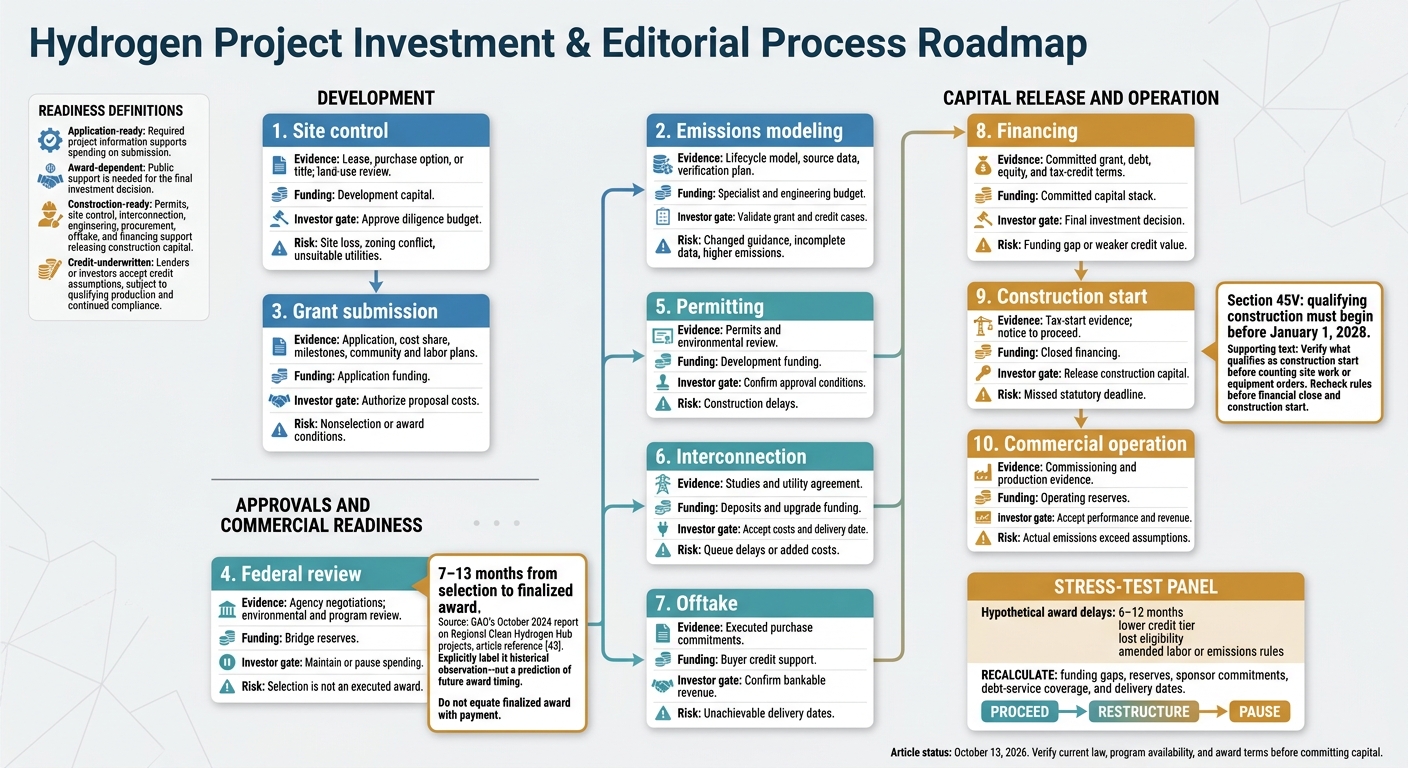
Hydrogen Project Funding: 10 Investment Decision Gates
Treat the January 1, 2028 construction-start deadline as a financing gate for Section 45V.[18] Verify what qualifies as construction start before counting site work or equipment orders in the capital plan. Check the rules again before financial close and construction start.
The deadline makes tax eligibility part of the financing schedule - not just a compliance task.
Project Stages and Funding Decision Gates
Run review, permitting, interconnection, and offtake in parallel, while tying spending to clear decision gates. Application-ready means the required project information supports spending on submission. Award-dependent means public support is needed for the final investment decision. Construction-ready means permits, site control, interconnection, engineering, procurement, offtake, and financing support releasing construction capital. Credit-underwritten means lenders or investors accept the credit assumptions, subject to qualifying production and continued compliance.
Each stage below connects diligence to a stop-or-go capital decision.
| Stage | Approval or evidence | Funding dependency | Investor gate | Policy or timing risk |
|---|---|---|---|---|
| Site control | Lease, purchase option, or title; land-use review | Development capital | Approve diligence budget | Site loss, zoning conflict, unsuitable utilities |
| Emissions modeling | Lifecycle model, source data, verification plan | Specialist and engineering budget | Validate grant and credit cases | Changed guidance, incomplete data, higher emissions |
| Grant submission | Application, cost share, milestones, community and labor plans | Application funding | Authorize proposal costs | Nonselection or award conditions |
| Federal review | Agency negotiations; environmental and program review | Bridge reserves | Maintain or pause spending | Selection is not an executed award |
| Permitting | Permits and environmental review | Development funding | Confirm approval conditions | Construction delays |
| Interconnection | Studies and utility agreement | Deposits and upgrade funding | Accept costs and delivery date | Queue delays or added costs |
| Offtake | Executed purchase commitments | Buyer credit support | Confirm bankable revenue | Unachievable delivery dates |
| Financing | Committed grant, debt, equity, and tax-credit terms | Committed capital stack | Final investment decision | Funding gap or weaker credit value |
| Construction start | Tax-start evidence; notice to proceed | Closed financing | Release construction capital | Missed statutory deadline |
| Commercial operation | Commissioning and production evidence | Operating reserves | Accept performance and revenue | Actual emissions exceed assumptions |
Policy Scenarios and Stakeholder Planning
With the stage gates defined, stress-test the schedule against delays and rule changes.
Update emissions models before grant submission and credit underwriting so capital decisions reflect current assumptions. Test hypothetical award delays of 6–12 months, a lower credit tier, lost eligibility, and amended labor or emissions rules. Identify where capital could be tied up or needed elsewhere. Recalculate funding gaps, reserves, sponsor commitments, debt-service coverage, and delivery dates, then set clear thresholds to proceed, restructure, or pause.
In October 2024, GAO reported that Regional Clean Hydrogen Hub projects took approximately 7–13 months from selection to finalized award.[19] Use that gap to size bridge funding - not to predict award timing.
Agree on delay notice obligations with utilities, communities, labor groups, buyers, and investors. Council Fire supports stakeholder planning and program implementation. It does not provide grant administration, award guarantees, or legal, tax, engineering, or permitting advice.
Conclusion: Check Eligibility Before Committing Capital
Before committing capital, verify current law, program availability, award terms, and the construction deadline. Keep grants, credits, and loans separate in the funding plan. Maintain a dated funding-and-approvals map that records emissions evidence, compliance owners, committed matching funds, approval dates, deadlines, primary sources, and fallback plans. Update it whenever guidance, eligibility, or scope changes.
FAQs
Can I use tax-credit revenue to meet grant cost-share requirements?
It depends on the grant program’s terms. Elective pay or credit transfers can turn tax credits into near-term cash. But you need to account for them in project financing from the start to comply with grant stacking rules and covenants [1].
Grant and tax-credit timelines can change. Check your grant agreement’s eligibility requirements before counting on tax-credit proceeds to meet your cost-share obligations [2][1].
How could policy changes affect my pending hydrogen grant?
Policy changes can shrink available funding, shift eligibility deadlines, and add compliance requirements. Agencies may also cancel or revise programs. New construction deadlines can leave projects ineligible - for example, 45V projects must begin construction before 2028.
To limit these risks, keep your project narrative, engineering files, and tax filings consistent with one another. Maintain records as events occur, and make sure your internal controls meet current agency requirements.
What if grant delays jeopardize my 45V construction deadline?
Grant delays put funding at risk. Under current law, construction must begin before January 1, 2028, to qualify for the clean hydrogen production tax credit. Missing that deadline can mean losing the credit entirely.
Discrepancies between IRS and DOE documentation can also delay claims or lead to denial. Keep commissioning reports, tax filings, and project records consistent. Use MRV data as your single source of truth, and meet every registration and reporting deadline.

FAQ