In This Article
How retailers and brands run safe, funded take-back drop-offs with store protocols, staff training, pickup rules, and verified recovery records.
How Retail Partners Support Consumer Take-Back
We make consumer take-back work by pairing easy store drop-offs with safe handling, clear funding, and proof of where each item goes. Unlike a merchandise return, take-back sends unwanted products toward reuse, repair, recycling, or safe disposal - usually without a refund.
Before inviting customers to participate, we need to:
Plan the route: Choose stores, define accepted items, confirm storage space, and secure processors and pickups.
Prepare people: Train staff on intake and hazards, and give customers clear preparation steps and incentive terms.
Put commitments in writing: Assign duties, costs, pickup deadlines, and backup plans.
Measure service and recovery separately: Track rejected drop-offs, wait times, cost per accepted return, and documented outcomes. Aim for records covering 100% of collected material - a contract target, not proof that everything is recycled.
Our rule for growth is simple: pilot, measure, fix, then expand. <u>Collection is only the first step</u>; we should add locations only after safety issues are resolved and recovery routes are verified.
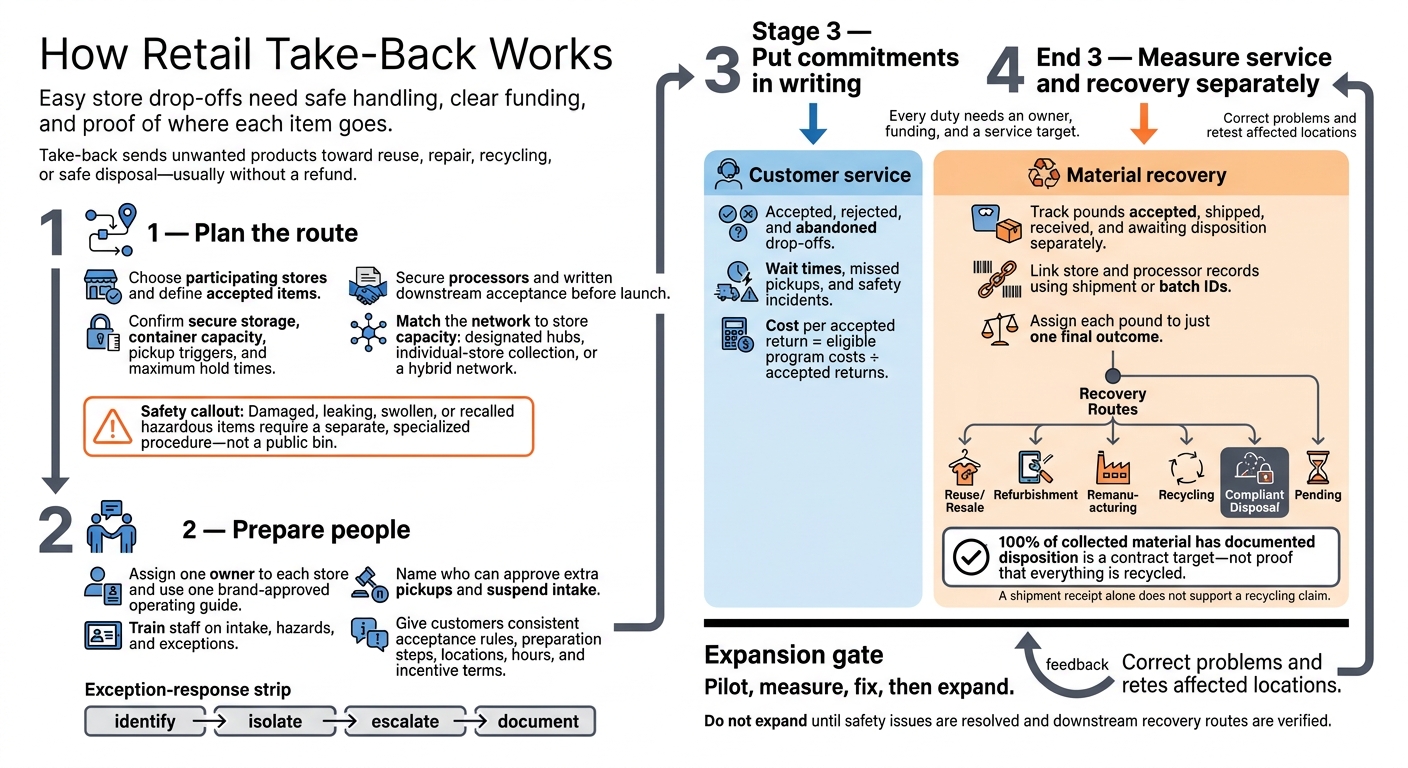
How Retail Take-Back Works: From Drop-Off to Verified Outcomes
RESOURCED: GUESS Apparel Recycling Programs
sbb-itb-8baf5f1
Plan Collection Sites and Recovery Routes
Use the handoff map to decide where customers can return items, what each site accepts, and how returns reach recovery.
Select Stores and Set Acceptance Rules
Score stores on proximity, access, hours, security, and storage space. Customers should be able to find and use the return point, and staff should know how it works. Use sales and population data to identify underserved areas, then pilot sites in urban, suburban, and rural markets. Compare expected weekly returns with container capacity and pickup frequency.
Publish accepted categories, condition rules, preparation steps, limits, and prohibited items. Use tamper-resistant bins for low-risk items and staffed desks for items that need review. Damaged, leaking, swollen, or recalled hazardous items require a separate, specialized procedure - not a public bin.[1]
Match these acceptance rules to a network that can support them.
Match the Network to the Item
Build the network around store capacity rather than assuming every location can accept every item. Brands should supply containers and arrange transportation, with pickups triggered by fill levels and maximum hold times.
Brands set the rules; retailers decide where each item type fits.
| Network model | Customer convenience | Staff workload and storage | Transportation and tracking |
|---|---|---|---|
| Designated hubs | Lower convenience | Simpler training and centralized storage | Fewer pickups; simpler tracking |
| Individual-store collection | Highest convenience | Higher distributed workload and storage needs | More frequent pickups; greater tracking burden |
| Hybrid network | Balances convenience and control | Concentrates complex intake at hubs | Regional consolidation; different tracking requirements |
After selecting sites, define procedures that keep intake safe and pickups on time.
Set Storage, Pickup, and Recovery Procedures
Set container capacity, segregation rules, secure storage locations, inspection frequency, maximum hold times, pickup triggers, and backup contacts. These rules protect store workflows and keep customer drop-off from turning into a service failure.
Record the store, time, shipment ID, category, quantity or weight, condition, carrier, destination, and receipt confirmation. Reconcile these logs with processor records. If a pickup is missed, stop intake before capacity is exceeded. For unsafe items, follow an isolation and escalation procedure; do not handle or transport them without approval.
Require written downstream acceptance before launch. Confirm materials, condition, volume, capacity, permits, insurance, and turnaround times. Assign routes for reuse, resale, refurbishment, remanufacturing, recycling, or compliant disposal, with receiving records and documentation for each route. A shipment receipt alone does not support a recycling claim.[2]
Have a qualified specialist check product- and location-specific requirements for waste, transportation, fire safety, worker protection, and data security. For electronics recyclers, check the relevant R2 or e-Stewards certification scope.[4]
Train Staff and Coordinate Customer Messages
Once collection sites are set, the launch depends on consistent store execution and clear customer instructions.
Assign Store Roles and Intake Steps
Assign one owner to each store and use one brand-approved operating guide. The brand defines acceptance rules, preparation steps, incentive terms, safety rules, escalation contacts, and approved claim language. The retailer selects stores, schedules coverage, manages intake, and communicates with customers.
Follow the same intake sequence for every return: greet the customer, confirm the item, check eligibility, explain the incentive, record the return, issue any credit, and explain what happens next. Log the material category, item type, quantity, date, store ID, incentive issued, and transfer destination. Collect personal data only when the incentive requires it, and set a retention limit.
Training should prepare staff for routine intake and exceptions.
Train Staff on Safety and Exceptions
Train associates before launch. Reinforce the rules through onboarding, short reference cards, follow-up training, incident forms, and manager spot checks. Practice handling contaminated, recalled, counterfeit, and hazardous items - not just routine returns.
Use one response pattern: identify, isolate, escalate, document. Follow the recall owner’s instructions for recalled products. Separate suspected counterfeits and escalate them rather than accepting them into the recovery stream. Staff must not open, crush, dismantle, smell, or test suspicious items.
Make responsibilities clear: who isolates an item, who calls facilities or emergency services, who notifies the brand and processor, and when to expedite pickup.
Check bins daily for fullness, contamination, leaks, odors, damage, blocked access, signage, and disposal that breaks program rules. Frontline staff should escalate any item that is leaking, smoking, hot, broken, unidentified, recalled, suspected counterfeit, or outside the written acceptance rules.
Once staff know the process, give customers consistent messages across every channel.
Give Customers Clear Return Instructions
Use one version-controlled instruction set across signs, product pages, receipts, email, loyalty channels, and customer service. Brands approve program rules; retailers verify participating stores, hours, and temporary suspensions.
State which items are accepted or excluded, quantity limits, preparation steps, participating locations, store hours, incentive value, eligibility, expiration, and what customers should do if a store cannot accept a return.
Explain cleaning and component separation when required. For devices, include personal-data removal instructions. Do not direct customers to remove batteries unless the product-specific procedure requires it. Incentive messages must explain the benefit, value, eligibility, exclusions, expiration date, and whether inspection is required before the incentive is issued.
Use plain U.S. English, short sentences, high-contrast print, readable type, screen-reader-friendly pages, and translations suited to the community. Before launch, ask customers and associates to identify eligible items, explain preparation steps, find a participating store, and calculate the incentive.
Track misunderstandings, rejected drop-offs, repeat questions, and complaints by store and channel. Revise instructions when the same error recurs.
Instructions should explain both how to return items and what happens afterward. Describe downstream handling only to the extent supported by records. Keep reuse, refurbishment, recycling, and disposal claims separate, and qualify claims when access or processing options are limited.[5][6][7]
Define Responsibilities, Costs, and Service Standards
Once collection and training are set, put the commercial terms in writing.
Every duty needs an owner, funding, and a service target to keep drop-off points open, predictable, and easy to use. Written terms turn day-to-day tasks into enforceable commitments.
Build a Responsibility and Cost Matrix
Treat the matrix below as contract targets, not benchmarks. Attach it to the contract and name an accountable party and backup for each duty. Adjust targets to store capacity, product risks, and local requirements.
| Workstream | Primary responsibility and owner | Payer | Performance metric |
|---|---|---|---|
| Eligibility and instructions | Brand owns rule updates and exception handling | Brand program budget | Current instructions posted at 95% of sites |
| Equipment and space | Retailer maintains agreed collection capacity | Brand funds equipment; retailer covers space | Agreed usable capacity maintained |
| Labor and training | Retailer staffs intake | Brand-funded base site fee plus volume adjustment | All designated employees trained before launch; new hires within 30 days |
| Transportation | Brand coordinates pickups | Brand pays carrier | 95% of pickups on time |
| Sorting | Brand contracts qualified processing providers | Brand pays baseline processing; responsible party pays documented exceptions | Track contamination and exception costs per shipment |
| Incentives | Retailer issues approved benefits | Brand-funded or shared reward budget | Match all payments to eligible returns |
| Compliance and incidents | Each partner meets assigned compliance and incident duties | Allocate insurance and response costs by duty and cause | Acknowledge incidents within four business hours; escalate emergencies immediately |
| Data and claims | Retailer submits reporting files for joint reconciliation | Brand reporting budget; retailer fee covers reporting | Submit monthly data by the fifth business day |
| Final disposition | Brand approves final disposition | Brand or eligible producer program | 100% of collected material has documented disposition |
Compare Funding Options
Budget separately for labor, space, equipment, training, transportation, sorting, processing, reporting, rewards, insurance, and disposal. Funding can overlap by function. Producer-responsibility funding depends on product category, jurisdiction, registration status, and program eligibility.[4][8]
Unclear cost terms leave stores absorbing staff time and space costs - and make consistent service harder to deliver.
| Funding option | Payer and allocation driver | Administration | Customer-service commitment to fund |
|---|---|---|---|
| Brand-funded operations | Brand pays agreed costs based on forecast and actual returns | Brand manages vendor contracts and budget | Consistent collection hours and pickup coverage |
| Retailer service fees | Brand or program pays per site, return, pound, or labor hour | Retailer invoices against agreed records | Staffed intake, reserved storage, and timely reporting |
| Shared-cost formula | Partners split costs by volume, labor, store count, or cause of contamination | Reconcile common data and reset allocations periodically | Capacity increases as workload grows |
| Producer-responsibility funding | Producer or approved program funds eligible activities | Program rules govern claims, contractors, and reporting | Defined collection access and funded recovery services |
| Incentive-cost sharing | Brand and retailer divide verified reward costs | Match issued benefits to qualifying returns | Correct benefits issued within the promised timeframe |
Set a baseline price for compliant material and a separate schedule for exceptions. Assign contamination costs by documented cause, not automatically to the store. Allocate damaged-item costs based on custody and handling failure.
Carrier-caused missed pickups should trigger corrective action or credits. Charges for retailer staging failures need supporting evidence. Unexpected volume should activate agreed surcharges, overflow equipment, or extra pickups - not automatic refusal.
With costs assigned, define pickup windows, response times, and payment rules.
Set Pickup, Response, and Payment Terms
Include the following terms in the operating agreement. Pickup triggers must leave enough capacity for material arriving before the truck does. Adjust deadlines for product hazards, store space, and applicable legal limits.
| Contract term | Required commitment and authority |
|---|---|
| Capacity and storage | Trigger a standard pickup at a defined fill level and set a maximum storage period to keep stores from closing the drop-off point. Name the retailer contact who requests collection and the brand coordinator responsible for completion. |
| Pickup timing | Specify standard, urgent, and emergency windows, including holidays. |
| Incidents | Acknowledge incidents within four business hours; escalate emergencies immediately. Require immediate escalation for fire, leakage, injury, theft, hazardous materials, or blocked customer access. Name the incident lead and backup. |
| Extra volume | Name who can approve extra pickups, substitute carriers, temporary equipment, and budget overruns. Set approval limits before launch. |
| Data delivery | Define fields, pounds versus units, file format, reporting deadlines, correction windows, and audit access. Reconcile store records with carrier and processor records. |
| Payment | Specify invoice evidence, measurement basis, payment due dates, dispute deadlines, and missed-service credits. Assign a dispute owner and a process for paying undisputed amounts. |
| Service interruption | Name who can suspend intake and who updates store signs, online locations, and customer instructions. Require advance notice where possible and an approved alternative return route. |
| Review | Review terms at least annually - and whenever volumes, costs, product risks, or legal duties change. |
Measure Customer Service and Recovery Results
Use contract terms as the reporting baseline, with one dashboard for store and program views. Define each metric’s numerator, denominator, exclusions, cutoff, source, and owner. The retailer owns store data, the brand owns customer and program data, and the processor or auditor owns downstream outcome data. Report every metric by store, product category, customer communication channel, and reporting period. Keep customer-service results separate from material-recovery results so reports remain comparable.[9][11]
Track Customer Access and Store Performance
Start with customer access, then check store execution. Measure the share of target customers within X miles of a site, alongside site hours, accepted items, appointment availability, and closures. Track accepted, rejected, and abandoned drop-offs separately. Count a return only when staff accept and log it. Calculate the rejection rate by dividing rejected attempts by all attempted drop-offs.
Report average and maximum wait times, training completion, intake accuracy, overflow, missed pickups, and safety incidents by store and product category. Compare customer questions and incentive redemptions by communication channel. Code confusion under eligibility, packaging, location, incentive, hours, or safety.
Review exceptions weekly during the first 8–12 weeks, then hold monthly operating reviews. Assign each failure an owner, corrective action, due date, and verification measure.[9]
Verify Recovery Outcomes and Cost per Return
Verify that collected material reaches a documented end use. Track pounds accepted, shipped, received, and awaiting disposition separately. Use shipment or batch IDs to link store and processor records.
Report contamination rate, recycling yield, and documented shares for reuse, refurbishment, recycling, and disposal. Assign each pound to just one final outcome. Material that moves from refurbishment to recycling must not be counted twice. Keep unresolved material in a pending category until its final outcome is documented.[3][10]
Calculate cost per accepted return by dividing eligible program costs by accepted returns. Use the same accounting boundary across stores, covering labor, training, collection containers, transportation, storage, processing, customer incentives, technology, customer service, auditing, and disposal.
Show recovered revenue separately and state whether it offsets costs. Also report cost per pound collected and cost per pound recovered, counting only documented recovery. Display all dollar figures to two decimal places and review cost and outcome data quarterly.
Conclusion: Pilot Before Expanding
Let service and recovery metrics guide the decision to scale. Pilot, measure, fix, then expand. Before adding locations, confirm that sites are visible and accessible, staff are trained, and instructions are consistent. Document duties and funding commitments in writing, and require records of downstream recovery.
Test both high-volume and small-format stores in urban, suburban, and rural settings, accounting for language-access needs.
Use the pilot review to correct instructions, storage, pickup arrangements, and funding gaps before rollout. Then retest affected locations. Do not expand until safety issues are resolved and downstream recovery routes are verified.
Site design, staff roles, customer instructions, and funding must follow the same operating model. Scale only when the pilot shows that the network, staff workflow, customer guidance, and recovery path work together.
FAQs
How should we split take-back costs fairly?
Assign clear ownership for collection, transport, processing, sales, and reporting. Use shared scorecards to allocate costs and track results for the same material flow: pounds diverted, dollars saved, and material quality.
Set agreements that divide risks, costs, savings, and revenue equitably. Include avoided-disposal savings and minimum-volume commitments in multi-year contracts. Review and adjust these terms quarterly to keep incentives aligned and partners engaged.
How can we resolve conflicting return instructions?
Treat return protocols as core design requirements, not afterthoughts. Put one person in charge of the return process to coordinate retailers, manufacturers, and logistics partners. Assign a clear owner and deadline to every dependency.
Work together to pinpoint the barrier behind the conflict. Use shared contracts to spell out who handles customer communication and what standards collection points must meet. Hold regular cross-functional reviews to agree on changes and keep consumer instructions consistent, transparent, and easy to follow.
What evidence shows our take-back pilot is ready to scale?
Look beyond participation numbers. Check for repeatable results across shifts and locations, traceable item records, and verified outcomes. Use an established readiness framework to document leadership commitment, technical skills, data management, and reverse logistics workflows.
Review your 60-day or 90-day benchmarks. Tie missed targets to specific gaps in infrastructure or ownership - not capability deficits. Reliable, process-driven performance signals readiness to expand into new regions or product lines.



FAQ