
Oct 19, 2026 · 8 min read
ESG Strategy
In This Article
Set ESG rules, validate alerts, and assess portfolio impacts so screening flags become documented investment decisions.
How ESG Screening Tools Flag Risk
An ESG flag is a call for review - not proof of misconduct or financial risk. I use screening to check holdings against policy rules, such as a 5% tobacco-revenue limit, then verify the issuer and supporting data before making a decision.
My process follows three steps:
Set the rules: Define exclusions, score cutoffs, conduct standards, issuer links, and how to treat missing data.
Review the alerts: Check sources, separate allegations from confirmed findings, and assign watchlist owners and approval duties.
Check the portfolio: Assess concentration, liquidity, costs, and financial risk before trading, then monitor changes.
The distinction matters: passing a screen does not make an investment attractive. I keep <u>a dated record of each decision</u>, including the rule, sources, reviewer, approval, and next review date.
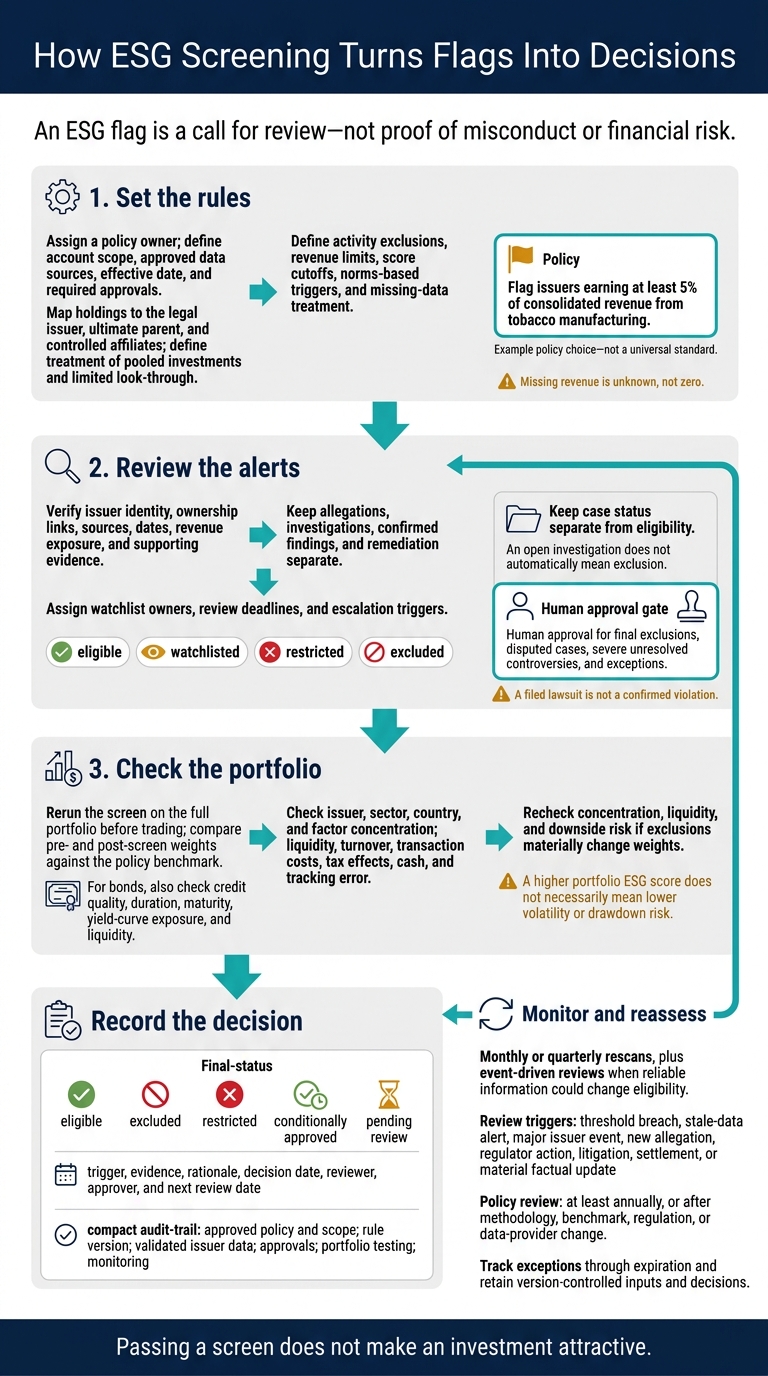
How ESG Screening Turns Flags Into Decisions
ESG Risk Analysis - Environment, Social, Governance Risk Analysis - Power BI
sbb-itb-8baf5f1
Step 1: Turn ESG Policy Into Screening Rules
Assign a policy owner, such as the chief investment officer or ESG committee, to handle interpretation, exceptions, and updates. Define the covered accounts, strategies, and asset classes, along with approved data sources and an effective date. Obtain required approvals before turning on the rules. These choices determine which holdings the tool flags - and why.
Before screening, map each holding to its legal issuer, ultimate parent, and controlled affiliates. Check security identifiers and ownership links. Specify whether restrictions apply to the legal issuer, ultimate parent, or both, and how controlled subsidiaries, minority stakes, and joint ventures count. This mapping determines which entities get flagged.
For pooled investments, state whether screening covers the vehicle, its underlying holdings, or both. Limited look-through requires a documented fallback, not an automatic pass. Record the percentage of assets that cannot be screened.
Define Activity Exclusions and Revenue Limits
With issuers mapped, set the exposure rules that trigger a flag. Be precise: tobacco manufacturing differs from distribution, and thermal coal is narrower than fossil fuels. Separate outright exclusions from revenue limits. State whether licensing, financing, or other indirect involvement counts.
For example, flag issuers earning at least 5% of consolidated revenue from tobacco manufacturing.
The 5% threshold is a policy choice, not a universal standard. Document the reporting year, revenue denominator, estimates, rounding rules, and how to handle conflicting source classifications. When disclosure falls short, use an unknown status rather than treating missing revenue as zero.
Set ESG Score and Norms-Based Triggers
For each score cutoff, record the provider, scale, score direction, methodology version, observation date, and missing-data treatment. State whether the cutoff applies to an overall or pillar score, and whether it is absolute or sector-relative. Risk-management scores and impact scores are not interchangeable. Research attributes 56% of ESG-rating divergence to measurement differences, which makes provider-specific rules important.[2] Back-test tighter thresholds and report how many holdings they exclude.
For norms-based rules, name the standard, such as the UN Global Compact principles, and define triggers for human rights, labor, pollution, or corruption. Keep allegations, investigations, confirmed findings, and remediation separate. Set evidence and severity requirements, a review deadline for unresolved cases, and clear responsibility for escalation. Disputed allegations should not silently become confirmed breaches.
Compare Screening Rules and Their Limits
| Rule type | Trigger | Decision outcome | Principal limitation |
|---|---|---|---|
| Activity exclusion | Defined prohibited involvement | Prohibit, or escalate disputed involvement | Business-activity classifications and indirect involvement may be incomplete |
| Revenue limit | Restricted revenue meets the approved threshold | Flag or exclude under policy | Revenue disclosure may be incomplete, estimated, or inconsistently classified |
| Score threshold | Overall or pillar score breaches an absolute or sector-relative cutoff | Restrict, exclude, or escalate under policy | Results depend on methodology and may not measure the same ESG concept |
| Norms-based rule | Evidence meets the defined breach or controversy trigger | Watchlist, engagement, or exclusion | Allegations may be disputed; evidence and remediation can change |
Once rules are live, each flag moves to issuer-level review to check the alert against issuer evidence.
Step 2: Review Alerts and Issuer Evidence
When an alert triggers, move from rule-based screening to an issuer-level review. Classify the issuer as eligible, watchlisted, restricted, or excluded under the approved policy. Use that classification to determine whether the case stays open, moves to a watchlist, or escalates.
Add Unresolved Controversies to a Watchlist
Review adverse media, lawsuits, regulatory actions, major incidents, and suspected norms breaches. Record the event date, source date, severity, affected stakeholders, source reliability, issuer response, remediation, and recurrence. These details help separate unresolved concerns from verified breaches.
A filed lawsuit is not a confirmed violation. Where feasible, check allegations that could change a decision against two reliable sources. Assign each watchlist entry an owner, review deadline, and escalation trigger, such as another serious incident or a missed remediation milestone.
Check Issuer Identity and Supporting Data
Validate the alert against the security’s issuer identifier, parent companies, subsidiaries, ownership percentages, revenue exposure, and operating geography. Determine whether the issuer controlled the activity or was connected only through a supplier or minority stake. Before accepting a match, check for stale records, conflicting sources, duplicate incidents, and unrelated names.
Assess severity, duration, recurrence, financial exposure, and management response. A public commitment is not remediation: require evidence of corrective action and measurable progress. Label supporting data as current, aging, stale, disputed, or unavailable. Escalate decisions that depend on unresolved gaps. When issuers submit corrections, ask them to identify the exact document and page supporting each change.
Document Decisions and Required Approvals
Keep case status separate from eligibility. An issuer under open investigation may still be eligible, while unresolved cases may trigger purchase restrictions. Record the approval authority, effective date, and any exceptions.
Define which actions the tool may automate, such as opening a case or pausing purchases. Require human approval for final exclusions, disputed cases, severe unresolved controversies, and exceptions. Give each exception a scope, expiration date, and reassessment condition. Retain the original alert and every later decision, keeping the record ready for the next portfolio review cycle.
Step 3: Check Portfolio Effects and Monitor Changes
After issuer-level approvals, rerun the screen on the full portfolio before trading. This turns a screening flag into a portfolio decision. Compare pre- and post-screen weights against the policy benchmark, and record both absolute and benchmark-relative changes. This separates ESG effects from unintended portfolio shifts.
Those changes show whether the screen calls for a routine rebalance or creates a new risk problem.
Assess Concentration and Financial Risk
Check concentration by issuer, sector, country, and factor. Review liquidity, turnover, transaction costs, tax effects, cash, and tracking error. For bonds, also assess credit quality, duration, maturity, yield-curve exposure, and liquidity.
A higher portfolio ESG score does not necessarily mean lower volatility or drawdown risk.[3][1] Exclusions can remove diversified exposures, leaving the portfolio more dependent on fewer issuers, sectors, countries, or investment factors. Test interest-rate shocks, commodity-price changes, and credit-spread widening, along with transition, litigation, regulatory, and reputational risk.
If exclusions materially change weights, recheck concentration, liquidity, and downside risk before trading.
Set Review Triggers and Maintain Audit Logs
Pair monthly or quarterly rescans with event-driven reviews when reliable information could change eligibility. Set policy-specific deadlines for stale data rather than assuming older data remains valid. A fixed review schedule keeps flags current and supported by evidence.
| Review stage | Trigger | Owner | Evidence | Required action |
|---|---|---|---|---|
| Post-screen portfolio check | New rebalance or mandate change | Sustainability and investment teams | Holdings file, rule version, issuer IDs, ESG snapshot | Apply rules, measure portfolio effects, and escalate breaches |
| Watchlist monitoring | Scheduled monthly or quarterly rescan, threshold breach, stale-data alert, or major issuer event | Sustainability, data, and risk teams | Updated vendor files, aging report, exposure report | Update inputs; reassess exposure and required mitigation |
| Controversy reassessment | New allegation, regulator action, litigation, settlement, or material factual update | Sustainability and compliance teams, with investment input | Primary-source evidence, issuer response, materiality assessment | Reassess eligibility and position limits; obtain required approval |
| Periodic policy review | At least annually or after methodology, benchmark, regulation, or data-provider change | Investment, sustainability, compliance, risk, and data teams | Version history, test results, exception log | Approve changes; rerun affected portfolios and update disclosures |
Keep reproducible snapshots of screening inputs, portfolio and benchmark weights, risk results, and trade implementation. Assign clear ownership: investment handles valuation and execution; sustainability interprets ESG criteria; risk checks exposures; compliance checks mandate adherence; and data manages feeds and version control.
Test methodology and data-source changes before adoption, and retain both old and new outputs. Require dual review when financial and ESG criteria conflict. Track exceptions through expiration instead of allowing silent overrides.
Conclusion: Turn Flags Into Documented Decisions
After screening, issuer review, and portfolio checks, record the decision. Coded exclusions, thresholds, watchlists, and controversy triggers flag issues. Review and approvals determine what happens next, while monitoring checks whether the position still meets policy.
Record the final status - eligible, excluded, restricted, conditionally approved, or pending review - alongside the trigger, evidence, rationale, decision date, reviewer, approver, and next review date.
Document how treatment differs by asset class: country-level criteria for sovereign bonds, due diligence and contractual reporting for private assets, and look-through or separate-treatment rules for pooled funds and derivatives.
Before closing the case, verify the full audit trail: approved policy and account scope; version-controlled rules; validated issuer data; named watchlist owners; required approvals; portfolio testing; and scheduled plus event-driven monitoring.
FAQs
How do I choose ESG thresholds for my portfolio?
Start with a double materiality assessment to identify priority ESG issues affecting operations and enterprise value. Set thresholds using sector-relevant frameworks such as GRI, ISSB, or CDP.
Score severity, likelihood, and financial magnitude on a consistent 1–5 scale. Consider issues with medium or high financial impact and at least a moderate likelihood of occurring within five years.
Document the criteria so teams can apply them consistently and auditors can review them. Then build these thresholds into risk management and capital allocation.
How can I tell if an ESG flag is financially material?
Assess whether the issue could affect enterprise value, cause financial losses, or create regulatory exposure. Use sector-specific materiality frameworks to examine effects on asset pricing, timing, liability, or approval to operate.
Review gross margins, free cash flow, and debt levels to gauge effects on earnings and the ability to fund the transition. Then assess whether governance controls are keeping the risk in check - or whether it threatens future performance.
What evidence justifies removing an issuer from my watchlist?
Removal from the watchlist is justified when engagement or remediation has reduced the underlying risks. Supporting evidence includes documented remediation, completed and verified corrective action plans, or clear proof that the issuer has addressed the control failures or ESG gaps that led to watchlist status.
An exit should remain a last resort when engagement fails to reduce severe risks or the company cannot meet sustainability requirements despite reasonable support.



FAQ