In This Article
Compare upfront price and ownership costs to choose cost-effective, compliant green purchases; set assumptions and test sensitivity.
Green Procurement: Lifetime Costs vs. Purchase Price
I compare the cost of owning a product - not just buying it - when future bills could change which bid wins. In this article’s hypothetical lighting example, the $60 option costs about 23% less over 10 years than the $25 option after installation, electricity, replacements, and disposal.
Here’s how I choose the cost basis:
Purchase price: Compare upfront costs, including delivery, installation, and setup. Use this approach when later costs are small or roughly equal.
Lifetime cost: Include energy, water, supplies, maintenance, repairs, replacements, and disposal, minus supported resale value. Discount future costs using the same study period and assumptions for every bid.
Both methods: Check upfront funding, require equal performance, and set green requirements before bids arrive. Lower ownership cost does not prove lower emissions or waste.
Quick Comparison
| Decision point | Purchase-price analysis | Lifetime-cost analysis |
|---|---|---|
| Cost focus | Upfront spending | Ownership costs over a set period |
| Best fit | Small or equal future costs | Future costs that could change the winner |
| Data needed | Itemized acquisition quotes | Quotes plus use, service, replacement, and disposal estimates |
| Main limit | Leaves later bills outside the ranking | Depends on estimates and cannot solve funding limits |
My rule: <u>set the scoring rules before bids arrive</u>. Document sources, test uncertain costs, make supplier promises contract duties, and track actual results against the forecast.
Employing the Life-Cycle Costing Tool in Public Procurement
sbb-itb-8baf5f1
1. Purchase-Price Analysis
This section focuses on the upfront purchase decision. Later sections address operating and end-of-life costs.
Cost Coverage and Budgets
Compare fully loaded acquisition costs, not catalog prices. Ask suppliers to itemize delivery, insurance, installation, commissioning, applicable taxes, configuration, training, and any other required setup work. Confirm whether taxes are included and each charge is firm or estimated. This keeps an incomplete bid from looking cheaper than it is.[1] Keep these charges separate from later operating costs.
Energy and Operating Costs
Show future electricity, fuel, water, and consumable costs separately whenever they could affect value or the choice between bids. Record operating hours and utility rates as separate inputs. These figures make costs clear, but use them in award scoring only if the solicitation allows it.[1]
Maintenance and End-of-Life Risk
Require suppliers to disclose warranty coverage, maintenance schedules, service response times, parts availability, the software support period, and take-back, return, or disposal charges. Use these details to flag risks, not to score awards. Include removal of existing equipment in acquisition costs; leave disposal of the new product for lifetime-cost analysis.[1]
Green Criteria and Bid Comparisons
Set performance requirements before comparing prices. With price and risk kept separate, assess every bid against the same performance standard. Put environmental requirements in separate evaluation fields, clearly marking pass/fail criteria and scored preferences. For covered federal product categories, specify ENERGY STAR-certified or FEMP-designated products unless an exception applies. Include efficiency requirements in both the technical specifications and evaluation criteria before bids arrive.[2]
2. Lifetime-Cost Analysis
Purchase price is only the starting point. When operating and end-of-life costs affect the decision, compare the full cost of ownership over time. Use lifetime cost as the award basis when the solicitation allows it.
Cost Coverage and Budgets
Lifetime-cost analysis measures total ownership cost over a defined study period. Match that period to the service life, contract term, replacement cycle, or planning horizon. Define what you’re evaluating: one asset, a system, or the service it provides. Include acquisition, energy, consumables, maintenance, repairs, and replacement costs.[4] Use the same scope for every bid so comparisons stay consistent.
Convert future costs to present value using (PV_t = C_t/(1+r)^t). Pair nominal dollars with a nominal discount rate, or constant dollars with a real discount rate - never mix the two. Document the rate, price basis, payment dates, energy-price escalation, and treatment of taxes or financing. Exclude sunk costs that the purchasing decision won’t change.[3][6] With the study period fixed, convert recurring costs to present value.
Energy and Operating Costs
Calculate annual operating costs using expected use, utility rates, demand charges, consumables, and standby power. Back up these inputs with utility bills, tariff schedules, manufacturer data, or measured conditions.[2][5] Begin operating costs when the equipment enters service, and discount each year’s costs consistently.[3][6][8] This prevents energy-intensive bids from appearing cheaper at award simply because they cost less upfront.
Maintenance, Repairs, and End-of-Life Costs
Estimate scheduled service, labor, parts, contractor rates, inspections, failure rates, downtime, and spare-component costs. Account for replacement timing and possible obsolescence before the study period ends.[3][4][7] These estimates show cost differences that purchase price alone can hide.
Include residual value only when market evidence or a transparent depreciation rule supports it. Deduct that value at the end of the study period. Record decommissioning and disposal costs in the year they occur, including removal, transport, treatment, hazardous handling, landfill charges, and site restoration where applicable.[3][4][7]
When failure data are uncertain, model low, expected, and high repair scenarios. Show whether those scenarios change the award decision.
After modeling costs, screen bids against the required performance and environmental thresholds.
Green Criteria and Bid Comparisons
Set mandatory functional, safety, regulatory, and environmental requirements before comparing bids. Evaluate only compliant bids, using one shared life-cycle-cost model and the same assumptions. Count energy and water savings once, within operating costs. Keep broader environmental impacts separate unless the solicitation assigns them a monetary value or score.[1][2]
Use life-cycle cost to measure ownership expense and life-cycle assessment to measure environmental impact. These tools answer different questions.[9]
Compare Costs, Risks, and Green Criteria
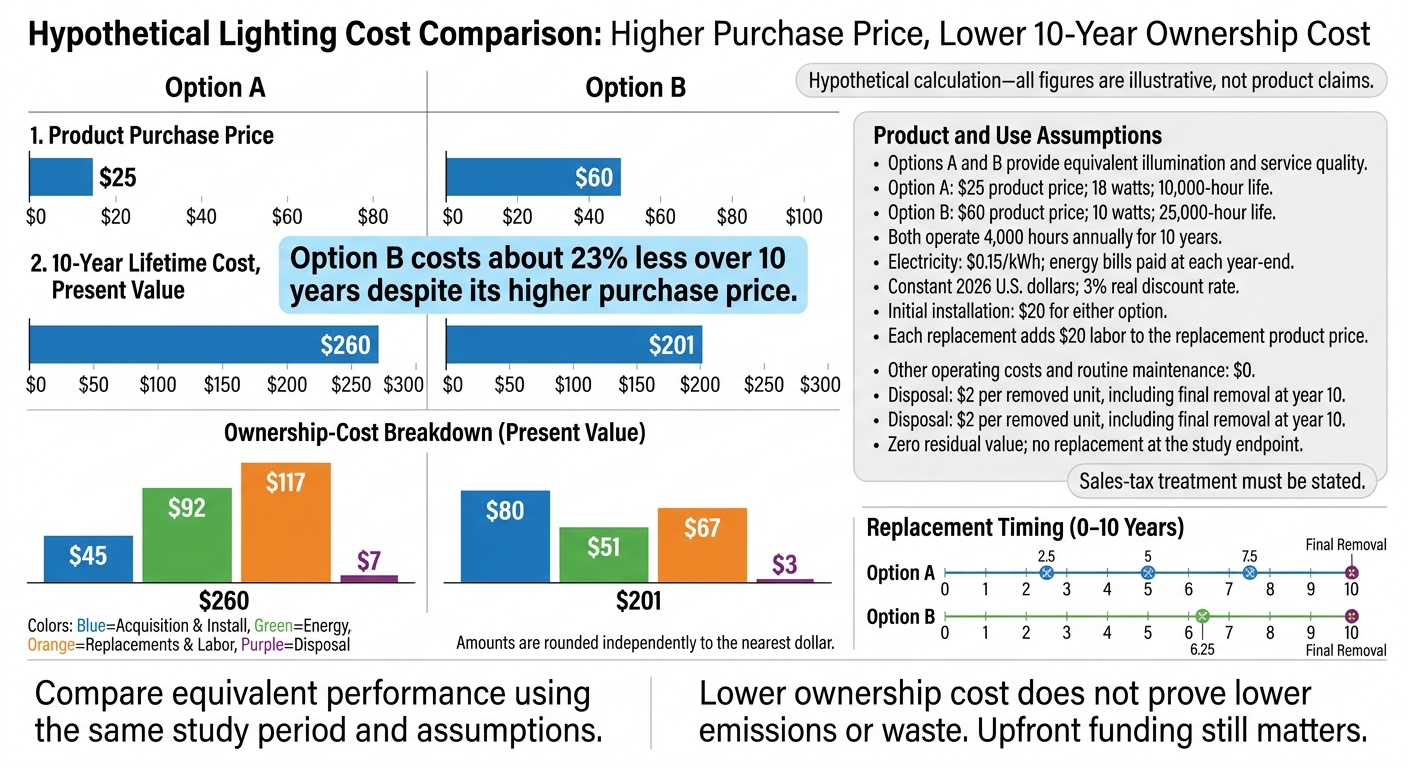
Lighting Lifetime Costs: $25 vs. $60 Purchase Price
Cost Coverage and Budgets
Once performance requirements are set, identify which budget drives the decision. A lower lifetime cost can still exceed an annual budget.
| Budget issue | Purchase-price analysis | Lifetime-cost analysis |
|---|---|---|
| Initial affordability | Checks available acquisition funding | Still requires an upfront funding check |
| Future obligations | Excludes later costs from the ranking | Shows future payment needs |
| Capital versus operating budgets | Focuses on acquisition-budget control | Links capital spending to operating costs |
| Staff effort | Uses fewer inputs | Needs input from facilities, finance, and procurement |
Energy and Operating Costs
Compare the same level of service, not just similar equipment. For lighting, match illumination, color rendering, the area lit, operating schedule, safety requirements, and required uptime. Track physical consumption separately from dollars: utility-price forecasts measure financial exposure, not environmental impact.
| Input | Purchase-price analysis | Lifetime-cost analysis |
|---|---|---|
| Electricity | Does not rank bids by future electricity expense | Prices annual kWh and applicable demand charges |
| Fuel and water | Excludes later bills from acquisition cost | Prices gallons, therms, or cubic feet |
| Operating hours | May establish suitability, but not ownership cost | Uses the same schedule and load assumptions |
| Rate-change exposure | Does not quantify future exposure | Tests rate changes; price risk remains |
Maintenance, Repairs, and End-of-Life Costs
Separate costs covered by contracts from those the buyer must pay later. Do not count service-contract savings twice. Test assumptions about useful life, repair frequency, parts availability, and take-back terms. Supplier promises are not guaranteed savings.
| Cost or obligation | Purchase-price analysis | Lifetime-cost analysis |
|---|---|---|
| Service contracts and labor | Includes amounts payable at acquisition | Includes future service and labor not covered by contracts |
| Repairs and component replacements | Usually excludes them from the initial comparison | Models timing, parts, and installation |
| Downtime | Generally excludes it from acquisition cost | Includes downtime losses only when supported by evidence |
| Decommissioning and transport | Includes prepaid charges, if any | Includes removal and transport obligations |
| Recycling and disposal | May defer the financial obligation | Includes buyer-paid end-of-life charges |
| Residual value | Does not offset the initial invoice | Credits residual or salvage proceeds at the study endpoint |
Green Criteria and Bid Comparisons
Keep cost, resource use, and environmental claims in separate fields. If you assign dollar values to externalities, count them only once and specify the boundary and source.
| Criterion | Purchase-price comparison | Lifetime-cost comparison | Evidence to request |
|---|---|---|---|
| Resource efficiency | Apply as a requirement | Price consumption, but report physical use separately | Comparable test results |
| Repairability | Require minimum repair access | Evaluate repair-cost differences supported by evidence | Manuals, parts commitments |
| Circularity | Specify reuse or take-back requirements | Include verified financial consequences | Binding take-back terms |
| Green claims | Do not infer from price | Do not infer from lower ownership cost | Relevant certifications or declarations |
| Consistent treatment | Apply identical eligibility rules | Apply identical eligibility rules and cost inputs | Shared submission requirements |
Lighting shows how these comparisons work for equipment used many hours each year.
Lighting Example: Calculate Lifetime Costs
Hypothetical calculation - all figures below are illustrative, not product claims. Options A and B provide equivalent illumination and service quality. A costs $25, draws 18 watts, and lasts 10,000 hours; B costs $60, draws 10 watts, and lasts 25,000 hours. Both operate 4,000 hours annually for 10 years at $0.15/kWh. Use constant 2026 U.S. dollars, a 3% real discount rate, and state whether sales tax is included. Acquisition includes $20 initial installation; each replacement adds $20 labor. Other operating costs and routine maintenance cost $0.
Replace A at years 2.5, 5, and 7.5; replace B at year 6.25. Charge $2 disposal per removed unit, including final removal at year 10. Do not replace equipment at the endpoint; assign zero residual value. Pay energy bills at each year-end.
Present-value cost Option A Option B Acquisition and initial installation $45 $80 Energy $92 $51 Other operations $0 $0 Routine maintenance $0 $0 Replacements, including labor $117 $67 Disposal $7 $3 Residual value $0 $0 Total $260 $201 Amounts are rounded independently to the nearest dollar.
With these base assumptions, B’s lower operating cost more than offsets its higher purchase price.
Strengths, Limits, and Best Uses
| Decision factor | Purchase-price analysis: strength / limit | Lifetime-cost analysis: strength / limit |
|---|---|---|
| Simplicity | Fast comparison / narrow cost coverage | Broader comparison / more modeling |
| Data needs | Fewer inputs / less visibility into future costs | More cost detail / requires reliable evidence |
| Initial budget control | Clear funding check / can favor purchases with higher later expenses | Shows trade-offs / cannot solve funding limits |
| Future cost visibility | Limited / suitable when later costs are immaterial | Greater / only as complete as the model |
| Uncertain assumptions | Less forecasting / leaves risks unpriced | Supports sensitivity tests / rankings can change |
Purchase-price analysis fits short-lived purchases with immaterial operating costs, or cases where reliable operating data are unavailable. Lifetime-cost analysis fits high-use assets with material energy, maintenance, or replacement costs. Under either method, apply minimum green requirements and follow the solicitation’s cost rules.
Set Cost Rules and Record Assumptions
A sound comparison starts before bids arrive: fix the inputs, use shared formulas, and put the assumptions in writing.
Define Scope and Required Performance
Set the cost basis before issuing the solicitation. If you use purchase-price analysis instead of life-cycle costing, document why it is sufficient. Federal acquisition planning guidance calls for that explanation.[12][13]
Define the qualifying asset categories, required performance, service conditions, study period, useful-life assumptions, included costs, evaluation formula, and award method. Keep each requirement within applicable procurement rules.
Set Common Inputs and Calculation Rules
Publish buyer-controlled inputs and require the same discounting method for every bid.[11] Require equivalent service throughout the study period, with replacements included where needed.
Use a Shared Worksheet and Assumptions Register
| Controlled input | Evidence source | Owner | Bid treatment |
|---|---|---|---|
| Purchase and installation, including delivery and commissioning | Bid schedule and supplier quote | Procurement | Use quoted values; correct only permitted clerical errors |
| Energy use and utility prices, including operating profile, load, and escalation | Test reports, certifications, engineering data, utility tariffs, or approved forecasts | Operations, sustainability consulting, and finance | Apply the same operating profile and price series to every responsive bid |
| Maintenance, labor, repairs, and parts, including frequency, availability, and downtime | Service manuals, contract rates, payroll data, service records, parts lists, and supplier commitments | Operations, finance, and procurement | Use verified bidder data only; otherwise apply the agency default. Treat unsupported claims as unverified and use the published fallback |
| Useful life and replacement schedule | Warranty, certification, reliability data, or agency history | Operations | Apply identical replacement and equivalent-service rules |
| Disposal, take-back, and residual value | Contractor terms, recycler quotes, published fees, or documented resale evidence | Sustainability and procurement | Include consistently; credit residual value only when documented |
| Discounting and escalation | Approved policy or applicable federal/state guidance | Finance | Apply one method and rate to all bids |
| Sustainability requirements | Certification, supplier declaration, audit, or contract clause | Sustainability and legal counsel | Score or require only under disclosed criteria |
Label each input as a supplier fact, buyer assumption, or modeled estimate. For every material input, record the source date, units, confidence level, verification method, and owner. Verify any claim that could change the award.
Once the baseline worksheet is fixed, test the inputs most likely to change the award.
Disclose Sensitivity Tests and Award Rules
Publish sensitivity ranges before reviewing bids. Test electricity prices at the baseline and 20% above and below it, along with operating hours, service life, repair frequency, labor rates, downtime, disposal costs, and discount rates. State whether these tests affect scoring or only document risk.
Identify the award method: lowest compliant present-value life-cycle cost, lowest annualized cost for equivalent service, or a disclosed weighted best-value score. Specify how rounding, ties, and missing data will be handled. Use only published defaults, allowed clarifications, or rejection rules.
With the method set, assign responsibility for the data, review, and contract terms.
Assign Roles and Contract Duties
Procurement owns solicitation language, bid comparability, and procedural consistency. Finance approves prices, discounting, escalation, and budget treatment. Operations validates service conditions and maintenance, repair, and performance data. Sustainability checks environmental criteria, circularity, and verification. Legal counsel reviews authority, claims, warranties, remedies, and records.
Turn material promises into contract duties. Cover guaranteed energy performance, preventive-maintenance intervals, maximum repair response times, minimum parts availability, repairability documentation, software-support periods, supplier take-back, recycling certificates, reporting frequency, and responsibility for removal and end-of-life costs.
Keep Records and Track Actual Costs
Track actual results against the assumptions in the award model. Keep the solicitation, bidder worksheets, source evidence, assumptions register, calculation files, formula versions, clarification records, sensitivity tests, evaluation notes, approvals, award rationale, and contract amendments in the procurement file.
Assign a named owner to track actual energy use, operating hours, maintenance visits, repairs, parts, replacements, downtime, disposal, rebates, and supplier performance. Review results quarterly and update defaults annually. Distinguish supplier underperformance from changes in operating conditions or markets, and from faulty assumptions. Use those findings to improve future solicitations.
Conclusion: Choose the Right Cost Basis
Once assumptions and rules are set, use the simplest defensible cost basis that accounts for material differences. If a plausible change in operating assumptions could change the winner, purchase price alone probably isn’t enough.[1][10]
Use purchase-price analysis for low-risk purchases when downstream costs are negligible or equivalent. Document in the solicitation file why omitted costs cannot reasonably change the decision. A low purchase price alone isn’t sufficient justification.
Neither method replaces performance or environmental requirements. Compare equivalent performance, disclose assumptions, test uncertainty, and keep supporting evidence using the same assumptions register and recordkeeping practices described above. Track actual energy use, waste, and other outcomes against the forecast to verify financial results and sustainability outcomes.[10]
FAQs
How can I justify higher upfront costs within a tight budget?
Compare Total Cost of Ownership (TCO), not just the purchase price. Factor in energy use, maintenance, repairs, and end-of-life disposal to show when a product with a higher upfront price costs less over its service life.
Use Life Cycle Cost Analysis (LCCA) to compare long-term savings based on data. Track performance over 3 to 5 years to test your approach and build a stronger case for future budget requests.
What if small assumption changes produce different winning bids?
Your model’s results depend on its assumptions. Use sensitivity analysis to test which factors - such as maintenance frequency, energy costs, or service life - have the greatest effect on the results.
Document your calculation methods and assumptions so external reviewers can assess your reasoning. Bring stakeholders into the process early to help define these variables, build trust, and reflect what matters most to them. This also makes the procurement process transparent and repeatable.
How should I weigh lifetime savings against environmental impacts?
Compare total cost of ownership, not just the purchase price. Include energy, maintenance, repair, disposal, and risk costs. Use lifecycle cost analysis and net present value to compare costs across the asset’s service life.
To assess emissions impacts, divide the incremental net cost by total emissions reduced. Internal carbon pricing can help clarify trade-offs. Keep hard-to-price gains, such as resilience or brand value, separate from the financial model and present them as factors that guide business decisions.



FAQ