In This Article
Compare seven public-sector green budget tagging approaches—coverage, classification, review roles, and links between planned and executed spending.
On this page
- 1. France’s Green Budget
- 2. Colombia’s Climate Budget Tagging
- 3. Philippines’ Climate Change Expenditure Tagging
- 4. Nepal’s Climate Change Budget Coding
- 5. Germany’s Green Budget and Subsidy Reporting
- 6. Italy’s Green Budget and Subsidy Reporting
- Climate Budget Tagging - knowing what you spend
- 7. Municipal Climate Budget Assessment Using I4CE Guidance
- How the Models Differ
- Strengths, Limits, and Setup Requirements
- Conclusion: Match Tags to the Budget System
- FAQs
Green Budget Tagging: Comparing Public-Sector Models
Green budget tags show what spending is intended to support - not what it achieves. Choose a model that fits the budget’s scope, staff capacity, and reporting needs, then track planned and actual spending separately.
This comparison covers six national approaches and one municipal method, using published material available through November 18, 2026. It examines four questions: what gets tagged, how categories are assigned, who reviews them, and whether tags connect budget plans to actual spending.
Quick Comparison
| Model | Coverage | Classification | Review roles | Reporting focus |
|---|---|---|---|---|
| France | Central-government spending, tax expenditures, and certain allocated taxes | Scores from −1 to 3 across six objectives | Budget, finance, and ecology authorities | Annual Finance Bill annex |
| Colombia | National and territorial climate spending across 12 sectors | Climate-action categories and relevance weights | Planning department and reporting agencies | Climate-finance records requiring reconciliation with spending |
| Philippines | National climate-related programs, with separate local guidance | Adaptation and mitigation typology codes | Budget department, Climate Change Commission, and agencies | Allocations across budget stages |
| Nepal | Climate-coded programs and projects | Three bands based on climate-related shares | Finance ministry, planning commission, and line ministries | Budget annexes and expenditure records |
| Germany | Selected green-bond spending and separate subsidy reviews | Bond eligibility and subsidy assessments | Finance ministry, responsible ministries, and UBA | Separate bond and subsidy reports |
| Italy | State budget, final accounts, subsidies, and green bonds | Spending categories, subsidy labels, and bond eligibility | Finance and environment ministries | Separate budget, outturn, subsidy, and bond reports |
| I4CE municipal method | Defined local budgets and accounts | Separate mitigation and adaptation assessments | Local finance and technical teams | Classifications linked to local budgets or actual spending |
The central rule is the same across all seven: keep classification separate from results. Preserve budget identifiers, document partial shares and unassessed items, and use outcome monitoring to test whether spending delivers.
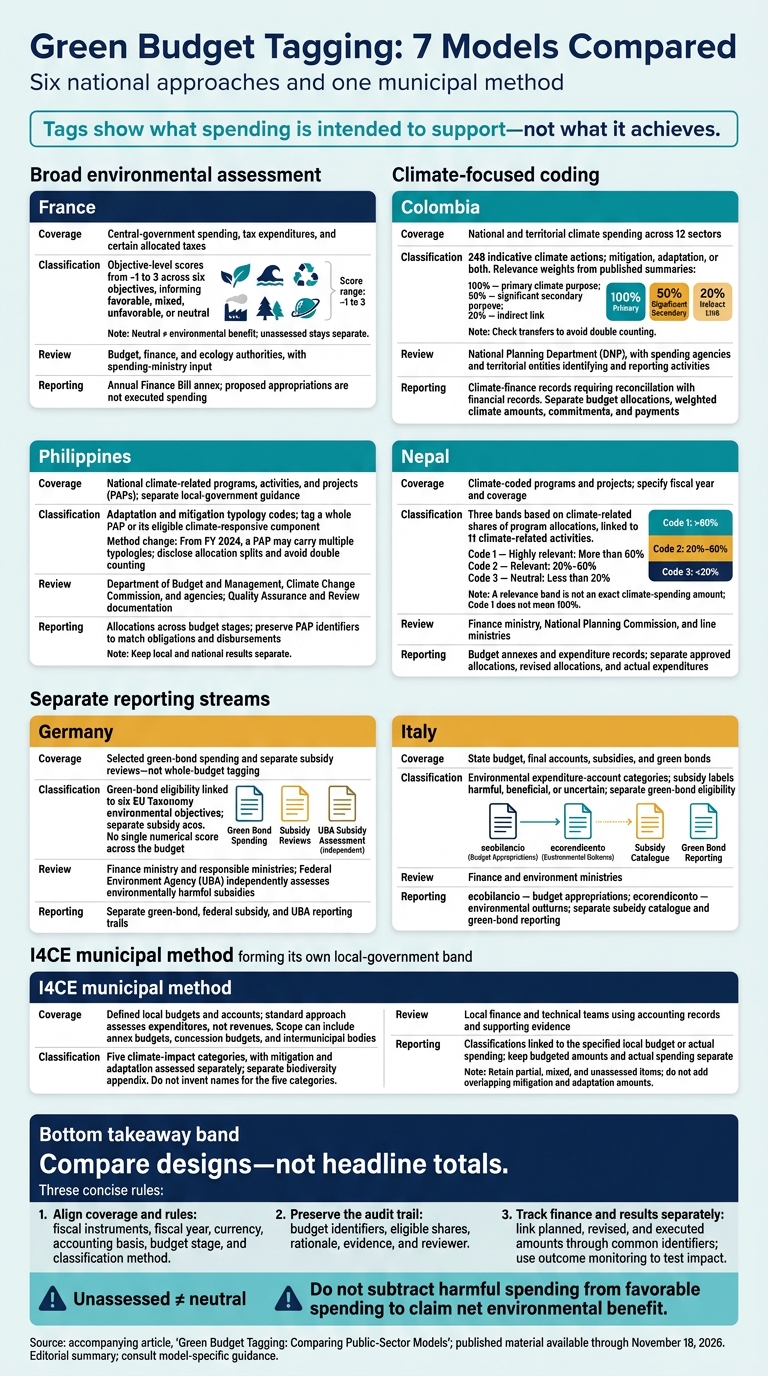
Green Budget Tagging: 7 Models Compared
1. France’s Green Budget
Budget Coverage
France’s Green Budget is an annual annex to the Finance Bill that assesses the environmental impact of central-government budgetary and tax expenditures. It covers appropriations, tax expenditures, and certain taxes allocated to public bodies. Ordinary spending with material environmental effects can also be assessed, but most local-government and public-enterprise spending falls outside its scope.[3] This makes France a broad, state-level benchmark for comparison with narrower tagging systems.
The framework assesses six objectives: climate-change mitigation; climate-change adaptation and prevention of natural risks; water management; the circular economy, waste management, and prevention of technological risks; pollution control covering water, air, and soil; and biodiversity conservation, including protection of natural, agricultural, and forest areas.[10][12]
Categories and Scoring
Each relevant item receives an objective-level score from −1 to 3, supported by a written justification. These scores feed into an overall label: favorable, mixed, unfavorable, or neutral.[6][7] A measure can score differently across objectives, so readers should check both the individual scores and the overall label.
Scores compare spending against a reference scenario, usually no spending or reduced spending. A neutral score does not mean an environmental benefit, and unassessed items should appear separately.[6][8]
Governance and Review
The Budget Directorate, the ecology ministry, and finance authorities share preparation duties, with policy input from spending ministries. Central coordination helps keep classifications consistent across ministries. The process uses documented reference scenarios, technical review, and published updates to the methodology.[9]
Budget and Expenditure Reporting
France introduced the green-budget component in 2020. Its fourth edition accompanied the 2024 Finance Bill.[5][12] The annual environmental-impact annex links classifications to proposed spending. Supporting reports explain the methodology, objective-level assessments, justifications, and reference scenarios.[6][8]
Proposed appropriations are not executed spending. Execution tracking should link each tagged amount to its mission, program, action, tax expenditure, or appropriation. It should also state the fiscal year, assessment status, and planned-versus-executed amounts.[5][8]
France’s model provides the most detailed objective-level scoring; the approaches that follow focus more narrowly on climate-specific tagging and expenditure coding.
sbb-itb-8baf5f1
2. Colombia’s Climate Budget Tagging
Budget Coverage
Colombia tags public spending at the national, regional, and local levels across 12 sectors.[4] Agencies should tag spending as close as possible to the activity, project component, or budget line. This keeps the label tied to what the money funds - not the broader mandate of a ministry.[14] The system can use SIIF, the FUT system, the General Royalties System, and other administrative records.[16]
Categories and Scoring
Unlike France’s objective scoring, Colombia uses a climate-action taxonomy with relevance weights. It lists 248 indicative climate actions and classifies spending as mitigation, adaptation, or both.[16][17] Mitigation covers emissions reduction or carbon sequestration. Adaptation covers reduced vulnerability and stronger resilience.[15]
Published summaries assign weights of 100% for a primary climate purpose, 50% for a significant secondary purpose, and 20% for an indirect link.[18] Agencies should record why they chose a classification and how they calculated the share for partly relevant activities. A taxonomy listing alone should not make spending eligible.
Governance and Review
The National Planning Department (DNP) and the Climate Finance Committee issued the methodological guidance, including a 2016 guide.[16] Spending agencies and territorial entities identify and report relevant activities, while DNP coordinates the methodology.[14][17]
A World Bank assessment noted that the Ministry of Finance had not adopted DNP’s expenditure-review method. The tags still need to be reconciled with financial records.[14]
Budget and Expenditure Reporting
DNP’s climate-finance monitoring, reporting, and verification (MRV) platform publishes tables, maps, reports, and downloadable data.[16] To link tags to spending, agencies should carry activity identifiers, financing sources, and relevance weights through approved allocations and budget execution.
Reports should separate budget allocations, weighted climate amounts, commitments, and payments, and clearly identify the reporting year. When combining national and territorial records, agencies should check transfers to avoid double counting.[13][16] The activity-level detail also supports comparisons with the budget-line systems in the models that follow.
3. Philippines’ Climate Change Expenditure Tagging
Budget Coverage
The Philippines required Climate Change Expenditure Tagging (CCET) for national budget submissions starting with FY 2015. The requirement covers national government agencies, state universities and colleges, and government-owned or controlled corporations (GOCCs). During annual budget preparation, these bodies tag climate-related programs, activities, and projects (PAPs).
Local government units follow related guidance for climate-related programs, projects, and activities in annual investment programs. Their results should be reported separately from national totals.[25][26]
Categories and Scoring
CCET uses typology codes aligned with the National Climate Change Action Plan. Agencies can tag an entire PAP or its climate-responsive component, distinguishing adaptation from mitigation and recording the eligible share. The system classifies spending; it does not measure climate impact.[20][21][27]
Starting in FY 2024, a single PAP may carry multiple typologies. Agencies must therefore show how allocations are split and avoid double counting.[22][23] This makes CCET a budget-coding tool rather than an impact-scoring system.
Governance and Review
Agencies submit tagged PAPs with Quality Assurance and Review (QAR) documentation that explains the climate rationale and code choices. The Department of Budget and Management (DBM) builds CCET into budget submission systems. The Climate Change Commission reviews codes, maintains the typology manual, and updates the master file.[19][23]
A strong QAR connects the funding request to a specific climate risk or mitigation purpose and a measurable result.
Budget and Expenditure Reporting
CCET reporting helps users trace allocations across budget stages. Raw totals alone do not support direct comparisons because published figures cover proposals, appropriations, and annual reporting:
The FY 2021 National Expenditure Program (NEP) reported ₱181.90 billion in proposed climate allocations.[21]
The FY 2024 General Appropriations Act (GAA) reported ₱457.41 billion in approved climate allocations.[20]
FY 2025 annual reporting put climate-tagged allocations at ₱1.156 trillion, or 18.3% of the ₱6.326 trillion national budget.[24]
These figures should not be treated as a growth series without first reconciling the budget stages and the FY 2024 methodology change. Keep the PAP identifier so budget execution can be matched to obligations and disbursements.[22][23][27]
4. Nepal’s Climate Change Budget Coding
Budget Coverage
Like the Philippines, Nepal codes climate relevance during budget preparation. But instead of typology codes, it uses percentage thresholds. Developed with UNDP support in 2012, Nepal’s Climate Change Budget Code became part of the Line Ministry Budget Information System (LMBIS) in FY 2013/14. It initially covered only capital spending. Later reporting extended the method to federal and provincial medium-term expenditure frameworks, making fiscal year and coverage important when reading the figures.[28][29][33]
Categories and Scoring
Nepal assigns one of three codes based on the share of a program’s total allocation linked to 11 climate-related activities. These include sustainable water use, renewable energy, and disaster-risk reduction.[28][34]
| Code | Category | Climate-related share of program allocation |
|---|---|---|
| 1 | Highly relevant | More than 60% |
| 2 | Relevant | 20%–60% |
| 3 | Neutral | Less than 20% |
The code measures relevance - not the exact amount of climate spending. A Code 1 program does not automatically count as 100% climate spending, so the full tagged allocation must remain separate from the climate-attributable amount. Earlier guidance screened activities within programs; later descriptions shifted to tagging at the project-code level.[28][30][33]
Governance and Review
During annual budget preparation, line ministries submit climate-relevant proposals through LMBIS. The Ministry of Finance provides guidance, while the National Planning Commission reviews and validates submissions.[10][28][30]
Budget and Expenditure Reporting
The Red Book annex and Citizens Climate Budget report climate-coded amounts drawn from Ministry of Finance and Financial Comptroller General Office records. Where possible, report approved allocations, revised allocations, and actual expenditures separately. Budget and accounting classifications do not always match, so map program codes, budget lines, LMBIS, and the Financial Management Information System (FMIS) before comparing allocations with spending.[10][29][31][32][35]
5. Germany’s Green Budget and Subsidy Reporting
Budget Coverage
Germany uses separate federal reporting tools rather than the whole-budget tagging systems described above.[40] Green-bond reporting tracks selected eligible federal expenditures, not the entire budget.[41] Federal subsidy reports cover financial assistance and tax expenditures.[38] The Federal Environment Agency’s (UBA) inventory reviews environmentally harmful subsidies, mainly at the federal level, with limited coverage of states and municipalities.[36] Each tool therefore uses its own classification approach.
Categories and Scoring
Expenditures eligible for green bonds are linked to the six EU Taxonomy environmental objectives.[41] UBA groups subsidies by sector: energy supply and use, transport, housing, agriculture, forestry, and fisheries. It then assesses their effects on climate, air, soil, water, biodiversity and landscape, health, and raw-material consumption.[36] These rules classify expenditures; they do not provide one numerical score across the budget.[38]
Governance and Review
The Federal Ministry of Finance chairs the Core Green Bond Team, which selects eligible expenditures with the responsible ministries.[42] The ministry also leads federal subsidy reporting. Its expanded guidelines require sustainability impact assessments for all subsidies.[38] Separately, UBA independently assesses environmentally harmful subsidies and recommends reforms. Its findings form another reporting stream, which needs to be read within its own scope and methods.[36]
Budget and Expenditure Reporting
UBA’s 2021 update estimated approximately €65.4 billion in environmentally harmful subsidies for 2018.[37] That figure measures identified harmful support - not Germany’s total budget or its green spending.
Keep green-bond, subsidy, and UBA reporting trails separate. For each finding, retain the source, budget year, responsible ministry, legal basis, amount, and classification method. Also distinguish direct spending from forgone tax revenue.[38][39] A bond allocation records eligible spending, not environmental results.
6. Italy’s Green Budget and Subsidy Reporting
Budget Coverage
Italy reports through separate streams, rather than applying one climate tag across the whole budget. The ecobilancio accompanies the central government budget, while the ecorendiconto reports environmental outturns from final accounts. A separate subsidy catalogue tracks direct support and tax expenditures.[46][47]
Categories and Scoring
Each stream uses a different classification system: environmental expenditure accounts, subsidy assessment, and green bond eligibility. Expenditure accounts group spending by mission and program using SERIEE-based categories, rather than a single climate percentage. The subsidy catalogue classifies measures as harmful, beneficial, or uncertain.[15][47]
Green BTP sovereign bond reporting uses six eligibility categories: renewable energy; energy efficiency; sustainable transport; pollution prevention and control and circular-economy measures; environmental and biodiversity protection; and environmental research.[45]
Governance and Review
The Ministry of Economy and Finance manages the state environmental budget and execution reports. The environment ministry maintains the subsidy catalogue, established under Article 68 of Law No. 221 of December 28, 2015.[43][44]
Budget and Expenditure Reporting
The three reporting streams must remain distinct. Italy’s 2024 subsidy catalogue covered 191 measures, with €25.4 billion classified as harmful, €71.8 billion as beneficial, and €26.3 billion as uncertain. Harmful fossil-fuel subsidies totaled €19.6 billion - part of the harmful total, not an additional amount.[43][48]
These reports track finances; they do not establish environmental results. Link ecobilancio appropriations to ecorendiconto outturns by mission and program.[46][47]
Climate Budget Tagging - knowing what you spend
7. Municipal Climate Budget Assessment Using I4CE Guidance
This local model uses a municipal review method drawn from French budgeting practice and applied to local accounts.
Budget Coverage
I4CE’s published guidance covers annual budgets, financial statements, multiyear budget documents, and closed accounts.[49][50][53] Unlike the national systems discussed above, it is designed for municipal budgets and accounts. It can also cover annex budgets, concession budgets, and intermunicipal bodies.[11][53] The standard approach assesses expenditures, not revenues.[53]
Name the exact budgets or accounts reviewed. Guidance describes what a method can cover; it does not show where the method has been applied. This makes the approach a local counterpart to national budget tagging, rather than a direct copy.
Categories and Scoring
The framework uses five climate-impact categories, treats mitigation and adaptation separately, and includes a separate biodiversity appendix.[51][50] Keep those categories intact rather than converting them into a single percentage tag.
Reviewers use France’s M57 budgetary and accounting framework. They may also need records beyond the accounting line to explain an item.[54] Municipal reports should retain the municipality’s own labels, explain allocations across mixed-purpose activities, and leave spending unclassified when the records do not support a classification.
Governance and Review
I4CE’s workflow starts with defining the scope, then moves through line-item review, supporting-document checks, consolidation, and follow-up.[49][54] Record who reviewed each line item, which evidence they used, how they handled uncertainty, and how they resolved disagreements. When an accounting line lacks detail, consult procurement files, project studies, and other records of the work.
Budget and Expenditure Reporting
Publish classifications alongside the relevant budget or financial statement, clearly separating budgeted amounts from actual spending.[49][50] Keep mitigation and adaptation totals separate, and do not add overlapping amounts.[49][54]
Report only classifications linked to a documented municipal expenditure base, review trail, and reporting output. These reporting choices support comparisons across municipalities without imposing a single national template.
How the Models Differ
The comparisons below focus on the design choices that most affect how a tagging system works in practice.
Coverage: Climate Goals and Other Green Priorities
Compare what each model covers, not just its label. France has the broadest scope. Municipal reviews reflect local responsibilities, records, and staff capacity, while Colombia, the Philippines, and Nepal focus more narrowly on climate.[11][58][61][62]
| Scope dimension | Comparative distinction | Practical implication |
|---|---|---|
| Capital and operating spending | Climate-focused systems do not necessarily assess every spending type.[57][62] | Climate coverage does not mean whole-budget coverage. |
| Transfers across government levels | Colombia uses national and territorial records.[62] | Consistency requires reconciling records across government levels. |
| Tax expenditures and allocated taxes | France assesses more than appropriations.[3][58] | State which fiscal instruments are included. |
| Subsidies | Germany and Italy report subsidies separately.[60][62] | Keep subsidy boundaries separate from expenditure coverage. |
| Local accounts | Municipal assessments follow local accounts and responsibilities.[11][61] | Define which budgets and entities are assessed. |
Categories and Scoring: Labels, Thresholds, and Weights
Each model’s categories and weights are internal rules, not interchangeable scores.[56] France scores objectives. Climate-focused systems code relevance or purpose, while subsidy reports classify environmental effects.
Publish thresholds and coefficient assumptions. A partial allocation is not a measure of impact. Nor should harmful spending be subtracted from favorable spending to claim a net environmental benefit.
| Classification logic | Where it appears | Comparison rule |
|---|---|---|
| Objective scoring | France scores six objectives from −1 to 3 to inform an overall label.[58] | Preserve differences between objectives. |
| Relevance weighting and threshold coding | Colombia and Nepal classify climate-related budget items using their own unit definitions and thresholds.[62] | Do not apply one model’s coefficients or thresholds to another. |
| Typology coding | The Philippines codes climate components of agency spending by mitigation or adaptation.[57] | Compare eligible components, not whole-agency totals. |
| Percentage-threshold coding | Nepal classifies budget items by their climate-relevant share.[62] | A relevance band is not an exact climate-spending amount. |
| Subsidy and expenditure classification | Germany and Italy classify subsidy effects; Italy also uses environmental accounting categories.[60][62] | Harmful-subsidy labels and accounting categories are not interchangeable. |
| Municipal expenditure assessment | Local classifications preserve separate assessment statuses.[11][61] | Keep partial, mixed, and unassessed items separate rather than forcing a yes/no result. |
Governance: Roles and Classification Review
Each model needs clear definitions, agency instructions, and a documented review process. Central coordination helps keep classifications consistent. Agencies supply spending evidence, while municipal reviews rely on local accounts and responsibilities.[56][57][61]
| Actor | Comparative function | Review requirement |
|---|---|---|
| Budget office | Coordinates instructions and disclosure.[57] | Check consistency with budget classifications. |
| Technical ministry | Defines environmental criteria.[57] | Test the environmental rationale. |
| Line agency | Supplies program evidence.[57] | Document classifications and weights.[2] |
| Municipal finance team | Links assessments to local accounts.[61] | Combine financial and technical review. |
| Independent review | Provides scrutiny where documented. | Do not suggest independent validation unless it has been established. |
Where independent scrutiny is absent, an audit, legislative review, or evaluation panel is a recommended safeguard, not an established feature.
Reporting: Budget Plans and Actual Spending
Publish planned and executed amounts separately, linked by a consistent budget identifier.[59] Some models report allocations, others report outturns, and others use separate subsidy streams. Before comparing totals, align coverage, budget stage, fiscal year, currency, accounting basis, and classification rules.
| Reporting lens | Comparative rule | Disclosure needed |
|---|---|---|
| Allocations and execution | Match planned and executed amounts through a common identifier. | Budget stage, fiscal year, accounting basis, and reporting coverage |
| Germany and Italy’s subsidy reports | Separate subsidy reporting from core budget tagging.[60][62] | Keep direct spending, tax expenditures, and harmful support in separate reporting streams. |
| Year-over-year series | Disclose changes that affect comparisons. | Revised categories, weights, or boundaries |
| Harmful-spending review | Distinguish favorable, harmful, mixed, and unassessed spending. | Keep harmful and favorable totals separate; neither proves net impact. |
Unassessed does not mean neutral. Building climate resilience requires moving beyond simple tagging to understanding how these fiscal choices impact long-term ecosystem health. The next section examines how these design choices affect setup requirements, review workload, and reporting limits.
Strengths, Limits, and Setup Requirements
The table translates the comparison into implementation trade-offs. Suitability judgments are analysis, not observed results. The right model depends on what the budget system can support, including staffing, review depth, and what it can reliably report.
| Model | Implementation trade-off | Setup conditions (analysis) |
|---|---|---|
| France | Supports detailed trade-off review, but requires extensive evidence and coordination.[63][64][66] | Central budget coordination, environmental specialists, and capacity for cross-ministry review. |
| Colombia | Supports consistent climate identification, but gives limited attention to other environmental effects.[4] | A focused climate-accountability mandate and connected planning and reporting records. |
| Philippines | Fits formal budget submissions, but adds consistency checks and staff workload.[4][57] | Clear program structures, agency training, and central quality checks. |
| Nepal | Provides a low-burden starting structure, but ministry capacity varies.[4][57] | Phased implementation, training, and stronger documentation over time. |
| Germany | Extends review beyond ordinary spending lines, but requires strong legal and economic evidence.[55][67] | Reliable subsidy records and policy-evaluation expertise. |
| Italy | Uses complementary reporting streams, but makes comparison harder and requires more evidence.[55][67] | Finance and environment teams able to reconcile definitions and records. |
| I4CE municipal assessment | Uses screening to target detailed review, but local records may not support full classification.[11][50][51] | Local finance and technical staff working from existing accounts, with room to expand coverage gradually. |
The main trade-off is straightforward: more coverage means more review time and staff effort. Budget for evidence collection and disputed classifications, not just initial coding. First, decide whether the purpose is climate accountability or broader environmental scrutiny.
Weights add another workload choice: each assignment needs a documented basis.[65] Agencies should explain the eligible component and retain supporting records.
For a municipality’s first cycle, select two to five priority sectors. Map major programs and capital projects to existing budget codes, using a spreadsheet or financial-system export. Record the amount, rationale, evidence, and accountable reviewer. Publish the coverage limits, then add weights and broader environmental screening as records improve. Start with a phased rollout rather than a full national buildout.[4][50]
Test usefulness separately from tagging volume. The World Bank found no evidence that tagging data informed resource allocation, and few countries reported actual climate-relevant expenditures.[67] Track whether reviews lead to budget questions, project changes, or funding decisions. Judge usefulness by those review outcomes - not total tagged amounts.
Conclusion: Match Tags to the Budget System
The comparison points to a clear rule: match the tag system to the budget system. Scope matters as much as labels. Use climate-only tagging when emissions reduction or adaptation is the immediate priority. Choose a broader framework when policy also covers biodiversity, pollution, water, or other environmental goals. A phased rollout can begin with selected sectors, with exclusions clearly disclosed.[56]
Categories should reflect adopted policy goals. Weights should indicate partial relevance, with a documented basis for each share. Tagged spending is not proof of impact; that requires outcome monitoring and evaluation.[31][62]
For a full fiscal picture, include positive, neutral, and harmful classifications, plus relevant tax expenditures and subsidies. A green-spending total alone can overlook measures that work against the same goals.[69]
Connect these classifications to existing program and budget codes, and map them to the chart of accounts. Public expenditure reports should show planned, revised, and executed spending, making tagged amounts, weights, and revisions visible.[68]
Outside support should never replace public ownership. When governments need help, Council Fire helps turn sustainability strategy into measurable action. The tagging framework should remain government-owned, documented, and publicly accountable.[52]
FAQs
How can we adapt green budget tagging to a U.S. city?
Define whether tagging covers community projects, operations, or both, and align it with budget and capital planning cycles. Tag projects by climate priority, such as mitigation or adaptation/resilience. Use quantified assumptions to score them alongside criteria such as safety and asset condition.
Document each measure’s costs and KPIs, linking them to the relevant authority and available funding. Label qualifying projects in your Capital Improvement Plan so spending can be traced to expenditure and performance metrics. [1][2]
How should we resolve disputed green classifications?
Set up a standardized scoring system before reviewing projects [1]. Use only published defaults, permitted clarifications, or predefined rejection rules. Apply the same eligibility rules and cost inputs to every project [2].
Verify environmental claims through certifications or declarations - not prices or cost savings [2]. Involve audit committees throughout the budgeting cycle to check data accuracy, support sound decisions, and strengthen stakeholder trust and transparency [1].
How can we tell if tagging improves budget decisions?
Track actual results against initial forecasts, not just tag counts. Use tagging as a weighted criterion in a single capital planning scoring system, alongside safety and asset condition.
Track physical outputs, modeled potential benefits, and outcomes verified after hazards occur or through direct monitoring. Report progress annually alongside financial performance to show whether sustainability goals shape budget allocations.




FAQ