In This Article
How to test local social-norm prompts in cafeterias and households and measure weighed plate waste per meal.
How Social Norm Prompts Help Reduce Food Waste
Social norm prompts may reduce food waste, but we can’t assume they work. In a trial of 250 households, norm messages did no better than education alone on weighed waste. Our starting point: test accurate local claims and measure discarded food - not just what people say.
We recommend three steps:
Check the claim: Use local data about diners’ behavior or approval, and offer a clear action, such as choosing a smaller portion.
Test without pressure: Keep portions optional, avoid shaming, and compare prompts with reminders and no-message conditions.
Weigh the results: Track <u>pounds of plate waste per meal</u>, account for menu and attendance changes, and repeat promising tests before expanding.
Our rule is simple: keep prompts that repeatedly reduce measured waste - not those that only earn positive survey responses.
What Food-Waste Research Shows
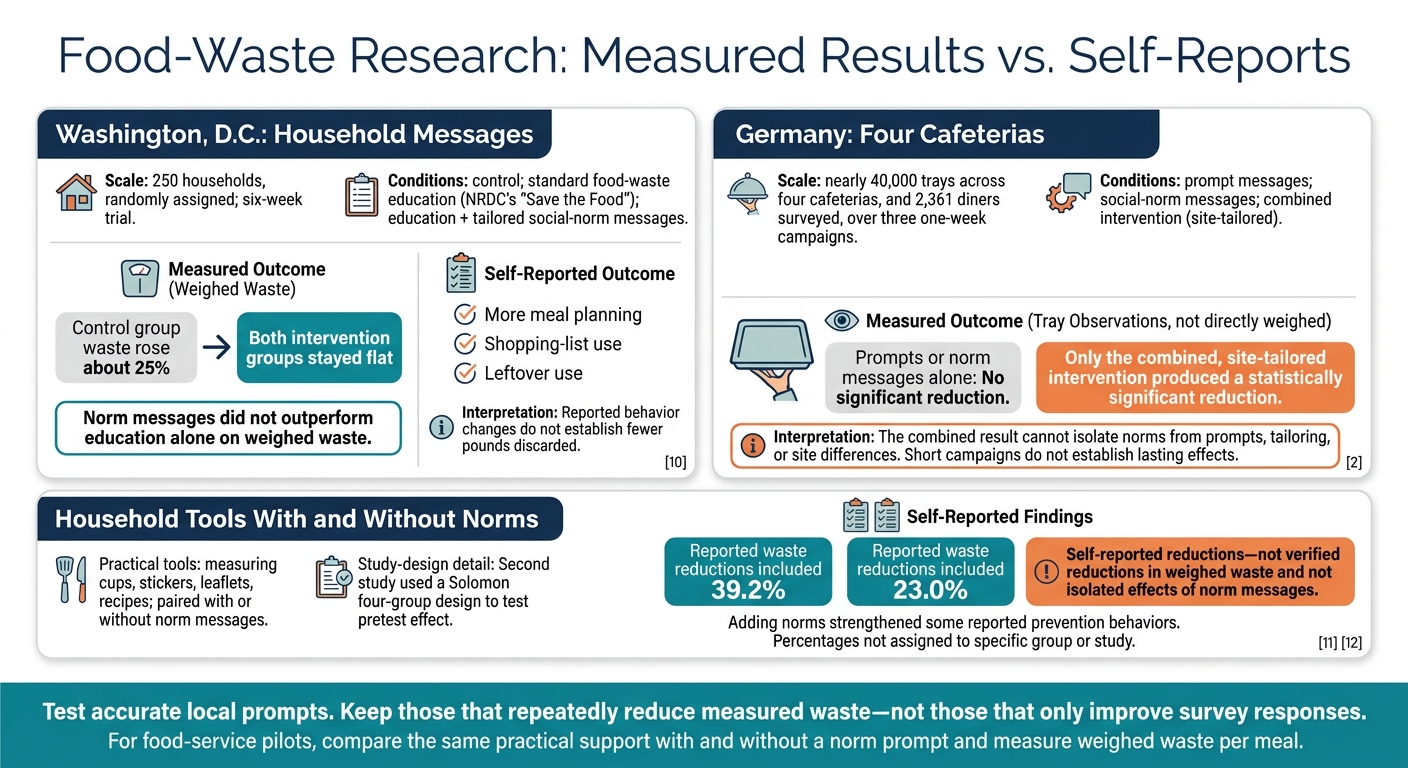
Food-Waste Research: Measured Results vs. Self-Reports
Washington, D.C.: Testing Household Messages
A six-week trial randomly assigned 250 households to a control group, standard food-waste education, or education plus tailored social-norm messages. The education materials came from the Natural Resources Defense Council’s “Save the Food” campaign. The norm messages described reported behaviors among relevant local peers.
Researchers weighed household food waste during the study. Waste in the control group rose about 25% over six weeks, while waste in both intervention groups stayed flat. Norm messages did not outperform education alone on weighed waste.[3]
Survey responses told a different part of the story. People who received norm messages reported more meal planning, shopping-list use, and leftover use. But those self-reports do not establish that households discarded fewer pounds of food.[3] Household waste depends on shopping, storage, and leftovers. Cafeterias test a different behavior, with more emphasis on portion choice than household planning.
Germany: Testing Messages in Four Cafeterias
Across four German cafeterias, only a combined, site-tailored intervention reduced plate waste; prompts or norm messages alone did not.[1]
Researchers assessed nearly 40,000 trays and surveyed 2,361 diners during three one-week campaigns. They tested prompt messages, social-norm messages, and a combined intervention developed jointly and tailored to each site. Only the combined approach produced a statistically significant reduction in plate waste in the reported between-condition analysis.[1]
The study assessed plate waste through tray observations. Its combined result cannot separate the effect of norms from prompts, tailoring, or differences between sites. And with campaigns lasting just one week each, the findings offer limited guidance on whether the effects would last.[1]
Do Norm Messages Add to Practical Tools?
The next question is whether norm messages add anything when teams already have practical waste-reduction tools.
The household tool studies paired measuring cups, stickers, leaflets, and recipes with or without norm messages. The second study used a Solomon four-group design to test whether taking a pretest changed the results. Adding norms strengthened some reported prevention behaviors. However, the 39.2% and 23.0% self-reported waste reductions neither isolate the effect of norms nor verify a reduction in weighed waste.[4][5]
For food-service teams, the relevant test compares the same practical support with and without an accurate norm prompt - and measures discarded food, not just survey responses.[4][5]
sbb-itb-8baf5f1
Write Accurate Prompts for Local Diners
Norm messages work only when they reflect local behavior, so prompts need to fit the site. The prompt is the message tested against discarded food - not the entire intervention.
Verify Peer Claims and Suggest an Action
Claims about what most diners do in this cafeteria need local evidence. Observe the same cafeteria, meal period, food category, and serving format. Report the sample, dates, exclusions, how repeat diners were handled, and the full observation window.
Keep behavior separate from approval. Portion-choice records show what diners selected, not what they believe. Later waste measurements show discarded food, not approval or motivation. Use descriptive norms for observed behavior and injunctive norms only for clearly stated actions.
Pair each verified claim with an option staff can provide, such as a smaller portion, a sample, or an additional serving where allowed. Put the prompt where diners make that choice. If the evidence does not support a favorable norm, use a factual reminder - not an invented social claim. Assign one person to update claims when menus, portions, service, or diners change.
Check Wording and Avoid Shaming
Ask diners and frontline staff to explain what the sign means and what it asks diners to do. Check readability, language needs, and whether staff can consistently offer the stated option. Keep smaller portions optional. Offer samples or ingredient information to help diners choose while respecting dietary, medical, cultural, and athletic needs.
Avoid shaming diners or pressuring them to finish food despite discomfort, allergies, or poor quality. Don’t make waste sound normal.[6] During a short pilot, listen for complaints, confusion about seconds, or feelings of criticism. Watch for diners ignoring the sign or taking less than they want and leaving dissatisfied.
Before expanding the test, revise any misleading or shaming wording. Once the message is clear and free of shaming, move to a measured pilot.
Test Prompts and Measure Food Waste
Accurate norm prompts matter only if they reduce measured waste. Once the wording is accurate, test whether it changes the weight of discarded food.
Set a Baseline and Assign Test Groups
Measure discarded food during normal service. Use the same collection points, scales, tare method, food categories, and observation times planned for the test. Compare that baseline with service using accurate norm prompts, randomly assigning cafeterias, stations, days, or meal periods. Set the test duration, primary outcome, exclusions, missing-data rules, and independent assignment units before testing begins. Watch for spillover between groups and lingering effects from earlier prompt exposure. Include control, norm-only, reminder-only, and norm-plus-reminder conditions.[1][7][8][12][13]
Log meals served, menu items, portions, staffing, prompt location and wording, and service format. A pilot can flag collection problems. The main test, though, needs repeated periods that reflect normal service variation - not a single unusual day.[8][12]
Weigh Discarded Food and Calculate Waste per Meal
Use weighed plate waste as the primary outcome. Calibrate scales, subtract empty-container weights, and record net weight in pounds and ounces - or pounds only if that matches the reporting format. Keep the meal-count procedure unchanged. Separate plate waste from other waste streams, and sort it by food category to see which foods changed after the prompt. Put one person in charge of weighing, recording measurements, and maintaining documentation. If weighing every tray isn't feasible, document a representative sampling rule and check visual estimates against weighed samples.[8][9][11][14][16]
Report total pounds, waste per meal, and pounds per 100 meals. Report per-diner figures only when diner counts are reliable. Use surveys only to check prompt recognition, understanding, perceived norms, and acceptability - not to measure waste reduction.[8][10][13][15]
| Measure | Purpose | Main limit |
|---|---|---|
| Total weighed waste | Shows the disposal burden | Changes with attendance |
| Weighed waste per meal | Compares periods with different meal counts | Depends on accurate meal counts |
| Waste by food category | Identifies which foods drive changes | Requires consistent sorting |
| Self-reported waste or intentions | Examines diners’ responses | Subject to recall and social-desirability bias |
The analysis should test whether the change in waste exceeded normal variation.
Compare Results and Check Test Delivery
Compare baseline-to-post changes between prompt and control conditions, accounting for clustering and repeated observations. Use waste per meal as the main normalized metric, with total pounds as the secondary reporting metric. Report independent assignment units separately from trays or weighing records. Include effect sizes, uncertainty intervals, missing observations, menu changes, and attendance shifts.
Record prompt visibility and any changes in portion size, take-home options, or tray-return procedures. Keep groups as assigned in the main analysis, then examine delivery problems in a secondary analysis. Repeat promising results with a different menu mix or at another location before expanding.[2][8][12]
Conclusion: Let Measured Waste Guide Decisions
Social norm prompts produce mixed results. Treat them as tools to test, not guaranteed solutions. If you pair prompts with smaller portions or staff reminders, the results reflect the full package - not the prompt alone.
Base decisions on verified local claims, weighed waste per meal, and checks that prompts reach diners as intended. Keep prompts that repeatedly reduce waste, revise unclear ones, and drop those that fail after adequate testing. Remove prompts with unverified claims or harmful wording. One positive survey does not prove less waste.
Include food-service staff and diners in reviewing results and choosing changes. Let local waste data - not survey sentiment - determine whether prompts stay.
FAQs
How much local data do we need to support a norm claim?
Before testing prompts, set a baseline for your cafeteria, such as pounds of food waste per 100 meals served. Use digital scales and waste logs to gather accurate data from your site so you can compare results.
Social norms depend on local context, community customs, and demographics. Data from another cafeteria may not feel relevant to your diners. Base your norm claim on local, verifiable data, not vague assertions.
How long should we test a food-waste prompt?
There’s no fixed testing period. Start with a small-scale pilot to gather data and fine-tune your messaging before rolling it out to a larger group. Track behavior beyond the short term to see whether changes become lasting habits. Prompts can lose their effect over time.
Compare results with your baseline quarterly or semiannually to spot trends and adjust your approach.
What size waste reduction would justify expanding our pilot?
There’s no universal percentage. The waste reduction needed to justify expansion depends on your organization’s goals, return on investment (ROI) targets, and baseline performance.
Council Fire recommends quarterly assessments against long-term objectives and your annual strategy. Start with baseline cost and volume metrics to calculate savings from lower disposal fees and inventory improvements. Then compare those results with your financial and sustainability benchmarks to determine whether scaling delivers enough value.



FAQ