
Mar 30, 2026
How to Finance Ocean Conservation with Impact Investing for Corporations
ESG Strategy
In This Article
How corporations can finance ocean conservation with blue bonds, debt-for-nature swaps, and VC while measuring real ecological outcomes.
How to Finance Ocean Conservation with Impact Investing for Corporations
Corporations are increasingly using impact investing to combine financial returns with improving ocean health. This approach focuses on measurable results, aligning with UN Sustainable Development Goal 14 (Life Below Water). Companies can participate through blue bonds, debt-for-nature swaps, and venture capital for marine technologies.
Key Highlights:
$4 billion committed to conservation projects since 2014 via NatureVest.
€300 million mobilized by SWEN Blue Ocean 2 for ocean-focused startups.
The blue economy is valued at $3.2 trillion, covering areas like sustainable aquaculture and ocean plastic solutions.
Tools like blue bonds and debt-for-nature swaps are helping fund marine protected areas and fisheries reforms.
Case studies, such as Seychelles’ debt-for-nature swap and Coral Vita's Series A investment, illustrate how businesses can achieve measurable outcomes.
Steps for Corporations:
Assess readiness: Evaluate financial resources, risk tolerance, and alignment with goals.
Set priorities: Focus on specific areas like overfishing or marine pollution.
Leverage frameworks: Use tools like the Sustainable Blue Economy Finance Principles to guide investments.
Track results: Use metrics like fish stock recovery or carbon sequestration to measure success.
Businesses investing in ocean conservation not only support ecological health but also secure long-term economic benefits by aligning with global sustainability initiatives.
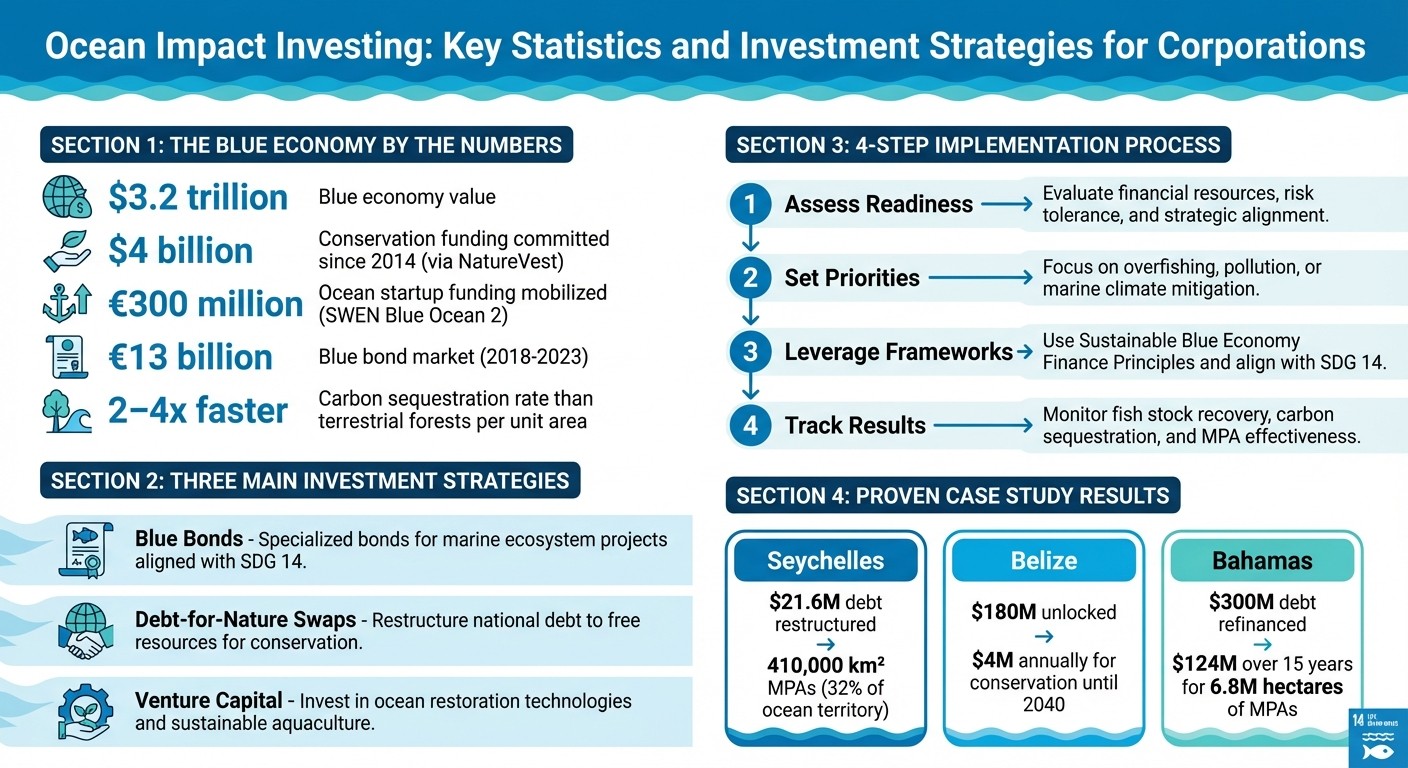
Ocean Impact Investing: Key Statistics and Investment Strategies for Corporations
SWEN Capital: Climate and ocean finance among best performing VC funds
Evaluating Your Corporation's Readiness for Ocean Impact Investments
Before diving into ocean impact investments, take a hard look at your internal capabilities. Assess factors like financial resources, technical know-how, and how well these align with your strategic goals. This evaluation ensures that your efforts deliver both financial returns and measurable environmental benefits. Focus on five key areas: your business model, market position, organizational structure, financial capacity, and current commitments [8]. A thorough review helps you direct investments toward initiatives like blue bonds or marine restoration technologies, setting the foundation for impactful and aligned conservation efforts.
One of the first questions to address is your stance on the risk-versus-return balance. Are you aiming for market-rate returns similar to traditional investments, or are you prioritizing "impact-first" projects where environmental benefits outweigh financial gains? [1] This decision will shape your investment strategy, from the types of projects you pursue to how you measure success. For example, NYK's collaboration with The Ocean Foundation and Rockefeller Asset Management between November 2020 and May 2021 highlights how internal assessments can lead to strategic shifts. During this period, NYK joined the Ship Recycling Transparency Initiative and committed to Science-Based Targets, aiming to cut energy intensity by 30% by 2030 and 50% by 2050 [3].
To make a compelling case for investment, create a financial narrative that treats nature as a valuable asset [7]. This involves framing environmental challenges in financial terms and setting up systems to track both short-term indicators (like policy advancements) and long-term outcomes (such as fish stock recovery) from the start [6]. A notable example is Builders Vision’s $70 million co-guarantee for The Bahamas Debt Conversion Project in August 2025. This initiative refinanced $300 million of external debt, unlocking $124 million over 15 years for marine conservation, including the management of 6.8 million hectares of Marine Protected Areas [4].
Identifying Ocean-Specific Priorities
Once you've assessed internal readiness, it's time to narrow your focus. Instead of spreading resources thinly across various projects, concentrate on specific conservation outcomes for greater impact. Target areas like overfishing, ocean pollution, or marine climate mitigation to drive meaningful change [2][6]. A survey of top sustainable ocean funds revealed that 13 out of 14 prioritize pollution and waste management [9].
Develop a Theory of Change to connect your investments directly to measurable conservation outcomes, such as improving marine protected area (MPA) management or reforming fisheries [6]. This approach distinguishes between "outputs" (e.g., reports or meetings) and "outcomes" (e.g., improved ecosystem health or policy adoption) [6]. For instance, in February 2026, a private environmental foundation restructured its $200 million ocean portfolio after realizing its resources were too scattered. By adopting a Theory of Change, the foundation redirected $28 million toward MPA management and blue carbon projects, leading to improved management scores in 8 of 12 priority sites within 18 months and launching a $12 million blue carbon initiative [6].
Think about how marine conservation ties into your core business objectives. For example, shipping companies might focus on decarbonized maritime infrastructure, while food corporations could explore sustainable seafood ventures or alternatives like land-grown shrimp. Financial institutions might find opportunities in blue bonds or debt-for-nature swaps [5]. Coastal ecosystems, such as mangroves and seagrasses, are particularly attractive for corporate carbon strategies since they sequester carbon 2 to 4 times faster than terrestrial forests per unit area [6][7].
Reviewing Your Current ESG Framework
To ensure your investments align with global standards, evaluate your current ESG framework against ocean conservation benchmarks. The Sustainable Blue Economy Finance Principles offer a solid starting point for guiding investment decisions [2]. Additionally, familiarize yourself with frameworks like the "30x30" target from the Kunming-Montreal Global Biodiversity Framework and the Taskforce on Nature-related Financial Disclosures (TNFD) [6].
Aligning your impact strategy with UN Sustainable Development Goal 14 (Life Below Water) provides a globally recognized baseline for measuring success [9]. European companies can also leverage the Sustainable Finance Disclosure Regulation (SFDR) Article 9 criteria to ensure investments have clear and measurable impact indicators [9]. For effective reporting, establish 1 to 5 Key Performance Indicators (KPIs) for each project [9].
If your organization lacks expertise in this area, consider partnering with specialized agencies or NGOs like The Nature Conservancy to assess your readiness for impact investments [8][9]. George Duffield, Founding Partner at Ocean 14 Capital, emphasizes this inward-focused approach:
"To get the right metrics you've got to go deep into the company's specific operational pathways. You need to identify the things that generate convergent returns – economic and environmental. It doesn't work from the top down – it has to be inside out" [9].
Leverage digital monitoring tools such as environmental DNA (eDNA) and real-time fish biomass tracking to enhance biodiversity measurement across your supply chain [2]. These technologies are becoming essential for accurate impact reporting, bridging the gap between scientific precision and financial accountability. As Torsten Thiele, Founder of Global Ocean Trust, explains:
"Traditional accounting captures the fish on your plate, not the fish as a functioning part of an ecosystem. That is the mental shift we need" [7].
Investment Strategies for Financing Marine Ecosystems
Once you've determined your goals and readiness, it's time to put your capital to work using proven financial tools. Three prominent strategies - blue bonds, debt-for-nature swaps, and venture capital in ocean restoration technologies - have demonstrated success in achieving both conservation and financial objectives. Each method offers unique benefits depending on your organization’s size, risk tolerance, and strategic priorities. Let’s explore these approaches in detail.
Blue Bonds for Marine Protected Areas
Blue bonds are a specialized subset of the green bond market, designed specifically to fund marine and freshwater ecosystem projects [10]. To issue or invest in these bonds, corporations must adhere to the Green Bond Principles (GBPs) set by the International Capital Market Association (ICMA) and follow the International Finance Corporation (IFC) Blue Finance Guidelines [10][11]. These bonds are typically aligned with UN Sustainable Development Goals, particularly SDG 6 (Clean Water and Sanitation) and SDG 14 (Life Below Water) [10].
The market for blue bonds has seen considerable growth, crossing €13 billion between 2018 and 2023, though it still represents just 0.2% of sustainable financial issuances [10]. For example, in January 2026, Emirates NBD issued a $300 million blue bond as part of a broader $1 billion initiative, funding projects like desalination and sustainable water management under IFC guidelines [11]. Similarly, DP World issued a $100 million blue bond in December 2024, allocating half the proceeds to sustainable marine transportation and the other half to marine biodiversity conservation [11]. Willem Visser, Portfolio Manager at T. Rowe Price, who facilitated the DP World transaction, noted:
"Our objective is to help mobilize capital to the blue economy by working with issuers on bonds where 100% of the proceeds will be allocated to clean water and ocean-friendly projects" [11].
For newcomers, private placements are a good starting point to gauge investor interest before moving to public offerings [10]. Identify eligible "blue" assets in your operations, such as marine biodiversity projects, sustainable fisheries, or coastal resilience initiatives [10][11]. Collaborating with third-party organizations like UNDP can help validate these projects and enhance market credibility [10]. With one in five investors actively seeking blue investments, the market is receptive to well-structured opportunities [10].
Debt-for-Nature Swaps
Debt-for-nature swaps allow corporations to participate in restructuring national debt, freeing resources for marine conservation. These deals often involve a conservation trust fund to ensure effective project financing and management [12]. A notable example is Belize’s debt restructuring, which unlocked $180 million for ocean conservation. This initiative guarantees $4 million annually for a World Heritage site until 2040 and builds a $90 million endowment for long-term support [12].
Corporations can adopt similar models to fund large-scale conservation while meeting their ESG objectives. Aligning corporate goals with national conservation commitments, such as expanding protected biodiversity zones, is key. Debt service payments can be redirected to initiatives like mangrove restoration, fisheries management, and coral reef protection [12]. For companies with significant coastal operations, these swaps offer a way to ensure resource stability while achieving measurable environmental impact.
Venture Capital in Ocean Restoration Technologies
Venture capital in ocean restoration technologies provides an avenue to invest in scalable innovations addressing marine challenges. The global blue economy, valued at $3.2 trillion, holds immense growth potential in sectors tackling overfishing, pollution, and climate-related ocean solutions [2][3]. The SWEN Blue Ocean strategy exemplifies this, mobilizing over €300 million by early 2026, with 85% of funding coming from institutional investors [2].
Successful ventures often combine science and finance, partnering with research institutions to ensure projects are backed by robust data and deliver systemic benefits [2]. For instance, in September 2024, the Blue Ocean fund invested £14 million in MiAlgae, supporting its production of omega-3 from microalgae fermentation - a sustainable alternative to fish oil [2]. Similarly, in July 2024, Polystyvert secured $16 million to advance its polystyrene recycling technology, addressing ocean plastic pollution [2].
Focus your investments on areas with high potential, such as aquaculture digitalization, decarbonizing maritime transport, circular economy solutions, and alternative proteins [2]. OptoScale, for example, raised $4.1 million in October 2021 to scale its AI-based fish farm monitoring technology, which improves biomass measurement accuracy [2]. Beyond capital, offering expertise and resources to these ventures can amplify both financial returns and environmental benefits. Engaging with coalitions like "1000 Ocean Startups" or the "UNEP Sustainable Blue Economy Finance Initiative" can also provide access to vetted innovations and standardized frameworks [3][2].
Case Studies of Corporate-Led Ocean Investments
The following examples highlight how businesses are leading ocean conservation efforts through structured finance and strategic collaborations. These initiatives show the potential of combining financial innovation with environmental stewardship.
The Seychelles Debt-for-Nature Swap
In 2016, Seychelles partnered with The Nature Conservancy (TNC) to create the world's first debt-for-nature swap aimed at marine conservation. This agreement restructured $21.6 million of the nation’s debt, allowing redirected funds to support ocean protection efforts. By 2020, Seychelles surpassed its original goal, designating 410,000 square kilometers of Marine Protected Areas (MPAs), which now cover 32% of its ocean territory [13].
To ensure transparency and effective fund management, the Seychelles Conservation and Climate Adaptation Trust (SeyCCAT) was established. SeyCCAT now provides around $700,000 annually in grants, supporting over 40 local projects. One standout initiative is a rotating fisheries-closure program in Praslin that has helped fish stocks recover while training fishers in data collection. Additionally, a $3 million endowment fund was created to sustain conservation efforts, with debt service payments contributing $200,000 annually to the Blue Grants Fund.
Angelique Pouponneau, SeyCCAT’s Chief Executive, highlighted the long-term impact of the initiative:
"With the debt for nature deal, we have a recurring fund, enabling us to continue financing conservation efforts even when other sources of income for conservation are at risk" [13].
Rob Weary of TNC also praised the success of the program:
"The fact that the government has followed through and even exceeded the target - they've reached 32% - is a great model for the world" [13].
This eight-year effort underscores the importance of patience, collaboration, and transparency. By blending philanthropy with loan capital and consulting extensively with stakeholders, Seychelles created a sustainable funding model that balances conservation goals with economic priorities.
Coral Vita's Series A Investment
Corporate investments in ocean restoration are driving scalable, science-backed solutions. For instance, biomimetic 3D-printed tiles have shown settlement rates four times higher than traditional ceramics. Programs like "1000 Ocean Startups" and the "UNEP Sustainable Blue Economy Finance Initiative" provide frameworks to reduce risk and accelerate progress [14].
The Meloy Fund and Sustainable Seafood Enterprises
The Meloy Fund exemplifies how targeted investments in sustainable seafood can transform supply chains while delivering measurable environmental, social, and financial returns. Operating in Indonesia and the Philippines, the fund focuses on growth-stage enterprises, providing investments between $1 million and $5 million - filling the gap between microfinance and traditional private equity [16]. By September 2025, the fund had invested $6.1 million across six companies, alongside $380,000 in technical assistance [17].
One notable investment was in PT SIG Asia, an Indonesian tuna processor and exporter. Under CEO Daniel Loy, the company enhanced traceability systems, introduced fair pricing for artisanal fishers, and joined Fishery Improvement Projects to work toward Marine Stewardship Council certification [16][17]. The fund’s Technical Assistance Facility (TAF) also helped improve sustainability practices, building capacity for internationally recognized certifications.
The Meloy Fund’s broader goal is to place 1.2 million hectares of coastal habitats under improved management and positively impact 100,000 fisher households over its ten-year lifespan [15]. Dale Galvin, Managing Partner of the fund, explained:
"It's a mutual agreement that these actions are good for business and for people and nature. They understand that's a business need and not just a nice thing to do" [16].
Daniel Loy echoed this sentiment:
"This partnership with the Meloy Fund gives us an opportunity to expand our company, implement value-generating environmental, social, and governance-compliant practices, and expand our leadership in the sustainable seafood industry in our region" [16].
Galvin also noted the growing importance of sustainability in global markets:
"Sustainability commitments are increasingly the prerequisite to sell to certain markets... It's the price of entry" [16].
This case illustrates how embedding sustainability into contracts and focusing on mid-stream processors and exporters can reform supply chains. By ensuring traceability and strong ESG standards, businesses can achieve both environmental and economic success.
Working with Council Fire to Implement Ocean Impact Investments
For corporations looking to move beyond basic ESG compliance and take meaningful steps toward ocean conservation, partnering with an experienced organization can make all the difference. Council Fire specializes in transforming sustainability goals into actionable ocean investment strategies, covering everything from portfolio restructuring to stakeholder collaboration. This structured approach enables impactful conservation efforts through detailed analysis, innovative financial tools, and proactive engagement.
Impact Analysis for Ocean Projects
Council Fire begins with a thorough review of current investments to identify areas that need improvement. This involves categorizing assets based on strategic goals, geographic reach, and types of intervention. One common issue they uncover is funding for "paper parks" - marine protected areas (MPAs) that exist in name only, without adequate management. Research shows that 30–40% of designated MPAs fall into this category, lacking the resources to achieve their conservation goals [6].
To address this, Council Fire customizes a Theory of Change for each portfolio, ensuring that investments directly lead to tangible outcomes like improved fisheries governance and enhanced blue carbon sequestration. For instance, in a project spanning February 2025 to February 2026, they restructured a $200 million ocean conservation portfolio for a private environmental foundation. Through targeted stakeholder interviews and grant mapping, they redirected $28 million from lower-impact areas to high-leverage initiatives, such as improving MPA management and developing blue carbon infrastructure. This effort resulted in improved effectiveness scores at 8 out of 12 priority sites and the launch of a $12 million blue carbon program, which successfully generated verified carbon credits under Verra's VM0033 methodology [6].
Council Fire also identifies emerging opportunities in areas like deep-sea mining governance, marine genetic resources, and ocean-climate science. By investing early in these sectors, corporations can influence future regulatory frameworks and open new pathways for conservation [6]. These insights are instrumental in developing financial tools tailored to ocean conservation.
Designing Blue Bonds and Other Financial Instruments
Council Fire builds on established investment techniques to create financial tools that align with each corporation's risk tolerance and conservation objectives. Designing instruments like blue bonds, conservation trust funds, and debt-for-nature swaps requires specialized knowledge, and Council Fire provides the expertise needed to structure these tools effectively [6][18]. Given the economic and livelihood benefits tied to the ocean economy, these instruments have the potential to deliver both environmental and financial returns [18].
Their approach highlights Marine Spatial Planning (MSP) as a critical governance tool for managing competing ocean uses, such as fishing, shipping, and conservation. By restructuring portfolios strategically, Council Fire has successfully attracted $45 million in co-funding from three organizations, creating a unified funding effort for greater collective impact [6].
Stakeholder Engagement and Outcome Measurement
Achieving meaningful ocean conservation relies on collaboration with a wide range of stakeholders, including marine scientists, fisheries economists, Indigenous leaders, and local communities. Council Fire facilitates these partnerships by aligning corporate teams, boards, and external experts around a unified conservation strategy [6]. This inclusive process ensures that investment strategies are grounded in both science and social considerations.
To track progress, Council Fire uses data-driven dashboards that monitor environmental and financial outcomes in real time. Standardized tools like the Management Effectiveness Tracking Tool (METT) and the MPA Guide framework are central to their approach [6]. According to Council Fire:
"Designing the measurement framework concurrently with the strategy ensures that grants are structured to produce measurable evidence from the outset, rather than trying to retrofit evaluation after the fact" [6].
This integrated design allows corporations to demonstrate impact immediately, monitoring early indicators like policy advancements and partnerships alongside longer-term outcomes such as fish stock recovery and verified carbon credits. By combining measurable results with science-led strategies, Council Fire helps corporations embed sustainability into their financial decision-making processes.
Measuring and Reporting Investment Impact
When it comes to ocean conservation, success should be gauged by outcomes, not just activities. Corporations must adopt frameworks that evaluate both financial returns and environmental benefits, ensuring that every dollar invested leads to tangible, measurable results. The distinction between outputs - like reports or meetings - and outcomes, such as verified fish stock recovery or carbon sequestration, is crucial [6].
To achieve consistent and meaningful results, structured frameworks are essential for linking financial investments to conservation outcomes.
Frameworks for Measuring ROI and Environmental Metrics
Established measurement frameworks offer a roadmap for capturing meaningful conservation outcomes. The Theory of Change, for example, maps how specific inputs lead to desired environmental results [6]. For Marine Protected Areas (MPAs), the Management Effectiveness Tracking Tool (METT) assesses whether these zones deliver ecological benefits, rather than existing as "paper parks" with no real impact. Alarmingly, studies reveal that 30–40% of MPAs lack sufficient management, highlighting the need to focus on effectiveness rather than just the size of designated areas [6].
Other tools like the Taskforce on Nature-related Financial Disclosures (TNFD) provide a framework for managing risks tied to nature and for financial reporting [6]. Similarly, the Ocean Investment Protocol offers structured guidelines to navigate risks within the sustainable blue economy [19]. A notable example comes from July 2025, when SWEN Blue Ocean released an Impact Report showing how it mobilized over $300 million for ocean-focused startups by June 2025. Through partnerships with OptoScale and their real-time fish biomass measurement technology, as well as environmental DNA (eDNA) for biodiversity monitoring, the fund demonstrated how competitive market returns can align with reducing overfishing and pollution [2].
Using a mix of leading indicators (like policy changes or catch documentation) to predict outcomes and lagging indicators (such as fish biomass or carbon credits) to confirm results ensures a comprehensive evaluation of impact [6]. Blue carbon ecosystems, such as mangroves and seagrasses, play a pivotal role here. These ecosystems can sequester carbon at rates two to four times higher than terrestrial forests per unit area, making verified sequestration metrics particularly impactful [6]. Standardized dashboards can further simplify complex data into clear, actionable insights for quarterly reviews by boards and stakeholders.
These frameworks also enable robust before-and-after comparisons, which are critical for validating results.
Before-and-After Comparisons
Setting baselines and tracking changes over time allows organizations to clearly demonstrate their impact. Metrics like reef coverage percentages, fish stock levels, and water quality indicators provide concrete evidence of investment effectiveness. For example, in February 2026, a private environmental foundation partnered with Council Fire to restructure its $200 million ocean portfolio using a Theory of Change approach. By redirecting $28 million toward improving MPA management and supporting blue carbon initiatives, the foundation boosted METT scores at 8 of 12 priority sites within just 18 months. Additionally, the project achieved a first-of-its-kind mangrove conservation initiative that generated verified carbon credits under Verra's VM0033 methodology, a standard also seen in blue bond projects [6].
Visual data reporting plays a key role in making these comparisons accessible to non-technical stakeholders. Dashboards showcasing trends - like rebounding fish populations, quantified CO2 sequestration, or enhanced community livelihoods - help clarify progress. Third-party verification further strengthens the credibility of high-stakes metrics, especially for carbon credits or biodiversity claims. Designing measurement frameworks alongside the broader strategy ensures that results are measurable from the start, avoiding the pitfalls of retrofitting evaluations after the fact [6]. This integrated approach not only demonstrates immediate progress but also builds a foundation for long-term accountability.
Conclusion
Investing in ocean conservation through impact-driven strategies offers businesses a way to combine financial performance with meaningful environmental progress. However, achieving this requires moving past superficial efforts and focusing on measurable improvements in marine ecosystem health. Persistent obstacles, such as insufficient management of Marine Protected Areas (MPAs) and the underutilization of blue carbon ecosystems, highlight the need for targeted, results-oriented investment approaches.
A compelling example of this is how a private environmental foundation restructured its portfolio based on a Theory of Change. By strategically shifting resources toward MPA management and blue carbon initiatives, the foundation achieved notable outcomes, including reforms in fisheries governance, enhanced site effectiveness, and significant co-funding opportunities [6]. This case underscores the power of aligning investment strategies with clear, outcome-driven frameworks.
The success of impact investing lies in prioritizing measurable results over mere activity tracking. As Council Fire emphasizes:
"Foundations [and corporations] that track reports published, convenings held, and campaigns launched without connecting these to measurable conservation outcomes will struggle to demonstrate impact regardless of spending levels" [6].
Council Fire plays a pivotal role in helping corporations translate strategic goals into actionable financial tools for ocean conservation. From crafting blue bonds and blue carbon initiatives to building advanced measurement systems, they guide businesses through the complexities of ocean impact investing with precision and data-backed strategies. For companies seeking to create a tangible difference, partnering with Council Fire offers a pathway to protect marine ecosystems while achieving broader sustainability objectives - turning aspirations into lasting, measurable outcomes.
FAQs
How do we choose between blue bonds, debt-for-nature swaps, and venture capital?
When deciding among blue bonds, debt-for-nature swaps, and venture capital, consider your objectives, risk appetite, and the kind of impact you want to achieve:
Blue bonds are designed to finance extensive marine conservation projects, combining clear environmental benefits with financial returns.
Debt-for-nature swaps provide debt relief in exchange for commitments to conservation, making them particularly suited for developing nations.
Venture capital focuses on funding cutting-edge startups, carrying higher risks but offering the chance to back groundbreaking solutions.
What ocean impact metrics should we track to prove real results?
Key metrics for assessing ocean impacts focus on areas like the health of marine ecosystems, shifts in policy, and the well-being of coastal communities. Examples include the extent of marine protected areas, the sustainability of fish stocks, reductions in plastic waste, and enhancements in biodiversity. To show clear conservation outcomes, effective metrics need to blend ecological data, governance developments, and socio-economic results. Tools such as the TNFD framework also emphasize the importance of nature-related financial disclosures to monitor and report progress.
How can Council Fire help us design and manage an ocean impact portfolio?
Council Fire works to create and oversee ocean impact portfolios that align investments with specific, measurable conservation objectives. Their strategies include initiatives such as marine protected areas, fisheries reform, and blue carbon projects. By employing a theory of change, they aim to maximize the effectiveness of these efforts. This method ensures that funding translates into real-world improvements, such as healthier ecosystems, policy advancements, and benefits for local communities. Progress is tracked through well-defined metrics, promoting both accountability and meaningful outcomes.
Related Blog Posts
Latest Articles
©2025
Narrative Change and Power Building: The Missing Half of Advocacy
Narrative change is the process of disrupting dominant narratives that normalize inequity and advancing new narratives from historically marginalized communities.

Funding Resilience Without Federal Grants
BRIC is unreliable and FEMA is shrinking. Here's how cities fund climate resilience with dedicated revenue, blended finance, and a coordinating authority.

The ESG Blind Spot: How AI Is Finding Risks in Companies Nobody Else Is Watching
Norway's sovereign wealth fund uses AI to screen 7,200 portfolio companies for forced labor and corruption within 24 hours. The real story is the emerging-market coverage gap that traditional ESG data vendors miss — and what it means for any company with a global supply chain.
Narrative Change and Power Building: The Missing Half of Advocacy
Narrative change is the process of disrupting dominant narratives that normalize inequity and advancing new narratives from historically marginalized communities.
Funding Resilience Without Federal Grants
BRIC is unreliable and FEMA is shrinking. Here's how cities fund climate resilience with dedicated revenue, blended finance, and a coordinating authority.
The ESG Blind Spot: How AI Is Finding Risks in Companies Nobody Else Is Watching
Norway's sovereign wealth fund uses AI to screen 7,200 portfolio companies for forced labor and corruption within 24 hours. The real story is the emerging-market coverage gap that traditional ESG data vendors miss — and what it means for any company with a global supply chain.
FAQ
01
What does it really mean to “redefine profit”?
02
What makes Council Fire different?
03
Who does Council Fire work with?
04
What does working with Council Fire actually look like?
05
How does Council Fire help organizations turn big goals into action?
06
How does Council Fire define and measure success?
Mar 30, 2026
How to Finance Ocean Conservation with Impact Investing for Corporations
ESG Strategy
In This Article
How corporations can finance ocean conservation with blue bonds, debt-for-nature swaps, and VC while measuring real ecological outcomes.
How to Finance Ocean Conservation with Impact Investing for Corporations
Corporations are increasingly using impact investing to combine financial returns with improving ocean health. This approach focuses on measurable results, aligning with UN Sustainable Development Goal 14 (Life Below Water). Companies can participate through blue bonds, debt-for-nature swaps, and venture capital for marine technologies.
Key Highlights:
$4 billion committed to conservation projects since 2014 via NatureVest.
€300 million mobilized by SWEN Blue Ocean 2 for ocean-focused startups.
The blue economy is valued at $3.2 trillion, covering areas like sustainable aquaculture and ocean plastic solutions.
Tools like blue bonds and debt-for-nature swaps are helping fund marine protected areas and fisheries reforms.
Case studies, such as Seychelles’ debt-for-nature swap and Coral Vita's Series A investment, illustrate how businesses can achieve measurable outcomes.
Steps for Corporations:
Assess readiness: Evaluate financial resources, risk tolerance, and alignment with goals.
Set priorities: Focus on specific areas like overfishing or marine pollution.
Leverage frameworks: Use tools like the Sustainable Blue Economy Finance Principles to guide investments.
Track results: Use metrics like fish stock recovery or carbon sequestration to measure success.
Businesses investing in ocean conservation not only support ecological health but also secure long-term economic benefits by aligning with global sustainability initiatives.
Ocean Impact Investing: Key Statistics and Investment Strategies for Corporations
SWEN Capital: Climate and ocean finance among best performing VC funds
Evaluating Your Corporation's Readiness for Ocean Impact Investments
Before diving into ocean impact investments, take a hard look at your internal capabilities. Assess factors like financial resources, technical know-how, and how well these align with your strategic goals. This evaluation ensures that your efforts deliver both financial returns and measurable environmental benefits. Focus on five key areas: your business model, market position, organizational structure, financial capacity, and current commitments [8]. A thorough review helps you direct investments toward initiatives like blue bonds or marine restoration technologies, setting the foundation for impactful and aligned conservation efforts.
One of the first questions to address is your stance on the risk-versus-return balance. Are you aiming for market-rate returns similar to traditional investments, or are you prioritizing "impact-first" projects where environmental benefits outweigh financial gains? [1] This decision will shape your investment strategy, from the types of projects you pursue to how you measure success. For example, NYK's collaboration with The Ocean Foundation and Rockefeller Asset Management between November 2020 and May 2021 highlights how internal assessments can lead to strategic shifts. During this period, NYK joined the Ship Recycling Transparency Initiative and committed to Science-Based Targets, aiming to cut energy intensity by 30% by 2030 and 50% by 2050 [3].
To make a compelling case for investment, create a financial narrative that treats nature as a valuable asset [7]. This involves framing environmental challenges in financial terms and setting up systems to track both short-term indicators (like policy advancements) and long-term outcomes (such as fish stock recovery) from the start [6]. A notable example is Builders Vision’s $70 million co-guarantee for The Bahamas Debt Conversion Project in August 2025. This initiative refinanced $300 million of external debt, unlocking $124 million over 15 years for marine conservation, including the management of 6.8 million hectares of Marine Protected Areas [4].
Identifying Ocean-Specific Priorities
Once you've assessed internal readiness, it's time to narrow your focus. Instead of spreading resources thinly across various projects, concentrate on specific conservation outcomes for greater impact. Target areas like overfishing, ocean pollution, or marine climate mitigation to drive meaningful change [2][6]. A survey of top sustainable ocean funds revealed that 13 out of 14 prioritize pollution and waste management [9].
Develop a Theory of Change to connect your investments directly to measurable conservation outcomes, such as improving marine protected area (MPA) management or reforming fisheries [6]. This approach distinguishes between "outputs" (e.g., reports or meetings) and "outcomes" (e.g., improved ecosystem health or policy adoption) [6]. For instance, in February 2026, a private environmental foundation restructured its $200 million ocean portfolio after realizing its resources were too scattered. By adopting a Theory of Change, the foundation redirected $28 million toward MPA management and blue carbon projects, leading to improved management scores in 8 of 12 priority sites within 18 months and launching a $12 million blue carbon initiative [6].
Think about how marine conservation ties into your core business objectives. For example, shipping companies might focus on decarbonized maritime infrastructure, while food corporations could explore sustainable seafood ventures or alternatives like land-grown shrimp. Financial institutions might find opportunities in blue bonds or debt-for-nature swaps [5]. Coastal ecosystems, such as mangroves and seagrasses, are particularly attractive for corporate carbon strategies since they sequester carbon 2 to 4 times faster than terrestrial forests per unit area [6][7].
Reviewing Your Current ESG Framework
To ensure your investments align with global standards, evaluate your current ESG framework against ocean conservation benchmarks. The Sustainable Blue Economy Finance Principles offer a solid starting point for guiding investment decisions [2]. Additionally, familiarize yourself with frameworks like the "30x30" target from the Kunming-Montreal Global Biodiversity Framework and the Taskforce on Nature-related Financial Disclosures (TNFD) [6].
Aligning your impact strategy with UN Sustainable Development Goal 14 (Life Below Water) provides a globally recognized baseline for measuring success [9]. European companies can also leverage the Sustainable Finance Disclosure Regulation (SFDR) Article 9 criteria to ensure investments have clear and measurable impact indicators [9]. For effective reporting, establish 1 to 5 Key Performance Indicators (KPIs) for each project [9].
If your organization lacks expertise in this area, consider partnering with specialized agencies or NGOs like The Nature Conservancy to assess your readiness for impact investments [8][9]. George Duffield, Founding Partner at Ocean 14 Capital, emphasizes this inward-focused approach:
"To get the right metrics you've got to go deep into the company's specific operational pathways. You need to identify the things that generate convergent returns – economic and environmental. It doesn't work from the top down – it has to be inside out" [9].
Leverage digital monitoring tools such as environmental DNA (eDNA) and real-time fish biomass tracking to enhance biodiversity measurement across your supply chain [2]. These technologies are becoming essential for accurate impact reporting, bridging the gap between scientific precision and financial accountability. As Torsten Thiele, Founder of Global Ocean Trust, explains:
"Traditional accounting captures the fish on your plate, not the fish as a functioning part of an ecosystem. That is the mental shift we need" [7].
Investment Strategies for Financing Marine Ecosystems
Once you've determined your goals and readiness, it's time to put your capital to work using proven financial tools. Three prominent strategies - blue bonds, debt-for-nature swaps, and venture capital in ocean restoration technologies - have demonstrated success in achieving both conservation and financial objectives. Each method offers unique benefits depending on your organization’s size, risk tolerance, and strategic priorities. Let’s explore these approaches in detail.
Blue Bonds for Marine Protected Areas
Blue bonds are a specialized subset of the green bond market, designed specifically to fund marine and freshwater ecosystem projects [10]. To issue or invest in these bonds, corporations must adhere to the Green Bond Principles (GBPs) set by the International Capital Market Association (ICMA) and follow the International Finance Corporation (IFC) Blue Finance Guidelines [10][11]. These bonds are typically aligned with UN Sustainable Development Goals, particularly SDG 6 (Clean Water and Sanitation) and SDG 14 (Life Below Water) [10].
The market for blue bonds has seen considerable growth, crossing €13 billion between 2018 and 2023, though it still represents just 0.2% of sustainable financial issuances [10]. For example, in January 2026, Emirates NBD issued a $300 million blue bond as part of a broader $1 billion initiative, funding projects like desalination and sustainable water management under IFC guidelines [11]. Similarly, DP World issued a $100 million blue bond in December 2024, allocating half the proceeds to sustainable marine transportation and the other half to marine biodiversity conservation [11]. Willem Visser, Portfolio Manager at T. Rowe Price, who facilitated the DP World transaction, noted:
"Our objective is to help mobilize capital to the blue economy by working with issuers on bonds where 100% of the proceeds will be allocated to clean water and ocean-friendly projects" [11].
For newcomers, private placements are a good starting point to gauge investor interest before moving to public offerings [10]. Identify eligible "blue" assets in your operations, such as marine biodiversity projects, sustainable fisheries, or coastal resilience initiatives [10][11]. Collaborating with third-party organizations like UNDP can help validate these projects and enhance market credibility [10]. With one in five investors actively seeking blue investments, the market is receptive to well-structured opportunities [10].
Debt-for-Nature Swaps
Debt-for-nature swaps allow corporations to participate in restructuring national debt, freeing resources for marine conservation. These deals often involve a conservation trust fund to ensure effective project financing and management [12]. A notable example is Belize’s debt restructuring, which unlocked $180 million for ocean conservation. This initiative guarantees $4 million annually for a World Heritage site until 2040 and builds a $90 million endowment for long-term support [12].
Corporations can adopt similar models to fund large-scale conservation while meeting their ESG objectives. Aligning corporate goals with national conservation commitments, such as expanding protected biodiversity zones, is key. Debt service payments can be redirected to initiatives like mangrove restoration, fisheries management, and coral reef protection [12]. For companies with significant coastal operations, these swaps offer a way to ensure resource stability while achieving measurable environmental impact.
Venture Capital in Ocean Restoration Technologies
Venture capital in ocean restoration technologies provides an avenue to invest in scalable innovations addressing marine challenges. The global blue economy, valued at $3.2 trillion, holds immense growth potential in sectors tackling overfishing, pollution, and climate-related ocean solutions [2][3]. The SWEN Blue Ocean strategy exemplifies this, mobilizing over €300 million by early 2026, with 85% of funding coming from institutional investors [2].
Successful ventures often combine science and finance, partnering with research institutions to ensure projects are backed by robust data and deliver systemic benefits [2]. For instance, in September 2024, the Blue Ocean fund invested £14 million in MiAlgae, supporting its production of omega-3 from microalgae fermentation - a sustainable alternative to fish oil [2]. Similarly, in July 2024, Polystyvert secured $16 million to advance its polystyrene recycling technology, addressing ocean plastic pollution [2].
Focus your investments on areas with high potential, such as aquaculture digitalization, decarbonizing maritime transport, circular economy solutions, and alternative proteins [2]. OptoScale, for example, raised $4.1 million in October 2021 to scale its AI-based fish farm monitoring technology, which improves biomass measurement accuracy [2]. Beyond capital, offering expertise and resources to these ventures can amplify both financial returns and environmental benefits. Engaging with coalitions like "1000 Ocean Startups" or the "UNEP Sustainable Blue Economy Finance Initiative" can also provide access to vetted innovations and standardized frameworks [3][2].
Case Studies of Corporate-Led Ocean Investments
The following examples highlight how businesses are leading ocean conservation efforts through structured finance and strategic collaborations. These initiatives show the potential of combining financial innovation with environmental stewardship.
The Seychelles Debt-for-Nature Swap
In 2016, Seychelles partnered with The Nature Conservancy (TNC) to create the world's first debt-for-nature swap aimed at marine conservation. This agreement restructured $21.6 million of the nation’s debt, allowing redirected funds to support ocean protection efforts. By 2020, Seychelles surpassed its original goal, designating 410,000 square kilometers of Marine Protected Areas (MPAs), which now cover 32% of its ocean territory [13].
To ensure transparency and effective fund management, the Seychelles Conservation and Climate Adaptation Trust (SeyCCAT) was established. SeyCCAT now provides around $700,000 annually in grants, supporting over 40 local projects. One standout initiative is a rotating fisheries-closure program in Praslin that has helped fish stocks recover while training fishers in data collection. Additionally, a $3 million endowment fund was created to sustain conservation efforts, with debt service payments contributing $200,000 annually to the Blue Grants Fund.
Angelique Pouponneau, SeyCCAT’s Chief Executive, highlighted the long-term impact of the initiative:
"With the debt for nature deal, we have a recurring fund, enabling us to continue financing conservation efforts even when other sources of income for conservation are at risk" [13].
Rob Weary of TNC also praised the success of the program:
"The fact that the government has followed through and even exceeded the target - they've reached 32% - is a great model for the world" [13].
This eight-year effort underscores the importance of patience, collaboration, and transparency. By blending philanthropy with loan capital and consulting extensively with stakeholders, Seychelles created a sustainable funding model that balances conservation goals with economic priorities.
Coral Vita's Series A Investment
Corporate investments in ocean restoration are driving scalable, science-backed solutions. For instance, biomimetic 3D-printed tiles have shown settlement rates four times higher than traditional ceramics. Programs like "1000 Ocean Startups" and the "UNEP Sustainable Blue Economy Finance Initiative" provide frameworks to reduce risk and accelerate progress [14].
The Meloy Fund and Sustainable Seafood Enterprises
The Meloy Fund exemplifies how targeted investments in sustainable seafood can transform supply chains while delivering measurable environmental, social, and financial returns. Operating in Indonesia and the Philippines, the fund focuses on growth-stage enterprises, providing investments between $1 million and $5 million - filling the gap between microfinance and traditional private equity [16]. By September 2025, the fund had invested $6.1 million across six companies, alongside $380,000 in technical assistance [17].
One notable investment was in PT SIG Asia, an Indonesian tuna processor and exporter. Under CEO Daniel Loy, the company enhanced traceability systems, introduced fair pricing for artisanal fishers, and joined Fishery Improvement Projects to work toward Marine Stewardship Council certification [16][17]. The fund’s Technical Assistance Facility (TAF) also helped improve sustainability practices, building capacity for internationally recognized certifications.
The Meloy Fund’s broader goal is to place 1.2 million hectares of coastal habitats under improved management and positively impact 100,000 fisher households over its ten-year lifespan [15]. Dale Galvin, Managing Partner of the fund, explained:
"It's a mutual agreement that these actions are good for business and for people and nature. They understand that's a business need and not just a nice thing to do" [16].
Daniel Loy echoed this sentiment:
"This partnership with the Meloy Fund gives us an opportunity to expand our company, implement value-generating environmental, social, and governance-compliant practices, and expand our leadership in the sustainable seafood industry in our region" [16].
Galvin also noted the growing importance of sustainability in global markets:
"Sustainability commitments are increasingly the prerequisite to sell to certain markets... It's the price of entry" [16].
This case illustrates how embedding sustainability into contracts and focusing on mid-stream processors and exporters can reform supply chains. By ensuring traceability and strong ESG standards, businesses can achieve both environmental and economic success.
Working with Council Fire to Implement Ocean Impact Investments
For corporations looking to move beyond basic ESG compliance and take meaningful steps toward ocean conservation, partnering with an experienced organization can make all the difference. Council Fire specializes in transforming sustainability goals into actionable ocean investment strategies, covering everything from portfolio restructuring to stakeholder collaboration. This structured approach enables impactful conservation efforts through detailed analysis, innovative financial tools, and proactive engagement.
Impact Analysis for Ocean Projects
Council Fire begins with a thorough review of current investments to identify areas that need improvement. This involves categorizing assets based on strategic goals, geographic reach, and types of intervention. One common issue they uncover is funding for "paper parks" - marine protected areas (MPAs) that exist in name only, without adequate management. Research shows that 30–40% of designated MPAs fall into this category, lacking the resources to achieve their conservation goals [6].
To address this, Council Fire customizes a Theory of Change for each portfolio, ensuring that investments directly lead to tangible outcomes like improved fisheries governance and enhanced blue carbon sequestration. For instance, in a project spanning February 2025 to February 2026, they restructured a $200 million ocean conservation portfolio for a private environmental foundation. Through targeted stakeholder interviews and grant mapping, they redirected $28 million from lower-impact areas to high-leverage initiatives, such as improving MPA management and developing blue carbon infrastructure. This effort resulted in improved effectiveness scores at 8 out of 12 priority sites and the launch of a $12 million blue carbon program, which successfully generated verified carbon credits under Verra's VM0033 methodology [6].
Council Fire also identifies emerging opportunities in areas like deep-sea mining governance, marine genetic resources, and ocean-climate science. By investing early in these sectors, corporations can influence future regulatory frameworks and open new pathways for conservation [6]. These insights are instrumental in developing financial tools tailored to ocean conservation.
Designing Blue Bonds and Other Financial Instruments
Council Fire builds on established investment techniques to create financial tools that align with each corporation's risk tolerance and conservation objectives. Designing instruments like blue bonds, conservation trust funds, and debt-for-nature swaps requires specialized knowledge, and Council Fire provides the expertise needed to structure these tools effectively [6][18]. Given the economic and livelihood benefits tied to the ocean economy, these instruments have the potential to deliver both environmental and financial returns [18].
Their approach highlights Marine Spatial Planning (MSP) as a critical governance tool for managing competing ocean uses, such as fishing, shipping, and conservation. By restructuring portfolios strategically, Council Fire has successfully attracted $45 million in co-funding from three organizations, creating a unified funding effort for greater collective impact [6].
Stakeholder Engagement and Outcome Measurement
Achieving meaningful ocean conservation relies on collaboration with a wide range of stakeholders, including marine scientists, fisheries economists, Indigenous leaders, and local communities. Council Fire facilitates these partnerships by aligning corporate teams, boards, and external experts around a unified conservation strategy [6]. This inclusive process ensures that investment strategies are grounded in both science and social considerations.
To track progress, Council Fire uses data-driven dashboards that monitor environmental and financial outcomes in real time. Standardized tools like the Management Effectiveness Tracking Tool (METT) and the MPA Guide framework are central to their approach [6]. According to Council Fire:
"Designing the measurement framework concurrently with the strategy ensures that grants are structured to produce measurable evidence from the outset, rather than trying to retrofit evaluation after the fact" [6].
This integrated design allows corporations to demonstrate impact immediately, monitoring early indicators like policy advancements and partnerships alongside longer-term outcomes such as fish stock recovery and verified carbon credits. By combining measurable results with science-led strategies, Council Fire helps corporations embed sustainability into their financial decision-making processes.
Measuring and Reporting Investment Impact
When it comes to ocean conservation, success should be gauged by outcomes, not just activities. Corporations must adopt frameworks that evaluate both financial returns and environmental benefits, ensuring that every dollar invested leads to tangible, measurable results. The distinction between outputs - like reports or meetings - and outcomes, such as verified fish stock recovery or carbon sequestration, is crucial [6].
To achieve consistent and meaningful results, structured frameworks are essential for linking financial investments to conservation outcomes.
Frameworks for Measuring ROI and Environmental Metrics
Established measurement frameworks offer a roadmap for capturing meaningful conservation outcomes. The Theory of Change, for example, maps how specific inputs lead to desired environmental results [6]. For Marine Protected Areas (MPAs), the Management Effectiveness Tracking Tool (METT) assesses whether these zones deliver ecological benefits, rather than existing as "paper parks" with no real impact. Alarmingly, studies reveal that 30–40% of MPAs lack sufficient management, highlighting the need to focus on effectiveness rather than just the size of designated areas [6].
Other tools like the Taskforce on Nature-related Financial Disclosures (TNFD) provide a framework for managing risks tied to nature and for financial reporting [6]. Similarly, the Ocean Investment Protocol offers structured guidelines to navigate risks within the sustainable blue economy [19]. A notable example comes from July 2025, when SWEN Blue Ocean released an Impact Report showing how it mobilized over $300 million for ocean-focused startups by June 2025. Through partnerships with OptoScale and their real-time fish biomass measurement technology, as well as environmental DNA (eDNA) for biodiversity monitoring, the fund demonstrated how competitive market returns can align with reducing overfishing and pollution [2].
Using a mix of leading indicators (like policy changes or catch documentation) to predict outcomes and lagging indicators (such as fish biomass or carbon credits) to confirm results ensures a comprehensive evaluation of impact [6]. Blue carbon ecosystems, such as mangroves and seagrasses, play a pivotal role here. These ecosystems can sequester carbon at rates two to four times higher than terrestrial forests per unit area, making verified sequestration metrics particularly impactful [6]. Standardized dashboards can further simplify complex data into clear, actionable insights for quarterly reviews by boards and stakeholders.
These frameworks also enable robust before-and-after comparisons, which are critical for validating results.
Before-and-After Comparisons
Setting baselines and tracking changes over time allows organizations to clearly demonstrate their impact. Metrics like reef coverage percentages, fish stock levels, and water quality indicators provide concrete evidence of investment effectiveness. For example, in February 2026, a private environmental foundation partnered with Council Fire to restructure its $200 million ocean portfolio using a Theory of Change approach. By redirecting $28 million toward improving MPA management and supporting blue carbon initiatives, the foundation boosted METT scores at 8 of 12 priority sites within just 18 months. Additionally, the project achieved a first-of-its-kind mangrove conservation initiative that generated verified carbon credits under Verra's VM0033 methodology, a standard also seen in blue bond projects [6].
Visual data reporting plays a key role in making these comparisons accessible to non-technical stakeholders. Dashboards showcasing trends - like rebounding fish populations, quantified CO2 sequestration, or enhanced community livelihoods - help clarify progress. Third-party verification further strengthens the credibility of high-stakes metrics, especially for carbon credits or biodiversity claims. Designing measurement frameworks alongside the broader strategy ensures that results are measurable from the start, avoiding the pitfalls of retrofitting evaluations after the fact [6]. This integrated approach not only demonstrates immediate progress but also builds a foundation for long-term accountability.
Conclusion
Investing in ocean conservation through impact-driven strategies offers businesses a way to combine financial performance with meaningful environmental progress. However, achieving this requires moving past superficial efforts and focusing on measurable improvements in marine ecosystem health. Persistent obstacles, such as insufficient management of Marine Protected Areas (MPAs) and the underutilization of blue carbon ecosystems, highlight the need for targeted, results-oriented investment approaches.
A compelling example of this is how a private environmental foundation restructured its portfolio based on a Theory of Change. By strategically shifting resources toward MPA management and blue carbon initiatives, the foundation achieved notable outcomes, including reforms in fisheries governance, enhanced site effectiveness, and significant co-funding opportunities [6]. This case underscores the power of aligning investment strategies with clear, outcome-driven frameworks.
The success of impact investing lies in prioritizing measurable results over mere activity tracking. As Council Fire emphasizes:
"Foundations [and corporations] that track reports published, convenings held, and campaigns launched without connecting these to measurable conservation outcomes will struggle to demonstrate impact regardless of spending levels" [6].
Council Fire plays a pivotal role in helping corporations translate strategic goals into actionable financial tools for ocean conservation. From crafting blue bonds and blue carbon initiatives to building advanced measurement systems, they guide businesses through the complexities of ocean impact investing with precision and data-backed strategies. For companies seeking to create a tangible difference, partnering with Council Fire offers a pathway to protect marine ecosystems while achieving broader sustainability objectives - turning aspirations into lasting, measurable outcomes.
FAQs
How do we choose between blue bonds, debt-for-nature swaps, and venture capital?
When deciding among blue bonds, debt-for-nature swaps, and venture capital, consider your objectives, risk appetite, and the kind of impact you want to achieve:
Blue bonds are designed to finance extensive marine conservation projects, combining clear environmental benefits with financial returns.
Debt-for-nature swaps provide debt relief in exchange for commitments to conservation, making them particularly suited for developing nations.
Venture capital focuses on funding cutting-edge startups, carrying higher risks but offering the chance to back groundbreaking solutions.
What ocean impact metrics should we track to prove real results?
Key metrics for assessing ocean impacts focus on areas like the health of marine ecosystems, shifts in policy, and the well-being of coastal communities. Examples include the extent of marine protected areas, the sustainability of fish stocks, reductions in plastic waste, and enhancements in biodiversity. To show clear conservation outcomes, effective metrics need to blend ecological data, governance developments, and socio-economic results. Tools such as the TNFD framework also emphasize the importance of nature-related financial disclosures to monitor and report progress.
How can Council Fire help us design and manage an ocean impact portfolio?
Council Fire works to create and oversee ocean impact portfolios that align investments with specific, measurable conservation objectives. Their strategies include initiatives such as marine protected areas, fisheries reform, and blue carbon projects. By employing a theory of change, they aim to maximize the effectiveness of these efforts. This method ensures that funding translates into real-world improvements, such as healthier ecosystems, policy advancements, and benefits for local communities. Progress is tracked through well-defined metrics, promoting both accountability and meaningful outcomes.
Related Blog Posts
Latest Articles
©2025
Narrative Change and Power Building: The Missing Half of Advocacy
Narrative change is the process of disrupting dominant narratives that normalize inequity and advancing new narratives from historically marginalized communities.
Funding Resilience Without Federal Grants
BRIC is unreliable and FEMA is shrinking. Here's how cities fund climate resilience with dedicated revenue, blended finance, and a coordinating authority.
The ESG Blind Spot: How AI Is Finding Risks in Companies Nobody Else Is Watching
Norway's sovereign wealth fund uses AI to screen 7,200 portfolio companies for forced labor and corruption within 24 hours. The real story is the emerging-market coverage gap that traditional ESG data vendors miss — and what it means for any company with a global supply chain.
FAQ
01
What does it really mean to “redefine profit”?
02
What makes Council Fire different?
03
Who does Council Fire work with?
04
What does working with Council Fire actually look like?
05
How does Council Fire help organizations turn big goals into action?
06
How does Council Fire define and measure success?
Mar 30, 2026
How to Finance Ocean Conservation with Impact Investing for Corporations
ESG Strategy
In This Article
How corporations can finance ocean conservation with blue bonds, debt-for-nature swaps, and VC while measuring real ecological outcomes.
How to Finance Ocean Conservation with Impact Investing for Corporations
Corporations are increasingly using impact investing to combine financial returns with improving ocean health. This approach focuses on measurable results, aligning with UN Sustainable Development Goal 14 (Life Below Water). Companies can participate through blue bonds, debt-for-nature swaps, and venture capital for marine technologies.
Key Highlights:
$4 billion committed to conservation projects since 2014 via NatureVest.
€300 million mobilized by SWEN Blue Ocean 2 for ocean-focused startups.
The blue economy is valued at $3.2 trillion, covering areas like sustainable aquaculture and ocean plastic solutions.
Tools like blue bonds and debt-for-nature swaps are helping fund marine protected areas and fisheries reforms.
Case studies, such as Seychelles’ debt-for-nature swap and Coral Vita's Series A investment, illustrate how businesses can achieve measurable outcomes.
Steps for Corporations:
Assess readiness: Evaluate financial resources, risk tolerance, and alignment with goals.
Set priorities: Focus on specific areas like overfishing or marine pollution.
Leverage frameworks: Use tools like the Sustainable Blue Economy Finance Principles to guide investments.
Track results: Use metrics like fish stock recovery or carbon sequestration to measure success.
Businesses investing in ocean conservation not only support ecological health but also secure long-term economic benefits by aligning with global sustainability initiatives.
Ocean Impact Investing: Key Statistics and Investment Strategies for Corporations
SWEN Capital: Climate and ocean finance among best performing VC funds
Evaluating Your Corporation's Readiness for Ocean Impact Investments
Before diving into ocean impact investments, take a hard look at your internal capabilities. Assess factors like financial resources, technical know-how, and how well these align with your strategic goals. This evaluation ensures that your efforts deliver both financial returns and measurable environmental benefits. Focus on five key areas: your business model, market position, organizational structure, financial capacity, and current commitments [8]. A thorough review helps you direct investments toward initiatives like blue bonds or marine restoration technologies, setting the foundation for impactful and aligned conservation efforts.
One of the first questions to address is your stance on the risk-versus-return balance. Are you aiming for market-rate returns similar to traditional investments, or are you prioritizing "impact-first" projects where environmental benefits outweigh financial gains? [1] This decision will shape your investment strategy, from the types of projects you pursue to how you measure success. For example, NYK's collaboration with The Ocean Foundation and Rockefeller Asset Management between November 2020 and May 2021 highlights how internal assessments can lead to strategic shifts. During this period, NYK joined the Ship Recycling Transparency Initiative and committed to Science-Based Targets, aiming to cut energy intensity by 30% by 2030 and 50% by 2050 [3].
To make a compelling case for investment, create a financial narrative that treats nature as a valuable asset [7]. This involves framing environmental challenges in financial terms and setting up systems to track both short-term indicators (like policy advancements) and long-term outcomes (such as fish stock recovery) from the start [6]. A notable example is Builders Vision’s $70 million co-guarantee for The Bahamas Debt Conversion Project in August 2025. This initiative refinanced $300 million of external debt, unlocking $124 million over 15 years for marine conservation, including the management of 6.8 million hectares of Marine Protected Areas [4].
Identifying Ocean-Specific Priorities
Once you've assessed internal readiness, it's time to narrow your focus. Instead of spreading resources thinly across various projects, concentrate on specific conservation outcomes for greater impact. Target areas like overfishing, ocean pollution, or marine climate mitigation to drive meaningful change [2][6]. A survey of top sustainable ocean funds revealed that 13 out of 14 prioritize pollution and waste management [9].
Develop a Theory of Change to connect your investments directly to measurable conservation outcomes, such as improving marine protected area (MPA) management or reforming fisheries [6]. This approach distinguishes between "outputs" (e.g., reports or meetings) and "outcomes" (e.g., improved ecosystem health or policy adoption) [6]. For instance, in February 2026, a private environmental foundation restructured its $200 million ocean portfolio after realizing its resources were too scattered. By adopting a Theory of Change, the foundation redirected $28 million toward MPA management and blue carbon projects, leading to improved management scores in 8 of 12 priority sites within 18 months and launching a $12 million blue carbon initiative [6].
Think about how marine conservation ties into your core business objectives. For example, shipping companies might focus on decarbonized maritime infrastructure, while food corporations could explore sustainable seafood ventures or alternatives like land-grown shrimp. Financial institutions might find opportunities in blue bonds or debt-for-nature swaps [5]. Coastal ecosystems, such as mangroves and seagrasses, are particularly attractive for corporate carbon strategies since they sequester carbon 2 to 4 times faster than terrestrial forests per unit area [6][7].
Reviewing Your Current ESG Framework
To ensure your investments align with global standards, evaluate your current ESG framework against ocean conservation benchmarks. The Sustainable Blue Economy Finance Principles offer a solid starting point for guiding investment decisions [2]. Additionally, familiarize yourself with frameworks like the "30x30" target from the Kunming-Montreal Global Biodiversity Framework and the Taskforce on Nature-related Financial Disclosures (TNFD) [6].
Aligning your impact strategy with UN Sustainable Development Goal 14 (Life Below Water) provides a globally recognized baseline for measuring success [9]. European companies can also leverage the Sustainable Finance Disclosure Regulation (SFDR) Article 9 criteria to ensure investments have clear and measurable impact indicators [9]. For effective reporting, establish 1 to 5 Key Performance Indicators (KPIs) for each project [9].
If your organization lacks expertise in this area, consider partnering with specialized agencies or NGOs like The Nature Conservancy to assess your readiness for impact investments [8][9]. George Duffield, Founding Partner at Ocean 14 Capital, emphasizes this inward-focused approach:
"To get the right metrics you've got to go deep into the company's specific operational pathways. You need to identify the things that generate convergent returns – economic and environmental. It doesn't work from the top down – it has to be inside out" [9].
Leverage digital monitoring tools such as environmental DNA (eDNA) and real-time fish biomass tracking to enhance biodiversity measurement across your supply chain [2]. These technologies are becoming essential for accurate impact reporting, bridging the gap between scientific precision and financial accountability. As Torsten Thiele, Founder of Global Ocean Trust, explains:
"Traditional accounting captures the fish on your plate, not the fish as a functioning part of an ecosystem. That is the mental shift we need" [7].
Investment Strategies for Financing Marine Ecosystems
Once you've determined your goals and readiness, it's time to put your capital to work using proven financial tools. Three prominent strategies - blue bonds, debt-for-nature swaps, and venture capital in ocean restoration technologies - have demonstrated success in achieving both conservation and financial objectives. Each method offers unique benefits depending on your organization’s size, risk tolerance, and strategic priorities. Let’s explore these approaches in detail.
Blue Bonds for Marine Protected Areas
Blue bonds are a specialized subset of the green bond market, designed specifically to fund marine and freshwater ecosystem projects [10]. To issue or invest in these bonds, corporations must adhere to the Green Bond Principles (GBPs) set by the International Capital Market Association (ICMA) and follow the International Finance Corporation (IFC) Blue Finance Guidelines [10][11]. These bonds are typically aligned with UN Sustainable Development Goals, particularly SDG 6 (Clean Water and Sanitation) and SDG 14 (Life Below Water) [10].
The market for blue bonds has seen considerable growth, crossing €13 billion between 2018 and 2023, though it still represents just 0.2% of sustainable financial issuances [10]. For example, in January 2026, Emirates NBD issued a $300 million blue bond as part of a broader $1 billion initiative, funding projects like desalination and sustainable water management under IFC guidelines [11]. Similarly, DP World issued a $100 million blue bond in December 2024, allocating half the proceeds to sustainable marine transportation and the other half to marine biodiversity conservation [11]. Willem Visser, Portfolio Manager at T. Rowe Price, who facilitated the DP World transaction, noted:
"Our objective is to help mobilize capital to the blue economy by working with issuers on bonds where 100% of the proceeds will be allocated to clean water and ocean-friendly projects" [11].
For newcomers, private placements are a good starting point to gauge investor interest before moving to public offerings [10]. Identify eligible "blue" assets in your operations, such as marine biodiversity projects, sustainable fisheries, or coastal resilience initiatives [10][11]. Collaborating with third-party organizations like UNDP can help validate these projects and enhance market credibility [10]. With one in five investors actively seeking blue investments, the market is receptive to well-structured opportunities [10].
Debt-for-Nature Swaps
Debt-for-nature swaps allow corporations to participate in restructuring national debt, freeing resources for marine conservation. These deals often involve a conservation trust fund to ensure effective project financing and management [12]. A notable example is Belize’s debt restructuring, which unlocked $180 million for ocean conservation. This initiative guarantees $4 million annually for a World Heritage site until 2040 and builds a $90 million endowment for long-term support [12].
Corporations can adopt similar models to fund large-scale conservation while meeting their ESG objectives. Aligning corporate goals with national conservation commitments, such as expanding protected biodiversity zones, is key. Debt service payments can be redirected to initiatives like mangrove restoration, fisheries management, and coral reef protection [12]. For companies with significant coastal operations, these swaps offer a way to ensure resource stability while achieving measurable environmental impact.
Venture Capital in Ocean Restoration Technologies
Venture capital in ocean restoration technologies provides an avenue to invest in scalable innovations addressing marine challenges. The global blue economy, valued at $3.2 trillion, holds immense growth potential in sectors tackling overfishing, pollution, and climate-related ocean solutions [2][3]. The SWEN Blue Ocean strategy exemplifies this, mobilizing over €300 million by early 2026, with 85% of funding coming from institutional investors [2].
Successful ventures often combine science and finance, partnering with research institutions to ensure projects are backed by robust data and deliver systemic benefits [2]. For instance, in September 2024, the Blue Ocean fund invested £14 million in MiAlgae, supporting its production of omega-3 from microalgae fermentation - a sustainable alternative to fish oil [2]. Similarly, in July 2024, Polystyvert secured $16 million to advance its polystyrene recycling technology, addressing ocean plastic pollution [2].
Focus your investments on areas with high potential, such as aquaculture digitalization, decarbonizing maritime transport, circular economy solutions, and alternative proteins [2]. OptoScale, for example, raised $4.1 million in October 2021 to scale its AI-based fish farm monitoring technology, which improves biomass measurement accuracy [2]. Beyond capital, offering expertise and resources to these ventures can amplify both financial returns and environmental benefits. Engaging with coalitions like "1000 Ocean Startups" or the "UNEP Sustainable Blue Economy Finance Initiative" can also provide access to vetted innovations and standardized frameworks [3][2].
Case Studies of Corporate-Led Ocean Investments
The following examples highlight how businesses are leading ocean conservation efforts through structured finance and strategic collaborations. These initiatives show the potential of combining financial innovation with environmental stewardship.
The Seychelles Debt-for-Nature Swap
In 2016, Seychelles partnered with The Nature Conservancy (TNC) to create the world's first debt-for-nature swap aimed at marine conservation. This agreement restructured $21.6 million of the nation’s debt, allowing redirected funds to support ocean protection efforts. By 2020, Seychelles surpassed its original goal, designating 410,000 square kilometers of Marine Protected Areas (MPAs), which now cover 32% of its ocean territory [13].
To ensure transparency and effective fund management, the Seychelles Conservation and Climate Adaptation Trust (SeyCCAT) was established. SeyCCAT now provides around $700,000 annually in grants, supporting over 40 local projects. One standout initiative is a rotating fisheries-closure program in Praslin that has helped fish stocks recover while training fishers in data collection. Additionally, a $3 million endowment fund was created to sustain conservation efforts, with debt service payments contributing $200,000 annually to the Blue Grants Fund.
Angelique Pouponneau, SeyCCAT’s Chief Executive, highlighted the long-term impact of the initiative:
"With the debt for nature deal, we have a recurring fund, enabling us to continue financing conservation efforts even when other sources of income for conservation are at risk" [13].
Rob Weary of TNC also praised the success of the program:
"The fact that the government has followed through and even exceeded the target - they've reached 32% - is a great model for the world" [13].
This eight-year effort underscores the importance of patience, collaboration, and transparency. By blending philanthropy with loan capital and consulting extensively with stakeholders, Seychelles created a sustainable funding model that balances conservation goals with economic priorities.
Coral Vita's Series A Investment
Corporate investments in ocean restoration are driving scalable, science-backed solutions. For instance, biomimetic 3D-printed tiles have shown settlement rates four times higher than traditional ceramics. Programs like "1000 Ocean Startups" and the "UNEP Sustainable Blue Economy Finance Initiative" provide frameworks to reduce risk and accelerate progress [14].
The Meloy Fund and Sustainable Seafood Enterprises
The Meloy Fund exemplifies how targeted investments in sustainable seafood can transform supply chains while delivering measurable environmental, social, and financial returns. Operating in Indonesia and the Philippines, the fund focuses on growth-stage enterprises, providing investments between $1 million and $5 million - filling the gap between microfinance and traditional private equity [16]. By September 2025, the fund had invested $6.1 million across six companies, alongside $380,000 in technical assistance [17].
One notable investment was in PT SIG Asia, an Indonesian tuna processor and exporter. Under CEO Daniel Loy, the company enhanced traceability systems, introduced fair pricing for artisanal fishers, and joined Fishery Improvement Projects to work toward Marine Stewardship Council certification [16][17]. The fund’s Technical Assistance Facility (TAF) also helped improve sustainability practices, building capacity for internationally recognized certifications.
The Meloy Fund’s broader goal is to place 1.2 million hectares of coastal habitats under improved management and positively impact 100,000 fisher households over its ten-year lifespan [15]. Dale Galvin, Managing Partner of the fund, explained:
"It's a mutual agreement that these actions are good for business and for people and nature. They understand that's a business need and not just a nice thing to do" [16].
Daniel Loy echoed this sentiment:
"This partnership with the Meloy Fund gives us an opportunity to expand our company, implement value-generating environmental, social, and governance-compliant practices, and expand our leadership in the sustainable seafood industry in our region" [16].
Galvin also noted the growing importance of sustainability in global markets:
"Sustainability commitments are increasingly the prerequisite to sell to certain markets... It's the price of entry" [16].
This case illustrates how embedding sustainability into contracts and focusing on mid-stream processors and exporters can reform supply chains. By ensuring traceability and strong ESG standards, businesses can achieve both environmental and economic success.
Working with Council Fire to Implement Ocean Impact Investments
For corporations looking to move beyond basic ESG compliance and take meaningful steps toward ocean conservation, partnering with an experienced organization can make all the difference. Council Fire specializes in transforming sustainability goals into actionable ocean investment strategies, covering everything from portfolio restructuring to stakeholder collaboration. This structured approach enables impactful conservation efforts through detailed analysis, innovative financial tools, and proactive engagement.
Impact Analysis for Ocean Projects
Council Fire begins with a thorough review of current investments to identify areas that need improvement. This involves categorizing assets based on strategic goals, geographic reach, and types of intervention. One common issue they uncover is funding for "paper parks" - marine protected areas (MPAs) that exist in name only, without adequate management. Research shows that 30–40% of designated MPAs fall into this category, lacking the resources to achieve their conservation goals [6].
To address this, Council Fire customizes a Theory of Change for each portfolio, ensuring that investments directly lead to tangible outcomes like improved fisheries governance and enhanced blue carbon sequestration. For instance, in a project spanning February 2025 to February 2026, they restructured a $200 million ocean conservation portfolio for a private environmental foundation. Through targeted stakeholder interviews and grant mapping, they redirected $28 million from lower-impact areas to high-leverage initiatives, such as improving MPA management and developing blue carbon infrastructure. This effort resulted in improved effectiveness scores at 8 out of 12 priority sites and the launch of a $12 million blue carbon program, which successfully generated verified carbon credits under Verra's VM0033 methodology [6].
Council Fire also identifies emerging opportunities in areas like deep-sea mining governance, marine genetic resources, and ocean-climate science. By investing early in these sectors, corporations can influence future regulatory frameworks and open new pathways for conservation [6]. These insights are instrumental in developing financial tools tailored to ocean conservation.
Designing Blue Bonds and Other Financial Instruments
Council Fire builds on established investment techniques to create financial tools that align with each corporation's risk tolerance and conservation objectives. Designing instruments like blue bonds, conservation trust funds, and debt-for-nature swaps requires specialized knowledge, and Council Fire provides the expertise needed to structure these tools effectively [6][18]. Given the economic and livelihood benefits tied to the ocean economy, these instruments have the potential to deliver both environmental and financial returns [18].
Their approach highlights Marine Spatial Planning (MSP) as a critical governance tool for managing competing ocean uses, such as fishing, shipping, and conservation. By restructuring portfolios strategically, Council Fire has successfully attracted $45 million in co-funding from three organizations, creating a unified funding effort for greater collective impact [6].
Stakeholder Engagement and Outcome Measurement
Achieving meaningful ocean conservation relies on collaboration with a wide range of stakeholders, including marine scientists, fisheries economists, Indigenous leaders, and local communities. Council Fire facilitates these partnerships by aligning corporate teams, boards, and external experts around a unified conservation strategy [6]. This inclusive process ensures that investment strategies are grounded in both science and social considerations.
To track progress, Council Fire uses data-driven dashboards that monitor environmental and financial outcomes in real time. Standardized tools like the Management Effectiveness Tracking Tool (METT) and the MPA Guide framework are central to their approach [6]. According to Council Fire:
"Designing the measurement framework concurrently with the strategy ensures that grants are structured to produce measurable evidence from the outset, rather than trying to retrofit evaluation after the fact" [6].
This integrated design allows corporations to demonstrate impact immediately, monitoring early indicators like policy advancements and partnerships alongside longer-term outcomes such as fish stock recovery and verified carbon credits. By combining measurable results with science-led strategies, Council Fire helps corporations embed sustainability into their financial decision-making processes.
Measuring and Reporting Investment Impact
When it comes to ocean conservation, success should be gauged by outcomes, not just activities. Corporations must adopt frameworks that evaluate both financial returns and environmental benefits, ensuring that every dollar invested leads to tangible, measurable results. The distinction between outputs - like reports or meetings - and outcomes, such as verified fish stock recovery or carbon sequestration, is crucial [6].
To achieve consistent and meaningful results, structured frameworks are essential for linking financial investments to conservation outcomes.
Frameworks for Measuring ROI and Environmental Metrics
Established measurement frameworks offer a roadmap for capturing meaningful conservation outcomes. The Theory of Change, for example, maps how specific inputs lead to desired environmental results [6]. For Marine Protected Areas (MPAs), the Management Effectiveness Tracking Tool (METT) assesses whether these zones deliver ecological benefits, rather than existing as "paper parks" with no real impact. Alarmingly, studies reveal that 30–40% of MPAs lack sufficient management, highlighting the need to focus on effectiveness rather than just the size of designated areas [6].
Other tools like the Taskforce on Nature-related Financial Disclosures (TNFD) provide a framework for managing risks tied to nature and for financial reporting [6]. Similarly, the Ocean Investment Protocol offers structured guidelines to navigate risks within the sustainable blue economy [19]. A notable example comes from July 2025, when SWEN Blue Ocean released an Impact Report showing how it mobilized over $300 million for ocean-focused startups by June 2025. Through partnerships with OptoScale and their real-time fish biomass measurement technology, as well as environmental DNA (eDNA) for biodiversity monitoring, the fund demonstrated how competitive market returns can align with reducing overfishing and pollution [2].
Using a mix of leading indicators (like policy changes or catch documentation) to predict outcomes and lagging indicators (such as fish biomass or carbon credits) to confirm results ensures a comprehensive evaluation of impact [6]. Blue carbon ecosystems, such as mangroves and seagrasses, play a pivotal role here. These ecosystems can sequester carbon at rates two to four times higher than terrestrial forests per unit area, making verified sequestration metrics particularly impactful [6]. Standardized dashboards can further simplify complex data into clear, actionable insights for quarterly reviews by boards and stakeholders.
These frameworks also enable robust before-and-after comparisons, which are critical for validating results.
Before-and-After Comparisons
Setting baselines and tracking changes over time allows organizations to clearly demonstrate their impact. Metrics like reef coverage percentages, fish stock levels, and water quality indicators provide concrete evidence of investment effectiveness. For example, in February 2026, a private environmental foundation partnered with Council Fire to restructure its $200 million ocean portfolio using a Theory of Change approach. By redirecting $28 million toward improving MPA management and supporting blue carbon initiatives, the foundation boosted METT scores at 8 of 12 priority sites within just 18 months. Additionally, the project achieved a first-of-its-kind mangrove conservation initiative that generated verified carbon credits under Verra's VM0033 methodology, a standard also seen in blue bond projects [6].
Visual data reporting plays a key role in making these comparisons accessible to non-technical stakeholders. Dashboards showcasing trends - like rebounding fish populations, quantified CO2 sequestration, or enhanced community livelihoods - help clarify progress. Third-party verification further strengthens the credibility of high-stakes metrics, especially for carbon credits or biodiversity claims. Designing measurement frameworks alongside the broader strategy ensures that results are measurable from the start, avoiding the pitfalls of retrofitting evaluations after the fact [6]. This integrated approach not only demonstrates immediate progress but also builds a foundation for long-term accountability.
Conclusion
Investing in ocean conservation through impact-driven strategies offers businesses a way to combine financial performance with meaningful environmental progress. However, achieving this requires moving past superficial efforts and focusing on measurable improvements in marine ecosystem health. Persistent obstacles, such as insufficient management of Marine Protected Areas (MPAs) and the underutilization of blue carbon ecosystems, highlight the need for targeted, results-oriented investment approaches.
A compelling example of this is how a private environmental foundation restructured its portfolio based on a Theory of Change. By strategically shifting resources toward MPA management and blue carbon initiatives, the foundation achieved notable outcomes, including reforms in fisheries governance, enhanced site effectiveness, and significant co-funding opportunities [6]. This case underscores the power of aligning investment strategies with clear, outcome-driven frameworks.
The success of impact investing lies in prioritizing measurable results over mere activity tracking. As Council Fire emphasizes:
"Foundations [and corporations] that track reports published, convenings held, and campaigns launched without connecting these to measurable conservation outcomes will struggle to demonstrate impact regardless of spending levels" [6].
Council Fire plays a pivotal role in helping corporations translate strategic goals into actionable financial tools for ocean conservation. From crafting blue bonds and blue carbon initiatives to building advanced measurement systems, they guide businesses through the complexities of ocean impact investing with precision and data-backed strategies. For companies seeking to create a tangible difference, partnering with Council Fire offers a pathway to protect marine ecosystems while achieving broader sustainability objectives - turning aspirations into lasting, measurable outcomes.
FAQs
How do we choose between blue bonds, debt-for-nature swaps, and venture capital?
When deciding among blue bonds, debt-for-nature swaps, and venture capital, consider your objectives, risk appetite, and the kind of impact you want to achieve:
Blue bonds are designed to finance extensive marine conservation projects, combining clear environmental benefits with financial returns.
Debt-for-nature swaps provide debt relief in exchange for commitments to conservation, making them particularly suited for developing nations.
Venture capital focuses on funding cutting-edge startups, carrying higher risks but offering the chance to back groundbreaking solutions.
What ocean impact metrics should we track to prove real results?
Key metrics for assessing ocean impacts focus on areas like the health of marine ecosystems, shifts in policy, and the well-being of coastal communities. Examples include the extent of marine protected areas, the sustainability of fish stocks, reductions in plastic waste, and enhancements in biodiversity. To show clear conservation outcomes, effective metrics need to blend ecological data, governance developments, and socio-economic results. Tools such as the TNFD framework also emphasize the importance of nature-related financial disclosures to monitor and report progress.
How can Council Fire help us design and manage an ocean impact portfolio?
Council Fire works to create and oversee ocean impact portfolios that align investments with specific, measurable conservation objectives. Their strategies include initiatives such as marine protected areas, fisheries reform, and blue carbon projects. By employing a theory of change, they aim to maximize the effectiveness of these efforts. This method ensures that funding translates into real-world improvements, such as healthier ecosystems, policy advancements, and benefits for local communities. Progress is tracked through well-defined metrics, promoting both accountability and meaningful outcomes.
Related Blog Posts
Latest Articles
©2025
Narrative Change and Power Building: The Missing Half of Advocacy
Narrative change is the process of disrupting dominant narratives that normalize inequity and advancing new narratives from historically marginalized communities.
Funding Resilience Without Federal Grants
BRIC is unreliable and FEMA is shrinking. Here's how cities fund climate resilience with dedicated revenue, blended finance, and a coordinating authority.
The ESG Blind Spot: How AI Is Finding Risks in Companies Nobody Else Is Watching
Norway's sovereign wealth fund uses AI to screen 7,200 portfolio companies for forced labor and corruption within 24 hours. The real story is the emerging-market coverage gap that traditional ESG data vendors miss — and what it means for any company with a global supply chain.
FAQ
What does it really mean to “redefine profit”?
What makes Council Fire different?
Who does Council Fire work with?
What does working with Council Fire actually look like?
How does Council Fire help organizations turn big goals into action?
How does Council Fire define and measure success?