
Mar 29, 2026
How to Finance Ocean Conservation with Impact Investing for Municipalities & Government Agencies
Sustainability Strategy
In This Article
Practical strategies for municipalities to fund ocean protection using blue bonds, debt-for-nature swaps, and impact funds.
How to Finance Ocean Conservation with Impact Investing for Municipalities & Government Agencies
Municipalities and government agencies face a pressing challenge: protecting our oceans while addressing tight budgets. With oceans requiring $175 billion annually for protection but receiving only $30 billion since 2010, the funding gap is clear. Impact investing offers a practical solution, using tools like blue bonds, debt-for-nature swaps, and blue impact funds to attract private investment and achieve measurable outcomes.
Key takeaways:
Ocean Conservation Needs: Evaluate risks like biodiversity loss, climate impacts, and rising sea levels. Use marine spatial planning and early warning systems to prioritize efforts.
Financial Tools: Leverage blue bonds (e.g., Seychelles' $15M bond), debt-for-nature swaps (e.g., The Bahamas' $70M project), and impact funds to fund marine protection.
Partnerships: Collaborate with NGOs, banks, and private investors to align goals and share risks.
Monitoring: Set measurable biodiversity and community resilience targets to track progress and attract future investments.
This approach aligns ecological goals with financial strategies, helping municipalities protect marine ecosystems while supporting local economies.
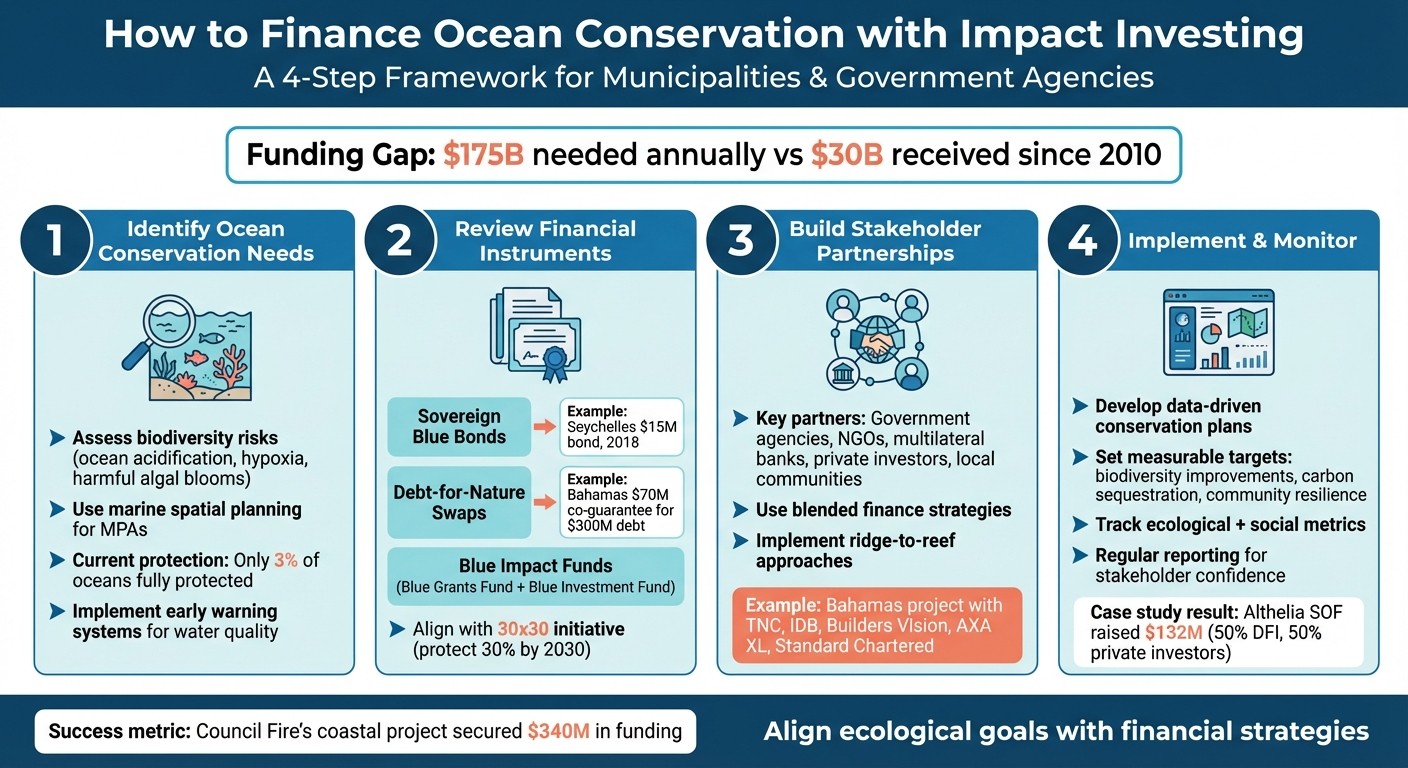
4-Step Framework for Financing Ocean Conservation Through Impact Investing
Step 1: Identify Ocean Conservation Needs and Funding Gaps
Assess Biodiversity Risks and Marine Ecosystem Challenges
Before committing resources, municipalities must evaluate ocean-related risks. This begins with funding scientific studies to understand threats like ocean acidification, hypoxia, and harmful algal blooms - issues that harm marine life and disrupt coastal economies [2]. These evaluations should also consider climate risks, such as rising sea levels, which endanger both local infrastructure and biodiversity [2].
Marine spatial planning is a valuable tool for identifying ecosystem needs and designating priority areas for Marine Protected Areas (MPAs) [1]. Currently, only about 3% of the world’s oceans are fully protected [1]. By focusing on critical habitats like mangroves, seagrass meadows, and coral reefs, municipalities can create structured plans to address biodiversity risks and prioritize conservation efforts [1].
To enhance these efforts, implement early warning systems for water quality monitoring and review existing MPAs to identify enforcement shortcomings. This ensures that conservation measures are both effective and impactful [1][2]. With comprehensive assessments in place, municipalities can align conservation priorities with innovative funding solutions.
Review Budget Constraints and Investment Opportunities
Once conservation needs are identified, the next step is to match these priorities with appropriate financing strategies. Many municipalities face tight budgets, and traditional funding sources often fall short of covering all conservation requirements. Creative financial tools can help close this gap.
For example, debt-for-nature swaps offer a solution for municipalities with high external debt. In August 2025, The Bahamas launched a debt conversion project that included a $70 million co-guarantee to refinance $300 million in commercial debt. This initiative is expected to generate $124 million over 15 years for marine spatial planning, a national mangrove management plan, and improved MPA oversight [1].
Municipalities can also align their local goals with global programs like the "30x30" initiative, which aims to protect 30% of lands and coastal waters by 2030. This alignment can unlock access to specialized grants [2]. Additionally, state-level bond acts and greenhouse gas reduction funds can support the initial stages of scientific monitoring and planning required to identify conservation priorities [2]. It's also essential to evaluate how risks, such as coral reef degradation, impact local industries like tourism and seafood, further emphasizing the need for targeted investments [1].
Financial innovation for ocean conservation
Step 2: Review Financial Instruments for Ocean Conservation
To support ocean conservation efforts, municipalities can choose from several effective financial tools. Among these, sovereign blue bonds, debt-for-nature swaps, and specialized blue impact funds stand out. Each of these instruments addresses specific challenges in marine conservation, providing not only critical funding but also aligning investment strategies with ecological goals.
Sovereign Blue Bonds for Marine Protected Areas
In October 2018, Seychelles made history by launching the first-ever sovereign blue bond, raising $15 million from international investors such as Calvert Impact Capital, Nuveen, and Prudential Financial Inc. To lower risks and borrowing costs for investors, the initiative included a $5 million guarantee from the World Bank and a $5 million concessional loan from the Global Environment Facility. The funds were allocated to a Blue Grants Fund and a Blue Investment Fund, both aimed at supporting Marine Protected Areas (MPAs) and sustainable fisheries [3].
Debt-for-Nature Swaps for Ecosystem Restoration
Debt-for-nature swaps provide an alternative financing method for conservation. Between 2015 and 2018, Seychelles negotiated a $21.6 million debt-for-nature swap with help from The Nature Conservancy. Through this program, the government repurchased debt from Paris Club creditors - including the UK, France, and Italy - using a loan facilitated by the Seychelles' Conservation and Climate Adaptation Trust (SeyCCAT). In return, Seychelles committed to designating 30% of its Exclusive Economic Zone, about 400,000 km², as MPAs. Additionally, the initiative created a permanent endowment fund, projected to grow to $6.7 million upon maturity [3].
Former Seychelles President Danny Faure highlighted the importance of such partnerships:
"Seychelles' Blue Economy experiences and successes to date have shown how crucial partnerships can be, especially raising innovative finance and investment. The world's first Debt Swap for Ocean Conservation and Climate Adaptation and first sovereign Blue Bonds attest this."
– Danny Faure, Former President of Seychelles [3]
This approach is particularly beneficial for municipalities facing high debt-to-GDP ratios, as seen in Seychelles, which had a debt-to-GDP ratio exceeding 150% following the 2008 financial crisis [3].
Blue Impact Funds for Sustainable Fisheries and Coastal Communities
Blue impact funds focus on community-driven projects, delivering direct benefits to local populations. Funds generated through blue bonds or debt-for-nature swaps are distributed to local stakeholders via competitive processes, supporting initiatives like sustainable fisheries, habitat restoration, and climate adaptation. Under Seychelles' model, SeyCCAT oversees two key mechanisms:
Blue Grants Fund: Offers non-repayable funding for conservation research and restoration projects, distributing approximately $700,000 annually.
Blue Investment Fund: Managed by the Development Bank of Seychelles, this fund provides loans for commercial ventures that generate revenue while advancing conservation goals [3].
To ensure the success of these instruments, municipalities should prioritize capacity building for local stakeholders. This can include offering application materials in local languages and hosting workshops on project proposal writing. Additionally, safeguards should be put in place to prevent excessive environmental strain [3].
Step 3: Build Stakeholder Partnerships for Long-Term Success
Expanding on targeted financing tools, creating strong partnerships across diverse stakeholders is essential for advancing ocean conservation efforts. Financing these initiatives requires more than just government involvement - it calls for a unified approach that includes various sectors. Successful conservation projects often involve collaboration between government agencies, international NGOs, multilateral development banks, private investors, commercial banks, and local communities. Each partner brings something unique to the table, whether it's technical know-how, funding, risk management, or on-the-ground implementation.
Engage Stakeholders Across Sectors
A standout example of cross-sector collaboration is the Bahamas Debt Conversion Project. In August 2025, The Bahamas government joined forces with The Nature Conservancy, the Inter-American Development Bank (IDB), Builders Vision, AXA XL, and Standard Chartered to support marine conservation through debt refinancing [1].
Private investors are now stepping up in ways that go beyond traditional philanthropy. Builders Vision, a family office led by Lukas Walton, played a pivotal role by providing a $70 million co-guarantee - the first of its kind. This innovative move lowered risks for other lenders and made it possible to attract institutional capital. As Walton explained:
"Builders Vision was founded on the belief that profits and purpose are not mutually exclusive - they can work together to achieve both financial returns and environmental impact." [1]
For municipalities, identifying the right partners is key. Multilateral banks can offer bond guarantees, while insurers like AXA XL help mitigate environmental risks, improving the credit profile of projects. NGOs bring expertise in marine spatial planning and stakeholder engagement, and local organizations are vital for tackling region-specific challenges such as sustainable fisheries, coral reef restoration, and coastal resilience.
Minimizing financial and environmental risks is equally critical to ensure the long-term success of these conservation efforts.
Reduce Financial and Environmental Risks in Ocean Projects
Since partnerships form the foundation of conservation financing, using blended finance strategies can further secure these investments. Blended finance spreads risk by combining public, philanthropic, and private capital. For example, government and philanthropic funds can serve as "first-loss" capital, absorbing initial risks to make projects more attractive to private investors. Co-guarantees from family offices or development banks can also help lower borrowing costs and unlock larger pools of institutional funding.
To safeguard marine investments from land-based threats, municipalities should adopt "ridge-to-reef" strategies. These approaches integrate watershed management with coastal conservation, addressing issues like agricultural runoff and sedimentation that harm coral reefs and coastal ecosystems. By aligning agricultural, forestry, and marine stakeholders, municipalities can tackle pollution at its source.
Formalizing conservation commitments is another critical step. Governments need to provide clear, enforceable frameworks for marine spatial planning and national management plans for protected areas. This reduces regulatory uncertainty and signals long-term political dedication to conservation. With only 3% of the world's oceans currently fully protected [1], municipalities that establish credible protections can position themselves as leaders in the growing blue economy.
Step 4: Implement and Monitor Financing Strategies
Once partnerships are secured and financial tools are selected, municipalities must focus on executing their conservation plans with precision. This process begins with creating detailed, data-driven strategies that align environmental goals with measurable financial results. These plans should include specific targets, such as biodiversity improvements, carbon sequestration benchmarks, and measures of community resilience, to ensure continued funding and accountability.
Develop Data-Driven Conservation Plans
Effective conservation financing hinges on achieving measurable, nature-positive results that support biodiversity [4]. This requires customized strategies tailored to the unique needs of each initiative. For instance, when creating Marine Protected Areas (MPAs), municipalities should start with baseline biodiversity studies and set clear recovery targets for key species. Similarly, Blue Carbon projects should establish quantifiable carbon sequestration objectives, while circular economy initiatives must outline specific waste reduction goals.
To address the interconnected nature of ecosystems, municipalities can use ridge-to-reef approaches that mitigate land-based impacts on coastal environments. For sustainable seafood and aquaculture projects, adopting external certification standards can help ensure supply chain transparency and compliance with global environmental and social benchmarks.
With these well-defined and measurable goals in place, the focus shifts to ongoing monitoring to validate the effectiveness of these conservation efforts.
Monitor and Measure Conservation Outcomes
After laying the groundwork with data-driven plans, municipalities must ensure that conservation goals are met through consistent monitoring. This involves tracking both ecological and social metrics. For example, ecological indicators like coral reef health or fish stock recovery should be assessed alongside economic measures, such as the resilience of coastal communities and the sustainability of local livelihoods. This dual focus ensures that projects deliver broad and meaningful benefits.
Outrigger Impact, a prominent organization in blue economy financing, highlights the importance of this integrated approach:
"Outrigger is dedicated to building environmental and economic resilience and driving nature‐positive outcomes across ocean states by catalysing the blue economy and enhancing the sustainability of ocean resources" [4].
Municipalities can adopt similar frameworks that combine ecological restoration with community development. Leveraging blue technologies, such as plastic upcycling, green shipping, and sustainable port initiatives, can further enhance transparency and accountability. Regular reporting on pollution reduction and other measurable outcomes is essential for maintaining stakeholder confidence and ensuring the credibility of conservation projects. Beyond confirming environmental benefits, this ongoing measurement also lays the groundwork for attracting future investments aimed at sustainability.
Case Study: The Althelia Sustainable Ocean Fund in Action
This case study offers a glimpse into how blended finance can transform ocean conservation from a grant-dependent approach into a sustainable investment model.
The Althelia Sustainable Ocean Fund (SOF) serves as a prime example. Launched between 2017 and 2018, the fund initially faced skepticism. Simon Dent, Principal and Director of Blue Investments at SOF, shared his experience:
"We'd tell people we're going to invest in the ocean and they would ask 'how can you invest in water?' Really, we make investments on land to drive change in the oceans." [5]
Despite the doubts, SOF achieved remarkable progress. By its final close in May 2020, the fund had raised over $132 million, evenly split between development finance institutions and private institutional investors. A $50 million Development Credit Authority facility from USAID further bolstered the fund by guaranteeing up to 50% of the principal on eligible loans. Dent emphasized the significance of this backing:
"The USAID guarantee was very helpful in giving investors some comfort that there was an effective sovereign guarantee in place for certain investments." [5]
This approach to de-risking investments offers a model that municipalities could adapt to secure long-term financing for sustainable initiatives.
The fund's portfolio highlights two noteworthy projects. In Belize, SOF provided a loan to TASA, supported by IUCN grant funding. This enabled the organization to establish sustainable revenue streams through eco-tourism and small-scale fisheries, reducing reliance on unpredictable grants. Meanwhile, in India, SOF invested in Plastic for Change, a FairTrade-certified plastic recycling company operating in coastal cities. This initiative not only cuts the flow of plastic waste into the ocean but also improves livelihoods for informal waste collectors. [5]
The SOF demonstrates how targeted, impact-driven investments can bridge public policy goals with the sustainable financing of marine ecosystems.
Partner with Council Fire for Implementation Support
Council Fire offers practical solutions to help municipalities and government agencies translate ambitious ocean conservation goals into actionable, measurable outcomes. By focusing on governance design, stakeholder collaboration, and data-driven planning, they provide tailored strategies for public sector organizations.
In February 2026, Council Fire spearheaded a governance initiative for a coastal county comprising 12 municipalities and 420,000 residents. They established an independent resilience authority capable of issuing revenue bonds and introduced a resilience fee tied to impervious surfaces. This effort secured $340 million in funding, including $85 million in FEMA BRIC grants and $120 million in authority-issued bonds, paving the way for the state's largest coordinated living shoreline project. [7]
Council Fire's philosophy emphasizes outcomes over outputs - prioritizing tangible improvements in ecosystem health and policy implementation over mere activity tracking. For instance, they restructured a $200 million ocean conservation portfolio for a private foundation, redirecting $28 million from lower-impact areas to initiatives with stronger evidence, such as marine protected area management and blue carbon projects. Within 18 months, management effectiveness scores improved at 8 out of 12 priority sites. [6]
To ensure real-time conservation tracking, Council Fire employs standardized tools like METT and the MPA Guide. Their strategic alignment efforts have drawn an additional $45 million in co-funding from partner organizations, creating unified funding blocs that enhance impact across jurisdictions. This approach bolsters consistent funding and operational stability, bridging the gap between policy ambitions and conservation realities. [6]
The team at Council Fire combines decades of experience in crafting dedicated funding mechanisms that ensure financial stability beyond annual budget cycles. Their innovative financial designs have generated $14 million annually in resilience fee revenue, providing essential local matches for federal and state grants. [7]
Conclusion
Impact investing in ocean conservation provides a practical way for municipalities and government agencies to close the $175 billion annual funding gap required to meet global conservation goals [8]. Despite commitments exceeding $10 billion at the 3rd United Nations Ocean Conference, this covers just 8% of the financial needs for blue initiatives [8]. The solution lies in leveraging tools like blended finance structures, sustainability-linked bonds, and nature-based financial instruments to attract private investment while retaining public oversight.
Collaboration plays a pivotal role in addressing this funding shortfall. As Stacy Jupiter, Markus Knigge, and Loreley Picourt emphasize:
"We need to step out of our investor, grant maker, policymaker, and practitioner siloes to continue these important conversations that mobilize resources" [8].
By working together, municipalities can combine smaller projects into larger, investable portfolios, redirect subsidies from harmful practices to regenerative efforts, and create standardized impact measurement systems that build trust among investors.
The financial instruments discussed - such as green bonds for marine protected areas and blue impact funds for coastal communities - offer actionable pathways for restoring ecosystems. When paired with outcome-based accountability and governance led by Indigenous Peoples and local communities, public agencies can turn ocean conservation into an investment opportunity that generates environmental, social, and economic benefits.
FAQs
Which ocean projects are investable in my municipality?
Several ocean-related initiatives in your area could be ideal for impact investing, especially those focused on climate resilience and adapting to rising sea levels. These might include resilience authorities working on regional climate strategies or detailed plans targeting challenges like tidal flooding and saltwater intrusion. Potential funding sources, such as state grants aimed at ecosystem restoration or coastal resilience, can help drive these efforts. Review local resilience strategies and infrastructure projects to pinpoint opportunities that align with these approaches.
How can we de-risk a blue bond or impact fund deal?
To reduce risks in blue bond or impact fund deals, consider using creative financing strategies and building robust partnerships with stakeholders. A prime example is São Paulo's impressive $1.35 billion blue bond issuance. Key steps include establishing clear guidelines, spreading investments across diverse areas, and setting up effective monitoring systems to address potential risks like credit defaults or fluctuating interest rates. Additionally, gaining insights into secondary market behaviors can help evaluate liquidity and market-related risks more accurately.
What metrics should we report to prove conservation impact?
Tracking the right metrics is essential to showcase the impact of conservation efforts. Start by measuring environmental outcomes, such as improvements in ocean health, preservation of biodiversity, and reductions in pollution levels. It's equally important to evaluate social and economic benefits, including how well stakeholders are engaged and the ways in which economic resilience is supported.
To ensure these metrics are effective, they should closely align with the specific goals of the project. Providing quantifiable data on ecosystem health and highlighting tangible achievements can help illustrate meaningful progress in ocean conservation initiatives.
Related Blog Posts
Latest Articles
©2025
Narrative Change and Power Building: The Missing Half of Advocacy
Narrative change is the process of disrupting dominant narratives that normalize inequity and advancing new narratives from historically marginalized communities.

Funding Resilience Without Federal Grants
BRIC is unreliable and FEMA is shrinking. Here's how cities fund climate resilience with dedicated revenue, blended finance, and a coordinating authority.

The ESG Blind Spot: How AI Is Finding Risks in Companies Nobody Else Is Watching
Norway's sovereign wealth fund uses AI to screen 7,200 portfolio companies for forced labor and corruption within 24 hours. The real story is the emerging-market coverage gap that traditional ESG data vendors miss — and what it means for any company with a global supply chain.
Narrative Change and Power Building: The Missing Half of Advocacy
Narrative change is the process of disrupting dominant narratives that normalize inequity and advancing new narratives from historically marginalized communities.
Funding Resilience Without Federal Grants
BRIC is unreliable and FEMA is shrinking. Here's how cities fund climate resilience with dedicated revenue, blended finance, and a coordinating authority.
The ESG Blind Spot: How AI Is Finding Risks in Companies Nobody Else Is Watching
Norway's sovereign wealth fund uses AI to screen 7,200 portfolio companies for forced labor and corruption within 24 hours. The real story is the emerging-market coverage gap that traditional ESG data vendors miss — and what it means for any company with a global supply chain.
FAQ
01
What does it really mean to “redefine profit”?
02
What makes Council Fire different?
03
Who does Council Fire work with?
04
What does working with Council Fire actually look like?
05
How does Council Fire help organizations turn big goals into action?
06
How does Council Fire define and measure success?
Mar 29, 2026
How to Finance Ocean Conservation with Impact Investing for Municipalities & Government Agencies
Sustainability Strategy
In This Article
Practical strategies for municipalities to fund ocean protection using blue bonds, debt-for-nature swaps, and impact funds.
How to Finance Ocean Conservation with Impact Investing for Municipalities & Government Agencies
Municipalities and government agencies face a pressing challenge: protecting our oceans while addressing tight budgets. With oceans requiring $175 billion annually for protection but receiving only $30 billion since 2010, the funding gap is clear. Impact investing offers a practical solution, using tools like blue bonds, debt-for-nature swaps, and blue impact funds to attract private investment and achieve measurable outcomes.
Key takeaways:
Ocean Conservation Needs: Evaluate risks like biodiversity loss, climate impacts, and rising sea levels. Use marine spatial planning and early warning systems to prioritize efforts.
Financial Tools: Leverage blue bonds (e.g., Seychelles' $15M bond), debt-for-nature swaps (e.g., The Bahamas' $70M project), and impact funds to fund marine protection.
Partnerships: Collaborate with NGOs, banks, and private investors to align goals and share risks.
Monitoring: Set measurable biodiversity and community resilience targets to track progress and attract future investments.
This approach aligns ecological goals with financial strategies, helping municipalities protect marine ecosystems while supporting local economies.
4-Step Framework for Financing Ocean Conservation Through Impact Investing
Step 1: Identify Ocean Conservation Needs and Funding Gaps
Assess Biodiversity Risks and Marine Ecosystem Challenges
Before committing resources, municipalities must evaluate ocean-related risks. This begins with funding scientific studies to understand threats like ocean acidification, hypoxia, and harmful algal blooms - issues that harm marine life and disrupt coastal economies [2]. These evaluations should also consider climate risks, such as rising sea levels, which endanger both local infrastructure and biodiversity [2].
Marine spatial planning is a valuable tool for identifying ecosystem needs and designating priority areas for Marine Protected Areas (MPAs) [1]. Currently, only about 3% of the world’s oceans are fully protected [1]. By focusing on critical habitats like mangroves, seagrass meadows, and coral reefs, municipalities can create structured plans to address biodiversity risks and prioritize conservation efforts [1].
To enhance these efforts, implement early warning systems for water quality monitoring and review existing MPAs to identify enforcement shortcomings. This ensures that conservation measures are both effective and impactful [1][2]. With comprehensive assessments in place, municipalities can align conservation priorities with innovative funding solutions.
Review Budget Constraints and Investment Opportunities
Once conservation needs are identified, the next step is to match these priorities with appropriate financing strategies. Many municipalities face tight budgets, and traditional funding sources often fall short of covering all conservation requirements. Creative financial tools can help close this gap.
For example, debt-for-nature swaps offer a solution for municipalities with high external debt. In August 2025, The Bahamas launched a debt conversion project that included a $70 million co-guarantee to refinance $300 million in commercial debt. This initiative is expected to generate $124 million over 15 years for marine spatial planning, a national mangrove management plan, and improved MPA oversight [1].
Municipalities can also align their local goals with global programs like the "30x30" initiative, which aims to protect 30% of lands and coastal waters by 2030. This alignment can unlock access to specialized grants [2]. Additionally, state-level bond acts and greenhouse gas reduction funds can support the initial stages of scientific monitoring and planning required to identify conservation priorities [2]. It's also essential to evaluate how risks, such as coral reef degradation, impact local industries like tourism and seafood, further emphasizing the need for targeted investments [1].
Financial innovation for ocean conservation
Step 2: Review Financial Instruments for Ocean Conservation
To support ocean conservation efforts, municipalities can choose from several effective financial tools. Among these, sovereign blue bonds, debt-for-nature swaps, and specialized blue impact funds stand out. Each of these instruments addresses specific challenges in marine conservation, providing not only critical funding but also aligning investment strategies with ecological goals.
Sovereign Blue Bonds for Marine Protected Areas
In October 2018, Seychelles made history by launching the first-ever sovereign blue bond, raising $15 million from international investors such as Calvert Impact Capital, Nuveen, and Prudential Financial Inc. To lower risks and borrowing costs for investors, the initiative included a $5 million guarantee from the World Bank and a $5 million concessional loan from the Global Environment Facility. The funds were allocated to a Blue Grants Fund and a Blue Investment Fund, both aimed at supporting Marine Protected Areas (MPAs) and sustainable fisheries [3].
Debt-for-Nature Swaps for Ecosystem Restoration
Debt-for-nature swaps provide an alternative financing method for conservation. Between 2015 and 2018, Seychelles negotiated a $21.6 million debt-for-nature swap with help from The Nature Conservancy. Through this program, the government repurchased debt from Paris Club creditors - including the UK, France, and Italy - using a loan facilitated by the Seychelles' Conservation and Climate Adaptation Trust (SeyCCAT). In return, Seychelles committed to designating 30% of its Exclusive Economic Zone, about 400,000 km², as MPAs. Additionally, the initiative created a permanent endowment fund, projected to grow to $6.7 million upon maturity [3].
Former Seychelles President Danny Faure highlighted the importance of such partnerships:
"Seychelles' Blue Economy experiences and successes to date have shown how crucial partnerships can be, especially raising innovative finance and investment. The world's first Debt Swap for Ocean Conservation and Climate Adaptation and first sovereign Blue Bonds attest this."
– Danny Faure, Former President of Seychelles [3]
This approach is particularly beneficial for municipalities facing high debt-to-GDP ratios, as seen in Seychelles, which had a debt-to-GDP ratio exceeding 150% following the 2008 financial crisis [3].
Blue Impact Funds for Sustainable Fisheries and Coastal Communities
Blue impact funds focus on community-driven projects, delivering direct benefits to local populations. Funds generated through blue bonds or debt-for-nature swaps are distributed to local stakeholders via competitive processes, supporting initiatives like sustainable fisheries, habitat restoration, and climate adaptation. Under Seychelles' model, SeyCCAT oversees two key mechanisms:
Blue Grants Fund: Offers non-repayable funding for conservation research and restoration projects, distributing approximately $700,000 annually.
Blue Investment Fund: Managed by the Development Bank of Seychelles, this fund provides loans for commercial ventures that generate revenue while advancing conservation goals [3].
To ensure the success of these instruments, municipalities should prioritize capacity building for local stakeholders. This can include offering application materials in local languages and hosting workshops on project proposal writing. Additionally, safeguards should be put in place to prevent excessive environmental strain [3].
Step 3: Build Stakeholder Partnerships for Long-Term Success
Expanding on targeted financing tools, creating strong partnerships across diverse stakeholders is essential for advancing ocean conservation efforts. Financing these initiatives requires more than just government involvement - it calls for a unified approach that includes various sectors. Successful conservation projects often involve collaboration between government agencies, international NGOs, multilateral development banks, private investors, commercial banks, and local communities. Each partner brings something unique to the table, whether it's technical know-how, funding, risk management, or on-the-ground implementation.
Engage Stakeholders Across Sectors
A standout example of cross-sector collaboration is the Bahamas Debt Conversion Project. In August 2025, The Bahamas government joined forces with The Nature Conservancy, the Inter-American Development Bank (IDB), Builders Vision, AXA XL, and Standard Chartered to support marine conservation through debt refinancing [1].
Private investors are now stepping up in ways that go beyond traditional philanthropy. Builders Vision, a family office led by Lukas Walton, played a pivotal role by providing a $70 million co-guarantee - the first of its kind. This innovative move lowered risks for other lenders and made it possible to attract institutional capital. As Walton explained:
"Builders Vision was founded on the belief that profits and purpose are not mutually exclusive - they can work together to achieve both financial returns and environmental impact." [1]
For municipalities, identifying the right partners is key. Multilateral banks can offer bond guarantees, while insurers like AXA XL help mitigate environmental risks, improving the credit profile of projects. NGOs bring expertise in marine spatial planning and stakeholder engagement, and local organizations are vital for tackling region-specific challenges such as sustainable fisheries, coral reef restoration, and coastal resilience.
Minimizing financial and environmental risks is equally critical to ensure the long-term success of these conservation efforts.
Reduce Financial and Environmental Risks in Ocean Projects
Since partnerships form the foundation of conservation financing, using blended finance strategies can further secure these investments. Blended finance spreads risk by combining public, philanthropic, and private capital. For example, government and philanthropic funds can serve as "first-loss" capital, absorbing initial risks to make projects more attractive to private investors. Co-guarantees from family offices or development banks can also help lower borrowing costs and unlock larger pools of institutional funding.
To safeguard marine investments from land-based threats, municipalities should adopt "ridge-to-reef" strategies. These approaches integrate watershed management with coastal conservation, addressing issues like agricultural runoff and sedimentation that harm coral reefs and coastal ecosystems. By aligning agricultural, forestry, and marine stakeholders, municipalities can tackle pollution at its source.
Formalizing conservation commitments is another critical step. Governments need to provide clear, enforceable frameworks for marine spatial planning and national management plans for protected areas. This reduces regulatory uncertainty and signals long-term political dedication to conservation. With only 3% of the world's oceans currently fully protected [1], municipalities that establish credible protections can position themselves as leaders in the growing blue economy.
Step 4: Implement and Monitor Financing Strategies
Once partnerships are secured and financial tools are selected, municipalities must focus on executing their conservation plans with precision. This process begins with creating detailed, data-driven strategies that align environmental goals with measurable financial results. These plans should include specific targets, such as biodiversity improvements, carbon sequestration benchmarks, and measures of community resilience, to ensure continued funding and accountability.
Develop Data-Driven Conservation Plans
Effective conservation financing hinges on achieving measurable, nature-positive results that support biodiversity [4]. This requires customized strategies tailored to the unique needs of each initiative. For instance, when creating Marine Protected Areas (MPAs), municipalities should start with baseline biodiversity studies and set clear recovery targets for key species. Similarly, Blue Carbon projects should establish quantifiable carbon sequestration objectives, while circular economy initiatives must outline specific waste reduction goals.
To address the interconnected nature of ecosystems, municipalities can use ridge-to-reef approaches that mitigate land-based impacts on coastal environments. For sustainable seafood and aquaculture projects, adopting external certification standards can help ensure supply chain transparency and compliance with global environmental and social benchmarks.
With these well-defined and measurable goals in place, the focus shifts to ongoing monitoring to validate the effectiveness of these conservation efforts.
Monitor and Measure Conservation Outcomes
After laying the groundwork with data-driven plans, municipalities must ensure that conservation goals are met through consistent monitoring. This involves tracking both ecological and social metrics. For example, ecological indicators like coral reef health or fish stock recovery should be assessed alongside economic measures, such as the resilience of coastal communities and the sustainability of local livelihoods. This dual focus ensures that projects deliver broad and meaningful benefits.
Outrigger Impact, a prominent organization in blue economy financing, highlights the importance of this integrated approach:
"Outrigger is dedicated to building environmental and economic resilience and driving nature‐positive outcomes across ocean states by catalysing the blue economy and enhancing the sustainability of ocean resources" [4].
Municipalities can adopt similar frameworks that combine ecological restoration with community development. Leveraging blue technologies, such as plastic upcycling, green shipping, and sustainable port initiatives, can further enhance transparency and accountability. Regular reporting on pollution reduction and other measurable outcomes is essential for maintaining stakeholder confidence and ensuring the credibility of conservation projects. Beyond confirming environmental benefits, this ongoing measurement also lays the groundwork for attracting future investments aimed at sustainability.
Case Study: The Althelia Sustainable Ocean Fund in Action
This case study offers a glimpse into how blended finance can transform ocean conservation from a grant-dependent approach into a sustainable investment model.
The Althelia Sustainable Ocean Fund (SOF) serves as a prime example. Launched between 2017 and 2018, the fund initially faced skepticism. Simon Dent, Principal and Director of Blue Investments at SOF, shared his experience:
"We'd tell people we're going to invest in the ocean and they would ask 'how can you invest in water?' Really, we make investments on land to drive change in the oceans." [5]
Despite the doubts, SOF achieved remarkable progress. By its final close in May 2020, the fund had raised over $132 million, evenly split between development finance institutions and private institutional investors. A $50 million Development Credit Authority facility from USAID further bolstered the fund by guaranteeing up to 50% of the principal on eligible loans. Dent emphasized the significance of this backing:
"The USAID guarantee was very helpful in giving investors some comfort that there was an effective sovereign guarantee in place for certain investments." [5]
This approach to de-risking investments offers a model that municipalities could adapt to secure long-term financing for sustainable initiatives.
The fund's portfolio highlights two noteworthy projects. In Belize, SOF provided a loan to TASA, supported by IUCN grant funding. This enabled the organization to establish sustainable revenue streams through eco-tourism and small-scale fisheries, reducing reliance on unpredictable grants. Meanwhile, in India, SOF invested in Plastic for Change, a FairTrade-certified plastic recycling company operating in coastal cities. This initiative not only cuts the flow of plastic waste into the ocean but also improves livelihoods for informal waste collectors. [5]
The SOF demonstrates how targeted, impact-driven investments can bridge public policy goals with the sustainable financing of marine ecosystems.
Partner with Council Fire for Implementation Support
Council Fire offers practical solutions to help municipalities and government agencies translate ambitious ocean conservation goals into actionable, measurable outcomes. By focusing on governance design, stakeholder collaboration, and data-driven planning, they provide tailored strategies for public sector organizations.
In February 2026, Council Fire spearheaded a governance initiative for a coastal county comprising 12 municipalities and 420,000 residents. They established an independent resilience authority capable of issuing revenue bonds and introduced a resilience fee tied to impervious surfaces. This effort secured $340 million in funding, including $85 million in FEMA BRIC grants and $120 million in authority-issued bonds, paving the way for the state's largest coordinated living shoreline project. [7]
Council Fire's philosophy emphasizes outcomes over outputs - prioritizing tangible improvements in ecosystem health and policy implementation over mere activity tracking. For instance, they restructured a $200 million ocean conservation portfolio for a private foundation, redirecting $28 million from lower-impact areas to initiatives with stronger evidence, such as marine protected area management and blue carbon projects. Within 18 months, management effectiveness scores improved at 8 out of 12 priority sites. [6]
To ensure real-time conservation tracking, Council Fire employs standardized tools like METT and the MPA Guide. Their strategic alignment efforts have drawn an additional $45 million in co-funding from partner organizations, creating unified funding blocs that enhance impact across jurisdictions. This approach bolsters consistent funding and operational stability, bridging the gap between policy ambitions and conservation realities. [6]
The team at Council Fire combines decades of experience in crafting dedicated funding mechanisms that ensure financial stability beyond annual budget cycles. Their innovative financial designs have generated $14 million annually in resilience fee revenue, providing essential local matches for federal and state grants. [7]
Conclusion
Impact investing in ocean conservation provides a practical way for municipalities and government agencies to close the $175 billion annual funding gap required to meet global conservation goals [8]. Despite commitments exceeding $10 billion at the 3rd United Nations Ocean Conference, this covers just 8% of the financial needs for blue initiatives [8]. The solution lies in leveraging tools like blended finance structures, sustainability-linked bonds, and nature-based financial instruments to attract private investment while retaining public oversight.
Collaboration plays a pivotal role in addressing this funding shortfall. As Stacy Jupiter, Markus Knigge, and Loreley Picourt emphasize:
"We need to step out of our investor, grant maker, policymaker, and practitioner siloes to continue these important conversations that mobilize resources" [8].
By working together, municipalities can combine smaller projects into larger, investable portfolios, redirect subsidies from harmful practices to regenerative efforts, and create standardized impact measurement systems that build trust among investors.
The financial instruments discussed - such as green bonds for marine protected areas and blue impact funds for coastal communities - offer actionable pathways for restoring ecosystems. When paired with outcome-based accountability and governance led by Indigenous Peoples and local communities, public agencies can turn ocean conservation into an investment opportunity that generates environmental, social, and economic benefits.
FAQs
Which ocean projects are investable in my municipality?
Several ocean-related initiatives in your area could be ideal for impact investing, especially those focused on climate resilience and adapting to rising sea levels. These might include resilience authorities working on regional climate strategies or detailed plans targeting challenges like tidal flooding and saltwater intrusion. Potential funding sources, such as state grants aimed at ecosystem restoration or coastal resilience, can help drive these efforts. Review local resilience strategies and infrastructure projects to pinpoint opportunities that align with these approaches.
How can we de-risk a blue bond or impact fund deal?
To reduce risks in blue bond or impact fund deals, consider using creative financing strategies and building robust partnerships with stakeholders. A prime example is São Paulo's impressive $1.35 billion blue bond issuance. Key steps include establishing clear guidelines, spreading investments across diverse areas, and setting up effective monitoring systems to address potential risks like credit defaults or fluctuating interest rates. Additionally, gaining insights into secondary market behaviors can help evaluate liquidity and market-related risks more accurately.
What metrics should we report to prove conservation impact?
Tracking the right metrics is essential to showcase the impact of conservation efforts. Start by measuring environmental outcomes, such as improvements in ocean health, preservation of biodiversity, and reductions in pollution levels. It's equally important to evaluate social and economic benefits, including how well stakeholders are engaged and the ways in which economic resilience is supported.
To ensure these metrics are effective, they should closely align with the specific goals of the project. Providing quantifiable data on ecosystem health and highlighting tangible achievements can help illustrate meaningful progress in ocean conservation initiatives.
Related Blog Posts
Latest Articles
©2025
Narrative Change and Power Building: The Missing Half of Advocacy
Narrative change is the process of disrupting dominant narratives that normalize inequity and advancing new narratives from historically marginalized communities.
Funding Resilience Without Federal Grants
BRIC is unreliable and FEMA is shrinking. Here's how cities fund climate resilience with dedicated revenue, blended finance, and a coordinating authority.
The ESG Blind Spot: How AI Is Finding Risks in Companies Nobody Else Is Watching
Norway's sovereign wealth fund uses AI to screen 7,200 portfolio companies for forced labor and corruption within 24 hours. The real story is the emerging-market coverage gap that traditional ESG data vendors miss — and what it means for any company with a global supply chain.
FAQ
01
What does it really mean to “redefine profit”?
02
What makes Council Fire different?
03
Who does Council Fire work with?
04
What does working with Council Fire actually look like?
05
How does Council Fire help organizations turn big goals into action?
06
How does Council Fire define and measure success?
Mar 29, 2026
How to Finance Ocean Conservation with Impact Investing for Municipalities & Government Agencies
Sustainability Strategy
In This Article
Practical strategies for municipalities to fund ocean protection using blue bonds, debt-for-nature swaps, and impact funds.
How to Finance Ocean Conservation with Impact Investing for Municipalities & Government Agencies
Municipalities and government agencies face a pressing challenge: protecting our oceans while addressing tight budgets. With oceans requiring $175 billion annually for protection but receiving only $30 billion since 2010, the funding gap is clear. Impact investing offers a practical solution, using tools like blue bonds, debt-for-nature swaps, and blue impact funds to attract private investment and achieve measurable outcomes.
Key takeaways:
Ocean Conservation Needs: Evaluate risks like biodiversity loss, climate impacts, and rising sea levels. Use marine spatial planning and early warning systems to prioritize efforts.
Financial Tools: Leverage blue bonds (e.g., Seychelles' $15M bond), debt-for-nature swaps (e.g., The Bahamas' $70M project), and impact funds to fund marine protection.
Partnerships: Collaborate with NGOs, banks, and private investors to align goals and share risks.
Monitoring: Set measurable biodiversity and community resilience targets to track progress and attract future investments.
This approach aligns ecological goals with financial strategies, helping municipalities protect marine ecosystems while supporting local economies.
4-Step Framework for Financing Ocean Conservation Through Impact Investing
Step 1: Identify Ocean Conservation Needs and Funding Gaps
Assess Biodiversity Risks and Marine Ecosystem Challenges
Before committing resources, municipalities must evaluate ocean-related risks. This begins with funding scientific studies to understand threats like ocean acidification, hypoxia, and harmful algal blooms - issues that harm marine life and disrupt coastal economies [2]. These evaluations should also consider climate risks, such as rising sea levels, which endanger both local infrastructure and biodiversity [2].
Marine spatial planning is a valuable tool for identifying ecosystem needs and designating priority areas for Marine Protected Areas (MPAs) [1]. Currently, only about 3% of the world’s oceans are fully protected [1]. By focusing on critical habitats like mangroves, seagrass meadows, and coral reefs, municipalities can create structured plans to address biodiversity risks and prioritize conservation efforts [1].
To enhance these efforts, implement early warning systems for water quality monitoring and review existing MPAs to identify enforcement shortcomings. This ensures that conservation measures are both effective and impactful [1][2]. With comprehensive assessments in place, municipalities can align conservation priorities with innovative funding solutions.
Review Budget Constraints and Investment Opportunities
Once conservation needs are identified, the next step is to match these priorities with appropriate financing strategies. Many municipalities face tight budgets, and traditional funding sources often fall short of covering all conservation requirements. Creative financial tools can help close this gap.
For example, debt-for-nature swaps offer a solution for municipalities with high external debt. In August 2025, The Bahamas launched a debt conversion project that included a $70 million co-guarantee to refinance $300 million in commercial debt. This initiative is expected to generate $124 million over 15 years for marine spatial planning, a national mangrove management plan, and improved MPA oversight [1].
Municipalities can also align their local goals with global programs like the "30x30" initiative, which aims to protect 30% of lands and coastal waters by 2030. This alignment can unlock access to specialized grants [2]. Additionally, state-level bond acts and greenhouse gas reduction funds can support the initial stages of scientific monitoring and planning required to identify conservation priorities [2]. It's also essential to evaluate how risks, such as coral reef degradation, impact local industries like tourism and seafood, further emphasizing the need for targeted investments [1].
Financial innovation for ocean conservation
Step 2: Review Financial Instruments for Ocean Conservation
To support ocean conservation efforts, municipalities can choose from several effective financial tools. Among these, sovereign blue bonds, debt-for-nature swaps, and specialized blue impact funds stand out. Each of these instruments addresses specific challenges in marine conservation, providing not only critical funding but also aligning investment strategies with ecological goals.
Sovereign Blue Bonds for Marine Protected Areas
In October 2018, Seychelles made history by launching the first-ever sovereign blue bond, raising $15 million from international investors such as Calvert Impact Capital, Nuveen, and Prudential Financial Inc. To lower risks and borrowing costs for investors, the initiative included a $5 million guarantee from the World Bank and a $5 million concessional loan from the Global Environment Facility. The funds were allocated to a Blue Grants Fund and a Blue Investment Fund, both aimed at supporting Marine Protected Areas (MPAs) and sustainable fisheries [3].
Debt-for-Nature Swaps for Ecosystem Restoration
Debt-for-nature swaps provide an alternative financing method for conservation. Between 2015 and 2018, Seychelles negotiated a $21.6 million debt-for-nature swap with help from The Nature Conservancy. Through this program, the government repurchased debt from Paris Club creditors - including the UK, France, and Italy - using a loan facilitated by the Seychelles' Conservation and Climate Adaptation Trust (SeyCCAT). In return, Seychelles committed to designating 30% of its Exclusive Economic Zone, about 400,000 km², as MPAs. Additionally, the initiative created a permanent endowment fund, projected to grow to $6.7 million upon maturity [3].
Former Seychelles President Danny Faure highlighted the importance of such partnerships:
"Seychelles' Blue Economy experiences and successes to date have shown how crucial partnerships can be, especially raising innovative finance and investment. The world's first Debt Swap for Ocean Conservation and Climate Adaptation and first sovereign Blue Bonds attest this."
– Danny Faure, Former President of Seychelles [3]
This approach is particularly beneficial for municipalities facing high debt-to-GDP ratios, as seen in Seychelles, which had a debt-to-GDP ratio exceeding 150% following the 2008 financial crisis [3].
Blue Impact Funds for Sustainable Fisheries and Coastal Communities
Blue impact funds focus on community-driven projects, delivering direct benefits to local populations. Funds generated through blue bonds or debt-for-nature swaps are distributed to local stakeholders via competitive processes, supporting initiatives like sustainable fisheries, habitat restoration, and climate adaptation. Under Seychelles' model, SeyCCAT oversees two key mechanisms:
Blue Grants Fund: Offers non-repayable funding for conservation research and restoration projects, distributing approximately $700,000 annually.
Blue Investment Fund: Managed by the Development Bank of Seychelles, this fund provides loans for commercial ventures that generate revenue while advancing conservation goals [3].
To ensure the success of these instruments, municipalities should prioritize capacity building for local stakeholders. This can include offering application materials in local languages and hosting workshops on project proposal writing. Additionally, safeguards should be put in place to prevent excessive environmental strain [3].
Step 3: Build Stakeholder Partnerships for Long-Term Success
Expanding on targeted financing tools, creating strong partnerships across diverse stakeholders is essential for advancing ocean conservation efforts. Financing these initiatives requires more than just government involvement - it calls for a unified approach that includes various sectors. Successful conservation projects often involve collaboration between government agencies, international NGOs, multilateral development banks, private investors, commercial banks, and local communities. Each partner brings something unique to the table, whether it's technical know-how, funding, risk management, or on-the-ground implementation.
Engage Stakeholders Across Sectors
A standout example of cross-sector collaboration is the Bahamas Debt Conversion Project. In August 2025, The Bahamas government joined forces with The Nature Conservancy, the Inter-American Development Bank (IDB), Builders Vision, AXA XL, and Standard Chartered to support marine conservation through debt refinancing [1].
Private investors are now stepping up in ways that go beyond traditional philanthropy. Builders Vision, a family office led by Lukas Walton, played a pivotal role by providing a $70 million co-guarantee - the first of its kind. This innovative move lowered risks for other lenders and made it possible to attract institutional capital. As Walton explained:
"Builders Vision was founded on the belief that profits and purpose are not mutually exclusive - they can work together to achieve both financial returns and environmental impact." [1]
For municipalities, identifying the right partners is key. Multilateral banks can offer bond guarantees, while insurers like AXA XL help mitigate environmental risks, improving the credit profile of projects. NGOs bring expertise in marine spatial planning and stakeholder engagement, and local organizations are vital for tackling region-specific challenges such as sustainable fisheries, coral reef restoration, and coastal resilience.
Minimizing financial and environmental risks is equally critical to ensure the long-term success of these conservation efforts.
Reduce Financial and Environmental Risks in Ocean Projects
Since partnerships form the foundation of conservation financing, using blended finance strategies can further secure these investments. Blended finance spreads risk by combining public, philanthropic, and private capital. For example, government and philanthropic funds can serve as "first-loss" capital, absorbing initial risks to make projects more attractive to private investors. Co-guarantees from family offices or development banks can also help lower borrowing costs and unlock larger pools of institutional funding.
To safeguard marine investments from land-based threats, municipalities should adopt "ridge-to-reef" strategies. These approaches integrate watershed management with coastal conservation, addressing issues like agricultural runoff and sedimentation that harm coral reefs and coastal ecosystems. By aligning agricultural, forestry, and marine stakeholders, municipalities can tackle pollution at its source.
Formalizing conservation commitments is another critical step. Governments need to provide clear, enforceable frameworks for marine spatial planning and national management plans for protected areas. This reduces regulatory uncertainty and signals long-term political dedication to conservation. With only 3% of the world's oceans currently fully protected [1], municipalities that establish credible protections can position themselves as leaders in the growing blue economy.
Step 4: Implement and Monitor Financing Strategies
Once partnerships are secured and financial tools are selected, municipalities must focus on executing their conservation plans with precision. This process begins with creating detailed, data-driven strategies that align environmental goals with measurable financial results. These plans should include specific targets, such as biodiversity improvements, carbon sequestration benchmarks, and measures of community resilience, to ensure continued funding and accountability.
Develop Data-Driven Conservation Plans
Effective conservation financing hinges on achieving measurable, nature-positive results that support biodiversity [4]. This requires customized strategies tailored to the unique needs of each initiative. For instance, when creating Marine Protected Areas (MPAs), municipalities should start with baseline biodiversity studies and set clear recovery targets for key species. Similarly, Blue Carbon projects should establish quantifiable carbon sequestration objectives, while circular economy initiatives must outline specific waste reduction goals.
To address the interconnected nature of ecosystems, municipalities can use ridge-to-reef approaches that mitigate land-based impacts on coastal environments. For sustainable seafood and aquaculture projects, adopting external certification standards can help ensure supply chain transparency and compliance with global environmental and social benchmarks.
With these well-defined and measurable goals in place, the focus shifts to ongoing monitoring to validate the effectiveness of these conservation efforts.
Monitor and Measure Conservation Outcomes
After laying the groundwork with data-driven plans, municipalities must ensure that conservation goals are met through consistent monitoring. This involves tracking both ecological and social metrics. For example, ecological indicators like coral reef health or fish stock recovery should be assessed alongside economic measures, such as the resilience of coastal communities and the sustainability of local livelihoods. This dual focus ensures that projects deliver broad and meaningful benefits.
Outrigger Impact, a prominent organization in blue economy financing, highlights the importance of this integrated approach:
"Outrigger is dedicated to building environmental and economic resilience and driving nature‐positive outcomes across ocean states by catalysing the blue economy and enhancing the sustainability of ocean resources" [4].
Municipalities can adopt similar frameworks that combine ecological restoration with community development. Leveraging blue technologies, such as plastic upcycling, green shipping, and sustainable port initiatives, can further enhance transparency and accountability. Regular reporting on pollution reduction and other measurable outcomes is essential for maintaining stakeholder confidence and ensuring the credibility of conservation projects. Beyond confirming environmental benefits, this ongoing measurement also lays the groundwork for attracting future investments aimed at sustainability.
Case Study: The Althelia Sustainable Ocean Fund in Action
This case study offers a glimpse into how blended finance can transform ocean conservation from a grant-dependent approach into a sustainable investment model.
The Althelia Sustainable Ocean Fund (SOF) serves as a prime example. Launched between 2017 and 2018, the fund initially faced skepticism. Simon Dent, Principal and Director of Blue Investments at SOF, shared his experience:
"We'd tell people we're going to invest in the ocean and they would ask 'how can you invest in water?' Really, we make investments on land to drive change in the oceans." [5]
Despite the doubts, SOF achieved remarkable progress. By its final close in May 2020, the fund had raised over $132 million, evenly split between development finance institutions and private institutional investors. A $50 million Development Credit Authority facility from USAID further bolstered the fund by guaranteeing up to 50% of the principal on eligible loans. Dent emphasized the significance of this backing:
"The USAID guarantee was very helpful in giving investors some comfort that there was an effective sovereign guarantee in place for certain investments." [5]
This approach to de-risking investments offers a model that municipalities could adapt to secure long-term financing for sustainable initiatives.
The fund's portfolio highlights two noteworthy projects. In Belize, SOF provided a loan to TASA, supported by IUCN grant funding. This enabled the organization to establish sustainable revenue streams through eco-tourism and small-scale fisheries, reducing reliance on unpredictable grants. Meanwhile, in India, SOF invested in Plastic for Change, a FairTrade-certified plastic recycling company operating in coastal cities. This initiative not only cuts the flow of plastic waste into the ocean but also improves livelihoods for informal waste collectors. [5]
The SOF demonstrates how targeted, impact-driven investments can bridge public policy goals with the sustainable financing of marine ecosystems.
Partner with Council Fire for Implementation Support
Council Fire offers practical solutions to help municipalities and government agencies translate ambitious ocean conservation goals into actionable, measurable outcomes. By focusing on governance design, stakeholder collaboration, and data-driven planning, they provide tailored strategies for public sector organizations.
In February 2026, Council Fire spearheaded a governance initiative for a coastal county comprising 12 municipalities and 420,000 residents. They established an independent resilience authority capable of issuing revenue bonds and introduced a resilience fee tied to impervious surfaces. This effort secured $340 million in funding, including $85 million in FEMA BRIC grants and $120 million in authority-issued bonds, paving the way for the state's largest coordinated living shoreline project. [7]
Council Fire's philosophy emphasizes outcomes over outputs - prioritizing tangible improvements in ecosystem health and policy implementation over mere activity tracking. For instance, they restructured a $200 million ocean conservation portfolio for a private foundation, redirecting $28 million from lower-impact areas to initiatives with stronger evidence, such as marine protected area management and blue carbon projects. Within 18 months, management effectiveness scores improved at 8 out of 12 priority sites. [6]
To ensure real-time conservation tracking, Council Fire employs standardized tools like METT and the MPA Guide. Their strategic alignment efforts have drawn an additional $45 million in co-funding from partner organizations, creating unified funding blocs that enhance impact across jurisdictions. This approach bolsters consistent funding and operational stability, bridging the gap between policy ambitions and conservation realities. [6]
The team at Council Fire combines decades of experience in crafting dedicated funding mechanisms that ensure financial stability beyond annual budget cycles. Their innovative financial designs have generated $14 million annually in resilience fee revenue, providing essential local matches for federal and state grants. [7]
Conclusion
Impact investing in ocean conservation provides a practical way for municipalities and government agencies to close the $175 billion annual funding gap required to meet global conservation goals [8]. Despite commitments exceeding $10 billion at the 3rd United Nations Ocean Conference, this covers just 8% of the financial needs for blue initiatives [8]. The solution lies in leveraging tools like blended finance structures, sustainability-linked bonds, and nature-based financial instruments to attract private investment while retaining public oversight.
Collaboration plays a pivotal role in addressing this funding shortfall. As Stacy Jupiter, Markus Knigge, and Loreley Picourt emphasize:
"We need to step out of our investor, grant maker, policymaker, and practitioner siloes to continue these important conversations that mobilize resources" [8].
By working together, municipalities can combine smaller projects into larger, investable portfolios, redirect subsidies from harmful practices to regenerative efforts, and create standardized impact measurement systems that build trust among investors.
The financial instruments discussed - such as green bonds for marine protected areas and blue impact funds for coastal communities - offer actionable pathways for restoring ecosystems. When paired with outcome-based accountability and governance led by Indigenous Peoples and local communities, public agencies can turn ocean conservation into an investment opportunity that generates environmental, social, and economic benefits.
FAQs
Which ocean projects are investable in my municipality?
Several ocean-related initiatives in your area could be ideal for impact investing, especially those focused on climate resilience and adapting to rising sea levels. These might include resilience authorities working on regional climate strategies or detailed plans targeting challenges like tidal flooding and saltwater intrusion. Potential funding sources, such as state grants aimed at ecosystem restoration or coastal resilience, can help drive these efforts. Review local resilience strategies and infrastructure projects to pinpoint opportunities that align with these approaches.
How can we de-risk a blue bond or impact fund deal?
To reduce risks in blue bond or impact fund deals, consider using creative financing strategies and building robust partnerships with stakeholders. A prime example is São Paulo's impressive $1.35 billion blue bond issuance. Key steps include establishing clear guidelines, spreading investments across diverse areas, and setting up effective monitoring systems to address potential risks like credit defaults or fluctuating interest rates. Additionally, gaining insights into secondary market behaviors can help evaluate liquidity and market-related risks more accurately.
What metrics should we report to prove conservation impact?
Tracking the right metrics is essential to showcase the impact of conservation efforts. Start by measuring environmental outcomes, such as improvements in ocean health, preservation of biodiversity, and reductions in pollution levels. It's equally important to evaluate social and economic benefits, including how well stakeholders are engaged and the ways in which economic resilience is supported.
To ensure these metrics are effective, they should closely align with the specific goals of the project. Providing quantifiable data on ecosystem health and highlighting tangible achievements can help illustrate meaningful progress in ocean conservation initiatives.
Related Blog Posts
Latest Articles
©2025
Narrative Change and Power Building: The Missing Half of Advocacy
Narrative change is the process of disrupting dominant narratives that normalize inequity and advancing new narratives from historically marginalized communities.
Funding Resilience Without Federal Grants
BRIC is unreliable and FEMA is shrinking. Here's how cities fund climate resilience with dedicated revenue, blended finance, and a coordinating authority.
The ESG Blind Spot: How AI Is Finding Risks in Companies Nobody Else Is Watching
Norway's sovereign wealth fund uses AI to screen 7,200 portfolio companies for forced labor and corruption within 24 hours. The real story is the emerging-market coverage gap that traditional ESG data vendors miss — and what it means for any company with a global supply chain.
FAQ
What does it really mean to “redefine profit”?
What makes Council Fire different?
Who does Council Fire work with?
What does working with Council Fire actually look like?
How does Council Fire help organizations turn big goals into action?
How does Council Fire define and measure success?