Person
Person

Sep 9, 2026

ESG Risk Mitigation for Healthcare Supply Chains

ESG Strategy

In This Article

Reduce healthcare supply-chain ESG risk by mapping supplier hotspots, enforcing ESG terms, requiring traceability, and shifting spend.

ESG Risk Mitigation for Healthcare Supply Chains

Most healthcare ESG risk sits with suppliers, not inside the hospital. In U.S. healthcare, Scope 3 emissions make up about 80%–82% of total emissions, and about 54% of that comes from purchased goods and services. At the same time, hospitals generate more than 5 million tons of waste each year, and labor abuse risk can sit deep in sourcing networks for PPE, textiles, and other medical products.

If I had to cut this article down to its core, I’d say this: you reduce supplier ESG risk by mapping high-risk categories, setting clear contract rules, requiring traceability, and using buying power to shift spend. That means focusing first on pharmaceuticals, devices, packaging, sterilization, logistics, and sole-source vendors.

Here’s the plain takeaway:

  • Find the hotspots by spend, product category, geography, and supplier dependency

  • Score suppliers using emissions, waste, and labor signals

  • Set minimum rules in RFPs and contracts for disclosure, labor, waste, chemicals, and incident notice

  • Push traceability deeper for high-risk products and source regions

  • Use corrective action plans before cutting suppliers

  • Weight tenders so lower-carbon and lower-waste options can win more business

  • Track progress with supplier coverage, disclosure rates, traceability depth, emissions intensity, and waste results

In short: supplier ESG work is procurement work. If you want lower risk, better visibility, and fewer supply chain surprises, the fix starts with how you buy, how you contract, and how closely you track supplier follow-through.
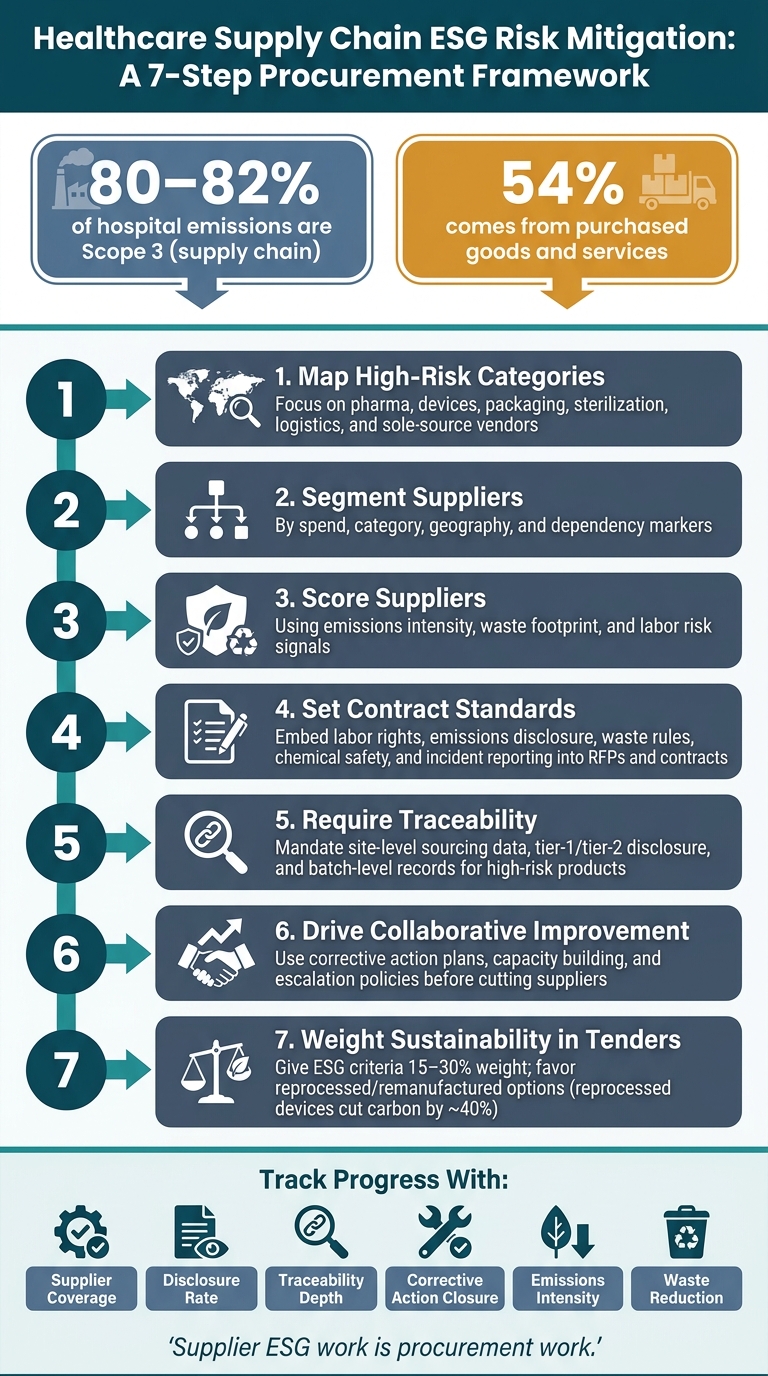
Healthcare Supply Chain ESG Risk Mitigation: 7-Step Procurement Framework

Healthcare Supply Chain ESG Risk Mitigation: 7-Step Procurement Framework

Supply Chain Management: Six Pillars of ESG

How to Map Supplier ESG Risk Across the Healthcare Value Chain

Once supplier risk is mapped at a high level, procurement teams can go a layer deeper and pinpoint the vendors and categories driving the most exposure. A structured map helps teams focus where action will have the most impact, instead of spreading time across the entire supplier base.

Segment Suppliers by Spend, Category, Geography, and Risk Signals

Start with consolidated spend data. From there, identify top-spend suppliers and mission-critical categories such as pharmaceuticals, implants, sterile disposables, diagnostics, and logistics. These filters bring the highest-stakes relationships into view, especially where ESG failures can trigger both financial loss and clinical fallout.

Next, add geography. Suppliers operating in regions with weak labor enforcement, high climate exposure, or corruption risk deserve closer review. Then layer in dependency markers like sole-source arrangements, long lead times, and limited backup options. Those factors can turn a supplier issue into a supply disruption fast.

Use Emissions, Waste, and Labor Data to Find High-Risk Suppliers

A practical scoring model looks at three areas: emissions, waste, and labor risk.

For emissions, assess intensity by category. Pharmaceuticals and medical devices often carry heavy upstream manufacturing emissions, while logistics adds transport and cold-chain exposure. For waste, track packaging volume, single-use plastic content, and whether suppliers provide take-back or recycling programs. For labor risk, review labor policies, audit findings, past violations, and public controversies.

When supplier data is limited, LCA databases and public risk signals can help surface hidden subcontractor and sourcing risk. That kind of multi-factor scoring gives procurement teams a sharper way to decide where deeper engagement is needed.

The end product should be a supplier and category heat map that shows where to require corrective action, test alternative sources, or move more business toward preferred suppliers.

The methods below show what each lens reveals, and where each one falls short.

Comparison Table: Healthcare Supplier Risk-Mapping Methods

Each method captures a different type of risk. Used together, they give procurement teams a more complete view.

Risk-Mapping Method

What It Captures

Best Use Case in Healthcare

Key Limitations

Spend-Based

Financial exposure and vendor dependency

First-pass prioritization of top-tier suppliers

Misses high-risk "long-tail" suppliers with low spend but high ESG impact

Category-Based

Inherent risks tied to specific product types

Identifying high-impact product lines like single-use plastics, reagents, or PPE

Can miss stronger suppliers inside a high-risk category

Emissions-Based

Carbon footprint across Scope 3 - manufacturing, transport, and disposal

Decarbonization planning and logistics review

Depends on supplier-disclosed or modeled data, which is often incomplete

Labor-Risk Screening

Human rights, worker safety, and ethical compliance in global supply networks

Screening pharmaceutical ingredient and textile suppliers in high-risk geographies

Data is often self-reported or drawn from third-party audits that happen infrequently

How Procurement Teams Set ESG Standards for Suppliers

Once procurement teams map risk hotspots, the next step is plain but tough: turn those risks into supplier rules that can actually be enforced.

Set Minimum ESG Terms in Bids and Contracts

Every RFP and contract should include a supplier code of conduct. This gives procurement a clear line in the sand and makes expectations hard to dodge later.

That code should focus on the areas with the biggest impact:

  • Labor rights: no forced labor or child labor, safe working conditions, and due diligence for high-risk geographies

  • Emissions: Scope 1 and 2 data, plus a documented reduction plan for larger vendors

  • Waste: packaging that fits hospital waste streams and take-back programs for devices and equipment

  • Chemical safety: hazardous substance disclosure, Safety Data Sheets, and OSHA alignment

  • Incident reporting: contract clauses that require fast notice to the health system for serious labor violations, regulatory citations, or major environmental incidents

It also helps to phase these rules in over time, starting with disclosure and moving toward targets. That approach gives suppliers a path forward without letting the bar disappear.

Require Disclosures That Support Traceability and Oversight

Disclosure is what lets procurement check supplier claims instead of taking them at face value. It also helps teams spot weak links in the chain before they turn into bigger problems.

Suppliers should complete standardized ESG questionnaires during onboarding and then again each year for strategic or high-risk suppliers. Core fields should include Scope 1 and 2 emissions data, product materials and hazardous substances, sourcing details for critical inputs, and workforce policies tied to safety and grievance mechanisms.

For high-risk products such as implantables, pharmaceuticals, and materials tied to known labor or environmental concerns, traceability needs to go deeper. Procurement should require identification of manufacturing sites, countries of origin for major components, and batch-level records that allow traceability through inventory.

Contracts should also require suppliers to keep supplier portals current with sourcing information and certifications. On top of that, they should support periodic audits of that data. Without that kind of paper trail, oversight gets fuzzy fast.

Disclosure and contract terms set the starting point for supplier improvement.

Comparison Table: Supplier ESG Requirements and Tradeoffs

Requirement

What it Reduces

Evidence Procurement Should Request

Implementation Burden

Carbon disclosure

Emissions risk; inability to benchmark suppliers

Scope 1 & 2 data, relevant Scope 3 categories, reduction targets, board sign-off, annual update

Medium for suppliers; medium for hospital systems

Labor standards

Modern slavery, unsafe conditions, human-rights exposure

Modern slavery statement, due diligence process, risk assessment, training records, incident notification clause

Medium to high for suppliers in high-risk categories

Waste requirements

Disposal risk, regulatory noncompliance, environmental harm

Waste-management procedures, recycling/reuse rates, hazardous-waste handling, permits where applicable

Medium

Traceability obligations

Sourcing opacity, supply disruption, reputational risk

Source locations, tier-1/tier-2 supplier disclosure, product composition, end-of-life pathway data

High for complex products and global supply chains

These standards create the baseline for supplier remediation and collaboration.

How to Reduce Risk Through Vendor Collaboration and Circular Supply Strategies

After standards and disclosures comes the hard part: fixing what the data shows. Contracts set the floor, but they don't solve problems on their own. Risk drops when procurement manages supplier performance, not just supplier paperwork. For vendors marked high risk in the map, that usually means working with them to close gaps instead of relying on audits alone.

Work With Suppliers on Corrective Action and Capacity Building

When an issue shows up, the first move should be a corrective action plan. A solid plan spells out the top issues, sets clear targets, assigns deadlines, and includes quarterly checks on emissions, waste, labor, and traceability.[1][3][4][5]

That plan only goes so far without supplier support. Training, shared roadmaps, and practical guidance help vendors hit those targets. This is where ESG stops being a box-ticking exercise and starts looking like day-to-day supplier performance management.

Escalation still has a place, but it shouldn't be the opening move. It makes more sense for suppliers that miss milestones again and again or ignore serious findings. In practice, that usually means formal warnings first, followed by delisting, volume cuts, or suspension if misses continue. These policies work best when everyone can see the rules and procurement applies them the same way across the supplier base.

Use Purchasing Decisions to Favor Lower-Emission and Lower-Waste Options

Procurement can also cut risk through the way it buys, not just the way it monitors. One clear step is to give sustainability a 15–30% weight in tender scoring, using lifecycle emissions, waste footprint, circular design, and ESG management quality.[1][2] That gives environmental performance a seat at the table alongside price and quality.

Circular supply strategies matter here too. The category and supplier heat map can show where reprocessing, remanufacturing, or take-back programs will reduce emissions and waste the fastest. Reprocessing single-use devices, buying remanufactured equipment, and requiring take-back programs for packaging and devices can cut Scope 3 emissions and shrink landfill volumes.

The numbers help make the case. Life cycle assessments show that reprocessed medical devices reduce carbon footprints by an average of 40% compared with newly manufactured equivalents.[5]

Of course, these shifts aren't plug-and-play. Procurement has to work closely with clinical teams and infection prevention staff to confirm regulatory compliance and patient safety. But when that coordination is in place, the payoff is hard to ignore.

Comparison Table: Compliance-Only Monitoring vs. Collaborative Supplier Improvement

Dimension

Compliance-Only Monitoring

Collaborative Supplier Improvement

Primary Focus

Adherence to contract terms and minimum standards

Joint problem-solving and capacity building

ESG Risk Reduction

Moderate; identifies but may not fix root causes

High; addresses systemic issues through shared roadmaps

Data Quality

Static; based on periodic audits or self-reports

Dynamic; based on continuous tracking and joint KPIs

Supplier Engagement

Low; transactional and reactive

High; long-term and partnership-oriented

Implementation Effort

Low to moderate

High; requires staff time, training, and joint investment

Likely Long-Term Impact

Modest; incremental changes, persistent systemic risks

Significant; builds resilient, lower-carbon, more circular supply chains over time

Conclusion: Building Traceable, Lower-Risk Healthcare Supply Chains

Healthcare supply chain ESG risk is operational. It shapes resilience, cost, compliance, and supply continuity just as much as it shapes reporting.

Procurement already has the main levers in hand. Supplier segmentation, contract standards, disclosure requirements, corrective action plans, and purchasing decisions that factor in sustainability are all established tools. Adding an ESG lens turns those levers into something you can track and enforce, not just talk about.

The same supplier data also points to where circular options can reduce risk first. Traceability is what makes circularity workable. When you can see where materials come from and follow them through the supply chain, you can spot where reuse, refurbishment, or take-back programs are most likely to matter - turning visibility into action.

What Leaders Should Do Next

Once standards and visibility are in place, the next move is clear: focus on the suppliers that matter most. Start with the highest-risk supplier categories. Pharmaceuticals, medical devices, packaging, sterilization, logistics, and high-spend contract manufacturers are often the right place to begin.

Then move in a direct sequence:

  • Standardize ESG requirements across new bids and contract renewals

  • Launch targeted engagement plans with high-risk vendors

  • Tie progress metrics to sourcing decisions, not just reports

Track supplier coverage, disclosure completeness, corrective action closure rates, traceability depth, emissions intensity, and waste reduction. When those numbers change, supply chain risk changes with them.

FAQs

Where should a hospital start with supplier ESG risk?

Start by mapping the supply chain so you can see where the main environmental and social impacts sit. A smart first step is to focus on Tier 1 suppliers, high-risk geographies, and commodity categories. That gives you a workable view of risk without trying to boil the ocean on day one.

From there, put your biggest suppliers first based on spend. Set clear ESG goals, then build those expectations into RFPs and contracts with items such as greenhouse gas reporting and ethical labor standards. This matters because supplier requirements work best when they’re plain, measurable, and tied to how business gets done.

Use spend-based data at the start to build your baseline. It’s a practical way to move fast when supplier-level data is thin or uneven. As reporting improves, sharpen that picture with supplier-specific disclosures and standardized frameworks so your data gets more precise over time.

How can procurement verify supplier ESG claims?

Procurement can test supplier ESG claims by asking for data that can be checked on its own, not just polished slide decks or broad promises. That means asking for items like environmental permits, safety records, and labor policies, then making sure sustainability requirements, audit rights, and reporting duties are written into contracts from the start.

That contract piece matters more than many teams think. If ESG terms live only in a supplier questionnaire, they’re easy to sidestep. When those terms are part of the agreement, procurement has a clear path to review performance, request updates, and act if a supplier falls short.

Teams can also compare self-reported data with third-party ratings and certifications to spot gaps or red flags. On-site audits and worker interviews add another layer, especially when paper records look fine but day-to-day conditions tell a different story. And for supply chains with many handoffs, blockchain or IoT tools can help improve transparency and data accuracy.

What if a high-risk supplier is also sole-source?

When a high-risk supplier is also a sole-source supplier, healthcare organizations need to put supply diversification at the top of the list. The goal is simple: reduce material risk by cutting dependence on a single source. Procurement teams can look for alternate suppliers or manufacturing partners that can help spread that risk.

If a near-term replacement isn’t possible, the focus should shift to supplier engagement. That usually means corrective action plans, capacity building, and close, steady monitoring. It’s a practical way to manage critical dependencies now while lowering risk over time.


Related Blog Posts

Latest Articles

©2025

FAQ

01

What does it really mean to “redefine profit”?

02

What makes Council Fire different?

03

Who does Council Fire work with?

04

What does working with Council Fire actually look like?

05

How does Council Fire help organizations turn big goals into action?

06

How does Council Fire define and measure success?

Person
Person

Sep 9, 2026

ESG Risk Mitigation for Healthcare Supply Chains

ESG Strategy

In This Article

Reduce healthcare supply-chain ESG risk by mapping supplier hotspots, enforcing ESG terms, requiring traceability, and shifting spend.

ESG Risk Mitigation for Healthcare Supply Chains

Most healthcare ESG risk sits with suppliers, not inside the hospital. In U.S. healthcare, Scope 3 emissions make up about 80%–82% of total emissions, and about 54% of that comes from purchased goods and services. At the same time, hospitals generate more than 5 million tons of waste each year, and labor abuse risk can sit deep in sourcing networks for PPE, textiles, and other medical products.

If I had to cut this article down to its core, I’d say this: you reduce supplier ESG risk by mapping high-risk categories, setting clear contract rules, requiring traceability, and using buying power to shift spend. That means focusing first on pharmaceuticals, devices, packaging, sterilization, logistics, and sole-source vendors.

Here’s the plain takeaway:

  • Find the hotspots by spend, product category, geography, and supplier dependency

  • Score suppliers using emissions, waste, and labor signals

  • Set minimum rules in RFPs and contracts for disclosure, labor, waste, chemicals, and incident notice

  • Push traceability deeper for high-risk products and source regions

  • Use corrective action plans before cutting suppliers

  • Weight tenders so lower-carbon and lower-waste options can win more business

  • Track progress with supplier coverage, disclosure rates, traceability depth, emissions intensity, and waste results

In short: supplier ESG work is procurement work. If you want lower risk, better visibility, and fewer supply chain surprises, the fix starts with how you buy, how you contract, and how closely you track supplier follow-through.

Healthcare Supply Chain ESG Risk Mitigation: 7-Step Procurement Framework

Healthcare Supply Chain ESG Risk Mitigation: 7-Step Procurement Framework

Supply Chain Management: Six Pillars of ESG

How to Map Supplier ESG Risk Across the Healthcare Value Chain

Once supplier risk is mapped at a high level, procurement teams can go a layer deeper and pinpoint the vendors and categories driving the most exposure. A structured map helps teams focus where action will have the most impact, instead of spreading time across the entire supplier base.

Segment Suppliers by Spend, Category, Geography, and Risk Signals

Start with consolidated spend data. From there, identify top-spend suppliers and mission-critical categories such as pharmaceuticals, implants, sterile disposables, diagnostics, and logistics. These filters bring the highest-stakes relationships into view, especially where ESG failures can trigger both financial loss and clinical fallout.

Next, add geography. Suppliers operating in regions with weak labor enforcement, high climate exposure, or corruption risk deserve closer review. Then layer in dependency markers like sole-source arrangements, long lead times, and limited backup options. Those factors can turn a supplier issue into a supply disruption fast.

Use Emissions, Waste, and Labor Data to Find High-Risk Suppliers

A practical scoring model looks at three areas: emissions, waste, and labor risk.

For emissions, assess intensity by category. Pharmaceuticals and medical devices often carry heavy upstream manufacturing emissions, while logistics adds transport and cold-chain exposure. For waste, track packaging volume, single-use plastic content, and whether suppliers provide take-back or recycling programs. For labor risk, review labor policies, audit findings, past violations, and public controversies.

When supplier data is limited, LCA databases and public risk signals can help surface hidden subcontractor and sourcing risk. That kind of multi-factor scoring gives procurement teams a sharper way to decide where deeper engagement is needed.

The end product should be a supplier and category heat map that shows where to require corrective action, test alternative sources, or move more business toward preferred suppliers.

The methods below show what each lens reveals, and where each one falls short.

Comparison Table: Healthcare Supplier Risk-Mapping Methods

Each method captures a different type of risk. Used together, they give procurement teams a more complete view.

Risk-Mapping Method

What It Captures

Best Use Case in Healthcare

Key Limitations

Spend-Based

Financial exposure and vendor dependency

First-pass prioritization of top-tier suppliers

Misses high-risk "long-tail" suppliers with low spend but high ESG impact

Category-Based

Inherent risks tied to specific product types

Identifying high-impact product lines like single-use plastics, reagents, or PPE

Can miss stronger suppliers inside a high-risk category

Emissions-Based

Carbon footprint across Scope 3 - manufacturing, transport, and disposal

Decarbonization planning and logistics review

Depends on supplier-disclosed or modeled data, which is often incomplete

Labor-Risk Screening

Human rights, worker safety, and ethical compliance in global supply networks

Screening pharmaceutical ingredient and textile suppliers in high-risk geographies

Data is often self-reported or drawn from third-party audits that happen infrequently

How Procurement Teams Set ESG Standards for Suppliers

Once procurement teams map risk hotspots, the next step is plain but tough: turn those risks into supplier rules that can actually be enforced.

Set Minimum ESG Terms in Bids and Contracts

Every RFP and contract should include a supplier code of conduct. This gives procurement a clear line in the sand and makes expectations hard to dodge later.

That code should focus on the areas with the biggest impact:

  • Labor rights: no forced labor or child labor, safe working conditions, and due diligence for high-risk geographies

  • Emissions: Scope 1 and 2 data, plus a documented reduction plan for larger vendors

  • Waste: packaging that fits hospital waste streams and take-back programs for devices and equipment

  • Chemical safety: hazardous substance disclosure, Safety Data Sheets, and OSHA alignment

  • Incident reporting: contract clauses that require fast notice to the health system for serious labor violations, regulatory citations, or major environmental incidents

It also helps to phase these rules in over time, starting with disclosure and moving toward targets. That approach gives suppliers a path forward without letting the bar disappear.

Require Disclosures That Support Traceability and Oversight

Disclosure is what lets procurement check supplier claims instead of taking them at face value. It also helps teams spot weak links in the chain before they turn into bigger problems.

Suppliers should complete standardized ESG questionnaires during onboarding and then again each year for strategic or high-risk suppliers. Core fields should include Scope 1 and 2 emissions data, product materials and hazardous substances, sourcing details for critical inputs, and workforce policies tied to safety and grievance mechanisms.

For high-risk products such as implantables, pharmaceuticals, and materials tied to known labor or environmental concerns, traceability needs to go deeper. Procurement should require identification of manufacturing sites, countries of origin for major components, and batch-level records that allow traceability through inventory.

Contracts should also require suppliers to keep supplier portals current with sourcing information and certifications. On top of that, they should support periodic audits of that data. Without that kind of paper trail, oversight gets fuzzy fast.

Disclosure and contract terms set the starting point for supplier improvement.

Comparison Table: Supplier ESG Requirements and Tradeoffs

Requirement

What it Reduces

Evidence Procurement Should Request

Implementation Burden

Carbon disclosure

Emissions risk; inability to benchmark suppliers

Scope 1 & 2 data, relevant Scope 3 categories, reduction targets, board sign-off, annual update

Medium for suppliers; medium for hospital systems

Labor standards

Modern slavery, unsafe conditions, human-rights exposure

Modern slavery statement, due diligence process, risk assessment, training records, incident notification clause

Medium to high for suppliers in high-risk categories

Waste requirements

Disposal risk, regulatory noncompliance, environmental harm

Waste-management procedures, recycling/reuse rates, hazardous-waste handling, permits where applicable

Medium

Traceability obligations

Sourcing opacity, supply disruption, reputational risk

Source locations, tier-1/tier-2 supplier disclosure, product composition, end-of-life pathway data

High for complex products and global supply chains

These standards create the baseline for supplier remediation and collaboration.

How to Reduce Risk Through Vendor Collaboration and Circular Supply Strategies

After standards and disclosures comes the hard part: fixing what the data shows. Contracts set the floor, but they don't solve problems on their own. Risk drops when procurement manages supplier performance, not just supplier paperwork. For vendors marked high risk in the map, that usually means working with them to close gaps instead of relying on audits alone.

Work With Suppliers on Corrective Action and Capacity Building

When an issue shows up, the first move should be a corrective action plan. A solid plan spells out the top issues, sets clear targets, assigns deadlines, and includes quarterly checks on emissions, waste, labor, and traceability.[1][3][4][5]

That plan only goes so far without supplier support. Training, shared roadmaps, and practical guidance help vendors hit those targets. This is where ESG stops being a box-ticking exercise and starts looking like day-to-day supplier performance management.

Escalation still has a place, but it shouldn't be the opening move. It makes more sense for suppliers that miss milestones again and again or ignore serious findings. In practice, that usually means formal warnings first, followed by delisting, volume cuts, or suspension if misses continue. These policies work best when everyone can see the rules and procurement applies them the same way across the supplier base.

Use Purchasing Decisions to Favor Lower-Emission and Lower-Waste Options

Procurement can also cut risk through the way it buys, not just the way it monitors. One clear step is to give sustainability a 15–30% weight in tender scoring, using lifecycle emissions, waste footprint, circular design, and ESG management quality.[1][2] That gives environmental performance a seat at the table alongside price and quality.

Circular supply strategies matter here too. The category and supplier heat map can show where reprocessing, remanufacturing, or take-back programs will reduce emissions and waste the fastest. Reprocessing single-use devices, buying remanufactured equipment, and requiring take-back programs for packaging and devices can cut Scope 3 emissions and shrink landfill volumes.

The numbers help make the case. Life cycle assessments show that reprocessed medical devices reduce carbon footprints by an average of 40% compared with newly manufactured equivalents.[5]

Of course, these shifts aren't plug-and-play. Procurement has to work closely with clinical teams and infection prevention staff to confirm regulatory compliance and patient safety. But when that coordination is in place, the payoff is hard to ignore.

Comparison Table: Compliance-Only Monitoring vs. Collaborative Supplier Improvement

Dimension

Compliance-Only Monitoring

Collaborative Supplier Improvement

Primary Focus

Adherence to contract terms and minimum standards

Joint problem-solving and capacity building

ESG Risk Reduction

Moderate; identifies but may not fix root causes

High; addresses systemic issues through shared roadmaps

Data Quality

Static; based on periodic audits or self-reports

Dynamic; based on continuous tracking and joint KPIs

Supplier Engagement

Low; transactional and reactive

High; long-term and partnership-oriented

Implementation Effort

Low to moderate

High; requires staff time, training, and joint investment

Likely Long-Term Impact

Modest; incremental changes, persistent systemic risks

Significant; builds resilient, lower-carbon, more circular supply chains over time

Conclusion: Building Traceable, Lower-Risk Healthcare Supply Chains

Healthcare supply chain ESG risk is operational. It shapes resilience, cost, compliance, and supply continuity just as much as it shapes reporting.

Procurement already has the main levers in hand. Supplier segmentation, contract standards, disclosure requirements, corrective action plans, and purchasing decisions that factor in sustainability are all established tools. Adding an ESG lens turns those levers into something you can track and enforce, not just talk about.

The same supplier data also points to where circular options can reduce risk first. Traceability is what makes circularity workable. When you can see where materials come from and follow them through the supply chain, you can spot where reuse, refurbishment, or take-back programs are most likely to matter - turning visibility into action.

What Leaders Should Do Next

Once standards and visibility are in place, the next move is clear: focus on the suppliers that matter most. Start with the highest-risk supplier categories. Pharmaceuticals, medical devices, packaging, sterilization, logistics, and high-spend contract manufacturers are often the right place to begin.

Then move in a direct sequence:

  • Standardize ESG requirements across new bids and contract renewals

  • Launch targeted engagement plans with high-risk vendors

  • Tie progress metrics to sourcing decisions, not just reports

Track supplier coverage, disclosure completeness, corrective action closure rates, traceability depth, emissions intensity, and waste reduction. When those numbers change, supply chain risk changes with them.

FAQs

Where should a hospital start with supplier ESG risk?

Start by mapping the supply chain so you can see where the main environmental and social impacts sit. A smart first step is to focus on Tier 1 suppliers, high-risk geographies, and commodity categories. That gives you a workable view of risk without trying to boil the ocean on day one.

From there, put your biggest suppliers first based on spend. Set clear ESG goals, then build those expectations into RFPs and contracts with items such as greenhouse gas reporting and ethical labor standards. This matters because supplier requirements work best when they’re plain, measurable, and tied to how business gets done.

Use spend-based data at the start to build your baseline. It’s a practical way to move fast when supplier-level data is thin or uneven. As reporting improves, sharpen that picture with supplier-specific disclosures and standardized frameworks so your data gets more precise over time.

How can procurement verify supplier ESG claims?

Procurement can test supplier ESG claims by asking for data that can be checked on its own, not just polished slide decks or broad promises. That means asking for items like environmental permits, safety records, and labor policies, then making sure sustainability requirements, audit rights, and reporting duties are written into contracts from the start.

That contract piece matters more than many teams think. If ESG terms live only in a supplier questionnaire, they’re easy to sidestep. When those terms are part of the agreement, procurement has a clear path to review performance, request updates, and act if a supplier falls short.

Teams can also compare self-reported data with third-party ratings and certifications to spot gaps or red flags. On-site audits and worker interviews add another layer, especially when paper records look fine but day-to-day conditions tell a different story. And for supply chains with many handoffs, blockchain or IoT tools can help improve transparency and data accuracy.

What if a high-risk supplier is also sole-source?

When a high-risk supplier is also a sole-source supplier, healthcare organizations need to put supply diversification at the top of the list. The goal is simple: reduce material risk by cutting dependence on a single source. Procurement teams can look for alternate suppliers or manufacturing partners that can help spread that risk.

If a near-term replacement isn’t possible, the focus should shift to supplier engagement. That usually means corrective action plans, capacity building, and close, steady monitoring. It’s a practical way to manage critical dependencies now while lowering risk over time.
Related Blog Posts

FAQ

01

What does it really mean to “redefine profit”?

02

What makes Council Fire different?

03

Who does Council Fire work with?

04

What does working with Council Fire actually look like?

05

How does Council Fire help organizations turn big goals into action?

06

How does Council Fire define and measure success?

Person
Person

Sep 9, 2026

ESG Risk Mitigation for Healthcare Supply Chains

ESG Strategy

In This Article

Reduce healthcare supply-chain ESG risk by mapping supplier hotspots, enforcing ESG terms, requiring traceability, and shifting spend.

ESG Risk Mitigation for Healthcare Supply Chains

Most healthcare ESG risk sits with suppliers, not inside the hospital. In U.S. healthcare, Scope 3 emissions make up about 80%–82% of total emissions, and about 54% of that comes from purchased goods and services. At the same time, hospitals generate more than 5 million tons of waste each year, and labor abuse risk can sit deep in sourcing networks for PPE, textiles, and other medical products.

If I had to cut this article down to its core, I’d say this: you reduce supplier ESG risk by mapping high-risk categories, setting clear contract rules, requiring traceability, and using buying power to shift spend. That means focusing first on pharmaceuticals, devices, packaging, sterilization, logistics, and sole-source vendors.

Here’s the plain takeaway:

  • Find the hotspots by spend, product category, geography, and supplier dependency

  • Score suppliers using emissions, waste, and labor signals

  • Set minimum rules in RFPs and contracts for disclosure, labor, waste, chemicals, and incident notice

  • Push traceability deeper for high-risk products and source regions

  • Use corrective action plans before cutting suppliers

  • Weight tenders so lower-carbon and lower-waste options can win more business

  • Track progress with supplier coverage, disclosure rates, traceability depth, emissions intensity, and waste results

In short: supplier ESG work is procurement work. If you want lower risk, better visibility, and fewer supply chain surprises, the fix starts with how you buy, how you contract, and how closely you track supplier follow-through.

Healthcare Supply Chain ESG Risk Mitigation: 7-Step Procurement Framework

Healthcare Supply Chain ESG Risk Mitigation: 7-Step Procurement Framework

Supply Chain Management: Six Pillars of ESG

How to Map Supplier ESG Risk Across the Healthcare Value Chain

Once supplier risk is mapped at a high level, procurement teams can go a layer deeper and pinpoint the vendors and categories driving the most exposure. A structured map helps teams focus where action will have the most impact, instead of spreading time across the entire supplier base.

Segment Suppliers by Spend, Category, Geography, and Risk Signals

Start with consolidated spend data. From there, identify top-spend suppliers and mission-critical categories such as pharmaceuticals, implants, sterile disposables, diagnostics, and logistics. These filters bring the highest-stakes relationships into view, especially where ESG failures can trigger both financial loss and clinical fallout.

Next, add geography. Suppliers operating in regions with weak labor enforcement, high climate exposure, or corruption risk deserve closer review. Then layer in dependency markers like sole-source arrangements, long lead times, and limited backup options. Those factors can turn a supplier issue into a supply disruption fast.

Use Emissions, Waste, and Labor Data to Find High-Risk Suppliers

A practical scoring model looks at three areas: emissions, waste, and labor risk.

For emissions, assess intensity by category. Pharmaceuticals and medical devices often carry heavy upstream manufacturing emissions, while logistics adds transport and cold-chain exposure. For waste, track packaging volume, single-use plastic content, and whether suppliers provide take-back or recycling programs. For labor risk, review labor policies, audit findings, past violations, and public controversies.

When supplier data is limited, LCA databases and public risk signals can help surface hidden subcontractor and sourcing risk. That kind of multi-factor scoring gives procurement teams a sharper way to decide where deeper engagement is needed.

The end product should be a supplier and category heat map that shows where to require corrective action, test alternative sources, or move more business toward preferred suppliers.

The methods below show what each lens reveals, and where each one falls short.

Comparison Table: Healthcare Supplier Risk-Mapping Methods

Each method captures a different type of risk. Used together, they give procurement teams a more complete view.

Risk-Mapping Method

What It Captures

Best Use Case in Healthcare

Key Limitations

Spend-Based

Financial exposure and vendor dependency

First-pass prioritization of top-tier suppliers

Misses high-risk "long-tail" suppliers with low spend but high ESG impact

Category-Based

Inherent risks tied to specific product types

Identifying high-impact product lines like single-use plastics, reagents, or PPE

Can miss stronger suppliers inside a high-risk category

Emissions-Based

Carbon footprint across Scope 3 - manufacturing, transport, and disposal

Decarbonization planning and logistics review

Depends on supplier-disclosed or modeled data, which is often incomplete

Labor-Risk Screening

Human rights, worker safety, and ethical compliance in global supply networks

Screening pharmaceutical ingredient and textile suppliers in high-risk geographies

Data is often self-reported or drawn from third-party audits that happen infrequently

How Procurement Teams Set ESG Standards for Suppliers

Once procurement teams map risk hotspots, the next step is plain but tough: turn those risks into supplier rules that can actually be enforced.

Set Minimum ESG Terms in Bids and Contracts

Every RFP and contract should include a supplier code of conduct. This gives procurement a clear line in the sand and makes expectations hard to dodge later.

That code should focus on the areas with the biggest impact:

  • Labor rights: no forced labor or child labor, safe working conditions, and due diligence for high-risk geographies

  • Emissions: Scope 1 and 2 data, plus a documented reduction plan for larger vendors

  • Waste: packaging that fits hospital waste streams and take-back programs for devices and equipment

  • Chemical safety: hazardous substance disclosure, Safety Data Sheets, and OSHA alignment

  • Incident reporting: contract clauses that require fast notice to the health system for serious labor violations, regulatory citations, or major environmental incidents

It also helps to phase these rules in over time, starting with disclosure and moving toward targets. That approach gives suppliers a path forward without letting the bar disappear.

Require Disclosures That Support Traceability and Oversight

Disclosure is what lets procurement check supplier claims instead of taking them at face value. It also helps teams spot weak links in the chain before they turn into bigger problems.

Suppliers should complete standardized ESG questionnaires during onboarding and then again each year for strategic or high-risk suppliers. Core fields should include Scope 1 and 2 emissions data, product materials and hazardous substances, sourcing details for critical inputs, and workforce policies tied to safety and grievance mechanisms.

For high-risk products such as implantables, pharmaceuticals, and materials tied to known labor or environmental concerns, traceability needs to go deeper. Procurement should require identification of manufacturing sites, countries of origin for major components, and batch-level records that allow traceability through inventory.

Contracts should also require suppliers to keep supplier portals current with sourcing information and certifications. On top of that, they should support periodic audits of that data. Without that kind of paper trail, oversight gets fuzzy fast.

Disclosure and contract terms set the starting point for supplier improvement.

Comparison Table: Supplier ESG Requirements and Tradeoffs

Requirement

What it Reduces

Evidence Procurement Should Request

Implementation Burden

Carbon disclosure

Emissions risk; inability to benchmark suppliers

Scope 1 & 2 data, relevant Scope 3 categories, reduction targets, board sign-off, annual update

Medium for suppliers; medium for hospital systems

Labor standards

Modern slavery, unsafe conditions, human-rights exposure

Modern slavery statement, due diligence process, risk assessment, training records, incident notification clause

Medium to high for suppliers in high-risk categories

Waste requirements

Disposal risk, regulatory noncompliance, environmental harm

Waste-management procedures, recycling/reuse rates, hazardous-waste handling, permits where applicable

Medium

Traceability obligations

Sourcing opacity, supply disruption, reputational risk

Source locations, tier-1/tier-2 supplier disclosure, product composition, end-of-life pathway data

High for complex products and global supply chains

These standards create the baseline for supplier remediation and collaboration.

How to Reduce Risk Through Vendor Collaboration and Circular Supply Strategies

After standards and disclosures comes the hard part: fixing what the data shows. Contracts set the floor, but they don't solve problems on their own. Risk drops when procurement manages supplier performance, not just supplier paperwork. For vendors marked high risk in the map, that usually means working with them to close gaps instead of relying on audits alone.

Work With Suppliers on Corrective Action and Capacity Building

When an issue shows up, the first move should be a corrective action plan. A solid plan spells out the top issues, sets clear targets, assigns deadlines, and includes quarterly checks on emissions, waste, labor, and traceability.[1][3][4][5]

That plan only goes so far without supplier support. Training, shared roadmaps, and practical guidance help vendors hit those targets. This is where ESG stops being a box-ticking exercise and starts looking like day-to-day supplier performance management.

Escalation still has a place, but it shouldn't be the opening move. It makes more sense for suppliers that miss milestones again and again or ignore serious findings. In practice, that usually means formal warnings first, followed by delisting, volume cuts, or suspension if misses continue. These policies work best when everyone can see the rules and procurement applies them the same way across the supplier base.

Use Purchasing Decisions to Favor Lower-Emission and Lower-Waste Options

Procurement can also cut risk through the way it buys, not just the way it monitors. One clear step is to give sustainability a 15–30% weight in tender scoring, using lifecycle emissions, waste footprint, circular design, and ESG management quality.[1][2] That gives environmental performance a seat at the table alongside price and quality.

Circular supply strategies matter here too. The category and supplier heat map can show where reprocessing, remanufacturing, or take-back programs will reduce emissions and waste the fastest. Reprocessing single-use devices, buying remanufactured equipment, and requiring take-back programs for packaging and devices can cut Scope 3 emissions and shrink landfill volumes.

The numbers help make the case. Life cycle assessments show that reprocessed medical devices reduce carbon footprints by an average of 40% compared with newly manufactured equivalents.[5]

Of course, these shifts aren't plug-and-play. Procurement has to work closely with clinical teams and infection prevention staff to confirm regulatory compliance and patient safety. But when that coordination is in place, the payoff is hard to ignore.

Comparison Table: Compliance-Only Monitoring vs. Collaborative Supplier Improvement

Dimension

Compliance-Only Monitoring

Collaborative Supplier Improvement

Primary Focus

Adherence to contract terms and minimum standards

Joint problem-solving and capacity building

ESG Risk Reduction

Moderate; identifies but may not fix root causes

High; addresses systemic issues through shared roadmaps

Data Quality

Static; based on periodic audits or self-reports

Dynamic; based on continuous tracking and joint KPIs

Supplier Engagement

Low; transactional and reactive

High; long-term and partnership-oriented

Implementation Effort

Low to moderate

High; requires staff time, training, and joint investment

Likely Long-Term Impact

Modest; incremental changes, persistent systemic risks

Significant; builds resilient, lower-carbon, more circular supply chains over time

Conclusion: Building Traceable, Lower-Risk Healthcare Supply Chains

Healthcare supply chain ESG risk is operational. It shapes resilience, cost, compliance, and supply continuity just as much as it shapes reporting.

Procurement already has the main levers in hand. Supplier segmentation, contract standards, disclosure requirements, corrective action plans, and purchasing decisions that factor in sustainability are all established tools. Adding an ESG lens turns those levers into something you can track and enforce, not just talk about.

The same supplier data also points to where circular options can reduce risk first. Traceability is what makes circularity workable. When you can see where materials come from and follow them through the supply chain, you can spot where reuse, refurbishment, or take-back programs are most likely to matter - turning visibility into action.

What Leaders Should Do Next

Once standards and visibility are in place, the next move is clear: focus on the suppliers that matter most. Start with the highest-risk supplier categories. Pharmaceuticals, medical devices, packaging, sterilization, logistics, and high-spend contract manufacturers are often the right place to begin.

Then move in a direct sequence:

  • Standardize ESG requirements across new bids and contract renewals

  • Launch targeted engagement plans with high-risk vendors

  • Tie progress metrics to sourcing decisions, not just reports

Track supplier coverage, disclosure completeness, corrective action closure rates, traceability depth, emissions intensity, and waste reduction. When those numbers change, supply chain risk changes with them.

FAQs

Where should a hospital start with supplier ESG risk?

Start by mapping the supply chain so you can see where the main environmental and social impacts sit. A smart first step is to focus on Tier 1 suppliers, high-risk geographies, and commodity categories. That gives you a workable view of risk without trying to boil the ocean on day one.

From there, put your biggest suppliers first based on spend. Set clear ESG goals, then build those expectations into RFPs and contracts with items such as greenhouse gas reporting and ethical labor standards. This matters because supplier requirements work best when they’re plain, measurable, and tied to how business gets done.

Use spend-based data at the start to build your baseline. It’s a practical way to move fast when supplier-level data is thin or uneven. As reporting improves, sharpen that picture with supplier-specific disclosures and standardized frameworks so your data gets more precise over time.

How can procurement verify supplier ESG claims?

Procurement can test supplier ESG claims by asking for data that can be checked on its own, not just polished slide decks or broad promises. That means asking for items like environmental permits, safety records, and labor policies, then making sure sustainability requirements, audit rights, and reporting duties are written into contracts from the start.

That contract piece matters more than many teams think. If ESG terms live only in a supplier questionnaire, they’re easy to sidestep. When those terms are part of the agreement, procurement has a clear path to review performance, request updates, and act if a supplier falls short.

Teams can also compare self-reported data with third-party ratings and certifications to spot gaps or red flags. On-site audits and worker interviews add another layer, especially when paper records look fine but day-to-day conditions tell a different story. And for supply chains with many handoffs, blockchain or IoT tools can help improve transparency and data accuracy.

What if a high-risk supplier is also sole-source?

When a high-risk supplier is also a sole-source supplier, healthcare organizations need to put supply diversification at the top of the list. The goal is simple: reduce material risk by cutting dependence on a single source. Procurement teams can look for alternate suppliers or manufacturing partners that can help spread that risk.

If a near-term replacement isn’t possible, the focus should shift to supplier engagement. That usually means corrective action plans, capacity building, and close, steady monitoring. It’s a practical way to manage critical dependencies now while lowering risk over time.

Related Blog Posts

FAQ

What does it really mean to “redefine profit”?

What makes Council Fire different?

Who does Council Fire work with?

What does working with Council Fire actually look like?

How does Council Fire help organizations turn big goals into action?

How does Council Fire define and measure success?