
Sep 23, 2026
Employee training for climate goals: 7 steps
Capacity Building
In This Article
Turn climate training into measurable action with a 7-step framework: role-based learning, manager reinforcement, and outcome-driven metrics.
Employee training for climate goals: 7 steps
Most training fails for one simple reason: people learn, but nothing at work changes. If I want climate goals to show up in day-to-day decisions, I need to tie training to a target, a role, a manager, and a metric.
Here’s the short version:
I start with the business goal and the emissions target.
I define what people must know, do, and change.
I map the roles that affect the result.
I build role-based learning tied to daily tasks.
I pick delivery formats based on the behavior I need.
I give managers tools to reinforce action at 30, 60, and 90 days.
I track results beyond completion, such as energy use, waste, cost, and CO2e.
The article’s core point is clear: attendance is not impact. A team can hit a 95% completion rate and still miss its emissions target. What matters is whether training leads to actions like equipment changes, supplier scoring, route updates, or waste reduction - and whether those actions improve business results.
A few facts stand out:
Scope 3 work often depends on teams outside sustainability, such as procurement, finance, and product.
A scorecard should link training activity → skill gain → behavior → business result → climate result.
Reviews at 30, 60, and 90 days help spot whether the problem is the training, manager follow-through, or blocked approvals and data gaps.
If I had to reduce the full article to one checklist, it would be this:
Step | What I need to do | What success looks like |
|---|---|---|
1 | Set climate and learning outcomes | Clear actions and metrics |
2 | Map roles and gaps | Named owners and decision rights |
3 | Build role-based learning | Training tied to daily work |
4 | Choose delivery formats | People can practice the skill |
5 | Equip managers | Follow-through after training |
6 | Link to business targets | Metrics show behavior change |
7 | Review and improve | Pilot results guide scale-up |
In short, the piece shows how I can turn climate training from a box-checking task into a work-change system with clear ownership and measured results.
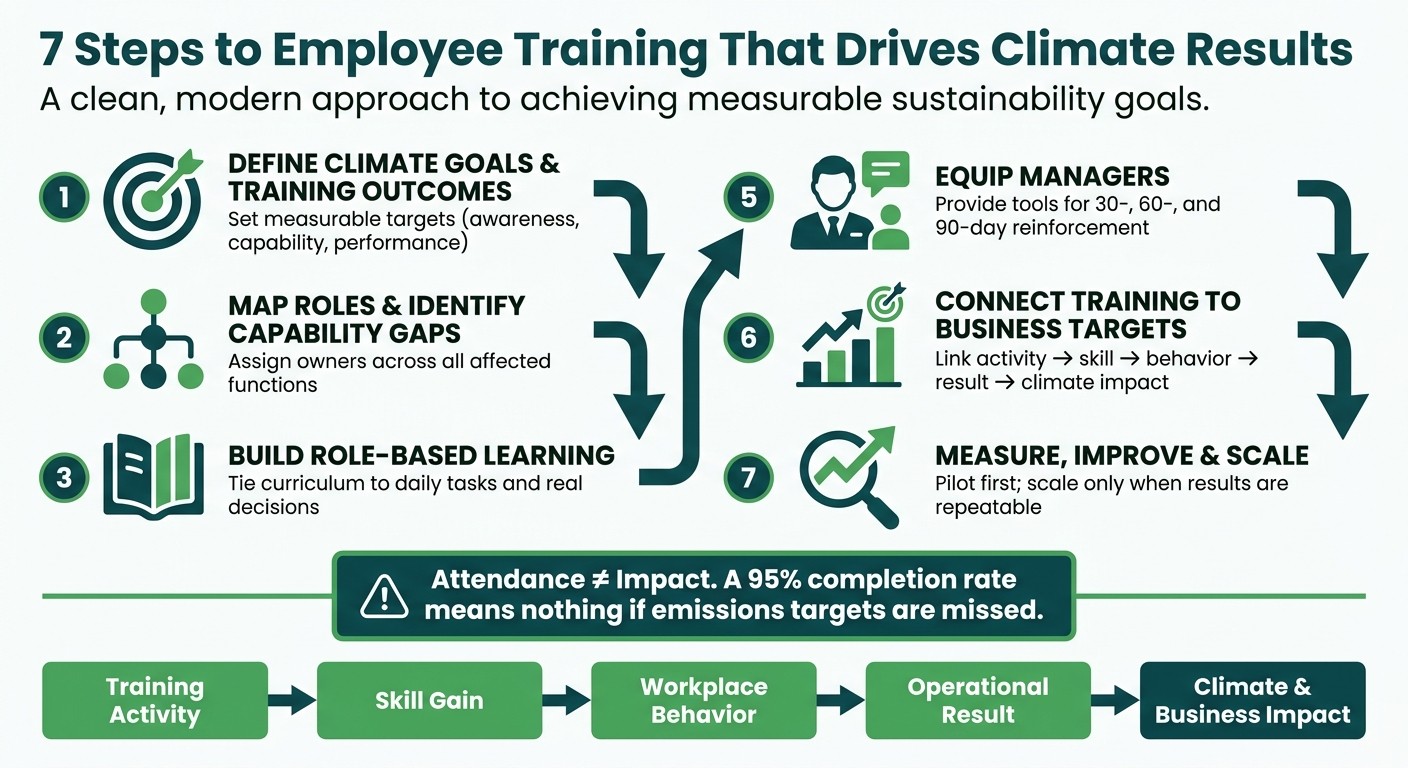
7-Step Employee Training Framework for Climate Goals
The 7-step framework for employee training and climate goals
This framework covers goal-setting, role mapping, curriculum design, delivery, manager support, business alignment, and continuous improvement. Each step needs a clear owner and a concrete output you can check.
Step 1: Define climate goals and training outcomes
Before you pick content, start with the organization’s climate targets: the baseline year, the emissions scopes that matter, the time horizon, and the people who own each target. Then turn every climate commitment into three learning outcomes: awareness, capability, and performance.
Awareness means employees can explain the company’s climate priorities and how their work affects them. Capability means they can carry out a specific task, like calculating emissions, reviewing suppliers, cutting energy use, or applying low-carbon design criteria. Performance means that skill leads to a measurable result at work, such as cutting energy intensity by 5%, improving supplier emissions data completeness, or removing a defined source of waste.
Write outcomes with action verbs like calculate, identify, redesign, verify, reduce, prioritize, and implement. Skip vague phrases like understanding sustainability. A stronger example looks like this:
By June 2027, facilities teams will implement three verified energy-saving actions at each site, tracked monthly against the 2026 baseline.
Run a baseline assessment before choosing content. Use a short climate-literacy survey, role-based knowledge checks, manager and subject-matter interviews, and a review of current energy, waste, or emissions data. This step shows both skill gaps and system barriers, such as missing budget authority or incomplete equipment data, that training by itself won’t fix.
Next, build a goal-to-training matrix that links each target to the roles involved, the skill required, the workplace use case, the owner, and the progress metric. This matrix should guide curriculum, delivery, and tracking.
Climate target | Affected roles | Required capability | Workplace application | Owner | Progress check |
|---|---|---|---|---|---|
Reduce facility energy use 10% by December 2027 | Facilities, operations, supervisors | Identify and verify energy-saving interventions | Adjust equipment schedules or controls | Facilities director | kWh per unit of output vs. 2026 baseline |
Reduce Scope 3 procurement emissions | Procurement, product, finance | Apply supplier and lifecycle criteria | Score suppliers using agreed criteria | Procurement lead | Supplier emissions data completeness |
Reduce logistics emissions | Fleet, dispatch, warehouse managers | Optimize routing and loading | Pilot revised routes | Fleet director | Fuel use or CO₂e per shipment |
The matrix makes ownership plain. It shows who owns the target and who owns the training.
With outcomes in place, the next move is to map the roles and decisions that shape them.
Step 2: Assign team roles and identify capability gaps
Map roles by the process that drives the target, not by the org chart. A Scope 3 procurement target might touch procurement, finance, product design, operations, legal, supplier management, and data or information technology. A building-energy target may involve facilities, operations, finance, real estate, security, and site managers.
Once that map is clear, assign responsibilities across six groups:
Executives set priorities, approve resources, and review progress.
Sustainability or climate teams define methods, maintain target integrity, and give technical guidance.
HR and learning teams fold climate skills into job profiles, onboarding, and training records.
Managers turn goals into team actions, protect time for learning, and coach people through application.
Employees complete the learning that fits their role, apply the needed practices, and report barriers.
Climate champions help peer learning and surface local opportunities.
Document decision rights, not just task lists. A facilities manager may approve operating changes, while finance checks the investment case. When those boundaries are fuzzy, training often leads to knowledge but not action.
Use more than one method to assess gaps: employee surveys, manager interviews, knowledge checks, and a review of operating data like energy bills, waste records, or procurement spend. Segment the results by role, location, and function. Low quiz scores point to knowledge gaps. Flat energy use may point to equipment limits, incentive problems, or blocked decision rights. The assessment needs to catch both skill gaps and system barriers.
Once the gaps are mapped, shape learning around the work people do each day.
Step 3: Build role-based learning that fits daily work
After roles and gaps are clear, organize the curriculum into three layers. Core climate literacy goes to everyone. It should be a short, practical explanation of the company’s targets, the emissions sources that matter, and how each employee’s work connects to them.
Functional capability goes deeper for roles that directly affect emissions. Procurement teams need supplier screening and emissions-data quality. Facilities teams need energy management. Finance teams need carbon costs and investment appraisal.
Applied problem-solving asks participants to work with real job data to diagnose an issue, propose an intervention, estimate impact, identify dependencies, and define a measurement plan.
Role-based content does not mean you need a different program for every job title. Build a shared foundation, then add reusable modules by function. Let the gap assessment decide which modules each role needs. A simple test helps here: What changes within 30 days, and how will you verify it?
Each module should end with a workplace application: a named owner, a deadline, the support required, a baseline, and a metric. That might mean changing a purchasing specification, testing a lower-energy operating procedure, proposing a supplier-data improvement, or committing to a measured drop in waste. That’s the point where training starts to affect the business.
Choose delivery methods and reinforce action
Step 4: Select workshop and delivery formats
Once the learning content is set, the next move is choosing formats that help employees practice the exact decisions linked to the climate target.
The rule is simple: match the format to the climate behavior you need to change, not the option that's easiest to put on the calendar. Foundational climate literacy - emissions terms, the company's climate goals, and required policies - fits self-paced e-learning well. People can move through it on their own time. But when the work involves tougher decisions, cross-team trade-offs, or hands-on problem-solving, live interaction matters, whether that's virtual or in person.
A practical blended sequence often works like this: employees finish an asynchronous module first, then join a live discussion or workshop, then tackle a team-based application exercise, and finally get coaching at set intervals. That sequence matters. It separates learning from practice, which is exactly where many one-format programs fall apart. Blended delivery works best when people have room to learn, practice, get support, and receive feedback.
Format | Best use | Typical time commitment | Scalability | Interaction level |
|---|---|---|---|---|
E-learning | Core climate concepts, policies, and baseline knowledge | 10–30 min per module | High | Low to moderate |
Live virtual session | Expert instruction, Q&A, cross-location alignment | 60–120 min | High | Moderate to high |
In-person workshop | Simulations, complex trade-offs, and team problem-solving | Half day to 1 day | Moderate | High |
Department working session | Translating enterprise goals into role-specific actions | 60–120 min | Moderate | High |
Follow-up coaching | Removing barriers and reinforcing application | 20–45 min per check-in | Moderate to low | High |
For U.S. teams spread across time zones, shifts, and sites, it helps to repeat live sessions, record them when that adds value, and offer an asynchronous option. Mobile access should be built in from the start, along with basic accessibility features. If people can't get to the training easily, they won't use it.
Every format should end with one clear next action tied to the employee's role.
Delivery sets the stage. Manager follow-through is what turns training into day-to-day action.
Step 5: Equip managers to support climate learning on the job
After delivery, managers need to reinforce the specific action each employee committed to. That's how training sticks. Employees need time, feedback, and clear permission to use what they learned.
A one-page manager kit is often the simplest fix. Give each manager a guide built around four moments: before training (Which decision will you apply this to?), during team meetings (Where do our current priorities create emissions, waste, or climate resilience risks?), after training (What did you try, what changed, and what barrier should we remove?), and during performance discussions (What progress have you made on your climate commitment?).
Managers also need two practical tools, not just talking points:
A decision checklist that adds climate criteria to approvals they already handle, such as purchasing sign-offs, travel requests, facility work orders, project gates, or supplier evaluations
A tracker for the role-based action each employee committed to in training, including what they'll do, by when, what support they need, and how success will be measured
Regular check-ins at about 30 and 90 days can keep those commitments from stalling.
Climate checks should show up in the routines managers already run: pre-shift huddles, equipment checks, route planning, purchasing reviews, and maintenance routines. Managers who protect time for this work, clear data or approval roadblocks, and connect employees with the right specialists in facilities, procurement, finance, or sustainability will get much stronger application than managers who only confirm attendance.[1][2]
Tie training to business targets and improve the program
Step 6: Connect training to business and climate targets
Once managers reinforce the new behavior, the next question is simple: did it change how people work, and did that show up in operating results? Completion tells you people showed up. It does not tell you whether anything changed. What matters is whether training shifted behavior and moved a business metric.
The clearest way to make that link is through a basic logic chain: training activity → skill gain → workplace behavior → operational result → business or climate impact. That path keeps the program tied to outcomes instead of guesswork.
Take energy-management training for facilities staff. The target skill might be spotting equipment inefficiencies. The expected behavior is doing monthly equipment checks and flagging unusual energy use. The operational result is lower electricity use per square foot. The climate result is lower Scope 2 emissions. The business result is lower utility costs. Those baseline definitions - and the owner for each metric - should be in the scorecard before launch.[3][4][7]
Metric | Purpose | Data source | Review frequency | Owner |
|---|---|---|---|---|
Training completion rate | Confirms reach and access | Learning-management system | Weekly during launch | Learning and development lead |
Knowledge retention | Tests whether employees remember key concepts | Quizzes or scenario assessments | At completion, then after 30–90 days | Training manager |
Applied skill | Confirms learning is used at work | Manager observations, checklists, work samples | Monthly or quarterly | Department manager |
Energy use per sq ft | Measures operational efficiency | Utility bills or smart-meter data | Monthly | Facilities or energy manager |
Waste diversion rate | Measures waste-handling behavior and process performance | Waste hauler records and audits | Monthly or quarterly | Operations or facilities lead |
Scope 1, 2, or 3 emissions | Tracks climate impact | GHG inventory and activity data | Quarterly or annually, depending on the inventory | Sustainability or finance team |
Cost savings | Connects climate action to financial performance | General ledger, utility bills, procurement records | Monthly or quarterly | Finance business partner |
Manager reinforcement | Checks whether supervisors reinforced the action | Pulse surveys, action-plan reviews, interviews | 30, 60, and 90 days | HR business partner |
Give each metric one accountable owner. If you skip that, training, sustainability, and finance can each assume someone else is checking the result.[5][9][10] Use one method for Scope 1, 2, and 3, report emissions in metric tons of CO2e, and keep U.S. operating and financial units separate.
This scorecard helps you spot where the process is breaking down - whether the issue is the training itself, manager follow-through, or the workflow around the job.
Step 7: Measure, improve, and scale what works
With the scorecard in place, review results on a fixed cadence and look for the weak link. A steady 30-, 60-, and 90-day review cycle, followed by quarterly reviews, works well. Before launch, set the baseline, define targets, assign owners, and log business conditions that could affect the outcome, such as weather, production volume, and occupancy. At 30 days, check knowledge retention, barriers, and manager reinforcement. At 60 days, look for applied skill in day-to-day work: inspections, purchasing choices, maintenance actions, or sorting accuracy. At 90 days, compare operational and financial indicators with the baseline and dig into any result that doesn’t line up with expectations.[6][7][8]
If results are weaker than expected, check the full performance chain before adding more content. Look at understanding, authority, data access, and manager support. Then look at whether procedures, incentives, or systems were pulling people in the other direction. If procurement staff can’t get supplier emissions data, the answer may be better data fields, revised purchasing rules, manager coaching, and supplier engagement - not another general awareness course.
Scale only after a pilot shows four things:
Employees retained the knowledge
Employees used the right skills on the job
Managers reinforced the behavior
At least one operational or business indicator improved
Record implementation costs, and expand only when the result can be repeated and the operating model can handle more learners.[3][7]
If the picture is mixed, adjust the content, manager routines, workflow, or measurement process before going broader. High completion rates don’t prove emissions went down. Pilot results should shape the next version of the program before you expand it.
Conclusion: A practical checklist for climate training that delivers results
Treat these seven steps as a loop, not a one-time rollout: define the goal, map roles, close skill gaps, deliver role-based learning, equip managers, tie training to targets, and improve from results.
Completion rates look good on a dashboard. But they only matter when they change behavior and lead to measurable results in day-to-day operations.
Use this final check before launch. Confirm that you have:
A measurable climate objective, such as reducing Scope 1 and 2 emissions, cutting waste, or lowering energy use per square foot
Role-based learning outcomes and content tied to real decisions and everyday workflows
Named owners across sustainability, HR, learning and development, operations, finance, and business units
Baseline data and agreed success measures, with a fixed review cadence
A delivery plan that blends digital learning, workshops, on-the-job practice, manager support, and follow-up
Ask your team: What climate outcome are we targeting, which decisions drive it, who will reinforce them, and what evidence will prove impact?
If you need help operationalizing sustainability, Council Fire can help turn strategy into measurable action.
FAQs
How do I start if our climate goals are still unclear?
Start with a sustainability audit. It gives you a clear baseline of your current environmental, social, and economic impact, so you can see where you stand, spot gaps, and track progress over time.
From there, run a materiality assessment to find the ESG issues that matter most to your stakeholders and your day-to-day operations. Once those priorities are clear, turn them into specific, measurable KPIs linked to your company’s values and business goals.
Which teams should own climate training outcomes?
Ownership needs to sit across the business, not with one team parked off to the side. Executive leadership and board committees set direction and provide oversight. Climate leads or dedicated teams, meanwhile, need the budget and decision-making power to do the work.
That only works when key functions move together. Finance, operations, facilities, and HR can help tie training to business goals so it doesn’t feel like a side project. HR often takes the lead on workforce sustainability metrics and green skills, while Green Teams and employee resource groups help build peer accountability day to day.
What metrics prove training changed behavior?
Track a mix of engagement, day-to-day, and financial metrics. Look at engagement scores before and after training. Compare voluntary turnover in trained groups versus untrained groups, and watch participation in green team efforts.
Then tie behavior change to business results. Measure energy use, water conservation, waste diversion, and any cost savings or productivity gains linked to better efficiency.
Related Blog Posts
Latest Articles
©2025

Narrative Change and Power Building: The Missing Half of Advocacy
Narrative change is the process of disrupting dominant narratives that normalize inequity and advancing new narratives from historically marginalized communities.

Funding Resilience Without Federal Grants
BRIC is unreliable and FEMA is shrinking. Here's how cities fund climate resilience with dedicated revenue, blended finance, and a coordinating authority.

The ESG Blind Spot: How AI Is Finding Risks in Companies Nobody Else Is Watching
Norway's sovereign wealth fund uses AI to screen 7,200 portfolio companies for forced labor and corruption within 24 hours. The real story is the emerging-market coverage gap that traditional ESG data vendors miss — and what it means for any company with a global supply chain.
Narrative Change and Power Building: The Missing Half of Advocacy
Narrative change is the process of disrupting dominant narratives that normalize inequity and advancing new narratives from historically marginalized communities.
Funding Resilience Without Federal Grants
BRIC is unreliable and FEMA is shrinking. Here's how cities fund climate resilience with dedicated revenue, blended finance, and a coordinating authority.
The ESG Blind Spot: How AI Is Finding Risks in Companies Nobody Else Is Watching
Norway's sovereign wealth fund uses AI to screen 7,200 portfolio companies for forced labor and corruption within 24 hours. The real story is the emerging-market coverage gap that traditional ESG data vendors miss — and what it means for any company with a global supply chain.
FAQ
01
What does it really mean to “redefine profit”?
02
What makes Council Fire different?
03
Who does Council Fire work with?
04
What does working with Council Fire actually look like?
05
How does Council Fire help organizations turn big goals into action?
06
How does Council Fire define and measure success?
Sep 23, 2026
Employee training for climate goals: 7 steps
Capacity Building
In This Article
Turn climate training into measurable action with a 7-step framework: role-based learning, manager reinforcement, and outcome-driven metrics.
Employee training for climate goals: 7 steps
Most training fails for one simple reason: people learn, but nothing at work changes. If I want climate goals to show up in day-to-day decisions, I need to tie training to a target, a role, a manager, and a metric.
Here’s the short version:
I start with the business goal and the emissions target.
I define what people must know, do, and change.
I map the roles that affect the result.
I build role-based learning tied to daily tasks.
I pick delivery formats based on the behavior I need.
I give managers tools to reinforce action at 30, 60, and 90 days.
I track results beyond completion, such as energy use, waste, cost, and CO2e.
The article’s core point is clear: attendance is not impact. A team can hit a 95% completion rate and still miss its emissions target. What matters is whether training leads to actions like equipment changes, supplier scoring, route updates, or waste reduction - and whether those actions improve business results.
A few facts stand out:
Scope 3 work often depends on teams outside sustainability, such as procurement, finance, and product.
A scorecard should link training activity → skill gain → behavior → business result → climate result.
Reviews at 30, 60, and 90 days help spot whether the problem is the training, manager follow-through, or blocked approvals and data gaps.
If I had to reduce the full article to one checklist, it would be this:
Step | What I need to do | What success looks like |
|---|---|---|
1 | Set climate and learning outcomes | Clear actions and metrics |
2 | Map roles and gaps | Named owners and decision rights |
3 | Build role-based learning | Training tied to daily work |
4 | Choose delivery formats | People can practice the skill |
5 | Equip managers | Follow-through after training |
6 | Link to business targets | Metrics show behavior change |
7 | Review and improve | Pilot results guide scale-up |
In short, the piece shows how I can turn climate training from a box-checking task into a work-change system with clear ownership and measured results.
7-Step Employee Training Framework for Climate Goals
The 7-step framework for employee training and climate goals
This framework covers goal-setting, role mapping, curriculum design, delivery, manager support, business alignment, and continuous improvement. Each step needs a clear owner and a concrete output you can check.
Step 1: Define climate goals and training outcomes
Before you pick content, start with the organization’s climate targets: the baseline year, the emissions scopes that matter, the time horizon, and the people who own each target. Then turn every climate commitment into three learning outcomes: awareness, capability, and performance.
Awareness means employees can explain the company’s climate priorities and how their work affects them. Capability means they can carry out a specific task, like calculating emissions, reviewing suppliers, cutting energy use, or applying low-carbon design criteria. Performance means that skill leads to a measurable result at work, such as cutting energy intensity by 5%, improving supplier emissions data completeness, or removing a defined source of waste.
Write outcomes with action verbs like calculate, identify, redesign, verify, reduce, prioritize, and implement. Skip vague phrases like understanding sustainability. A stronger example looks like this:
By June 2027, facilities teams will implement three verified energy-saving actions at each site, tracked monthly against the 2026 baseline.
Run a baseline assessment before choosing content. Use a short climate-literacy survey, role-based knowledge checks, manager and subject-matter interviews, and a review of current energy, waste, or emissions data. This step shows both skill gaps and system barriers, such as missing budget authority or incomplete equipment data, that training by itself won’t fix.
Next, build a goal-to-training matrix that links each target to the roles involved, the skill required, the workplace use case, the owner, and the progress metric. This matrix should guide curriculum, delivery, and tracking.
Climate target | Affected roles | Required capability | Workplace application | Owner | Progress check |
|---|---|---|---|---|---|
Reduce facility energy use 10% by December 2027 | Facilities, operations, supervisors | Identify and verify energy-saving interventions | Adjust equipment schedules or controls | Facilities director | kWh per unit of output vs. 2026 baseline |
Reduce Scope 3 procurement emissions | Procurement, product, finance | Apply supplier and lifecycle criteria | Score suppliers using agreed criteria | Procurement lead | Supplier emissions data completeness |
Reduce logistics emissions | Fleet, dispatch, warehouse managers | Optimize routing and loading | Pilot revised routes | Fleet director | Fuel use or CO₂e per shipment |
The matrix makes ownership plain. It shows who owns the target and who owns the training.
With outcomes in place, the next move is to map the roles and decisions that shape them.
Step 2: Assign team roles and identify capability gaps
Map roles by the process that drives the target, not by the org chart. A Scope 3 procurement target might touch procurement, finance, product design, operations, legal, supplier management, and data or information technology. A building-energy target may involve facilities, operations, finance, real estate, security, and site managers.
Once that map is clear, assign responsibilities across six groups:
Executives set priorities, approve resources, and review progress.
Sustainability or climate teams define methods, maintain target integrity, and give technical guidance.
HR and learning teams fold climate skills into job profiles, onboarding, and training records.
Managers turn goals into team actions, protect time for learning, and coach people through application.
Employees complete the learning that fits their role, apply the needed practices, and report barriers.
Climate champions help peer learning and surface local opportunities.
Document decision rights, not just task lists. A facilities manager may approve operating changes, while finance checks the investment case. When those boundaries are fuzzy, training often leads to knowledge but not action.
Use more than one method to assess gaps: employee surveys, manager interviews, knowledge checks, and a review of operating data like energy bills, waste records, or procurement spend. Segment the results by role, location, and function. Low quiz scores point to knowledge gaps. Flat energy use may point to equipment limits, incentive problems, or blocked decision rights. The assessment needs to catch both skill gaps and system barriers.
Once the gaps are mapped, shape learning around the work people do each day.
Step 3: Build role-based learning that fits daily work
After roles and gaps are clear, organize the curriculum into three layers. Core climate literacy goes to everyone. It should be a short, practical explanation of the company’s targets, the emissions sources that matter, and how each employee’s work connects to them.
Functional capability goes deeper for roles that directly affect emissions. Procurement teams need supplier screening and emissions-data quality. Facilities teams need energy management. Finance teams need carbon costs and investment appraisal.
Applied problem-solving asks participants to work with real job data to diagnose an issue, propose an intervention, estimate impact, identify dependencies, and define a measurement plan.
Role-based content does not mean you need a different program for every job title. Build a shared foundation, then add reusable modules by function. Let the gap assessment decide which modules each role needs. A simple test helps here: What changes within 30 days, and how will you verify it?
Each module should end with a workplace application: a named owner, a deadline, the support required, a baseline, and a metric. That might mean changing a purchasing specification, testing a lower-energy operating procedure, proposing a supplier-data improvement, or committing to a measured drop in waste. That’s the point where training starts to affect the business.
Choose delivery methods and reinforce action
Step 4: Select workshop and delivery formats
Once the learning content is set, the next move is choosing formats that help employees practice the exact decisions linked to the climate target.
The rule is simple: match the format to the climate behavior you need to change, not the option that's easiest to put on the calendar. Foundational climate literacy - emissions terms, the company's climate goals, and required policies - fits self-paced e-learning well. People can move through it on their own time. But when the work involves tougher decisions, cross-team trade-offs, or hands-on problem-solving, live interaction matters, whether that's virtual or in person.
A practical blended sequence often works like this: employees finish an asynchronous module first, then join a live discussion or workshop, then tackle a team-based application exercise, and finally get coaching at set intervals. That sequence matters. It separates learning from practice, which is exactly where many one-format programs fall apart. Blended delivery works best when people have room to learn, practice, get support, and receive feedback.
Format | Best use | Typical time commitment | Scalability | Interaction level |
|---|---|---|---|---|
E-learning | Core climate concepts, policies, and baseline knowledge | 10–30 min per module | High | Low to moderate |
Live virtual session | Expert instruction, Q&A, cross-location alignment | 60–120 min | High | Moderate to high |
In-person workshop | Simulations, complex trade-offs, and team problem-solving | Half day to 1 day | Moderate | High |
Department working session | Translating enterprise goals into role-specific actions | 60–120 min | Moderate | High |
Follow-up coaching | Removing barriers and reinforcing application | 20–45 min per check-in | Moderate to low | High |
For U.S. teams spread across time zones, shifts, and sites, it helps to repeat live sessions, record them when that adds value, and offer an asynchronous option. Mobile access should be built in from the start, along with basic accessibility features. If people can't get to the training easily, they won't use it.
Every format should end with one clear next action tied to the employee's role.
Delivery sets the stage. Manager follow-through is what turns training into day-to-day action.
Step 5: Equip managers to support climate learning on the job
After delivery, managers need to reinforce the specific action each employee committed to. That's how training sticks. Employees need time, feedback, and clear permission to use what they learned.
A one-page manager kit is often the simplest fix. Give each manager a guide built around four moments: before training (Which decision will you apply this to?), during team meetings (Where do our current priorities create emissions, waste, or climate resilience risks?), after training (What did you try, what changed, and what barrier should we remove?), and during performance discussions (What progress have you made on your climate commitment?).
Managers also need two practical tools, not just talking points:
A decision checklist that adds climate criteria to approvals they already handle, such as purchasing sign-offs, travel requests, facility work orders, project gates, or supplier evaluations
A tracker for the role-based action each employee committed to in training, including what they'll do, by when, what support they need, and how success will be measured
Regular check-ins at about 30 and 90 days can keep those commitments from stalling.
Climate checks should show up in the routines managers already run: pre-shift huddles, equipment checks, route planning, purchasing reviews, and maintenance routines. Managers who protect time for this work, clear data or approval roadblocks, and connect employees with the right specialists in facilities, procurement, finance, or sustainability will get much stronger application than managers who only confirm attendance.[1][2]
Tie training to business targets and improve the program
Step 6: Connect training to business and climate targets
Once managers reinforce the new behavior, the next question is simple: did it change how people work, and did that show up in operating results? Completion tells you people showed up. It does not tell you whether anything changed. What matters is whether training shifted behavior and moved a business metric.
The clearest way to make that link is through a basic logic chain: training activity → skill gain → workplace behavior → operational result → business or climate impact. That path keeps the program tied to outcomes instead of guesswork.
Take energy-management training for facilities staff. The target skill might be spotting equipment inefficiencies. The expected behavior is doing monthly equipment checks and flagging unusual energy use. The operational result is lower electricity use per square foot. The climate result is lower Scope 2 emissions. The business result is lower utility costs. Those baseline definitions - and the owner for each metric - should be in the scorecard before launch.[3][4][7]
Metric | Purpose | Data source | Review frequency | Owner |
|---|---|---|---|---|
Training completion rate | Confirms reach and access | Learning-management system | Weekly during launch | Learning and development lead |
Knowledge retention | Tests whether employees remember key concepts | Quizzes or scenario assessments | At completion, then after 30–90 days | Training manager |
Applied skill | Confirms learning is used at work | Manager observations, checklists, work samples | Monthly or quarterly | Department manager |
Energy use per sq ft | Measures operational efficiency | Utility bills or smart-meter data | Monthly | Facilities or energy manager |
Waste diversion rate | Measures waste-handling behavior and process performance | Waste hauler records and audits | Monthly or quarterly | Operations or facilities lead |
Scope 1, 2, or 3 emissions | Tracks climate impact | GHG inventory and activity data | Quarterly or annually, depending on the inventory | Sustainability or finance team |
Cost savings | Connects climate action to financial performance | General ledger, utility bills, procurement records | Monthly or quarterly | Finance business partner |
Manager reinforcement | Checks whether supervisors reinforced the action | Pulse surveys, action-plan reviews, interviews | 30, 60, and 90 days | HR business partner |
Give each metric one accountable owner. If you skip that, training, sustainability, and finance can each assume someone else is checking the result.[5][9][10] Use one method for Scope 1, 2, and 3, report emissions in metric tons of CO2e, and keep U.S. operating and financial units separate.
This scorecard helps you spot where the process is breaking down - whether the issue is the training itself, manager follow-through, or the workflow around the job.
Step 7: Measure, improve, and scale what works
With the scorecard in place, review results on a fixed cadence and look for the weak link. A steady 30-, 60-, and 90-day review cycle, followed by quarterly reviews, works well. Before launch, set the baseline, define targets, assign owners, and log business conditions that could affect the outcome, such as weather, production volume, and occupancy. At 30 days, check knowledge retention, barriers, and manager reinforcement. At 60 days, look for applied skill in day-to-day work: inspections, purchasing choices, maintenance actions, or sorting accuracy. At 90 days, compare operational and financial indicators with the baseline and dig into any result that doesn’t line up with expectations.[6][7][8]
If results are weaker than expected, check the full performance chain before adding more content. Look at understanding, authority, data access, and manager support. Then look at whether procedures, incentives, or systems were pulling people in the other direction. If procurement staff can’t get supplier emissions data, the answer may be better data fields, revised purchasing rules, manager coaching, and supplier engagement - not another general awareness course.
Scale only after a pilot shows four things:
Employees retained the knowledge
Employees used the right skills on the job
Managers reinforced the behavior
At least one operational or business indicator improved
Record implementation costs, and expand only when the result can be repeated and the operating model can handle more learners.[3][7]
If the picture is mixed, adjust the content, manager routines, workflow, or measurement process before going broader. High completion rates don’t prove emissions went down. Pilot results should shape the next version of the program before you expand it.
Conclusion: A practical checklist for climate training that delivers results
Treat these seven steps as a loop, not a one-time rollout: define the goal, map roles, close skill gaps, deliver role-based learning, equip managers, tie training to targets, and improve from results.
Completion rates look good on a dashboard. But they only matter when they change behavior and lead to measurable results in day-to-day operations.
Use this final check before launch. Confirm that you have:
A measurable climate objective, such as reducing Scope 1 and 2 emissions, cutting waste, or lowering energy use per square foot
Role-based learning outcomes and content tied to real decisions and everyday workflows
Named owners across sustainability, HR, learning and development, operations, finance, and business units
Baseline data and agreed success measures, with a fixed review cadence
A delivery plan that blends digital learning, workshops, on-the-job practice, manager support, and follow-up
Ask your team: What climate outcome are we targeting, which decisions drive it, who will reinforce them, and what evidence will prove impact?
If you need help operationalizing sustainability, Council Fire can help turn strategy into measurable action.
FAQs
How do I start if our climate goals are still unclear?
Start with a sustainability audit. It gives you a clear baseline of your current environmental, social, and economic impact, so you can see where you stand, spot gaps, and track progress over time.
From there, run a materiality assessment to find the ESG issues that matter most to your stakeholders and your day-to-day operations. Once those priorities are clear, turn them into specific, measurable KPIs linked to your company’s values and business goals.
Which teams should own climate training outcomes?
Ownership needs to sit across the business, not with one team parked off to the side. Executive leadership and board committees set direction and provide oversight. Climate leads or dedicated teams, meanwhile, need the budget and decision-making power to do the work.
That only works when key functions move together. Finance, operations, facilities, and HR can help tie training to business goals so it doesn’t feel like a side project. HR often takes the lead on workforce sustainability metrics and green skills, while Green Teams and employee resource groups help build peer accountability day to day.
What metrics prove training changed behavior?
Track a mix of engagement, day-to-day, and financial metrics. Look at engagement scores before and after training. Compare voluntary turnover in trained groups versus untrained groups, and watch participation in green team efforts.
Then tie behavior change to business results. Measure energy use, water conservation, waste diversion, and any cost savings or productivity gains linked to better efficiency.
Related Blog Posts
Latest Articles
©2025
Narrative Change and Power Building: The Missing Half of Advocacy
Narrative change is the process of disrupting dominant narratives that normalize inequity and advancing new narratives from historically marginalized communities.
Funding Resilience Without Federal Grants
BRIC is unreliable and FEMA is shrinking. Here's how cities fund climate resilience with dedicated revenue, blended finance, and a coordinating authority.
The ESG Blind Spot: How AI Is Finding Risks in Companies Nobody Else Is Watching
Norway's sovereign wealth fund uses AI to screen 7,200 portfolio companies for forced labor and corruption within 24 hours. The real story is the emerging-market coverage gap that traditional ESG data vendors miss — and what it means for any company with a global supply chain.
FAQ
01
What does it really mean to “redefine profit”?
02
What makes Council Fire different?
03
Who does Council Fire work with?
04
What does working with Council Fire actually look like?
05
How does Council Fire help organizations turn big goals into action?
06
How does Council Fire define and measure success?
Sep 23, 2026
Employee training for climate goals: 7 steps
Capacity Building
In This Article
Turn climate training into measurable action with a 7-step framework: role-based learning, manager reinforcement, and outcome-driven metrics.
Employee training for climate goals: 7 steps
Most training fails for one simple reason: people learn, but nothing at work changes. If I want climate goals to show up in day-to-day decisions, I need to tie training to a target, a role, a manager, and a metric.
Here’s the short version:
I start with the business goal and the emissions target.
I define what people must know, do, and change.
I map the roles that affect the result.
I build role-based learning tied to daily tasks.
I pick delivery formats based on the behavior I need.
I give managers tools to reinforce action at 30, 60, and 90 days.
I track results beyond completion, such as energy use, waste, cost, and CO2e.
The article’s core point is clear: attendance is not impact. A team can hit a 95% completion rate and still miss its emissions target. What matters is whether training leads to actions like equipment changes, supplier scoring, route updates, or waste reduction - and whether those actions improve business results.
A few facts stand out:
Scope 3 work often depends on teams outside sustainability, such as procurement, finance, and product.
A scorecard should link training activity → skill gain → behavior → business result → climate result.
Reviews at 30, 60, and 90 days help spot whether the problem is the training, manager follow-through, or blocked approvals and data gaps.
If I had to reduce the full article to one checklist, it would be this:
Step | What I need to do | What success looks like |
|---|---|---|
1 | Set climate and learning outcomes | Clear actions and metrics |
2 | Map roles and gaps | Named owners and decision rights |
3 | Build role-based learning | Training tied to daily work |
4 | Choose delivery formats | People can practice the skill |
5 | Equip managers | Follow-through after training |
6 | Link to business targets | Metrics show behavior change |
7 | Review and improve | Pilot results guide scale-up |
In short, the piece shows how I can turn climate training from a box-checking task into a work-change system with clear ownership and measured results.
7-Step Employee Training Framework for Climate Goals
The 7-step framework for employee training and climate goals
This framework covers goal-setting, role mapping, curriculum design, delivery, manager support, business alignment, and continuous improvement. Each step needs a clear owner and a concrete output you can check.
Step 1: Define climate goals and training outcomes
Before you pick content, start with the organization’s climate targets: the baseline year, the emissions scopes that matter, the time horizon, and the people who own each target. Then turn every climate commitment into three learning outcomes: awareness, capability, and performance.
Awareness means employees can explain the company’s climate priorities and how their work affects them. Capability means they can carry out a specific task, like calculating emissions, reviewing suppliers, cutting energy use, or applying low-carbon design criteria. Performance means that skill leads to a measurable result at work, such as cutting energy intensity by 5%, improving supplier emissions data completeness, or removing a defined source of waste.
Write outcomes with action verbs like calculate, identify, redesign, verify, reduce, prioritize, and implement. Skip vague phrases like understanding sustainability. A stronger example looks like this:
By June 2027, facilities teams will implement three verified energy-saving actions at each site, tracked monthly against the 2026 baseline.
Run a baseline assessment before choosing content. Use a short climate-literacy survey, role-based knowledge checks, manager and subject-matter interviews, and a review of current energy, waste, or emissions data. This step shows both skill gaps and system barriers, such as missing budget authority or incomplete equipment data, that training by itself won’t fix.
Next, build a goal-to-training matrix that links each target to the roles involved, the skill required, the workplace use case, the owner, and the progress metric. This matrix should guide curriculum, delivery, and tracking.
Climate target | Affected roles | Required capability | Workplace application | Owner | Progress check |
|---|---|---|---|---|---|
Reduce facility energy use 10% by December 2027 | Facilities, operations, supervisors | Identify and verify energy-saving interventions | Adjust equipment schedules or controls | Facilities director | kWh per unit of output vs. 2026 baseline |
Reduce Scope 3 procurement emissions | Procurement, product, finance | Apply supplier and lifecycle criteria | Score suppliers using agreed criteria | Procurement lead | Supplier emissions data completeness |
Reduce logistics emissions | Fleet, dispatch, warehouse managers | Optimize routing and loading | Pilot revised routes | Fleet director | Fuel use or CO₂e per shipment |
The matrix makes ownership plain. It shows who owns the target and who owns the training.
With outcomes in place, the next move is to map the roles and decisions that shape them.
Step 2: Assign team roles and identify capability gaps
Map roles by the process that drives the target, not by the org chart. A Scope 3 procurement target might touch procurement, finance, product design, operations, legal, supplier management, and data or information technology. A building-energy target may involve facilities, operations, finance, real estate, security, and site managers.
Once that map is clear, assign responsibilities across six groups:
Executives set priorities, approve resources, and review progress.
Sustainability or climate teams define methods, maintain target integrity, and give technical guidance.
HR and learning teams fold climate skills into job profiles, onboarding, and training records.
Managers turn goals into team actions, protect time for learning, and coach people through application.
Employees complete the learning that fits their role, apply the needed practices, and report barriers.
Climate champions help peer learning and surface local opportunities.
Document decision rights, not just task lists. A facilities manager may approve operating changes, while finance checks the investment case. When those boundaries are fuzzy, training often leads to knowledge but not action.
Use more than one method to assess gaps: employee surveys, manager interviews, knowledge checks, and a review of operating data like energy bills, waste records, or procurement spend. Segment the results by role, location, and function. Low quiz scores point to knowledge gaps. Flat energy use may point to equipment limits, incentive problems, or blocked decision rights. The assessment needs to catch both skill gaps and system barriers.
Once the gaps are mapped, shape learning around the work people do each day.
Step 3: Build role-based learning that fits daily work
After roles and gaps are clear, organize the curriculum into three layers. Core climate literacy goes to everyone. It should be a short, practical explanation of the company’s targets, the emissions sources that matter, and how each employee’s work connects to them.
Functional capability goes deeper for roles that directly affect emissions. Procurement teams need supplier screening and emissions-data quality. Facilities teams need energy management. Finance teams need carbon costs and investment appraisal.
Applied problem-solving asks participants to work with real job data to diagnose an issue, propose an intervention, estimate impact, identify dependencies, and define a measurement plan.
Role-based content does not mean you need a different program for every job title. Build a shared foundation, then add reusable modules by function. Let the gap assessment decide which modules each role needs. A simple test helps here: What changes within 30 days, and how will you verify it?
Each module should end with a workplace application: a named owner, a deadline, the support required, a baseline, and a metric. That might mean changing a purchasing specification, testing a lower-energy operating procedure, proposing a supplier-data improvement, or committing to a measured drop in waste. That’s the point where training starts to affect the business.
Choose delivery methods and reinforce action
Step 4: Select workshop and delivery formats
Once the learning content is set, the next move is choosing formats that help employees practice the exact decisions linked to the climate target.
The rule is simple: match the format to the climate behavior you need to change, not the option that's easiest to put on the calendar. Foundational climate literacy - emissions terms, the company's climate goals, and required policies - fits self-paced e-learning well. People can move through it on their own time. But when the work involves tougher decisions, cross-team trade-offs, or hands-on problem-solving, live interaction matters, whether that's virtual or in person.
A practical blended sequence often works like this: employees finish an asynchronous module first, then join a live discussion or workshop, then tackle a team-based application exercise, and finally get coaching at set intervals. That sequence matters. It separates learning from practice, which is exactly where many one-format programs fall apart. Blended delivery works best when people have room to learn, practice, get support, and receive feedback.
Format | Best use | Typical time commitment | Scalability | Interaction level |
|---|---|---|---|---|
E-learning | Core climate concepts, policies, and baseline knowledge | 10–30 min per module | High | Low to moderate |
Live virtual session | Expert instruction, Q&A, cross-location alignment | 60–120 min | High | Moderate to high |
In-person workshop | Simulations, complex trade-offs, and team problem-solving | Half day to 1 day | Moderate | High |
Department working session | Translating enterprise goals into role-specific actions | 60–120 min | Moderate | High |
Follow-up coaching | Removing barriers and reinforcing application | 20–45 min per check-in | Moderate to low | High |
For U.S. teams spread across time zones, shifts, and sites, it helps to repeat live sessions, record them when that adds value, and offer an asynchronous option. Mobile access should be built in from the start, along with basic accessibility features. If people can't get to the training easily, they won't use it.
Every format should end with one clear next action tied to the employee's role.
Delivery sets the stage. Manager follow-through is what turns training into day-to-day action.
Step 5: Equip managers to support climate learning on the job
After delivery, managers need to reinforce the specific action each employee committed to. That's how training sticks. Employees need time, feedback, and clear permission to use what they learned.
A one-page manager kit is often the simplest fix. Give each manager a guide built around four moments: before training (Which decision will you apply this to?), during team meetings (Where do our current priorities create emissions, waste, or climate resilience risks?), after training (What did you try, what changed, and what barrier should we remove?), and during performance discussions (What progress have you made on your climate commitment?).
Managers also need two practical tools, not just talking points:
A decision checklist that adds climate criteria to approvals they already handle, such as purchasing sign-offs, travel requests, facility work orders, project gates, or supplier evaluations
A tracker for the role-based action each employee committed to in training, including what they'll do, by when, what support they need, and how success will be measured
Regular check-ins at about 30 and 90 days can keep those commitments from stalling.
Climate checks should show up in the routines managers already run: pre-shift huddles, equipment checks, route planning, purchasing reviews, and maintenance routines. Managers who protect time for this work, clear data or approval roadblocks, and connect employees with the right specialists in facilities, procurement, finance, or sustainability will get much stronger application than managers who only confirm attendance.[1][2]
Tie training to business targets and improve the program
Step 6: Connect training to business and climate targets
Once managers reinforce the new behavior, the next question is simple: did it change how people work, and did that show up in operating results? Completion tells you people showed up. It does not tell you whether anything changed. What matters is whether training shifted behavior and moved a business metric.
The clearest way to make that link is through a basic logic chain: training activity → skill gain → workplace behavior → operational result → business or climate impact. That path keeps the program tied to outcomes instead of guesswork.
Take energy-management training for facilities staff. The target skill might be spotting equipment inefficiencies. The expected behavior is doing monthly equipment checks and flagging unusual energy use. The operational result is lower electricity use per square foot. The climate result is lower Scope 2 emissions. The business result is lower utility costs. Those baseline definitions - and the owner for each metric - should be in the scorecard before launch.[3][4][7]
Metric | Purpose | Data source | Review frequency | Owner |
|---|---|---|---|---|
Training completion rate | Confirms reach and access | Learning-management system | Weekly during launch | Learning and development lead |
Knowledge retention | Tests whether employees remember key concepts | Quizzes or scenario assessments | At completion, then after 30–90 days | Training manager |
Applied skill | Confirms learning is used at work | Manager observations, checklists, work samples | Monthly or quarterly | Department manager |
Energy use per sq ft | Measures operational efficiency | Utility bills or smart-meter data | Monthly | Facilities or energy manager |
Waste diversion rate | Measures waste-handling behavior and process performance | Waste hauler records and audits | Monthly or quarterly | Operations or facilities lead |
Scope 1, 2, or 3 emissions | Tracks climate impact | GHG inventory and activity data | Quarterly or annually, depending on the inventory | Sustainability or finance team |
Cost savings | Connects climate action to financial performance | General ledger, utility bills, procurement records | Monthly or quarterly | Finance business partner |
Manager reinforcement | Checks whether supervisors reinforced the action | Pulse surveys, action-plan reviews, interviews | 30, 60, and 90 days | HR business partner |
Give each metric one accountable owner. If you skip that, training, sustainability, and finance can each assume someone else is checking the result.[5][9][10] Use one method for Scope 1, 2, and 3, report emissions in metric tons of CO2e, and keep U.S. operating and financial units separate.
This scorecard helps you spot where the process is breaking down - whether the issue is the training itself, manager follow-through, or the workflow around the job.
Step 7: Measure, improve, and scale what works
With the scorecard in place, review results on a fixed cadence and look for the weak link. A steady 30-, 60-, and 90-day review cycle, followed by quarterly reviews, works well. Before launch, set the baseline, define targets, assign owners, and log business conditions that could affect the outcome, such as weather, production volume, and occupancy. At 30 days, check knowledge retention, barriers, and manager reinforcement. At 60 days, look for applied skill in day-to-day work: inspections, purchasing choices, maintenance actions, or sorting accuracy. At 90 days, compare operational and financial indicators with the baseline and dig into any result that doesn’t line up with expectations.[6][7][8]
If results are weaker than expected, check the full performance chain before adding more content. Look at understanding, authority, data access, and manager support. Then look at whether procedures, incentives, or systems were pulling people in the other direction. If procurement staff can’t get supplier emissions data, the answer may be better data fields, revised purchasing rules, manager coaching, and supplier engagement - not another general awareness course.
Scale only after a pilot shows four things:
Employees retained the knowledge
Employees used the right skills on the job
Managers reinforced the behavior
At least one operational or business indicator improved
Record implementation costs, and expand only when the result can be repeated and the operating model can handle more learners.[3][7]
If the picture is mixed, adjust the content, manager routines, workflow, or measurement process before going broader. High completion rates don’t prove emissions went down. Pilot results should shape the next version of the program before you expand it.
Conclusion: A practical checklist for climate training that delivers results
Treat these seven steps as a loop, not a one-time rollout: define the goal, map roles, close skill gaps, deliver role-based learning, equip managers, tie training to targets, and improve from results.
Completion rates look good on a dashboard. But they only matter when they change behavior and lead to measurable results in day-to-day operations.
Use this final check before launch. Confirm that you have:
A measurable climate objective, such as reducing Scope 1 and 2 emissions, cutting waste, or lowering energy use per square foot
Role-based learning outcomes and content tied to real decisions and everyday workflows
Named owners across sustainability, HR, learning and development, operations, finance, and business units
Baseline data and agreed success measures, with a fixed review cadence
A delivery plan that blends digital learning, workshops, on-the-job practice, manager support, and follow-up
Ask your team: What climate outcome are we targeting, which decisions drive it, who will reinforce them, and what evidence will prove impact?
If you need help operationalizing sustainability, Council Fire can help turn strategy into measurable action.
FAQs
How do I start if our climate goals are still unclear?
Start with a sustainability audit. It gives you a clear baseline of your current environmental, social, and economic impact, so you can see where you stand, spot gaps, and track progress over time.
From there, run a materiality assessment to find the ESG issues that matter most to your stakeholders and your day-to-day operations. Once those priorities are clear, turn them into specific, measurable KPIs linked to your company’s values and business goals.
Which teams should own climate training outcomes?
Ownership needs to sit across the business, not with one team parked off to the side. Executive leadership and board committees set direction and provide oversight. Climate leads or dedicated teams, meanwhile, need the budget and decision-making power to do the work.
That only works when key functions move together. Finance, operations, facilities, and HR can help tie training to business goals so it doesn’t feel like a side project. HR often takes the lead on workforce sustainability metrics and green skills, while Green Teams and employee resource groups help build peer accountability day to day.
What metrics prove training changed behavior?
Track a mix of engagement, day-to-day, and financial metrics. Look at engagement scores before and after training. Compare voluntary turnover in trained groups versus untrained groups, and watch participation in green team efforts.
Then tie behavior change to business results. Measure energy use, water conservation, waste diversion, and any cost savings or productivity gains linked to better efficiency.
Related Blog Posts
Latest Articles
©2025
Narrative Change and Power Building: The Missing Half of Advocacy
Narrative change is the process of disrupting dominant narratives that normalize inequity and advancing new narratives from historically marginalized communities.
Funding Resilience Without Federal Grants
BRIC is unreliable and FEMA is shrinking. Here's how cities fund climate resilience with dedicated revenue, blended finance, and a coordinating authority.
The ESG Blind Spot: How AI Is Finding Risks in Companies Nobody Else Is Watching
Norway's sovereign wealth fund uses AI to screen 7,200 portfolio companies for forced labor and corruption within 24 hours. The real story is the emerging-market coverage gap that traditional ESG data vendors miss — and what it means for any company with a global supply chain.
FAQ
What does it really mean to “redefine profit”?
What makes Council Fire different?
Who does Council Fire work with?
What does working with Council Fire actually look like?
How does Council Fire help organizations turn big goals into action?
How does Council Fire define and measure success?