
Apr 4, 2026
How to Embed Equity in Local Resilience Planning for Universities & Research Institutions
Sustainability Strategy
In This Article
Guidance for universities to embed equity in climate resilience through audits, community co-design, and measurable outcomes.
How to Embed Equity in Local Resilience Planning for Universities & Research Institutions
Universities must create resilience plans that address social inequities, not just technical challenges. Climate change disproportionately impacts vulnerable groups, and traditional top-down approaches often fail to protect these populations. To ensure fairness, universities should focus on:
Including Marginalized Voices: Engage historically excluded communities in decision-making.
Fair Resource Allocation: Address systemic disparities in how benefits and protections are distributed.
Long-Term Solutions: Plan for future generations while considering past inequities.
Key actions include conducting equity audits, mapping vulnerabilities, and using tools like the EPA's "Equitable Resilience Builder." Collaboration with local communities, interdisciplinary teams, and diverse stakeholders is critical. Success requires measurable outcomes, such as reduced risks for vulnerable groups and improved social systems. By prioritizing equity, universities can strengthen both their campuses and surrounding communities in the face of climate challenges.
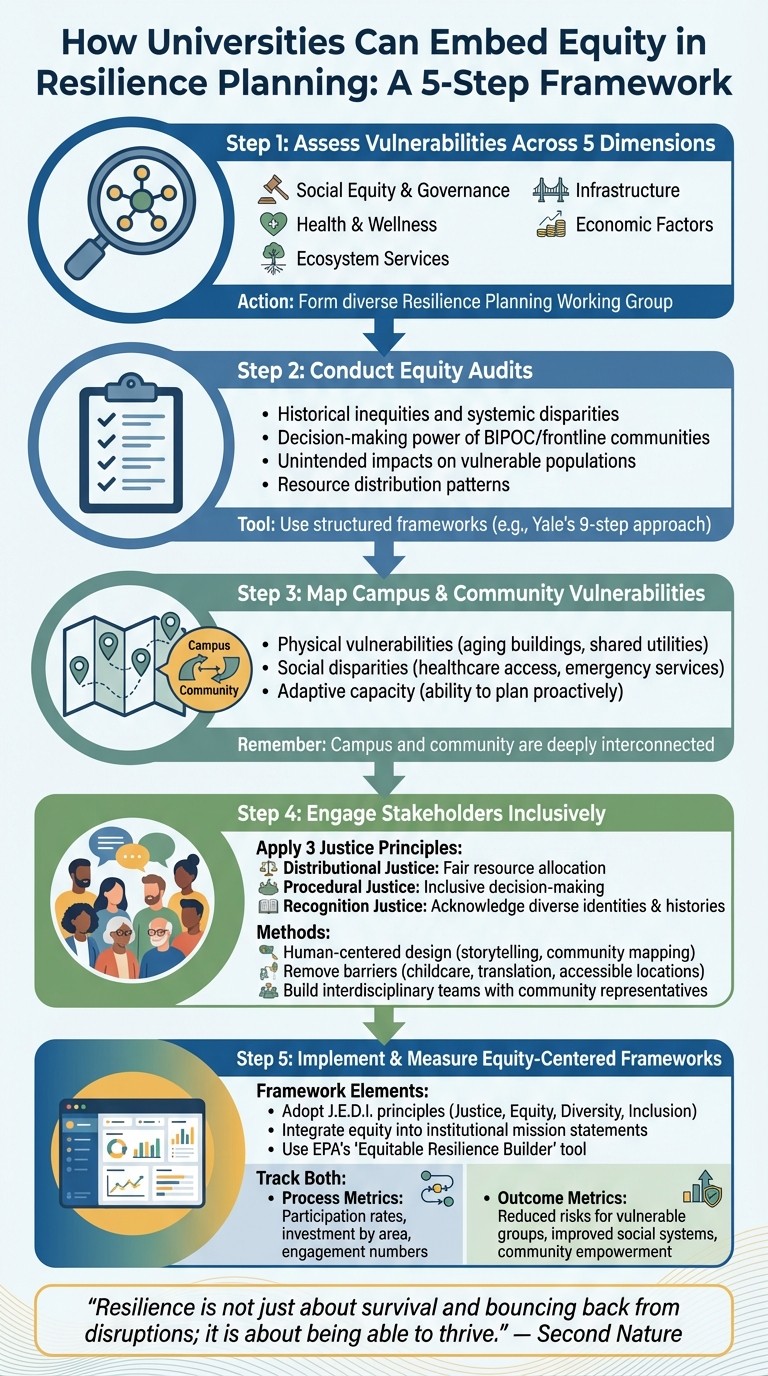
5-Step Framework for Embedding Equity in University Resilience Planning
Centering Equity in University Climate Change Planning
Identifying Vulnerabilities and Equity Gaps
Universities need to start by identifying vulnerabilities and the groups most at risk. This goes beyond evaluating physical infrastructure, requiring an examination of the social, economic, and environmental factors that shape how different populations are affected by climate threats. Vulnerabilities should be assessed across five key dimensions: Social Equity & Governance, Health & Wellness, Ecosystem Services, Infrastructure, and Economic factors [5].
The first step in this process is forming partnerships with historically excluded communities [1]. The Yale Center for Environmental Justice highlights the importance of this approach, stating, "Inclusive planning grounded in environmental and climate justice results in more resilient communities" [1]. Such collaboration ensures that equity audits reflect the lived experiences of vulnerable groups rather than relying solely on top-down analyses.
"Resilience is not just about survival and bouncing back from disruptions; it is about being able to thrive."
To be effective, equity must be integrated throughout the entire assessment process rather than treated as an afterthought. This involves creating a Resilience Planning Working Group with diverse expertise and perspectives. The group should evaluate not only present vulnerabilities but also the adaptive capacity of both the campus and the surrounding community. This means assessing their ability to plan proactively for better futures instead of merely reacting to crises. The goal is to establish a baseline that highlights strengths, weaknesses, and the historical inequities that contribute to current disparities [1][5]. This baseline becomes the foundation for inclusive stakeholder engagement.
How to Conduct Equity Audits
Equity audits go beyond demographic data to explore how policies and practices may disproportionately affect vulnerable populations. For example, a renewable energy initiative that increases utility costs could unintentionally burden low-income households [4].
A structured framework, such as the nine-step approach developed by the Yale Center for Environmental Justice, is essential. This framework ensures equity is prioritized from the planning stages through implementation [1]. It emphasizes balancing community values and needs with technical and economic considerations [4]. Additionally, the audit should assess the decision-making power of underrepresented groups, particularly frontline and BIPOC communities, to avoid imposing top-down solutions [4].
Dimension | Key Indicators for Equity Assessment |
|---|---|
Social Equity & Governance | Historical inequities, representation of BIPOC/frontline groups, community decision-making power |
Health & Wellness | Health disparities, access to emergency services, threats to vulnerable populations' security |
Economic | Financial impact of climate policies on low-income groups, resource distribution, livelihood stability |
Infrastructure | Housing vulnerability, accessibility of campus facilities, effects of resettlement plans |
Ecosystem Services | Access to green spaces, environmental burdens, availability of essentials like clean water and air |
The audit acts as a baseline for understanding current resilience efforts and identifying areas for improvement. Once completed, its findings should feed directly into the institution’s Climate Action Plan, ensuring equity goals are translated into actionable strategies. This is not a static process - universities often revisit and refine their assessments as circumstances and priorities change [5].
How to Map Campus and Community Vulnerabilities
Mapping vulnerabilities is a critical next step, capturing the interconnected risks that impact both the campus and the broader community. Universities and their surrounding areas are deeply interlinked, sharing resources, infrastructure, and exposure to climate risks [5]. A comprehensive map should cover both physical vulnerabilities - such as aging buildings or shared utility systems - and social disparities, like unequal access to healthcare, emergency services, or economic resources.
By using the five-dimension framework [5], universities can uncover how climate impacts ripple across systems and affect groups unequally.
"The most successful campus resilience plans will be those that fully embrace the catalytic nature of resilience assessment and planning, and that incorporate diversity and inclusiveness throughout the process."
Second Nature [5]
The focus should extend beyond current conditions to include adaptive capacity. This means evaluating whether the campus and its community can adjust and seize new opportunities as they arise [5]. Such a forward-thinking approach shifts the narrative from merely "bouncing back" to creating an environment where all members of the community can thrive. Regular updates to the map ensure it remains a dynamic tool, evolving alongside climate-related changes and institutional objectives [5].
Engaging Stakeholders Through Inclusive Practices
Once equity gaps and vulnerabilities are identified, the next step in resilience planning is to engage all affected communities. This process requires moving beyond traditional methods, like town halls and campus forums, which often overlook the very groups most impacted by climate risks. Universities must rethink their definition of "community" and prioritize building trust with historically excluded groups.
"Your definition of community is important because it shapes who you include when you make decisions or seek input, as well as how and when you approach them."
Heather Houser, Associate Professor and Planet Texas 2050 Researcher, UT Austin [6]
This redefined approach involves reaching beyond campus boundaries to include low-income neighborhoods, communities of color, and disabled residents - groups that often face disproportionate climate challenges. Effective engagement addresses three critical aspects of equity: distributional justice (fair resource allocation), procedural justice (fair and inclusive decision-making), and recognition justice (acknowledging diverse identities and histories) [3]. Without addressing all three, resilience plans may inadvertently reinforce the inequities they aim to resolve.
Shifting from an "expert-driven" to a "community-centered" planning model means valuing local knowledge - such as lived experiences, cultural traditions, and personal histories - on par with technical data [6]. This approach transforms stakeholder engagement into a true partnership, where diverse voices actively shape outcomes.
Using Human-Centered Design for Stakeholder Engagement
Human-centered design (HCD) offers practical methods to foster meaningful collaboration among students, faculty, staff, and local residents. Techniques like storytelling, community mapping, and group brainstorming help capture personal experiences with climate hazards and disasters [2].
For example, in January 2020, the University of Texas at Austin's Planet Texas 2050 team partnered with the Division of Diversity and Community Engagement and Go! Austin/Vamos! Austin (GAVA) to host a "Front Porch Gathering" in the Dove Springs neighborhood. This area, which faced severe flooding in 2013 and 2015, provided residents with an opportunity to share their experiences. Their input revealed gaps in flood infrastructure and emergency response, leading to more equitable preparedness strategies [6].
HCD also works to eliminate barriers to participation. By offering childcare, food, travel stipends, and American Sign Language interpretation, and by hosting meetings in trusted locations like community centers or places of worship, HCD ensures broader and more inclusive participation [8].
"Commit to learning and listening more than you talk."
Moving from a "seeking input" approach to a "co-designing" model delivers substantial benefits. For instance, in July 2024, researchers from the University of Central Florida collaborated with the City of Orlando to co-design an equity-focused resilience and education hub. By using a community-engaged process, they identified local priorities and created a model for urban resilience hubs that address both physical and social needs during climate disasters [7].
Building Interdisciplinary Teams
Interdisciplinary teams play a vital role in integrating community insights with technical expertise. These teams combine diverse academic and practical perspectives to craft solutions that are both effective and inclusive. They also help translate equity audit findings into actionable strategies.
Successful teams typically include scientists, policymakers, urban designers, civil society members, and representatives from frontline and BIPOC communities [4]. For example, the MIT Norman B. Leventhal Center for Advanced Urbanism (LCAU) published "The Equitable Resilience Framework" in December 2025. Led by Janelle Knox-Hayes, this project brought together over 25 experts from fields like urban planning, environmental justice, and architecture to create a non-hierarchical framework that centers local social practices and BIPOC knowledge in climate adaptation strategies [4].
"The framework we design is anti-hierarchical - a transformation in how expertise itself meets community needs for equity in resilient adaptation."
The Equitable Resilience Framework team [4]
Managing power dynamics within these teams is essential. Ensuring that marginalized voices feel empowered to contribute requires attention to who dominates conversations and how decisions are made [8]. Hiring community organizers from affected neighborhoods can help shift the dynamic from an "expert lecturer" model to a peer-to-peer approach that values lived experience equally with technical knowledge [8].
An example of this collaborative approach occurred in February 2020, when UT Austin's Center for Transportation Research hosted the "Hack for Resilient Communities." This event brought together students, researchers, and representatives from the City of Austin's Office of Sustainability and GAVA. Interdisciplinary teams explored connections between health, transit, and air pollution, ensuring their research addressed the needs of vulnerable populations [6].
To sustain engagement, dedicated funding and resources are crucial. Without these, participation from underrepresented groups tends to decline over time [2]. Universities can strengthen their efforts by building long-term partnerships with trusted community organizations, creating a foundation for lasting collaboration that extends beyond individual initiatives.
Creating and Implementing Equity-Centered Resilience Frameworks
Universities are taking steps to turn equity principles into practical strategies by building frameworks that prioritize community values in decision-making. This shift ensures that institutional expertise supports community needs, rather than imposing solutions that may unintentionally deepen existing inequalities.
"To succeed, climate change solutions must embed social considerations into every step of their design and implementation. They must strive to be inclusive and fair, to promote communication and knowledge-sharing, and to give power to those who historically lack it."
MIT Leventhal Center for Advanced Urbanism [4]
These frameworks strike a balance between technical expertise and local insights, which helps avoid maladaptation - where well-meaning initiatives, like renewable energy projects, inadvertently harm low-income or marginalized groups. Universities must also confront the systemic disadvantages that shape inequities, ensuring resilience plans address these root causes.
Adopting Justice, Equity, Diversity, and Inclusion (J.E.D.I.) Frameworks
J.E.D.I. frameworks ensure fairness throughout resilience planning by focusing on three key areas: procedural equity (who has a voice in decision-making), distributional equity (how resources and benefits are shared), and recognition justice (acknowledging the historical and cultural contexts that influence communities' experiences with climate challenges).
In late 2024, the University of California, Santa Barbara applied a DEIJ-centered approach to its Climate Change Resilience and Adaptation Planning Project. Under the leadership of Jewel Persad, the university’s Sustainability Manager, the initiative involved indigenous leaders like Mia Lopez, Vice Chair of the Coastal Band of the Chumash Nation. Together, they reframed discussions around infrastructure, moving away from labeling communities as "vulnerable" and instead emphasizing empowerment through cultural knowledge [9].
"We need to stop thinking of these less visible communities as vulnerable. We are empowered; we are not vulnerable. We are struggling because we want to keep our identity and cultural ways alive, and within this infrastructure, there's no room for it."
Mia Lopez, Vice Chair of the Coastal Band of the Chumash Nation [9]
"The key to the DEIJ approach is trust and accountability. The framework must first focus on relationships with all people in order to build outwards."
UC Santa Barbara Sustainability [9]
To ensure fairness, universities can use equity-focused templates during planning workshops. These tools help identify potential burdens on disadvantaged groups and establish checkpoints to confirm equitable resource distribution throughout the process.
Integrating Equity into Institutional Mission Statements
Incorporating equity into mission statements elevates resilience planning to a central institutional priority, ensuring sustained funding and collaboration. When equity becomes a core value, climate adaptation efforts gain the administrative and cross-departmental support needed to succeed.
In 2025, researchers at the University of Utah, including Jessica Chaplain and Danielle Endres, conducted a case study on the university’s Climate Action Planning (CAP). Their evaluation, which analyzed distributional, procedural, and recognition equity, highlighted challenges in turning stated equity goals into actionable outcomes [3].
"An equitable approach to climate resilience strives for fairness in multiple facets and stages. It ensures that people are treated according to their needs and with consideration of both current and historical contexts and of relative advantages or disadvantages."
MIT Leventhal Center for Advanced Urbanism [4]
Aligning resilience strategies with campus and regional initiatives creates a ripple effect, extending the impact to city and state levels. This approach fosters partnerships that amplify resources and ensures that institutional efforts align with broader community goals [1].
Measuring Outcomes of Equitable Resilience Strategies
Equity-centered frameworks require more than standard metrics; they evaluate whether projects empower communities and enhance their long-term resilience. Success is measured not just by numbers but by the quality of relationships built and the extent to which historically excluded groups can shape their own futures.
The MIT Equitable Resilience Framework emphasizes tracking communication and knowledge-sharing among scientists, civil society, and policymakers to ensure policies reflect local values and practices [4]. Similarly, the Yale Center for Environmental Justice has developed a nine-step framework that prioritizes partnerships with historically excluded low-income and BIPOC communities [1].
"Solutions built with communities have better outcomes."
MIT Leventhal Center for Advanced Urbanism [4]
Combining quantitative and qualitative methods offers a fuller picture of impact. Metrics such as participation rates, resource allocation across income-diverse neighborhoods, and the evolution of decision-making processes help universities refine their strategies, preventing inequities from becoming entrenched in long-term plans.
How Council Fire Supports Equity in Resilience Planning
Council Fire takes the concept of equity and turns it into practical actions, ensuring resilience strategies are not just theoretical but deliver real, measurable results. By combining technical expertise with a focus on community engagement, the organization creates pathways for institutions to meet their equity commitments in meaningful ways.
Climate Resilience Planning Services
Council Fire works with institutions to prepare for climate challenges by identifying the intersections of climate risks and socioeconomic vulnerabilities. A standout example occurred in February 2026 when a public research university, with 35,000 students and a sprawling 450-acre campus, collaborated with Council Fire to craft a carbon neutrality roadmap. Leveraging the IRA direct pay provisions and carefully sequencing efficiency measures, the university managed to accelerate its neutrality goal from 2040 to 2035. This initiative included implementing a Phase 1 ground-source heat pump system, which now serves 22 buildings. The result? A 35% reduction in emissions and $2.8 million in annual operating cost savings [12].
The organization also incorporates advanced mapping tools, such as the CDC's Social Vulnerability Index, to ensure resources are allocated to areas where climate risks and low adaptive capacity overlap. This data-driven approach lays a solid foundation for engaging with communities more deeply and effectively.
Building Trust Through Stakeholder Collaboration
Council Fire understands that authentic engagement starts by meeting people where they are - literally. Instead of expecting stakeholders to attend formal meetings, the team hosts sessions in familiar community spaces like schools, churches, and housing complexes. For instance, in February 2026, they completed a project in a Mid-Atlantic coastal city with 28,000 residents facing threats from sea-level rise. Their three-tier engagement process included bilingual workshops (English and Spanish) and even provided childcare, resulting in a 22% survey response rate. This inclusive effort uncovered a significant contamination risk in a historically Black neighborhood near a legacy Superfund site - something technical models alone had missed [10].
"Resilience planning fails without authentic community participation." - Council Fire [11]
To make participation easier and more equitable, Council Fire compensates community members - such as local leaders and faith representatives - for their time and expertise. They also use participatory methods like community mapping, storytelling circles, and photovoice projects to empower residents. These tools not only build trust but also ensure that community voices directly shape the outcomes.
Translating Equity Goals into Measurable Outcomes
General goals like "improve climate resilience" are not enough. Council Fire uses multi-criteria scoring frameworks that evaluate equity impacts, the number of beneficiaries, and the effectiveness of hazard reduction strategies. In the Mid-Atlantic city project, this approach helped secure $14.7 million in federal and state grants within 18 months of plan adoption, achieving a benefit-cost ratio of 4.2:1. Concrete outcomes included the creation of community resilience hubs at a local church and community center, as well as the completion of a 1.2-mile living shoreline project, which reduced wave energy by 40–60% [10].
"Design for grant readiness from day one. Every element of the plan - benefit-cost analyses, equity scoring, nature-based solutions emphasis - was structured to align with federal funding criteria." - Council Fire [10]
Council Fire tracks progress using both process and outcome metrics. Process metrics include investments by geographic area and the number of residents engaged, while outcome metrics measure reduced flood damage claims, trends in heat-related illnesses, and shorter power outage durations. By analyzing disaggregated demographic data, they ensure accountability and prevent resilience investments from unintentionally displacing the very communities they aim to protect. This comprehensive, systems-based approach turns equity from an abstract goal into a clear, actionable plan with defined milestones, responsibilities, and publicly accessible dashboards.
Conclusion
Embedding equity into resilience planning goes beyond ethical considerations - it’s a cornerstone of creating institutions and communities that can genuinely withstand and adapt to challenges. Universities that emphasize inclusive practices craft strategies that tackle vulnerabilities without perpetuating historical inequities. Achieving this shift involves moving away from purely technical evaluations and embracing participatory methods like storytelling, mapping, and community-led brainstorming. These tools help surface lived experiences that often elude traditional data analysis.
"Resilience is not just about survival and bouncing back from disruptions; it is about being able to thrive." - Second Nature [5]
Effective resilience planning spans five key dimensions: Social Equity & Governance, Health & Wellness, Infrastructure, Ecosystem Services, and Economic factors [5]. While frameworks provide essential guidelines, tools like the EPA's "Equitable Resilience Builder" translate community engagement into concrete strategies. However, frameworks alone cannot drive change. True progress depends on sustained engagement, adequate resources, and an understanding that building resilience is a continuous process - not a one-time effort.
"Inclusive planning grounded in environmental and climate justice results in more resilient communities." - Yale Center for Environmental Justice [1]
To advance, institutions must conduct thorough equity audits, assemble diverse, interdisciplinary teams, and transform broad objectives into specific, measurable targets. By prioritizing historically excluded voices and tracking tangible outcomes, resilience investments can uplift communities rather than marginalize them. This proactive approach redefines resilience - not as merely enduring adversity but as fostering thriving, adaptable communities in the face of climate uncertainty.
FAQs
How do we start an equity audit for campus resilience?
To initiate an equity audit aimed at improving campus resilience, it's essential to follow a structured approach that places equity at the forefront of planning efforts. Begin by actively involving a diverse range of stakeholders to ensure all perspectives are represented. Addressing social disparities should be a central focus, alongside defining resilience indicators tailored to the campus's unique needs.
Start by identifying vulnerabilities specific to the campus, making sure to incorporate input from the broader community. Prioritizing the voices of historically excluded groups early in the process is crucial. This not only fosters collaboration but also helps ensure that resources are distributed inclusively, paving the way for a resilience plan that is fair and just for everyone involved.
Who should be included in resilience planning decisions?
Resilience planning benefits greatly from involving a wide range of stakeholders, ensuring fairness and inclusivity throughout the process. Key participants should include local community members, representatives from grassroots organizations, and voices from vulnerable or historically marginalized groups. By actively engaging these diverse perspectives, the planning process becomes more reflective of varied needs and experiences. This participatory approach not only amplifies underrepresented voices but also helps tackle social inequalities, creating strategies that genuinely serve the entire community.
What metrics prove our resilience plan is equitable?
To gauge the effectiveness of an equitable resilience plan, certain metrics play a crucial role. These include social vulnerability indicators, which highlight areas where communities may face greater risks, as well as measures of fair resource distribution to ensure equitable support. Additionally, tracking community engagement levels offers insight into how involved and empowered residents are in shaping solutions. Finally, evaluating positive adaptation outcomes helps assess whether the strategies implemented are yielding benefits for all. These aspects can be analyzed using established frameworks and tools tailored to identify community strengths and address vulnerabilities effectively.
Related Blog Posts
How to Build a Climate Resilience Plan for Universities & Research Institutions
How to Integrate Climate Risk into Infrastructure Planning for Universities & Research Institutions
How to Conduct Vulnerability Assessment & Equity Mapping for Universities & Research Institutions
How to Embed Equity in Local Resilience Planning for Municipalities & Government Agencies
Latest Articles
©2025

Narrative Change and Power Building: The Missing Half of Advocacy
Narrative change is the process of disrupting dominant narratives that normalize inequity and advancing new narratives from historically marginalized communities.

Funding Resilience Without Federal Grants
BRIC is unreliable and FEMA is shrinking. Here's how cities fund climate resilience with dedicated revenue, blended finance, and a coordinating authority.

The ESG Blind Spot: How AI Is Finding Risks in Companies Nobody Else Is Watching
Norway's sovereign wealth fund uses AI to screen 7,200 portfolio companies for forced labor and corruption within 24 hours. The real story is the emerging-market coverage gap that traditional ESG data vendors miss — and what it means for any company with a global supply chain.
Narrative Change and Power Building: The Missing Half of Advocacy
Narrative change is the process of disrupting dominant narratives that normalize inequity and advancing new narratives from historically marginalized communities.
Funding Resilience Without Federal Grants
BRIC is unreliable and FEMA is shrinking. Here's how cities fund climate resilience with dedicated revenue, blended finance, and a coordinating authority.
The ESG Blind Spot: How AI Is Finding Risks in Companies Nobody Else Is Watching
Norway's sovereign wealth fund uses AI to screen 7,200 portfolio companies for forced labor and corruption within 24 hours. The real story is the emerging-market coverage gap that traditional ESG data vendors miss — and what it means for any company with a global supply chain.
FAQ
01
What does it really mean to “redefine profit”?
02
What makes Council Fire different?
03
Who does Council Fire work with?
04
What does working with Council Fire actually look like?
05
How does Council Fire help organizations turn big goals into action?
06
How does Council Fire define and measure success?
Apr 4, 2026
How to Embed Equity in Local Resilience Planning for Universities & Research Institutions
Sustainability Strategy
In This Article
Guidance for universities to embed equity in climate resilience through audits, community co-design, and measurable outcomes.
How to Embed Equity in Local Resilience Planning for Universities & Research Institutions
Universities must create resilience plans that address social inequities, not just technical challenges. Climate change disproportionately impacts vulnerable groups, and traditional top-down approaches often fail to protect these populations. To ensure fairness, universities should focus on:
Including Marginalized Voices: Engage historically excluded communities in decision-making.
Fair Resource Allocation: Address systemic disparities in how benefits and protections are distributed.
Long-Term Solutions: Plan for future generations while considering past inequities.
Key actions include conducting equity audits, mapping vulnerabilities, and using tools like the EPA's "Equitable Resilience Builder." Collaboration with local communities, interdisciplinary teams, and diverse stakeholders is critical. Success requires measurable outcomes, such as reduced risks for vulnerable groups and improved social systems. By prioritizing equity, universities can strengthen both their campuses and surrounding communities in the face of climate challenges.
5-Step Framework for Embedding Equity in University Resilience Planning
Centering Equity in University Climate Change Planning
Identifying Vulnerabilities and Equity Gaps
Universities need to start by identifying vulnerabilities and the groups most at risk. This goes beyond evaluating physical infrastructure, requiring an examination of the social, economic, and environmental factors that shape how different populations are affected by climate threats. Vulnerabilities should be assessed across five key dimensions: Social Equity & Governance, Health & Wellness, Ecosystem Services, Infrastructure, and Economic factors [5].
The first step in this process is forming partnerships with historically excluded communities [1]. The Yale Center for Environmental Justice highlights the importance of this approach, stating, "Inclusive planning grounded in environmental and climate justice results in more resilient communities" [1]. Such collaboration ensures that equity audits reflect the lived experiences of vulnerable groups rather than relying solely on top-down analyses.
"Resilience is not just about survival and bouncing back from disruptions; it is about being able to thrive."
To be effective, equity must be integrated throughout the entire assessment process rather than treated as an afterthought. This involves creating a Resilience Planning Working Group with diverse expertise and perspectives. The group should evaluate not only present vulnerabilities but also the adaptive capacity of both the campus and the surrounding community. This means assessing their ability to plan proactively for better futures instead of merely reacting to crises. The goal is to establish a baseline that highlights strengths, weaknesses, and the historical inequities that contribute to current disparities [1][5]. This baseline becomes the foundation for inclusive stakeholder engagement.
How to Conduct Equity Audits
Equity audits go beyond demographic data to explore how policies and practices may disproportionately affect vulnerable populations. For example, a renewable energy initiative that increases utility costs could unintentionally burden low-income households [4].
A structured framework, such as the nine-step approach developed by the Yale Center for Environmental Justice, is essential. This framework ensures equity is prioritized from the planning stages through implementation [1]. It emphasizes balancing community values and needs with technical and economic considerations [4]. Additionally, the audit should assess the decision-making power of underrepresented groups, particularly frontline and BIPOC communities, to avoid imposing top-down solutions [4].
Dimension | Key Indicators for Equity Assessment |
|---|---|
Social Equity & Governance | Historical inequities, representation of BIPOC/frontline groups, community decision-making power |
Health & Wellness | Health disparities, access to emergency services, threats to vulnerable populations' security |
Economic | Financial impact of climate policies on low-income groups, resource distribution, livelihood stability |
Infrastructure | Housing vulnerability, accessibility of campus facilities, effects of resettlement plans |
Ecosystem Services | Access to green spaces, environmental burdens, availability of essentials like clean water and air |
The audit acts as a baseline for understanding current resilience efforts and identifying areas for improvement. Once completed, its findings should feed directly into the institution’s Climate Action Plan, ensuring equity goals are translated into actionable strategies. This is not a static process - universities often revisit and refine their assessments as circumstances and priorities change [5].
How to Map Campus and Community Vulnerabilities
Mapping vulnerabilities is a critical next step, capturing the interconnected risks that impact both the campus and the broader community. Universities and their surrounding areas are deeply interlinked, sharing resources, infrastructure, and exposure to climate risks [5]. A comprehensive map should cover both physical vulnerabilities - such as aging buildings or shared utility systems - and social disparities, like unequal access to healthcare, emergency services, or economic resources.
By using the five-dimension framework [5], universities can uncover how climate impacts ripple across systems and affect groups unequally.
"The most successful campus resilience plans will be those that fully embrace the catalytic nature of resilience assessment and planning, and that incorporate diversity and inclusiveness throughout the process."
Second Nature [5]
The focus should extend beyond current conditions to include adaptive capacity. This means evaluating whether the campus and its community can adjust and seize new opportunities as they arise [5]. Such a forward-thinking approach shifts the narrative from merely "bouncing back" to creating an environment where all members of the community can thrive. Regular updates to the map ensure it remains a dynamic tool, evolving alongside climate-related changes and institutional objectives [5].
Engaging Stakeholders Through Inclusive Practices
Once equity gaps and vulnerabilities are identified, the next step in resilience planning is to engage all affected communities. This process requires moving beyond traditional methods, like town halls and campus forums, which often overlook the very groups most impacted by climate risks. Universities must rethink their definition of "community" and prioritize building trust with historically excluded groups.
"Your definition of community is important because it shapes who you include when you make decisions or seek input, as well as how and when you approach them."
Heather Houser, Associate Professor and Planet Texas 2050 Researcher, UT Austin [6]
This redefined approach involves reaching beyond campus boundaries to include low-income neighborhoods, communities of color, and disabled residents - groups that often face disproportionate climate challenges. Effective engagement addresses three critical aspects of equity: distributional justice (fair resource allocation), procedural justice (fair and inclusive decision-making), and recognition justice (acknowledging diverse identities and histories) [3]. Without addressing all three, resilience plans may inadvertently reinforce the inequities they aim to resolve.
Shifting from an "expert-driven" to a "community-centered" planning model means valuing local knowledge - such as lived experiences, cultural traditions, and personal histories - on par with technical data [6]. This approach transforms stakeholder engagement into a true partnership, where diverse voices actively shape outcomes.
Using Human-Centered Design for Stakeholder Engagement
Human-centered design (HCD) offers practical methods to foster meaningful collaboration among students, faculty, staff, and local residents. Techniques like storytelling, community mapping, and group brainstorming help capture personal experiences with climate hazards and disasters [2].
For example, in January 2020, the University of Texas at Austin's Planet Texas 2050 team partnered with the Division of Diversity and Community Engagement and Go! Austin/Vamos! Austin (GAVA) to host a "Front Porch Gathering" in the Dove Springs neighborhood. This area, which faced severe flooding in 2013 and 2015, provided residents with an opportunity to share their experiences. Their input revealed gaps in flood infrastructure and emergency response, leading to more equitable preparedness strategies [6].
HCD also works to eliminate barriers to participation. By offering childcare, food, travel stipends, and American Sign Language interpretation, and by hosting meetings in trusted locations like community centers or places of worship, HCD ensures broader and more inclusive participation [8].
"Commit to learning and listening more than you talk."
Moving from a "seeking input" approach to a "co-designing" model delivers substantial benefits. For instance, in July 2024, researchers from the University of Central Florida collaborated with the City of Orlando to co-design an equity-focused resilience and education hub. By using a community-engaged process, they identified local priorities and created a model for urban resilience hubs that address both physical and social needs during climate disasters [7].
Building Interdisciplinary Teams
Interdisciplinary teams play a vital role in integrating community insights with technical expertise. These teams combine diverse academic and practical perspectives to craft solutions that are both effective and inclusive. They also help translate equity audit findings into actionable strategies.
Successful teams typically include scientists, policymakers, urban designers, civil society members, and representatives from frontline and BIPOC communities [4]. For example, the MIT Norman B. Leventhal Center for Advanced Urbanism (LCAU) published "The Equitable Resilience Framework" in December 2025. Led by Janelle Knox-Hayes, this project brought together over 25 experts from fields like urban planning, environmental justice, and architecture to create a non-hierarchical framework that centers local social practices and BIPOC knowledge in climate adaptation strategies [4].
"The framework we design is anti-hierarchical - a transformation in how expertise itself meets community needs for equity in resilient adaptation."
The Equitable Resilience Framework team [4]
Managing power dynamics within these teams is essential. Ensuring that marginalized voices feel empowered to contribute requires attention to who dominates conversations and how decisions are made [8]. Hiring community organizers from affected neighborhoods can help shift the dynamic from an "expert lecturer" model to a peer-to-peer approach that values lived experience equally with technical knowledge [8].
An example of this collaborative approach occurred in February 2020, when UT Austin's Center for Transportation Research hosted the "Hack for Resilient Communities." This event brought together students, researchers, and representatives from the City of Austin's Office of Sustainability and GAVA. Interdisciplinary teams explored connections between health, transit, and air pollution, ensuring their research addressed the needs of vulnerable populations [6].
To sustain engagement, dedicated funding and resources are crucial. Without these, participation from underrepresented groups tends to decline over time [2]. Universities can strengthen their efforts by building long-term partnerships with trusted community organizations, creating a foundation for lasting collaboration that extends beyond individual initiatives.
Creating and Implementing Equity-Centered Resilience Frameworks
Universities are taking steps to turn equity principles into practical strategies by building frameworks that prioritize community values in decision-making. This shift ensures that institutional expertise supports community needs, rather than imposing solutions that may unintentionally deepen existing inequalities.
"To succeed, climate change solutions must embed social considerations into every step of their design and implementation. They must strive to be inclusive and fair, to promote communication and knowledge-sharing, and to give power to those who historically lack it."
MIT Leventhal Center for Advanced Urbanism [4]
These frameworks strike a balance between technical expertise and local insights, which helps avoid maladaptation - where well-meaning initiatives, like renewable energy projects, inadvertently harm low-income or marginalized groups. Universities must also confront the systemic disadvantages that shape inequities, ensuring resilience plans address these root causes.
Adopting Justice, Equity, Diversity, and Inclusion (J.E.D.I.) Frameworks
J.E.D.I. frameworks ensure fairness throughout resilience planning by focusing on three key areas: procedural equity (who has a voice in decision-making), distributional equity (how resources and benefits are shared), and recognition justice (acknowledging the historical and cultural contexts that influence communities' experiences with climate challenges).
In late 2024, the University of California, Santa Barbara applied a DEIJ-centered approach to its Climate Change Resilience and Adaptation Planning Project. Under the leadership of Jewel Persad, the university’s Sustainability Manager, the initiative involved indigenous leaders like Mia Lopez, Vice Chair of the Coastal Band of the Chumash Nation. Together, they reframed discussions around infrastructure, moving away from labeling communities as "vulnerable" and instead emphasizing empowerment through cultural knowledge [9].
"We need to stop thinking of these less visible communities as vulnerable. We are empowered; we are not vulnerable. We are struggling because we want to keep our identity and cultural ways alive, and within this infrastructure, there's no room for it."
Mia Lopez, Vice Chair of the Coastal Band of the Chumash Nation [9]
"The key to the DEIJ approach is trust and accountability. The framework must first focus on relationships with all people in order to build outwards."
UC Santa Barbara Sustainability [9]
To ensure fairness, universities can use equity-focused templates during planning workshops. These tools help identify potential burdens on disadvantaged groups and establish checkpoints to confirm equitable resource distribution throughout the process.
Integrating Equity into Institutional Mission Statements
Incorporating equity into mission statements elevates resilience planning to a central institutional priority, ensuring sustained funding and collaboration. When equity becomes a core value, climate adaptation efforts gain the administrative and cross-departmental support needed to succeed.
In 2025, researchers at the University of Utah, including Jessica Chaplain and Danielle Endres, conducted a case study on the university’s Climate Action Planning (CAP). Their evaluation, which analyzed distributional, procedural, and recognition equity, highlighted challenges in turning stated equity goals into actionable outcomes [3].
"An equitable approach to climate resilience strives for fairness in multiple facets and stages. It ensures that people are treated according to their needs and with consideration of both current and historical contexts and of relative advantages or disadvantages."
MIT Leventhal Center for Advanced Urbanism [4]
Aligning resilience strategies with campus and regional initiatives creates a ripple effect, extending the impact to city and state levels. This approach fosters partnerships that amplify resources and ensures that institutional efforts align with broader community goals [1].
Measuring Outcomes of Equitable Resilience Strategies
Equity-centered frameworks require more than standard metrics; they evaluate whether projects empower communities and enhance their long-term resilience. Success is measured not just by numbers but by the quality of relationships built and the extent to which historically excluded groups can shape their own futures.
The MIT Equitable Resilience Framework emphasizes tracking communication and knowledge-sharing among scientists, civil society, and policymakers to ensure policies reflect local values and practices [4]. Similarly, the Yale Center for Environmental Justice has developed a nine-step framework that prioritizes partnerships with historically excluded low-income and BIPOC communities [1].
"Solutions built with communities have better outcomes."
MIT Leventhal Center for Advanced Urbanism [4]
Combining quantitative and qualitative methods offers a fuller picture of impact. Metrics such as participation rates, resource allocation across income-diverse neighborhoods, and the evolution of decision-making processes help universities refine their strategies, preventing inequities from becoming entrenched in long-term plans.
How Council Fire Supports Equity in Resilience Planning
Council Fire takes the concept of equity and turns it into practical actions, ensuring resilience strategies are not just theoretical but deliver real, measurable results. By combining technical expertise with a focus on community engagement, the organization creates pathways for institutions to meet their equity commitments in meaningful ways.
Climate Resilience Planning Services
Council Fire works with institutions to prepare for climate challenges by identifying the intersections of climate risks and socioeconomic vulnerabilities. A standout example occurred in February 2026 when a public research university, with 35,000 students and a sprawling 450-acre campus, collaborated with Council Fire to craft a carbon neutrality roadmap. Leveraging the IRA direct pay provisions and carefully sequencing efficiency measures, the university managed to accelerate its neutrality goal from 2040 to 2035. This initiative included implementing a Phase 1 ground-source heat pump system, which now serves 22 buildings. The result? A 35% reduction in emissions and $2.8 million in annual operating cost savings [12].
The organization also incorporates advanced mapping tools, such as the CDC's Social Vulnerability Index, to ensure resources are allocated to areas where climate risks and low adaptive capacity overlap. This data-driven approach lays a solid foundation for engaging with communities more deeply and effectively.
Building Trust Through Stakeholder Collaboration
Council Fire understands that authentic engagement starts by meeting people where they are - literally. Instead of expecting stakeholders to attend formal meetings, the team hosts sessions in familiar community spaces like schools, churches, and housing complexes. For instance, in February 2026, they completed a project in a Mid-Atlantic coastal city with 28,000 residents facing threats from sea-level rise. Their three-tier engagement process included bilingual workshops (English and Spanish) and even provided childcare, resulting in a 22% survey response rate. This inclusive effort uncovered a significant contamination risk in a historically Black neighborhood near a legacy Superfund site - something technical models alone had missed [10].
"Resilience planning fails without authentic community participation." - Council Fire [11]
To make participation easier and more equitable, Council Fire compensates community members - such as local leaders and faith representatives - for their time and expertise. They also use participatory methods like community mapping, storytelling circles, and photovoice projects to empower residents. These tools not only build trust but also ensure that community voices directly shape the outcomes.
Translating Equity Goals into Measurable Outcomes
General goals like "improve climate resilience" are not enough. Council Fire uses multi-criteria scoring frameworks that evaluate equity impacts, the number of beneficiaries, and the effectiveness of hazard reduction strategies. In the Mid-Atlantic city project, this approach helped secure $14.7 million in federal and state grants within 18 months of plan adoption, achieving a benefit-cost ratio of 4.2:1. Concrete outcomes included the creation of community resilience hubs at a local church and community center, as well as the completion of a 1.2-mile living shoreline project, which reduced wave energy by 40–60% [10].
"Design for grant readiness from day one. Every element of the plan - benefit-cost analyses, equity scoring, nature-based solutions emphasis - was structured to align with federal funding criteria." - Council Fire [10]
Council Fire tracks progress using both process and outcome metrics. Process metrics include investments by geographic area and the number of residents engaged, while outcome metrics measure reduced flood damage claims, trends in heat-related illnesses, and shorter power outage durations. By analyzing disaggregated demographic data, they ensure accountability and prevent resilience investments from unintentionally displacing the very communities they aim to protect. This comprehensive, systems-based approach turns equity from an abstract goal into a clear, actionable plan with defined milestones, responsibilities, and publicly accessible dashboards.
Conclusion
Embedding equity into resilience planning goes beyond ethical considerations - it’s a cornerstone of creating institutions and communities that can genuinely withstand and adapt to challenges. Universities that emphasize inclusive practices craft strategies that tackle vulnerabilities without perpetuating historical inequities. Achieving this shift involves moving away from purely technical evaluations and embracing participatory methods like storytelling, mapping, and community-led brainstorming. These tools help surface lived experiences that often elude traditional data analysis.
"Resilience is not just about survival and bouncing back from disruptions; it is about being able to thrive." - Second Nature [5]
Effective resilience planning spans five key dimensions: Social Equity & Governance, Health & Wellness, Infrastructure, Ecosystem Services, and Economic factors [5]. While frameworks provide essential guidelines, tools like the EPA's "Equitable Resilience Builder" translate community engagement into concrete strategies. However, frameworks alone cannot drive change. True progress depends on sustained engagement, adequate resources, and an understanding that building resilience is a continuous process - not a one-time effort.
"Inclusive planning grounded in environmental and climate justice results in more resilient communities." - Yale Center for Environmental Justice [1]
To advance, institutions must conduct thorough equity audits, assemble diverse, interdisciplinary teams, and transform broad objectives into specific, measurable targets. By prioritizing historically excluded voices and tracking tangible outcomes, resilience investments can uplift communities rather than marginalize them. This proactive approach redefines resilience - not as merely enduring adversity but as fostering thriving, adaptable communities in the face of climate uncertainty.
FAQs
How do we start an equity audit for campus resilience?
To initiate an equity audit aimed at improving campus resilience, it's essential to follow a structured approach that places equity at the forefront of planning efforts. Begin by actively involving a diverse range of stakeholders to ensure all perspectives are represented. Addressing social disparities should be a central focus, alongside defining resilience indicators tailored to the campus's unique needs.
Start by identifying vulnerabilities specific to the campus, making sure to incorporate input from the broader community. Prioritizing the voices of historically excluded groups early in the process is crucial. This not only fosters collaboration but also helps ensure that resources are distributed inclusively, paving the way for a resilience plan that is fair and just for everyone involved.
Who should be included in resilience planning decisions?
Resilience planning benefits greatly from involving a wide range of stakeholders, ensuring fairness and inclusivity throughout the process. Key participants should include local community members, representatives from grassroots organizations, and voices from vulnerable or historically marginalized groups. By actively engaging these diverse perspectives, the planning process becomes more reflective of varied needs and experiences. This participatory approach not only amplifies underrepresented voices but also helps tackle social inequalities, creating strategies that genuinely serve the entire community.
What metrics prove our resilience plan is equitable?
To gauge the effectiveness of an equitable resilience plan, certain metrics play a crucial role. These include social vulnerability indicators, which highlight areas where communities may face greater risks, as well as measures of fair resource distribution to ensure equitable support. Additionally, tracking community engagement levels offers insight into how involved and empowered residents are in shaping solutions. Finally, evaluating positive adaptation outcomes helps assess whether the strategies implemented are yielding benefits for all. These aspects can be analyzed using established frameworks and tools tailored to identify community strengths and address vulnerabilities effectively.
Related Blog Posts
How to Build a Climate Resilience Plan for Universities & Research Institutions
How to Integrate Climate Risk into Infrastructure Planning for Universities & Research Institutions
How to Conduct Vulnerability Assessment & Equity Mapping for Universities & Research Institutions
How to Embed Equity in Local Resilience Planning for Municipalities & Government Agencies
Latest Articles
©2025
Narrative Change and Power Building: The Missing Half of Advocacy
Narrative change is the process of disrupting dominant narratives that normalize inequity and advancing new narratives from historically marginalized communities.
Funding Resilience Without Federal Grants
BRIC is unreliable and FEMA is shrinking. Here's how cities fund climate resilience with dedicated revenue, blended finance, and a coordinating authority.
The ESG Blind Spot: How AI Is Finding Risks in Companies Nobody Else Is Watching
Norway's sovereign wealth fund uses AI to screen 7,200 portfolio companies for forced labor and corruption within 24 hours. The real story is the emerging-market coverage gap that traditional ESG data vendors miss — and what it means for any company with a global supply chain.
FAQ
01
What does it really mean to “redefine profit”?
02
What makes Council Fire different?
03
Who does Council Fire work with?
04
What does working with Council Fire actually look like?
05
How does Council Fire help organizations turn big goals into action?
06
How does Council Fire define and measure success?
Apr 4, 2026
How to Embed Equity in Local Resilience Planning for Universities & Research Institutions
Sustainability Strategy
In This Article
Guidance for universities to embed equity in climate resilience through audits, community co-design, and measurable outcomes.
How to Embed Equity in Local Resilience Planning for Universities & Research Institutions
Universities must create resilience plans that address social inequities, not just technical challenges. Climate change disproportionately impacts vulnerable groups, and traditional top-down approaches often fail to protect these populations. To ensure fairness, universities should focus on:
Including Marginalized Voices: Engage historically excluded communities in decision-making.
Fair Resource Allocation: Address systemic disparities in how benefits and protections are distributed.
Long-Term Solutions: Plan for future generations while considering past inequities.
Key actions include conducting equity audits, mapping vulnerabilities, and using tools like the EPA's "Equitable Resilience Builder." Collaboration with local communities, interdisciplinary teams, and diverse stakeholders is critical. Success requires measurable outcomes, such as reduced risks for vulnerable groups and improved social systems. By prioritizing equity, universities can strengthen both their campuses and surrounding communities in the face of climate challenges.
5-Step Framework for Embedding Equity in University Resilience Planning
Centering Equity in University Climate Change Planning
Identifying Vulnerabilities and Equity Gaps
Universities need to start by identifying vulnerabilities and the groups most at risk. This goes beyond evaluating physical infrastructure, requiring an examination of the social, economic, and environmental factors that shape how different populations are affected by climate threats. Vulnerabilities should be assessed across five key dimensions: Social Equity & Governance, Health & Wellness, Ecosystem Services, Infrastructure, and Economic factors [5].
The first step in this process is forming partnerships with historically excluded communities [1]. The Yale Center for Environmental Justice highlights the importance of this approach, stating, "Inclusive planning grounded in environmental and climate justice results in more resilient communities" [1]. Such collaboration ensures that equity audits reflect the lived experiences of vulnerable groups rather than relying solely on top-down analyses.
"Resilience is not just about survival and bouncing back from disruptions; it is about being able to thrive."
To be effective, equity must be integrated throughout the entire assessment process rather than treated as an afterthought. This involves creating a Resilience Planning Working Group with diverse expertise and perspectives. The group should evaluate not only present vulnerabilities but also the adaptive capacity of both the campus and the surrounding community. This means assessing their ability to plan proactively for better futures instead of merely reacting to crises. The goal is to establish a baseline that highlights strengths, weaknesses, and the historical inequities that contribute to current disparities [1][5]. This baseline becomes the foundation for inclusive stakeholder engagement.
How to Conduct Equity Audits
Equity audits go beyond demographic data to explore how policies and practices may disproportionately affect vulnerable populations. For example, a renewable energy initiative that increases utility costs could unintentionally burden low-income households [4].
A structured framework, such as the nine-step approach developed by the Yale Center for Environmental Justice, is essential. This framework ensures equity is prioritized from the planning stages through implementation [1]. It emphasizes balancing community values and needs with technical and economic considerations [4]. Additionally, the audit should assess the decision-making power of underrepresented groups, particularly frontline and BIPOC communities, to avoid imposing top-down solutions [4].
Dimension | Key Indicators for Equity Assessment |
|---|---|
Social Equity & Governance | Historical inequities, representation of BIPOC/frontline groups, community decision-making power |
Health & Wellness | Health disparities, access to emergency services, threats to vulnerable populations' security |
Economic | Financial impact of climate policies on low-income groups, resource distribution, livelihood stability |
Infrastructure | Housing vulnerability, accessibility of campus facilities, effects of resettlement plans |
Ecosystem Services | Access to green spaces, environmental burdens, availability of essentials like clean water and air |
The audit acts as a baseline for understanding current resilience efforts and identifying areas for improvement. Once completed, its findings should feed directly into the institution’s Climate Action Plan, ensuring equity goals are translated into actionable strategies. This is not a static process - universities often revisit and refine their assessments as circumstances and priorities change [5].
How to Map Campus and Community Vulnerabilities
Mapping vulnerabilities is a critical next step, capturing the interconnected risks that impact both the campus and the broader community. Universities and their surrounding areas are deeply interlinked, sharing resources, infrastructure, and exposure to climate risks [5]. A comprehensive map should cover both physical vulnerabilities - such as aging buildings or shared utility systems - and social disparities, like unequal access to healthcare, emergency services, or economic resources.
By using the five-dimension framework [5], universities can uncover how climate impacts ripple across systems and affect groups unequally.
"The most successful campus resilience plans will be those that fully embrace the catalytic nature of resilience assessment and planning, and that incorporate diversity and inclusiveness throughout the process."
Second Nature [5]
The focus should extend beyond current conditions to include adaptive capacity. This means evaluating whether the campus and its community can adjust and seize new opportunities as they arise [5]. Such a forward-thinking approach shifts the narrative from merely "bouncing back" to creating an environment where all members of the community can thrive. Regular updates to the map ensure it remains a dynamic tool, evolving alongside climate-related changes and institutional objectives [5].
Engaging Stakeholders Through Inclusive Practices
Once equity gaps and vulnerabilities are identified, the next step in resilience planning is to engage all affected communities. This process requires moving beyond traditional methods, like town halls and campus forums, which often overlook the very groups most impacted by climate risks. Universities must rethink their definition of "community" and prioritize building trust with historically excluded groups.
"Your definition of community is important because it shapes who you include when you make decisions or seek input, as well as how and when you approach them."
Heather Houser, Associate Professor and Planet Texas 2050 Researcher, UT Austin [6]
This redefined approach involves reaching beyond campus boundaries to include low-income neighborhoods, communities of color, and disabled residents - groups that often face disproportionate climate challenges. Effective engagement addresses three critical aspects of equity: distributional justice (fair resource allocation), procedural justice (fair and inclusive decision-making), and recognition justice (acknowledging diverse identities and histories) [3]. Without addressing all three, resilience plans may inadvertently reinforce the inequities they aim to resolve.
Shifting from an "expert-driven" to a "community-centered" planning model means valuing local knowledge - such as lived experiences, cultural traditions, and personal histories - on par with technical data [6]. This approach transforms stakeholder engagement into a true partnership, where diverse voices actively shape outcomes.
Using Human-Centered Design for Stakeholder Engagement
Human-centered design (HCD) offers practical methods to foster meaningful collaboration among students, faculty, staff, and local residents. Techniques like storytelling, community mapping, and group brainstorming help capture personal experiences with climate hazards and disasters [2].
For example, in January 2020, the University of Texas at Austin's Planet Texas 2050 team partnered with the Division of Diversity and Community Engagement and Go! Austin/Vamos! Austin (GAVA) to host a "Front Porch Gathering" in the Dove Springs neighborhood. This area, which faced severe flooding in 2013 and 2015, provided residents with an opportunity to share their experiences. Their input revealed gaps in flood infrastructure and emergency response, leading to more equitable preparedness strategies [6].
HCD also works to eliminate barriers to participation. By offering childcare, food, travel stipends, and American Sign Language interpretation, and by hosting meetings in trusted locations like community centers or places of worship, HCD ensures broader and more inclusive participation [8].
"Commit to learning and listening more than you talk."
Moving from a "seeking input" approach to a "co-designing" model delivers substantial benefits. For instance, in July 2024, researchers from the University of Central Florida collaborated with the City of Orlando to co-design an equity-focused resilience and education hub. By using a community-engaged process, they identified local priorities and created a model for urban resilience hubs that address both physical and social needs during climate disasters [7].
Building Interdisciplinary Teams
Interdisciplinary teams play a vital role in integrating community insights with technical expertise. These teams combine diverse academic and practical perspectives to craft solutions that are both effective and inclusive. They also help translate equity audit findings into actionable strategies.
Successful teams typically include scientists, policymakers, urban designers, civil society members, and representatives from frontline and BIPOC communities [4]. For example, the MIT Norman B. Leventhal Center for Advanced Urbanism (LCAU) published "The Equitable Resilience Framework" in December 2025. Led by Janelle Knox-Hayes, this project brought together over 25 experts from fields like urban planning, environmental justice, and architecture to create a non-hierarchical framework that centers local social practices and BIPOC knowledge in climate adaptation strategies [4].
"The framework we design is anti-hierarchical - a transformation in how expertise itself meets community needs for equity in resilient adaptation."
The Equitable Resilience Framework team [4]
Managing power dynamics within these teams is essential. Ensuring that marginalized voices feel empowered to contribute requires attention to who dominates conversations and how decisions are made [8]. Hiring community organizers from affected neighborhoods can help shift the dynamic from an "expert lecturer" model to a peer-to-peer approach that values lived experience equally with technical knowledge [8].
An example of this collaborative approach occurred in February 2020, when UT Austin's Center for Transportation Research hosted the "Hack for Resilient Communities." This event brought together students, researchers, and representatives from the City of Austin's Office of Sustainability and GAVA. Interdisciplinary teams explored connections between health, transit, and air pollution, ensuring their research addressed the needs of vulnerable populations [6].
To sustain engagement, dedicated funding and resources are crucial. Without these, participation from underrepresented groups tends to decline over time [2]. Universities can strengthen their efforts by building long-term partnerships with trusted community organizations, creating a foundation for lasting collaboration that extends beyond individual initiatives.
Creating and Implementing Equity-Centered Resilience Frameworks
Universities are taking steps to turn equity principles into practical strategies by building frameworks that prioritize community values in decision-making. This shift ensures that institutional expertise supports community needs, rather than imposing solutions that may unintentionally deepen existing inequalities.
"To succeed, climate change solutions must embed social considerations into every step of their design and implementation. They must strive to be inclusive and fair, to promote communication and knowledge-sharing, and to give power to those who historically lack it."
MIT Leventhal Center for Advanced Urbanism [4]
These frameworks strike a balance between technical expertise and local insights, which helps avoid maladaptation - where well-meaning initiatives, like renewable energy projects, inadvertently harm low-income or marginalized groups. Universities must also confront the systemic disadvantages that shape inequities, ensuring resilience plans address these root causes.
Adopting Justice, Equity, Diversity, and Inclusion (J.E.D.I.) Frameworks
J.E.D.I. frameworks ensure fairness throughout resilience planning by focusing on three key areas: procedural equity (who has a voice in decision-making), distributional equity (how resources and benefits are shared), and recognition justice (acknowledging the historical and cultural contexts that influence communities' experiences with climate challenges).
In late 2024, the University of California, Santa Barbara applied a DEIJ-centered approach to its Climate Change Resilience and Adaptation Planning Project. Under the leadership of Jewel Persad, the university’s Sustainability Manager, the initiative involved indigenous leaders like Mia Lopez, Vice Chair of the Coastal Band of the Chumash Nation. Together, they reframed discussions around infrastructure, moving away from labeling communities as "vulnerable" and instead emphasizing empowerment through cultural knowledge [9].
"We need to stop thinking of these less visible communities as vulnerable. We are empowered; we are not vulnerable. We are struggling because we want to keep our identity and cultural ways alive, and within this infrastructure, there's no room for it."
Mia Lopez, Vice Chair of the Coastal Band of the Chumash Nation [9]
"The key to the DEIJ approach is trust and accountability. The framework must first focus on relationships with all people in order to build outwards."
UC Santa Barbara Sustainability [9]
To ensure fairness, universities can use equity-focused templates during planning workshops. These tools help identify potential burdens on disadvantaged groups and establish checkpoints to confirm equitable resource distribution throughout the process.
Integrating Equity into Institutional Mission Statements
Incorporating equity into mission statements elevates resilience planning to a central institutional priority, ensuring sustained funding and collaboration. When equity becomes a core value, climate adaptation efforts gain the administrative and cross-departmental support needed to succeed.
In 2025, researchers at the University of Utah, including Jessica Chaplain and Danielle Endres, conducted a case study on the university’s Climate Action Planning (CAP). Their evaluation, which analyzed distributional, procedural, and recognition equity, highlighted challenges in turning stated equity goals into actionable outcomes [3].
"An equitable approach to climate resilience strives for fairness in multiple facets and stages. It ensures that people are treated according to their needs and with consideration of both current and historical contexts and of relative advantages or disadvantages."
MIT Leventhal Center for Advanced Urbanism [4]
Aligning resilience strategies with campus and regional initiatives creates a ripple effect, extending the impact to city and state levels. This approach fosters partnerships that amplify resources and ensures that institutional efforts align with broader community goals [1].
Measuring Outcomes of Equitable Resilience Strategies
Equity-centered frameworks require more than standard metrics; they evaluate whether projects empower communities and enhance their long-term resilience. Success is measured not just by numbers but by the quality of relationships built and the extent to which historically excluded groups can shape their own futures.
The MIT Equitable Resilience Framework emphasizes tracking communication and knowledge-sharing among scientists, civil society, and policymakers to ensure policies reflect local values and practices [4]. Similarly, the Yale Center for Environmental Justice has developed a nine-step framework that prioritizes partnerships with historically excluded low-income and BIPOC communities [1].
"Solutions built with communities have better outcomes."
MIT Leventhal Center for Advanced Urbanism [4]
Combining quantitative and qualitative methods offers a fuller picture of impact. Metrics such as participation rates, resource allocation across income-diverse neighborhoods, and the evolution of decision-making processes help universities refine their strategies, preventing inequities from becoming entrenched in long-term plans.
How Council Fire Supports Equity in Resilience Planning
Council Fire takes the concept of equity and turns it into practical actions, ensuring resilience strategies are not just theoretical but deliver real, measurable results. By combining technical expertise with a focus on community engagement, the organization creates pathways for institutions to meet their equity commitments in meaningful ways.
Climate Resilience Planning Services
Council Fire works with institutions to prepare for climate challenges by identifying the intersections of climate risks and socioeconomic vulnerabilities. A standout example occurred in February 2026 when a public research university, with 35,000 students and a sprawling 450-acre campus, collaborated with Council Fire to craft a carbon neutrality roadmap. Leveraging the IRA direct pay provisions and carefully sequencing efficiency measures, the university managed to accelerate its neutrality goal from 2040 to 2035. This initiative included implementing a Phase 1 ground-source heat pump system, which now serves 22 buildings. The result? A 35% reduction in emissions and $2.8 million in annual operating cost savings [12].
The organization also incorporates advanced mapping tools, such as the CDC's Social Vulnerability Index, to ensure resources are allocated to areas where climate risks and low adaptive capacity overlap. This data-driven approach lays a solid foundation for engaging with communities more deeply and effectively.
Building Trust Through Stakeholder Collaboration
Council Fire understands that authentic engagement starts by meeting people where they are - literally. Instead of expecting stakeholders to attend formal meetings, the team hosts sessions in familiar community spaces like schools, churches, and housing complexes. For instance, in February 2026, they completed a project in a Mid-Atlantic coastal city with 28,000 residents facing threats from sea-level rise. Their three-tier engagement process included bilingual workshops (English and Spanish) and even provided childcare, resulting in a 22% survey response rate. This inclusive effort uncovered a significant contamination risk in a historically Black neighborhood near a legacy Superfund site - something technical models alone had missed [10].
"Resilience planning fails without authentic community participation." - Council Fire [11]
To make participation easier and more equitable, Council Fire compensates community members - such as local leaders and faith representatives - for their time and expertise. They also use participatory methods like community mapping, storytelling circles, and photovoice projects to empower residents. These tools not only build trust but also ensure that community voices directly shape the outcomes.
Translating Equity Goals into Measurable Outcomes
General goals like "improve climate resilience" are not enough. Council Fire uses multi-criteria scoring frameworks that evaluate equity impacts, the number of beneficiaries, and the effectiveness of hazard reduction strategies. In the Mid-Atlantic city project, this approach helped secure $14.7 million in federal and state grants within 18 months of plan adoption, achieving a benefit-cost ratio of 4.2:1. Concrete outcomes included the creation of community resilience hubs at a local church and community center, as well as the completion of a 1.2-mile living shoreline project, which reduced wave energy by 40–60% [10].
"Design for grant readiness from day one. Every element of the plan - benefit-cost analyses, equity scoring, nature-based solutions emphasis - was structured to align with federal funding criteria." - Council Fire [10]
Council Fire tracks progress using both process and outcome metrics. Process metrics include investments by geographic area and the number of residents engaged, while outcome metrics measure reduced flood damage claims, trends in heat-related illnesses, and shorter power outage durations. By analyzing disaggregated demographic data, they ensure accountability and prevent resilience investments from unintentionally displacing the very communities they aim to protect. This comprehensive, systems-based approach turns equity from an abstract goal into a clear, actionable plan with defined milestones, responsibilities, and publicly accessible dashboards.
Conclusion
Embedding equity into resilience planning goes beyond ethical considerations - it’s a cornerstone of creating institutions and communities that can genuinely withstand and adapt to challenges. Universities that emphasize inclusive practices craft strategies that tackle vulnerabilities without perpetuating historical inequities. Achieving this shift involves moving away from purely technical evaluations and embracing participatory methods like storytelling, mapping, and community-led brainstorming. These tools help surface lived experiences that often elude traditional data analysis.
"Resilience is not just about survival and bouncing back from disruptions; it is about being able to thrive." - Second Nature [5]
Effective resilience planning spans five key dimensions: Social Equity & Governance, Health & Wellness, Infrastructure, Ecosystem Services, and Economic factors [5]. While frameworks provide essential guidelines, tools like the EPA's "Equitable Resilience Builder" translate community engagement into concrete strategies. However, frameworks alone cannot drive change. True progress depends on sustained engagement, adequate resources, and an understanding that building resilience is a continuous process - not a one-time effort.
"Inclusive planning grounded in environmental and climate justice results in more resilient communities." - Yale Center for Environmental Justice [1]
To advance, institutions must conduct thorough equity audits, assemble diverse, interdisciplinary teams, and transform broad objectives into specific, measurable targets. By prioritizing historically excluded voices and tracking tangible outcomes, resilience investments can uplift communities rather than marginalize them. This proactive approach redefines resilience - not as merely enduring adversity but as fostering thriving, adaptable communities in the face of climate uncertainty.
FAQs
How do we start an equity audit for campus resilience?
To initiate an equity audit aimed at improving campus resilience, it's essential to follow a structured approach that places equity at the forefront of planning efforts. Begin by actively involving a diverse range of stakeholders to ensure all perspectives are represented. Addressing social disparities should be a central focus, alongside defining resilience indicators tailored to the campus's unique needs.
Start by identifying vulnerabilities specific to the campus, making sure to incorporate input from the broader community. Prioritizing the voices of historically excluded groups early in the process is crucial. This not only fosters collaboration but also helps ensure that resources are distributed inclusively, paving the way for a resilience plan that is fair and just for everyone involved.
Who should be included in resilience planning decisions?
Resilience planning benefits greatly from involving a wide range of stakeholders, ensuring fairness and inclusivity throughout the process. Key participants should include local community members, representatives from grassroots organizations, and voices from vulnerable or historically marginalized groups. By actively engaging these diverse perspectives, the planning process becomes more reflective of varied needs and experiences. This participatory approach not only amplifies underrepresented voices but also helps tackle social inequalities, creating strategies that genuinely serve the entire community.
What metrics prove our resilience plan is equitable?
To gauge the effectiveness of an equitable resilience plan, certain metrics play a crucial role. These include social vulnerability indicators, which highlight areas where communities may face greater risks, as well as measures of fair resource distribution to ensure equitable support. Additionally, tracking community engagement levels offers insight into how involved and empowered residents are in shaping solutions. Finally, evaluating positive adaptation outcomes helps assess whether the strategies implemented are yielding benefits for all. These aspects can be analyzed using established frameworks and tools tailored to identify community strengths and address vulnerabilities effectively.
Related Blog Posts
How to Build a Climate Resilience Plan for Universities & Research Institutions
How to Integrate Climate Risk into Infrastructure Planning for Universities & Research Institutions
How to Conduct Vulnerability Assessment & Equity Mapping for Universities & Research Institutions
How to Embed Equity in Local Resilience Planning for Municipalities & Government Agencies
Latest Articles
©2025
Narrative Change and Power Building: The Missing Half of Advocacy
Narrative change is the process of disrupting dominant narratives that normalize inequity and advancing new narratives from historically marginalized communities.
Funding Resilience Without Federal Grants
BRIC is unreliable and FEMA is shrinking. Here's how cities fund climate resilience with dedicated revenue, blended finance, and a coordinating authority.
The ESG Blind Spot: How AI Is Finding Risks in Companies Nobody Else Is Watching
Norway's sovereign wealth fund uses AI to screen 7,200 portfolio companies for forced labor and corruption within 24 hours. The real story is the emerging-market coverage gap that traditional ESG data vendors miss — and what it means for any company with a global supply chain.
FAQ
What does it really mean to “redefine profit”?
What makes Council Fire different?
Who does Council Fire work with?
What does working with Council Fire actually look like?
How does Council Fire help organizations turn big goals into action?
How does Council Fire define and measure success?