
Oct 7, 2026 · 13 min read
Governance
In This Article
Map assets, set governance, test controls, manage vendors, and exercise incident response to protect smart community services.
Cybersecurity Compliance in Smart Communities
I treat cybersecurity compliance as a service-protection task: name owners, confirm legal duties, and test whether critical systems can recover. For your community, that means covering connected public services, resident data, and suppliers - not just city IT.
I organize the work around 5 priorities:
Define the scope: Map assets, dependencies, owners, and applicable laws, contracts, and funding terms.
Set clear rules: Assign risk decisions, limit data use and access, and connect cyber planning with infrastructure and emergency plans.
Test safeguards: Check access controls, network separation, monitoring, and recovery against service targets.
Hold suppliers accountable: Review security before purchase and set contract terms for incident notices, access, data handling, and exit.
Verify readiness: Exercise incident plans, track separate reporting deadlines, and keep audit records tied to tested controls.
NIST CSF 2.0 and CISA’s cybersecurity goals are voluntary unless made binding. My bottom line: <u>a written policy is not proof that a safeguard works</u>, and compliance does not guarantee protection from an incident.
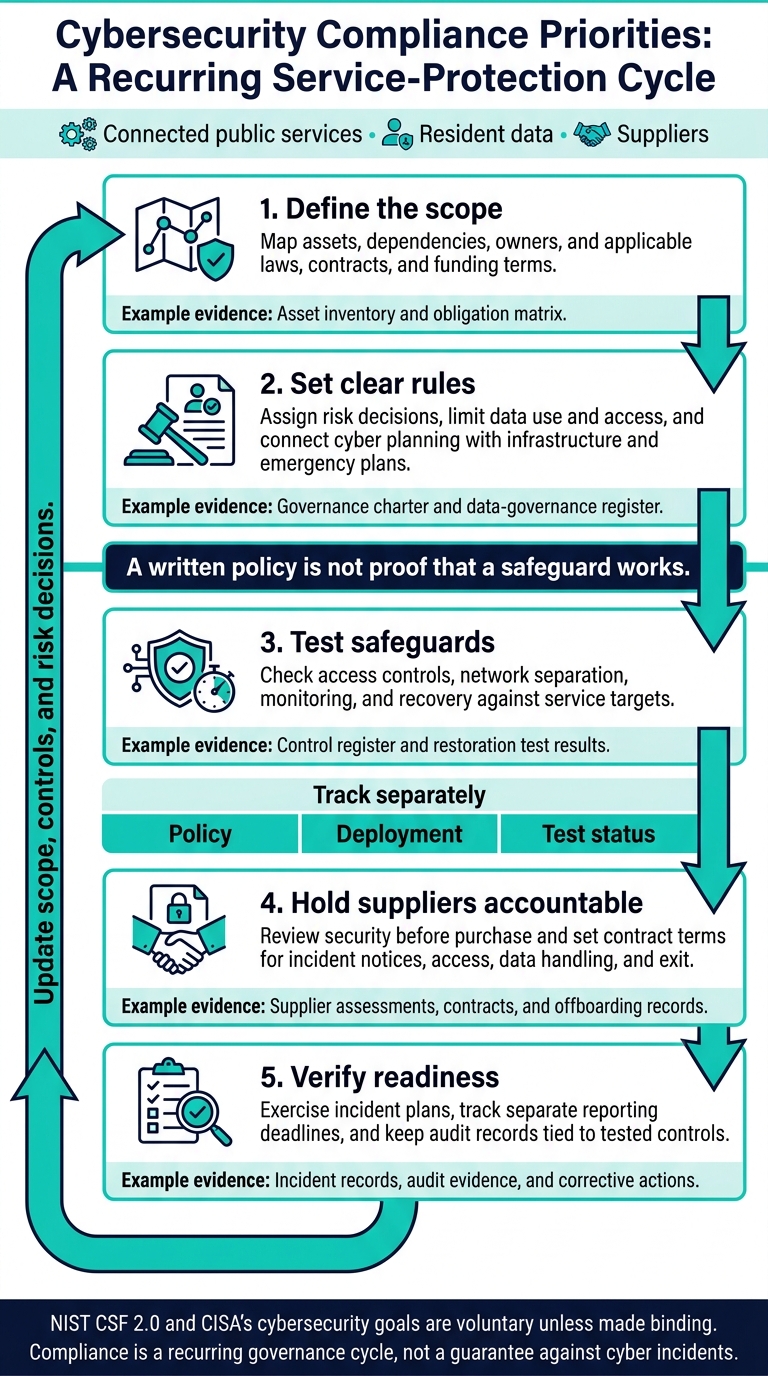
Smart Community Cybersecurity Compliance Cycle
Cybersecurity for Cities
sbb-itb-8baf5f1
2. Set Governance, Risk, and Data Rules
With the scope defined, assign decision rights, risk owners, and data rules for the assets already in the inventory.
Assign Risk Owners and Decision Authority
Use Govern to assign decision rights and Identify to connect risks to service continuity, safety, privacy, and equity. Approve a governance charter that names the executive sponsor, CISO or equivalent, OT owners, privacy official, procurement lead, emergency manager, and vendor owners. Specify who can accept residual risk, approve exceptions, authorize disclosure, disconnect life-safety systems, and approve restoration.[9][6][5]
Add governance fields to the inventory for devices, controllers, sensors, applications, APIs, cloud services, links, facilities, data stores, suppliers, and admin accounts. For each asset, record its owner, custodian, physical location, network zone, software or firmware version, data handled, dependencies, maintenance window, backup method, vendor support status, and replacement date.
Rank risks by their impact on life safety, continuity, privacy, accessibility, equity, legal duty, financial loss, trust, and environmental resilience. Document the affected service or population, current safeguards, residual risk, treatment owner, budget or resource needs, deadline, and verification method. Every exception needs an approving authority, compensating controls, an expiration or review date, and an escalation path if it becomes overdue.
Define Data Use, Access, and Retention
Before collecting data, document its purpose, collection authority, minimum fields, classification, recipients, retention basis, and deletion method. Set requirements for encryption, key management, role-based access, export approvals, and deletion. Require MFA for privileged and remote access where supported, and approved compensating controls for OT that cannot support it. Review access after role changes and contractor departures. Log data viewing, exports, and sharing.[7]
Use a data-governance register to turn these rules into requirements teams can enforce:
| Data category and system type | Owner | Permitted use | Retention basis | Access controls | Disclosure rules | Audit evidence |
|---|---|---|---|---|---|---|
| Camera footage / public-space cameras | Public safety or transportation department | Defined safety, incident, or traffic-management purposes; prohibit unrelated profiling or secondary use without authorization | Records schedule, investigation need, or preservation hold | Role-based access, MFA, export approval, immutable access logs | Apply applicable public-records rules and exemptions for privacy, security, or active investigations | Configuration, access logs, export approvals, deletion reports |
| Location records / transit, parking, or mobile applications | Transit or mobility program owner | Service delivery, planning, accessibility, and aggregate analysis; minimize precise historical tracking | Documented operational and legal need; aggregate or de-identify when possible | Least privilege, encryption, tokenization, separation of identifiers | Disclose only under applicable law, consent, contract, or an approved public-records process | Data-flow map, privacy assessment, query logs, sharing register |
| Utility account information / billing systems | Utility department or regulated provider | Billing, service operations, outage response, fraud prevention, and legally authorized analysis | Utility retention schedule, accounting requirements, litigation hold, or investigation | Separate customer and staff roles, MFA, encryption, monitored exports | Limit disclosure of personally identifiable and account-security information; route requests through records counsel | Access reviews, disclosure log, retention schedule, hold notices |
| Infrastructure control data / OT and SCADA | System or facility owner | Safe operation, maintenance, resilience planning, and incident response | Operational, safety, regulatory, and preservation requirements | Segmented networks, privileged access management, monitored vendor access, offline recovery copies | Restrict sensitive security and control details; disclose through authorized public-records and security review processes | Asset inventory, network diagram, privileged-session logs, backup tests |
A retention deadline never overrides a legal hold. Keep ordinary retention, archival retention, and preservation separate. Have counsel and the records officer validate schedules, public-records duties, and exemptions. Keep decisions about access for service operations separate from public disclosure decisions, including those involving nonpersonal infrastructure data.
Use these rules to guide the access controls, monitoring, and audit evidence in the next section.
Link Cyber Resilience to Infrastructure Planning
Once governance and data rules are in place, build cybersecurity into capital, climate, and emergency planning. CISA’s smart-city guidance calls for secure planning and design, proactive supply-chain risk management, and operational resilience.[10] Include cybersecurity in stakeholder engagement.
Assess whether flooding, heat, wildfire, severe storms, or power loss could disable communications, sensors, control centers, backups, or cloud connectivity. Pair physical resilience measures with cyber controls: geographically separated backups, resilient communications, manual operating procedures, segmented OT networks, tested restoration plans, and redundant power.
Bring cybersecurity, public works, emergency management, procurement, accessibility, and community stakeholders together in joint planning workshops. Prioritize investments that protect both service continuity and equitable access.
For example, keep transit information available through non-digital channels during a network outage.
3. Put Security Controls in Place and Test Them
With owners, data rules, and priorities set, put those obligations into practice through tested controls that protect service continuity, safety, privacy, and public trust.
Map each control to the highest-risk services. Use NIST CSF 2.0 and CISA CPGs as the implementation baseline.[6][3][4][8]
Secure Access, Devices, and Network Segments
Require phishing-resistant MFA for privileged and remote access. Route OT access through monitored gateways, block direct connections by default, and require time-limited authorization. Separate administrative, public application, IoT, and OT traffic into zones, then test those boundaries.
Keep IT and OT credentials separate. Use secure device provisioning, track certificate expiration, and follow approved baselines. Encrypt connections where supported. For legacy equipment, document compensating controls and replacement deadlines. Include cabinet-access checks and exercises covering phishing, removable media, and incident reporting.[4][15]
These access boundaries support OT monitoring and recovery.
Plan OT Monitoring and Recovery
Start with the services and recovery targets ranked in the infrastructure plan. Use passive monitoring where scanning could disrupt equipment. Set alerts for controller-logic changes, unexpected connections, and activity outside approved maintenance windows. Give every alert an owner and an escalation deadline.
Coordinate scanning, patching, and containment with operators and equipment providers. Before making changes, confirm safe operating conditions, backups, and rollback steps. Do not auto-isolate OT if doing so would endanger critical services.[12][13]
Keep recovery copies in offline, immutable, encrypted backups. Separate backup credentials from production credentials, restrict backup administration, and monitor backup failures. Back up controller logic, configurations, firmware, certificates, and operating procedures - not just business files.
Test restoration against each service’s recovery time objective (RTO) and recovery point objective (RPO). Verify manual operations, alternate communications, and restoration priorities. Record recovery time, data loss, failed dependencies, and safety issues.[11][12]
Enter each test result in the control register below.
Record Control Status and Test Results
Maintain a control register that links each safeguard to its governing obligation. Track policy, deployment, and test status separately. The register should document evidence, not imply completion. Use “compliant” only when you name both the obligation and the supporting evidence.
Review the register quarterly. Assign failed tests an owner, corrective action, deadline, and retest requirement.[3][4]
Show what is deployed, what has been tested, and what still needs remediation. Each row should connect a control to a critical service, an owner, and a test result.
Control objective Affected asset Accountable owner Implementation status Test method Evidence location Exception Remediation deadline Require phishing-resistant MFA for privileged remote access OT jump server and vendor access gateway OT security manager Partially implemented Review identity-provider configuration; conduct approved login test IAM report; access-review ticket Two legacy vendor accounts require compensating controls June 30, 2027 Segment public applications from OT networks Smart-parking platform and traffic-control network Network engineering lead Implemented; effectiveness test pending Firewall rule review and controlled segmentation test Network diagram; firewall export; test record Temporary maintenance path still open March 31, 2027 Detect unauthorized controller or configuration changes Water-treatment PLC environment Water operations manager In progress Passive-monitoring alert test and operator response exercise OT monitoring dashboard; exercise report Legacy PLC lacks native logging September 30, 2027 Restore critical OT configurations from protected backups Water-treatment servers and controller logic Business continuity owner Implemented; restoration test failed Full restoration exercise against documented RTO and RPO Backup report; restoration log; corrective-action plan Restoration depends on unavailable vendor license February 28, 2027
Use this control evidence to verify supplier access, monitoring obligations, and offboarding requirements in the next section.
4. Manage Vendor and Supply Chain Risk
Keep suppliers within the same compliance scope as owned assets. Record their access, data handling, and recovery roles in the register.
Assess Suppliers Before Signing Contracts
Maintain a supplier register linked to assets, contracts, risk tiers, and owners. Treat it as a vendor-specific layer of the asset inventory. Classify suppliers by network connectivity, the sensitivity of data they access, possible safety or public-service impact, recovery dependencies, and concentration risk - shared dependencies that could disrupt several services at once.
Use critical, significant, and standard tiers to determine assessment depth, monitoring, evidence, and approval requirements. NIST recommends managing supply-chain risk across the full product and service lifecycle and integrating it into acquisition and organizational risk management.[16][17]
Review each supplier’s security program, incident history, subcontractors, data locations, and continuity evidence. Check independent assurance for its scope, assessment period, exclusions, exceptions, control descriptions, auditor qualifications, and remediation status. A certificate or report does not prove compliance.
Small contractors may provide configuration records or interview notes instead of formal assurance. Even so, privileged access and essential-service dependencies require baseline safeguards. Record gaps, compensating controls, approvals, and correction deadlines.
Set Contract Security and Exit Terms
Turn the risk assessment into enforceable contract requirements covering security and privacy obligations, access control, logging, patching, disclosure, subcontractor controls, and continuity. Apply the established time-limited, segmented access model to suppliers.
For OT suppliers, require approved remote access, jump hosts, time-limited maintenance windows, emergency access, and immediate revocation when work ends. Set a contractual incident notice deadline separate from any statutory reporting duty:
For example, require notice within 24 hours after the supplier reasonably confirms a security incident affecting community systems or data.
Require follow-up updates, evidence preservation, and a named incident lead. The supplier should not decide legal reporting obligations on its own.[18][19][20]
Define data ownership, permitted use, retention, return, deletion, portability, and retention exceptions required by law. Before signing, include transition support, recovery dependencies, and continuity arrangements. Procurement and legal teams should review remedies, enforcement, and exceptions. For critical services, test recovery and exit arrangements before signing.[19]
These terms should support incident response, access revocation, and audit evidence.
Review Suppliers Through Offboarding
Review critical suppliers annually and other suppliers at renewal. Conduct additional reviews after a material incident, significant vulnerability, ownership or financial change, new subcontractor, changed data location, major product or architecture change, expanded service scope, new privileged access, or changed recovery dependency.[18]
Add the supplier-specific lifecycle evidence below to the control register.
| Lifecycle stage | Required checks | Contractual safeguards | Reassessment triggers | Accountable owners | Evidence |
|---|---|---|---|---|---|
| Procurement | Supplier criticality, connectivity, data, safety impact, recovery dependency, concentration risk, and assurance scope | Security requirements, response duties, subcontractor controls, evidence rights | Before award | Procurement, security, legal, system owner | Supplier risk tier, proposal, assessment, approval |
| Onboarding | Supplier identities, access paths, data flows, configurations, training, and continuity contacts | Least privilege, MFA, approved remote access, logging, data-use limits | New access, system expansion, changed data | System owner, security, supplier manager | Supplier access record, data-flow review, onboarding tests |
| Operation | Supplier performance, vulnerabilities, incidents, subcontractors, access, and remediation | Patch deadlines, reporting, audit cooperation, exercises, service levels, corrective actions | Incident, finding, vulnerability, subcontractor change, outage | Supplier manager, security, operations | Supplier reviews, access logs, remediation tickets, exercise results |
| Renewal | Supplier risk, performance, unresolved findings, price, scope, or service changes, and continued need | Updated terms, remediation commitments, renewal conditions, termination rights | Renewal, major upgrade, ownership change, new jurisdiction | Procurement, legal, security, business owner | Renewal assessment, updated assurance, risk acceptance |
| Offboarding | Revoke access, recover assets, transfer knowledge, return data or delete it, and verify continuity | Portability, transition support, deletion certification, retention exceptions required by law | Termination, replacement, material breach, provider failure | System owner, security, legal, records manager | Supplier access-disablement logs, asset receipt, data export, deletion certificate, closure approval |
Add supplier incidents, access revocations, and deletion certificates to incident response and audit records. Use the same evidence set for incident reviews and audit preparation.
5. Prepare for Incidents, Audits, and Regular Reviews
Once controls, suppliers, and recovery plans are in place, test how the community responds when systems fail.
Test Community-Wide Incident Response
Set incident severity based on public safety, service impact, data sensitivity, geographic reach, downtime, and legal or contractual impact. Follow the governance charter’s assignments for the incident commander and approvers. Assign a technical lead, OT lead, communications lead, legal or privacy reviewer, executive sponsor, and vendor contacts. Clearly state who can isolate systems, shut down services, approve restoration, contact law enforcement, and issue public statements.[14][21]
Have counsel and privacy staff maintain a notification register that tracks each requirement separately. It should cover community-wide legal, regulatory, and public-notice triggers; recipients; deadlines or legally required delay standards; required content; and approval paths. Do not assume one reporting deadline applies to every requirement. Prepare plain-language resident notices, alternative formats where needed, and backup communication channels that work when websites or telecommunications are disrupted.[23]
Run exercises with agencies, utilities, and suppliers for ransomware, IoT compromise, OT disruption, data exposure, supplier compromise, cloud failure, and telecom outages. Mark fictional scenarios as hypothetical. Record each scenario, detection and escalation times, affected assets and services, decisions, preserved evidence, actions taken, recovery milestones, and lessons learned. Test restoration in an isolated environment against recovery time and recovery point objectives. Require trained operators to validate OT safety before reconnection. A successful backup does not prove recovery readiness.[24][14][22]
Organize Audit Evidence and Measure Readiness
Use incident records to support audits and recurring reviews.
Store governance records, inventories, diagrams, risk assessments, access reviews, training records, vulnerability and patch reports, supplier files, incident records, backup and restoration tests, exercises, and corrective actions in a controlled repository. Link every record to a control, owner, and obligation. Assign evidence owners and set restricted access, retention rules, and version control. Preserve forensic originals and chain-of-custody records. Each control’s status should link to proof that it worked - not just a written policy.
Build a risk-based calendar for routine access and privileged-account reviews, vulnerability and backup checks, supplier monitoring, and incident-log reviews. Report metrics monthly or quarterly, based on risk. Schedule annual policy approval, enterprise risk assessment, restoration tests, tabletop exercises, supplier reassessments, and independent reviews.
Track inventory coverage, MFA adoption, supplier assessment coverage, restoration success, critical-vulnerability remediation time, and overdue actions. Define the population measured and reporting period for each metric. Give every finding an owner, deadline, interim mitigation, and closure test. Require two-person review before closing a finding. Escalate unresolved high risks for time-limited acceptance and funding decisions.
Conclusion: Check Compliance Readiness
Use the same evidence trail to close findings, renew approvals, and update risk decisions.
Before sign-off, confirm that the obligation matrix, control register, supplier file, and incident log agree. Verify obligations and check that scope and owners are current. Confirm that data rules and controls have been tested, notification duties are documented, suppliers participate in exercises, and recovery meets approved objectives. Audit evidence must be traceable, and unresolved risks must have authorized decisions and tracked corrective actions. Compliance is a recurring governance cycle, not a guarantee against cyber incidents.[14][21]
FAQs
Which cybersecurity requirements apply to our community?
Smart community systems need clear data governance and privacy policies that spell out what data can be collected, how long it’s kept, who can access it, and how it can be shared. Require encryption for data both at rest and in transit, timely breach notifications, and vendor contracts that set explicit data protection requirements and penalties for noncompliance.
Conduct regular audits and maintain an audit trail to support audit preparation and enforcement [1].
How can we prioritize compliance on a limited budget?
Start with a gap analysis to identify major risks and data sources [1]. Test processes in one sector before scaling. Use simple inventory tools already in place and standardized templates to cut administrative work [1].
Group smaller projects into a single pipeline to spread transaction costs and attract investors [2]. Build sustainability goals into existing operations and budget cycles rather than creating separate, costly systems [3].
How do we secure legacy systems without disrupting services?
Set clear data security policies that require timely breach notifications. Build privacy into system design by collecting only the data needed and using encryption. Require vendors and operators to comply with these policies through their contracts.
During upgrades, run old and new systems in parallel to test new controls against legacy workflows. Keep governance responsibilities clear, enforce access controls, and maintain traceable audit trails from source systems. Coordinate continuity plans, with agreed communication and response procedures, to keep critical services running. [1][2][3]



FAQ