
Jul 2, 2026
How Crowdfunding Supports Green PPPs
Sustainability Strategy
In This Article
Retail crowdfunding can help fund local green PPPs—choose the right model, use Reg CF/Reg A, and set clear protections and reporting.
How Crowdfunding Supports Green PPPs
Crowdfunding can help fill funding gaps for green public-private partnerships when public money is slow, the project is easy to explain, and local people can see the result. This approach helps empower communities by involving them directly in the transition to sustainable infrastructure. In the U.S., this works best for projects like community solar, school energy upgrades, stormwater systems, and EV charging sites. The model is strongest when the project has clear outputs, a set funding target, plain disclosures, and a legal path under Reg CF or Reg A.
Here’s the short version:
I’d use crowdfunding when a project has local support, visible public impact, and small-to-mid funding needs
Debt-style crowdfunding often fits best when cash flow is steady and repayment terms are easy to map
Donation or reward models fit projects with little direct revenue
Small contributors need plain risk disclosures, funding thresholds, reporting dates, and clear use of proceeds
Timing matters: prepare before award, then launch after award so the campaign lines up with financial close
In the U.S., Reg CF allows up to $5 million per year, while Reg A allows up to $75 million
Crowdfunding works best with bonds, grants, and other capital sources - not as a stand-alone fix
A few data points make the case. By late 2025, Climatize said it had funded 26 renewable energy projects with more than $12.3 million. Connecticut Green Bank’s Green Liberty Notes brought in more than $4 million, and over 60% of investments were $1,000 or less. That tells me small-dollar participation can work when the offer is simple and the project story is local.
If I were sizing up a green PPP for crowdfunding, I’d look at five things first:
Project fit - Can people see it, understand it, and track the result?
Funding model - Is this better suited to donations, rewards, debt, or equity?
Contributor protection - Are risks, repayment terms, and backup rights spelled out?
Compliance - Is the campaign set up through the right SEC path and intermediary?
Capital stack role - Is crowdfunding leading, or just filling one layer of the deal?
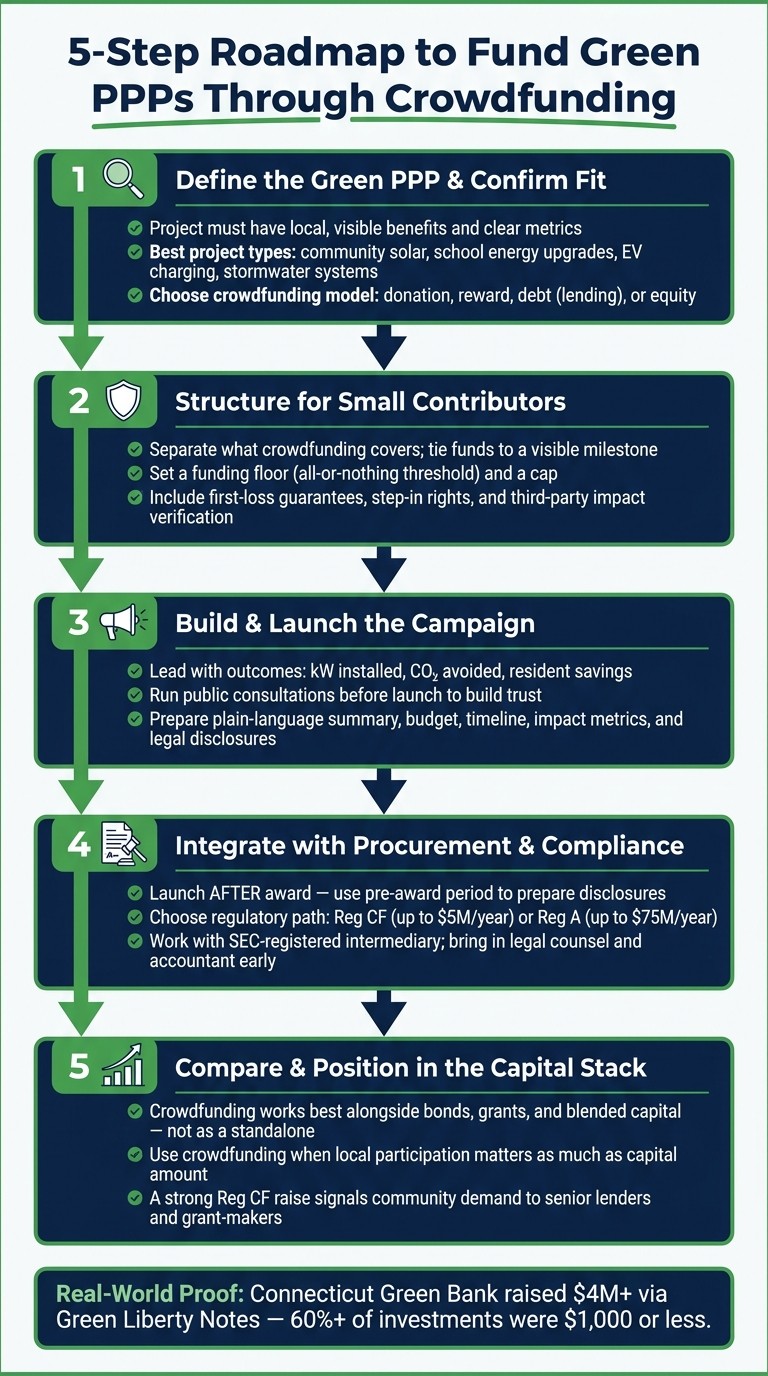
5-Step Roadmap to Fund Green PPPs Through Crowdfunding
Quick comparison
Option | Best for | Return to contributor | Funding size | Public participation |
|---|---|---|---|---|
Crowdfunding | Local green PPPs with visible results | None, fixed interest, or profit share | Small to mid-size | High |
Green bonds | Large public infrastructure | Fixed income | Large | Low |
Grants | Pilot or public-good projects | None | Small to mid-size | Medium |
Blended capital | Mixed-risk projects | Depends on structure | Mid to large | Medium |
My takeaway is simple: crowdfunding works when people can connect their dollars to a project they know, trust, and want in their community. The rest comes down to deal structure, legal setup, and steady reporting.
Step 1: Define the green PPP and confirm crowdfunding is a good fit
Crowdfunding tends to work best when a green PPP delivers local, visible benefits, has clear metrics, and needs a funding amount that many people can help cover. Before you add it to the capital stack, put the project through three basic tests.
Crowdfunding works best when contributors can see the asset, understand the benefit, and track the result.
Identify project types that work well with crowdfunding
Projects that do well with the crowd are usually simple to see and simple to measure. Think solar arrays on schools, community solar, energy-efficiency upgrades in underserved neighborhoods, urban tree planting, and EV charging hubs.
The strongest campaigns connect each dollar to outputs people can follow, such as kilowatts installed, tons of CO2 avoided, or resident savings. [1]
Choose the crowdfunding model that matches the PPP cash flow
The model should line up with how the project makes or returns money. If cash flow is steady and easy to map, debt can make sense. If the project is public-facing but does not produce much direct revenue, rewards or donations may be the better lane.
Crowdfunding Model | Best Project Fit | Contributor Expectation | Risk Profile |
|---|---|---|---|
Donation-based | Small-scale community improvements | Impact only | No financial return expected |
Reward-based | Civic/social projects (parks, street improvements) | Symbolic rewards or recognition | Low financial risk; high visibility |
Lending-based (Debt) | Community solar, energy efficiency retrofits | Repayment + fixed interest | Moderate; relies on stable cash flow |
Investment-based (Equity) | Private-led revenue projects inside a PPP | Profit share, dividends, or exit proceeds | Higher; longer timelines, lower liquidity |
For many green PPPs with predictable revenue, lending-based crowdfunding is often the best match because contributors get a clear repayment path. In late 2025, Minnesota developer Enterprise Energy raised $600,000 on the Climatize platform through a 24-month note at 11.25% fixed interest, with repayment tied to project financing and power-purchase revenues. [1]
Reward-based models fit civic projects that people can easily see in their daily lives but that have limited revenue. Donation-based models are better for smaller community improvements. Equity can fit when the private partner is building a revenue-producing business inside the PPP, but it brings more regulatory work and longer wait times before contributors may see any return. [2]
If the fit is there, the next step is to build contributor protections, disclosures, and funding thresholds into the deal.
Step 2: Structure the PPP so small contributors can fund it with confidence
Once crowdfunding makes sense, set up the PPP so small contributors can back it without feeling like they're walking in blind. People need to see where their money goes, what shields it, and how you'll track results.
Set the capital stack, use of proceeds, and funding thresholds
Start by separating what crowdfunding will pay for. Don’t ask contributors to cover the whole project. Tie their money to a clear, visible milestone instead, like the design phase, construction, or commissioning of EV charging stations. [2]
Set both a floor and a cap. An all-or-nothing threshold helps here, since campaigns that miss the target return funds automatically. [5][2]
The capital stack should also show where crowdfunding sits next to other funding sources. If there’s a first-loss guarantee or a similar layer that absorbs risk before small contributors take any hit, say so plainly. When people can see that another funding source takes the first loss, the crowdfunded tranche feels a lot easier to back.
Build contributor protections, disclosures, and governance into the deal
Write the PPP agreement in plain English. Lay out construction risk, performance risk, and demand risk. Spell out repayment rules, revenue-sharing terms, and who owns delivery. Periodic updates should be required, not treated like a nice extra. [2][5]
A joint steering committee can keep decision-making open after launch. Step-in rights give the public sector a way to protect the project if the private partner falls short. Third-party verification of impact metrics matters too. Contributors shouldn’t have to take anyone’s word for it.
Governance/Protection Term | Function in Green PPP | Benefit to Small Contributors |
|---|---|---|
First-Loss Guarantee | Public or philanthropic funds absorb initial losses | Reduces individual risk; improves risk-adjusted return |
Joint Steering Committee | Multi-stakeholder decision-making body | Ensures community voice and transparency in delivery |
Third-Party Verification | Independent audit of impact metrics | Builds trust that environmental goals are actually met |
Step-in Rights | Allows public sector to take over if private partner fails | Protects project continuity and public benefit |
Use measurable impact metrics to build public trust
From day one, publish a short set of metrics people can follow without digging through fine print:
Dollars raised
Milestone completion
Emissions reduced
Energy saved
Reporting timeliness
Track compliance items on a separate line, including KYC/AML, securities filings, tax treatment, and data protection.
Next, align the crowdfunding campaign with procurement, compliance, and financial close.
Step 3: Build and launch the crowdfunding campaign
With the capital stack in place and protections set, it’s time to turn the deal into a campaign people can understand and back. That means clear messaging, focused outreach, and milestones you can track.
Write a campaign case that links dollars to visible outcomes
Start with the result, not the technical details. People want to know what their money will do in plain terms. Tie the ask to concrete, auditable outcomes: kilowatts of solar capacity installed, tons of CO₂ avoided each year, or dollar savings delivered to low-income households.
Gold Leaf Farming offers a good example. In 2025, it used the Climatize platform to finance a 370 kW solar array in California, with a 48-month note at 9.5% simple interest and a stated goal of avoiding 500 metric tons of CO₂ each year. [1] Those terms gave contributors something specific to assess.
If your PPP uses a revenue-share or fixed-rate note, put the terms front and center. Don’t make people hunt for them.
Plan outreach to residents, partners, and mission-aligned stakeholders
Once the message is set, focus on the people most likely to fund the project and help move it forward. A strong campaign doesn’t rely on luck. It needs a clear distribution plan that reaches residents, public agencies, private partners, and mission-aligned stakeholders through the right channels.
Public consultations should come first. They help build trust and bring in local input before positions harden. Industry days can then help test partner interest and capabilities. Impact reports keep contributors and aligned stakeholders informed as the campaign moves ahead.
Outreach Tool | Target Audience | Purpose |
|---|---|---|
Public consultations | Residents, local community groups | Build trust and gather local input |
Industry days | Private investors, contractors | Gauge private partner capabilities |
Impact reports | Contributors, mission-aligned stakeholders | Demonstrate value and build trust |
Prepare campaign materials, reporting schedule, and launch milestones
Before launch, get the full campaign package ready. That includes a plain-language project summary, a clear budget showing how funds will be used, a project timeline with named milestones, impact metrics, and all required legal disclosures.
Set the reporting schedule before the campaign opens. Then tie each update to actual milestone completions. That keeps the campaign credible, compliant, and in step with delivery timelines. Connecticut's Green Liberty Notes show how low minimums and clear reporting can broaden participation. [1]
Step 4: Integrate crowdfunding into procurement, compliance, and delivery
Crowdfunding needs to fit inside procurement, compliance, and delivery - not sit off to the side and slow things down. The aim is simple: bring this funding source into the project timeline without disrupting award, filings, or financial close.
Align the campaign with feasibility, procurement, and financial close
Timing matters more than many sponsors think. Launch crowdfunding after award, not before. Use the pre-award period to get the disclosure package and funding structure ready, then line up the campaign window and funding threshold with financial close milestones so you don't end up with a gap in capital. [4]
Once the award is in place, finish the disclosures, risk documents, and funding terms, then open the campaign so it matches the close schedule. SEC-required disclosure materials should include the project risk register, contract agreements, and feasibility studies. [4]
A regulated platform can also make ownership records much easier to handle. Instead of showing hundreds of small investors as separate entries, the platform can present them as a single line item. That can help avoid admin slowdowns during financial close. [3]
Use the pre-award period to prepare disclosures and the post-award period to launch.
Address U.S. legal and reporting requirements early
In the U.S., the two main securities paths for green PPP crowdfunding are Regulation Crowdfunding (Reg CF) and Regulation A (Reg A). Reg CF allows raises of up to $5 million per year from accredited and non-accredited investors. Reg A allows up to $75 million per year and calls for audited financials. [3]
Framework | Annual Raise Limit | Investor Eligibility | Key Filing |
|---|---|---|---|
Reg CF | Up to $5 million [3] | Accredited and non-accredited investors | Form C (SEC) |
Reg A | Up to $75 million [3] | Accredited and non-accredited investors | Offering Circular |
Whichever route you take, work through the SEC-registered intermediary required under that framework. [3][4] Bring in legal counsel and an accountant early so Form C filings or offering circulars are prepared correctly. [3] A transfer agent can manage investor records and make ongoing ownership tracking much simpler, especially when a project has a large pool of small contributors. [3]
Track and report performance after funds are deployed
Reporting doesn't end at financial close. Based on the regulation used, sponsors must send updates on the required schedule, covering construction milestones, audited financials, and impact metrics. [4] Use the platform to share those updates with contributors, including audited financial statements, SEC-required disclosures, and progress during construction and O&M. [4]
Set up the reporting system before funds are deployed so updates go out on time and in a consistent format. Each update should connect back to construction milestones and impact metrics. Keep that reporting steady through construction and into operations.
With compliance and reporting in place, compare crowdfunding with bonds, grants, and blended capital in Step 5.
Step 5: Compare crowdfunding with other green PPP financing tools
Once the deal structure and compliance path are in place, one practical question remains: where does crowdfunding sit in the capital stack?
When crowdfunding is the strongest option for a green PPP
Crowdfunding works best for green PPPs with clear local upside, modest funding needs, and strong resident interest. The big draw is simple: it turns residents into stakeholders. That can ease local pushback because people now have a direct financial interest in the project, not just an opinion about it.
It also helps when federal climate funding is slow to arrive or hard to count on. In those cases, retail investors can cover part of the gap.
The Connecticut Green Bank offers a strong example. Through Honeycomb Credit's "Green Liberty Notes", the bank has raised over $4 million for energy-efficiency programs, with more than 60% of investments coming in at $1,000 or less. [1] That level of retail participation is much harder to get through bonds or blended capital.
How crowdfunding compares with bonds, grants, and blended capital
The table below shows where crowdfunding should lead, support, or sit alongside other financing tools.
Financing Tool | Typical Project Size | Investor Type | Community Engagement | Risk/Return Profile | Best-Fit Green PPP Use Case |
|---|---|---|---|---|---|
Crowdfunding (Reg CF/Reg A) | Small to moderate | Retail / Local residents | Very high - stakeholder ownership | Moderate risk / project-based returns | Community solar, local EV charging, energy-efficiency retrofits |
Green Bonds | Large-scale | Institutional / ESG funds | Low | Low risk / long-term debt | Large-scale transit, municipal water systems |
Blended Finance | Mid- to large-scale | Mixed (public + private) | Moderate | De-risked / market rate | Climate adaptation, emerging-market energy |
Public Grants | Small pilot to mid-scale | Government / philanthropy | Moderate | No financial return | Pilot technology, underserved-area infrastructure |
A simple way to think about it:
Use crowdfunding when local participation matters as much as the amount of capital.
Use bonds, grants, or blended capital when project scale or institutional funding matters more.
A strong Reg CF raise can also do more than bring in money. It can show senior lenders and grant-makers that the community wants the project, while lowering perceived social risk. [3][1]
Conclusion: A practical roadmap for funding green PPPs through crowdfunding
After weighing crowdfunding against bonds, grants, and blended capital, the takeaway is straightforward: crowdfunding is not a substitute for bonds, grants, or institutional capital. It works best alongside them, giving local residents a direct financial stake while helping build community support.
When used well, crowdfunding brings in community capital, public buy-in, and early proof of demand for a green PPP. That kind of signal can help a project gain traction with public and institutional stakeholders. Programs like the Connecticut Green Bank's Green Liberty Notes show this can work at scale today. The program has raised more than $4 million, and over 60% of investments were $1,000 or less.[1]
FAQs
How much can crowdfunding realistically cover in a green PPP?
Crowdfunding can play a useful role in funding green public-private partnerships, especially for smaller projects that people can see and use in their daily lives - think parks, bike lanes, EV charging stations, and community solar. Depending on the size of the project and the level of local support, individual efforts have brought in hundreds of thousands of dollars.
For larger infrastructure projects, crowdfunding tends to work best as one piece of a broader blended finance plan. In most cases, that means pairing it with public funding and private equity rather than relying on it alone.
What are the biggest risks for small contributors?
The main risks are business failure, fraud, and limited liquidity. Infrastructure projects often take years to pay back, so your money can stay tied up for a long time with no simple way to exit or sell your stake.
There’s also the risk of misreading how the project is doing or how it’s set up. That’s why it helps to go through the disclosed materials with care, especially risk registers and financial statements, before putting in any funds.
When should a green PPP launch its crowdfunding campaign?
A green public-private partnership should launch its crowdfunding campaign only when the project is fully prepared. That means clear goals, open financials, and a story people can follow without squinting at the details.
Public support doesn’t start on launch day. It starts earlier, through steady communication with community groups and project partners. When people hear about a project early and see that updates keep coming, trust has a chance to grow.
Council Fire can help line up these efforts through strategic guidance on stakeholder collaboration and project planning.
Related Blog Posts
Latest Articles
©2025

Narrative Change and Power Building: The Missing Half of Advocacy
Narrative change is the process of disrupting dominant narratives that normalize inequity and advancing new narratives from historically marginalized communities.

Funding Resilience Without Federal Grants
BRIC is unreliable and FEMA is shrinking. Here's how cities fund climate resilience with dedicated revenue, blended finance, and a coordinating authority.

The ESG Blind Spot: How AI Is Finding Risks in Companies Nobody Else Is Watching
Norway's sovereign wealth fund uses AI to screen 7,200 portfolio companies for forced labor and corruption within 24 hours. The real story is the emerging-market coverage gap that traditional ESG data vendors miss — and what it means for any company with a global supply chain.
Narrative Change and Power Building: The Missing Half of Advocacy
Narrative change is the process of disrupting dominant narratives that normalize inequity and advancing new narratives from historically marginalized communities.
Funding Resilience Without Federal Grants
BRIC is unreliable and FEMA is shrinking. Here's how cities fund climate resilience with dedicated revenue, blended finance, and a coordinating authority.
The ESG Blind Spot: How AI Is Finding Risks in Companies Nobody Else Is Watching
Norway's sovereign wealth fund uses AI to screen 7,200 portfolio companies for forced labor and corruption within 24 hours. The real story is the emerging-market coverage gap that traditional ESG data vendors miss — and what it means for any company with a global supply chain.
FAQ
01
What does it really mean to “redefine profit”?
02
What makes Council Fire different?
03
Who does Council Fire work with?
04
What does working with Council Fire actually look like?
05
How does Council Fire help organizations turn big goals into action?
06
How does Council Fire define and measure success?
Jul 2, 2026
How Crowdfunding Supports Green PPPs
Sustainability Strategy
In This Article
Retail crowdfunding can help fund local green PPPs—choose the right model, use Reg CF/Reg A, and set clear protections and reporting.
How Crowdfunding Supports Green PPPs
Crowdfunding can help fill funding gaps for green public-private partnerships when public money is slow, the project is easy to explain, and local people can see the result. This approach helps empower communities by involving them directly in the transition to sustainable infrastructure. In the U.S., this works best for projects like community solar, school energy upgrades, stormwater systems, and EV charging sites. The model is strongest when the project has clear outputs, a set funding target, plain disclosures, and a legal path under Reg CF or Reg A.
Here’s the short version:
I’d use crowdfunding when a project has local support, visible public impact, and small-to-mid funding needs
Debt-style crowdfunding often fits best when cash flow is steady and repayment terms are easy to map
Donation or reward models fit projects with little direct revenue
Small contributors need plain risk disclosures, funding thresholds, reporting dates, and clear use of proceeds
Timing matters: prepare before award, then launch after award so the campaign lines up with financial close
In the U.S., Reg CF allows up to $5 million per year, while Reg A allows up to $75 million
Crowdfunding works best with bonds, grants, and other capital sources - not as a stand-alone fix
A few data points make the case. By late 2025, Climatize said it had funded 26 renewable energy projects with more than $12.3 million. Connecticut Green Bank’s Green Liberty Notes brought in more than $4 million, and over 60% of investments were $1,000 or less. That tells me small-dollar participation can work when the offer is simple and the project story is local.
If I were sizing up a green PPP for crowdfunding, I’d look at five things first:
Project fit - Can people see it, understand it, and track the result?
Funding model - Is this better suited to donations, rewards, debt, or equity?
Contributor protection - Are risks, repayment terms, and backup rights spelled out?
Compliance - Is the campaign set up through the right SEC path and intermediary?
Capital stack role - Is crowdfunding leading, or just filling one layer of the deal?
5-Step Roadmap to Fund Green PPPs Through Crowdfunding
Quick comparison
Option | Best for | Return to contributor | Funding size | Public participation |
|---|---|---|---|---|
Crowdfunding | Local green PPPs with visible results | None, fixed interest, or profit share | Small to mid-size | High |
Green bonds | Large public infrastructure | Fixed income | Large | Low |
Grants | Pilot or public-good projects | None | Small to mid-size | Medium |
Blended capital | Mixed-risk projects | Depends on structure | Mid to large | Medium |
My takeaway is simple: crowdfunding works when people can connect their dollars to a project they know, trust, and want in their community. The rest comes down to deal structure, legal setup, and steady reporting.
Step 1: Define the green PPP and confirm crowdfunding is a good fit
Crowdfunding tends to work best when a green PPP delivers local, visible benefits, has clear metrics, and needs a funding amount that many people can help cover. Before you add it to the capital stack, put the project through three basic tests.
Crowdfunding works best when contributors can see the asset, understand the benefit, and track the result.
Identify project types that work well with crowdfunding
Projects that do well with the crowd are usually simple to see and simple to measure. Think solar arrays on schools, community solar, energy-efficiency upgrades in underserved neighborhoods, urban tree planting, and EV charging hubs.
The strongest campaigns connect each dollar to outputs people can follow, such as kilowatts installed, tons of CO2 avoided, or resident savings. [1]
Choose the crowdfunding model that matches the PPP cash flow
The model should line up with how the project makes or returns money. If cash flow is steady and easy to map, debt can make sense. If the project is public-facing but does not produce much direct revenue, rewards or donations may be the better lane.
Crowdfunding Model | Best Project Fit | Contributor Expectation | Risk Profile |
|---|---|---|---|
Donation-based | Small-scale community improvements | Impact only | No financial return expected |
Reward-based | Civic/social projects (parks, street improvements) | Symbolic rewards or recognition | Low financial risk; high visibility |
Lending-based (Debt) | Community solar, energy efficiency retrofits | Repayment + fixed interest | Moderate; relies on stable cash flow |
Investment-based (Equity) | Private-led revenue projects inside a PPP | Profit share, dividends, or exit proceeds | Higher; longer timelines, lower liquidity |
For many green PPPs with predictable revenue, lending-based crowdfunding is often the best match because contributors get a clear repayment path. In late 2025, Minnesota developer Enterprise Energy raised $600,000 on the Climatize platform through a 24-month note at 11.25% fixed interest, with repayment tied to project financing and power-purchase revenues. [1]
Reward-based models fit civic projects that people can easily see in their daily lives but that have limited revenue. Donation-based models are better for smaller community improvements. Equity can fit when the private partner is building a revenue-producing business inside the PPP, but it brings more regulatory work and longer wait times before contributors may see any return. [2]
If the fit is there, the next step is to build contributor protections, disclosures, and funding thresholds into the deal.
Step 2: Structure the PPP so small contributors can fund it with confidence
Once crowdfunding makes sense, set up the PPP so small contributors can back it without feeling like they're walking in blind. People need to see where their money goes, what shields it, and how you'll track results.
Set the capital stack, use of proceeds, and funding thresholds
Start by separating what crowdfunding will pay for. Don’t ask contributors to cover the whole project. Tie their money to a clear, visible milestone instead, like the design phase, construction, or commissioning of EV charging stations. [2]
Set both a floor and a cap. An all-or-nothing threshold helps here, since campaigns that miss the target return funds automatically. [5][2]
The capital stack should also show where crowdfunding sits next to other funding sources. If there’s a first-loss guarantee or a similar layer that absorbs risk before small contributors take any hit, say so plainly. When people can see that another funding source takes the first loss, the crowdfunded tranche feels a lot easier to back.
Build contributor protections, disclosures, and governance into the deal
Write the PPP agreement in plain English. Lay out construction risk, performance risk, and demand risk. Spell out repayment rules, revenue-sharing terms, and who owns delivery. Periodic updates should be required, not treated like a nice extra. [2][5]
A joint steering committee can keep decision-making open after launch. Step-in rights give the public sector a way to protect the project if the private partner falls short. Third-party verification of impact metrics matters too. Contributors shouldn’t have to take anyone’s word for it.
Governance/Protection Term | Function in Green PPP | Benefit to Small Contributors |
|---|---|---|
First-Loss Guarantee | Public or philanthropic funds absorb initial losses | Reduces individual risk; improves risk-adjusted return |
Joint Steering Committee | Multi-stakeholder decision-making body | Ensures community voice and transparency in delivery |
Third-Party Verification | Independent audit of impact metrics | Builds trust that environmental goals are actually met |
Step-in Rights | Allows public sector to take over if private partner fails | Protects project continuity and public benefit |
Use measurable impact metrics to build public trust
From day one, publish a short set of metrics people can follow without digging through fine print:
Dollars raised
Milestone completion
Emissions reduced
Energy saved
Reporting timeliness
Track compliance items on a separate line, including KYC/AML, securities filings, tax treatment, and data protection.
Next, align the crowdfunding campaign with procurement, compliance, and financial close.
Step 3: Build and launch the crowdfunding campaign
With the capital stack in place and protections set, it’s time to turn the deal into a campaign people can understand and back. That means clear messaging, focused outreach, and milestones you can track.
Write a campaign case that links dollars to visible outcomes
Start with the result, not the technical details. People want to know what their money will do in plain terms. Tie the ask to concrete, auditable outcomes: kilowatts of solar capacity installed, tons of CO₂ avoided each year, or dollar savings delivered to low-income households.
Gold Leaf Farming offers a good example. In 2025, it used the Climatize platform to finance a 370 kW solar array in California, with a 48-month note at 9.5% simple interest and a stated goal of avoiding 500 metric tons of CO₂ each year. [1] Those terms gave contributors something specific to assess.
If your PPP uses a revenue-share or fixed-rate note, put the terms front and center. Don’t make people hunt for them.
Plan outreach to residents, partners, and mission-aligned stakeholders
Once the message is set, focus on the people most likely to fund the project and help move it forward. A strong campaign doesn’t rely on luck. It needs a clear distribution plan that reaches residents, public agencies, private partners, and mission-aligned stakeholders through the right channels.
Public consultations should come first. They help build trust and bring in local input before positions harden. Industry days can then help test partner interest and capabilities. Impact reports keep contributors and aligned stakeholders informed as the campaign moves ahead.
Outreach Tool | Target Audience | Purpose |
|---|---|---|
Public consultations | Residents, local community groups | Build trust and gather local input |
Industry days | Private investors, contractors | Gauge private partner capabilities |
Impact reports | Contributors, mission-aligned stakeholders | Demonstrate value and build trust |
Prepare campaign materials, reporting schedule, and launch milestones
Before launch, get the full campaign package ready. That includes a plain-language project summary, a clear budget showing how funds will be used, a project timeline with named milestones, impact metrics, and all required legal disclosures.
Set the reporting schedule before the campaign opens. Then tie each update to actual milestone completions. That keeps the campaign credible, compliant, and in step with delivery timelines. Connecticut's Green Liberty Notes show how low minimums and clear reporting can broaden participation. [1]
Step 4: Integrate crowdfunding into procurement, compliance, and delivery
Crowdfunding needs to fit inside procurement, compliance, and delivery - not sit off to the side and slow things down. The aim is simple: bring this funding source into the project timeline without disrupting award, filings, or financial close.
Align the campaign with feasibility, procurement, and financial close
Timing matters more than many sponsors think. Launch crowdfunding after award, not before. Use the pre-award period to get the disclosure package and funding structure ready, then line up the campaign window and funding threshold with financial close milestones so you don't end up with a gap in capital. [4]
Once the award is in place, finish the disclosures, risk documents, and funding terms, then open the campaign so it matches the close schedule. SEC-required disclosure materials should include the project risk register, contract agreements, and feasibility studies. [4]
A regulated platform can also make ownership records much easier to handle. Instead of showing hundreds of small investors as separate entries, the platform can present them as a single line item. That can help avoid admin slowdowns during financial close. [3]
Use the pre-award period to prepare disclosures and the post-award period to launch.
Address U.S. legal and reporting requirements early
In the U.S., the two main securities paths for green PPP crowdfunding are Regulation Crowdfunding (Reg CF) and Regulation A (Reg A). Reg CF allows raises of up to $5 million per year from accredited and non-accredited investors. Reg A allows up to $75 million per year and calls for audited financials. [3]
Framework | Annual Raise Limit | Investor Eligibility | Key Filing |
|---|---|---|---|
Reg CF | Up to $5 million [3] | Accredited and non-accredited investors | Form C (SEC) |
Reg A | Up to $75 million [3] | Accredited and non-accredited investors | Offering Circular |
Whichever route you take, work through the SEC-registered intermediary required under that framework. [3][4] Bring in legal counsel and an accountant early so Form C filings or offering circulars are prepared correctly. [3] A transfer agent can manage investor records and make ongoing ownership tracking much simpler, especially when a project has a large pool of small contributors. [3]
Track and report performance after funds are deployed
Reporting doesn't end at financial close. Based on the regulation used, sponsors must send updates on the required schedule, covering construction milestones, audited financials, and impact metrics. [4] Use the platform to share those updates with contributors, including audited financial statements, SEC-required disclosures, and progress during construction and O&M. [4]
Set up the reporting system before funds are deployed so updates go out on time and in a consistent format. Each update should connect back to construction milestones and impact metrics. Keep that reporting steady through construction and into operations.
With compliance and reporting in place, compare crowdfunding with bonds, grants, and blended capital in Step 5.
Step 5: Compare crowdfunding with other green PPP financing tools
Once the deal structure and compliance path are in place, one practical question remains: where does crowdfunding sit in the capital stack?
When crowdfunding is the strongest option for a green PPP
Crowdfunding works best for green PPPs with clear local upside, modest funding needs, and strong resident interest. The big draw is simple: it turns residents into stakeholders. That can ease local pushback because people now have a direct financial interest in the project, not just an opinion about it.
It also helps when federal climate funding is slow to arrive or hard to count on. In those cases, retail investors can cover part of the gap.
The Connecticut Green Bank offers a strong example. Through Honeycomb Credit's "Green Liberty Notes", the bank has raised over $4 million for energy-efficiency programs, with more than 60% of investments coming in at $1,000 or less. [1] That level of retail participation is much harder to get through bonds or blended capital.
How crowdfunding compares with bonds, grants, and blended capital
The table below shows where crowdfunding should lead, support, or sit alongside other financing tools.
Financing Tool | Typical Project Size | Investor Type | Community Engagement | Risk/Return Profile | Best-Fit Green PPP Use Case |
|---|---|---|---|---|---|
Crowdfunding (Reg CF/Reg A) | Small to moderate | Retail / Local residents | Very high - stakeholder ownership | Moderate risk / project-based returns | Community solar, local EV charging, energy-efficiency retrofits |
Green Bonds | Large-scale | Institutional / ESG funds | Low | Low risk / long-term debt | Large-scale transit, municipal water systems |
Blended Finance | Mid- to large-scale | Mixed (public + private) | Moderate | De-risked / market rate | Climate adaptation, emerging-market energy |
Public Grants | Small pilot to mid-scale | Government / philanthropy | Moderate | No financial return | Pilot technology, underserved-area infrastructure |
A simple way to think about it:
Use crowdfunding when local participation matters as much as the amount of capital.
Use bonds, grants, or blended capital when project scale or institutional funding matters more.
A strong Reg CF raise can also do more than bring in money. It can show senior lenders and grant-makers that the community wants the project, while lowering perceived social risk. [3][1]
Conclusion: A practical roadmap for funding green PPPs through crowdfunding
After weighing crowdfunding against bonds, grants, and blended capital, the takeaway is straightforward: crowdfunding is not a substitute for bonds, grants, or institutional capital. It works best alongside them, giving local residents a direct financial stake while helping build community support.
When used well, crowdfunding brings in community capital, public buy-in, and early proof of demand for a green PPP. That kind of signal can help a project gain traction with public and institutional stakeholders. Programs like the Connecticut Green Bank's Green Liberty Notes show this can work at scale today. The program has raised more than $4 million, and over 60% of investments were $1,000 or less.[1]
FAQs
How much can crowdfunding realistically cover in a green PPP?
Crowdfunding can play a useful role in funding green public-private partnerships, especially for smaller projects that people can see and use in their daily lives - think parks, bike lanes, EV charging stations, and community solar. Depending on the size of the project and the level of local support, individual efforts have brought in hundreds of thousands of dollars.
For larger infrastructure projects, crowdfunding tends to work best as one piece of a broader blended finance plan. In most cases, that means pairing it with public funding and private equity rather than relying on it alone.
What are the biggest risks for small contributors?
The main risks are business failure, fraud, and limited liquidity. Infrastructure projects often take years to pay back, so your money can stay tied up for a long time with no simple way to exit or sell your stake.
There’s also the risk of misreading how the project is doing or how it’s set up. That’s why it helps to go through the disclosed materials with care, especially risk registers and financial statements, before putting in any funds.
When should a green PPP launch its crowdfunding campaign?
A green public-private partnership should launch its crowdfunding campaign only when the project is fully prepared. That means clear goals, open financials, and a story people can follow without squinting at the details.
Public support doesn’t start on launch day. It starts earlier, through steady communication with community groups and project partners. When people hear about a project early and see that updates keep coming, trust has a chance to grow.
Council Fire can help line up these efforts through strategic guidance on stakeholder collaboration and project planning.
Related Blog Posts
Latest Articles
©2025
Narrative Change and Power Building: The Missing Half of Advocacy
Narrative change is the process of disrupting dominant narratives that normalize inequity and advancing new narratives from historically marginalized communities.
Funding Resilience Without Federal Grants
BRIC is unreliable and FEMA is shrinking. Here's how cities fund climate resilience with dedicated revenue, blended finance, and a coordinating authority.
The ESG Blind Spot: How AI Is Finding Risks in Companies Nobody Else Is Watching
Norway's sovereign wealth fund uses AI to screen 7,200 portfolio companies for forced labor and corruption within 24 hours. The real story is the emerging-market coverage gap that traditional ESG data vendors miss — and what it means for any company with a global supply chain.
FAQ
01
What does it really mean to “redefine profit”?
02
What makes Council Fire different?
03
Who does Council Fire work with?
04
What does working with Council Fire actually look like?
05
How does Council Fire help organizations turn big goals into action?
06
How does Council Fire define and measure success?
Jul 2, 2026
How Crowdfunding Supports Green PPPs
Sustainability Strategy
In This Article
Retail crowdfunding can help fund local green PPPs—choose the right model, use Reg CF/Reg A, and set clear protections and reporting.
How Crowdfunding Supports Green PPPs
Crowdfunding can help fill funding gaps for green public-private partnerships when public money is slow, the project is easy to explain, and local people can see the result. This approach helps empower communities by involving them directly in the transition to sustainable infrastructure. In the U.S., this works best for projects like community solar, school energy upgrades, stormwater systems, and EV charging sites. The model is strongest when the project has clear outputs, a set funding target, plain disclosures, and a legal path under Reg CF or Reg A.
Here’s the short version:
I’d use crowdfunding when a project has local support, visible public impact, and small-to-mid funding needs
Debt-style crowdfunding often fits best when cash flow is steady and repayment terms are easy to map
Donation or reward models fit projects with little direct revenue
Small contributors need plain risk disclosures, funding thresholds, reporting dates, and clear use of proceeds
Timing matters: prepare before award, then launch after award so the campaign lines up with financial close
In the U.S., Reg CF allows up to $5 million per year, while Reg A allows up to $75 million
Crowdfunding works best with bonds, grants, and other capital sources - not as a stand-alone fix
A few data points make the case. By late 2025, Climatize said it had funded 26 renewable energy projects with more than $12.3 million. Connecticut Green Bank’s Green Liberty Notes brought in more than $4 million, and over 60% of investments were $1,000 or less. That tells me small-dollar participation can work when the offer is simple and the project story is local.
If I were sizing up a green PPP for crowdfunding, I’d look at five things first:
Project fit - Can people see it, understand it, and track the result?
Funding model - Is this better suited to donations, rewards, debt, or equity?
Contributor protection - Are risks, repayment terms, and backup rights spelled out?
Compliance - Is the campaign set up through the right SEC path and intermediary?
Capital stack role - Is crowdfunding leading, or just filling one layer of the deal?
5-Step Roadmap to Fund Green PPPs Through Crowdfunding
Quick comparison
Option | Best for | Return to contributor | Funding size | Public participation |
|---|---|---|---|---|
Crowdfunding | Local green PPPs with visible results | None, fixed interest, or profit share | Small to mid-size | High |
Green bonds | Large public infrastructure | Fixed income | Large | Low |
Grants | Pilot or public-good projects | None | Small to mid-size | Medium |
Blended capital | Mixed-risk projects | Depends on structure | Mid to large | Medium |
My takeaway is simple: crowdfunding works when people can connect their dollars to a project they know, trust, and want in their community. The rest comes down to deal structure, legal setup, and steady reporting.
Step 1: Define the green PPP and confirm crowdfunding is a good fit
Crowdfunding tends to work best when a green PPP delivers local, visible benefits, has clear metrics, and needs a funding amount that many people can help cover. Before you add it to the capital stack, put the project through three basic tests.
Crowdfunding works best when contributors can see the asset, understand the benefit, and track the result.
Identify project types that work well with crowdfunding
Projects that do well with the crowd are usually simple to see and simple to measure. Think solar arrays on schools, community solar, energy-efficiency upgrades in underserved neighborhoods, urban tree planting, and EV charging hubs.
The strongest campaigns connect each dollar to outputs people can follow, such as kilowatts installed, tons of CO2 avoided, or resident savings. [1]
Choose the crowdfunding model that matches the PPP cash flow
The model should line up with how the project makes or returns money. If cash flow is steady and easy to map, debt can make sense. If the project is public-facing but does not produce much direct revenue, rewards or donations may be the better lane.
Crowdfunding Model | Best Project Fit | Contributor Expectation | Risk Profile |
|---|---|---|---|
Donation-based | Small-scale community improvements | Impact only | No financial return expected |
Reward-based | Civic/social projects (parks, street improvements) | Symbolic rewards or recognition | Low financial risk; high visibility |
Lending-based (Debt) | Community solar, energy efficiency retrofits | Repayment + fixed interest | Moderate; relies on stable cash flow |
Investment-based (Equity) | Private-led revenue projects inside a PPP | Profit share, dividends, or exit proceeds | Higher; longer timelines, lower liquidity |
For many green PPPs with predictable revenue, lending-based crowdfunding is often the best match because contributors get a clear repayment path. In late 2025, Minnesota developer Enterprise Energy raised $600,000 on the Climatize platform through a 24-month note at 11.25% fixed interest, with repayment tied to project financing and power-purchase revenues. [1]
Reward-based models fit civic projects that people can easily see in their daily lives but that have limited revenue. Donation-based models are better for smaller community improvements. Equity can fit when the private partner is building a revenue-producing business inside the PPP, but it brings more regulatory work and longer wait times before contributors may see any return. [2]
If the fit is there, the next step is to build contributor protections, disclosures, and funding thresholds into the deal.
Step 2: Structure the PPP so small contributors can fund it with confidence
Once crowdfunding makes sense, set up the PPP so small contributors can back it without feeling like they're walking in blind. People need to see where their money goes, what shields it, and how you'll track results.
Set the capital stack, use of proceeds, and funding thresholds
Start by separating what crowdfunding will pay for. Don’t ask contributors to cover the whole project. Tie their money to a clear, visible milestone instead, like the design phase, construction, or commissioning of EV charging stations. [2]
Set both a floor and a cap. An all-or-nothing threshold helps here, since campaigns that miss the target return funds automatically. [5][2]
The capital stack should also show where crowdfunding sits next to other funding sources. If there’s a first-loss guarantee or a similar layer that absorbs risk before small contributors take any hit, say so plainly. When people can see that another funding source takes the first loss, the crowdfunded tranche feels a lot easier to back.
Build contributor protections, disclosures, and governance into the deal
Write the PPP agreement in plain English. Lay out construction risk, performance risk, and demand risk. Spell out repayment rules, revenue-sharing terms, and who owns delivery. Periodic updates should be required, not treated like a nice extra. [2][5]
A joint steering committee can keep decision-making open after launch. Step-in rights give the public sector a way to protect the project if the private partner falls short. Third-party verification of impact metrics matters too. Contributors shouldn’t have to take anyone’s word for it.
Governance/Protection Term | Function in Green PPP | Benefit to Small Contributors |
|---|---|---|
First-Loss Guarantee | Public or philanthropic funds absorb initial losses | Reduces individual risk; improves risk-adjusted return |
Joint Steering Committee | Multi-stakeholder decision-making body | Ensures community voice and transparency in delivery |
Third-Party Verification | Independent audit of impact metrics | Builds trust that environmental goals are actually met |
Step-in Rights | Allows public sector to take over if private partner fails | Protects project continuity and public benefit |
Use measurable impact metrics to build public trust
From day one, publish a short set of metrics people can follow without digging through fine print:
Dollars raised
Milestone completion
Emissions reduced
Energy saved
Reporting timeliness
Track compliance items on a separate line, including KYC/AML, securities filings, tax treatment, and data protection.
Next, align the crowdfunding campaign with procurement, compliance, and financial close.
Step 3: Build and launch the crowdfunding campaign
With the capital stack in place and protections set, it’s time to turn the deal into a campaign people can understand and back. That means clear messaging, focused outreach, and milestones you can track.
Write a campaign case that links dollars to visible outcomes
Start with the result, not the technical details. People want to know what their money will do in plain terms. Tie the ask to concrete, auditable outcomes: kilowatts of solar capacity installed, tons of CO₂ avoided each year, or dollar savings delivered to low-income households.
Gold Leaf Farming offers a good example. In 2025, it used the Climatize platform to finance a 370 kW solar array in California, with a 48-month note at 9.5% simple interest and a stated goal of avoiding 500 metric tons of CO₂ each year. [1] Those terms gave contributors something specific to assess.
If your PPP uses a revenue-share or fixed-rate note, put the terms front and center. Don’t make people hunt for them.
Plan outreach to residents, partners, and mission-aligned stakeholders
Once the message is set, focus on the people most likely to fund the project and help move it forward. A strong campaign doesn’t rely on luck. It needs a clear distribution plan that reaches residents, public agencies, private partners, and mission-aligned stakeholders through the right channels.
Public consultations should come first. They help build trust and bring in local input before positions harden. Industry days can then help test partner interest and capabilities. Impact reports keep contributors and aligned stakeholders informed as the campaign moves ahead.
Outreach Tool | Target Audience | Purpose |
|---|---|---|
Public consultations | Residents, local community groups | Build trust and gather local input |
Industry days | Private investors, contractors | Gauge private partner capabilities |
Impact reports | Contributors, mission-aligned stakeholders | Demonstrate value and build trust |
Prepare campaign materials, reporting schedule, and launch milestones
Before launch, get the full campaign package ready. That includes a plain-language project summary, a clear budget showing how funds will be used, a project timeline with named milestones, impact metrics, and all required legal disclosures.
Set the reporting schedule before the campaign opens. Then tie each update to actual milestone completions. That keeps the campaign credible, compliant, and in step with delivery timelines. Connecticut's Green Liberty Notes show how low minimums and clear reporting can broaden participation. [1]
Step 4: Integrate crowdfunding into procurement, compliance, and delivery
Crowdfunding needs to fit inside procurement, compliance, and delivery - not sit off to the side and slow things down. The aim is simple: bring this funding source into the project timeline without disrupting award, filings, or financial close.
Align the campaign with feasibility, procurement, and financial close
Timing matters more than many sponsors think. Launch crowdfunding after award, not before. Use the pre-award period to get the disclosure package and funding structure ready, then line up the campaign window and funding threshold with financial close milestones so you don't end up with a gap in capital. [4]
Once the award is in place, finish the disclosures, risk documents, and funding terms, then open the campaign so it matches the close schedule. SEC-required disclosure materials should include the project risk register, contract agreements, and feasibility studies. [4]
A regulated platform can also make ownership records much easier to handle. Instead of showing hundreds of small investors as separate entries, the platform can present them as a single line item. That can help avoid admin slowdowns during financial close. [3]
Use the pre-award period to prepare disclosures and the post-award period to launch.
Address U.S. legal and reporting requirements early
In the U.S., the two main securities paths for green PPP crowdfunding are Regulation Crowdfunding (Reg CF) and Regulation A (Reg A). Reg CF allows raises of up to $5 million per year from accredited and non-accredited investors. Reg A allows up to $75 million per year and calls for audited financials. [3]
Framework | Annual Raise Limit | Investor Eligibility | Key Filing |
|---|---|---|---|
Reg CF | Up to $5 million [3] | Accredited and non-accredited investors | Form C (SEC) |
Reg A | Up to $75 million [3] | Accredited and non-accredited investors | Offering Circular |
Whichever route you take, work through the SEC-registered intermediary required under that framework. [3][4] Bring in legal counsel and an accountant early so Form C filings or offering circulars are prepared correctly. [3] A transfer agent can manage investor records and make ongoing ownership tracking much simpler, especially when a project has a large pool of small contributors. [3]
Track and report performance after funds are deployed
Reporting doesn't end at financial close. Based on the regulation used, sponsors must send updates on the required schedule, covering construction milestones, audited financials, and impact metrics. [4] Use the platform to share those updates with contributors, including audited financial statements, SEC-required disclosures, and progress during construction and O&M. [4]
Set up the reporting system before funds are deployed so updates go out on time and in a consistent format. Each update should connect back to construction milestones and impact metrics. Keep that reporting steady through construction and into operations.
With compliance and reporting in place, compare crowdfunding with bonds, grants, and blended capital in Step 5.
Step 5: Compare crowdfunding with other green PPP financing tools
Once the deal structure and compliance path are in place, one practical question remains: where does crowdfunding sit in the capital stack?
When crowdfunding is the strongest option for a green PPP
Crowdfunding works best for green PPPs with clear local upside, modest funding needs, and strong resident interest. The big draw is simple: it turns residents into stakeholders. That can ease local pushback because people now have a direct financial interest in the project, not just an opinion about it.
It also helps when federal climate funding is slow to arrive or hard to count on. In those cases, retail investors can cover part of the gap.
The Connecticut Green Bank offers a strong example. Through Honeycomb Credit's "Green Liberty Notes", the bank has raised over $4 million for energy-efficiency programs, with more than 60% of investments coming in at $1,000 or less. [1] That level of retail participation is much harder to get through bonds or blended capital.
How crowdfunding compares with bonds, grants, and blended capital
The table below shows where crowdfunding should lead, support, or sit alongside other financing tools.
Financing Tool | Typical Project Size | Investor Type | Community Engagement | Risk/Return Profile | Best-Fit Green PPP Use Case |
|---|---|---|---|---|---|
Crowdfunding (Reg CF/Reg A) | Small to moderate | Retail / Local residents | Very high - stakeholder ownership | Moderate risk / project-based returns | Community solar, local EV charging, energy-efficiency retrofits |
Green Bonds | Large-scale | Institutional / ESG funds | Low | Low risk / long-term debt | Large-scale transit, municipal water systems |
Blended Finance | Mid- to large-scale | Mixed (public + private) | Moderate | De-risked / market rate | Climate adaptation, emerging-market energy |
Public Grants | Small pilot to mid-scale | Government / philanthropy | Moderate | No financial return | Pilot technology, underserved-area infrastructure |
A simple way to think about it:
Use crowdfunding when local participation matters as much as the amount of capital.
Use bonds, grants, or blended capital when project scale or institutional funding matters more.
A strong Reg CF raise can also do more than bring in money. It can show senior lenders and grant-makers that the community wants the project, while lowering perceived social risk. [3][1]
Conclusion: A practical roadmap for funding green PPPs through crowdfunding
After weighing crowdfunding against bonds, grants, and blended capital, the takeaway is straightforward: crowdfunding is not a substitute for bonds, grants, or institutional capital. It works best alongside them, giving local residents a direct financial stake while helping build community support.
When used well, crowdfunding brings in community capital, public buy-in, and early proof of demand for a green PPP. That kind of signal can help a project gain traction with public and institutional stakeholders. Programs like the Connecticut Green Bank's Green Liberty Notes show this can work at scale today. The program has raised more than $4 million, and over 60% of investments were $1,000 or less.[1]
FAQs
How much can crowdfunding realistically cover in a green PPP?
Crowdfunding can play a useful role in funding green public-private partnerships, especially for smaller projects that people can see and use in their daily lives - think parks, bike lanes, EV charging stations, and community solar. Depending on the size of the project and the level of local support, individual efforts have brought in hundreds of thousands of dollars.
For larger infrastructure projects, crowdfunding tends to work best as one piece of a broader blended finance plan. In most cases, that means pairing it with public funding and private equity rather than relying on it alone.
What are the biggest risks for small contributors?
The main risks are business failure, fraud, and limited liquidity. Infrastructure projects often take years to pay back, so your money can stay tied up for a long time with no simple way to exit or sell your stake.
There’s also the risk of misreading how the project is doing or how it’s set up. That’s why it helps to go through the disclosed materials with care, especially risk registers and financial statements, before putting in any funds.
When should a green PPP launch its crowdfunding campaign?
A green public-private partnership should launch its crowdfunding campaign only when the project is fully prepared. That means clear goals, open financials, and a story people can follow without squinting at the details.
Public support doesn’t start on launch day. It starts earlier, through steady communication with community groups and project partners. When people hear about a project early and see that updates keep coming, trust has a chance to grow.
Council Fire can help line up these efforts through strategic guidance on stakeholder collaboration and project planning.
Related Blog Posts
Latest Articles
©2025
Narrative Change and Power Building: The Missing Half of Advocacy
Narrative change is the process of disrupting dominant narratives that normalize inequity and advancing new narratives from historically marginalized communities.
Funding Resilience Without Federal Grants
BRIC is unreliable and FEMA is shrinking. Here's how cities fund climate resilience with dedicated revenue, blended finance, and a coordinating authority.
The ESG Blind Spot: How AI Is Finding Risks in Companies Nobody Else Is Watching
Norway's sovereign wealth fund uses AI to screen 7,200 portfolio companies for forced labor and corruption within 24 hours. The real story is the emerging-market coverage gap that traditional ESG data vendors miss — and what it means for any company with a global supply chain.
FAQ
What does it really mean to “redefine profit”?
What makes Council Fire different?
Who does Council Fire work with?
What does working with Council Fire actually look like?
How does Council Fire help organizations turn big goals into action?
How does Council Fire define and measure success?