
Sep 30, 2026 · 20 min read
Governance
In This Article
Design written, traceable benefit-sharing: map rights, set allocation rules, track funds, enforce governance, monitor outcomes, and plan closure.
On this page
- Community Benefits Plans & Agreements Webinar
- 1. Establish the legal, tenure, and consent foundation
- 2. Choose a benefit-sharing model and set allocation rules
- 3. Build transparent fund flows and governance controls
- 4. Monitor results and review the model over the project life
- Conclusion: a checklist for designing a sound benefit-sharing system
- FAQs
Community benefit-sharing models: guide
If people cannot tell who gets paid, from which revenue, by what formula, on what schedule, under whose control, and what happens when facts change, the model is not ready. That is the core message.
I’d sum the guide up this way: start with rights and consent, not money. Then set written allocation rules, track every dollar from source to recipient, give people a way to challenge decisions, and review the model when revenue, land use, ownership, or project impacts change. Benefit-sharing is about project gains - it does not replace legal compensation, land rights, treaty duties, or Indigenous decision-making authority.
If I were using this guide, I’d focus on these checks first:
Map rights before benefits: land, water, access, fishing, grazing, treaty, and knowledge-related interests can overlap.
Separate three things: legal entitlement, compensation for harm, and voluntary project benefits.
Put formulas in writing: define revenue, deductions, timing, recipients, and review triggers.
Track money end to end: gross revenue, allowed deductions, transfers, balances, audits, and receipts.
Guard against capture: split approval, custody, spending, and complaint handling across different people or bodies.
Measure more than payments: watch participation, equity, livelihoods, and ecosystem results.
Plan for change and closure: missed payments, lower revenue, project transfer, dispute, or shutdown should already have rules.
A few hard truths sit underneath the guide. Title documents alone rarely show the full picture. Attendance is not consent. Silence is not consent. And a road, clinic, or training program should not be counted like cash unless the agreement states who controls it, who can use it, who pays to run it, and what happens when it fails.
What I like about the article is its plain test for whether a model can hold up in practice: can an outsider read it and understand the money, the rights, the governance, and the fallback plan? If not, the weak point is already visible.
In short: a sound model is written, traceable, reviewable, and tied to rights from day one.
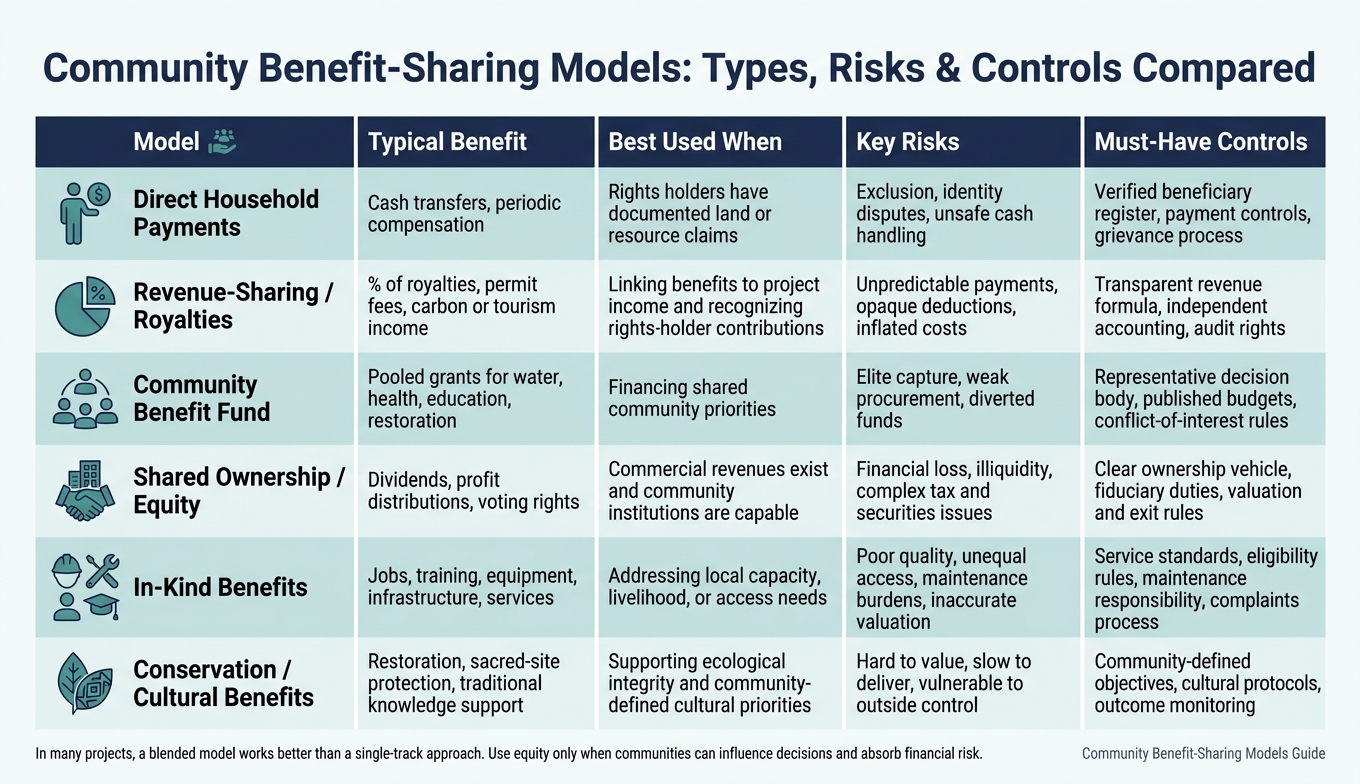
Community Benefit-Sharing Models: Types, Risks & Controls Compared
Community Benefits Plans & Agreements Webinar
sbb-itb-8baf5f1
1. Establish the legal, tenure, and consent foundation
Before you write allocation rules, check every legal and contract layer that applies to the project: federal, state, tribal, county, and municipal rules, along with permits, leases, easements, grant terms, lender conditions, and any certification or carbon-market standards. If the project involves Indigenous Peoples, traditional knowledge, or genetic resources, review tribal law and community protocols too, as well as treaty and trust duties and the United Nations Declaration on the Rights of Indigenous Peoples. Even in the United States, projects may still run into access-and-benefit-sharing terms through foreign law, institutional policy, or contract.[2][3][4]
A short legal-screening memo, prepared before benefit discussions start, can flag these duties early, when they are still easier to handle. It should also clarify who may receive benefits and under what terms. Use that memo to identify every rights holder, duty bearer, and affected party before you draft any allocation formula.
Map rights, obligations, and affected parties
Legal title rarely tells the whole story. A project area can include legal title, customary tenure, communal ownership, grazing or fishing permits, conservation easements, water-access rights, seasonal-use arrangements, and interests tied to culture and traditional knowledge. These layers often overlap, and each one can shape who must be consulted, who may consent, and who has a claim to project gains.
The most useful tool at this stage is a legal-and-rights matrix, with one row for each right or obligation. At a minimum, each row should note:
The right or duty
Its geographic scope
The rights holder or duty bearer
The responsible authority
The legal or customary source
The evidence required, such as a deed, treaty, permit, map, bylaw, or community protocol
The project activity that may affect it
Whether consent or compensation is required
The benefit-sharing effect
Contract duties belong in the matrix as well. A conservation lease may require local hiring. A lender may require stakeholder engagement. A tribal agreement may keep approval rights over the use of cultural knowledge. This matrix should be reviewed by qualified legal counsel and by affected rights holders. It should not sit in a folder as an internal checklist. Exclusion and restrictive-rights setups are common failure points, so every affected group needs to appear in the rights inventory, and the matrix should feed straight into allocation design.
Document land tenure and overlapping claims
Pair document review with participatory mapping and field verification. Gather deeds, surveys, treaty materials, tribal records, permits, leases, easements, and administrative maps. Then compare them with community-drawn maps and oral histories. Record seasonal hunting, fishing, grazing, gathering, water use, travel routes, cultural sites, and habitat zones. For sensitive cultural details, use restricted-access or confidential map layers, and get permission before collecting or sharing that information.
When boundaries conflict, show the competing claims instead of quietly picking one. If a tenure dispute stays unresolved, it can wreck an allocation formula, expose the project to double payment or exclusion, and weaken the standing of any consent that comes later. Mapping should lead straight to a dispute-resolution plan, not just a map that gets filed away. That plan may include escrowed funds, joint decision-making, or provisional access rules while claims are being worked out. Once the competing claims are mapped, the next step is to confirm who has the authority to consult, decide, or consent.
Build a consent process that can be revisited
Start by asking each rights-bearing group how it makes decisions and who can speak or sign for the group. Confirm whether that role sits with a tribal government, elected council, clan or family structure, customary authority, cooperative, or another institution. Make sure women, youth, elders, tenants, seasonal users, and neighboring groups are part of the process, not just the most visible local leader.
Consultation and consent are not the same thing. Consultation is a process for sharing information and gathering views. Free, prior, and informed consent (FPIC) is stronger: it allows affected Indigenous Peoples to take part through their own representative institutions and to give, withhold, or condition consent for activities affecting their lands, territories, resources, or rights.[1][4] Where FPIC applies, the process must be built around actual decision-making power.
A practical sequence looks like this: identify rights holders and representatives, disclose scope, risks, benefits, alternatives, uncertainties, and revenue assumptions, allow time for independent advice, negotiate mutually agreed terms, record consent, conditional consent, or non-consent, put safeguards in place, and verify compliance through joint monitoring.
The agreement should also set review dates, material-change triggers, and withdrawal or suspension procedures where the law and the facts allow. Good triggers to spell out early include changes in project footprint, ownership, financing, revenue model, environmental impact, or the discovery of cultural sites or rights holders that were not mapped before. Consent should match the specific activity and decision at hand. It is not a blank check for unknown future uses. Silence is not consent. Attendance is not consent. And an early approval should not be stretched to cover later activities that are materially different. Use the rights matrix and the consent record to draft the allocation rules in the next section.
2. Choose a benefit-sharing model and set allocation rules
Pick the model based on the project's revenue, rights, priorities, and local capacity. In plain terms, start with four things: where the money will come from, what rights are already recognized, what the community says matters most, and what local groups can actually manage. In many cases, a blended model works better than a single-track approach.
A carbon project is a good example. It might combine direct payments to recognized rights-holders, a community-controlled fund for water or health priorities, paid local monitoring jobs, and restoration support. Each piece meets a different need, and each one needs its own rules. After rights and consent are in place, turn them into clear benefit formulas and payment rules.
Compare direct payments, community funds, equity, and in-kind benefits
The table below compares common models, when to use them, and the controls they need.
| Model | Typical benefit type | Appropriate use | Principal risks | Governance requirements | Documentation needed |
|---|---|---|---|---|---|
| Direct household or rights-holder payments | Cash transfers, periodic compensation, participation payments | Rights holders with documented claims, resource use, or project impacts | Exclusion, identity disputes, coercion, unsafe cash handling | Verified beneficiary register, payment controls, privacy safeguards, grievance process | Eligibility criteria, payment schedule, transfer records, receipts, exception log |
| Revenue-sharing or royalties | Percentage of royalties, permit fees, tourism or carbon income | Linking benefits to project income and recognizing rights-holder claims or contribution | Unpredictable payments, opaque deductions, inflated costs, delayed transfers | Transparent revenue definition, independent accounting, audit rights, minimum floor where appropriate | Revenue formula, gross-to-net waterfall, contracts, audited statements, payment records |
| Community benefit fund | Collective grants or pooled resources for locally selected projects | Financing shared priorities such as water, health, education, restoration, or cultural programs | Elite capture, weak procurement, unclear ownership, diverted funds | Representative decision body, published budgets, conflict rules, procurement controls | Fund charter, bylaws, meeting records, budgets, grant agreements, procurement files, financial reports |
| Shared ownership or equity | Dividends, profit distributions, voting rights, ownership stake | Projects with commercial revenues and capable community or Indigenous institutions | Financial loss, illiquidity, complex tax and securities issues, unequal voting power | Clear ownership vehicle, fiduciary duties, disclosure, valuation rules, exit provisions | Share or trust documents, capitalization table, shareholder agreement, financial statements, dividend policy |
| In-kind benefits | Jobs, training, equipment, infrastructure, services, access improvements | Addressing local capacity, livelihood, public-service, or access needs | Poor quality, unequal access, maintenance burdens, inaccurate valuation | Service standards, eligibility rules, maintenance responsibility, complaints process | Specifications, contracts, beneficiary records, delivery certificates, operating-cost plan |
| Conservation or cultural benefits | Restoration, food and water security, sacred-site protection, traditional-knowledge support, cultural programs | Supporting ecological integrity, cultural continuity, and community-defined priorities | Benefits can be hard to value, slow to deliver, and vulnerable to outside control | Community-defined objectives, cultural protocols, safeguards for traditional knowledge, outcome monitoring | Management plans, cultural protocols, restoration records, access rules, monitoring reports |
Use equity only when communities can influence decisions and absorb financial risk. If they cannot, guaranteed payments are the safer route.
Write allocation rules that answer who, why, how much, and for how long
Loose promises tend to fall apart. Write the rules so people can use them in day-to-day decisions. Define eligible beneficiaries with documented bases: legally recognized rights, customary tenure, direct resource use, contribution to conservation outcomes, exposure to project impacts, vulnerability, or community membership. Then explain why each basis applies.
If more than one village, tribe, or user group is affected, set the formula before revenue arrives. That avoids a familiar problem: everyone agrees in principle, then fights over the split once money shows up.
A workable formula should separate at least four parts:
A guaranteed base amount that does not depend on annual performance
A rights-holder or impact-based payment tied to documented losses, restrictions, or access limits
A community-wide allocation for shared priorities
A performance-based conservation payment linked to verified, measurable results
Spell out the start date, payment frequency, inflation adjustment, and what happens if revenue is zero or negative. Compensation for project impacts should not disappear just because a conservation target was missed for reasons outside a beneficiary's control.
Inclusion has to be built into the rules from the start. Say how women, youth, elders, people with disabilities, and mobile or seasonal resource users will help set priorities and receive benefits. And when direct payments are due, they should go to the person or household legally entitled to receive them, not automatically through a single local authority.
Account for non-cash benefits and avoid false equivalence
A clinic, water system, road, or training program is not automatically equal to cash. Before counting any non-cash benefit against a project's obligation, the agreement needs to answer a few basic questions: Who controls it? Who can use it? Who pays the running costs? What happens when it breaks down or needs replacement?
For each non-cash commitment, document the item or service, quality standard, delivery date, intended users, access conditions, expected useful life, responsible owner, and maintenance budget. That sounds like paperwork, but it prevents a lot of trouble later.
For a water system, record construction specifications, expected capacity, users served, land or ownership arrangements, electricity or fuel costs, and service-level targets. For training, record the curriculum, trainer qualifications, attendance, completion, and whether participants leave with recognized credentials or access to jobs. Don’t count the same asset twice. If a road is credited against the obligation, say so clearly and state how public access will be protected.
Benefits can be transferred at any point in a project's life cycle, not just after revenue starts coming in. That leaves room for early-stage support, such as training, negotiated planning support, or livelihood assistance before the project turns a profit.
Use a benefit matrix - one row per benefit - to carry these rules into fund controls and governance.
3. Build transparent fund flows and governance controls
Once the allocation rules are in place, the next job is making sure the money actually moves the way the agreement says it should. That means building an accounting and governance system that still works if leadership turns over, revenue comes in below target, or complaints land on the table. The benefit matrix and allocation categories from the prior section should feed straight into ledger lines, approval steps, and reporting.
Define revenue, deductions, timing, and payment records
The core split is simple: gross project revenue versus the distributable benefit pool. Gross revenue is all income the project brings in. The distributable pool is what remains after subtracting only those deductions the agreement clearly allows. The formula should read:
Distributable pool = eligible gross revenue − approved taxes, refunds, and verified operating or monitoring deductions
The agreement should spell out the revenue base, which deductions count, the calculation period, payment currency, exchange-rate source, payment dates, and how to handle taxes, refunds, in-kind revenue, and inflation indexing. It should also bar hidden deductions from shrinking the community share, including unrelated corporate overhead, executive bonuses, or debt service that was never approved. [5][7][8]
A documented payment chain helps keep each step visible: revenue receipt, calculation of the distributable pool, independent verification, authorization, transfer to the named account, distribution to recipients, then reconciliation and public reporting. Keep a separate ledger for project revenue, deductions, benefit transfers, administrative costs, unpaid amounts, and interest. Each payment record should show the source, gross amount, deduction category, net amount, approval date, payment date, recipient or beneficiary group, transaction reference, currency, exchange rate, and supporting receipt.
Records should stay on file for the full project term plus a set post-project period, while still respecting privacy and cultural confidentiality protections. At a minimum, that means monthly or quarterly bank reconciliations, numbered payment vouchers, signed or electronically confirmed receipts, and annual independent audits. Public reporting should show aggregate amounts received, deductions, transfers, balances, and implementation costs, without exposing sensitive personal information. [7][8]
Match fund structures to risk and control needs
The best fund structure depends on a few grounded factors: payment size, project duration, admin capacity, and the actual risk of elite capture or misuse. No single setup fits every case.
| Structure | Control | Transparency | Cost | Risk | Best-fit use case |
|---|---|---|---|---|---|
| Direct distribution | Low to moderate; payments follow eligibility rules | High for recipient-level transfers if records are complete | Low to moderate | Misidentification, exclusion, household conflict, and weak long-term investment | Small or regular payments to clearly identified eligible recipients |
| Community fund account | Moderate; a local committee approves expenditures under a budget | Moderate to high with public ledgers, reporting, and audits | Moderate | Elite capture, unauthorized withdrawals, and weak bookkeeping | Community infrastructure, livelihoods, conservation activities, and shared services |
| Trust or escrow structure | High; an independent trustee or escrow agent applies contractual rules | High if trustee reports are public and audited | Moderate to high | Administrative expense, slow disbursement, and inflexible rules | Large, long-term, legally sensitive, or multi-community projects |
| Shared enterprise account | Held jointly by the project and a community enterprise | Moderate; depends on accounting separation and disclosure | Moderate | Commercial losses, conflicts over reinvestment, and unclear ownership | Revenue-generating enterprises, processing facilities, ecotourism, or cooperative businesses |
In many projects, a hybrid setup makes more sense than picking just one model. Direct payments may work for household-level benefits, a ring-fenced community fund may suit shared priorities, and an escrow or trust account may be better for long-term obligations. The governing document should identify the account holder, permitted uses, signatories, procurement rules, audit requirements, and what happens if the governing body becomes inactive.
Structure by itself won't save a weak system. What matters in day-to-day practice are the custody rules, approval steps, and dispute process.
Set governance roles, conflict rules, and grievance channels
A representative oversight body needs clear separation of duties. Decision-making, fund custody, spending approval, implementation, monitoring, and complaint handling should not all sit with the same person or group. Membership should include all affected groups, and the selection process should be documented before members take their seats.
The governing instrument should set quorum, voting thresholds, meeting frequency, term limits, rotation, vacancy replacement, and publication of minutes. A sound minimum control framework includes:
At least two authorized signatories for any transfer
No one who approves a payment can also be the sole recipient or supplier
Written budgets and procurement thresholds
Competitive quotes, or written justification, for larger purchases
Annual conflict-of-interest declarations
Mandatory recusal where decisions involve relatives, employers, business partners, or personal interests
Periodic bank reconciliation and independent audit
Handover steps for records, passwords, and account authority when officers change
Financial approval should be separate from supplier selection and from receipt of goods or services. In plain terms, no single person should control custody, approval, and reporting. [6]
The grievance channel also needs to work for actual people, not just on paper. It should allow in-person, phone, text, written, and confidential or anonymous reporting. It must be free to use, available without legal representation, and open to people with limited literacy or mobility. If a complaint involves a committee member, that complaint should bypass the member completely and go to an independent panel or outside mediator.
The system should track complaint type, response time, resolution, and unresolved cases, without publicly naming complainants. A useful minimum is to acknowledge every complaint within 10 business days, then set clear deadlines for investigation, response, and appeal in the governing documents. [9][10]
The matrix below sets out accountability for the main functions.
| Function | Accountable body | Responsible party | Required checks |
|---|---|---|---|
| Consent and major amendments | Rights-holders and designated representative institutions | Project proponent and community facilitators | Consent records, accessible information, and documented dissent |
| Fund management | Oversight board or trustee | Fund administrator or treasurer | Segregated account, dual signatures, reconciliations, and audit |
| Activity implementation | Oversight body | Approved community organizations, contractors, or agencies | Workplans, procurement records, and completion evidence |
| Monitoring | Joint monitoring committee | Independent monitors and community monitors | Agreed indicators, field verification, and protection from retaliation |
| Financial and results reporting | Fund administrator and oversight board | Finance officer and monitoring team | Periodic public reports and independent review |
| Complaints and redress | Independent grievance panel or designated ombudsperson | Grievance officer | Confidential intake, tracking number, response deadline, and appeal |
| Periodic review | Joint review committee | Project proponent and rights-holders | Scheduled review, event-based triggers, and documented amendments |
Publish this matrix in plain language and, where needed, in local languages too. People should be able to see at a glance who approves spending, who can challenge a decision, and who holds the records. [5][8]
4. Monitor results and review the model over the project life
Once allocation rules and fund controls are in place, the next task is to see whether the model keeps working over time. Monitoring is the feedback loop. It shows whether the benefit-sharing system is doing what it said it would do. A sound monitoring program keeps checking three things: whether money moved as promised, whether decision-making still has legitimacy and broad participation, and whether social, livelihood, and ecological results are getting better. Without that loop, small problems can sit in the background until they turn into open conflict.
Track money, participation, equity, livelihoods, and ecosystems
Start with the benefit matrix and payment ledger. Use them to set the baseline and indicators. Before payments or conservation work start, document a baseline for revenue, livelihoods, services, institutions, ecosystem condition, tenure, and decision-making. That baseline matters because it separates project effects from trends that were already there.
From there, track indicators across five linked categories, using the same benefit categories and ledger lines already set in Sections 2 and 3. Follow revenue, allowable deductions, allocations, transfers, balances, and payment dates. Follow attendance, votes, notice periods, information access, and who holds decision-making and signatory authority. Attendance by itself does not prove inclusion. [11][13]
Use household surveys along with administrative data on jobs, wages, procurement, training, food security, and access losses. Look closely at distributional effects. Average income can go up while poorer households, women, tenants, or seasonal resource users lose access to land or customary resources. For ecosystems, combine field measurements, local ecological knowledge, restoration records, and independent verification. Also track unintended effects on purpose: conflict between recipient and non-recipient groups, elite capture, local cost-of-living increases, dependence on short-term payments, and resource pressure moving outside the project area. [12][13]
Each indicator should state:
its definition
the baseline
the target
the data source
the responsible party
the collection frequency
the corrective-action threshold
That last item is the point at which a result triggers a formal response, not just a note in a report.
Schedule reviews and define event-based triggers
Use three layers of review instead of one annual check. Routine monitoring should run monthly or quarterly and cover receipts, payments, grievances, and urgent risks. An annual review should look at independently verified accounts, payment timeliness, benefit delivery, participation, representation, livelihood indicators, ecosystem results, grievances, corrective actions, and the next year’s budget. Then a periodic design review - often every two to five years, or at agreed project phases - should step back and reassess the allocation formula, eligible beneficiaries, governance structure, administrative deductions, indicators, consent conditions, and long-term durability. [12][14]
When indicators miss their targets, use the review cycle to reset terms before problems harden. Scheduled reviews matter, but event-based triggers matter just as much. The agreement should require an unscheduled review whenever a defined threshold is crossed. Those triggers usually fall into a few groups: changes in scope or market conditions; expansion into new land, waters, habitats, or communities; shifts in tenure, law, or rights; ecological shocks; payment or compliance failures; serious grievances or harm; and project lifecycle events such as suspension, renewal, closure, or transfer.
The trigger clause should define what counts as material. That might be a set percentage change in annual revenue, the addition of a new affected settlement, or repeated missed payments. It should also state who must notify whom, how fast the review begins, whether operations pause, how urgent benefits continue, and whether outside facilitation is needed.
Plan for amendment, closure, and post-closure stewardship
Every review should lead to a written report in accessible formats and local languages. The report should say what was promised, what happened, who benefited, what fell short, why the gap happened, and which corrective actions have named owners and deadlines. Communities should have a fair period to check the findings and challenge errors before decisions are locked in.
Corrective actions may include late-payment remedies, repayment or reallocation of misused funds, tighter procurement controls, broader beneficiary eligibility, revised representation rules, more training, independent audits, restoration commitments, or changes to the revenue formula. Amendments should say whether they apply going forward or backward, protect accrued rights, preserve confidentiality, and require renewed approval or consent when a change materially affects rights, land access, cultural interests, or project impacts. Do not change indicators just to make performance look better. Keep the original baseline and explain every method change so results can still be compared over time.
Closure should be designed at the start of the project, not at the end. Review findings feed into amendments, then closure, then post-closure stewardship. Each phase should build on the same system. Define the closure date, notice period, final audit, treatment of outstanding obligations, asset disposition, handling of unspent and restricted balances, final benefit payments, and data retention. Unspent balances may move to a successor community institution, go into a protected stewardship fund, return under an agreed allocation rule, or support approved long-term activities. The agreement should bar one-sided diversion of funds and require a documented community decision.
Post-closure stewardship should assign responsibility for ecological monitoring, restoration, invasive-species control, livelihood transition, and continuing access or cultural protections, with the monitoring period set by residual risk. Grievance access should continue after closure. Communities may still need records and remedies after operations end, especially if later harm appears or unpaid obligations come to light. [11]
These closure rules help keep the model reviewable and enforceable after project operations end.
Conclusion: a checklist for designing a sound benefit-sharing system
Use this checklist before signing or launching any benefit-sharing model. Every part has to line up: legal rights, tenure, consent, allocation rules, fund controls, governance, monitoring, and closure planning. And it all has to hold up not only on day one, but through the full life of the project. If one part is missing or left fuzzy, the whole system is more likely to break down or face a challenge.
Use the checklist below as the final go/no-go test before signature or launch. It follows the same order as the guide: rights, tenure, consent, model design, fund controls, governance, monitoring, and closure.
Design checklist for decision-makers
| Checklist Item | What to Confirm |
|---|---|
| Rights and obligations | Legal duties, permit conditions, contractual commitments, and rights-holder roles are documented and assigned. |
| Tenure | Land, resource, customary-use, access, and overlapping claims are recorded; unresolved disputes have a defined process. |
| Consent | The correct decision-maker has given documented, non-coercive consent or participation, and re-consultation triggers are defined. |
| Model fit | The mix of payments, funds, equity, services, jobs, and restoration reflects community priorities and project risks, with cash and non-cash benefits separately defined and valued. |
| Allocation rules | Eligibility, formulas, timing, duration, inflation adjustments, deductions, and change procedures are explicit and publicly available. |
| Fund flow | Revenue is traceable from source to recipient through bank records and payment registers. |
| Governance | Authority, administration, conflicts, procurement, audits, and participation are clearly assigned. |
| Grievances | Accessible, confidential, non-retaliatory channels and escalation remedies are operating before project impacts begin. |
| Monitoring | Money, participation, equity, livelihoods, and ecosystem indicators are baselined, disaggregated, reported, and independently verified. |
| Review and closure | Routine reviews, event-based triggers, amendment procedures, decommissioning duties, outstanding payment obligations, and post-project stewardship are funded and assigned. |
One last distinction matters: keep legal entitlement, compensation, and voluntary benefit-sharing separate. These are not the same thing. Each one comes with different rights, timeframes, and remedies, and communities should know exactly which one applies to them.
FAQs
How does benefit-sharing differ from legal compensation?
Benefit-sharing means local residents and affected communities receive a fair share of a project’s financial and non-financial gains through community-defined arrangements. These terms are often written into legally binding agreements, which helps turn broad promises into clear commitments.
Legal compensation works differently. It usually covers specific losses or the costs of taking part in a process, but it does not always give communities an ongoing, rights-based share of the project’s value over time.
Who decides who gets benefits?
Who gets the benefits comes down to the model’s governance and consent rules. In community benefit agreements (CBAs), those benefits are directed to local residents named through the legally binding agreement between developers and community groups.
Good practice means communities don’t just receive benefits after the fact; they help set the priorities through participatory decision-making. When Indigenous peoples are affected, free, prior, and informed consent (FPIC) also needs to guide the process, backed by transparent governance.
What should trigger a review of the model?
A review should happen whenever the model needs to stay responsive as conditions shift and new challenges show up. Set regular review cycles - quarterly or annual check-ins work well - to measure progress against goals and see where the work stands.
Real-time feedback should flag issues as they come up, not months later when the moment has passed. Then layer in periodic third-party assessments and structured partner reflection to get a clearer read on what’s working, what isn’t, and where course corrections make sense.



FAQ