
Dec 29, 2025
How to Build a Climate Resilience Plan for Foundations & Philanthropic Organizations
Sustainability Strategy
In This Article
Step-by-step guide for foundations to assess climate risks, engage stakeholders, fund adaptation projects, implement pilots, and track resilience metrics.
How to Build a Climate Resilience Plan for Foundations & Philanthropic Organizations
Building a climate resilience plan is critical for protecting your organization's operations, assets, and the communities you serve. Here’s a quick guide to creating a robust plan:
Assess Risks: Identify local climate hazards (e.g., heat, flooding, wildfires) and evaluate their impact on your physical assets, people, and mission-critical services. Use tools like FEMA’s National Risk Index for better insights.
Engage Stakeholders: Collaborate with internal teams, community leaders, and experts to design solutions that address the unique needs of affected communities.
Develop Strategies: Focus on solutions like nature-based projects, infrastructure upgrades, and policy changes while exploring funding mechanisms such as catalytic grants and community campaigns.
Implement Plans: Start with pilot projects, scale successful efforts, and align resilience actions with existing initiatives.
Measure Progress: Track metrics like asset vulnerability, resource usage, and compliance with updated building codes. Regularly review and refine strategies based on evolving risks.
Key takeaway: Proactive planning reduces risks, ensures operational continuity, and supports vulnerable communities. Use data-driven tools and collaborative approaches to stay ahead of climate challenges.
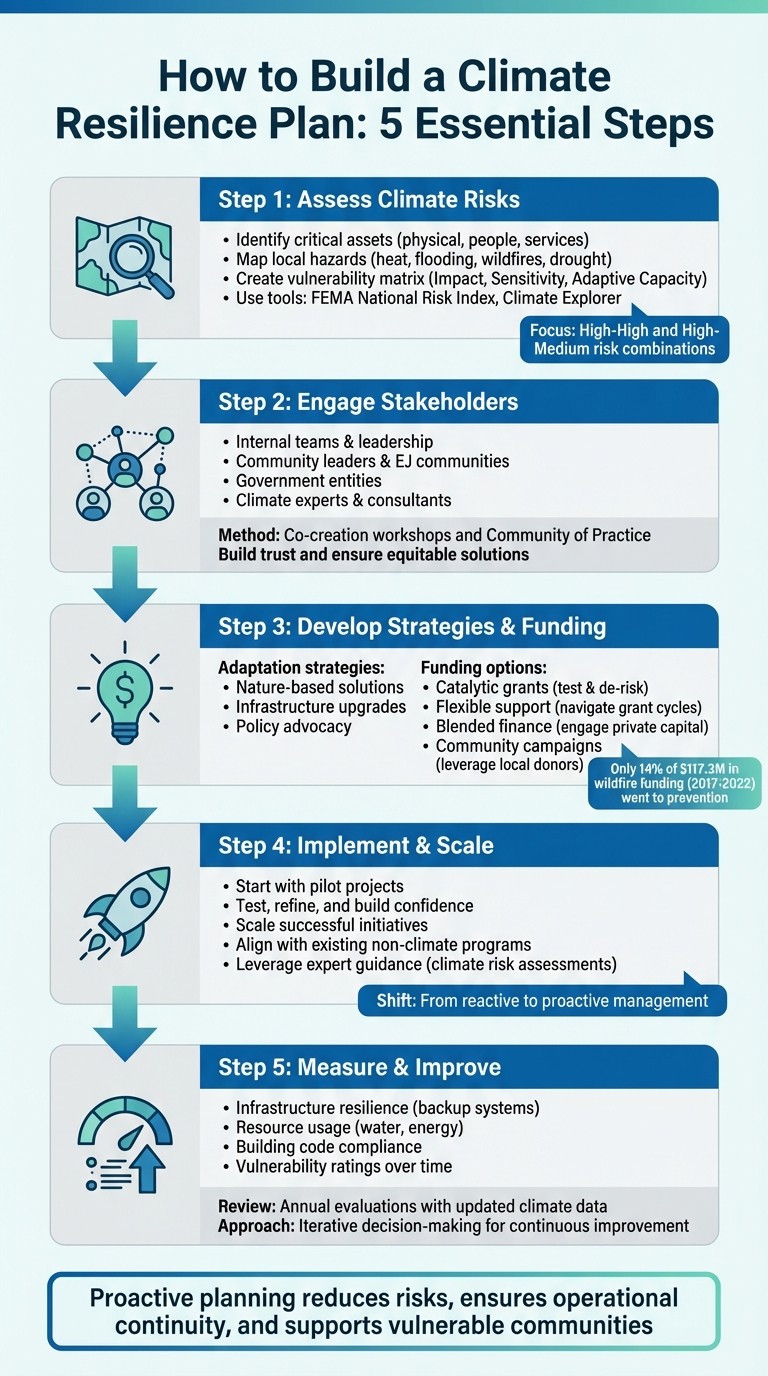
5-Step Climate Resilience Planning Framework for Philanthropic Organizations
Equitable Community Engagement in Climate Resilience Planning, Aurash Khawarzad
Step 1: Assess Climate Risks to Your Organization
Understanding climate risks begins with two key ideas: vulnerability and risk. Vulnerability refers to how sensitive an asset is to hazards and its ability to recover from them [5][6]. Risk, on the other hand, combines the likelihood of a hazard occurring with the scale of its potential consequences - whether financial losses or social impacts [5][6].
Start by identifying your organization's critical assets across three main areas: physical infrastructure (like offices or data centers), people (employees and grantees), and services (such as grant-making operations or community programs) [1][4]. Once you have this list, connect each asset to relevant local hazards, such as extreme heat, flooding, wildfires, drought, or severe winter storms [2]. These steps will provide the foundation for building resilience strategies that align with your mission.
Identify Physical and Operational Risks
To organize your findings, create a spreadsheet that outlines each asset and includes columns for Impact, Sensitivity, Adaptive Capacity, and Vulnerability. For each asset and hazard combination, assign a rating of high, medium, or low [5][6]. Tailor this process to the specific hazards in your region. For example, if your organization operates in a coastal area, an office building might be highly vulnerable to flooding but have medium adaptive capacity if equipped with backup power systems.
Establish clear rules for assessing probabilities to ensure consistency. For instance, categorize hazards likely to occur within five years as "High" probability and those expected every five to twenty years as "Medium." Use a 3×3 risk matrix to map assets based on their vulnerability. Place "Probability" on the y-axis and "Magnitude of Consequence" on the x-axis. Focus on asset-hazard combinations that fall into the "High-High" or "High-Medium" zones [5][6].
Leverage tools like FEMA's National Risk Index, the Climate Explorer, the Sea Level Rise Viewer, and the Wildfire Risk to Communities tool to visualize local risks [1][5][7]. Pay close attention to assets that could cause cascading failures, such as telecommunications or power systems that other operations depend on [5][6].
Analyze Mission-Specific Risks
In addition to physical assets, evaluate how climate risks could directly impact your organization's mission. Identify the key people, places, services, or natural systems your mission is designed to protect [1]. For example, if your foundation focuses on affordable housing, assess how hazards like extreme heat or flooding might affect the communities you support. Similarly, if environmental conservation is your goal, consider how drought or wildfires could disrupt local ecosystems.
"Think about the things your community truly depends upon to function, and use that knowledge to set your priorities." - U.S. Climate Resilience Toolkit [6]
Work with adaptation experts to interpret climate data and prioritize risks based on your mission [5][6]. While qualitative assessments using simple ratings (low, medium, high) are often sufficient for initial evaluations, more detailed quantitative methods, such as geospatial mapping, may be necessary for long-term planning [5][6].
Step 2: Engage Stakeholders for Collaborative Planning
Effective climate resilience planning thrives on collaboration. By involving a diverse range of voices - from internal teams to community leaders and government officials - you create a foundation of trust that drives meaningful action. This inclusive approach ensures that resilience strategies align with your organization’s mission while addressing the actual needs of the communities you aim to support. A crucial first step in this process is identifying and engaging the right stakeholders.
Map Key Stakeholders
Start by revisiting the assets identified in Step 1, asking, “Who has the most vested interest in protecting these?” This question will guide you in identifying your core stakeholders. These could include:
Internal teams: Leadership, operations staff, and local champions who are already invested in resilience efforts.
Community leaders: Individuals with deep local knowledge who can provide insight into pressing concerns.
Government entities: Representatives from local, county, state, or Tribal agencies focused on sustainability or hazard mitigation.
Community-based organizations: Groups advocating for frontline and Environmental Justice (EJ) communities.
Specialized experts: Climate-service practitioners, academic institutions, and consultants who can offer nuanced risk assessments.
Interest groups: Conservation organizations, business associations, and outdoor enthusiasts often rally around specific local assets.
"Community champions usually have a track record of getting things done. They can use the steps as a roadmap to help them manage a resilience-building process." - U.S. Climate Resilience Toolkit
Pay special attention to equity by identifying EJ communities that may lack access to resources like green spaces or cooling infrastructure. These areas are often disproportionately affected by urban heat islands, making them a priority for resilience planning. Seek partners with a proven history of resilience work and the capacity to commit to long-term solutions.
Facilitate Co-Creation Workshops
Once stakeholders are identified, bring them together through workshops designed to encourage shared ownership of the resilience plan. These sessions are key to fostering collaboration and building momentum for long-term initiatives.
A notable example comes from September 2025, when the Barr Foundation joined forces with the Metropolitan Area Planning Council and Frontline Solutions for the Community Heat Resilience pilot in Lynn, Salem, and Somerville, Massachusetts. Over two years, this initiative provided funding and technical support to city departments and community-based organizations like the Latino Support Network and GreenRoots. The project emphasized building enduring relationships between municipal departments and EJ communities, transitioning from reactive heat responses to proactive, systematic planning.
Workshops can also serve as a launchpad for establishing a Community of Practice (COP), where participants exchange insights and advocate for broader policy changes at municipal and state levels. Structure these sessions around key steps such as understanding exposure, assessing risks, exploring solutions, prioritizing actions, and implementing projects. Offer technical coaching to help stakeholders design and fund community-focused initiatives. Leverage existing planning frameworks, like Hazard Mitigation Plans, to streamline the integration of climate resilience into broader strategies.
"Building lasting relationships between EJ communities, community based organizations, and municipalities... enable[s] them to develop and implement long-term, collaborative solutions." - Barr Foundation
To ensure lasting impact, invest in strengthening the capacity of community organizations. Transitioning from emergency responses to institutionalized, systematic planning requires robust partnerships between municipalities and local groups. These relationships are the cornerstone of sustainable, community-driven adaptation efforts.
Step 3: Develop Adaptation Strategies and Funding Mechanisms
After identifying risks and gathering collaborative insights, it's time to take action. This step focuses on balancing practical strategies to build resilience with sustainable funding solutions to support those efforts over the long term. By combining well-planned adaptation strategies with creative financing, you can ensure a stronger, more prepared future.
Prioritize Adaptation Strategies
Three key strategies take center stage: nature-based solutions, infrastructure upgrades, and policy advocacy. Nature-based approaches, like restoring wetlands or conducting controlled burns, not only protect ecosystems but also mitigate risks. Infrastructure improvements, such as retrofitting buildings to withstand extreme heat or upgrading stormwater systems, address vulnerabilities directly. Meanwhile, policy advocacy can eliminate hurdles like permitting delays that slow down essential programs, such as prescribed burns.
To make the most of limited resources, consider a qualitative screening process. Categorizing risks as low, medium, or high helps prioritize the most pressing challenges without diving into costly analyses or consulting services upfront.
Foundations like Gordon and Betty Moore and William and Flora Hewlett have shown the power of early, prevention-focused investments. These targeted efforts often scale quickly through pilot funding, followed by government or private sector support. Between 2017 and 2022, U.S. foundations contributed $117.3 million to wildfire-related causes, yet only $16.6 million - about 14% - focused on resilience and preparedness instead of disaster response[8].
"We're going to have fires every year. We'll never get ahead of it if we're working in response mode."
Keytra Meyer, Director of Advancement and Philanthropic Innovation, Humboldt Area Foundation[8]
By prioritizing these strategies, organizations can not only reduce risks but also strengthen their commitment to safeguarding vulnerable communities.
Explore Funding Models
Once your adaptation strategies are clear, securing the right funding becomes the next critical step. Sustainable financing mechanisms can align with your resilience goals, ensuring long-term impact. Options include catalytic grants, flexible funding, blended finance, and community-based campaigns. Each approach has its advantages and challenges, making it essential to choose the right mix for your needs.
Catalytic grants: These grants are ideal for testing new technologies and de-risking projects, paving the way for government scaling. However, they often require a roadmap for follow-on funding to ensure continuity.
Unrestricted or flexible support: This type of funding helps nonprofits navigate the complexities of federal grant cycles and maintain operations between funding rounds. Its downside? Immediate outcomes can be harder to measure.
Blended finance: By engaging private capital, this approach scales impact and improves risk-return profiles. That said, structuring these deals can be complex and requires careful alignment of stakeholder goals.
Community campaigns: Leveraging local donor networks, these campaigns tap into regional wealth and interest. However, their success often depends on the local economy and may be geographically limited.
| Funding Mechanism | Pros | Cons |
| --- | --- | --- |
| <strong>Catalytic Grants</strong> | Tests new technologies and de-risks projects for government scaling<a href="https://www.philanthropy.com/article/living-with-fire-donors-want-to-focus-on-reducing-risk-not-on-disaster" target="_blank" style="text-decoration: none;" rel="nofollow noopener noreferrer" data-framer-link="Link:{"url":"https://www.philanthropy.com/article/living-with-fire-donors-want-to-focus-on-reducing-risk-not-on-disaster","type":"url"}" data-framer-open-in-new-tab=""><sup>[8]</sup></a>. | Short-term focus; requires a clear pathway for follow-on funds. |
| <strong>Unrestricted Support</strong> | Provides flexibility for nonprofits navigating grant cycles<a href="https://www.philanthropy.com/article/living-with-fire-donors-want-to-focus-on-reducing-risk-not-on-disaster" target="_blank" style="text-decoration: none;" rel="nofollow noopener noreferrer" data-framer-link="Link:{"url":"https://www.philanthropy.com/article/living-with-fire-donors-want-to-focus-on-reducing-risk-not-on-disaster","type":"url"}" data-framer-open-in-new-tab=""><sup>[8]</sup></a>. | Harder to measure specific, immediate outcomes. |
| <strong>Blended Finance</strong> | Engages private capital to scale impact and improve risk-return profiles<a href="https://wri.org/insights/adaptation-finance-explained" target="_blank" style="text-decoration: none;" rel="nofollow noopener noreferrer" data-framer-link="Link:{"url":"https://wri.org/insights/adaptation-finance-explained","type":"url"}" data-framer-open-in-new-tab=""><sup>[9]</sup></a>. | Complex to structure; requires alignment among diverse stakeholders. |
| <strong>Community Campaigns</strong> | Leverages local donor interest and regional wealth for protection<a href="https://www.philanthropy.com/article/living-with-fire-donors-want-to-focus-on-reducing-risk-not-on-disaster" target="_blank" style="text-decoration: none;" rel="nofollow noopener noreferrer" data-framer-link="Link:{"url":"https://www.philanthropy.com/article/living-with-fire-donors-want-to-focus-on-reducing-risk-not-on-disaster","type":"url"}" data-framer-open-in-new-tab=""><sup>[8]</sup></a>. | Limited to specific geographies; influenced by local economic conditions. |
| Funding Mechanism | Pros | Cons |
| --- | --- | --- |
| <strong>Catalytic Grants</strong> | Tests new technologies and de-risks projects for government scaling<a href="https://www.philanthropy.com/article/living-with-fire-donors-want-to-focus-on-reducing-risk-not-on-disaster" target="_blank" style="text-decoration: none;" rel="nofollow noopener noreferrer" data-framer-link="Link:{"url":"https://www.philanthropy.com/article/living-with-fire-donors-want-to-focus-on-reducing-risk-not-on-disaster","type":"url"}" data-framer-open-in-new-tab=""><sup>[8]</sup></a>. | Short-term focus; requires a clear pathway for follow-on funds. |
| <strong>Unrestricted Support</strong> | Provides flexibility for nonprofits navigating grant cycles<a href="https://www.philanthropy.com/article/living-with-fire-donors-want-to-focus-on-reducing-risk-not-on-disaster" target="_blank" style="text-decoration: none;" rel="nofollow noopener noreferrer" data-framer-link="Link:{"url":"https://www.philanthropy.com/article/living-with-fire-donors-want-to-focus-on-reducing-risk-not-on-disaster","type":"url"}" data-framer-open-in-new-tab=""><sup>[8]</sup></a>. | Harder to measure specific, immediate outcomes. |
| <strong>Blended Finance</strong> | Engages private capital to scale impact and improve risk-return profiles<a href="https://wri.org/insights/adaptation-finance-explained" target="_blank" style="text-decoration: none;" rel="nofollow noopener noreferrer" data-framer-link="Link:{"url":"https://wri.org/insights/adaptation-finance-explained","type":"url"}" data-framer-open-in-new-tab=""><sup>[9]</sup></a>. | Complex to structure; requires alignment among diverse stakeholders. |
| <strong>Community Campaigns</strong> | Leverages local donor interest and regional wealth for protection<a href="https://www.philanthropy.com/article/living-with-fire-donors-want-to-focus-on-reducing-risk-not-on-disaster" target="_blank" style="text-decoration: none;" rel="nofollow noopener noreferrer" data-framer-link="Link:{"url":"https://www.philanthropy.com/article/living-with-fire-donors-want-to-focus-on-reducing-risk-not-on-disaster","type":"url"}" data-framer-open-in-new-tab=""><sup>[8]</sup></a>. | Limited to specific geographies; influenced by local economic conditions. |For example, in April 2022, the Tahoe Truckee Community Foundation launched its ambitious $30 million "Forest Futures" campaign to combat catastrophic wildfires. By May 2022, the foundation had already raised $3.3 million from local donors and second-home owners, distributing its first $1 million in grants to nine organizations for forest treatment and workforce development projects[8].
"Philanthropy can provide flexible dollars to complement more restrictive federal grants and help nonprofits as they wade through grant-application processes."
Eden Stiffman, Senior Editor, Chronicle of Philanthropy[8]
The most effective funding strategies often combine multiple sources. Catalytic grants can pilot new ideas, which can later transition to government funding or private investment. Building the capacity of local organizations to structure viable, large-scale projects is equally important. With adaptation finance representing less than 10% of global climate investments[9], there’s considerable opportunity for philanthropic efforts to lead the charge in this space.
Step 4: Implement and Integrate with Council Fire Expertise
Turning plans into actionable results requires expert guidance and a structured approach. By leveraging identified risks and strategies, these steps ensure steady progress toward measurable outcomes.
Pilot and Scale Initiatives
Begin with pilot projects to test ideas, refine strategies, and build confidence before committing substantial resources. Pilots allow you to identify what works, minimize risks, and create a roadmap for broader implementation. Once these initial efforts prove successful, scale them by aligning resilience actions with existing non-climate initiatives. This alignment often uncovers shared funding opportunities, streamlining the process and maximizing impact[1][3].
The goal is to move beyond "business-as-usual" operations to a stronger baseline where assets can endure hazards and recover faster. Progress can be measured by assessing how systems adapt to potential damage - what experts refer to as "adaptive capacity"[5][6]. Shifting from reactive to proactive management not only enhances resilience but can also save significant resources, especially given the billions of dollars the U.S. loses annually to climate-related hazards[13].
Utilize Council Fire's Expertise
Council Fire brings specialized knowledge to strengthen your internal capabilities in risk management and climate adaptation. Their services include comprehensive climate risk assessments across six key areas: human, operational, financial, compliance, reputational, and environmental dimensions[10]. By relying on data-driven methods, they help transform qualitative insights into actionable, quantitative results, reducing uncertainty and enabling clear prioritization of efforts[5][6].
Their team integrates technical assessments with your organization’s mission, ensuring that data translates into tangible progress. Through tools like climate risk profiles, future floodplain maps, and climate projections, Council Fire supports the operationalization of your plans. They also emphasize stakeholder engagement through co-creation workshops and participatory planning, ensuring strategies are inclusive and actionable[11][12]. By combining systems thinking with effective communication, they help translate your goals into measurable outcomes, setting the foundation for continuous improvement in resilience efforts.
Step 5: Measure Impact and Continuously Improve
Building climate resilience is not a one-time effort - it’s a dynamic process that demands regular evaluation and adaptation. As environmental conditions shift and new information becomes available, your strategy must evolve to stay effective. By tracking progress with clear metrics and conducting periodic reviews, you can anticipate emerging risks and ensure your resilience investments continue to deliver maximum benefits.
Establish Metrics for Success
To gauge the effectiveness of your strategies, rely on measurable indicators. Focus on specific asset-hazard pairings to monitor how vulnerabilities change over time. For each critical asset - whether it’s a facility, program, or service - evaluate two key factors: Sensitivity (the degree to which an asset is impacted by a hazard) and Adaptive Capacity (the asset’s ability to adjust or recover from that impact)[5].
Track essential indicators such as:
Infrastructure resilience: Assess backup systems like generators, emergency supplies, and storage capacity.
Resource trends: Monitor metrics like water usage at the building level to identify conservation opportunities.
Energy independence: Evaluate systems like distributed renewable energy, microgrids, and electrification efforts.
For facilities in flood-prone areas, ensure compliance with updated building codes, such as constructing or retrofitting structures to sit at least four feet above base flood levels[2].
To maintain clarity, create a vulnerability spreadsheet. Include columns for Potential Impact, Sensitivity, Adaptive Capacity, and an overall Vulnerability Rating for each asset-hazard pairing. Update this spreadsheet regularly to reflect changing conditions[5]. These metrics provide the foundation for ongoing reviews and adjustments to your resilience plan.
Conduct Regular Reviews
Once you’ve established your metrics, schedule regular reviews to refine your strategies in response to new data. Annual evaluations are particularly effective for incorporating updated climate projections, vulnerability assessments, and lessons learned from your resilience initiatives. Align these reviews with existing update cycles for official planning documents, such as Hazard Mitigation Plans, to streamline the process and leverage community engagement efforts[1][4].
The U.S. Climate Resilience Toolkit emphasizes the importance of this iterative approach:
"It is important to develop, refine, and deploy tools and integrated approaches that enable iterative decision making and increase the flexibility and robustness of climate change responses"[14].
During these reviews, aim to shift from qualitative assessments to more precise, quantitative data. For example, while initial plans might categorize risks as low, medium, or high, integrating geospatial mapping and financial loss estimates can provide a more detailed understanding of vulnerabilities[5]. Also, revisit historical data to ensure it still reflects current and future risks, as climate change may alter the frequency or intensity of hazards[5].
Pay particular attention to assets whose failure could have widespread consequences. Critical infrastructure, such as telecommunications networks or key bridges, often serves as a lifeline for multiple sectors. Prioritize resilience upgrades for these high-risk, high-impact nodes to prevent cascading failures across interconnected systems[5].
Conclusion
Creating a climate resilience plan for your foundation or philanthropic organization is a crucial step in protecting your key assets and ensuring lasting impact. By taking a structured approach - evaluating climate risks, collaborating with stakeholders, crafting adaptation strategies, seeking expert guidance during implementation, and regularly tracking progress - you can proactively address the climate challenges that threaten your mission and the communities you serve.
Such planning not only helps prevent severe damage but also reduces uncertainty in decision-making, enhances adaptability, and safeguards both social and financial investments [3][5]. Additionally, integrating climate considerations into your official planning documents keeps your organization eligible for federal and state funding opportunities [1].
Resilience planning is not a one-time effort; strategies should evolve as new information becomes available [1]. Partnering with climate-service experts or consultants can make a significant difference by turning complex climate data into actionable strategies. These professionals can identify risks and develop plans that align with your organization’s unique goals and values [1][4][6][5].
FAQs
How can philanthropic organizations effectively address climate risks?
Philanthropic organizations can tackle climate risks effectively by pinpointing the programs and assets that are central to their mission and evaluating how these might be affected by specific climate hazards. This begins with assessing each asset’s vulnerability - how susceptible it is to a particular hazard - and its adaptive capacity, or its ability to manage and recover from impacts. By ranking risks based on their likelihood and potential consequences, organizations can determine where immediate action is most critical.
With risks prioritized, the next step is to create a resilience plan using a clear, step-by-step approach: identify exposure, evaluate risks, consider adaptation strategies, and develop a focused plan of action. Tools like risk matrices can be invaluable here, helping to balance climate risks with strategic objectives, stakeholder concerns, and available resources. Regularly revisiting and updating these assessments ensures that efforts stay aligned with evolving challenges and remain centered on achieving mission-driven outcomes.
Collaboration with stakeholders and implementing practical adaptation strategies - such as upgrading infrastructure, investing in innovative solutions, or strengthening community support networks - can further bolster resilience. By taking these proactive measures, philanthropic organizations can protect their initiatives from climate-related disruptions and continue to advance their long-term goals effectively.
What are effective ways to sustainably fund climate resilience projects?
Sustainable funding for climate resilience projects moves beyond the idea of one-time donations. Instead, it emphasizes crafting financial strategies that drive long-term impact. By blending public, private, and philanthropic resources, foundations can develop funding models that not only align with their mission but also deliver enduring results.
Here are some effective strategies being employed:
Direct grants: These support community-driven climate initiatives or fund essential infrastructure improvements.
Collaborative funding pools: Multiple organizations join forces, combining resources to expand their reach and share expertise.
Revolving loan funds: These provide low-interest loans for resilience projects. As borrowers repay, the funds are replenished, ensuring ongoing support.
Insurance-linked financing: Tools like resilience bonds offer payouts triggered by climate-related events, reducing upfront costs and incentivizing proactive risk management.
By integrating grants, loans, and forward-thinking financial tools, foundations can build adaptable funding ecosystems. These approaches not only strengthen climate resilience efforts but also ensure alignment with long-term objectives.
How can we keep improving our climate resilience strategies over time?
To keep making progress, approach climate resilience planning as a continuous journey rather than a one-off task. Revisit critical steps like risk assessments, stakeholder engagement, and action plans regularly - whether that’s once a year or after major climate-related events. This ensures your organization can adapt to new information, shifting risks, and updated priorities.
Set measurable goals and track your progress with clear performance metrics to determine if your efforts are effectively reducing risks. Engage a diverse group of stakeholders for feedback, and dedicate resources to training sessions, workshops, and skill-building opportunities to stay updated on emerging practices. By sticking to a structured and iterative method, your organization can fine-tune its strategies over time and stay prepared to tackle evolving climate challenges.
Related Blog Posts
Latest Articles
©2025


FAQ
01
What does it really mean to “redefine profit”?
02
What makes Council Fire different?
03
Who does Council Fire you work with?
04
What does working with Council Fire actually look like?
05
How does Council Fire help organizations turn big goals into action?
06
How does Council Fire define and measure success?
Dec 29, 2025
How to Build a Climate Resilience Plan for Foundations & Philanthropic Organizations
Sustainability Strategy
In This Article
Step-by-step guide for foundations to assess climate risks, engage stakeholders, fund adaptation projects, implement pilots, and track resilience metrics.
How to Build a Climate Resilience Plan for Foundations & Philanthropic Organizations
Building a climate resilience plan is critical for protecting your organization's operations, assets, and the communities you serve. Here’s a quick guide to creating a robust plan:
Assess Risks: Identify local climate hazards (e.g., heat, flooding, wildfires) and evaluate their impact on your physical assets, people, and mission-critical services. Use tools like FEMA’s National Risk Index for better insights.
Engage Stakeholders: Collaborate with internal teams, community leaders, and experts to design solutions that address the unique needs of affected communities.
Develop Strategies: Focus on solutions like nature-based projects, infrastructure upgrades, and policy changes while exploring funding mechanisms such as catalytic grants and community campaigns.
Implement Plans: Start with pilot projects, scale successful efforts, and align resilience actions with existing initiatives.
Measure Progress: Track metrics like asset vulnerability, resource usage, and compliance with updated building codes. Regularly review and refine strategies based on evolving risks.
Key takeaway: Proactive planning reduces risks, ensures operational continuity, and supports vulnerable communities. Use data-driven tools and collaborative approaches to stay ahead of climate challenges.
5-Step Climate Resilience Planning Framework for Philanthropic Organizations
Equitable Community Engagement in Climate Resilience Planning, Aurash Khawarzad
Step 1: Assess Climate Risks to Your Organization
Understanding climate risks begins with two key ideas: vulnerability and risk. Vulnerability refers to how sensitive an asset is to hazards and its ability to recover from them [5][6]. Risk, on the other hand, combines the likelihood of a hazard occurring with the scale of its potential consequences - whether financial losses or social impacts [5][6].
Start by identifying your organization's critical assets across three main areas: physical infrastructure (like offices or data centers), people (employees and grantees), and services (such as grant-making operations or community programs) [1][4]. Once you have this list, connect each asset to relevant local hazards, such as extreme heat, flooding, wildfires, drought, or severe winter storms [2]. These steps will provide the foundation for building resilience strategies that align with your mission.
Identify Physical and Operational Risks
To organize your findings, create a spreadsheet that outlines each asset and includes columns for Impact, Sensitivity, Adaptive Capacity, and Vulnerability. For each asset and hazard combination, assign a rating of high, medium, or low [5][6]. Tailor this process to the specific hazards in your region. For example, if your organization operates in a coastal area, an office building might be highly vulnerable to flooding but have medium adaptive capacity if equipped with backup power systems.
Establish clear rules for assessing probabilities to ensure consistency. For instance, categorize hazards likely to occur within five years as "High" probability and those expected every five to twenty years as "Medium." Use a 3×3 risk matrix to map assets based on their vulnerability. Place "Probability" on the y-axis and "Magnitude of Consequence" on the x-axis. Focus on asset-hazard combinations that fall into the "High-High" or "High-Medium" zones [5][6].
Leverage tools like FEMA's National Risk Index, the Climate Explorer, the Sea Level Rise Viewer, and the Wildfire Risk to Communities tool to visualize local risks [1][5][7]. Pay close attention to assets that could cause cascading failures, such as telecommunications or power systems that other operations depend on [5][6].
Analyze Mission-Specific Risks
In addition to physical assets, evaluate how climate risks could directly impact your organization's mission. Identify the key people, places, services, or natural systems your mission is designed to protect [1]. For example, if your foundation focuses on affordable housing, assess how hazards like extreme heat or flooding might affect the communities you support. Similarly, if environmental conservation is your goal, consider how drought or wildfires could disrupt local ecosystems.
"Think about the things your community truly depends upon to function, and use that knowledge to set your priorities." - U.S. Climate Resilience Toolkit [6]
Work with adaptation experts to interpret climate data and prioritize risks based on your mission [5][6]. While qualitative assessments using simple ratings (low, medium, high) are often sufficient for initial evaluations, more detailed quantitative methods, such as geospatial mapping, may be necessary for long-term planning [5][6].
Step 2: Engage Stakeholders for Collaborative Planning
Effective climate resilience planning thrives on collaboration. By involving a diverse range of voices - from internal teams to community leaders and government officials - you create a foundation of trust that drives meaningful action. This inclusive approach ensures that resilience strategies align with your organization’s mission while addressing the actual needs of the communities you aim to support. A crucial first step in this process is identifying and engaging the right stakeholders.
Map Key Stakeholders
Start by revisiting the assets identified in Step 1, asking, “Who has the most vested interest in protecting these?” This question will guide you in identifying your core stakeholders. These could include:
Internal teams: Leadership, operations staff, and local champions who are already invested in resilience efforts.
Community leaders: Individuals with deep local knowledge who can provide insight into pressing concerns.
Government entities: Representatives from local, county, state, or Tribal agencies focused on sustainability or hazard mitigation.
Community-based organizations: Groups advocating for frontline and Environmental Justice (EJ) communities.
Specialized experts: Climate-service practitioners, academic institutions, and consultants who can offer nuanced risk assessments.
Interest groups: Conservation organizations, business associations, and outdoor enthusiasts often rally around specific local assets.
"Community champions usually have a track record of getting things done. They can use the steps as a roadmap to help them manage a resilience-building process." - U.S. Climate Resilience Toolkit
Pay special attention to equity by identifying EJ communities that may lack access to resources like green spaces or cooling infrastructure. These areas are often disproportionately affected by urban heat islands, making them a priority for resilience planning. Seek partners with a proven history of resilience work and the capacity to commit to long-term solutions.
Facilitate Co-Creation Workshops
Once stakeholders are identified, bring them together through workshops designed to encourage shared ownership of the resilience plan. These sessions are key to fostering collaboration and building momentum for long-term initiatives.
A notable example comes from September 2025, when the Barr Foundation joined forces with the Metropolitan Area Planning Council and Frontline Solutions for the Community Heat Resilience pilot in Lynn, Salem, and Somerville, Massachusetts. Over two years, this initiative provided funding and technical support to city departments and community-based organizations like the Latino Support Network and GreenRoots. The project emphasized building enduring relationships between municipal departments and EJ communities, transitioning from reactive heat responses to proactive, systematic planning.
Workshops can also serve as a launchpad for establishing a Community of Practice (COP), where participants exchange insights and advocate for broader policy changes at municipal and state levels. Structure these sessions around key steps such as understanding exposure, assessing risks, exploring solutions, prioritizing actions, and implementing projects. Offer technical coaching to help stakeholders design and fund community-focused initiatives. Leverage existing planning frameworks, like Hazard Mitigation Plans, to streamline the integration of climate resilience into broader strategies.
"Building lasting relationships between EJ communities, community based organizations, and municipalities... enable[s] them to develop and implement long-term, collaborative solutions." - Barr Foundation
To ensure lasting impact, invest in strengthening the capacity of community organizations. Transitioning from emergency responses to institutionalized, systematic planning requires robust partnerships between municipalities and local groups. These relationships are the cornerstone of sustainable, community-driven adaptation efforts.
Step 3: Develop Adaptation Strategies and Funding Mechanisms
After identifying risks and gathering collaborative insights, it's time to take action. This step focuses on balancing practical strategies to build resilience with sustainable funding solutions to support those efforts over the long term. By combining well-planned adaptation strategies with creative financing, you can ensure a stronger, more prepared future.
Prioritize Adaptation Strategies
Three key strategies take center stage: nature-based solutions, infrastructure upgrades, and policy advocacy. Nature-based approaches, like restoring wetlands or conducting controlled burns, not only protect ecosystems but also mitigate risks. Infrastructure improvements, such as retrofitting buildings to withstand extreme heat or upgrading stormwater systems, address vulnerabilities directly. Meanwhile, policy advocacy can eliminate hurdles like permitting delays that slow down essential programs, such as prescribed burns.
To make the most of limited resources, consider a qualitative screening process. Categorizing risks as low, medium, or high helps prioritize the most pressing challenges without diving into costly analyses or consulting services upfront.
Foundations like Gordon and Betty Moore and William and Flora Hewlett have shown the power of early, prevention-focused investments. These targeted efforts often scale quickly through pilot funding, followed by government or private sector support. Between 2017 and 2022, U.S. foundations contributed $117.3 million to wildfire-related causes, yet only $16.6 million - about 14% - focused on resilience and preparedness instead of disaster response[8].
"We're going to have fires every year. We'll never get ahead of it if we're working in response mode."
Keytra Meyer, Director of Advancement and Philanthropic Innovation, Humboldt Area Foundation[8]
By prioritizing these strategies, organizations can not only reduce risks but also strengthen their commitment to safeguarding vulnerable communities.
Explore Funding Models
Once your adaptation strategies are clear, securing the right funding becomes the next critical step. Sustainable financing mechanisms can align with your resilience goals, ensuring long-term impact. Options include catalytic grants, flexible funding, blended finance, and community-based campaigns. Each approach has its advantages and challenges, making it essential to choose the right mix for your needs.
Catalytic grants: These grants are ideal for testing new technologies and de-risking projects, paving the way for government scaling. However, they often require a roadmap for follow-on funding to ensure continuity.
Unrestricted or flexible support: This type of funding helps nonprofits navigate the complexities of federal grant cycles and maintain operations between funding rounds. Its downside? Immediate outcomes can be harder to measure.
Blended finance: By engaging private capital, this approach scales impact and improves risk-return profiles. That said, structuring these deals can be complex and requires careful alignment of stakeholder goals.
Community campaigns: Leveraging local donor networks, these campaigns tap into regional wealth and interest. However, their success often depends on the local economy and may be geographically limited.
| Funding Mechanism | Pros | Cons |
| --- | --- | --- |
| <strong>Catalytic Grants</strong> | Tests new technologies and de-risks projects for government scaling<a href="https://www.philanthropy.com/article/living-with-fire-donors-want-to-focus-on-reducing-risk-not-on-disaster" target="_blank" style="text-decoration: none;" rel="nofollow noopener noreferrer" data-framer-link="Link:{"url":"https://www.philanthropy.com/article/living-with-fire-donors-want-to-focus-on-reducing-risk-not-on-disaster","type":"url"}" data-framer-open-in-new-tab=""><sup>[8]</sup></a>. | Short-term focus; requires a clear pathway for follow-on funds. |
| <strong>Unrestricted Support</strong> | Provides flexibility for nonprofits navigating grant cycles<a href="https://www.philanthropy.com/article/living-with-fire-donors-want-to-focus-on-reducing-risk-not-on-disaster" target="_blank" style="text-decoration: none;" rel="nofollow noopener noreferrer" data-framer-link="Link:{"url":"https://www.philanthropy.com/article/living-with-fire-donors-want-to-focus-on-reducing-risk-not-on-disaster","type":"url"}" data-framer-open-in-new-tab=""><sup>[8]</sup></a>. | Harder to measure specific, immediate outcomes. |
| <strong>Blended Finance</strong> | Engages private capital to scale impact and improve risk-return profiles<a href="https://wri.org/insights/adaptation-finance-explained" target="_blank" style="text-decoration: none;" rel="nofollow noopener noreferrer" data-framer-link="Link:{"url":"https://wri.org/insights/adaptation-finance-explained","type":"url"}" data-framer-open-in-new-tab=""><sup>[9]</sup></a>. | Complex to structure; requires alignment among diverse stakeholders. |
| <strong>Community Campaigns</strong> | Leverages local donor interest and regional wealth for protection<a href="https://www.philanthropy.com/article/living-with-fire-donors-want-to-focus-on-reducing-risk-not-on-disaster" target="_blank" style="text-decoration: none;" rel="nofollow noopener noreferrer" data-framer-link="Link:{"url":"https://www.philanthropy.com/article/living-with-fire-donors-want-to-focus-on-reducing-risk-not-on-disaster","type":"url"}" data-framer-open-in-new-tab=""><sup>[8]</sup></a>. | Limited to specific geographies; influenced by local economic conditions. |
For example, in April 2022, the Tahoe Truckee Community Foundation launched its ambitious $30 million "Forest Futures" campaign to combat catastrophic wildfires. By May 2022, the foundation had already raised $3.3 million from local donors and second-home owners, distributing its first $1 million in grants to nine organizations for forest treatment and workforce development projects[8].
"Philanthropy can provide flexible dollars to complement more restrictive federal grants and help nonprofits as they wade through grant-application processes."
Eden Stiffman, Senior Editor, Chronicle of Philanthropy[8]
The most effective funding strategies often combine multiple sources. Catalytic grants can pilot new ideas, which can later transition to government funding or private investment. Building the capacity of local organizations to structure viable, large-scale projects is equally important. With adaptation finance representing less than 10% of global climate investments[9], there’s considerable opportunity for philanthropic efforts to lead the charge in this space.
Step 4: Implement and Integrate with Council Fire Expertise
Turning plans into actionable results requires expert guidance and a structured approach. By leveraging identified risks and strategies, these steps ensure steady progress toward measurable outcomes.
Pilot and Scale Initiatives
Begin with pilot projects to test ideas, refine strategies, and build confidence before committing substantial resources. Pilots allow you to identify what works, minimize risks, and create a roadmap for broader implementation. Once these initial efforts prove successful, scale them by aligning resilience actions with existing non-climate initiatives. This alignment often uncovers shared funding opportunities, streamlining the process and maximizing impact[1][3].
The goal is to move beyond "business-as-usual" operations to a stronger baseline where assets can endure hazards and recover faster. Progress can be measured by assessing how systems adapt to potential damage - what experts refer to as "adaptive capacity"[5][6]. Shifting from reactive to proactive management not only enhances resilience but can also save significant resources, especially given the billions of dollars the U.S. loses annually to climate-related hazards[13].
Utilize Council Fire's Expertise
Council Fire brings specialized knowledge to strengthen your internal capabilities in risk management and climate adaptation. Their services include comprehensive climate risk assessments across six key areas: human, operational, financial, compliance, reputational, and environmental dimensions[10]. By relying on data-driven methods, they help transform qualitative insights into actionable, quantitative results, reducing uncertainty and enabling clear prioritization of efforts[5][6].
Their team integrates technical assessments with your organization’s mission, ensuring that data translates into tangible progress. Through tools like climate risk profiles, future floodplain maps, and climate projections, Council Fire supports the operationalization of your plans. They also emphasize stakeholder engagement through co-creation workshops and participatory planning, ensuring strategies are inclusive and actionable[11][12]. By combining systems thinking with effective communication, they help translate your goals into measurable outcomes, setting the foundation for continuous improvement in resilience efforts.
Step 5: Measure Impact and Continuously Improve
Building climate resilience is not a one-time effort - it’s a dynamic process that demands regular evaluation and adaptation. As environmental conditions shift and new information becomes available, your strategy must evolve to stay effective. By tracking progress with clear metrics and conducting periodic reviews, you can anticipate emerging risks and ensure your resilience investments continue to deliver maximum benefits.
Establish Metrics for Success
To gauge the effectiveness of your strategies, rely on measurable indicators. Focus on specific asset-hazard pairings to monitor how vulnerabilities change over time. For each critical asset - whether it’s a facility, program, or service - evaluate two key factors: Sensitivity (the degree to which an asset is impacted by a hazard) and Adaptive Capacity (the asset’s ability to adjust or recover from that impact)[5].
Track essential indicators such as:
Infrastructure resilience: Assess backup systems like generators, emergency supplies, and storage capacity.
Resource trends: Monitor metrics like water usage at the building level to identify conservation opportunities.
Energy independence: Evaluate systems like distributed renewable energy, microgrids, and electrification efforts.
For facilities in flood-prone areas, ensure compliance with updated building codes, such as constructing or retrofitting structures to sit at least four feet above base flood levels[2].
To maintain clarity, create a vulnerability spreadsheet. Include columns for Potential Impact, Sensitivity, Adaptive Capacity, and an overall Vulnerability Rating for each asset-hazard pairing. Update this spreadsheet regularly to reflect changing conditions[5]. These metrics provide the foundation for ongoing reviews and adjustments to your resilience plan.
Conduct Regular Reviews
Once you’ve established your metrics, schedule regular reviews to refine your strategies in response to new data. Annual evaluations are particularly effective for incorporating updated climate projections, vulnerability assessments, and lessons learned from your resilience initiatives. Align these reviews with existing update cycles for official planning documents, such as Hazard Mitigation Plans, to streamline the process and leverage community engagement efforts[1][4].
The U.S. Climate Resilience Toolkit emphasizes the importance of this iterative approach:
"It is important to develop, refine, and deploy tools and integrated approaches that enable iterative decision making and increase the flexibility and robustness of climate change responses"[14].
During these reviews, aim to shift from qualitative assessments to more precise, quantitative data. For example, while initial plans might categorize risks as low, medium, or high, integrating geospatial mapping and financial loss estimates can provide a more detailed understanding of vulnerabilities[5]. Also, revisit historical data to ensure it still reflects current and future risks, as climate change may alter the frequency or intensity of hazards[5].
Pay particular attention to assets whose failure could have widespread consequences. Critical infrastructure, such as telecommunications networks or key bridges, often serves as a lifeline for multiple sectors. Prioritize resilience upgrades for these high-risk, high-impact nodes to prevent cascading failures across interconnected systems[5].
Conclusion
Creating a climate resilience plan for your foundation or philanthropic organization is a crucial step in protecting your key assets and ensuring lasting impact. By taking a structured approach - evaluating climate risks, collaborating with stakeholders, crafting adaptation strategies, seeking expert guidance during implementation, and regularly tracking progress - you can proactively address the climate challenges that threaten your mission and the communities you serve.
Such planning not only helps prevent severe damage but also reduces uncertainty in decision-making, enhances adaptability, and safeguards both social and financial investments [3][5]. Additionally, integrating climate considerations into your official planning documents keeps your organization eligible for federal and state funding opportunities [1].
Resilience planning is not a one-time effort; strategies should evolve as new information becomes available [1]. Partnering with climate-service experts or consultants can make a significant difference by turning complex climate data into actionable strategies. These professionals can identify risks and develop plans that align with your organization’s unique goals and values [1][4][6][5].
FAQs
How can philanthropic organizations effectively address climate risks?
Philanthropic organizations can tackle climate risks effectively by pinpointing the programs and assets that are central to their mission and evaluating how these might be affected by specific climate hazards. This begins with assessing each asset’s vulnerability - how susceptible it is to a particular hazard - and its adaptive capacity, or its ability to manage and recover from impacts. By ranking risks based on their likelihood and potential consequences, organizations can determine where immediate action is most critical.
With risks prioritized, the next step is to create a resilience plan using a clear, step-by-step approach: identify exposure, evaluate risks, consider adaptation strategies, and develop a focused plan of action. Tools like risk matrices can be invaluable here, helping to balance climate risks with strategic objectives, stakeholder concerns, and available resources. Regularly revisiting and updating these assessments ensures that efforts stay aligned with evolving challenges and remain centered on achieving mission-driven outcomes.
Collaboration with stakeholders and implementing practical adaptation strategies - such as upgrading infrastructure, investing in innovative solutions, or strengthening community support networks - can further bolster resilience. By taking these proactive measures, philanthropic organizations can protect their initiatives from climate-related disruptions and continue to advance their long-term goals effectively.
What are effective ways to sustainably fund climate resilience projects?
Sustainable funding for climate resilience projects moves beyond the idea of one-time donations. Instead, it emphasizes crafting financial strategies that drive long-term impact. By blending public, private, and philanthropic resources, foundations can develop funding models that not only align with their mission but also deliver enduring results.
Here are some effective strategies being employed:
Direct grants: These support community-driven climate initiatives or fund essential infrastructure improvements.
Collaborative funding pools: Multiple organizations join forces, combining resources to expand their reach and share expertise.
Revolving loan funds: These provide low-interest loans for resilience projects. As borrowers repay, the funds are replenished, ensuring ongoing support.
Insurance-linked financing: Tools like resilience bonds offer payouts triggered by climate-related events, reducing upfront costs and incentivizing proactive risk management.
By integrating grants, loans, and forward-thinking financial tools, foundations can build adaptable funding ecosystems. These approaches not only strengthen climate resilience efforts but also ensure alignment with long-term objectives.
How can we keep improving our climate resilience strategies over time?
To keep making progress, approach climate resilience planning as a continuous journey rather than a one-off task. Revisit critical steps like risk assessments, stakeholder engagement, and action plans regularly - whether that’s once a year or after major climate-related events. This ensures your organization can adapt to new information, shifting risks, and updated priorities.
Set measurable goals and track your progress with clear performance metrics to determine if your efforts are effectively reducing risks. Engage a diverse group of stakeholders for feedback, and dedicate resources to training sessions, workshops, and skill-building opportunities to stay updated on emerging practices. By sticking to a structured and iterative method, your organization can fine-tune its strategies over time and stay prepared to tackle evolving climate challenges.
Related Blog Posts
FAQ
01
What does it really mean to “redefine profit”?
02
What makes Council Fire different?
03
Who does Council Fire you work with?
04
What does working with Council Fire actually look like?
05
How does Council Fire help organizations turn big goals into action?
06
How does Council Fire define and measure success?
Dec 29, 2025
How to Build a Climate Resilience Plan for Foundations & Philanthropic Organizations
Sustainability Strategy
In This Article
Step-by-step guide for foundations to assess climate risks, engage stakeholders, fund adaptation projects, implement pilots, and track resilience metrics.
How to Build a Climate Resilience Plan for Foundations & Philanthropic Organizations
Building a climate resilience plan is critical for protecting your organization's operations, assets, and the communities you serve. Here’s a quick guide to creating a robust plan:
Assess Risks: Identify local climate hazards (e.g., heat, flooding, wildfires) and evaluate their impact on your physical assets, people, and mission-critical services. Use tools like FEMA’s National Risk Index for better insights.
Engage Stakeholders: Collaborate with internal teams, community leaders, and experts to design solutions that address the unique needs of affected communities.
Develop Strategies: Focus on solutions like nature-based projects, infrastructure upgrades, and policy changes while exploring funding mechanisms such as catalytic grants and community campaigns.
Implement Plans: Start with pilot projects, scale successful efforts, and align resilience actions with existing initiatives.
Measure Progress: Track metrics like asset vulnerability, resource usage, and compliance with updated building codes. Regularly review and refine strategies based on evolving risks.
Key takeaway: Proactive planning reduces risks, ensures operational continuity, and supports vulnerable communities. Use data-driven tools and collaborative approaches to stay ahead of climate challenges.
5-Step Climate Resilience Planning Framework for Philanthropic Organizations
Equitable Community Engagement in Climate Resilience Planning, Aurash Khawarzad
Step 1: Assess Climate Risks to Your Organization
Understanding climate risks begins with two key ideas: vulnerability and risk. Vulnerability refers to how sensitive an asset is to hazards and its ability to recover from them [5][6]. Risk, on the other hand, combines the likelihood of a hazard occurring with the scale of its potential consequences - whether financial losses or social impacts [5][6].
Start by identifying your organization's critical assets across three main areas: physical infrastructure (like offices or data centers), people (employees and grantees), and services (such as grant-making operations or community programs) [1][4]. Once you have this list, connect each asset to relevant local hazards, such as extreme heat, flooding, wildfires, drought, or severe winter storms [2]. These steps will provide the foundation for building resilience strategies that align with your mission.
Identify Physical and Operational Risks
To organize your findings, create a spreadsheet that outlines each asset and includes columns for Impact, Sensitivity, Adaptive Capacity, and Vulnerability. For each asset and hazard combination, assign a rating of high, medium, or low [5][6]. Tailor this process to the specific hazards in your region. For example, if your organization operates in a coastal area, an office building might be highly vulnerable to flooding but have medium adaptive capacity if equipped with backup power systems.
Establish clear rules for assessing probabilities to ensure consistency. For instance, categorize hazards likely to occur within five years as "High" probability and those expected every five to twenty years as "Medium." Use a 3×3 risk matrix to map assets based on their vulnerability. Place "Probability" on the y-axis and "Magnitude of Consequence" on the x-axis. Focus on asset-hazard combinations that fall into the "High-High" or "High-Medium" zones [5][6].
Leverage tools like FEMA's National Risk Index, the Climate Explorer, the Sea Level Rise Viewer, and the Wildfire Risk to Communities tool to visualize local risks [1][5][7]. Pay close attention to assets that could cause cascading failures, such as telecommunications or power systems that other operations depend on [5][6].
Analyze Mission-Specific Risks
In addition to physical assets, evaluate how climate risks could directly impact your organization's mission. Identify the key people, places, services, or natural systems your mission is designed to protect [1]. For example, if your foundation focuses on affordable housing, assess how hazards like extreme heat or flooding might affect the communities you support. Similarly, if environmental conservation is your goal, consider how drought or wildfires could disrupt local ecosystems.
"Think about the things your community truly depends upon to function, and use that knowledge to set your priorities." - U.S. Climate Resilience Toolkit [6]
Work with adaptation experts to interpret climate data and prioritize risks based on your mission [5][6]. While qualitative assessments using simple ratings (low, medium, high) are often sufficient for initial evaluations, more detailed quantitative methods, such as geospatial mapping, may be necessary for long-term planning [5][6].
Step 2: Engage Stakeholders for Collaborative Planning
Effective climate resilience planning thrives on collaboration. By involving a diverse range of voices - from internal teams to community leaders and government officials - you create a foundation of trust that drives meaningful action. This inclusive approach ensures that resilience strategies align with your organization’s mission while addressing the actual needs of the communities you aim to support. A crucial first step in this process is identifying and engaging the right stakeholders.
Map Key Stakeholders
Start by revisiting the assets identified in Step 1, asking, “Who has the most vested interest in protecting these?” This question will guide you in identifying your core stakeholders. These could include:
Internal teams: Leadership, operations staff, and local champions who are already invested in resilience efforts.
Community leaders: Individuals with deep local knowledge who can provide insight into pressing concerns.
Government entities: Representatives from local, county, state, or Tribal agencies focused on sustainability or hazard mitigation.
Community-based organizations: Groups advocating for frontline and Environmental Justice (EJ) communities.
Specialized experts: Climate-service practitioners, academic institutions, and consultants who can offer nuanced risk assessments.
Interest groups: Conservation organizations, business associations, and outdoor enthusiasts often rally around specific local assets.
"Community champions usually have a track record of getting things done. They can use the steps as a roadmap to help them manage a resilience-building process." - U.S. Climate Resilience Toolkit
Pay special attention to equity by identifying EJ communities that may lack access to resources like green spaces or cooling infrastructure. These areas are often disproportionately affected by urban heat islands, making them a priority for resilience planning. Seek partners with a proven history of resilience work and the capacity to commit to long-term solutions.
Facilitate Co-Creation Workshops
Once stakeholders are identified, bring them together through workshops designed to encourage shared ownership of the resilience plan. These sessions are key to fostering collaboration and building momentum for long-term initiatives.
A notable example comes from September 2025, when the Barr Foundation joined forces with the Metropolitan Area Planning Council and Frontline Solutions for the Community Heat Resilience pilot in Lynn, Salem, and Somerville, Massachusetts. Over two years, this initiative provided funding and technical support to city departments and community-based organizations like the Latino Support Network and GreenRoots. The project emphasized building enduring relationships between municipal departments and EJ communities, transitioning from reactive heat responses to proactive, systematic planning.
Workshops can also serve as a launchpad for establishing a Community of Practice (COP), where participants exchange insights and advocate for broader policy changes at municipal and state levels. Structure these sessions around key steps such as understanding exposure, assessing risks, exploring solutions, prioritizing actions, and implementing projects. Offer technical coaching to help stakeholders design and fund community-focused initiatives. Leverage existing planning frameworks, like Hazard Mitigation Plans, to streamline the integration of climate resilience into broader strategies.
"Building lasting relationships between EJ communities, community based organizations, and municipalities... enable[s] them to develop and implement long-term, collaborative solutions." - Barr Foundation
To ensure lasting impact, invest in strengthening the capacity of community organizations. Transitioning from emergency responses to institutionalized, systematic planning requires robust partnerships between municipalities and local groups. These relationships are the cornerstone of sustainable, community-driven adaptation efforts.
Step 3: Develop Adaptation Strategies and Funding Mechanisms
After identifying risks and gathering collaborative insights, it's time to take action. This step focuses on balancing practical strategies to build resilience with sustainable funding solutions to support those efforts over the long term. By combining well-planned adaptation strategies with creative financing, you can ensure a stronger, more prepared future.
Prioritize Adaptation Strategies
Three key strategies take center stage: nature-based solutions, infrastructure upgrades, and policy advocacy. Nature-based approaches, like restoring wetlands or conducting controlled burns, not only protect ecosystems but also mitigate risks. Infrastructure improvements, such as retrofitting buildings to withstand extreme heat or upgrading stormwater systems, address vulnerabilities directly. Meanwhile, policy advocacy can eliminate hurdles like permitting delays that slow down essential programs, such as prescribed burns.
To make the most of limited resources, consider a qualitative screening process. Categorizing risks as low, medium, or high helps prioritize the most pressing challenges without diving into costly analyses or consulting services upfront.
Foundations like Gordon and Betty Moore and William and Flora Hewlett have shown the power of early, prevention-focused investments. These targeted efforts often scale quickly through pilot funding, followed by government or private sector support. Between 2017 and 2022, U.S. foundations contributed $117.3 million to wildfire-related causes, yet only $16.6 million - about 14% - focused on resilience and preparedness instead of disaster response[8].
"We're going to have fires every year. We'll never get ahead of it if we're working in response mode."
Keytra Meyer, Director of Advancement and Philanthropic Innovation, Humboldt Area Foundation[8]
By prioritizing these strategies, organizations can not only reduce risks but also strengthen their commitment to safeguarding vulnerable communities.
Explore Funding Models
Once your adaptation strategies are clear, securing the right funding becomes the next critical step. Sustainable financing mechanisms can align with your resilience goals, ensuring long-term impact. Options include catalytic grants, flexible funding, blended finance, and community-based campaigns. Each approach has its advantages and challenges, making it essential to choose the right mix for your needs.
Catalytic grants: These grants are ideal for testing new technologies and de-risking projects, paving the way for government scaling. However, they often require a roadmap for follow-on funding to ensure continuity.
Unrestricted or flexible support: This type of funding helps nonprofits navigate the complexities of federal grant cycles and maintain operations between funding rounds. Its downside? Immediate outcomes can be harder to measure.
Blended finance: By engaging private capital, this approach scales impact and improves risk-return profiles. That said, structuring these deals can be complex and requires careful alignment of stakeholder goals.
Community campaigns: Leveraging local donor networks, these campaigns tap into regional wealth and interest. However, their success often depends on the local economy and may be geographically limited.
| Funding Mechanism | Pros | Cons |
| --- | --- | --- |
| <strong>Catalytic Grants</strong> | Tests new technologies and de-risks projects for government scaling<a href="https://www.philanthropy.com/article/living-with-fire-donors-want-to-focus-on-reducing-risk-not-on-disaster" target="_blank" style="text-decoration: none;" rel="nofollow noopener noreferrer" data-framer-link="Link:{"url":"https://www.philanthropy.com/article/living-with-fire-donors-want-to-focus-on-reducing-risk-not-on-disaster","type":"url"}" data-framer-open-in-new-tab=""><sup>[8]</sup></a>. | Short-term focus; requires a clear pathway for follow-on funds. |
| <strong>Unrestricted Support</strong> | Provides flexibility for nonprofits navigating grant cycles<a href="https://www.philanthropy.com/article/living-with-fire-donors-want-to-focus-on-reducing-risk-not-on-disaster" target="_blank" style="text-decoration: none;" rel="nofollow noopener noreferrer" data-framer-link="Link:{"url":"https://www.philanthropy.com/article/living-with-fire-donors-want-to-focus-on-reducing-risk-not-on-disaster","type":"url"}" data-framer-open-in-new-tab=""><sup>[8]</sup></a>. | Harder to measure specific, immediate outcomes. |
| <strong>Blended Finance</strong> | Engages private capital to scale impact and improve risk-return profiles<a href="https://wri.org/insights/adaptation-finance-explained" target="_blank" style="text-decoration: none;" rel="nofollow noopener noreferrer" data-framer-link="Link:{"url":"https://wri.org/insights/adaptation-finance-explained","type":"url"}" data-framer-open-in-new-tab=""><sup>[9]</sup></a>. | Complex to structure; requires alignment among diverse stakeholders. |
| <strong>Community Campaigns</strong> | Leverages local donor interest and regional wealth for protection<a href="https://www.philanthropy.com/article/living-with-fire-donors-want-to-focus-on-reducing-risk-not-on-disaster" target="_blank" style="text-decoration: none;" rel="nofollow noopener noreferrer" data-framer-link="Link:{"url":"https://www.philanthropy.com/article/living-with-fire-donors-want-to-focus-on-reducing-risk-not-on-disaster","type":"url"}" data-framer-open-in-new-tab=""><sup>[8]</sup></a>. | Limited to specific geographies; influenced by local economic conditions. |
For example, in April 2022, the Tahoe Truckee Community Foundation launched its ambitious $30 million "Forest Futures" campaign to combat catastrophic wildfires. By May 2022, the foundation had already raised $3.3 million from local donors and second-home owners, distributing its first $1 million in grants to nine organizations for forest treatment and workforce development projects[8].
"Philanthropy can provide flexible dollars to complement more restrictive federal grants and help nonprofits as they wade through grant-application processes."
Eden Stiffman, Senior Editor, Chronicle of Philanthropy[8]
The most effective funding strategies often combine multiple sources. Catalytic grants can pilot new ideas, which can later transition to government funding or private investment. Building the capacity of local organizations to structure viable, large-scale projects is equally important. With adaptation finance representing less than 10% of global climate investments[9], there’s considerable opportunity for philanthropic efforts to lead the charge in this space.
Step 4: Implement and Integrate with Council Fire Expertise
Turning plans into actionable results requires expert guidance and a structured approach. By leveraging identified risks and strategies, these steps ensure steady progress toward measurable outcomes.
Pilot and Scale Initiatives
Begin with pilot projects to test ideas, refine strategies, and build confidence before committing substantial resources. Pilots allow you to identify what works, minimize risks, and create a roadmap for broader implementation. Once these initial efforts prove successful, scale them by aligning resilience actions with existing non-climate initiatives. This alignment often uncovers shared funding opportunities, streamlining the process and maximizing impact[1][3].
The goal is to move beyond "business-as-usual" operations to a stronger baseline where assets can endure hazards and recover faster. Progress can be measured by assessing how systems adapt to potential damage - what experts refer to as "adaptive capacity"[5][6]. Shifting from reactive to proactive management not only enhances resilience but can also save significant resources, especially given the billions of dollars the U.S. loses annually to climate-related hazards[13].
Utilize Council Fire's Expertise
Council Fire brings specialized knowledge to strengthen your internal capabilities in risk management and climate adaptation. Their services include comprehensive climate risk assessments across six key areas: human, operational, financial, compliance, reputational, and environmental dimensions[10]. By relying on data-driven methods, they help transform qualitative insights into actionable, quantitative results, reducing uncertainty and enabling clear prioritization of efforts[5][6].
Their team integrates technical assessments with your organization’s mission, ensuring that data translates into tangible progress. Through tools like climate risk profiles, future floodplain maps, and climate projections, Council Fire supports the operationalization of your plans. They also emphasize stakeholder engagement through co-creation workshops and participatory planning, ensuring strategies are inclusive and actionable[11][12]. By combining systems thinking with effective communication, they help translate your goals into measurable outcomes, setting the foundation for continuous improvement in resilience efforts.
Step 5: Measure Impact and Continuously Improve
Building climate resilience is not a one-time effort - it’s a dynamic process that demands regular evaluation and adaptation. As environmental conditions shift and new information becomes available, your strategy must evolve to stay effective. By tracking progress with clear metrics and conducting periodic reviews, you can anticipate emerging risks and ensure your resilience investments continue to deliver maximum benefits.
Establish Metrics for Success
To gauge the effectiveness of your strategies, rely on measurable indicators. Focus on specific asset-hazard pairings to monitor how vulnerabilities change over time. For each critical asset - whether it’s a facility, program, or service - evaluate two key factors: Sensitivity (the degree to which an asset is impacted by a hazard) and Adaptive Capacity (the asset’s ability to adjust or recover from that impact)[5].
Track essential indicators such as:
Infrastructure resilience: Assess backup systems like generators, emergency supplies, and storage capacity.
Resource trends: Monitor metrics like water usage at the building level to identify conservation opportunities.
Energy independence: Evaluate systems like distributed renewable energy, microgrids, and electrification efforts.
For facilities in flood-prone areas, ensure compliance with updated building codes, such as constructing or retrofitting structures to sit at least four feet above base flood levels[2].
To maintain clarity, create a vulnerability spreadsheet. Include columns for Potential Impact, Sensitivity, Adaptive Capacity, and an overall Vulnerability Rating for each asset-hazard pairing. Update this spreadsheet regularly to reflect changing conditions[5]. These metrics provide the foundation for ongoing reviews and adjustments to your resilience plan.
Conduct Regular Reviews
Once you’ve established your metrics, schedule regular reviews to refine your strategies in response to new data. Annual evaluations are particularly effective for incorporating updated climate projections, vulnerability assessments, and lessons learned from your resilience initiatives. Align these reviews with existing update cycles for official planning documents, such as Hazard Mitigation Plans, to streamline the process and leverage community engagement efforts[1][4].
The U.S. Climate Resilience Toolkit emphasizes the importance of this iterative approach:
"It is important to develop, refine, and deploy tools and integrated approaches that enable iterative decision making and increase the flexibility and robustness of climate change responses"[14].
During these reviews, aim to shift from qualitative assessments to more precise, quantitative data. For example, while initial plans might categorize risks as low, medium, or high, integrating geospatial mapping and financial loss estimates can provide a more detailed understanding of vulnerabilities[5]. Also, revisit historical data to ensure it still reflects current and future risks, as climate change may alter the frequency or intensity of hazards[5].
Pay particular attention to assets whose failure could have widespread consequences. Critical infrastructure, such as telecommunications networks or key bridges, often serves as a lifeline for multiple sectors. Prioritize resilience upgrades for these high-risk, high-impact nodes to prevent cascading failures across interconnected systems[5].
Conclusion
Creating a climate resilience plan for your foundation or philanthropic organization is a crucial step in protecting your key assets and ensuring lasting impact. By taking a structured approach - evaluating climate risks, collaborating with stakeholders, crafting adaptation strategies, seeking expert guidance during implementation, and regularly tracking progress - you can proactively address the climate challenges that threaten your mission and the communities you serve.
Such planning not only helps prevent severe damage but also reduces uncertainty in decision-making, enhances adaptability, and safeguards both social and financial investments [3][5]. Additionally, integrating climate considerations into your official planning documents keeps your organization eligible for federal and state funding opportunities [1].
Resilience planning is not a one-time effort; strategies should evolve as new information becomes available [1]. Partnering with climate-service experts or consultants can make a significant difference by turning complex climate data into actionable strategies. These professionals can identify risks and develop plans that align with your organization’s unique goals and values [1][4][6][5].
FAQs
How can philanthropic organizations effectively address climate risks?
Philanthropic organizations can tackle climate risks effectively by pinpointing the programs and assets that are central to their mission and evaluating how these might be affected by specific climate hazards. This begins with assessing each asset’s vulnerability - how susceptible it is to a particular hazard - and its adaptive capacity, or its ability to manage and recover from impacts. By ranking risks based on their likelihood and potential consequences, organizations can determine where immediate action is most critical.
With risks prioritized, the next step is to create a resilience plan using a clear, step-by-step approach: identify exposure, evaluate risks, consider adaptation strategies, and develop a focused plan of action. Tools like risk matrices can be invaluable here, helping to balance climate risks with strategic objectives, stakeholder concerns, and available resources. Regularly revisiting and updating these assessments ensures that efforts stay aligned with evolving challenges and remain centered on achieving mission-driven outcomes.
Collaboration with stakeholders and implementing practical adaptation strategies - such as upgrading infrastructure, investing in innovative solutions, or strengthening community support networks - can further bolster resilience. By taking these proactive measures, philanthropic organizations can protect their initiatives from climate-related disruptions and continue to advance their long-term goals effectively.
What are effective ways to sustainably fund climate resilience projects?
Sustainable funding for climate resilience projects moves beyond the idea of one-time donations. Instead, it emphasizes crafting financial strategies that drive long-term impact. By blending public, private, and philanthropic resources, foundations can develop funding models that not only align with their mission but also deliver enduring results.
Here are some effective strategies being employed:
Direct grants: These support community-driven climate initiatives or fund essential infrastructure improvements.
Collaborative funding pools: Multiple organizations join forces, combining resources to expand their reach and share expertise.
Revolving loan funds: These provide low-interest loans for resilience projects. As borrowers repay, the funds are replenished, ensuring ongoing support.
Insurance-linked financing: Tools like resilience bonds offer payouts triggered by climate-related events, reducing upfront costs and incentivizing proactive risk management.
By integrating grants, loans, and forward-thinking financial tools, foundations can build adaptable funding ecosystems. These approaches not only strengthen climate resilience efforts but also ensure alignment with long-term objectives.
How can we keep improving our climate resilience strategies over time?
To keep making progress, approach climate resilience planning as a continuous journey rather than a one-off task. Revisit critical steps like risk assessments, stakeholder engagement, and action plans regularly - whether that’s once a year or after major climate-related events. This ensures your organization can adapt to new information, shifting risks, and updated priorities.
Set measurable goals and track your progress with clear performance metrics to determine if your efforts are effectively reducing risks. Engage a diverse group of stakeholders for feedback, and dedicate resources to training sessions, workshops, and skill-building opportunities to stay updated on emerging practices. By sticking to a structured and iterative method, your organization can fine-tune its strategies over time and stay prepared to tackle evolving climate challenges.
Related Blog Posts
FAQ
What does it really mean to “redefine profit”?
What makes Council Fire different?
Who does Council Fire you work with?
What does working with Council Fire actually look like?
How does Council Fire help organizations turn big goals into action?
How does Council Fire define and measure success?