In This Article
Resident-led decision rights and paid participation make climate policy protect homes, reduce household costs, and prevent displacement.
Climate Policy Co-Creation: Community Roles
We make climate policy co-creation work by giving residents a clear role before decisions are made. For heat, flood, and clean energy plans, we start by stating what residents can change, who approves decisions, and how participation will be paid for.
We focus on three commitments:
Share decisions clearly: Put residents facing the greatest risks first, define each partner’s role, and keep agencies responsible for public decisions.
Test household outcomes: Check whether homes stay cooler, flood recovery improves, and energy upgrades lower total costs without pushing residents out.
Keep accountability public: Fund participation separately, explain responses to resident proposals, and set rules for changing plans when results fall short.
We measure success through safer homes and lower household costs, not meeting attendance. That means <u>resident influence continues after adoption</u>, supported by quarterly updates, annual reviews, and a target to acknowledge complaints within five business days.
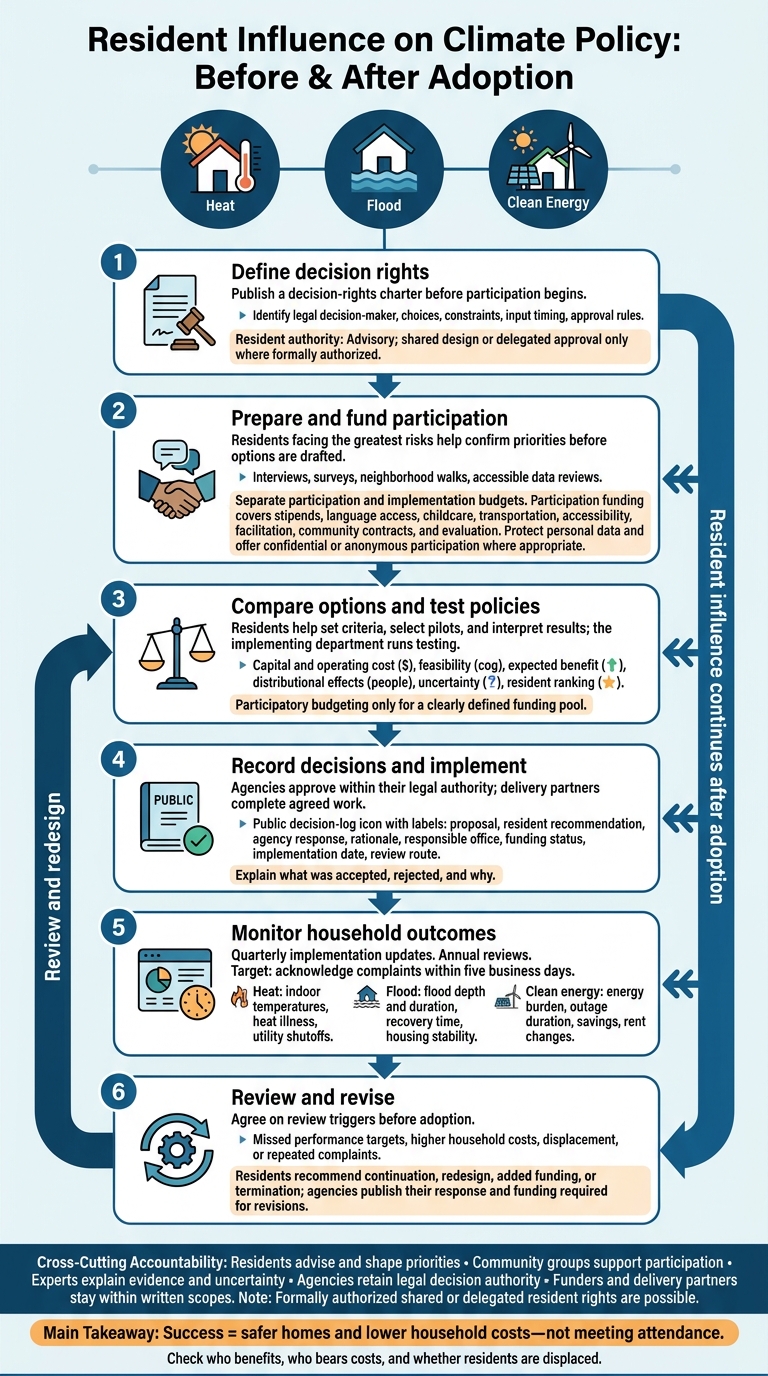
Climate Policy Co-Creation: From Resident Input to Accountability
How to Scale up and Sustain Community Engagement in Environmental Policymaking
sbb-itb-8baf5f1
Define Community Roles and Decision Rights
Publish a decision-rights charter before participation begins. Identify the legal decision-maker, the choices residents can shape, the constraints, when input will be sought, and how changes will be approved. Verify city, county, Tribal, state, and federal authority before meetings begin. State whether residents advise, share design authority where formally authorized, or hold delegated approval rights for heat, flood, and clean energy decisions.
The charter keeps roles clear before policy design starts. Use the table below to assign work and authority. In the local version, name the responsible office or person instead of making the entire jurisdiction accountable for every task.[1]
| Participant | Responsibilities | Decision authority | Required resources | Reporting obligations |
|---|---|---|---|---|
| Residents facing the greatest heat, flood, or energy risks | Describe lived impacts; check risk information; weigh tradeoffs; set priorities; monitor results | Advisory role on needs, priorities, and design criteria; shared approval where formally authorized | Stipends and access support | Report whether policies reflect lived experience and benefits reach high-risk households |
| Community organizations | Recruit participants; coordinate the process; help mediate conflicts; support monitoring | Advisory or delegated coordination role defined in writing; no automatic authority to speak for all residents | Flexible operating funds, staff time, facilitation, and participant databases managed with consent | Disclose membership, selection methods, and conflicts; summarize input and gaps in participation |
| Public agencies | Define legal scope; provide data and budgets; conduct regulatory review; select or approve policies; implement programs | Formal decision authority within statutory jurisdiction | Staff, legal counsel, procurement capacity, technical systems, and implementation funding | Publish decisions, reasons, budgets, milestones, performance measures, and responses to community recommendations |
| Independent technical experts | Explain projections, health risks, costs, constraints, and uncertainty; test assumptions | No sole authority over community priorities or policy choices unless separately authorized | Reliable data, modeling tools, time, and compensation for independent review | Disclose methods, assumptions, uncertainty, funding sources, and conflicts of interest |
| Funders | Finance engagement, pilots, technical assistance, and implementation | Grant or contract decisions within their authority; should not override public decision rights | Multi-year, flexible funds and clear grant requirements | Report award criteria, expenditures, restrictions, outcomes, and equity impacts |
| Delivery partners, utilities, contractors, or nonprofits | Complete agreed work, meet standards, engage affected users, and correct deficiencies | Implementation authority limited by contracts, permits, and approved designs | Contracts, workforce, equipment, insurance, and performance information | Report progress, costs, complaints, safety incidents, and corrective actions |
| Accountable public official or governing body | Ensure lawful, equitable, and effective results; resolve unsettled disputes; authorize revisions | Final public accountability for public decisions and outcomes | Oversight authority, audit access, enforcement tools, and sustained funding | Issue public updates, explain departures from recommendations, and document corrective action |
These assignments provide a shared structure for heat, flood, and clean energy policy choices.
Roles for Residents and Community Groups
Residents bring evidence that maps and models may miss. They can weigh tradeoffs and check whether benefits reach the intended households. Community groups should support this work - not control whose views count.
Publish membership criteria, geographic coverage, affiliations, selection methods, and seat-rotation rules. Keep organizational input separate from input by unaffiliated residents, and record disagreements.
Roles for Agencies, Experts, and Partners
Agencies must distinguish technical findings, policy judgments, and legal limits. Experts explain what projections show - and what they do not. Residents and officials weigh the tradeoffs. Give participants clear evidence and technical assistance before asking them to evaluate options.[2]
Set written scopes for funders and delivery partners that cover milestones, data use, safety, community benefits, complaint handling, and consequences for nonperformance. Require conflict disclosures before deliberation and recusal where appropriate. Fund participation itself, not just construction.
Maintain a public response log that links each major recommendation to a decision, its rationale, the person or organization responsible for carrying it out, and a deadline.
Co-Create Heat, Flood, and Clean Energy Policies
Use the decision-rights charter to turn general roles into specific decisions about heat, flooding, and clean energy. The roles stay the same across policy areas, but each calls for different safeguards and measures of progress.
| Policy area | Resident knowledge | Agency responsibility | Community-group role | Priority safeguards | Equity indicators |
|---|---|---|---|---|---|
| Heat | Overheated homes, cooling barriers, worker heat safety | Set cooling, housing, alert, and worker-safety protections | Check access; support enrollment | Accessible hours and transportation; affordable cooling; renter protections | Indoor temperatures, heat illness, utility shutoffs, renter access to upgrades |
| Flood | Recurring flooding, mold, evacuation barriers, insurance problems | Set drainage, evacuation, recovery, and voluntary relocation actions | Document damage; connect households to assistance | Do not shift flood risk downstream; fair-market valuation; tenant and relocation support | Flood depth and duration, recovery time, aid approvals, housing stability |
| Clean energy | High bills, outages, landlord restrictions, transportation needs | Set efficiency, solar, electrification, transit, and consumer protections within local authority | Explain contracts; verify savings; connect residents to training | No net increase in total household costs; protection against rent increases and disconnections | Energy burden, outage duration, savings, enrollment, rent changes, local job placement |
Heat: Cooling, Housing, and Worker Safety
Residents advise: Use heat walks, confidential worker interviews, and indoor monitoring with residents’ consent to find overheated apartments, gaps in shade, utility debt, and unsafe working conditions. Record temperatures in degrees Fahrenheit, along with times and locations.
Agencies approve within their authority: Combine residents’ findings with local forecasts and building data to assess cooling-center hours, transportation, shade, weatherization, repairs, and alerts. Check legal authority before proposing housing temperature standards, utility shutoff restrictions, or workplace requirements.
Community groups monitor access: Test routes and entrances with older adults and people with disabilities. Check language access and options for filing confidential complaints.
Equity checkpoint: After each heat season, compare the table’s indicators and completed repairs by neighborhood and renter status.
Flood: Drainage, Recovery, and Displacement
Flood policy must track both physical risk and where projects may move that risk.
Residents advise: Add dated flood photographs, mold reports, blocked drain locations, evacuation barriers, and insurance difficulties to flood maps.
Agencies approve within their authority: Review those maps alongside rainfall forecasts and capital plans before choosing drainage upgrades, green infrastructure, floodproofing, or emergency routes. Name the office responsible for maintenance.
Community groups support and monitor recovery: Help households document losses and get claims assistance, temporary housing, and relocation counseling.
Equity checkpoint: Compare the table’s indicators across affected neighborhoods and by renter status. Check whether projects shift risk downstream and whether replacement housing keeps people connected to jobs, schools, and transit. Keep buyouts voluntary, with clear fair-market valuation methods, moving support, and a plan to maintain acquired land.
Clean Energy: Costs, Reliability, and Access
Residents advise: Review bills, outage experiences, landlord barriers, appliance needs, and travel patterns before choosing technologies.
Agencies approve within their authority: Compare weatherization, rooftop or community solar, electrification, resilience hubs, transportation access, and workforce programs with local grid capacity and neighborhood priorities.
Community groups monitor benefits: Explain contracts, help tenants enroll, connect residents to training, and check whether promised savings reach households.
Equity checkpoint: Apply a total-household-cost test that covers equipment, financing, maintenance, electricity, remaining fuel charges, transportation, and rent changes. Pair electrification with needed weatherization and panel upgrades. Compare the table’s indicators and disconnections among at-risk households.
Manage, Fund, and Review Co-Creation
Once roles are set, work moves to preparation, funding, testing, and review. Throughout, residents facing the greatest risk should help shape climate resilience decisions regarding heat, flood, and clean energy.
Prepare, Listen, and Define the Problem
Use the decision-rights charter to assign who prepares, who facilitates, and who decides. Organize preparation around three tasks:
Define the problem: Map affected populations, past harms, and who controls land and infrastructure decisions that affect them. Use interviews, surveys, neighborhood walks, and accessible data reviews so residents can confirm priorities before anyone drafts options.
Set participation rules: Add timelines and separate budget lines for participation and implementation to the charter. Provide facilitation that supports a fair process.
Protect data: Set rules for data use, collect only necessary personal information, and offer anonymous or confidential participation when appropriate.
Give participation its own budget rather than treating it as an afterthought in implementation funding. Cover stipends, language access, childcare, transportation, accessibility, facilitation, community contracts, and evaluation.[3][4] Fund flexible meeting times and prompt payments. Approve recurring participation funding for post-adoption reviews separately from implementation spending.
Compare Options, Test Policies, and Record Decisions
With funding in place, compare concrete heat, flood, and clean energy options. The implementing department runs testing, while residents help set criteria, select pilots, and interpret results. Use workshops and scenario exercises to fill the table below with local estimates.
Give committees written voting rules, conflict disclosures, and recusal requirements. Use participatory budgeting only when residents can allocate a clearly defined funding pool.[5][6]
Option Capital and operating cost Feasibility check Expected benefit to test Distributional effects Uncertainty Resident ranking Extended cooling-center hours Staffing, transportation, operations Staff and accessible transportation availability More usable cooling access Who can reach the center, and who cannot? Attendance during heat emergencies Record ranking and reasons Green infrastructure Design, construction, maintenance Land and drainage conditions, maintenance capacity Less local flooding Which blocks benefit; who bears disruption? Performance during heavier storms Record ranking and reasons Weatherization assistance Upgrades, administration, household costs Contractor capacity and enrollment rules Lower energy use and bills Whether renters and high-burden households qualify Actual savings and participation Record ranking and reasons
Every test should end with a public record of what was proposed, accepted, rejected, and why. Keep a public decision log that includes each proposal, resident recommendation, agency response, rationale, responsible office, funding status, implementation date, and review route. Release drafts early enough for residents to flag factual errors.
Keep pilot construction and equipment costs in implementation funding. Charge resident workshops, interpretation, and feedback sessions to participation funding.
Measure Results and Revise Policies
After adoption, shift the process to monitoring and revision so residents retain influence. Assign one executive or department to report overall progress. Name the people responsible for data collection, resident communications, accessibility, finance, implementation, and complaint resolution.
Publish quarterly implementation updates and annual reviews. Offer phone, online, mail, and in-person complaint channels, and acknowledge complaints within five business days.
Alongside the policy indicators above, track representation, stipend payment time, interpretation and accessibility requests fulfilled, recommendations adopted, trust, unresolved complaints, and who receives benefits or bears costs. Break results down by relevant groups while suppressing identifying details.
Agree on review triggers before adoption, including missed performance targets, higher household costs, displacement, or repeated complaints. At each review, residents recommend continuation, redesign, added funding, or termination. Publish the agency response and the funding required for revisions.
Conclusion: Maintain Resident Influence and Accountability
Once implementation begins, success means residents facing the greatest risks are safer - not simply that meetings are well attended. Residents must retain influence through design, implementation, and review. Include participation in project budgets, and pay residents for their time, travel, and child care. Never make payment depend on support for a preferred policy. Heat, flood, and clean energy measures must fit local housing, infrastructure, working conditions, and household budgets.
Implementation partners such as Council Fire can help put community priorities into practice through planning, risk mapping, engagement design, and partner coordination. Outside expertise must not replace public decision-making. Partners support resident priorities; they do not define them. Agencies retain their legal, fiduciary, regulatory, and accountability duties.
Before adoption, put partner agreements in writing to protect residents’ decision rights. Align those agreements with the decision-rights charter and require regular reporting through the public response log. Spell out conflict-of-interest rules, data ownership, accessibility, compensation, and a process for residents to challenge recommendations. Treat adoption as the start of accountability, with residents continuing to shape the work.
FAQs
How can residents challenge rejected recommendations?
Residents can use municipal or agency feedback channels - group discussions, private meetings, written submissions, or online platforms - to ask why a recommendation was rejected. They can also suggest changes based on their lived experience.
Municipalities should explain how community input shaped decisions and why they chose a different approach. Keeping communication open in both directions throughout planning helps residents continue pushing for changes.
How can communities include residents who distrust agencies?
Build long-term, transparent relationships rather than relying on one-time public meetings. Work with trusted block captains, faith leaders, neighborhood advocates, and community organizations to reach residents who may be isolated. Acknowledge past injustices and explain how today’s processes differ.
Treat residents as experts. Offer stipends for their time, meet in familiar community spaces, and show exactly how their input shapes policy outcomes.
How should conflicting neighborhood priorities be resolved?
Before projects begin, put a clear, transparent governance charter in place. Define the mission, how decisions will be made, and how disputes will be resolved. Assign senior representatives to a governing council that decides on major investments and policy changes, while working groups manage day-to-day decisions.
Set clear escalation paths with maximum response times of 10 to 15 business days. Bring in an independent facilitator when needed to give all parties a fair hearing and keep the process moving.




FAQ