Feb 26, 2026
How to Design a Circular Supply Chain Roadmap for Corporations
Sustainability Strategy
In This Article
Step-by-step guide to assess supply chains, set measurable circularity goals, redesign for repair and reuse, and run phased pilots to recover materials and cut waste.
How to Design a Circular Supply Chain Roadmap for Corporations
Redesigning supply chains to reduce waste and reuse materials is no longer optional - it’s a smarter way to operate. Circular supply chains replace the outdated “take-make-dispose” model with a system that keeps materials in continuous use, benefiting both businesses and the planet. Here’s what you need to know:
What is a circular supply chain? It’s a closed-loop system where used products are returned for recycling, refurbishment, or reuse, reducing waste and reliance on raw materials.
Why does it matter? Circular practices can cut global emissions by 39%, lower production costs, and create new revenue streams like refurbished product sales.
How to start? Assess your current supply chain, define measurable goals, redesign products for durability and repair, and integrate reverse logistics for material recovery.
Key Steps:
Assess Your Supply Chain: Map out material flows and identify inefficiencies.
Set Priorities: Establish clear targets like reducing virgin material use or increasing recycled content.
Redesign Operations: Use modular designs, implement take-back programs, and adopt reverse logistics.
Implement in Phases: Start small, scale successful pilots, and collaborate with partners.
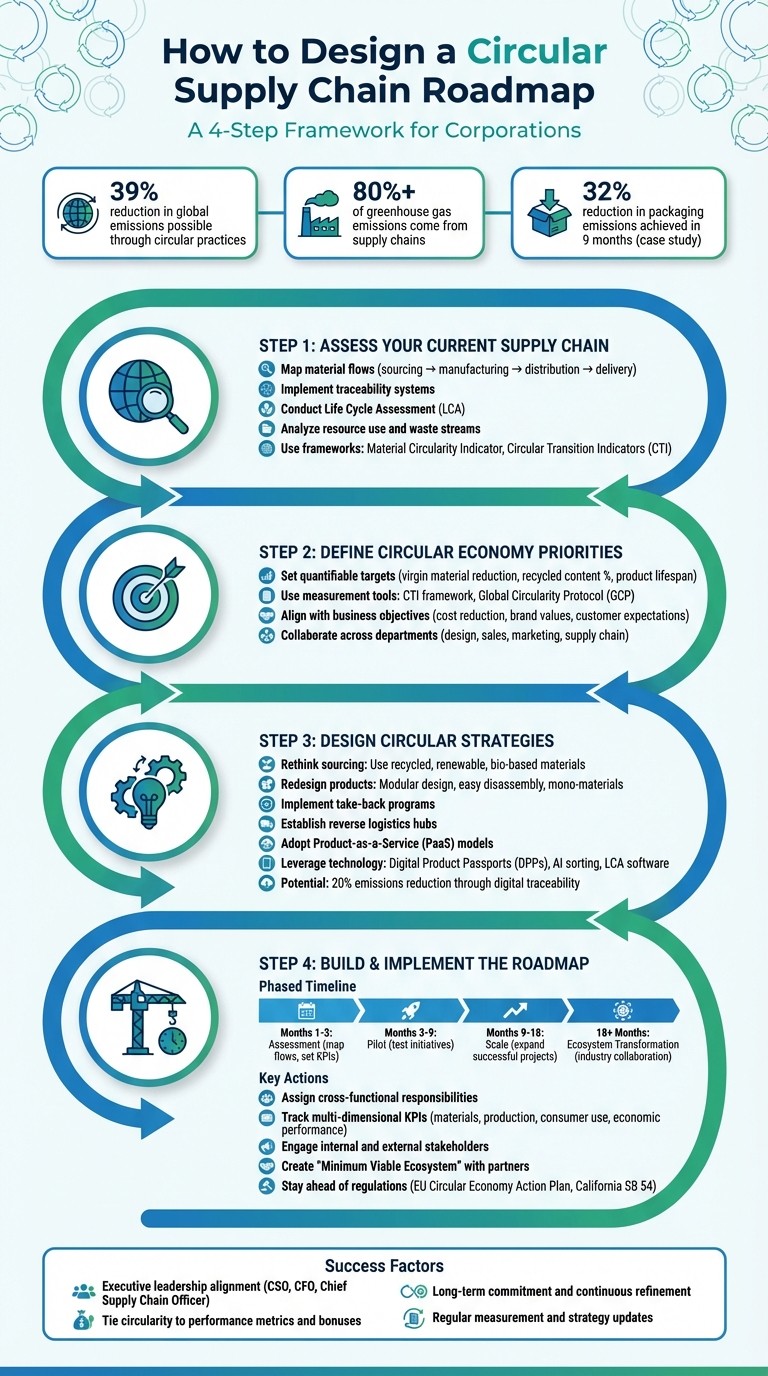
4-Step Circular Supply Chain Implementation Roadmap for Corporations
Building a circular supply chain
Step 1: Assess Your Current Supply Chain
Evaluating your supply chain is the first step to identifying areas of resource inefficiency and opportunities for circular improvements. Since more than 80% of total greenhouse gas emissions for most consumer goods companies come from their supply chain [1], this step is essential for improving both environmental outcomes and financial performance. This groundwork is crucial for designing an effective circular strategy in the next stages.
Map Your Supply Chain Processes
Start by mapping every stage of your supply chain - sourcing, manufacturing, distribution, and delivery. Include both forward and reverse flows to account for all inputs, processing steps, and waste outputs.
Implement traceability systems to monitor products from delivery to returns. These systems require multidirectional information flows, capturing data about each item's location, material composition, and disassembly options [1]. Supplier questionnaires and scorecards can help you evaluate vendors' circular practices alongside their costs and quality standards.
For example, a home and personal care company with $3.0 billion in revenue conducted a cradle-to-grave Life Cycle Assessment (LCA) to compare four packaging options for a 500 mL shampoo bottle. The analysis revealed that primary aluminum significantly impacted emissions unless it contained a high percentage of recycled content. Acting on these insights, the company switched to 50% recycled HDPE and lightweight materials, reducing packaging-related greenhouse gas emissions by 32% in Europe and 28% in North America within just nine months [4].
Once your supply chain is mapped, the next step is to analyze resource efficiency and waste.
Analyze Resource Use and Waste Streams
Focus on circular metrics such as resource consumption, recovery rates, and the 4Rs: Refuse, Reduce, Reuse, and Recycle [2]. A material circularity audit, using tools like the Ellen MacArthur Foundation's Material Circularity Indicator, can help you assess how much virgin material is being used compared to recovered materials.
"Circular economy requires assessment of the entire value chains, becoming relevant to investigate and propose CE frameworks that are oriented towards supply chain management." - Jose Alejandro Cano et al., Environments Journal [2]
Adopt standardized frameworks like the Circular Transition Indicators (CTI) or an updated SCOR model to evaluate circular performance quantitatively [2][3]. These tools enable you to track not only physical waste but also the underutilization of resources throughout their lifecycle. They can also help identify cascading opportunities where materials can be repurposed for use in other industries.
The insights gained from this analysis will guide the development of your circular strategy in Step 2.
Step 2: Define Circular Economy Priorities
Establishing clear, measurable goals is essential for addressing inefficiencies while aligning these efforts with your broader business strategy. Below, we outline steps to make these priorities actionable.
Identify Key Circularity Goals
Focus on setting specific, quantifiable targets. These might include reducing the use of virgin materials, increasing the proportion of recycled content, improving product repairability, or extending product lifespans. Tools like the Circular Transition Indicators (CTI) framework - featuring metrics such as "% Circular Inflow" and "Recovery Potential" - can help shape these benchmarks. Similarly, the Global Circularity Protocol (GCP), released on November 11, 2025, integrates with major reporting standards like GRI, ISO 59020, and ESRS, offering a structured approach to measure progress [7][8].
Circularity also serves as a safeguard against challenges like commodity price inflation and supply chain disruptions. By securing alternative material sources and implementing strategies such as subscription models that allow manufacturers to retain ownership, businesses can streamline reclamation processes and enhance resource efficiency [5].
Once these goals are defined, they should be seamlessly woven into your overarching business objectives.
Align Circular Goals with Business Objectives
To ensure circular priorities deliver maximum impact, they must support financial performance, align with brand values, and meet customer expectations. Since supply chains are a major contributor to emissions [1], aligning circular strategies can help reduce both environmental and operational costs.
Achieving this alignment requires collaboration across departments including product design, sales, marketing, and supply chain management [5][6]. For instance, if supply chain disruptions are a recurring issue, focus on goals that reduce dependency on raw material extraction. Alternatively, if your customers are increasingly drawn to sustainable products, emphasize features like recycled content or take-back programs. By integrating circular priorities into your operations, you can not only build a more resilient supply chain but also gain competitive advantages that resonate with stakeholders throughout your organization.
Step 3: Design Your Circular Supply Chain Strategies
Once priorities are set, the next step is to weave circular economy principles into the very fabric of your supply chain. This involves rethinking material sourcing, redesigning products for extended use, and using technology to monitor and optimize resource flows.
Rethink Sourcing and Product Design
Begin by transitioning from virgin raw materials to recycled, renewable, or bio-based options. This shift reduces reliance on extraction-heavy supply chains while minimizing environmental harm. Design products with modularity and easy disassembly in mind. For instance, using mechanical fasteners instead of adhesives allows components to be replaced or recovered more efficiently at the end of their lifecycle. Simplifying material choices - such as opting for mono-material designs - makes recycling significantly easier by eliminating the need to separate mixed materials.
Introduce take-back programs that offer trade-in credits or discounts on future purchases. These initiatives ensure a steady stream of materials for refurbishment or recycling while fostering stronger customer loyalty. Apple, for example, employs artificial intelligence to assess the condition of returned devices, determining whether they should be refurbished for resale or processed for recycling [5].
These design changes lay the groundwork for integrating circular practices into daily operations.
Embed Circularity into Operations
With redesigned products, the next step is to incorporate circular processes into your operations. Reverse logistics becomes the backbone of this approach, enabling efficient returns, repairs, refurbishments, and recycling. Establish centralized hubs where returned goods are inspected, graded, and directed to their next stage - whether that’s resale, repair, or material recovery. Adopt closed-loop manufacturing by reclaiming components from end-of-life products and reintroducing them into production.
Transform waste into resources through upcycling, where byproducts from manufacturing or agriculture are turned into valuable inputs like packaging or new components. Explore Product-as-a-Service (PaaS) models, where you retain ownership of products and lease them instead of selling outright. For example, leasing equipment or lighting keeps materials within your control, simplifying their eventual recovery.
Once these operational changes are in place, technology can help make circular practices even more efficient.
Leverage Technology for Circular Supply Chains
Digital Product Passports (DPPs) are a game-changer, offering detailed information on a product’s material composition, carbon footprint, and repairability. These tools not only simplify ESG reporting but also enhance transparency across the supply chain, building trust with consumers. In fact, digital traceability could cut emissions by up to 20% in high-emission industries [9].
Use AI tools to sort returned goods, estimate resale value, and direct items to the most suitable recovery process [5]. During the design phase, employ lifecycle assessment (LCA) software to evaluate a product’s durability and recyclability before production even begins [10]. Collaborate within industry ecosystems - like Catena-X in the automotive sector - to create secure and standardized platforms for sharing supply chain data [9].
Step 4: Build and Implement the Roadmap
Once your circular strategies are defined, the next step is to bring them to life through a structured roadmap. By breaking the process into clear, phased steps with defined timelines, responsibilities, and measurable outcomes, you can avoid feeling overwhelmed while allowing room to adapt and improve along the way.
Create a Phased Implementation Plan
Divide your roadmap into four key phases, each building on the progress of the previous one:
Assessment (Months 1–3): Begin by mapping material flows, analyzing stakeholder roles, and setting key performance indicators (KPIs) to guide your efforts.
Pilot (Months 3–9): Test small-scale initiatives such as product redesigns, material substitutions, and reverse logistics. This phase focuses on experimentation and learning.
Scale (Months 9–18): Expand successful pilot projects across regions or product lines. Introduce technologies like AI or robotics to streamline processes and improve efficiency.
Ecosystem Transformation (18+ Months): Collaborate across the industry to establish shared standards, create partnerships in research and development, and drive systemic changes.
Each phase should include clearly defined deliverables and decision points to ensure that insights from earlier stages guide the next steps. Assign responsibilities across teams from product design to operations and marketing to ensure smooth collaboration. Use multi-dimensional KPIs to track progress, including:
Materials: Recycling rates and percentages of renewable content.
Production: Gains in resource efficiency.
Consumer Use: Metrics like repair rates and extended product lifecycles.
Economic Performance: Revenue from service-based models and savings from material recovery.
With this phased plan in place, the focus shifts to rallying both internal teams and external partners to execute the strategy effectively.
Engage Stakeholders for Alignment
To ensure the success of your roadmap, align both internal and external stakeholders from the outset. Misalignment can derail progress - for instance, engineers might design products for easy disassembly, but the sales team could struggle to market refurbished goods [5].
Externally, create a "Minimum Viable Ecosystem" where suppliers and logistics partners share risks and rewards. Use tools like standardized supplier questionnaires and scorecards to gather consistent data on circular practices across your network. Conduct regular audits to ensure partners meet circular and ESG standards. Financial incentives can play a critical role - design contracts so partners directly benefit from material recovery or waste reduction, fostering stronger, long-term collaboration.
Stay proactive by adapting your roadmap to meet emerging regulations like California’s SB 54 or the EU’s Circular Economy Action Plan. Being ahead of compliance requirements not only reduces risk but also positions your organization as a leader in circular innovation.
Conclusion
Key Points Recap
To reshape how materials, products, and waste are managed, a circular supply chain roadmap is essential. Start by assessing your supply chain to understand material flows and identify areas for improvement. Define your priorities within the circular economy by setting goals that align with your broader business objectives, whether that's cutting costs, meeting regulations, or enhancing brand reputation. Next, design strategies by rethinking sourcing, embedding circular processes into operations, and using technology to close material loops. Finally, implement your roadmap in phases - starting with small-scale pilots, expanding successful initiatives, and collaborating with both internal teams and external partners.
This transition from a "take-make-dispose" approach to a regenerative, closed-loop system fundamentally changes how businesses operate. Products are redesigned for reuse, customers play a role in material recovery, and waste is no longer seen as unavoidable but as an issue to be resolved.
These steps lay the groundwork for the leadership needed to drive this transformation effectively.
The Role of Leadership and Long-Term Commitment
Leadership alignment at the executive level is critical for sustaining circular supply chain efforts. The Chief Supply Chain Officer, Chief Sustainability Officer, and Chief Financial Officer must collaborate to ensure sufficient resources - both financial and human - are allocated to these initiatives. Leadership fosters adoption by embedding circularity into performance metrics, such as tying annual reviews and bonuses for supply chain teams to circular economy goals. Defining clear roles, investing in expertise, and establishing criteria for supplier circularity while rewarding innovative recovery efforts are also crucial steps [11].
A long-term view is equally important. As markets shift and new opportunities arise, companies must regularly refine their strategies. Ongoing measurement helps manage challenges like commodity price swings and supply chain disruptions by maintaining access to reclaimed material sources [5]. Organizations that treat circularity as a continuous journey, rather than a one-off project, will build resilience throughout their supply chain.
FAQs
What KPIs should we track first for circularity?
To begin monitoring circularity, prioritize key performance indicators (KPIs) such as recycling rates, resource efficiency, material reuse, and waste reduction. These metrics closely align with the core principles of a circular economy, which focus on eliminating waste and keeping materials in use. Tools like the Circular Transition Indicators framework can help by measuring aspects such as material flows, recovery cycles, and waste management effectiveness. These KPIs offer a practical starting point to assess progress and pinpoint opportunities for enhancement.
How do we set up reverse logistics without raising costs?
To establish reverse logistics while keeping costs manageable, the emphasis should be on efficiency and reclaiming value from used products. Here’s how to approach it effectively:
Design for Reuse and Recycling: Develop products with materials and components that can be easily reused or recycled, reducing waste and recovery expenses.
Streamlined Collection and Repair Systems: Implement straightforward processes for collecting, repairing, or refurbishing items to extend their lifecycle.
Use of Advanced Technology: Apply tools like AI for process optimization and blockchain for transparent tracking, ensuring smoother operations.
Track Key Metrics: Monitor indicators such as recycling rates to assess performance and identify areas for improvement.
These measures not only help control costs but also support progress toward circular economy objectives.
Which products should we pilot for circular redesign?
Companies can experiment with products specifically created for disassembly, reuse, and recyclability. Ideal examples include modular designs, items featuring standardized fasteners, and those crafted from recycled or easily recyclable materials. Products that lend themselves to repair, refurbishment, or remanufacturing - such as machinery, electronics, or consumer goods - are also strong contenders. These strategies boost resource efficiency, minimize waste, and prolong product lifecycles, aligning closely with the principles of a circular economy.
Related Blog Posts
Latest Articles
©2025



FAQ
01
What does it really mean to “redefine profit”?
02
What makes Council Fire different?
03
Who does Council Fire you work with?
04
What does working with Council Fire actually look like?
05
How does Council Fire help organizations turn big goals into action?
06
How does Council Fire define and measure success?
Feb 26, 2026
How to Design a Circular Supply Chain Roadmap for Corporations
Sustainability Strategy
In This Article
Step-by-step guide to assess supply chains, set measurable circularity goals, redesign for repair and reuse, and run phased pilots to recover materials and cut waste.
How to Design a Circular Supply Chain Roadmap for Corporations
Redesigning supply chains to reduce waste and reuse materials is no longer optional - it’s a smarter way to operate. Circular supply chains replace the outdated “take-make-dispose” model with a system that keeps materials in continuous use, benefiting both businesses and the planet. Here’s what you need to know:
What is a circular supply chain? It’s a closed-loop system where used products are returned for recycling, refurbishment, or reuse, reducing waste and reliance on raw materials.
Why does it matter? Circular practices can cut global emissions by 39%, lower production costs, and create new revenue streams like refurbished product sales.
How to start? Assess your current supply chain, define measurable goals, redesign products for durability and repair, and integrate reverse logistics for material recovery.
Key Steps:
Assess Your Supply Chain: Map out material flows and identify inefficiencies.
Set Priorities: Establish clear targets like reducing virgin material use or increasing recycled content.
Redesign Operations: Use modular designs, implement take-back programs, and adopt reverse logistics.
Implement in Phases: Start small, scale successful pilots, and collaborate with partners.
4-Step Circular Supply Chain Implementation Roadmap for Corporations
Building a circular supply chain
Step 1: Assess Your Current Supply Chain
Evaluating your supply chain is the first step to identifying areas of resource inefficiency and opportunities for circular improvements. Since more than 80% of total greenhouse gas emissions for most consumer goods companies come from their supply chain [1], this step is essential for improving both environmental outcomes and financial performance. This groundwork is crucial for designing an effective circular strategy in the next stages.
Map Your Supply Chain Processes
Start by mapping every stage of your supply chain - sourcing, manufacturing, distribution, and delivery. Include both forward and reverse flows to account for all inputs, processing steps, and waste outputs.
Implement traceability systems to monitor products from delivery to returns. These systems require multidirectional information flows, capturing data about each item's location, material composition, and disassembly options [1]. Supplier questionnaires and scorecards can help you evaluate vendors' circular practices alongside their costs and quality standards.
For example, a home and personal care company with $3.0 billion in revenue conducted a cradle-to-grave Life Cycle Assessment (LCA) to compare four packaging options for a 500 mL shampoo bottle. The analysis revealed that primary aluminum significantly impacted emissions unless it contained a high percentage of recycled content. Acting on these insights, the company switched to 50% recycled HDPE and lightweight materials, reducing packaging-related greenhouse gas emissions by 32% in Europe and 28% in North America within just nine months [4].
Once your supply chain is mapped, the next step is to analyze resource efficiency and waste.
Analyze Resource Use and Waste Streams
Focus on circular metrics such as resource consumption, recovery rates, and the 4Rs: Refuse, Reduce, Reuse, and Recycle [2]. A material circularity audit, using tools like the Ellen MacArthur Foundation's Material Circularity Indicator, can help you assess how much virgin material is being used compared to recovered materials.
"Circular economy requires assessment of the entire value chains, becoming relevant to investigate and propose CE frameworks that are oriented towards supply chain management." - Jose Alejandro Cano et al., Environments Journal [2]
Adopt standardized frameworks like the Circular Transition Indicators (CTI) or an updated SCOR model to evaluate circular performance quantitatively [2][3]. These tools enable you to track not only physical waste but also the underutilization of resources throughout their lifecycle. They can also help identify cascading opportunities where materials can be repurposed for use in other industries.
The insights gained from this analysis will guide the development of your circular strategy in Step 2.
Step 2: Define Circular Economy Priorities
Establishing clear, measurable goals is essential for addressing inefficiencies while aligning these efforts with your broader business strategy. Below, we outline steps to make these priorities actionable.
Identify Key Circularity Goals
Focus on setting specific, quantifiable targets. These might include reducing the use of virgin materials, increasing the proportion of recycled content, improving product repairability, or extending product lifespans. Tools like the Circular Transition Indicators (CTI) framework - featuring metrics such as "% Circular Inflow" and "Recovery Potential" - can help shape these benchmarks. Similarly, the Global Circularity Protocol (GCP), released on November 11, 2025, integrates with major reporting standards like GRI, ISO 59020, and ESRS, offering a structured approach to measure progress [7][8].
Circularity also serves as a safeguard against challenges like commodity price inflation and supply chain disruptions. By securing alternative material sources and implementing strategies such as subscription models that allow manufacturers to retain ownership, businesses can streamline reclamation processes and enhance resource efficiency [5].
Once these goals are defined, they should be seamlessly woven into your overarching business objectives.
Align Circular Goals with Business Objectives
To ensure circular priorities deliver maximum impact, they must support financial performance, align with brand values, and meet customer expectations. Since supply chains are a major contributor to emissions [1], aligning circular strategies can help reduce both environmental and operational costs.
Achieving this alignment requires collaboration across departments including product design, sales, marketing, and supply chain management [5][6]. For instance, if supply chain disruptions are a recurring issue, focus on goals that reduce dependency on raw material extraction. Alternatively, if your customers are increasingly drawn to sustainable products, emphasize features like recycled content or take-back programs. By integrating circular priorities into your operations, you can not only build a more resilient supply chain but also gain competitive advantages that resonate with stakeholders throughout your organization.
Step 3: Design Your Circular Supply Chain Strategies
Once priorities are set, the next step is to weave circular economy principles into the very fabric of your supply chain. This involves rethinking material sourcing, redesigning products for extended use, and using technology to monitor and optimize resource flows.
Rethink Sourcing and Product Design
Begin by transitioning from virgin raw materials to recycled, renewable, or bio-based options. This shift reduces reliance on extraction-heavy supply chains while minimizing environmental harm. Design products with modularity and easy disassembly in mind. For instance, using mechanical fasteners instead of adhesives allows components to be replaced or recovered more efficiently at the end of their lifecycle. Simplifying material choices - such as opting for mono-material designs - makes recycling significantly easier by eliminating the need to separate mixed materials.
Introduce take-back programs that offer trade-in credits or discounts on future purchases. These initiatives ensure a steady stream of materials for refurbishment or recycling while fostering stronger customer loyalty. Apple, for example, employs artificial intelligence to assess the condition of returned devices, determining whether they should be refurbished for resale or processed for recycling [5].
These design changes lay the groundwork for integrating circular practices into daily operations.
Embed Circularity into Operations
With redesigned products, the next step is to incorporate circular processes into your operations. Reverse logistics becomes the backbone of this approach, enabling efficient returns, repairs, refurbishments, and recycling. Establish centralized hubs where returned goods are inspected, graded, and directed to their next stage - whether that’s resale, repair, or material recovery. Adopt closed-loop manufacturing by reclaiming components from end-of-life products and reintroducing them into production.
Transform waste into resources through upcycling, where byproducts from manufacturing or agriculture are turned into valuable inputs like packaging or new components. Explore Product-as-a-Service (PaaS) models, where you retain ownership of products and lease them instead of selling outright. For example, leasing equipment or lighting keeps materials within your control, simplifying their eventual recovery.
Once these operational changes are in place, technology can help make circular practices even more efficient.
Leverage Technology for Circular Supply Chains
Digital Product Passports (DPPs) are a game-changer, offering detailed information on a product’s material composition, carbon footprint, and repairability. These tools not only simplify ESG reporting but also enhance transparency across the supply chain, building trust with consumers. In fact, digital traceability could cut emissions by up to 20% in high-emission industries [9].
Use AI tools to sort returned goods, estimate resale value, and direct items to the most suitable recovery process [5]. During the design phase, employ lifecycle assessment (LCA) software to evaluate a product’s durability and recyclability before production even begins [10]. Collaborate within industry ecosystems - like Catena-X in the automotive sector - to create secure and standardized platforms for sharing supply chain data [9].
Step 4: Build and Implement the Roadmap
Once your circular strategies are defined, the next step is to bring them to life through a structured roadmap. By breaking the process into clear, phased steps with defined timelines, responsibilities, and measurable outcomes, you can avoid feeling overwhelmed while allowing room to adapt and improve along the way.
Create a Phased Implementation Plan
Divide your roadmap into four key phases, each building on the progress of the previous one:
Assessment (Months 1–3): Begin by mapping material flows, analyzing stakeholder roles, and setting key performance indicators (KPIs) to guide your efforts.
Pilot (Months 3–9): Test small-scale initiatives such as product redesigns, material substitutions, and reverse logistics. This phase focuses on experimentation and learning.
Scale (Months 9–18): Expand successful pilot projects across regions or product lines. Introduce technologies like AI or robotics to streamline processes and improve efficiency.
Ecosystem Transformation (18+ Months): Collaborate across the industry to establish shared standards, create partnerships in research and development, and drive systemic changes.
Each phase should include clearly defined deliverables and decision points to ensure that insights from earlier stages guide the next steps. Assign responsibilities across teams from product design to operations and marketing to ensure smooth collaboration. Use multi-dimensional KPIs to track progress, including:
Materials: Recycling rates and percentages of renewable content.
Production: Gains in resource efficiency.
Consumer Use: Metrics like repair rates and extended product lifecycles.
Economic Performance: Revenue from service-based models and savings from material recovery.
With this phased plan in place, the focus shifts to rallying both internal teams and external partners to execute the strategy effectively.
Engage Stakeholders for Alignment
To ensure the success of your roadmap, align both internal and external stakeholders from the outset. Misalignment can derail progress - for instance, engineers might design products for easy disassembly, but the sales team could struggle to market refurbished goods [5].
Externally, create a "Minimum Viable Ecosystem" where suppliers and logistics partners share risks and rewards. Use tools like standardized supplier questionnaires and scorecards to gather consistent data on circular practices across your network. Conduct regular audits to ensure partners meet circular and ESG standards. Financial incentives can play a critical role - design contracts so partners directly benefit from material recovery or waste reduction, fostering stronger, long-term collaboration.
Stay proactive by adapting your roadmap to meet emerging regulations like California’s SB 54 or the EU’s Circular Economy Action Plan. Being ahead of compliance requirements not only reduces risk but also positions your organization as a leader in circular innovation.
Conclusion
Key Points Recap
To reshape how materials, products, and waste are managed, a circular supply chain roadmap is essential. Start by assessing your supply chain to understand material flows and identify areas for improvement. Define your priorities within the circular economy by setting goals that align with your broader business objectives, whether that's cutting costs, meeting regulations, or enhancing brand reputation. Next, design strategies by rethinking sourcing, embedding circular processes into operations, and using technology to close material loops. Finally, implement your roadmap in phases - starting with small-scale pilots, expanding successful initiatives, and collaborating with both internal teams and external partners.
This transition from a "take-make-dispose" approach to a regenerative, closed-loop system fundamentally changes how businesses operate. Products are redesigned for reuse, customers play a role in material recovery, and waste is no longer seen as unavoidable but as an issue to be resolved.
These steps lay the groundwork for the leadership needed to drive this transformation effectively.
The Role of Leadership and Long-Term Commitment
Leadership alignment at the executive level is critical for sustaining circular supply chain efforts. The Chief Supply Chain Officer, Chief Sustainability Officer, and Chief Financial Officer must collaborate to ensure sufficient resources - both financial and human - are allocated to these initiatives. Leadership fosters adoption by embedding circularity into performance metrics, such as tying annual reviews and bonuses for supply chain teams to circular economy goals. Defining clear roles, investing in expertise, and establishing criteria for supplier circularity while rewarding innovative recovery efforts are also crucial steps [11].
A long-term view is equally important. As markets shift and new opportunities arise, companies must regularly refine their strategies. Ongoing measurement helps manage challenges like commodity price swings and supply chain disruptions by maintaining access to reclaimed material sources [5]. Organizations that treat circularity as a continuous journey, rather than a one-off project, will build resilience throughout their supply chain.
FAQs
What KPIs should we track first for circularity?
To begin monitoring circularity, prioritize key performance indicators (KPIs) such as recycling rates, resource efficiency, material reuse, and waste reduction. These metrics closely align with the core principles of a circular economy, which focus on eliminating waste and keeping materials in use. Tools like the Circular Transition Indicators framework can help by measuring aspects such as material flows, recovery cycles, and waste management effectiveness. These KPIs offer a practical starting point to assess progress and pinpoint opportunities for enhancement.
How do we set up reverse logistics without raising costs?
To establish reverse logistics while keeping costs manageable, the emphasis should be on efficiency and reclaiming value from used products. Here’s how to approach it effectively:
Design for Reuse and Recycling: Develop products with materials and components that can be easily reused or recycled, reducing waste and recovery expenses.
Streamlined Collection and Repair Systems: Implement straightforward processes for collecting, repairing, or refurbishing items to extend their lifecycle.
Use of Advanced Technology: Apply tools like AI for process optimization and blockchain for transparent tracking, ensuring smoother operations.
Track Key Metrics: Monitor indicators such as recycling rates to assess performance and identify areas for improvement.
These measures not only help control costs but also support progress toward circular economy objectives.
Which products should we pilot for circular redesign?
Companies can experiment with products specifically created for disassembly, reuse, and recyclability. Ideal examples include modular designs, items featuring standardized fasteners, and those crafted from recycled or easily recyclable materials. Products that lend themselves to repair, refurbishment, or remanufacturing - such as machinery, electronics, or consumer goods - are also strong contenders. These strategies boost resource efficiency, minimize waste, and prolong product lifecycles, aligning closely with the principles of a circular economy.
Related Blog Posts
FAQ
01
What does it really mean to “redefine profit”?
02
What makes Council Fire different?
03
Who does Council Fire you work with?
04
What does working with Council Fire actually look like?
05
How does Council Fire help organizations turn big goals into action?
06
How does Council Fire define and measure success?
Feb 26, 2026
How to Design a Circular Supply Chain Roadmap for Corporations
Sustainability Strategy
In This Article
Step-by-step guide to assess supply chains, set measurable circularity goals, redesign for repair and reuse, and run phased pilots to recover materials and cut waste.
How to Design a Circular Supply Chain Roadmap for Corporations
Redesigning supply chains to reduce waste and reuse materials is no longer optional - it’s a smarter way to operate. Circular supply chains replace the outdated “take-make-dispose” model with a system that keeps materials in continuous use, benefiting both businesses and the planet. Here’s what you need to know:
What is a circular supply chain? It’s a closed-loop system where used products are returned for recycling, refurbishment, or reuse, reducing waste and reliance on raw materials.
Why does it matter? Circular practices can cut global emissions by 39%, lower production costs, and create new revenue streams like refurbished product sales.
How to start? Assess your current supply chain, define measurable goals, redesign products for durability and repair, and integrate reverse logistics for material recovery.
Key Steps:
Assess Your Supply Chain: Map out material flows and identify inefficiencies.
Set Priorities: Establish clear targets like reducing virgin material use or increasing recycled content.
Redesign Operations: Use modular designs, implement take-back programs, and adopt reverse logistics.
Implement in Phases: Start small, scale successful pilots, and collaborate with partners.
4-Step Circular Supply Chain Implementation Roadmap for Corporations
Building a circular supply chain
Step 1: Assess Your Current Supply Chain
Evaluating your supply chain is the first step to identifying areas of resource inefficiency and opportunities for circular improvements. Since more than 80% of total greenhouse gas emissions for most consumer goods companies come from their supply chain [1], this step is essential for improving both environmental outcomes and financial performance. This groundwork is crucial for designing an effective circular strategy in the next stages.
Map Your Supply Chain Processes
Start by mapping every stage of your supply chain - sourcing, manufacturing, distribution, and delivery. Include both forward and reverse flows to account for all inputs, processing steps, and waste outputs.
Implement traceability systems to monitor products from delivery to returns. These systems require multidirectional information flows, capturing data about each item's location, material composition, and disassembly options [1]. Supplier questionnaires and scorecards can help you evaluate vendors' circular practices alongside their costs and quality standards.
For example, a home and personal care company with $3.0 billion in revenue conducted a cradle-to-grave Life Cycle Assessment (LCA) to compare four packaging options for a 500 mL shampoo bottle. The analysis revealed that primary aluminum significantly impacted emissions unless it contained a high percentage of recycled content. Acting on these insights, the company switched to 50% recycled HDPE and lightweight materials, reducing packaging-related greenhouse gas emissions by 32% in Europe and 28% in North America within just nine months [4].
Once your supply chain is mapped, the next step is to analyze resource efficiency and waste.
Analyze Resource Use and Waste Streams
Focus on circular metrics such as resource consumption, recovery rates, and the 4Rs: Refuse, Reduce, Reuse, and Recycle [2]. A material circularity audit, using tools like the Ellen MacArthur Foundation's Material Circularity Indicator, can help you assess how much virgin material is being used compared to recovered materials.
"Circular economy requires assessment of the entire value chains, becoming relevant to investigate and propose CE frameworks that are oriented towards supply chain management." - Jose Alejandro Cano et al., Environments Journal [2]
Adopt standardized frameworks like the Circular Transition Indicators (CTI) or an updated SCOR model to evaluate circular performance quantitatively [2][3]. These tools enable you to track not only physical waste but also the underutilization of resources throughout their lifecycle. They can also help identify cascading opportunities where materials can be repurposed for use in other industries.
The insights gained from this analysis will guide the development of your circular strategy in Step 2.
Step 2: Define Circular Economy Priorities
Establishing clear, measurable goals is essential for addressing inefficiencies while aligning these efforts with your broader business strategy. Below, we outline steps to make these priorities actionable.
Identify Key Circularity Goals
Focus on setting specific, quantifiable targets. These might include reducing the use of virgin materials, increasing the proportion of recycled content, improving product repairability, or extending product lifespans. Tools like the Circular Transition Indicators (CTI) framework - featuring metrics such as "% Circular Inflow" and "Recovery Potential" - can help shape these benchmarks. Similarly, the Global Circularity Protocol (GCP), released on November 11, 2025, integrates with major reporting standards like GRI, ISO 59020, and ESRS, offering a structured approach to measure progress [7][8].
Circularity also serves as a safeguard against challenges like commodity price inflation and supply chain disruptions. By securing alternative material sources and implementing strategies such as subscription models that allow manufacturers to retain ownership, businesses can streamline reclamation processes and enhance resource efficiency [5].
Once these goals are defined, they should be seamlessly woven into your overarching business objectives.
Align Circular Goals with Business Objectives
To ensure circular priorities deliver maximum impact, they must support financial performance, align with brand values, and meet customer expectations. Since supply chains are a major contributor to emissions [1], aligning circular strategies can help reduce both environmental and operational costs.
Achieving this alignment requires collaboration across departments including product design, sales, marketing, and supply chain management [5][6]. For instance, if supply chain disruptions are a recurring issue, focus on goals that reduce dependency on raw material extraction. Alternatively, if your customers are increasingly drawn to sustainable products, emphasize features like recycled content or take-back programs. By integrating circular priorities into your operations, you can not only build a more resilient supply chain but also gain competitive advantages that resonate with stakeholders throughout your organization.
Step 3: Design Your Circular Supply Chain Strategies
Once priorities are set, the next step is to weave circular economy principles into the very fabric of your supply chain. This involves rethinking material sourcing, redesigning products for extended use, and using technology to monitor and optimize resource flows.
Rethink Sourcing and Product Design
Begin by transitioning from virgin raw materials to recycled, renewable, or bio-based options. This shift reduces reliance on extraction-heavy supply chains while minimizing environmental harm. Design products with modularity and easy disassembly in mind. For instance, using mechanical fasteners instead of adhesives allows components to be replaced or recovered more efficiently at the end of their lifecycle. Simplifying material choices - such as opting for mono-material designs - makes recycling significantly easier by eliminating the need to separate mixed materials.
Introduce take-back programs that offer trade-in credits or discounts on future purchases. These initiatives ensure a steady stream of materials for refurbishment or recycling while fostering stronger customer loyalty. Apple, for example, employs artificial intelligence to assess the condition of returned devices, determining whether they should be refurbished for resale or processed for recycling [5].
These design changes lay the groundwork for integrating circular practices into daily operations.
Embed Circularity into Operations
With redesigned products, the next step is to incorporate circular processes into your operations. Reverse logistics becomes the backbone of this approach, enabling efficient returns, repairs, refurbishments, and recycling. Establish centralized hubs where returned goods are inspected, graded, and directed to their next stage - whether that’s resale, repair, or material recovery. Adopt closed-loop manufacturing by reclaiming components from end-of-life products and reintroducing them into production.
Transform waste into resources through upcycling, where byproducts from manufacturing or agriculture are turned into valuable inputs like packaging or new components. Explore Product-as-a-Service (PaaS) models, where you retain ownership of products and lease them instead of selling outright. For example, leasing equipment or lighting keeps materials within your control, simplifying their eventual recovery.
Once these operational changes are in place, technology can help make circular practices even more efficient.
Leverage Technology for Circular Supply Chains
Digital Product Passports (DPPs) are a game-changer, offering detailed information on a product’s material composition, carbon footprint, and repairability. These tools not only simplify ESG reporting but also enhance transparency across the supply chain, building trust with consumers. In fact, digital traceability could cut emissions by up to 20% in high-emission industries [9].
Use AI tools to sort returned goods, estimate resale value, and direct items to the most suitable recovery process [5]. During the design phase, employ lifecycle assessment (LCA) software to evaluate a product’s durability and recyclability before production even begins [10]. Collaborate within industry ecosystems - like Catena-X in the automotive sector - to create secure and standardized platforms for sharing supply chain data [9].
Step 4: Build and Implement the Roadmap
Once your circular strategies are defined, the next step is to bring them to life through a structured roadmap. By breaking the process into clear, phased steps with defined timelines, responsibilities, and measurable outcomes, you can avoid feeling overwhelmed while allowing room to adapt and improve along the way.
Create a Phased Implementation Plan
Divide your roadmap into four key phases, each building on the progress of the previous one:
Assessment (Months 1–3): Begin by mapping material flows, analyzing stakeholder roles, and setting key performance indicators (KPIs) to guide your efforts.
Pilot (Months 3–9): Test small-scale initiatives such as product redesigns, material substitutions, and reverse logistics. This phase focuses on experimentation and learning.
Scale (Months 9–18): Expand successful pilot projects across regions or product lines. Introduce technologies like AI or robotics to streamline processes and improve efficiency.
Ecosystem Transformation (18+ Months): Collaborate across the industry to establish shared standards, create partnerships in research and development, and drive systemic changes.
Each phase should include clearly defined deliverables and decision points to ensure that insights from earlier stages guide the next steps. Assign responsibilities across teams from product design to operations and marketing to ensure smooth collaboration. Use multi-dimensional KPIs to track progress, including:
Materials: Recycling rates and percentages of renewable content.
Production: Gains in resource efficiency.
Consumer Use: Metrics like repair rates and extended product lifecycles.
Economic Performance: Revenue from service-based models and savings from material recovery.
With this phased plan in place, the focus shifts to rallying both internal teams and external partners to execute the strategy effectively.
Engage Stakeholders for Alignment
To ensure the success of your roadmap, align both internal and external stakeholders from the outset. Misalignment can derail progress - for instance, engineers might design products for easy disassembly, but the sales team could struggle to market refurbished goods [5].
Externally, create a "Minimum Viable Ecosystem" where suppliers and logistics partners share risks and rewards. Use tools like standardized supplier questionnaires and scorecards to gather consistent data on circular practices across your network. Conduct regular audits to ensure partners meet circular and ESG standards. Financial incentives can play a critical role - design contracts so partners directly benefit from material recovery or waste reduction, fostering stronger, long-term collaboration.
Stay proactive by adapting your roadmap to meet emerging regulations like California’s SB 54 or the EU’s Circular Economy Action Plan. Being ahead of compliance requirements not only reduces risk but also positions your organization as a leader in circular innovation.
Conclusion
Key Points Recap
To reshape how materials, products, and waste are managed, a circular supply chain roadmap is essential. Start by assessing your supply chain to understand material flows and identify areas for improvement. Define your priorities within the circular economy by setting goals that align with your broader business objectives, whether that's cutting costs, meeting regulations, or enhancing brand reputation. Next, design strategies by rethinking sourcing, embedding circular processes into operations, and using technology to close material loops. Finally, implement your roadmap in phases - starting with small-scale pilots, expanding successful initiatives, and collaborating with both internal teams and external partners.
This transition from a "take-make-dispose" approach to a regenerative, closed-loop system fundamentally changes how businesses operate. Products are redesigned for reuse, customers play a role in material recovery, and waste is no longer seen as unavoidable but as an issue to be resolved.
These steps lay the groundwork for the leadership needed to drive this transformation effectively.
The Role of Leadership and Long-Term Commitment
Leadership alignment at the executive level is critical for sustaining circular supply chain efforts. The Chief Supply Chain Officer, Chief Sustainability Officer, and Chief Financial Officer must collaborate to ensure sufficient resources - both financial and human - are allocated to these initiatives. Leadership fosters adoption by embedding circularity into performance metrics, such as tying annual reviews and bonuses for supply chain teams to circular economy goals. Defining clear roles, investing in expertise, and establishing criteria for supplier circularity while rewarding innovative recovery efforts are also crucial steps [11].
A long-term view is equally important. As markets shift and new opportunities arise, companies must regularly refine their strategies. Ongoing measurement helps manage challenges like commodity price swings and supply chain disruptions by maintaining access to reclaimed material sources [5]. Organizations that treat circularity as a continuous journey, rather than a one-off project, will build resilience throughout their supply chain.
FAQs
What KPIs should we track first for circularity?
To begin monitoring circularity, prioritize key performance indicators (KPIs) such as recycling rates, resource efficiency, material reuse, and waste reduction. These metrics closely align with the core principles of a circular economy, which focus on eliminating waste and keeping materials in use. Tools like the Circular Transition Indicators framework can help by measuring aspects such as material flows, recovery cycles, and waste management effectiveness. These KPIs offer a practical starting point to assess progress and pinpoint opportunities for enhancement.
How do we set up reverse logistics without raising costs?
To establish reverse logistics while keeping costs manageable, the emphasis should be on efficiency and reclaiming value from used products. Here’s how to approach it effectively:
Design for Reuse and Recycling: Develop products with materials and components that can be easily reused or recycled, reducing waste and recovery expenses.
Streamlined Collection and Repair Systems: Implement straightforward processes for collecting, repairing, or refurbishing items to extend their lifecycle.
Use of Advanced Technology: Apply tools like AI for process optimization and blockchain for transparent tracking, ensuring smoother operations.
Track Key Metrics: Monitor indicators such as recycling rates to assess performance and identify areas for improvement.
These measures not only help control costs but also support progress toward circular economy objectives.
Which products should we pilot for circular redesign?
Companies can experiment with products specifically created for disassembly, reuse, and recyclability. Ideal examples include modular designs, items featuring standardized fasteners, and those crafted from recycled or easily recyclable materials. Products that lend themselves to repair, refurbishment, or remanufacturing - such as machinery, electronics, or consumer goods - are also strong contenders. These strategies boost resource efficiency, minimize waste, and prolong product lifecycles, aligning closely with the principles of a circular economy.
Related Blog Posts
FAQ
What does it really mean to “redefine profit”?
What makes Council Fire different?
Who does Council Fire you work with?
What does working with Council Fire actually look like?
How does Council Fire help organizations turn big goals into action?
How does Council Fire define and measure success?