
Jun 25, 2026
How to Build Cross-Sector Partnerships That Drive Systems Change for Foundations & Philanthropic Organizations
Capacity Building
In This Article
Guide for foundations to build cross-sector partnerships: map systems, align governance & funding, build trust and measure systems change.
How to Build Cross-Sector Partnerships That Drive Systems Change for Foundations & Philanthropic Organizations
If I want systems change, I can’t fund one program and hope the system fixes itself. I need the right mix of partners, clear rules, shared money plans, trust, and proof that policy, power, or funding flows are changing.
Here’s the article in plain terms:
Start with the system, not the partner list. I first map the root problem, key players, incentives, blockers, and missing voices.
Check power early. I look at who decides, who is affected, and who has been shut out before.
Pick partners with a screen. I test each one for interest, influence, and assets.
Set rules before friction starts. I define governance, voting, conflict steps, and written commitments.
Pay for partnership work. That includes coordination, facilitation, data work, and community participation - not just grants for services.
Build trust fast. A 90-day quick win can keep momentum up while partners learn how to work together.
Track system shift, not just activity. I watch for changes in policy, institutional behavior, decision power, and funding flows.
Review and adjust. If the system changes, the partnership should change too.
One example in the article stands out: in New Orleans, a city-health-and-organizing partnership helped win a Workers’ Bill of Rights measure with more than 80% voter support. That’s the point of this kind of work: not just running a project, but changing the rules around the project.
My takeaway: if one grantee can solve the problem, normal grantmaking may be enough. If the barrier sits in policy, infrastructure, or power, I need a cross-sector partnership built on shared accountability.
Cross-Sector Collaboration & Impact Ecosystems
Map Stakeholders, Incentives, and Power Before You Launch
Partnerships break down when the system map has holes in it. Before you bring people in, map who shapes the system, what each group wants, and what each one can stop. That groundwork tells you who needs a seat at the table - and who can help shift the system in practice.
Build a stakeholder map that reflects the full system
Start with the root problem, not the symptom. That choice sets the boundary for the whole map and tells you who belongs on it.
From there, run a system scan that goes past the usual suspects. Include sectors with hidden leverage, since they may hold leverage points that standard partner lists miss [4]. Tools like Kumu for actor and social network mapping, Insight Maker for causal loop diagrams, and Smaply for stakeholder personas can make the work concrete and easier to share across your team [5].
The rule that matters most is simple: build the map with potential partners and affected community members, not just for them. The H&M Foundation convened Saamuhika Shakti in Bengaluru in 2022 and mapped and engaged informal waste pickers as central stakeholders so the work reflected the realities of poverty and local constraints [3]. That lines up with a plain but often skipped idea: define the system you want to change with the people living inside it every day.
Once the system comes into focus, pressure-test where power sits and who is still absent from the plan.
Surface power dynamics and equity risks early
After you have a draft map, ask the tougher questions: Who holds decision power here? Who bears the consequences if this fails? Who has historically been left out of planning?
Those questions help you spot equity risks before they get baked into governance - who gains, who loses, and who gets shut out if the partnership is set up poorly. Give smaller community partners early support and technical help so they can take part as peers, not symbols. In plain terms, that means making room for community voice, being clear about who approves big decisions, and naming power gaps out loud instead of letting them sit in the background.
Create a partner selection screen
Once the map is in place, you need a way to narrow a long list of possible partners into a short list you can work with. A simple screen helps. Assess each candidate across three dimensions [4]:
Dimension | What to ask |
|---|---|
Interest | How committed are they to solving this specific problem - not just a related one? |
Influence | Would their absence undermine the partnership's legitimacy or stall progress? |
Assets | Do they bring complementary skills, networks, or resources you can't get elsewhere? |
Don’t stop with outside partners. Map internal stakeholders too. Identify the people or business units inside your own organization that shape the partnership’s fate so you have buy-in across the organization and aren’t relying on one champion [4]. A partner may look strong on paper and still slow things down if they lack actual decision power.
Use that shortlist to shape governance, roles, and funding around each partner’s real authority. With the right mix in view, you can move into shared governance, role design, and funding with far less guesswork.
Design Governance, Roles, and Funding for Shared Accountability
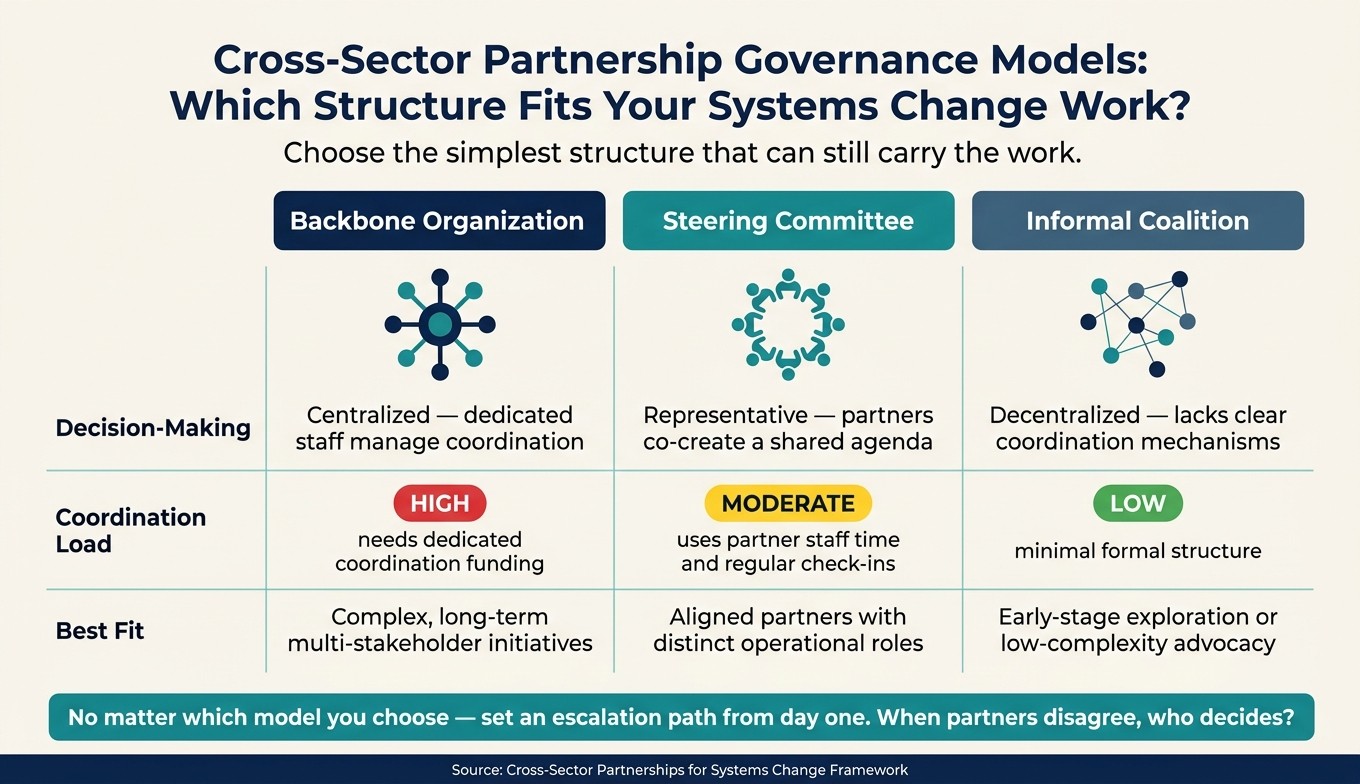
Cross-Sector Partnership Governance Models: Which Structure Fits Your Systems Change Work?
Once partners are in place, the operating model has to get locked down: governance, roles, and funding. This is where a promising group turns into a working partnership with clear decision rights and actual funding behind the work. Without that, even well-matched coalitions slow down fast when priorities collide or timelines slip. In systems change, governance is not paperwork. It’s the mechanism partners use to make one set of choices across many institutions.
Choose a governance model that fits the work
Use the simplest structure that can still carry the work. A co-creation forum is often the right place to start because it sets the agenda and the rules for coordination. The structure only works if every partner knows who decides what.
Governance Model | Decision-Making | Coordination Load | Best Fit |
|---|---|---|---|
Backbone Organization | High; needs dedicated coordination funding [1] | Complex, long-term multi-stakeholder initiatives [3] | |
Steering Committee | Representative; partners co-create a shared agenda [3] | Moderate; uses partner staff time and regular check-ins [3] | Aligned partners with distinct operational roles [3] |
Informal Coalition | Decentralized; lacks clear coordination mechanisms [3] | Low; minimal formal structure | Early-stage exploration or low-complexity advocacy [3] |
The backbone model comes with the most overhead, but it fits complex initiatives that need steady coordination over time. A steering committee works well when partners are already moving in the same direction and need a shared place to make decisions. An informal coalition can make sense early on, but it tends to strain once the work gets more complex.
One point matters no matter which model you use: set an escalation path from day one. When partners disagree, who decides? And how fast does that process move? If that answer is fuzzy, delays are almost guaranteed.
Define roles, decision rules, and partner commitments
A governance chart by itself won’t save a partnership. Each partner needs a clear line of sight into what they own, which decisions sit with them, and how conflict gets handled.
Put each partner’s commitments in writing. Foundations often fund setup, coordination, technical assistance, and the early costs and uncertainty that others may not take on yet [1][2]. Governments bring policy alignment and public funding. Businesses bring the capacity to scale. Community partners bring lived experience, and that role has to come with actual support for participation, not token involvement [3][1]. If a decision affects a community, those partners should hold voting power.
Shared work also needs shared measures. Success should be tracked through joint indicators, not a patchwork of separate organizational scorecards. That only works when the partnership agrees in writing on a few basics:
Shared values
Norms for disagreement
A process for renegotiating commitments
Those written principles help the group deal with friction without coming apart [3].
Align funding with long-term systems goals
Program funding rarely pays for collective infrastructure. Systems work does. That means foundations need to budget for backbone coordination, joint performance indicators, facilitation, and the costs of community participation, not only direct service delivery [1][2].
Funding Structure | Advantages | Risks | Fit for Systems Change |
|---|---|---|---|
Catalytic funding | Unlocks larger public/private investment; covers setup costs [1] | May not cover long-term implementation | High; provides activation energy for new models [1] |
Blended finance | Scales through market forces [1] | Complex to structure; requires high financial expertise [1] | High for infrastructure or commercially viable social models [1] |
Outcome-based financing | Shifts risk to investors; keeps focus on results [1] | High management effort for measurement | Moderate; best for proven interventions needing scale [1] |
Each funding structure solves a different problem. Catalytic funding helps get a model off the ground. Blended finance can help scale efforts that have a market pathway. Outcome-based financing works best when the intervention is already proven and the main challenge is expansion.
The Quality Education India Development Impact Bond shows how outcome-based financing can work in practice. Philanthropic organizations provided outcome funding to repay private investors only after educational objectives were achieved across three Indian states, shifting financial risk while keeping the focus on results [1].
Fund the partnership’s operating costs, not just its outputs. Coordination, trust-building, and adaptation are part of the work, not side tasks. Once the operating model is set, attention turns to trust and day-to-day coordination.
Build Trust and the Day-to-Day Collaboration Infrastructure
Once governance and funding are in place, the hard part shifts to daily practice. A partnership does not stay together on structure alone. It holds because people stay in sync through steady communication, clear expectations, openness, and follow-through.
Use trust-building practices from the start
A lot of partnerships lose steam in the gap between early meetings and a signed agreement. That’s often when momentum drops and internal backing starts to wobble [4]. One of the best ways to keep things moving is to find a quick win in the first 90 days - a small, visible piece of work partners can finish together and learn from [4].
Foundations help build trust when they are open about their own incentives and limits. That kind of honesty gives partners a better shot at setting a shared agenda [3][6]. Internal alignment matters too. Boards and senior staff need to understand that community-led change is often uneven and iterative, not neat and linear [6].
Trust also grows when funders treat local leaders and community members with lived experience as experts in the work, instead of steering based only on their own view of the problem [6]. Shared data can help here. In Battle Creek, Michigan, shared data and resident-led reflection helped partners reset priorities and improve kindergarten readiness [6].
Friction is part of the deal. It should be treated as a normal part of working together, not as proof that the partnership is off track. Foundations can support that approach by paying for joint learning sessions on topics like local history or shared data collection methods [6].
Those habits work best when they are backed by simple tools.
Set up the tools and routines that keep partners aligned
A signed partnership agreement should lay out roles, responsibilities, resource contributions, and decision-making structures [4]. After that, the day-to-day rhythm matters: regular partner meetings, a clear decision log, and feedback loops help surface problems early and give people a way to flag issues before they pile up [3][4][6].
Tool or Routine | Purpose |
|---|---|
Partnership agreement | Spell out roles, responsibilities, resource contributions, and decision-making structures |
Joint training | Build shared context through learning on local history or technical subjects |
Feedback loops | Surface problems early and identify internal processes that may be hindering progress |
Decision logs | Create a central record of how and why key decisions were made |
Quick wins | Build momentum with a small-scale project in the first 90 days |
Someone also needs to own the daily cadence. That can be a backbone organization, a facilitator, or a partnership lead. Their job is to keep the work moving, spot issues early, and push those issues into the next review cycle so they do not sit unresolved.
Measure Systems Change, Adapt the Partnership, and Scale What Works
Track systems-level indicators, not just program outputs
Once governance is set, the next job is to show whether the partnership is changing the system itself. That means tracking policy shifts, changes in how institutions behave, funding flows, and who holds decision power - not only output counts.
Causal loop diagrams and Social Network Analysis (SNA) can help partners test whether they are shifting the system or simply running programs.[3][5] In India, for instance, a shared causal loop diagram helped partners revise strategy when COVID-19 changed market conditions.[5]
Feature | Project-Level Metrics | System-Shift Indicators |
|---|---|---|
Focus | Individual outputs | Shared results across the system |
Time horizon | Short-term or grant-cycle | Long-term, iterative |
Data source | Internal program data | Systems maps, SNA, market assessments |
What it tells you | Activity progress | Leverage points and when to pivot |
It also helps to give one person clear ownership of system mapping and tracking so the work doesn't disappear under day-to-day demands.[5]
Those signals should feed regular review cycles, so partners can change course while the work is still moving.
Use review cycles to adjust governance, funding, and strategy
Reviews should lead to decisions, not just status updates. When partners update systems maps together, they can spot misalignment early - before it turns into friction - and then adjust governance, funding, or strategy. NextWave Plastics, for example, uses iterative actor mapping to follow supplier shifts and revise sourcing decisions.[5]
Mistrust, confusion, and midcourse changes are part of the process. They are not signs that the partnership failed. A partnership that changes its structure or redirects funding as conditions shift is doing the work as it should. In these cycles, philanthropy plays a key role by providing seed funding during the pilot-and-iterate phase, giving partners room to test ideas before backing scale.[1]
Conclusion: A practical framework foundations can use now
With measurement and review in place, the final move is deciding what deserves to scale.
Building a cross-sector partnership that drives systems change comes down to a set of deliberate choices: define a systems goal that goes beyond program delivery, map the stakeholder landscape, build governance that fits the work's complexity, support trust-building, and measure structural change over time rather than simple activity counts.
What makes this work is shared accountability. When partners stop tracking only their own metrics and start tracking shared results, the partnership shifts from a coordination effort into a vehicle for system change. The aim is to build a partnership that becomes part of policy, operations, or market practice - with philanthropy no longer needed for continued support.[1][7]
FAQs
When is a cross-sector partnership better than a traditional grant?
A cross-sector partnership makes more sense than a standard grant when the aim is systems-level change rather than one-off program results.
That tends to be the case when a problem is too complex for any single organization or sector to solve on its own. It also fits when foundations want to bring more than money to the table - pairing funding with shared skills, aligned incentives, and impact that can grow and last.
How do we choose the right governance model for a partnership?
Choose the governance model that matches your mission, the impact you want to make, and what each stakeholder can realistically take on. Start by naming your role - Trusted Partner, Connector, Supporter, or Systems Leader. That simple step helps you sort out how decisions get made, where resources should go, and how power is shared across the group.
Use stakeholder mapping and value assessment to test whether the structure supports systems change rather than one-off results. In plain terms, you’re checking if the model helps people work across the whole system, not just fix one piece at a time.
Lean toward decision-making that is inclusive and consensus-oriented. It may take more time up front, but it builds learning, steadier relationships, and the kind of trust that holds up over the long haul.
What are the best ways to measure systems change over time?
Measure systems change by putting contribution over attribution at the center and using more than one method as the work shifts over time.
Focus on three areas: changes in the system itself, your organization’s part in those changes, and how well your pathways are working. To make sense of that picture, use systems mapping tools like social network analysis or causal loop diagrams. They can help you spot relationships, trends, feedback loops, and inflection points.
Related Blog Posts
Latest Articles
©2025

Narrative Change and Power Building: The Missing Half of Advocacy
Narrative change is the process of disrupting dominant narratives that normalize inequity and advancing new narratives from historically marginalized communities.

Funding Resilience Without Federal Grants
BRIC is unreliable and FEMA is shrinking. Here's how cities fund climate resilience with dedicated revenue, blended finance, and a coordinating authority.

The ESG Blind Spot: How AI Is Finding Risks in Companies Nobody Else Is Watching
Norway's sovereign wealth fund uses AI to screen 7,200 portfolio companies for forced labor and corruption within 24 hours. The real story is the emerging-market coverage gap that traditional ESG data vendors miss — and what it means for any company with a global supply chain.
Narrative Change and Power Building: The Missing Half of Advocacy
Narrative change is the process of disrupting dominant narratives that normalize inequity and advancing new narratives from historically marginalized communities.
Funding Resilience Without Federal Grants
BRIC is unreliable and FEMA is shrinking. Here's how cities fund climate resilience with dedicated revenue, blended finance, and a coordinating authority.
The ESG Blind Spot: How AI Is Finding Risks in Companies Nobody Else Is Watching
Norway's sovereign wealth fund uses AI to screen 7,200 portfolio companies for forced labor and corruption within 24 hours. The real story is the emerging-market coverage gap that traditional ESG data vendors miss — and what it means for any company with a global supply chain.
FAQ
01
What does it really mean to “redefine profit”?
02
What makes Council Fire different?
03
Who does Council Fire work with?
04
What does working with Council Fire actually look like?
05
How does Council Fire help organizations turn big goals into action?
06
How does Council Fire define and measure success?
Jun 25, 2026
How to Build Cross-Sector Partnerships That Drive Systems Change for Foundations & Philanthropic Organizations
Capacity Building
In This Article
Guide for foundations to build cross-sector partnerships: map systems, align governance & funding, build trust and measure systems change.
How to Build Cross-Sector Partnerships That Drive Systems Change for Foundations & Philanthropic Organizations
If I want systems change, I can’t fund one program and hope the system fixes itself. I need the right mix of partners, clear rules, shared money plans, trust, and proof that policy, power, or funding flows are changing.
Here’s the article in plain terms:
Start with the system, not the partner list. I first map the root problem, key players, incentives, blockers, and missing voices.
Check power early. I look at who decides, who is affected, and who has been shut out before.
Pick partners with a screen. I test each one for interest, influence, and assets.
Set rules before friction starts. I define governance, voting, conflict steps, and written commitments.
Pay for partnership work. That includes coordination, facilitation, data work, and community participation - not just grants for services.
Build trust fast. A 90-day quick win can keep momentum up while partners learn how to work together.
Track system shift, not just activity. I watch for changes in policy, institutional behavior, decision power, and funding flows.
Review and adjust. If the system changes, the partnership should change too.
One example in the article stands out: in New Orleans, a city-health-and-organizing partnership helped win a Workers’ Bill of Rights measure with more than 80% voter support. That’s the point of this kind of work: not just running a project, but changing the rules around the project.
My takeaway: if one grantee can solve the problem, normal grantmaking may be enough. If the barrier sits in policy, infrastructure, or power, I need a cross-sector partnership built on shared accountability.
Cross-Sector Collaboration & Impact Ecosystems
Map Stakeholders, Incentives, and Power Before You Launch
Partnerships break down when the system map has holes in it. Before you bring people in, map who shapes the system, what each group wants, and what each one can stop. That groundwork tells you who needs a seat at the table - and who can help shift the system in practice.
Build a stakeholder map that reflects the full system
Start with the root problem, not the symptom. That choice sets the boundary for the whole map and tells you who belongs on it.
From there, run a system scan that goes past the usual suspects. Include sectors with hidden leverage, since they may hold leverage points that standard partner lists miss [4]. Tools like Kumu for actor and social network mapping, Insight Maker for causal loop diagrams, and Smaply for stakeholder personas can make the work concrete and easier to share across your team [5].
The rule that matters most is simple: build the map with potential partners and affected community members, not just for them. The H&M Foundation convened Saamuhika Shakti in Bengaluru in 2022 and mapped and engaged informal waste pickers as central stakeholders so the work reflected the realities of poverty and local constraints [3]. That lines up with a plain but often skipped idea: define the system you want to change with the people living inside it every day.
Once the system comes into focus, pressure-test where power sits and who is still absent from the plan.
Surface power dynamics and equity risks early
After you have a draft map, ask the tougher questions: Who holds decision power here? Who bears the consequences if this fails? Who has historically been left out of planning?
Those questions help you spot equity risks before they get baked into governance - who gains, who loses, and who gets shut out if the partnership is set up poorly. Give smaller community partners early support and technical help so they can take part as peers, not symbols. In plain terms, that means making room for community voice, being clear about who approves big decisions, and naming power gaps out loud instead of letting them sit in the background.
Create a partner selection screen
Once the map is in place, you need a way to narrow a long list of possible partners into a short list you can work with. A simple screen helps. Assess each candidate across three dimensions [4]:
Dimension | What to ask |
|---|---|
Interest | How committed are they to solving this specific problem - not just a related one? |
Influence | Would their absence undermine the partnership's legitimacy or stall progress? |
Assets | Do they bring complementary skills, networks, or resources you can't get elsewhere? |
Don’t stop with outside partners. Map internal stakeholders too. Identify the people or business units inside your own organization that shape the partnership’s fate so you have buy-in across the organization and aren’t relying on one champion [4]. A partner may look strong on paper and still slow things down if they lack actual decision power.
Use that shortlist to shape governance, roles, and funding around each partner’s real authority. With the right mix in view, you can move into shared governance, role design, and funding with far less guesswork.
Design Governance, Roles, and Funding for Shared Accountability
Cross-Sector Partnership Governance Models: Which Structure Fits Your Systems Change Work?
Once partners are in place, the operating model has to get locked down: governance, roles, and funding. This is where a promising group turns into a working partnership with clear decision rights and actual funding behind the work. Without that, even well-matched coalitions slow down fast when priorities collide or timelines slip. In systems change, governance is not paperwork. It’s the mechanism partners use to make one set of choices across many institutions.
Choose a governance model that fits the work
Use the simplest structure that can still carry the work. A co-creation forum is often the right place to start because it sets the agenda and the rules for coordination. The structure only works if every partner knows who decides what.
Governance Model | Decision-Making | Coordination Load | Best Fit |
|---|---|---|---|
Backbone Organization | High; needs dedicated coordination funding [1] | Complex, long-term multi-stakeholder initiatives [3] | |
Steering Committee | Representative; partners co-create a shared agenda [3] | Moderate; uses partner staff time and regular check-ins [3] | Aligned partners with distinct operational roles [3] |
Informal Coalition | Decentralized; lacks clear coordination mechanisms [3] | Low; minimal formal structure | Early-stage exploration or low-complexity advocacy [3] |
The backbone model comes with the most overhead, but it fits complex initiatives that need steady coordination over time. A steering committee works well when partners are already moving in the same direction and need a shared place to make decisions. An informal coalition can make sense early on, but it tends to strain once the work gets more complex.
One point matters no matter which model you use: set an escalation path from day one. When partners disagree, who decides? And how fast does that process move? If that answer is fuzzy, delays are almost guaranteed.
Define roles, decision rules, and partner commitments
A governance chart by itself won’t save a partnership. Each partner needs a clear line of sight into what they own, which decisions sit with them, and how conflict gets handled.
Put each partner’s commitments in writing. Foundations often fund setup, coordination, technical assistance, and the early costs and uncertainty that others may not take on yet [1][2]. Governments bring policy alignment and public funding. Businesses bring the capacity to scale. Community partners bring lived experience, and that role has to come with actual support for participation, not token involvement [3][1]. If a decision affects a community, those partners should hold voting power.
Shared work also needs shared measures. Success should be tracked through joint indicators, not a patchwork of separate organizational scorecards. That only works when the partnership agrees in writing on a few basics:
Shared values
Norms for disagreement
A process for renegotiating commitments
Those written principles help the group deal with friction without coming apart [3].
Align funding with long-term systems goals
Program funding rarely pays for collective infrastructure. Systems work does. That means foundations need to budget for backbone coordination, joint performance indicators, facilitation, and the costs of community participation, not only direct service delivery [1][2].
Funding Structure | Advantages | Risks | Fit for Systems Change |
|---|---|---|---|
Catalytic funding | Unlocks larger public/private investment; covers setup costs [1] | May not cover long-term implementation | High; provides activation energy for new models [1] |
Blended finance | Scales through market forces [1] | Complex to structure; requires high financial expertise [1] | High for infrastructure or commercially viable social models [1] |
Outcome-based financing | Shifts risk to investors; keeps focus on results [1] | High management effort for measurement | Moderate; best for proven interventions needing scale [1] |
Each funding structure solves a different problem. Catalytic funding helps get a model off the ground. Blended finance can help scale efforts that have a market pathway. Outcome-based financing works best when the intervention is already proven and the main challenge is expansion.
The Quality Education India Development Impact Bond shows how outcome-based financing can work in practice. Philanthropic organizations provided outcome funding to repay private investors only after educational objectives were achieved across three Indian states, shifting financial risk while keeping the focus on results [1].
Fund the partnership’s operating costs, not just its outputs. Coordination, trust-building, and adaptation are part of the work, not side tasks. Once the operating model is set, attention turns to trust and day-to-day coordination.
Build Trust and the Day-to-Day Collaboration Infrastructure
Once governance and funding are in place, the hard part shifts to daily practice. A partnership does not stay together on structure alone. It holds because people stay in sync through steady communication, clear expectations, openness, and follow-through.
Use trust-building practices from the start
A lot of partnerships lose steam in the gap between early meetings and a signed agreement. That’s often when momentum drops and internal backing starts to wobble [4]. One of the best ways to keep things moving is to find a quick win in the first 90 days - a small, visible piece of work partners can finish together and learn from [4].
Foundations help build trust when they are open about their own incentives and limits. That kind of honesty gives partners a better shot at setting a shared agenda [3][6]. Internal alignment matters too. Boards and senior staff need to understand that community-led change is often uneven and iterative, not neat and linear [6].
Trust also grows when funders treat local leaders and community members with lived experience as experts in the work, instead of steering based only on their own view of the problem [6]. Shared data can help here. In Battle Creek, Michigan, shared data and resident-led reflection helped partners reset priorities and improve kindergarten readiness [6].
Friction is part of the deal. It should be treated as a normal part of working together, not as proof that the partnership is off track. Foundations can support that approach by paying for joint learning sessions on topics like local history or shared data collection methods [6].
Those habits work best when they are backed by simple tools.
Set up the tools and routines that keep partners aligned
A signed partnership agreement should lay out roles, responsibilities, resource contributions, and decision-making structures [4]. After that, the day-to-day rhythm matters: regular partner meetings, a clear decision log, and feedback loops help surface problems early and give people a way to flag issues before they pile up [3][4][6].
Tool or Routine | Purpose |
|---|---|
Partnership agreement | Spell out roles, responsibilities, resource contributions, and decision-making structures |
Joint training | Build shared context through learning on local history or technical subjects |
Feedback loops | Surface problems early and identify internal processes that may be hindering progress |
Decision logs | Create a central record of how and why key decisions were made |
Quick wins | Build momentum with a small-scale project in the first 90 days |
Someone also needs to own the daily cadence. That can be a backbone organization, a facilitator, or a partnership lead. Their job is to keep the work moving, spot issues early, and push those issues into the next review cycle so they do not sit unresolved.
Measure Systems Change, Adapt the Partnership, and Scale What Works
Track systems-level indicators, not just program outputs
Once governance is set, the next job is to show whether the partnership is changing the system itself. That means tracking policy shifts, changes in how institutions behave, funding flows, and who holds decision power - not only output counts.
Causal loop diagrams and Social Network Analysis (SNA) can help partners test whether they are shifting the system or simply running programs.[3][5] In India, for instance, a shared causal loop diagram helped partners revise strategy when COVID-19 changed market conditions.[5]
Feature | Project-Level Metrics | System-Shift Indicators |
|---|---|---|
Focus | Individual outputs | Shared results across the system |
Time horizon | Short-term or grant-cycle | Long-term, iterative |
Data source | Internal program data | Systems maps, SNA, market assessments |
What it tells you | Activity progress | Leverage points and when to pivot |
It also helps to give one person clear ownership of system mapping and tracking so the work doesn't disappear under day-to-day demands.[5]
Those signals should feed regular review cycles, so partners can change course while the work is still moving.
Use review cycles to adjust governance, funding, and strategy
Reviews should lead to decisions, not just status updates. When partners update systems maps together, they can spot misalignment early - before it turns into friction - and then adjust governance, funding, or strategy. NextWave Plastics, for example, uses iterative actor mapping to follow supplier shifts and revise sourcing decisions.[5]
Mistrust, confusion, and midcourse changes are part of the process. They are not signs that the partnership failed. A partnership that changes its structure or redirects funding as conditions shift is doing the work as it should. In these cycles, philanthropy plays a key role by providing seed funding during the pilot-and-iterate phase, giving partners room to test ideas before backing scale.[1]
Conclusion: A practical framework foundations can use now
With measurement and review in place, the final move is deciding what deserves to scale.
Building a cross-sector partnership that drives systems change comes down to a set of deliberate choices: define a systems goal that goes beyond program delivery, map the stakeholder landscape, build governance that fits the work's complexity, support trust-building, and measure structural change over time rather than simple activity counts.
What makes this work is shared accountability. When partners stop tracking only their own metrics and start tracking shared results, the partnership shifts from a coordination effort into a vehicle for system change. The aim is to build a partnership that becomes part of policy, operations, or market practice - with philanthropy no longer needed for continued support.[1][7]
FAQs
When is a cross-sector partnership better than a traditional grant?
A cross-sector partnership makes more sense than a standard grant when the aim is systems-level change rather than one-off program results.
That tends to be the case when a problem is too complex for any single organization or sector to solve on its own. It also fits when foundations want to bring more than money to the table - pairing funding with shared skills, aligned incentives, and impact that can grow and last.
How do we choose the right governance model for a partnership?
Choose the governance model that matches your mission, the impact you want to make, and what each stakeholder can realistically take on. Start by naming your role - Trusted Partner, Connector, Supporter, or Systems Leader. That simple step helps you sort out how decisions get made, where resources should go, and how power is shared across the group.
Use stakeholder mapping and value assessment to test whether the structure supports systems change rather than one-off results. In plain terms, you’re checking if the model helps people work across the whole system, not just fix one piece at a time.
Lean toward decision-making that is inclusive and consensus-oriented. It may take more time up front, but it builds learning, steadier relationships, and the kind of trust that holds up over the long haul.
What are the best ways to measure systems change over time?
Measure systems change by putting contribution over attribution at the center and using more than one method as the work shifts over time.
Focus on three areas: changes in the system itself, your organization’s part in those changes, and how well your pathways are working. To make sense of that picture, use systems mapping tools like social network analysis or causal loop diagrams. They can help you spot relationships, trends, feedback loops, and inflection points.
Related Blog Posts
Latest Articles
©2025
Narrative Change and Power Building: The Missing Half of Advocacy
Narrative change is the process of disrupting dominant narratives that normalize inequity and advancing new narratives from historically marginalized communities.
Funding Resilience Without Federal Grants
BRIC is unreliable and FEMA is shrinking. Here's how cities fund climate resilience with dedicated revenue, blended finance, and a coordinating authority.
The ESG Blind Spot: How AI Is Finding Risks in Companies Nobody Else Is Watching
Norway's sovereign wealth fund uses AI to screen 7,200 portfolio companies for forced labor and corruption within 24 hours. The real story is the emerging-market coverage gap that traditional ESG data vendors miss — and what it means for any company with a global supply chain.
FAQ
01
What does it really mean to “redefine profit”?
02
What makes Council Fire different?
03
Who does Council Fire work with?
04
What does working with Council Fire actually look like?
05
How does Council Fire help organizations turn big goals into action?
06
How does Council Fire define and measure success?
Jun 25, 2026
How to Build Cross-Sector Partnerships That Drive Systems Change for Foundations & Philanthropic Organizations
Capacity Building
In This Article
Guide for foundations to build cross-sector partnerships: map systems, align governance & funding, build trust and measure systems change.
How to Build Cross-Sector Partnerships That Drive Systems Change for Foundations & Philanthropic Organizations
If I want systems change, I can’t fund one program and hope the system fixes itself. I need the right mix of partners, clear rules, shared money plans, trust, and proof that policy, power, or funding flows are changing.
Here’s the article in plain terms:
Start with the system, not the partner list. I first map the root problem, key players, incentives, blockers, and missing voices.
Check power early. I look at who decides, who is affected, and who has been shut out before.
Pick partners with a screen. I test each one for interest, influence, and assets.
Set rules before friction starts. I define governance, voting, conflict steps, and written commitments.
Pay for partnership work. That includes coordination, facilitation, data work, and community participation - not just grants for services.
Build trust fast. A 90-day quick win can keep momentum up while partners learn how to work together.
Track system shift, not just activity. I watch for changes in policy, institutional behavior, decision power, and funding flows.
Review and adjust. If the system changes, the partnership should change too.
One example in the article stands out: in New Orleans, a city-health-and-organizing partnership helped win a Workers’ Bill of Rights measure with more than 80% voter support. That’s the point of this kind of work: not just running a project, but changing the rules around the project.
My takeaway: if one grantee can solve the problem, normal grantmaking may be enough. If the barrier sits in policy, infrastructure, or power, I need a cross-sector partnership built on shared accountability.
Cross-Sector Collaboration & Impact Ecosystems
Map Stakeholders, Incentives, and Power Before You Launch
Partnerships break down when the system map has holes in it. Before you bring people in, map who shapes the system, what each group wants, and what each one can stop. That groundwork tells you who needs a seat at the table - and who can help shift the system in practice.
Build a stakeholder map that reflects the full system
Start with the root problem, not the symptom. That choice sets the boundary for the whole map and tells you who belongs on it.
From there, run a system scan that goes past the usual suspects. Include sectors with hidden leverage, since they may hold leverage points that standard partner lists miss [4]. Tools like Kumu for actor and social network mapping, Insight Maker for causal loop diagrams, and Smaply for stakeholder personas can make the work concrete and easier to share across your team [5].
The rule that matters most is simple: build the map with potential partners and affected community members, not just for them. The H&M Foundation convened Saamuhika Shakti in Bengaluru in 2022 and mapped and engaged informal waste pickers as central stakeholders so the work reflected the realities of poverty and local constraints [3]. That lines up with a plain but often skipped idea: define the system you want to change with the people living inside it every day.
Once the system comes into focus, pressure-test where power sits and who is still absent from the plan.
Surface power dynamics and equity risks early
After you have a draft map, ask the tougher questions: Who holds decision power here? Who bears the consequences if this fails? Who has historically been left out of planning?
Those questions help you spot equity risks before they get baked into governance - who gains, who loses, and who gets shut out if the partnership is set up poorly. Give smaller community partners early support and technical help so they can take part as peers, not symbols. In plain terms, that means making room for community voice, being clear about who approves big decisions, and naming power gaps out loud instead of letting them sit in the background.
Create a partner selection screen
Once the map is in place, you need a way to narrow a long list of possible partners into a short list you can work with. A simple screen helps. Assess each candidate across three dimensions [4]:
Dimension | What to ask |
|---|---|
Interest | How committed are they to solving this specific problem - not just a related one? |
Influence | Would their absence undermine the partnership's legitimacy or stall progress? |
Assets | Do they bring complementary skills, networks, or resources you can't get elsewhere? |
Don’t stop with outside partners. Map internal stakeholders too. Identify the people or business units inside your own organization that shape the partnership’s fate so you have buy-in across the organization and aren’t relying on one champion [4]. A partner may look strong on paper and still slow things down if they lack actual decision power.
Use that shortlist to shape governance, roles, and funding around each partner’s real authority. With the right mix in view, you can move into shared governance, role design, and funding with far less guesswork.
Design Governance, Roles, and Funding for Shared Accountability
Cross-Sector Partnership Governance Models: Which Structure Fits Your Systems Change Work?
Once partners are in place, the operating model has to get locked down: governance, roles, and funding. This is where a promising group turns into a working partnership with clear decision rights and actual funding behind the work. Without that, even well-matched coalitions slow down fast when priorities collide or timelines slip. In systems change, governance is not paperwork. It’s the mechanism partners use to make one set of choices across many institutions.
Choose a governance model that fits the work
Use the simplest structure that can still carry the work. A co-creation forum is often the right place to start because it sets the agenda and the rules for coordination. The structure only works if every partner knows who decides what.
Governance Model | Decision-Making | Coordination Load | Best Fit |
|---|---|---|---|
Backbone Organization | High; needs dedicated coordination funding [1] | Complex, long-term multi-stakeholder initiatives [3] | |
Steering Committee | Representative; partners co-create a shared agenda [3] | Moderate; uses partner staff time and regular check-ins [3] | Aligned partners with distinct operational roles [3] |
Informal Coalition | Decentralized; lacks clear coordination mechanisms [3] | Low; minimal formal structure | Early-stage exploration or low-complexity advocacy [3] |
The backbone model comes with the most overhead, but it fits complex initiatives that need steady coordination over time. A steering committee works well when partners are already moving in the same direction and need a shared place to make decisions. An informal coalition can make sense early on, but it tends to strain once the work gets more complex.
One point matters no matter which model you use: set an escalation path from day one. When partners disagree, who decides? And how fast does that process move? If that answer is fuzzy, delays are almost guaranteed.
Define roles, decision rules, and partner commitments
A governance chart by itself won’t save a partnership. Each partner needs a clear line of sight into what they own, which decisions sit with them, and how conflict gets handled.
Put each partner’s commitments in writing. Foundations often fund setup, coordination, technical assistance, and the early costs and uncertainty that others may not take on yet [1][2]. Governments bring policy alignment and public funding. Businesses bring the capacity to scale. Community partners bring lived experience, and that role has to come with actual support for participation, not token involvement [3][1]. If a decision affects a community, those partners should hold voting power.
Shared work also needs shared measures. Success should be tracked through joint indicators, not a patchwork of separate organizational scorecards. That only works when the partnership agrees in writing on a few basics:
Shared values
Norms for disagreement
A process for renegotiating commitments
Those written principles help the group deal with friction without coming apart [3].
Align funding with long-term systems goals
Program funding rarely pays for collective infrastructure. Systems work does. That means foundations need to budget for backbone coordination, joint performance indicators, facilitation, and the costs of community participation, not only direct service delivery [1][2].
Funding Structure | Advantages | Risks | Fit for Systems Change |
|---|---|---|---|
Catalytic funding | Unlocks larger public/private investment; covers setup costs [1] | May not cover long-term implementation | High; provides activation energy for new models [1] |
Blended finance | Scales through market forces [1] | Complex to structure; requires high financial expertise [1] | High for infrastructure or commercially viable social models [1] |
Outcome-based financing | Shifts risk to investors; keeps focus on results [1] | High management effort for measurement | Moderate; best for proven interventions needing scale [1] |
Each funding structure solves a different problem. Catalytic funding helps get a model off the ground. Blended finance can help scale efforts that have a market pathway. Outcome-based financing works best when the intervention is already proven and the main challenge is expansion.
The Quality Education India Development Impact Bond shows how outcome-based financing can work in practice. Philanthropic organizations provided outcome funding to repay private investors only after educational objectives were achieved across three Indian states, shifting financial risk while keeping the focus on results [1].
Fund the partnership’s operating costs, not just its outputs. Coordination, trust-building, and adaptation are part of the work, not side tasks. Once the operating model is set, attention turns to trust and day-to-day coordination.
Build Trust and the Day-to-Day Collaboration Infrastructure
Once governance and funding are in place, the hard part shifts to daily practice. A partnership does not stay together on structure alone. It holds because people stay in sync through steady communication, clear expectations, openness, and follow-through.
Use trust-building practices from the start
A lot of partnerships lose steam in the gap between early meetings and a signed agreement. That’s often when momentum drops and internal backing starts to wobble [4]. One of the best ways to keep things moving is to find a quick win in the first 90 days - a small, visible piece of work partners can finish together and learn from [4].
Foundations help build trust when they are open about their own incentives and limits. That kind of honesty gives partners a better shot at setting a shared agenda [3][6]. Internal alignment matters too. Boards and senior staff need to understand that community-led change is often uneven and iterative, not neat and linear [6].
Trust also grows when funders treat local leaders and community members with lived experience as experts in the work, instead of steering based only on their own view of the problem [6]. Shared data can help here. In Battle Creek, Michigan, shared data and resident-led reflection helped partners reset priorities and improve kindergarten readiness [6].
Friction is part of the deal. It should be treated as a normal part of working together, not as proof that the partnership is off track. Foundations can support that approach by paying for joint learning sessions on topics like local history or shared data collection methods [6].
Those habits work best when they are backed by simple tools.
Set up the tools and routines that keep partners aligned
A signed partnership agreement should lay out roles, responsibilities, resource contributions, and decision-making structures [4]. After that, the day-to-day rhythm matters: regular partner meetings, a clear decision log, and feedback loops help surface problems early and give people a way to flag issues before they pile up [3][4][6].
Tool or Routine | Purpose |
|---|---|
Partnership agreement | Spell out roles, responsibilities, resource contributions, and decision-making structures |
Joint training | Build shared context through learning on local history or technical subjects |
Feedback loops | Surface problems early and identify internal processes that may be hindering progress |
Decision logs | Create a central record of how and why key decisions were made |
Quick wins | Build momentum with a small-scale project in the first 90 days |
Someone also needs to own the daily cadence. That can be a backbone organization, a facilitator, or a partnership lead. Their job is to keep the work moving, spot issues early, and push those issues into the next review cycle so they do not sit unresolved.
Measure Systems Change, Adapt the Partnership, and Scale What Works
Track systems-level indicators, not just program outputs
Once governance is set, the next job is to show whether the partnership is changing the system itself. That means tracking policy shifts, changes in how institutions behave, funding flows, and who holds decision power - not only output counts.
Causal loop diagrams and Social Network Analysis (SNA) can help partners test whether they are shifting the system or simply running programs.[3][5] In India, for instance, a shared causal loop diagram helped partners revise strategy when COVID-19 changed market conditions.[5]
Feature | Project-Level Metrics | System-Shift Indicators |
|---|---|---|
Focus | Individual outputs | Shared results across the system |
Time horizon | Short-term or grant-cycle | Long-term, iterative |
Data source | Internal program data | Systems maps, SNA, market assessments |
What it tells you | Activity progress | Leverage points and when to pivot |
It also helps to give one person clear ownership of system mapping and tracking so the work doesn't disappear under day-to-day demands.[5]
Those signals should feed regular review cycles, so partners can change course while the work is still moving.
Use review cycles to adjust governance, funding, and strategy
Reviews should lead to decisions, not just status updates. When partners update systems maps together, they can spot misalignment early - before it turns into friction - and then adjust governance, funding, or strategy. NextWave Plastics, for example, uses iterative actor mapping to follow supplier shifts and revise sourcing decisions.[5]
Mistrust, confusion, and midcourse changes are part of the process. They are not signs that the partnership failed. A partnership that changes its structure or redirects funding as conditions shift is doing the work as it should. In these cycles, philanthropy plays a key role by providing seed funding during the pilot-and-iterate phase, giving partners room to test ideas before backing scale.[1]
Conclusion: A practical framework foundations can use now
With measurement and review in place, the final move is deciding what deserves to scale.
Building a cross-sector partnership that drives systems change comes down to a set of deliberate choices: define a systems goal that goes beyond program delivery, map the stakeholder landscape, build governance that fits the work's complexity, support trust-building, and measure structural change over time rather than simple activity counts.
What makes this work is shared accountability. When partners stop tracking only their own metrics and start tracking shared results, the partnership shifts from a coordination effort into a vehicle for system change. The aim is to build a partnership that becomes part of policy, operations, or market practice - with philanthropy no longer needed for continued support.[1][7]
FAQs
When is a cross-sector partnership better than a traditional grant?
A cross-sector partnership makes more sense than a standard grant when the aim is systems-level change rather than one-off program results.
That tends to be the case when a problem is too complex for any single organization or sector to solve on its own. It also fits when foundations want to bring more than money to the table - pairing funding with shared skills, aligned incentives, and impact that can grow and last.
How do we choose the right governance model for a partnership?
Choose the governance model that matches your mission, the impact you want to make, and what each stakeholder can realistically take on. Start by naming your role - Trusted Partner, Connector, Supporter, or Systems Leader. That simple step helps you sort out how decisions get made, where resources should go, and how power is shared across the group.
Use stakeholder mapping and value assessment to test whether the structure supports systems change rather than one-off results. In plain terms, you’re checking if the model helps people work across the whole system, not just fix one piece at a time.
Lean toward decision-making that is inclusive and consensus-oriented. It may take more time up front, but it builds learning, steadier relationships, and the kind of trust that holds up over the long haul.
What are the best ways to measure systems change over time?
Measure systems change by putting contribution over attribution at the center and using more than one method as the work shifts over time.
Focus on three areas: changes in the system itself, your organization’s part in those changes, and how well your pathways are working. To make sense of that picture, use systems mapping tools like social network analysis or causal loop diagrams. They can help you spot relationships, trends, feedback loops, and inflection points.
Related Blog Posts
Latest Articles
©2025
Narrative Change and Power Building: The Missing Half of Advocacy
Narrative change is the process of disrupting dominant narratives that normalize inequity and advancing new narratives from historically marginalized communities.
Funding Resilience Without Federal Grants
BRIC is unreliable and FEMA is shrinking. Here's how cities fund climate resilience with dedicated revenue, blended finance, and a coordinating authority.
The ESG Blind Spot: How AI Is Finding Risks in Companies Nobody Else Is Watching
Norway's sovereign wealth fund uses AI to screen 7,200 portfolio companies for forced labor and corruption within 24 hours. The real story is the emerging-market coverage gap that traditional ESG data vendors miss — and what it means for any company with a global supply chain.
FAQ
What does it really mean to “redefine profit”?
What makes Council Fire different?
Who does Council Fire work with?
What does working with Council Fire actually look like?
How does Council Fire help organizations turn big goals into action?
How does Council Fire define and measure success?