Jan 30, 2026
How Blended Finance Supports Renewable Energy
Sustainability Strategy
In This Article
How public, philanthropic and private capital de-risk renewable energy projects in emerging markets using guarantees, concessional loans and first-loss capital.
How Blended Finance Supports Renewable Energy
Blended finance is reshaping renewable energy investment by merging public, philanthropic, and private funding to address the $1 trillion annual shortfall needed to meet global clean energy goals by 2030. This approach reduces risks for private investors in emerging markets, where political instability and high upfront costs often deter commercial participation. Key tools like concessional loans, guarantees, and first-loss capital enable projects to secure funding and attract private capital - up to $0.40 per $1 of public investment.
Key Takeaways:
Investment Gap: $1.4 trillion annual investment needed; only $624 billion was invested in 2024.
Blended Finance Tools: Concessional loans, risk guarantees, and equity investments.
Emerging Market Focus: High risks in developing nations make blended finance essential.
Private Capital Mobilization: Some projects attract over $2 of private funding per $1 of public investment.
Blended finance aligns public goals with private returns, enabling renewable energy projects to scale in regions most in need.
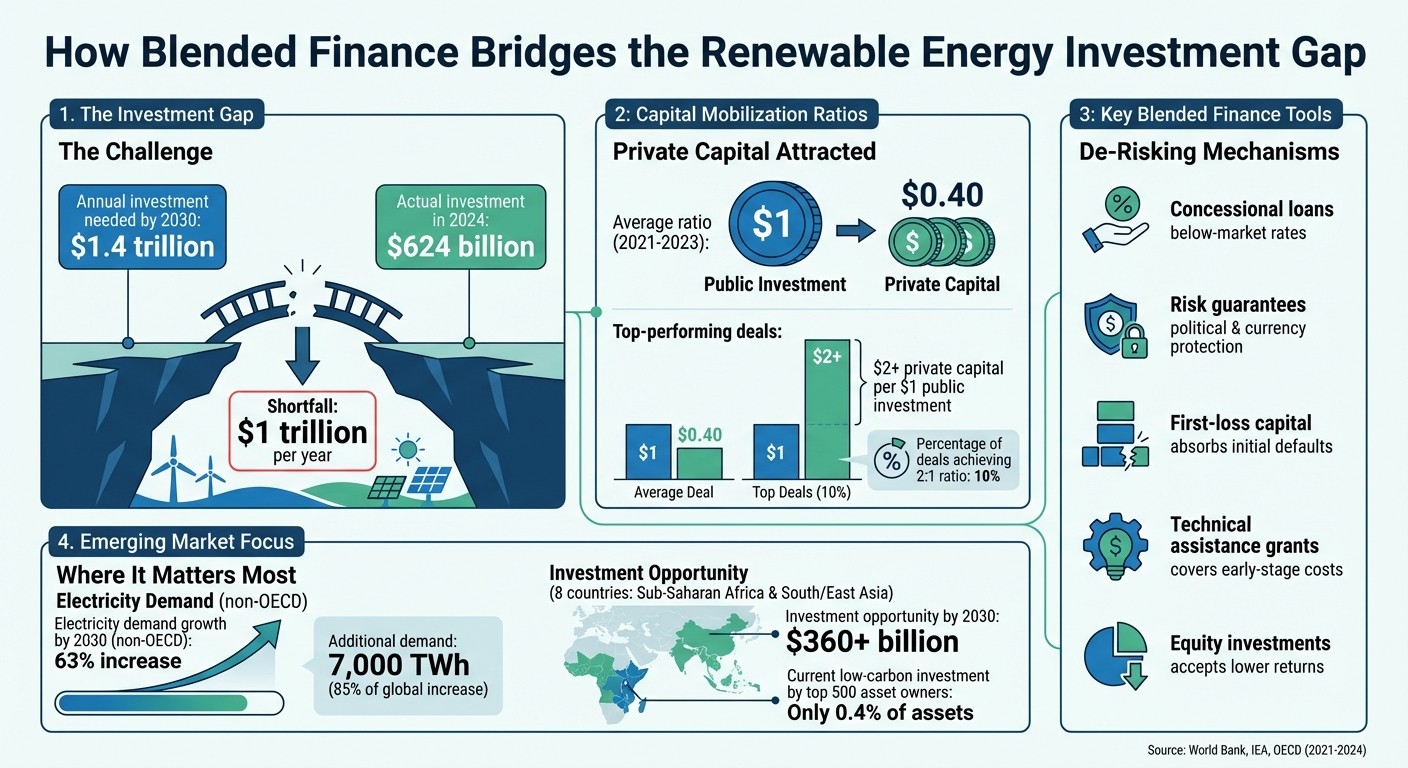
Blended Finance for Renewable Energy: Investment Gap and Capital Mobilization
What is Blended Finance and How Does It Work?
Defining Blended Finance
Blended finance brings together public, philanthropic, and private capital to fund projects in emerging markets [2]. By using concessional funding - such as loans or financing with terms below market rates - it improves a project's risk-return balance, making it more appealing to commercial investors.
In this model, public entities or philanthropic organizations take on risks that private investors typically avoid, such as political instability, currency fluctuations, or first-loss positions. This approach transforms projects deemed "unbankable" into viable investments. Between 2021 and 2023, blended finance infrastructure deals attracted 40% of private capital for every $1 of public or philanthropic funding, with about 10% of deals mobilizing over $2 for every $1 of public investment [2].
Blended finance tools include:
Concessional loans: Offering below-market interest rates with longer repayment periods.
Guarantees and risk-sharing arrangements: Transferring risks, such as defaults, to public guarantors.
Equity investments: Public entities accepting lower returns than typical market investors.
Grants: Covering costs like technical assistance or project preparation without requiring repayment [2].
A fundamental principle of blended finance is "additionality" - ensuring that a project would not proceed without concessional funding [2]. Another key aspect is "minimum concessionality," which ensures public funds are used only to the extent necessary, avoiding market distortions [2].
This de-risking approach is especially critical for renewable energy projects, which face distinct financial obstacles.
Why Renewable Energy Projects Need Blended Finance
Renewable energy infrastructure comes with specific challenges that make blended finance indispensable. These projects often require substantial upfront capital and have payback periods spanning decades [2][3]. While the levelized cost of electricity for utility-scale solar photovoltaic has fallen at an annual rate of 20% in recent years, the initial investment hurdle remains steep [3].
Emerging markets amplify the challenges for renewable projects. Political and regulatory instability, currency risks, and technology uncertainties make these investments less attractive to commercial financiers [2][3]. Even though renewables have become competitive in developed markets, institutional investors remain cautious about renewable projects in emerging economies, perceiving them as high-risk. Currently, only 0.4% of total assets under management by the top 500 asset owners are categorized as low-carbon investments [3].
Blended finance helps overcome these barriers by mitigating risks and enabling investments that traditional financing methods sideline.
The scale of the financing gap is immense. To limit global warming, an additional $1 trillion per year in renewable energy investments is needed by 2030, far exceeding the current average of $200 billion annually [3]. Blended finance seeks to bridge this gap by establishing track records for renewable projects, proving their viability, and gradually building investor confidence for commercial funding. As the World Bank explains, "the key objective is to de-risk investments and catalyze private sector participation, often through the provision of financial protections such as concessional loans, risk guarantees, and equity contributions" [2].
How are you using blended finance to support renewable energy companies?
Financial Tools That Reduce Investment Risk
Blended finance employs specific strategies to lower risks for private investors, addressing key challenges that often deter commercial funding in emerging market infrastructure. Below are examples of how these mechanisms work to systematically reduce investment risks.
Guarantees and Insurance
Development finance institutions use guarantees to shift financial risks from private lenders to public entities, often at below-market fees [2]. These guarantees focus on mitigating non-commercial risks - such as political instability or currency fluctuations - that private investors may find difficult to manage [2][3].
The IFC Risk Mitigation Facility (RMF), operational since 2023, exemplifies this approach by offering guarantees without requiring sovereign indemnity. This specifically targets risks tied to political and currency issues in large-scale energy and transportation projects [2]. By redistributing these risks, guarantees encourage greater participation from commercial investors [2].
"One of the primary roles of concessional finance is to reduce the risk for the private investors." - World Bank [2]
In addition to guarantees, first-loss capital provides further protection by absorbing initial financial setbacks.
First-Loss Capital
First-loss capital mechanisms involve a donor or financial institution taking on the initial losses of a project or portfolio [2]. This setup shields private investors from the immediate financial impact of defaults or underperformance.
For instance, the IFC Blended Finance Facility (BFF), launched in 2024, leverages support from the IDA Private Sector Window alongside IFC investments. This facility is designed to mitigate risks in high-priority areas like climate change mitigation and infrastructure development in low-income and fragile regions [2]. By absorbing initial losses, first-loss capital enhances the credit appeal of renewable energy projects that might otherwise struggle to secure funding [2].
Results-Based Financing
Results-based financing links payments to specific performance milestones, such as energy production levels or emission reductions. This ensures public funds are only disbursed when measurable outcomes are achieved, effectively managing operational risks. By aligning the interests of developers and investors, this approach strengthens project reliability.
Sustainability-linked loans, for example, offer reduced interest rates when decarbonization goals are met [5]. Similarly, green bonds, which saw $575 billion in global issuance in 2023, provide borrowers with a pricing advantage of 10 to 30 basis points compared to traditional bonds [4]. Performance-based Operations and Maintenance agreements further reinforce this model by tying contractor compensation directly to project output and efficiency, ensuring accountability and successful delivery [4].
How to Structure Blended Finance for Renewable Energy
Securing the right mix of capital for renewable energy projects requires a well-thought-out structure. The goal is to align public development objectives with private investor returns while effectively distributing risks that neither party can shoulder alone.
Layered Fund Structures
Layered fund structures bring together capital from various sources, each taking on a different level of risk. Public or philanthropic funds often take the "first-loss" position, meaning they absorb initial defaults. This setup provides a safety net, making the investment more attractive to private players by offering credit protection [6]. As a result, projects can propose more flexible terms, such as extended repayment schedules, lower interest rates, or unsecured loans - key to addressing the higher risks tied to renewable energy ventures [6].
Take, for instance, a renewable energy fund with $100 million in total capital. If $15 million comes from concessional first-loss funding provided by development finance institutions, this lowers the perceived risk for private investors, enabling the fund to secure $85 million in commercial investment. This type of structure balances risk and ensures the project remains commercially viable.
Typically, renewable energy projects are financed with 70–80% debt, complemented by equity, including tax equity [4]. Special Purpose Vehicles (SPVs) are often used to isolate project risks from the developer’s balance sheet, ensuring that the project remains unaffected by potential bankruptcies [4][5]. Long-term Power Purchase Agreements (PPAs), usually lasting 10 to 25 years, with financially stable offtakers provide predictable cash flows - an essential factor for attracting senior debt [5].
"For investors playing a non-concessional role... the use of concessionary capital can help to lower the risk around the deal, by providing protection against potential defaults." – Better Society Capital [6]
While structuring capital is critical, managing upfront project costs is equally important.
Technical Assistance Grants
Technical assistance grants play a crucial role in covering early-stage expenses, such as feasibility studies, environmental assessments, and legal structuring. These upfront costs often deter private investment in emerging renewable energy markets [2]. By addressing these initial financial barriers, grants pave the way for projects to reach financial close.
Grants can be distributed as upfront funding or tied to specific milestones, rewarding progress [2]. Between 2021 and 2023, blended finance infrastructure deals demonstrated impressive leverage, attracting $0.40 in private capital for every $1 of public or philanthropic funding, with some deals achieving ratios as high as $2 of private funding for every $1 of public investment [2].
The principle of minimum concessionality ensures grants are used judiciously - providing just enough support to make a project viable without distorting market dynamics [2]. This approach works best when paired with broader policy changes and regulatory frameworks that create a conducive environment for renewable energy investments [1][2]. Every intervention should include an exit strategy to ensure the project transitions to full commercial sustainability as the market matures [1][2].
Case Studies: Blended Finance in Renewable Energy
Practical examples show how blended finance improves access to renewable energy in challenging markets, highlighting the success of public-private partnerships. These case studies demonstrate how de-risking strategies turn ambitious renewable energy projects into reality.
Off-Grid Solar Market Expansion
Off-grid solar markets face distinct hurdles, such as fragmented customer bases, lack of credit histories, and competition from entrenched diesel generator industries. Blended finance addresses these issues by employing tools like subordinated debt and guarantees.
In Nigeria, Daybreak serves as a prime example. This leading provider of off-grid solar and battery solutions for commercial and industrial customers utilized subordinated debt with a concessional component to de-risk investments. This financing structure attracted competitive commercial senior debt, creating a replicable model for a market expected to grow tenfold by 2025 [7]. Currently, off-grid systems supply about 80% of Nigeria's energy demand, and the country aims to achieve 13 GW of off-grid solar PV capacity by 2030 [7].
The Scaling Mini-Grid Initiative in the Democratic Republic of Congo showcases another innovative approach. This platform-based project aims to electrify underserved communities by using blended finance guarantees to reduce demand risk. With $400 million mobilized, the initiative is set to develop 180 MW of solar PV capacity, bringing renewable energy to over 1.5 million people [7].
"Blended finance can mitigate risks on pioneering transactions and support long-term growth of the off-grid solar market in Africa." – Linda Munyengeterwa, Regional Industry Director of Infrastructure Middle East and Africa, IFC [7]
These cases highlight how tools like subordinated debt, guarantees, and streamlined project preparation can bridge the gap for commercial lenders, enabling renewable energy growth in areas that need it most.
Expanding Blended Finance for Future Projects
Mobilizing Private Capital at Scale
Blended finance plays a critical role in bridging the funding gap for renewable energy projects. When structured effectively, these initiatives can attract significant private investment, with some deals leveraging over $2 of private funding for every $1 of public financing [2].
The scale of the challenge is immense. To meet global clean energy goals, investment must triple by 2030. For non-OECD countries, electricity demand is projected to grow by 63% by 2030, compared to 2014 levels. This translates to nearly 7,000 terawatt hours (TWh) of additional demand, accounting for 85% of the global increase in energy needs [8]. Moreover, just eight countries in Sub-Saharan Africa and South/East Asia present a clean energy investment opportunity exceeding $360 billion by 2030 [8].
"Getting on track for net zero emissions by 2050 will require clean energy spending in emerging and developing economies to more than triple by 2030 – far beyond the capacity of public financing alone." – IEA [9]
This creates a compelling case for focusing on emerging markets to drive future growth.
Emerging Market Opportunities
Blended finance is increasingly targeting areas like distributed generation, off-grid solar solutions, and transmission grid infrastructure. These sectors are especially critical in regions where grid access is limited [8]. Energy storage systems are also gaining traction, as they allow for smoother integration of renewable energy sources into existing power grids.
Transmission grid financing is another priority. Limited infrastructure often prevents renewable energy generated in remote areas from reaching consumers. By using tools like guarantees and risk mitigation mechanisms, blended finance can address the political and regulatory uncertainties that discourage private investment in cross-border transmission projects [1]. Additionally, there is growing interest in funding efforts to decarbonize heavy industries in developing regions, where high upfront costs and unpredictable policies pose significant challenges [1].
Aligning Stakeholders for Success
To unlock these opportunities, strong collaboration among governments, development institutions, and private investors is essential. Each group has distinct goals: governments focus on achieving developmental outcomes, private investors seek attractive returns, and development institutions aim to balance these priorities. Streamlined decision-making processes are critical, as delays in approvals can deter private sector participation [8].
"A systematic approach to the deployment of blended finance – that tailors instruments to the nature of underlying barriers to commercial investment, minimises concessionality, has a clear exit strategy, and is co-ordinated within a wider ecosystem of support and enabling measures – can help maximise its development impact and stimulate private sector development." – OECD [1]
Technical assistance is equally important. By offering advisory services alongside financial tools, stakeholders can build local expertise and ensure that projects remain viable in the long term [8]. The key is to use only the minimum amount of concessional funding needed to make projects feasible, conserving public resources and avoiding market distortions [1][2]. Organizations like Council Fire specialize in aligning diverse stakeholder interests and developing strategies to support these complex partnerships, ensuring their success well beyond the initial phases of public support.
Conclusion
Blended finance offers a practical solution to close the funding gap in renewable energy by leveraging public and concessional funds to reduce investment risks, successfully attracting private capital at a 40% ratio for every $1 invested [2].
For this approach to succeed, financial tools must be carefully designed to address specific market challenges. This includes using the least amount of concessional funding necessary, creating clear exit strategies, and ensuring a smooth transition to fully commercial operations. As the OECD emphasizes, blended finance efforts should be "coordinated within a wider ecosystem of support and enabling measures" [1].
Strong partnerships are at the heart of this strategy. Governments, development institutions, and private investors each bring unique contributions - ranging from policy reforms and technical know-how to patient capital and market-driven discipline. Council Fire plays a key role in aligning these diverse interests, structuring partnerships that balance financial feasibility with meaningful environmental outcomes.
Emerging markets, where energy needs are growing rapidly and infrastructure remains underdeveloped, present a prime opportunity for blended finance. The frameworks are in place; the next step is to mobilize these models on a larger scale to meet global energy and sustainability goals.
FAQs
How does blended finance make renewable energy investments safer for private investors?
Blended finance plays a crucial role in lowering the risks associated with private investments in renewable energy projects. It tackles pressing challenges like currency fluctuations, policy instability, and inefficiencies in the market. Tools such as guarantees, concessional loans, and risk-sharing mechanisms are central to this approach, offering a safety net that fosters greater confidence among investors.
By merging public and private funding, blended finance models create a more appealing environment for investment, encouraging private capital to support large-scale renewable energy projects. This partnership not only reduces financial risks but also helps speed up the shift toward cleaner and more reliable energy systems.
What financial tools are used in blended finance to fund renewable energy projects?
Blended finance strategies play a crucial role in advancing renewable energy projects by attracting private investment and mitigating risks. Among the key tools is concessional debt, which provides loans at below-market interest rates or with extended repayment schedules, making projects more attractive to investors. Another approach, results-based financing, links funding to clearly defined and measurable outcomes, promoting accountability and encouraging strong performance.
Additional mechanisms include guarantees, which safeguard private investors against potential losses, and risk-sharing facilities, which allow financial risks to be shared between public and private entities. By combining these tools, blended finance aligns financial incentives with renewable energy objectives, paving the way for more feasible and scalable large-scale projects.
Why is blended finance essential for funding renewable energy projects in emerging markets?
Blended finance plays a key role in advancing renewable energy projects in emerging markets by addressing financial and risk-related challenges that often deter private investors. Issues such as currency instability, political risks, and a high perception of uncertainty can make these projects seem less appealing. By leveraging a mix of public, private, and philanthropic funding - through tools like concessional loans, guarantees, and risk-sharing mechanisms - blended finance mitigates these risks and attracts the capital needed to move projects forward.
This method has proven especially effective in expanding renewable energy infrastructure in areas where conventional financing options fall short. It has paved the way for investments in solar power, mini-grids, and other clean energy technologies in underserved regions, accelerating the shift toward sustainable energy while balancing financial returns with environmental and social progress.
Related Blog Posts
Latest Articles
©2025



FAQ
01
What does it really mean to “redefine profit”?
02
What makes Council Fire different?
03
Who does Council Fire you work with?
04
What does working with Council Fire actually look like?
05
How does Council Fire help organizations turn big goals into action?
06
How does Council Fire define and measure success?
Jan 30, 2026
How Blended Finance Supports Renewable Energy
Sustainability Strategy
In This Article
How public, philanthropic and private capital de-risk renewable energy projects in emerging markets using guarantees, concessional loans and first-loss capital.
How Blended Finance Supports Renewable Energy
Blended finance is reshaping renewable energy investment by merging public, philanthropic, and private funding to address the $1 trillion annual shortfall needed to meet global clean energy goals by 2030. This approach reduces risks for private investors in emerging markets, where political instability and high upfront costs often deter commercial participation. Key tools like concessional loans, guarantees, and first-loss capital enable projects to secure funding and attract private capital - up to $0.40 per $1 of public investment.
Key Takeaways:
Investment Gap: $1.4 trillion annual investment needed; only $624 billion was invested in 2024.
Blended Finance Tools: Concessional loans, risk guarantees, and equity investments.
Emerging Market Focus: High risks in developing nations make blended finance essential.
Private Capital Mobilization: Some projects attract over $2 of private funding per $1 of public investment.
Blended finance aligns public goals with private returns, enabling renewable energy projects to scale in regions most in need.
Blended Finance for Renewable Energy: Investment Gap and Capital Mobilization
What is Blended Finance and How Does It Work?
Defining Blended Finance
Blended finance brings together public, philanthropic, and private capital to fund projects in emerging markets [2]. By using concessional funding - such as loans or financing with terms below market rates - it improves a project's risk-return balance, making it more appealing to commercial investors.
In this model, public entities or philanthropic organizations take on risks that private investors typically avoid, such as political instability, currency fluctuations, or first-loss positions. This approach transforms projects deemed "unbankable" into viable investments. Between 2021 and 2023, blended finance infrastructure deals attracted 40% of private capital for every $1 of public or philanthropic funding, with about 10% of deals mobilizing over $2 for every $1 of public investment [2].
Blended finance tools include:
Concessional loans: Offering below-market interest rates with longer repayment periods.
Guarantees and risk-sharing arrangements: Transferring risks, such as defaults, to public guarantors.
Equity investments: Public entities accepting lower returns than typical market investors.
Grants: Covering costs like technical assistance or project preparation without requiring repayment [2].
A fundamental principle of blended finance is "additionality" - ensuring that a project would not proceed without concessional funding [2]. Another key aspect is "minimum concessionality," which ensures public funds are used only to the extent necessary, avoiding market distortions [2].
This de-risking approach is especially critical for renewable energy projects, which face distinct financial obstacles.
Why Renewable Energy Projects Need Blended Finance
Renewable energy infrastructure comes with specific challenges that make blended finance indispensable. These projects often require substantial upfront capital and have payback periods spanning decades [2][3]. While the levelized cost of electricity for utility-scale solar photovoltaic has fallen at an annual rate of 20% in recent years, the initial investment hurdle remains steep [3].
Emerging markets amplify the challenges for renewable projects. Political and regulatory instability, currency risks, and technology uncertainties make these investments less attractive to commercial financiers [2][3]. Even though renewables have become competitive in developed markets, institutional investors remain cautious about renewable projects in emerging economies, perceiving them as high-risk. Currently, only 0.4% of total assets under management by the top 500 asset owners are categorized as low-carbon investments [3].
Blended finance helps overcome these barriers by mitigating risks and enabling investments that traditional financing methods sideline.
The scale of the financing gap is immense. To limit global warming, an additional $1 trillion per year in renewable energy investments is needed by 2030, far exceeding the current average of $200 billion annually [3]. Blended finance seeks to bridge this gap by establishing track records for renewable projects, proving their viability, and gradually building investor confidence for commercial funding. As the World Bank explains, "the key objective is to de-risk investments and catalyze private sector participation, often through the provision of financial protections such as concessional loans, risk guarantees, and equity contributions" [2].
How are you using blended finance to support renewable energy companies?
Financial Tools That Reduce Investment Risk
Blended finance employs specific strategies to lower risks for private investors, addressing key challenges that often deter commercial funding in emerging market infrastructure. Below are examples of how these mechanisms work to systematically reduce investment risks.
Guarantees and Insurance
Development finance institutions use guarantees to shift financial risks from private lenders to public entities, often at below-market fees [2]. These guarantees focus on mitigating non-commercial risks - such as political instability or currency fluctuations - that private investors may find difficult to manage [2][3].
The IFC Risk Mitigation Facility (RMF), operational since 2023, exemplifies this approach by offering guarantees without requiring sovereign indemnity. This specifically targets risks tied to political and currency issues in large-scale energy and transportation projects [2]. By redistributing these risks, guarantees encourage greater participation from commercial investors [2].
"One of the primary roles of concessional finance is to reduce the risk for the private investors." - World Bank [2]
In addition to guarantees, first-loss capital provides further protection by absorbing initial financial setbacks.
First-Loss Capital
First-loss capital mechanisms involve a donor or financial institution taking on the initial losses of a project or portfolio [2]. This setup shields private investors from the immediate financial impact of defaults or underperformance.
For instance, the IFC Blended Finance Facility (BFF), launched in 2024, leverages support from the IDA Private Sector Window alongside IFC investments. This facility is designed to mitigate risks in high-priority areas like climate change mitigation and infrastructure development in low-income and fragile regions [2]. By absorbing initial losses, first-loss capital enhances the credit appeal of renewable energy projects that might otherwise struggle to secure funding [2].
Results-Based Financing
Results-based financing links payments to specific performance milestones, such as energy production levels or emission reductions. This ensures public funds are only disbursed when measurable outcomes are achieved, effectively managing operational risks. By aligning the interests of developers and investors, this approach strengthens project reliability.
Sustainability-linked loans, for example, offer reduced interest rates when decarbonization goals are met [5]. Similarly, green bonds, which saw $575 billion in global issuance in 2023, provide borrowers with a pricing advantage of 10 to 30 basis points compared to traditional bonds [4]. Performance-based Operations and Maintenance agreements further reinforce this model by tying contractor compensation directly to project output and efficiency, ensuring accountability and successful delivery [4].
How to Structure Blended Finance for Renewable Energy
Securing the right mix of capital for renewable energy projects requires a well-thought-out structure. The goal is to align public development objectives with private investor returns while effectively distributing risks that neither party can shoulder alone.
Layered Fund Structures
Layered fund structures bring together capital from various sources, each taking on a different level of risk. Public or philanthropic funds often take the "first-loss" position, meaning they absorb initial defaults. This setup provides a safety net, making the investment more attractive to private players by offering credit protection [6]. As a result, projects can propose more flexible terms, such as extended repayment schedules, lower interest rates, or unsecured loans - key to addressing the higher risks tied to renewable energy ventures [6].
Take, for instance, a renewable energy fund with $100 million in total capital. If $15 million comes from concessional first-loss funding provided by development finance institutions, this lowers the perceived risk for private investors, enabling the fund to secure $85 million in commercial investment. This type of structure balances risk and ensures the project remains commercially viable.
Typically, renewable energy projects are financed with 70–80% debt, complemented by equity, including tax equity [4]. Special Purpose Vehicles (SPVs) are often used to isolate project risks from the developer’s balance sheet, ensuring that the project remains unaffected by potential bankruptcies [4][5]. Long-term Power Purchase Agreements (PPAs), usually lasting 10 to 25 years, with financially stable offtakers provide predictable cash flows - an essential factor for attracting senior debt [5].
"For investors playing a non-concessional role... the use of concessionary capital can help to lower the risk around the deal, by providing protection against potential defaults." – Better Society Capital [6]
While structuring capital is critical, managing upfront project costs is equally important.
Technical Assistance Grants
Technical assistance grants play a crucial role in covering early-stage expenses, such as feasibility studies, environmental assessments, and legal structuring. These upfront costs often deter private investment in emerging renewable energy markets [2]. By addressing these initial financial barriers, grants pave the way for projects to reach financial close.
Grants can be distributed as upfront funding or tied to specific milestones, rewarding progress [2]. Between 2021 and 2023, blended finance infrastructure deals demonstrated impressive leverage, attracting $0.40 in private capital for every $1 of public or philanthropic funding, with some deals achieving ratios as high as $2 of private funding for every $1 of public investment [2].
The principle of minimum concessionality ensures grants are used judiciously - providing just enough support to make a project viable without distorting market dynamics [2]. This approach works best when paired with broader policy changes and regulatory frameworks that create a conducive environment for renewable energy investments [1][2]. Every intervention should include an exit strategy to ensure the project transitions to full commercial sustainability as the market matures [1][2].
Case Studies: Blended Finance in Renewable Energy
Practical examples show how blended finance improves access to renewable energy in challenging markets, highlighting the success of public-private partnerships. These case studies demonstrate how de-risking strategies turn ambitious renewable energy projects into reality.
Off-Grid Solar Market Expansion
Off-grid solar markets face distinct hurdles, such as fragmented customer bases, lack of credit histories, and competition from entrenched diesel generator industries. Blended finance addresses these issues by employing tools like subordinated debt and guarantees.
In Nigeria, Daybreak serves as a prime example. This leading provider of off-grid solar and battery solutions for commercial and industrial customers utilized subordinated debt with a concessional component to de-risk investments. This financing structure attracted competitive commercial senior debt, creating a replicable model for a market expected to grow tenfold by 2025 [7]. Currently, off-grid systems supply about 80% of Nigeria's energy demand, and the country aims to achieve 13 GW of off-grid solar PV capacity by 2030 [7].
The Scaling Mini-Grid Initiative in the Democratic Republic of Congo showcases another innovative approach. This platform-based project aims to electrify underserved communities by using blended finance guarantees to reduce demand risk. With $400 million mobilized, the initiative is set to develop 180 MW of solar PV capacity, bringing renewable energy to over 1.5 million people [7].
"Blended finance can mitigate risks on pioneering transactions and support long-term growth of the off-grid solar market in Africa." – Linda Munyengeterwa, Regional Industry Director of Infrastructure Middle East and Africa, IFC [7]
These cases highlight how tools like subordinated debt, guarantees, and streamlined project preparation can bridge the gap for commercial lenders, enabling renewable energy growth in areas that need it most.
Expanding Blended Finance for Future Projects
Mobilizing Private Capital at Scale
Blended finance plays a critical role in bridging the funding gap for renewable energy projects. When structured effectively, these initiatives can attract significant private investment, with some deals leveraging over $2 of private funding for every $1 of public financing [2].
The scale of the challenge is immense. To meet global clean energy goals, investment must triple by 2030. For non-OECD countries, electricity demand is projected to grow by 63% by 2030, compared to 2014 levels. This translates to nearly 7,000 terawatt hours (TWh) of additional demand, accounting for 85% of the global increase in energy needs [8]. Moreover, just eight countries in Sub-Saharan Africa and South/East Asia present a clean energy investment opportunity exceeding $360 billion by 2030 [8].
"Getting on track for net zero emissions by 2050 will require clean energy spending in emerging and developing economies to more than triple by 2030 – far beyond the capacity of public financing alone." – IEA [9]
This creates a compelling case for focusing on emerging markets to drive future growth.
Emerging Market Opportunities
Blended finance is increasingly targeting areas like distributed generation, off-grid solar solutions, and transmission grid infrastructure. These sectors are especially critical in regions where grid access is limited [8]. Energy storage systems are also gaining traction, as they allow for smoother integration of renewable energy sources into existing power grids.
Transmission grid financing is another priority. Limited infrastructure often prevents renewable energy generated in remote areas from reaching consumers. By using tools like guarantees and risk mitigation mechanisms, blended finance can address the political and regulatory uncertainties that discourage private investment in cross-border transmission projects [1]. Additionally, there is growing interest in funding efforts to decarbonize heavy industries in developing regions, where high upfront costs and unpredictable policies pose significant challenges [1].
Aligning Stakeholders for Success
To unlock these opportunities, strong collaboration among governments, development institutions, and private investors is essential. Each group has distinct goals: governments focus on achieving developmental outcomes, private investors seek attractive returns, and development institutions aim to balance these priorities. Streamlined decision-making processes are critical, as delays in approvals can deter private sector participation [8].
"A systematic approach to the deployment of blended finance – that tailors instruments to the nature of underlying barriers to commercial investment, minimises concessionality, has a clear exit strategy, and is co-ordinated within a wider ecosystem of support and enabling measures – can help maximise its development impact and stimulate private sector development." – OECD [1]
Technical assistance is equally important. By offering advisory services alongside financial tools, stakeholders can build local expertise and ensure that projects remain viable in the long term [8]. The key is to use only the minimum amount of concessional funding needed to make projects feasible, conserving public resources and avoiding market distortions [1][2]. Organizations like Council Fire specialize in aligning diverse stakeholder interests and developing strategies to support these complex partnerships, ensuring their success well beyond the initial phases of public support.
Conclusion
Blended finance offers a practical solution to close the funding gap in renewable energy by leveraging public and concessional funds to reduce investment risks, successfully attracting private capital at a 40% ratio for every $1 invested [2].
For this approach to succeed, financial tools must be carefully designed to address specific market challenges. This includes using the least amount of concessional funding necessary, creating clear exit strategies, and ensuring a smooth transition to fully commercial operations. As the OECD emphasizes, blended finance efforts should be "coordinated within a wider ecosystem of support and enabling measures" [1].
Strong partnerships are at the heart of this strategy. Governments, development institutions, and private investors each bring unique contributions - ranging from policy reforms and technical know-how to patient capital and market-driven discipline. Council Fire plays a key role in aligning these diverse interests, structuring partnerships that balance financial feasibility with meaningful environmental outcomes.
Emerging markets, where energy needs are growing rapidly and infrastructure remains underdeveloped, present a prime opportunity for blended finance. The frameworks are in place; the next step is to mobilize these models on a larger scale to meet global energy and sustainability goals.
FAQs
How does blended finance make renewable energy investments safer for private investors?
Blended finance plays a crucial role in lowering the risks associated with private investments in renewable energy projects. It tackles pressing challenges like currency fluctuations, policy instability, and inefficiencies in the market. Tools such as guarantees, concessional loans, and risk-sharing mechanisms are central to this approach, offering a safety net that fosters greater confidence among investors.
By merging public and private funding, blended finance models create a more appealing environment for investment, encouraging private capital to support large-scale renewable energy projects. This partnership not only reduces financial risks but also helps speed up the shift toward cleaner and more reliable energy systems.
What financial tools are used in blended finance to fund renewable energy projects?
Blended finance strategies play a crucial role in advancing renewable energy projects by attracting private investment and mitigating risks. Among the key tools is concessional debt, which provides loans at below-market interest rates or with extended repayment schedules, making projects more attractive to investors. Another approach, results-based financing, links funding to clearly defined and measurable outcomes, promoting accountability and encouraging strong performance.
Additional mechanisms include guarantees, which safeguard private investors against potential losses, and risk-sharing facilities, which allow financial risks to be shared between public and private entities. By combining these tools, blended finance aligns financial incentives with renewable energy objectives, paving the way for more feasible and scalable large-scale projects.
Why is blended finance essential for funding renewable energy projects in emerging markets?
Blended finance plays a key role in advancing renewable energy projects in emerging markets by addressing financial and risk-related challenges that often deter private investors. Issues such as currency instability, political risks, and a high perception of uncertainty can make these projects seem less appealing. By leveraging a mix of public, private, and philanthropic funding - through tools like concessional loans, guarantees, and risk-sharing mechanisms - blended finance mitigates these risks and attracts the capital needed to move projects forward.
This method has proven especially effective in expanding renewable energy infrastructure in areas where conventional financing options fall short. It has paved the way for investments in solar power, mini-grids, and other clean energy technologies in underserved regions, accelerating the shift toward sustainable energy while balancing financial returns with environmental and social progress.
Related Blog Posts
FAQ
01
What does it really mean to “redefine profit”?
02
What makes Council Fire different?
03
Who does Council Fire you work with?
04
What does working with Council Fire actually look like?
05
How does Council Fire help organizations turn big goals into action?
06
How does Council Fire define and measure success?
Jan 30, 2026
How Blended Finance Supports Renewable Energy
Sustainability Strategy
In This Article
How public, philanthropic and private capital de-risk renewable energy projects in emerging markets using guarantees, concessional loans and first-loss capital.
How Blended Finance Supports Renewable Energy
Blended finance is reshaping renewable energy investment by merging public, philanthropic, and private funding to address the $1 trillion annual shortfall needed to meet global clean energy goals by 2030. This approach reduces risks for private investors in emerging markets, where political instability and high upfront costs often deter commercial participation. Key tools like concessional loans, guarantees, and first-loss capital enable projects to secure funding and attract private capital - up to $0.40 per $1 of public investment.
Key Takeaways:
Investment Gap: $1.4 trillion annual investment needed; only $624 billion was invested in 2024.
Blended Finance Tools: Concessional loans, risk guarantees, and equity investments.
Emerging Market Focus: High risks in developing nations make blended finance essential.
Private Capital Mobilization: Some projects attract over $2 of private funding per $1 of public investment.
Blended finance aligns public goals with private returns, enabling renewable energy projects to scale in regions most in need.
Blended Finance for Renewable Energy: Investment Gap and Capital Mobilization
What is Blended Finance and How Does It Work?
Defining Blended Finance
Blended finance brings together public, philanthropic, and private capital to fund projects in emerging markets [2]. By using concessional funding - such as loans or financing with terms below market rates - it improves a project's risk-return balance, making it more appealing to commercial investors.
In this model, public entities or philanthropic organizations take on risks that private investors typically avoid, such as political instability, currency fluctuations, or first-loss positions. This approach transforms projects deemed "unbankable" into viable investments. Between 2021 and 2023, blended finance infrastructure deals attracted 40% of private capital for every $1 of public or philanthropic funding, with about 10% of deals mobilizing over $2 for every $1 of public investment [2].
Blended finance tools include:
Concessional loans: Offering below-market interest rates with longer repayment periods.
Guarantees and risk-sharing arrangements: Transferring risks, such as defaults, to public guarantors.
Equity investments: Public entities accepting lower returns than typical market investors.
Grants: Covering costs like technical assistance or project preparation without requiring repayment [2].
A fundamental principle of blended finance is "additionality" - ensuring that a project would not proceed without concessional funding [2]. Another key aspect is "minimum concessionality," which ensures public funds are used only to the extent necessary, avoiding market distortions [2].
This de-risking approach is especially critical for renewable energy projects, which face distinct financial obstacles.
Why Renewable Energy Projects Need Blended Finance
Renewable energy infrastructure comes with specific challenges that make blended finance indispensable. These projects often require substantial upfront capital and have payback periods spanning decades [2][3]. While the levelized cost of electricity for utility-scale solar photovoltaic has fallen at an annual rate of 20% in recent years, the initial investment hurdle remains steep [3].
Emerging markets amplify the challenges for renewable projects. Political and regulatory instability, currency risks, and technology uncertainties make these investments less attractive to commercial financiers [2][3]. Even though renewables have become competitive in developed markets, institutional investors remain cautious about renewable projects in emerging economies, perceiving them as high-risk. Currently, only 0.4% of total assets under management by the top 500 asset owners are categorized as low-carbon investments [3].
Blended finance helps overcome these barriers by mitigating risks and enabling investments that traditional financing methods sideline.
The scale of the financing gap is immense. To limit global warming, an additional $1 trillion per year in renewable energy investments is needed by 2030, far exceeding the current average of $200 billion annually [3]. Blended finance seeks to bridge this gap by establishing track records for renewable projects, proving their viability, and gradually building investor confidence for commercial funding. As the World Bank explains, "the key objective is to de-risk investments and catalyze private sector participation, often through the provision of financial protections such as concessional loans, risk guarantees, and equity contributions" [2].
How are you using blended finance to support renewable energy companies?
Financial Tools That Reduce Investment Risk
Blended finance employs specific strategies to lower risks for private investors, addressing key challenges that often deter commercial funding in emerging market infrastructure. Below are examples of how these mechanisms work to systematically reduce investment risks.
Guarantees and Insurance
Development finance institutions use guarantees to shift financial risks from private lenders to public entities, often at below-market fees [2]. These guarantees focus on mitigating non-commercial risks - such as political instability or currency fluctuations - that private investors may find difficult to manage [2][3].
The IFC Risk Mitigation Facility (RMF), operational since 2023, exemplifies this approach by offering guarantees without requiring sovereign indemnity. This specifically targets risks tied to political and currency issues in large-scale energy and transportation projects [2]. By redistributing these risks, guarantees encourage greater participation from commercial investors [2].
"One of the primary roles of concessional finance is to reduce the risk for the private investors." - World Bank [2]
In addition to guarantees, first-loss capital provides further protection by absorbing initial financial setbacks.
First-Loss Capital
First-loss capital mechanisms involve a donor or financial institution taking on the initial losses of a project or portfolio [2]. This setup shields private investors from the immediate financial impact of defaults or underperformance.
For instance, the IFC Blended Finance Facility (BFF), launched in 2024, leverages support from the IDA Private Sector Window alongside IFC investments. This facility is designed to mitigate risks in high-priority areas like climate change mitigation and infrastructure development in low-income and fragile regions [2]. By absorbing initial losses, first-loss capital enhances the credit appeal of renewable energy projects that might otherwise struggle to secure funding [2].
Results-Based Financing
Results-based financing links payments to specific performance milestones, such as energy production levels or emission reductions. This ensures public funds are only disbursed when measurable outcomes are achieved, effectively managing operational risks. By aligning the interests of developers and investors, this approach strengthens project reliability.
Sustainability-linked loans, for example, offer reduced interest rates when decarbonization goals are met [5]. Similarly, green bonds, which saw $575 billion in global issuance in 2023, provide borrowers with a pricing advantage of 10 to 30 basis points compared to traditional bonds [4]. Performance-based Operations and Maintenance agreements further reinforce this model by tying contractor compensation directly to project output and efficiency, ensuring accountability and successful delivery [4].
How to Structure Blended Finance for Renewable Energy
Securing the right mix of capital for renewable energy projects requires a well-thought-out structure. The goal is to align public development objectives with private investor returns while effectively distributing risks that neither party can shoulder alone.
Layered Fund Structures
Layered fund structures bring together capital from various sources, each taking on a different level of risk. Public or philanthropic funds often take the "first-loss" position, meaning they absorb initial defaults. This setup provides a safety net, making the investment more attractive to private players by offering credit protection [6]. As a result, projects can propose more flexible terms, such as extended repayment schedules, lower interest rates, or unsecured loans - key to addressing the higher risks tied to renewable energy ventures [6].
Take, for instance, a renewable energy fund with $100 million in total capital. If $15 million comes from concessional first-loss funding provided by development finance institutions, this lowers the perceived risk for private investors, enabling the fund to secure $85 million in commercial investment. This type of structure balances risk and ensures the project remains commercially viable.
Typically, renewable energy projects are financed with 70–80% debt, complemented by equity, including tax equity [4]. Special Purpose Vehicles (SPVs) are often used to isolate project risks from the developer’s balance sheet, ensuring that the project remains unaffected by potential bankruptcies [4][5]. Long-term Power Purchase Agreements (PPAs), usually lasting 10 to 25 years, with financially stable offtakers provide predictable cash flows - an essential factor for attracting senior debt [5].
"For investors playing a non-concessional role... the use of concessionary capital can help to lower the risk around the deal, by providing protection against potential defaults." – Better Society Capital [6]
While structuring capital is critical, managing upfront project costs is equally important.
Technical Assistance Grants
Technical assistance grants play a crucial role in covering early-stage expenses, such as feasibility studies, environmental assessments, and legal structuring. These upfront costs often deter private investment in emerging renewable energy markets [2]. By addressing these initial financial barriers, grants pave the way for projects to reach financial close.
Grants can be distributed as upfront funding or tied to specific milestones, rewarding progress [2]. Between 2021 and 2023, blended finance infrastructure deals demonstrated impressive leverage, attracting $0.40 in private capital for every $1 of public or philanthropic funding, with some deals achieving ratios as high as $2 of private funding for every $1 of public investment [2].
The principle of minimum concessionality ensures grants are used judiciously - providing just enough support to make a project viable without distorting market dynamics [2]. This approach works best when paired with broader policy changes and regulatory frameworks that create a conducive environment for renewable energy investments [1][2]. Every intervention should include an exit strategy to ensure the project transitions to full commercial sustainability as the market matures [1][2].
Case Studies: Blended Finance in Renewable Energy
Practical examples show how blended finance improves access to renewable energy in challenging markets, highlighting the success of public-private partnerships. These case studies demonstrate how de-risking strategies turn ambitious renewable energy projects into reality.
Off-Grid Solar Market Expansion
Off-grid solar markets face distinct hurdles, such as fragmented customer bases, lack of credit histories, and competition from entrenched diesel generator industries. Blended finance addresses these issues by employing tools like subordinated debt and guarantees.
In Nigeria, Daybreak serves as a prime example. This leading provider of off-grid solar and battery solutions for commercial and industrial customers utilized subordinated debt with a concessional component to de-risk investments. This financing structure attracted competitive commercial senior debt, creating a replicable model for a market expected to grow tenfold by 2025 [7]. Currently, off-grid systems supply about 80% of Nigeria's energy demand, and the country aims to achieve 13 GW of off-grid solar PV capacity by 2030 [7].
The Scaling Mini-Grid Initiative in the Democratic Republic of Congo showcases another innovative approach. This platform-based project aims to electrify underserved communities by using blended finance guarantees to reduce demand risk. With $400 million mobilized, the initiative is set to develop 180 MW of solar PV capacity, bringing renewable energy to over 1.5 million people [7].
"Blended finance can mitigate risks on pioneering transactions and support long-term growth of the off-grid solar market in Africa." – Linda Munyengeterwa, Regional Industry Director of Infrastructure Middle East and Africa, IFC [7]
These cases highlight how tools like subordinated debt, guarantees, and streamlined project preparation can bridge the gap for commercial lenders, enabling renewable energy growth in areas that need it most.
Expanding Blended Finance for Future Projects
Mobilizing Private Capital at Scale
Blended finance plays a critical role in bridging the funding gap for renewable energy projects. When structured effectively, these initiatives can attract significant private investment, with some deals leveraging over $2 of private funding for every $1 of public financing [2].
The scale of the challenge is immense. To meet global clean energy goals, investment must triple by 2030. For non-OECD countries, electricity demand is projected to grow by 63% by 2030, compared to 2014 levels. This translates to nearly 7,000 terawatt hours (TWh) of additional demand, accounting for 85% of the global increase in energy needs [8]. Moreover, just eight countries in Sub-Saharan Africa and South/East Asia present a clean energy investment opportunity exceeding $360 billion by 2030 [8].
"Getting on track for net zero emissions by 2050 will require clean energy spending in emerging and developing economies to more than triple by 2030 – far beyond the capacity of public financing alone." – IEA [9]
This creates a compelling case for focusing on emerging markets to drive future growth.
Emerging Market Opportunities
Blended finance is increasingly targeting areas like distributed generation, off-grid solar solutions, and transmission grid infrastructure. These sectors are especially critical in regions where grid access is limited [8]. Energy storage systems are also gaining traction, as they allow for smoother integration of renewable energy sources into existing power grids.
Transmission grid financing is another priority. Limited infrastructure often prevents renewable energy generated in remote areas from reaching consumers. By using tools like guarantees and risk mitigation mechanisms, blended finance can address the political and regulatory uncertainties that discourage private investment in cross-border transmission projects [1]. Additionally, there is growing interest in funding efforts to decarbonize heavy industries in developing regions, where high upfront costs and unpredictable policies pose significant challenges [1].
Aligning Stakeholders for Success
To unlock these opportunities, strong collaboration among governments, development institutions, and private investors is essential. Each group has distinct goals: governments focus on achieving developmental outcomes, private investors seek attractive returns, and development institutions aim to balance these priorities. Streamlined decision-making processes are critical, as delays in approvals can deter private sector participation [8].
"A systematic approach to the deployment of blended finance – that tailors instruments to the nature of underlying barriers to commercial investment, minimises concessionality, has a clear exit strategy, and is co-ordinated within a wider ecosystem of support and enabling measures – can help maximise its development impact and stimulate private sector development." – OECD [1]
Technical assistance is equally important. By offering advisory services alongside financial tools, stakeholders can build local expertise and ensure that projects remain viable in the long term [8]. The key is to use only the minimum amount of concessional funding needed to make projects feasible, conserving public resources and avoiding market distortions [1][2]. Organizations like Council Fire specialize in aligning diverse stakeholder interests and developing strategies to support these complex partnerships, ensuring their success well beyond the initial phases of public support.
Conclusion
Blended finance offers a practical solution to close the funding gap in renewable energy by leveraging public and concessional funds to reduce investment risks, successfully attracting private capital at a 40% ratio for every $1 invested [2].
For this approach to succeed, financial tools must be carefully designed to address specific market challenges. This includes using the least amount of concessional funding necessary, creating clear exit strategies, and ensuring a smooth transition to fully commercial operations. As the OECD emphasizes, blended finance efforts should be "coordinated within a wider ecosystem of support and enabling measures" [1].
Strong partnerships are at the heart of this strategy. Governments, development institutions, and private investors each bring unique contributions - ranging from policy reforms and technical know-how to patient capital and market-driven discipline. Council Fire plays a key role in aligning these diverse interests, structuring partnerships that balance financial feasibility with meaningful environmental outcomes.
Emerging markets, where energy needs are growing rapidly and infrastructure remains underdeveloped, present a prime opportunity for blended finance. The frameworks are in place; the next step is to mobilize these models on a larger scale to meet global energy and sustainability goals.
FAQs
How does blended finance make renewable energy investments safer for private investors?
Blended finance plays a crucial role in lowering the risks associated with private investments in renewable energy projects. It tackles pressing challenges like currency fluctuations, policy instability, and inefficiencies in the market. Tools such as guarantees, concessional loans, and risk-sharing mechanisms are central to this approach, offering a safety net that fosters greater confidence among investors.
By merging public and private funding, blended finance models create a more appealing environment for investment, encouraging private capital to support large-scale renewable energy projects. This partnership not only reduces financial risks but also helps speed up the shift toward cleaner and more reliable energy systems.
What financial tools are used in blended finance to fund renewable energy projects?
Blended finance strategies play a crucial role in advancing renewable energy projects by attracting private investment and mitigating risks. Among the key tools is concessional debt, which provides loans at below-market interest rates or with extended repayment schedules, making projects more attractive to investors. Another approach, results-based financing, links funding to clearly defined and measurable outcomes, promoting accountability and encouraging strong performance.
Additional mechanisms include guarantees, which safeguard private investors against potential losses, and risk-sharing facilities, which allow financial risks to be shared between public and private entities. By combining these tools, blended finance aligns financial incentives with renewable energy objectives, paving the way for more feasible and scalable large-scale projects.
Why is blended finance essential for funding renewable energy projects in emerging markets?
Blended finance plays a key role in advancing renewable energy projects in emerging markets by addressing financial and risk-related challenges that often deter private investors. Issues such as currency instability, political risks, and a high perception of uncertainty can make these projects seem less appealing. By leveraging a mix of public, private, and philanthropic funding - through tools like concessional loans, guarantees, and risk-sharing mechanisms - blended finance mitigates these risks and attracts the capital needed to move projects forward.
This method has proven especially effective in expanding renewable energy infrastructure in areas where conventional financing options fall short. It has paved the way for investments in solar power, mini-grids, and other clean energy technologies in underserved regions, accelerating the shift toward sustainable energy while balancing financial returns with environmental and social progress.
Related Blog Posts
FAQ
What does it really mean to “redefine profit”?
What makes Council Fire different?
Who does Council Fire you work with?
What does working with Council Fire actually look like?
How does Council Fire help organizations turn big goals into action?
How does Council Fire define and measure success?