

Feb 27, 2026
Best Tools for Advocacy Campaign Evaluation
Capacity Building
In This Article
Compare top tools and metrics to measure advocacy campaigns—from reach and engagement to outcomes and ROI—for clearer, data-driven impact.
Best Tools for Advocacy Campaign Evaluation
Advocacy organizations need clear metrics to evaluate campaign success, build stakeholder trust, and allocate resources effectively. Measuring impact involves tracking reach and engagement, outcomes, and ROI. Tools like Quorum Grassroots, Bonterra EveryAction, and Advocacy Progress Planner simplify these processes by offering real-time analytics, integrated CRMs, and logic models. For example, Quorum connects grassroots actions to legislative milestones, while Bonterra integrates advocacy with fundraising. These tools ensure campaigns stay focused on measurable goals, even for long-term efforts like policy changes. By combining data analysis with stakeholder communication, organizations can demonstrate results and refine strategies over time.
How to use monitoring and evaluation to drive change in advocacy and campaigns? With Sarah Rose
Core Metrics for Measuring Campaign Performance
Advocacy groups often measure their progress through three main metric categories: reach and engagement, outcome and impact, and return on investment (ROI). Each category answers a critical question about the campaign's effectiveness, from gauging audience interaction to assessing resource efficiency and long-term growth.
Reach and Engagement
Reach metrics track how many people are exposed to your campaign. These include metrics like content impressions, audience size, website visits, and media coverage [4][8][2]. On the other hand, engagement metrics measure how actively people interact with your content, such as email open rates, social media likes and shares, and click-through rates [4][5][8].
Given that the average person receives over 150 emails daily, metrics like open rates are crucial to understanding message visibility. For instance, social media advocacy traffic grew from 8.7% in 2018 to 13.3% in 2019 [4]. Advocacy alerts tend to outperform typical fundraising emails, receiving six times more responses [4]. In one standout example, a TikTok advocacy video garnered over 3.6 million views, leading to thousands of constituent messages [4].
"We want to know if we're moving the needle, so our ultimate goal is feedback from the Hill. The best is when we receive a call from Hill staff, saying 'we're hearing from a lot of principals about XYZ.'"
– Amanda N. Karhuse, Director of Advocacy, National Association of Secondary School Principals [4]
Advocate mobilization metrics focus on the number of new advocates recruited, volunteer retention rates, and the total legislative contacts generated [4][1][8]. Some platforms even offer proprietary advocacy scores to gauge civic engagement, helping organizations refine their future campaigns [1]. Establishing internal benchmarks by tracking metrics like open and action rates over time can help organizations create a tailored baseline for their industry [4].
Outcome and Impact Measurement
While reach metrics highlight visibility, outcome metrics assess the tangible results of a campaign. Progress is often measured across four levels: activity counts (actions taken), interim outcomes (changes in attitudes or support), policy achievements (legislative or regulatory wins), and long-term societal impact [11].
Given the complexities of policy change, advocacy evaluation often focuses on "contribution" rather than "attribution" [4][3]. Instead of claiming sole credit for a win, organizations demonstrate how their efforts influenced the broader outcome. For example, they might track whether legislators adopt their messaging on social media, monitor shifts in public opinion through surveys, or document stakeholder actions that align with campaign goals [4][2].
"Advocacy evaluation should be seen as a form of trained judgment, rather than a method. That judgment requires a deep knowledge of and feel for the politics of the issues."
– Steven Teles, Professor of Political Science, Johns Hopkins University [4]
Organizations like Feeding America use an advocacy index score (ranging from 0.0 to 3.0) across five pillars - lawmaker contacts, coalitions, grassroots, grasstops, and media - to evaluate their network's effectiveness [4]. Setting SMART objectives can help break broad goals into measurable milestones, such as "recruit 5,000 new supporters" or "generate 500 lawmaker contacts" [1][2].
These qualitative shifts build the foundation for assessing financial efficiency through ROI.
Return on Investment (ROI)
ROI measures the financial efficiency and overall value of a campaign. A practical formula for advocacy ROI is:
(Attributed Revenue + Cost Savings − Program Cost) ÷ Program Cost [12].
Revenue inputs might include new business referrals, influenced renewals, and expansion opportunities. Cost savings can come from reduced support needs via peer communities, lower content creation costs, and improved customer acquisition rates due to advocate endorsements [12].
However, 16% of advocacy professionals cite the inability to quantify and report value as a major challenge [4]. For instance, one mature program demonstrated a 155% ROI with a payback period of roughly 7.7 months [12].
"VoterVoice and FiscalNote have been a tremendous help because it's so much easier to be able to track those numbers that we're looking for. If you have the money to invest in one of these platforms, you absolutely should."
– Nicole Patton, Manager of Grassroots Advocacy, National Down Syndrome Society [4]
To ensure accurate ROI analysis, organizations should define credit rules early, such as establishing lookback windows and distinguishing between referrals and influenced revenue [12]. Using control groups - areas or accounts not exposed to advocacy efforts - can help measure the true impact on win rates or cycle times [12]. Instead of focusing solely on vanity metrics like reach, organizations should prioritize 3-5 key performance indicators that align directly with their strategic goals [8].
Top Tools for Advocacy Campaign Evaluation
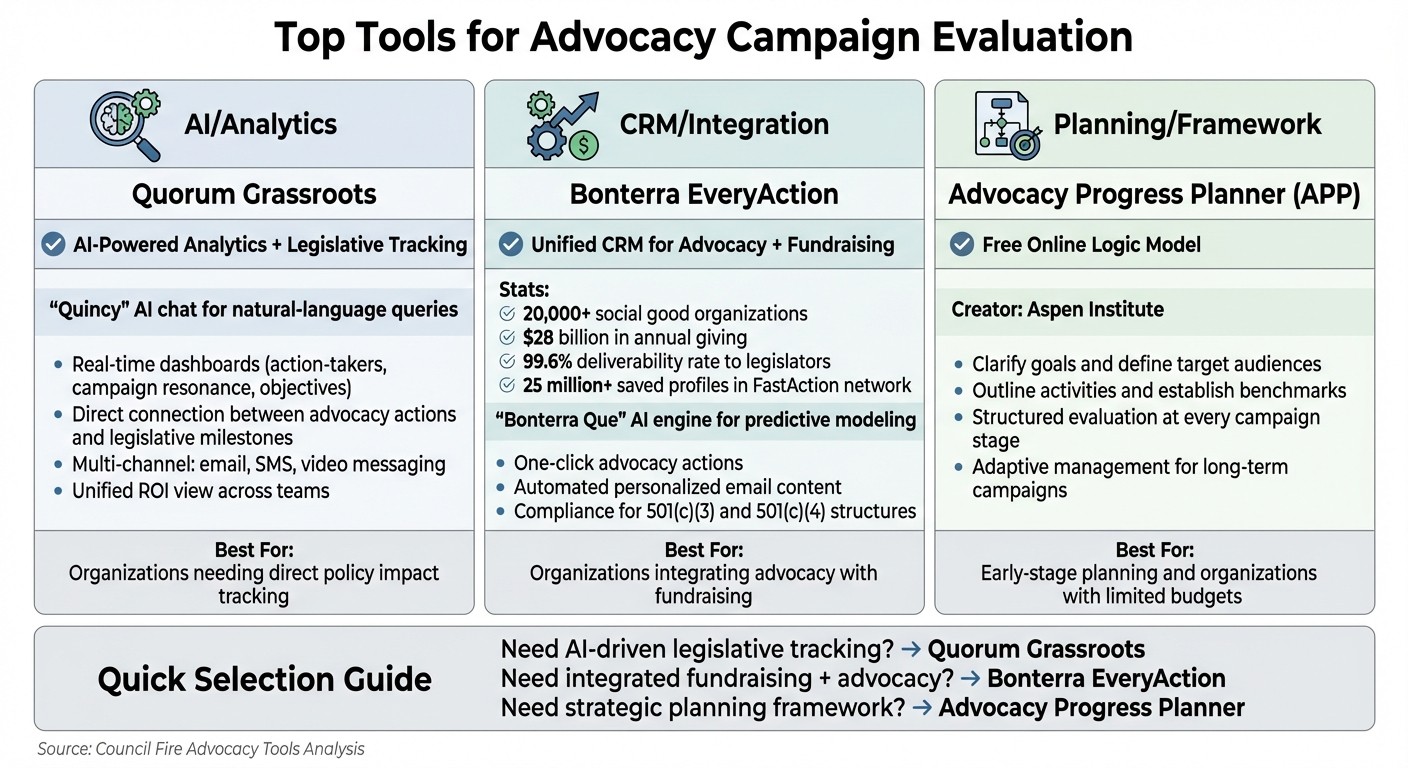
Top 3 Advocacy Campaign Evaluation Tools Comparison
The right tools can redefine how advocacy campaigns measure success, transforming raw data into actionable insights. From advanced AI-driven platforms to free strategic frameworks, these tools cater to diverse evaluation needs, helping organizations gauge the tangible impact of their efforts.
Quorum Grassroots
Quorum Grassroots combines AI-powered analytics with legislative tracking to show how grassroots efforts influence policy outcomes. Its standout feature, the AI chat tool "Quincy", allows users to ask natural-language questions like, "Which campaigns generated the most grasstops activity?" and receive immediate, data-driven answers [17][13].
This platform offers real-time dashboards that highlight key metrics, such as top action-takers, campaign resonance, and progress toward specific objectives. Unlike standard email tools, Quorum directly connects advocacy actions to legislative milestones by tracking bill sponsorships and mentions during hearings. It also consolidates interactions between advocates and lawmakers. With multi-channel capabilities - including email, SMS, and user-generated video messaging - it enables campaigns to build a collection of personal testimonies for digital outreach [17][13]. Additionally, Quorum ensures grassroots data integrates seamlessly across government relations and PAC teams, providing leadership with a unified view of ROI [13][14].
Bonterra EveryAction
Bonterra EveryAction stands out for integrating advocacy and fundraising through its unified CRM system. Trusted by over 20,000 social good organizations and facilitating more than $28 billion in annual giving [15], it provides a comprehensive view of supporter engagement across multiple channels [15][16].
With a 99.6% deliverability rate to legislators, the platform prioritizes website comment forms over traditional email to ensure advocates’ messages reach decision-makers [15][16]. Its FastAction network, featuring over 25 million saved supporter profiles, allows for one-click advocacy and fundraising actions, reducing barriers to participation [16]. Bonterra Que, the platform's AI engine, uses predictive modeling to identify supporters at risk of disengaging or those ready to increase their involvement. It also generates personalized, on-brand email content automatically, leveraging insights from over 90,000 campaigns [15].
"EveryAction and the Bonterra team gave us the structure we needed to stop guessing and start growing." – William McNulty, Co-Founder and Head of Mission at White Stork [15]
The platform is designed to handle complex nonprofit structures, including dual 501(c)(3) and 501(c)(4) models, while maintaining compliance [15].
Advocacy Progress Planner (APP)
For organizations seeking straightforward tools, the Advocacy Progress Planner offers a free, online logic model to guide campaign design. Created by the Aspen Institute, this tool helps advocates and grantmakers clarify goals, define target audiences, outline activities, and establish measurable benchmarks [9]. It is particularly useful during the early stages of campaign planning to ensure alignment between objectives, audiences, and strategies.
Continuous Progress Tools
The Aspen Institute also provides the Continuous Progress Tools, which offer a structured approach to evaluating campaigns at every stage - before, during, and after [9]. Developed by the Advocacy Planning and Evaluation Program (APEP), these tools help organizations set realistic expectations, track progress, and make mid-campaign adjustments based on real-time data rather than assumptions. This adaptive management approach is especially beneficial for long-term campaigns aimed at influencing policy, ensuring strategies remain effective as circumstances evolve.
Combining Tools with Sustainability Consulting
Turning advocacy data into meaningful outcomes requires more than just analysis - it demands strategic consulting that connects the dots between metrics and long-term goals. Council Fire's sustainability consulting approach does exactly that, transforming raw data into actionable insights that align with environmental, social, and economic priorities. Rather than focusing solely on attribution, their strategy emphasizes contribution, understanding that meaningful change often involves a network of actors working over extended periods [3]. This approach bridges technical data with strategic goals, driving progress toward sustainability.
Customizing Impact Analysis
Council Fire employs a logic model to map advocacy efforts to tangible outcomes, such as legislative achievements, shifts in public opinion, and broader sustainability impacts [7][2]. This model sets benchmarks not only for immediate wins but also for longer-term changes, like increased policymaker engagement and organizational adaptations, which can take years to unfold [3][7]. By contextualizing raw data within these broader objectives, their analyses provide a more nuanced understanding of progress.
Granular data, such as civic engagement metrics and demographic details, enables precise targeting based on behavior [1][5]. Visual dashboards simplify this complex information, presenting it in clear, accessible formats for stakeholders and donors [1].
"Planning for evaluation should occur at the start of an advocacy effort, ideally while the strategy is being developed or soon after." – Julia Coffman, Author, UNICEF [3]
AI-powered predictive analysis adds another layer, identifying trends within large datasets and forecasting future challenges. This capability is particularly critical for tackling long-term issues like climate change [18]. By tagging legislative data by topic and priority, Council Fire ensures every advocacy action aligns with specific environmental, social, and economic goals [18].
Stakeholder Engagement and Communication Strategies
Effective advocacy goes beyond analysis - it hinges on clear and dynamic communication with stakeholders. Building trust across diverse groups means sharing progress transparently, even when final goals have yet to be achieved. Council Fire's approach tracks interim outcomes, ensuring campaigns remain credible even if legislative milestones are still on the horizon [3]. Regular debriefs turn these tracking efforts into actionable insights, allowing organizations to adjust strategies as needed [7].
To refine communication efforts, Council Fire uses the "Spectrum of Allies" framework to map stakeholder positions [6]. When combined with real-time engagement metrics from advocacy platforms, this mapping highlights community mobilization and shifts in public sentiment - key indicators of social impact. By integrating these tools, organizations can stay aligned with evolving goals while maintaining transparency with funders, partners, and the communities they serve.
Conclusion
Choosing the right evaluation tools turns advocacy efforts into precise, data-driven strategies. By effectively tracking campaigns, organizations can demonstrate their impact to funders and decision-makers, ensuring the continued support needed to pursue ambitious sustainability objectives. Monitoring interim milestones also helps maintain credibility, even when navigating lengthy policy cycles. This approach not only validates results but also shapes adaptive strategies for future sustainability efforts.
Integrating CRM systems into campaigns can increase conversion rates by an impressive 300%, while workflow automation reduces costs by 25% and minimizes errors by 18% [10]. Despite these benefits, 41% of executives still lean on intuition over data when making critical decisions [10].
"Data is the lifeblood of modern advocacy. Without data-driven advocacy, we're just shouting into the void." – CallHub [10]
To succeed, organizations must pair advanced tools with strategic consulting to turn raw data into meaningful insights. Quantitative findings can guide consulting strategies that align with broader environmental, social, and economic goals. Council Fire's sustainability-focused approach supports organizations by creating clear advocacy plans, identifying critical performance metrics, and establishing feedback systems to drive ongoing progress.
FAQs
Which 3–5 KPIs should we track for our advocacy campaign?
Key performance indicators (KPIs) to monitor in an advocacy campaign include:
Policy influence and legislative changes: Tracking progress in shaping or achieving specific policy goals.
Public awareness and opinion shifts: Measuring changes in public understanding or attitudes toward the issue.
Supporter mobilization and engagement: Assessing the growth and activity levels of your supporter base.
Media coverage: Evaluating the quantity and quality of media attention your campaign generates.
Stakeholder participation: Monitoring involvement from key groups or individuals critical to your campaign's success.
These metrics help gauge the effectiveness and overall impact of advocacy efforts.
How can we measure policy impact without claiming full credit?
Policy impact is often assessed through contribution analysis, a method that examines how advocacy efforts play a role in achieving policy outcomes while acknowledging the influence of other factors. This approach offers a balanced perspective by taking into account the wider context and the collective contributions that shape the results.
What data is needed to calculate advocacy ROI?
To determine the return on investment (ROI) for advocacy efforts, start by collecting key data points: attributed revenue from referrals and influenced expansions, cost savings, customer acquisition cost (CAC) reductions, and program costs. Then, apply this formula:
(Attributed Revenue + Cost Savings − Program Cost) ÷ Program Cost
This calculation offers a straightforward way to assess the financial impact of your advocacy campaigns.
Related Blog Posts
Latest Articles
©2025



FAQ
01
What does it really mean to “redefine profit”?
02
What makes Council Fire different?
03
Who does Council Fire you work with?
04
What does working with Council Fire actually look like?
05
How does Council Fire help organizations turn big goals into action?
06
How does Council Fire define and measure success?
Feb 27, 2026
Best Tools for Advocacy Campaign Evaluation
Capacity Building
In This Article
Compare top tools and metrics to measure advocacy campaigns—from reach and engagement to outcomes and ROI—for clearer, data-driven impact.
Best Tools for Advocacy Campaign Evaluation
Advocacy organizations need clear metrics to evaluate campaign success, build stakeholder trust, and allocate resources effectively. Measuring impact involves tracking reach and engagement, outcomes, and ROI. Tools like Quorum Grassroots, Bonterra EveryAction, and Advocacy Progress Planner simplify these processes by offering real-time analytics, integrated CRMs, and logic models. For example, Quorum connects grassroots actions to legislative milestones, while Bonterra integrates advocacy with fundraising. These tools ensure campaigns stay focused on measurable goals, even for long-term efforts like policy changes. By combining data analysis with stakeholder communication, organizations can demonstrate results and refine strategies over time.
How to use monitoring and evaluation to drive change in advocacy and campaigns? With Sarah Rose
Core Metrics for Measuring Campaign Performance
Advocacy groups often measure their progress through three main metric categories: reach and engagement, outcome and impact, and return on investment (ROI). Each category answers a critical question about the campaign's effectiveness, from gauging audience interaction to assessing resource efficiency and long-term growth.
Reach and Engagement
Reach metrics track how many people are exposed to your campaign. These include metrics like content impressions, audience size, website visits, and media coverage [4][8][2]. On the other hand, engagement metrics measure how actively people interact with your content, such as email open rates, social media likes and shares, and click-through rates [4][5][8].
Given that the average person receives over 150 emails daily, metrics like open rates are crucial to understanding message visibility. For instance, social media advocacy traffic grew from 8.7% in 2018 to 13.3% in 2019 [4]. Advocacy alerts tend to outperform typical fundraising emails, receiving six times more responses [4]. In one standout example, a TikTok advocacy video garnered over 3.6 million views, leading to thousands of constituent messages [4].
"We want to know if we're moving the needle, so our ultimate goal is feedback from the Hill. The best is when we receive a call from Hill staff, saying 'we're hearing from a lot of principals about XYZ.'"
– Amanda N. Karhuse, Director of Advocacy, National Association of Secondary School Principals [4]
Advocate mobilization metrics focus on the number of new advocates recruited, volunteer retention rates, and the total legislative contacts generated [4][1][8]. Some platforms even offer proprietary advocacy scores to gauge civic engagement, helping organizations refine their future campaigns [1]. Establishing internal benchmarks by tracking metrics like open and action rates over time can help organizations create a tailored baseline for their industry [4].
Outcome and Impact Measurement
While reach metrics highlight visibility, outcome metrics assess the tangible results of a campaign. Progress is often measured across four levels: activity counts (actions taken), interim outcomes (changes in attitudes or support), policy achievements (legislative or regulatory wins), and long-term societal impact [11].
Given the complexities of policy change, advocacy evaluation often focuses on "contribution" rather than "attribution" [4][3]. Instead of claiming sole credit for a win, organizations demonstrate how their efforts influenced the broader outcome. For example, they might track whether legislators adopt their messaging on social media, monitor shifts in public opinion through surveys, or document stakeholder actions that align with campaign goals [4][2].
"Advocacy evaluation should be seen as a form of trained judgment, rather than a method. That judgment requires a deep knowledge of and feel for the politics of the issues."
– Steven Teles, Professor of Political Science, Johns Hopkins University [4]
Organizations like Feeding America use an advocacy index score (ranging from 0.0 to 3.0) across five pillars - lawmaker contacts, coalitions, grassroots, grasstops, and media - to evaluate their network's effectiveness [4]. Setting SMART objectives can help break broad goals into measurable milestones, such as "recruit 5,000 new supporters" or "generate 500 lawmaker contacts" [1][2].
These qualitative shifts build the foundation for assessing financial efficiency through ROI.
Return on Investment (ROI)
ROI measures the financial efficiency and overall value of a campaign. A practical formula for advocacy ROI is:
(Attributed Revenue + Cost Savings − Program Cost) ÷ Program Cost [12].
Revenue inputs might include new business referrals, influenced renewals, and expansion opportunities. Cost savings can come from reduced support needs via peer communities, lower content creation costs, and improved customer acquisition rates due to advocate endorsements [12].
However, 16% of advocacy professionals cite the inability to quantify and report value as a major challenge [4]. For instance, one mature program demonstrated a 155% ROI with a payback period of roughly 7.7 months [12].
"VoterVoice and FiscalNote have been a tremendous help because it's so much easier to be able to track those numbers that we're looking for. If you have the money to invest in one of these platforms, you absolutely should."
– Nicole Patton, Manager of Grassroots Advocacy, National Down Syndrome Society [4]
To ensure accurate ROI analysis, organizations should define credit rules early, such as establishing lookback windows and distinguishing between referrals and influenced revenue [12]. Using control groups - areas or accounts not exposed to advocacy efforts - can help measure the true impact on win rates or cycle times [12]. Instead of focusing solely on vanity metrics like reach, organizations should prioritize 3-5 key performance indicators that align directly with their strategic goals [8].
Top Tools for Advocacy Campaign Evaluation
Top 3 Advocacy Campaign Evaluation Tools Comparison
The right tools can redefine how advocacy campaigns measure success, transforming raw data into actionable insights. From advanced AI-driven platforms to free strategic frameworks, these tools cater to diverse evaluation needs, helping organizations gauge the tangible impact of their efforts.
Quorum Grassroots
Quorum Grassroots combines AI-powered analytics with legislative tracking to show how grassroots efforts influence policy outcomes. Its standout feature, the AI chat tool "Quincy", allows users to ask natural-language questions like, "Which campaigns generated the most grasstops activity?" and receive immediate, data-driven answers [17][13].
This platform offers real-time dashboards that highlight key metrics, such as top action-takers, campaign resonance, and progress toward specific objectives. Unlike standard email tools, Quorum directly connects advocacy actions to legislative milestones by tracking bill sponsorships and mentions during hearings. It also consolidates interactions between advocates and lawmakers. With multi-channel capabilities - including email, SMS, and user-generated video messaging - it enables campaigns to build a collection of personal testimonies for digital outreach [17][13]. Additionally, Quorum ensures grassroots data integrates seamlessly across government relations and PAC teams, providing leadership with a unified view of ROI [13][14].
Bonterra EveryAction
Bonterra EveryAction stands out for integrating advocacy and fundraising through its unified CRM system. Trusted by over 20,000 social good organizations and facilitating more than $28 billion in annual giving [15], it provides a comprehensive view of supporter engagement across multiple channels [15][16].
With a 99.6% deliverability rate to legislators, the platform prioritizes website comment forms over traditional email to ensure advocates’ messages reach decision-makers [15][16]. Its FastAction network, featuring over 25 million saved supporter profiles, allows for one-click advocacy and fundraising actions, reducing barriers to participation [16]. Bonterra Que, the platform's AI engine, uses predictive modeling to identify supporters at risk of disengaging or those ready to increase their involvement. It also generates personalized, on-brand email content automatically, leveraging insights from over 90,000 campaigns [15].
"EveryAction and the Bonterra team gave us the structure we needed to stop guessing and start growing." – William McNulty, Co-Founder and Head of Mission at White Stork [15]
The platform is designed to handle complex nonprofit structures, including dual 501(c)(3) and 501(c)(4) models, while maintaining compliance [15].
Advocacy Progress Planner (APP)
For organizations seeking straightforward tools, the Advocacy Progress Planner offers a free, online logic model to guide campaign design. Created by the Aspen Institute, this tool helps advocates and grantmakers clarify goals, define target audiences, outline activities, and establish measurable benchmarks [9]. It is particularly useful during the early stages of campaign planning to ensure alignment between objectives, audiences, and strategies.
Continuous Progress Tools
The Aspen Institute also provides the Continuous Progress Tools, which offer a structured approach to evaluating campaigns at every stage - before, during, and after [9]. Developed by the Advocacy Planning and Evaluation Program (APEP), these tools help organizations set realistic expectations, track progress, and make mid-campaign adjustments based on real-time data rather than assumptions. This adaptive management approach is especially beneficial for long-term campaigns aimed at influencing policy, ensuring strategies remain effective as circumstances evolve.
Combining Tools with Sustainability Consulting
Turning advocacy data into meaningful outcomes requires more than just analysis - it demands strategic consulting that connects the dots between metrics and long-term goals. Council Fire's sustainability consulting approach does exactly that, transforming raw data into actionable insights that align with environmental, social, and economic priorities. Rather than focusing solely on attribution, their strategy emphasizes contribution, understanding that meaningful change often involves a network of actors working over extended periods [3]. This approach bridges technical data with strategic goals, driving progress toward sustainability.
Customizing Impact Analysis
Council Fire employs a logic model to map advocacy efforts to tangible outcomes, such as legislative achievements, shifts in public opinion, and broader sustainability impacts [7][2]. This model sets benchmarks not only for immediate wins but also for longer-term changes, like increased policymaker engagement and organizational adaptations, which can take years to unfold [3][7]. By contextualizing raw data within these broader objectives, their analyses provide a more nuanced understanding of progress.
Granular data, such as civic engagement metrics and demographic details, enables precise targeting based on behavior [1][5]. Visual dashboards simplify this complex information, presenting it in clear, accessible formats for stakeholders and donors [1].
"Planning for evaluation should occur at the start of an advocacy effort, ideally while the strategy is being developed or soon after." – Julia Coffman, Author, UNICEF [3]
AI-powered predictive analysis adds another layer, identifying trends within large datasets and forecasting future challenges. This capability is particularly critical for tackling long-term issues like climate change [18]. By tagging legislative data by topic and priority, Council Fire ensures every advocacy action aligns with specific environmental, social, and economic goals [18].
Stakeholder Engagement and Communication Strategies
Effective advocacy goes beyond analysis - it hinges on clear and dynamic communication with stakeholders. Building trust across diverse groups means sharing progress transparently, even when final goals have yet to be achieved. Council Fire's approach tracks interim outcomes, ensuring campaigns remain credible even if legislative milestones are still on the horizon [3]. Regular debriefs turn these tracking efforts into actionable insights, allowing organizations to adjust strategies as needed [7].
To refine communication efforts, Council Fire uses the "Spectrum of Allies" framework to map stakeholder positions [6]. When combined with real-time engagement metrics from advocacy platforms, this mapping highlights community mobilization and shifts in public sentiment - key indicators of social impact. By integrating these tools, organizations can stay aligned with evolving goals while maintaining transparency with funders, partners, and the communities they serve.
Conclusion
Choosing the right evaluation tools turns advocacy efforts into precise, data-driven strategies. By effectively tracking campaigns, organizations can demonstrate their impact to funders and decision-makers, ensuring the continued support needed to pursue ambitious sustainability objectives. Monitoring interim milestones also helps maintain credibility, even when navigating lengthy policy cycles. This approach not only validates results but also shapes adaptive strategies for future sustainability efforts.
Integrating CRM systems into campaigns can increase conversion rates by an impressive 300%, while workflow automation reduces costs by 25% and minimizes errors by 18% [10]. Despite these benefits, 41% of executives still lean on intuition over data when making critical decisions [10].
"Data is the lifeblood of modern advocacy. Without data-driven advocacy, we're just shouting into the void." – CallHub [10]
To succeed, organizations must pair advanced tools with strategic consulting to turn raw data into meaningful insights. Quantitative findings can guide consulting strategies that align with broader environmental, social, and economic goals. Council Fire's sustainability-focused approach supports organizations by creating clear advocacy plans, identifying critical performance metrics, and establishing feedback systems to drive ongoing progress.
FAQs
Which 3–5 KPIs should we track for our advocacy campaign?
Key performance indicators (KPIs) to monitor in an advocacy campaign include:
Policy influence and legislative changes: Tracking progress in shaping or achieving specific policy goals.
Public awareness and opinion shifts: Measuring changes in public understanding or attitudes toward the issue.
Supporter mobilization and engagement: Assessing the growth and activity levels of your supporter base.
Media coverage: Evaluating the quantity and quality of media attention your campaign generates.
Stakeholder participation: Monitoring involvement from key groups or individuals critical to your campaign's success.
These metrics help gauge the effectiveness and overall impact of advocacy efforts.
How can we measure policy impact without claiming full credit?
Policy impact is often assessed through contribution analysis, a method that examines how advocacy efforts play a role in achieving policy outcomes while acknowledging the influence of other factors. This approach offers a balanced perspective by taking into account the wider context and the collective contributions that shape the results.
What data is needed to calculate advocacy ROI?
To determine the return on investment (ROI) for advocacy efforts, start by collecting key data points: attributed revenue from referrals and influenced expansions, cost savings, customer acquisition cost (CAC) reductions, and program costs. Then, apply this formula:
(Attributed Revenue + Cost Savings − Program Cost) ÷ Program Cost
This calculation offers a straightforward way to assess the financial impact of your advocacy campaigns.
Related Blog Posts
FAQ
01
What does it really mean to “redefine profit”?
02
What makes Council Fire different?
03
Who does Council Fire you work with?
04
What does working with Council Fire actually look like?
05
How does Council Fire help organizations turn big goals into action?
06
How does Council Fire define and measure success?
Feb 27, 2026
Best Tools for Advocacy Campaign Evaluation
Capacity Building
In This Article
Compare top tools and metrics to measure advocacy campaigns—from reach and engagement to outcomes and ROI—for clearer, data-driven impact.
Best Tools for Advocacy Campaign Evaluation
Advocacy organizations need clear metrics to evaluate campaign success, build stakeholder trust, and allocate resources effectively. Measuring impact involves tracking reach and engagement, outcomes, and ROI. Tools like Quorum Grassroots, Bonterra EveryAction, and Advocacy Progress Planner simplify these processes by offering real-time analytics, integrated CRMs, and logic models. For example, Quorum connects grassroots actions to legislative milestones, while Bonterra integrates advocacy with fundraising. These tools ensure campaigns stay focused on measurable goals, even for long-term efforts like policy changes. By combining data analysis with stakeholder communication, organizations can demonstrate results and refine strategies over time.
How to use monitoring and evaluation to drive change in advocacy and campaigns? With Sarah Rose
Core Metrics for Measuring Campaign Performance
Advocacy groups often measure their progress through three main metric categories: reach and engagement, outcome and impact, and return on investment (ROI). Each category answers a critical question about the campaign's effectiveness, from gauging audience interaction to assessing resource efficiency and long-term growth.
Reach and Engagement
Reach metrics track how many people are exposed to your campaign. These include metrics like content impressions, audience size, website visits, and media coverage [4][8][2]. On the other hand, engagement metrics measure how actively people interact with your content, such as email open rates, social media likes and shares, and click-through rates [4][5][8].
Given that the average person receives over 150 emails daily, metrics like open rates are crucial to understanding message visibility. For instance, social media advocacy traffic grew from 8.7% in 2018 to 13.3% in 2019 [4]. Advocacy alerts tend to outperform typical fundraising emails, receiving six times more responses [4]. In one standout example, a TikTok advocacy video garnered over 3.6 million views, leading to thousands of constituent messages [4].
"We want to know if we're moving the needle, so our ultimate goal is feedback from the Hill. The best is when we receive a call from Hill staff, saying 'we're hearing from a lot of principals about XYZ.'"
– Amanda N. Karhuse, Director of Advocacy, National Association of Secondary School Principals [4]
Advocate mobilization metrics focus on the number of new advocates recruited, volunteer retention rates, and the total legislative contacts generated [4][1][8]. Some platforms even offer proprietary advocacy scores to gauge civic engagement, helping organizations refine their future campaigns [1]. Establishing internal benchmarks by tracking metrics like open and action rates over time can help organizations create a tailored baseline for their industry [4].
Outcome and Impact Measurement
While reach metrics highlight visibility, outcome metrics assess the tangible results of a campaign. Progress is often measured across four levels: activity counts (actions taken), interim outcomes (changes in attitudes or support), policy achievements (legislative or regulatory wins), and long-term societal impact [11].
Given the complexities of policy change, advocacy evaluation often focuses on "contribution" rather than "attribution" [4][3]. Instead of claiming sole credit for a win, organizations demonstrate how their efforts influenced the broader outcome. For example, they might track whether legislators adopt their messaging on social media, monitor shifts in public opinion through surveys, or document stakeholder actions that align with campaign goals [4][2].
"Advocacy evaluation should be seen as a form of trained judgment, rather than a method. That judgment requires a deep knowledge of and feel for the politics of the issues."
– Steven Teles, Professor of Political Science, Johns Hopkins University [4]
Organizations like Feeding America use an advocacy index score (ranging from 0.0 to 3.0) across five pillars - lawmaker contacts, coalitions, grassroots, grasstops, and media - to evaluate their network's effectiveness [4]. Setting SMART objectives can help break broad goals into measurable milestones, such as "recruit 5,000 new supporters" or "generate 500 lawmaker contacts" [1][2].
These qualitative shifts build the foundation for assessing financial efficiency through ROI.
Return on Investment (ROI)
ROI measures the financial efficiency and overall value of a campaign. A practical formula for advocacy ROI is:
(Attributed Revenue + Cost Savings − Program Cost) ÷ Program Cost [12].
Revenue inputs might include new business referrals, influenced renewals, and expansion opportunities. Cost savings can come from reduced support needs via peer communities, lower content creation costs, and improved customer acquisition rates due to advocate endorsements [12].
However, 16% of advocacy professionals cite the inability to quantify and report value as a major challenge [4]. For instance, one mature program demonstrated a 155% ROI with a payback period of roughly 7.7 months [12].
"VoterVoice and FiscalNote have been a tremendous help because it's so much easier to be able to track those numbers that we're looking for. If you have the money to invest in one of these platforms, you absolutely should."
– Nicole Patton, Manager of Grassroots Advocacy, National Down Syndrome Society [4]
To ensure accurate ROI analysis, organizations should define credit rules early, such as establishing lookback windows and distinguishing between referrals and influenced revenue [12]. Using control groups - areas or accounts not exposed to advocacy efforts - can help measure the true impact on win rates or cycle times [12]. Instead of focusing solely on vanity metrics like reach, organizations should prioritize 3-5 key performance indicators that align directly with their strategic goals [8].
Top Tools for Advocacy Campaign Evaluation
Top 3 Advocacy Campaign Evaluation Tools Comparison
The right tools can redefine how advocacy campaigns measure success, transforming raw data into actionable insights. From advanced AI-driven platforms to free strategic frameworks, these tools cater to diverse evaluation needs, helping organizations gauge the tangible impact of their efforts.
Quorum Grassroots
Quorum Grassroots combines AI-powered analytics with legislative tracking to show how grassroots efforts influence policy outcomes. Its standout feature, the AI chat tool "Quincy", allows users to ask natural-language questions like, "Which campaigns generated the most grasstops activity?" and receive immediate, data-driven answers [17][13].
This platform offers real-time dashboards that highlight key metrics, such as top action-takers, campaign resonance, and progress toward specific objectives. Unlike standard email tools, Quorum directly connects advocacy actions to legislative milestones by tracking bill sponsorships and mentions during hearings. It also consolidates interactions between advocates and lawmakers. With multi-channel capabilities - including email, SMS, and user-generated video messaging - it enables campaigns to build a collection of personal testimonies for digital outreach [17][13]. Additionally, Quorum ensures grassroots data integrates seamlessly across government relations and PAC teams, providing leadership with a unified view of ROI [13][14].
Bonterra EveryAction
Bonterra EveryAction stands out for integrating advocacy and fundraising through its unified CRM system. Trusted by over 20,000 social good organizations and facilitating more than $28 billion in annual giving [15], it provides a comprehensive view of supporter engagement across multiple channels [15][16].
With a 99.6% deliverability rate to legislators, the platform prioritizes website comment forms over traditional email to ensure advocates’ messages reach decision-makers [15][16]. Its FastAction network, featuring over 25 million saved supporter profiles, allows for one-click advocacy and fundraising actions, reducing barriers to participation [16]. Bonterra Que, the platform's AI engine, uses predictive modeling to identify supporters at risk of disengaging or those ready to increase their involvement. It also generates personalized, on-brand email content automatically, leveraging insights from over 90,000 campaigns [15].
"EveryAction and the Bonterra team gave us the structure we needed to stop guessing and start growing." – William McNulty, Co-Founder and Head of Mission at White Stork [15]
The platform is designed to handle complex nonprofit structures, including dual 501(c)(3) and 501(c)(4) models, while maintaining compliance [15].
Advocacy Progress Planner (APP)
For organizations seeking straightforward tools, the Advocacy Progress Planner offers a free, online logic model to guide campaign design. Created by the Aspen Institute, this tool helps advocates and grantmakers clarify goals, define target audiences, outline activities, and establish measurable benchmarks [9]. It is particularly useful during the early stages of campaign planning to ensure alignment between objectives, audiences, and strategies.
Continuous Progress Tools
The Aspen Institute also provides the Continuous Progress Tools, which offer a structured approach to evaluating campaigns at every stage - before, during, and after [9]. Developed by the Advocacy Planning and Evaluation Program (APEP), these tools help organizations set realistic expectations, track progress, and make mid-campaign adjustments based on real-time data rather than assumptions. This adaptive management approach is especially beneficial for long-term campaigns aimed at influencing policy, ensuring strategies remain effective as circumstances evolve.
Combining Tools with Sustainability Consulting
Turning advocacy data into meaningful outcomes requires more than just analysis - it demands strategic consulting that connects the dots between metrics and long-term goals. Council Fire's sustainability consulting approach does exactly that, transforming raw data into actionable insights that align with environmental, social, and economic priorities. Rather than focusing solely on attribution, their strategy emphasizes contribution, understanding that meaningful change often involves a network of actors working over extended periods [3]. This approach bridges technical data with strategic goals, driving progress toward sustainability.
Customizing Impact Analysis
Council Fire employs a logic model to map advocacy efforts to tangible outcomes, such as legislative achievements, shifts in public opinion, and broader sustainability impacts [7][2]. This model sets benchmarks not only for immediate wins but also for longer-term changes, like increased policymaker engagement and organizational adaptations, which can take years to unfold [3][7]. By contextualizing raw data within these broader objectives, their analyses provide a more nuanced understanding of progress.
Granular data, such as civic engagement metrics and demographic details, enables precise targeting based on behavior [1][5]. Visual dashboards simplify this complex information, presenting it in clear, accessible formats for stakeholders and donors [1].
"Planning for evaluation should occur at the start of an advocacy effort, ideally while the strategy is being developed or soon after." – Julia Coffman, Author, UNICEF [3]
AI-powered predictive analysis adds another layer, identifying trends within large datasets and forecasting future challenges. This capability is particularly critical for tackling long-term issues like climate change [18]. By tagging legislative data by topic and priority, Council Fire ensures every advocacy action aligns with specific environmental, social, and economic goals [18].
Stakeholder Engagement and Communication Strategies
Effective advocacy goes beyond analysis - it hinges on clear and dynamic communication with stakeholders. Building trust across diverse groups means sharing progress transparently, even when final goals have yet to be achieved. Council Fire's approach tracks interim outcomes, ensuring campaigns remain credible even if legislative milestones are still on the horizon [3]. Regular debriefs turn these tracking efforts into actionable insights, allowing organizations to adjust strategies as needed [7].
To refine communication efforts, Council Fire uses the "Spectrum of Allies" framework to map stakeholder positions [6]. When combined with real-time engagement metrics from advocacy platforms, this mapping highlights community mobilization and shifts in public sentiment - key indicators of social impact. By integrating these tools, organizations can stay aligned with evolving goals while maintaining transparency with funders, partners, and the communities they serve.
Conclusion
Choosing the right evaluation tools turns advocacy efforts into precise, data-driven strategies. By effectively tracking campaigns, organizations can demonstrate their impact to funders and decision-makers, ensuring the continued support needed to pursue ambitious sustainability objectives. Monitoring interim milestones also helps maintain credibility, even when navigating lengthy policy cycles. This approach not only validates results but also shapes adaptive strategies for future sustainability efforts.
Integrating CRM systems into campaigns can increase conversion rates by an impressive 300%, while workflow automation reduces costs by 25% and minimizes errors by 18% [10]. Despite these benefits, 41% of executives still lean on intuition over data when making critical decisions [10].
"Data is the lifeblood of modern advocacy. Without data-driven advocacy, we're just shouting into the void." – CallHub [10]
To succeed, organizations must pair advanced tools with strategic consulting to turn raw data into meaningful insights. Quantitative findings can guide consulting strategies that align with broader environmental, social, and economic goals. Council Fire's sustainability-focused approach supports organizations by creating clear advocacy plans, identifying critical performance metrics, and establishing feedback systems to drive ongoing progress.
FAQs
Which 3–5 KPIs should we track for our advocacy campaign?
Key performance indicators (KPIs) to monitor in an advocacy campaign include:
Policy influence and legislative changes: Tracking progress in shaping or achieving specific policy goals.
Public awareness and opinion shifts: Measuring changes in public understanding or attitudes toward the issue.
Supporter mobilization and engagement: Assessing the growth and activity levels of your supporter base.
Media coverage: Evaluating the quantity and quality of media attention your campaign generates.
Stakeholder participation: Monitoring involvement from key groups or individuals critical to your campaign's success.
These metrics help gauge the effectiveness and overall impact of advocacy efforts.
How can we measure policy impact without claiming full credit?
Policy impact is often assessed through contribution analysis, a method that examines how advocacy efforts play a role in achieving policy outcomes while acknowledging the influence of other factors. This approach offers a balanced perspective by taking into account the wider context and the collective contributions that shape the results.
What data is needed to calculate advocacy ROI?
To determine the return on investment (ROI) for advocacy efforts, start by collecting key data points: attributed revenue from referrals and influenced expansions, cost savings, customer acquisition cost (CAC) reductions, and program costs. Then, apply this formula:
(Attributed Revenue + Cost Savings − Program Cost) ÷ Program Cost
This calculation offers a straightforward way to assess the financial impact of your advocacy campaigns.
Related Blog Posts
FAQ
What does it really mean to “redefine profit”?
What makes Council Fire different?
Who does Council Fire you work with?
What does working with Council Fire actually look like?
How does Council Fire help organizations turn big goals into action?
How does Council Fire define and measure success?