
Sep 22, 2026
Awareness and behavior change: guide for leaders
Sustainability Strategy
In This Article
Turn awareness into action: define clear behaviors, remove friction, set defaults, engage suppliers, and measure outcomes.
Awareness and behavior change: guide for leaders
Awareness does not change daily actions on its own. In the article, 76% of employees know their company’s plan, but only 17% say they have what they need to act. To me, the message is simple: if you want lower energy use, less waste, less air travel, or better supplier choices, I need to define the exact behavior, remove friction, set defaults, and track results.
Here’s the core of it in plain terms:
Start with one clear action, not a broad goal.
Find the blocker: skills, tools, process, norms, or manager follow-through.
Make the better choice the default inside daily work.
Give teams feedback often, tied to their own decisions.
Hold suppliers to clear outcome-based rules, not just forms.
Measure three things apart: awareness, behavior, and business results.
A few numbers stand out:
67% of climate behavior programs in one 2024 review showed no statistical effect after 12 months.
Prompts and signage can lift target actions by 10%–30%.
One office case cut energy use by 18.8% with feedback, goals, and information.
Social norm nudges have delivered about 6.4% electricity savings in workplace cases.
Scope 3 makes up 75% of emissions on average, yet only 38% of CDP reporters in 2024 had Scope 3 reduction targets.
If I were leading this work, I would treat awareness as the starting point, then build a simple system: clear owner, clear metric, clear review date, and a process that makes the lower-impact action easier than the old one.
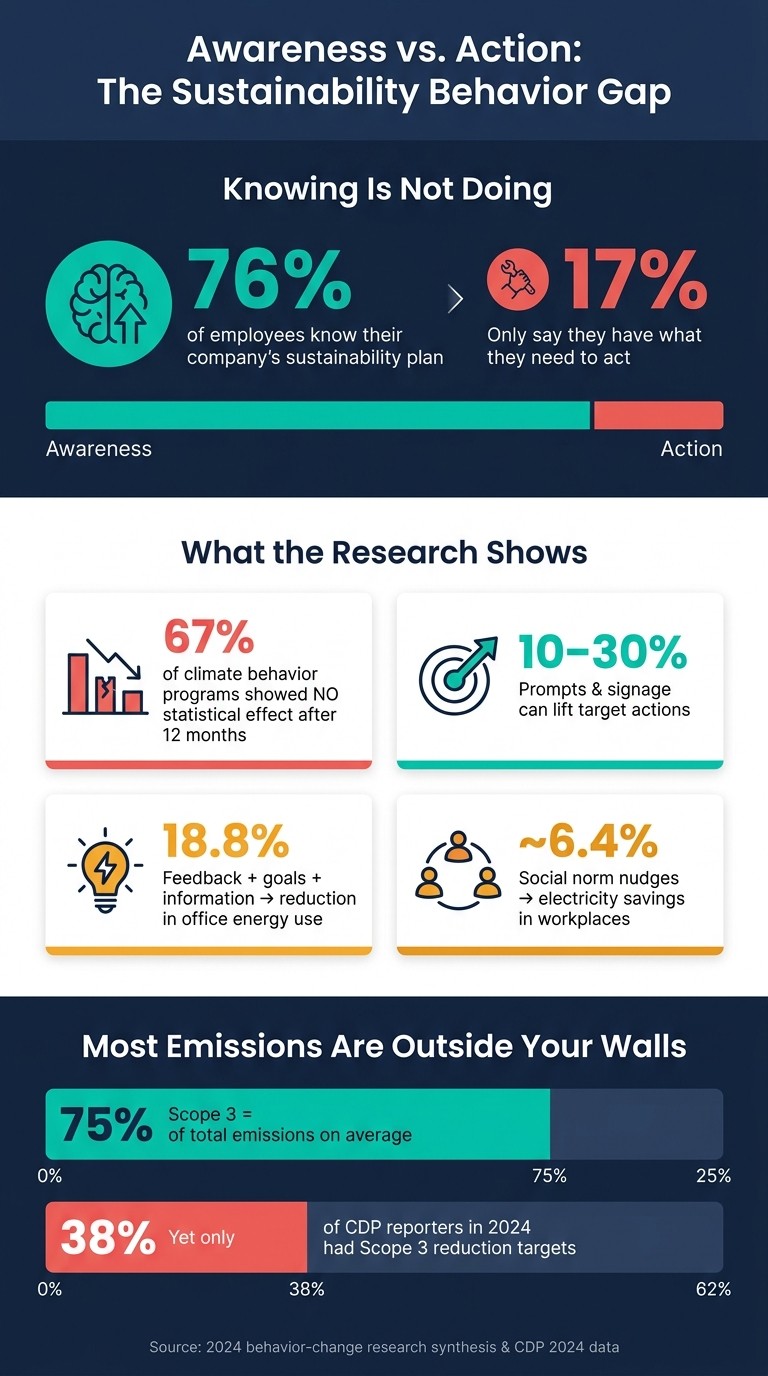
Awareness vs. Action: Key Stats on Workplace Sustainability Behavior Change
Use behavior science to define the right target actions
Focus on behaviors, not broad intentions
Goals like “be more sustainable” sound nice, but they don’t tell anyone what to do on Monday morning. If you want action, turn the goal into something people can see, do, and measure. Tie it to a role, a setting, and a deadline leaders can track.
A good behavioral target answers four questions: who does what, how much, and by when? “Reduce office electricity use by 10% over 12 months” gives people a clear task. “Care more about energy” does not. In procurement, “increase spend with suppliers meeting our sustainability criteria from 20% to 35% by the end of fiscal year 2027” gives buyers a specific mark to hit. “Source responsibly” leaves too much open to guesswork.
Set a baseline first. Then assign one owner to each target behavior. If no one owns it, it tends to drift.
Once the target action is clear, the next job is figuring out what gets in the way.
Map barriers and motivators before launching a campaign
Before building a campaign, find out what is blocking the behavior in the first place. A 2024 synthesis of 312 climate-related behavior-change interventions found that 67% showed no statistically significant effect at 12 months.[2] That’s a blunt reminder: the problem usually isn’t awareness. It’s friction.
The most common blockers fall into two buckets: capacity barriers and motivation barriers. Capacity barriers include missing tools, clunky processes, or poor infrastructure. Motivation barriers show up as low personal relevance, weak social norms, or other priorities taking over. If office electricity use stays high even though staff say they care about conservation, the issue may be building controls or occupancy patterns, not a lack of knowledge. A light diagnostic can bring this into view: short surveys, a handful of one-on-one interviews, and a look at baseline performance data.
Pay close attention to four behavior levers:
Social norms: What do peers and managers visibly do?
Defaults: What happens if someone does nothing?
Confidence: Do people think they can do the task?
Access: Are the right tools and processes in place?
Take virtual meetings as an example. If they are not the default for internal check-ins, people will keep getting reminders to choose them, and many will still go with the easier path in the moment.
Once the barrier is clear, use the lightest move that removes it.
Choose tactics that match the behavior
The tactic should fit the barrier. Prompts and signage work well for routine, point-of-decision actions like waste sorting or shutting down equipment. Research suggests they can increase targeted actions by 10–30%.[3] Dashboards and feedback tools work better for energy or resource tracking, where visibility helps people stay accountable. In one commercial office case, a mix of feedback, goal setting, and information led to an 18.8% reduction in energy use.[7] Manager briefings work best when the behavior depends on local enforcement or role clarity, such as travel approval or supplier selection. In those cases, managers shape the real decision setting far more than a one-time email ever will.
The table below links common tactics to the behavior lever they mainly affect, along with where each one tends to work best.
Tactic | Primary Behavior Lever | Best-Fit Use Case | Strengths | Limitations |
|---|---|---|---|---|
Training | Self-efficacy / Knowledge | Role-specific process changes (e.g., procurement criteria) | Builds capability | Time-intensive; doesn't fix physical barriers |
Manager Briefings | Social Norms / Authority | Travel approval, supplier selection, team-level expectations | High accountability; direct relevance | Needs manager buy-in |
Prompts / Signage | Salience / Cueing | Point-of-decision habits (e.g., waste sorting, monitor shutdown) | Low cost; immediate reminder | Fades over time |
Dashboards | Feedback / Accountability | Energy, waste, or travel tracking | Real-time proof of impact; drives competition | Requires data infrastructure |
Email Campaigns | Awareness / Information | Broad launches or policy updates | Scalable and easy to distribute | High inbox fatigue; weak behavior driver alone |
Recognition Systems | Social Reinforcement | Sustaining long-term action; peer visibility | Boosts morale and culture | Must feel genuine and tied to real data |
Default Changes | Convenience / Inertia | Virtual-first meeting policies; double-sided printing settings | Powerful without requiring active choice | Requires operational or IT control to implement |
One pattern shows up again and again in the research: a mix of tactics works better than any single move on its own. Social norm nudges have produced an average of 6.4% electricity savings in documented workplace cases.[5][6] Pair those nudges with feedback, goal setting, and clear instructions, and the savings go up. The point is simple: match the mix to the behavior instead of leaning on the easiest channel, like email.
The next step is to build the behavior into daily work.
Build a working program for staff and day-to-day decisions
Set expectations by role and decision authority
Awareness changes behavior only when it reaches the person who actually makes the call. That sounds obvious, but many companies still send the same message to everyone and hope it sticks. It usually doesn’t.
Sustainability choices don’t happen in one place or at one level. A procurement officer weighing vendors is making a very different decision from a finance director signing off on a capital request. The stakes are different. The timing is different. The information they need is different too. Treat them the same, and you end up with generic guidance and no clear owner.
A better approach is to map each behavior to the role that controls it, grouped by decision type:
Operational decisions: Frontline staff follow updated procedures, like sorting waste the right way or shutting down equipment at the end of a shift.
Purchasing decisions: Managers turn targets into team routines and approve only vendors that meet sustainability criteria.
Capital approval: Executives ask for lifecycle cost data in strategy reviews and model low-carbon choices in their own decisions, often through a future leaders program designed to build organizational resilience.
For each function, define two or three measurable behaviors. Keep it plain and tied to work people already do. Procurement teams might own the share of spend with suppliers that meet sustainability criteria. Finance teams might own lifecycle cost analysis on capital requests, using $ payback terms.
A one-page role brief works well here. It should answer one simple question: what changes in my job?
Once roles are clear, the next step is to build that expectation into the process itself.
Make the desired behavior the default at work
Lasting behavior change happens when the right choice is the easy choice. If people have to remember every step, results drift. If the process does the work for them, habits start to hold.
The data backs this up. Automatically switching off devices after inactivity can reduce desk-based electricity use by up to 50% in office settings.[9] Changing default printer settings from single-sided to double-sided cuts paper use without asking staff to do anything extra.[10][5]
That’s the logic to use across daily workflows. Put preferred sustainable vendors at the top of the procurement system. Set travel booking tools to show rail and economy-class options first. Update standard operating procedures so sustainability steps are built in, not treated like optional extras people can skip when they’re busy.
When managers back the process the same way every time, it starts to feel normal. Not a memo. Not a side project. Just how work gets done.
Then comes the part many teams miss: keeping that default from fading into the background.
Create feedback loops that sustain action
One-off campaigns burn bright and then disappear. People need to see that their actions matter, and they need to see it often.
Workplace studies show the pattern clearly. A field study using social norm notices in workplaces led to 10% less energy use during the intervention and 11% less during follow-up compared with baseline.[8] In another case, group feedback and peer education reduced workplace energy use by 7% to 8%, while information-only groups rose by 4%.[4]
That’s why feedback has to be visible and tied to each team’s own decisions. Put the data where people already look: team scorecards, management reviews, regular operating meetings. Show each function what it controls and how it’s doing.
Peer champions can help move this along. Pick one respected person in each function, give them a clear role, and let them coach colleagues in a low-key way. That kind of peer-to-peer nudge often lands better than another top-down reminder. Add simple recognition tied to measured results, and the signal gets stronger.
Without a review rhythm, awareness slips back into good intentions.
Use the same role, default, and feedback logic when supplier decisions enter the process.
Beyond Awareness: Sparking Behavior Change for the Environment
Extend awareness and accountability to suppliers
Behavior change can’t stop at your company’s front door. Most of the impact sits in the supply chain, not inside your own operations. Scope 3 emissions make up 75% of total emissions on average, yet only 38% of CDP reporters in 2024 had Scope 3 reduction targets. [18] If you ask employees to cut their footprint while overlooking suppliers that drive most of the total impact, people notice. That gap can weaken trust.
Set clear supplier requirements tied to outcomes
Big promises rarely shift supplier behavior on their own. Clear requirements do. Each internal goal should connect to a plain supply chain outcome, then turn into a supplier requirement with a number attached.
If the goal is to cut supply chain emissions, the supplier requirement should be to track emissions trends and show year-over-year progress. If the goal is responsible sourcing, the requirement should define what share of spend must meet known certification criteria. The main point is simple: measure outcomes, not paperwork. Report submissions are outputs. Emissions cuts are outcomes. [1]
Labor and human rights expectations work the same way. Build internationally recognized standards - such as the UN Global Compact principles - into supplier codes of conduct, then back them up with measurable indicators like audit completion rates and corrective-action closure rates. [12][14][16]
Use communication and capacity building to change supplier behavior
Requirements without support usually lead to more forms, not better performance. For high-impact and strategic suppliers, use supplier summits, workshops, and regular one-on-one performance reviews to explain what’s expected, work through barriers, and agree on next steps. [11][12][15] For the rest of the supplier base, written onboarding materials, shared reporting templates, and digital portals help make compliance easier across a large group. [11][14][16]
Capacity building is often where these programs lose momentum. Suppliers may want to improve but lack the know-how, systems, or staff time. Training in emissions accounting, waste management, human-rights due diligence, and ESG reporting gives supplier managers the skills to act, not just check a box. Peer-learning networks can help too. When suppliers swap ideas through company-led groups or industry efforts, adoption often moves faster than it does with top-down direction alone. [12][13]
Match the engagement method to the supplier relationship
Not every supplier needs the same level of attention. Some need a baseline set of rules. Others need deeper engagement because of their spend, risk, or influence. The table below shows where each method fits best - and where it tends to fall short.
Approach | When to use | Main strength | Main limit |
|---|---|---|---|
Codes of conduct | Broad supplier base; setting minimum standards across all tiers | Simple to communicate; embeds expectations in contracts [14][16] | Often drives superficial compliance; limited support for implementation [12][13][19][20] |
Training programs | Suppliers with willingness but limited know-how or systems | Builds internal capabilities; clarifies expectations [12][13] | Impact depends on application; may not reach deeper tiers [12][14] |
Performance reviews & scorecards | Strategic or high-spend suppliers; renewal or negotiation cycles | Integrates sustainability into business performance; creates accountability [11][15] | Can feel like policing if not paired with support; poor data can erode trust [11][17] |
Collaborative projects | Complex, systemic challenges requiring shared expertise | Drives deeper behavior change and shared accountability [11][12] | Time-consuming; requires high trust and relationship maturity |
A practical approach is to use codes of conduct and training to set the floor across the full supplier base, then put performance reviews and collaborative projects where they matter most: suppliers with the biggest impact and the most leverage, including Tier 2 suppliers and beyond. Start by mapping suppliers by impact and relationship maturity.
Next, track whether supplier requirements are changing actual performance, not just reporting activity.
Measure results, learn, and adjust
Track awareness, behavior, and business impact separately
Once leaders set expectations for staff and suppliers, the next step is simple: show what changed. That only works if you keep the metrics separate. Participation, awareness, and business results are not the same thing, and they do not answer the same question.
Awareness metrics show what people know or understand. This can include knowledge of role-based actions or understanding how to book lower-carbon travel. You can measure this through periodic staff surveys, pulse polls, or short quizzes built into training.
Behavior metrics track what people actually do. That means observable actions, not opinions. Examples include kWh used per facility each month, pounds of waste generated or diverted, business travel miles by mode, emissions in metric tons CO₂e, and the share of spend with preferred sustainable suppliers. These numbers usually come from utility bills, travel systems, procurement records, asset systems, and facility logs.
Business results link those actions to operating and financial outcomes. That may include lower utility spend in USD, fewer compliance incidents, reduced travel budgets, or productivity gains from fewer travel days.
Leading indicators matter as well. They help you see whether awareness is likely to turn into action before the business results show up. Track confidence, norms, control, and skill adoption. In practice, that means asking employees whether they feel confident spotting lower-impact options, whether low-carbon choices feel standard on their team, whether suitable options are easy to find in the system, and whether they regularly use sustainability checklists. A 5-point scale makes it easier to track movement each quarter.
Once the team knows what to measure, it can set a baseline and decide how often each metric should be reviewed.
Build a regular review cadence into the program
Set a baseline for every key metric before launch. That can include average monthly kWh, air miles per employee, waste diversion rate, and sustainable supplier spend as a share of total spend. Without a starting point, it’s tough to know if the program changed anything or just made people feel busy.
Review operating data monthly, survey data quarterly, and targets annually. Just as important, tie each review to an actual decision. Use the numbers to adjust defaults, training, or manager follow-through instead of treating the dashboard like a filing cabinet.
If awareness goes up but behavior stays flat, that gap usually points to friction somewhere in the system. The issue may be missing skills, weak defaults, poor access, weak incentives, or uneven manager follow-through. Focus groups and open-text survey responses can help surface those snags in a way dashboards often cannot.
Use the review cycle to decide what to stop, what to fix, and what to scale.
Conclusion: the leadership moves that make awareness work
Awareness is the start, not the finish. Leaders need to define the behavior, remove barriers, build role-based support, engage suppliers, and track results. They also own the metrics, the process changes, and the follow-up.
Translate the program into metrics, data sources, and review owners using this framework:
Initiative | Key Indicators | Data Sources | Review Cadence |
|---|---|---|---|
Reduce office energy use | kWh per month; kWh per sq ft; CO₂e | Utility bills; building management systems | Monthly ops review |
Cut business air travel | Air miles per employee; % virtual meetings | Travel booking platform; expense reports | Quarterly leadership |
Shift spend to sustainable suppliers | % of spend with preferred suppliers; CO₂e | ERP/procurement system; supplier reports | Quarterly procurement |
Increase waste diversion | Pounds to landfill vs. recycling/compost | Waste hauler reports; facility logs | Monthly facilities |
Build staff capability | Awareness, confidence, and norm scores | Staff surveys; LMS training completion | Quarterly HR review |
Assign a named owner to each metric so the measurement system stays tied to operating decisions. Review the dashboard together across operations, finance, and HR so behavior change stays linked to how the business runs day to day. Council Fire helps turn sustainability strategy into measurable action by bringing kWh, miles, emissions, and spend into one decision framework.
FAQs
Why doesn’t awareness alone change behavior?
Awareness by itself usually doesn't change behavior. It tells people what matters, but it doesn't clear the roadblocks that stop action. Fear, skepticism, cost concerns, and plain old comfort with the status quo can all get in the way. That's why people often need clear communication, hands-on training, and a chance to take part so they can build the skills and confidence to act.
Awareness also fades fast when updates are inconsistent, sustainability isn't built into daily routines, and leaders stop reinforcing priorities. If the message shows up once and then disappears, people move on. Lasting change comes from specific actions, active participation, and measurable outcomes.
What should leaders measure first?
Start by clarifying your theory of change. In plain terms, map out how your activities are supposed to lead to the outcomes you want. That step gives the work a clear line of sight. You’re not just doing tasks - you’re showing why those tasks should change behavior and what results should follow.
Next, run a baseline assessment. This records current involvement, resource use, and environmental or social impact before the work begins. Think of it as your starting line. Without it, progress is hard to prove. With it, you can track change over time and show whether your behavior change efforts are working.
How can we get suppliers to act?
Move past one-off asks and bake sustainability into formal business processes. Set expectations early, say them plainly, and put emissions-reduction goals and sustainable procurement requirements directly into contracts.
Smaller suppliers may want to improve but lack the time, staff, or know-how to do it alone. Give them practical support, share guidance they can use, and keep the conversation going through regular feedback. Just as important, track whether suppliers are putting better practices in place so accountability doesn’t slip.
Related Blog Posts
Latest Articles
©2025

Narrative Change and Power Building: The Missing Half of Advocacy
Narrative change is the process of disrupting dominant narratives that normalize inequity and advancing new narratives from historically marginalized communities.

Funding Resilience Without Federal Grants
BRIC is unreliable and FEMA is shrinking. Here's how cities fund climate resilience with dedicated revenue, blended finance, and a coordinating authority.

The ESG Blind Spot: How AI Is Finding Risks in Companies Nobody Else Is Watching
Norway's sovereign wealth fund uses AI to screen 7,200 portfolio companies for forced labor and corruption within 24 hours. The real story is the emerging-market coverage gap that traditional ESG data vendors miss — and what it means for any company with a global supply chain.
Narrative Change and Power Building: The Missing Half of Advocacy
Narrative change is the process of disrupting dominant narratives that normalize inequity and advancing new narratives from historically marginalized communities.
Funding Resilience Without Federal Grants
BRIC is unreliable and FEMA is shrinking. Here's how cities fund climate resilience with dedicated revenue, blended finance, and a coordinating authority.
The ESG Blind Spot: How AI Is Finding Risks in Companies Nobody Else Is Watching
Norway's sovereign wealth fund uses AI to screen 7,200 portfolio companies for forced labor and corruption within 24 hours. The real story is the emerging-market coverage gap that traditional ESG data vendors miss — and what it means for any company with a global supply chain.
FAQ
01
What does it really mean to “redefine profit”?
02
What makes Council Fire different?
03
Who does Council Fire work with?
04
What does working with Council Fire actually look like?
05
How does Council Fire help organizations turn big goals into action?
06
How does Council Fire define and measure success?
Sep 22, 2026
Awareness and behavior change: guide for leaders
Sustainability Strategy
In This Article
Turn awareness into action: define clear behaviors, remove friction, set defaults, engage suppliers, and measure outcomes.
Awareness and behavior change: guide for leaders
Awareness does not change daily actions on its own. In the article, 76% of employees know their company’s plan, but only 17% say they have what they need to act. To me, the message is simple: if you want lower energy use, less waste, less air travel, or better supplier choices, I need to define the exact behavior, remove friction, set defaults, and track results.
Here’s the core of it in plain terms:
Start with one clear action, not a broad goal.
Find the blocker: skills, tools, process, norms, or manager follow-through.
Make the better choice the default inside daily work.
Give teams feedback often, tied to their own decisions.
Hold suppliers to clear outcome-based rules, not just forms.
Measure three things apart: awareness, behavior, and business results.
A few numbers stand out:
67% of climate behavior programs in one 2024 review showed no statistical effect after 12 months.
Prompts and signage can lift target actions by 10%–30%.
One office case cut energy use by 18.8% with feedback, goals, and information.
Social norm nudges have delivered about 6.4% electricity savings in workplace cases.
Scope 3 makes up 75% of emissions on average, yet only 38% of CDP reporters in 2024 had Scope 3 reduction targets.
If I were leading this work, I would treat awareness as the starting point, then build a simple system: clear owner, clear metric, clear review date, and a process that makes the lower-impact action easier than the old one.
Awareness vs. Action: Key Stats on Workplace Sustainability Behavior Change
Use behavior science to define the right target actions
Focus on behaviors, not broad intentions
Goals like “be more sustainable” sound nice, but they don’t tell anyone what to do on Monday morning. If you want action, turn the goal into something people can see, do, and measure. Tie it to a role, a setting, and a deadline leaders can track.
A good behavioral target answers four questions: who does what, how much, and by when? “Reduce office electricity use by 10% over 12 months” gives people a clear task. “Care more about energy” does not. In procurement, “increase spend with suppliers meeting our sustainability criteria from 20% to 35% by the end of fiscal year 2027” gives buyers a specific mark to hit. “Source responsibly” leaves too much open to guesswork.
Set a baseline first. Then assign one owner to each target behavior. If no one owns it, it tends to drift.
Once the target action is clear, the next job is figuring out what gets in the way.
Map barriers and motivators before launching a campaign
Before building a campaign, find out what is blocking the behavior in the first place. A 2024 synthesis of 312 climate-related behavior-change interventions found that 67% showed no statistically significant effect at 12 months.[2] That’s a blunt reminder: the problem usually isn’t awareness. It’s friction.
The most common blockers fall into two buckets: capacity barriers and motivation barriers. Capacity barriers include missing tools, clunky processes, or poor infrastructure. Motivation barriers show up as low personal relevance, weak social norms, or other priorities taking over. If office electricity use stays high even though staff say they care about conservation, the issue may be building controls or occupancy patterns, not a lack of knowledge. A light diagnostic can bring this into view: short surveys, a handful of one-on-one interviews, and a look at baseline performance data.
Pay close attention to four behavior levers:
Social norms: What do peers and managers visibly do?
Defaults: What happens if someone does nothing?
Confidence: Do people think they can do the task?
Access: Are the right tools and processes in place?
Take virtual meetings as an example. If they are not the default for internal check-ins, people will keep getting reminders to choose them, and many will still go with the easier path in the moment.
Once the barrier is clear, use the lightest move that removes it.
Choose tactics that match the behavior
The tactic should fit the barrier. Prompts and signage work well for routine, point-of-decision actions like waste sorting or shutting down equipment. Research suggests they can increase targeted actions by 10–30%.[3] Dashboards and feedback tools work better for energy or resource tracking, where visibility helps people stay accountable. In one commercial office case, a mix of feedback, goal setting, and information led to an 18.8% reduction in energy use.[7] Manager briefings work best when the behavior depends on local enforcement or role clarity, such as travel approval or supplier selection. In those cases, managers shape the real decision setting far more than a one-time email ever will.
The table below links common tactics to the behavior lever they mainly affect, along with where each one tends to work best.
Tactic | Primary Behavior Lever | Best-Fit Use Case | Strengths | Limitations |
|---|---|---|---|---|
Training | Self-efficacy / Knowledge | Role-specific process changes (e.g., procurement criteria) | Builds capability | Time-intensive; doesn't fix physical barriers |
Manager Briefings | Social Norms / Authority | Travel approval, supplier selection, team-level expectations | High accountability; direct relevance | Needs manager buy-in |
Prompts / Signage | Salience / Cueing | Point-of-decision habits (e.g., waste sorting, monitor shutdown) | Low cost; immediate reminder | Fades over time |
Dashboards | Feedback / Accountability | Energy, waste, or travel tracking | Real-time proof of impact; drives competition | Requires data infrastructure |
Email Campaigns | Awareness / Information | Broad launches or policy updates | Scalable and easy to distribute | High inbox fatigue; weak behavior driver alone |
Recognition Systems | Social Reinforcement | Sustaining long-term action; peer visibility | Boosts morale and culture | Must feel genuine and tied to real data |
Default Changes | Convenience / Inertia | Virtual-first meeting policies; double-sided printing settings | Powerful without requiring active choice | Requires operational or IT control to implement |
One pattern shows up again and again in the research: a mix of tactics works better than any single move on its own. Social norm nudges have produced an average of 6.4% electricity savings in documented workplace cases.[5][6] Pair those nudges with feedback, goal setting, and clear instructions, and the savings go up. The point is simple: match the mix to the behavior instead of leaning on the easiest channel, like email.
The next step is to build the behavior into daily work.
Build a working program for staff and day-to-day decisions
Set expectations by role and decision authority
Awareness changes behavior only when it reaches the person who actually makes the call. That sounds obvious, but many companies still send the same message to everyone and hope it sticks. It usually doesn’t.
Sustainability choices don’t happen in one place or at one level. A procurement officer weighing vendors is making a very different decision from a finance director signing off on a capital request. The stakes are different. The timing is different. The information they need is different too. Treat them the same, and you end up with generic guidance and no clear owner.
A better approach is to map each behavior to the role that controls it, grouped by decision type:
Operational decisions: Frontline staff follow updated procedures, like sorting waste the right way or shutting down equipment at the end of a shift.
Purchasing decisions: Managers turn targets into team routines and approve only vendors that meet sustainability criteria.
Capital approval: Executives ask for lifecycle cost data in strategy reviews and model low-carbon choices in their own decisions, often through a future leaders program designed to build organizational resilience.
For each function, define two or three measurable behaviors. Keep it plain and tied to work people already do. Procurement teams might own the share of spend with suppliers that meet sustainability criteria. Finance teams might own lifecycle cost analysis on capital requests, using $ payback terms.
A one-page role brief works well here. It should answer one simple question: what changes in my job?
Once roles are clear, the next step is to build that expectation into the process itself.
Make the desired behavior the default at work
Lasting behavior change happens when the right choice is the easy choice. If people have to remember every step, results drift. If the process does the work for them, habits start to hold.
The data backs this up. Automatically switching off devices after inactivity can reduce desk-based electricity use by up to 50% in office settings.[9] Changing default printer settings from single-sided to double-sided cuts paper use without asking staff to do anything extra.[10][5]
That’s the logic to use across daily workflows. Put preferred sustainable vendors at the top of the procurement system. Set travel booking tools to show rail and economy-class options first. Update standard operating procedures so sustainability steps are built in, not treated like optional extras people can skip when they’re busy.
When managers back the process the same way every time, it starts to feel normal. Not a memo. Not a side project. Just how work gets done.
Then comes the part many teams miss: keeping that default from fading into the background.
Create feedback loops that sustain action
One-off campaigns burn bright and then disappear. People need to see that their actions matter, and they need to see it often.
Workplace studies show the pattern clearly. A field study using social norm notices in workplaces led to 10% less energy use during the intervention and 11% less during follow-up compared with baseline.[8] In another case, group feedback and peer education reduced workplace energy use by 7% to 8%, while information-only groups rose by 4%.[4]
That’s why feedback has to be visible and tied to each team’s own decisions. Put the data where people already look: team scorecards, management reviews, regular operating meetings. Show each function what it controls and how it’s doing.
Peer champions can help move this along. Pick one respected person in each function, give them a clear role, and let them coach colleagues in a low-key way. That kind of peer-to-peer nudge often lands better than another top-down reminder. Add simple recognition tied to measured results, and the signal gets stronger.
Without a review rhythm, awareness slips back into good intentions.
Use the same role, default, and feedback logic when supplier decisions enter the process.
Beyond Awareness: Sparking Behavior Change for the Environment
Extend awareness and accountability to suppliers
Behavior change can’t stop at your company’s front door. Most of the impact sits in the supply chain, not inside your own operations. Scope 3 emissions make up 75% of total emissions on average, yet only 38% of CDP reporters in 2024 had Scope 3 reduction targets. [18] If you ask employees to cut their footprint while overlooking suppliers that drive most of the total impact, people notice. That gap can weaken trust.
Set clear supplier requirements tied to outcomes
Big promises rarely shift supplier behavior on their own. Clear requirements do. Each internal goal should connect to a plain supply chain outcome, then turn into a supplier requirement with a number attached.
If the goal is to cut supply chain emissions, the supplier requirement should be to track emissions trends and show year-over-year progress. If the goal is responsible sourcing, the requirement should define what share of spend must meet known certification criteria. The main point is simple: measure outcomes, not paperwork. Report submissions are outputs. Emissions cuts are outcomes. [1]
Labor and human rights expectations work the same way. Build internationally recognized standards - such as the UN Global Compact principles - into supplier codes of conduct, then back them up with measurable indicators like audit completion rates and corrective-action closure rates. [12][14][16]
Use communication and capacity building to change supplier behavior
Requirements without support usually lead to more forms, not better performance. For high-impact and strategic suppliers, use supplier summits, workshops, and regular one-on-one performance reviews to explain what’s expected, work through barriers, and agree on next steps. [11][12][15] For the rest of the supplier base, written onboarding materials, shared reporting templates, and digital portals help make compliance easier across a large group. [11][14][16]
Capacity building is often where these programs lose momentum. Suppliers may want to improve but lack the know-how, systems, or staff time. Training in emissions accounting, waste management, human-rights due diligence, and ESG reporting gives supplier managers the skills to act, not just check a box. Peer-learning networks can help too. When suppliers swap ideas through company-led groups or industry efforts, adoption often moves faster than it does with top-down direction alone. [12][13]
Match the engagement method to the supplier relationship
Not every supplier needs the same level of attention. Some need a baseline set of rules. Others need deeper engagement because of their spend, risk, or influence. The table below shows where each method fits best - and where it tends to fall short.
Approach | When to use | Main strength | Main limit |
|---|---|---|---|
Codes of conduct | Broad supplier base; setting minimum standards across all tiers | Simple to communicate; embeds expectations in contracts [14][16] | Often drives superficial compliance; limited support for implementation [12][13][19][20] |
Training programs | Suppliers with willingness but limited know-how or systems | Builds internal capabilities; clarifies expectations [12][13] | Impact depends on application; may not reach deeper tiers [12][14] |
Performance reviews & scorecards | Strategic or high-spend suppliers; renewal or negotiation cycles | Integrates sustainability into business performance; creates accountability [11][15] | Can feel like policing if not paired with support; poor data can erode trust [11][17] |
Collaborative projects | Complex, systemic challenges requiring shared expertise | Drives deeper behavior change and shared accountability [11][12] | Time-consuming; requires high trust and relationship maturity |
A practical approach is to use codes of conduct and training to set the floor across the full supplier base, then put performance reviews and collaborative projects where they matter most: suppliers with the biggest impact and the most leverage, including Tier 2 suppliers and beyond. Start by mapping suppliers by impact and relationship maturity.
Next, track whether supplier requirements are changing actual performance, not just reporting activity.
Measure results, learn, and adjust
Track awareness, behavior, and business impact separately
Once leaders set expectations for staff and suppliers, the next step is simple: show what changed. That only works if you keep the metrics separate. Participation, awareness, and business results are not the same thing, and they do not answer the same question.
Awareness metrics show what people know or understand. This can include knowledge of role-based actions or understanding how to book lower-carbon travel. You can measure this through periodic staff surveys, pulse polls, or short quizzes built into training.
Behavior metrics track what people actually do. That means observable actions, not opinions. Examples include kWh used per facility each month, pounds of waste generated or diverted, business travel miles by mode, emissions in metric tons CO₂e, and the share of spend with preferred sustainable suppliers. These numbers usually come from utility bills, travel systems, procurement records, asset systems, and facility logs.
Business results link those actions to operating and financial outcomes. That may include lower utility spend in USD, fewer compliance incidents, reduced travel budgets, or productivity gains from fewer travel days.
Leading indicators matter as well. They help you see whether awareness is likely to turn into action before the business results show up. Track confidence, norms, control, and skill adoption. In practice, that means asking employees whether they feel confident spotting lower-impact options, whether low-carbon choices feel standard on their team, whether suitable options are easy to find in the system, and whether they regularly use sustainability checklists. A 5-point scale makes it easier to track movement each quarter.
Once the team knows what to measure, it can set a baseline and decide how often each metric should be reviewed.
Build a regular review cadence into the program
Set a baseline for every key metric before launch. That can include average monthly kWh, air miles per employee, waste diversion rate, and sustainable supplier spend as a share of total spend. Without a starting point, it’s tough to know if the program changed anything or just made people feel busy.
Review operating data monthly, survey data quarterly, and targets annually. Just as important, tie each review to an actual decision. Use the numbers to adjust defaults, training, or manager follow-through instead of treating the dashboard like a filing cabinet.
If awareness goes up but behavior stays flat, that gap usually points to friction somewhere in the system. The issue may be missing skills, weak defaults, poor access, weak incentives, or uneven manager follow-through. Focus groups and open-text survey responses can help surface those snags in a way dashboards often cannot.
Use the review cycle to decide what to stop, what to fix, and what to scale.
Conclusion: the leadership moves that make awareness work
Awareness is the start, not the finish. Leaders need to define the behavior, remove barriers, build role-based support, engage suppliers, and track results. They also own the metrics, the process changes, and the follow-up.
Translate the program into metrics, data sources, and review owners using this framework:
Initiative | Key Indicators | Data Sources | Review Cadence |
|---|---|---|---|
Reduce office energy use | kWh per month; kWh per sq ft; CO₂e | Utility bills; building management systems | Monthly ops review |
Cut business air travel | Air miles per employee; % virtual meetings | Travel booking platform; expense reports | Quarterly leadership |
Shift spend to sustainable suppliers | % of spend with preferred suppliers; CO₂e | ERP/procurement system; supplier reports | Quarterly procurement |
Increase waste diversion | Pounds to landfill vs. recycling/compost | Waste hauler reports; facility logs | Monthly facilities |
Build staff capability | Awareness, confidence, and norm scores | Staff surveys; LMS training completion | Quarterly HR review |
Assign a named owner to each metric so the measurement system stays tied to operating decisions. Review the dashboard together across operations, finance, and HR so behavior change stays linked to how the business runs day to day. Council Fire helps turn sustainability strategy into measurable action by bringing kWh, miles, emissions, and spend into one decision framework.
FAQs
Why doesn’t awareness alone change behavior?
Awareness by itself usually doesn't change behavior. It tells people what matters, but it doesn't clear the roadblocks that stop action. Fear, skepticism, cost concerns, and plain old comfort with the status quo can all get in the way. That's why people often need clear communication, hands-on training, and a chance to take part so they can build the skills and confidence to act.
Awareness also fades fast when updates are inconsistent, sustainability isn't built into daily routines, and leaders stop reinforcing priorities. If the message shows up once and then disappears, people move on. Lasting change comes from specific actions, active participation, and measurable outcomes.
What should leaders measure first?
Start by clarifying your theory of change. In plain terms, map out how your activities are supposed to lead to the outcomes you want. That step gives the work a clear line of sight. You’re not just doing tasks - you’re showing why those tasks should change behavior and what results should follow.
Next, run a baseline assessment. This records current involvement, resource use, and environmental or social impact before the work begins. Think of it as your starting line. Without it, progress is hard to prove. With it, you can track change over time and show whether your behavior change efforts are working.
How can we get suppliers to act?
Move past one-off asks and bake sustainability into formal business processes. Set expectations early, say them plainly, and put emissions-reduction goals and sustainable procurement requirements directly into contracts.
Smaller suppliers may want to improve but lack the time, staff, or know-how to do it alone. Give them practical support, share guidance they can use, and keep the conversation going through regular feedback. Just as important, track whether suppliers are putting better practices in place so accountability doesn’t slip.
Related Blog Posts
Latest Articles
©2025
Narrative Change and Power Building: The Missing Half of Advocacy
Narrative change is the process of disrupting dominant narratives that normalize inequity and advancing new narratives from historically marginalized communities.
Funding Resilience Without Federal Grants
BRIC is unreliable and FEMA is shrinking. Here's how cities fund climate resilience with dedicated revenue, blended finance, and a coordinating authority.
The ESG Blind Spot: How AI Is Finding Risks in Companies Nobody Else Is Watching
Norway's sovereign wealth fund uses AI to screen 7,200 portfolio companies for forced labor and corruption within 24 hours. The real story is the emerging-market coverage gap that traditional ESG data vendors miss — and what it means for any company with a global supply chain.
FAQ
01
What does it really mean to “redefine profit”?
02
What makes Council Fire different?
03
Who does Council Fire work with?
04
What does working with Council Fire actually look like?
05
How does Council Fire help organizations turn big goals into action?
06
How does Council Fire define and measure success?
Sep 22, 2026
Awareness and behavior change: guide for leaders
Sustainability Strategy
In This Article
Turn awareness into action: define clear behaviors, remove friction, set defaults, engage suppliers, and measure outcomes.
Awareness and behavior change: guide for leaders
Awareness does not change daily actions on its own. In the article, 76% of employees know their company’s plan, but only 17% say they have what they need to act. To me, the message is simple: if you want lower energy use, less waste, less air travel, or better supplier choices, I need to define the exact behavior, remove friction, set defaults, and track results.
Here’s the core of it in plain terms:
Start with one clear action, not a broad goal.
Find the blocker: skills, tools, process, norms, or manager follow-through.
Make the better choice the default inside daily work.
Give teams feedback often, tied to their own decisions.
Hold suppliers to clear outcome-based rules, not just forms.
Measure three things apart: awareness, behavior, and business results.
A few numbers stand out:
67% of climate behavior programs in one 2024 review showed no statistical effect after 12 months.
Prompts and signage can lift target actions by 10%–30%.
One office case cut energy use by 18.8% with feedback, goals, and information.
Social norm nudges have delivered about 6.4% electricity savings in workplace cases.
Scope 3 makes up 75% of emissions on average, yet only 38% of CDP reporters in 2024 had Scope 3 reduction targets.
If I were leading this work, I would treat awareness as the starting point, then build a simple system: clear owner, clear metric, clear review date, and a process that makes the lower-impact action easier than the old one.
Awareness vs. Action: Key Stats on Workplace Sustainability Behavior Change
Use behavior science to define the right target actions
Focus on behaviors, not broad intentions
Goals like “be more sustainable” sound nice, but they don’t tell anyone what to do on Monday morning. If you want action, turn the goal into something people can see, do, and measure. Tie it to a role, a setting, and a deadline leaders can track.
A good behavioral target answers four questions: who does what, how much, and by when? “Reduce office electricity use by 10% over 12 months” gives people a clear task. “Care more about energy” does not. In procurement, “increase spend with suppliers meeting our sustainability criteria from 20% to 35% by the end of fiscal year 2027” gives buyers a specific mark to hit. “Source responsibly” leaves too much open to guesswork.
Set a baseline first. Then assign one owner to each target behavior. If no one owns it, it tends to drift.
Once the target action is clear, the next job is figuring out what gets in the way.
Map barriers and motivators before launching a campaign
Before building a campaign, find out what is blocking the behavior in the first place. A 2024 synthesis of 312 climate-related behavior-change interventions found that 67% showed no statistically significant effect at 12 months.[2] That’s a blunt reminder: the problem usually isn’t awareness. It’s friction.
The most common blockers fall into two buckets: capacity barriers and motivation barriers. Capacity barriers include missing tools, clunky processes, or poor infrastructure. Motivation barriers show up as low personal relevance, weak social norms, or other priorities taking over. If office electricity use stays high even though staff say they care about conservation, the issue may be building controls or occupancy patterns, not a lack of knowledge. A light diagnostic can bring this into view: short surveys, a handful of one-on-one interviews, and a look at baseline performance data.
Pay close attention to four behavior levers:
Social norms: What do peers and managers visibly do?
Defaults: What happens if someone does nothing?
Confidence: Do people think they can do the task?
Access: Are the right tools and processes in place?
Take virtual meetings as an example. If they are not the default for internal check-ins, people will keep getting reminders to choose them, and many will still go with the easier path in the moment.
Once the barrier is clear, use the lightest move that removes it.
Choose tactics that match the behavior
The tactic should fit the barrier. Prompts and signage work well for routine, point-of-decision actions like waste sorting or shutting down equipment. Research suggests they can increase targeted actions by 10–30%.[3] Dashboards and feedback tools work better for energy or resource tracking, where visibility helps people stay accountable. In one commercial office case, a mix of feedback, goal setting, and information led to an 18.8% reduction in energy use.[7] Manager briefings work best when the behavior depends on local enforcement or role clarity, such as travel approval or supplier selection. In those cases, managers shape the real decision setting far more than a one-time email ever will.
The table below links common tactics to the behavior lever they mainly affect, along with where each one tends to work best.
Tactic | Primary Behavior Lever | Best-Fit Use Case | Strengths | Limitations |
|---|---|---|---|---|
Training | Self-efficacy / Knowledge | Role-specific process changes (e.g., procurement criteria) | Builds capability | Time-intensive; doesn't fix physical barriers |
Manager Briefings | Social Norms / Authority | Travel approval, supplier selection, team-level expectations | High accountability; direct relevance | Needs manager buy-in |
Prompts / Signage | Salience / Cueing | Point-of-decision habits (e.g., waste sorting, monitor shutdown) | Low cost; immediate reminder | Fades over time |
Dashboards | Feedback / Accountability | Energy, waste, or travel tracking | Real-time proof of impact; drives competition | Requires data infrastructure |
Email Campaigns | Awareness / Information | Broad launches or policy updates | Scalable and easy to distribute | High inbox fatigue; weak behavior driver alone |
Recognition Systems | Social Reinforcement | Sustaining long-term action; peer visibility | Boosts morale and culture | Must feel genuine and tied to real data |
Default Changes | Convenience / Inertia | Virtual-first meeting policies; double-sided printing settings | Powerful without requiring active choice | Requires operational or IT control to implement |
One pattern shows up again and again in the research: a mix of tactics works better than any single move on its own. Social norm nudges have produced an average of 6.4% electricity savings in documented workplace cases.[5][6] Pair those nudges with feedback, goal setting, and clear instructions, and the savings go up. The point is simple: match the mix to the behavior instead of leaning on the easiest channel, like email.
The next step is to build the behavior into daily work.
Build a working program for staff and day-to-day decisions
Set expectations by role and decision authority
Awareness changes behavior only when it reaches the person who actually makes the call. That sounds obvious, but many companies still send the same message to everyone and hope it sticks. It usually doesn’t.
Sustainability choices don’t happen in one place or at one level. A procurement officer weighing vendors is making a very different decision from a finance director signing off on a capital request. The stakes are different. The timing is different. The information they need is different too. Treat them the same, and you end up with generic guidance and no clear owner.
A better approach is to map each behavior to the role that controls it, grouped by decision type:
Operational decisions: Frontline staff follow updated procedures, like sorting waste the right way or shutting down equipment at the end of a shift.
Purchasing decisions: Managers turn targets into team routines and approve only vendors that meet sustainability criteria.
Capital approval: Executives ask for lifecycle cost data in strategy reviews and model low-carbon choices in their own decisions, often through a future leaders program designed to build organizational resilience.
For each function, define two or three measurable behaviors. Keep it plain and tied to work people already do. Procurement teams might own the share of spend with suppliers that meet sustainability criteria. Finance teams might own lifecycle cost analysis on capital requests, using $ payback terms.
A one-page role brief works well here. It should answer one simple question: what changes in my job?
Once roles are clear, the next step is to build that expectation into the process itself.
Make the desired behavior the default at work
Lasting behavior change happens when the right choice is the easy choice. If people have to remember every step, results drift. If the process does the work for them, habits start to hold.
The data backs this up. Automatically switching off devices after inactivity can reduce desk-based electricity use by up to 50% in office settings.[9] Changing default printer settings from single-sided to double-sided cuts paper use without asking staff to do anything extra.[10][5]
That’s the logic to use across daily workflows. Put preferred sustainable vendors at the top of the procurement system. Set travel booking tools to show rail and economy-class options first. Update standard operating procedures so sustainability steps are built in, not treated like optional extras people can skip when they’re busy.
When managers back the process the same way every time, it starts to feel normal. Not a memo. Not a side project. Just how work gets done.
Then comes the part many teams miss: keeping that default from fading into the background.
Create feedback loops that sustain action
One-off campaigns burn bright and then disappear. People need to see that their actions matter, and they need to see it often.
Workplace studies show the pattern clearly. A field study using social norm notices in workplaces led to 10% less energy use during the intervention and 11% less during follow-up compared with baseline.[8] In another case, group feedback and peer education reduced workplace energy use by 7% to 8%, while information-only groups rose by 4%.[4]
That’s why feedback has to be visible and tied to each team’s own decisions. Put the data where people already look: team scorecards, management reviews, regular operating meetings. Show each function what it controls and how it’s doing.
Peer champions can help move this along. Pick one respected person in each function, give them a clear role, and let them coach colleagues in a low-key way. That kind of peer-to-peer nudge often lands better than another top-down reminder. Add simple recognition tied to measured results, and the signal gets stronger.
Without a review rhythm, awareness slips back into good intentions.
Use the same role, default, and feedback logic when supplier decisions enter the process.
Beyond Awareness: Sparking Behavior Change for the Environment
Extend awareness and accountability to suppliers
Behavior change can’t stop at your company’s front door. Most of the impact sits in the supply chain, not inside your own operations. Scope 3 emissions make up 75% of total emissions on average, yet only 38% of CDP reporters in 2024 had Scope 3 reduction targets. [18] If you ask employees to cut their footprint while overlooking suppliers that drive most of the total impact, people notice. That gap can weaken trust.
Set clear supplier requirements tied to outcomes
Big promises rarely shift supplier behavior on their own. Clear requirements do. Each internal goal should connect to a plain supply chain outcome, then turn into a supplier requirement with a number attached.
If the goal is to cut supply chain emissions, the supplier requirement should be to track emissions trends and show year-over-year progress. If the goal is responsible sourcing, the requirement should define what share of spend must meet known certification criteria. The main point is simple: measure outcomes, not paperwork. Report submissions are outputs. Emissions cuts are outcomes. [1]
Labor and human rights expectations work the same way. Build internationally recognized standards - such as the UN Global Compact principles - into supplier codes of conduct, then back them up with measurable indicators like audit completion rates and corrective-action closure rates. [12][14][16]
Use communication and capacity building to change supplier behavior
Requirements without support usually lead to more forms, not better performance. For high-impact and strategic suppliers, use supplier summits, workshops, and regular one-on-one performance reviews to explain what’s expected, work through barriers, and agree on next steps. [11][12][15] For the rest of the supplier base, written onboarding materials, shared reporting templates, and digital portals help make compliance easier across a large group. [11][14][16]
Capacity building is often where these programs lose momentum. Suppliers may want to improve but lack the know-how, systems, or staff time. Training in emissions accounting, waste management, human-rights due diligence, and ESG reporting gives supplier managers the skills to act, not just check a box. Peer-learning networks can help too. When suppliers swap ideas through company-led groups or industry efforts, adoption often moves faster than it does with top-down direction alone. [12][13]
Match the engagement method to the supplier relationship
Not every supplier needs the same level of attention. Some need a baseline set of rules. Others need deeper engagement because of their spend, risk, or influence. The table below shows where each method fits best - and where it tends to fall short.
Approach | When to use | Main strength | Main limit |
|---|---|---|---|
Codes of conduct | Broad supplier base; setting minimum standards across all tiers | Simple to communicate; embeds expectations in contracts [14][16] | Often drives superficial compliance; limited support for implementation [12][13][19][20] |
Training programs | Suppliers with willingness but limited know-how or systems | Builds internal capabilities; clarifies expectations [12][13] | Impact depends on application; may not reach deeper tiers [12][14] |
Performance reviews & scorecards | Strategic or high-spend suppliers; renewal or negotiation cycles | Integrates sustainability into business performance; creates accountability [11][15] | Can feel like policing if not paired with support; poor data can erode trust [11][17] |
Collaborative projects | Complex, systemic challenges requiring shared expertise | Drives deeper behavior change and shared accountability [11][12] | Time-consuming; requires high trust and relationship maturity |
A practical approach is to use codes of conduct and training to set the floor across the full supplier base, then put performance reviews and collaborative projects where they matter most: suppliers with the biggest impact and the most leverage, including Tier 2 suppliers and beyond. Start by mapping suppliers by impact and relationship maturity.
Next, track whether supplier requirements are changing actual performance, not just reporting activity.
Measure results, learn, and adjust
Track awareness, behavior, and business impact separately
Once leaders set expectations for staff and suppliers, the next step is simple: show what changed. That only works if you keep the metrics separate. Participation, awareness, and business results are not the same thing, and they do not answer the same question.
Awareness metrics show what people know or understand. This can include knowledge of role-based actions or understanding how to book lower-carbon travel. You can measure this through periodic staff surveys, pulse polls, or short quizzes built into training.
Behavior metrics track what people actually do. That means observable actions, not opinions. Examples include kWh used per facility each month, pounds of waste generated or diverted, business travel miles by mode, emissions in metric tons CO₂e, and the share of spend with preferred sustainable suppliers. These numbers usually come from utility bills, travel systems, procurement records, asset systems, and facility logs.
Business results link those actions to operating and financial outcomes. That may include lower utility spend in USD, fewer compliance incidents, reduced travel budgets, or productivity gains from fewer travel days.
Leading indicators matter as well. They help you see whether awareness is likely to turn into action before the business results show up. Track confidence, norms, control, and skill adoption. In practice, that means asking employees whether they feel confident spotting lower-impact options, whether low-carbon choices feel standard on their team, whether suitable options are easy to find in the system, and whether they regularly use sustainability checklists. A 5-point scale makes it easier to track movement each quarter.
Once the team knows what to measure, it can set a baseline and decide how often each metric should be reviewed.
Build a regular review cadence into the program
Set a baseline for every key metric before launch. That can include average monthly kWh, air miles per employee, waste diversion rate, and sustainable supplier spend as a share of total spend. Without a starting point, it’s tough to know if the program changed anything or just made people feel busy.
Review operating data monthly, survey data quarterly, and targets annually. Just as important, tie each review to an actual decision. Use the numbers to adjust defaults, training, or manager follow-through instead of treating the dashboard like a filing cabinet.
If awareness goes up but behavior stays flat, that gap usually points to friction somewhere in the system. The issue may be missing skills, weak defaults, poor access, weak incentives, or uneven manager follow-through. Focus groups and open-text survey responses can help surface those snags in a way dashboards often cannot.
Use the review cycle to decide what to stop, what to fix, and what to scale.
Conclusion: the leadership moves that make awareness work
Awareness is the start, not the finish. Leaders need to define the behavior, remove barriers, build role-based support, engage suppliers, and track results. They also own the metrics, the process changes, and the follow-up.
Translate the program into metrics, data sources, and review owners using this framework:
Initiative | Key Indicators | Data Sources | Review Cadence |
|---|---|---|---|
Reduce office energy use | kWh per month; kWh per sq ft; CO₂e | Utility bills; building management systems | Monthly ops review |
Cut business air travel | Air miles per employee; % virtual meetings | Travel booking platform; expense reports | Quarterly leadership |
Shift spend to sustainable suppliers | % of spend with preferred suppliers; CO₂e | ERP/procurement system; supplier reports | Quarterly procurement |
Increase waste diversion | Pounds to landfill vs. recycling/compost | Waste hauler reports; facility logs | Monthly facilities |
Build staff capability | Awareness, confidence, and norm scores | Staff surveys; LMS training completion | Quarterly HR review |
Assign a named owner to each metric so the measurement system stays tied to operating decisions. Review the dashboard together across operations, finance, and HR so behavior change stays linked to how the business runs day to day. Council Fire helps turn sustainability strategy into measurable action by bringing kWh, miles, emissions, and spend into one decision framework.
FAQs
Why doesn’t awareness alone change behavior?
Awareness by itself usually doesn't change behavior. It tells people what matters, but it doesn't clear the roadblocks that stop action. Fear, skepticism, cost concerns, and plain old comfort with the status quo can all get in the way. That's why people often need clear communication, hands-on training, and a chance to take part so they can build the skills and confidence to act.
Awareness also fades fast when updates are inconsistent, sustainability isn't built into daily routines, and leaders stop reinforcing priorities. If the message shows up once and then disappears, people move on. Lasting change comes from specific actions, active participation, and measurable outcomes.
What should leaders measure first?
Start by clarifying your theory of change. In plain terms, map out how your activities are supposed to lead to the outcomes you want. That step gives the work a clear line of sight. You’re not just doing tasks - you’re showing why those tasks should change behavior and what results should follow.
Next, run a baseline assessment. This records current involvement, resource use, and environmental or social impact before the work begins. Think of it as your starting line. Without it, progress is hard to prove. With it, you can track change over time and show whether your behavior change efforts are working.
How can we get suppliers to act?
Move past one-off asks and bake sustainability into formal business processes. Set expectations early, say them plainly, and put emissions-reduction goals and sustainable procurement requirements directly into contracts.
Smaller suppliers may want to improve but lack the time, staff, or know-how to do it alone. Give them practical support, share guidance they can use, and keep the conversation going through regular feedback. Just as important, track whether suppliers are putting better practices in place so accountability doesn’t slip.
Related Blog Posts
Latest Articles
©2025
Narrative Change and Power Building: The Missing Half of Advocacy
Narrative change is the process of disrupting dominant narratives that normalize inequity and advancing new narratives from historically marginalized communities.
Funding Resilience Without Federal Grants
BRIC is unreliable and FEMA is shrinking. Here's how cities fund climate resilience with dedicated revenue, blended finance, and a coordinating authority.
The ESG Blind Spot: How AI Is Finding Risks in Companies Nobody Else Is Watching
Norway's sovereign wealth fund uses AI to screen 7,200 portfolio companies for forced labor and corruption within 24 hours. The real story is the emerging-market coverage gap that traditional ESG data vendors miss — and what it means for any company with a global supply chain.
FAQ
What does it really mean to “redefine profit”?
What makes Council Fire different?
Who does Council Fire work with?
What does working with Council Fire actually look like?
How does Council Fire help organizations turn big goals into action?
How does Council Fire define and measure success?