

Mar 2, 2026
How to Align Stakeholders Around a Shared ESG Vision for Corporations
ESG Strategy
In This Article
Step-by-step guidance to map and prioritize stakeholders, run double materiality assessments, set SMART ESG goals, and report transparently to maintain buy-in.
How to Align Stakeholders Around a Shared ESG Vision for Corporations
Aligning stakeholders around a shared ESG vision is essential for corporations to achieve long-term success and create meaningful impact. This process involves understanding diverse priorities, conducting materiality assessments, and setting clear, measurable goals. Here’s a quick summary of how to make it work:
Identify Stakeholders: Use tools like stakeholder mapping to categorize and prioritize groups based on their power and interest.
Engage Effectively: Tailor communication and involvement strategies to each stakeholder group, ensuring their concerns are addressed.
Focus on Material Issues: Conduct materiality assessments to align ESG efforts with both business priorities and societal impact.
Set Measurable Goals: Develop clear, time-bound objectives using frameworks like SMART and align them with global benchmarks such as the UN SDGs.
Communicate Transparently: Share progress regularly, highlighting both achievements and challenges to build trust and accountability.
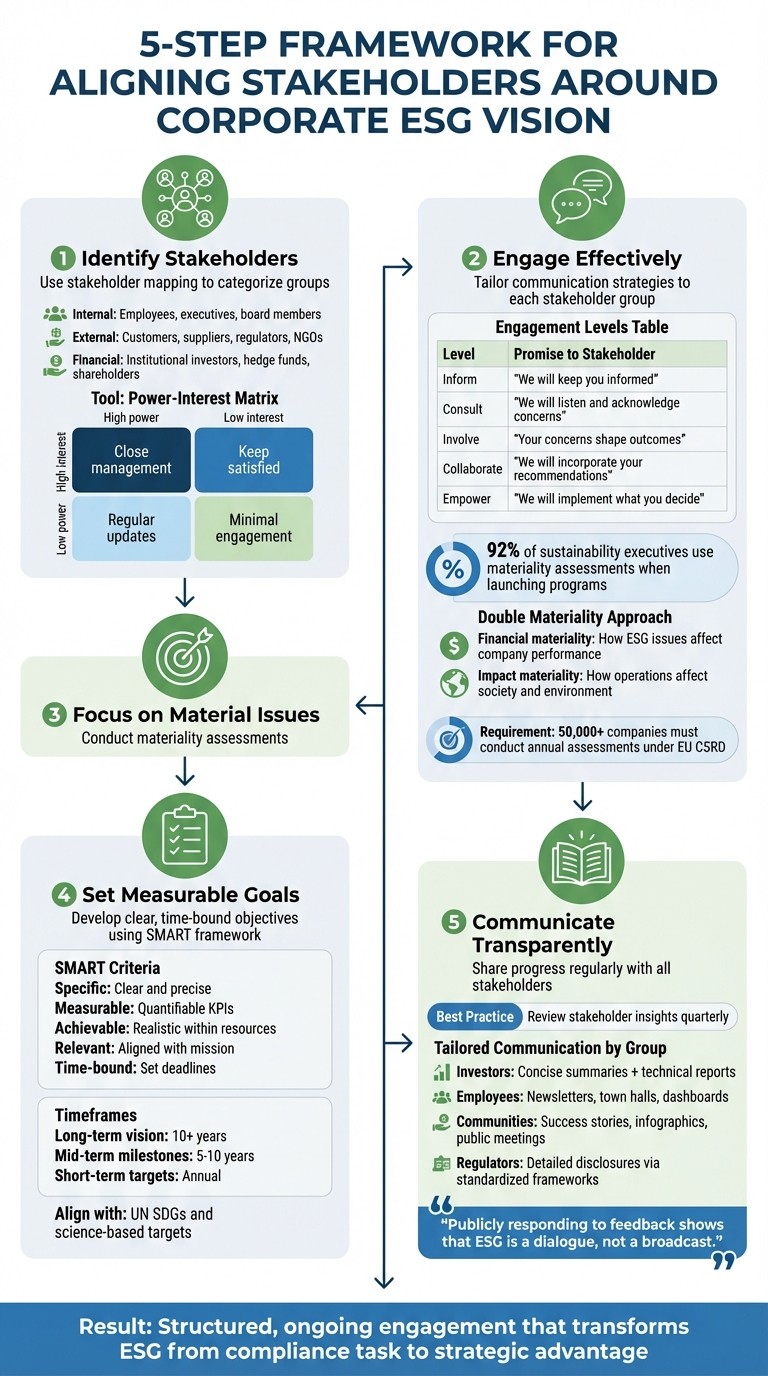
5-Step Framework for Aligning Stakeholders Around Corporate ESG Vision
ESG & Stakeholders: The Value Connection
Identifying and Analyzing Stakeholders
Before bringing stakeholders together around an ESG vision, it’s essential to know who they are and understand their influence. Stakeholder identification isn’t just about compiling a contact list - it’s about grasping the relationships and power dynamics that could impact your efforts. Without this understanding, you might overlook critical voices or engage the wrong groups, jeopardizing your initiatives.
Conduct Stakeholder Mapping
Stakeholder mapping provides a visual breakdown of everyone who has an impact on or is affected by your ESG efforts. Start by categorizing stakeholders into three main groups: internal (employees, executives, board members), external (customers, suppliers, regulators, NGOs), and financial (institutional investors, hedge funds, shareholders). Each group has unique priorities and timelines, which makes this distinction critical.
A Power-Interest Matrix can help you organize stakeholders effectively. Here's how it works:
High power/high interest: These stakeholders require close management.
High power/low interest: They need to be kept satisfied.
Low power/high interest: Regular updates are sufficient for this group.
Low power/low interest: Minimal engagement is needed.
For instance, institutional investors often fall into the high power/high interest category because of their long-term focus, while hedge funds may have significant power but less interest in sustainability metrics [1].
BSR’s Five-Step Analysis offers another method for evaluating stakeholders. It looks at their expertise, legitimacy for engagement, willingness to participate, influence, and the risks of excluding them [4]. As BSR notes:
"The process of stakeholder mapping is as important as the result, and the quality of the process depends heavily on the knowledge of the people participating." [4]
Don’t overlook silent stakeholders - those who may not be vocal but bring valuable expertise or influence. Tools that map stakeholders using "Expertise" and "Willingness" as axes, with circle sizes representing their value and arrows indicating influence, can be especially helpful [4].
These mapping techniques set the stage for turning stakeholder insights into a cohesive ESG strategy.
Prioritize Stakeholders for Effective Engagement
Not every stakeholder group needs the same level of attention. The key is distinguishing between "importance" and "influence." A group might be essential to your business but lack individual power - for example, small-scale farmers are vital to supply chains, but a large retail customer typically holds more sway in decision-making [1].
Tensie Whelan from NYU Stern Center for Sustainable Business highlights the need for a proactive approach:
"Stakeholders represent a risk to be managed far more proactively and authentically than in the past." [1]
Assign internal owners to manage each stakeholder group and document their preferred communication channels [3]. For B2B companies, segmenting clients based on their sustainability commitments can create competitive advantages [1].
Stakeholder maps should be updated quarterly or whenever significant changes occur. This ensures consistency in messaging and prevents internal silos where different departments might engage the same stakeholders with conflicting information [2].
Engagement Level | Goal | Promise to Stakeholder |
|---|---|---|
Inform | Share objective information to build understanding. | "We will keep you informed." |
Consult | Gather feedback on analysis or decisions. | "We will listen to and acknowledge your concerns." |
Involve | Collaborate throughout the process. | "We will ensure your concerns shape the outcomes." |
Collaborate | Partner in decision-making. | "We will seek your advice and incorporate your recommendations." |
Empower | Delegate final decision-making authority. | "We will implement what you decide." |
The level of engagement depends on stakeholder priority and the specifics of your ESG initiatives. While not every group needs final decision-making authority, high-priority stakeholders should be involved in ways that reflect their importance, such as through collaborative partnerships that influence your ESG vision.
With a well-organized map and a prioritized list, you’ll be ready to refine your ESG goals in alignment with your stakeholders.
Collaborating on ESG Priorities Through Materiality Assessments
After mapping and prioritizing your stakeholders, the next step is identifying which ESG issues deserve the most attention. A materiality assessment serves as a practical tool that connects sustainability efforts with business operations, pinpointing the overlap between stakeholder concerns and company activities.
Today's dual assessment approach (commonly referred to as double materiality) examines two key dimensions: how ESG issues influence your company's financial performance (financial materiality) and how your operations affect society and the environment [5][8][11]. This method ensures you're addressing not only risks to your business but also your broader responsibilities. The EU's Corporate Sustainability Reporting Directive (CSRD) now requires over 50,000 companies to conduct annual double materiality assessments, shifting this practice from a voluntary effort to a regulatory mandate [8]. Notably, 92% of sustainability executives report using materiality assessments when launching programs or revising strategies [10].
Gather Stakeholder Input on ESG Priorities
Building on your stakeholder mapping, refine your ESG priorities by seeking targeted feedback. Different groups often have distinct concerns, and a one-size-fits-all survey risks overlooking critical details. Instead, use targeted outreach methods such as smaller surveys, interviews, and workshops designed for specific stakeholder groups [8].
Start by analyzing your entire value chain - including upstream suppliers, internal operations, and downstream customers - to locate environmental or social "hotspots." Then, categorize your stakeholders into two groups: those directly affected by your business and those who rely on your ESG disclosures [8].
Customize your engagement strategies based on stakeholder preferences. Investors tend to prefer formal briefings and in-depth reports, while employees may respond better to town halls and regular updates [9]. Accessibility is key - if some stakeholders lack internet access, offer offline options and keep surveys brief [7].
Don’t neglect your broader workforce, especially younger employees. Alison Taylor, Clinical Professor at NYU Stern School of Business, cautions:
"If you do not consult your workers on priorities, you risk setting off conflict and opening yourself up to demands on dozens of issues." [12]
Junior staff often detect emerging ESG risks before senior leaders and can identify internal misalignments that might otherwise go unnoticed [12]. For silent stakeholders - like future generations or the environment - engage trusted proxies such as subject-matter experts or NGOs to represent their interests [8].
Use Materiality Results to Shape a Unified Vision
Once stakeholder input is collected, translate these insights into a strategic roadmap. Use a materiality matrix to map "Importance to Stakeholders" on one axis and "Significance of Impact on the Business" on the other [6]. Focus on the issues in the top-right quadrant, as these represent your most critical priorities [5][12].
Maintain focus by limiting your efforts to three high-impact areas. This approach helps conserve resources and ensures your initiatives remain effective [12]. Share the results with stakeholders, explaining how you determined your priorities and closing the feedback loop [7].
Cross-functional collaboration is vital. Include team members from Finance, HR, Marketing, and Operations to ensure the assessment reflects diverse perspectives within your organization [13]. This teamwork fosters alignment and helps your company act as a unified entity rather than a collection of disconnected departments [2].
Dr. Tim Siegenbeek van Heukelom, Chief Impact Officer at Socialsuite, highlights the importance of this process:
"A double materiality assessment (DMA) should be the first step in your sustainability journey... you can feed sustainability priorities directly into the corporate strategy." [8]
When executed effectively, materiality assessments transform stakeholder feedback into a clear ESG roadmap. This roadmap not only guides resource allocation but also strengthens governance and fosters a sense of shared purpose across your organization.
Creating and Communicating Shared ESG Goals
Once you've identified key challenges, the next step is turning these insights into actionable, measurable objectives. This process transforms your ESG vision into a set of clear, strategic goals. The difference between vague aspirations and well-defined targets often determines whether your ESG initiatives gain momentum or lose steam.
Develop SMART ESG Goals
Using the SMART framework - Specific (clear and precise), Measurable (quantifiable KPIs), Achievable (realistic within current resources), Relevant (aligned with your mission), and Time-bound (set deadlines) - can help structure your ESG objectives effectively [14]. It's important to align these goals across different timeframes for a balanced approach: a long-term vision (10+ years), mid-term milestones (5–10 years), and short-term annual targets. Tying these objectives to science-based targets ensures credibility and accountability [14].
Additionally, aligning your ESG goals with the UN Sustainable Development Goals (SDGs) can showcase your contribution to broader global priorities. Before finalizing these targets, consider polling stakeholders to ensure you're addressing the areas with the greatest potential impact [16]. This approach not only strengthens your framework but also builds trust and accountability through shared ownership.
Build Buy-In Through Transparent Communication
Securing stakeholder support requires honest and transparent communication. Avoid the pitfalls of greenwashing by openly discussing both your achievements and the obstacles you're working to overcome. Use established frameworks like GRI, SASB, or TCFD to back your claims with credible metrics and benchmarks. Clear visuals and plain language can make your updates more accessible and engaging [15].
Kathryn Doyle, Manager at BSR, emphasizes the importance of a thoughtful approach to stakeholder engagement:
"Meaningful stakeholder engagement is the result of deliberate effort and strategy. Too often, companies approach engagement on an ad hoc, reactive basis" [2].
To maintain this engagement, use existing communication channels to provide regular updates, incorporating feedback loops to refine your strategy. This reinforces the connections established during the earlier stakeholder mapping phase and ensures ongoing alignment with shared goals.
Building Continuous Engagement and Accountability
Once ESG goals are in place, the challenge shifts to keeping the momentum alive and ensuring accountability. Without regular updates and transparent communication, even the most ambitious ESG initiatives risk losing the trust and support of stakeholders.
Monitor Progress with Data-Driven Metrics
Tracking ESG performance requires more than occasional check-ins - it demands consistent, data-backed effort. Leading organizations review stakeholder insights on a quarterly basis, transitioning from reactive responses to proactive engagement [3][2]. This steady rhythm helps identify potential issues early, allowing for timely course corrections.
Breaking down departmental silos is a key step in accurate data collection. Forming cross-functional teams that include members from Legal, HR, Finance, and Operations ensures metrics are collected and reported cohesively [2]. This collaboration not only streamlines measurement but also creates a unified narrative for the organization.
Specialized sustainability software can be a game-changer here. By automating data collection, it’s possible to cut manual input by up to 75%, reducing both workload and errors [17]. To further reinforce accountability, maintain a shared commitment register. This tool logs stakeholder promises, assigns ownership, and sets deadlines, ensuring follow-through on key initiatives [3].
With reliable metrics in hand, the focus can shift to transparent communication of ESG outcomes.
Report ESG Outcomes Transparently
Collecting accurate data is only half the battle - communicating it effectively is just as important. Different stakeholders require tailored approaches. For example:
Investors often appreciate concise summaries paired with technical reports that focus on financial performance and risk.
Employees are more likely to engage with newsletters, town halls, or internal dashboards that highlight mission alignment and DEI efforts.
Communities respond well to success stories, infographics, and public meetings that showcase social and environmental impact.
Regulators need detailed disclosures presented through standardized frameworks [18].
Transparency is key. Publicly summarizing stakeholder input, detailing actions taken, and acknowledging areas needing improvement fosters trust and demonstrates a commitment to ongoing progress [3]. Sharing both achievements and challenges signals that the organization is serious about continuous improvement and accountability.
Conclusion: Driving Collaboration for Measurable Impact
Bringing stakeholders together around a unified ESG vision requires consistent effort and dedication at every step. By identifying and prioritizing key stakeholders, conducting materiality assessments, and establishing SMART goals, organizations create a strong foundation for effective collaboration. Transparent communication and accountability are essential to maintaining engagement and achieving tangible results.
To ensure responsibility is clear and issues are addressed efficiently, assign each stakeholder group an internal sponsor and provide a dedicated channel for recording and resolving concerns [3]. This framework reinforces the idea that ESG is a shared responsibility across the organization. As Drova highlights:
"Publicly responding to feedback shows that ESG is a dialogue, not a broadcast." [3]
This approach fosters structured, ongoing engagement. Building on initial stakeholder strategies, organizations should establish a regular rhythm for interactions. Top-performing teams revisit stakeholder insights at least quarterly or after significant organizational changes, creating an early warning system that identifies potential environmental or social challenges before they escalate [3]. This continuous exchange transforms ESG from a compliance task into a strategic advantage.
FAQs
How do we handle stakeholder conflicts on ESG priorities?
Resolving conflicts among stakeholders over ESG priorities hinges on transparency, inclusive engagement, and effective communication. Begin by pinpointing the key stakeholders involved and collecting a range of perspectives through tools like consultations or surveys. Carefully examine this feedback to identify common concerns and shape measurable objectives that align with established ESG frameworks. Building trust is essential - keep communication channels open, handle disagreements with a constructive approach, and provide regular updates on progress to reinforce alignment with shared goals and values.
What data is needed for a double materiality assessment?
To conduct a double materiality assessment, it's crucial to gather data on how a company's societal and environmental actions influence its financial outcomes. Equally important is incorporating feedback from stakeholders to uncover any impacts that might otherwise be missed. Together, these elements create a well-rounded view of external effects and their internal financial consequences.
How can we prevent greenwashing in ESG reporting?
To ensure ESG reporting maintains integrity and avoids greenwashing, prioritize transparency, accuracy, and stakeholder collaboration. Actively involve stakeholders by incorporating their input into measurable goals, such as cutting emissions or supporting local initiatives. Rely on trusted frameworks like the Global Reporting Initiative (GRI) or International Sustainability Standards Board (ISSB) to align your disclosures with recognized benchmarks. Share progress consistently through straightforward reports, and leverage reliable tools to showcase actual impact - steering clear of overstated or deceptive claims.
Related Blog Posts
Latest Articles
©2025



FAQ
01
What does it really mean to “redefine profit”?
02
What makes Council Fire different?
03
Who does Council Fire you work with?
04
What does working with Council Fire actually look like?
05
How does Council Fire help organizations turn big goals into action?
06
How does Council Fire define and measure success?
Mar 2, 2026
How to Align Stakeholders Around a Shared ESG Vision for Corporations
ESG Strategy
In This Article
Step-by-step guidance to map and prioritize stakeholders, run double materiality assessments, set SMART ESG goals, and report transparently to maintain buy-in.
How to Align Stakeholders Around a Shared ESG Vision for Corporations
Aligning stakeholders around a shared ESG vision is essential for corporations to achieve long-term success and create meaningful impact. This process involves understanding diverse priorities, conducting materiality assessments, and setting clear, measurable goals. Here’s a quick summary of how to make it work:
Identify Stakeholders: Use tools like stakeholder mapping to categorize and prioritize groups based on their power and interest.
Engage Effectively: Tailor communication and involvement strategies to each stakeholder group, ensuring their concerns are addressed.
Focus on Material Issues: Conduct materiality assessments to align ESG efforts with both business priorities and societal impact.
Set Measurable Goals: Develop clear, time-bound objectives using frameworks like SMART and align them with global benchmarks such as the UN SDGs.
Communicate Transparently: Share progress regularly, highlighting both achievements and challenges to build trust and accountability.
5-Step Framework for Aligning Stakeholders Around Corporate ESG Vision
ESG & Stakeholders: The Value Connection
Identifying and Analyzing Stakeholders
Before bringing stakeholders together around an ESG vision, it’s essential to know who they are and understand their influence. Stakeholder identification isn’t just about compiling a contact list - it’s about grasping the relationships and power dynamics that could impact your efforts. Without this understanding, you might overlook critical voices or engage the wrong groups, jeopardizing your initiatives.
Conduct Stakeholder Mapping
Stakeholder mapping provides a visual breakdown of everyone who has an impact on or is affected by your ESG efforts. Start by categorizing stakeholders into three main groups: internal (employees, executives, board members), external (customers, suppliers, regulators, NGOs), and financial (institutional investors, hedge funds, shareholders). Each group has unique priorities and timelines, which makes this distinction critical.
A Power-Interest Matrix can help you organize stakeholders effectively. Here's how it works:
High power/high interest: These stakeholders require close management.
High power/low interest: They need to be kept satisfied.
Low power/high interest: Regular updates are sufficient for this group.
Low power/low interest: Minimal engagement is needed.
For instance, institutional investors often fall into the high power/high interest category because of their long-term focus, while hedge funds may have significant power but less interest in sustainability metrics [1].
BSR’s Five-Step Analysis offers another method for evaluating stakeholders. It looks at their expertise, legitimacy for engagement, willingness to participate, influence, and the risks of excluding them [4]. As BSR notes:
"The process of stakeholder mapping is as important as the result, and the quality of the process depends heavily on the knowledge of the people participating." [4]
Don’t overlook silent stakeholders - those who may not be vocal but bring valuable expertise or influence. Tools that map stakeholders using "Expertise" and "Willingness" as axes, with circle sizes representing their value and arrows indicating influence, can be especially helpful [4].
These mapping techniques set the stage for turning stakeholder insights into a cohesive ESG strategy.
Prioritize Stakeholders for Effective Engagement
Not every stakeholder group needs the same level of attention. The key is distinguishing between "importance" and "influence." A group might be essential to your business but lack individual power - for example, small-scale farmers are vital to supply chains, but a large retail customer typically holds more sway in decision-making [1].
Tensie Whelan from NYU Stern Center for Sustainable Business highlights the need for a proactive approach:
"Stakeholders represent a risk to be managed far more proactively and authentically than in the past." [1]
Assign internal owners to manage each stakeholder group and document their preferred communication channels [3]. For B2B companies, segmenting clients based on their sustainability commitments can create competitive advantages [1].
Stakeholder maps should be updated quarterly or whenever significant changes occur. This ensures consistency in messaging and prevents internal silos where different departments might engage the same stakeholders with conflicting information [2].
Engagement Level | Goal | Promise to Stakeholder |
|---|---|---|
Inform | Share objective information to build understanding. | "We will keep you informed." |
Consult | Gather feedback on analysis or decisions. | "We will listen to and acknowledge your concerns." |
Involve | Collaborate throughout the process. | "We will ensure your concerns shape the outcomes." |
Collaborate | Partner in decision-making. | "We will seek your advice and incorporate your recommendations." |
Empower | Delegate final decision-making authority. | "We will implement what you decide." |
The level of engagement depends on stakeholder priority and the specifics of your ESG initiatives. While not every group needs final decision-making authority, high-priority stakeholders should be involved in ways that reflect their importance, such as through collaborative partnerships that influence your ESG vision.
With a well-organized map and a prioritized list, you’ll be ready to refine your ESG goals in alignment with your stakeholders.
Collaborating on ESG Priorities Through Materiality Assessments
After mapping and prioritizing your stakeholders, the next step is identifying which ESG issues deserve the most attention. A materiality assessment serves as a practical tool that connects sustainability efforts with business operations, pinpointing the overlap between stakeholder concerns and company activities.
Today's dual assessment approach (commonly referred to as double materiality) examines two key dimensions: how ESG issues influence your company's financial performance (financial materiality) and how your operations affect society and the environment [5][8][11]. This method ensures you're addressing not only risks to your business but also your broader responsibilities. The EU's Corporate Sustainability Reporting Directive (CSRD) now requires over 50,000 companies to conduct annual double materiality assessments, shifting this practice from a voluntary effort to a regulatory mandate [8]. Notably, 92% of sustainability executives report using materiality assessments when launching programs or revising strategies [10].
Gather Stakeholder Input on ESG Priorities
Building on your stakeholder mapping, refine your ESG priorities by seeking targeted feedback. Different groups often have distinct concerns, and a one-size-fits-all survey risks overlooking critical details. Instead, use targeted outreach methods such as smaller surveys, interviews, and workshops designed for specific stakeholder groups [8].
Start by analyzing your entire value chain - including upstream suppliers, internal operations, and downstream customers - to locate environmental or social "hotspots." Then, categorize your stakeholders into two groups: those directly affected by your business and those who rely on your ESG disclosures [8].
Customize your engagement strategies based on stakeholder preferences. Investors tend to prefer formal briefings and in-depth reports, while employees may respond better to town halls and regular updates [9]. Accessibility is key - if some stakeholders lack internet access, offer offline options and keep surveys brief [7].
Don’t neglect your broader workforce, especially younger employees. Alison Taylor, Clinical Professor at NYU Stern School of Business, cautions:
"If you do not consult your workers on priorities, you risk setting off conflict and opening yourself up to demands on dozens of issues." [12]
Junior staff often detect emerging ESG risks before senior leaders and can identify internal misalignments that might otherwise go unnoticed [12]. For silent stakeholders - like future generations or the environment - engage trusted proxies such as subject-matter experts or NGOs to represent their interests [8].
Use Materiality Results to Shape a Unified Vision
Once stakeholder input is collected, translate these insights into a strategic roadmap. Use a materiality matrix to map "Importance to Stakeholders" on one axis and "Significance of Impact on the Business" on the other [6]. Focus on the issues in the top-right quadrant, as these represent your most critical priorities [5][12].
Maintain focus by limiting your efforts to three high-impact areas. This approach helps conserve resources and ensures your initiatives remain effective [12]. Share the results with stakeholders, explaining how you determined your priorities and closing the feedback loop [7].
Cross-functional collaboration is vital. Include team members from Finance, HR, Marketing, and Operations to ensure the assessment reflects diverse perspectives within your organization [13]. This teamwork fosters alignment and helps your company act as a unified entity rather than a collection of disconnected departments [2].
Dr. Tim Siegenbeek van Heukelom, Chief Impact Officer at Socialsuite, highlights the importance of this process:
"A double materiality assessment (DMA) should be the first step in your sustainability journey... you can feed sustainability priorities directly into the corporate strategy." [8]
When executed effectively, materiality assessments transform stakeholder feedback into a clear ESG roadmap. This roadmap not only guides resource allocation but also strengthens governance and fosters a sense of shared purpose across your organization.
Creating and Communicating Shared ESG Goals
Once you've identified key challenges, the next step is turning these insights into actionable, measurable objectives. This process transforms your ESG vision into a set of clear, strategic goals. The difference between vague aspirations and well-defined targets often determines whether your ESG initiatives gain momentum or lose steam.
Develop SMART ESG Goals
Using the SMART framework - Specific (clear and precise), Measurable (quantifiable KPIs), Achievable (realistic within current resources), Relevant (aligned with your mission), and Time-bound (set deadlines) - can help structure your ESG objectives effectively [14]. It's important to align these goals across different timeframes for a balanced approach: a long-term vision (10+ years), mid-term milestones (5–10 years), and short-term annual targets. Tying these objectives to science-based targets ensures credibility and accountability [14].
Additionally, aligning your ESG goals with the UN Sustainable Development Goals (SDGs) can showcase your contribution to broader global priorities. Before finalizing these targets, consider polling stakeholders to ensure you're addressing the areas with the greatest potential impact [16]. This approach not only strengthens your framework but also builds trust and accountability through shared ownership.
Build Buy-In Through Transparent Communication
Securing stakeholder support requires honest and transparent communication. Avoid the pitfalls of greenwashing by openly discussing both your achievements and the obstacles you're working to overcome. Use established frameworks like GRI, SASB, or TCFD to back your claims with credible metrics and benchmarks. Clear visuals and plain language can make your updates more accessible and engaging [15].
Kathryn Doyle, Manager at BSR, emphasizes the importance of a thoughtful approach to stakeholder engagement:
"Meaningful stakeholder engagement is the result of deliberate effort and strategy. Too often, companies approach engagement on an ad hoc, reactive basis" [2].
To maintain this engagement, use existing communication channels to provide regular updates, incorporating feedback loops to refine your strategy. This reinforces the connections established during the earlier stakeholder mapping phase and ensures ongoing alignment with shared goals.
Building Continuous Engagement and Accountability
Once ESG goals are in place, the challenge shifts to keeping the momentum alive and ensuring accountability. Without regular updates and transparent communication, even the most ambitious ESG initiatives risk losing the trust and support of stakeholders.
Monitor Progress with Data-Driven Metrics
Tracking ESG performance requires more than occasional check-ins - it demands consistent, data-backed effort. Leading organizations review stakeholder insights on a quarterly basis, transitioning from reactive responses to proactive engagement [3][2]. This steady rhythm helps identify potential issues early, allowing for timely course corrections.
Breaking down departmental silos is a key step in accurate data collection. Forming cross-functional teams that include members from Legal, HR, Finance, and Operations ensures metrics are collected and reported cohesively [2]. This collaboration not only streamlines measurement but also creates a unified narrative for the organization.
Specialized sustainability software can be a game-changer here. By automating data collection, it’s possible to cut manual input by up to 75%, reducing both workload and errors [17]. To further reinforce accountability, maintain a shared commitment register. This tool logs stakeholder promises, assigns ownership, and sets deadlines, ensuring follow-through on key initiatives [3].
With reliable metrics in hand, the focus can shift to transparent communication of ESG outcomes.
Report ESG Outcomes Transparently
Collecting accurate data is only half the battle - communicating it effectively is just as important. Different stakeholders require tailored approaches. For example:
Investors often appreciate concise summaries paired with technical reports that focus on financial performance and risk.
Employees are more likely to engage with newsletters, town halls, or internal dashboards that highlight mission alignment and DEI efforts.
Communities respond well to success stories, infographics, and public meetings that showcase social and environmental impact.
Regulators need detailed disclosures presented through standardized frameworks [18].
Transparency is key. Publicly summarizing stakeholder input, detailing actions taken, and acknowledging areas needing improvement fosters trust and demonstrates a commitment to ongoing progress [3]. Sharing both achievements and challenges signals that the organization is serious about continuous improvement and accountability.
Conclusion: Driving Collaboration for Measurable Impact
Bringing stakeholders together around a unified ESG vision requires consistent effort and dedication at every step. By identifying and prioritizing key stakeholders, conducting materiality assessments, and establishing SMART goals, organizations create a strong foundation for effective collaboration. Transparent communication and accountability are essential to maintaining engagement and achieving tangible results.
To ensure responsibility is clear and issues are addressed efficiently, assign each stakeholder group an internal sponsor and provide a dedicated channel for recording and resolving concerns [3]. This framework reinforces the idea that ESG is a shared responsibility across the organization. As Drova highlights:
"Publicly responding to feedback shows that ESG is a dialogue, not a broadcast." [3]
This approach fosters structured, ongoing engagement. Building on initial stakeholder strategies, organizations should establish a regular rhythm for interactions. Top-performing teams revisit stakeholder insights at least quarterly or after significant organizational changes, creating an early warning system that identifies potential environmental or social challenges before they escalate [3]. This continuous exchange transforms ESG from a compliance task into a strategic advantage.
FAQs
How do we handle stakeholder conflicts on ESG priorities?
Resolving conflicts among stakeholders over ESG priorities hinges on transparency, inclusive engagement, and effective communication. Begin by pinpointing the key stakeholders involved and collecting a range of perspectives through tools like consultations or surveys. Carefully examine this feedback to identify common concerns and shape measurable objectives that align with established ESG frameworks. Building trust is essential - keep communication channels open, handle disagreements with a constructive approach, and provide regular updates on progress to reinforce alignment with shared goals and values.
What data is needed for a double materiality assessment?
To conduct a double materiality assessment, it's crucial to gather data on how a company's societal and environmental actions influence its financial outcomes. Equally important is incorporating feedback from stakeholders to uncover any impacts that might otherwise be missed. Together, these elements create a well-rounded view of external effects and their internal financial consequences.
How can we prevent greenwashing in ESG reporting?
To ensure ESG reporting maintains integrity and avoids greenwashing, prioritize transparency, accuracy, and stakeholder collaboration. Actively involve stakeholders by incorporating their input into measurable goals, such as cutting emissions or supporting local initiatives. Rely on trusted frameworks like the Global Reporting Initiative (GRI) or International Sustainability Standards Board (ISSB) to align your disclosures with recognized benchmarks. Share progress consistently through straightforward reports, and leverage reliable tools to showcase actual impact - steering clear of overstated or deceptive claims.
Related Blog Posts
FAQ
01
What does it really mean to “redefine profit”?
02
What makes Council Fire different?
03
Who does Council Fire you work with?
04
What does working with Council Fire actually look like?
05
How does Council Fire help organizations turn big goals into action?
06
How does Council Fire define and measure success?
Mar 2, 2026
How to Align Stakeholders Around a Shared ESG Vision for Corporations
ESG Strategy
In This Article
Step-by-step guidance to map and prioritize stakeholders, run double materiality assessments, set SMART ESG goals, and report transparently to maintain buy-in.
How to Align Stakeholders Around a Shared ESG Vision for Corporations
Aligning stakeholders around a shared ESG vision is essential for corporations to achieve long-term success and create meaningful impact. This process involves understanding diverse priorities, conducting materiality assessments, and setting clear, measurable goals. Here’s a quick summary of how to make it work:
Identify Stakeholders: Use tools like stakeholder mapping to categorize and prioritize groups based on their power and interest.
Engage Effectively: Tailor communication and involvement strategies to each stakeholder group, ensuring their concerns are addressed.
Focus on Material Issues: Conduct materiality assessments to align ESG efforts with both business priorities and societal impact.
Set Measurable Goals: Develop clear, time-bound objectives using frameworks like SMART and align them with global benchmarks such as the UN SDGs.
Communicate Transparently: Share progress regularly, highlighting both achievements and challenges to build trust and accountability.
5-Step Framework for Aligning Stakeholders Around Corporate ESG Vision
ESG & Stakeholders: The Value Connection
Identifying and Analyzing Stakeholders
Before bringing stakeholders together around an ESG vision, it’s essential to know who they are and understand their influence. Stakeholder identification isn’t just about compiling a contact list - it’s about grasping the relationships and power dynamics that could impact your efforts. Without this understanding, you might overlook critical voices or engage the wrong groups, jeopardizing your initiatives.
Conduct Stakeholder Mapping
Stakeholder mapping provides a visual breakdown of everyone who has an impact on or is affected by your ESG efforts. Start by categorizing stakeholders into three main groups: internal (employees, executives, board members), external (customers, suppliers, regulators, NGOs), and financial (institutional investors, hedge funds, shareholders). Each group has unique priorities and timelines, which makes this distinction critical.
A Power-Interest Matrix can help you organize stakeholders effectively. Here's how it works:
High power/high interest: These stakeholders require close management.
High power/low interest: They need to be kept satisfied.
Low power/high interest: Regular updates are sufficient for this group.
Low power/low interest: Minimal engagement is needed.
For instance, institutional investors often fall into the high power/high interest category because of their long-term focus, while hedge funds may have significant power but less interest in sustainability metrics [1].
BSR’s Five-Step Analysis offers another method for evaluating stakeholders. It looks at their expertise, legitimacy for engagement, willingness to participate, influence, and the risks of excluding them [4]. As BSR notes:
"The process of stakeholder mapping is as important as the result, and the quality of the process depends heavily on the knowledge of the people participating." [4]
Don’t overlook silent stakeholders - those who may not be vocal but bring valuable expertise or influence. Tools that map stakeholders using "Expertise" and "Willingness" as axes, with circle sizes representing their value and arrows indicating influence, can be especially helpful [4].
These mapping techniques set the stage for turning stakeholder insights into a cohesive ESG strategy.
Prioritize Stakeholders for Effective Engagement
Not every stakeholder group needs the same level of attention. The key is distinguishing between "importance" and "influence." A group might be essential to your business but lack individual power - for example, small-scale farmers are vital to supply chains, but a large retail customer typically holds more sway in decision-making [1].
Tensie Whelan from NYU Stern Center for Sustainable Business highlights the need for a proactive approach:
"Stakeholders represent a risk to be managed far more proactively and authentically than in the past." [1]
Assign internal owners to manage each stakeholder group and document their preferred communication channels [3]. For B2B companies, segmenting clients based on their sustainability commitments can create competitive advantages [1].
Stakeholder maps should be updated quarterly or whenever significant changes occur. This ensures consistency in messaging and prevents internal silos where different departments might engage the same stakeholders with conflicting information [2].
Engagement Level | Goal | Promise to Stakeholder |
|---|---|---|
Inform | Share objective information to build understanding. | "We will keep you informed." |
Consult | Gather feedback on analysis or decisions. | "We will listen to and acknowledge your concerns." |
Involve | Collaborate throughout the process. | "We will ensure your concerns shape the outcomes." |
Collaborate | Partner in decision-making. | "We will seek your advice and incorporate your recommendations." |
Empower | Delegate final decision-making authority. | "We will implement what you decide." |
The level of engagement depends on stakeholder priority and the specifics of your ESG initiatives. While not every group needs final decision-making authority, high-priority stakeholders should be involved in ways that reflect their importance, such as through collaborative partnerships that influence your ESG vision.
With a well-organized map and a prioritized list, you’ll be ready to refine your ESG goals in alignment with your stakeholders.
Collaborating on ESG Priorities Through Materiality Assessments
After mapping and prioritizing your stakeholders, the next step is identifying which ESG issues deserve the most attention. A materiality assessment serves as a practical tool that connects sustainability efforts with business operations, pinpointing the overlap between stakeholder concerns and company activities.
Today's dual assessment approach (commonly referred to as double materiality) examines two key dimensions: how ESG issues influence your company's financial performance (financial materiality) and how your operations affect society and the environment [5][8][11]. This method ensures you're addressing not only risks to your business but also your broader responsibilities. The EU's Corporate Sustainability Reporting Directive (CSRD) now requires over 50,000 companies to conduct annual double materiality assessments, shifting this practice from a voluntary effort to a regulatory mandate [8]. Notably, 92% of sustainability executives report using materiality assessments when launching programs or revising strategies [10].
Gather Stakeholder Input on ESG Priorities
Building on your stakeholder mapping, refine your ESG priorities by seeking targeted feedback. Different groups often have distinct concerns, and a one-size-fits-all survey risks overlooking critical details. Instead, use targeted outreach methods such as smaller surveys, interviews, and workshops designed for specific stakeholder groups [8].
Start by analyzing your entire value chain - including upstream suppliers, internal operations, and downstream customers - to locate environmental or social "hotspots." Then, categorize your stakeholders into two groups: those directly affected by your business and those who rely on your ESG disclosures [8].
Customize your engagement strategies based on stakeholder preferences. Investors tend to prefer formal briefings and in-depth reports, while employees may respond better to town halls and regular updates [9]. Accessibility is key - if some stakeholders lack internet access, offer offline options and keep surveys brief [7].
Don’t neglect your broader workforce, especially younger employees. Alison Taylor, Clinical Professor at NYU Stern School of Business, cautions:
"If you do not consult your workers on priorities, you risk setting off conflict and opening yourself up to demands on dozens of issues." [12]
Junior staff often detect emerging ESG risks before senior leaders and can identify internal misalignments that might otherwise go unnoticed [12]. For silent stakeholders - like future generations or the environment - engage trusted proxies such as subject-matter experts or NGOs to represent their interests [8].
Use Materiality Results to Shape a Unified Vision
Once stakeholder input is collected, translate these insights into a strategic roadmap. Use a materiality matrix to map "Importance to Stakeholders" on one axis and "Significance of Impact on the Business" on the other [6]. Focus on the issues in the top-right quadrant, as these represent your most critical priorities [5][12].
Maintain focus by limiting your efforts to three high-impact areas. This approach helps conserve resources and ensures your initiatives remain effective [12]. Share the results with stakeholders, explaining how you determined your priorities and closing the feedback loop [7].
Cross-functional collaboration is vital. Include team members from Finance, HR, Marketing, and Operations to ensure the assessment reflects diverse perspectives within your organization [13]. This teamwork fosters alignment and helps your company act as a unified entity rather than a collection of disconnected departments [2].
Dr. Tim Siegenbeek van Heukelom, Chief Impact Officer at Socialsuite, highlights the importance of this process:
"A double materiality assessment (DMA) should be the first step in your sustainability journey... you can feed sustainability priorities directly into the corporate strategy." [8]
When executed effectively, materiality assessments transform stakeholder feedback into a clear ESG roadmap. This roadmap not only guides resource allocation but also strengthens governance and fosters a sense of shared purpose across your organization.
Creating and Communicating Shared ESG Goals
Once you've identified key challenges, the next step is turning these insights into actionable, measurable objectives. This process transforms your ESG vision into a set of clear, strategic goals. The difference between vague aspirations and well-defined targets often determines whether your ESG initiatives gain momentum or lose steam.
Develop SMART ESG Goals
Using the SMART framework - Specific (clear and precise), Measurable (quantifiable KPIs), Achievable (realistic within current resources), Relevant (aligned with your mission), and Time-bound (set deadlines) - can help structure your ESG objectives effectively [14]. It's important to align these goals across different timeframes for a balanced approach: a long-term vision (10+ years), mid-term milestones (5–10 years), and short-term annual targets. Tying these objectives to science-based targets ensures credibility and accountability [14].
Additionally, aligning your ESG goals with the UN Sustainable Development Goals (SDGs) can showcase your contribution to broader global priorities. Before finalizing these targets, consider polling stakeholders to ensure you're addressing the areas with the greatest potential impact [16]. This approach not only strengthens your framework but also builds trust and accountability through shared ownership.
Build Buy-In Through Transparent Communication
Securing stakeholder support requires honest and transparent communication. Avoid the pitfalls of greenwashing by openly discussing both your achievements and the obstacles you're working to overcome. Use established frameworks like GRI, SASB, or TCFD to back your claims with credible metrics and benchmarks. Clear visuals and plain language can make your updates more accessible and engaging [15].
Kathryn Doyle, Manager at BSR, emphasizes the importance of a thoughtful approach to stakeholder engagement:
"Meaningful stakeholder engagement is the result of deliberate effort and strategy. Too often, companies approach engagement on an ad hoc, reactive basis" [2].
To maintain this engagement, use existing communication channels to provide regular updates, incorporating feedback loops to refine your strategy. This reinforces the connections established during the earlier stakeholder mapping phase and ensures ongoing alignment with shared goals.
Building Continuous Engagement and Accountability
Once ESG goals are in place, the challenge shifts to keeping the momentum alive and ensuring accountability. Without regular updates and transparent communication, even the most ambitious ESG initiatives risk losing the trust and support of stakeholders.
Monitor Progress with Data-Driven Metrics
Tracking ESG performance requires more than occasional check-ins - it demands consistent, data-backed effort. Leading organizations review stakeholder insights on a quarterly basis, transitioning from reactive responses to proactive engagement [3][2]. This steady rhythm helps identify potential issues early, allowing for timely course corrections.
Breaking down departmental silos is a key step in accurate data collection. Forming cross-functional teams that include members from Legal, HR, Finance, and Operations ensures metrics are collected and reported cohesively [2]. This collaboration not only streamlines measurement but also creates a unified narrative for the organization.
Specialized sustainability software can be a game-changer here. By automating data collection, it’s possible to cut manual input by up to 75%, reducing both workload and errors [17]. To further reinforce accountability, maintain a shared commitment register. This tool logs stakeholder promises, assigns ownership, and sets deadlines, ensuring follow-through on key initiatives [3].
With reliable metrics in hand, the focus can shift to transparent communication of ESG outcomes.
Report ESG Outcomes Transparently
Collecting accurate data is only half the battle - communicating it effectively is just as important. Different stakeholders require tailored approaches. For example:
Investors often appreciate concise summaries paired with technical reports that focus on financial performance and risk.
Employees are more likely to engage with newsletters, town halls, or internal dashboards that highlight mission alignment and DEI efforts.
Communities respond well to success stories, infographics, and public meetings that showcase social and environmental impact.
Regulators need detailed disclosures presented through standardized frameworks [18].
Transparency is key. Publicly summarizing stakeholder input, detailing actions taken, and acknowledging areas needing improvement fosters trust and demonstrates a commitment to ongoing progress [3]. Sharing both achievements and challenges signals that the organization is serious about continuous improvement and accountability.
Conclusion: Driving Collaboration for Measurable Impact
Bringing stakeholders together around a unified ESG vision requires consistent effort and dedication at every step. By identifying and prioritizing key stakeholders, conducting materiality assessments, and establishing SMART goals, organizations create a strong foundation for effective collaboration. Transparent communication and accountability are essential to maintaining engagement and achieving tangible results.
To ensure responsibility is clear and issues are addressed efficiently, assign each stakeholder group an internal sponsor and provide a dedicated channel for recording and resolving concerns [3]. This framework reinforces the idea that ESG is a shared responsibility across the organization. As Drova highlights:
"Publicly responding to feedback shows that ESG is a dialogue, not a broadcast." [3]
This approach fosters structured, ongoing engagement. Building on initial stakeholder strategies, organizations should establish a regular rhythm for interactions. Top-performing teams revisit stakeholder insights at least quarterly or after significant organizational changes, creating an early warning system that identifies potential environmental or social challenges before they escalate [3]. This continuous exchange transforms ESG from a compliance task into a strategic advantage.
FAQs
How do we handle stakeholder conflicts on ESG priorities?
Resolving conflicts among stakeholders over ESG priorities hinges on transparency, inclusive engagement, and effective communication. Begin by pinpointing the key stakeholders involved and collecting a range of perspectives through tools like consultations or surveys. Carefully examine this feedback to identify common concerns and shape measurable objectives that align with established ESG frameworks. Building trust is essential - keep communication channels open, handle disagreements with a constructive approach, and provide regular updates on progress to reinforce alignment with shared goals and values.
What data is needed for a double materiality assessment?
To conduct a double materiality assessment, it's crucial to gather data on how a company's societal and environmental actions influence its financial outcomes. Equally important is incorporating feedback from stakeholders to uncover any impacts that might otherwise be missed. Together, these elements create a well-rounded view of external effects and their internal financial consequences.
How can we prevent greenwashing in ESG reporting?
To ensure ESG reporting maintains integrity and avoids greenwashing, prioritize transparency, accuracy, and stakeholder collaboration. Actively involve stakeholders by incorporating their input into measurable goals, such as cutting emissions or supporting local initiatives. Rely on trusted frameworks like the Global Reporting Initiative (GRI) or International Sustainability Standards Board (ISSB) to align your disclosures with recognized benchmarks. Share progress consistently through straightforward reports, and leverage reliable tools to showcase actual impact - steering clear of overstated or deceptive claims.
Related Blog Posts
FAQ
What does it really mean to “redefine profit”?
What makes Council Fire different?
Who does Council Fire you work with?
What does working with Council Fire actually look like?
How does Council Fire help organizations turn big goals into action?
How does Council Fire define and measure success?