
Jun 3, 2026
How to Align Local Policy with State and Federal Climate Goals for Universities & Research Institutions
Sustainability Strategy
In This Article
Steps for universities to map state/federal climate mandates, close emissions gaps, set governance, secure funding, and report progress.
How to Align Local Policy with State and Federal Climate Goals for Universities & Research Institutions
Universities play a key role in addressing climate challenges by aligning their operations with state and federal climate goals. This alignment ensures compliance, secures funding, and maximizes the impact of sustainability initiatives. Here's a quick summary of how universities can achieve this:
Understand Policy Requirements: Map federal and state climate mandates, such as the Inflation Reduction Act (IRA) and state-specific Climate Action Plans (CAPs), to campus operations.
Conduct a Gap Analysis: Compare current campus emissions and practices against government benchmarks in areas like energy, buildings, transportation, and waste.
Implement Governance Structures: Use models like shared or polycentric governance to coordinate sustainability efforts across departments.
Embed Climate Goals: Integrate these goals into capital planning, procurement, and research policies, leveraging incentives like IRA direct pay provisions.
Sector-Specific Actions: Focus on decarbonizing energy systems, electrifying vehicle fleets, and improving waste management.
Secure Funding and Partnerships: Tap into federal and state grants, and collaborate with local governments and communities for joint initiatives.
Ensure Accountability: Use standardized tools like SIMAP for tracking emissions and publish transparent progress reports.
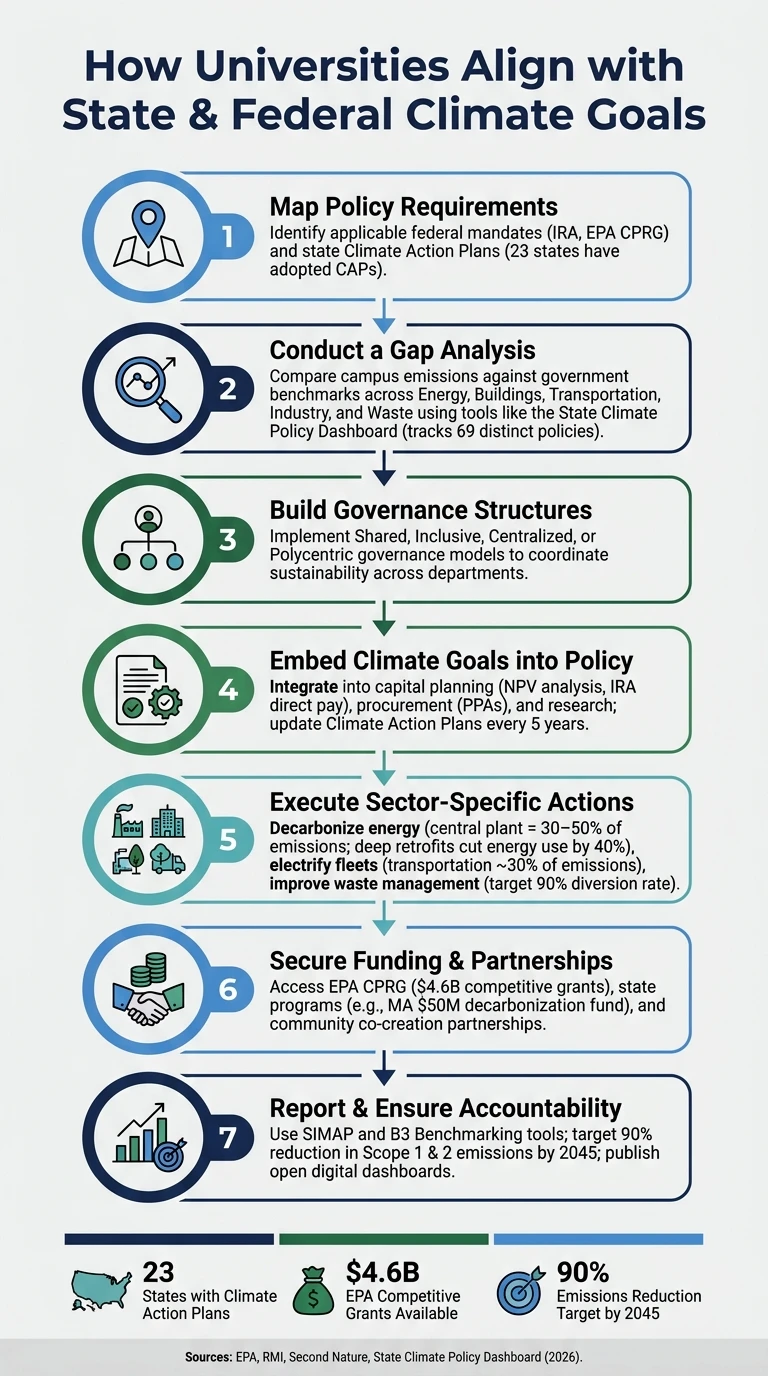
How Universities Align Campus Operations with State & Federal Climate Goals
Harvard Voices on Climate Change: Mapping the Future of Renewable Energy
Mapping Federal and State Climate Targets to Campus Operations
Universities need to go beyond a general understanding of climate policies to pinpoint the specific federal and state mandates that directly affect their operations. This requires a detailed look at applicable regulations and their requirements.
Key Federal and State Climate Goals Universities Should Track
On the federal level, institutions should focus on programs like the EPA's Climate Pollution Reduction Grants (CPRG). These grants introduced Priority Climate Action Plans (PCAPs), which include greenhouse gas (GHG) inventories and strategies for emission reduction, emphasizing benefits for low-income and disadvantaged communities (LIDACs). For universities aiming for federal funding or aligning with Justice40 mandates - where 40% of certain federal investments must benefit disadvantaged communities - these plans are especially relevant.
State-level goals bring more variation. As of March 2026, 23 states have adopted Climate Action Plans with specific GHG reduction targets and strategies [7]. Some states have more detailed requirements. For instance:
Maryland mandates that 26 state agencies create Climate Implementation Plans (CIPs) under its Climate Solutions Now Act, with annual reporting starting December 1, 2024 [7].
Colorado has its GHG Pollution Reduction Roadmap 2.0, targeting an 80% reduction in CO₂ emissions from the power sector by 2030 (compared to 2005 levels) [7][11].
Massachusetts has phased Clean Energy and Climate Plans for 2025, 2030, and 2050 [7].
Public universities in these states are often directly involved in meeting these targets, either through compliance or as models for implementation. To align with these mandates, campuses should conduct a structured gap analysis.
Conducting a Campus Climate Gap Analysis
A gap analysis involves comparing your campus's current performance against government benchmarks in sectors such as Electricity, Buildings, Transportation, Industry, and Waste Management [8]. Structuring the analysis around these categories ensures easier alignment with state and federal standards.
Begin by checking your state's current policy status. The State Climate Policy Dashboard (updated in March 2026) tracks 69 distinct climate policies, classifying them as Enacted, In-progress, Partially Enacted, or Not Enacted [5]. Here's how these categories impact campus planning:
Policy Status | Implications for Your Campus |
|---|---|
Enacted | Compliance is required immediately |
In-progress | Regulations are pending; preparation is needed |
Partially Enacted | Policies are incomplete; monitor for updates |
Not Enacted | No current mandate; opportunity to take the lead |
(Source: State Climate Policy Dashboard [5])
Next, compare your campus emissions data with the EPA's Quantified Climate Action Measures Directory, which lists over 270 state and 240 local measures from plans issued between 2018 and 2023 [8]. This resource provides detailed targets and methods, helping align campus strategies with government expectations.
Tools and Resources for Climate Policy Integration
Once mandates and gaps are identified, specialized tools can help integrate climate policies into campus operations. The EPA PCAP Directory offers data from 211 plans submitted by states, Metropolitan Statistical Areas (MSAs), tribes, and territories. It features a searchable database of over 2,600 specific GHG reduction actions [9][10]. For campuses in major metro areas, local PCAPs may impose stricter targets than state-level plans. For example, Pittsburgh, PA’s metro area PCAP outlines a decarbonized energy strategy aiming to reduce 307,500 MTCO2e between 2025 and 2030 [10].
The RMI State PCAP Assessment Spreadsheet is another valuable tool, summarizing 650 measures from 47 state plans by sector and projected GHG impact. These plans cover about 90% of the U.S. population and emissions [12]. According to RMI:
"This treasure trove of information - now organized and streamlined - provides an invaluable snapshot of state climate planning today and can be used to inform future planning and action." [12]
Finally, the State Comparison Tool within the State Climate Policy Dashboard allows campuses to benchmark their state’s policies against leaders like Colorado, Maryland, or Massachusetts [6][7]. This helps anticipate policy trends and gives campuses a chance to prepare for future regulations ahead of time.
Building Governance Structures for Climate Policy Alignment
Once you've pinpointed policy gaps, the next step is aligning your internal governance to effectively implement solutions. Mapping your campus's climate challenges against state and federal targets is a critical first step, but without clear governance structures, even the most well-crafted climate action plans can falter.
Internal Governance Models for Climate Coordination
Selecting the right governance model is key to ensuring your campus can respond effectively to climate challenges. Below is a summary of the primary governance models used by universities:
Governance Model | Key Characteristic | Primary Benefit |
|---|---|---|
Shared Governance | Cross-functional teams with diffused authority | Leverages expertise from various departments [13] |
Inclusive Governance | Removes barriers to participation | Boosts employee engagement and belonging [13] |
Centralized Office | Dedicated sustainability staff or Chief Sustainability Officer | |
Polycentric Model | Multiple decision-making centers across campus units | Promotes resilience and localized responsiveness [4] |
Research highlights the benefits of combining these approaches. Dragana Djukic-Min, a researcher at the University of Texas at Dallas, emphasizes:
"Shared governance and inclusive governance positively predict the commitment of HEIs to reducing greenhouse gas emissions, and campus engagement mediates these relationships." [13]
For large research institutions, a polycentric model is particularly effective. It allows departments like facilities management, procurement, and academic research to independently pursue climate objectives while maintaining alignment with an overarching strategy.
To make these governance models actionable, integrate them into policies that shape campus sustainability efforts.
How to Embed Climate Goals into Campus Policies
For governance structures to succeed, climate goals must be embedded into policies governing daily operations, including capital planning, procurement, and research.
On the capital planning front, universities increasingly rely on Net Present Value (NPV) analysis to justify long-term investments. This approach highlights the financial benefits of sustainability projects over time. Additionally, leveraging Inflation Reduction Act (IRA) direct pay provisions, which are available to tax-exempt entities, can make large-scale electrification projects financially feasible [1].
For procurement, tools like Power Purchase Agreements (PPAs) enable campuses to secure renewable energy without requiring significant upfront investment. These agreements provide a practical way to transition to cleaner energy sources while managing costs.
Climate Action Plans (CAPs) should be dynamic, evolving documents. Best practices suggest revisiting and updating CAPs every five years. This ensures alignment with campus master planning cycles and any changes in state or federal regulations [14]. Without regular updates, CAPs risk becoming outdated and disconnected from the institution's operational and regulatory environment.
Accountability and Stakeholder Engagement
Strong governance and embedded policies must be paired with clear accountability and active stakeholder engagement to solidify climate commitments. Assigning dedicated leadership, such as a Chief Sustainability Officer, can provide the necessary oversight and formalize the institution's climate goals [3][2].
Transparency is equally critical. Publishing progress data on open digital dashboards fosters trust among students, faculty, and the public. It also prevents institutional efforts from losing momentum. To sustain long-term support, especially for initiatives that may involve fee increases or operational disruptions, consider forming student advisory committees. These committees can help maintain engagement and provide a platform for student voices.
Finally, turning campus operations into a "sustainability lab" can simultaneously advance institutional expertise and support research goals. By integrating sustainability into the core mission, campuses can lead by example while fostering innovation.
Sector-Specific Action Plans for Climate Policy Alignment
Once governance frameworks and accountability systems are in place, the next step is turning climate commitments into actionable plans. This means creating strategies tailored to specific sectors, ensuring campus operations align with state and federal climate goals.
Energy and Buildings
For many universities, the central plant is responsible for 30–50% of total emissions, making it a prime target for decarbonization efforts. Deep building retrofits alone can reduce energy use by an average of 40% per building [1]. When paired with plant electrification, the impact becomes even greater. A notable example is a major research university that, by February 2026, completed the first phase of transitioning to an 800-well ground-source heat pump system serving 22 buildings. This initiative cut central plant emissions by 35% while saving $2.8 million annually in operating costs. The university also installed a 15 MW solar array on parking structures and secured a 50 MW off-site wind Power Purchase Agreement (PPA) at $32/MWh, effectively eliminating Scope 2 emissions [1].
As highlighted in a Council Fire case study:
"The central plant is the whole ballgame. For most universities, the central heating system is 30-50% of total emissions." [1]
Collaboration with local utilities is essential, as full campus electrification can add 40 MW or more of peak demand. Without early coordination, grid capacity issues could delay projects. States like Washington have addressed this challenge through regulations like Normative Annex W, which requires 15-year decarbonization plans for campus energy systems and limits fossil fuel use to 10% of annual output [1][15].
The table below outlines strategies and the financial incentives available under the Inflation Reduction Act (IRA):
Technology/Strategy | Impact | Financial Incentive |
|---|---|---|
Ground-Source Heat Pumps | 35% reduction in plant emissions | IRA Direct Pay (ITC) |
Deep Building Retrofits | 40% energy reduction per building | Section 179D Deductions |
Off-site Wind PPA | Eliminates Scope 2 emissions | Fixed rates below grid price |
On-site Solar (15 MW) | 22,000 MWh annual generation | IRA Direct Pay (PTC/ITC) |
Internal Carbon Fee | $1.2M annual green revolving fund | N/A (Self-funded) |
Once energy systems are addressed, focusing on transportation can further reduce emissions and meet compliance goals.
Transportation and Fleet Management
After energy, transportation is another area with significant potential for emissions reduction. This category, which includes fleet vehicles, commuting, and air travel, often accounts for around 30% of a university’s greenhouse gas emissions [1].
To cut emissions, universities can implement programs like subsidized transit passes, e-bike lending libraries, and remote work policies. These efforts can reduce single-occupancy vehicle (SOV) trips by up to 28%, freeing up funds for fleet electrification. Fleet electrification itself benefits from IRA direct pay provisions, which help offset the costs of charging infrastructure [1].
Another effective strategy is introducing an internal carbon fee on sponsored air travel. For instance, one research university set a fee of $25 per metric ton of CO2e, generating $1.2 million annually. The funds were funneled into a green revolving fund, which supported local climate projects, creating a self-sustaining financial loop [1]. Additionally, state compliance often requires tracking and reporting commute-trip reduction data as part of broader climate reporting efforts.
Land Use, Waste, and Circular Economy Initiatives
To align with climate policies comprehensively, universities must also address waste and land use. These areas, increasingly regulated by state mandates, present clear opportunities for improvement. The University at Buffalo (UB), for instance, has committed to achieving a 90% waste diversion rate by 2030 [16]. In September 2024, UB finalized a strategic plan to overhaul waste infrastructure across 200 buildings, implementing a standardized "Recycling/Organics/Trash" (R/O/T) collection system. By Fall 2025, the university aims to roll out an organics collection program in all on-campus apartments [16].
UB has also embraced circularity through initiatives like UBReUSE, an annual move-out collection and resale program, and the Student Sustainability Impact Team (SSIT) Green Event Kits, which provide reusable dishware to eliminate single-use plastics at events [16]. For institutions in states with food waste legislation, such as New York's Food Recycling and Donation Law, compliance with food rescue and donation procedures is a legal requirement, not just a best practice [16].
Funding, Partnerships, and Reporting for Climate-Aligned Projects
Once actionable sector plans are in place, the next steps involve securing funding and building strong partnerships to bring these projects to life.
How to Find and Secure State and Federal Funding
Universities have access to a wide range of state and federal funding opportunities for climate-related initiatives. For instance, the EPA's CPRG program offers nearly $5 billion for greenhouse gas reduction projects, including $4.6 billion in competitive implementation grants [19]. To help institutions navigate these opportunities, the EPA provides a "Federal Funding Resource Opportunities Table", which organizes available grants by sector, making it easier to align funding with campus priorities.
State-level funding can also play a vital role. In December 2023, Massachusetts launched a $50 million decarbonization program for its 29 public higher education campuses. Managed by the Division of Capital Asset Management and Maintenance (DCAMM), the program allocated $26.5 million to the UMass system, $11.6 million to state universities, and $11.9 million to community colleges. These funds supported projects such as heat pump installations, EV charging stations, and building envelope repairs [18].
"These funds support campuses' sustainability efforts, resulting in lasting benefits for these public institutions, students and our Commonwealth." - Noe Ortega, Commissioner of Higher Education [18]
When applying for grants, universities typically submit a Letter of Intent followed by a detailed proposal through their Sponsored Projects or Contracts & Grants office. Large matching grants, like those offered through the UC Climate Action Research Initiative (ranging from $2M to $10M), often require at least a 10% match from external sources, such as federal grants or private foundations [17]. Reviewing your state's Priority Climate Action Plan (PCAP) before applying can also strengthen proposals, as alignment with state greenhouse gas reduction strategies is a common scoring criterion [19][20].
Once funding is secured, the focus shifts to forming strategic partnerships.
Building Partnerships with Government and Community Organizations
Effective climate projects thrive on collaboration. Engaging community partners early in the process, rather than seeking feedback on finalized plans, often determines whether initiatives succeed or stall.
The partnership between Agnes Scott College and the City of Decatur, Georgia, is a standout example. Beginning in 2021, Sustainability Director Kimberly Reeves and Decatur Assistant City Manager Cara Scharer co-developed a Joint Climate Resilience Plan. Students contributed by installing 36 heat sensors and flood monitors along Sugar Creek, generating environmental data that the city could act upon. By April 2026, this collaboration had secured five new grants and completed or initiated 75% of its planned projects [21].
"The beautiful thing about Agnes Scott's plan is that from the beginning they brought in their community partners to co-create the solutions. Too often, higher education thinks they know what's best for the community." - Timothy Carter, President, Second Nature [21]
Successful partnerships require intentional structuring. Moving beyond basic communication to genuine co-creation - such as giving community partners co-PI roles on grants or formalizing relationships through MOUs - leads to more impactful and accountable outcomes [21].
While partnerships are crucial, maintaining rigorous reporting standards is equally important for sustaining these projects.
Aligning Campus Reporting with State and Federal Requirements
Reporting often presents challenges for universities. Inconsistent data, missed deadlines, and fragmented systems can jeopardize compliance and future funding opportunities. Standardized and timely data entry is key to avoiding these pitfalls.
Minnesota State provides a strong model with its Procedure 5.17.1, which was introduced in July 2022. This system requires all 30+ colleges and universities to input utility billing data into the B3 Benchmarking tool monthly. Additionally, annual reports detailing Metric Tons of CO2 Equivalent (MTCO2e) are due by March 31 each year. Targets are closely tied to statewide goals, such as reducing energy use per square foot by 30% by 2027 (compared to 2017 levels) and cutting carbon emissions by 80% by 2050 (compared to 2009 levels) [22]. The practice of monthly data entry ensures that the system remains manageable and avoids last-minute scrambles.
Beyond state-level tools, platforms like the Sustainability Indicator Management & Analysis Platform (SIMAP) are becoming the standard for greenhouse gas calculations in higher education. SIMAP now includes fields for qualitative context alongside quantitative data, allowing institutions to explain their strategies rather than just report numbers [2]. Second Nature's updated guidelines also emphasize decarbonization as the primary goal, urging institutions to aim for a 90% reduction in Scopes 1 and 2 emissions by 2045, shifting away from reliance on offsets [2]. Consistent and thorough reporting not only ensures compliance but also builds a foundation for continued investment.
Reporting Category | Standard Metric | Example Target |
|---|---|---|
Carbon Emissions | MTCO2e (via B3 / SIMAP) | 80% below 2009 levels by 2050 (MN State) |
Energy Efficiency | EUI (kBtu/sq. ft.) | 30% below 2017 levels by 2027 (MN State) |
Solid Waste | Metric tons / Diversion Rate | 75% diversion rate by 2030 (MN State) |
Managing Risks in Climate Policy Alignment
With governance and accountability firmly in place, addressing policy risks becomes a crucial element in maintaining climate objectives. While funding and partnerships play a critical role, regulatory and political uncertainties can disrupt even the most well-designed plans. Effective risk management ensures that efforts to align with climate policies remain steady and capable of supporting long-term goals.
How to Monitor Regulatory and Political Risks
One of the biggest challenges to maintaining climate alignment isn't a lack of ambition - it's regulatory uncertainty. Shifts in federal policy can dramatically alter the regulatory landscape. A notable example is the ongoing debate surrounding the EPA's 2009 Endangerment Finding, which serves as the legal backbone for federal greenhouse gas regulation. Theo Daniels of Second Nature emphasized the stakes:
"If finalized, this decision [rescinding the Endangerment Finding] would represent one of the most consequential federal climate rollbacks in decades, with immediate implications for the policy environment that higher education institutions operate within and plan around." [23]
When federal oversight diminishes, state-level policies often diverge, making systemwide planning even more complex [23][24]. To navigate these challenges, universities and institutions should closely monitor legislative developments through organizations like the National Caucus of Environmental Legislators (NCEL) and Second Nature, which track both state-level policy changes and federal rollbacks in real time [23][24]. Establishing a dedicated climate policy evaluation committee can help institutions stay proactive, identifying changes that might impact compliance or funding.
Scenario Planning and Adaptive Management
Risk mitigation requires a dynamic approach. Climate plans must evolve to remain effective amidst political and regulatory shifts. The most resilient institutions treat their plans as living documents that adapt to new information and circumstances. Second Nature underscores this point:
"The plans are to be aspirational statements of intent rather than binding commitments. It is expected that signatories will adjust their plans over time in response to new information and changing circumstances." [14]
In practical terms, this means creating multiple pathways to achieve climate goals. At a minimum, institutions should map out both a conservative timeline and an accelerated one, complete with detailed projections for costs, emissions, and operational impacts at each stage [1]. For instance, modeling a phased move to a ground-source heat pump district system alongside deep building retrofits can outline a realistic path to achieving an 85% emissions reduction without over-relying on offsets [1]. Regularly updating Climate Action Plans - ideally every five years - ensures they remain relevant and defensible.
Overcoming Organizational and Financial Constraints
Internal challenges, such as outdated infrastructure, can make transitioning away from fossil fuels both expensive and disruptive. This is a frequent hurdle at older research campuses [25]. Additionally, bureaucratic processes can slow procurement, delay approvals, and fragment accountability across departments.
The University of California system provides a compelling example of how to address these challenges. After revising its goal to "fully decarbonize" from 2025 to 2045, the UC system consolidated its efforts under the Global Climate Leadership Council. This centralized body oversees energy efficiency upgrades and renewable energy projects across all campuses, streamlining decision-making and reducing fragmentation [25].
On the financial side, diversifying funding sources can help institutions stay resilient. Combining federal grants, state programs, green bonds, and partnerships with local communities reduces reliance on any single funding stream, minimizing risks if one source becomes unavailable [25][26]. Adopting standardized frameworks like the GHG Protocol or ISO 14064-1 can also enhance transparency in carbon accounting, making it more robust against regulatory changes [25].
Conclusion: Key Takeaways for Aligning University Climate Policies
Aligning campus climate policies requires ongoing commitment, strong governance, precise metrics, and flexible strategies. Universities that lead in this area often start early, establish clear accountability systems, and treat their Climate Action Plans as evolving tools rather than static documents.
Key principles to consider:
Limit reliance on carbon offsets to no more than 10% of total reductions, aligning with regulatory and stakeholder expectations [1].
Set science-based decarbonization goals, such as achieving a 90% reduction in Scopes 1 and 2 emissions by 2045, to stay ahead of tightening regulations [2].
Ensure transparency by publishing regular progress reports and using internal dashboards to track metrics.
The sequence of actions matters. As highlighted:
"Starting with efficiency measures that generate immediate savings creates a revenue stream that funds larger capital projects. This sequencing also builds confidence as early wins prove feasibility." [1]
Early successes create financial and organizational momentum, paving the way for long-term decarbonization efforts. Universities ready to take action can benefit from Council Fire's expertise. By offering services like carbon footprint analysis, stakeholder engagement, decarbonization planning, and reporting alignment, Council Fire supports campuses in building lasting climate resilience through strategic and measurable approaches.
FAQs
Where do we start if we don’t know which state and federal climate rules apply to our campus?
To get started, take a look at the Environmental Protection Agency’s Quantified Climate Action Measures Directory, which organizes state and local efforts to reduce greenhouse gas emissions. Next, dive into your state’s specific energy policies, such as Renewable Portfolio Standards or Clean Energy Standards, as these regulations differ depending on your location. Lastly, collaborate with licensed engineers or architects to verify technical specifications and ensure your campus aligns with both regulatory requirements and broader climate objectives.
What’s the fastest way to run a campus climate gap analysis and prioritize projects?
To efficiently perform a campus climate gap analysis, begin by conducting a comprehensive emissions inventory guided by the Greenhouse Gas Protocol. Use the ENERGY STAR Portfolio Manager to evaluate building energy performance and pinpoint areas of inefficiency. Collect qualitative insights by organizing stakeholder workshops or distributing surveys. When prioritizing projects, apply a 3x3 matrix to evaluate risks and identify quick-win efficiency measures. These smaller, cost-saving efforts can help generate funds for more ambitious initiatives.
How can a university fund electrification and retrofits without raising tuition or fees?
Universities have various pathways to fund electrification and retrofitting projects by tapping into federal incentives, state programs, and performance-based financing. The Inflation Reduction Act provides a significant opportunity for tax-exempt institutions through its direct pay provisions, offering cash payments that cover 6% to 30% of costs for renewable energy and EV charging investments. Beyond this, schools can explore options like Energy Savings Performance Contracts (ESPCs), state-issued green bonds, revolving loan funds, and public-private partnerships. These strategies help minimize upfront expenses while delivering long-term financial benefits.
Related Blog Posts
How to Build a Climate Resilience Plan for Universities & Research Institutions
How to Integrate Climate Risk into Infrastructure Planning for Universities & Research Institutions
How to Co-Design Climate-Ready Communities with Residents for Universities & Research Institutions
How to Align Local Policy with State and Federal Climate Goals for Corporations
Latest Articles
©2026

Narrative Change and Power Building: The Missing Half of Advocacy
Narrative change is the process of disrupting dominant narratives that normalize inequity and advancing new narratives from historically marginalized communities.

Funding Resilience Without Federal Grants
BRIC is unreliable and FEMA is shrinking. Here's how cities fund climate resilience with dedicated revenue, blended finance, and a coordinating authority.

The ESG Blind Spot: How AI Is Finding Risks in Companies Nobody Else Is Watching
Norway's sovereign wealth fund uses AI to screen 7,200 portfolio companies for forced labor and corruption within 24 hours. The real story is the emerging-market coverage gap that traditional ESG data vendors miss — and what it means for any company with a global supply chain.
Narrative Change and Power Building: The Missing Half of Advocacy
Narrative change is the process of disrupting dominant narratives that normalize inequity and advancing new narratives from historically marginalized communities.
Funding Resilience Without Federal Grants
BRIC is unreliable and FEMA is shrinking. Here's how cities fund climate resilience with dedicated revenue, blended finance, and a coordinating authority.
The ESG Blind Spot: How AI Is Finding Risks in Companies Nobody Else Is Watching
Norway's sovereign wealth fund uses AI to screen 7,200 portfolio companies for forced labor and corruption within 24 hours. The real story is the emerging-market coverage gap that traditional ESG data vendors miss — and what it means for any company with a global supply chain.
FAQ
01
What does it really mean to “redefine profit”?
02
What makes Council Fire different?
03
Who does Council Fire work with?
04
What does working with Council Fire actually look like?
05
How does Council Fire help organizations turn big goals into action?
06
How does Council Fire define and measure success?
07
How does technology fit into Council Fire’s work?
Jun 3, 2026
How to Align Local Policy with State and Federal Climate Goals for Universities & Research Institutions
Sustainability Strategy
In This Article
Steps for universities to map state/federal climate mandates, close emissions gaps, set governance, secure funding, and report progress.
How to Align Local Policy with State and Federal Climate Goals for Universities & Research Institutions
Universities play a key role in addressing climate challenges by aligning their operations with state and federal climate goals. This alignment ensures compliance, secures funding, and maximizes the impact of sustainability initiatives. Here's a quick summary of how universities can achieve this:
Understand Policy Requirements: Map federal and state climate mandates, such as the Inflation Reduction Act (IRA) and state-specific Climate Action Plans (CAPs), to campus operations.
Conduct a Gap Analysis: Compare current campus emissions and practices against government benchmarks in areas like energy, buildings, transportation, and waste.
Implement Governance Structures: Use models like shared or polycentric governance to coordinate sustainability efforts across departments.
Embed Climate Goals: Integrate these goals into capital planning, procurement, and research policies, leveraging incentives like IRA direct pay provisions.
Sector-Specific Actions: Focus on decarbonizing energy systems, electrifying vehicle fleets, and improving waste management.
Secure Funding and Partnerships: Tap into federal and state grants, and collaborate with local governments and communities for joint initiatives.
Ensure Accountability: Use standardized tools like SIMAP for tracking emissions and publish transparent progress reports.
How Universities Align Campus Operations with State & Federal Climate Goals
Harvard Voices on Climate Change: Mapping the Future of Renewable Energy
Mapping Federal and State Climate Targets to Campus Operations
Universities need to go beyond a general understanding of climate policies to pinpoint the specific federal and state mandates that directly affect their operations. This requires a detailed look at applicable regulations and their requirements.
Key Federal and State Climate Goals Universities Should Track
On the federal level, institutions should focus on programs like the EPA's Climate Pollution Reduction Grants (CPRG). These grants introduced Priority Climate Action Plans (PCAPs), which include greenhouse gas (GHG) inventories and strategies for emission reduction, emphasizing benefits for low-income and disadvantaged communities (LIDACs). For universities aiming for federal funding or aligning with Justice40 mandates - where 40% of certain federal investments must benefit disadvantaged communities - these plans are especially relevant.
State-level goals bring more variation. As of March 2026, 23 states have adopted Climate Action Plans with specific GHG reduction targets and strategies [7]. Some states have more detailed requirements. For instance:
Maryland mandates that 26 state agencies create Climate Implementation Plans (CIPs) under its Climate Solutions Now Act, with annual reporting starting December 1, 2024 [7].
Colorado has its GHG Pollution Reduction Roadmap 2.0, targeting an 80% reduction in CO₂ emissions from the power sector by 2030 (compared to 2005 levels) [7][11].
Massachusetts has phased Clean Energy and Climate Plans for 2025, 2030, and 2050 [7].
Public universities in these states are often directly involved in meeting these targets, either through compliance or as models for implementation. To align with these mandates, campuses should conduct a structured gap analysis.
Conducting a Campus Climate Gap Analysis
A gap analysis involves comparing your campus's current performance against government benchmarks in sectors such as Electricity, Buildings, Transportation, Industry, and Waste Management [8]. Structuring the analysis around these categories ensures easier alignment with state and federal standards.
Begin by checking your state's current policy status. The State Climate Policy Dashboard (updated in March 2026) tracks 69 distinct climate policies, classifying them as Enacted, In-progress, Partially Enacted, or Not Enacted [5]. Here's how these categories impact campus planning:
Policy Status | Implications for Your Campus |
|---|---|
Enacted | Compliance is required immediately |
In-progress | Regulations are pending; preparation is needed |
Partially Enacted | Policies are incomplete; monitor for updates |
Not Enacted | No current mandate; opportunity to take the lead |
(Source: State Climate Policy Dashboard [5])
Next, compare your campus emissions data with the EPA's Quantified Climate Action Measures Directory, which lists over 270 state and 240 local measures from plans issued between 2018 and 2023 [8]. This resource provides detailed targets and methods, helping align campus strategies with government expectations.
Tools and Resources for Climate Policy Integration
Once mandates and gaps are identified, specialized tools can help integrate climate policies into campus operations. The EPA PCAP Directory offers data from 211 plans submitted by states, Metropolitan Statistical Areas (MSAs), tribes, and territories. It features a searchable database of over 2,600 specific GHG reduction actions [9][10]. For campuses in major metro areas, local PCAPs may impose stricter targets than state-level plans. For example, Pittsburgh, PA’s metro area PCAP outlines a decarbonized energy strategy aiming to reduce 307,500 MTCO2e between 2025 and 2030 [10].
The RMI State PCAP Assessment Spreadsheet is another valuable tool, summarizing 650 measures from 47 state plans by sector and projected GHG impact. These plans cover about 90% of the U.S. population and emissions [12]. According to RMI:
"This treasure trove of information - now organized and streamlined - provides an invaluable snapshot of state climate planning today and can be used to inform future planning and action." [12]
Finally, the State Comparison Tool within the State Climate Policy Dashboard allows campuses to benchmark their state’s policies against leaders like Colorado, Maryland, or Massachusetts [6][7]. This helps anticipate policy trends and gives campuses a chance to prepare for future regulations ahead of time.
Building Governance Structures for Climate Policy Alignment
Once you've pinpointed policy gaps, the next step is aligning your internal governance to effectively implement solutions. Mapping your campus's climate challenges against state and federal targets is a critical first step, but without clear governance structures, even the most well-crafted climate action plans can falter.
Internal Governance Models for Climate Coordination
Selecting the right governance model is key to ensuring your campus can respond effectively to climate challenges. Below is a summary of the primary governance models used by universities:
Governance Model | Key Characteristic | Primary Benefit |
|---|---|---|
Shared Governance | Cross-functional teams with diffused authority | Leverages expertise from various departments [13] |
Inclusive Governance | Removes barriers to participation | Boosts employee engagement and belonging [13] |
Centralized Office | Dedicated sustainability staff or Chief Sustainability Officer | |
Polycentric Model | Multiple decision-making centers across campus units | Promotes resilience and localized responsiveness [4] |
Research highlights the benefits of combining these approaches. Dragana Djukic-Min, a researcher at the University of Texas at Dallas, emphasizes:
"Shared governance and inclusive governance positively predict the commitment of HEIs to reducing greenhouse gas emissions, and campus engagement mediates these relationships." [13]
For large research institutions, a polycentric model is particularly effective. It allows departments like facilities management, procurement, and academic research to independently pursue climate objectives while maintaining alignment with an overarching strategy.
To make these governance models actionable, integrate them into policies that shape campus sustainability efforts.
How to Embed Climate Goals into Campus Policies
For governance structures to succeed, climate goals must be embedded into policies governing daily operations, including capital planning, procurement, and research.
On the capital planning front, universities increasingly rely on Net Present Value (NPV) analysis to justify long-term investments. This approach highlights the financial benefits of sustainability projects over time. Additionally, leveraging Inflation Reduction Act (IRA) direct pay provisions, which are available to tax-exempt entities, can make large-scale electrification projects financially feasible [1].
For procurement, tools like Power Purchase Agreements (PPAs) enable campuses to secure renewable energy without requiring significant upfront investment. These agreements provide a practical way to transition to cleaner energy sources while managing costs.
Climate Action Plans (CAPs) should be dynamic, evolving documents. Best practices suggest revisiting and updating CAPs every five years. This ensures alignment with campus master planning cycles and any changes in state or federal regulations [14]. Without regular updates, CAPs risk becoming outdated and disconnected from the institution's operational and regulatory environment.
Accountability and Stakeholder Engagement
Strong governance and embedded policies must be paired with clear accountability and active stakeholder engagement to solidify climate commitments. Assigning dedicated leadership, such as a Chief Sustainability Officer, can provide the necessary oversight and formalize the institution's climate goals [3][2].
Transparency is equally critical. Publishing progress data on open digital dashboards fosters trust among students, faculty, and the public. It also prevents institutional efforts from losing momentum. To sustain long-term support, especially for initiatives that may involve fee increases or operational disruptions, consider forming student advisory committees. These committees can help maintain engagement and provide a platform for student voices.
Finally, turning campus operations into a "sustainability lab" can simultaneously advance institutional expertise and support research goals. By integrating sustainability into the core mission, campuses can lead by example while fostering innovation.
Sector-Specific Action Plans for Climate Policy Alignment
Once governance frameworks and accountability systems are in place, the next step is turning climate commitments into actionable plans. This means creating strategies tailored to specific sectors, ensuring campus operations align with state and federal climate goals.
Energy and Buildings
For many universities, the central plant is responsible for 30–50% of total emissions, making it a prime target for decarbonization efforts. Deep building retrofits alone can reduce energy use by an average of 40% per building [1]. When paired with plant electrification, the impact becomes even greater. A notable example is a major research university that, by February 2026, completed the first phase of transitioning to an 800-well ground-source heat pump system serving 22 buildings. This initiative cut central plant emissions by 35% while saving $2.8 million annually in operating costs. The university also installed a 15 MW solar array on parking structures and secured a 50 MW off-site wind Power Purchase Agreement (PPA) at $32/MWh, effectively eliminating Scope 2 emissions [1].
As highlighted in a Council Fire case study:
"The central plant is the whole ballgame. For most universities, the central heating system is 30-50% of total emissions." [1]
Collaboration with local utilities is essential, as full campus electrification can add 40 MW or more of peak demand. Without early coordination, grid capacity issues could delay projects. States like Washington have addressed this challenge through regulations like Normative Annex W, which requires 15-year decarbonization plans for campus energy systems and limits fossil fuel use to 10% of annual output [1][15].
The table below outlines strategies and the financial incentives available under the Inflation Reduction Act (IRA):
Technology/Strategy | Impact | Financial Incentive |
|---|---|---|
Ground-Source Heat Pumps | 35% reduction in plant emissions | IRA Direct Pay (ITC) |
Deep Building Retrofits | 40% energy reduction per building | Section 179D Deductions |
Off-site Wind PPA | Eliminates Scope 2 emissions | Fixed rates below grid price |
On-site Solar (15 MW) | 22,000 MWh annual generation | IRA Direct Pay (PTC/ITC) |
Internal Carbon Fee | $1.2M annual green revolving fund | N/A (Self-funded) |
Once energy systems are addressed, focusing on transportation can further reduce emissions and meet compliance goals.
Transportation and Fleet Management
After energy, transportation is another area with significant potential for emissions reduction. This category, which includes fleet vehicles, commuting, and air travel, often accounts for around 30% of a university’s greenhouse gas emissions [1].
To cut emissions, universities can implement programs like subsidized transit passes, e-bike lending libraries, and remote work policies. These efforts can reduce single-occupancy vehicle (SOV) trips by up to 28%, freeing up funds for fleet electrification. Fleet electrification itself benefits from IRA direct pay provisions, which help offset the costs of charging infrastructure [1].
Another effective strategy is introducing an internal carbon fee on sponsored air travel. For instance, one research university set a fee of $25 per metric ton of CO2e, generating $1.2 million annually. The funds were funneled into a green revolving fund, which supported local climate projects, creating a self-sustaining financial loop [1]. Additionally, state compliance often requires tracking and reporting commute-trip reduction data as part of broader climate reporting efforts.
Land Use, Waste, and Circular Economy Initiatives
To align with climate policies comprehensively, universities must also address waste and land use. These areas, increasingly regulated by state mandates, present clear opportunities for improvement. The University at Buffalo (UB), for instance, has committed to achieving a 90% waste diversion rate by 2030 [16]. In September 2024, UB finalized a strategic plan to overhaul waste infrastructure across 200 buildings, implementing a standardized "Recycling/Organics/Trash" (R/O/T) collection system. By Fall 2025, the university aims to roll out an organics collection program in all on-campus apartments [16].
UB has also embraced circularity through initiatives like UBReUSE, an annual move-out collection and resale program, and the Student Sustainability Impact Team (SSIT) Green Event Kits, which provide reusable dishware to eliminate single-use plastics at events [16]. For institutions in states with food waste legislation, such as New York's Food Recycling and Donation Law, compliance with food rescue and donation procedures is a legal requirement, not just a best practice [16].
Funding, Partnerships, and Reporting for Climate-Aligned Projects
Once actionable sector plans are in place, the next steps involve securing funding and building strong partnerships to bring these projects to life.
How to Find and Secure State and Federal Funding
Universities have access to a wide range of state and federal funding opportunities for climate-related initiatives. For instance, the EPA's CPRG program offers nearly $5 billion for greenhouse gas reduction projects, including $4.6 billion in competitive implementation grants [19]. To help institutions navigate these opportunities, the EPA provides a "Federal Funding Resource Opportunities Table", which organizes available grants by sector, making it easier to align funding with campus priorities.
State-level funding can also play a vital role. In December 2023, Massachusetts launched a $50 million decarbonization program for its 29 public higher education campuses. Managed by the Division of Capital Asset Management and Maintenance (DCAMM), the program allocated $26.5 million to the UMass system, $11.6 million to state universities, and $11.9 million to community colleges. These funds supported projects such as heat pump installations, EV charging stations, and building envelope repairs [18].
"These funds support campuses' sustainability efforts, resulting in lasting benefits for these public institutions, students and our Commonwealth." - Noe Ortega, Commissioner of Higher Education [18]
When applying for grants, universities typically submit a Letter of Intent followed by a detailed proposal through their Sponsored Projects or Contracts & Grants office. Large matching grants, like those offered through the UC Climate Action Research Initiative (ranging from $2M to $10M), often require at least a 10% match from external sources, such as federal grants or private foundations [17]. Reviewing your state's Priority Climate Action Plan (PCAP) before applying can also strengthen proposals, as alignment with state greenhouse gas reduction strategies is a common scoring criterion [19][20].
Once funding is secured, the focus shifts to forming strategic partnerships.
Building Partnerships with Government and Community Organizations
Effective climate projects thrive on collaboration. Engaging community partners early in the process, rather than seeking feedback on finalized plans, often determines whether initiatives succeed or stall.
The partnership between Agnes Scott College and the City of Decatur, Georgia, is a standout example. Beginning in 2021, Sustainability Director Kimberly Reeves and Decatur Assistant City Manager Cara Scharer co-developed a Joint Climate Resilience Plan. Students contributed by installing 36 heat sensors and flood monitors along Sugar Creek, generating environmental data that the city could act upon. By April 2026, this collaboration had secured five new grants and completed or initiated 75% of its planned projects [21].
"The beautiful thing about Agnes Scott's plan is that from the beginning they brought in their community partners to co-create the solutions. Too often, higher education thinks they know what's best for the community." - Timothy Carter, President, Second Nature [21]
Successful partnerships require intentional structuring. Moving beyond basic communication to genuine co-creation - such as giving community partners co-PI roles on grants or formalizing relationships through MOUs - leads to more impactful and accountable outcomes [21].
While partnerships are crucial, maintaining rigorous reporting standards is equally important for sustaining these projects.
Aligning Campus Reporting with State and Federal Requirements
Reporting often presents challenges for universities. Inconsistent data, missed deadlines, and fragmented systems can jeopardize compliance and future funding opportunities. Standardized and timely data entry is key to avoiding these pitfalls.
Minnesota State provides a strong model with its Procedure 5.17.1, which was introduced in July 2022. This system requires all 30+ colleges and universities to input utility billing data into the B3 Benchmarking tool monthly. Additionally, annual reports detailing Metric Tons of CO2 Equivalent (MTCO2e) are due by March 31 each year. Targets are closely tied to statewide goals, such as reducing energy use per square foot by 30% by 2027 (compared to 2017 levels) and cutting carbon emissions by 80% by 2050 (compared to 2009 levels) [22]. The practice of monthly data entry ensures that the system remains manageable and avoids last-minute scrambles.
Beyond state-level tools, platforms like the Sustainability Indicator Management & Analysis Platform (SIMAP) are becoming the standard for greenhouse gas calculations in higher education. SIMAP now includes fields for qualitative context alongside quantitative data, allowing institutions to explain their strategies rather than just report numbers [2]. Second Nature's updated guidelines also emphasize decarbonization as the primary goal, urging institutions to aim for a 90% reduction in Scopes 1 and 2 emissions by 2045, shifting away from reliance on offsets [2]. Consistent and thorough reporting not only ensures compliance but also builds a foundation for continued investment.
Reporting Category | Standard Metric | Example Target |
|---|---|---|
Carbon Emissions | MTCO2e (via B3 / SIMAP) | 80% below 2009 levels by 2050 (MN State) |
Energy Efficiency | EUI (kBtu/sq. ft.) | 30% below 2017 levels by 2027 (MN State) |
Solid Waste | Metric tons / Diversion Rate | 75% diversion rate by 2030 (MN State) |
Managing Risks in Climate Policy Alignment
With governance and accountability firmly in place, addressing policy risks becomes a crucial element in maintaining climate objectives. While funding and partnerships play a critical role, regulatory and political uncertainties can disrupt even the most well-designed plans. Effective risk management ensures that efforts to align with climate policies remain steady and capable of supporting long-term goals.
How to Monitor Regulatory and Political Risks
One of the biggest challenges to maintaining climate alignment isn't a lack of ambition - it's regulatory uncertainty. Shifts in federal policy can dramatically alter the regulatory landscape. A notable example is the ongoing debate surrounding the EPA's 2009 Endangerment Finding, which serves as the legal backbone for federal greenhouse gas regulation. Theo Daniels of Second Nature emphasized the stakes:
"If finalized, this decision [rescinding the Endangerment Finding] would represent one of the most consequential federal climate rollbacks in decades, with immediate implications for the policy environment that higher education institutions operate within and plan around." [23]
When federal oversight diminishes, state-level policies often diverge, making systemwide planning even more complex [23][24]. To navigate these challenges, universities and institutions should closely monitor legislative developments through organizations like the National Caucus of Environmental Legislators (NCEL) and Second Nature, which track both state-level policy changes and federal rollbacks in real time [23][24]. Establishing a dedicated climate policy evaluation committee can help institutions stay proactive, identifying changes that might impact compliance or funding.
Scenario Planning and Adaptive Management
Risk mitigation requires a dynamic approach. Climate plans must evolve to remain effective amidst political and regulatory shifts. The most resilient institutions treat their plans as living documents that adapt to new information and circumstances. Second Nature underscores this point:
"The plans are to be aspirational statements of intent rather than binding commitments. It is expected that signatories will adjust their plans over time in response to new information and changing circumstances." [14]
In practical terms, this means creating multiple pathways to achieve climate goals. At a minimum, institutions should map out both a conservative timeline and an accelerated one, complete with detailed projections for costs, emissions, and operational impacts at each stage [1]. For instance, modeling a phased move to a ground-source heat pump district system alongside deep building retrofits can outline a realistic path to achieving an 85% emissions reduction without over-relying on offsets [1]. Regularly updating Climate Action Plans - ideally every five years - ensures they remain relevant and defensible.
Overcoming Organizational and Financial Constraints
Internal challenges, such as outdated infrastructure, can make transitioning away from fossil fuels both expensive and disruptive. This is a frequent hurdle at older research campuses [25]. Additionally, bureaucratic processes can slow procurement, delay approvals, and fragment accountability across departments.
The University of California system provides a compelling example of how to address these challenges. After revising its goal to "fully decarbonize" from 2025 to 2045, the UC system consolidated its efforts under the Global Climate Leadership Council. This centralized body oversees energy efficiency upgrades and renewable energy projects across all campuses, streamlining decision-making and reducing fragmentation [25].
On the financial side, diversifying funding sources can help institutions stay resilient. Combining federal grants, state programs, green bonds, and partnerships with local communities reduces reliance on any single funding stream, minimizing risks if one source becomes unavailable [25][26]. Adopting standardized frameworks like the GHG Protocol or ISO 14064-1 can also enhance transparency in carbon accounting, making it more robust against regulatory changes [25].
Conclusion: Key Takeaways for Aligning University Climate Policies
Aligning campus climate policies requires ongoing commitment, strong governance, precise metrics, and flexible strategies. Universities that lead in this area often start early, establish clear accountability systems, and treat their Climate Action Plans as evolving tools rather than static documents.
Key principles to consider:
Limit reliance on carbon offsets to no more than 10% of total reductions, aligning with regulatory and stakeholder expectations [1].
Set science-based decarbonization goals, such as achieving a 90% reduction in Scopes 1 and 2 emissions by 2045, to stay ahead of tightening regulations [2].
Ensure transparency by publishing regular progress reports and using internal dashboards to track metrics.
The sequence of actions matters. As highlighted:
"Starting with efficiency measures that generate immediate savings creates a revenue stream that funds larger capital projects. This sequencing also builds confidence as early wins prove feasibility." [1]
Early successes create financial and organizational momentum, paving the way for long-term decarbonization efforts. Universities ready to take action can benefit from Council Fire's expertise. By offering services like carbon footprint analysis, stakeholder engagement, decarbonization planning, and reporting alignment, Council Fire supports campuses in building lasting climate resilience through strategic and measurable approaches.
FAQs
Where do we start if we don’t know which state and federal climate rules apply to our campus?
To get started, take a look at the Environmental Protection Agency’s Quantified Climate Action Measures Directory, which organizes state and local efforts to reduce greenhouse gas emissions. Next, dive into your state’s specific energy policies, such as Renewable Portfolio Standards or Clean Energy Standards, as these regulations differ depending on your location. Lastly, collaborate with licensed engineers or architects to verify technical specifications and ensure your campus aligns with both regulatory requirements and broader climate objectives.
What’s the fastest way to run a campus climate gap analysis and prioritize projects?
To efficiently perform a campus climate gap analysis, begin by conducting a comprehensive emissions inventory guided by the Greenhouse Gas Protocol. Use the ENERGY STAR Portfolio Manager to evaluate building energy performance and pinpoint areas of inefficiency. Collect qualitative insights by organizing stakeholder workshops or distributing surveys. When prioritizing projects, apply a 3x3 matrix to evaluate risks and identify quick-win efficiency measures. These smaller, cost-saving efforts can help generate funds for more ambitious initiatives.
How can a university fund electrification and retrofits without raising tuition or fees?
Universities have various pathways to fund electrification and retrofitting projects by tapping into federal incentives, state programs, and performance-based financing. The Inflation Reduction Act provides a significant opportunity for tax-exempt institutions through its direct pay provisions, offering cash payments that cover 6% to 30% of costs for renewable energy and EV charging investments. Beyond this, schools can explore options like Energy Savings Performance Contracts (ESPCs), state-issued green bonds, revolving loan funds, and public-private partnerships. These strategies help minimize upfront expenses while delivering long-term financial benefits.
Related Blog Posts
How to Build a Climate Resilience Plan for Universities & Research Institutions
How to Integrate Climate Risk into Infrastructure Planning for Universities & Research Institutions
How to Co-Design Climate-Ready Communities with Residents for Universities & Research Institutions
How to Align Local Policy with State and Federal Climate Goals for Corporations
Latest Articles
©2026
Narrative Change and Power Building: The Missing Half of Advocacy
Narrative change is the process of disrupting dominant narratives that normalize inequity and advancing new narratives from historically marginalized communities.
Funding Resilience Without Federal Grants
BRIC is unreliable and FEMA is shrinking. Here's how cities fund climate resilience with dedicated revenue, blended finance, and a coordinating authority.
The ESG Blind Spot: How AI Is Finding Risks in Companies Nobody Else Is Watching
Norway's sovereign wealth fund uses AI to screen 7,200 portfolio companies for forced labor and corruption within 24 hours. The real story is the emerging-market coverage gap that traditional ESG data vendors miss — and what it means for any company with a global supply chain.
FAQ
01
What does it really mean to “redefine profit”?
02
What makes Council Fire different?
03
Who does Council Fire work with?
04
What does working with Council Fire actually look like?
05
How does Council Fire help organizations turn big goals into action?
06
How does Council Fire define and measure success?
07
How does technology fit into Council Fire’s work?
Jun 3, 2026
How to Align Local Policy with State and Federal Climate Goals for Universities & Research Institutions
Sustainability Strategy
In This Article
Steps for universities to map state/federal climate mandates, close emissions gaps, set governance, secure funding, and report progress.
How to Align Local Policy with State and Federal Climate Goals for Universities & Research Institutions
Universities play a key role in addressing climate challenges by aligning their operations with state and federal climate goals. This alignment ensures compliance, secures funding, and maximizes the impact of sustainability initiatives. Here's a quick summary of how universities can achieve this:
Understand Policy Requirements: Map federal and state climate mandates, such as the Inflation Reduction Act (IRA) and state-specific Climate Action Plans (CAPs), to campus operations.
Conduct a Gap Analysis: Compare current campus emissions and practices against government benchmarks in areas like energy, buildings, transportation, and waste.
Implement Governance Structures: Use models like shared or polycentric governance to coordinate sustainability efforts across departments.
Embed Climate Goals: Integrate these goals into capital planning, procurement, and research policies, leveraging incentives like IRA direct pay provisions.
Sector-Specific Actions: Focus on decarbonizing energy systems, electrifying vehicle fleets, and improving waste management.
Secure Funding and Partnerships: Tap into federal and state grants, and collaborate with local governments and communities for joint initiatives.
Ensure Accountability: Use standardized tools like SIMAP for tracking emissions and publish transparent progress reports.
How Universities Align Campus Operations with State & Federal Climate Goals
Harvard Voices on Climate Change: Mapping the Future of Renewable Energy
Mapping Federal and State Climate Targets to Campus Operations
Universities need to go beyond a general understanding of climate policies to pinpoint the specific federal and state mandates that directly affect their operations. This requires a detailed look at applicable regulations and their requirements.
Key Federal and State Climate Goals Universities Should Track
On the federal level, institutions should focus on programs like the EPA's Climate Pollution Reduction Grants (CPRG). These grants introduced Priority Climate Action Plans (PCAPs), which include greenhouse gas (GHG) inventories and strategies for emission reduction, emphasizing benefits for low-income and disadvantaged communities (LIDACs). For universities aiming for federal funding or aligning with Justice40 mandates - where 40% of certain federal investments must benefit disadvantaged communities - these plans are especially relevant.
State-level goals bring more variation. As of March 2026, 23 states have adopted Climate Action Plans with specific GHG reduction targets and strategies [7]. Some states have more detailed requirements. For instance:
Maryland mandates that 26 state agencies create Climate Implementation Plans (CIPs) under its Climate Solutions Now Act, with annual reporting starting December 1, 2024 [7].
Colorado has its GHG Pollution Reduction Roadmap 2.0, targeting an 80% reduction in CO₂ emissions from the power sector by 2030 (compared to 2005 levels) [7][11].
Massachusetts has phased Clean Energy and Climate Plans for 2025, 2030, and 2050 [7].
Public universities in these states are often directly involved in meeting these targets, either through compliance or as models for implementation. To align with these mandates, campuses should conduct a structured gap analysis.
Conducting a Campus Climate Gap Analysis
A gap analysis involves comparing your campus's current performance against government benchmarks in sectors such as Electricity, Buildings, Transportation, Industry, and Waste Management [8]. Structuring the analysis around these categories ensures easier alignment with state and federal standards.
Begin by checking your state's current policy status. The State Climate Policy Dashboard (updated in March 2026) tracks 69 distinct climate policies, classifying them as Enacted, In-progress, Partially Enacted, or Not Enacted [5]. Here's how these categories impact campus planning:
Policy Status | Implications for Your Campus |
|---|---|
Enacted | Compliance is required immediately |
In-progress | Regulations are pending; preparation is needed |
Partially Enacted | Policies are incomplete; monitor for updates |
Not Enacted | No current mandate; opportunity to take the lead |
(Source: State Climate Policy Dashboard [5])
Next, compare your campus emissions data with the EPA's Quantified Climate Action Measures Directory, which lists over 270 state and 240 local measures from plans issued between 2018 and 2023 [8]. This resource provides detailed targets and methods, helping align campus strategies with government expectations.
Tools and Resources for Climate Policy Integration
Once mandates and gaps are identified, specialized tools can help integrate climate policies into campus operations. The EPA PCAP Directory offers data from 211 plans submitted by states, Metropolitan Statistical Areas (MSAs), tribes, and territories. It features a searchable database of over 2,600 specific GHG reduction actions [9][10]. For campuses in major metro areas, local PCAPs may impose stricter targets than state-level plans. For example, Pittsburgh, PA’s metro area PCAP outlines a decarbonized energy strategy aiming to reduce 307,500 MTCO2e between 2025 and 2030 [10].
The RMI State PCAP Assessment Spreadsheet is another valuable tool, summarizing 650 measures from 47 state plans by sector and projected GHG impact. These plans cover about 90% of the U.S. population and emissions [12]. According to RMI:
"This treasure trove of information - now organized and streamlined - provides an invaluable snapshot of state climate planning today and can be used to inform future planning and action." [12]
Finally, the State Comparison Tool within the State Climate Policy Dashboard allows campuses to benchmark their state’s policies against leaders like Colorado, Maryland, or Massachusetts [6][7]. This helps anticipate policy trends and gives campuses a chance to prepare for future regulations ahead of time.
Building Governance Structures for Climate Policy Alignment
Once you've pinpointed policy gaps, the next step is aligning your internal governance to effectively implement solutions. Mapping your campus's climate challenges against state and federal targets is a critical first step, but without clear governance structures, even the most well-crafted climate action plans can falter.
Internal Governance Models for Climate Coordination
Selecting the right governance model is key to ensuring your campus can respond effectively to climate challenges. Below is a summary of the primary governance models used by universities:
Governance Model | Key Characteristic | Primary Benefit |
|---|---|---|
Shared Governance | Cross-functional teams with diffused authority | Leverages expertise from various departments [13] |
Inclusive Governance | Removes barriers to participation | Boosts employee engagement and belonging [13] |
Centralized Office | Dedicated sustainability staff or Chief Sustainability Officer | |
Polycentric Model | Multiple decision-making centers across campus units | Promotes resilience and localized responsiveness [4] |
Research highlights the benefits of combining these approaches. Dragana Djukic-Min, a researcher at the University of Texas at Dallas, emphasizes:
"Shared governance and inclusive governance positively predict the commitment of HEIs to reducing greenhouse gas emissions, and campus engagement mediates these relationships." [13]
For large research institutions, a polycentric model is particularly effective. It allows departments like facilities management, procurement, and academic research to independently pursue climate objectives while maintaining alignment with an overarching strategy.
To make these governance models actionable, integrate them into policies that shape campus sustainability efforts.
How to Embed Climate Goals into Campus Policies
For governance structures to succeed, climate goals must be embedded into policies governing daily operations, including capital planning, procurement, and research.
On the capital planning front, universities increasingly rely on Net Present Value (NPV) analysis to justify long-term investments. This approach highlights the financial benefits of sustainability projects over time. Additionally, leveraging Inflation Reduction Act (IRA) direct pay provisions, which are available to tax-exempt entities, can make large-scale electrification projects financially feasible [1].
For procurement, tools like Power Purchase Agreements (PPAs) enable campuses to secure renewable energy without requiring significant upfront investment. These agreements provide a practical way to transition to cleaner energy sources while managing costs.
Climate Action Plans (CAPs) should be dynamic, evolving documents. Best practices suggest revisiting and updating CAPs every five years. This ensures alignment with campus master planning cycles and any changes in state or federal regulations [14]. Without regular updates, CAPs risk becoming outdated and disconnected from the institution's operational and regulatory environment.
Accountability and Stakeholder Engagement
Strong governance and embedded policies must be paired with clear accountability and active stakeholder engagement to solidify climate commitments. Assigning dedicated leadership, such as a Chief Sustainability Officer, can provide the necessary oversight and formalize the institution's climate goals [3][2].
Transparency is equally critical. Publishing progress data on open digital dashboards fosters trust among students, faculty, and the public. It also prevents institutional efforts from losing momentum. To sustain long-term support, especially for initiatives that may involve fee increases or operational disruptions, consider forming student advisory committees. These committees can help maintain engagement and provide a platform for student voices.
Finally, turning campus operations into a "sustainability lab" can simultaneously advance institutional expertise and support research goals. By integrating sustainability into the core mission, campuses can lead by example while fostering innovation.
Sector-Specific Action Plans for Climate Policy Alignment
Once governance frameworks and accountability systems are in place, the next step is turning climate commitments into actionable plans. This means creating strategies tailored to specific sectors, ensuring campus operations align with state and federal climate goals.
Energy and Buildings
For many universities, the central plant is responsible for 30–50% of total emissions, making it a prime target for decarbonization efforts. Deep building retrofits alone can reduce energy use by an average of 40% per building [1]. When paired with plant electrification, the impact becomes even greater. A notable example is a major research university that, by February 2026, completed the first phase of transitioning to an 800-well ground-source heat pump system serving 22 buildings. This initiative cut central plant emissions by 35% while saving $2.8 million annually in operating costs. The university also installed a 15 MW solar array on parking structures and secured a 50 MW off-site wind Power Purchase Agreement (PPA) at $32/MWh, effectively eliminating Scope 2 emissions [1].
As highlighted in a Council Fire case study:
"The central plant is the whole ballgame. For most universities, the central heating system is 30-50% of total emissions." [1]
Collaboration with local utilities is essential, as full campus electrification can add 40 MW or more of peak demand. Without early coordination, grid capacity issues could delay projects. States like Washington have addressed this challenge through regulations like Normative Annex W, which requires 15-year decarbonization plans for campus energy systems and limits fossil fuel use to 10% of annual output [1][15].
The table below outlines strategies and the financial incentives available under the Inflation Reduction Act (IRA):
Technology/Strategy | Impact | Financial Incentive |
|---|---|---|
Ground-Source Heat Pumps | 35% reduction in plant emissions | IRA Direct Pay (ITC) |
Deep Building Retrofits | 40% energy reduction per building | Section 179D Deductions |
Off-site Wind PPA | Eliminates Scope 2 emissions | Fixed rates below grid price |
On-site Solar (15 MW) | 22,000 MWh annual generation | IRA Direct Pay (PTC/ITC) |
Internal Carbon Fee | $1.2M annual green revolving fund | N/A (Self-funded) |
Once energy systems are addressed, focusing on transportation can further reduce emissions and meet compliance goals.
Transportation and Fleet Management
After energy, transportation is another area with significant potential for emissions reduction. This category, which includes fleet vehicles, commuting, and air travel, often accounts for around 30% of a university’s greenhouse gas emissions [1].
To cut emissions, universities can implement programs like subsidized transit passes, e-bike lending libraries, and remote work policies. These efforts can reduce single-occupancy vehicle (SOV) trips by up to 28%, freeing up funds for fleet electrification. Fleet electrification itself benefits from IRA direct pay provisions, which help offset the costs of charging infrastructure [1].
Another effective strategy is introducing an internal carbon fee on sponsored air travel. For instance, one research university set a fee of $25 per metric ton of CO2e, generating $1.2 million annually. The funds were funneled into a green revolving fund, which supported local climate projects, creating a self-sustaining financial loop [1]. Additionally, state compliance often requires tracking and reporting commute-trip reduction data as part of broader climate reporting efforts.
Land Use, Waste, and Circular Economy Initiatives
To align with climate policies comprehensively, universities must also address waste and land use. These areas, increasingly regulated by state mandates, present clear opportunities for improvement. The University at Buffalo (UB), for instance, has committed to achieving a 90% waste diversion rate by 2030 [16]. In September 2024, UB finalized a strategic plan to overhaul waste infrastructure across 200 buildings, implementing a standardized "Recycling/Organics/Trash" (R/O/T) collection system. By Fall 2025, the university aims to roll out an organics collection program in all on-campus apartments [16].
UB has also embraced circularity through initiatives like UBReUSE, an annual move-out collection and resale program, and the Student Sustainability Impact Team (SSIT) Green Event Kits, which provide reusable dishware to eliminate single-use plastics at events [16]. For institutions in states with food waste legislation, such as New York's Food Recycling and Donation Law, compliance with food rescue and donation procedures is a legal requirement, not just a best practice [16].
Funding, Partnerships, and Reporting for Climate-Aligned Projects
Once actionable sector plans are in place, the next steps involve securing funding and building strong partnerships to bring these projects to life.
How to Find and Secure State and Federal Funding
Universities have access to a wide range of state and federal funding opportunities for climate-related initiatives. For instance, the EPA's CPRG program offers nearly $5 billion for greenhouse gas reduction projects, including $4.6 billion in competitive implementation grants [19]. To help institutions navigate these opportunities, the EPA provides a "Federal Funding Resource Opportunities Table", which organizes available grants by sector, making it easier to align funding with campus priorities.
State-level funding can also play a vital role. In December 2023, Massachusetts launched a $50 million decarbonization program for its 29 public higher education campuses. Managed by the Division of Capital Asset Management and Maintenance (DCAMM), the program allocated $26.5 million to the UMass system, $11.6 million to state universities, and $11.9 million to community colleges. These funds supported projects such as heat pump installations, EV charging stations, and building envelope repairs [18].
"These funds support campuses' sustainability efforts, resulting in lasting benefits for these public institutions, students and our Commonwealth." - Noe Ortega, Commissioner of Higher Education [18]
When applying for grants, universities typically submit a Letter of Intent followed by a detailed proposal through their Sponsored Projects or Contracts & Grants office. Large matching grants, like those offered through the UC Climate Action Research Initiative (ranging from $2M to $10M), often require at least a 10% match from external sources, such as federal grants or private foundations [17]. Reviewing your state's Priority Climate Action Plan (PCAP) before applying can also strengthen proposals, as alignment with state greenhouse gas reduction strategies is a common scoring criterion [19][20].
Once funding is secured, the focus shifts to forming strategic partnerships.
Building Partnerships with Government and Community Organizations
Effective climate projects thrive on collaboration. Engaging community partners early in the process, rather than seeking feedback on finalized plans, often determines whether initiatives succeed or stall.
The partnership between Agnes Scott College and the City of Decatur, Georgia, is a standout example. Beginning in 2021, Sustainability Director Kimberly Reeves and Decatur Assistant City Manager Cara Scharer co-developed a Joint Climate Resilience Plan. Students contributed by installing 36 heat sensors and flood monitors along Sugar Creek, generating environmental data that the city could act upon. By April 2026, this collaboration had secured five new grants and completed or initiated 75% of its planned projects [21].
"The beautiful thing about Agnes Scott's plan is that from the beginning they brought in their community partners to co-create the solutions. Too often, higher education thinks they know what's best for the community." - Timothy Carter, President, Second Nature [21]
Successful partnerships require intentional structuring. Moving beyond basic communication to genuine co-creation - such as giving community partners co-PI roles on grants or formalizing relationships through MOUs - leads to more impactful and accountable outcomes [21].
While partnerships are crucial, maintaining rigorous reporting standards is equally important for sustaining these projects.
Aligning Campus Reporting with State and Federal Requirements
Reporting often presents challenges for universities. Inconsistent data, missed deadlines, and fragmented systems can jeopardize compliance and future funding opportunities. Standardized and timely data entry is key to avoiding these pitfalls.
Minnesota State provides a strong model with its Procedure 5.17.1, which was introduced in July 2022. This system requires all 30+ colleges and universities to input utility billing data into the B3 Benchmarking tool monthly. Additionally, annual reports detailing Metric Tons of CO2 Equivalent (MTCO2e) are due by March 31 each year. Targets are closely tied to statewide goals, such as reducing energy use per square foot by 30% by 2027 (compared to 2017 levels) and cutting carbon emissions by 80% by 2050 (compared to 2009 levels) [22]. The practice of monthly data entry ensures that the system remains manageable and avoids last-minute scrambles.
Beyond state-level tools, platforms like the Sustainability Indicator Management & Analysis Platform (SIMAP) are becoming the standard for greenhouse gas calculations in higher education. SIMAP now includes fields for qualitative context alongside quantitative data, allowing institutions to explain their strategies rather than just report numbers [2]. Second Nature's updated guidelines also emphasize decarbonization as the primary goal, urging institutions to aim for a 90% reduction in Scopes 1 and 2 emissions by 2045, shifting away from reliance on offsets [2]. Consistent and thorough reporting not only ensures compliance but also builds a foundation for continued investment.
Reporting Category | Standard Metric | Example Target |
|---|---|---|
Carbon Emissions | MTCO2e (via B3 / SIMAP) | 80% below 2009 levels by 2050 (MN State) |
Energy Efficiency | EUI (kBtu/sq. ft.) | 30% below 2017 levels by 2027 (MN State) |
Solid Waste | Metric tons / Diversion Rate | 75% diversion rate by 2030 (MN State) |
Managing Risks in Climate Policy Alignment
With governance and accountability firmly in place, addressing policy risks becomes a crucial element in maintaining climate objectives. While funding and partnerships play a critical role, regulatory and political uncertainties can disrupt even the most well-designed plans. Effective risk management ensures that efforts to align with climate policies remain steady and capable of supporting long-term goals.
How to Monitor Regulatory and Political Risks
One of the biggest challenges to maintaining climate alignment isn't a lack of ambition - it's regulatory uncertainty. Shifts in federal policy can dramatically alter the regulatory landscape. A notable example is the ongoing debate surrounding the EPA's 2009 Endangerment Finding, which serves as the legal backbone for federal greenhouse gas regulation. Theo Daniels of Second Nature emphasized the stakes:
"If finalized, this decision [rescinding the Endangerment Finding] would represent one of the most consequential federal climate rollbacks in decades, with immediate implications for the policy environment that higher education institutions operate within and plan around." [23]
When federal oversight diminishes, state-level policies often diverge, making systemwide planning even more complex [23][24]. To navigate these challenges, universities and institutions should closely monitor legislative developments through organizations like the National Caucus of Environmental Legislators (NCEL) and Second Nature, which track both state-level policy changes and federal rollbacks in real time [23][24]. Establishing a dedicated climate policy evaluation committee can help institutions stay proactive, identifying changes that might impact compliance or funding.
Scenario Planning and Adaptive Management
Risk mitigation requires a dynamic approach. Climate plans must evolve to remain effective amidst political and regulatory shifts. The most resilient institutions treat their plans as living documents that adapt to new information and circumstances. Second Nature underscores this point:
"The plans are to be aspirational statements of intent rather than binding commitments. It is expected that signatories will adjust their plans over time in response to new information and changing circumstances." [14]
In practical terms, this means creating multiple pathways to achieve climate goals. At a minimum, institutions should map out both a conservative timeline and an accelerated one, complete with detailed projections for costs, emissions, and operational impacts at each stage [1]. For instance, modeling a phased move to a ground-source heat pump district system alongside deep building retrofits can outline a realistic path to achieving an 85% emissions reduction without over-relying on offsets [1]. Regularly updating Climate Action Plans - ideally every five years - ensures they remain relevant and defensible.
Overcoming Organizational and Financial Constraints
Internal challenges, such as outdated infrastructure, can make transitioning away from fossil fuels both expensive and disruptive. This is a frequent hurdle at older research campuses [25]. Additionally, bureaucratic processes can slow procurement, delay approvals, and fragment accountability across departments.
The University of California system provides a compelling example of how to address these challenges. After revising its goal to "fully decarbonize" from 2025 to 2045, the UC system consolidated its efforts under the Global Climate Leadership Council. This centralized body oversees energy efficiency upgrades and renewable energy projects across all campuses, streamlining decision-making and reducing fragmentation [25].
On the financial side, diversifying funding sources can help institutions stay resilient. Combining federal grants, state programs, green bonds, and partnerships with local communities reduces reliance on any single funding stream, minimizing risks if one source becomes unavailable [25][26]. Adopting standardized frameworks like the GHG Protocol or ISO 14064-1 can also enhance transparency in carbon accounting, making it more robust against regulatory changes [25].
Conclusion: Key Takeaways for Aligning University Climate Policies
Aligning campus climate policies requires ongoing commitment, strong governance, precise metrics, and flexible strategies. Universities that lead in this area often start early, establish clear accountability systems, and treat their Climate Action Plans as evolving tools rather than static documents.
Key principles to consider:
Limit reliance on carbon offsets to no more than 10% of total reductions, aligning with regulatory and stakeholder expectations [1].
Set science-based decarbonization goals, such as achieving a 90% reduction in Scopes 1 and 2 emissions by 2045, to stay ahead of tightening regulations [2].
Ensure transparency by publishing regular progress reports and using internal dashboards to track metrics.
The sequence of actions matters. As highlighted:
"Starting with efficiency measures that generate immediate savings creates a revenue stream that funds larger capital projects. This sequencing also builds confidence as early wins prove feasibility." [1]
Early successes create financial and organizational momentum, paving the way for long-term decarbonization efforts. Universities ready to take action can benefit from Council Fire's expertise. By offering services like carbon footprint analysis, stakeholder engagement, decarbonization planning, and reporting alignment, Council Fire supports campuses in building lasting climate resilience through strategic and measurable approaches.
FAQs
Where do we start if we don’t know which state and federal climate rules apply to our campus?
To get started, take a look at the Environmental Protection Agency’s Quantified Climate Action Measures Directory, which organizes state and local efforts to reduce greenhouse gas emissions. Next, dive into your state’s specific energy policies, such as Renewable Portfolio Standards or Clean Energy Standards, as these regulations differ depending on your location. Lastly, collaborate with licensed engineers or architects to verify technical specifications and ensure your campus aligns with both regulatory requirements and broader climate objectives.
What’s the fastest way to run a campus climate gap analysis and prioritize projects?
To efficiently perform a campus climate gap analysis, begin by conducting a comprehensive emissions inventory guided by the Greenhouse Gas Protocol. Use the ENERGY STAR Portfolio Manager to evaluate building energy performance and pinpoint areas of inefficiency. Collect qualitative insights by organizing stakeholder workshops or distributing surveys. When prioritizing projects, apply a 3x3 matrix to evaluate risks and identify quick-win efficiency measures. These smaller, cost-saving efforts can help generate funds for more ambitious initiatives.
How can a university fund electrification and retrofits without raising tuition or fees?
Universities have various pathways to fund electrification and retrofitting projects by tapping into federal incentives, state programs, and performance-based financing. The Inflation Reduction Act provides a significant opportunity for tax-exempt institutions through its direct pay provisions, offering cash payments that cover 6% to 30% of costs for renewable energy and EV charging investments. Beyond this, schools can explore options like Energy Savings Performance Contracts (ESPCs), state-issued green bonds, revolving loan funds, and public-private partnerships. These strategies help minimize upfront expenses while delivering long-term financial benefits.
Related Blog Posts
How to Build a Climate Resilience Plan for Universities & Research Institutions
How to Integrate Climate Risk into Infrastructure Planning for Universities & Research Institutions
How to Co-Design Climate-Ready Communities with Residents for Universities & Research Institutions
How to Align Local Policy with State and Federal Climate Goals for Corporations
Latest Articles
©2026
Narrative Change and Power Building: The Missing Half of Advocacy
Narrative change is the process of disrupting dominant narratives that normalize inequity and advancing new narratives from historically marginalized communities.
Funding Resilience Without Federal Grants
BRIC is unreliable and FEMA is shrinking. Here's how cities fund climate resilience with dedicated revenue, blended finance, and a coordinating authority.
The ESG Blind Spot: How AI Is Finding Risks in Companies Nobody Else Is Watching
Norway's sovereign wealth fund uses AI to screen 7,200 portfolio companies for forced labor and corruption within 24 hours. The real story is the emerging-market coverage gap that traditional ESG data vendors miss — and what it means for any company with a global supply chain.
FAQ
What does it really mean to “redefine profit”?
What makes Council Fire different?
Who does Council Fire work with?
What does working with Council Fire actually look like?
How does Council Fire help organizations turn big goals into action?
How does Council Fire define and measure success?
How does technology fit into Council Fire’s work?