
Aug 3, 2026
2026 ESG Reporting Study: Platform Signals
ESG Strategy
In This Article
2026 study: buyers demand audit-ready cloud ESG platforms with source tracing, Scope 3 support, and machine-readable outputs.
2026 ESG Reporting Study: Platform Signals
In 2026, ESG software buying is about one thing: audit-ready reporting. I see the market moving away from spreadsheets and point tools toward cloud systems that pull data into one place, track source records, and support filings across more than one rule set.
If I had to sum up the study in a few lines, it would be this:
Law is pushing demand: California SB 253 sets a U.S. floor for large companies doing business in the state, with Scope 1 and 2 reporting in 2026 and Scope 3 in 2027.
Investor pressure is still strong: 83% of investors use ESG information in core investment decisions.
Data is still the weak point: 83% of companies say accurate CSRD data collection is hard, and 29% feel unready for ESG data audits.
Buyers want proof, not just dashboards: top requests center on audit trails, evidence storage, framework mapping, and connected ERP, HR, and procurement data.
AI is being used in narrow ways: mainly for PDF extraction, supplier-file intake, and mapping one dataset across ISSB and CSRD-style disclosures.
2027 planning is already clear: fix data structure first, then add automation and machine-readable tagging such as iXBRL.
What stands out to me is that reporting teams are not waiting for every rule to settle. Even after CSRD scope changed in early 2026, many newly exempt firms still planned to keep or grow reporting. That tells me software demand is now driven by audit pressure, investors, customers, and cross-border reporting needs - not only by direct legal scope.
The short version: if your reporting process still depends on emailed spreadsheets, manual file chasing, and weak source tracking, 2026 is the year that starts to break. The study points to a simple buyer checklist: one data source, clean evidence trails, support for Scope 3, and outputs built for machine-readable filing.
This article pulls those market signals into one plain-English view so you can see what changed in 2026 and what that means for 2027 planning.
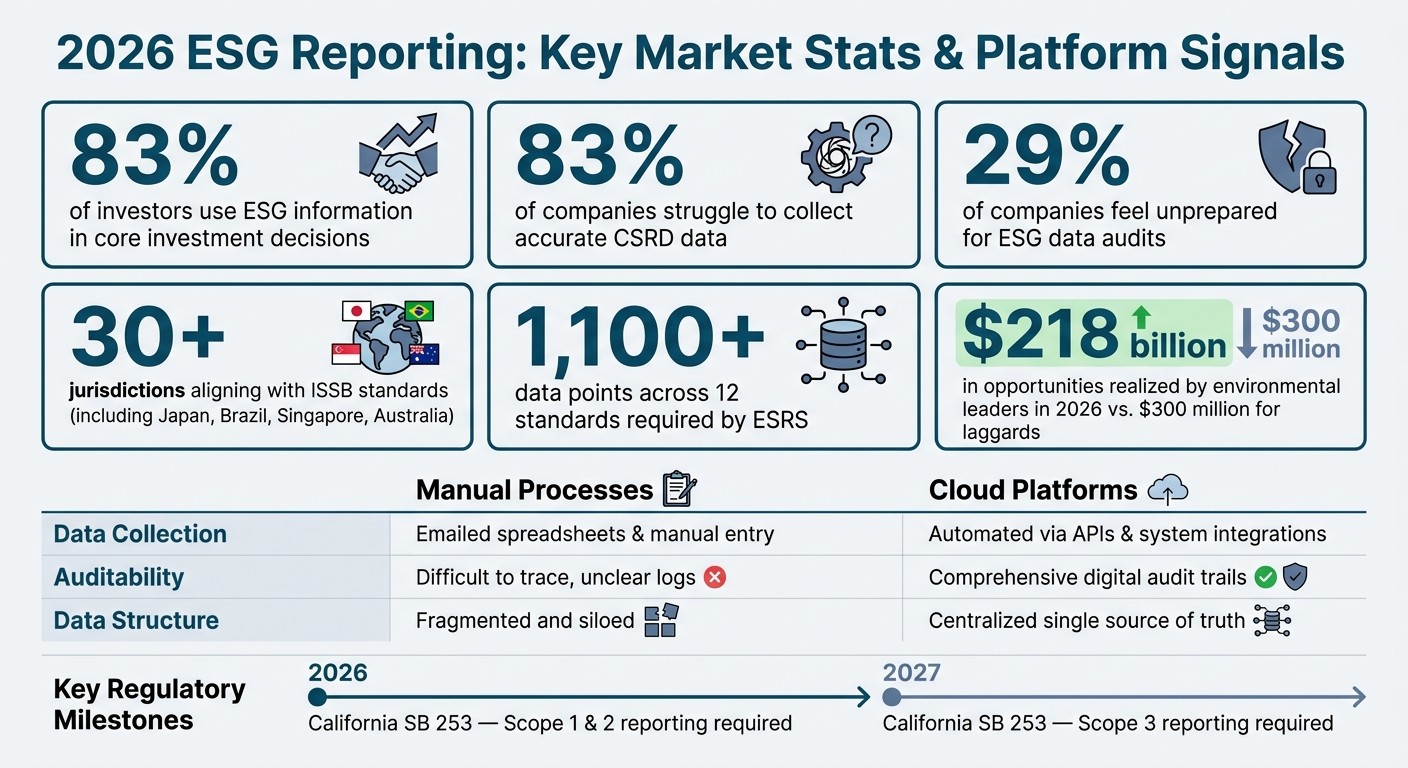
2026 ESG Reporting: Key Market Stats & Platform Signals
Top 10 ESG Software of 2026
ESG Reporting Platform Market Trajectory in 2026
Demand for ESG reporting software is climbing in 2026 as compliance, assurance, and data consolidation start hitting at the same time. That mix is changing the market in a very practical way. Buyers aren’t only looking at growth rates anymore - they’re rethinking what a platform needs to do day to day.
North America's Position and Platform Procurement Pressure
North America remains a main growth engine, with U.S. organizations dealing with overlapping compliance duties across state lines while also answering to investor demands. 83% of investors now include sustainability information in core investment decisions [1], and that alone is shaping software buying decisions whether or not federal rules move forward.
At the same time, more than 30 jurisdictions - including Japan, Brazil, and Singapore - are aligning with ISSB standards [2]. For multinational organizations, that gives reporting teams a more consistent framework across markets. It doesn’t make the work simple, but it does make platform planning less of a guessing game. As a result, U.S. buyers are leaning toward systems that can support more than one framework from a single data set instead of forcing teams to rebuild reports country by country.
Cloud Deployment and the Shift Away from Spreadsheets
That pressure is also speeding up cloud adoption and pulling teams away from spreadsheet-heavy workflows. You can see it in what buyers now ask for: centralized platforms that connect cleanly with existing systems and reduce manual handling.
Cloud-native platforms automate data collection through APIs and system integrations, flag errors in real time, and preserve digital audit trails for third-party review. They’re also modular, so teams can add Scope 3 supplier modules or XBRL tagging without rebuilding the system.
Feature | Manual Processes | Cloud Platforms |
|---|---|---|
Data Collection | Emailing spreadsheets and manual entry | Automated via APIs and system integration |
Auditability | Difficult to trace with unclear logs | Comprehensive digital audit trails |
Data Structure | Fragmented and siloed | Centralized single source of truth |
In plain terms, cloud reporting moves teams away from chasing files and patching together numbers. It puts control in one place, with cleaner records and less friction during review. That shift leads straight to the next issue: which platform features buyers now put at the top of the list.
What Buyers Are Purchasing and Which Features They Prioritize
Top Purchase Drivers: Regulatory Readiness, Assurance, and Data Consolidation
As cloud use keeps growing, buyers are putting money into controls that cut audit risk and reduce manual cleanup. In 2026, procurement is shaped by three main pressures: regulatory readiness, assurance support, and data consolidation.
Regulatory readiness is the clearest driver. U.S. buyers are centered on confirmed mandates, not vague future rules. California's SB 253 and SB 261 stand out as the most concrete examples, with Scope 1 and 2 reporting required in 2026 and Scope 3 following in 2027.
Assurance support has also shifted. What used to be a nice extra is now a required platform function. With 29% of sustainability professionals feeling unprepared for ESG data audits [1], buyers are looking for built-in audit trails, data lineage, and evidence storage that can stand up to review.
Data consolidation rounds out the top three. Put simply, reporting teams want one connected flow of data instead of patching together spreadsheets from separate systems. The aim is to connect ERP, HR, and procurement data so teams can report without stitching numbers together by hand.
Most Requested Platform Capabilities in 2026
Those buying pressures now shape which features get funded. Buyers are leaning toward modular tools built for specific reporting and risk jobs, rather than broad platforms that try to do everything and end up feeling thin.
Multi-framework mapping is still near the top of the list. Organizations want to tag data once and use it across frameworks and jurisdictions. That saves time, but more than that, it cuts the chance of mismatched disclosures across reporting regimes.
Scope 3 supply chain data is also a must-have, though this is still where many teams get stuck. Supplier data is messy, uneven, and often late. That makes collection hard even when the platform looks good in a demo.
Double materiality workflows are gaining ground fast, especially for organizations with EU exposure. Audit trails, evidence capture, and workflow controls are also in high demand because buyers want systems that do more than store data - they want systems that help defend it.
AI-assisted data collection, especially for PDF extraction and supplier-file intake, is getting a lot of attention. The interest is there. The catch is that platform maturity in this area is still catching up.
Feature Demand vs. Current Platform Maturity: Comparison Table
Demand and platform maturity vary a lot by feature. The biggest gaps show up where buyers need the most help and tools are still catching up.
Capability | Buyer Demand | Platform Maturity | Strongest Demand Driver |
|---|---|---|---|
GHG Accounting (Scope 1 & 2) | Critical | High | Core disclosure requirements |
Audit Trails & Evidence Vaults | Critical | High | Assurance readiness |
Framework Mapping (ISSB/GRI) | High | High | Multi-jurisdiction reporting |
Scope 3 Supply Chain Data | High | Moderate | Supplier data collection |
Double Materiality Workflows | High | Moderate | EU/CSRD reporting |
AI Data Collection | High | Moderate | Intelligent document processing for PDFs and unstructured data |
XBRL / Data Tagging | Moderate to High | Moderate | Interoperability between ISSB and ESRS frameworks |
That gap explains most of the implementation friction in 2026. Buyers want platforms that are audit-ready, multi-framework, and connected across data sources. The problem is that the features furthest from that bar are the same ones buyers now care about most.
Data Bottlenecks in ESG Reporting and How AI Is Being Applied
Common Data Problems: Quality, Silos, Scope 3, and Audit Trails
The feature gaps in ESG software usually come back to four stubborn bottlenecks: data quality, silos, Scope 3 inputs, and weak evidence trails. Recent research shows that 83% of companies struggle to collect accurate CSRD data [1]. That pressure gets even heavier because ESRS includes more than 1,100 data points across 12 standards [1]. For many teams, that’s not just a reporting task. It’s a data management problem.
Scope 3 is still the toughest area to handle. Supplier data often shows up late, arrives half-complete, or uses formats that don’t match internal systems. That helps explain why buyers now focus so much on audit trails, data consolidation, and multi-framework mapping. These pain points are shaping both purchasing choices and product roadmaps.
Another major blocker is unstructured data. A lot of compliance-ready information sits inside PDFs, financial statements, and assurance reports, so teams still pull it out by hand [1]. That slows the work, adds room for mistakes, and makes audit trails harder to track from start to finish.
Audit readiness is also a weak spot. 29% of companies feel unprepared for ESG data audits [1]. So it makes sense that teams want a clear evidence chain linking each reported value back to the source document [1].
That sets up one of the clearest AI use cases in 2026: turning unstructured evidence into structured data that people can review.
Where AI Is Delivering Real Reporting Value
Right now, AI is proving most useful in two places: manual extraction and framework mapping. Intelligent Document Processing can read unstructured reports and pull out data points automatically [1]. That takes some of the grind out of the process, especially when teams are working through large volumes of documents.
AI is also being used to map one dataset across multiple frameworks, including CSRD and ISSB, which supports cross-framework interoperability [1] [2]. In practice, that means companies don’t have to rebuild the same reporting dataset from scratch every time a different standard comes into play.
The key point is simple: AI is not replacing reporting controls. It is cutting down the manual cleanup that happens before review and assurance. High-risk data still needs human review [1].
Data Pain Points and Platform or AI Responses: Comparison Table
Data Pain Point | Response | Remaining Limitation |
|---|---|---|
Manual extraction from PDFs and assurance reports | Intelligent Document Processing (IDP) and semantic parsing [1] | High-risk data still needs human review [1] |
Audit evidence gaps | Traceable evidence chains linking every reported value back to its source document [1] | High-risk data still needs human review [1] |
Changing taxonomies and rules | Automated mapping to multiple frameworks such as CSRD and ISSB [1] | Regulatory interpretation can still be ambiguous [1] |
Platform Roadmap Signals for 2027 and Next Steps for Reporting Teams
Regulatory Digitization Is Pushing Platforms Toward Machine-Readable Reporting
As 2026 buyers ask for cleaner data and tighter controls, platforms are heading toward one clear destination: native machine-readable reporting. ESG platforms are moving in that direction, and vendors will need native iXBRL or similar tagging built into the product to stay in step [2].
For platform vendors, this changes the bar. Data points mapped to ESRS or ISSB need built-in taxonomy support and machine-readable output as part of the day-to-day workflow, not as an afterthought. That gives an edge to platforms that can support shared taxonomies and show clear source traceability.
ISSB alignment across more than 30 jurisdictions, including Japan, Brazil, and Australia, is also making the report once and reuse across jurisdictions model far more practical [2]. For reporting teams, that matters. It means a cleaner reporting stack today can reduce duplicate work later.
Practical Next Steps for Reporting Teams and Their Partners
For teams planning 2027 work, the sequence is straightforward: fix data architecture first, then automate extraction. Start with IDP to pull data from unstructured PDFs and reports. After that, validate the output against disclosure requirements [1].
The next step is to set AI governance before rolling it out more broadly. AI-assisted outputs still need human review to stay defensible in front of regulators, and each extracted field should link back to its source document [1]. If that trail is missing, the process may look fast on paper but fall apart during audit review.
Key Takeaways from the 2026 Study
These roadmap signals point to one operating requirement: reporting teams need auditable, machine-readable data flows now. Environmental leaders realized $218 billion in opportunities in 2026, compared with just $300 million for laggards [2]. The platform choices made in 2026 will shape 2027 audit readiness.
FAQs
What makes ESG reporting audit-ready?
ESG reporting becomes audit-ready when it leaves behind manual spreadsheets and runs through purpose-built platforms with strong controls. That shift matters because auditors don’t just look at the final number. They look at how that number was produced, who touched it, what changed, and whether the path back to the source is clear.
Every reported figure should be traceable to its source. In plain terms, that means documented evidence, clear calculation methods, and approval logs that show how the data moved from raw input to final disclosure. If someone asks, “Where did this number come from?” the answer should be easy to show, not pieced together from email threads and scattered files.
A solid setup usually includes a few core parts:
Role-based access so people only see and edit what they’re allowed to handle
Change logs that record updates and create a clean history
Automated validation rules to flag missing fields, odd values, or broken formulas
A central data dictionary so teams use the same definitions across the board
Standardized collection workflows that reduce guesswork from one reporting cycle to the next
Human review to check judgment calls, catch context issues, and back up consistency, accuracy, and transparency
This is where many reporting programs either hold together or start to wobble. Good software helps, but the real goal is control you can show. When the system, the process, and the review trail all line up, the reporting process is in much better shape for audit scrutiny.
Why is Scope 3 still so difficult?
Scope 3 is hard for a simple reason: it stretches across 15 categories, pulls in thousands of data points, and often accounts for 80% to 90% of an organization’s total emissions.
That changes the game. Scope 1 and Scope 2 usually sit closer to home. Scope 3 does not. It relies on input from a long list of outside suppliers, and those suppliers often report at very different levels of detail. Some have solid systems. Others are still piecing things together.
The result is messy data. Information may be unstructured, spread across multiple systems, or missing altogether. When teams try to manage that work in spreadsheets, the process can get out of hand fast.
How should teams prepare for 2027?
Start by fixing your operating model before you pick technology. ESG reporting works when data ownership is clear, internal controls are written down, and the strategy is defined. Platform features matter, but they don't come first. Put your attention on the one urgent decision you need to make better, then choose a tool that helps you make that decision with less friction.
Build your data architecture around the ISSB baseline. Map your data sources now, not later. Automate connections to your ERP and HR systems, and put audit trails near the top of the list as assurance standards get tighter. At the same time, skip oversized compliance suites if they don't match your actual needs. Buying more software than the job calls for is an easy way to spend a lot and solve very little.
Related Blog Posts
Latest Articles
©2025

Narrative Change and Power Building: The Missing Half of Advocacy
Narrative change is the process of disrupting dominant narratives that normalize inequity and advancing new narratives from historically marginalized communities.

Funding Resilience Without Federal Grants
BRIC is unreliable and FEMA is shrinking. Here's how cities fund climate resilience with dedicated revenue, blended finance, and a coordinating authority.

The ESG Blind Spot: How AI Is Finding Risks in Companies Nobody Else Is Watching
Norway's sovereign wealth fund uses AI to screen 7,200 portfolio companies for forced labor and corruption within 24 hours. The real story is the emerging-market coverage gap that traditional ESG data vendors miss — and what it means for any company with a global supply chain.
Narrative Change and Power Building: The Missing Half of Advocacy
Narrative change is the process of disrupting dominant narratives that normalize inequity and advancing new narratives from historically marginalized communities.
Funding Resilience Without Federal Grants
BRIC is unreliable and FEMA is shrinking. Here's how cities fund climate resilience with dedicated revenue, blended finance, and a coordinating authority.
The ESG Blind Spot: How AI Is Finding Risks in Companies Nobody Else Is Watching
Norway's sovereign wealth fund uses AI to screen 7,200 portfolio companies for forced labor and corruption within 24 hours. The real story is the emerging-market coverage gap that traditional ESG data vendors miss — and what it means for any company with a global supply chain.
FAQ
01
What does it really mean to “redefine profit”?
02
What makes Council Fire different?
03
Who does Council Fire work with?
04
What does working with Council Fire actually look like?
05
How does Council Fire help organizations turn big goals into action?
06
How does Council Fire define and measure success?
Aug 3, 2026
2026 ESG Reporting Study: Platform Signals
ESG Strategy
In This Article
2026 study: buyers demand audit-ready cloud ESG platforms with source tracing, Scope 3 support, and machine-readable outputs.
2026 ESG Reporting Study: Platform Signals
In 2026, ESG software buying is about one thing: audit-ready reporting. I see the market moving away from spreadsheets and point tools toward cloud systems that pull data into one place, track source records, and support filings across more than one rule set.
If I had to sum up the study in a few lines, it would be this:
Law is pushing demand: California SB 253 sets a U.S. floor for large companies doing business in the state, with Scope 1 and 2 reporting in 2026 and Scope 3 in 2027.
Investor pressure is still strong: 83% of investors use ESG information in core investment decisions.
Data is still the weak point: 83% of companies say accurate CSRD data collection is hard, and 29% feel unready for ESG data audits.
Buyers want proof, not just dashboards: top requests center on audit trails, evidence storage, framework mapping, and connected ERP, HR, and procurement data.
AI is being used in narrow ways: mainly for PDF extraction, supplier-file intake, and mapping one dataset across ISSB and CSRD-style disclosures.
2027 planning is already clear: fix data structure first, then add automation and machine-readable tagging such as iXBRL.
What stands out to me is that reporting teams are not waiting for every rule to settle. Even after CSRD scope changed in early 2026, many newly exempt firms still planned to keep or grow reporting. That tells me software demand is now driven by audit pressure, investors, customers, and cross-border reporting needs - not only by direct legal scope.
The short version: if your reporting process still depends on emailed spreadsheets, manual file chasing, and weak source tracking, 2026 is the year that starts to break. The study points to a simple buyer checklist: one data source, clean evidence trails, support for Scope 3, and outputs built for machine-readable filing.
This article pulls those market signals into one plain-English view so you can see what changed in 2026 and what that means for 2027 planning.
2026 ESG Reporting: Key Market Stats & Platform Signals
Top 10 ESG Software of 2026
ESG Reporting Platform Market Trajectory in 2026
Demand for ESG reporting software is climbing in 2026 as compliance, assurance, and data consolidation start hitting at the same time. That mix is changing the market in a very practical way. Buyers aren’t only looking at growth rates anymore - they’re rethinking what a platform needs to do day to day.
North America's Position and Platform Procurement Pressure
North America remains a main growth engine, with U.S. organizations dealing with overlapping compliance duties across state lines while also answering to investor demands. 83% of investors now include sustainability information in core investment decisions [1], and that alone is shaping software buying decisions whether or not federal rules move forward.
At the same time, more than 30 jurisdictions - including Japan, Brazil, and Singapore - are aligning with ISSB standards [2]. For multinational organizations, that gives reporting teams a more consistent framework across markets. It doesn’t make the work simple, but it does make platform planning less of a guessing game. As a result, U.S. buyers are leaning toward systems that can support more than one framework from a single data set instead of forcing teams to rebuild reports country by country.
Cloud Deployment and the Shift Away from Spreadsheets
That pressure is also speeding up cloud adoption and pulling teams away from spreadsheet-heavy workflows. You can see it in what buyers now ask for: centralized platforms that connect cleanly with existing systems and reduce manual handling.
Cloud-native platforms automate data collection through APIs and system integrations, flag errors in real time, and preserve digital audit trails for third-party review. They’re also modular, so teams can add Scope 3 supplier modules or XBRL tagging without rebuilding the system.
Feature | Manual Processes | Cloud Platforms |
|---|---|---|
Data Collection | Emailing spreadsheets and manual entry | Automated via APIs and system integration |
Auditability | Difficult to trace with unclear logs | Comprehensive digital audit trails |
Data Structure | Fragmented and siloed | Centralized single source of truth |
In plain terms, cloud reporting moves teams away from chasing files and patching together numbers. It puts control in one place, with cleaner records and less friction during review. That shift leads straight to the next issue: which platform features buyers now put at the top of the list.
What Buyers Are Purchasing and Which Features They Prioritize
Top Purchase Drivers: Regulatory Readiness, Assurance, and Data Consolidation
As cloud use keeps growing, buyers are putting money into controls that cut audit risk and reduce manual cleanup. In 2026, procurement is shaped by three main pressures: regulatory readiness, assurance support, and data consolidation.
Regulatory readiness is the clearest driver. U.S. buyers are centered on confirmed mandates, not vague future rules. California's SB 253 and SB 261 stand out as the most concrete examples, with Scope 1 and 2 reporting required in 2026 and Scope 3 following in 2027.
Assurance support has also shifted. What used to be a nice extra is now a required platform function. With 29% of sustainability professionals feeling unprepared for ESG data audits [1], buyers are looking for built-in audit trails, data lineage, and evidence storage that can stand up to review.
Data consolidation rounds out the top three. Put simply, reporting teams want one connected flow of data instead of patching together spreadsheets from separate systems. The aim is to connect ERP, HR, and procurement data so teams can report without stitching numbers together by hand.
Most Requested Platform Capabilities in 2026
Those buying pressures now shape which features get funded. Buyers are leaning toward modular tools built for specific reporting and risk jobs, rather than broad platforms that try to do everything and end up feeling thin.
Multi-framework mapping is still near the top of the list. Organizations want to tag data once and use it across frameworks and jurisdictions. That saves time, but more than that, it cuts the chance of mismatched disclosures across reporting regimes.
Scope 3 supply chain data is also a must-have, though this is still where many teams get stuck. Supplier data is messy, uneven, and often late. That makes collection hard even when the platform looks good in a demo.
Double materiality workflows are gaining ground fast, especially for organizations with EU exposure. Audit trails, evidence capture, and workflow controls are also in high demand because buyers want systems that do more than store data - they want systems that help defend it.
AI-assisted data collection, especially for PDF extraction and supplier-file intake, is getting a lot of attention. The interest is there. The catch is that platform maturity in this area is still catching up.
Feature Demand vs. Current Platform Maturity: Comparison Table
Demand and platform maturity vary a lot by feature. The biggest gaps show up where buyers need the most help and tools are still catching up.
Capability | Buyer Demand | Platform Maturity | Strongest Demand Driver |
|---|---|---|---|
GHG Accounting (Scope 1 & 2) | Critical | High | Core disclosure requirements |
Audit Trails & Evidence Vaults | Critical | High | Assurance readiness |
Framework Mapping (ISSB/GRI) | High | High | Multi-jurisdiction reporting |
Scope 3 Supply Chain Data | High | Moderate | Supplier data collection |
Double Materiality Workflows | High | Moderate | EU/CSRD reporting |
AI Data Collection | High | Moderate | Intelligent document processing for PDFs and unstructured data |
XBRL / Data Tagging | Moderate to High | Moderate | Interoperability between ISSB and ESRS frameworks |
That gap explains most of the implementation friction in 2026. Buyers want platforms that are audit-ready, multi-framework, and connected across data sources. The problem is that the features furthest from that bar are the same ones buyers now care about most.
Data Bottlenecks in ESG Reporting and How AI Is Being Applied
Common Data Problems: Quality, Silos, Scope 3, and Audit Trails
The feature gaps in ESG software usually come back to four stubborn bottlenecks: data quality, silos, Scope 3 inputs, and weak evidence trails. Recent research shows that 83% of companies struggle to collect accurate CSRD data [1]. That pressure gets even heavier because ESRS includes more than 1,100 data points across 12 standards [1]. For many teams, that’s not just a reporting task. It’s a data management problem.
Scope 3 is still the toughest area to handle. Supplier data often shows up late, arrives half-complete, or uses formats that don’t match internal systems. That helps explain why buyers now focus so much on audit trails, data consolidation, and multi-framework mapping. These pain points are shaping both purchasing choices and product roadmaps.
Another major blocker is unstructured data. A lot of compliance-ready information sits inside PDFs, financial statements, and assurance reports, so teams still pull it out by hand [1]. That slows the work, adds room for mistakes, and makes audit trails harder to track from start to finish.
Audit readiness is also a weak spot. 29% of companies feel unprepared for ESG data audits [1]. So it makes sense that teams want a clear evidence chain linking each reported value back to the source document [1].
That sets up one of the clearest AI use cases in 2026: turning unstructured evidence into structured data that people can review.
Where AI Is Delivering Real Reporting Value
Right now, AI is proving most useful in two places: manual extraction and framework mapping. Intelligent Document Processing can read unstructured reports and pull out data points automatically [1]. That takes some of the grind out of the process, especially when teams are working through large volumes of documents.
AI is also being used to map one dataset across multiple frameworks, including CSRD and ISSB, which supports cross-framework interoperability [1] [2]. In practice, that means companies don’t have to rebuild the same reporting dataset from scratch every time a different standard comes into play.
The key point is simple: AI is not replacing reporting controls. It is cutting down the manual cleanup that happens before review and assurance. High-risk data still needs human review [1].
Data Pain Points and Platform or AI Responses: Comparison Table
Data Pain Point | Response | Remaining Limitation |
|---|---|---|
Manual extraction from PDFs and assurance reports | Intelligent Document Processing (IDP) and semantic parsing [1] | High-risk data still needs human review [1] |
Audit evidence gaps | Traceable evidence chains linking every reported value back to its source document [1] | High-risk data still needs human review [1] |
Changing taxonomies and rules | Automated mapping to multiple frameworks such as CSRD and ISSB [1] | Regulatory interpretation can still be ambiguous [1] |
Platform Roadmap Signals for 2027 and Next Steps for Reporting Teams
Regulatory Digitization Is Pushing Platforms Toward Machine-Readable Reporting
As 2026 buyers ask for cleaner data and tighter controls, platforms are heading toward one clear destination: native machine-readable reporting. ESG platforms are moving in that direction, and vendors will need native iXBRL or similar tagging built into the product to stay in step [2].
For platform vendors, this changes the bar. Data points mapped to ESRS or ISSB need built-in taxonomy support and machine-readable output as part of the day-to-day workflow, not as an afterthought. That gives an edge to platforms that can support shared taxonomies and show clear source traceability.
ISSB alignment across more than 30 jurisdictions, including Japan, Brazil, and Australia, is also making the report once and reuse across jurisdictions model far more practical [2]. For reporting teams, that matters. It means a cleaner reporting stack today can reduce duplicate work later.
Practical Next Steps for Reporting Teams and Their Partners
For teams planning 2027 work, the sequence is straightforward: fix data architecture first, then automate extraction. Start with IDP to pull data from unstructured PDFs and reports. After that, validate the output against disclosure requirements [1].
The next step is to set AI governance before rolling it out more broadly. AI-assisted outputs still need human review to stay defensible in front of regulators, and each extracted field should link back to its source document [1]. If that trail is missing, the process may look fast on paper but fall apart during audit review.
Key Takeaways from the 2026 Study
These roadmap signals point to one operating requirement: reporting teams need auditable, machine-readable data flows now. Environmental leaders realized $218 billion in opportunities in 2026, compared with just $300 million for laggards [2]. The platform choices made in 2026 will shape 2027 audit readiness.
FAQs
What makes ESG reporting audit-ready?
ESG reporting becomes audit-ready when it leaves behind manual spreadsheets and runs through purpose-built platforms with strong controls. That shift matters because auditors don’t just look at the final number. They look at how that number was produced, who touched it, what changed, and whether the path back to the source is clear.
Every reported figure should be traceable to its source. In plain terms, that means documented evidence, clear calculation methods, and approval logs that show how the data moved from raw input to final disclosure. If someone asks, “Where did this number come from?” the answer should be easy to show, not pieced together from email threads and scattered files.
A solid setup usually includes a few core parts:
Role-based access so people only see and edit what they’re allowed to handle
Change logs that record updates and create a clean history
Automated validation rules to flag missing fields, odd values, or broken formulas
A central data dictionary so teams use the same definitions across the board
Standardized collection workflows that reduce guesswork from one reporting cycle to the next
Human review to check judgment calls, catch context issues, and back up consistency, accuracy, and transparency
This is where many reporting programs either hold together or start to wobble. Good software helps, but the real goal is control you can show. When the system, the process, and the review trail all line up, the reporting process is in much better shape for audit scrutiny.
Why is Scope 3 still so difficult?
Scope 3 is hard for a simple reason: it stretches across 15 categories, pulls in thousands of data points, and often accounts for 80% to 90% of an organization’s total emissions.
That changes the game. Scope 1 and Scope 2 usually sit closer to home. Scope 3 does not. It relies on input from a long list of outside suppliers, and those suppliers often report at very different levels of detail. Some have solid systems. Others are still piecing things together.
The result is messy data. Information may be unstructured, spread across multiple systems, or missing altogether. When teams try to manage that work in spreadsheets, the process can get out of hand fast.
How should teams prepare for 2027?
Start by fixing your operating model before you pick technology. ESG reporting works when data ownership is clear, internal controls are written down, and the strategy is defined. Platform features matter, but they don't come first. Put your attention on the one urgent decision you need to make better, then choose a tool that helps you make that decision with less friction.
Build your data architecture around the ISSB baseline. Map your data sources now, not later. Automate connections to your ERP and HR systems, and put audit trails near the top of the list as assurance standards get tighter. At the same time, skip oversized compliance suites if they don't match your actual needs. Buying more software than the job calls for is an easy way to spend a lot and solve very little.
Related Blog Posts
Latest Articles
©2025
Narrative Change and Power Building: The Missing Half of Advocacy
Narrative change is the process of disrupting dominant narratives that normalize inequity and advancing new narratives from historically marginalized communities.
Funding Resilience Without Federal Grants
BRIC is unreliable and FEMA is shrinking. Here's how cities fund climate resilience with dedicated revenue, blended finance, and a coordinating authority.
The ESG Blind Spot: How AI Is Finding Risks in Companies Nobody Else Is Watching
Norway's sovereign wealth fund uses AI to screen 7,200 portfolio companies for forced labor and corruption within 24 hours. The real story is the emerging-market coverage gap that traditional ESG data vendors miss — and what it means for any company with a global supply chain.
FAQ
01
What does it really mean to “redefine profit”?
02
What makes Council Fire different?
03
Who does Council Fire work with?
04
What does working with Council Fire actually look like?
05
How does Council Fire help organizations turn big goals into action?
06
How does Council Fire define and measure success?
Aug 3, 2026
2026 ESG Reporting Study: Platform Signals
ESG Strategy
In This Article
2026 study: buyers demand audit-ready cloud ESG platforms with source tracing, Scope 3 support, and machine-readable outputs.
2026 ESG Reporting Study: Platform Signals
In 2026, ESG software buying is about one thing: audit-ready reporting. I see the market moving away from spreadsheets and point tools toward cloud systems that pull data into one place, track source records, and support filings across more than one rule set.
If I had to sum up the study in a few lines, it would be this:
Law is pushing demand: California SB 253 sets a U.S. floor for large companies doing business in the state, with Scope 1 and 2 reporting in 2026 and Scope 3 in 2027.
Investor pressure is still strong: 83% of investors use ESG information in core investment decisions.
Data is still the weak point: 83% of companies say accurate CSRD data collection is hard, and 29% feel unready for ESG data audits.
Buyers want proof, not just dashboards: top requests center on audit trails, evidence storage, framework mapping, and connected ERP, HR, and procurement data.
AI is being used in narrow ways: mainly for PDF extraction, supplier-file intake, and mapping one dataset across ISSB and CSRD-style disclosures.
2027 planning is already clear: fix data structure first, then add automation and machine-readable tagging such as iXBRL.
What stands out to me is that reporting teams are not waiting for every rule to settle. Even after CSRD scope changed in early 2026, many newly exempt firms still planned to keep or grow reporting. That tells me software demand is now driven by audit pressure, investors, customers, and cross-border reporting needs - not only by direct legal scope.
The short version: if your reporting process still depends on emailed spreadsheets, manual file chasing, and weak source tracking, 2026 is the year that starts to break. The study points to a simple buyer checklist: one data source, clean evidence trails, support for Scope 3, and outputs built for machine-readable filing.
This article pulls those market signals into one plain-English view so you can see what changed in 2026 and what that means for 2027 planning.
2026 ESG Reporting: Key Market Stats & Platform Signals
Top 10 ESG Software of 2026
ESG Reporting Platform Market Trajectory in 2026
Demand for ESG reporting software is climbing in 2026 as compliance, assurance, and data consolidation start hitting at the same time. That mix is changing the market in a very practical way. Buyers aren’t only looking at growth rates anymore - they’re rethinking what a platform needs to do day to day.
North America's Position and Platform Procurement Pressure
North America remains a main growth engine, with U.S. organizations dealing with overlapping compliance duties across state lines while also answering to investor demands. 83% of investors now include sustainability information in core investment decisions [1], and that alone is shaping software buying decisions whether or not federal rules move forward.
At the same time, more than 30 jurisdictions - including Japan, Brazil, and Singapore - are aligning with ISSB standards [2]. For multinational organizations, that gives reporting teams a more consistent framework across markets. It doesn’t make the work simple, but it does make platform planning less of a guessing game. As a result, U.S. buyers are leaning toward systems that can support more than one framework from a single data set instead of forcing teams to rebuild reports country by country.
Cloud Deployment and the Shift Away from Spreadsheets
That pressure is also speeding up cloud adoption and pulling teams away from spreadsheet-heavy workflows. You can see it in what buyers now ask for: centralized platforms that connect cleanly with existing systems and reduce manual handling.
Cloud-native platforms automate data collection through APIs and system integrations, flag errors in real time, and preserve digital audit trails for third-party review. They’re also modular, so teams can add Scope 3 supplier modules or XBRL tagging without rebuilding the system.
Feature | Manual Processes | Cloud Platforms |
|---|---|---|
Data Collection | Emailing spreadsheets and manual entry | Automated via APIs and system integration |
Auditability | Difficult to trace with unclear logs | Comprehensive digital audit trails |
Data Structure | Fragmented and siloed | Centralized single source of truth |
In plain terms, cloud reporting moves teams away from chasing files and patching together numbers. It puts control in one place, with cleaner records and less friction during review. That shift leads straight to the next issue: which platform features buyers now put at the top of the list.
What Buyers Are Purchasing and Which Features They Prioritize
Top Purchase Drivers: Regulatory Readiness, Assurance, and Data Consolidation
As cloud use keeps growing, buyers are putting money into controls that cut audit risk and reduce manual cleanup. In 2026, procurement is shaped by three main pressures: regulatory readiness, assurance support, and data consolidation.
Regulatory readiness is the clearest driver. U.S. buyers are centered on confirmed mandates, not vague future rules. California's SB 253 and SB 261 stand out as the most concrete examples, with Scope 1 and 2 reporting required in 2026 and Scope 3 following in 2027.
Assurance support has also shifted. What used to be a nice extra is now a required platform function. With 29% of sustainability professionals feeling unprepared for ESG data audits [1], buyers are looking for built-in audit trails, data lineage, and evidence storage that can stand up to review.
Data consolidation rounds out the top three. Put simply, reporting teams want one connected flow of data instead of patching together spreadsheets from separate systems. The aim is to connect ERP, HR, and procurement data so teams can report without stitching numbers together by hand.
Most Requested Platform Capabilities in 2026
Those buying pressures now shape which features get funded. Buyers are leaning toward modular tools built for specific reporting and risk jobs, rather than broad platforms that try to do everything and end up feeling thin.
Multi-framework mapping is still near the top of the list. Organizations want to tag data once and use it across frameworks and jurisdictions. That saves time, but more than that, it cuts the chance of mismatched disclosures across reporting regimes.
Scope 3 supply chain data is also a must-have, though this is still where many teams get stuck. Supplier data is messy, uneven, and often late. That makes collection hard even when the platform looks good in a demo.
Double materiality workflows are gaining ground fast, especially for organizations with EU exposure. Audit trails, evidence capture, and workflow controls are also in high demand because buyers want systems that do more than store data - they want systems that help defend it.
AI-assisted data collection, especially for PDF extraction and supplier-file intake, is getting a lot of attention. The interest is there. The catch is that platform maturity in this area is still catching up.
Feature Demand vs. Current Platform Maturity: Comparison Table
Demand and platform maturity vary a lot by feature. The biggest gaps show up where buyers need the most help and tools are still catching up.
Capability | Buyer Demand | Platform Maturity | Strongest Demand Driver |
|---|---|---|---|
GHG Accounting (Scope 1 & 2) | Critical | High | Core disclosure requirements |
Audit Trails & Evidence Vaults | Critical | High | Assurance readiness |
Framework Mapping (ISSB/GRI) | High | High | Multi-jurisdiction reporting |
Scope 3 Supply Chain Data | High | Moderate | Supplier data collection |
Double Materiality Workflows | High | Moderate | EU/CSRD reporting |
AI Data Collection | High | Moderate | Intelligent document processing for PDFs and unstructured data |
XBRL / Data Tagging | Moderate to High | Moderate | Interoperability between ISSB and ESRS frameworks |
That gap explains most of the implementation friction in 2026. Buyers want platforms that are audit-ready, multi-framework, and connected across data sources. The problem is that the features furthest from that bar are the same ones buyers now care about most.
Data Bottlenecks in ESG Reporting and How AI Is Being Applied
Common Data Problems: Quality, Silos, Scope 3, and Audit Trails
The feature gaps in ESG software usually come back to four stubborn bottlenecks: data quality, silos, Scope 3 inputs, and weak evidence trails. Recent research shows that 83% of companies struggle to collect accurate CSRD data [1]. That pressure gets even heavier because ESRS includes more than 1,100 data points across 12 standards [1]. For many teams, that’s not just a reporting task. It’s a data management problem.
Scope 3 is still the toughest area to handle. Supplier data often shows up late, arrives half-complete, or uses formats that don’t match internal systems. That helps explain why buyers now focus so much on audit trails, data consolidation, and multi-framework mapping. These pain points are shaping both purchasing choices and product roadmaps.
Another major blocker is unstructured data. A lot of compliance-ready information sits inside PDFs, financial statements, and assurance reports, so teams still pull it out by hand [1]. That slows the work, adds room for mistakes, and makes audit trails harder to track from start to finish.
Audit readiness is also a weak spot. 29% of companies feel unprepared for ESG data audits [1]. So it makes sense that teams want a clear evidence chain linking each reported value back to the source document [1].
That sets up one of the clearest AI use cases in 2026: turning unstructured evidence into structured data that people can review.
Where AI Is Delivering Real Reporting Value
Right now, AI is proving most useful in two places: manual extraction and framework mapping. Intelligent Document Processing can read unstructured reports and pull out data points automatically [1]. That takes some of the grind out of the process, especially when teams are working through large volumes of documents.
AI is also being used to map one dataset across multiple frameworks, including CSRD and ISSB, which supports cross-framework interoperability [1] [2]. In practice, that means companies don’t have to rebuild the same reporting dataset from scratch every time a different standard comes into play.
The key point is simple: AI is not replacing reporting controls. It is cutting down the manual cleanup that happens before review and assurance. High-risk data still needs human review [1].
Data Pain Points and Platform or AI Responses: Comparison Table
Data Pain Point | Response | Remaining Limitation |
|---|---|---|
Manual extraction from PDFs and assurance reports | Intelligent Document Processing (IDP) and semantic parsing [1] | High-risk data still needs human review [1] |
Audit evidence gaps | Traceable evidence chains linking every reported value back to its source document [1] | High-risk data still needs human review [1] |
Changing taxonomies and rules | Automated mapping to multiple frameworks such as CSRD and ISSB [1] | Regulatory interpretation can still be ambiguous [1] |
Platform Roadmap Signals for 2027 and Next Steps for Reporting Teams
Regulatory Digitization Is Pushing Platforms Toward Machine-Readable Reporting
As 2026 buyers ask for cleaner data and tighter controls, platforms are heading toward one clear destination: native machine-readable reporting. ESG platforms are moving in that direction, and vendors will need native iXBRL or similar tagging built into the product to stay in step [2].
For platform vendors, this changes the bar. Data points mapped to ESRS or ISSB need built-in taxonomy support and machine-readable output as part of the day-to-day workflow, not as an afterthought. That gives an edge to platforms that can support shared taxonomies and show clear source traceability.
ISSB alignment across more than 30 jurisdictions, including Japan, Brazil, and Australia, is also making the report once and reuse across jurisdictions model far more practical [2]. For reporting teams, that matters. It means a cleaner reporting stack today can reduce duplicate work later.
Practical Next Steps for Reporting Teams and Their Partners
For teams planning 2027 work, the sequence is straightforward: fix data architecture first, then automate extraction. Start with IDP to pull data from unstructured PDFs and reports. After that, validate the output against disclosure requirements [1].
The next step is to set AI governance before rolling it out more broadly. AI-assisted outputs still need human review to stay defensible in front of regulators, and each extracted field should link back to its source document [1]. If that trail is missing, the process may look fast on paper but fall apart during audit review.
Key Takeaways from the 2026 Study
These roadmap signals point to one operating requirement: reporting teams need auditable, machine-readable data flows now. Environmental leaders realized $218 billion in opportunities in 2026, compared with just $300 million for laggards [2]. The platform choices made in 2026 will shape 2027 audit readiness.
FAQs
What makes ESG reporting audit-ready?
ESG reporting becomes audit-ready when it leaves behind manual spreadsheets and runs through purpose-built platforms with strong controls. That shift matters because auditors don’t just look at the final number. They look at how that number was produced, who touched it, what changed, and whether the path back to the source is clear.
Every reported figure should be traceable to its source. In plain terms, that means documented evidence, clear calculation methods, and approval logs that show how the data moved from raw input to final disclosure. If someone asks, “Where did this number come from?” the answer should be easy to show, not pieced together from email threads and scattered files.
A solid setup usually includes a few core parts:
Role-based access so people only see and edit what they’re allowed to handle
Change logs that record updates and create a clean history
Automated validation rules to flag missing fields, odd values, or broken formulas
A central data dictionary so teams use the same definitions across the board
Standardized collection workflows that reduce guesswork from one reporting cycle to the next
Human review to check judgment calls, catch context issues, and back up consistency, accuracy, and transparency
This is where many reporting programs either hold together or start to wobble. Good software helps, but the real goal is control you can show. When the system, the process, and the review trail all line up, the reporting process is in much better shape for audit scrutiny.
Why is Scope 3 still so difficult?
Scope 3 is hard for a simple reason: it stretches across 15 categories, pulls in thousands of data points, and often accounts for 80% to 90% of an organization’s total emissions.
That changes the game. Scope 1 and Scope 2 usually sit closer to home. Scope 3 does not. It relies on input from a long list of outside suppliers, and those suppliers often report at very different levels of detail. Some have solid systems. Others are still piecing things together.
The result is messy data. Information may be unstructured, spread across multiple systems, or missing altogether. When teams try to manage that work in spreadsheets, the process can get out of hand fast.
How should teams prepare for 2027?
Start by fixing your operating model before you pick technology. ESG reporting works when data ownership is clear, internal controls are written down, and the strategy is defined. Platform features matter, but they don't come first. Put your attention on the one urgent decision you need to make better, then choose a tool that helps you make that decision with less friction.
Build your data architecture around the ISSB baseline. Map your data sources now, not later. Automate connections to your ERP and HR systems, and put audit trails near the top of the list as assurance standards get tighter. At the same time, skip oversized compliance suites if they don't match your actual needs. Buying more software than the job calls for is an easy way to spend a lot and solve very little.
Related Blog Posts
Latest Articles
©2025
Narrative Change and Power Building: The Missing Half of Advocacy
Narrative change is the process of disrupting dominant narratives that normalize inequity and advancing new narratives from historically marginalized communities.
Funding Resilience Without Federal Grants
BRIC is unreliable and FEMA is shrinking. Here's how cities fund climate resilience with dedicated revenue, blended finance, and a coordinating authority.
The ESG Blind Spot: How AI Is Finding Risks in Companies Nobody Else Is Watching
Norway's sovereign wealth fund uses AI to screen 7,200 portfolio companies for forced labor and corruption within 24 hours. The real story is the emerging-market coverage gap that traditional ESG data vendors miss — and what it means for any company with a global supply chain.
FAQ
What does it really mean to “redefine profit”?
What makes Council Fire different?
Who does Council Fire work with?
What does working with Council Fire actually look like?
How does Council Fire help organizations turn big goals into action?
How does Council Fire define and measure success?