
Jan 26, 2026
How to Conduct Vulnerability Assessment & Equity Mapping for Universities & Research Institutions
Sustainability Strategy
In This Article
Guide for universities to assess hazards, map equity with GIS and stakeholder input, and prioritize resilience across campus and surrounding communities.
How to Conduct Vulnerability Assessment & Equity Mapping for Universities & Research Institutions
Universities face growing challenges like climate risks, social inequities, and operational disruptions. To address these effectively, institutions can use two powerful tools: vulnerability assessments and equity mapping. Vulnerability assessments identify risks to physical assets and social systems, while equity mapping uses GIS data to visualize disparities in resource distribution across campuses and nearby communities. Together, these methods help universities shift from reactive crisis management to proactive planning, ensuring they are better prepared for future challenges.
Key Takeaways:
Vulnerability Assessments: Focus on five areas - Social Equity & Governance, Health & Wellness, Ecosystem Services, Infrastructure, and Economic systems. Use tools like screening matrices and risk indices to identify and prioritize high-risk assets.
Equity Mapping: Highlights disparities in access to resources, using both qualitative insights and geospatial data. This process identifies gaps affecting student outcomes and community well-being.
Actionable Steps: Start by forming a planning group, gathering risk data, and engaging stakeholders. Use findings to guide campus policies, budget allocation, and sustainability initiatives.
These tools not only address immediate risks but also help institutions build resilience by aligning campus and community priorities.
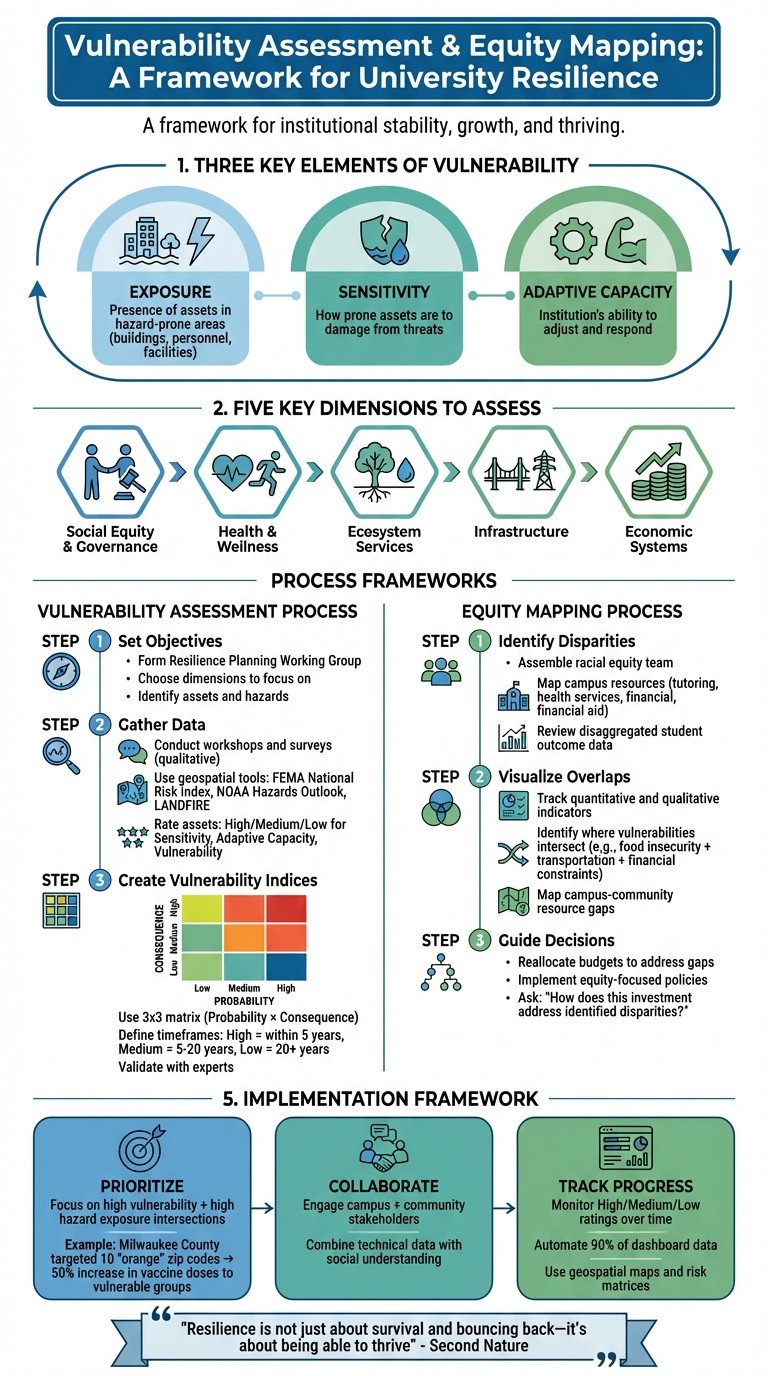
Step-by-Step Guide to Vulnerability Assessment and Equity Mapping for Universities
Key Concepts and Frameworks
What Makes Up a Vulnerability Assessment
Institutional vulnerability is built on three key elements: Exposure, Sensitivity, and Adaptive Capacity. Exposure refers to the presence of assets - such as buildings, personnel, or research facilities - in areas susceptible to hazards like flooding [2][4]. Sensitivity evaluates how prone an asset is to damage from a particular threat. For instance, a historic library may be far more vulnerable to water damage compared to a modern structure with flood-resistant features [2][4]. Lastly, Adaptive Capacity reflects an institution's ability to adjust, respond, and adapt effectively to challenges [2][4].
To assess risk, combine the probability of a hazard occurring with the magnitude of its consequences, whether they are financial, social, or operational [2][4]. Start by identifying your assets and potential hazards. Then, rate each asset's sensitivity, adaptive capacity, and overall vulnerability as High, Medium, or Low. For a more detailed analysis, use a 3x3 matrix to map out assets based on probability and consequence [2][4].
Equity Mapping Basics
Equity mapping employs spatial data to highlight areas where institutional resources may not adequately serve vulnerable populations. This process involves collecting data across five key dimensions: Social Equity & Governance, Health & Wellness, Ecosystem Services, Infrastructure, and Economic factors [3].
Begin with qualitative methods like stakeholder workshops and surveys to classify vulnerability levels as low, medium, or high [2][3]. These initial steps help establish immediate priorities. Next, incorporate quantitative geospatial data to calculate and visualize vulnerability across your campus [4]. Including input from those most affected by systemic challenges is critical during data collection, as it captures nuances that raw numbers might overlook [3]. Once both qualitative insights and spatial data are in place, you can choose a framework tailored to your institution's needs.
Choosing the Right Framework for Your Institution
With your data in hand, select a framework that aligns with your institution's specific risks and capabilities. For example, Second Nature’s Resilience Framework provides a comprehensive approach for higher education, addressing all five dimensions mentioned earlier rather than focusing solely on physical infrastructure [1][3]. The University of California system employs the Higher Education Risk Assessment Tool, which organizes risks into eight categories: Hazard, Financial, IT, Human Resources, Research, Contract and Grant, Campus Life, and Facilities & Maintenance [5].
"The purpose of this tool is not to ensure all risks are rated as 'Adequately Controlled' but rather to help departments assess their control structure for sufficiency given their environment, resources, and bandwidth." – UCOP Office of Risk Services [5]
Scale your assessment to your staff’s capacity. This can range from a brief workshop to a more data-intensive quantitative study [3]. When using risk tools, adjust the weighting to emphasize the likelihood of frequent issues, such as workers' compensation claims, or the severity of reputational risks [5]. Establish consistent criteria for categorizing probability - for instance, defining "High" as likely within five years - to ensure objectivity across departments [2]. Selecting the right framework completes the groundwork for your vulnerability and equity analysis, paving the way for actionable strategies.
How to Conduct a Vulnerability Assessment
Setting Objectives and Scope
Start by establishing a Resilience Planning Working Group that includes both campus and community stakeholders. This ensures a broad perspective on potential vulnerabilities. Decide which of the five key dimensions you'll focus on: Social Equity & Governance, Health & Wellness, Ecosystem Services, Infrastructure, and Economic Systems [1][3].
Next, compile an inventory of assets - the people, places, and services your institution aims to protect. Pair this with a list of climate-related hazards that could threaten those assets [6]. Pay close attention to areas where campus-specific assets intersect with community infrastructure, like shared bridges or telecommunications systems, since damage in these areas can lead to cascading failures across both sectors [3]. Select an assessment method that aligns with your team's resources, whether that's a quick workshop, detailed surveys, or in-depth interviews [3].
"The most successful campus resilience plans will be those that fully embrace the catalytic nature of resilience assessment and planning, and that incorporate diversity and inclusiveness throughout the process." – Second Nature [1]
Once your objectives are set and assets identified, you can move forward with collecting and analyzing risk data.
Gathering and Analyzing Data
Begin with qualitative methods by listing assets and evaluating their Potential Impact, Sensitivity (High/Medium/Low), Adaptive Capacity (High/Medium/Low), and overall Vulnerability (High/Medium/Low) in a spreadsheet [2][4]. Use workshops and surveys to gather insights from individuals who are most affected by systemic challenges [3].
To enhance precision, incorporate quantitative geospatial data. Tools like FEMA's National Risk Index, NOAA's U.S. Hazards Outlook, and LANDFIRE provide valuable regional hazard frequency data [2][4]. Map out medium-to-high vulnerability asset-hazard pairs on a 3x3 matrix, plotting probability on the vertical axis and magnitude of consequence on the horizontal axis. This visualization highlights your most pressing risks [4].
Creating and Validating Vulnerability Indices
Calculate risk by giving equal weight to Impact and Likelihood [5], but adjust these weights as needed to reflect your institution's specific priorities.
Establish consistent timeframes for probability ratings. For example, classify "High" as likely to occur within five years, "Medium" as once in 5–20 years, and "Low" as less than once in 20 years [2][4]. To ensure accuracy, consult with adaptation practitioners or Architecture and Engineering firms to review your findings and clarify any unfamiliar concepts [2]. Finally, refine your vulnerability ratings based on existing controls. Risks that are already "adequately controlled" can be deprioritized, while those that are "poorly controlled" should demand immediate attention [5].
How to Conduct Equity Mapping
Identifying Disparities in Campus Operations
Start by assembling a dedicated campus racial equity team, ensuring each member has clearly defined roles and access to a shared glossary to establish common understanding [8]. The next step involves asset mapping, which means taking stock of campus resources like tutoring centers, health services, financial aid programs, and mentorship opportunities. Evaluate how minoritized students perceive these resources - do they view them as helpful or as barriers? [8] To uncover campus-specific disparities, use disaggregated student outcome data and conduct focus groups tailored to these issues. Additionally, review institutional documents and online content for potential racial biases [8]. This thorough analysis lays the groundwork for actionable, long-term planning by pinpointing where interventions can lead to systemic change.
Visualizing Data and Overlapping Vulnerabilities
After identifying disparities, focus on systematically visualizing and analyzing overlapping vulnerabilities. Organize your findings around five key dimensions and develop both quantitative and qualitative indicators to track them [7][3]. Use visual tools to highlight areas where vulnerabilities overlap. For example, consider a student dealing with food insecurity (Health & Wellness) who also faces transportation challenges (Infrastructure) and financial constraints - these combined factors can create significant barriers. Look for gaps and overlaps between campus resources and the vulnerabilities in the surrounding community, as shared infrastructure like public transportation or emergency services often affects both groups [3].
Using Equity Mapping to Guide Decisions
Once overlap patterns are clear, use these insights to reshape campus operations. Reallocate budgets to address identified gaps, implement policies to reduce barriers, and establish equity-focused offices for lasting impact [7]. Incorporate equity mapping results into policy-making, budget planning, and program evaluations to ensure these efforts remain effective over time. During budget discussions, ask, "How does this investment address the disparities we've identified?" to keep decisions aligned with equity goals. Involve stakeholders - particularly those directly affected by inequities - since their input can uncover vulnerabilities that data might miss [3]. This collaborative approach ensures that equity strategies not only address immediate needs but also align with broader institutional sustainability goals.
UAA Tutorial: Exploring Neighborhood Equity
Putting Findings into Action
Once vulnerability assessments and equity mapping are complete, the next step is turning these insights into meaningful campus initiatives.
Prioritizing Equity-Focused Interventions
Efforts should focus on areas where high social vulnerability overlaps with significant hazard exposure. These intersections - where vulnerability is compounded by limited access - are critical for achieving the greatest impact [12]. The EVE model can help categorize these intersections into four quadrants, such as high vulnerability with low access or low vulnerability with high access, making it easier to pinpoint underserved populations [10]. A great example of this approach comes from Milwaukee County, where, under the guidance of Dr. Ben Weston, officials identified 10 "orange" zip codes with the highest vulnerability and lowest vaccination rates. By targeting these areas with expanded eligibility and mobile vaccination sites, they saw a 50% increase in vaccine doses allocated to vulnerable groups between March 2020 and March 2022 [10].
Medium-risk areas shouldn't be overlooked either - they offer a chance to strengthen resilience before vulnerabilities worsen [12]. Addressing these areas requires focusing on specific drivers of vulnerability, whether they stem from physical barriers like facility distance, social challenges like education gaps, or health disparities [9][13]. Aligning these equity-focused interventions with broader institutional goals - such as mental health initiatives, sustainability efforts, or infrastructure improvements - can also help secure funding and streamline operations [12]. These priorities naturally feed into stakeholder engagement and progress tracking.
Engaging Stakeholders and Building Collaboration
Establishing a Resilience Planning Working Group is essential. This group should include representatives from both campus and community sectors to guide implementation efforts [1]. Universities don't exist in isolation - they share resources, challenges, and opportunities with their surrounding communities [1]. Technical climate data must be paired with a deep understanding of social dynamics and a commitment to serving all community members [4][2].
While hiring consultants can be helpful, it’s crucial to have a local champion or dedicated team to ensure that climate strategies are balanced with the values and needs of the community [4][2]. For example, the College of Menominee Nation integrates indigenous knowledge and community priorities into its climate resilience planning, demonstrating how local values can shape effective solutions [4]. Combining advanced tools like GIS modeling with hands-on methods like participatory workshops can foster consensus among faculty, staff, and students on which actions to prioritize [11]. Once collaboration is established, progress should be tracked using clear, measurable indicators.
Tracking and Communicating Progress
To monitor progress, establish both quantitative and qualitative indicators across five key dimensions: Social Equity & Governance, Health & Wellness, Ecosystem Services, Infrastructure, and Economic factors [3]. A practical tool for this is a vulnerability spreadsheet that tracks campus assets and rates their Sensitivity, Adaptive Capacity, and Vulnerability as High, Medium, or Low, allowing for changes to be monitored over time [2]. Automating up to 90% of dashboard data can also free up staff to focus on high-priority interventions [10].
Visual tools like geospatial maps and a 3x3 risk matrix can simplify complex data, showing hazard probabilities alongside potential consequences [2][4]. Platforms such as Second Nature's Reporting Platform enable institutions to submit formal Resilience Assessment Reports, making progress publicly visible and fostering accountability [3]. When preparing budget proposals, it's vital to ask: "How does this investment address the disparities we've identified?" This ensures that decisions remain aligned with equity goals and the broader mission of resilience planning.
Conclusion
Vulnerability assessments and equity mapping play a critical role in creating campuses that can adapt and thrive in the face of disruptions. By evaluating these five dimensions, institutions establish a baseline for resilience and pinpoint areas requiring attention.
This baseline assessment should inform Climate Action Plans that address both campus and community priorities. As Second Nature highlights, "Resilience is not just about survival and bouncing back from disruptions; it is about being able to thrive" [1]. Achieving this requires institutions to identify where campus and community resources align and where gaps exist, fostering a shared approach to resilience.
"Resilience building is an iterative process" [1]. The initial assessment serves as a starting point, but regular updates are essential as climate risks and campus conditions evolve. Combining qualitative insights with geospatial data helps reduce uncertainty and strengthens decision-making. Tracking progress through a mix of quantitative and qualitative indicators ensures accountability and ongoing improvement.
FAQs
How can universities identify priorities for vulnerability assessments and equity mapping?
Universities can set clear priorities by zeroing in on areas and groups most impacted by pressing social, environmental, or systemic challenges. A good starting point is to assess both campus and community resources that are particularly at risk from issues like climate change. Understanding their vulnerability and capacity to adjust can spotlight the areas that demand immediate action.
When it comes to equity, the focus should be on addressing the needs of marginalized or historically underserved populations. Applying equity-centered tools and frameworks ensures the process remains inclusive and tackles deep-rooted disparities. Involving a wide range of voices through methods like participatory mapping can highlight the perspectives of those most affected. This not only makes assessments more thorough but also aligns efforts with social justice principles, paving the way for targeted and meaningful solutions.
What is the role of stakeholders in vulnerability assessments and equity mapping for universities and research institutions?
Stakeholders play a crucial role in the success of vulnerability assessments and equity mapping, offering a range of perspectives that help ensure the process aligns with the community's values and priorities. Their involvement is key to uncovering social, environmental, and systemic disparities, while also shaping strategies that emphasize fairness and long-term well-being.
Collaborating with stakeholders builds trust, promotes openness, and ensures that decisions are inclusive. Their contributions are invaluable in pinpointing vulnerabilities, developing resilience metrics, and prioritizing actions to address inequities. Continuous engagement with these groups enables universities and research institutions to adapt their strategies over time, staying responsive to the shifting needs of the community and equity-focused objectives.
How does equity mapping help universities make better policies and allocate budgets fairly?
Equity mapping provides universities with a powerful tool to uncover disparities and systemic barriers within their campus communities. By analyzing data, this approach sheds light on the challenges faced by marginalized groups, allowing institutions to develop policies that promote inclusivity and fairness.
Through identifying overlapping vulnerabilities and systemic gaps, equity mapping helps universities focus their efforts where they are needed most. Whether it's funding diversity initiatives, enhancing support programs, or upgrading infrastructure, this process ensures that financial resources target areas with the greatest impact. The result is a campus environment that nurtures equity and inclusion for students, staff, and faculty alike.
Related Blog Posts
How to Build a Climate Resilience Plan for Universities & Research Institutions
How to Integrate Climate Risk into Infrastructure Planning for Universities & Research Institutions
How to Conduct Vulnerability Assessment & Equity Mapping for Municipalities & Government Agencies
How to Conduct Vulnerability Assessment & Equity Mapping for Corporations
Latest Articles
©2025


FAQ
01
What does it really mean to “redefine profit”?
02
What makes Council Fire different?
03
Who does Council Fire you work with?
04
What does working with Council Fire actually look like?
05
How does Council Fire help organizations turn big goals into action?
06
How does Council Fire define and measure success?
Jan 26, 2026
How to Conduct Vulnerability Assessment & Equity Mapping for Universities & Research Institutions
Sustainability Strategy
In This Article
Guide for universities to assess hazards, map equity with GIS and stakeholder input, and prioritize resilience across campus and surrounding communities.
How to Conduct Vulnerability Assessment & Equity Mapping for Universities & Research Institutions
Universities face growing challenges like climate risks, social inequities, and operational disruptions. To address these effectively, institutions can use two powerful tools: vulnerability assessments and equity mapping. Vulnerability assessments identify risks to physical assets and social systems, while equity mapping uses GIS data to visualize disparities in resource distribution across campuses and nearby communities. Together, these methods help universities shift from reactive crisis management to proactive planning, ensuring they are better prepared for future challenges.
Key Takeaways:
Vulnerability Assessments: Focus on five areas - Social Equity & Governance, Health & Wellness, Ecosystem Services, Infrastructure, and Economic systems. Use tools like screening matrices and risk indices to identify and prioritize high-risk assets.
Equity Mapping: Highlights disparities in access to resources, using both qualitative insights and geospatial data. This process identifies gaps affecting student outcomes and community well-being.
Actionable Steps: Start by forming a planning group, gathering risk data, and engaging stakeholders. Use findings to guide campus policies, budget allocation, and sustainability initiatives.
These tools not only address immediate risks but also help institutions build resilience by aligning campus and community priorities.
Step-by-Step Guide to Vulnerability Assessment and Equity Mapping for Universities
Key Concepts and Frameworks
What Makes Up a Vulnerability Assessment
Institutional vulnerability is built on three key elements: Exposure, Sensitivity, and Adaptive Capacity. Exposure refers to the presence of assets - such as buildings, personnel, or research facilities - in areas susceptible to hazards like flooding [2][4]. Sensitivity evaluates how prone an asset is to damage from a particular threat. For instance, a historic library may be far more vulnerable to water damage compared to a modern structure with flood-resistant features [2][4]. Lastly, Adaptive Capacity reflects an institution's ability to adjust, respond, and adapt effectively to challenges [2][4].
To assess risk, combine the probability of a hazard occurring with the magnitude of its consequences, whether they are financial, social, or operational [2][4]. Start by identifying your assets and potential hazards. Then, rate each asset's sensitivity, adaptive capacity, and overall vulnerability as High, Medium, or Low. For a more detailed analysis, use a 3x3 matrix to map out assets based on probability and consequence [2][4].
Equity Mapping Basics
Equity mapping employs spatial data to highlight areas where institutional resources may not adequately serve vulnerable populations. This process involves collecting data across five key dimensions: Social Equity & Governance, Health & Wellness, Ecosystem Services, Infrastructure, and Economic factors [3].
Begin with qualitative methods like stakeholder workshops and surveys to classify vulnerability levels as low, medium, or high [2][3]. These initial steps help establish immediate priorities. Next, incorporate quantitative geospatial data to calculate and visualize vulnerability across your campus [4]. Including input from those most affected by systemic challenges is critical during data collection, as it captures nuances that raw numbers might overlook [3]. Once both qualitative insights and spatial data are in place, you can choose a framework tailored to your institution's needs.
Choosing the Right Framework for Your Institution
With your data in hand, select a framework that aligns with your institution's specific risks and capabilities. For example, Second Nature’s Resilience Framework provides a comprehensive approach for higher education, addressing all five dimensions mentioned earlier rather than focusing solely on physical infrastructure [1][3]. The University of California system employs the Higher Education Risk Assessment Tool, which organizes risks into eight categories: Hazard, Financial, IT, Human Resources, Research, Contract and Grant, Campus Life, and Facilities & Maintenance [5].
"The purpose of this tool is not to ensure all risks are rated as 'Adequately Controlled' but rather to help departments assess their control structure for sufficiency given their environment, resources, and bandwidth." – UCOP Office of Risk Services [5]
Scale your assessment to your staff’s capacity. This can range from a brief workshop to a more data-intensive quantitative study [3]. When using risk tools, adjust the weighting to emphasize the likelihood of frequent issues, such as workers' compensation claims, or the severity of reputational risks [5]. Establish consistent criteria for categorizing probability - for instance, defining "High" as likely within five years - to ensure objectivity across departments [2]. Selecting the right framework completes the groundwork for your vulnerability and equity analysis, paving the way for actionable strategies.
How to Conduct a Vulnerability Assessment
Setting Objectives and Scope
Start by establishing a Resilience Planning Working Group that includes both campus and community stakeholders. This ensures a broad perspective on potential vulnerabilities. Decide which of the five key dimensions you'll focus on: Social Equity & Governance, Health & Wellness, Ecosystem Services, Infrastructure, and Economic Systems [1][3].
Next, compile an inventory of assets - the people, places, and services your institution aims to protect. Pair this with a list of climate-related hazards that could threaten those assets [6]. Pay close attention to areas where campus-specific assets intersect with community infrastructure, like shared bridges or telecommunications systems, since damage in these areas can lead to cascading failures across both sectors [3]. Select an assessment method that aligns with your team's resources, whether that's a quick workshop, detailed surveys, or in-depth interviews [3].
"The most successful campus resilience plans will be those that fully embrace the catalytic nature of resilience assessment and planning, and that incorporate diversity and inclusiveness throughout the process." – Second Nature [1]
Once your objectives are set and assets identified, you can move forward with collecting and analyzing risk data.
Gathering and Analyzing Data
Begin with qualitative methods by listing assets and evaluating their Potential Impact, Sensitivity (High/Medium/Low), Adaptive Capacity (High/Medium/Low), and overall Vulnerability (High/Medium/Low) in a spreadsheet [2][4]. Use workshops and surveys to gather insights from individuals who are most affected by systemic challenges [3].
To enhance precision, incorporate quantitative geospatial data. Tools like FEMA's National Risk Index, NOAA's U.S. Hazards Outlook, and LANDFIRE provide valuable regional hazard frequency data [2][4]. Map out medium-to-high vulnerability asset-hazard pairs on a 3x3 matrix, plotting probability on the vertical axis and magnitude of consequence on the horizontal axis. This visualization highlights your most pressing risks [4].
Creating and Validating Vulnerability Indices
Calculate risk by giving equal weight to Impact and Likelihood [5], but adjust these weights as needed to reflect your institution's specific priorities.
Establish consistent timeframes for probability ratings. For example, classify "High" as likely to occur within five years, "Medium" as once in 5–20 years, and "Low" as less than once in 20 years [2][4]. To ensure accuracy, consult with adaptation practitioners or Architecture and Engineering firms to review your findings and clarify any unfamiliar concepts [2]. Finally, refine your vulnerability ratings based on existing controls. Risks that are already "adequately controlled" can be deprioritized, while those that are "poorly controlled" should demand immediate attention [5].
How to Conduct Equity Mapping
Identifying Disparities in Campus Operations
Start by assembling a dedicated campus racial equity team, ensuring each member has clearly defined roles and access to a shared glossary to establish common understanding [8]. The next step involves asset mapping, which means taking stock of campus resources like tutoring centers, health services, financial aid programs, and mentorship opportunities. Evaluate how minoritized students perceive these resources - do they view them as helpful or as barriers? [8] To uncover campus-specific disparities, use disaggregated student outcome data and conduct focus groups tailored to these issues. Additionally, review institutional documents and online content for potential racial biases [8]. This thorough analysis lays the groundwork for actionable, long-term planning by pinpointing where interventions can lead to systemic change.
Visualizing Data and Overlapping Vulnerabilities
After identifying disparities, focus on systematically visualizing and analyzing overlapping vulnerabilities. Organize your findings around five key dimensions and develop both quantitative and qualitative indicators to track them [7][3]. Use visual tools to highlight areas where vulnerabilities overlap. For example, consider a student dealing with food insecurity (Health & Wellness) who also faces transportation challenges (Infrastructure) and financial constraints - these combined factors can create significant barriers. Look for gaps and overlaps between campus resources and the vulnerabilities in the surrounding community, as shared infrastructure like public transportation or emergency services often affects both groups [3].
Using Equity Mapping to Guide Decisions
Once overlap patterns are clear, use these insights to reshape campus operations. Reallocate budgets to address identified gaps, implement policies to reduce barriers, and establish equity-focused offices for lasting impact [7]. Incorporate equity mapping results into policy-making, budget planning, and program evaluations to ensure these efforts remain effective over time. During budget discussions, ask, "How does this investment address the disparities we've identified?" to keep decisions aligned with equity goals. Involve stakeholders - particularly those directly affected by inequities - since their input can uncover vulnerabilities that data might miss [3]. This collaborative approach ensures that equity strategies not only address immediate needs but also align with broader institutional sustainability goals.
UAA Tutorial: Exploring Neighborhood Equity
Putting Findings into Action
Once vulnerability assessments and equity mapping are complete, the next step is turning these insights into meaningful campus initiatives.
Prioritizing Equity-Focused Interventions
Efforts should focus on areas where high social vulnerability overlaps with significant hazard exposure. These intersections - where vulnerability is compounded by limited access - are critical for achieving the greatest impact [12]. The EVE model can help categorize these intersections into four quadrants, such as high vulnerability with low access or low vulnerability with high access, making it easier to pinpoint underserved populations [10]. A great example of this approach comes from Milwaukee County, where, under the guidance of Dr. Ben Weston, officials identified 10 "orange" zip codes with the highest vulnerability and lowest vaccination rates. By targeting these areas with expanded eligibility and mobile vaccination sites, they saw a 50% increase in vaccine doses allocated to vulnerable groups between March 2020 and March 2022 [10].
Medium-risk areas shouldn't be overlooked either - they offer a chance to strengthen resilience before vulnerabilities worsen [12]. Addressing these areas requires focusing on specific drivers of vulnerability, whether they stem from physical barriers like facility distance, social challenges like education gaps, or health disparities [9][13]. Aligning these equity-focused interventions with broader institutional goals - such as mental health initiatives, sustainability efforts, or infrastructure improvements - can also help secure funding and streamline operations [12]. These priorities naturally feed into stakeholder engagement and progress tracking.
Engaging Stakeholders and Building Collaboration
Establishing a Resilience Planning Working Group is essential. This group should include representatives from both campus and community sectors to guide implementation efforts [1]. Universities don't exist in isolation - they share resources, challenges, and opportunities with their surrounding communities [1]. Technical climate data must be paired with a deep understanding of social dynamics and a commitment to serving all community members [4][2].
While hiring consultants can be helpful, it’s crucial to have a local champion or dedicated team to ensure that climate strategies are balanced with the values and needs of the community [4][2]. For example, the College of Menominee Nation integrates indigenous knowledge and community priorities into its climate resilience planning, demonstrating how local values can shape effective solutions [4]. Combining advanced tools like GIS modeling with hands-on methods like participatory workshops can foster consensus among faculty, staff, and students on which actions to prioritize [11]. Once collaboration is established, progress should be tracked using clear, measurable indicators.
Tracking and Communicating Progress
To monitor progress, establish both quantitative and qualitative indicators across five key dimensions: Social Equity & Governance, Health & Wellness, Ecosystem Services, Infrastructure, and Economic factors [3]. A practical tool for this is a vulnerability spreadsheet that tracks campus assets and rates their Sensitivity, Adaptive Capacity, and Vulnerability as High, Medium, or Low, allowing for changes to be monitored over time [2]. Automating up to 90% of dashboard data can also free up staff to focus on high-priority interventions [10].
Visual tools like geospatial maps and a 3x3 risk matrix can simplify complex data, showing hazard probabilities alongside potential consequences [2][4]. Platforms such as Second Nature's Reporting Platform enable institutions to submit formal Resilience Assessment Reports, making progress publicly visible and fostering accountability [3]. When preparing budget proposals, it's vital to ask: "How does this investment address the disparities we've identified?" This ensures that decisions remain aligned with equity goals and the broader mission of resilience planning.
Conclusion
Vulnerability assessments and equity mapping play a critical role in creating campuses that can adapt and thrive in the face of disruptions. By evaluating these five dimensions, institutions establish a baseline for resilience and pinpoint areas requiring attention.
This baseline assessment should inform Climate Action Plans that address both campus and community priorities. As Second Nature highlights, "Resilience is not just about survival and bouncing back from disruptions; it is about being able to thrive" [1]. Achieving this requires institutions to identify where campus and community resources align and where gaps exist, fostering a shared approach to resilience.
"Resilience building is an iterative process" [1]. The initial assessment serves as a starting point, but regular updates are essential as climate risks and campus conditions evolve. Combining qualitative insights with geospatial data helps reduce uncertainty and strengthens decision-making. Tracking progress through a mix of quantitative and qualitative indicators ensures accountability and ongoing improvement.
FAQs
How can universities identify priorities for vulnerability assessments and equity mapping?
Universities can set clear priorities by zeroing in on areas and groups most impacted by pressing social, environmental, or systemic challenges. A good starting point is to assess both campus and community resources that are particularly at risk from issues like climate change. Understanding their vulnerability and capacity to adjust can spotlight the areas that demand immediate action.
When it comes to equity, the focus should be on addressing the needs of marginalized or historically underserved populations. Applying equity-centered tools and frameworks ensures the process remains inclusive and tackles deep-rooted disparities. Involving a wide range of voices through methods like participatory mapping can highlight the perspectives of those most affected. This not only makes assessments more thorough but also aligns efforts with social justice principles, paving the way for targeted and meaningful solutions.
What is the role of stakeholders in vulnerability assessments and equity mapping for universities and research institutions?
Stakeholders play a crucial role in the success of vulnerability assessments and equity mapping, offering a range of perspectives that help ensure the process aligns with the community's values and priorities. Their involvement is key to uncovering social, environmental, and systemic disparities, while also shaping strategies that emphasize fairness and long-term well-being.
Collaborating with stakeholders builds trust, promotes openness, and ensures that decisions are inclusive. Their contributions are invaluable in pinpointing vulnerabilities, developing resilience metrics, and prioritizing actions to address inequities. Continuous engagement with these groups enables universities and research institutions to adapt their strategies over time, staying responsive to the shifting needs of the community and equity-focused objectives.
How does equity mapping help universities make better policies and allocate budgets fairly?
Equity mapping provides universities with a powerful tool to uncover disparities and systemic barriers within their campus communities. By analyzing data, this approach sheds light on the challenges faced by marginalized groups, allowing institutions to develop policies that promote inclusivity and fairness.
Through identifying overlapping vulnerabilities and systemic gaps, equity mapping helps universities focus their efforts where they are needed most. Whether it's funding diversity initiatives, enhancing support programs, or upgrading infrastructure, this process ensures that financial resources target areas with the greatest impact. The result is a campus environment that nurtures equity and inclusion for students, staff, and faculty alike.
Related Blog Posts
How to Build a Climate Resilience Plan for Universities & Research Institutions
How to Integrate Climate Risk into Infrastructure Planning for Universities & Research Institutions
How to Conduct Vulnerability Assessment & Equity Mapping for Municipalities & Government Agencies
How to Conduct Vulnerability Assessment & Equity Mapping for Corporations
FAQ
01
What does it really mean to “redefine profit”?
02
What makes Council Fire different?
03
Who does Council Fire you work with?
04
What does working with Council Fire actually look like?
05
How does Council Fire help organizations turn big goals into action?
06
How does Council Fire define and measure success?
Jan 26, 2026
How to Conduct Vulnerability Assessment & Equity Mapping for Universities & Research Institutions
Sustainability Strategy
In This Article
Guide for universities to assess hazards, map equity with GIS and stakeholder input, and prioritize resilience across campus and surrounding communities.
How to Conduct Vulnerability Assessment & Equity Mapping for Universities & Research Institutions
Universities face growing challenges like climate risks, social inequities, and operational disruptions. To address these effectively, institutions can use two powerful tools: vulnerability assessments and equity mapping. Vulnerability assessments identify risks to physical assets and social systems, while equity mapping uses GIS data to visualize disparities in resource distribution across campuses and nearby communities. Together, these methods help universities shift from reactive crisis management to proactive planning, ensuring they are better prepared for future challenges.
Key Takeaways:
Vulnerability Assessments: Focus on five areas - Social Equity & Governance, Health & Wellness, Ecosystem Services, Infrastructure, and Economic systems. Use tools like screening matrices and risk indices to identify and prioritize high-risk assets.
Equity Mapping: Highlights disparities in access to resources, using both qualitative insights and geospatial data. This process identifies gaps affecting student outcomes and community well-being.
Actionable Steps: Start by forming a planning group, gathering risk data, and engaging stakeholders. Use findings to guide campus policies, budget allocation, and sustainability initiatives.
These tools not only address immediate risks but also help institutions build resilience by aligning campus and community priorities.
Step-by-Step Guide to Vulnerability Assessment and Equity Mapping for Universities
Key Concepts and Frameworks
What Makes Up a Vulnerability Assessment
Institutional vulnerability is built on three key elements: Exposure, Sensitivity, and Adaptive Capacity. Exposure refers to the presence of assets - such as buildings, personnel, or research facilities - in areas susceptible to hazards like flooding [2][4]. Sensitivity evaluates how prone an asset is to damage from a particular threat. For instance, a historic library may be far more vulnerable to water damage compared to a modern structure with flood-resistant features [2][4]. Lastly, Adaptive Capacity reflects an institution's ability to adjust, respond, and adapt effectively to challenges [2][4].
To assess risk, combine the probability of a hazard occurring with the magnitude of its consequences, whether they are financial, social, or operational [2][4]. Start by identifying your assets and potential hazards. Then, rate each asset's sensitivity, adaptive capacity, and overall vulnerability as High, Medium, or Low. For a more detailed analysis, use a 3x3 matrix to map out assets based on probability and consequence [2][4].
Equity Mapping Basics
Equity mapping employs spatial data to highlight areas where institutional resources may not adequately serve vulnerable populations. This process involves collecting data across five key dimensions: Social Equity & Governance, Health & Wellness, Ecosystem Services, Infrastructure, and Economic factors [3].
Begin with qualitative methods like stakeholder workshops and surveys to classify vulnerability levels as low, medium, or high [2][3]. These initial steps help establish immediate priorities. Next, incorporate quantitative geospatial data to calculate and visualize vulnerability across your campus [4]. Including input from those most affected by systemic challenges is critical during data collection, as it captures nuances that raw numbers might overlook [3]. Once both qualitative insights and spatial data are in place, you can choose a framework tailored to your institution's needs.
Choosing the Right Framework for Your Institution
With your data in hand, select a framework that aligns with your institution's specific risks and capabilities. For example, Second Nature’s Resilience Framework provides a comprehensive approach for higher education, addressing all five dimensions mentioned earlier rather than focusing solely on physical infrastructure [1][3]. The University of California system employs the Higher Education Risk Assessment Tool, which organizes risks into eight categories: Hazard, Financial, IT, Human Resources, Research, Contract and Grant, Campus Life, and Facilities & Maintenance [5].
"The purpose of this tool is not to ensure all risks are rated as 'Adequately Controlled' but rather to help departments assess their control structure for sufficiency given their environment, resources, and bandwidth." – UCOP Office of Risk Services [5]
Scale your assessment to your staff’s capacity. This can range from a brief workshop to a more data-intensive quantitative study [3]. When using risk tools, adjust the weighting to emphasize the likelihood of frequent issues, such as workers' compensation claims, or the severity of reputational risks [5]. Establish consistent criteria for categorizing probability - for instance, defining "High" as likely within five years - to ensure objectivity across departments [2]. Selecting the right framework completes the groundwork for your vulnerability and equity analysis, paving the way for actionable strategies.
How to Conduct a Vulnerability Assessment
Setting Objectives and Scope
Start by establishing a Resilience Planning Working Group that includes both campus and community stakeholders. This ensures a broad perspective on potential vulnerabilities. Decide which of the five key dimensions you'll focus on: Social Equity & Governance, Health & Wellness, Ecosystem Services, Infrastructure, and Economic Systems [1][3].
Next, compile an inventory of assets - the people, places, and services your institution aims to protect. Pair this with a list of climate-related hazards that could threaten those assets [6]. Pay close attention to areas where campus-specific assets intersect with community infrastructure, like shared bridges or telecommunications systems, since damage in these areas can lead to cascading failures across both sectors [3]. Select an assessment method that aligns with your team's resources, whether that's a quick workshop, detailed surveys, or in-depth interviews [3].
"The most successful campus resilience plans will be those that fully embrace the catalytic nature of resilience assessment and planning, and that incorporate diversity and inclusiveness throughout the process." – Second Nature [1]
Once your objectives are set and assets identified, you can move forward with collecting and analyzing risk data.
Gathering and Analyzing Data
Begin with qualitative methods by listing assets and evaluating their Potential Impact, Sensitivity (High/Medium/Low), Adaptive Capacity (High/Medium/Low), and overall Vulnerability (High/Medium/Low) in a spreadsheet [2][4]. Use workshops and surveys to gather insights from individuals who are most affected by systemic challenges [3].
To enhance precision, incorporate quantitative geospatial data. Tools like FEMA's National Risk Index, NOAA's U.S. Hazards Outlook, and LANDFIRE provide valuable regional hazard frequency data [2][4]. Map out medium-to-high vulnerability asset-hazard pairs on a 3x3 matrix, plotting probability on the vertical axis and magnitude of consequence on the horizontal axis. This visualization highlights your most pressing risks [4].
Creating and Validating Vulnerability Indices
Calculate risk by giving equal weight to Impact and Likelihood [5], but adjust these weights as needed to reflect your institution's specific priorities.
Establish consistent timeframes for probability ratings. For example, classify "High" as likely to occur within five years, "Medium" as once in 5–20 years, and "Low" as less than once in 20 years [2][4]. To ensure accuracy, consult with adaptation practitioners or Architecture and Engineering firms to review your findings and clarify any unfamiliar concepts [2]. Finally, refine your vulnerability ratings based on existing controls. Risks that are already "adequately controlled" can be deprioritized, while those that are "poorly controlled" should demand immediate attention [5].
How to Conduct Equity Mapping
Identifying Disparities in Campus Operations
Start by assembling a dedicated campus racial equity team, ensuring each member has clearly defined roles and access to a shared glossary to establish common understanding [8]. The next step involves asset mapping, which means taking stock of campus resources like tutoring centers, health services, financial aid programs, and mentorship opportunities. Evaluate how minoritized students perceive these resources - do they view them as helpful or as barriers? [8] To uncover campus-specific disparities, use disaggregated student outcome data and conduct focus groups tailored to these issues. Additionally, review institutional documents and online content for potential racial biases [8]. This thorough analysis lays the groundwork for actionable, long-term planning by pinpointing where interventions can lead to systemic change.
Visualizing Data and Overlapping Vulnerabilities
After identifying disparities, focus on systematically visualizing and analyzing overlapping vulnerabilities. Organize your findings around five key dimensions and develop both quantitative and qualitative indicators to track them [7][3]. Use visual tools to highlight areas where vulnerabilities overlap. For example, consider a student dealing with food insecurity (Health & Wellness) who also faces transportation challenges (Infrastructure) and financial constraints - these combined factors can create significant barriers. Look for gaps and overlaps between campus resources and the vulnerabilities in the surrounding community, as shared infrastructure like public transportation or emergency services often affects both groups [3].
Using Equity Mapping to Guide Decisions
Once overlap patterns are clear, use these insights to reshape campus operations. Reallocate budgets to address identified gaps, implement policies to reduce barriers, and establish equity-focused offices for lasting impact [7]. Incorporate equity mapping results into policy-making, budget planning, and program evaluations to ensure these efforts remain effective over time. During budget discussions, ask, "How does this investment address the disparities we've identified?" to keep decisions aligned with equity goals. Involve stakeholders - particularly those directly affected by inequities - since their input can uncover vulnerabilities that data might miss [3]. This collaborative approach ensures that equity strategies not only address immediate needs but also align with broader institutional sustainability goals.
UAA Tutorial: Exploring Neighborhood Equity
Putting Findings into Action
Once vulnerability assessments and equity mapping are complete, the next step is turning these insights into meaningful campus initiatives.
Prioritizing Equity-Focused Interventions
Efforts should focus on areas where high social vulnerability overlaps with significant hazard exposure. These intersections - where vulnerability is compounded by limited access - are critical for achieving the greatest impact [12]. The EVE model can help categorize these intersections into four quadrants, such as high vulnerability with low access or low vulnerability with high access, making it easier to pinpoint underserved populations [10]. A great example of this approach comes from Milwaukee County, where, under the guidance of Dr. Ben Weston, officials identified 10 "orange" zip codes with the highest vulnerability and lowest vaccination rates. By targeting these areas with expanded eligibility and mobile vaccination sites, they saw a 50% increase in vaccine doses allocated to vulnerable groups between March 2020 and March 2022 [10].
Medium-risk areas shouldn't be overlooked either - they offer a chance to strengthen resilience before vulnerabilities worsen [12]. Addressing these areas requires focusing on specific drivers of vulnerability, whether they stem from physical barriers like facility distance, social challenges like education gaps, or health disparities [9][13]. Aligning these equity-focused interventions with broader institutional goals - such as mental health initiatives, sustainability efforts, or infrastructure improvements - can also help secure funding and streamline operations [12]. These priorities naturally feed into stakeholder engagement and progress tracking.
Engaging Stakeholders and Building Collaboration
Establishing a Resilience Planning Working Group is essential. This group should include representatives from both campus and community sectors to guide implementation efforts [1]. Universities don't exist in isolation - they share resources, challenges, and opportunities with their surrounding communities [1]. Technical climate data must be paired with a deep understanding of social dynamics and a commitment to serving all community members [4][2].
While hiring consultants can be helpful, it’s crucial to have a local champion or dedicated team to ensure that climate strategies are balanced with the values and needs of the community [4][2]. For example, the College of Menominee Nation integrates indigenous knowledge and community priorities into its climate resilience planning, demonstrating how local values can shape effective solutions [4]. Combining advanced tools like GIS modeling with hands-on methods like participatory workshops can foster consensus among faculty, staff, and students on which actions to prioritize [11]. Once collaboration is established, progress should be tracked using clear, measurable indicators.
Tracking and Communicating Progress
To monitor progress, establish both quantitative and qualitative indicators across five key dimensions: Social Equity & Governance, Health & Wellness, Ecosystem Services, Infrastructure, and Economic factors [3]. A practical tool for this is a vulnerability spreadsheet that tracks campus assets and rates their Sensitivity, Adaptive Capacity, and Vulnerability as High, Medium, or Low, allowing for changes to be monitored over time [2]. Automating up to 90% of dashboard data can also free up staff to focus on high-priority interventions [10].
Visual tools like geospatial maps and a 3x3 risk matrix can simplify complex data, showing hazard probabilities alongside potential consequences [2][4]. Platforms such as Second Nature's Reporting Platform enable institutions to submit formal Resilience Assessment Reports, making progress publicly visible and fostering accountability [3]. When preparing budget proposals, it's vital to ask: "How does this investment address the disparities we've identified?" This ensures that decisions remain aligned with equity goals and the broader mission of resilience planning.
Conclusion
Vulnerability assessments and equity mapping play a critical role in creating campuses that can adapt and thrive in the face of disruptions. By evaluating these five dimensions, institutions establish a baseline for resilience and pinpoint areas requiring attention.
This baseline assessment should inform Climate Action Plans that address both campus and community priorities. As Second Nature highlights, "Resilience is not just about survival and bouncing back from disruptions; it is about being able to thrive" [1]. Achieving this requires institutions to identify where campus and community resources align and where gaps exist, fostering a shared approach to resilience.
"Resilience building is an iterative process" [1]. The initial assessment serves as a starting point, but regular updates are essential as climate risks and campus conditions evolve. Combining qualitative insights with geospatial data helps reduce uncertainty and strengthens decision-making. Tracking progress through a mix of quantitative and qualitative indicators ensures accountability and ongoing improvement.
FAQs
How can universities identify priorities for vulnerability assessments and equity mapping?
Universities can set clear priorities by zeroing in on areas and groups most impacted by pressing social, environmental, or systemic challenges. A good starting point is to assess both campus and community resources that are particularly at risk from issues like climate change. Understanding their vulnerability and capacity to adjust can spotlight the areas that demand immediate action.
When it comes to equity, the focus should be on addressing the needs of marginalized or historically underserved populations. Applying equity-centered tools and frameworks ensures the process remains inclusive and tackles deep-rooted disparities. Involving a wide range of voices through methods like participatory mapping can highlight the perspectives of those most affected. This not only makes assessments more thorough but also aligns efforts with social justice principles, paving the way for targeted and meaningful solutions.
What is the role of stakeholders in vulnerability assessments and equity mapping for universities and research institutions?
Stakeholders play a crucial role in the success of vulnerability assessments and equity mapping, offering a range of perspectives that help ensure the process aligns with the community's values and priorities. Their involvement is key to uncovering social, environmental, and systemic disparities, while also shaping strategies that emphasize fairness and long-term well-being.
Collaborating with stakeholders builds trust, promotes openness, and ensures that decisions are inclusive. Their contributions are invaluable in pinpointing vulnerabilities, developing resilience metrics, and prioritizing actions to address inequities. Continuous engagement with these groups enables universities and research institutions to adapt their strategies over time, staying responsive to the shifting needs of the community and equity-focused objectives.
How does equity mapping help universities make better policies and allocate budgets fairly?
Equity mapping provides universities with a powerful tool to uncover disparities and systemic barriers within their campus communities. By analyzing data, this approach sheds light on the challenges faced by marginalized groups, allowing institutions to develop policies that promote inclusivity and fairness.
Through identifying overlapping vulnerabilities and systemic gaps, equity mapping helps universities focus their efforts where they are needed most. Whether it's funding diversity initiatives, enhancing support programs, or upgrading infrastructure, this process ensures that financial resources target areas with the greatest impact. The result is a campus environment that nurtures equity and inclusion for students, staff, and faculty alike.
Related Blog Posts
How to Build a Climate Resilience Plan for Universities & Research Institutions
How to Integrate Climate Risk into Infrastructure Planning for Universities & Research Institutions
How to Conduct Vulnerability Assessment & Equity Mapping for Municipalities & Government Agencies
How to Conduct Vulnerability Assessment & Equity Mapping for Corporations
FAQ
What does it really mean to “redefine profit”?
What makes Council Fire different?
Who does Council Fire you work with?
What does working with Council Fire actually look like?
How does Council Fire help organizations turn big goals into action?
How does Council Fire define and measure success?