Jan 27, 2026
How to Conduct Vulnerability Assessment & Equity Mapping for Maritime & Logistics Companies
ESG Strategy
In This Article
Assess vulnerabilities, map supply chains and equity impacts, and build mitigation plans to strengthen maritime and logistics resilience.
How to Conduct Vulnerability Assessment & Equity Mapping for Maritime & Logistics Companies
Maritime and logistics companies face risks like extreme weather, cyberattacks, and equipment failures that can disrupt global supply chains. Addressing these challenges requires identifying critical assets, evaluating risks, and including social considerations through equity mapping. Neglecting these factors can lead to operational delays, financial losses, and community backlash.
Here’s how you can strengthen resilience:
Define Scope and Objectives: Pinpoint key operations and set clear goals to address potential disruptions.
Map Supply Chains and Stakeholders: Trace logistics networks and assess their impact on communities and the environment.
Identify and Measure Risks: Use structured frameworks to prioritize threats based on their likelihood and severity.
Create Mitigation Plans: Develop strategies to reduce risks and address community concerns, such as pollution or economic disparities.
Monitor and Improve: Regularly update risk assessments and refine plans as conditions change.
This approach integrates technical evaluations with social equity, ensuring both operational stability and community well-being. By combining risk management with equity mapping, maritime companies can avoid costly disruptions and build trust with stakeholders.
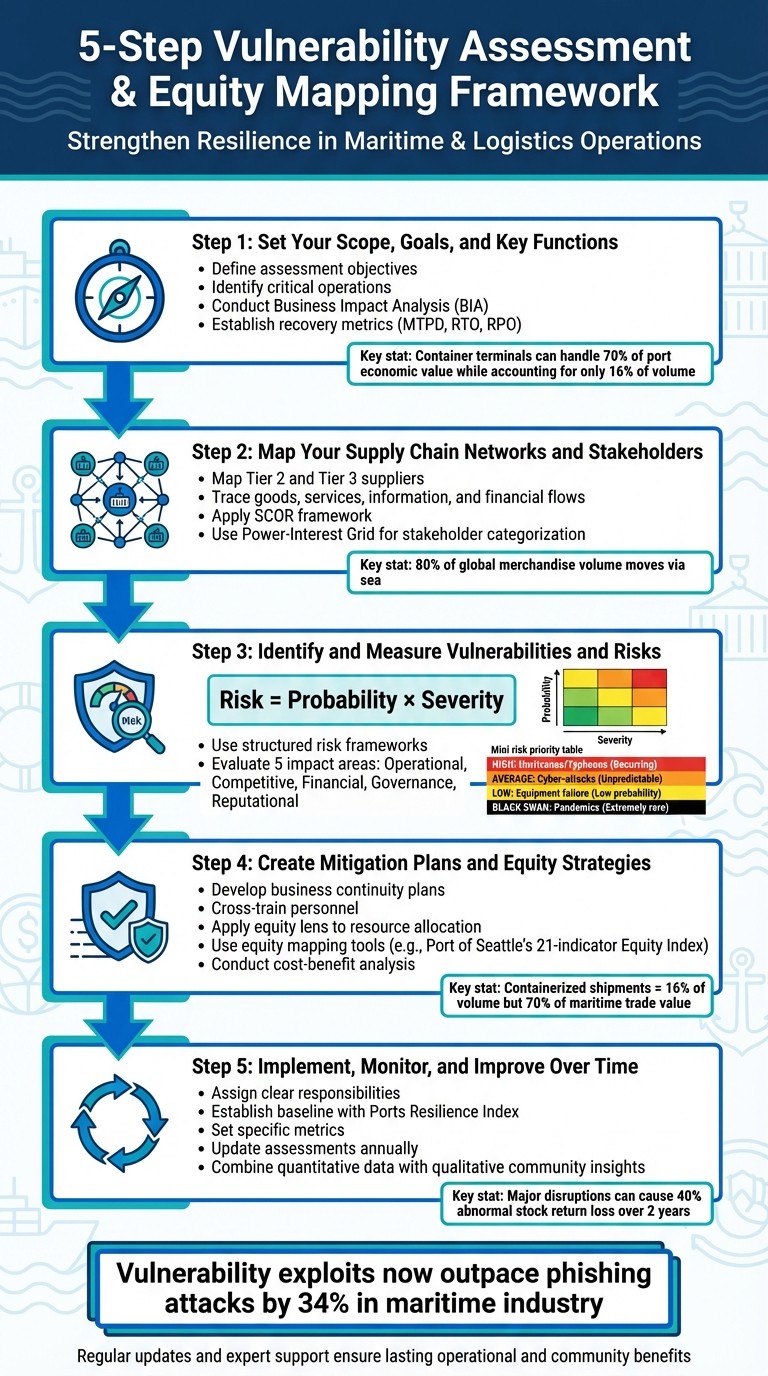
5-Step Vulnerability Assessment and Equity Mapping Process for Maritime Companies
Maritime Security Assessment
Step 1: Set Your Scope, Goals, and Key Functions
To start, define the boundaries of your evaluation by pinpointing essential operations and objectives. Identify the key assets you need to protect and establish the criteria for success. This clarity not only prevents overwhelm but also ensures you gain the support of stakeholders [3]. Once you’ve set these boundaries, you can move on to crafting precise objectives.
Define Your Assessment Objectives
Clarify your goals by setting objectives that address how uncertainty might impact various aspects of your operations - whether it’s operational, competitive, financial, governance-related, or reputational risks [1]. These categories highlight how a single disruption, such as a cyberattack targeting IT systems, can simultaneously lead to operational delays, financial setbacks, and damage to your reputation.
"Risks are generally defined in relation to the effect of uncertainty on objectives set. Risks can have an impact on a port's corporate objectives as well as on key dependencies, core processes, and stakeholder expectations."
UN Trade and Development (UNCTAD) [3]
Distinguish between risks that are predictable and those that arise suddenly by analyzing historical data and recent trends. Additionally, consider how equity factors will shape your prioritization of risks. Stakeholder expectations should also be a key part of this analysis [3].
Identify Your Critical Operations
With your objectives in place, the next step is to determine the critical operations that need protection. Conduct a Business Impact Analysis (BIA) to measure how disruptions might affect your ability to function over time. Use recovery metrics like Maximum Tolerable Period of Disruption (MTPD), Recovery Time Objective (RTO), and Recovery Point Objective (RPO) to establish benchmarks [3]. Focus on operations that generate substantial revenue or whose disruption would have severe consequences. For instance, if a container terminal handles 70% of your port's economic value while accounting for only 16% of its volume [6], it’s clearly a critical operation.
Quantify the potential impact of disruptions on these operations. For example, if your ship-to-shore crane operations cannot be down for more than 24 hours without significant financial losses, then 24 hours becomes your MTPD. These metrics not only justify the costs of resilience measures but also help you allocate resources more effectively.
Don’t forget to evaluate interdependencies with hinterland operators, logistics hubs, and third-party providers [3]. Ports often serve as single points of failure, meaning disruptions at your terminal can have far-reaching effects. For example, a disruption might cause ships to idle at anchor or lead to congestion at gates and rail yards [1][4]. A thorough assessment must account for these ripple effects to ensure a comprehensive risk strategy. By addressing both operational resilience and equity considerations, you can create a well-rounded approach to managing risks.
Step 2: Map Your Supply Chain Networks and Stakeholders
After defining your scope and identifying critical operations, the next move is to chart the entire landscape of your supply chain and the people it impacts. This requires tracing connections beyond your immediate partners to include Tier 2 and Tier 3 suppliers - those further down the chain who indirectly feed into your operations [10]. Gaining this broader understanding helps uncover hidden single-source dependencies that could lead to significant disruptions if overlooked.
Map Your Logistics Networks
Begin by creating a visual representation of how goods, services, information, and finances flow through your supply chain - from raw material sourcing to final distribution [7][10]. Include details about your physical infrastructure, such as ports, warehouses, and shipping routes. Considering that 80% of global merchandise volume moves via sea [9], maritime companies, in particular, should focus on vessel routes, port capacities, and the inland connections that link coastal terminals to distribution hubs.
Leverage the Supply Chain Operations Reference (SCOR) framework to check how well your internal mapping aligns with vessel compliance and planned schedules [8][9]. Additionally, map out the flow of specifications, orders, invoices, and payments [10]. This exercise helps identify information bottlenecks and financial dependencies. Use supplier surveys and procurement records to gather data [7], then visualize the results using flowcharts or mapping software [8][10].
Add Equity Mapping to Your Analysis
Once your logistics and digital flows are detailed, shift attention to the social and environmental aspects of your supply chain. Stakeholder mapping is a critical step here - identify the individuals and groups directly or indirectly affected by your operations. These might include local communities, government agencies, environmental organizations, and subcontractors [10]. The Power-Interest Grid can help categorize stakeholders into four groups: Manage Closely (High Power/High Interest), Keep Satisfied (High Power/Low Interest), Keep Informed (Low Power/High Interest), and Monitor (Low Power/Low Interest) [10].
To deepen your analysis, combine qualitative and quantitative methods. Start with a vulnerability spreadsheet that includes columns like Asset, Potential Impact, Sensitivity (High/Medium/Low), Adaptive Capacity (High/Medium/Low), and Vulnerability (High/Medium/Low) [2]. For a broader perspective, use geospatial tools such as FEMA's National Risk Index to assess exposure to 18 natural hazards and evaluate how communities within your operational footprint might face disproportionate risks [2]. This two-pronged approach ensures a balance between technical climate data and the social realities of the communities you impact [2][11]. Understanding these dynamics can help you anticipate how disruptions at your facilities might ripple through vulnerable populations.
Step 3: Identify and Measure Vulnerabilities and Risks
Once the mapping is complete, the next step is to identify specific threats that could disrupt your operations. This involves a detailed examination of both external threats - like hurricanes, cyber breaches, and geopolitical instability - and internal challenges such as outdated IT systems, equipment failures, or gaps in staff training. Using the mapped supply chain and stakeholder landscape as a foundation, you can now quantify these threats.
Use Risk Identification Frameworks
Start by applying a structured framework to categorize threats based on their nature and priority. For instance, maritime and logistics companies frequently face hazards like severe weather (hurricanes, typhoons) and geopolitical risks in economically vulnerable regions [1]. Cyber-attacks targeting IT systems that handle payroll, equipment monitoring, or terminal operations are another growing concern. Rare but highly disruptive "Black Swan" events, such as pandemics or global financial crises, can also heavily impact labor availability and financial stability.
To quantify risks, use the formula Risk = Probability × Severity. Then evaluate how these risks influence key areas, including:
Operational: Your ability to maintain service delivery.
Competitive: Your position in the market.
Financial: Revenue streams and credit ratings.
Governance: Management processes and oversight.
Reputational: Public perception of your organization.
A Business Impact Analysis (BIA) is instrumental in identifying critical internal dependencies, such as essential IT applications, key personnel, or manual processes that might fail during a disruption [3].
"Business Impact Analysis (BIA) is a fundamental first step in developing a port Business Continuity Management (BCM) system. It focuses on identifying the critical parts of port assets and operations that could be impacted and prioritizing BCM to protect these critical parts." - United Nations Conference on Trade and Development (UNCTAD) [3]
This systematic approach lays the groundwork for evaluating and prioritizing risks effectively.
Measure and Prioritize Your Risks
Once threats are identified, the next step is to measure and prioritize them. One effective tool is a 3×3 matrix that plots threats based on their probability and consequence [2]. Define timeframes for each risk - for example, "High" for events expected within five years and "Medium" for those likely in 5–20 years. Focus your resources on risks in the high-high or high-medium categories, as these represent the greatest threats to your operations and the communities you serve.
It’s also essential to recognize how risks can cascade through your network. For instance, a power outage at one terminal could disrupt vessel schedules across the shipping network, leading to delays or diversions. Similarly, a cyber-attack targeting outdated systems might simultaneously disrupt payroll and terminal operations, creating compounded challenges. When evaluating internal vulnerabilities, consider both the sensitivity of an asset (how much it is affected by a hazard) and its adaptive capacity (its ability to recover or adjust). Alongside financial costs, be sure to account for the social impacts on affected communities.
Vulnerability Comparison Table
Below is a summary of common vulnerabilities, categorized by priority, examples, likelihood, and context:
| Risk Priority | Hazard Example | Likelihood | Potential Impact | Maritime-Specific Context |
| --- | --- | --- | --- | --- |
| High | Hurricanes, Typhoons | Recurring/Predictable | Critical; can stop operations | Seasonal events in regions like the Caribbean and East Asia; may shut down ports for days |
| Average | Cyber-attacks | Reasonable but Unpredictable | Significant; disrupts IT and operations | Targets systems like payroll and terminal management |
| Low | Equipment failure, minor accidents | Low/Unpredictable | Marginal; usually limited impact | Can strain remaining systems but is manageable with proper maintenance |
| Black Swan | Pandemics, Global Financial Crises | Extremely Rare/Unpredictable | Substantial; systemic disruptions | Events like COVID-19 heavily impacted labor and financial capacity
| Risk Priority | Hazard Example | Likelihood | Potential Impact | Maritime-Specific Context |
| --- | --- | --- | --- | --- |
| High | Hurricanes, Typhoons | Recurring/Predictable | Critical; can stop operations | Seasonal events in regions like the Caribbean and East Asia; may shut down ports for days |
| Average | Cyber-attacks | Reasonable but Unpredictable | Significant; disrupts IT and operations | Targets systems like payroll and terminal management |
| Low | Equipment failure, minor accidents | Low/Unpredictable | Marginal; usually limited impact | Can strain remaining systems but is manageable with proper maintenance |
| Black Swan | Pandemics, Global Financial Crises | Extremely Rare/Unpredictable | Substantial; systemic disruptions | Events like COVID-19 heavily impacted labor and financial capacity
Step 4: Create Mitigation Plans and Equity Strategies
Once risks have been prioritized, the next step is to turn your findings into actionable plans that enhance operational stability while addressing social and environmental challenges.
Apply Risk Mitigation Techniques
Align your mitigation efforts with the risks that pose the greatest threat. For high-probability, high-severity risks - such as hurricanes or cyber-attacks - develop comprehensive business continuity and crisis management plans. These plans should aim to minimize both the likelihood of disruptions and their potential impact. For example, you could strengthen cybersecurity measures for terminal operations and payroll systems or establish manual workarounds for critical IT-dependent processes to keep operations running during outages [3].
To tackle cascading disruptions - like a power outage leading to ship diversions and congestion - consider spreading functional teams across multiple locations, cross-training key personnel, and maintaining updated contact lists for essential staff [3]. This approach ensures that the failure of a single facility won't cripple an entire business function.
It's also important to define and track recovery metrics to assess how well your mitigation strategies are working [3]. For risks with lower priority, standard operating procedures may suffice without the need for dedicated continuity plans [3].
These measures lay the groundwork for incorporating equity-focused solutions into your broader risk management framework.
Build Equity-Centered Plans
Equity mapping can identify communities disproportionately affected by your operations, whether through pollution, limited economic opportunities, or restricted access to essential services. Use this data to guide decisions on resource allocation and policies. For instance, the Port of Seattle introduced an interactive Equity Index tool in November 2021. This tool uses 21 indicators across categories like Accessibility, Economy, Environment, and Livability to pinpoint areas with high pollution and low economic opportunities, helping the Port allocate funding and noise mitigation efforts more effectively [12].
Go beyond basic outreach by engaging stakeholders in ways that are meaningful and inclusive, ensuring community members have a voice in decision-making processes [13]. Apply an "equity lens" during planning by asking critical questions: Does this project address or exacerbate existing disparities? Who benefits, and who might face negative impacts? Data shows that nearly half of an individual's wellbeing is tied to their zip code [12], highlighting the importance of geographic context in equitable planning.
Direct resources - such as noise monitors, vaccination sites, or job training programs - toward historically underserved communities identified through equity analysis [12]. This kind of equity-driven approach has been shown to save costs, improve efficiency, and strengthen relationships with local communities [13].
Evaluate Costs and Benefits
After defining your mitigation and equity strategies, it’s essential to assess their value and justify the associated investments.
A Business Impact Analysis (BIA) can help quantify the effects of disruptions on your operations over time, supporting the case for resilience investments [3]. This analysis should consider factors like direct revenue losses, increased operational costs, insurance rate changes, credit rating impacts, and the implementation costs of mitigation measures [1]. Beyond financial metrics, include the protection of human life, reduction of environmental harm, and preservation of your reputation [3][1].
"The cost implications of disruptions at a port are such that there is a substantial return to be made on appropriate resilience investments." - UNCTAD [4]
Take into account both first-order disruptions, such as direct damage to infrastructure, and second-order effects, like delayed ships or rerouted cargo [1]. Although containerized shipments make up only about 16% of global maritime trade by volume, they represent over 70% of its total value [6]. Even brief interruptions can lead to significant financial losses. Use a severity and probability matrix to prioritize investments, focusing resources where they will have the greatest impact [3]. Revisit and update your cost-benefit analyses annually or whenever significant changes occur, such as updates to IT systems, shifts in key personnel, or changes in suppliers [3].
Step 5: Implement, Monitor, and Improve Over Time
Once your mitigation and equity strategies are in place, the next step is turning plans into action. This requires clear roles, consistent tracking, and the flexibility to adapt as circumstances evolve.
Implement Risk Mitigation Protocols
Assign specific responsibilities for each mitigation measure to ensure accountability. Integrate these protocols into daily operations rather than treating them as standalone efforts. For instance, if your strategy involves cross-training staff to manage manual processes during IT outages, make it part of regular training schedules and include these procedures in your standard operating manuals.
Start with the most critical risks - those with severe consequences and a high likelihood of occurrence, such as recurring hurricanes in the Caribbean or Gulf Coast regions [1]. Address both the immediate and cascading effects of these risks. Monitor performance across key areas, including operations, finances, governance, reputation, and competitive positioning. This phase establishes the groundwork for ongoing refinement and improvement.
Set Up Continuous Monitoring Systems
After implementation, continuous monitoring ensures your measures remain effective over time. Begin by establishing a baseline using tools that assess your current preparedness. For example, the Ports Resilience Index can help pinpoint strengths and weaknesses, providing a foundation for tracking progress toward resilience goals [5]. Define specific metrics early on - such as gate wait times, yard operation efficiency, or the reach of equity programs - to evaluate the success of your actions [15].
Reassess risks periodically as conditions shift. Use tools like an asset spreadsheet to track changes, including columns for factors such as potential impact, sensitivity, adaptive capacity, and vulnerability (rated as High, Medium, or Low) [2]. For equity initiatives, combine quantitative data, like hazard maps and property values, with qualitative insights that reflect community needs.
"Quantitative information about physical assets needs to be complemented by social awareness and a commitment to serve the entire community." - U.S. Climate Resilience Toolkit [11]
Update your assessments annually or after major changes, such as the introduction of new IT systems, staff turnover, or supplier updates. Prepare for rare but high-impact "Black Swan" events by adopting flexible risk management frameworks that account for uncertainties [1]. Use standardized probability rules - for example, "High Probability" for events likely within five years and "Medium Probability" for events expected once every five to twenty years - to ensure risks are categorized consistently [2].
Work with Council Fire for Expert Support
Implementing and monitoring these strategies can be complex, especially when balancing technical data with community needs. Many organizations turn to experts for guidance. Hiring adaptation practitioners or engineering firms can help document critical issues and ensure that resilience plans address practical challenges.
Council Fire offers specialized support for climate resilience planning and stakeholder engagement, particularly for maritime and logistics sectors. By translating sustainability goals into actionable strategies, Council Fire helps organizations achieve system-level outcomes that go beyond compliance. Whether it’s conducting vulnerability assessments, engaging with communities, or setting up monitoring systems, their expertise ensures your mitigation and equity efforts deliver meaningful environmental, social, and economic outcomes.
Conclusion: Key Takeaways for Maritime and Logistics Companies
Vulnerability assessments and equity mapping are essential tools for strengthening the resilience of your operations and the communities you serve. It all begins with setting clear objectives and identifying the critical functions of your business. From there, mapping your logistics networks alongside social equity factors allows you to gain a comprehensive view of potential risks. By using structured risk measurement, you can prioritize vulnerabilities based on reliable data rather than assumptions. Considering that over 80% of global trade moves by ship, understanding how disruptions ripple through your network - from ports to the surrounding regions - is crucial for maintaining stability and competitiveness [14].
Incorporating equity mapping into your strategy ensures that your mitigation efforts go beyond financial considerations. For example, a disruption at a port doesn’t just halt goods - it can significantly impact local communities. By balancing hard data on hazards with an awareness of social factors, your resilience plans can support both your operations and the well-being of the people affected. Ignoring this balance can have serious repercussions: studies show that major supply chain disruptions can result in a 40% abnormal stock return loss over two years and a 13.5% increase in equity risk in the following year [14]. These assessments require regular updates to reflect changing risks and conditions.
Annual updates to your Business Impact Analyses are critical as systems evolve, suppliers change, or teams experience turnover. The maritime industry faces an ever-changing risk landscape, with vulnerability exploits now outpacing phishing attacks by 34% [16]. Your monitoring systems need to account for both gradual risks, like climate change, and sudden, unpredictable "Black Swan" events that fall outside normal expectations.
Navigating these complexities often requires expert guidance. Council Fire offers specialized support to help maritime and logistics companies turn sustainability and resilience goals into practical strategies. Their expertise in climate resilience planning, stakeholder collaboration, and systems thinking can help you achieve meaningful environmental, social, and economic outcomes. Whether you're conducting your first vulnerability assessment or fine-tuning an existing process, working with experts ensures that your efforts create lasting benefits for both your operations and the communities you impact. This comprehensive approach, combining technical risk management with equity considerations, reflects the framework outlined above.
FAQs
How does equity mapping help maritime companies manage risks more effectively?
Equity mapping offers maritime companies a powerful tool for risk management by pinpointing social and environmental imbalances that could affect their operations. By identifying these disparities, businesses can better connect with stakeholders and craft strategies tailored to address vulnerabilities within the communities they interact with.
This method enhances resilience while promoting fairness and long-term responsibility, ensuring that risk management practices are thorough and considerate of all affected parties.
What are the main steps to conduct a vulnerability assessment for maritime and logistics operations?
Conducting a vulnerability assessment for maritime and logistics operations requires a thorough look at potential risks to critical assets and the development of strategies to improve resilience. The process begins with identifying key assets and functions - think port facilities, transportation networks, and cargo systems - and understanding how these components function under normal conditions.
The next step involves analyzing dependencies and pinpointing potential failure points. This helps reveal vulnerabilities that might otherwise go unnoticed. From there, it's essential to evaluate a range of threats, whether they stem from natural disasters, cybersecurity breaches, or disruptions in the supply chain. To prioritize risks effectively, tools like probability-impact models can be particularly useful, helping to weigh the likelihood of each threat against its potential impact.
Once vulnerabilities are identified and ranked, the focus shifts to creating a practical action plan. This should include input from key stakeholders to ensure the strategies are both comprehensive and actionable. Continuous feedback and refinement of the plan are critical to maintaining and strengthening operational resilience over time.
Why is it essential to regularly update risk assessments in the maritime industry?
Regular updates to risk assessments play a vital role in the maritime industry, helping companies tackle emerging threats like cybersecurity issues, climate-related challenges, and operational disruptions. By taking a proactive approach, organizations can pinpoint vulnerabilities early, put effective mitigation plans in place, and strengthen their overall resilience.
Consistently revisiting these assessments also ensures regulatory compliance, keeps pace with industry developments, and builds trust with stakeholders. This ongoing effort enables businesses to remain ready for unforeseen events while supporting safer and more reliable operations.
Related Blog Posts
How to Build a Climate Resilience Plan for Maritime & Logistics Companies
How to Integrate Climate Risk into Infrastructure Planning for Maritime & Logistics Companies
How to Conduct Vulnerability Assessment & Equity Mapping for Municipalities & Government Agencies
How to Conduct Vulnerability Assessment & Equity Mapping for Corporations
Latest Articles
©2025



FAQ
01
What does it really mean to “redefine profit”?
02
What makes Council Fire different?
03
Who does Council Fire you work with?
04
What does working with Council Fire actually look like?
05
How does Council Fire help organizations turn big goals into action?
06
How does Council Fire define and measure success?
Jan 27, 2026
How to Conduct Vulnerability Assessment & Equity Mapping for Maritime & Logistics Companies
ESG Strategy
In This Article
Assess vulnerabilities, map supply chains and equity impacts, and build mitigation plans to strengthen maritime and logistics resilience.
How to Conduct Vulnerability Assessment & Equity Mapping for Maritime & Logistics Companies
Maritime and logistics companies face risks like extreme weather, cyberattacks, and equipment failures that can disrupt global supply chains. Addressing these challenges requires identifying critical assets, evaluating risks, and including social considerations through equity mapping. Neglecting these factors can lead to operational delays, financial losses, and community backlash.
Here’s how you can strengthen resilience:
Define Scope and Objectives: Pinpoint key operations and set clear goals to address potential disruptions.
Map Supply Chains and Stakeholders: Trace logistics networks and assess their impact on communities and the environment.
Identify and Measure Risks: Use structured frameworks to prioritize threats based on their likelihood and severity.
Create Mitigation Plans: Develop strategies to reduce risks and address community concerns, such as pollution or economic disparities.
Monitor and Improve: Regularly update risk assessments and refine plans as conditions change.
This approach integrates technical evaluations with social equity, ensuring both operational stability and community well-being. By combining risk management with equity mapping, maritime companies can avoid costly disruptions and build trust with stakeholders.
5-Step Vulnerability Assessment and Equity Mapping Process for Maritime Companies
Maritime Security Assessment
Step 1: Set Your Scope, Goals, and Key Functions
To start, define the boundaries of your evaluation by pinpointing essential operations and objectives. Identify the key assets you need to protect and establish the criteria for success. This clarity not only prevents overwhelm but also ensures you gain the support of stakeholders [3]. Once you’ve set these boundaries, you can move on to crafting precise objectives.
Define Your Assessment Objectives
Clarify your goals by setting objectives that address how uncertainty might impact various aspects of your operations - whether it’s operational, competitive, financial, governance-related, or reputational risks [1]. These categories highlight how a single disruption, such as a cyberattack targeting IT systems, can simultaneously lead to operational delays, financial setbacks, and damage to your reputation.
"Risks are generally defined in relation to the effect of uncertainty on objectives set. Risks can have an impact on a port's corporate objectives as well as on key dependencies, core processes, and stakeholder expectations."
UN Trade and Development (UNCTAD) [3]
Distinguish between risks that are predictable and those that arise suddenly by analyzing historical data and recent trends. Additionally, consider how equity factors will shape your prioritization of risks. Stakeholder expectations should also be a key part of this analysis [3].
Identify Your Critical Operations
With your objectives in place, the next step is to determine the critical operations that need protection. Conduct a Business Impact Analysis (BIA) to measure how disruptions might affect your ability to function over time. Use recovery metrics like Maximum Tolerable Period of Disruption (MTPD), Recovery Time Objective (RTO), and Recovery Point Objective (RPO) to establish benchmarks [3]. Focus on operations that generate substantial revenue or whose disruption would have severe consequences. For instance, if a container terminal handles 70% of your port's economic value while accounting for only 16% of its volume [6], it’s clearly a critical operation.
Quantify the potential impact of disruptions on these operations. For example, if your ship-to-shore crane operations cannot be down for more than 24 hours without significant financial losses, then 24 hours becomes your MTPD. These metrics not only justify the costs of resilience measures but also help you allocate resources more effectively.
Don’t forget to evaluate interdependencies with hinterland operators, logistics hubs, and third-party providers [3]. Ports often serve as single points of failure, meaning disruptions at your terminal can have far-reaching effects. For example, a disruption might cause ships to idle at anchor or lead to congestion at gates and rail yards [1][4]. A thorough assessment must account for these ripple effects to ensure a comprehensive risk strategy. By addressing both operational resilience and equity considerations, you can create a well-rounded approach to managing risks.
Step 2: Map Your Supply Chain Networks and Stakeholders
After defining your scope and identifying critical operations, the next move is to chart the entire landscape of your supply chain and the people it impacts. This requires tracing connections beyond your immediate partners to include Tier 2 and Tier 3 suppliers - those further down the chain who indirectly feed into your operations [10]. Gaining this broader understanding helps uncover hidden single-source dependencies that could lead to significant disruptions if overlooked.
Map Your Logistics Networks
Begin by creating a visual representation of how goods, services, information, and finances flow through your supply chain - from raw material sourcing to final distribution [7][10]. Include details about your physical infrastructure, such as ports, warehouses, and shipping routes. Considering that 80% of global merchandise volume moves via sea [9], maritime companies, in particular, should focus on vessel routes, port capacities, and the inland connections that link coastal terminals to distribution hubs.
Leverage the Supply Chain Operations Reference (SCOR) framework to check how well your internal mapping aligns with vessel compliance and planned schedules [8][9]. Additionally, map out the flow of specifications, orders, invoices, and payments [10]. This exercise helps identify information bottlenecks and financial dependencies. Use supplier surveys and procurement records to gather data [7], then visualize the results using flowcharts or mapping software [8][10].
Add Equity Mapping to Your Analysis
Once your logistics and digital flows are detailed, shift attention to the social and environmental aspects of your supply chain. Stakeholder mapping is a critical step here - identify the individuals and groups directly or indirectly affected by your operations. These might include local communities, government agencies, environmental organizations, and subcontractors [10]. The Power-Interest Grid can help categorize stakeholders into four groups: Manage Closely (High Power/High Interest), Keep Satisfied (High Power/Low Interest), Keep Informed (Low Power/High Interest), and Monitor (Low Power/Low Interest) [10].
To deepen your analysis, combine qualitative and quantitative methods. Start with a vulnerability spreadsheet that includes columns like Asset, Potential Impact, Sensitivity (High/Medium/Low), Adaptive Capacity (High/Medium/Low), and Vulnerability (High/Medium/Low) [2]. For a broader perspective, use geospatial tools such as FEMA's National Risk Index to assess exposure to 18 natural hazards and evaluate how communities within your operational footprint might face disproportionate risks [2]. This two-pronged approach ensures a balance between technical climate data and the social realities of the communities you impact [2][11]. Understanding these dynamics can help you anticipate how disruptions at your facilities might ripple through vulnerable populations.
Step 3: Identify and Measure Vulnerabilities and Risks
Once the mapping is complete, the next step is to identify specific threats that could disrupt your operations. This involves a detailed examination of both external threats - like hurricanes, cyber breaches, and geopolitical instability - and internal challenges such as outdated IT systems, equipment failures, or gaps in staff training. Using the mapped supply chain and stakeholder landscape as a foundation, you can now quantify these threats.
Use Risk Identification Frameworks
Start by applying a structured framework to categorize threats based on their nature and priority. For instance, maritime and logistics companies frequently face hazards like severe weather (hurricanes, typhoons) and geopolitical risks in economically vulnerable regions [1]. Cyber-attacks targeting IT systems that handle payroll, equipment monitoring, or terminal operations are another growing concern. Rare but highly disruptive "Black Swan" events, such as pandemics or global financial crises, can also heavily impact labor availability and financial stability.
To quantify risks, use the formula Risk = Probability × Severity. Then evaluate how these risks influence key areas, including:
Operational: Your ability to maintain service delivery.
Competitive: Your position in the market.
Financial: Revenue streams and credit ratings.
Governance: Management processes and oversight.
Reputational: Public perception of your organization.
A Business Impact Analysis (BIA) is instrumental in identifying critical internal dependencies, such as essential IT applications, key personnel, or manual processes that might fail during a disruption [3].
"Business Impact Analysis (BIA) is a fundamental first step in developing a port Business Continuity Management (BCM) system. It focuses on identifying the critical parts of port assets and operations that could be impacted and prioritizing BCM to protect these critical parts." - United Nations Conference on Trade and Development (UNCTAD) [3]
This systematic approach lays the groundwork for evaluating and prioritizing risks effectively.
Measure and Prioritize Your Risks
Once threats are identified, the next step is to measure and prioritize them. One effective tool is a 3×3 matrix that plots threats based on their probability and consequence [2]. Define timeframes for each risk - for example, "High" for events expected within five years and "Medium" for those likely in 5–20 years. Focus your resources on risks in the high-high or high-medium categories, as these represent the greatest threats to your operations and the communities you serve.
It’s also essential to recognize how risks can cascade through your network. For instance, a power outage at one terminal could disrupt vessel schedules across the shipping network, leading to delays or diversions. Similarly, a cyber-attack targeting outdated systems might simultaneously disrupt payroll and terminal operations, creating compounded challenges. When evaluating internal vulnerabilities, consider both the sensitivity of an asset (how much it is affected by a hazard) and its adaptive capacity (its ability to recover or adjust). Alongside financial costs, be sure to account for the social impacts on affected communities.
Vulnerability Comparison Table
Below is a summary of common vulnerabilities, categorized by priority, examples, likelihood, and context:
| Risk Priority | Hazard Example | Likelihood | Potential Impact | Maritime-Specific Context |
| --- | --- | --- | --- | --- |
| High | Hurricanes, Typhoons | Recurring/Predictable | Critical; can stop operations | Seasonal events in regions like the Caribbean and East Asia; may shut down ports for days |
| Average | Cyber-attacks | Reasonable but Unpredictable | Significant; disrupts IT and operations | Targets systems like payroll and terminal management |
| Low | Equipment failure, minor accidents | Low/Unpredictable | Marginal; usually limited impact | Can strain remaining systems but is manageable with proper maintenance |
| Black Swan | Pandemics, Global Financial Crises | Extremely Rare/Unpredictable | Substantial; systemic disruptions | Events like COVID-19 heavily impacted labor and financial capacity
Step 4: Create Mitigation Plans and Equity Strategies
Once risks have been prioritized, the next step is to turn your findings into actionable plans that enhance operational stability while addressing social and environmental challenges.
Apply Risk Mitigation Techniques
Align your mitigation efforts with the risks that pose the greatest threat. For high-probability, high-severity risks - such as hurricanes or cyber-attacks - develop comprehensive business continuity and crisis management plans. These plans should aim to minimize both the likelihood of disruptions and their potential impact. For example, you could strengthen cybersecurity measures for terminal operations and payroll systems or establish manual workarounds for critical IT-dependent processes to keep operations running during outages [3].
To tackle cascading disruptions - like a power outage leading to ship diversions and congestion - consider spreading functional teams across multiple locations, cross-training key personnel, and maintaining updated contact lists for essential staff [3]. This approach ensures that the failure of a single facility won't cripple an entire business function.
It's also important to define and track recovery metrics to assess how well your mitigation strategies are working [3]. For risks with lower priority, standard operating procedures may suffice without the need for dedicated continuity plans [3].
These measures lay the groundwork for incorporating equity-focused solutions into your broader risk management framework.
Build Equity-Centered Plans
Equity mapping can identify communities disproportionately affected by your operations, whether through pollution, limited economic opportunities, or restricted access to essential services. Use this data to guide decisions on resource allocation and policies. For instance, the Port of Seattle introduced an interactive Equity Index tool in November 2021. This tool uses 21 indicators across categories like Accessibility, Economy, Environment, and Livability to pinpoint areas with high pollution and low economic opportunities, helping the Port allocate funding and noise mitigation efforts more effectively [12].
Go beyond basic outreach by engaging stakeholders in ways that are meaningful and inclusive, ensuring community members have a voice in decision-making processes [13]. Apply an "equity lens" during planning by asking critical questions: Does this project address or exacerbate existing disparities? Who benefits, and who might face negative impacts? Data shows that nearly half of an individual's wellbeing is tied to their zip code [12], highlighting the importance of geographic context in equitable planning.
Direct resources - such as noise monitors, vaccination sites, or job training programs - toward historically underserved communities identified through equity analysis [12]. This kind of equity-driven approach has been shown to save costs, improve efficiency, and strengthen relationships with local communities [13].
Evaluate Costs and Benefits
After defining your mitigation and equity strategies, it’s essential to assess their value and justify the associated investments.
A Business Impact Analysis (BIA) can help quantify the effects of disruptions on your operations over time, supporting the case for resilience investments [3]. This analysis should consider factors like direct revenue losses, increased operational costs, insurance rate changes, credit rating impacts, and the implementation costs of mitigation measures [1]. Beyond financial metrics, include the protection of human life, reduction of environmental harm, and preservation of your reputation [3][1].
"The cost implications of disruptions at a port are such that there is a substantial return to be made on appropriate resilience investments." - UNCTAD [4]
Take into account both first-order disruptions, such as direct damage to infrastructure, and second-order effects, like delayed ships or rerouted cargo [1]. Although containerized shipments make up only about 16% of global maritime trade by volume, they represent over 70% of its total value [6]. Even brief interruptions can lead to significant financial losses. Use a severity and probability matrix to prioritize investments, focusing resources where they will have the greatest impact [3]. Revisit and update your cost-benefit analyses annually or whenever significant changes occur, such as updates to IT systems, shifts in key personnel, or changes in suppliers [3].
Step 5: Implement, Monitor, and Improve Over Time
Once your mitigation and equity strategies are in place, the next step is turning plans into action. This requires clear roles, consistent tracking, and the flexibility to adapt as circumstances evolve.
Implement Risk Mitigation Protocols
Assign specific responsibilities for each mitigation measure to ensure accountability. Integrate these protocols into daily operations rather than treating them as standalone efforts. For instance, if your strategy involves cross-training staff to manage manual processes during IT outages, make it part of regular training schedules and include these procedures in your standard operating manuals.
Start with the most critical risks - those with severe consequences and a high likelihood of occurrence, such as recurring hurricanes in the Caribbean or Gulf Coast regions [1]. Address both the immediate and cascading effects of these risks. Monitor performance across key areas, including operations, finances, governance, reputation, and competitive positioning. This phase establishes the groundwork for ongoing refinement and improvement.
Set Up Continuous Monitoring Systems
After implementation, continuous monitoring ensures your measures remain effective over time. Begin by establishing a baseline using tools that assess your current preparedness. For example, the Ports Resilience Index can help pinpoint strengths and weaknesses, providing a foundation for tracking progress toward resilience goals [5]. Define specific metrics early on - such as gate wait times, yard operation efficiency, or the reach of equity programs - to evaluate the success of your actions [15].
Reassess risks periodically as conditions shift. Use tools like an asset spreadsheet to track changes, including columns for factors such as potential impact, sensitivity, adaptive capacity, and vulnerability (rated as High, Medium, or Low) [2]. For equity initiatives, combine quantitative data, like hazard maps and property values, with qualitative insights that reflect community needs.
"Quantitative information about physical assets needs to be complemented by social awareness and a commitment to serve the entire community." - U.S. Climate Resilience Toolkit [11]
Update your assessments annually or after major changes, such as the introduction of new IT systems, staff turnover, or supplier updates. Prepare for rare but high-impact "Black Swan" events by adopting flexible risk management frameworks that account for uncertainties [1]. Use standardized probability rules - for example, "High Probability" for events likely within five years and "Medium Probability" for events expected once every five to twenty years - to ensure risks are categorized consistently [2].
Work with Council Fire for Expert Support
Implementing and monitoring these strategies can be complex, especially when balancing technical data with community needs. Many organizations turn to experts for guidance. Hiring adaptation practitioners or engineering firms can help document critical issues and ensure that resilience plans address practical challenges.
Council Fire offers specialized support for climate resilience planning and stakeholder engagement, particularly for maritime and logistics sectors. By translating sustainability goals into actionable strategies, Council Fire helps organizations achieve system-level outcomes that go beyond compliance. Whether it’s conducting vulnerability assessments, engaging with communities, or setting up monitoring systems, their expertise ensures your mitigation and equity efforts deliver meaningful environmental, social, and economic outcomes.
Conclusion: Key Takeaways for Maritime and Logistics Companies
Vulnerability assessments and equity mapping are essential tools for strengthening the resilience of your operations and the communities you serve. It all begins with setting clear objectives and identifying the critical functions of your business. From there, mapping your logistics networks alongside social equity factors allows you to gain a comprehensive view of potential risks. By using structured risk measurement, you can prioritize vulnerabilities based on reliable data rather than assumptions. Considering that over 80% of global trade moves by ship, understanding how disruptions ripple through your network - from ports to the surrounding regions - is crucial for maintaining stability and competitiveness [14].
Incorporating equity mapping into your strategy ensures that your mitigation efforts go beyond financial considerations. For example, a disruption at a port doesn’t just halt goods - it can significantly impact local communities. By balancing hard data on hazards with an awareness of social factors, your resilience plans can support both your operations and the well-being of the people affected. Ignoring this balance can have serious repercussions: studies show that major supply chain disruptions can result in a 40% abnormal stock return loss over two years and a 13.5% increase in equity risk in the following year [14]. These assessments require regular updates to reflect changing risks and conditions.
Annual updates to your Business Impact Analyses are critical as systems evolve, suppliers change, or teams experience turnover. The maritime industry faces an ever-changing risk landscape, with vulnerability exploits now outpacing phishing attacks by 34% [16]. Your monitoring systems need to account for both gradual risks, like climate change, and sudden, unpredictable "Black Swan" events that fall outside normal expectations.
Navigating these complexities often requires expert guidance. Council Fire offers specialized support to help maritime and logistics companies turn sustainability and resilience goals into practical strategies. Their expertise in climate resilience planning, stakeholder collaboration, and systems thinking can help you achieve meaningful environmental, social, and economic outcomes. Whether you're conducting your first vulnerability assessment or fine-tuning an existing process, working with experts ensures that your efforts create lasting benefits for both your operations and the communities you impact. This comprehensive approach, combining technical risk management with equity considerations, reflects the framework outlined above.
FAQs
How does equity mapping help maritime companies manage risks more effectively?
Equity mapping offers maritime companies a powerful tool for risk management by pinpointing social and environmental imbalances that could affect their operations. By identifying these disparities, businesses can better connect with stakeholders and craft strategies tailored to address vulnerabilities within the communities they interact with.
This method enhances resilience while promoting fairness and long-term responsibility, ensuring that risk management practices are thorough and considerate of all affected parties.
What are the main steps to conduct a vulnerability assessment for maritime and logistics operations?
Conducting a vulnerability assessment for maritime and logistics operations requires a thorough look at potential risks to critical assets and the development of strategies to improve resilience. The process begins with identifying key assets and functions - think port facilities, transportation networks, and cargo systems - and understanding how these components function under normal conditions.
The next step involves analyzing dependencies and pinpointing potential failure points. This helps reveal vulnerabilities that might otherwise go unnoticed. From there, it's essential to evaluate a range of threats, whether they stem from natural disasters, cybersecurity breaches, or disruptions in the supply chain. To prioritize risks effectively, tools like probability-impact models can be particularly useful, helping to weigh the likelihood of each threat against its potential impact.
Once vulnerabilities are identified and ranked, the focus shifts to creating a practical action plan. This should include input from key stakeholders to ensure the strategies are both comprehensive and actionable. Continuous feedback and refinement of the plan are critical to maintaining and strengthening operational resilience over time.
Why is it essential to regularly update risk assessments in the maritime industry?
Regular updates to risk assessments play a vital role in the maritime industry, helping companies tackle emerging threats like cybersecurity issues, climate-related challenges, and operational disruptions. By taking a proactive approach, organizations can pinpoint vulnerabilities early, put effective mitigation plans in place, and strengthen their overall resilience.
Consistently revisiting these assessments also ensures regulatory compliance, keeps pace with industry developments, and builds trust with stakeholders. This ongoing effort enables businesses to remain ready for unforeseen events while supporting safer and more reliable operations.
Related Blog Posts
How to Build a Climate Resilience Plan for Maritime & Logistics Companies
How to Integrate Climate Risk into Infrastructure Planning for Maritime & Logistics Companies
How to Conduct Vulnerability Assessment & Equity Mapping for Municipalities & Government Agencies
How to Conduct Vulnerability Assessment & Equity Mapping for Corporations
FAQ
01
What does it really mean to “redefine profit”?
02
What makes Council Fire different?
03
Who does Council Fire you work with?
04
What does working with Council Fire actually look like?
05
How does Council Fire help organizations turn big goals into action?
06
How does Council Fire define and measure success?
Jan 27, 2026
How to Conduct Vulnerability Assessment & Equity Mapping for Maritime & Logistics Companies
ESG Strategy
In This Article
Assess vulnerabilities, map supply chains and equity impacts, and build mitigation plans to strengthen maritime and logistics resilience.
How to Conduct Vulnerability Assessment & Equity Mapping for Maritime & Logistics Companies
Maritime and logistics companies face risks like extreme weather, cyberattacks, and equipment failures that can disrupt global supply chains. Addressing these challenges requires identifying critical assets, evaluating risks, and including social considerations through equity mapping. Neglecting these factors can lead to operational delays, financial losses, and community backlash.
Here’s how you can strengthen resilience:
Define Scope and Objectives: Pinpoint key operations and set clear goals to address potential disruptions.
Map Supply Chains and Stakeholders: Trace logistics networks and assess their impact on communities and the environment.
Identify and Measure Risks: Use structured frameworks to prioritize threats based on their likelihood and severity.
Create Mitigation Plans: Develop strategies to reduce risks and address community concerns, such as pollution or economic disparities.
Monitor and Improve: Regularly update risk assessments and refine plans as conditions change.
This approach integrates technical evaluations with social equity, ensuring both operational stability and community well-being. By combining risk management with equity mapping, maritime companies can avoid costly disruptions and build trust with stakeholders.
5-Step Vulnerability Assessment and Equity Mapping Process for Maritime Companies
Maritime Security Assessment
Step 1: Set Your Scope, Goals, and Key Functions
To start, define the boundaries of your evaluation by pinpointing essential operations and objectives. Identify the key assets you need to protect and establish the criteria for success. This clarity not only prevents overwhelm but also ensures you gain the support of stakeholders [3]. Once you’ve set these boundaries, you can move on to crafting precise objectives.
Define Your Assessment Objectives
Clarify your goals by setting objectives that address how uncertainty might impact various aspects of your operations - whether it’s operational, competitive, financial, governance-related, or reputational risks [1]. These categories highlight how a single disruption, such as a cyberattack targeting IT systems, can simultaneously lead to operational delays, financial setbacks, and damage to your reputation.
"Risks are generally defined in relation to the effect of uncertainty on objectives set. Risks can have an impact on a port's corporate objectives as well as on key dependencies, core processes, and stakeholder expectations."
UN Trade and Development (UNCTAD) [3]
Distinguish between risks that are predictable and those that arise suddenly by analyzing historical data and recent trends. Additionally, consider how equity factors will shape your prioritization of risks. Stakeholder expectations should also be a key part of this analysis [3].
Identify Your Critical Operations
With your objectives in place, the next step is to determine the critical operations that need protection. Conduct a Business Impact Analysis (BIA) to measure how disruptions might affect your ability to function over time. Use recovery metrics like Maximum Tolerable Period of Disruption (MTPD), Recovery Time Objective (RTO), and Recovery Point Objective (RPO) to establish benchmarks [3]. Focus on operations that generate substantial revenue or whose disruption would have severe consequences. For instance, if a container terminal handles 70% of your port's economic value while accounting for only 16% of its volume [6], it’s clearly a critical operation.
Quantify the potential impact of disruptions on these operations. For example, if your ship-to-shore crane operations cannot be down for more than 24 hours without significant financial losses, then 24 hours becomes your MTPD. These metrics not only justify the costs of resilience measures but also help you allocate resources more effectively.
Don’t forget to evaluate interdependencies with hinterland operators, logistics hubs, and third-party providers [3]. Ports often serve as single points of failure, meaning disruptions at your terminal can have far-reaching effects. For example, a disruption might cause ships to idle at anchor or lead to congestion at gates and rail yards [1][4]. A thorough assessment must account for these ripple effects to ensure a comprehensive risk strategy. By addressing both operational resilience and equity considerations, you can create a well-rounded approach to managing risks.
Step 2: Map Your Supply Chain Networks and Stakeholders
After defining your scope and identifying critical operations, the next move is to chart the entire landscape of your supply chain and the people it impacts. This requires tracing connections beyond your immediate partners to include Tier 2 and Tier 3 suppliers - those further down the chain who indirectly feed into your operations [10]. Gaining this broader understanding helps uncover hidden single-source dependencies that could lead to significant disruptions if overlooked.
Map Your Logistics Networks
Begin by creating a visual representation of how goods, services, information, and finances flow through your supply chain - from raw material sourcing to final distribution [7][10]. Include details about your physical infrastructure, such as ports, warehouses, and shipping routes. Considering that 80% of global merchandise volume moves via sea [9], maritime companies, in particular, should focus on vessel routes, port capacities, and the inland connections that link coastal terminals to distribution hubs.
Leverage the Supply Chain Operations Reference (SCOR) framework to check how well your internal mapping aligns with vessel compliance and planned schedules [8][9]. Additionally, map out the flow of specifications, orders, invoices, and payments [10]. This exercise helps identify information bottlenecks and financial dependencies. Use supplier surveys and procurement records to gather data [7], then visualize the results using flowcharts or mapping software [8][10].
Add Equity Mapping to Your Analysis
Once your logistics and digital flows are detailed, shift attention to the social and environmental aspects of your supply chain. Stakeholder mapping is a critical step here - identify the individuals and groups directly or indirectly affected by your operations. These might include local communities, government agencies, environmental organizations, and subcontractors [10]. The Power-Interest Grid can help categorize stakeholders into four groups: Manage Closely (High Power/High Interest), Keep Satisfied (High Power/Low Interest), Keep Informed (Low Power/High Interest), and Monitor (Low Power/Low Interest) [10].
To deepen your analysis, combine qualitative and quantitative methods. Start with a vulnerability spreadsheet that includes columns like Asset, Potential Impact, Sensitivity (High/Medium/Low), Adaptive Capacity (High/Medium/Low), and Vulnerability (High/Medium/Low) [2]. For a broader perspective, use geospatial tools such as FEMA's National Risk Index to assess exposure to 18 natural hazards and evaluate how communities within your operational footprint might face disproportionate risks [2]. This two-pronged approach ensures a balance between technical climate data and the social realities of the communities you impact [2][11]. Understanding these dynamics can help you anticipate how disruptions at your facilities might ripple through vulnerable populations.
Step 3: Identify and Measure Vulnerabilities and Risks
Once the mapping is complete, the next step is to identify specific threats that could disrupt your operations. This involves a detailed examination of both external threats - like hurricanes, cyber breaches, and geopolitical instability - and internal challenges such as outdated IT systems, equipment failures, or gaps in staff training. Using the mapped supply chain and stakeholder landscape as a foundation, you can now quantify these threats.
Use Risk Identification Frameworks
Start by applying a structured framework to categorize threats based on their nature and priority. For instance, maritime and logistics companies frequently face hazards like severe weather (hurricanes, typhoons) and geopolitical risks in economically vulnerable regions [1]. Cyber-attacks targeting IT systems that handle payroll, equipment monitoring, or terminal operations are another growing concern. Rare but highly disruptive "Black Swan" events, such as pandemics or global financial crises, can also heavily impact labor availability and financial stability.
To quantify risks, use the formula Risk = Probability × Severity. Then evaluate how these risks influence key areas, including:
Operational: Your ability to maintain service delivery.
Competitive: Your position in the market.
Financial: Revenue streams and credit ratings.
Governance: Management processes and oversight.
Reputational: Public perception of your organization.
A Business Impact Analysis (BIA) is instrumental in identifying critical internal dependencies, such as essential IT applications, key personnel, or manual processes that might fail during a disruption [3].
"Business Impact Analysis (BIA) is a fundamental first step in developing a port Business Continuity Management (BCM) system. It focuses on identifying the critical parts of port assets and operations that could be impacted and prioritizing BCM to protect these critical parts." - United Nations Conference on Trade and Development (UNCTAD) [3]
This systematic approach lays the groundwork for evaluating and prioritizing risks effectively.
Measure and Prioritize Your Risks
Once threats are identified, the next step is to measure and prioritize them. One effective tool is a 3×3 matrix that plots threats based on their probability and consequence [2]. Define timeframes for each risk - for example, "High" for events expected within five years and "Medium" for those likely in 5–20 years. Focus your resources on risks in the high-high or high-medium categories, as these represent the greatest threats to your operations and the communities you serve.
It’s also essential to recognize how risks can cascade through your network. For instance, a power outage at one terminal could disrupt vessel schedules across the shipping network, leading to delays or diversions. Similarly, a cyber-attack targeting outdated systems might simultaneously disrupt payroll and terminal operations, creating compounded challenges. When evaluating internal vulnerabilities, consider both the sensitivity of an asset (how much it is affected by a hazard) and its adaptive capacity (its ability to recover or adjust). Alongside financial costs, be sure to account for the social impacts on affected communities.
Vulnerability Comparison Table
Below is a summary of common vulnerabilities, categorized by priority, examples, likelihood, and context:
| Risk Priority | Hazard Example | Likelihood | Potential Impact | Maritime-Specific Context |
| --- | --- | --- | --- | --- |
| High | Hurricanes, Typhoons | Recurring/Predictable | Critical; can stop operations | Seasonal events in regions like the Caribbean and East Asia; may shut down ports for days |
| Average | Cyber-attacks | Reasonable but Unpredictable | Significant; disrupts IT and operations | Targets systems like payroll and terminal management |
| Low | Equipment failure, minor accidents | Low/Unpredictable | Marginal; usually limited impact | Can strain remaining systems but is manageable with proper maintenance |
| Black Swan | Pandemics, Global Financial Crises | Extremely Rare/Unpredictable | Substantial; systemic disruptions | Events like COVID-19 heavily impacted labor and financial capacity
Step 4: Create Mitigation Plans and Equity Strategies
Once risks have been prioritized, the next step is to turn your findings into actionable plans that enhance operational stability while addressing social and environmental challenges.
Apply Risk Mitigation Techniques
Align your mitigation efforts with the risks that pose the greatest threat. For high-probability, high-severity risks - such as hurricanes or cyber-attacks - develop comprehensive business continuity and crisis management plans. These plans should aim to minimize both the likelihood of disruptions and their potential impact. For example, you could strengthen cybersecurity measures for terminal operations and payroll systems or establish manual workarounds for critical IT-dependent processes to keep operations running during outages [3].
To tackle cascading disruptions - like a power outage leading to ship diversions and congestion - consider spreading functional teams across multiple locations, cross-training key personnel, and maintaining updated contact lists for essential staff [3]. This approach ensures that the failure of a single facility won't cripple an entire business function.
It's also important to define and track recovery metrics to assess how well your mitigation strategies are working [3]. For risks with lower priority, standard operating procedures may suffice without the need for dedicated continuity plans [3].
These measures lay the groundwork for incorporating equity-focused solutions into your broader risk management framework.
Build Equity-Centered Plans
Equity mapping can identify communities disproportionately affected by your operations, whether through pollution, limited economic opportunities, or restricted access to essential services. Use this data to guide decisions on resource allocation and policies. For instance, the Port of Seattle introduced an interactive Equity Index tool in November 2021. This tool uses 21 indicators across categories like Accessibility, Economy, Environment, and Livability to pinpoint areas with high pollution and low economic opportunities, helping the Port allocate funding and noise mitigation efforts more effectively [12].
Go beyond basic outreach by engaging stakeholders in ways that are meaningful and inclusive, ensuring community members have a voice in decision-making processes [13]. Apply an "equity lens" during planning by asking critical questions: Does this project address or exacerbate existing disparities? Who benefits, and who might face negative impacts? Data shows that nearly half of an individual's wellbeing is tied to their zip code [12], highlighting the importance of geographic context in equitable planning.
Direct resources - such as noise monitors, vaccination sites, or job training programs - toward historically underserved communities identified through equity analysis [12]. This kind of equity-driven approach has been shown to save costs, improve efficiency, and strengthen relationships with local communities [13].
Evaluate Costs and Benefits
After defining your mitigation and equity strategies, it’s essential to assess their value and justify the associated investments.
A Business Impact Analysis (BIA) can help quantify the effects of disruptions on your operations over time, supporting the case for resilience investments [3]. This analysis should consider factors like direct revenue losses, increased operational costs, insurance rate changes, credit rating impacts, and the implementation costs of mitigation measures [1]. Beyond financial metrics, include the protection of human life, reduction of environmental harm, and preservation of your reputation [3][1].
"The cost implications of disruptions at a port are such that there is a substantial return to be made on appropriate resilience investments." - UNCTAD [4]
Take into account both first-order disruptions, such as direct damage to infrastructure, and second-order effects, like delayed ships or rerouted cargo [1]. Although containerized shipments make up only about 16% of global maritime trade by volume, they represent over 70% of its total value [6]. Even brief interruptions can lead to significant financial losses. Use a severity and probability matrix to prioritize investments, focusing resources where they will have the greatest impact [3]. Revisit and update your cost-benefit analyses annually or whenever significant changes occur, such as updates to IT systems, shifts in key personnel, or changes in suppliers [3].
Step 5: Implement, Monitor, and Improve Over Time
Once your mitigation and equity strategies are in place, the next step is turning plans into action. This requires clear roles, consistent tracking, and the flexibility to adapt as circumstances evolve.
Implement Risk Mitigation Protocols
Assign specific responsibilities for each mitigation measure to ensure accountability. Integrate these protocols into daily operations rather than treating them as standalone efforts. For instance, if your strategy involves cross-training staff to manage manual processes during IT outages, make it part of regular training schedules and include these procedures in your standard operating manuals.
Start with the most critical risks - those with severe consequences and a high likelihood of occurrence, such as recurring hurricanes in the Caribbean or Gulf Coast regions [1]. Address both the immediate and cascading effects of these risks. Monitor performance across key areas, including operations, finances, governance, reputation, and competitive positioning. This phase establishes the groundwork for ongoing refinement and improvement.
Set Up Continuous Monitoring Systems
After implementation, continuous monitoring ensures your measures remain effective over time. Begin by establishing a baseline using tools that assess your current preparedness. For example, the Ports Resilience Index can help pinpoint strengths and weaknesses, providing a foundation for tracking progress toward resilience goals [5]. Define specific metrics early on - such as gate wait times, yard operation efficiency, or the reach of equity programs - to evaluate the success of your actions [15].
Reassess risks periodically as conditions shift. Use tools like an asset spreadsheet to track changes, including columns for factors such as potential impact, sensitivity, adaptive capacity, and vulnerability (rated as High, Medium, or Low) [2]. For equity initiatives, combine quantitative data, like hazard maps and property values, with qualitative insights that reflect community needs.
"Quantitative information about physical assets needs to be complemented by social awareness and a commitment to serve the entire community." - U.S. Climate Resilience Toolkit [11]
Update your assessments annually or after major changes, such as the introduction of new IT systems, staff turnover, or supplier updates. Prepare for rare but high-impact "Black Swan" events by adopting flexible risk management frameworks that account for uncertainties [1]. Use standardized probability rules - for example, "High Probability" for events likely within five years and "Medium Probability" for events expected once every five to twenty years - to ensure risks are categorized consistently [2].
Work with Council Fire for Expert Support
Implementing and monitoring these strategies can be complex, especially when balancing technical data with community needs. Many organizations turn to experts for guidance. Hiring adaptation practitioners or engineering firms can help document critical issues and ensure that resilience plans address practical challenges.
Council Fire offers specialized support for climate resilience planning and stakeholder engagement, particularly for maritime and logistics sectors. By translating sustainability goals into actionable strategies, Council Fire helps organizations achieve system-level outcomes that go beyond compliance. Whether it’s conducting vulnerability assessments, engaging with communities, or setting up monitoring systems, their expertise ensures your mitigation and equity efforts deliver meaningful environmental, social, and economic outcomes.
Conclusion: Key Takeaways for Maritime and Logistics Companies
Vulnerability assessments and equity mapping are essential tools for strengthening the resilience of your operations and the communities you serve. It all begins with setting clear objectives and identifying the critical functions of your business. From there, mapping your logistics networks alongside social equity factors allows you to gain a comprehensive view of potential risks. By using structured risk measurement, you can prioritize vulnerabilities based on reliable data rather than assumptions. Considering that over 80% of global trade moves by ship, understanding how disruptions ripple through your network - from ports to the surrounding regions - is crucial for maintaining stability and competitiveness [14].
Incorporating equity mapping into your strategy ensures that your mitigation efforts go beyond financial considerations. For example, a disruption at a port doesn’t just halt goods - it can significantly impact local communities. By balancing hard data on hazards with an awareness of social factors, your resilience plans can support both your operations and the well-being of the people affected. Ignoring this balance can have serious repercussions: studies show that major supply chain disruptions can result in a 40% abnormal stock return loss over two years and a 13.5% increase in equity risk in the following year [14]. These assessments require regular updates to reflect changing risks and conditions.
Annual updates to your Business Impact Analyses are critical as systems evolve, suppliers change, or teams experience turnover. The maritime industry faces an ever-changing risk landscape, with vulnerability exploits now outpacing phishing attacks by 34% [16]. Your monitoring systems need to account for both gradual risks, like climate change, and sudden, unpredictable "Black Swan" events that fall outside normal expectations.
Navigating these complexities often requires expert guidance. Council Fire offers specialized support to help maritime and logistics companies turn sustainability and resilience goals into practical strategies. Their expertise in climate resilience planning, stakeholder collaboration, and systems thinking can help you achieve meaningful environmental, social, and economic outcomes. Whether you're conducting your first vulnerability assessment or fine-tuning an existing process, working with experts ensures that your efforts create lasting benefits for both your operations and the communities you impact. This comprehensive approach, combining technical risk management with equity considerations, reflects the framework outlined above.
FAQs
How does equity mapping help maritime companies manage risks more effectively?
Equity mapping offers maritime companies a powerful tool for risk management by pinpointing social and environmental imbalances that could affect their operations. By identifying these disparities, businesses can better connect with stakeholders and craft strategies tailored to address vulnerabilities within the communities they interact with.
This method enhances resilience while promoting fairness and long-term responsibility, ensuring that risk management practices are thorough and considerate of all affected parties.
What are the main steps to conduct a vulnerability assessment for maritime and logistics operations?
Conducting a vulnerability assessment for maritime and logistics operations requires a thorough look at potential risks to critical assets and the development of strategies to improve resilience. The process begins with identifying key assets and functions - think port facilities, transportation networks, and cargo systems - and understanding how these components function under normal conditions.
The next step involves analyzing dependencies and pinpointing potential failure points. This helps reveal vulnerabilities that might otherwise go unnoticed. From there, it's essential to evaluate a range of threats, whether they stem from natural disasters, cybersecurity breaches, or disruptions in the supply chain. To prioritize risks effectively, tools like probability-impact models can be particularly useful, helping to weigh the likelihood of each threat against its potential impact.
Once vulnerabilities are identified and ranked, the focus shifts to creating a practical action plan. This should include input from key stakeholders to ensure the strategies are both comprehensive and actionable. Continuous feedback and refinement of the plan are critical to maintaining and strengthening operational resilience over time.
Why is it essential to regularly update risk assessments in the maritime industry?
Regular updates to risk assessments play a vital role in the maritime industry, helping companies tackle emerging threats like cybersecurity issues, climate-related challenges, and operational disruptions. By taking a proactive approach, organizations can pinpoint vulnerabilities early, put effective mitigation plans in place, and strengthen their overall resilience.
Consistently revisiting these assessments also ensures regulatory compliance, keeps pace with industry developments, and builds trust with stakeholders. This ongoing effort enables businesses to remain ready for unforeseen events while supporting safer and more reliable operations.
Related Blog Posts
How to Build a Climate Resilience Plan for Maritime & Logistics Companies
How to Integrate Climate Risk into Infrastructure Planning for Maritime & Logistics Companies
How to Conduct Vulnerability Assessment & Equity Mapping for Municipalities & Government Agencies
How to Conduct Vulnerability Assessment & Equity Mapping for Corporations
FAQ
What does it really mean to “redefine profit”?
What makes Council Fire different?
Who does Council Fire you work with?
What does working with Council Fire actually look like?
How does Council Fire help organizations turn big goals into action?
How does Council Fire define and measure success?