
Dec 19, 2025
Ultimate Guide to Sustainability-Focused Partner Ecosystems
Sustainability Strategy
In This Article
Framework to build and scale multi-party sustainability partnerships: define goals, map partners, co-create measurable solutions, and use shared metrics.
Ultimate Guide to Sustainability-Focused Partner Ecosystems
No single organization can solve the complex issues of climate change, resource scarcity, and social inequity. Collaborative networks, known as sustainability-focused partner ecosystems, bring together businesses, nonprofits, governments, and communities to address these challenges collectively. These partnerships go beyond compliance, driving measurable progress in areas like carbon reduction, circular economies, and social equity.
Key Takeaways:
Why It Matters: 45% of organizations struggle with sustainability regulations, and 38% lack crucial data. Partner ecosystems help bridge these gaps.
Real-World Impact: Examples include Schneider Electric's suppliers cutting CO₂ emissions by 20% and Unilever's 95% deforestation-free palm oil supply chain.
Benefits:
Greater collective impact on sustainability goals.
Cost-sharing reduces financial burdens of ESG initiatives.
Enhanced trust and reputation among investors and consumers.
How to Start:
Define 3–5 key sustainability goals.
Map potential partners across sectors.
Co-create measurable solutions using shared data and standards.
Scale efforts with unified metrics and regenerative infrastructure.
This guide offers actionable steps to build and expand partnerships that drive meaningful environmental and social progress while aligning with business goals.
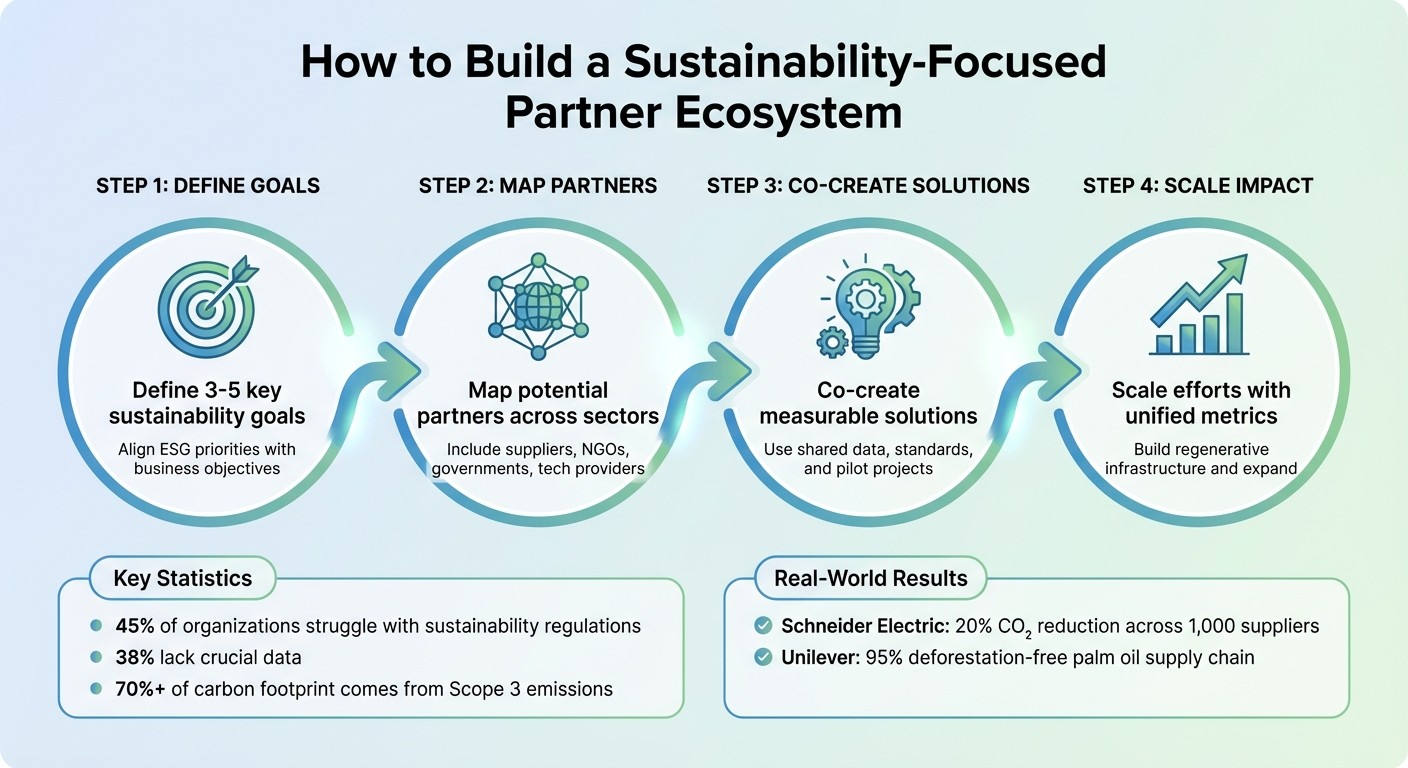
4-Step Framework for Building Sustainability-Focused Partner Ecosystems
What Are Sustainability-Focused Partner Ecosystems?
Defining Partner Ecosystems
A partner ecosystem is essentially a network of interconnected organizations - vendors, consultants, service providers, and others - working together to generate long-term value. Unlike traditional partnerships, which often involve just two parties in a transactional setup, these ecosystems are dynamic, multi-party collaborations. They emphasize collective innovation and cross-sector teamwork over isolated, one-off deals.
What sets partner ecosystems apart is their adaptability. Teams within these networks can share development costs, risks, and performance metrics across multiple projects. The focus shifts from simple bilateral agreements to broader, networked collaboration. By pooling their collective expertise, these ecosystems achieve outcomes that no single organization could accomplish on its own.
Next, we’ll examine how incorporating sustainability into these partnerships transforms them into powerful tools for driving environmental and social progress.
How Sustainability Fits Into Partner Ecosystems
When sustainability becomes a core part of a partner ecosystem, the collaborative model evolves to prioritize environmental, social, and economic responsibility. These networks often bring together businesses, nonprofits, government agencies, and academic institutions to address shared goals like combating climate change, conserving resources, and advancing social equity. Here, the emphasis extends beyond financial gains to achieving meaningful environmental and social improvements.
A systems-thinking approach helps these ecosystems tackle complex challenges like Scope 3 emissions, which typically account for more than 70% of a company’s carbon footprint [1]. For instance, Schneider Electric launched "The Zero Carbon Project" in April 2021, under the leadership of then-Chief Strategy & Sustainability Officer Olivier Blum. This initiative brought together its top 1,000 suppliers - responsible for 70% of the company’s carbon emissions - and set a bold target: cut their operational CO₂ emissions by 50% by 2025. By the end of 2023, these suppliers had already achieved a collective 20% reduction.
Another example is Unilever’s partnership with Google Cloud, initiated in September 2020 under Chief Supply Chain Officer Marc Engel. They used satellite imagery and artificial intelligence to monitor forest cover and land use across Unilever’s supply chain. Thanks to this ecosystem-driven approach, Unilever secured a 95% deforestation-free palm oil supply chain by the end of 2023, providing real-time data to empower local suppliers and smallholder farmers.
| Traditional Partnerships | Sustainability-Focused Ecosystems |
| --- | --- |
| Bilateral, transactional relationships | Multi-party networks with ongoing collaboration |
| Focus on cost reduction and market share | Emphasis on shared environmental and social goals |
| Short-term contracts | Long-term, systemic change |
| Competitive advantage for single firms | Collaborative resilience ("co-opetition") |
| Linear "take-make-waste" processes | Circular resource loops and regenerative outcomes
| Traditional Partnerships | Sustainability-Focused Ecosystems |
| --- | --- |
| Bilateral, transactional relationships | Multi-party networks with ongoing collaboration |
| Focus on cost reduction and market share | Emphasis on shared environmental and social goals |
| Short-term contracts | Long-term, systemic change |
| Competitive advantage for single firms | Collaborative resilience ("co-opetition") |
| Linear "take-make-waste" processes | Circular resource loops and regenerative outcomes
The concept of circular economies illustrates how these ecosystems operate. Partners collaborate to create closed-loop recycling systems, where one organization’s waste becomes another’s raw material. This approach reduces resource extraction while maximizing reuse. By embracing this industrial symbiosis, sustainability-focused ecosystems pave the way for lasting environmental and social benefits.
Key Benefits of Sustainability-Focused Partner Ecosystems
Greater Impact Through Collaboration
When organizations come together in sustainability-focused ecosystems, they tap into a collective strength that far exceeds what any single entity could achieve. By sharing resources, expertise, and technologies, partners can tackle large-scale challenges like climate action - such as turning waste into valuable raw materials. These collaborations encourage the exchange of knowledge, sparking rapid advancements. For instance, diverse stakeholders working together on renewable energy projects or alternative sourcing solutions often see accelerated progress.
Research highlights that these partnerships not only improve resilience and sustainability metrics but also significantly cut greenhouse gas emissions. By spreading risks across multiple contributors, ambitious projects that might seem unattainable for one organization become more feasible, driving meaningful action in areas like resource conservation.
In addition to amplifying their collective impact, these collaborations often result in substantial cost savings.
Cost Efficiency in ESG Initiatives
By pooling investments and sharing innovation, partner ecosystems help reduce the financial strain of expensive ESG initiatives. This shared approach allows organizations to cut costs in areas like greenhouse gas audits, renewable energy adoption, and ESG strategy development. The financial burden, which might be overwhelming for a single entity, becomes manageable when distributed among partners. Industry data suggests these ecosystems can lower costs in innovation-focused areas by 10–20% [3].
Shared tools, reduced waste, and optimized resource usage further contribute to long-term savings. Co-investment models enhance these benefits by ensuring that resources are equitably shared across environmental, social, and governance goals, eliminating the need for any single partner to bear the full cost on their own.
Improved Brand Reputation and Stakeholder Trust
Being part of a sustainability-focused ecosystem signals a strong commitment to shared environmental and social goals, which can significantly enhance a company's reputation. This involvement attracts eco-conscious consumers and opens the door to new markets. Ethical practices demonstrated through collaborative efforts foster lasting customer loyalty, while showcasing projects like renewable logistics resonates deeply with stakeholders.
Transparent progress on ESG initiatives strengthens relationships with investors, customers, and regulators. Companies that actively collaborate on climate action are often viewed as responsible and forward-thinking, which bolsters their market position. As part of a unified sustainability network, the collective credibility of such partnerships tells a far more compelling story than isolated efforts ever could.
We believe that the most pressing challenges of our time can only be solved through deep, purposeful collaboration [1].
This vision underscores how partnerships rooted in shared purpose not only validate an organization's commitment to sustainability but also amplify its impact.
How to Build a Sustainability-Focused Partner Ecosystem
Identifying and Developing Partnerships
Start by outlining your sustainability vision. Pinpoint 3–5 key ESG priorities, such as cutting greenhouse gas emissions, improving water efficiency, or enhancing community resilience, that align with your business goals. Conduct a baseline assessment to understand your carbon footprint, material dependencies, and key risk areas across your value chain. Pay special attention to how your operations rely on natural resources, energy, logistics, and the communities you serve.
Once you’ve established this foundation, map your ecosystem. Identify existing and potential stakeholders, including suppliers, distributors, customers, NGOs, local governments, technology providers, financial institutions, and expert advisors. Partnering with organizations like Council Fire, which specializes in areas such as natural resource management and sustainable infrastructure, can streamline this process and offer strategic insights.
To evaluate potential partners, use a scoring system that considers factors such as alignment with your sustainability goals, complementary expertise (e.g., advanced water-efficiency technologies or community engagement skills), proven track records (including certifications or successful pilot projects), willingness to share data and invest collaboratively, and cultural harmony emphasizing transparency and long-term commitment. This structured approach helps you identify partners who will contribute to meaningful, lasting outcomes, avoiding short-term, transactional relationships. Once partners are selected, move forward with co-creating tailored solutions.
Co-Creating Solutions
After identifying your partners, focus on designing actionable, collaborative solutions. Ground your efforts in data and science by using measurable baselines, such as emissions per unit or water usage, to model and develop lifecycle solutions. Bring together diverse teams that include engineers, product managers, procurement experts, finance professionals, community leaders, and external specialists in areas like climate resilience or resource management. This multidisciplinary approach ensures that solutions are comprehensive and address the complexities of real-world challenges.
Work within recognized frameworks and standards - such as science-based targets or circular economy principles - to ensure your solutions are measurable and comparable. Begin by piloting new approaches under actual conditions. For example, test alternative materials, transportation methods, or service models in specific U.S. markets while tracking environmental, social, and financial outcomes. Monitor metrics like CO₂ emissions per mile, fuel and disposal costs, and worker safety. Incorporate third-party verification and shared dashboards from the outset to maintain transparency, reduce the risk of greenwashing, and build trust with stakeholders.
Sharing Knowledge and Best Practices
Turning individual successes into collective progress requires effective knowledge sharing. Establish digital collaboration hubs, where partners can upload case studies, metrics, tools, and templates. Use tiered access controls to protect sensitive data while allowing general methodologies and high-level outcomes to be shared across the ecosystem. Complement these platforms with regular virtual meetings and an annual U.S. sustainability summit, where partners can share lessons learned, present pilot results, and discuss both successes and failures.
Create communities of practice centered on specific topics like climate resilience, circular packaging, or water stewardship, each led by a designated partner. Use shared KPI dashboards to track metrics such as emissions, resource usage, and cost savings, standardized across projects for easy comparison. To encourage participation while safeguarding proprietary information, clearly define what data can be shared openly versus what remains restricted. Use NDAs and data governance rules in partnership agreements to ensure security, and publicly recognize contributors through joint communications and business opportunities. This fosters a culture of collaboration while protecting individual interests.
Best Practices for Managing Sustainability-Focused Partner Ecosystems
Structured Collaboration Frameworks
Start with a solid governance structure to ensure clarity and alignment among all partners. Form a steering committee that includes representatives from key stakeholders to guide strategy, approve investments, and address conflicts when sustainability and financial objectives clash. Assign operational roles using a responsibility matrix, linking each role to specific ESG outcomes - like reducing emissions or improving community well-being. Document these processes in a governance charter, detailing voting procedures and escalation paths for missed targets or conflicting priorities.
Regular communication is essential. Schedule monthly project meetings, quarterly executive reviews, and an annual summit to align strategies and share insights. Leverage shared digital platforms - such as project management tools, secure data rooms, and dashboards - with standardized ESG data fields for metrics like Scopes 1–3 emissions, water usage, and social impact indicators. To balance openness with confidentiality, establish clear information-sharing rules through NDAs and data governance policies. For example, aggregate performance metrics can be shared publicly, while proprietary technologies remain protected. If sustainability KPIs start to slip, activate cross-partner task forces to identify the root causes and implement corrective actions promptly.
The next step is to extend these practices across the entire value chain, ensuring sustainability is embedded at every level.
Engaging the Full Value Chain
Once governance is in place, broaden the impact by involving all stakeholders - from suppliers to local governments. Real progress requires engaging everyone in the ecosystem, including suppliers, distributors, customers, communities, and regulators. For suppliers, include ESG clauses in contracts and collaborate on improvement plans. Offer training or co-financing for upgrades that reduce emissions and waste. For instance, Apple’s Supplier Clean Energy Program transitioned over 16.5 gigawatts of renewable energy across 300 manufacturers in 28 countries, avoiding 18.5 million metric tons of carbon emissions in 2023. This was achieved through specialized training and access to its "Clean Energy Academy."
For distributors and channel partners, set shared goals for reducing logistics emissions, improving packaging, and managing returns, supported by tools and recognition programs. With customers, co-develop sustainable products, introduce repair or take-back programs, and communicate impact using transparent metrics and labeling. When it comes to communities and local governments, organize stakeholder roundtables, factor in local priorities like job creation and health, and align projects with municipal sustainability plans.
Mapping the ecosystem upstream, midstream, and downstream ensures tailored engagement strategies for each group. Walmart’s Project Gigaton is a prime example, involving over 5,900 suppliers who collectively reduced or avoided 1 billion metric tons of greenhouse gas emissions six years ahead of schedule. This comprehensive approach not only amplifies environmental and social benefits but also enhances brand reputation and builds resilience, as stakeholders see their priorities reflected in the ecosystem’s decisions.
Co-Investment Models for Shared Success
Aligning capital, risk, and rewards among partners is key to achieving shared success. Cost-sharing agreements allow partners to jointly fund upfront expenses for projects like renewable energy installations, circular infrastructure, or shared logistics hubs, with savings distributed according to usage or predefined formulas. Outcome-based funding models involve larger ecosystem anchors or investors providing more initial capital in exchange for a share of verified savings - such as reduced energy costs - or revenue from green products. Another effective approach is blended finance, which combines grants, concessional capital, and commercial investment to reduce risks for high-impact projects. For example, Apple’s $200 million Restore Fund, in partnership with Goldman Sachs and Conservation International, is designed to remove at least 1 million metric tons of carbon dioxide annually while delivering financial returns by supporting sustainable forestry.
To ensure fairness, use tiered contribution frameworks that scale investments based on factors like a partner’s size, revenue, or carbon footprint. Smaller enterprises can contribute “in-kind” resources, such as local expertise or data, while larger corporations provide the majority of financial capital. Support these models with robust measurement frameworks to verify both emissions reductions and cost savings. Third-party experts, such as Council Fire, can assist in designing these structures to balance financial returns with social and environmental objectives, ensuring that all partners are invested in the long-term success of the initiative.
Google Cloud Talks Solving the Sustainability Challenge with Partners

Scaling Sustainability-Focused Partner Ecosystems
Expanding a sustainability-focused partner ecosystem requires more than just collaboration. It demands clear metrics, expert guidance, and investments in infrastructure that actively restore and enhance both environmental and social systems.
Using Industry Standards and Metrics
To effectively scale a sustainability ecosystem, partners need to align on shared goals and standardized metrics. Without consistent measurement practices, data becomes fragmented, making it difficult to track progress or secure additional investment.
Adopting established frameworks like the Science Based Targets initiative (SBTi), GHG Protocol, GRI, SASB/ISSB, and CDP can help define a core set of metrics. These might include measures such as metric tons of CO₂e, energy intensity, water usage, waste diversion, and diversity. Consistency in calculation methods ensures that all partners are on the same page.
A cross-ecosystem ESG stewardship team - comprising representatives from partners, suppliers, advisors, and regulators - can oversee these metrics. This team should meet quarterly to review performance, address gaps, and refine standards as the ecosystem evolves. A tiered approach to metrics, with a small set of mandatory core metrics and optional sector-specific ones, allows smaller partners to participate without being overwhelmed. Providing tools like standardized templates, calculation guides, and shared data platforms enables partners to benchmark performance and learn from one another.
For instance, in 2022–2023, Resonance Global collaborated with organizations such as Seafood Watch, Chicken of the Sea, and Cheesecake Factory to implement the Partnership Assurance Model (PAM) for sustainable aquaculture. By developing a regional-level assurance mechanism, they streamlined the certification process for small-scale farms, cutting costs and enabling faster adoption of responsible sourcing practices.
Standardized metrics lay the groundwork for bringing in external experts to guide further expansion.
Working with External Experts
Once metrics are in place, external experts can help scale sustainability efforts beyond pilot projects. Firms like Council Fire specialize in navigating the complexities of multi-region or multi-sector expansion, especially when partners face challenges like cross-jurisdictional regulations or misalignment.
These experts play a critical role in conducting impact assessments that reveal overlooked social and environmental outcomes. They also craft communication strategies to help partners transparently report their achievements to investors, regulators, and the public. This transparency not only builds trust but also attracts new partners and funding.
When selecting a consultancy, look for expertise in areas like systems-level sustainability strategy, stakeholder engagement, and technical knowledge in key impact areas such as climate resilience, water management, and equitable development. Experience in both public and private sectors is particularly beneficial, as many projects rely on public funding, permits, or community support to succeed.
Building Regenerative Infrastructure
Scaling isn’t just about adding more partners - it’s about creating infrastructure that actively restores natural and social systems. Regenerative infrastructure goes beyond reducing harm; it aims to improve environmental and social conditions. Examples include green stormwater systems that enhance biodiversity and reduce flood risks, renewable energy projects with community ownership models, and transportation systems that lower emissions while improving access to jobs and services in underserved areas.
These projects often involve collaboration between governments, businesses, communities, and financiers. Joint governance structures and blended funding approaches - such as combining public grants, private investments, and community equity - ensure that projects deliver long-term benefits. Risk-sharing mechanisms, like performance-based contracts or phased project designs, help manage uncertainties and adapt as projects progress.
Success should be measured by long-term regenerative outcomes. This could include wetland recovery, increases in soil carbon, improvements in public health, or community wealth-building. External experts like Council Fire can assist in designing these frameworks, ensuring that risks and rewards are clearly defined and acceptable to all stakeholders.
A practical roadmap for scaling might include identifying 2–3 priority impact areas - such as Scope 3 decarbonization, water resilience, or equitable community development - mapping current and potential partners, and launching one or two flagship projects designed for replication. Within three years, the ecosystem should have common metrics embedded in contracts, a functioning governance body, a portfolio of regenerative investments, and documented strategies for expansion into new sectors or regions. This structured approach ensures not just growth, but meaningful and lasting impact.
Conclusion
Tackling ambitious sustainability goals is not something any single organization can achieve on its own. The interconnected challenges of decarbonization, water resilience, supply chain transparency, and equitable development demand collaborative solutions. By forming sustainability-focused partnerships, organizations can combine resources, share expertise, and transform external pressures from investors, regulators, and customers into opportunities for growth and innovation.
These collaborative ecosystems deliver long-term environmental and social gains while strengthening competitive positioning. Working together allows for system-wide impact, reduces costs by sharing investments in technology and infrastructure, and builds trust through transparent, measurable progress. As noted in a Horasis analysis, meaningful environmental progress "cannot be undertaken as a unilateral process" but requires "hard-won collaborations and dedicated partnerships" [2].
To move forward, it’s time to put your sustainability plans into action. Start by identifying 3–5 key outcomes with measurable KPIs, mapping out current and potential partners, and initiating one or two pilot projects with clear baselines, budgets in USD, and timelines. Use tools like shared dashboards, cross-partner forums, and streamlined governance to institutionalize lessons learned. For additional support in creating collaboration frameworks, aligning stakeholders, or building regenerative infrastructure, consultancies like Council Fire can provide the expertise needed to transform strategy into results.
Begin with intention: choose one priority, one pilot project, and one partner to focus on this quarter. Engage cross-functional teams and launch a joint initiative. Progress doesn’t require perfect data or fully refined strategies - it starts by taking action, learning along the way, and scaling efforts within a thoughtfully designed sustainability partnership ecosystem.
FAQs
What steps can small businesses take to join a sustainability-focused partner ecosystem?
Small businesses looking to become part of a sustainability-focused partner ecosystem should begin by clearly defining their environmental and social objectives. From there, they can seek out organizations and initiatives that share similar values and are aligned with their mission.
Successful integration into such ecosystems relies heavily on trust, which can be nurtured through open communication and genuine collaboration. Businesses can contribute by sharing their expertise, working on joint projects, and actively supporting shared environmental and social initiatives. By engaging in these meaningful partnerships, small businesses not only advance their sustainability goals but also create opportunities for growth within the ecosystem.
What metrics should you monitor when growing a sustainability-focused partner ecosystem?
Expanding a partner ecosystem with a focus on sustainability requires keeping a close eye on metrics that capture both performance and the broader impact. Key areas to monitor include:
Stakeholder engagement levels: Evaluate how effectively partners are participating and collaborating within the ecosystem.
Impact metrics: Track the environmental, social, and economic outcomes associated with your sustainability goals.
Project success rates: Keep tabs on how consistently initiatives are completed on time and achieve their intended results.
Progress on long-term sustainability goals: Regularly check alignment with your broader objectives to ensure steady advancement.
By prioritizing these metrics, you can guide the ecosystem’s growth in a way that achieves measurable outcomes, encourages teamwork, and sparks innovative solutions.
How can sustainability-focused partner ecosystems improve brand reputation and build stakeholder trust?
Sustainability-driven partner ecosystems play a key role in boosting a company's reputation while building trust with stakeholders. By highlighting a company’s earnest efforts toward positive environmental and social goals, these ecosystems send a powerful message. They emphasize transparency, collaboration, and accountability - qualities that resonate strongly with customers, investors, and local communities.
When organizations join forces with like-minded partners, they can achieve tangible, long-lasting outcomes that reflect their dedication to sustainability. This collaborative approach not only strengthens their standing but also fosters meaningful connections with stakeholders who prioritize ethical and responsible business practices.
Related Blog Posts
Latest Articles
©2025



FAQ
01
What does it really mean to “redefine profit”?
02
What makes Council Fire different?
03
Who does Council Fire you work with?
04
What does working with Council Fire actually look like?
05
How does Council Fire help organizations turn big goals into action?
06
How does Council Fire define and measure success?
Dec 19, 2025
Ultimate Guide to Sustainability-Focused Partner Ecosystems
Sustainability Strategy
In This Article
Framework to build and scale multi-party sustainability partnerships: define goals, map partners, co-create measurable solutions, and use shared metrics.
Ultimate Guide to Sustainability-Focused Partner Ecosystems
No single organization can solve the complex issues of climate change, resource scarcity, and social inequity. Collaborative networks, known as sustainability-focused partner ecosystems, bring together businesses, nonprofits, governments, and communities to address these challenges collectively. These partnerships go beyond compliance, driving measurable progress in areas like carbon reduction, circular economies, and social equity.
Key Takeaways:
Why It Matters: 45% of organizations struggle with sustainability regulations, and 38% lack crucial data. Partner ecosystems help bridge these gaps.
Real-World Impact: Examples include Schneider Electric's suppliers cutting CO₂ emissions by 20% and Unilever's 95% deforestation-free palm oil supply chain.
Benefits:
Greater collective impact on sustainability goals.
Cost-sharing reduces financial burdens of ESG initiatives.
Enhanced trust and reputation among investors and consumers.
How to Start:
Define 3–5 key sustainability goals.
Map potential partners across sectors.
Co-create measurable solutions using shared data and standards.
Scale efforts with unified metrics and regenerative infrastructure.
This guide offers actionable steps to build and expand partnerships that drive meaningful environmental and social progress while aligning with business goals.
4-Step Framework for Building Sustainability-Focused Partner Ecosystems
What Are Sustainability-Focused Partner Ecosystems?
Defining Partner Ecosystems
A partner ecosystem is essentially a network of interconnected organizations - vendors, consultants, service providers, and others - working together to generate long-term value. Unlike traditional partnerships, which often involve just two parties in a transactional setup, these ecosystems are dynamic, multi-party collaborations. They emphasize collective innovation and cross-sector teamwork over isolated, one-off deals.
What sets partner ecosystems apart is their adaptability. Teams within these networks can share development costs, risks, and performance metrics across multiple projects. The focus shifts from simple bilateral agreements to broader, networked collaboration. By pooling their collective expertise, these ecosystems achieve outcomes that no single organization could accomplish on its own.
Next, we’ll examine how incorporating sustainability into these partnerships transforms them into powerful tools for driving environmental and social progress.
How Sustainability Fits Into Partner Ecosystems
When sustainability becomes a core part of a partner ecosystem, the collaborative model evolves to prioritize environmental, social, and economic responsibility. These networks often bring together businesses, nonprofits, government agencies, and academic institutions to address shared goals like combating climate change, conserving resources, and advancing social equity. Here, the emphasis extends beyond financial gains to achieving meaningful environmental and social improvements.
A systems-thinking approach helps these ecosystems tackle complex challenges like Scope 3 emissions, which typically account for more than 70% of a company’s carbon footprint [1]. For instance, Schneider Electric launched "The Zero Carbon Project" in April 2021, under the leadership of then-Chief Strategy & Sustainability Officer Olivier Blum. This initiative brought together its top 1,000 suppliers - responsible for 70% of the company’s carbon emissions - and set a bold target: cut their operational CO₂ emissions by 50% by 2025. By the end of 2023, these suppliers had already achieved a collective 20% reduction.
Another example is Unilever’s partnership with Google Cloud, initiated in September 2020 under Chief Supply Chain Officer Marc Engel. They used satellite imagery and artificial intelligence to monitor forest cover and land use across Unilever’s supply chain. Thanks to this ecosystem-driven approach, Unilever secured a 95% deforestation-free palm oil supply chain by the end of 2023, providing real-time data to empower local suppliers and smallholder farmers.
| Traditional Partnerships | Sustainability-Focused Ecosystems |
| --- | --- |
| Bilateral, transactional relationships | Multi-party networks with ongoing collaboration |
| Focus on cost reduction and market share | Emphasis on shared environmental and social goals |
| Short-term contracts | Long-term, systemic change |
| Competitive advantage for single firms | Collaborative resilience ("co-opetition") |
| Linear "take-make-waste" processes | Circular resource loops and regenerative outcomes
The concept of circular economies illustrates how these ecosystems operate. Partners collaborate to create closed-loop recycling systems, where one organization’s waste becomes another’s raw material. This approach reduces resource extraction while maximizing reuse. By embracing this industrial symbiosis, sustainability-focused ecosystems pave the way for lasting environmental and social benefits.
Key Benefits of Sustainability-Focused Partner Ecosystems
Greater Impact Through Collaboration
When organizations come together in sustainability-focused ecosystems, they tap into a collective strength that far exceeds what any single entity could achieve. By sharing resources, expertise, and technologies, partners can tackle large-scale challenges like climate action - such as turning waste into valuable raw materials. These collaborations encourage the exchange of knowledge, sparking rapid advancements. For instance, diverse stakeholders working together on renewable energy projects or alternative sourcing solutions often see accelerated progress.
Research highlights that these partnerships not only improve resilience and sustainability metrics but also significantly cut greenhouse gas emissions. By spreading risks across multiple contributors, ambitious projects that might seem unattainable for one organization become more feasible, driving meaningful action in areas like resource conservation.
In addition to amplifying their collective impact, these collaborations often result in substantial cost savings.
Cost Efficiency in ESG Initiatives
By pooling investments and sharing innovation, partner ecosystems help reduce the financial strain of expensive ESG initiatives. This shared approach allows organizations to cut costs in areas like greenhouse gas audits, renewable energy adoption, and ESG strategy development. The financial burden, which might be overwhelming for a single entity, becomes manageable when distributed among partners. Industry data suggests these ecosystems can lower costs in innovation-focused areas by 10–20% [3].
Shared tools, reduced waste, and optimized resource usage further contribute to long-term savings. Co-investment models enhance these benefits by ensuring that resources are equitably shared across environmental, social, and governance goals, eliminating the need for any single partner to bear the full cost on their own.
Improved Brand Reputation and Stakeholder Trust
Being part of a sustainability-focused ecosystem signals a strong commitment to shared environmental and social goals, which can significantly enhance a company's reputation. This involvement attracts eco-conscious consumers and opens the door to new markets. Ethical practices demonstrated through collaborative efforts foster lasting customer loyalty, while showcasing projects like renewable logistics resonates deeply with stakeholders.
Transparent progress on ESG initiatives strengthens relationships with investors, customers, and regulators. Companies that actively collaborate on climate action are often viewed as responsible and forward-thinking, which bolsters their market position. As part of a unified sustainability network, the collective credibility of such partnerships tells a far more compelling story than isolated efforts ever could.
We believe that the most pressing challenges of our time can only be solved through deep, purposeful collaboration [1].
This vision underscores how partnerships rooted in shared purpose not only validate an organization's commitment to sustainability but also amplify its impact.
How to Build a Sustainability-Focused Partner Ecosystem
Identifying and Developing Partnerships
Start by outlining your sustainability vision. Pinpoint 3–5 key ESG priorities, such as cutting greenhouse gas emissions, improving water efficiency, or enhancing community resilience, that align with your business goals. Conduct a baseline assessment to understand your carbon footprint, material dependencies, and key risk areas across your value chain. Pay special attention to how your operations rely on natural resources, energy, logistics, and the communities you serve.
Once you’ve established this foundation, map your ecosystem. Identify existing and potential stakeholders, including suppliers, distributors, customers, NGOs, local governments, technology providers, financial institutions, and expert advisors. Partnering with organizations like Council Fire, which specializes in areas such as natural resource management and sustainable infrastructure, can streamline this process and offer strategic insights.
To evaluate potential partners, use a scoring system that considers factors such as alignment with your sustainability goals, complementary expertise (e.g., advanced water-efficiency technologies or community engagement skills), proven track records (including certifications or successful pilot projects), willingness to share data and invest collaboratively, and cultural harmony emphasizing transparency and long-term commitment. This structured approach helps you identify partners who will contribute to meaningful, lasting outcomes, avoiding short-term, transactional relationships. Once partners are selected, move forward with co-creating tailored solutions.
Co-Creating Solutions
After identifying your partners, focus on designing actionable, collaborative solutions. Ground your efforts in data and science by using measurable baselines, such as emissions per unit or water usage, to model and develop lifecycle solutions. Bring together diverse teams that include engineers, product managers, procurement experts, finance professionals, community leaders, and external specialists in areas like climate resilience or resource management. This multidisciplinary approach ensures that solutions are comprehensive and address the complexities of real-world challenges.
Work within recognized frameworks and standards - such as science-based targets or circular economy principles - to ensure your solutions are measurable and comparable. Begin by piloting new approaches under actual conditions. For example, test alternative materials, transportation methods, or service models in specific U.S. markets while tracking environmental, social, and financial outcomes. Monitor metrics like CO₂ emissions per mile, fuel and disposal costs, and worker safety. Incorporate third-party verification and shared dashboards from the outset to maintain transparency, reduce the risk of greenwashing, and build trust with stakeholders.
Sharing Knowledge and Best Practices
Turning individual successes into collective progress requires effective knowledge sharing. Establish digital collaboration hubs, where partners can upload case studies, metrics, tools, and templates. Use tiered access controls to protect sensitive data while allowing general methodologies and high-level outcomes to be shared across the ecosystem. Complement these platforms with regular virtual meetings and an annual U.S. sustainability summit, where partners can share lessons learned, present pilot results, and discuss both successes and failures.
Create communities of practice centered on specific topics like climate resilience, circular packaging, or water stewardship, each led by a designated partner. Use shared KPI dashboards to track metrics such as emissions, resource usage, and cost savings, standardized across projects for easy comparison. To encourage participation while safeguarding proprietary information, clearly define what data can be shared openly versus what remains restricted. Use NDAs and data governance rules in partnership agreements to ensure security, and publicly recognize contributors through joint communications and business opportunities. This fosters a culture of collaboration while protecting individual interests.
Best Practices for Managing Sustainability-Focused Partner Ecosystems
Structured Collaboration Frameworks
Start with a solid governance structure to ensure clarity and alignment among all partners. Form a steering committee that includes representatives from key stakeholders to guide strategy, approve investments, and address conflicts when sustainability and financial objectives clash. Assign operational roles using a responsibility matrix, linking each role to specific ESG outcomes - like reducing emissions or improving community well-being. Document these processes in a governance charter, detailing voting procedures and escalation paths for missed targets or conflicting priorities.
Regular communication is essential. Schedule monthly project meetings, quarterly executive reviews, and an annual summit to align strategies and share insights. Leverage shared digital platforms - such as project management tools, secure data rooms, and dashboards - with standardized ESG data fields for metrics like Scopes 1–3 emissions, water usage, and social impact indicators. To balance openness with confidentiality, establish clear information-sharing rules through NDAs and data governance policies. For example, aggregate performance metrics can be shared publicly, while proprietary technologies remain protected. If sustainability KPIs start to slip, activate cross-partner task forces to identify the root causes and implement corrective actions promptly.
The next step is to extend these practices across the entire value chain, ensuring sustainability is embedded at every level.
Engaging the Full Value Chain
Once governance is in place, broaden the impact by involving all stakeholders - from suppliers to local governments. Real progress requires engaging everyone in the ecosystem, including suppliers, distributors, customers, communities, and regulators. For suppliers, include ESG clauses in contracts and collaborate on improvement plans. Offer training or co-financing for upgrades that reduce emissions and waste. For instance, Apple’s Supplier Clean Energy Program transitioned over 16.5 gigawatts of renewable energy across 300 manufacturers in 28 countries, avoiding 18.5 million metric tons of carbon emissions in 2023. This was achieved through specialized training and access to its "Clean Energy Academy."
For distributors and channel partners, set shared goals for reducing logistics emissions, improving packaging, and managing returns, supported by tools and recognition programs. With customers, co-develop sustainable products, introduce repair or take-back programs, and communicate impact using transparent metrics and labeling. When it comes to communities and local governments, organize stakeholder roundtables, factor in local priorities like job creation and health, and align projects with municipal sustainability plans.
Mapping the ecosystem upstream, midstream, and downstream ensures tailored engagement strategies for each group. Walmart’s Project Gigaton is a prime example, involving over 5,900 suppliers who collectively reduced or avoided 1 billion metric tons of greenhouse gas emissions six years ahead of schedule. This comprehensive approach not only amplifies environmental and social benefits but also enhances brand reputation and builds resilience, as stakeholders see their priorities reflected in the ecosystem’s decisions.
Co-Investment Models for Shared Success
Aligning capital, risk, and rewards among partners is key to achieving shared success. Cost-sharing agreements allow partners to jointly fund upfront expenses for projects like renewable energy installations, circular infrastructure, or shared logistics hubs, with savings distributed according to usage or predefined formulas. Outcome-based funding models involve larger ecosystem anchors or investors providing more initial capital in exchange for a share of verified savings - such as reduced energy costs - or revenue from green products. Another effective approach is blended finance, which combines grants, concessional capital, and commercial investment to reduce risks for high-impact projects. For example, Apple’s $200 million Restore Fund, in partnership with Goldman Sachs and Conservation International, is designed to remove at least 1 million metric tons of carbon dioxide annually while delivering financial returns by supporting sustainable forestry.
To ensure fairness, use tiered contribution frameworks that scale investments based on factors like a partner’s size, revenue, or carbon footprint. Smaller enterprises can contribute “in-kind” resources, such as local expertise or data, while larger corporations provide the majority of financial capital. Support these models with robust measurement frameworks to verify both emissions reductions and cost savings. Third-party experts, such as Council Fire, can assist in designing these structures to balance financial returns with social and environmental objectives, ensuring that all partners are invested in the long-term success of the initiative.
Google Cloud Talks Solving the Sustainability Challenge with Partners
Scaling Sustainability-Focused Partner Ecosystems
Expanding a sustainability-focused partner ecosystem requires more than just collaboration. It demands clear metrics, expert guidance, and investments in infrastructure that actively restore and enhance both environmental and social systems.
Using Industry Standards and Metrics
To effectively scale a sustainability ecosystem, partners need to align on shared goals and standardized metrics. Without consistent measurement practices, data becomes fragmented, making it difficult to track progress or secure additional investment.
Adopting established frameworks like the Science Based Targets initiative (SBTi), GHG Protocol, GRI, SASB/ISSB, and CDP can help define a core set of metrics. These might include measures such as metric tons of CO₂e, energy intensity, water usage, waste diversion, and diversity. Consistency in calculation methods ensures that all partners are on the same page.
A cross-ecosystem ESG stewardship team - comprising representatives from partners, suppliers, advisors, and regulators - can oversee these metrics. This team should meet quarterly to review performance, address gaps, and refine standards as the ecosystem evolves. A tiered approach to metrics, with a small set of mandatory core metrics and optional sector-specific ones, allows smaller partners to participate without being overwhelmed. Providing tools like standardized templates, calculation guides, and shared data platforms enables partners to benchmark performance and learn from one another.
For instance, in 2022–2023, Resonance Global collaborated with organizations such as Seafood Watch, Chicken of the Sea, and Cheesecake Factory to implement the Partnership Assurance Model (PAM) for sustainable aquaculture. By developing a regional-level assurance mechanism, they streamlined the certification process for small-scale farms, cutting costs and enabling faster adoption of responsible sourcing practices.
Standardized metrics lay the groundwork for bringing in external experts to guide further expansion.
Working with External Experts
Once metrics are in place, external experts can help scale sustainability efforts beyond pilot projects. Firms like Council Fire specialize in navigating the complexities of multi-region or multi-sector expansion, especially when partners face challenges like cross-jurisdictional regulations or misalignment.
These experts play a critical role in conducting impact assessments that reveal overlooked social and environmental outcomes. They also craft communication strategies to help partners transparently report their achievements to investors, regulators, and the public. This transparency not only builds trust but also attracts new partners and funding.
When selecting a consultancy, look for expertise in areas like systems-level sustainability strategy, stakeholder engagement, and technical knowledge in key impact areas such as climate resilience, water management, and equitable development. Experience in both public and private sectors is particularly beneficial, as many projects rely on public funding, permits, or community support to succeed.
Building Regenerative Infrastructure
Scaling isn’t just about adding more partners - it’s about creating infrastructure that actively restores natural and social systems. Regenerative infrastructure goes beyond reducing harm; it aims to improve environmental and social conditions. Examples include green stormwater systems that enhance biodiversity and reduce flood risks, renewable energy projects with community ownership models, and transportation systems that lower emissions while improving access to jobs and services in underserved areas.
These projects often involve collaboration between governments, businesses, communities, and financiers. Joint governance structures and blended funding approaches - such as combining public grants, private investments, and community equity - ensure that projects deliver long-term benefits. Risk-sharing mechanisms, like performance-based contracts or phased project designs, help manage uncertainties and adapt as projects progress.
Success should be measured by long-term regenerative outcomes. This could include wetland recovery, increases in soil carbon, improvements in public health, or community wealth-building. External experts like Council Fire can assist in designing these frameworks, ensuring that risks and rewards are clearly defined and acceptable to all stakeholders.
A practical roadmap for scaling might include identifying 2–3 priority impact areas - such as Scope 3 decarbonization, water resilience, or equitable community development - mapping current and potential partners, and launching one or two flagship projects designed for replication. Within three years, the ecosystem should have common metrics embedded in contracts, a functioning governance body, a portfolio of regenerative investments, and documented strategies for expansion into new sectors or regions. This structured approach ensures not just growth, but meaningful and lasting impact.
Conclusion
Tackling ambitious sustainability goals is not something any single organization can achieve on its own. The interconnected challenges of decarbonization, water resilience, supply chain transparency, and equitable development demand collaborative solutions. By forming sustainability-focused partnerships, organizations can combine resources, share expertise, and transform external pressures from investors, regulators, and customers into opportunities for growth and innovation.
These collaborative ecosystems deliver long-term environmental and social gains while strengthening competitive positioning. Working together allows for system-wide impact, reduces costs by sharing investments in technology and infrastructure, and builds trust through transparent, measurable progress. As noted in a Horasis analysis, meaningful environmental progress "cannot be undertaken as a unilateral process" but requires "hard-won collaborations and dedicated partnerships" [2].
To move forward, it’s time to put your sustainability plans into action. Start by identifying 3–5 key outcomes with measurable KPIs, mapping out current and potential partners, and initiating one or two pilot projects with clear baselines, budgets in USD, and timelines. Use tools like shared dashboards, cross-partner forums, and streamlined governance to institutionalize lessons learned. For additional support in creating collaboration frameworks, aligning stakeholders, or building regenerative infrastructure, consultancies like Council Fire can provide the expertise needed to transform strategy into results.
Begin with intention: choose one priority, one pilot project, and one partner to focus on this quarter. Engage cross-functional teams and launch a joint initiative. Progress doesn’t require perfect data or fully refined strategies - it starts by taking action, learning along the way, and scaling efforts within a thoughtfully designed sustainability partnership ecosystem.
FAQs
What steps can small businesses take to join a sustainability-focused partner ecosystem?
Small businesses looking to become part of a sustainability-focused partner ecosystem should begin by clearly defining their environmental and social objectives. From there, they can seek out organizations and initiatives that share similar values and are aligned with their mission.
Successful integration into such ecosystems relies heavily on trust, which can be nurtured through open communication and genuine collaboration. Businesses can contribute by sharing their expertise, working on joint projects, and actively supporting shared environmental and social initiatives. By engaging in these meaningful partnerships, small businesses not only advance their sustainability goals but also create opportunities for growth within the ecosystem.
What metrics should you monitor when growing a sustainability-focused partner ecosystem?
Expanding a partner ecosystem with a focus on sustainability requires keeping a close eye on metrics that capture both performance and the broader impact. Key areas to monitor include:
Stakeholder engagement levels: Evaluate how effectively partners are participating and collaborating within the ecosystem.
Impact metrics: Track the environmental, social, and economic outcomes associated with your sustainability goals.
Project success rates: Keep tabs on how consistently initiatives are completed on time and achieve their intended results.
Progress on long-term sustainability goals: Regularly check alignment with your broader objectives to ensure steady advancement.
By prioritizing these metrics, you can guide the ecosystem’s growth in a way that achieves measurable outcomes, encourages teamwork, and sparks innovative solutions.
How can sustainability-focused partner ecosystems improve brand reputation and build stakeholder trust?
Sustainability-driven partner ecosystems play a key role in boosting a company's reputation while building trust with stakeholders. By highlighting a company’s earnest efforts toward positive environmental and social goals, these ecosystems send a powerful message. They emphasize transparency, collaboration, and accountability - qualities that resonate strongly with customers, investors, and local communities.
When organizations join forces with like-minded partners, they can achieve tangible, long-lasting outcomes that reflect their dedication to sustainability. This collaborative approach not only strengthens their standing but also fosters meaningful connections with stakeholders who prioritize ethical and responsible business practices.
Related Blog Posts
FAQ
01
What does it really mean to “redefine profit”?
02
What makes Council Fire different?
03
Who does Council Fire you work with?
04
What does working with Council Fire actually look like?
05
How does Council Fire help organizations turn big goals into action?
06
How does Council Fire define and measure success?
Dec 19, 2025
Ultimate Guide to Sustainability-Focused Partner Ecosystems
Sustainability Strategy
In This Article
Framework to build and scale multi-party sustainability partnerships: define goals, map partners, co-create measurable solutions, and use shared metrics.
Ultimate Guide to Sustainability-Focused Partner Ecosystems
No single organization can solve the complex issues of climate change, resource scarcity, and social inequity. Collaborative networks, known as sustainability-focused partner ecosystems, bring together businesses, nonprofits, governments, and communities to address these challenges collectively. These partnerships go beyond compliance, driving measurable progress in areas like carbon reduction, circular economies, and social equity.
Key Takeaways:
Why It Matters: 45% of organizations struggle with sustainability regulations, and 38% lack crucial data. Partner ecosystems help bridge these gaps.
Real-World Impact: Examples include Schneider Electric's suppliers cutting CO₂ emissions by 20% and Unilever's 95% deforestation-free palm oil supply chain.
Benefits:
Greater collective impact on sustainability goals.
Cost-sharing reduces financial burdens of ESG initiatives.
Enhanced trust and reputation among investors and consumers.
How to Start:
Define 3–5 key sustainability goals.
Map potential partners across sectors.
Co-create measurable solutions using shared data and standards.
Scale efforts with unified metrics and regenerative infrastructure.
This guide offers actionable steps to build and expand partnerships that drive meaningful environmental and social progress while aligning with business goals.
4-Step Framework for Building Sustainability-Focused Partner Ecosystems
What Are Sustainability-Focused Partner Ecosystems?
Defining Partner Ecosystems
A partner ecosystem is essentially a network of interconnected organizations - vendors, consultants, service providers, and others - working together to generate long-term value. Unlike traditional partnerships, which often involve just two parties in a transactional setup, these ecosystems are dynamic, multi-party collaborations. They emphasize collective innovation and cross-sector teamwork over isolated, one-off deals.
What sets partner ecosystems apart is their adaptability. Teams within these networks can share development costs, risks, and performance metrics across multiple projects. The focus shifts from simple bilateral agreements to broader, networked collaboration. By pooling their collective expertise, these ecosystems achieve outcomes that no single organization could accomplish on its own.
Next, we’ll examine how incorporating sustainability into these partnerships transforms them into powerful tools for driving environmental and social progress.
How Sustainability Fits Into Partner Ecosystems
When sustainability becomes a core part of a partner ecosystem, the collaborative model evolves to prioritize environmental, social, and economic responsibility. These networks often bring together businesses, nonprofits, government agencies, and academic institutions to address shared goals like combating climate change, conserving resources, and advancing social equity. Here, the emphasis extends beyond financial gains to achieving meaningful environmental and social improvements.
A systems-thinking approach helps these ecosystems tackle complex challenges like Scope 3 emissions, which typically account for more than 70% of a company’s carbon footprint [1]. For instance, Schneider Electric launched "The Zero Carbon Project" in April 2021, under the leadership of then-Chief Strategy & Sustainability Officer Olivier Blum. This initiative brought together its top 1,000 suppliers - responsible for 70% of the company’s carbon emissions - and set a bold target: cut their operational CO₂ emissions by 50% by 2025. By the end of 2023, these suppliers had already achieved a collective 20% reduction.
Another example is Unilever’s partnership with Google Cloud, initiated in September 2020 under Chief Supply Chain Officer Marc Engel. They used satellite imagery and artificial intelligence to monitor forest cover and land use across Unilever’s supply chain. Thanks to this ecosystem-driven approach, Unilever secured a 95% deforestation-free palm oil supply chain by the end of 2023, providing real-time data to empower local suppliers and smallholder farmers.
| Traditional Partnerships | Sustainability-Focused Ecosystems |
| --- | --- |
| Bilateral, transactional relationships | Multi-party networks with ongoing collaboration |
| Focus on cost reduction and market share | Emphasis on shared environmental and social goals |
| Short-term contracts | Long-term, systemic change |
| Competitive advantage for single firms | Collaborative resilience ("co-opetition") |
| Linear "take-make-waste" processes | Circular resource loops and regenerative outcomes
The concept of circular economies illustrates how these ecosystems operate. Partners collaborate to create closed-loop recycling systems, where one organization’s waste becomes another’s raw material. This approach reduces resource extraction while maximizing reuse. By embracing this industrial symbiosis, sustainability-focused ecosystems pave the way for lasting environmental and social benefits.
Key Benefits of Sustainability-Focused Partner Ecosystems
Greater Impact Through Collaboration
When organizations come together in sustainability-focused ecosystems, they tap into a collective strength that far exceeds what any single entity could achieve. By sharing resources, expertise, and technologies, partners can tackle large-scale challenges like climate action - such as turning waste into valuable raw materials. These collaborations encourage the exchange of knowledge, sparking rapid advancements. For instance, diverse stakeholders working together on renewable energy projects or alternative sourcing solutions often see accelerated progress.
Research highlights that these partnerships not only improve resilience and sustainability metrics but also significantly cut greenhouse gas emissions. By spreading risks across multiple contributors, ambitious projects that might seem unattainable for one organization become more feasible, driving meaningful action in areas like resource conservation.
In addition to amplifying their collective impact, these collaborations often result in substantial cost savings.
Cost Efficiency in ESG Initiatives
By pooling investments and sharing innovation, partner ecosystems help reduce the financial strain of expensive ESG initiatives. This shared approach allows organizations to cut costs in areas like greenhouse gas audits, renewable energy adoption, and ESG strategy development. The financial burden, which might be overwhelming for a single entity, becomes manageable when distributed among partners. Industry data suggests these ecosystems can lower costs in innovation-focused areas by 10–20% [3].
Shared tools, reduced waste, and optimized resource usage further contribute to long-term savings. Co-investment models enhance these benefits by ensuring that resources are equitably shared across environmental, social, and governance goals, eliminating the need for any single partner to bear the full cost on their own.
Improved Brand Reputation and Stakeholder Trust
Being part of a sustainability-focused ecosystem signals a strong commitment to shared environmental and social goals, which can significantly enhance a company's reputation. This involvement attracts eco-conscious consumers and opens the door to new markets. Ethical practices demonstrated through collaborative efforts foster lasting customer loyalty, while showcasing projects like renewable logistics resonates deeply with stakeholders.
Transparent progress on ESG initiatives strengthens relationships with investors, customers, and regulators. Companies that actively collaborate on climate action are often viewed as responsible and forward-thinking, which bolsters their market position. As part of a unified sustainability network, the collective credibility of such partnerships tells a far more compelling story than isolated efforts ever could.
We believe that the most pressing challenges of our time can only be solved through deep, purposeful collaboration [1].
This vision underscores how partnerships rooted in shared purpose not only validate an organization's commitment to sustainability but also amplify its impact.
How to Build a Sustainability-Focused Partner Ecosystem
Identifying and Developing Partnerships
Start by outlining your sustainability vision. Pinpoint 3–5 key ESG priorities, such as cutting greenhouse gas emissions, improving water efficiency, or enhancing community resilience, that align with your business goals. Conduct a baseline assessment to understand your carbon footprint, material dependencies, and key risk areas across your value chain. Pay special attention to how your operations rely on natural resources, energy, logistics, and the communities you serve.
Once you’ve established this foundation, map your ecosystem. Identify existing and potential stakeholders, including suppliers, distributors, customers, NGOs, local governments, technology providers, financial institutions, and expert advisors. Partnering with organizations like Council Fire, which specializes in areas such as natural resource management and sustainable infrastructure, can streamline this process and offer strategic insights.
To evaluate potential partners, use a scoring system that considers factors such as alignment with your sustainability goals, complementary expertise (e.g., advanced water-efficiency technologies or community engagement skills), proven track records (including certifications or successful pilot projects), willingness to share data and invest collaboratively, and cultural harmony emphasizing transparency and long-term commitment. This structured approach helps you identify partners who will contribute to meaningful, lasting outcomes, avoiding short-term, transactional relationships. Once partners are selected, move forward with co-creating tailored solutions.
Co-Creating Solutions
After identifying your partners, focus on designing actionable, collaborative solutions. Ground your efforts in data and science by using measurable baselines, such as emissions per unit or water usage, to model and develop lifecycle solutions. Bring together diverse teams that include engineers, product managers, procurement experts, finance professionals, community leaders, and external specialists in areas like climate resilience or resource management. This multidisciplinary approach ensures that solutions are comprehensive and address the complexities of real-world challenges.
Work within recognized frameworks and standards - such as science-based targets or circular economy principles - to ensure your solutions are measurable and comparable. Begin by piloting new approaches under actual conditions. For example, test alternative materials, transportation methods, or service models in specific U.S. markets while tracking environmental, social, and financial outcomes. Monitor metrics like CO₂ emissions per mile, fuel and disposal costs, and worker safety. Incorporate third-party verification and shared dashboards from the outset to maintain transparency, reduce the risk of greenwashing, and build trust with stakeholders.
Sharing Knowledge and Best Practices
Turning individual successes into collective progress requires effective knowledge sharing. Establish digital collaboration hubs, where partners can upload case studies, metrics, tools, and templates. Use tiered access controls to protect sensitive data while allowing general methodologies and high-level outcomes to be shared across the ecosystem. Complement these platforms with regular virtual meetings and an annual U.S. sustainability summit, where partners can share lessons learned, present pilot results, and discuss both successes and failures.
Create communities of practice centered on specific topics like climate resilience, circular packaging, or water stewardship, each led by a designated partner. Use shared KPI dashboards to track metrics such as emissions, resource usage, and cost savings, standardized across projects for easy comparison. To encourage participation while safeguarding proprietary information, clearly define what data can be shared openly versus what remains restricted. Use NDAs and data governance rules in partnership agreements to ensure security, and publicly recognize contributors through joint communications and business opportunities. This fosters a culture of collaboration while protecting individual interests.
Best Practices for Managing Sustainability-Focused Partner Ecosystems
Structured Collaboration Frameworks
Start with a solid governance structure to ensure clarity and alignment among all partners. Form a steering committee that includes representatives from key stakeholders to guide strategy, approve investments, and address conflicts when sustainability and financial objectives clash. Assign operational roles using a responsibility matrix, linking each role to specific ESG outcomes - like reducing emissions or improving community well-being. Document these processes in a governance charter, detailing voting procedures and escalation paths for missed targets or conflicting priorities.
Regular communication is essential. Schedule monthly project meetings, quarterly executive reviews, and an annual summit to align strategies and share insights. Leverage shared digital platforms - such as project management tools, secure data rooms, and dashboards - with standardized ESG data fields for metrics like Scopes 1–3 emissions, water usage, and social impact indicators. To balance openness with confidentiality, establish clear information-sharing rules through NDAs and data governance policies. For example, aggregate performance metrics can be shared publicly, while proprietary technologies remain protected. If sustainability KPIs start to slip, activate cross-partner task forces to identify the root causes and implement corrective actions promptly.
The next step is to extend these practices across the entire value chain, ensuring sustainability is embedded at every level.
Engaging the Full Value Chain
Once governance is in place, broaden the impact by involving all stakeholders - from suppliers to local governments. Real progress requires engaging everyone in the ecosystem, including suppliers, distributors, customers, communities, and regulators. For suppliers, include ESG clauses in contracts and collaborate on improvement plans. Offer training or co-financing for upgrades that reduce emissions and waste. For instance, Apple’s Supplier Clean Energy Program transitioned over 16.5 gigawatts of renewable energy across 300 manufacturers in 28 countries, avoiding 18.5 million metric tons of carbon emissions in 2023. This was achieved through specialized training and access to its "Clean Energy Academy."
For distributors and channel partners, set shared goals for reducing logistics emissions, improving packaging, and managing returns, supported by tools and recognition programs. With customers, co-develop sustainable products, introduce repair or take-back programs, and communicate impact using transparent metrics and labeling. When it comes to communities and local governments, organize stakeholder roundtables, factor in local priorities like job creation and health, and align projects with municipal sustainability plans.
Mapping the ecosystem upstream, midstream, and downstream ensures tailored engagement strategies for each group. Walmart’s Project Gigaton is a prime example, involving over 5,900 suppliers who collectively reduced or avoided 1 billion metric tons of greenhouse gas emissions six years ahead of schedule. This comprehensive approach not only amplifies environmental and social benefits but also enhances brand reputation and builds resilience, as stakeholders see their priorities reflected in the ecosystem’s decisions.
Co-Investment Models for Shared Success
Aligning capital, risk, and rewards among partners is key to achieving shared success. Cost-sharing agreements allow partners to jointly fund upfront expenses for projects like renewable energy installations, circular infrastructure, or shared logistics hubs, with savings distributed according to usage or predefined formulas. Outcome-based funding models involve larger ecosystem anchors or investors providing more initial capital in exchange for a share of verified savings - such as reduced energy costs - or revenue from green products. Another effective approach is blended finance, which combines grants, concessional capital, and commercial investment to reduce risks for high-impact projects. For example, Apple’s $200 million Restore Fund, in partnership with Goldman Sachs and Conservation International, is designed to remove at least 1 million metric tons of carbon dioxide annually while delivering financial returns by supporting sustainable forestry.
To ensure fairness, use tiered contribution frameworks that scale investments based on factors like a partner’s size, revenue, or carbon footprint. Smaller enterprises can contribute “in-kind” resources, such as local expertise or data, while larger corporations provide the majority of financial capital. Support these models with robust measurement frameworks to verify both emissions reductions and cost savings. Third-party experts, such as Council Fire, can assist in designing these structures to balance financial returns with social and environmental objectives, ensuring that all partners are invested in the long-term success of the initiative.
Google Cloud Talks Solving the Sustainability Challenge with Partners
Scaling Sustainability-Focused Partner Ecosystems
Expanding a sustainability-focused partner ecosystem requires more than just collaboration. It demands clear metrics, expert guidance, and investments in infrastructure that actively restore and enhance both environmental and social systems.
Using Industry Standards and Metrics
To effectively scale a sustainability ecosystem, partners need to align on shared goals and standardized metrics. Without consistent measurement practices, data becomes fragmented, making it difficult to track progress or secure additional investment.
Adopting established frameworks like the Science Based Targets initiative (SBTi), GHG Protocol, GRI, SASB/ISSB, and CDP can help define a core set of metrics. These might include measures such as metric tons of CO₂e, energy intensity, water usage, waste diversion, and diversity. Consistency in calculation methods ensures that all partners are on the same page.
A cross-ecosystem ESG stewardship team - comprising representatives from partners, suppliers, advisors, and regulators - can oversee these metrics. This team should meet quarterly to review performance, address gaps, and refine standards as the ecosystem evolves. A tiered approach to metrics, with a small set of mandatory core metrics and optional sector-specific ones, allows smaller partners to participate without being overwhelmed. Providing tools like standardized templates, calculation guides, and shared data platforms enables partners to benchmark performance and learn from one another.
For instance, in 2022–2023, Resonance Global collaborated with organizations such as Seafood Watch, Chicken of the Sea, and Cheesecake Factory to implement the Partnership Assurance Model (PAM) for sustainable aquaculture. By developing a regional-level assurance mechanism, they streamlined the certification process for small-scale farms, cutting costs and enabling faster adoption of responsible sourcing practices.
Standardized metrics lay the groundwork for bringing in external experts to guide further expansion.
Working with External Experts
Once metrics are in place, external experts can help scale sustainability efforts beyond pilot projects. Firms like Council Fire specialize in navigating the complexities of multi-region or multi-sector expansion, especially when partners face challenges like cross-jurisdictional regulations or misalignment.
These experts play a critical role in conducting impact assessments that reveal overlooked social and environmental outcomes. They also craft communication strategies to help partners transparently report their achievements to investors, regulators, and the public. This transparency not only builds trust but also attracts new partners and funding.
When selecting a consultancy, look for expertise in areas like systems-level sustainability strategy, stakeholder engagement, and technical knowledge in key impact areas such as climate resilience, water management, and equitable development. Experience in both public and private sectors is particularly beneficial, as many projects rely on public funding, permits, or community support to succeed.
Building Regenerative Infrastructure
Scaling isn’t just about adding more partners - it’s about creating infrastructure that actively restores natural and social systems. Regenerative infrastructure goes beyond reducing harm; it aims to improve environmental and social conditions. Examples include green stormwater systems that enhance biodiversity and reduce flood risks, renewable energy projects with community ownership models, and transportation systems that lower emissions while improving access to jobs and services in underserved areas.
These projects often involve collaboration between governments, businesses, communities, and financiers. Joint governance structures and blended funding approaches - such as combining public grants, private investments, and community equity - ensure that projects deliver long-term benefits. Risk-sharing mechanisms, like performance-based contracts or phased project designs, help manage uncertainties and adapt as projects progress.
Success should be measured by long-term regenerative outcomes. This could include wetland recovery, increases in soil carbon, improvements in public health, or community wealth-building. External experts like Council Fire can assist in designing these frameworks, ensuring that risks and rewards are clearly defined and acceptable to all stakeholders.
A practical roadmap for scaling might include identifying 2–3 priority impact areas - such as Scope 3 decarbonization, water resilience, or equitable community development - mapping current and potential partners, and launching one or two flagship projects designed for replication. Within three years, the ecosystem should have common metrics embedded in contracts, a functioning governance body, a portfolio of regenerative investments, and documented strategies for expansion into new sectors or regions. This structured approach ensures not just growth, but meaningful and lasting impact.
Conclusion
Tackling ambitious sustainability goals is not something any single organization can achieve on its own. The interconnected challenges of decarbonization, water resilience, supply chain transparency, and equitable development demand collaborative solutions. By forming sustainability-focused partnerships, organizations can combine resources, share expertise, and transform external pressures from investors, regulators, and customers into opportunities for growth and innovation.
These collaborative ecosystems deliver long-term environmental and social gains while strengthening competitive positioning. Working together allows for system-wide impact, reduces costs by sharing investments in technology and infrastructure, and builds trust through transparent, measurable progress. As noted in a Horasis analysis, meaningful environmental progress "cannot be undertaken as a unilateral process" but requires "hard-won collaborations and dedicated partnerships" [2].
To move forward, it’s time to put your sustainability plans into action. Start by identifying 3–5 key outcomes with measurable KPIs, mapping out current and potential partners, and initiating one or two pilot projects with clear baselines, budgets in USD, and timelines. Use tools like shared dashboards, cross-partner forums, and streamlined governance to institutionalize lessons learned. For additional support in creating collaboration frameworks, aligning stakeholders, or building regenerative infrastructure, consultancies like Council Fire can provide the expertise needed to transform strategy into results.
Begin with intention: choose one priority, one pilot project, and one partner to focus on this quarter. Engage cross-functional teams and launch a joint initiative. Progress doesn’t require perfect data or fully refined strategies - it starts by taking action, learning along the way, and scaling efforts within a thoughtfully designed sustainability partnership ecosystem.
FAQs
What steps can small businesses take to join a sustainability-focused partner ecosystem?
Small businesses looking to become part of a sustainability-focused partner ecosystem should begin by clearly defining their environmental and social objectives. From there, they can seek out organizations and initiatives that share similar values and are aligned with their mission.
Successful integration into such ecosystems relies heavily on trust, which can be nurtured through open communication and genuine collaboration. Businesses can contribute by sharing their expertise, working on joint projects, and actively supporting shared environmental and social initiatives. By engaging in these meaningful partnerships, small businesses not only advance their sustainability goals but also create opportunities for growth within the ecosystem.
What metrics should you monitor when growing a sustainability-focused partner ecosystem?
Expanding a partner ecosystem with a focus on sustainability requires keeping a close eye on metrics that capture both performance and the broader impact. Key areas to monitor include:
Stakeholder engagement levels: Evaluate how effectively partners are participating and collaborating within the ecosystem.
Impact metrics: Track the environmental, social, and economic outcomes associated with your sustainability goals.
Project success rates: Keep tabs on how consistently initiatives are completed on time and achieve their intended results.
Progress on long-term sustainability goals: Regularly check alignment with your broader objectives to ensure steady advancement.
By prioritizing these metrics, you can guide the ecosystem’s growth in a way that achieves measurable outcomes, encourages teamwork, and sparks innovative solutions.
How can sustainability-focused partner ecosystems improve brand reputation and build stakeholder trust?
Sustainability-driven partner ecosystems play a key role in boosting a company's reputation while building trust with stakeholders. By highlighting a company’s earnest efforts toward positive environmental and social goals, these ecosystems send a powerful message. They emphasize transparency, collaboration, and accountability - qualities that resonate strongly with customers, investors, and local communities.
When organizations join forces with like-minded partners, they can achieve tangible, long-lasting outcomes that reflect their dedication to sustainability. This collaborative approach not only strengthens their standing but also fosters meaningful connections with stakeholders who prioritize ethical and responsible business practices.
Related Blog Posts
FAQ
What does it really mean to “redefine profit”?
What makes Council Fire different?
Who does Council Fire you work with?
What does working with Council Fire actually look like?
How does Council Fire help organizations turn big goals into action?
How does Council Fire define and measure success?