
Aug 5, 2026
Ulsan Eco-Industrial Park: Case Study Summary
Sustainability Strategy
In This Article
Planned steam, heat, and by-product networks that cut emissions, saved energy, and delivered strong economic gains from 2005–2016.
Ulsan Eco-Industrial Park: Case Study Summary
Ulsan shows that industrial decarbonization works best when waste, heat, and by-products are treated like shared business inputs. From 2005 to 2016, the park cut 665,712 tons of CO₂, saved 279,761 toe of energy, reused 79,357 tons of water, and generated yearly gains that far exceeded its public research spend of $14.8 million.
If I had to boil the case down for you, it comes to four points:
Policy set the direction. South Korea’s national EIP program gave Ulsan a formal path, funding, and review process.
A neutral park-level team made projects happen. The Eco-center mapped flows, studied options, and worked between firms, government, and researchers.
Big anchor plants made exchange networks viable. Shared steam, waste heat, and by-products worked because large facilities could supply steady volumes.
Results were measured in dollars and emissions. Some projects cut fuel use, lowered air pollution, and saved millions each year.
What stands out to me is that Ulsan did not rely on loose, one-off exchanges alone. It built planned networks such as the 3.7-mile (6 km) Yongyeon Steam Highway, which was designed to move about 90 tons of steam per hour and was tied to large yearly CO₂ and cost cuts. Other links connected city waste systems with factories, showing that industrial exchange can extend past plant fences.
At the same time, the case is not a simple success story. High upfront costs, data-sharing limits, permit issues, and dependence on a few large firms all put pressure on the model. So if you are looking at Ulsan as a guide, the main lesson is clear: map flows, fund early studies, build around steady demand, and track both money and emissions from day one.
I see Ulsan as a practical example of how a heavy-industry area can move from pollution control to a managed system of shared resources.
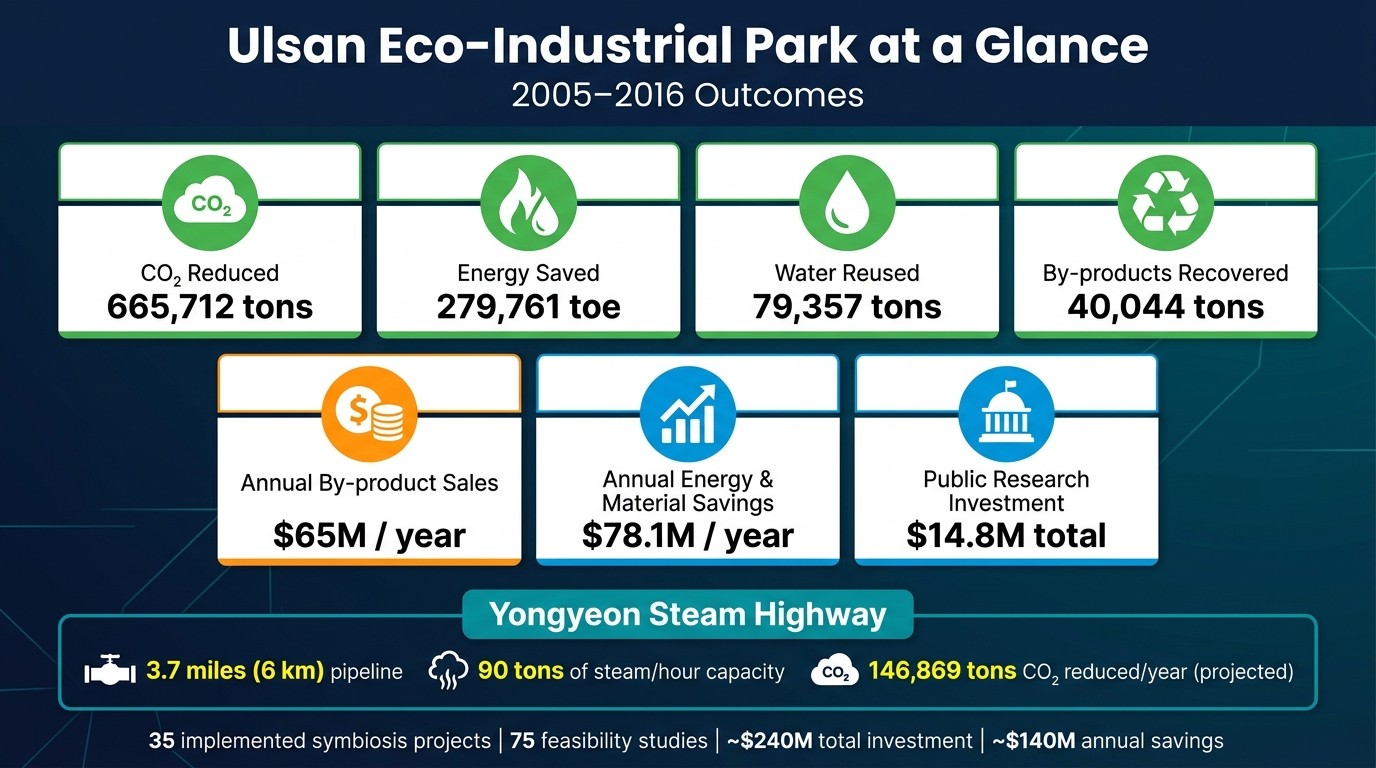
Ulsan Eco-Industrial Park: Key Results 2005–2016
Ulsan's shift from industrial complex to eco-industrial park
Industrial concentration and pollution pressures
National development policy concentrated petrochemical, refining, shipbuilding, automotive, and metals production in Ulsan's Mipo and Onsan complexes. Together, the two complexes covered about 6,540 hectares and employed more than 100,000 workers.[14][16]
That concentration helped industry grow, but it also packed major pollution sources into a tight area. Refineries and petrochemical plants emitted large amounts of SOx, NOx, and volatile organic compounds, while industrial effluents damaged nearby waterways and coastal ecosystems.[14][12][17] In Onsan, the damage became so severe that 7 districts and 7,467 households were evacuated, and firms tied to the pollution had to compensate residents.[21] The area was later designated an atmospheric pollution prevention area.[21]
This was the turning point. Ulsan didn't just need stricter control. It needed a better way to organize industry itself, which set the stage for designed industrial symbiosis.
The national EIP program and Ulsan's pilot role
In 2005, the national government began a three-phase EIP program. The first phase covered five pilot complexes from 2005–2010, the second expanded to 46 complexes from 2010–2014, and the third reached about 150 parks from 2015–2019.[20][8][11]
Ulsan was chosen as a pilot site because it faced heavy pollution pressure and also had strong potential for symbiosis.[14][15][17] Its mix of petrochemicals, refining, shipbuilding, and automotive production created large material and energy flows that could be linked across sectors.[14][15][17] KICOX and national ministries led the effort, paying for feasibility studies, engineering design work, and implementation support.[17][8]
What happened in Ulsan didn't stay in Ulsan. Early pilot results were turned into a standard EIP model that later guided the rollout phase and shaped work in other industrial parks across the country.[17][8][18] In practical terms, the pilot phase in Ulsan built the methods used later to map and develop exchange networks.
From informal exchanges to designed symbiosis
Before the program, some firms were already trading excess steam or by-products. But these were mostly ad hoc, one-to-one deals aimed at lowering disposal costs rather than part of a planned system.[15][12][19]
The EIP program changed that. KICOX and the Ulsan Eco-center mapped material and energy flows across hundreds of companies to find cases where engineered exchanges could replace scattered bilateral deals.[12][17] That effort led to about 75 feasibility studies and 35 implemented industrial symbiosis projects. It was backed by roughly $240 million in investment and produced around $140 million in annual savings.[4]
Those mapped flows became the groundwork for the exchange networks described next.
How Ulsan's exchange networks were designed and operated
Steam, waste heat, and utility-sharing networks
Ulsan treated surplus steam and waste heat as shared infrastructure, not as waste. Once those flows were mapped, they were turned into dedicated steam lines, by-product exchanges, and links with municipal energy systems. The hard part was not spotting the opportunity. It was building infrastructure that plants could count on day after day.
The clearest case is the Yongyeon Steam Highway, a dedicated steam pipeline corridor about 3.7 miles (6 km) long. It connected multiple plants through a public-private partnership. The pipeline was built to carry about 90 tons of steam per hour - roughly 720,000 tons per year - at 42 kg/cm² pressure. Total infrastructure investment came to about $27.5 million, with roughly $22 million from public sources through KICOX and $5.5 million from private firms.[8][10]
A large lead firm such as SK Energy supplied steady steam, which helped justify the pipeline and bring in other users. The Yongyeon network was projected to deliver 146,869 tons of CO₂ reduction per year and about 19.68 billion KRW per year in economic savings.[8][10]
Another major steam-sharing project linked the Sungam Municipal Waste Incineration Facility (MWIF) to Hyosung, a chemical manufacturer. That exchange cut fuel consumption by 18,850 tons per year, reduced 55,500 tons of CO₂ annually, and lowered air pollutants by 176.8 tons per year.[6] For Hyosung alone, later estimates put fuel cost savings at about 3.7 billion KRW per year.[7]
By-product exchange and urban energy links
Steam was only part of the picture. Ulsan also built exchange systems for by-products and city-linked energy supply, which gave the network more depth and made use of flows that would otherwise sit on the sidelines.
One well-known example linked Yoosung, a chemical producer, with Hankook Paper. In that exchange, surplus steam replaced bunker C oil at the paper mill. The result was about $7.1 million per year in combined steam sales and fuel replacement savings, a cut in energy use of 7,762 tons per year, and a reduction of 19,058 tons of CO₂ annually.[6][26]
Ulsan also built an organic waste-to-energy network with the municipality. It co-processes farm and food waste to produce about 9,000 m³ of biogas per day for chemical industries and about 91.2 tons of steam per day for paper industries.[5] That pushed symbiosis past plant-to-plant exchange and into city-scale resource recovery.
Taken together, these projects tied steam, by-products, and municipal waste into one working symbiosis system.
How performance was measured across networks
The Ulsan Eco-center used three tools together to evaluate these exchange networks: material flow analysis (MFA), energy balance modeling, and eco-efficiency metrics.[24][25]
Each tool played a different role:
MFA tracked where materials entered and left each facility, which made it easier to spot residues that could serve as inputs somewhere else.
Energy balance modeling tested whether waste heat or steam could move well enough across distance, temperature loss, and timing of demand.
Eco-efficiency metrics turned those findings into combined economic and environmental measures, including cost savings per unit of output, raw material reduction, and CO₂ emissions per unit of economic value.[25]
Across seven networks developed from 2007 to 2012, this framework recorded eco-efficiency gains of up to 28.7%.[25] That result did not come from engineering alone. It came from coordinating design, finance, and daily operations at the park level.
Governance, financing, and park management
National policy, KICOX, and the Ulsan Eco-center

Once the network design was set, governance became the make-or-break issue. Ulsan’s eco-industrial shift used a multi-level model with clear roles. MOTIE set EIP policy, picked pilot sites, and led annual reviews.[27][8] KICOX, a semi-governmental agency, managed overall planning, budgets, and project approval.[27][3] In Ulsan, the Eco-center - set up around 2007 and linked to KICOX - became the operating hub for the Mipo–Onsan complexes. Its advisory board included people from local government, the University of Ulsan, and industry.[27][28]
The Eco-center did the day-to-day work that kept the model moving. It collected operating data, screened symbiosis options, and coordinated feasibility studies with technical support from the university.[6] It also worked with KICOX and MOTIE on funding, approvals, and coordination with city authorities.[27][9][23]
That setup didn’t just shape decision-making. It also shaped how money moved into projects.
Public-private financing and implementation support
Ulsan used a blended financing model: public money covered early research, coordination, and project development, while private firms invested in the physical systems, including the steam pipelines and by-product exchange infrastructure already described. The usual funding split was 70% central government, 20% local government, and 10% private firms.[8][1]
In one steam-sharing case, financing came through an ESCO fund under the Energy Use Rationalization Act, which cut upfront costs for the firms involved.[7] Ulsan Metropolitan City also added project funding and administrative support.[9][23] The Ulsan EIP Center reviewed about 100 proposals and funded 77 for R&D and 34 for operations.[13][20]
Governance lessons for replication
One lesson stands out: neutral intermediaries can make the whole system work. Firms were willing to share operating data with the Eco-center because it sat in a trusted middle position, and the center could turn that data into projects that lenders and public agencies could back. That kind of bridge role is hard to overstate.
Project selection also stayed grounded in business logic. Before any public or private funds were committed, candidate projects went through standardized feasibility screening across technical, economic, and regulatory criteria.[6][7] Formal advisory committees, stakeholder forums, and multi-level evaluation helped keep the program accountable and open to adjustment over time.[27][8] Those governance choices help explain why Ulsan produced measurable results, even as they also brought some limits into view.
Eco Industrial Park Development - The Ulsan Experience
Results, limits, and lessons for policy and industry leaders
With the networks in place, the next issue was simple: what did they actually deliver, and where did they fall short?
Documented environmental and economic outcomes
Between 2005 and 2016, the program saved 279,761 tons of oil equivalent (toe) in energy, cut 665,712 tons of CO₂, reduced 4,052 tons of SOx and NOx, reused 79,357 tons of water, and recovered 40,044 tons of by-products and waste [27][7]. Those numbers weren’t just good on paper. They translated into steady economic gains as well.
By-product sales brought in $65 million per year, while energy and material savings added $78.1 million per year, compared with $14.8 million in public research funding [27][7]. That gap matters. It shows how a fairly modest public outlay can help set up projects that pay back at a much larger scale.
The gains also showed up beyond plant boundaries. In the surrounding area, SO₂ concentrations fell from 0.012 ppm to 0.008 ppm, and PM10 dropped from 55 µg/m³ to 46 µg/m³ [22]. Cleaner air helped ease local conflict and built stronger public support. That’s often the part people miss: when residents can feel the difference, industrial policy stops looking abstract.
Those results were large, but they also made the system’s weak points harder to ignore.
Limits and unresolved challenges
Ulsan relied on a small group of anchor firms. That made the network exposed to changes in plant operations, investment plans, or shutdown decisions. If one major player pulled back, parts of the exchange system could weaken fast.
Upfront costs were also high, and some projects struggled with weak long-term commercial staying power. In plain terms, getting a project started was hard, and keeping it financially attractive over time could be just as hard.
Rules added drag at nearly every step. By-product classification rules, permitting timelines for shared infrastructure, and the lack of recognition for symbiosis-derived CO₂ reductions all slowed implementation [6][27][2]. Even with the Eco-center handling data, firms were still careful about sharing detailed operating information. That caution narrowed the set of symbiosis options that could be reviewed in the first place [6][27][29].
Key takeaways for leaders designing industrial decarbonization strategies
Ulsan’s experience points to a few moves that stand out.
Use a trusted intermediary to map flows and turn them into projects that can get funded. The Eco-center worked because firms trusted it to collect and study data without behaving like a rival or a regulator.
Build around high-volume anchors. The steam and waste-heat networks with the strongest results depended on large, steady flows between major facilities.
Use public funding to lower early project risk. Ulsan’s $14.8 million in government research funding helped unlock returns many times larger [27][7].
Track both financial and environmental results. If a project only works on one of those two fronts, it often struggles when budgets tighten or leadership changes.
Ulsan’s path - from informal exchanges to a designed, governed, and measured symbiosis system - offers a clear picture of what industrial decarbonization looks like when it moves from idea to day-to-day practice.
FAQs
Why did Ulsan succeed where many industrial parks struggle?
Ulsan moved forward with a top-down, government-led approach that combined long-range planning with clear economic incentives. Its 15-year national master plan, launched in 2005, used material flow analysis to spot where resource exchanges could work and where public support would matter most.
That approach did more than set policy on paper. By tying research and development directly to business activity, Ulsan attracted private investment while keeping oversight under the Korea Industrial Complex Corporation. In practice, that gave the city a steady hand: economic goals and environmental aims were pushed in the same direction instead of pulling apart.
What role did the Eco-center play in making exchanges work?
The Eco-center served as the park’s main coordination hub. Run by the Korea National Cleaner Production Centre, it guided cleaner production work and mapped material flows to track the park’s impact on air, water, and waste.
That work did more than generate reports. It helped the park spot practical resource exchange opportunities - where one company’s byproduct could become another company’s input - and turn R&D into business models with a clear path to market.
With government oversight and coordinated R&D, the center also gave private investors more confidence. That support made it easier to back new projects and expand proven ideas across the park.
Can the Ulsan model be replicated in other heavy-industry regions?
Yes. The Ulsan model is often seen as something other heavy-industry regions can repeat because it is built on three clear pillars: national economic strategy, legislative backing, and active government involvement that maps and supports industrial collaboration.
That gives other regions a practical path to follow. Still, copying the model line for line rarely works. Results depend on how well it fits local economic conditions, the infrastructure already in place, and the strength of local governance.
Related Blog Posts
Latest Articles
©2025

Narrative Change and Power Building: The Missing Half of Advocacy
Narrative change is the process of disrupting dominant narratives that normalize inequity and advancing new narratives from historically marginalized communities.

Funding Resilience Without Federal Grants
BRIC is unreliable and FEMA is shrinking. Here's how cities fund climate resilience with dedicated revenue, blended finance, and a coordinating authority.

The ESG Blind Spot: How AI Is Finding Risks in Companies Nobody Else Is Watching
Norway's sovereign wealth fund uses AI to screen 7,200 portfolio companies for forced labor and corruption within 24 hours. The real story is the emerging-market coverage gap that traditional ESG data vendors miss — and what it means for any company with a global supply chain.
Narrative Change and Power Building: The Missing Half of Advocacy
Narrative change is the process of disrupting dominant narratives that normalize inequity and advancing new narratives from historically marginalized communities.
Funding Resilience Without Federal Grants
BRIC is unreliable and FEMA is shrinking. Here's how cities fund climate resilience with dedicated revenue, blended finance, and a coordinating authority.
The ESG Blind Spot: How AI Is Finding Risks in Companies Nobody Else Is Watching
Norway's sovereign wealth fund uses AI to screen 7,200 portfolio companies for forced labor and corruption within 24 hours. The real story is the emerging-market coverage gap that traditional ESG data vendors miss — and what it means for any company with a global supply chain.
FAQ
01
What does it really mean to “redefine profit”?
02
What makes Council Fire different?
03
Who does Council Fire work with?
04
What does working with Council Fire actually look like?
05
How does Council Fire help organizations turn big goals into action?
06
How does Council Fire define and measure success?
Aug 5, 2026
Ulsan Eco-Industrial Park: Case Study Summary
Sustainability Strategy
In This Article
Planned steam, heat, and by-product networks that cut emissions, saved energy, and delivered strong economic gains from 2005–2016.
Ulsan Eco-Industrial Park: Case Study Summary
Ulsan shows that industrial decarbonization works best when waste, heat, and by-products are treated like shared business inputs. From 2005 to 2016, the park cut 665,712 tons of CO₂, saved 279,761 toe of energy, reused 79,357 tons of water, and generated yearly gains that far exceeded its public research spend of $14.8 million.
If I had to boil the case down for you, it comes to four points:
Policy set the direction. South Korea’s national EIP program gave Ulsan a formal path, funding, and review process.
A neutral park-level team made projects happen. The Eco-center mapped flows, studied options, and worked between firms, government, and researchers.
Big anchor plants made exchange networks viable. Shared steam, waste heat, and by-products worked because large facilities could supply steady volumes.
Results were measured in dollars and emissions. Some projects cut fuel use, lowered air pollution, and saved millions each year.
What stands out to me is that Ulsan did not rely on loose, one-off exchanges alone. It built planned networks such as the 3.7-mile (6 km) Yongyeon Steam Highway, which was designed to move about 90 tons of steam per hour and was tied to large yearly CO₂ and cost cuts. Other links connected city waste systems with factories, showing that industrial exchange can extend past plant fences.
At the same time, the case is not a simple success story. High upfront costs, data-sharing limits, permit issues, and dependence on a few large firms all put pressure on the model. So if you are looking at Ulsan as a guide, the main lesson is clear: map flows, fund early studies, build around steady demand, and track both money and emissions from day one.
I see Ulsan as a practical example of how a heavy-industry area can move from pollution control to a managed system of shared resources.
Ulsan Eco-Industrial Park: Key Results 2005–2016
Ulsan's shift from industrial complex to eco-industrial park
Industrial concentration and pollution pressures
National development policy concentrated petrochemical, refining, shipbuilding, automotive, and metals production in Ulsan's Mipo and Onsan complexes. Together, the two complexes covered about 6,540 hectares and employed more than 100,000 workers.[14][16]
That concentration helped industry grow, but it also packed major pollution sources into a tight area. Refineries and petrochemical plants emitted large amounts of SOx, NOx, and volatile organic compounds, while industrial effluents damaged nearby waterways and coastal ecosystems.[14][12][17] In Onsan, the damage became so severe that 7 districts and 7,467 households were evacuated, and firms tied to the pollution had to compensate residents.[21] The area was later designated an atmospheric pollution prevention area.[21]
This was the turning point. Ulsan didn't just need stricter control. It needed a better way to organize industry itself, which set the stage for designed industrial symbiosis.
The national EIP program and Ulsan's pilot role
In 2005, the national government began a three-phase EIP program. The first phase covered five pilot complexes from 2005–2010, the second expanded to 46 complexes from 2010–2014, and the third reached about 150 parks from 2015–2019.[20][8][11]
Ulsan was chosen as a pilot site because it faced heavy pollution pressure and also had strong potential for symbiosis.[14][15][17] Its mix of petrochemicals, refining, shipbuilding, and automotive production created large material and energy flows that could be linked across sectors.[14][15][17] KICOX and national ministries led the effort, paying for feasibility studies, engineering design work, and implementation support.[17][8]
What happened in Ulsan didn't stay in Ulsan. Early pilot results were turned into a standard EIP model that later guided the rollout phase and shaped work in other industrial parks across the country.[17][8][18] In practical terms, the pilot phase in Ulsan built the methods used later to map and develop exchange networks.
From informal exchanges to designed symbiosis
Before the program, some firms were already trading excess steam or by-products. But these were mostly ad hoc, one-to-one deals aimed at lowering disposal costs rather than part of a planned system.[15][12][19]
The EIP program changed that. KICOX and the Ulsan Eco-center mapped material and energy flows across hundreds of companies to find cases where engineered exchanges could replace scattered bilateral deals.[12][17] That effort led to about 75 feasibility studies and 35 implemented industrial symbiosis projects. It was backed by roughly $240 million in investment and produced around $140 million in annual savings.[4]
Those mapped flows became the groundwork for the exchange networks described next.
How Ulsan's exchange networks were designed and operated
Steam, waste heat, and utility-sharing networks
Ulsan treated surplus steam and waste heat as shared infrastructure, not as waste. Once those flows were mapped, they were turned into dedicated steam lines, by-product exchanges, and links with municipal energy systems. The hard part was not spotting the opportunity. It was building infrastructure that plants could count on day after day.
The clearest case is the Yongyeon Steam Highway, a dedicated steam pipeline corridor about 3.7 miles (6 km) long. It connected multiple plants through a public-private partnership. The pipeline was built to carry about 90 tons of steam per hour - roughly 720,000 tons per year - at 42 kg/cm² pressure. Total infrastructure investment came to about $27.5 million, with roughly $22 million from public sources through KICOX and $5.5 million from private firms.[8][10]
A large lead firm such as SK Energy supplied steady steam, which helped justify the pipeline and bring in other users. The Yongyeon network was projected to deliver 146,869 tons of CO₂ reduction per year and about 19.68 billion KRW per year in economic savings.[8][10]
Another major steam-sharing project linked the Sungam Municipal Waste Incineration Facility (MWIF) to Hyosung, a chemical manufacturer. That exchange cut fuel consumption by 18,850 tons per year, reduced 55,500 tons of CO₂ annually, and lowered air pollutants by 176.8 tons per year.[6] For Hyosung alone, later estimates put fuel cost savings at about 3.7 billion KRW per year.[7]
By-product exchange and urban energy links
Steam was only part of the picture. Ulsan also built exchange systems for by-products and city-linked energy supply, which gave the network more depth and made use of flows that would otherwise sit on the sidelines.
One well-known example linked Yoosung, a chemical producer, with Hankook Paper. In that exchange, surplus steam replaced bunker C oil at the paper mill. The result was about $7.1 million per year in combined steam sales and fuel replacement savings, a cut in energy use of 7,762 tons per year, and a reduction of 19,058 tons of CO₂ annually.[6][26]
Ulsan also built an organic waste-to-energy network with the municipality. It co-processes farm and food waste to produce about 9,000 m³ of biogas per day for chemical industries and about 91.2 tons of steam per day for paper industries.[5] That pushed symbiosis past plant-to-plant exchange and into city-scale resource recovery.
Taken together, these projects tied steam, by-products, and municipal waste into one working symbiosis system.
How performance was measured across networks
The Ulsan Eco-center used three tools together to evaluate these exchange networks: material flow analysis (MFA), energy balance modeling, and eco-efficiency metrics.[24][25]
Each tool played a different role:
MFA tracked where materials entered and left each facility, which made it easier to spot residues that could serve as inputs somewhere else.
Energy balance modeling tested whether waste heat or steam could move well enough across distance, temperature loss, and timing of demand.
Eco-efficiency metrics turned those findings into combined economic and environmental measures, including cost savings per unit of output, raw material reduction, and CO₂ emissions per unit of economic value.[25]
Across seven networks developed from 2007 to 2012, this framework recorded eco-efficiency gains of up to 28.7%.[25] That result did not come from engineering alone. It came from coordinating design, finance, and daily operations at the park level.
Governance, financing, and park management
National policy, KICOX, and the Ulsan Eco-center
Once the network design was set, governance became the make-or-break issue. Ulsan’s eco-industrial shift used a multi-level model with clear roles. MOTIE set EIP policy, picked pilot sites, and led annual reviews.[27][8] KICOX, a semi-governmental agency, managed overall planning, budgets, and project approval.[27][3] In Ulsan, the Eco-center - set up around 2007 and linked to KICOX - became the operating hub for the Mipo–Onsan complexes. Its advisory board included people from local government, the University of Ulsan, and industry.[27][28]
The Eco-center did the day-to-day work that kept the model moving. It collected operating data, screened symbiosis options, and coordinated feasibility studies with technical support from the university.[6] It also worked with KICOX and MOTIE on funding, approvals, and coordination with city authorities.[27][9][23]
That setup didn’t just shape decision-making. It also shaped how money moved into projects.
Public-private financing and implementation support
Ulsan used a blended financing model: public money covered early research, coordination, and project development, while private firms invested in the physical systems, including the steam pipelines and by-product exchange infrastructure already described. The usual funding split was 70% central government, 20% local government, and 10% private firms.[8][1]
In one steam-sharing case, financing came through an ESCO fund under the Energy Use Rationalization Act, which cut upfront costs for the firms involved.[7] Ulsan Metropolitan City also added project funding and administrative support.[9][23] The Ulsan EIP Center reviewed about 100 proposals and funded 77 for R&D and 34 for operations.[13][20]
Governance lessons for replication
One lesson stands out: neutral intermediaries can make the whole system work. Firms were willing to share operating data with the Eco-center because it sat in a trusted middle position, and the center could turn that data into projects that lenders and public agencies could back. That kind of bridge role is hard to overstate.
Project selection also stayed grounded in business logic. Before any public or private funds were committed, candidate projects went through standardized feasibility screening across technical, economic, and regulatory criteria.[6][7] Formal advisory committees, stakeholder forums, and multi-level evaluation helped keep the program accountable and open to adjustment over time.[27][8] Those governance choices help explain why Ulsan produced measurable results, even as they also brought some limits into view.
Eco Industrial Park Development - The Ulsan Experience
Results, limits, and lessons for policy and industry leaders
With the networks in place, the next issue was simple: what did they actually deliver, and where did they fall short?
Documented environmental and economic outcomes
Between 2005 and 2016, the program saved 279,761 tons of oil equivalent (toe) in energy, cut 665,712 tons of CO₂, reduced 4,052 tons of SOx and NOx, reused 79,357 tons of water, and recovered 40,044 tons of by-products and waste [27][7]. Those numbers weren’t just good on paper. They translated into steady economic gains as well.
By-product sales brought in $65 million per year, while energy and material savings added $78.1 million per year, compared with $14.8 million in public research funding [27][7]. That gap matters. It shows how a fairly modest public outlay can help set up projects that pay back at a much larger scale.
The gains also showed up beyond plant boundaries. In the surrounding area, SO₂ concentrations fell from 0.012 ppm to 0.008 ppm, and PM10 dropped from 55 µg/m³ to 46 µg/m³ [22]. Cleaner air helped ease local conflict and built stronger public support. That’s often the part people miss: when residents can feel the difference, industrial policy stops looking abstract.
Those results were large, but they also made the system’s weak points harder to ignore.
Limits and unresolved challenges
Ulsan relied on a small group of anchor firms. That made the network exposed to changes in plant operations, investment plans, or shutdown decisions. If one major player pulled back, parts of the exchange system could weaken fast.
Upfront costs were also high, and some projects struggled with weak long-term commercial staying power. In plain terms, getting a project started was hard, and keeping it financially attractive over time could be just as hard.
Rules added drag at nearly every step. By-product classification rules, permitting timelines for shared infrastructure, and the lack of recognition for symbiosis-derived CO₂ reductions all slowed implementation [6][27][2]. Even with the Eco-center handling data, firms were still careful about sharing detailed operating information. That caution narrowed the set of symbiosis options that could be reviewed in the first place [6][27][29].
Key takeaways for leaders designing industrial decarbonization strategies
Ulsan’s experience points to a few moves that stand out.
Use a trusted intermediary to map flows and turn them into projects that can get funded. The Eco-center worked because firms trusted it to collect and study data without behaving like a rival or a regulator.
Build around high-volume anchors. The steam and waste-heat networks with the strongest results depended on large, steady flows between major facilities.
Use public funding to lower early project risk. Ulsan’s $14.8 million in government research funding helped unlock returns many times larger [27][7].
Track both financial and environmental results. If a project only works on one of those two fronts, it often struggles when budgets tighten or leadership changes.
Ulsan’s path - from informal exchanges to a designed, governed, and measured symbiosis system - offers a clear picture of what industrial decarbonization looks like when it moves from idea to day-to-day practice.
FAQs
Why did Ulsan succeed where many industrial parks struggle?
Ulsan moved forward with a top-down, government-led approach that combined long-range planning with clear economic incentives. Its 15-year national master plan, launched in 2005, used material flow analysis to spot where resource exchanges could work and where public support would matter most.
That approach did more than set policy on paper. By tying research and development directly to business activity, Ulsan attracted private investment while keeping oversight under the Korea Industrial Complex Corporation. In practice, that gave the city a steady hand: economic goals and environmental aims were pushed in the same direction instead of pulling apart.
What role did the Eco-center play in making exchanges work?
The Eco-center served as the park’s main coordination hub. Run by the Korea National Cleaner Production Centre, it guided cleaner production work and mapped material flows to track the park’s impact on air, water, and waste.
That work did more than generate reports. It helped the park spot practical resource exchange opportunities - where one company’s byproduct could become another company’s input - and turn R&D into business models with a clear path to market.
With government oversight and coordinated R&D, the center also gave private investors more confidence. That support made it easier to back new projects and expand proven ideas across the park.
Can the Ulsan model be replicated in other heavy-industry regions?
Yes. The Ulsan model is often seen as something other heavy-industry regions can repeat because it is built on three clear pillars: national economic strategy, legislative backing, and active government involvement that maps and supports industrial collaboration.
That gives other regions a practical path to follow. Still, copying the model line for line rarely works. Results depend on how well it fits local economic conditions, the infrastructure already in place, and the strength of local governance.
Related Blog Posts
Latest Articles
©2025
Narrative Change and Power Building: The Missing Half of Advocacy
Narrative change is the process of disrupting dominant narratives that normalize inequity and advancing new narratives from historically marginalized communities.
Funding Resilience Without Federal Grants
BRIC is unreliable and FEMA is shrinking. Here's how cities fund climate resilience with dedicated revenue, blended finance, and a coordinating authority.
The ESG Blind Spot: How AI Is Finding Risks in Companies Nobody Else Is Watching
Norway's sovereign wealth fund uses AI to screen 7,200 portfolio companies for forced labor and corruption within 24 hours. The real story is the emerging-market coverage gap that traditional ESG data vendors miss — and what it means for any company with a global supply chain.
FAQ
01
What does it really mean to “redefine profit”?
02
What makes Council Fire different?
03
Who does Council Fire work with?
04
What does working with Council Fire actually look like?
05
How does Council Fire help organizations turn big goals into action?
06
How does Council Fire define and measure success?
Aug 5, 2026
Ulsan Eco-Industrial Park: Case Study Summary
Sustainability Strategy
In This Article
Planned steam, heat, and by-product networks that cut emissions, saved energy, and delivered strong economic gains from 2005–2016.
Ulsan Eco-Industrial Park: Case Study Summary
Ulsan shows that industrial decarbonization works best when waste, heat, and by-products are treated like shared business inputs. From 2005 to 2016, the park cut 665,712 tons of CO₂, saved 279,761 toe of energy, reused 79,357 tons of water, and generated yearly gains that far exceeded its public research spend of $14.8 million.
If I had to boil the case down for you, it comes to four points:
Policy set the direction. South Korea’s national EIP program gave Ulsan a formal path, funding, and review process.
A neutral park-level team made projects happen. The Eco-center mapped flows, studied options, and worked between firms, government, and researchers.
Big anchor plants made exchange networks viable. Shared steam, waste heat, and by-products worked because large facilities could supply steady volumes.
Results were measured in dollars and emissions. Some projects cut fuel use, lowered air pollution, and saved millions each year.
What stands out to me is that Ulsan did not rely on loose, one-off exchanges alone. It built planned networks such as the 3.7-mile (6 km) Yongyeon Steam Highway, which was designed to move about 90 tons of steam per hour and was tied to large yearly CO₂ and cost cuts. Other links connected city waste systems with factories, showing that industrial exchange can extend past plant fences.
At the same time, the case is not a simple success story. High upfront costs, data-sharing limits, permit issues, and dependence on a few large firms all put pressure on the model. So if you are looking at Ulsan as a guide, the main lesson is clear: map flows, fund early studies, build around steady demand, and track both money and emissions from day one.
I see Ulsan as a practical example of how a heavy-industry area can move from pollution control to a managed system of shared resources.
Ulsan Eco-Industrial Park: Key Results 2005–2016
Ulsan's shift from industrial complex to eco-industrial park
Industrial concentration and pollution pressures
National development policy concentrated petrochemical, refining, shipbuilding, automotive, and metals production in Ulsan's Mipo and Onsan complexes. Together, the two complexes covered about 6,540 hectares and employed more than 100,000 workers.[14][16]
That concentration helped industry grow, but it also packed major pollution sources into a tight area. Refineries and petrochemical plants emitted large amounts of SOx, NOx, and volatile organic compounds, while industrial effluents damaged nearby waterways and coastal ecosystems.[14][12][17] In Onsan, the damage became so severe that 7 districts and 7,467 households were evacuated, and firms tied to the pollution had to compensate residents.[21] The area was later designated an atmospheric pollution prevention area.[21]
This was the turning point. Ulsan didn't just need stricter control. It needed a better way to organize industry itself, which set the stage for designed industrial symbiosis.
The national EIP program and Ulsan's pilot role
In 2005, the national government began a three-phase EIP program. The first phase covered five pilot complexes from 2005–2010, the second expanded to 46 complexes from 2010–2014, and the third reached about 150 parks from 2015–2019.[20][8][11]
Ulsan was chosen as a pilot site because it faced heavy pollution pressure and also had strong potential for symbiosis.[14][15][17] Its mix of petrochemicals, refining, shipbuilding, and automotive production created large material and energy flows that could be linked across sectors.[14][15][17] KICOX and national ministries led the effort, paying for feasibility studies, engineering design work, and implementation support.[17][8]
What happened in Ulsan didn't stay in Ulsan. Early pilot results were turned into a standard EIP model that later guided the rollout phase and shaped work in other industrial parks across the country.[17][8][18] In practical terms, the pilot phase in Ulsan built the methods used later to map and develop exchange networks.
From informal exchanges to designed symbiosis
Before the program, some firms were already trading excess steam or by-products. But these were mostly ad hoc, one-to-one deals aimed at lowering disposal costs rather than part of a planned system.[15][12][19]
The EIP program changed that. KICOX and the Ulsan Eco-center mapped material and energy flows across hundreds of companies to find cases where engineered exchanges could replace scattered bilateral deals.[12][17] That effort led to about 75 feasibility studies and 35 implemented industrial symbiosis projects. It was backed by roughly $240 million in investment and produced around $140 million in annual savings.[4]
Those mapped flows became the groundwork for the exchange networks described next.
How Ulsan's exchange networks were designed and operated
Steam, waste heat, and utility-sharing networks
Ulsan treated surplus steam and waste heat as shared infrastructure, not as waste. Once those flows were mapped, they were turned into dedicated steam lines, by-product exchanges, and links with municipal energy systems. The hard part was not spotting the opportunity. It was building infrastructure that plants could count on day after day.
The clearest case is the Yongyeon Steam Highway, a dedicated steam pipeline corridor about 3.7 miles (6 km) long. It connected multiple plants through a public-private partnership. The pipeline was built to carry about 90 tons of steam per hour - roughly 720,000 tons per year - at 42 kg/cm² pressure. Total infrastructure investment came to about $27.5 million, with roughly $22 million from public sources through KICOX and $5.5 million from private firms.[8][10]
A large lead firm such as SK Energy supplied steady steam, which helped justify the pipeline and bring in other users. The Yongyeon network was projected to deliver 146,869 tons of CO₂ reduction per year and about 19.68 billion KRW per year in economic savings.[8][10]
Another major steam-sharing project linked the Sungam Municipal Waste Incineration Facility (MWIF) to Hyosung, a chemical manufacturer. That exchange cut fuel consumption by 18,850 tons per year, reduced 55,500 tons of CO₂ annually, and lowered air pollutants by 176.8 tons per year.[6] For Hyosung alone, later estimates put fuel cost savings at about 3.7 billion KRW per year.[7]
By-product exchange and urban energy links
Steam was only part of the picture. Ulsan also built exchange systems for by-products and city-linked energy supply, which gave the network more depth and made use of flows that would otherwise sit on the sidelines.
One well-known example linked Yoosung, a chemical producer, with Hankook Paper. In that exchange, surplus steam replaced bunker C oil at the paper mill. The result was about $7.1 million per year in combined steam sales and fuel replacement savings, a cut in energy use of 7,762 tons per year, and a reduction of 19,058 tons of CO₂ annually.[6][26]
Ulsan also built an organic waste-to-energy network with the municipality. It co-processes farm and food waste to produce about 9,000 m³ of biogas per day for chemical industries and about 91.2 tons of steam per day for paper industries.[5] That pushed symbiosis past plant-to-plant exchange and into city-scale resource recovery.
Taken together, these projects tied steam, by-products, and municipal waste into one working symbiosis system.
How performance was measured across networks
The Ulsan Eco-center used three tools together to evaluate these exchange networks: material flow analysis (MFA), energy balance modeling, and eco-efficiency metrics.[24][25]
Each tool played a different role:
MFA tracked where materials entered and left each facility, which made it easier to spot residues that could serve as inputs somewhere else.
Energy balance modeling tested whether waste heat or steam could move well enough across distance, temperature loss, and timing of demand.
Eco-efficiency metrics turned those findings into combined economic and environmental measures, including cost savings per unit of output, raw material reduction, and CO₂ emissions per unit of economic value.[25]
Across seven networks developed from 2007 to 2012, this framework recorded eco-efficiency gains of up to 28.7%.[25] That result did not come from engineering alone. It came from coordinating design, finance, and daily operations at the park level.
Governance, financing, and park management
National policy, KICOX, and the Ulsan Eco-center
Once the network design was set, governance became the make-or-break issue. Ulsan’s eco-industrial shift used a multi-level model with clear roles. MOTIE set EIP policy, picked pilot sites, and led annual reviews.[27][8] KICOX, a semi-governmental agency, managed overall planning, budgets, and project approval.[27][3] In Ulsan, the Eco-center - set up around 2007 and linked to KICOX - became the operating hub for the Mipo–Onsan complexes. Its advisory board included people from local government, the University of Ulsan, and industry.[27][28]
The Eco-center did the day-to-day work that kept the model moving. It collected operating data, screened symbiosis options, and coordinated feasibility studies with technical support from the university.[6] It also worked with KICOX and MOTIE on funding, approvals, and coordination with city authorities.[27][9][23]
That setup didn’t just shape decision-making. It also shaped how money moved into projects.
Public-private financing and implementation support
Ulsan used a blended financing model: public money covered early research, coordination, and project development, while private firms invested in the physical systems, including the steam pipelines and by-product exchange infrastructure already described. The usual funding split was 70% central government, 20% local government, and 10% private firms.[8][1]
In one steam-sharing case, financing came through an ESCO fund under the Energy Use Rationalization Act, which cut upfront costs for the firms involved.[7] Ulsan Metropolitan City also added project funding and administrative support.[9][23] The Ulsan EIP Center reviewed about 100 proposals and funded 77 for R&D and 34 for operations.[13][20]
Governance lessons for replication
One lesson stands out: neutral intermediaries can make the whole system work. Firms were willing to share operating data with the Eco-center because it sat in a trusted middle position, and the center could turn that data into projects that lenders and public agencies could back. That kind of bridge role is hard to overstate.
Project selection also stayed grounded in business logic. Before any public or private funds were committed, candidate projects went through standardized feasibility screening across technical, economic, and regulatory criteria.[6][7] Formal advisory committees, stakeholder forums, and multi-level evaluation helped keep the program accountable and open to adjustment over time.[27][8] Those governance choices help explain why Ulsan produced measurable results, even as they also brought some limits into view.
Eco Industrial Park Development - The Ulsan Experience
Results, limits, and lessons for policy and industry leaders
With the networks in place, the next issue was simple: what did they actually deliver, and where did they fall short?
Documented environmental and economic outcomes
Between 2005 and 2016, the program saved 279,761 tons of oil equivalent (toe) in energy, cut 665,712 tons of CO₂, reduced 4,052 tons of SOx and NOx, reused 79,357 tons of water, and recovered 40,044 tons of by-products and waste [27][7]. Those numbers weren’t just good on paper. They translated into steady economic gains as well.
By-product sales brought in $65 million per year, while energy and material savings added $78.1 million per year, compared with $14.8 million in public research funding [27][7]. That gap matters. It shows how a fairly modest public outlay can help set up projects that pay back at a much larger scale.
The gains also showed up beyond plant boundaries. In the surrounding area, SO₂ concentrations fell from 0.012 ppm to 0.008 ppm, and PM10 dropped from 55 µg/m³ to 46 µg/m³ [22]. Cleaner air helped ease local conflict and built stronger public support. That’s often the part people miss: when residents can feel the difference, industrial policy stops looking abstract.
Those results were large, but they also made the system’s weak points harder to ignore.
Limits and unresolved challenges
Ulsan relied on a small group of anchor firms. That made the network exposed to changes in plant operations, investment plans, or shutdown decisions. If one major player pulled back, parts of the exchange system could weaken fast.
Upfront costs were also high, and some projects struggled with weak long-term commercial staying power. In plain terms, getting a project started was hard, and keeping it financially attractive over time could be just as hard.
Rules added drag at nearly every step. By-product classification rules, permitting timelines for shared infrastructure, and the lack of recognition for symbiosis-derived CO₂ reductions all slowed implementation [6][27][2]. Even with the Eco-center handling data, firms were still careful about sharing detailed operating information. That caution narrowed the set of symbiosis options that could be reviewed in the first place [6][27][29].
Key takeaways for leaders designing industrial decarbonization strategies
Ulsan’s experience points to a few moves that stand out.
Use a trusted intermediary to map flows and turn them into projects that can get funded. The Eco-center worked because firms trusted it to collect and study data without behaving like a rival or a regulator.
Build around high-volume anchors. The steam and waste-heat networks with the strongest results depended on large, steady flows between major facilities.
Use public funding to lower early project risk. Ulsan’s $14.8 million in government research funding helped unlock returns many times larger [27][7].
Track both financial and environmental results. If a project only works on one of those two fronts, it often struggles when budgets tighten or leadership changes.
Ulsan’s path - from informal exchanges to a designed, governed, and measured symbiosis system - offers a clear picture of what industrial decarbonization looks like when it moves from idea to day-to-day practice.
FAQs
Why did Ulsan succeed where many industrial parks struggle?
Ulsan moved forward with a top-down, government-led approach that combined long-range planning with clear economic incentives. Its 15-year national master plan, launched in 2005, used material flow analysis to spot where resource exchanges could work and where public support would matter most.
That approach did more than set policy on paper. By tying research and development directly to business activity, Ulsan attracted private investment while keeping oversight under the Korea Industrial Complex Corporation. In practice, that gave the city a steady hand: economic goals and environmental aims were pushed in the same direction instead of pulling apart.
What role did the Eco-center play in making exchanges work?
The Eco-center served as the park’s main coordination hub. Run by the Korea National Cleaner Production Centre, it guided cleaner production work and mapped material flows to track the park’s impact on air, water, and waste.
That work did more than generate reports. It helped the park spot practical resource exchange opportunities - where one company’s byproduct could become another company’s input - and turn R&D into business models with a clear path to market.
With government oversight and coordinated R&D, the center also gave private investors more confidence. That support made it easier to back new projects and expand proven ideas across the park.
Can the Ulsan model be replicated in other heavy-industry regions?
Yes. The Ulsan model is often seen as something other heavy-industry regions can repeat because it is built on three clear pillars: national economic strategy, legislative backing, and active government involvement that maps and supports industrial collaboration.
That gives other regions a practical path to follow. Still, copying the model line for line rarely works. Results depend on how well it fits local economic conditions, the infrastructure already in place, and the strength of local governance.
Related Blog Posts
Latest Articles
©2025
Narrative Change and Power Building: The Missing Half of Advocacy
Narrative change is the process of disrupting dominant narratives that normalize inequity and advancing new narratives from historically marginalized communities.
Funding Resilience Without Federal Grants
BRIC is unreliable and FEMA is shrinking. Here's how cities fund climate resilience with dedicated revenue, blended finance, and a coordinating authority.
The ESG Blind Spot: How AI Is Finding Risks in Companies Nobody Else Is Watching
Norway's sovereign wealth fund uses AI to screen 7,200 portfolio companies for forced labor and corruption within 24 hours. The real story is the emerging-market coverage gap that traditional ESG data vendors miss — and what it means for any company with a global supply chain.
FAQ
What does it really mean to “redefine profit”?
What makes Council Fire different?
Who does Council Fire work with?
What does working with Council Fire actually look like?
How does Council Fire help organizations turn big goals into action?
How does Council Fire define and measure success?