Apr 25, 2026
How to Transition to Renewable Energy Systems at the Local Level for Municipalities & Government Agencies
Sustainability Strategy
In This Article
Local governments can cut emissions and costs, create jobs and resilience by auditing energy, choosing renewables, and securing funding.
How to Transition to Renewable Energy Systems at the Local Level for Municipalities & Government Agencies
Municipalities and government agencies can shift to renewable energy by following a clear, actionable process. This not only reduces emissions but also cuts costs, improves air quality, and creates local jobs. Federal funding, such as the Inflation Reduction Act, provides significant financial support, making this transition more feasible.
Key Steps:
Assess Current Energy Use: Conduct energy audits to identify high-energy-consuming sectors like water treatment facilities.
Evaluate Local Resources: Use tools like SLOPE or PVWatts to analyze solar, wind, and other renewable potential.
Set Goals: Establish measurable targets based on energy needs, future demands, and greenhouse gas reduction plans.
Choose Technologies: Match energy needs with options like solar, wind, or biogas, considering costs and feasibility.
Secure Funding: Leverage municipal bonds, federal grants, and Power Purchase Agreements (PPAs) for financing.
Streamline Regulations: Update zoning and permitting codes to expedite project approvals.
Engage the Community: Build local support through outreach, workshops, and transparent communication.
Monitor and Adjust: Track performance and refine strategies using tools like REopt Lite and performance dashboards.
This guide provides municipalities with the tools and steps to transition to clean energy effectively, aligning with financial, operational, and community goals.
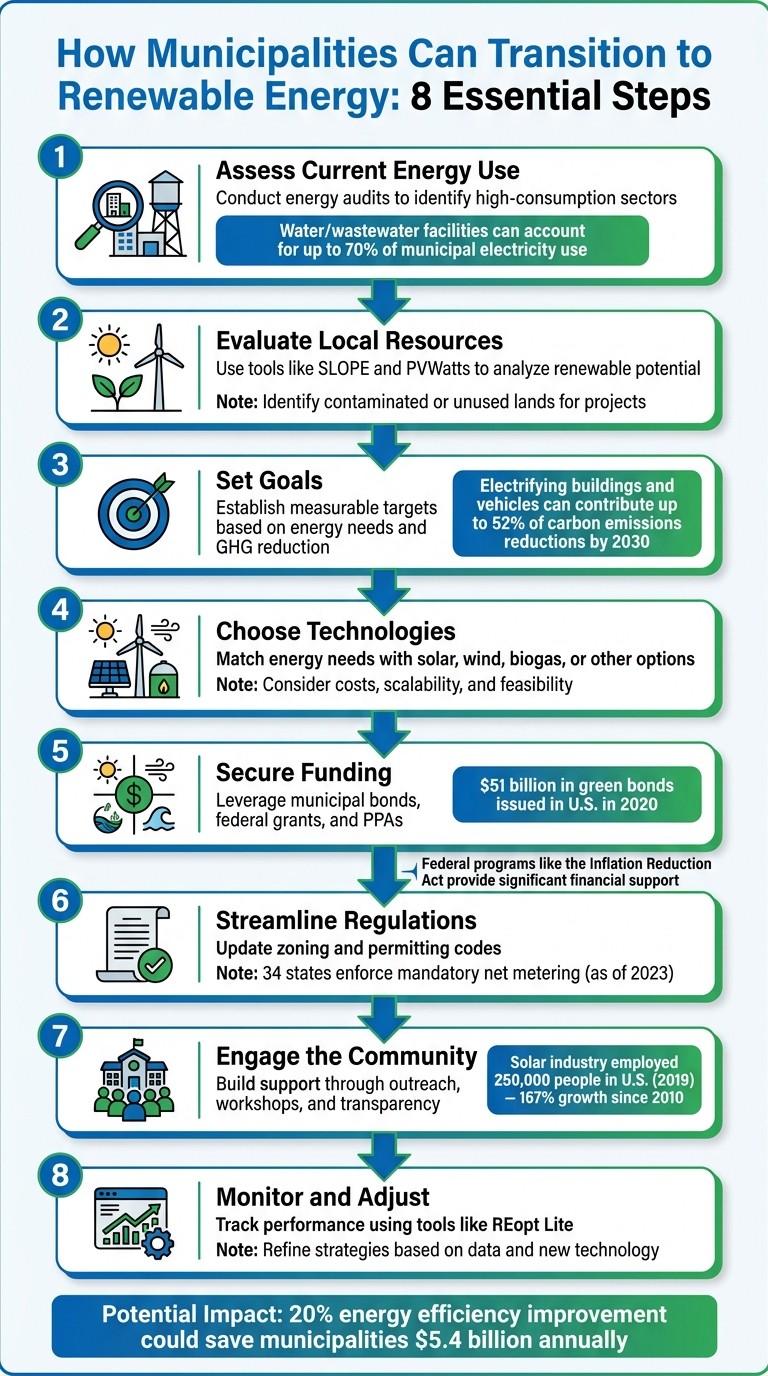
8-Step Process for Municipalities to Transition to Renewable Energy
MVP Webinar #2: Municipal Solar and Energy Storage Funding Success Stories.
Assess Your Local Energy Needs and Opportunities
Before diving into renewable energy solutions, it's important to take a close look at your current energy use and the renewable resources available in your area. This groundwork will guide informed decision-making.
Conduct Energy Audits and Analyze Current Consumption
Begin by mapping out how your municipality consumes electricity across its operations. The Local Energy Action Framework (LEAF) offers a structured approach, ensuring you don't assess facilities in isolation. Group your infrastructure into categories like office buildings, wastewater plants, airports, or fire stations. This will help pinpoint which sectors are driving the highest demand. For many municipalities, water and wastewater facilities dominate electricity use, often making up as much as 70% of total municipal consumption [3].
In early 2023, RMI implemented LEAF in six U.S. jurisdictions - Alexandria, VA; Ann Arbor, MI; Atlanta, GA; Boise, ID; Cincinnati, OH; and Miami-Dade County, FL. Using 2019 end-use load profiles, the team identified key energy drivers. For example, Atlanta's airport emerged as its largest consumer, while Boise faced a projected 170% winter load increase due to heating electrification [3].
Timing also plays a critical role in energy planning. Many municipalities find that 60–80% of electricity use happens between 5 p.m. and 8 a.m., when solar energy isn’t an option [3]. Knowing this helps determine which renewable technologies will work best. Additionally, consider future load increases from electrifying heating systems and vehicle fleets, which could raise annual building loads by 5–17% [3]. Identify flexible loads, like EV charging or water pumping, that can be shifted to align with renewable energy availability and avoid high peak pricing.
Once you’ve built a clear picture of your energy consumption, the next step is to match your needs with local renewable energy resources.
Evaluate Local Renewable Energy Resources
Leverage data-driven tools to understand the renewable energy potential in your area. The State and Local Planning for Energy (SLOPE) platform provides county-level data, making it easier to compare renewable energy opportunities with your consumption patterns [7]. For solar energy, the PVWatts Calculator estimates the energy output and cost savings of grid-connected photovoltaic systems, while WINDExchange offers detailed wind resource maps to evaluate wind energy potential [6].
Also, explore underutilized spaces for renewable projects. The RE-Powering America's Land program helps local governments identify contaminated or unused lands - like landfills and mining sites - that could host renewable energy installations [6]. For biogas, tools like the AgSTAR National Mapping Tool and the Landfill Methane Outreach Program (LMOP) database can help locate anaerobic digesters or landfills with energy potential [6].
These assessments provide a solid foundation to establish realistic and actionable renewable energy goals.
Set Realistic Renewable Energy Goals
Use the insights from your energy audits and resource evaluations to set measurable goals. Start by conducting a community-wide Greenhouse Gas (GHG) inventory using protocols like the Global Protocol for Community-Scale Greenhouse Gas Inventories (GPC). For smaller cities (populations under 250,000), the GPC BASIC protocol is a good fit, covering stationary energy, transportation, and waste [5]. Additionally, tools like the ENERGY STAR Portfolio Manager can help benchmark city-owned buildings and identify the top energy consumers for retrofitting [5].
When setting goals, factor in future electricity demand. As RMI points out, "Local governments might buy less renewable energy than they ultimately need if they do not consider the added demand that will come from electrifying buildings and vehicles" [3]. For example, the LEAF analysis found that electrifying buildings and vehicles could contribute to up to 52% of total carbon emissions reductions by 2030, but achieving this would require managing early morning load peaks [3].
To meet these goals, balance on-site generation - such as rooftop solar or land-based systems - with off-site procurement options like Power Purchase Agreements or green tariffs. Also, consider state renewable portfolio standards and federal funding programs like Justice40, which ensures that 40% of benefits reach disadvantaged communities [5].
Select the Right Renewable Energy Technologies
After completing energy audits and evaluating available resources, choosing the appropriate technology becomes a crucial step in reaching your renewable energy goals. The key is to align technology selection with local consumption patterns and resource availability while also setting clear parameters for budget, timeline, and success.
Overview of Key Renewable Energy Technologies
Municipalities have access to a variety of renewable energy options, each with its own strengths. Solar photovoltaic (PV) and solar thermal systems are ideal for municipal buildings and parking areas, provided the roofs have sufficient capacity and exposure to sunlight. Wind turbines, whether onshore or offshore, are effective in areas with consistent wind patterns but require attention to land use and noise considerations. Biogas systems utilize methane from landfills or wastewater treatment plants, making them a logical choice if your municipality manages these facilities. Geothermal heat pumps offer efficient heating and cooling but depend on suitable subsurface conditions and typically involve a higher upfront investment. Biomass combined heat and power (CHP) systems need a steady fuel supply, while low-impact hydroelectric projects rely on consistent water flow and minimal ecological disruption [1].
For coastal municipalities, emerging technologies like wave and tidal power are becoming more accessible, although they still face technical hurdles when compared to established solutions like solar or wind [1]. Selecting the right technology requires matching it to local factors such as solar radiance, wind speeds, proximity to waste streams, or geothermal potential [1]. After that, compare technologies based on cost, scalability, and feasibility to identify the best fit.
Compare Technologies by Cost, Scalability, and Feasibility
Each renewable energy technology has distinct advantages and challenges. For example, solar panels and geothermal heat pumps are often well-suited for individual buildings, while biogas and biomass systems are more effective when integrated into specific infrastructure like wastewater treatment plants [1]. To make the best choice, consider not only the financial costs and benefits but also the broader impacts, including environmental considerations, economic development opportunities, and job creation [1].
Technology | Primary Use Cases | Key Feasibility Factors |
|---|---|---|
Solar (PV/Thermal) | Municipal buildings, parking lots | Solar radiance, roof condition, available land |
Wind | Open municipal land, coastal areas | Average wind speeds, bird/wildlife impact, zoning |
Biogas | Landfills, wastewater treatment | Proximity to waste streams, digester infrastructure |
Geothermal | Building heating/cooling | Geological conditions, ground space for loops |
Biomass | Combined heat and power (CHP) | Reliable fuel supply chain, storage space |
Hydroelectric | Existing water infrastructure | Low-impact site availability, water flow consistency |
Before finalizing a technology, conduct a comprehensive assessment and address zoning and permitting requirements early, as these factors can significantly influence both feasibility and timelines [1]. Engaging local stakeholders is equally important, especially when deciding on facility locations [1]. Combining multiple renewable energy options can often help achieve goals more effectively, particularly in areas where resource quality varies [1].
On-Site Generation vs. Power Purchase Agreements
Once you’ve assessed your technology options, the next decision is whether to pursue direct ownership or a Power Purchase Agreement (PPA). This choice will shape your financial and operational approach.
On-site generation gives municipalities direct control over energy production, improves power quality, and serves as a hedge against financial risks. However, it requires significant upfront capital and places long-term maintenance responsibilities on the municipality [1][8].
Alternatively, Power Purchase Agreements (PPAs) provide a different model. Under a PPA, a third-party developer installs, owns, and operates the renewable energy system, while the municipality agrees to purchase the electricity at a fixed rate for 15 to 20 years [8]. This arrangement typically requires no upfront capital, as the developer and investors handle the financing [8][9]. Since municipalities cannot take advantage of federal tax credits directly, the developer monetizes these credits and passes the savings along through lower energy rates [8][9].
"In a PPA with an onsite project, the property owner (customer) buys the electricity produced by the renewable energy project at a pre-determined rate... The customer does not need to make the up-front capital costs of developing the project."
US EPA [8]
Before committing to a PPA, verify that your state allows third-party ownership and physical PPAs [8]. For instance, Washington, D.C.’s Department of General Services utilized a PPA with WGL Energy Systems to develop a portfolio of 35 onsite solar projects totaling 10.9 megawatts. This initiative is projected to save the District $30 million over the contract term, while the developer retained the tax credits and Renewable Energy Certificates (RECs) [8].
If your goal is to claim "100% renewable" usage, ensure the PPA terms specify that you own and retire the RECs [8]. Direct ownership, meanwhile, is more suitable when your municipality has the internal expertise and budget to manage long-term operations [1]. For those prioritizing low electricity rates and simplicity, a PPA often proves to be the more practical choice [8].
Navigate Policy and Regulatory Requirements
To successfully implement renewable energy projects, understanding and addressing key regulatory frameworks is essential. These frameworks span federal, state, and local levels, each playing a critical role in shaping project outcomes. For example, in July 2025, the One Big Beautiful Bill Act (OBBB) introduced changes to tax incentives for renewable energy. The Investment Tax Credit (ITC) for residential projects will end in 2025, while commercial projects lose this benefit by 2027 [10]. Additionally, starting in 2026, solar projects will face restrictions limiting equipment costs tied to Chinese-owned companies to 60%, dropping further to 40% by 2029 [10].
At the state level, policies such as Renewable Portfolio Standards (RPS) and Net Metering rules directly impact renewable energy projects. As of 2023, 34 states enforce mandatory net metering policies, and by mid-2025, 29 states, along with Washington, D.C. and Puerto Rico, will allow third-party Power Purchase Agreements (PPAs) [10]. On the local level, compliance with FERC Order 2222 - which integrates distributed energy resources (DERs) into wholesale markets - will be phased in between 2024 and 2029 [10]. Beyond these, local zoning and permitting codes must align with renewable energy goals to ensure project success.
Update Local Zoning and Land Use Codes
Local zoning regulations can significantly influence renewable energy development. Research from the National Renewable Energy Laboratory highlights a strong link between higher solar capacity per capita and zoning codes that explicitly address solar energy [11]. To encourage adoption, zoning codes should broadly define solar energy systems, covering everything from passive collection to electricity generation and water heating. Distinctions between roof-mounted, ground-mounted, and community-scale systems should also be clearly outlined [11].
"A conspicuous silence on the part of local policies, plans, and regulations on the topic of solar energy use constitutes a significant barrier to adoption and implementation of these technologies."
American Planning Association [11]
Examples of effective zoning include Brownsville, TX, which permits solar energy systems as an accessory use across all zoning districts [11]. Similarly, Philadelphia, PA allows solar as a by-right accessory use in all major zoning categories, contributing to its SolSmart Gold designation [14]. Addressing restrictions like height limits and setbacks can further facilitate solar development. For instance, Adams County, Colorado, allows roof-mounted panels to exceed height limits by up to five feet, while detached systems are capped at fifteen feet [11]. Excluding solar panels from impervious surface calculations can also support stormwater management by enabling vegetation growth beneath panels [11].
Utility-scale projects often require conditional permits and site-specific reviews. Developers may also need to submit decommissioning plans outlining equipment removal, land restoration, and financial assurances [11]. In historic districts, clear design standards - like those in Acton, MA - help preserve local character while accommodating renewable energy installations [11].
Simplify Permitting Processes
Permitting remains a significant hurdle for renewable energy projects, with outdated and inconsistent processes across nearly 18,000 U.S. jurisdictions [13]. Streamlining these processes can save time and reduce costs. For instance, conducting a zoning audit can identify and address restrictions that unintentionally hinder solar development. In cases where formal amendments are delayed, a signed zoning determination letter can provide immediate clarity on solar as an allowed use [14].
To simplify approvals for small-scale photovoltaic (PV) and Energy Storage Systems (ESS), consider adopting automated permitting platforms. These platforms expedite reviews for standard residential applications, saving time for both applicants and authorities [12]. Publishing online fact sheets with clear guidelines on permitted systems, zoning districts, and approval steps can further assist stakeholders [14].
Cities like Santa Monica, CA, have mandated solar installations for new construction and certain retrofits, accelerating deployment [14]. Meanwhile, Austin, TX, ensures new affordable and multifamily housing is "solar ready", facilitating future installations [14]. Adopting provisions like Appendix U (ICC) or Appendix RB (IECC) for new buildings can also reduce long-term costs. Regular training for planning staff - ideally every two years - helps maintain efficient application reviews, supported by frameworks like the SolSmart Standard Pathway, which offers a structured approach with 26 planning and zoning criteria [14].
Coordinate with State and Federal Programs
Aligning renewable energy projects with state and federal programs can provide financial and technical advantages. At the federal level, the Public Utility Regulatory Policies Act (PURPA) influences "avoided cost" rates for qualifying facilities (QFs), which vary by state [10]. Safe Harbor provisions allow projects with significant development progress to secure tax credits under current laws, a key consideration given the upcoming ITC phase-out [10].
State-level policies such as Net Metering - which determines compensation rates for exported energy - can significantly impact project economics. Understanding whether these rates are retail or wholesale is crucial [10]. Additionally, verifying the legality of third-party ownership can determine the feasibility of financing models like PPAs [10]. For instance, the Massachusetts Mass Solar Loan program has supported nearly 5,800 projects, with more than half benefiting low-income households [10].
For utility-scale projects, jurisdictional clarity is essential. Some states centralize siting processes for large-scale renewable energy, streamlining approvals. Programs like the EPA's "RE-Powering America's Land" initiative provide guidance for siting renewable energy on contaminated lands or landfills [11][12]. States such as Minnesota and Maryland even encourage native vegetation and pollinator habitats at solar sites, offering environmental benefits that can strengthen community support [11].
Policy Level | Key Regulatory Element | Municipal Action Required |
|---|---|---|
Federal | OBBB Act / ITC | Monitor phase-out dates (2025/2027) and domestic content requirements. |
Federal | PURPA | Understand state-level implementation of "avoided cost" rates for QFs. |
State | Net Metering | Verify compensation rates (retail vs. wholesale) for exported energy. |
State | PPA Legality | Confirm if third-party ownership is authorized in the jurisdiction. |
Fund and Finance Your Renewable Energy Projects
Financing renewable energy projects effectively not only secures funding but also accelerates the clean energy transition. This involves understanding the distinction between revenue sources, such as grants or taxes, and financing tools like bonds or loans [18]. For example, state and local buildings consume 2.9 quadrillion Btus annually, and improving energy efficiency by 20% could save $5.4 billion each year [17]. These potential savings highlight the importance of exploring diverse financial strategies available to municipalities.
Explore Available Funding Sources
Municipal bonds are a cornerstone of local government financing. These tax-exempt instruments allow municipalities to borrow at lower interest rates, leveraging government credit [15]. Their typical maturity period of 10 to 30 years aligns well with the lifespan of renewable energy systems [15]. Green bonds, designed specifically for environmental or clean energy projects, require transparency regarding environmental, social, and governance (ESG) risks [15]. In 2020 alone, $51 billion in green bonds were issued in the U.S., contributing to a global market that reached $1 trillion - a 60% growth since 2015 [15].
From 2018 to 2020, state-level bond programs successfully funded school energy upgrades and residential solar initiatives, proving the adaptability of this approach across various project types [15].
Municipalities also have access to federal grants and technical assistance through resources like the EPA Clearinghouse for Environmental Finance. Environmental Finance Centers (EFCs) assist with proposals, particularly for funding opportunities under the Bipartisan Infrastructure Law and the Inflation Reduction Act's Greenhouse Gas Reduction Fund [16]. Other options include Green Banks, revolving loan funds, Energy Savings Performance Contracts (ESPCs), and Commercial Property Assessed Clean Energy (C-PACE) [16]. Additionally, the DOE Better Buildings Financing Navigator helps organizations in the "MUSH" sector - Municipalities, Universities, Schools, and Hospitals - identify tailored financing solutions [16].
When structuring bond programs, municipalities can bundle smaller projects to minimize administrative costs [15]. Following ICMA principles for green bond frameworks enhances credibility and attracts investors [15]. For programs involving residential debt, consumer protections should be implemented to shield low-to-moderate income households from financial risks like power shut-offs or credit impacts [15].
Develop a Cost-Benefit Analysis Framework
A solid financial plan begins with calculating avoided energy costs, which reflect the savings from improved energy efficiency. Many buildings can achieve 20% energy savings through upgrades financed by bonds [15]. Unlike private entities, governments rarely sell buildings, allowing for longer payback periods - often up to 20 years - in their financial models [17]. State policies also permit ESPCs to have terms of up to 20 years, further supporting long-term feasibility [17].
Bundling projects can enhance financial viability. By combining sites with varying payback periods into a single project, high-performing sites can offset those with longer returns [17]. For instance, King County, Washington, created the Fund to Reduce Energy Demand (FRED), which uses bonds to provide loans for equipment upgrades. Utility bill savings from these upgrades repay the bonds, ensuring a neutral or positive cash flow for the municipality [17].
"Energy reduction in the public sector reduces operational costs, frees up much-needed funding for public priorities, and demonstrates good stewardship of taxpayer dollars." – State and Local Government Energy Financing Primer [17]
In addition to financial savings, a comprehensive analysis should quantify non-financial benefits like reduced greenhouse gas emissions and improved air quality [17][1]. For example, Pennsylvania's "Solar for Schools" grant program, signed into law in July 2024, allocates $25 million to cover up to 50% of solar installation costs. When combined with federal tax credits from the Inflation Reduction Act, this program significantly reduces the financial burden for school districts transitioning to renewable energy [18].
Early engagement with facilities staff can help define project scopes before selecting financing tools [17]. Address affordability gaps by implementing mechanisms like on-bill financing or interest rate buydowns to improve project economics for underserved sectors [19]. Risk mitigation strategies, such as guarantees or loan loss reserves, can also address concerns that might otherwise hinder viable projects [19]. Innovative contracting options, like Power Purchase Agreements (PPAs), further ease financial pressures.
Use Power Purchase Agreements and Renewable Energy Credits
Power Purchase Agreements (PPAs) offer a way for municipalities to adopt renewable energy without upfront capital costs. These agreements complement earlier planning efforts by integrating financial strategies. Under a PPA, municipalities contract with developers to purchase electricity at a fixed per-kilowatt-hour (kWh) rate [20]. Developers, who can claim tax incentives unavailable to tax-exempt entities, pass on savings through reduced electricity rates [20]. For example, the District of Columbia Department of General Services used a PPA to create one of the largest onsite solar projects in the U.S., spanning 35 facilities and requiring no upfront capital [17].
When issuing an RFP for a PPA, focus on system performance and outcomes rather than prescribing specific technical requirements. This flexibility allows developers to design efficient systems [20]. Key considerations include the per-kWh price, price escalator, and production guarantees [20]. Emphasize competitive pricing and favorable contract terms instead of proprietary project costs [20].
Contracts should include buy-out provisions, end-of-term options, and performance monitoring programs [20]. Providing detailed site information during the bidding process results in more accurate proposals. Additionally, using an RFI or RFQ before issuing a formal RFP can help identify promising projects and qualified vendors [20].
Financing Approach | Best For | Key Advantage | Ownership |
|---|---|---|---|
Direct Buy | Municipalities with available capital for small-scale projects | Captures 100% of the financial benefits | Municipality |
Power Purchase Agreement (PPA) | Agencies lacking upfront capital, especially for solar projects | No initial cost; third party handles installation and maintenance | Third-party developer |
Municipal Bonds | Large capital projects with long-term payback periods | Lower interest rates due to tax-exempt status | Municipality |
Green Bonds | Environmental or clean energy projects requiring ESG transparency | Attracts sustainability-focused investors | Municipality |
Engage Stakeholders and Build Community Support
For renewable energy projects to succeed, strong community support is indispensable. Stakeholder engagement serves as the backbone for transforming plans into actionable outcomes. Key players in this process include municipal and county staff, residents, local businesses, electric utilities, and advocacy groups [21]. Each group brings unique priorities to the table, and recognizing these differences is critical to crafting an effective outreach strategy.
Developing a formal engagement plan is a must. Tailor your messaging to address the specific concerns of each community group. Highlight lower electricity bills and long-term cost stability for residents and businesses, job creation for economic stakeholders, financial savings for social equity advocates, and environmental benefits for advocacy organizations [21][22]. The numbers speak for themselves: the solar industry employed nearly 250,000 people in the United States as of 2019 - a staggering 167% growth since 2010 [22].
"Engaging with local communities is a critical aspect of the energy transition process because it promotes a sense of ownership and facilitates knowledge sharing." – Energy, Sustainability and Society [4]
Early engagement is key to minimizing opposition down the road. Host town halls, webinars, and workshops to gather community input. For sensitive topics, consider bringing in neutral facilitators to ensure balanced discussions. Be prepared to address concerns with hard data, such as the decreasing cost of solar energy, and explain how energy storage can bolster grid reliability during extreme weather events [4][22].
Collaboration with electric utilities is equally important. Start conversations early to ensure alignment between municipal goals and utility operations, particularly as renewable energy use grows [21]. This dialogue can help address technical and operational concerns, smoothing the path for broader adoption. Show your municipality’s commitment to renewable energy by simplifying permitting and inspection processes - this sends a clear message to businesses and residents alike that clean energy is a priority [21]. Additionally, consider launching Solarize campaigns, which use collective purchasing power to make solar adoption more accessible and affordable [21].
To solidify support, integrate renewable energy goals into official planning documents. This not only institutionalizes these objectives but also provides a roadmap for stakeholders. Tie these goals to workforce development programs to boost local job training and economic opportunities, and share success stories to highlight the financial, environmental, and social gains of renewable energy initiatives.
Implement and Monitor Renewable Energy Systems
Once detailed plans are in place and community support is secured, the next step is ensuring the successful execution and ongoing performance of renewable energy systems.
Plan Implementation and Set Timelines
With funding and stakeholder backing in hand, it's time to put your renewable energy plan into action. Start by setting clear, publicly accessible energy goals to guide the project. San Diego’s approach offers a good example, with transparent, measurable milestones aligned with public objectives.
Develop a comprehensive project plan tailored to local conditions. This should include a site assessment to gather utility data, evaluate solar policies, check feasibility, and address permitting and mounting options. Issue a Request for Proposals (RFP) that outlines terms and requirements, and use a proposal evaluation matrix to objectively review bids. Establish a timeline with key milestones to track progress. Retaining Renewable Energy Certificates (RECs) is also critical to back up public claims about renewable energy usage. Once a proposal is selected, finalize the contract and consider a press release to maintain community engagement. The final phase involves construction and the formal commissioning of the system, setting the stage for consistent performance tracking.
Monitor Performance and Measure Impact
A solid monitoring framework is essential to measure the success of your renewable energy system. Start by defining goals, selecting relevant metrics, and setting baselines to measure impact. For systems owned by third parties, such as those under Power Purchase Agreements (PPAs) or leases, include performance monitoring requirements in the RFP to ensure accountability.
Tools like the System Advisor Model (SAM) can help predict system performance and estimate energy costs based on installation and operational expenses. A centralized reporting dashboard can further enhance transparency and accountability. For instance, a common benchmark for efficient solar permitting is a maximum three-day turnaround for residential applications [23].
Adjust Your Approach Based on Data and New Technology
Using performance data, refine your strategy to incorporate new insights and advancements in technology. Tools like REopt Lite can help evaluate the economic feasibility of grid-connected systems and battery storage, while identifying cost-saving dispatch strategies. Comparing predicted versus actual performance can highlight areas for improvement, and monitoring the Levelized Cost of Energy (LCOE) ensures competitiveness.
When drafting PPAs, include options for system buy-outs or upgrades at the end of the term, allowing for future technological advancements. Design RFPs to focus on overall system performance rather than rigid technical specifications, giving vendors the flexibility to adopt the latest innovations. Additionally, require vendors to provide training sessions and detailed operations and maintenance (O&M) manuals to empower local staff to manage the systems effectively. Resources like the Database of State Incentives for Renewables & Efficiency (DSIRE) can also help identify ongoing incentives to lower operational and maintenance costs.
Conclusion
Switching to renewable energy not only cuts emissions but also strengthens economic resilience, enhances public health, and promotes fairness within communities. Achieving this vision involves both reducing emissions from municipal operations and adopting policies that inspire change across the broader community [2]. With increased federal funding, many of the financial hurdles for renewable energy projects are now significantly lower, making these initiatives more achievable than ever.
Programs such as the FEMA Community Rating System offer direct benefits, like reducing flood insurance premiums by as much as 45%, while Solarize campaigns can boost solar adoption rates up to fivefold [5]. These household savings, paired with lower emissions, lay the groundwork for long-term public support.
This guide has outlined actionable steps - from evaluating energy needs to involving stakeholders - that can guide this transformation. Success hinges on dismantling departmental silos and establishing cross-departmental governance to align climate action across facilities, procurement, public works, and finance [5][2]. Regular interdepartmental meetings ensure that climate goals are integrated into capital planning and operational budgets, avoiding inefficiencies that arise when projects are tackled in isolation.
Even though municipal operations typically account for just 3–5% of total emissions, their influence can ripple outward to drive community-wide progress [2]. Municipalities wield significant power through procurement and policy. Choosing low-carbon materials or transitioning to zero-emission vehicles can reshape supply chains, while building performance standards and improved permitting processes can encourage large-scale private sector participation.
Every step, from auditing current energy use to evaluating system performance, contributes to sustainable progress. Transitioning to renewable energy is an evolving process that demands ongoing monitoring, flexibility, and the adoption of new technologies and funding options. By following the framework provided here, municipalities can make measurable strides toward a cleaner, more resilient energy landscape. Adopt these strategies to build a local energy system that is better prepared for the future.
FAQs
What should we audit first to find the biggest energy savings?
To make meaningful strides in energy efficiency, local governments should begin by examining their own operations. Conducting thorough audits of buildings, facilities, and fleet operations is a key first step. These audits help pinpoint where energy use is highest, revealing areas ripe for improvement. By addressing these high-consumption areas first, governments can achieve noticeable savings and lay the groundwork for adopting renewable energy systems. Focusing on these priorities ensures both cost reductions and efficiency gains early in the process.
How do we decide between owning renewables and using a PPA?
When deciding between owning renewable energy systems and entering a Power Purchase Agreement (PPA), several factors come into play, including financial resources, risk tolerance, and long-term objectives.
Ownership involves a significant upfront investment and ongoing maintenance responsibilities. However, it grants full control over the system and can lead to substantial savings over time. Conversely, PPAs eliminate the need for a large initial expense, shift operational and performance risks to the provider, and offer greater flexibility in terms of commitment and management.
The decision largely hinges on your municipality's financial capacity, willingness to manage risks, and emphasis on achieving energy independence. Carefully weigh these considerations to determine the most suitable approach.
How can we speed up permitting without changing state law?
Municipalities looking to speed up permitting processes can benefit greatly from adopting automated, streamlined systems. For example, tools such as SolarAPP+ allow for instant approvals of code-compliant residential solar systems. This not only shortens project timelines but also lightens the workload for staff. By simplifying and standardizing permitting for small photovoltaic (PV) systems, unnecessary delays and overly complex reviews can be avoided. These changes pave the way for faster, more affordable solar installations, boosting efficiency, cutting costs, and accelerating the adoption of renewable energy.
Related Blog Posts
Latest Articles
©2025

Narrative Change and Power Building: The Missing Half of Advocacy
Narrative change is the process of disrupting dominant narratives that normalize inequity and advancing new narratives from historically marginalized communities.

Funding Resilience Without Federal Grants
BRIC is unreliable and FEMA is shrinking. Here's how cities fund climate resilience with dedicated revenue, blended finance, and a coordinating authority.

The ESG Blind Spot: How AI Is Finding Risks in Companies Nobody Else Is Watching
Norway's sovereign wealth fund uses AI to screen 7,200 portfolio companies for forced labor and corruption within 24 hours. The real story is the emerging-market coverage gap that traditional ESG data vendors miss — and what it means for any company with a global supply chain.
Narrative Change and Power Building: The Missing Half of Advocacy
Narrative change is the process of disrupting dominant narratives that normalize inequity and advancing new narratives from historically marginalized communities.
Funding Resilience Without Federal Grants
BRIC is unreliable and FEMA is shrinking. Here's how cities fund climate resilience with dedicated revenue, blended finance, and a coordinating authority.
The ESG Blind Spot: How AI Is Finding Risks in Companies Nobody Else Is Watching
Norway's sovereign wealth fund uses AI to screen 7,200 portfolio companies for forced labor and corruption within 24 hours. The real story is the emerging-market coverage gap that traditional ESG data vendors miss — and what it means for any company with a global supply chain.
FAQ
01
What does it really mean to “redefine profit”?
02
What makes Council Fire different?
03
Who does Council Fire work with?
04
What does working with Council Fire actually look like?
05
How does Council Fire help organizations turn big goals into action?
06
How does Council Fire define and measure success?
Apr 25, 2026
How to Transition to Renewable Energy Systems at the Local Level for Municipalities & Government Agencies
Sustainability Strategy
In This Article
Local governments can cut emissions and costs, create jobs and resilience by auditing energy, choosing renewables, and securing funding.
How to Transition to Renewable Energy Systems at the Local Level for Municipalities & Government Agencies
Municipalities and government agencies can shift to renewable energy by following a clear, actionable process. This not only reduces emissions but also cuts costs, improves air quality, and creates local jobs. Federal funding, such as the Inflation Reduction Act, provides significant financial support, making this transition more feasible.
Key Steps:
Assess Current Energy Use: Conduct energy audits to identify high-energy-consuming sectors like water treatment facilities.
Evaluate Local Resources: Use tools like SLOPE or PVWatts to analyze solar, wind, and other renewable potential.
Set Goals: Establish measurable targets based on energy needs, future demands, and greenhouse gas reduction plans.
Choose Technologies: Match energy needs with options like solar, wind, or biogas, considering costs and feasibility.
Secure Funding: Leverage municipal bonds, federal grants, and Power Purchase Agreements (PPAs) for financing.
Streamline Regulations: Update zoning and permitting codes to expedite project approvals.
Engage the Community: Build local support through outreach, workshops, and transparent communication.
Monitor and Adjust: Track performance and refine strategies using tools like REopt Lite and performance dashboards.
This guide provides municipalities with the tools and steps to transition to clean energy effectively, aligning with financial, operational, and community goals.
8-Step Process for Municipalities to Transition to Renewable Energy
MVP Webinar #2: Municipal Solar and Energy Storage Funding Success Stories.
Assess Your Local Energy Needs and Opportunities
Before diving into renewable energy solutions, it's important to take a close look at your current energy use and the renewable resources available in your area. This groundwork will guide informed decision-making.
Conduct Energy Audits and Analyze Current Consumption
Begin by mapping out how your municipality consumes electricity across its operations. The Local Energy Action Framework (LEAF) offers a structured approach, ensuring you don't assess facilities in isolation. Group your infrastructure into categories like office buildings, wastewater plants, airports, or fire stations. This will help pinpoint which sectors are driving the highest demand. For many municipalities, water and wastewater facilities dominate electricity use, often making up as much as 70% of total municipal consumption [3].
In early 2023, RMI implemented LEAF in six U.S. jurisdictions - Alexandria, VA; Ann Arbor, MI; Atlanta, GA; Boise, ID; Cincinnati, OH; and Miami-Dade County, FL. Using 2019 end-use load profiles, the team identified key energy drivers. For example, Atlanta's airport emerged as its largest consumer, while Boise faced a projected 170% winter load increase due to heating electrification [3].
Timing also plays a critical role in energy planning. Many municipalities find that 60–80% of electricity use happens between 5 p.m. and 8 a.m., when solar energy isn’t an option [3]. Knowing this helps determine which renewable technologies will work best. Additionally, consider future load increases from electrifying heating systems and vehicle fleets, which could raise annual building loads by 5–17% [3]. Identify flexible loads, like EV charging or water pumping, that can be shifted to align with renewable energy availability and avoid high peak pricing.
Once you’ve built a clear picture of your energy consumption, the next step is to match your needs with local renewable energy resources.
Evaluate Local Renewable Energy Resources
Leverage data-driven tools to understand the renewable energy potential in your area. The State and Local Planning for Energy (SLOPE) platform provides county-level data, making it easier to compare renewable energy opportunities with your consumption patterns [7]. For solar energy, the PVWatts Calculator estimates the energy output and cost savings of grid-connected photovoltaic systems, while WINDExchange offers detailed wind resource maps to evaluate wind energy potential [6].
Also, explore underutilized spaces for renewable projects. The RE-Powering America's Land program helps local governments identify contaminated or unused lands - like landfills and mining sites - that could host renewable energy installations [6]. For biogas, tools like the AgSTAR National Mapping Tool and the Landfill Methane Outreach Program (LMOP) database can help locate anaerobic digesters or landfills with energy potential [6].
These assessments provide a solid foundation to establish realistic and actionable renewable energy goals.
Set Realistic Renewable Energy Goals
Use the insights from your energy audits and resource evaluations to set measurable goals. Start by conducting a community-wide Greenhouse Gas (GHG) inventory using protocols like the Global Protocol for Community-Scale Greenhouse Gas Inventories (GPC). For smaller cities (populations under 250,000), the GPC BASIC protocol is a good fit, covering stationary energy, transportation, and waste [5]. Additionally, tools like the ENERGY STAR Portfolio Manager can help benchmark city-owned buildings and identify the top energy consumers for retrofitting [5].
When setting goals, factor in future electricity demand. As RMI points out, "Local governments might buy less renewable energy than they ultimately need if they do not consider the added demand that will come from electrifying buildings and vehicles" [3]. For example, the LEAF analysis found that electrifying buildings and vehicles could contribute to up to 52% of total carbon emissions reductions by 2030, but achieving this would require managing early morning load peaks [3].
To meet these goals, balance on-site generation - such as rooftop solar or land-based systems - with off-site procurement options like Power Purchase Agreements or green tariffs. Also, consider state renewable portfolio standards and federal funding programs like Justice40, which ensures that 40% of benefits reach disadvantaged communities [5].
Select the Right Renewable Energy Technologies
After completing energy audits and evaluating available resources, choosing the appropriate technology becomes a crucial step in reaching your renewable energy goals. The key is to align technology selection with local consumption patterns and resource availability while also setting clear parameters for budget, timeline, and success.
Overview of Key Renewable Energy Technologies
Municipalities have access to a variety of renewable energy options, each with its own strengths. Solar photovoltaic (PV) and solar thermal systems are ideal for municipal buildings and parking areas, provided the roofs have sufficient capacity and exposure to sunlight. Wind turbines, whether onshore or offshore, are effective in areas with consistent wind patterns but require attention to land use and noise considerations. Biogas systems utilize methane from landfills or wastewater treatment plants, making them a logical choice if your municipality manages these facilities. Geothermal heat pumps offer efficient heating and cooling but depend on suitable subsurface conditions and typically involve a higher upfront investment. Biomass combined heat and power (CHP) systems need a steady fuel supply, while low-impact hydroelectric projects rely on consistent water flow and minimal ecological disruption [1].
For coastal municipalities, emerging technologies like wave and tidal power are becoming more accessible, although they still face technical hurdles when compared to established solutions like solar or wind [1]. Selecting the right technology requires matching it to local factors such as solar radiance, wind speeds, proximity to waste streams, or geothermal potential [1]. After that, compare technologies based on cost, scalability, and feasibility to identify the best fit.
Compare Technologies by Cost, Scalability, and Feasibility
Each renewable energy technology has distinct advantages and challenges. For example, solar panels and geothermal heat pumps are often well-suited for individual buildings, while biogas and biomass systems are more effective when integrated into specific infrastructure like wastewater treatment plants [1]. To make the best choice, consider not only the financial costs and benefits but also the broader impacts, including environmental considerations, economic development opportunities, and job creation [1].
Technology | Primary Use Cases | Key Feasibility Factors |
|---|---|---|
Solar (PV/Thermal) | Municipal buildings, parking lots | Solar radiance, roof condition, available land |
Wind | Open municipal land, coastal areas | Average wind speeds, bird/wildlife impact, zoning |
Biogas | Landfills, wastewater treatment | Proximity to waste streams, digester infrastructure |
Geothermal | Building heating/cooling | Geological conditions, ground space for loops |
Biomass | Combined heat and power (CHP) | Reliable fuel supply chain, storage space |
Hydroelectric | Existing water infrastructure | Low-impact site availability, water flow consistency |
Before finalizing a technology, conduct a comprehensive assessment and address zoning and permitting requirements early, as these factors can significantly influence both feasibility and timelines [1]. Engaging local stakeholders is equally important, especially when deciding on facility locations [1]. Combining multiple renewable energy options can often help achieve goals more effectively, particularly in areas where resource quality varies [1].
On-Site Generation vs. Power Purchase Agreements
Once you’ve assessed your technology options, the next decision is whether to pursue direct ownership or a Power Purchase Agreement (PPA). This choice will shape your financial and operational approach.
On-site generation gives municipalities direct control over energy production, improves power quality, and serves as a hedge against financial risks. However, it requires significant upfront capital and places long-term maintenance responsibilities on the municipality [1][8].
Alternatively, Power Purchase Agreements (PPAs) provide a different model. Under a PPA, a third-party developer installs, owns, and operates the renewable energy system, while the municipality agrees to purchase the electricity at a fixed rate for 15 to 20 years [8]. This arrangement typically requires no upfront capital, as the developer and investors handle the financing [8][9]. Since municipalities cannot take advantage of federal tax credits directly, the developer monetizes these credits and passes the savings along through lower energy rates [8][9].
"In a PPA with an onsite project, the property owner (customer) buys the electricity produced by the renewable energy project at a pre-determined rate... The customer does not need to make the up-front capital costs of developing the project."
US EPA [8]
Before committing to a PPA, verify that your state allows third-party ownership and physical PPAs [8]. For instance, Washington, D.C.’s Department of General Services utilized a PPA with WGL Energy Systems to develop a portfolio of 35 onsite solar projects totaling 10.9 megawatts. This initiative is projected to save the District $30 million over the contract term, while the developer retained the tax credits and Renewable Energy Certificates (RECs) [8].
If your goal is to claim "100% renewable" usage, ensure the PPA terms specify that you own and retire the RECs [8]. Direct ownership, meanwhile, is more suitable when your municipality has the internal expertise and budget to manage long-term operations [1]. For those prioritizing low electricity rates and simplicity, a PPA often proves to be the more practical choice [8].
Navigate Policy and Regulatory Requirements
To successfully implement renewable energy projects, understanding and addressing key regulatory frameworks is essential. These frameworks span federal, state, and local levels, each playing a critical role in shaping project outcomes. For example, in July 2025, the One Big Beautiful Bill Act (OBBB) introduced changes to tax incentives for renewable energy. The Investment Tax Credit (ITC) for residential projects will end in 2025, while commercial projects lose this benefit by 2027 [10]. Additionally, starting in 2026, solar projects will face restrictions limiting equipment costs tied to Chinese-owned companies to 60%, dropping further to 40% by 2029 [10].
At the state level, policies such as Renewable Portfolio Standards (RPS) and Net Metering rules directly impact renewable energy projects. As of 2023, 34 states enforce mandatory net metering policies, and by mid-2025, 29 states, along with Washington, D.C. and Puerto Rico, will allow third-party Power Purchase Agreements (PPAs) [10]. On the local level, compliance with FERC Order 2222 - which integrates distributed energy resources (DERs) into wholesale markets - will be phased in between 2024 and 2029 [10]. Beyond these, local zoning and permitting codes must align with renewable energy goals to ensure project success.
Update Local Zoning and Land Use Codes
Local zoning regulations can significantly influence renewable energy development. Research from the National Renewable Energy Laboratory highlights a strong link between higher solar capacity per capita and zoning codes that explicitly address solar energy [11]. To encourage adoption, zoning codes should broadly define solar energy systems, covering everything from passive collection to electricity generation and water heating. Distinctions between roof-mounted, ground-mounted, and community-scale systems should also be clearly outlined [11].
"A conspicuous silence on the part of local policies, plans, and regulations on the topic of solar energy use constitutes a significant barrier to adoption and implementation of these technologies."
American Planning Association [11]
Examples of effective zoning include Brownsville, TX, which permits solar energy systems as an accessory use across all zoning districts [11]. Similarly, Philadelphia, PA allows solar as a by-right accessory use in all major zoning categories, contributing to its SolSmart Gold designation [14]. Addressing restrictions like height limits and setbacks can further facilitate solar development. For instance, Adams County, Colorado, allows roof-mounted panels to exceed height limits by up to five feet, while detached systems are capped at fifteen feet [11]. Excluding solar panels from impervious surface calculations can also support stormwater management by enabling vegetation growth beneath panels [11].
Utility-scale projects often require conditional permits and site-specific reviews. Developers may also need to submit decommissioning plans outlining equipment removal, land restoration, and financial assurances [11]. In historic districts, clear design standards - like those in Acton, MA - help preserve local character while accommodating renewable energy installations [11].
Simplify Permitting Processes
Permitting remains a significant hurdle for renewable energy projects, with outdated and inconsistent processes across nearly 18,000 U.S. jurisdictions [13]. Streamlining these processes can save time and reduce costs. For instance, conducting a zoning audit can identify and address restrictions that unintentionally hinder solar development. In cases where formal amendments are delayed, a signed zoning determination letter can provide immediate clarity on solar as an allowed use [14].
To simplify approvals for small-scale photovoltaic (PV) and Energy Storage Systems (ESS), consider adopting automated permitting platforms. These platforms expedite reviews for standard residential applications, saving time for both applicants and authorities [12]. Publishing online fact sheets with clear guidelines on permitted systems, zoning districts, and approval steps can further assist stakeholders [14].
Cities like Santa Monica, CA, have mandated solar installations for new construction and certain retrofits, accelerating deployment [14]. Meanwhile, Austin, TX, ensures new affordable and multifamily housing is "solar ready", facilitating future installations [14]. Adopting provisions like Appendix U (ICC) or Appendix RB (IECC) for new buildings can also reduce long-term costs. Regular training for planning staff - ideally every two years - helps maintain efficient application reviews, supported by frameworks like the SolSmart Standard Pathway, which offers a structured approach with 26 planning and zoning criteria [14].
Coordinate with State and Federal Programs
Aligning renewable energy projects with state and federal programs can provide financial and technical advantages. At the federal level, the Public Utility Regulatory Policies Act (PURPA) influences "avoided cost" rates for qualifying facilities (QFs), which vary by state [10]. Safe Harbor provisions allow projects with significant development progress to secure tax credits under current laws, a key consideration given the upcoming ITC phase-out [10].
State-level policies such as Net Metering - which determines compensation rates for exported energy - can significantly impact project economics. Understanding whether these rates are retail or wholesale is crucial [10]. Additionally, verifying the legality of third-party ownership can determine the feasibility of financing models like PPAs [10]. For instance, the Massachusetts Mass Solar Loan program has supported nearly 5,800 projects, with more than half benefiting low-income households [10].
For utility-scale projects, jurisdictional clarity is essential. Some states centralize siting processes for large-scale renewable energy, streamlining approvals. Programs like the EPA's "RE-Powering America's Land" initiative provide guidance for siting renewable energy on contaminated lands or landfills [11][12]. States such as Minnesota and Maryland even encourage native vegetation and pollinator habitats at solar sites, offering environmental benefits that can strengthen community support [11].
Policy Level | Key Regulatory Element | Municipal Action Required |
|---|---|---|
Federal | OBBB Act / ITC | Monitor phase-out dates (2025/2027) and domestic content requirements. |
Federal | PURPA | Understand state-level implementation of "avoided cost" rates for QFs. |
State | Net Metering | Verify compensation rates (retail vs. wholesale) for exported energy. |
State | PPA Legality | Confirm if third-party ownership is authorized in the jurisdiction. |
Fund and Finance Your Renewable Energy Projects
Financing renewable energy projects effectively not only secures funding but also accelerates the clean energy transition. This involves understanding the distinction between revenue sources, such as grants or taxes, and financing tools like bonds or loans [18]. For example, state and local buildings consume 2.9 quadrillion Btus annually, and improving energy efficiency by 20% could save $5.4 billion each year [17]. These potential savings highlight the importance of exploring diverse financial strategies available to municipalities.
Explore Available Funding Sources
Municipal bonds are a cornerstone of local government financing. These tax-exempt instruments allow municipalities to borrow at lower interest rates, leveraging government credit [15]. Their typical maturity period of 10 to 30 years aligns well with the lifespan of renewable energy systems [15]. Green bonds, designed specifically for environmental or clean energy projects, require transparency regarding environmental, social, and governance (ESG) risks [15]. In 2020 alone, $51 billion in green bonds were issued in the U.S., contributing to a global market that reached $1 trillion - a 60% growth since 2015 [15].
From 2018 to 2020, state-level bond programs successfully funded school energy upgrades and residential solar initiatives, proving the adaptability of this approach across various project types [15].
Municipalities also have access to federal grants and technical assistance through resources like the EPA Clearinghouse for Environmental Finance. Environmental Finance Centers (EFCs) assist with proposals, particularly for funding opportunities under the Bipartisan Infrastructure Law and the Inflation Reduction Act's Greenhouse Gas Reduction Fund [16]. Other options include Green Banks, revolving loan funds, Energy Savings Performance Contracts (ESPCs), and Commercial Property Assessed Clean Energy (C-PACE) [16]. Additionally, the DOE Better Buildings Financing Navigator helps organizations in the "MUSH" sector - Municipalities, Universities, Schools, and Hospitals - identify tailored financing solutions [16].
When structuring bond programs, municipalities can bundle smaller projects to minimize administrative costs [15]. Following ICMA principles for green bond frameworks enhances credibility and attracts investors [15]. For programs involving residential debt, consumer protections should be implemented to shield low-to-moderate income households from financial risks like power shut-offs or credit impacts [15].
Develop a Cost-Benefit Analysis Framework
A solid financial plan begins with calculating avoided energy costs, which reflect the savings from improved energy efficiency. Many buildings can achieve 20% energy savings through upgrades financed by bonds [15]. Unlike private entities, governments rarely sell buildings, allowing for longer payback periods - often up to 20 years - in their financial models [17]. State policies also permit ESPCs to have terms of up to 20 years, further supporting long-term feasibility [17].
Bundling projects can enhance financial viability. By combining sites with varying payback periods into a single project, high-performing sites can offset those with longer returns [17]. For instance, King County, Washington, created the Fund to Reduce Energy Demand (FRED), which uses bonds to provide loans for equipment upgrades. Utility bill savings from these upgrades repay the bonds, ensuring a neutral or positive cash flow for the municipality [17].
"Energy reduction in the public sector reduces operational costs, frees up much-needed funding for public priorities, and demonstrates good stewardship of taxpayer dollars." – State and Local Government Energy Financing Primer [17]
In addition to financial savings, a comprehensive analysis should quantify non-financial benefits like reduced greenhouse gas emissions and improved air quality [17][1]. For example, Pennsylvania's "Solar for Schools" grant program, signed into law in July 2024, allocates $25 million to cover up to 50% of solar installation costs. When combined with federal tax credits from the Inflation Reduction Act, this program significantly reduces the financial burden for school districts transitioning to renewable energy [18].
Early engagement with facilities staff can help define project scopes before selecting financing tools [17]. Address affordability gaps by implementing mechanisms like on-bill financing or interest rate buydowns to improve project economics for underserved sectors [19]. Risk mitigation strategies, such as guarantees or loan loss reserves, can also address concerns that might otherwise hinder viable projects [19]. Innovative contracting options, like Power Purchase Agreements (PPAs), further ease financial pressures.
Use Power Purchase Agreements and Renewable Energy Credits
Power Purchase Agreements (PPAs) offer a way for municipalities to adopt renewable energy without upfront capital costs. These agreements complement earlier planning efforts by integrating financial strategies. Under a PPA, municipalities contract with developers to purchase electricity at a fixed per-kilowatt-hour (kWh) rate [20]. Developers, who can claim tax incentives unavailable to tax-exempt entities, pass on savings through reduced electricity rates [20]. For example, the District of Columbia Department of General Services used a PPA to create one of the largest onsite solar projects in the U.S., spanning 35 facilities and requiring no upfront capital [17].
When issuing an RFP for a PPA, focus on system performance and outcomes rather than prescribing specific technical requirements. This flexibility allows developers to design efficient systems [20]. Key considerations include the per-kWh price, price escalator, and production guarantees [20]. Emphasize competitive pricing and favorable contract terms instead of proprietary project costs [20].
Contracts should include buy-out provisions, end-of-term options, and performance monitoring programs [20]. Providing detailed site information during the bidding process results in more accurate proposals. Additionally, using an RFI or RFQ before issuing a formal RFP can help identify promising projects and qualified vendors [20].
Financing Approach | Best For | Key Advantage | Ownership |
|---|---|---|---|
Direct Buy | Municipalities with available capital for small-scale projects | Captures 100% of the financial benefits | Municipality |
Power Purchase Agreement (PPA) | Agencies lacking upfront capital, especially for solar projects | No initial cost; third party handles installation and maintenance | Third-party developer |
Municipal Bonds | Large capital projects with long-term payback periods | Lower interest rates due to tax-exempt status | Municipality |
Green Bonds | Environmental or clean energy projects requiring ESG transparency | Attracts sustainability-focused investors | Municipality |
Engage Stakeholders and Build Community Support
For renewable energy projects to succeed, strong community support is indispensable. Stakeholder engagement serves as the backbone for transforming plans into actionable outcomes. Key players in this process include municipal and county staff, residents, local businesses, electric utilities, and advocacy groups [21]. Each group brings unique priorities to the table, and recognizing these differences is critical to crafting an effective outreach strategy.
Developing a formal engagement plan is a must. Tailor your messaging to address the specific concerns of each community group. Highlight lower electricity bills and long-term cost stability for residents and businesses, job creation for economic stakeholders, financial savings for social equity advocates, and environmental benefits for advocacy organizations [21][22]. The numbers speak for themselves: the solar industry employed nearly 250,000 people in the United States as of 2019 - a staggering 167% growth since 2010 [22].
"Engaging with local communities is a critical aspect of the energy transition process because it promotes a sense of ownership and facilitates knowledge sharing." – Energy, Sustainability and Society [4]
Early engagement is key to minimizing opposition down the road. Host town halls, webinars, and workshops to gather community input. For sensitive topics, consider bringing in neutral facilitators to ensure balanced discussions. Be prepared to address concerns with hard data, such as the decreasing cost of solar energy, and explain how energy storage can bolster grid reliability during extreme weather events [4][22].
Collaboration with electric utilities is equally important. Start conversations early to ensure alignment between municipal goals and utility operations, particularly as renewable energy use grows [21]. This dialogue can help address technical and operational concerns, smoothing the path for broader adoption. Show your municipality’s commitment to renewable energy by simplifying permitting and inspection processes - this sends a clear message to businesses and residents alike that clean energy is a priority [21]. Additionally, consider launching Solarize campaigns, which use collective purchasing power to make solar adoption more accessible and affordable [21].
To solidify support, integrate renewable energy goals into official planning documents. This not only institutionalizes these objectives but also provides a roadmap for stakeholders. Tie these goals to workforce development programs to boost local job training and economic opportunities, and share success stories to highlight the financial, environmental, and social gains of renewable energy initiatives.
Implement and Monitor Renewable Energy Systems
Once detailed plans are in place and community support is secured, the next step is ensuring the successful execution and ongoing performance of renewable energy systems.
Plan Implementation and Set Timelines
With funding and stakeholder backing in hand, it's time to put your renewable energy plan into action. Start by setting clear, publicly accessible energy goals to guide the project. San Diego’s approach offers a good example, with transparent, measurable milestones aligned with public objectives.
Develop a comprehensive project plan tailored to local conditions. This should include a site assessment to gather utility data, evaluate solar policies, check feasibility, and address permitting and mounting options. Issue a Request for Proposals (RFP) that outlines terms and requirements, and use a proposal evaluation matrix to objectively review bids. Establish a timeline with key milestones to track progress. Retaining Renewable Energy Certificates (RECs) is also critical to back up public claims about renewable energy usage. Once a proposal is selected, finalize the contract and consider a press release to maintain community engagement. The final phase involves construction and the formal commissioning of the system, setting the stage for consistent performance tracking.
Monitor Performance and Measure Impact
A solid monitoring framework is essential to measure the success of your renewable energy system. Start by defining goals, selecting relevant metrics, and setting baselines to measure impact. For systems owned by third parties, such as those under Power Purchase Agreements (PPAs) or leases, include performance monitoring requirements in the RFP to ensure accountability.
Tools like the System Advisor Model (SAM) can help predict system performance and estimate energy costs based on installation and operational expenses. A centralized reporting dashboard can further enhance transparency and accountability. For instance, a common benchmark for efficient solar permitting is a maximum three-day turnaround for residential applications [23].
Adjust Your Approach Based on Data and New Technology
Using performance data, refine your strategy to incorporate new insights and advancements in technology. Tools like REopt Lite can help evaluate the economic feasibility of grid-connected systems and battery storage, while identifying cost-saving dispatch strategies. Comparing predicted versus actual performance can highlight areas for improvement, and monitoring the Levelized Cost of Energy (LCOE) ensures competitiveness.
When drafting PPAs, include options for system buy-outs or upgrades at the end of the term, allowing for future technological advancements. Design RFPs to focus on overall system performance rather than rigid technical specifications, giving vendors the flexibility to adopt the latest innovations. Additionally, require vendors to provide training sessions and detailed operations and maintenance (O&M) manuals to empower local staff to manage the systems effectively. Resources like the Database of State Incentives for Renewables & Efficiency (DSIRE) can also help identify ongoing incentives to lower operational and maintenance costs.
Conclusion
Switching to renewable energy not only cuts emissions but also strengthens economic resilience, enhances public health, and promotes fairness within communities. Achieving this vision involves both reducing emissions from municipal operations and adopting policies that inspire change across the broader community [2]. With increased federal funding, many of the financial hurdles for renewable energy projects are now significantly lower, making these initiatives more achievable than ever.
Programs such as the FEMA Community Rating System offer direct benefits, like reducing flood insurance premiums by as much as 45%, while Solarize campaigns can boost solar adoption rates up to fivefold [5]. These household savings, paired with lower emissions, lay the groundwork for long-term public support.
This guide has outlined actionable steps - from evaluating energy needs to involving stakeholders - that can guide this transformation. Success hinges on dismantling departmental silos and establishing cross-departmental governance to align climate action across facilities, procurement, public works, and finance [5][2]. Regular interdepartmental meetings ensure that climate goals are integrated into capital planning and operational budgets, avoiding inefficiencies that arise when projects are tackled in isolation.
Even though municipal operations typically account for just 3–5% of total emissions, their influence can ripple outward to drive community-wide progress [2]. Municipalities wield significant power through procurement and policy. Choosing low-carbon materials or transitioning to zero-emission vehicles can reshape supply chains, while building performance standards and improved permitting processes can encourage large-scale private sector participation.
Every step, from auditing current energy use to evaluating system performance, contributes to sustainable progress. Transitioning to renewable energy is an evolving process that demands ongoing monitoring, flexibility, and the adoption of new technologies and funding options. By following the framework provided here, municipalities can make measurable strides toward a cleaner, more resilient energy landscape. Adopt these strategies to build a local energy system that is better prepared for the future.
FAQs
What should we audit first to find the biggest energy savings?
To make meaningful strides in energy efficiency, local governments should begin by examining their own operations. Conducting thorough audits of buildings, facilities, and fleet operations is a key first step. These audits help pinpoint where energy use is highest, revealing areas ripe for improvement. By addressing these high-consumption areas first, governments can achieve noticeable savings and lay the groundwork for adopting renewable energy systems. Focusing on these priorities ensures both cost reductions and efficiency gains early in the process.
How do we decide between owning renewables and using a PPA?
When deciding between owning renewable energy systems and entering a Power Purchase Agreement (PPA), several factors come into play, including financial resources, risk tolerance, and long-term objectives.
Ownership involves a significant upfront investment and ongoing maintenance responsibilities. However, it grants full control over the system and can lead to substantial savings over time. Conversely, PPAs eliminate the need for a large initial expense, shift operational and performance risks to the provider, and offer greater flexibility in terms of commitment and management.
The decision largely hinges on your municipality's financial capacity, willingness to manage risks, and emphasis on achieving energy independence. Carefully weigh these considerations to determine the most suitable approach.
How can we speed up permitting without changing state law?
Municipalities looking to speed up permitting processes can benefit greatly from adopting automated, streamlined systems. For example, tools such as SolarAPP+ allow for instant approvals of code-compliant residential solar systems. This not only shortens project timelines but also lightens the workload for staff. By simplifying and standardizing permitting for small photovoltaic (PV) systems, unnecessary delays and overly complex reviews can be avoided. These changes pave the way for faster, more affordable solar installations, boosting efficiency, cutting costs, and accelerating the adoption of renewable energy.
Related Blog Posts
Latest Articles
©2025
Narrative Change and Power Building: The Missing Half of Advocacy
Narrative change is the process of disrupting dominant narratives that normalize inequity and advancing new narratives from historically marginalized communities.
Funding Resilience Without Federal Grants
BRIC is unreliable and FEMA is shrinking. Here's how cities fund climate resilience with dedicated revenue, blended finance, and a coordinating authority.
The ESG Blind Spot: How AI Is Finding Risks in Companies Nobody Else Is Watching
Norway's sovereign wealth fund uses AI to screen 7,200 portfolio companies for forced labor and corruption within 24 hours. The real story is the emerging-market coverage gap that traditional ESG data vendors miss — and what it means for any company with a global supply chain.
FAQ
01
What does it really mean to “redefine profit”?
02
What makes Council Fire different?
03
Who does Council Fire work with?
04
What does working with Council Fire actually look like?
05
How does Council Fire help organizations turn big goals into action?
06
How does Council Fire define and measure success?
Apr 25, 2026
How to Transition to Renewable Energy Systems at the Local Level for Municipalities & Government Agencies
Sustainability Strategy
In This Article
Local governments can cut emissions and costs, create jobs and resilience by auditing energy, choosing renewables, and securing funding.
How to Transition to Renewable Energy Systems at the Local Level for Municipalities & Government Agencies
Municipalities and government agencies can shift to renewable energy by following a clear, actionable process. This not only reduces emissions but also cuts costs, improves air quality, and creates local jobs. Federal funding, such as the Inflation Reduction Act, provides significant financial support, making this transition more feasible.
Key Steps:
Assess Current Energy Use: Conduct energy audits to identify high-energy-consuming sectors like water treatment facilities.
Evaluate Local Resources: Use tools like SLOPE or PVWatts to analyze solar, wind, and other renewable potential.
Set Goals: Establish measurable targets based on energy needs, future demands, and greenhouse gas reduction plans.
Choose Technologies: Match energy needs with options like solar, wind, or biogas, considering costs and feasibility.
Secure Funding: Leverage municipal bonds, federal grants, and Power Purchase Agreements (PPAs) for financing.
Streamline Regulations: Update zoning and permitting codes to expedite project approvals.
Engage the Community: Build local support through outreach, workshops, and transparent communication.
Monitor and Adjust: Track performance and refine strategies using tools like REopt Lite and performance dashboards.
This guide provides municipalities with the tools and steps to transition to clean energy effectively, aligning with financial, operational, and community goals.
8-Step Process for Municipalities to Transition to Renewable Energy
MVP Webinar #2: Municipal Solar and Energy Storage Funding Success Stories.
Assess Your Local Energy Needs and Opportunities
Before diving into renewable energy solutions, it's important to take a close look at your current energy use and the renewable resources available in your area. This groundwork will guide informed decision-making.
Conduct Energy Audits and Analyze Current Consumption
Begin by mapping out how your municipality consumes electricity across its operations. The Local Energy Action Framework (LEAF) offers a structured approach, ensuring you don't assess facilities in isolation. Group your infrastructure into categories like office buildings, wastewater plants, airports, or fire stations. This will help pinpoint which sectors are driving the highest demand. For many municipalities, water and wastewater facilities dominate electricity use, often making up as much as 70% of total municipal consumption [3].
In early 2023, RMI implemented LEAF in six U.S. jurisdictions - Alexandria, VA; Ann Arbor, MI; Atlanta, GA; Boise, ID; Cincinnati, OH; and Miami-Dade County, FL. Using 2019 end-use load profiles, the team identified key energy drivers. For example, Atlanta's airport emerged as its largest consumer, while Boise faced a projected 170% winter load increase due to heating electrification [3].
Timing also plays a critical role in energy planning. Many municipalities find that 60–80% of electricity use happens between 5 p.m. and 8 a.m., when solar energy isn’t an option [3]. Knowing this helps determine which renewable technologies will work best. Additionally, consider future load increases from electrifying heating systems and vehicle fleets, which could raise annual building loads by 5–17% [3]. Identify flexible loads, like EV charging or water pumping, that can be shifted to align with renewable energy availability and avoid high peak pricing.
Once you’ve built a clear picture of your energy consumption, the next step is to match your needs with local renewable energy resources.
Evaluate Local Renewable Energy Resources
Leverage data-driven tools to understand the renewable energy potential in your area. The State and Local Planning for Energy (SLOPE) platform provides county-level data, making it easier to compare renewable energy opportunities with your consumption patterns [7]. For solar energy, the PVWatts Calculator estimates the energy output and cost savings of grid-connected photovoltaic systems, while WINDExchange offers detailed wind resource maps to evaluate wind energy potential [6].
Also, explore underutilized spaces for renewable projects. The RE-Powering America's Land program helps local governments identify contaminated or unused lands - like landfills and mining sites - that could host renewable energy installations [6]. For biogas, tools like the AgSTAR National Mapping Tool and the Landfill Methane Outreach Program (LMOP) database can help locate anaerobic digesters or landfills with energy potential [6].
These assessments provide a solid foundation to establish realistic and actionable renewable energy goals.
Set Realistic Renewable Energy Goals
Use the insights from your energy audits and resource evaluations to set measurable goals. Start by conducting a community-wide Greenhouse Gas (GHG) inventory using protocols like the Global Protocol for Community-Scale Greenhouse Gas Inventories (GPC). For smaller cities (populations under 250,000), the GPC BASIC protocol is a good fit, covering stationary energy, transportation, and waste [5]. Additionally, tools like the ENERGY STAR Portfolio Manager can help benchmark city-owned buildings and identify the top energy consumers for retrofitting [5].
When setting goals, factor in future electricity demand. As RMI points out, "Local governments might buy less renewable energy than they ultimately need if they do not consider the added demand that will come from electrifying buildings and vehicles" [3]. For example, the LEAF analysis found that electrifying buildings and vehicles could contribute to up to 52% of total carbon emissions reductions by 2030, but achieving this would require managing early morning load peaks [3].
To meet these goals, balance on-site generation - such as rooftop solar or land-based systems - with off-site procurement options like Power Purchase Agreements or green tariffs. Also, consider state renewable portfolio standards and federal funding programs like Justice40, which ensures that 40% of benefits reach disadvantaged communities [5].
Select the Right Renewable Energy Technologies
After completing energy audits and evaluating available resources, choosing the appropriate technology becomes a crucial step in reaching your renewable energy goals. The key is to align technology selection with local consumption patterns and resource availability while also setting clear parameters for budget, timeline, and success.
Overview of Key Renewable Energy Technologies
Municipalities have access to a variety of renewable energy options, each with its own strengths. Solar photovoltaic (PV) and solar thermal systems are ideal for municipal buildings and parking areas, provided the roofs have sufficient capacity and exposure to sunlight. Wind turbines, whether onshore or offshore, are effective in areas with consistent wind patterns but require attention to land use and noise considerations. Biogas systems utilize methane from landfills or wastewater treatment plants, making them a logical choice if your municipality manages these facilities. Geothermal heat pumps offer efficient heating and cooling but depend on suitable subsurface conditions and typically involve a higher upfront investment. Biomass combined heat and power (CHP) systems need a steady fuel supply, while low-impact hydroelectric projects rely on consistent water flow and minimal ecological disruption [1].
For coastal municipalities, emerging technologies like wave and tidal power are becoming more accessible, although they still face technical hurdles when compared to established solutions like solar or wind [1]. Selecting the right technology requires matching it to local factors such as solar radiance, wind speeds, proximity to waste streams, or geothermal potential [1]. After that, compare technologies based on cost, scalability, and feasibility to identify the best fit.
Compare Technologies by Cost, Scalability, and Feasibility
Each renewable energy technology has distinct advantages and challenges. For example, solar panels and geothermal heat pumps are often well-suited for individual buildings, while biogas and biomass systems are more effective when integrated into specific infrastructure like wastewater treatment plants [1]. To make the best choice, consider not only the financial costs and benefits but also the broader impacts, including environmental considerations, economic development opportunities, and job creation [1].
Technology | Primary Use Cases | Key Feasibility Factors |
|---|---|---|
Solar (PV/Thermal) | Municipal buildings, parking lots | Solar radiance, roof condition, available land |
Wind | Open municipal land, coastal areas | Average wind speeds, bird/wildlife impact, zoning |
Biogas | Landfills, wastewater treatment | Proximity to waste streams, digester infrastructure |
Geothermal | Building heating/cooling | Geological conditions, ground space for loops |
Biomass | Combined heat and power (CHP) | Reliable fuel supply chain, storage space |
Hydroelectric | Existing water infrastructure | Low-impact site availability, water flow consistency |
Before finalizing a technology, conduct a comprehensive assessment and address zoning and permitting requirements early, as these factors can significantly influence both feasibility and timelines [1]. Engaging local stakeholders is equally important, especially when deciding on facility locations [1]. Combining multiple renewable energy options can often help achieve goals more effectively, particularly in areas where resource quality varies [1].
On-Site Generation vs. Power Purchase Agreements
Once you’ve assessed your technology options, the next decision is whether to pursue direct ownership or a Power Purchase Agreement (PPA). This choice will shape your financial and operational approach.
On-site generation gives municipalities direct control over energy production, improves power quality, and serves as a hedge against financial risks. However, it requires significant upfront capital and places long-term maintenance responsibilities on the municipality [1][8].
Alternatively, Power Purchase Agreements (PPAs) provide a different model. Under a PPA, a third-party developer installs, owns, and operates the renewable energy system, while the municipality agrees to purchase the electricity at a fixed rate for 15 to 20 years [8]. This arrangement typically requires no upfront capital, as the developer and investors handle the financing [8][9]. Since municipalities cannot take advantage of federal tax credits directly, the developer monetizes these credits and passes the savings along through lower energy rates [8][9].
"In a PPA with an onsite project, the property owner (customer) buys the electricity produced by the renewable energy project at a pre-determined rate... The customer does not need to make the up-front capital costs of developing the project."
US EPA [8]
Before committing to a PPA, verify that your state allows third-party ownership and physical PPAs [8]. For instance, Washington, D.C.’s Department of General Services utilized a PPA with WGL Energy Systems to develop a portfolio of 35 onsite solar projects totaling 10.9 megawatts. This initiative is projected to save the District $30 million over the contract term, while the developer retained the tax credits and Renewable Energy Certificates (RECs) [8].
If your goal is to claim "100% renewable" usage, ensure the PPA terms specify that you own and retire the RECs [8]. Direct ownership, meanwhile, is more suitable when your municipality has the internal expertise and budget to manage long-term operations [1]. For those prioritizing low electricity rates and simplicity, a PPA often proves to be the more practical choice [8].
Navigate Policy and Regulatory Requirements
To successfully implement renewable energy projects, understanding and addressing key regulatory frameworks is essential. These frameworks span federal, state, and local levels, each playing a critical role in shaping project outcomes. For example, in July 2025, the One Big Beautiful Bill Act (OBBB) introduced changes to tax incentives for renewable energy. The Investment Tax Credit (ITC) for residential projects will end in 2025, while commercial projects lose this benefit by 2027 [10]. Additionally, starting in 2026, solar projects will face restrictions limiting equipment costs tied to Chinese-owned companies to 60%, dropping further to 40% by 2029 [10].
At the state level, policies such as Renewable Portfolio Standards (RPS) and Net Metering rules directly impact renewable energy projects. As of 2023, 34 states enforce mandatory net metering policies, and by mid-2025, 29 states, along with Washington, D.C. and Puerto Rico, will allow third-party Power Purchase Agreements (PPAs) [10]. On the local level, compliance with FERC Order 2222 - which integrates distributed energy resources (DERs) into wholesale markets - will be phased in between 2024 and 2029 [10]. Beyond these, local zoning and permitting codes must align with renewable energy goals to ensure project success.
Update Local Zoning and Land Use Codes
Local zoning regulations can significantly influence renewable energy development. Research from the National Renewable Energy Laboratory highlights a strong link between higher solar capacity per capita and zoning codes that explicitly address solar energy [11]. To encourage adoption, zoning codes should broadly define solar energy systems, covering everything from passive collection to electricity generation and water heating. Distinctions between roof-mounted, ground-mounted, and community-scale systems should also be clearly outlined [11].
"A conspicuous silence on the part of local policies, plans, and regulations on the topic of solar energy use constitutes a significant barrier to adoption and implementation of these technologies."
American Planning Association [11]
Examples of effective zoning include Brownsville, TX, which permits solar energy systems as an accessory use across all zoning districts [11]. Similarly, Philadelphia, PA allows solar as a by-right accessory use in all major zoning categories, contributing to its SolSmart Gold designation [14]. Addressing restrictions like height limits and setbacks can further facilitate solar development. For instance, Adams County, Colorado, allows roof-mounted panels to exceed height limits by up to five feet, while detached systems are capped at fifteen feet [11]. Excluding solar panels from impervious surface calculations can also support stormwater management by enabling vegetation growth beneath panels [11].
Utility-scale projects often require conditional permits and site-specific reviews. Developers may also need to submit decommissioning plans outlining equipment removal, land restoration, and financial assurances [11]. In historic districts, clear design standards - like those in Acton, MA - help preserve local character while accommodating renewable energy installations [11].
Simplify Permitting Processes
Permitting remains a significant hurdle for renewable energy projects, with outdated and inconsistent processes across nearly 18,000 U.S. jurisdictions [13]. Streamlining these processes can save time and reduce costs. For instance, conducting a zoning audit can identify and address restrictions that unintentionally hinder solar development. In cases where formal amendments are delayed, a signed zoning determination letter can provide immediate clarity on solar as an allowed use [14].
To simplify approvals for small-scale photovoltaic (PV) and Energy Storage Systems (ESS), consider adopting automated permitting platforms. These platforms expedite reviews for standard residential applications, saving time for both applicants and authorities [12]. Publishing online fact sheets with clear guidelines on permitted systems, zoning districts, and approval steps can further assist stakeholders [14].
Cities like Santa Monica, CA, have mandated solar installations for new construction and certain retrofits, accelerating deployment [14]. Meanwhile, Austin, TX, ensures new affordable and multifamily housing is "solar ready", facilitating future installations [14]. Adopting provisions like Appendix U (ICC) or Appendix RB (IECC) for new buildings can also reduce long-term costs. Regular training for planning staff - ideally every two years - helps maintain efficient application reviews, supported by frameworks like the SolSmart Standard Pathway, which offers a structured approach with 26 planning and zoning criteria [14].
Coordinate with State and Federal Programs
Aligning renewable energy projects with state and federal programs can provide financial and technical advantages. At the federal level, the Public Utility Regulatory Policies Act (PURPA) influences "avoided cost" rates for qualifying facilities (QFs), which vary by state [10]. Safe Harbor provisions allow projects with significant development progress to secure tax credits under current laws, a key consideration given the upcoming ITC phase-out [10].
State-level policies such as Net Metering - which determines compensation rates for exported energy - can significantly impact project economics. Understanding whether these rates are retail or wholesale is crucial [10]. Additionally, verifying the legality of third-party ownership can determine the feasibility of financing models like PPAs [10]. For instance, the Massachusetts Mass Solar Loan program has supported nearly 5,800 projects, with more than half benefiting low-income households [10].
For utility-scale projects, jurisdictional clarity is essential. Some states centralize siting processes for large-scale renewable energy, streamlining approvals. Programs like the EPA's "RE-Powering America's Land" initiative provide guidance for siting renewable energy on contaminated lands or landfills [11][12]. States such as Minnesota and Maryland even encourage native vegetation and pollinator habitats at solar sites, offering environmental benefits that can strengthen community support [11].
Policy Level | Key Regulatory Element | Municipal Action Required |
|---|---|---|
Federal | OBBB Act / ITC | Monitor phase-out dates (2025/2027) and domestic content requirements. |
Federal | PURPA | Understand state-level implementation of "avoided cost" rates for QFs. |
State | Net Metering | Verify compensation rates (retail vs. wholesale) for exported energy. |
State | PPA Legality | Confirm if third-party ownership is authorized in the jurisdiction. |
Fund and Finance Your Renewable Energy Projects
Financing renewable energy projects effectively not only secures funding but also accelerates the clean energy transition. This involves understanding the distinction between revenue sources, such as grants or taxes, and financing tools like bonds or loans [18]. For example, state and local buildings consume 2.9 quadrillion Btus annually, and improving energy efficiency by 20% could save $5.4 billion each year [17]. These potential savings highlight the importance of exploring diverse financial strategies available to municipalities.
Explore Available Funding Sources
Municipal bonds are a cornerstone of local government financing. These tax-exempt instruments allow municipalities to borrow at lower interest rates, leveraging government credit [15]. Their typical maturity period of 10 to 30 years aligns well with the lifespan of renewable energy systems [15]. Green bonds, designed specifically for environmental or clean energy projects, require transparency regarding environmental, social, and governance (ESG) risks [15]. In 2020 alone, $51 billion in green bonds were issued in the U.S., contributing to a global market that reached $1 trillion - a 60% growth since 2015 [15].
From 2018 to 2020, state-level bond programs successfully funded school energy upgrades and residential solar initiatives, proving the adaptability of this approach across various project types [15].
Municipalities also have access to federal grants and technical assistance through resources like the EPA Clearinghouse for Environmental Finance. Environmental Finance Centers (EFCs) assist with proposals, particularly for funding opportunities under the Bipartisan Infrastructure Law and the Inflation Reduction Act's Greenhouse Gas Reduction Fund [16]. Other options include Green Banks, revolving loan funds, Energy Savings Performance Contracts (ESPCs), and Commercial Property Assessed Clean Energy (C-PACE) [16]. Additionally, the DOE Better Buildings Financing Navigator helps organizations in the "MUSH" sector - Municipalities, Universities, Schools, and Hospitals - identify tailored financing solutions [16].
When structuring bond programs, municipalities can bundle smaller projects to minimize administrative costs [15]. Following ICMA principles for green bond frameworks enhances credibility and attracts investors [15]. For programs involving residential debt, consumer protections should be implemented to shield low-to-moderate income households from financial risks like power shut-offs or credit impacts [15].
Develop a Cost-Benefit Analysis Framework
A solid financial plan begins with calculating avoided energy costs, which reflect the savings from improved energy efficiency. Many buildings can achieve 20% energy savings through upgrades financed by bonds [15]. Unlike private entities, governments rarely sell buildings, allowing for longer payback periods - often up to 20 years - in their financial models [17]. State policies also permit ESPCs to have terms of up to 20 years, further supporting long-term feasibility [17].
Bundling projects can enhance financial viability. By combining sites with varying payback periods into a single project, high-performing sites can offset those with longer returns [17]. For instance, King County, Washington, created the Fund to Reduce Energy Demand (FRED), which uses bonds to provide loans for equipment upgrades. Utility bill savings from these upgrades repay the bonds, ensuring a neutral or positive cash flow for the municipality [17].
"Energy reduction in the public sector reduces operational costs, frees up much-needed funding for public priorities, and demonstrates good stewardship of taxpayer dollars." – State and Local Government Energy Financing Primer [17]
In addition to financial savings, a comprehensive analysis should quantify non-financial benefits like reduced greenhouse gas emissions and improved air quality [17][1]. For example, Pennsylvania's "Solar for Schools" grant program, signed into law in July 2024, allocates $25 million to cover up to 50% of solar installation costs. When combined with federal tax credits from the Inflation Reduction Act, this program significantly reduces the financial burden for school districts transitioning to renewable energy [18].
Early engagement with facilities staff can help define project scopes before selecting financing tools [17]. Address affordability gaps by implementing mechanisms like on-bill financing or interest rate buydowns to improve project economics for underserved sectors [19]. Risk mitigation strategies, such as guarantees or loan loss reserves, can also address concerns that might otherwise hinder viable projects [19]. Innovative contracting options, like Power Purchase Agreements (PPAs), further ease financial pressures.
Use Power Purchase Agreements and Renewable Energy Credits
Power Purchase Agreements (PPAs) offer a way for municipalities to adopt renewable energy without upfront capital costs. These agreements complement earlier planning efforts by integrating financial strategies. Under a PPA, municipalities contract with developers to purchase electricity at a fixed per-kilowatt-hour (kWh) rate [20]. Developers, who can claim tax incentives unavailable to tax-exempt entities, pass on savings through reduced electricity rates [20]. For example, the District of Columbia Department of General Services used a PPA to create one of the largest onsite solar projects in the U.S., spanning 35 facilities and requiring no upfront capital [17].
When issuing an RFP for a PPA, focus on system performance and outcomes rather than prescribing specific technical requirements. This flexibility allows developers to design efficient systems [20]. Key considerations include the per-kWh price, price escalator, and production guarantees [20]. Emphasize competitive pricing and favorable contract terms instead of proprietary project costs [20].
Contracts should include buy-out provisions, end-of-term options, and performance monitoring programs [20]. Providing detailed site information during the bidding process results in more accurate proposals. Additionally, using an RFI or RFQ before issuing a formal RFP can help identify promising projects and qualified vendors [20].
Financing Approach | Best For | Key Advantage | Ownership |
|---|---|---|---|
Direct Buy | Municipalities with available capital for small-scale projects | Captures 100% of the financial benefits | Municipality |
Power Purchase Agreement (PPA) | Agencies lacking upfront capital, especially for solar projects | No initial cost; third party handles installation and maintenance | Third-party developer |
Municipal Bonds | Large capital projects with long-term payback periods | Lower interest rates due to tax-exempt status | Municipality |
Green Bonds | Environmental or clean energy projects requiring ESG transparency | Attracts sustainability-focused investors | Municipality |
Engage Stakeholders and Build Community Support
For renewable energy projects to succeed, strong community support is indispensable. Stakeholder engagement serves as the backbone for transforming plans into actionable outcomes. Key players in this process include municipal and county staff, residents, local businesses, electric utilities, and advocacy groups [21]. Each group brings unique priorities to the table, and recognizing these differences is critical to crafting an effective outreach strategy.
Developing a formal engagement plan is a must. Tailor your messaging to address the specific concerns of each community group. Highlight lower electricity bills and long-term cost stability for residents and businesses, job creation for economic stakeholders, financial savings for social equity advocates, and environmental benefits for advocacy organizations [21][22]. The numbers speak for themselves: the solar industry employed nearly 250,000 people in the United States as of 2019 - a staggering 167% growth since 2010 [22].
"Engaging with local communities is a critical aspect of the energy transition process because it promotes a sense of ownership and facilitates knowledge sharing." – Energy, Sustainability and Society [4]
Early engagement is key to minimizing opposition down the road. Host town halls, webinars, and workshops to gather community input. For sensitive topics, consider bringing in neutral facilitators to ensure balanced discussions. Be prepared to address concerns with hard data, such as the decreasing cost of solar energy, and explain how energy storage can bolster grid reliability during extreme weather events [4][22].
Collaboration with electric utilities is equally important. Start conversations early to ensure alignment between municipal goals and utility operations, particularly as renewable energy use grows [21]. This dialogue can help address technical and operational concerns, smoothing the path for broader adoption. Show your municipality’s commitment to renewable energy by simplifying permitting and inspection processes - this sends a clear message to businesses and residents alike that clean energy is a priority [21]. Additionally, consider launching Solarize campaigns, which use collective purchasing power to make solar adoption more accessible and affordable [21].
To solidify support, integrate renewable energy goals into official planning documents. This not only institutionalizes these objectives but also provides a roadmap for stakeholders. Tie these goals to workforce development programs to boost local job training and economic opportunities, and share success stories to highlight the financial, environmental, and social gains of renewable energy initiatives.
Implement and Monitor Renewable Energy Systems
Once detailed plans are in place and community support is secured, the next step is ensuring the successful execution and ongoing performance of renewable energy systems.
Plan Implementation and Set Timelines
With funding and stakeholder backing in hand, it's time to put your renewable energy plan into action. Start by setting clear, publicly accessible energy goals to guide the project. San Diego’s approach offers a good example, with transparent, measurable milestones aligned with public objectives.
Develop a comprehensive project plan tailored to local conditions. This should include a site assessment to gather utility data, evaluate solar policies, check feasibility, and address permitting and mounting options. Issue a Request for Proposals (RFP) that outlines terms and requirements, and use a proposal evaluation matrix to objectively review bids. Establish a timeline with key milestones to track progress. Retaining Renewable Energy Certificates (RECs) is also critical to back up public claims about renewable energy usage. Once a proposal is selected, finalize the contract and consider a press release to maintain community engagement. The final phase involves construction and the formal commissioning of the system, setting the stage for consistent performance tracking.
Monitor Performance and Measure Impact
A solid monitoring framework is essential to measure the success of your renewable energy system. Start by defining goals, selecting relevant metrics, and setting baselines to measure impact. For systems owned by third parties, such as those under Power Purchase Agreements (PPAs) or leases, include performance monitoring requirements in the RFP to ensure accountability.
Tools like the System Advisor Model (SAM) can help predict system performance and estimate energy costs based on installation and operational expenses. A centralized reporting dashboard can further enhance transparency and accountability. For instance, a common benchmark for efficient solar permitting is a maximum three-day turnaround for residential applications [23].
Adjust Your Approach Based on Data and New Technology
Using performance data, refine your strategy to incorporate new insights and advancements in technology. Tools like REopt Lite can help evaluate the economic feasibility of grid-connected systems and battery storage, while identifying cost-saving dispatch strategies. Comparing predicted versus actual performance can highlight areas for improvement, and monitoring the Levelized Cost of Energy (LCOE) ensures competitiveness.
When drafting PPAs, include options for system buy-outs or upgrades at the end of the term, allowing for future technological advancements. Design RFPs to focus on overall system performance rather than rigid technical specifications, giving vendors the flexibility to adopt the latest innovations. Additionally, require vendors to provide training sessions and detailed operations and maintenance (O&M) manuals to empower local staff to manage the systems effectively. Resources like the Database of State Incentives for Renewables & Efficiency (DSIRE) can also help identify ongoing incentives to lower operational and maintenance costs.
Conclusion
Switching to renewable energy not only cuts emissions but also strengthens economic resilience, enhances public health, and promotes fairness within communities. Achieving this vision involves both reducing emissions from municipal operations and adopting policies that inspire change across the broader community [2]. With increased federal funding, many of the financial hurdles for renewable energy projects are now significantly lower, making these initiatives more achievable than ever.
Programs such as the FEMA Community Rating System offer direct benefits, like reducing flood insurance premiums by as much as 45%, while Solarize campaigns can boost solar adoption rates up to fivefold [5]. These household savings, paired with lower emissions, lay the groundwork for long-term public support.
This guide has outlined actionable steps - from evaluating energy needs to involving stakeholders - that can guide this transformation. Success hinges on dismantling departmental silos and establishing cross-departmental governance to align climate action across facilities, procurement, public works, and finance [5][2]. Regular interdepartmental meetings ensure that climate goals are integrated into capital planning and operational budgets, avoiding inefficiencies that arise when projects are tackled in isolation.
Even though municipal operations typically account for just 3–5% of total emissions, their influence can ripple outward to drive community-wide progress [2]. Municipalities wield significant power through procurement and policy. Choosing low-carbon materials or transitioning to zero-emission vehicles can reshape supply chains, while building performance standards and improved permitting processes can encourage large-scale private sector participation.
Every step, from auditing current energy use to evaluating system performance, contributes to sustainable progress. Transitioning to renewable energy is an evolving process that demands ongoing monitoring, flexibility, and the adoption of new technologies and funding options. By following the framework provided here, municipalities can make measurable strides toward a cleaner, more resilient energy landscape. Adopt these strategies to build a local energy system that is better prepared for the future.
FAQs
What should we audit first to find the biggest energy savings?
To make meaningful strides in energy efficiency, local governments should begin by examining their own operations. Conducting thorough audits of buildings, facilities, and fleet operations is a key first step. These audits help pinpoint where energy use is highest, revealing areas ripe for improvement. By addressing these high-consumption areas first, governments can achieve noticeable savings and lay the groundwork for adopting renewable energy systems. Focusing on these priorities ensures both cost reductions and efficiency gains early in the process.
How do we decide between owning renewables and using a PPA?
When deciding between owning renewable energy systems and entering a Power Purchase Agreement (PPA), several factors come into play, including financial resources, risk tolerance, and long-term objectives.
Ownership involves a significant upfront investment and ongoing maintenance responsibilities. However, it grants full control over the system and can lead to substantial savings over time. Conversely, PPAs eliminate the need for a large initial expense, shift operational and performance risks to the provider, and offer greater flexibility in terms of commitment and management.
The decision largely hinges on your municipality's financial capacity, willingness to manage risks, and emphasis on achieving energy independence. Carefully weigh these considerations to determine the most suitable approach.
How can we speed up permitting without changing state law?
Municipalities looking to speed up permitting processes can benefit greatly from adopting automated, streamlined systems. For example, tools such as SolarAPP+ allow for instant approvals of code-compliant residential solar systems. This not only shortens project timelines but also lightens the workload for staff. By simplifying and standardizing permitting for small photovoltaic (PV) systems, unnecessary delays and overly complex reviews can be avoided. These changes pave the way for faster, more affordable solar installations, boosting efficiency, cutting costs, and accelerating the adoption of renewable energy.
Related Blog Posts
Latest Articles
©2025
Narrative Change and Power Building: The Missing Half of Advocacy
Narrative change is the process of disrupting dominant narratives that normalize inequity and advancing new narratives from historically marginalized communities.
Funding Resilience Without Federal Grants
BRIC is unreliable and FEMA is shrinking. Here's how cities fund climate resilience with dedicated revenue, blended finance, and a coordinating authority.
The ESG Blind Spot: How AI Is Finding Risks in Companies Nobody Else Is Watching
Norway's sovereign wealth fund uses AI to screen 7,200 portfolio companies for forced labor and corruption within 24 hours. The real story is the emerging-market coverage gap that traditional ESG data vendors miss — and what it means for any company with a global supply chain.
FAQ
What does it really mean to “redefine profit”?
What makes Council Fire different?
Who does Council Fire work with?
What does working with Council Fire actually look like?
How does Council Fire help organizations turn big goals into action?
How does Council Fire define and measure success?