Jul 9, 2026
Stakeholder Role in Baseline Data Collection
Sustainability Strategy
In This Article
Baseline data becomes defensible when local stakeholders co-design measures, document methods, and steward long-term monitoring.
Stakeholder Role in Baseline Data Collection
If you want baseline data people will trust and use, you need stakeholders involved from day one. I’d boil the article down to this: stakeholders help decide what gets measured, where data is gathered, how it is checked, and who can use it later.
In plain terms, the article shows that baseline data works best when it is shaped by more than technical staff alone. It points to a few clear takeaways:
Stakeholders fill gaps that desk research and short field visits often miss.
Local and Indigenous knowledge can add long-term site history, not just a short snapshot.
Clear records matter - methods, data gaps, consent, and review steps all need to be written down.
Good governance matters too - ownership, access, privacy, and traceable decisions should be set early.
The payoff is practical: better oversight, stronger public trust, better planning, and easier tracking of change over time.
A few details stand out. One community-led fisheries program ran for 22 years and recorded a peak summer catch of 4,770 fish in 1993. Another monitoring effort confirmed species presence across 37,000 hectares. Those examples show that stakeholder input is not just opinion - it can become long-term baseline evidence when it is recorded in a clear, steady way.
If I were reducing the article to one line, it would be this: baseline data gets stronger when the people who know the place help build the record.
How Stakeholders Contribute to Baseline Data
Scoping, Local Knowledge, and Site Observations
Stakeholders help shape baseline data before fieldwork even starts. During scoping, community members often point out the details a short site visit can miss: species people depend on, seasonal flooding, animal trails, water sources, and timing patterns across the year. That input helps define what the baseline needs to measure in the first place. When communities have deep experience with a site, their observations can move from informal input to formal baseline data.
Indigenous Knowledge and Community-Based Monitoring
Traditional Ecological Knowledge (TEK) adds long-term, place-based understanding that short-term surveys often miss. A standard field survey gives you a snapshot. TEK shows how habitats and species use have changed across generations. That longer historical view can help establish a baseline for habitats and species use [2].
TEK becomes baseline data when communities record it in a steady, documented way. A well-known case comes from the Cree Nation of Wemindji's coastal fisheries monitoring program in Eeyou Istchee, Quebec. From 1989 to 2011, Cree fishers and tallymen recorded daily catch data, including species, fish length, and gill net locations. The program logged a peak summer catch of 4,770 fish in 1993, which created a quantitative baseline for subsistence resource availability [3]. That dataset later informed mitigation for hydroelectric development [3].
Community-based monitoring also needs clear rules around consent, confidentiality, and respect for Indigenous communities, especially when knowledge is sensitive and communities want to protect it. Frameworks like Two-Eyed Seeing (Etuaptmumk) support the coexistence and mutual respect of Indigenous and Western knowledge systems [3]. When that knowledge is recorded with care and consistency, it can serve as defensible baseline evidence.
Documentation, Transparency, and Data Quality Controls
Stakeholder observations are only as strong as the system used to record and check them. Methods, assumptions, data gaps, and limits need to be documented clearly so the findings can stand up to review and support later comparison.
The Wemindji program used standardized data collection sheets and annual workshops to keep methods consistent across 22 years of community-led monitoring [3]. In Quintana Roo, community-led monitoring used local knowledge to place camera traps and acoustic monitors, confirming species presence across 37,000 hectares [4].
Cross-checking stakeholder observations with GIS mapping, remote sensing, and field instrument data makes the baseline more reliable. Without that record, later changes are hard to read. Long-term monitors can often tell whether a fluctuation reflects an actual shift or just sampling timing - something raw data alone may not show [3]. That same paper trail also makes stakeholder input usable in indicators, sampling plans, and data governance.
Engaging stakeholders in water-energy-food-environment systems assessment and planning
What Stakeholders Gain From Strong Baseline Data
Once stakeholders help define the baseline, it stops being just a technical record and starts doing real work. People use it to check results, test claims, and make better calls over time. In plain terms, strong baseline data helps stakeholders verify change, hold parties to their commitments, and plan with more confidence.
A Stronger Basis for Oversight, Trust, and Environmental Justice
When a documented baseline exists, local communities, government agencies, and environmental groups have something solid to point to. That matters. Without a baseline, it’s hard to show where harm came from or who should answer for it. With one, stakeholders can document change and assign accountability.
This carries extra weight in communities that have long faced an unfair share of pollution and other harms. If no baseline exists, proving that a new facility made air or water quality worse in a given neighborhood becomes a steep uphill climb. If the baseline is in place, the record is there. People can compare conditions, show what changed, and press for action based on evidence rather than guesswork.
Better Planning for Resilience, Infrastructure, and Resource Use
The same baseline also helps teams prepare for climate resilience before problems snowball. It gives planners a starting point for mapping exposure, vulnerability, and response capacity. When technical data is paired with local stakeholder knowledge, the picture gets sharper. NOAA sea-level rise scenarios, for example, may show flood risk on paper, while residents may know which roads back up first or where old contamination still sits. Put those together, and combined hazards can come into view, such as flooding mixed with legacy site contamination.
Baseline data also supports adaptive management, meaning teams can adjust course when monitoring shows conditions are changing. A 2019 emissions baseline, for instance, gives a coalition a fixed reference point for tracking progress toward a 50% reduction target by 2030. That makes it easier to correct course using what the data shows, not what people assumed at the start.
Methods for Integrating Stakeholder Input Into Baseline Programs
Stakeholder Engagement Methods for Baseline Data Collection
Once stakeholder value is clear, the next step is to build it into the baseline program. That sounds simple on paper, but making stakeholder input stick takes more than a few meetings. It takes clear roles, workable methods, and governance that people can actually follow.
Co-Designing Indicators, Sampling Plans, and Thresholds
Durable baseline programs are co-designed. In plain terms, that means stakeholders help shape which indicators are tracked, where sampling happens, how often data is collected, and what threshold should trigger a response or review. Done well, the baseline becomes a reference point for later comparison and for action when conditions change.
Different groups will often care about different things. Technical staff may lean toward water quality or air monitoring indicators. Community members may point to habitat conditions, traffic, noise, or community health concerns that standard assessments can miss. That gap matters. If the program only reflects one side, it can miss what people on the ground are seeing every day.
Local and Indigenous knowledge should be part of the indicator set so the baseline reflects actual site conditions, not just what a standard template happens to measure.
The way you engage people should also fit the kind of data being collected.
Choosing Engagement Methods for Different Data Types
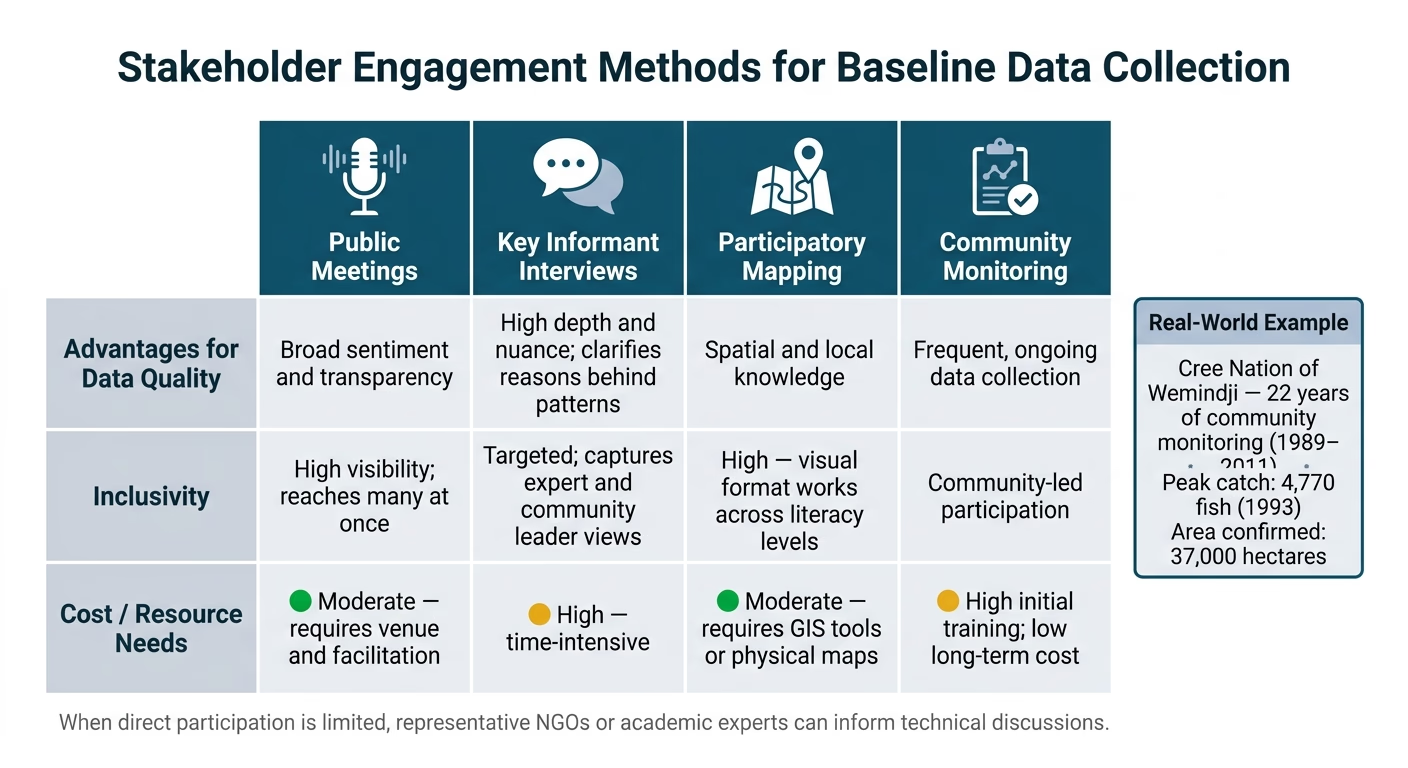
Choose the method that fits the data type, the data holder, and the level of participation needed. The table below compares four common methods across the issues that matter most for baseline programs.
Engagement Method | Advantages for Data Quality | Inclusivity | Cost/Resource Needs |
|---|---|---|---|
Public Meetings | Broad sentiment and transparency | High visibility; reaches many at once | Moderate; requires venue and facilitation |
Key Informant Interviews | High depth and nuance; clarifies reasons behind patterns | Targeted; captures expert and community leader views | High; time-intensive |
Participatory Mapping | Spatial and local knowledge | High; visual format works across literacy levels | Moderate; requires GIS tools or physical maps |
Community Monitoring | Frequent data | Community-led | High initial training; low long-term cost |
Each method brings a different kind of signal. Public meetings can show broad sentiment and make the process visible. Key informant interviews go deeper and help explain why certain patterns show up. Participatory mapping is useful when place-based knowledge matters, especially when people can point to changes on a map more easily than they can describe them in technical terms. Community monitoring can generate frequent data and keep local people involved over time.
When direct participation is limited, bring in representative NGOs or academic experts to inform technical discussions [1].
After the methods are set, governance decides who controls the data, how decisions are documented, and whether the baseline stays usable over time.
Data Governance, Training, and Long-Term Stewardship
Without clear governance, baseline data can end up stuck in silos, and thresholds can become hard to trace back to the input that shaped them. That problem is common, and it usually starts early. The fix is not fancy. It comes down to a few practical commitments from the start.
Maintain a stakeholder register - a centralized log that records every engagement activity, including dates, participants (anonymized where needed), topics discussed, and any follow-up commitments. If a program is subject to regulatory review or assurance, every stakeholder input that influenced a threshold should be traceable and auditable.
Data ownership also needs to be settled early. Inclusive programs use formal agreements that spell out who controls the data, who can access it, and under what conditions it can be shared. For Indigenous communities and others handling sensitive cultural information, that includes data sovereignty provisions - formal rights over how their information is used and disclosed.
Confidentiality protocols and informed consent processes should be built into the design from day one, including the right to withdraw. If those protections are bolted on later, trust usually slips.
A governed shared data system helps stakeholders review and analyze data without losing version control or security. And training matters here. When community members are trained in data collection and result interpretation, they move from being passive participants to active monitors. That makes later monitoring easier to compare against the same reference point. Just as important, report back on how stakeholder input changed the program. People are more likely to stay involved when they can see their input made a difference.
Conclusion: Baseline Data Is Stronger When Stakeholders Shape It
Baseline data is only as useful as people believe it. That belief comes from how the baseline is built and how well the process is documented. When stakeholders help decide what gets measured, where it gets measured, and why it matters, the baseline becomes a reference point that can stand up to scrutiny and reflect on-the-ground conditions. That trust is built through co-designed indicators, documented methods, and shared stewardship.
The payoff is practical for each group involved. Communities get a documented record that supports environmental justice and tracks day-to-day community impacts. Agencies gain trust in their oversight role. Project teams get site intelligence and early warning on emerging risks.
That result depends on clear roles, documented methods, and shared stewardship, all tied directly to co-design, traceability, and long-term monitoring.
Reporting back on how stakeholder input changed the baseline closes the loop and helps build trust for long-term monitoring.
FAQs
Why involve stakeholders early?
Bringing stakeholders into baseline data collection early makes the work far more useful. Metrics stop being abstract numbers on a dashboard and start pointing to actions teams can take. Just as important, early input can surface risks and blind spots before they turn into expensive operating issues or regulatory problems.
It also helps ground the data in what’s happening on the ground, not just in internal assumptions. That matters because sustainability plans are only as good as the picture they’re built on. When the data reflects actual impacts and lived experience, organizations are in a much better position to build the openness and trust needed for a credible, high-impact sustainability strategy.
What counts as baseline data?
Baseline data is your starting point. It’s the first set of metrics you use to track future progress and performance.
For environmental work, that baseline can cover things like water use, pollutant releases, land use, ecosystem service dependencies, and a base-year inventory of Scope 1, 2, and 3 emissions.
If primary data isn’t available, you can use secondary sources or proxies that you trust. The key is simple: document the method you used and be clear about the limits.
How do you verify stakeholder input?
Use a clear, step-by-step process to check accuracy and trust in the data. Compare stakeholder input with more than one source and with independent records, such as utility bills or internal system data. It also helps to build in automated checks, like range limits and year-over-year variance review, to catch numbers that look off before they move further.
Just as important, keep a clean audit trail that ties each figure back to its original source. Document the methodology and the engagement process in one central log so the record is easy to follow, supports transparency, and stands up to external assurance.
Related Blog Posts
Latest Articles
©2026

Narrative Change and Power Building: The Missing Half of Advocacy
Narrative change is the process of disrupting dominant narratives that normalize inequity and advancing new narratives from historically marginalized communities.

Funding Resilience Without Federal Grants
BRIC is unreliable and FEMA is shrinking. Here's how cities fund climate resilience with dedicated revenue, blended finance, and a coordinating authority.

The ESG Blind Spot: How AI Is Finding Risks in Companies Nobody Else Is Watching
Norway's sovereign wealth fund uses AI to screen 7,200 portfolio companies for forced labor and corruption within 24 hours. The real story is the emerging-market coverage gap that traditional ESG data vendors miss — and what it means for any company with a global supply chain.
Narrative Change and Power Building: The Missing Half of Advocacy
Narrative change is the process of disrupting dominant narratives that normalize inequity and advancing new narratives from historically marginalized communities.
Funding Resilience Without Federal Grants
BRIC is unreliable and FEMA is shrinking. Here's how cities fund climate resilience with dedicated revenue, blended finance, and a coordinating authority.
The ESG Blind Spot: How AI Is Finding Risks in Companies Nobody Else Is Watching
Norway's sovereign wealth fund uses AI to screen 7,200 portfolio companies for forced labor and corruption within 24 hours. The real story is the emerging-market coverage gap that traditional ESG data vendors miss — and what it means for any company with a global supply chain.
FAQ
01
What does it really mean to “redefine profit”?
02
What makes Council Fire different?
03
Who does Council Fire work with?
04
What does working with Council Fire actually look like?
05
How does Council Fire help organizations turn big goals into action?
06
How does Council Fire define and measure success?
07
How does technology fit into Council Fire’s work?
Jul 9, 2026
Stakeholder Role in Baseline Data Collection
Sustainability Strategy
In This Article
Baseline data becomes defensible when local stakeholders co-design measures, document methods, and steward long-term monitoring.
Stakeholder Role in Baseline Data Collection
If you want baseline data people will trust and use, you need stakeholders involved from day one. I’d boil the article down to this: stakeholders help decide what gets measured, where data is gathered, how it is checked, and who can use it later.
In plain terms, the article shows that baseline data works best when it is shaped by more than technical staff alone. It points to a few clear takeaways:
Stakeholders fill gaps that desk research and short field visits often miss.
Local and Indigenous knowledge can add long-term site history, not just a short snapshot.
Clear records matter - methods, data gaps, consent, and review steps all need to be written down.
Good governance matters too - ownership, access, privacy, and traceable decisions should be set early.
The payoff is practical: better oversight, stronger public trust, better planning, and easier tracking of change over time.
A few details stand out. One community-led fisheries program ran for 22 years and recorded a peak summer catch of 4,770 fish in 1993. Another monitoring effort confirmed species presence across 37,000 hectares. Those examples show that stakeholder input is not just opinion - it can become long-term baseline evidence when it is recorded in a clear, steady way.
If I were reducing the article to one line, it would be this: baseline data gets stronger when the people who know the place help build the record.
How Stakeholders Contribute to Baseline Data
Scoping, Local Knowledge, and Site Observations
Stakeholders help shape baseline data before fieldwork even starts. During scoping, community members often point out the details a short site visit can miss: species people depend on, seasonal flooding, animal trails, water sources, and timing patterns across the year. That input helps define what the baseline needs to measure in the first place. When communities have deep experience with a site, their observations can move from informal input to formal baseline data.
Indigenous Knowledge and Community-Based Monitoring
Traditional Ecological Knowledge (TEK) adds long-term, place-based understanding that short-term surveys often miss. A standard field survey gives you a snapshot. TEK shows how habitats and species use have changed across generations. That longer historical view can help establish a baseline for habitats and species use [2].
TEK becomes baseline data when communities record it in a steady, documented way. A well-known case comes from the Cree Nation of Wemindji's coastal fisheries monitoring program in Eeyou Istchee, Quebec. From 1989 to 2011, Cree fishers and tallymen recorded daily catch data, including species, fish length, and gill net locations. The program logged a peak summer catch of 4,770 fish in 1993, which created a quantitative baseline for subsistence resource availability [3]. That dataset later informed mitigation for hydroelectric development [3].
Community-based monitoring also needs clear rules around consent, confidentiality, and respect for Indigenous communities, especially when knowledge is sensitive and communities want to protect it. Frameworks like Two-Eyed Seeing (Etuaptmumk) support the coexistence and mutual respect of Indigenous and Western knowledge systems [3]. When that knowledge is recorded with care and consistency, it can serve as defensible baseline evidence.
Documentation, Transparency, and Data Quality Controls
Stakeholder observations are only as strong as the system used to record and check them. Methods, assumptions, data gaps, and limits need to be documented clearly so the findings can stand up to review and support later comparison.
The Wemindji program used standardized data collection sheets and annual workshops to keep methods consistent across 22 years of community-led monitoring [3]. In Quintana Roo, community-led monitoring used local knowledge to place camera traps and acoustic monitors, confirming species presence across 37,000 hectares [4].
Cross-checking stakeholder observations with GIS mapping, remote sensing, and field instrument data makes the baseline more reliable. Without that record, later changes are hard to read. Long-term monitors can often tell whether a fluctuation reflects an actual shift or just sampling timing - something raw data alone may not show [3]. That same paper trail also makes stakeholder input usable in indicators, sampling plans, and data governance.
Engaging stakeholders in water-energy-food-environment systems assessment and planning
What Stakeholders Gain From Strong Baseline Data
Once stakeholders help define the baseline, it stops being just a technical record and starts doing real work. People use it to check results, test claims, and make better calls over time. In plain terms, strong baseline data helps stakeholders verify change, hold parties to their commitments, and plan with more confidence.
A Stronger Basis for Oversight, Trust, and Environmental Justice
When a documented baseline exists, local communities, government agencies, and environmental groups have something solid to point to. That matters. Without a baseline, it’s hard to show where harm came from or who should answer for it. With one, stakeholders can document change and assign accountability.
This carries extra weight in communities that have long faced an unfair share of pollution and other harms. If no baseline exists, proving that a new facility made air or water quality worse in a given neighborhood becomes a steep uphill climb. If the baseline is in place, the record is there. People can compare conditions, show what changed, and press for action based on evidence rather than guesswork.
Better Planning for Resilience, Infrastructure, and Resource Use
The same baseline also helps teams prepare for climate resilience before problems snowball. It gives planners a starting point for mapping exposure, vulnerability, and response capacity. When technical data is paired with local stakeholder knowledge, the picture gets sharper. NOAA sea-level rise scenarios, for example, may show flood risk on paper, while residents may know which roads back up first or where old contamination still sits. Put those together, and combined hazards can come into view, such as flooding mixed with legacy site contamination.
Baseline data also supports adaptive management, meaning teams can adjust course when monitoring shows conditions are changing. A 2019 emissions baseline, for instance, gives a coalition a fixed reference point for tracking progress toward a 50% reduction target by 2030. That makes it easier to correct course using what the data shows, not what people assumed at the start.
Methods for Integrating Stakeholder Input Into Baseline Programs
Stakeholder Engagement Methods for Baseline Data Collection
Once stakeholder value is clear, the next step is to build it into the baseline program. That sounds simple on paper, but making stakeholder input stick takes more than a few meetings. It takes clear roles, workable methods, and governance that people can actually follow.
Co-Designing Indicators, Sampling Plans, and Thresholds
Durable baseline programs are co-designed. In plain terms, that means stakeholders help shape which indicators are tracked, where sampling happens, how often data is collected, and what threshold should trigger a response or review. Done well, the baseline becomes a reference point for later comparison and for action when conditions change.
Different groups will often care about different things. Technical staff may lean toward water quality or air monitoring indicators. Community members may point to habitat conditions, traffic, noise, or community health concerns that standard assessments can miss. That gap matters. If the program only reflects one side, it can miss what people on the ground are seeing every day.
Local and Indigenous knowledge should be part of the indicator set so the baseline reflects actual site conditions, not just what a standard template happens to measure.
The way you engage people should also fit the kind of data being collected.
Choosing Engagement Methods for Different Data Types
Choose the method that fits the data type, the data holder, and the level of participation needed. The table below compares four common methods across the issues that matter most for baseline programs.
Engagement Method | Advantages for Data Quality | Inclusivity | Cost/Resource Needs |
|---|---|---|---|
Public Meetings | Broad sentiment and transparency | High visibility; reaches many at once | Moderate; requires venue and facilitation |
Key Informant Interviews | High depth and nuance; clarifies reasons behind patterns | Targeted; captures expert and community leader views | High; time-intensive |
Participatory Mapping | Spatial and local knowledge | High; visual format works across literacy levels | Moderate; requires GIS tools or physical maps |
Community Monitoring | Frequent data | Community-led | High initial training; low long-term cost |
Each method brings a different kind of signal. Public meetings can show broad sentiment and make the process visible. Key informant interviews go deeper and help explain why certain patterns show up. Participatory mapping is useful when place-based knowledge matters, especially when people can point to changes on a map more easily than they can describe them in technical terms. Community monitoring can generate frequent data and keep local people involved over time.
When direct participation is limited, bring in representative NGOs or academic experts to inform technical discussions [1].
After the methods are set, governance decides who controls the data, how decisions are documented, and whether the baseline stays usable over time.
Data Governance, Training, and Long-Term Stewardship
Without clear governance, baseline data can end up stuck in silos, and thresholds can become hard to trace back to the input that shaped them. That problem is common, and it usually starts early. The fix is not fancy. It comes down to a few practical commitments from the start.
Maintain a stakeholder register - a centralized log that records every engagement activity, including dates, participants (anonymized where needed), topics discussed, and any follow-up commitments. If a program is subject to regulatory review or assurance, every stakeholder input that influenced a threshold should be traceable and auditable.
Data ownership also needs to be settled early. Inclusive programs use formal agreements that spell out who controls the data, who can access it, and under what conditions it can be shared. For Indigenous communities and others handling sensitive cultural information, that includes data sovereignty provisions - formal rights over how their information is used and disclosed.
Confidentiality protocols and informed consent processes should be built into the design from day one, including the right to withdraw. If those protections are bolted on later, trust usually slips.
A governed shared data system helps stakeholders review and analyze data without losing version control or security. And training matters here. When community members are trained in data collection and result interpretation, they move from being passive participants to active monitors. That makes later monitoring easier to compare against the same reference point. Just as important, report back on how stakeholder input changed the program. People are more likely to stay involved when they can see their input made a difference.
Conclusion: Baseline Data Is Stronger When Stakeholders Shape It
Baseline data is only as useful as people believe it. That belief comes from how the baseline is built and how well the process is documented. When stakeholders help decide what gets measured, where it gets measured, and why it matters, the baseline becomes a reference point that can stand up to scrutiny and reflect on-the-ground conditions. That trust is built through co-designed indicators, documented methods, and shared stewardship.
The payoff is practical for each group involved. Communities get a documented record that supports environmental justice and tracks day-to-day community impacts. Agencies gain trust in their oversight role. Project teams get site intelligence and early warning on emerging risks.
That result depends on clear roles, documented methods, and shared stewardship, all tied directly to co-design, traceability, and long-term monitoring.
Reporting back on how stakeholder input changed the baseline closes the loop and helps build trust for long-term monitoring.
FAQs
Why involve stakeholders early?
Bringing stakeholders into baseline data collection early makes the work far more useful. Metrics stop being abstract numbers on a dashboard and start pointing to actions teams can take. Just as important, early input can surface risks and blind spots before they turn into expensive operating issues or regulatory problems.
It also helps ground the data in what’s happening on the ground, not just in internal assumptions. That matters because sustainability plans are only as good as the picture they’re built on. When the data reflects actual impacts and lived experience, organizations are in a much better position to build the openness and trust needed for a credible, high-impact sustainability strategy.
What counts as baseline data?
Baseline data is your starting point. It’s the first set of metrics you use to track future progress and performance.
For environmental work, that baseline can cover things like water use, pollutant releases, land use, ecosystem service dependencies, and a base-year inventory of Scope 1, 2, and 3 emissions.
If primary data isn’t available, you can use secondary sources or proxies that you trust. The key is simple: document the method you used and be clear about the limits.
How do you verify stakeholder input?
Use a clear, step-by-step process to check accuracy and trust in the data. Compare stakeholder input with more than one source and with independent records, such as utility bills or internal system data. It also helps to build in automated checks, like range limits and year-over-year variance review, to catch numbers that look off before they move further.
Just as important, keep a clean audit trail that ties each figure back to its original source. Document the methodology and the engagement process in one central log so the record is easy to follow, supports transparency, and stands up to external assurance.
Related Blog Posts
Latest Articles
©2026
Narrative Change and Power Building: The Missing Half of Advocacy
Narrative change is the process of disrupting dominant narratives that normalize inequity and advancing new narratives from historically marginalized communities.
Funding Resilience Without Federal Grants
BRIC is unreliable and FEMA is shrinking. Here's how cities fund climate resilience with dedicated revenue, blended finance, and a coordinating authority.
The ESG Blind Spot: How AI Is Finding Risks in Companies Nobody Else Is Watching
Norway's sovereign wealth fund uses AI to screen 7,200 portfolio companies for forced labor and corruption within 24 hours. The real story is the emerging-market coverage gap that traditional ESG data vendors miss — and what it means for any company with a global supply chain.
FAQ
01
What does it really mean to “redefine profit”?
02
What makes Council Fire different?
03
Who does Council Fire work with?
04
What does working with Council Fire actually look like?
05
How does Council Fire help organizations turn big goals into action?
06
How does Council Fire define and measure success?
07
How does technology fit into Council Fire’s work?
Jul 9, 2026
Stakeholder Role in Baseline Data Collection
Sustainability Strategy
In This Article
Baseline data becomes defensible when local stakeholders co-design measures, document methods, and steward long-term monitoring.
Stakeholder Role in Baseline Data Collection
If you want baseline data people will trust and use, you need stakeholders involved from day one. I’d boil the article down to this: stakeholders help decide what gets measured, where data is gathered, how it is checked, and who can use it later.
In plain terms, the article shows that baseline data works best when it is shaped by more than technical staff alone. It points to a few clear takeaways:
Stakeholders fill gaps that desk research and short field visits often miss.
Local and Indigenous knowledge can add long-term site history, not just a short snapshot.
Clear records matter - methods, data gaps, consent, and review steps all need to be written down.
Good governance matters too - ownership, access, privacy, and traceable decisions should be set early.
The payoff is practical: better oversight, stronger public trust, better planning, and easier tracking of change over time.
A few details stand out. One community-led fisheries program ran for 22 years and recorded a peak summer catch of 4,770 fish in 1993. Another monitoring effort confirmed species presence across 37,000 hectares. Those examples show that stakeholder input is not just opinion - it can become long-term baseline evidence when it is recorded in a clear, steady way.
If I were reducing the article to one line, it would be this: baseline data gets stronger when the people who know the place help build the record.
How Stakeholders Contribute to Baseline Data
Scoping, Local Knowledge, and Site Observations
Stakeholders help shape baseline data before fieldwork even starts. During scoping, community members often point out the details a short site visit can miss: species people depend on, seasonal flooding, animal trails, water sources, and timing patterns across the year. That input helps define what the baseline needs to measure in the first place. When communities have deep experience with a site, their observations can move from informal input to formal baseline data.
Indigenous Knowledge and Community-Based Monitoring
Traditional Ecological Knowledge (TEK) adds long-term, place-based understanding that short-term surveys often miss. A standard field survey gives you a snapshot. TEK shows how habitats and species use have changed across generations. That longer historical view can help establish a baseline for habitats and species use [2].
TEK becomes baseline data when communities record it in a steady, documented way. A well-known case comes from the Cree Nation of Wemindji's coastal fisheries monitoring program in Eeyou Istchee, Quebec. From 1989 to 2011, Cree fishers and tallymen recorded daily catch data, including species, fish length, and gill net locations. The program logged a peak summer catch of 4,770 fish in 1993, which created a quantitative baseline for subsistence resource availability [3]. That dataset later informed mitigation for hydroelectric development [3].
Community-based monitoring also needs clear rules around consent, confidentiality, and respect for Indigenous communities, especially when knowledge is sensitive and communities want to protect it. Frameworks like Two-Eyed Seeing (Etuaptmumk) support the coexistence and mutual respect of Indigenous and Western knowledge systems [3]. When that knowledge is recorded with care and consistency, it can serve as defensible baseline evidence.
Documentation, Transparency, and Data Quality Controls
Stakeholder observations are only as strong as the system used to record and check them. Methods, assumptions, data gaps, and limits need to be documented clearly so the findings can stand up to review and support later comparison.
The Wemindji program used standardized data collection sheets and annual workshops to keep methods consistent across 22 years of community-led monitoring [3]. In Quintana Roo, community-led monitoring used local knowledge to place camera traps and acoustic monitors, confirming species presence across 37,000 hectares [4].
Cross-checking stakeholder observations with GIS mapping, remote sensing, and field instrument data makes the baseline more reliable. Without that record, later changes are hard to read. Long-term monitors can often tell whether a fluctuation reflects an actual shift or just sampling timing - something raw data alone may not show [3]. That same paper trail also makes stakeholder input usable in indicators, sampling plans, and data governance.
Engaging stakeholders in water-energy-food-environment systems assessment and planning
What Stakeholders Gain From Strong Baseline Data
Once stakeholders help define the baseline, it stops being just a technical record and starts doing real work. People use it to check results, test claims, and make better calls over time. In plain terms, strong baseline data helps stakeholders verify change, hold parties to their commitments, and plan with more confidence.
A Stronger Basis for Oversight, Trust, and Environmental Justice
When a documented baseline exists, local communities, government agencies, and environmental groups have something solid to point to. That matters. Without a baseline, it’s hard to show where harm came from or who should answer for it. With one, stakeholders can document change and assign accountability.
This carries extra weight in communities that have long faced an unfair share of pollution and other harms. If no baseline exists, proving that a new facility made air or water quality worse in a given neighborhood becomes a steep uphill climb. If the baseline is in place, the record is there. People can compare conditions, show what changed, and press for action based on evidence rather than guesswork.
Better Planning for Resilience, Infrastructure, and Resource Use
The same baseline also helps teams prepare for climate resilience before problems snowball. It gives planners a starting point for mapping exposure, vulnerability, and response capacity. When technical data is paired with local stakeholder knowledge, the picture gets sharper. NOAA sea-level rise scenarios, for example, may show flood risk on paper, while residents may know which roads back up first or where old contamination still sits. Put those together, and combined hazards can come into view, such as flooding mixed with legacy site contamination.
Baseline data also supports adaptive management, meaning teams can adjust course when monitoring shows conditions are changing. A 2019 emissions baseline, for instance, gives a coalition a fixed reference point for tracking progress toward a 50% reduction target by 2030. That makes it easier to correct course using what the data shows, not what people assumed at the start.
Methods for Integrating Stakeholder Input Into Baseline Programs
Stakeholder Engagement Methods for Baseline Data Collection
Once stakeholder value is clear, the next step is to build it into the baseline program. That sounds simple on paper, but making stakeholder input stick takes more than a few meetings. It takes clear roles, workable methods, and governance that people can actually follow.
Co-Designing Indicators, Sampling Plans, and Thresholds
Durable baseline programs are co-designed. In plain terms, that means stakeholders help shape which indicators are tracked, where sampling happens, how often data is collected, and what threshold should trigger a response or review. Done well, the baseline becomes a reference point for later comparison and for action when conditions change.
Different groups will often care about different things. Technical staff may lean toward water quality or air monitoring indicators. Community members may point to habitat conditions, traffic, noise, or community health concerns that standard assessments can miss. That gap matters. If the program only reflects one side, it can miss what people on the ground are seeing every day.
Local and Indigenous knowledge should be part of the indicator set so the baseline reflects actual site conditions, not just what a standard template happens to measure.
The way you engage people should also fit the kind of data being collected.
Choosing Engagement Methods for Different Data Types
Choose the method that fits the data type, the data holder, and the level of participation needed. The table below compares four common methods across the issues that matter most for baseline programs.
Engagement Method | Advantages for Data Quality | Inclusivity | Cost/Resource Needs |
|---|---|---|---|
Public Meetings | Broad sentiment and transparency | High visibility; reaches many at once | Moderate; requires venue and facilitation |
Key Informant Interviews | High depth and nuance; clarifies reasons behind patterns | Targeted; captures expert and community leader views | High; time-intensive |
Participatory Mapping | Spatial and local knowledge | High; visual format works across literacy levels | Moderate; requires GIS tools or physical maps |
Community Monitoring | Frequent data | Community-led | High initial training; low long-term cost |
Each method brings a different kind of signal. Public meetings can show broad sentiment and make the process visible. Key informant interviews go deeper and help explain why certain patterns show up. Participatory mapping is useful when place-based knowledge matters, especially when people can point to changes on a map more easily than they can describe them in technical terms. Community monitoring can generate frequent data and keep local people involved over time.
When direct participation is limited, bring in representative NGOs or academic experts to inform technical discussions [1].
After the methods are set, governance decides who controls the data, how decisions are documented, and whether the baseline stays usable over time.
Data Governance, Training, and Long-Term Stewardship
Without clear governance, baseline data can end up stuck in silos, and thresholds can become hard to trace back to the input that shaped them. That problem is common, and it usually starts early. The fix is not fancy. It comes down to a few practical commitments from the start.
Maintain a stakeholder register - a centralized log that records every engagement activity, including dates, participants (anonymized where needed), topics discussed, and any follow-up commitments. If a program is subject to regulatory review or assurance, every stakeholder input that influenced a threshold should be traceable and auditable.
Data ownership also needs to be settled early. Inclusive programs use formal agreements that spell out who controls the data, who can access it, and under what conditions it can be shared. For Indigenous communities and others handling sensitive cultural information, that includes data sovereignty provisions - formal rights over how their information is used and disclosed.
Confidentiality protocols and informed consent processes should be built into the design from day one, including the right to withdraw. If those protections are bolted on later, trust usually slips.
A governed shared data system helps stakeholders review and analyze data without losing version control or security. And training matters here. When community members are trained in data collection and result interpretation, they move from being passive participants to active monitors. That makes later monitoring easier to compare against the same reference point. Just as important, report back on how stakeholder input changed the program. People are more likely to stay involved when they can see their input made a difference.
Conclusion: Baseline Data Is Stronger When Stakeholders Shape It
Baseline data is only as useful as people believe it. That belief comes from how the baseline is built and how well the process is documented. When stakeholders help decide what gets measured, where it gets measured, and why it matters, the baseline becomes a reference point that can stand up to scrutiny and reflect on-the-ground conditions. That trust is built through co-designed indicators, documented methods, and shared stewardship.
The payoff is practical for each group involved. Communities get a documented record that supports environmental justice and tracks day-to-day community impacts. Agencies gain trust in their oversight role. Project teams get site intelligence and early warning on emerging risks.
That result depends on clear roles, documented methods, and shared stewardship, all tied directly to co-design, traceability, and long-term monitoring.
Reporting back on how stakeholder input changed the baseline closes the loop and helps build trust for long-term monitoring.
FAQs
Why involve stakeholders early?
Bringing stakeholders into baseline data collection early makes the work far more useful. Metrics stop being abstract numbers on a dashboard and start pointing to actions teams can take. Just as important, early input can surface risks and blind spots before they turn into expensive operating issues or regulatory problems.
It also helps ground the data in what’s happening on the ground, not just in internal assumptions. That matters because sustainability plans are only as good as the picture they’re built on. When the data reflects actual impacts and lived experience, organizations are in a much better position to build the openness and trust needed for a credible, high-impact sustainability strategy.
What counts as baseline data?
Baseline data is your starting point. It’s the first set of metrics you use to track future progress and performance.
For environmental work, that baseline can cover things like water use, pollutant releases, land use, ecosystem service dependencies, and a base-year inventory of Scope 1, 2, and 3 emissions.
If primary data isn’t available, you can use secondary sources or proxies that you trust. The key is simple: document the method you used and be clear about the limits.
How do you verify stakeholder input?
Use a clear, step-by-step process to check accuracy and trust in the data. Compare stakeholder input with more than one source and with independent records, such as utility bills or internal system data. It also helps to build in automated checks, like range limits and year-over-year variance review, to catch numbers that look off before they move further.
Just as important, keep a clean audit trail that ties each figure back to its original source. Document the methodology and the engagement process in one central log so the record is easy to follow, supports transparency, and stands up to external assurance.
Related Blog Posts
Latest Articles
©2026
Narrative Change and Power Building: The Missing Half of Advocacy
Narrative change is the process of disrupting dominant narratives that normalize inequity and advancing new narratives from historically marginalized communities.
Funding Resilience Without Federal Grants
BRIC is unreliable and FEMA is shrinking. Here's how cities fund climate resilience with dedicated revenue, blended finance, and a coordinating authority.
The ESG Blind Spot: How AI Is Finding Risks in Companies Nobody Else Is Watching
Norway's sovereign wealth fund uses AI to screen 7,200 portfolio companies for forced labor and corruption within 24 hours. The real story is the emerging-market coverage gap that traditional ESG data vendors miss — and what it means for any company with a global supply chain.
FAQ
What does it really mean to “redefine profit”?
What makes Council Fire different?
Who does Council Fire work with?
What does working with Council Fire actually look like?
How does Council Fire help organizations turn big goals into action?
How does Council Fire define and measure success?
How does technology fit into Council Fire’s work?